




Abstract
The purpose of this work is to investigate the controllability of Langevin-type stochastic neutral impulsive integro-differential equations governed by the Caputo fractional derivative and driven by fractional Brownian motion, which arise naturally in systems exhibiting memory, impulsive effects, and stochastic disturbances. Using resolvent operators and fixed-point techniques, necessary and sufficient controllability conditions are established for the associated linear system, while the controllability of the nonlinear system is demonstrated via the Banach contraction principle. The theoretical results confirm that appropriate control functions can steer the system to a desired state within a finite time interval. Finally, illustrative numerical examples are provided to demonstrate the applicability and effectiveness of the obtained results, highlighting their relevance to practical stochastic control problems.
1. Introduction
Fractional-order derivatives play a pivotal role in accurately representing intricate dynamics found in natural and engineered systems, where traditional integer-order derivatives often fall short. Fractional calculus has been extensively employed across multiple domains, offering refined analytical tools and enhanced modeling capabilities (see 1 and 2). On the other hand, stochastic differential equations (SDEs) bridge probability theory, stochastic analysis, and differential equations, effectively modeling systems influenced by random fluctuations or external noise (see 3–5). This work particularly investigates systems influenced by Fractional Brownian Motion (fBm) (see 6–8), a Gaussian process exhibiting self-similarity and long-range dependence, governed by the Hurst parameter H ∈ (0, 1). Initially introduced by Kolmogorov in 1940, fBm extends classical Brownian motion and has been the subject of extensive research in stochastic fractional differential equations (see 6, 9–12).
Fractional calculus provides a framework for constructing models that consider not only the current state but also historical data, making it highly relevant in physical phenomena with memory effects. The Caputo fractional derivative is adopted in this study since it permits the use of classical initial conditions and offers a physically meaningful and analytically convenient framework for the controllability analysis of fractional stochastic systems. Many real-world systems are subjected to sudden changes or impulses, necessitating the use of impulsive differential equations to describe their dynamics (see 13–16). Controllability, a fundamental concept in control theory, ensures the ability to steer such systems to a desired state, and it remains a focal point in control system design (see 5, 17–19).
In recent years, significant attention has been devoted to fractional stochastic Langevin neutral impulsive differential equations (see 20 and 21). Ahmed Salem et al. 22 (2021) explored the existence of solutions for a coupled Langevin fractional system of Caputo type with Riemann-Stieltjes boundary conditions. Harikrishnan et al. 23 (2018) presented an analytical study on impulsive Langevin equations involving the Hilfer fractional derivative. Additionally, Rizwan Rizwan et al. 24 (2022) analyzed nonlinear impulsive Langevin equations under Hilfer fractional derivatives from a qualitative perspective. However, to the best of our knowledge, there is no comprehensive work addressing the controllability and solution of Langevin neutral impulsive stochastic systems governed by the Caputo fractional derivative in the presence of fBm.25,26
The notable contribution of this chapter as follows: • The fixed point method is implemented to establish appropriate circumstances for the controllability of Langevin neutral impulsive stochastic system over the Caputo derivative and fBm. • The conclusions of this study expand on various prior discoveries in the literature, with a focus on the fBm framework within fractional stochastic systems. • The system terms are considered as a bounded linear operator rather than an An indefinite generators of a moderately everlasting semi-group, recognizing that Caputo derivatives lack the semigroup or commutative properties intrinsic to integer-order derivatives. • To demonstrate the outcomes for stochastic systems, bounded linear operators prove to be more effective. • The Gramian operator is employed to examine the ability of linear systems to be controlled. • For nonlinear systems, controllability is examined by utilizing the Banach expansion. • Numeric instances are provided to demonstrate the outcomes of the nonlinear and linear scenarios.
The study is structured thereby: Section 2 investigates the essential terminologies and obstacles. Section 3 addresses the actual presence of substances to the linear system. Section 4 establishes the essential requirements required for linear system control. Section 5 describes the key requirements required for the ability to manage nonlinear systems using the Banach fixed point method. Section 6 provides a pair computational instances to demonstrate the applicability and usefulness of the derived ability to control conclusions. The chapter finishes with observations and remarks in Section 7.
2. Preface
2.1. Fractional Brownian motion
A fBm along



Along
2.2. Caputo fractional derivative (CFD)
2 Let [p, q] denote a bounded interval on

2 The CFD of order η > 0, where m − 1 < η < m, as Specifically, for 0 < ξ < 1




1 The Mittag-Leffler operator of a bounded linear operator
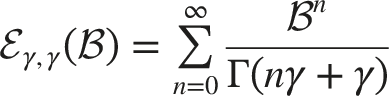

5 Let
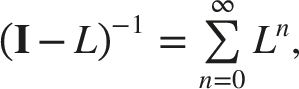
17
:
Assume (M, ρ) ≠ 0 is a complete metric space. Let 0 ≤ κ < 1 and suppose that G: M → M satisfies the condition:

Then, G possesses a unique fixed point x*. Additionally, for any initial point x0 ∈ M, the iterative sequence
3. Linear systems and solution formulation
In this section, we use
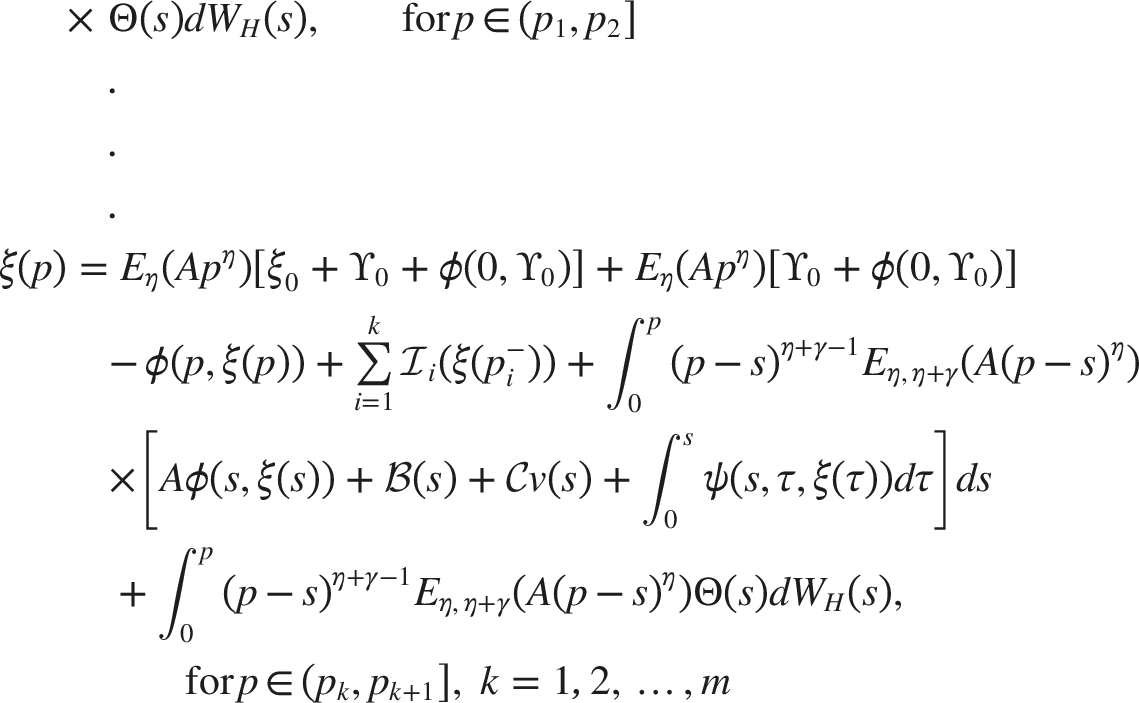
We analyze the Langevin neutral impulsive stochastic integro-differential equation governed along fBm, expressed as:
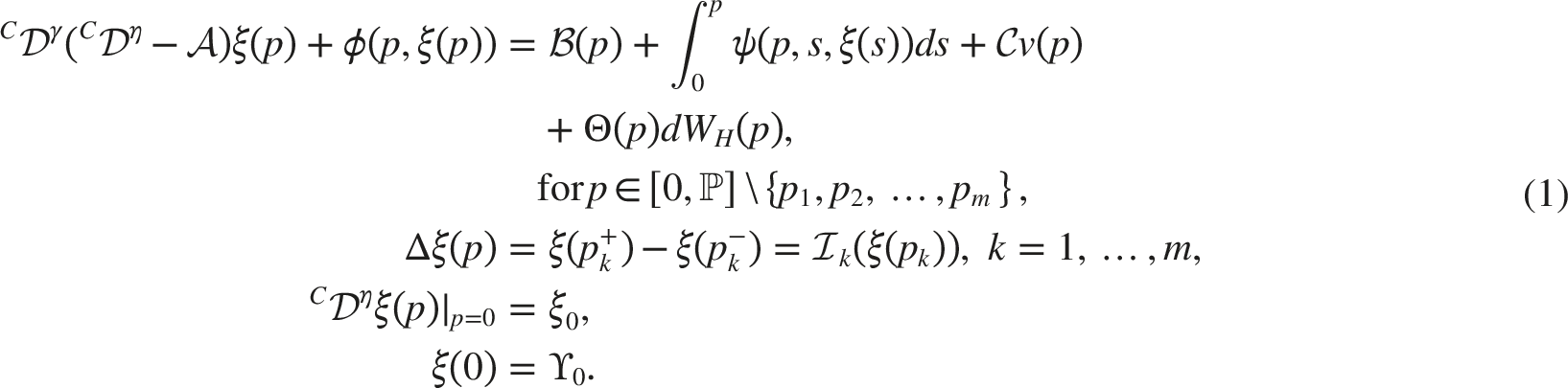
Here: • • • • • v(⋅) is the control, • • • • W
H
(t) is a fBm, • • ξ0 and ϒ0 are the initial states, •
4. Linear System’s controllability
Define the operator
Clearly, the adjoint operator Ξ* of Ξ,


The controllability Grammian operator
Here * represents adjoint operator.

The operator Q(ξ) = ΞΞ* is well defined and bounded for any η, γ ∈ (1/2, 1].
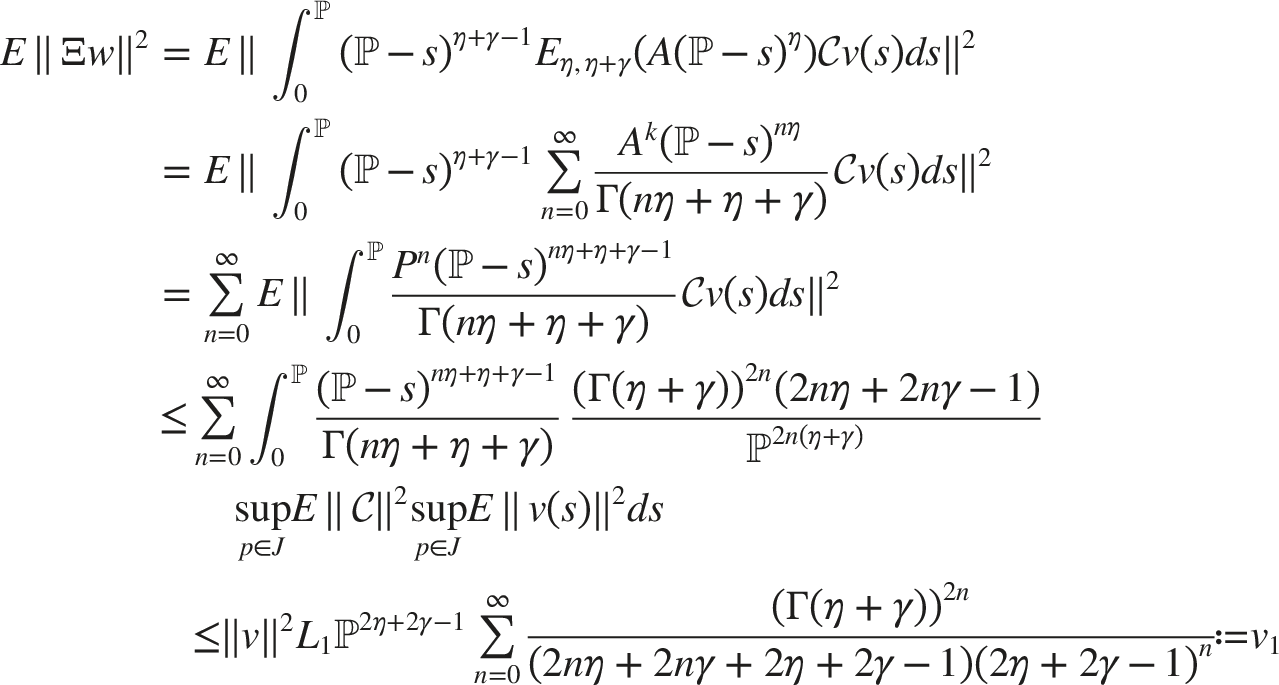
If the Grammian operator Q(ξ) is bounded, then the linear system (1) is completely controllable.
The reasoning against this Theorem is transparent.
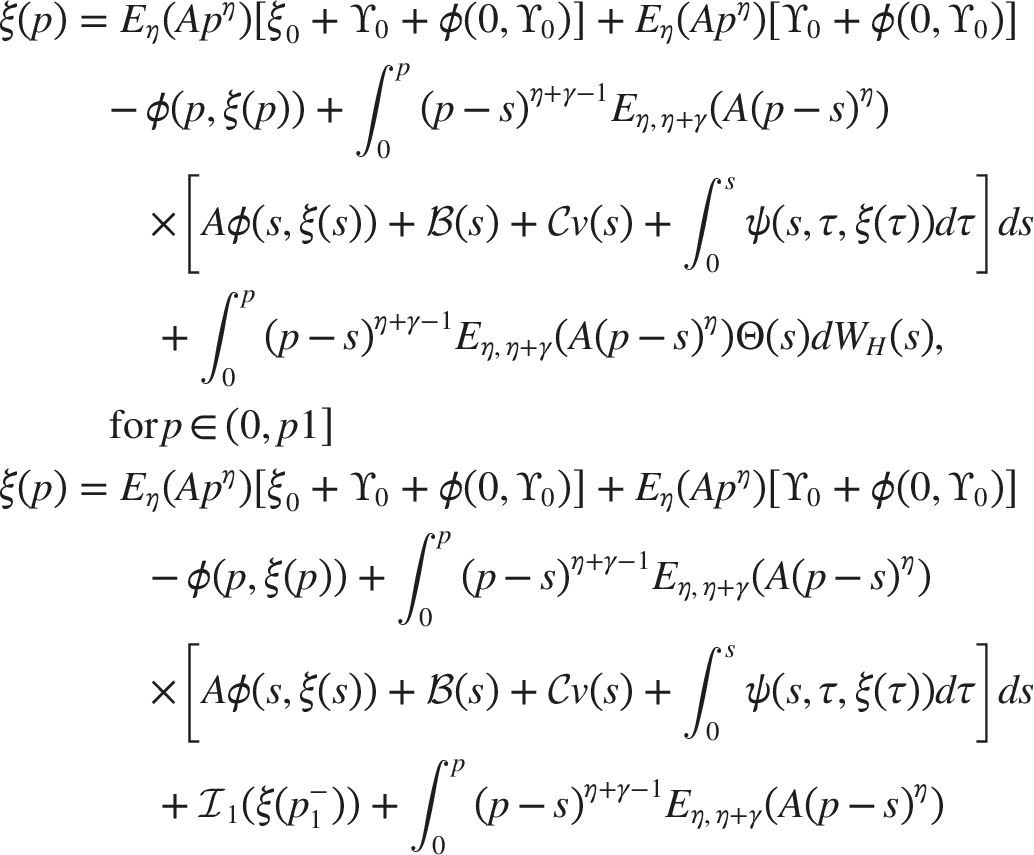
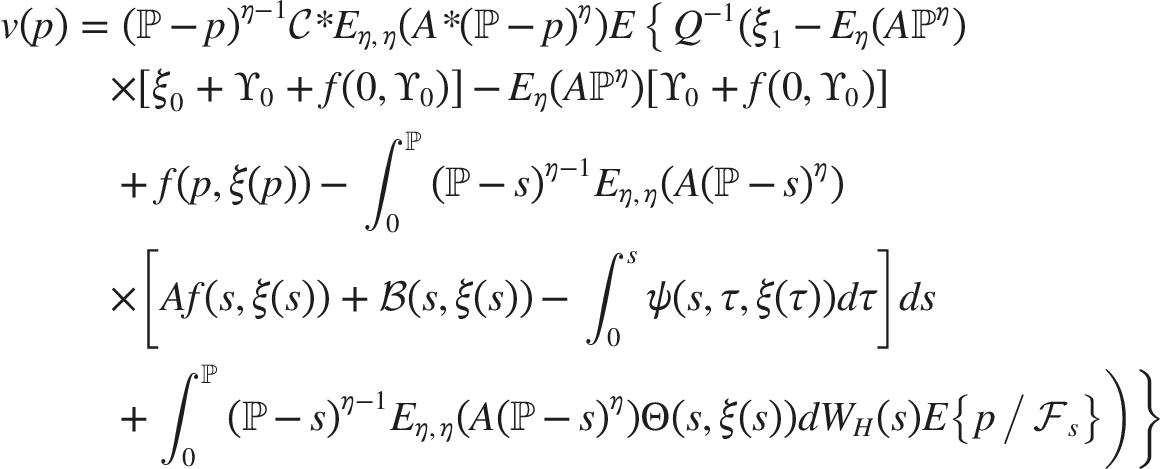
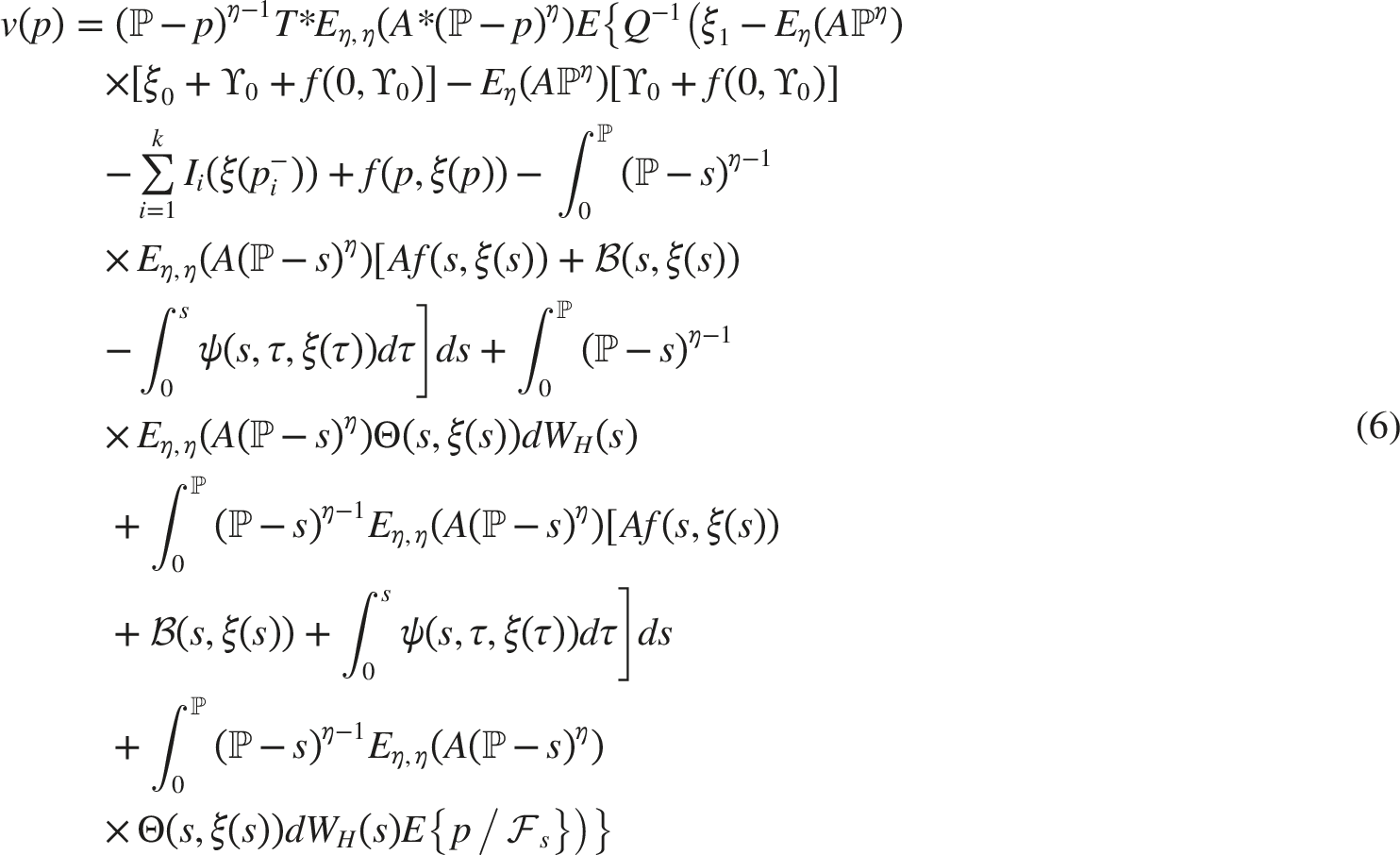
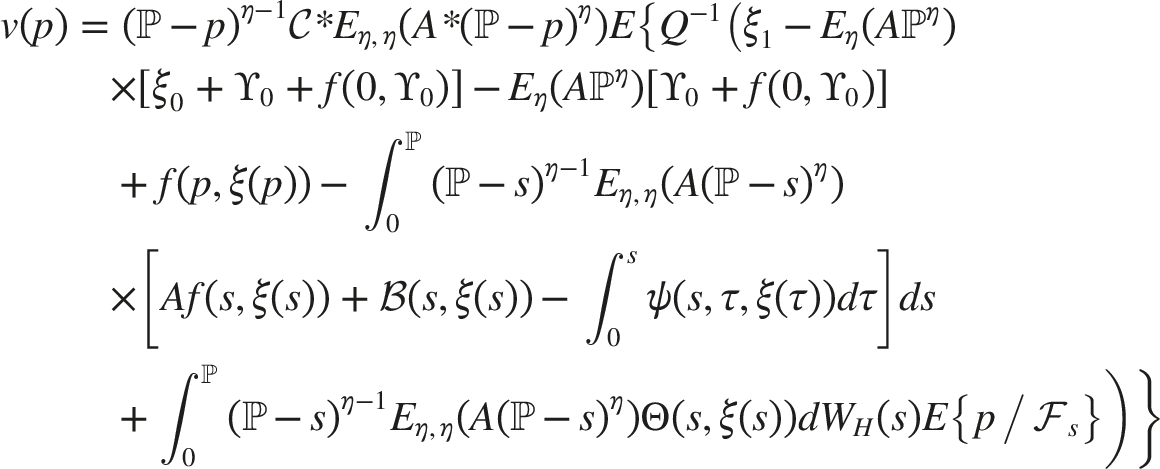
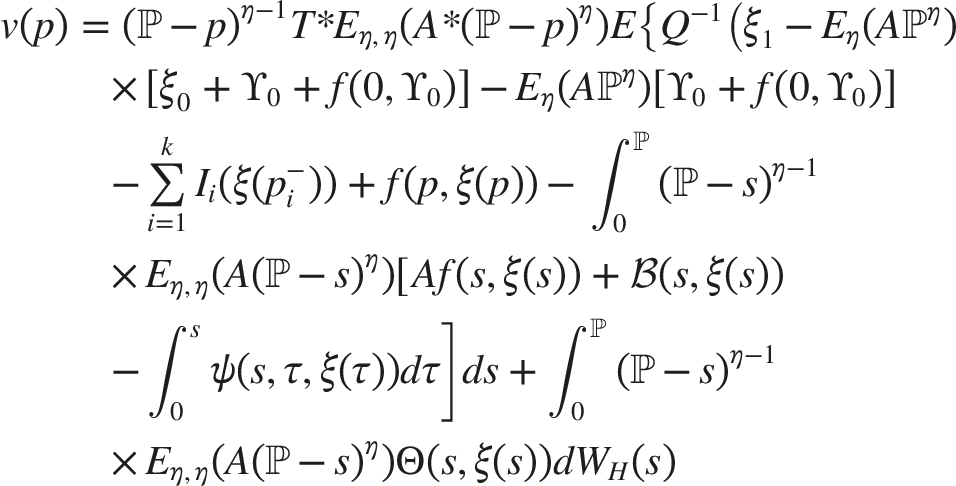
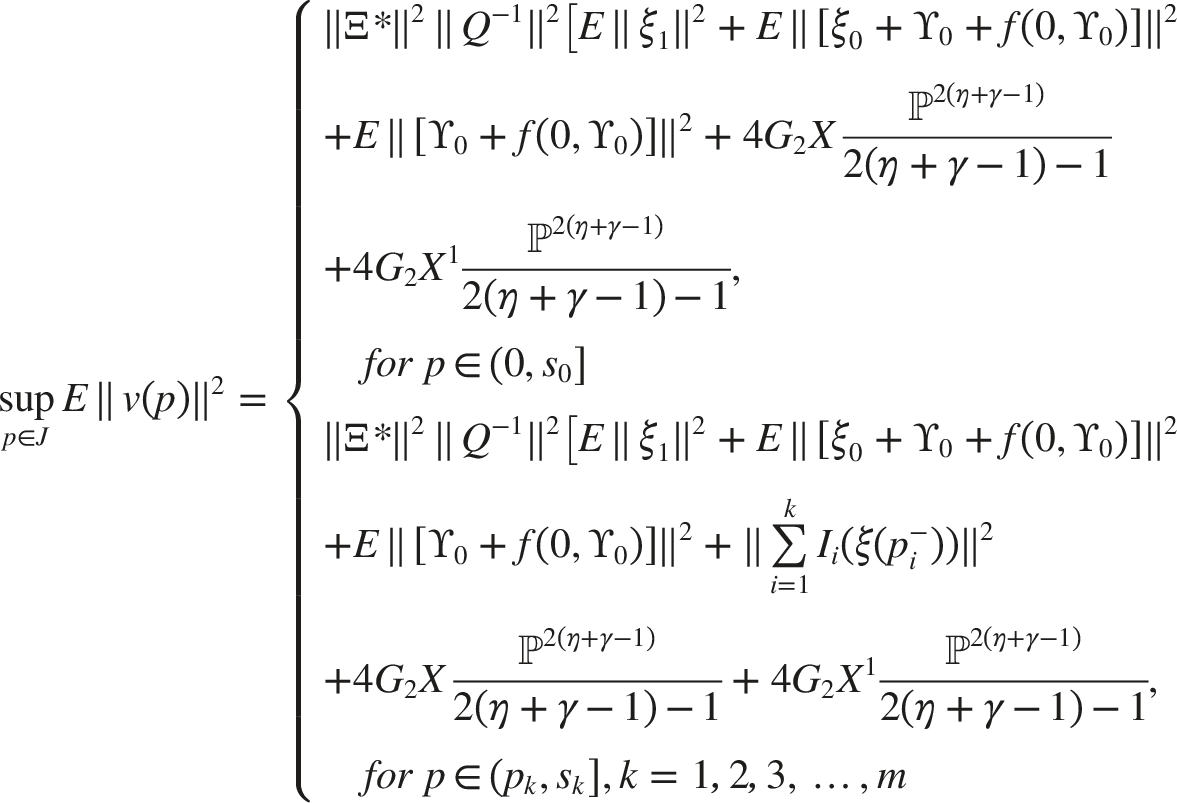
For the system (1), the control as
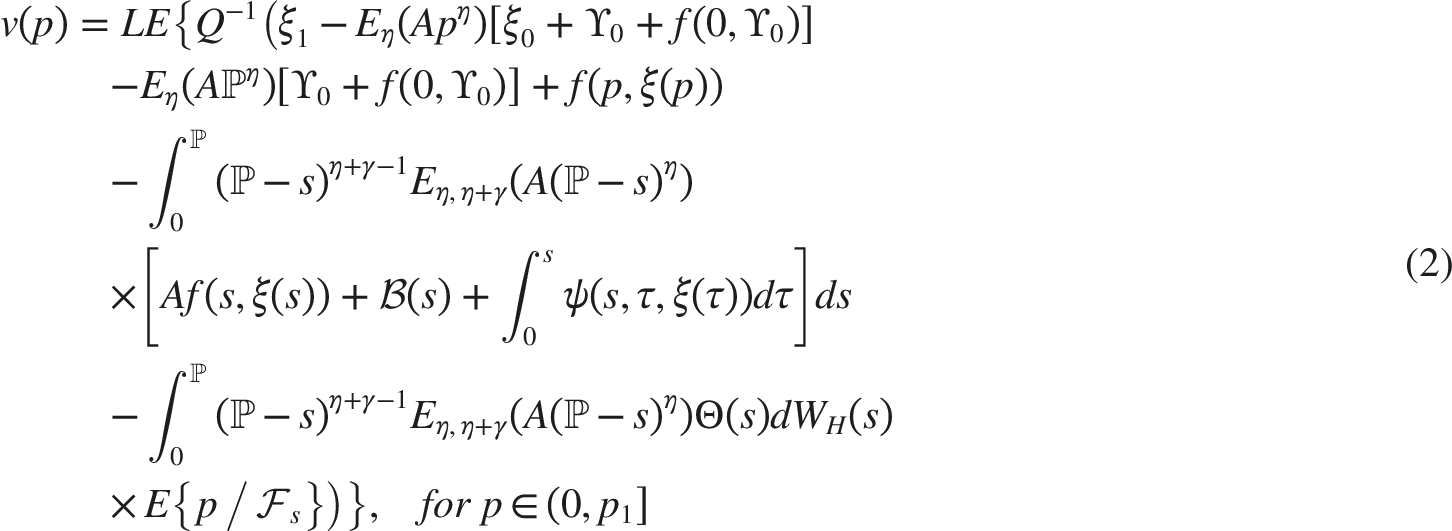
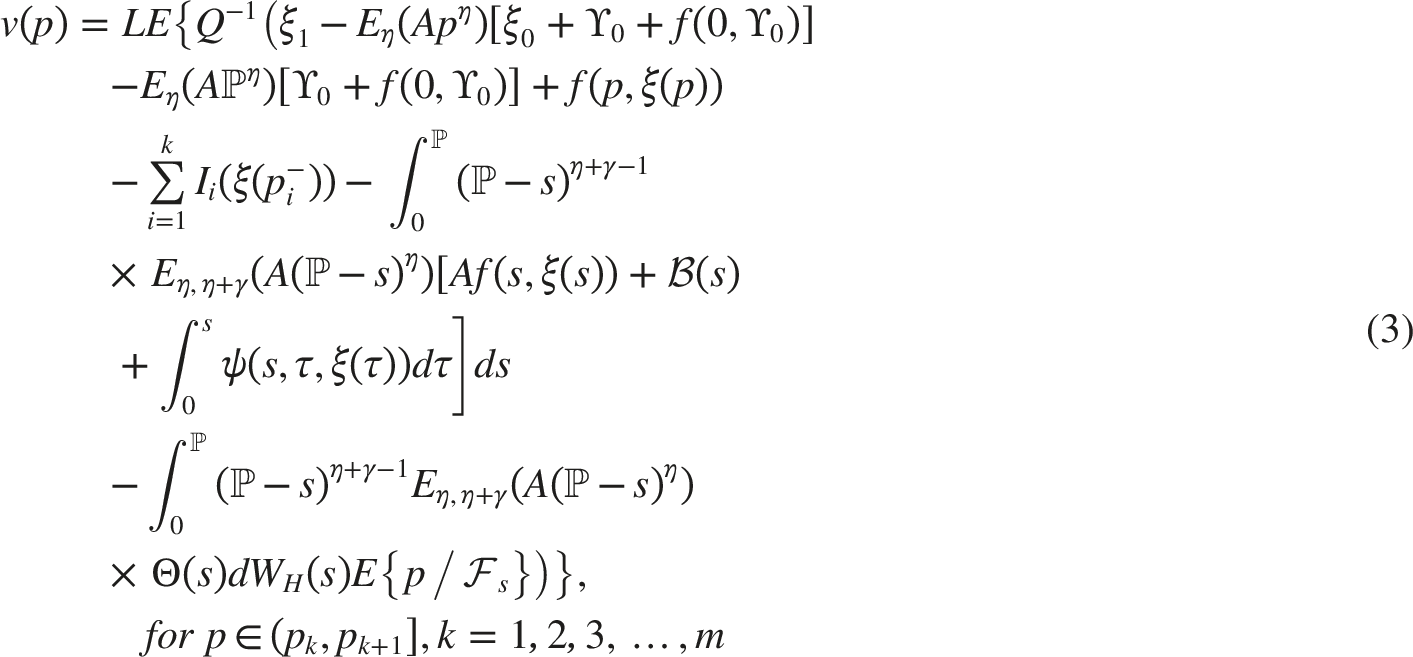
By substitute (3) in the following solution,
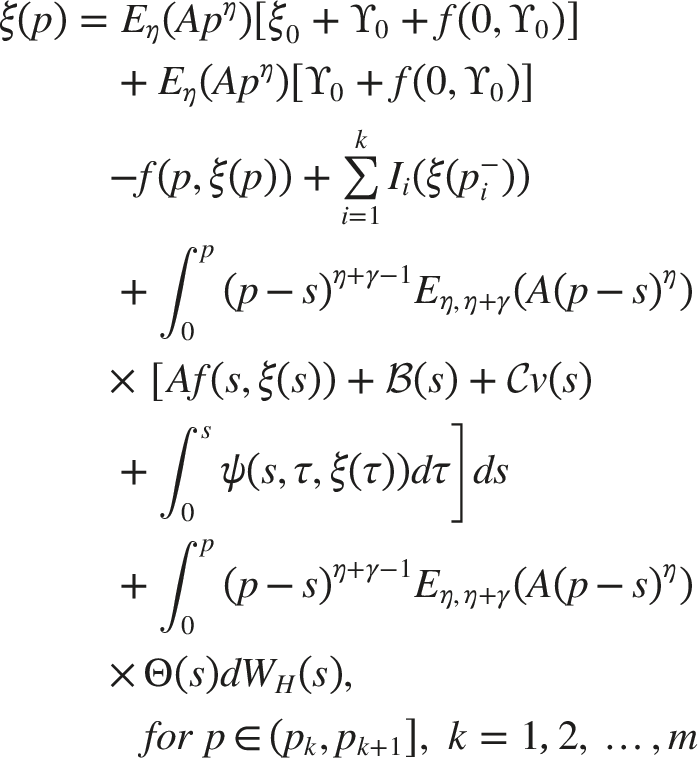
And evaluating ξ(p) equation at
We obtain ξ(p) = ξ1.
Since ξ1 is an arbitrary point in
Hence v(p) directs the system to every points in
5. Controllability of non-linear system
In this section, we extend the controllability results of the linear fractional system to the corresponding nonlinear model. The controllability of the associated linear system serves as a fundamental prerequisite for the nonlinear analysis, as it guarantees the invertibility of the controllability operator and allows the explicit construction of an admissible control function. Building on this linear framework, the nonlinear system is treated as a perturbation of the controllable linear system. Under appropriate Lipschitz continuity and boundedness assumptions, the resulting nonlinear operator is shown to be a contraction on a suitable function space. Consequently, the Banach Fixed Point Theorem is applied to establish the controllability of the nonlinear fractional system.
Evaluate the non-linear equation as • •
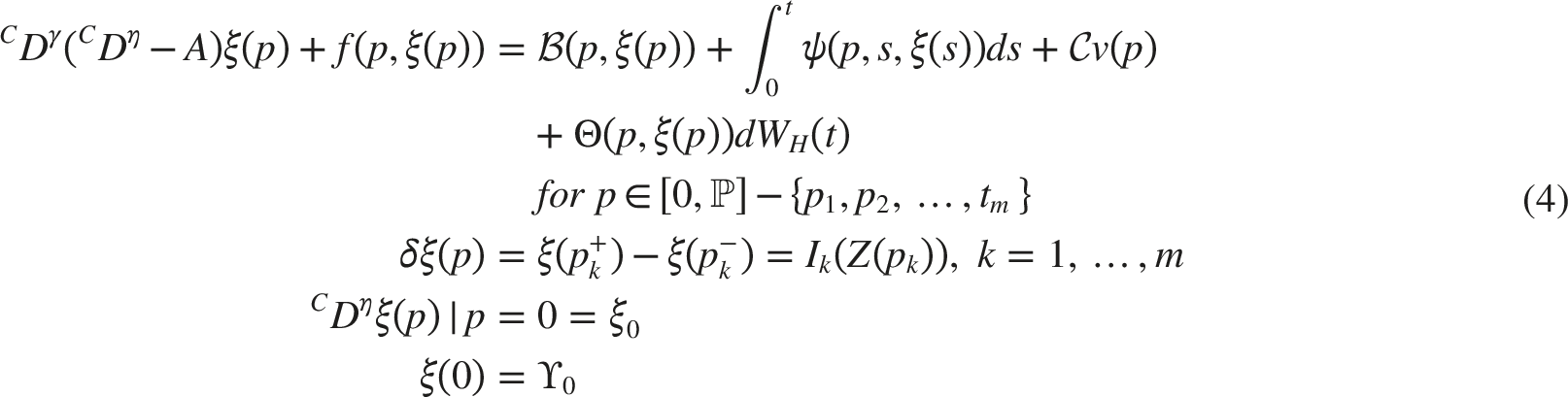
Let us assume that: ∃ γ
f
> 0 ∋:, ‖f(p, y) − f(p, ξ)‖2 < γ
f
‖y − ξ‖2, for all ∃ γ
q
> 0 ∋: ‖Q(p, y) − Q(p, ξ)‖2 < γ
q
‖y − ξ‖2, for all ∃ γ
r
> 0 ∋: ‖ψ(p, s, y) − ψ(p, s, ξ)‖2 < γ
r
‖y − ξ‖2, for all ∃ γΘ > 0 ∋: ‖Θ(p, y) − Θ(p, ξ)‖2 < γΘ‖y − ξ‖2, for all
A function
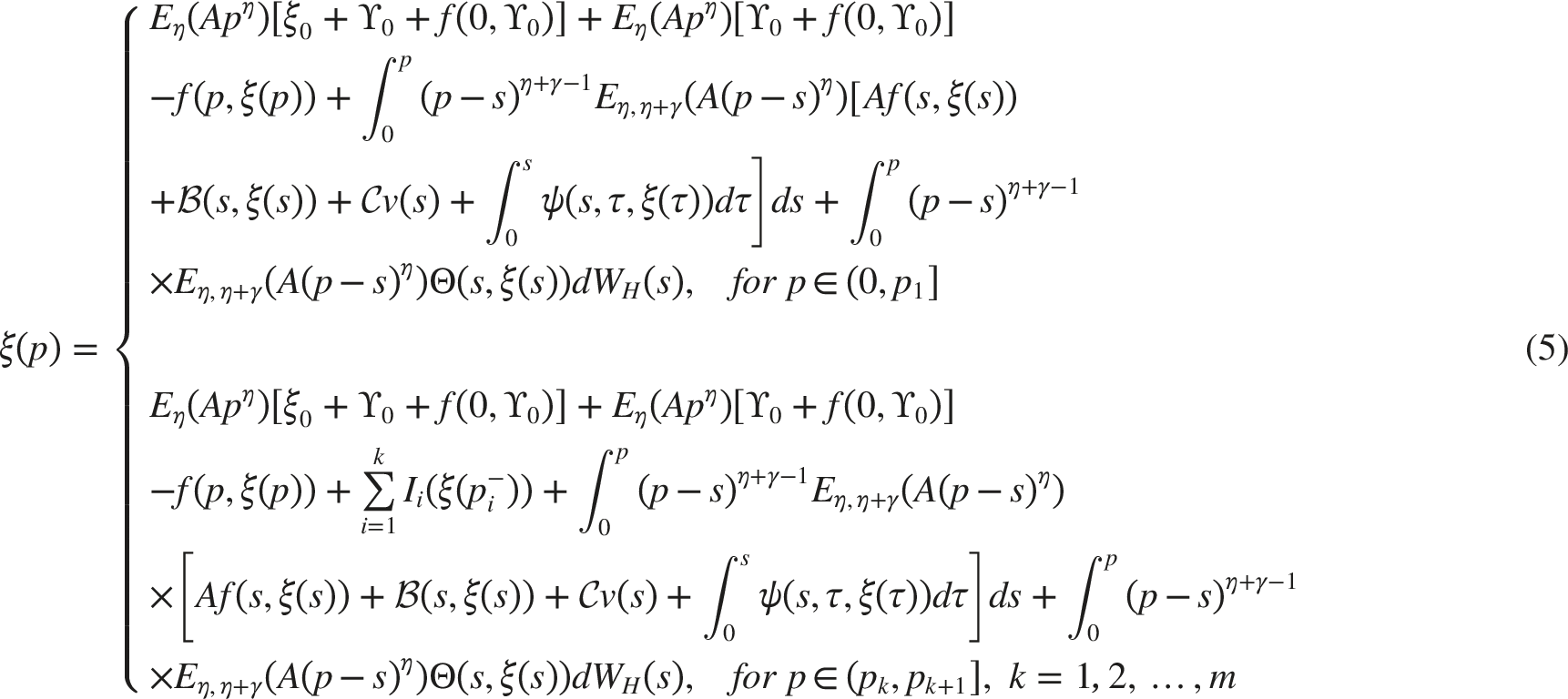
Under assumptions For p ∈ (p
k
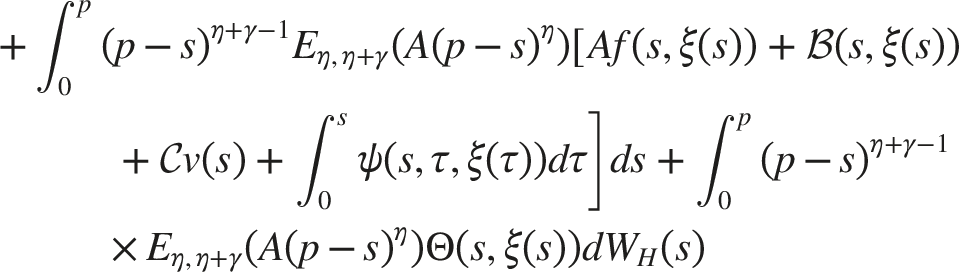
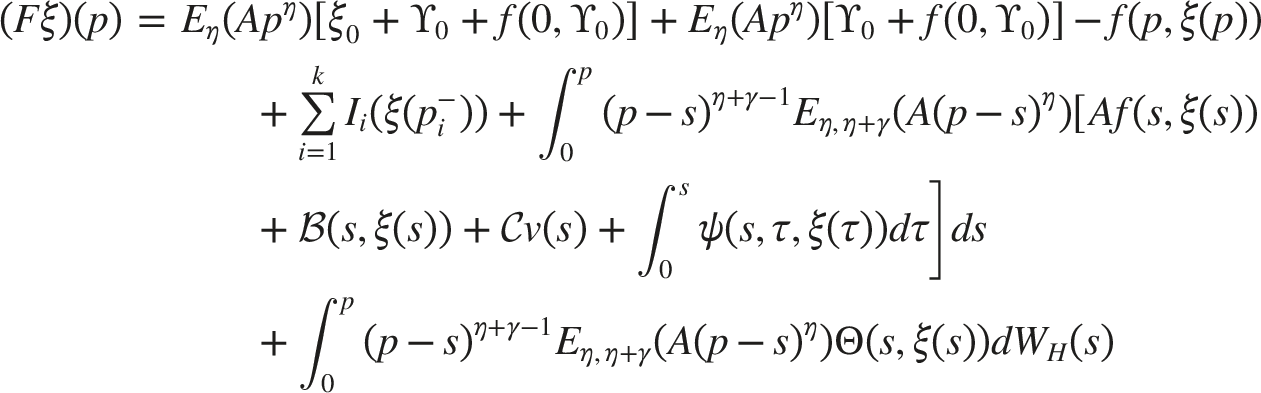
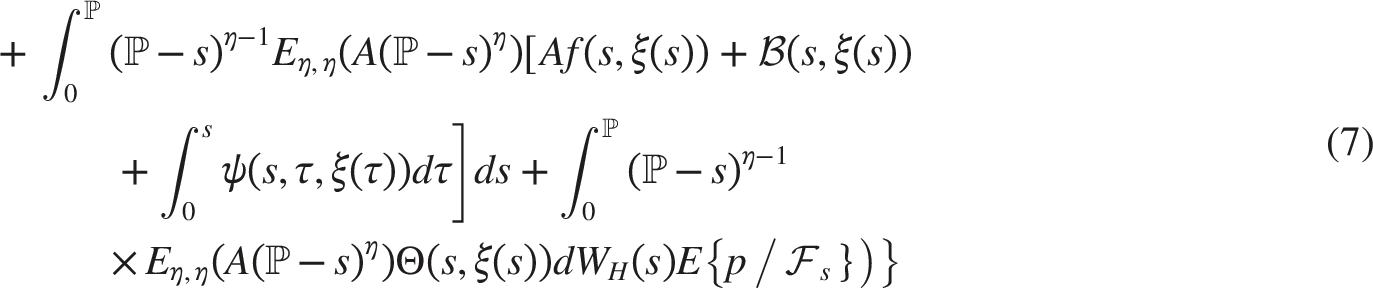
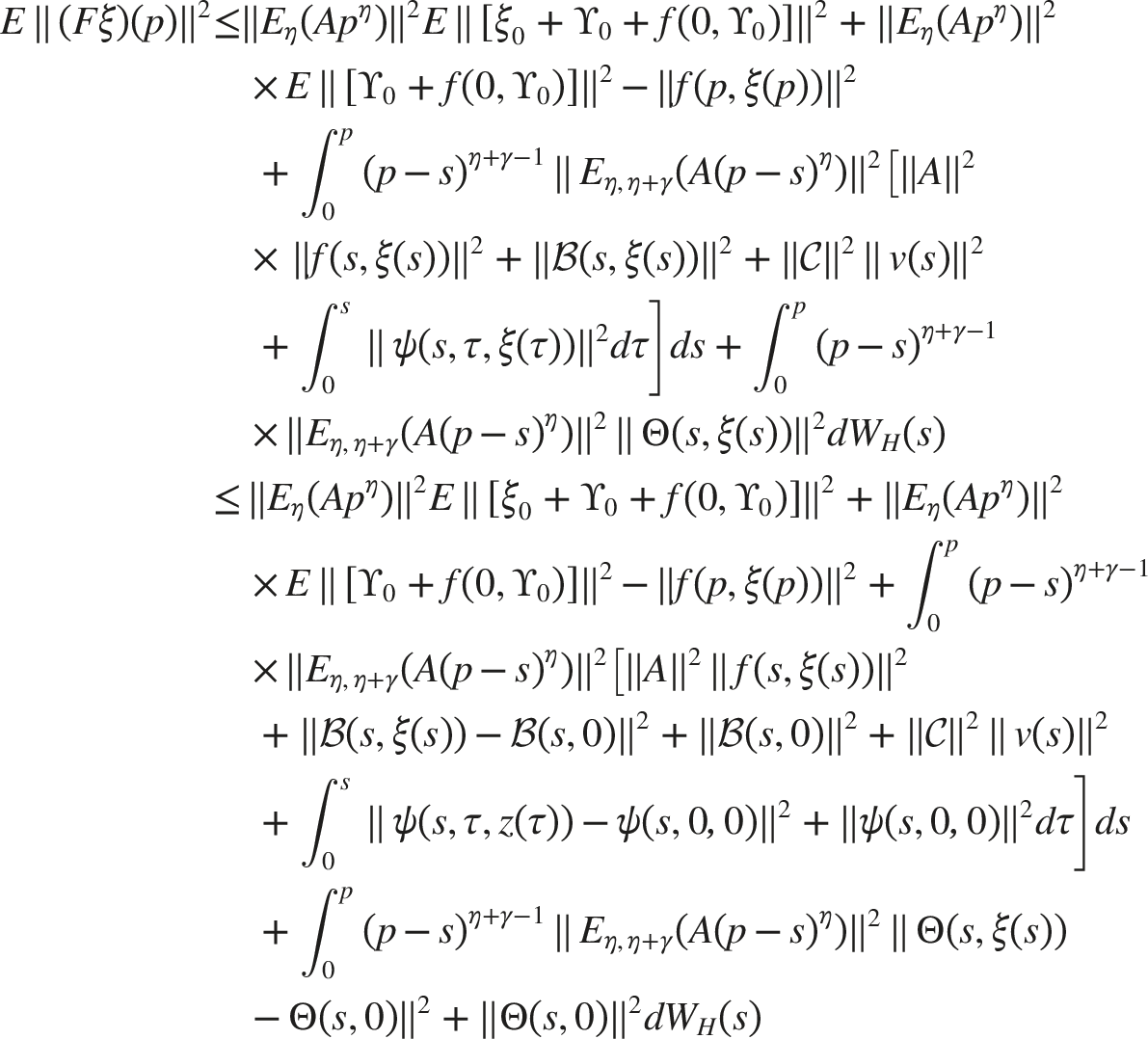
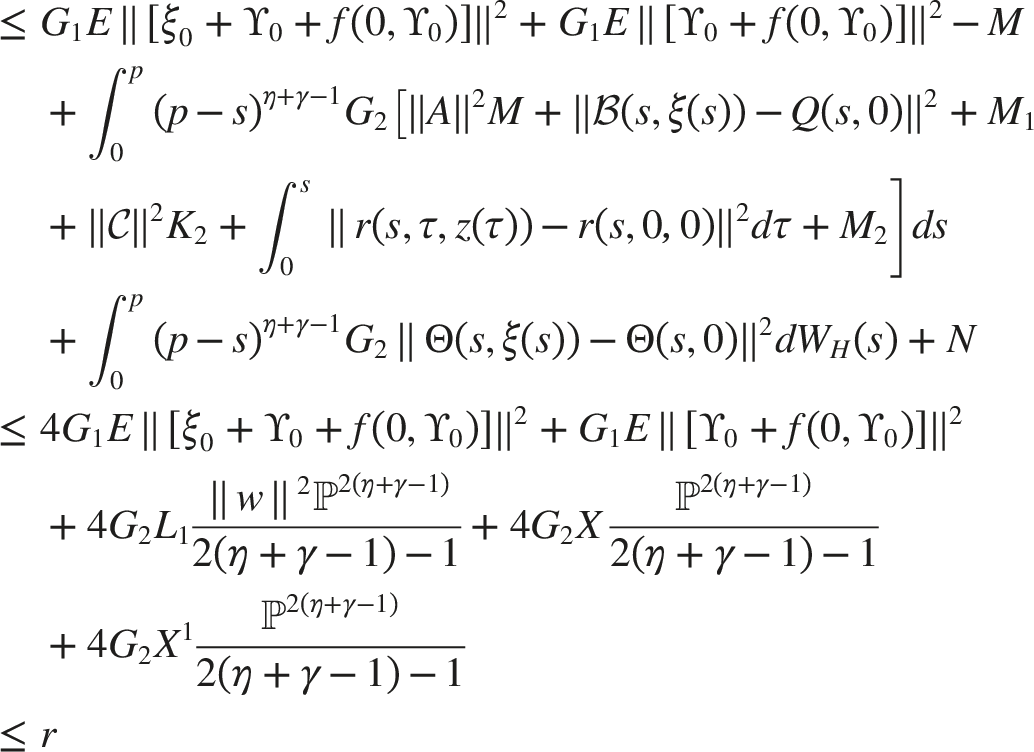
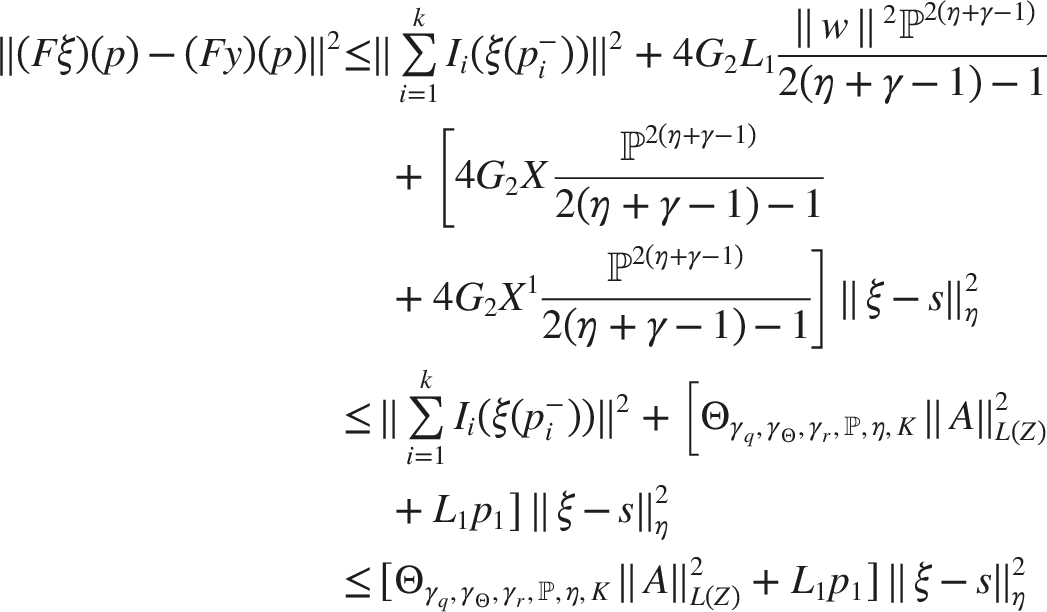
, pk+1], k = 1, 2, 3, …, m, we obtain □ The operator Let Where Since the linear system (1) corresponding to the nonlinear system (4) is controllable. We have, Q is invertible and the control as, ∀ p ∈ (0, p1], For p ∈ (p
k
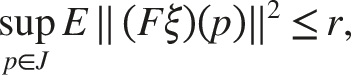
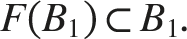
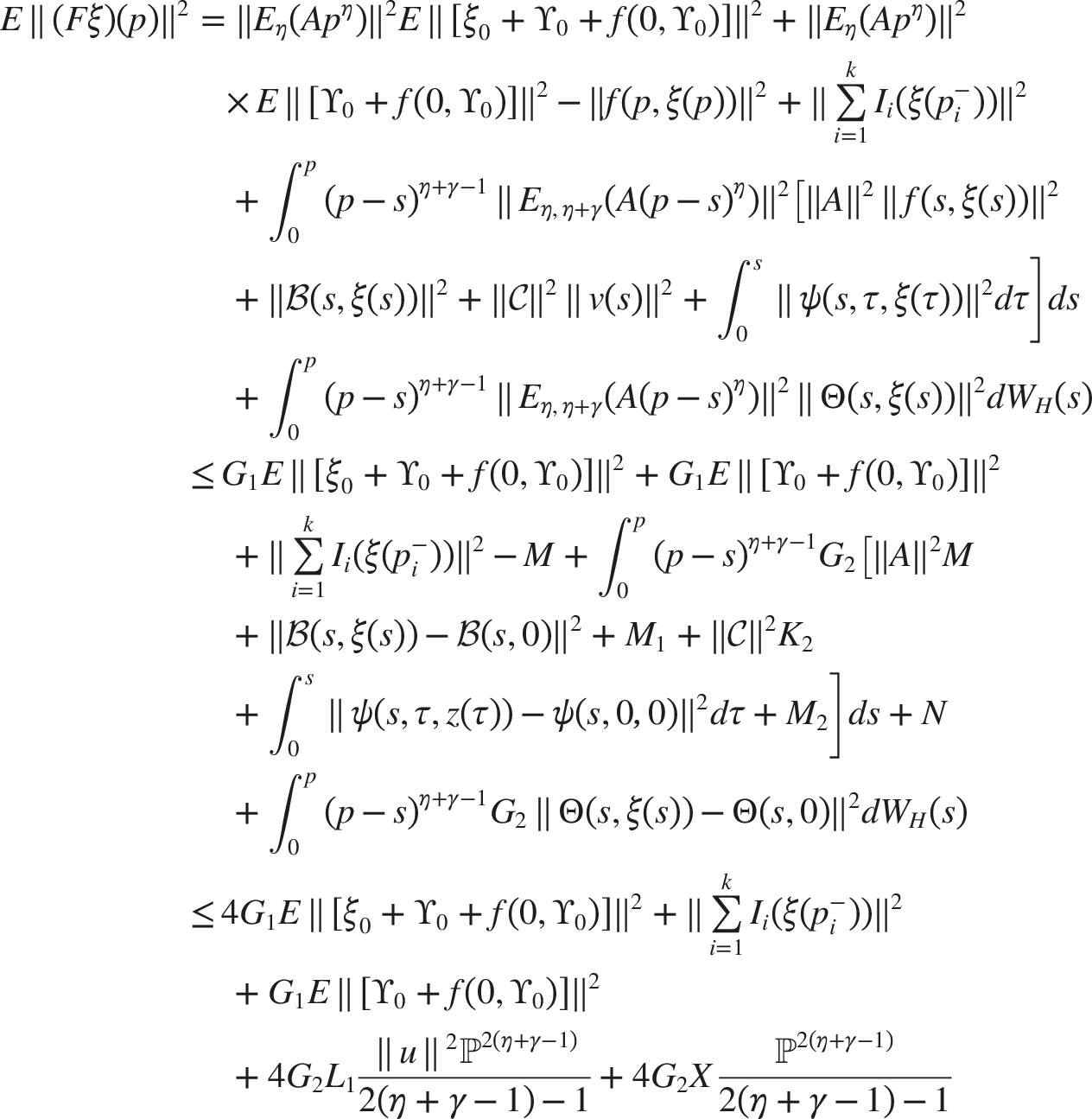
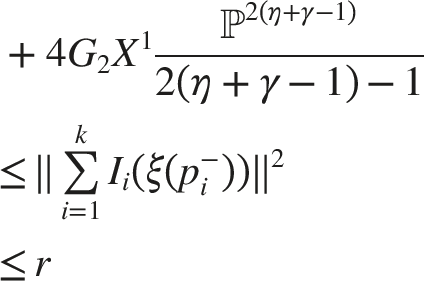
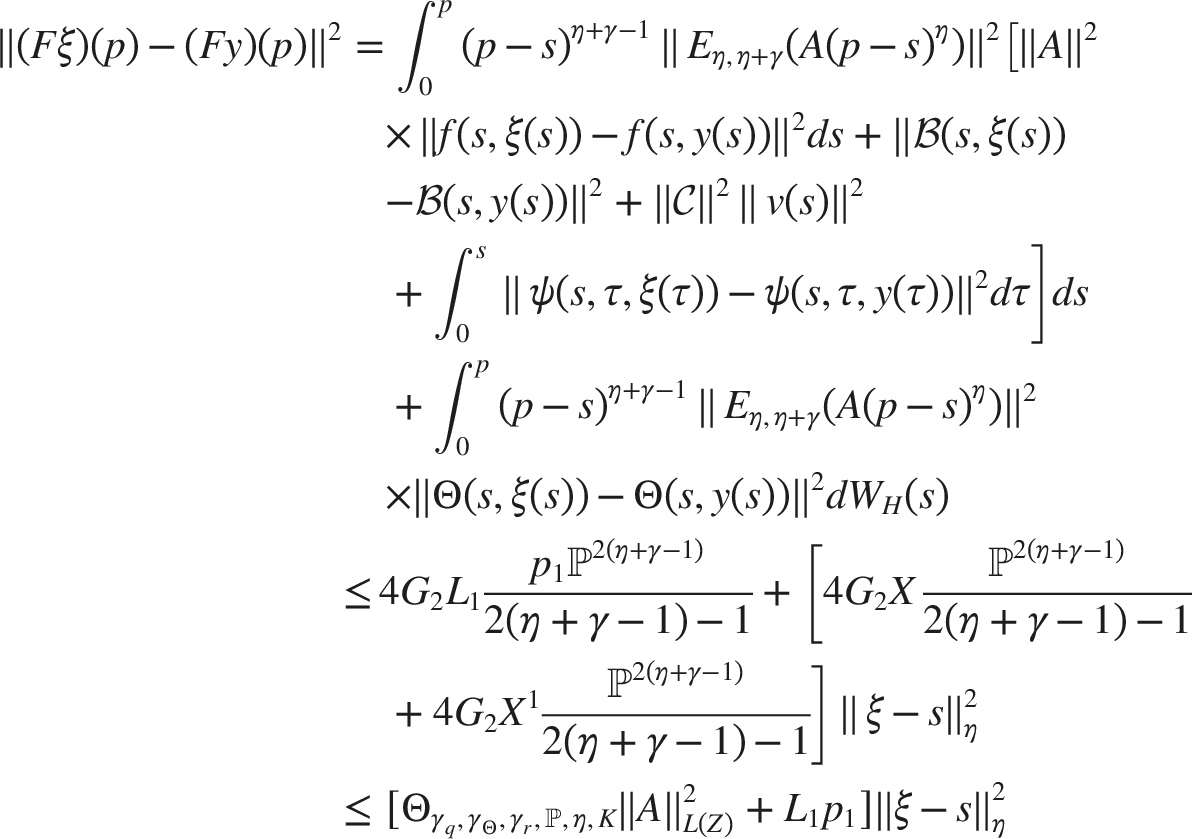
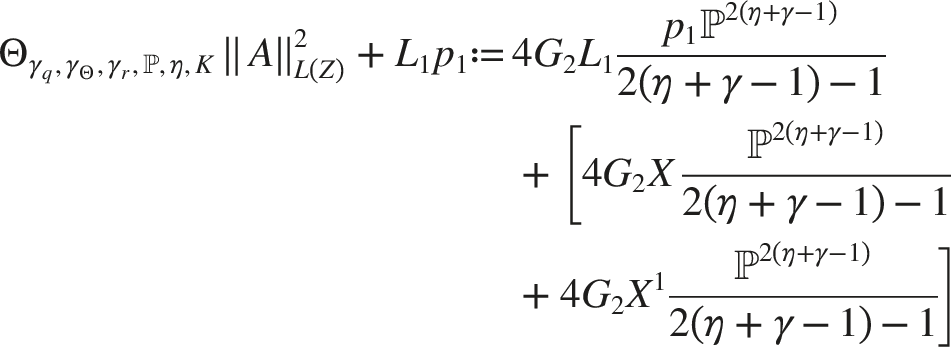
, pk+1], k = 1, 2, 3, …, m, Then, we first need to show that F(B1) ⊂ B1. Let ξ ∈ B1 and set Let us consider Then for each p ∈ [0, p1], we obtain: Now take Given that


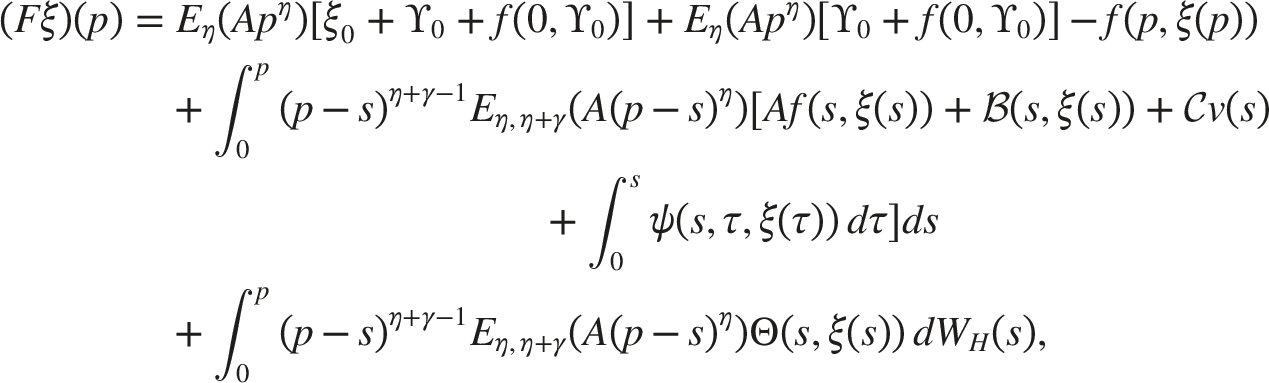






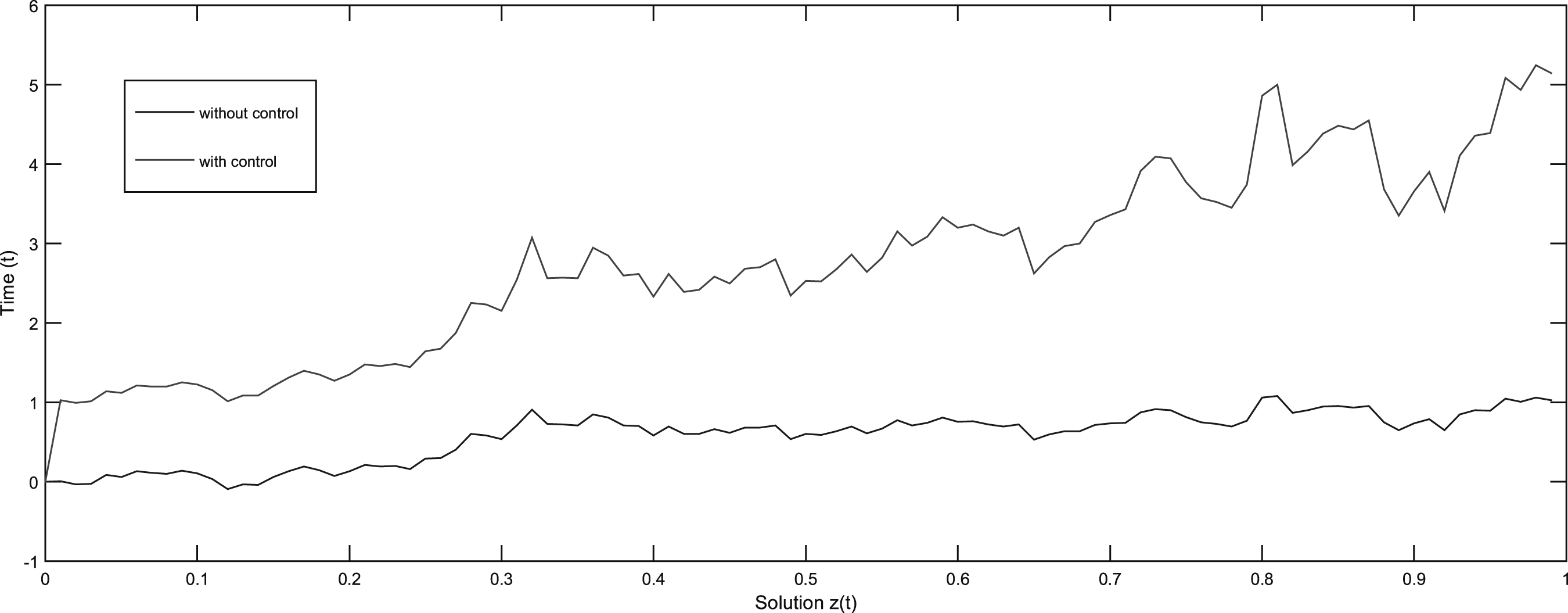
Fractional linear system (8) with η = 1/2, γ = 2/3 with control and without impulsive effect.
6. Examples
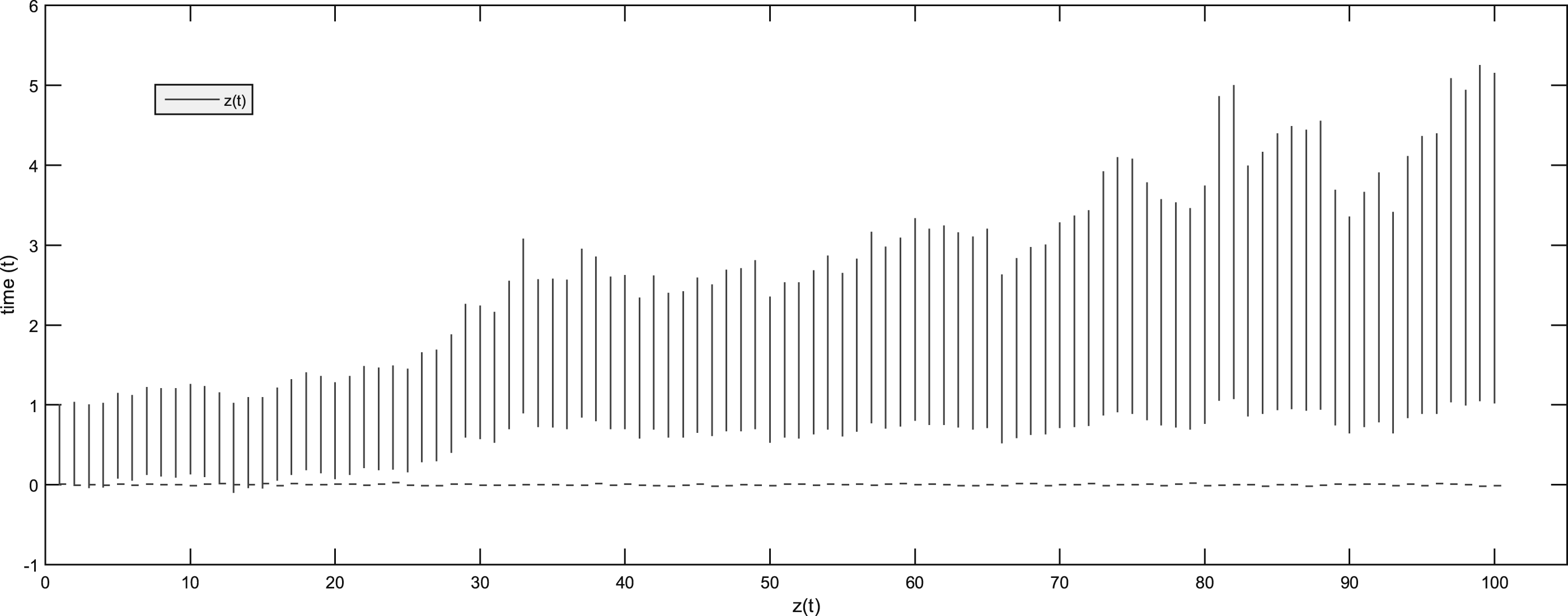
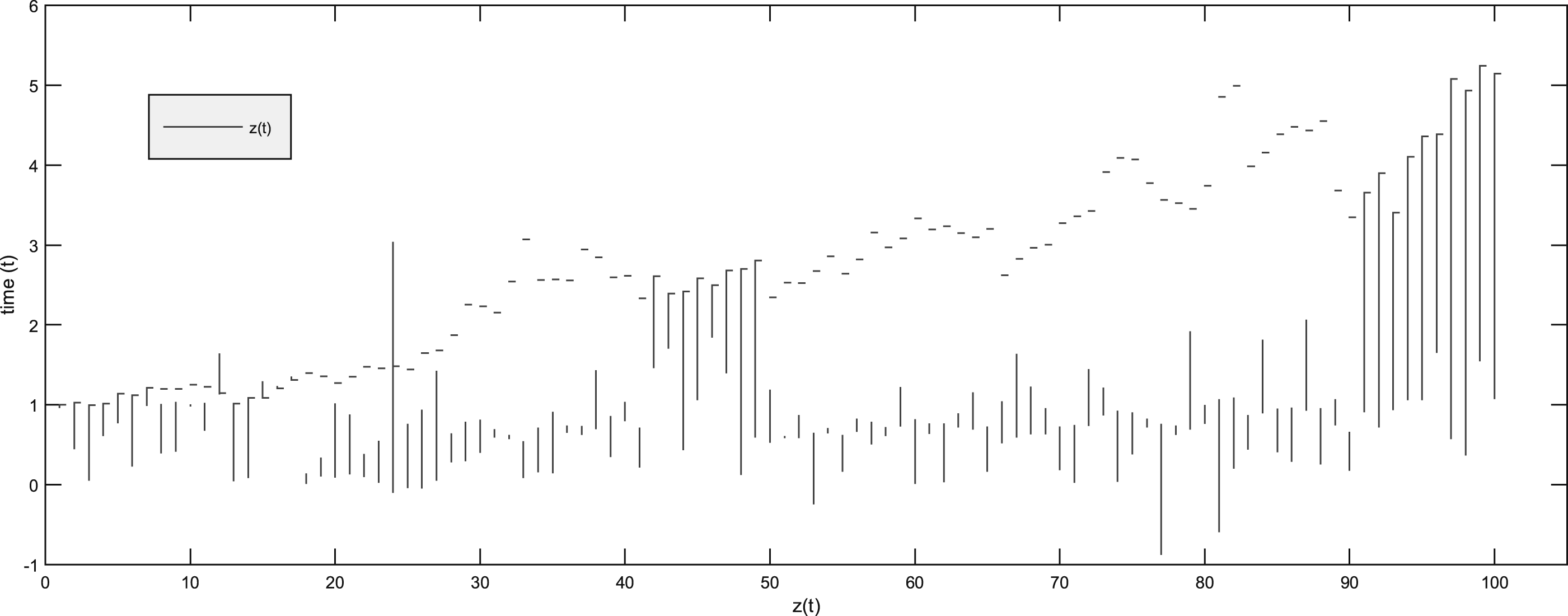
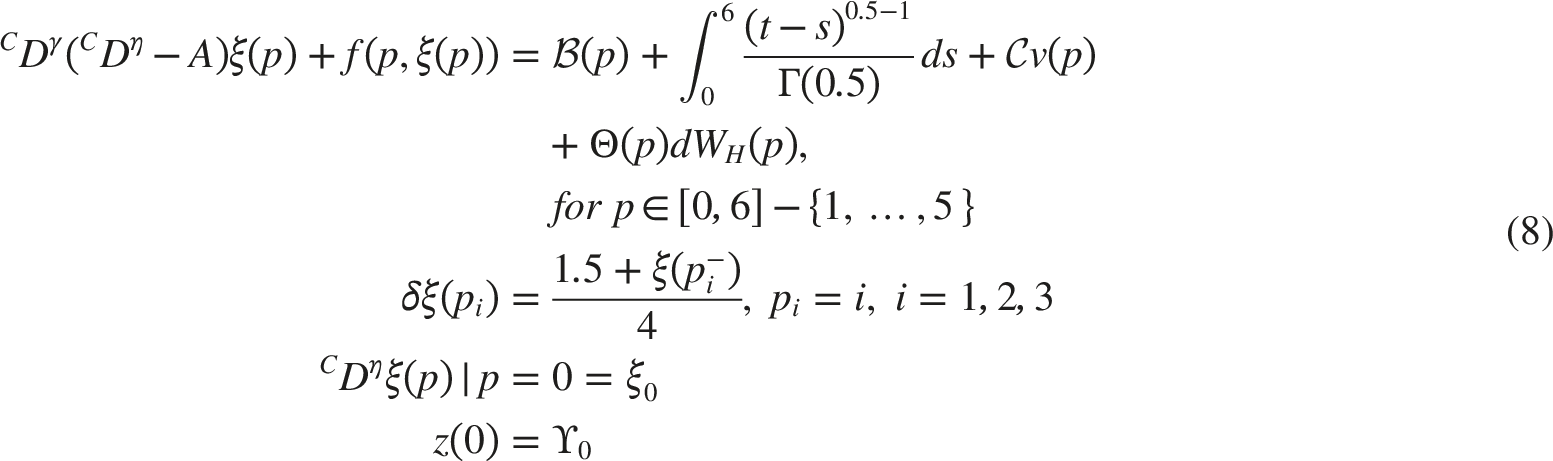
Consider the Langevin neutral impulsive system as The solution is Figures 2 and 3 depict the evolution of the state variable z(t) under fractional dynamics, stochastic perturbations, and impulsive effects. In the absence of impulses, the system evolves smoothly due to the memory property of the Caputo fractional derivative and the influence of fractional Brownian motion. Fractional linear system (8) with η = 1/2, γ = 2/3. Fractional linear system (8) with η = 1/2, γ = 2/3 with impulsive effect.
The impulsive mechanism introduces abrupt changes in the state at prescribed instants, clearly visible as jumps in the trajectories. These impulses significantly modify the system’s evolution by correcting deviations caused by stochastic disturbances. As a result, the trajectories exhibit improved stabilization after each impulse, demonstrating that impulsive control enhances controllability.
Overall, the numerical results validate the theoretical analysis and highlight the effectiveness of impulsive actions in controlling fractional stochastic systems with memory effects.
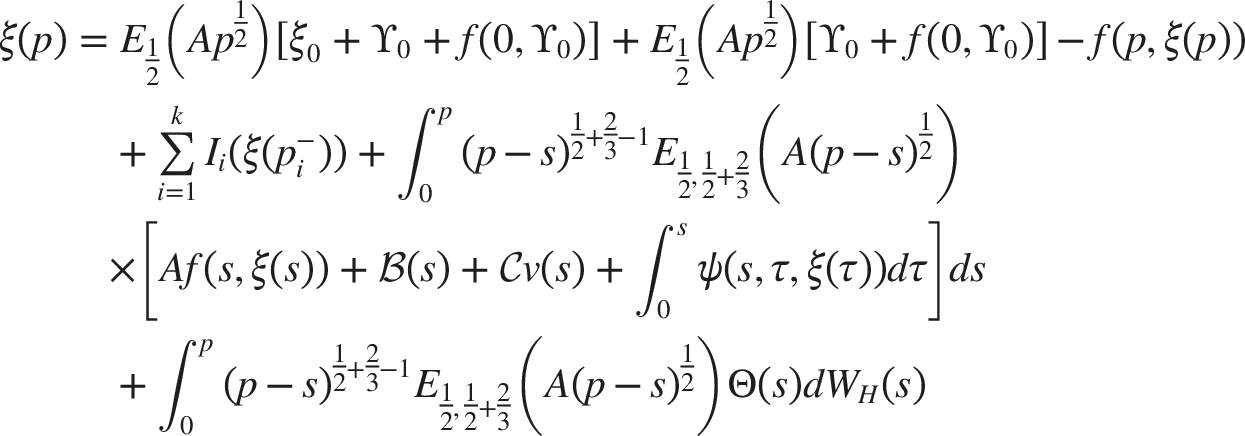
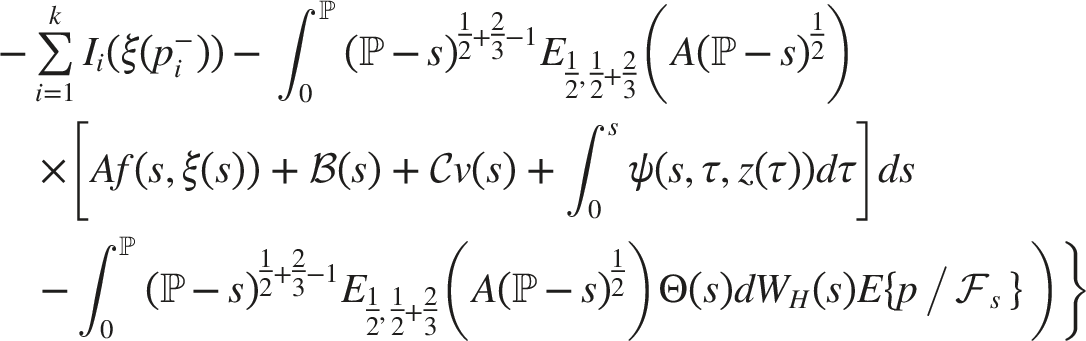
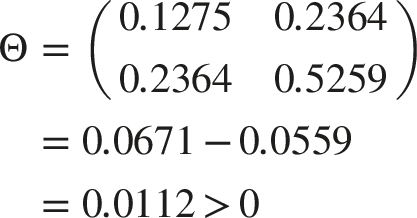
We have the control of the system (8) is given by The controllability Grammian operator as It is Invertible. Therefore, according to Theorem (4.4), the system described in (8), as presented in the example, is fully controllable on the interval [0, 6] \{1, …, 5}.

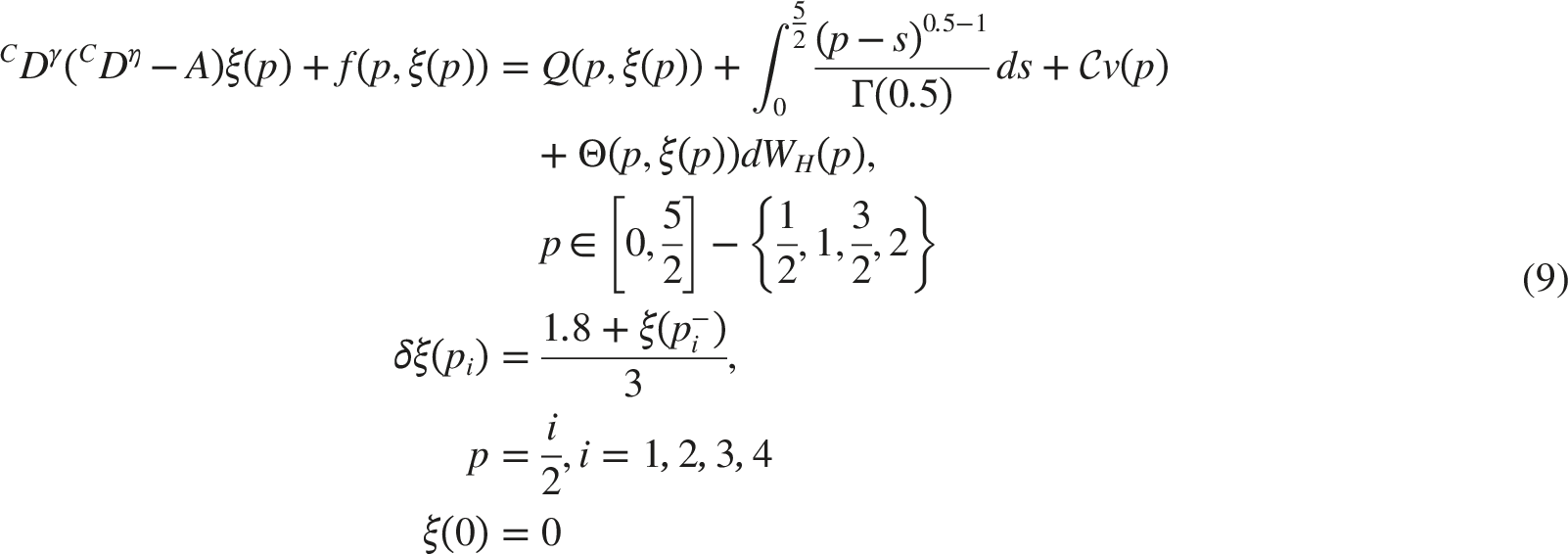
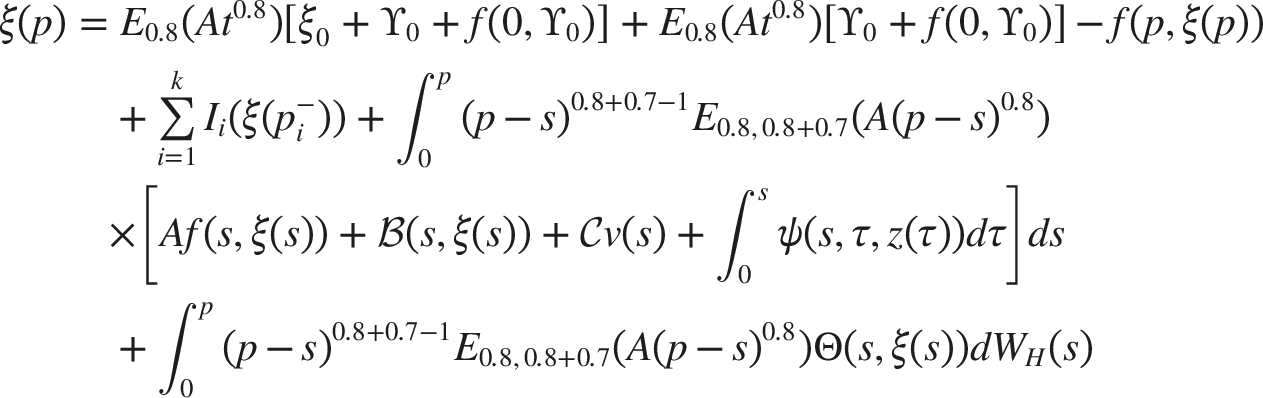
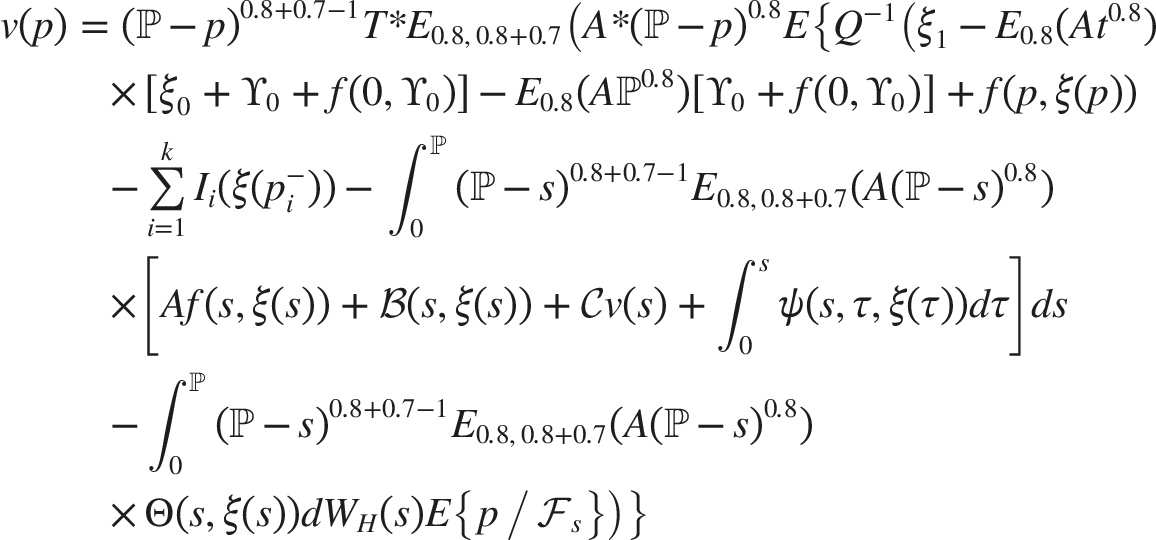
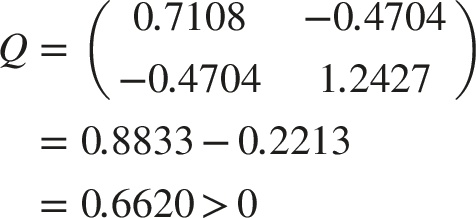
Evaluate the non linear system as The solution is, The control as The controllability Grammian operator as It is Invertible. Hence the system (9) is completely able to controlled on [0, 5/2] − {1/2, 1, 3/2, 2}.
6.1. Discussion of results
The numerical simulations demonstrate how fractional memory, stochastic perturbations, and impulsive effects collectively shape the system dynamics. The observed jumps in the state trajectories are primarily caused by the designed impulsive controls, which instantaneously redirect the system toward desired states. Variations in the stochastic intensity and the fractional-order parameters influence the amplitude and rate of convergence, revealing the sensitivity of the system to memory and noise. These results confirm that appropriate tuning of impulses and system parameters can effectively stabilize the nonlinear fractional stochastic system and enhance controllability, providing both theoretical validation and practical insight.
7. Conclusion
This work has presented a comprehensive controllability analysis for Langevin stochastic neutral impulsive integro-differential equations involving the Caputo fractional derivative and fractional Brownian motion. The main contributions of the paper include: (i) the derivation of necessary and sufficient controllability conditions for the corresponding linear fractional stochastic system, (ii) the establishment of controllability for the nonlinear system via the Banach contraction principle, and (iii) the validation of the theoretical results through illustrative examples. The results demonstrate that impulsive effects, memory terms, and fractional stochastic perturbations can be effectively handled within a unified controllability framework. Consequently, the proposed approach provides a useful mathematical foundation for analyzing the dynamical behavior of real-world systems arising in engineering, physics, and applied sciences that exhibit fractional-order dynamics and stochastic influences.
Footnotes
Acknowledgement
The Researchers would like to thank the Deanship of Graduate Studies and Scientific Research at Qassim University for financial support (QU-APC-2026).

Author contributions
M.L. contributed to the conceptualization and conducted the investigation. B.S.V. performed formal analysis, carried out validation, and wrote the original draft. D.U.O. undertook formal analysis and participated in writing – review and editing. H.A. and T.R. provided supervision and contributed to writing – review and editing. All authors discussed the results and contributed to the final manuscript.
Funding
The authors received no financial support for the research, authorship, and/or publication of this article.
Declaration of conflicting interests
The authors declared no potential conflicts of interest with respect to the research, authorship, and/or publication of this article.
Data Availability Statement
No/Not applicable (this manuscript does not report data generation or analysis).