



Abstract
In this paper, a new approach called the global residue harmonic balance technique is applied to construct analytical solutions for nonlinear oscillators that appear in cylindrical shells. Periodic solution is analytically proved, and consequently, the relation between amplitude and frequency is obtained in an analytical form. Numerical and analytical comparisons with the Runge–Kutta method and previously existing homotopy perturbation method (HPM) are given, to show the stability, quality, and efficiency of the present approach. The GRHBM provides an outstanding agreement with the numerical results for different amplitude values, leading to sufficiently accurate solutions for nonlinear oscillators.
Keywords
Introduction
The study of nonlinear vibration problems has received considerable attention because of its great importance in many areas of physical science, engineering, and various mechanical systems. Investigating the dynamic response of beams is one of the most important parts of the design process of structures. Nonlinear vibration of cylindrical shells is frequently employed in mechanical engineering; hence, it is critical to address free vibration in nonlinear form. It is extremely difficult to obtain accurate solutions to nonlinear problems, and it is sometimes even more difficult to obtain an analytical approximation. In general, the solution of nonlinear differential equations is classified into two main types, numerical and analytical methods. Traditional perturbation methods for solving nonlinear equations are restricted to weakly nonlinear situations.1,2 To overcome this problem, many researchers have solved nonlinear problems using new analytical techniques to find approximate solutions, for example, harmonic balance method,3–6 energy balance method,7–9 homotopy perturbation method,10–14 Li–He’s modified homotopy perturbation method, 15 Hamiltonian approach,16,17 coupled homotopy–variational approach,18–20 variational iteration algorithms21–24 and global error minimization method, 25 frequency–amplitude formulation, 26 fractional complex transform, 27 modification of Yao–Cheng oscillator, 28 and variational approach.29,30 Nowadays, much literature focuses on simple fractal oscillators in nonlinear systems.31–33 Recently, some researchers have studied the analytical solutions for nonlinear vibration equations of beams and shells. For example, Bayat et al. 34 used He’s variational technique, while Pakar and Bayat 35 applied He’s max min approach; also, Bayat et al. 36 used finite element modeling, and Bayat et al. 37 used He’s variational approach to obtain the frequency of the nonlinear equation. In addition, Bayat et al. 38 extended Hamiltonian approach to solve the nonlinear vibration of a stringer shell.
This paper aims to apply the higher-order global residue harmonic balance approach, which is an approximation method that combines the principles of the homotopy perturbation technique with the residue harmonic balance method. The GRHBM was first introduced by Ju and Xue,39–42 and recently developed through References 43–46. To illustrate the effectiveness of the present method, the nonlinear governing equation of the cylindrical shell is discussed in detail. The GRHBM is very effective for solving nonlinear oscillators. The obtained results are compared with those obtained by the HPM, as well as those predicted by the numerical method. The GRHBM proposes a useful and easy approach for finding the approximate solution of nonlinear differential equations.
The originality of this paper is immediately visible in the presented technique, as well as its simplicity and speed in providing analytically accurate solutions that converge swiftly to the numerical solutions. The advantage of using the GRHBM is that it provides analytically accurate solutions to the nonlinear vibration of a stringer shell directly, avoiding complicated computations. Moreover, this approach is much faster and more successful than other known analytical approaches in the literature for determining many analytical solutions. A straightforward solution approach with high accuracy in the acquired findings from the current problem demonstrates the uniqueness, dependability, and broad application of the suggested analytical technique.
Application of the global residue harmonic balance approach
In this section, we will consider the nonlinear problem of cylindrical shell that appears in many different fields of mechanical engineering and civil.12,38,47 A schematic view of the closed eccentrically circular cylindrical shell is illustrated in Figure 1: Schematic of the closed eccentrically circular stringer shell.
12
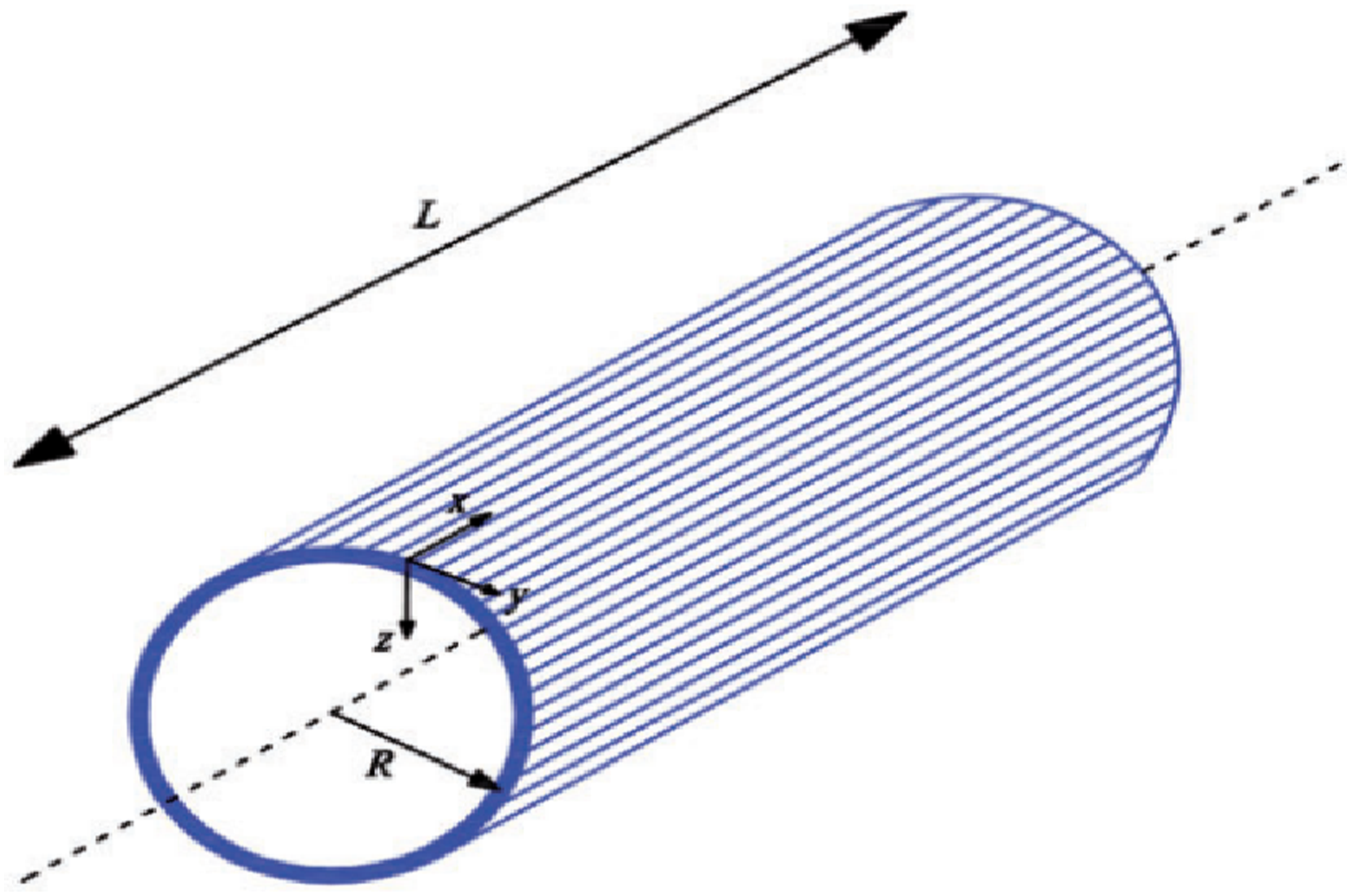



For more details, see ref. 12.
Using the transformation

In what follows, the GRHB approach, as one of the novelty approaches, is utilized to get an approximate solution for the nonlinear shaking of a stringer shell up to the second order. We will compare our results with some existing methods, including the HPM and R-K method.
First-order approximation
First, we consider

Putting equation (3) into equation (2) yields

Equating the coefficient of

The residual part of equation (4) throws the coefficients of

Second-order approximation
We consider

Inserting equation (7) into equation (2), we obtain
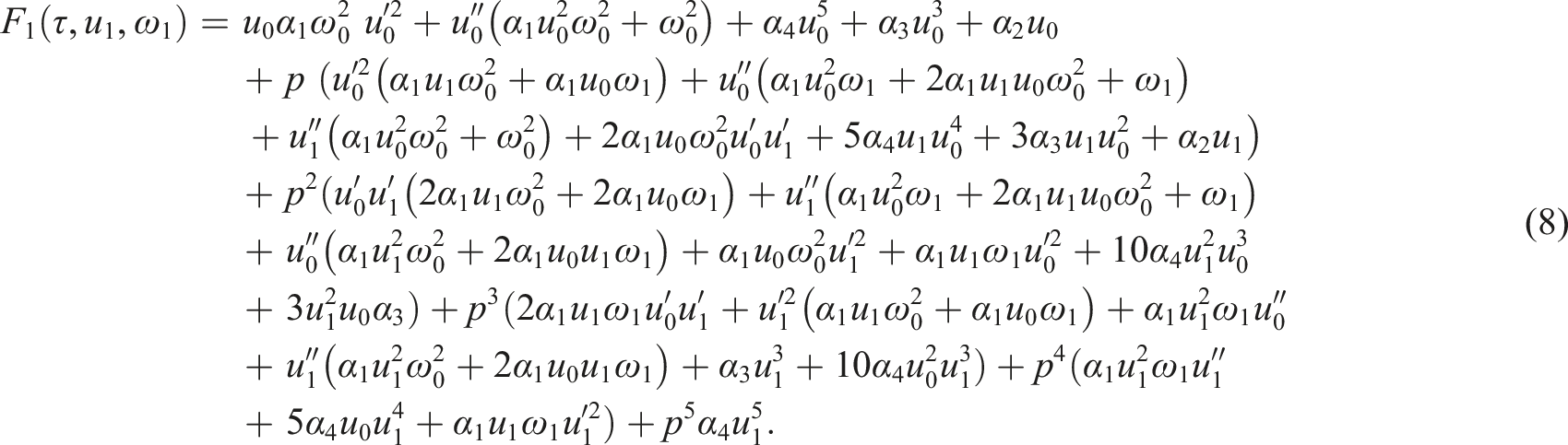
We assume

Consider the coefficient of
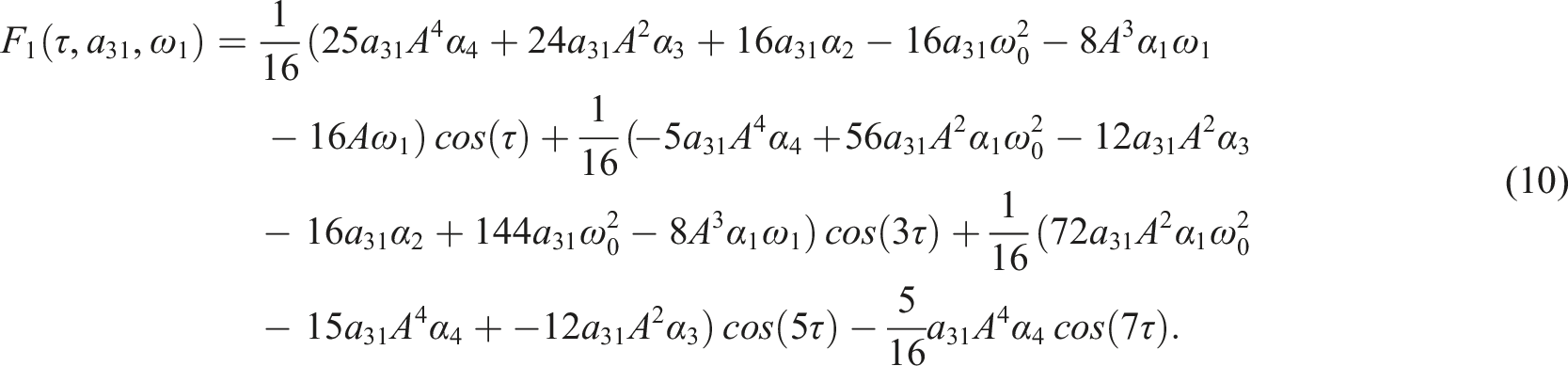
Rewrite equation (10) to be
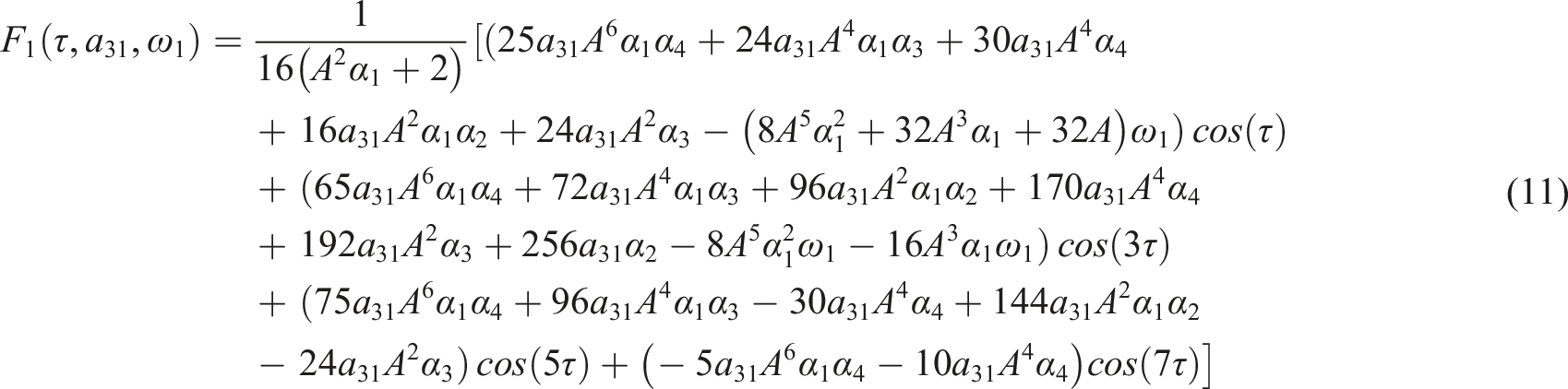
Then, we have

We set the coefficients of

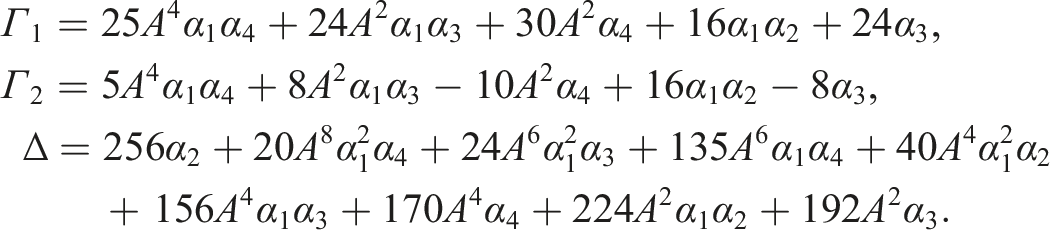
The second-order approximation can be expressed as

We note that the GRHBM can provide third or higher-order approximations in a similar manner.
Discussion
To confirm the validity of the GRHB method applied in this research, the results are evaluated against previous literature findings and numerical solutions. Figure 2 provides comparisons of the present results and the HPM
12
with the numerical ones for small and large values of the amplitudes of vibration Contrasting between the global residue harmonic balance method (black line), the homotopy perturbation method
12
(red line), and the numerical solution (blue line).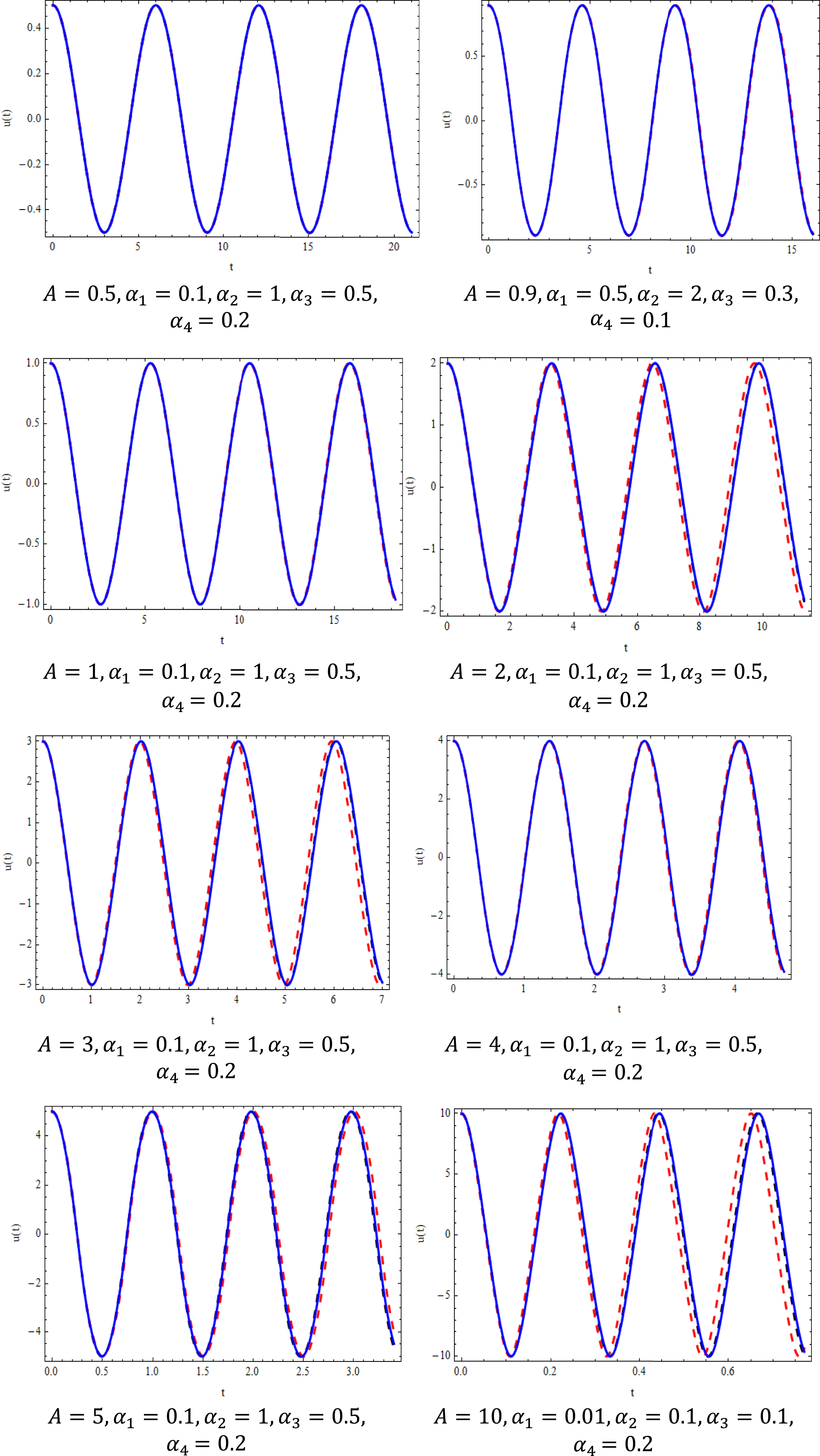
Concluding remarks
The GRHBM has been employed successfully in this study, to obtain analytically accurate solutions to the nonlinear problem of cylindrical shell. The present results are compared with the numerical ones achieved by using the HPM. It is clear from Figure 2 that the present solutions agree more closely with the numerical solutions than the homotopy perturbation method for different values of the amplitude A. Finally, we can conclude that the present method is powerful and simple, and can also be applied to other nonlinear problems without requiring complex mathematical calculations.
Footnotes
Declaration of conflicting interests
The author(s) declared no potential conflicts of interest with respect to the research, authorship, and/or publication of this article.
Funding
The author(s) received no financial support for the research, authorship, and/or publication of this article.
