




Abstract
We investigate the bistable dynamic behaviors of a fractional and modified Van der Pol system subjected to Gaussian colored noise, especially focusing on the control of bifurcation parameters. Firstly, according to the minimal mean square error concept and the generalized harmonic balance technique, the fractional derivative term can be expressed as a linear combination of the damping force and restoring force. Consequently, the initial system can be simplified as an equivalent integer-order Van der Pol system. And the Probability Density Function (PDF) of the system’s stationary amplitude can be obtained by utilizing the stochastic averaging method. Subsequently, the critical condition for stochastic P-bifurcation of system amplitude is determined by using the singularity theory. Finally, the qualitative analysis of the stationary PDF curves of amplitude is discussed in each region divided by the transition set curves. The agreement between the analytical solutions and the numerical outcomes obtained through Monte Carlo simulation confirms the theoretical analysis presented in this paper. Additionally, the results attained in this paper have a potential guidance to control the system’s response by optimizing the parametric design of the fractional-order controller.
Keywords
Introduction
Fractional calculus is an extension of calculus with non-integer orders, and it can capture the memory properties of viscoelastic substances compared with integer-order derivatives. As the expression of fractional derivative involves convolution, which enables to represent the memory and cumulative effects over time. Hence, the fractional derivative has been proved to be a better and more precise mathematical instrument for characterizing memory properties1–4 and has been widely applied in various domains including anomalous diffusion, non-Newtonian fluid mechanics, soft matter physics, viscoelastic mechanics, and diverse reaction processes.5–7 Therefore, considering the above characters and the ubiquitous ambient noise in engineering, it is crucial and meaningful to investigate the impacts of fractional-order parameters and noise excitation on the dynamic properties of the stochastic systems.
In general, additive noise comes from the internal fluctuations of the system, while multiplicative noise comes from the fluctuations of the external environment of the system, and in most cases, multiplicative and additive noise are interrelated and may have a great influence on system dynamics. Cao et al. 8 studied the bistable system under the action of interrelated noise and gave the corresponding uniform colored noise approximation. Li et al. 9 studied the non-equilibrium phase transition under correlated noise and found that the mutual correlation between multiplicative and additive noise plays an important role in the phase transition of the system. Mei et al.10–12 studied the nonlinear dynamic system under the action of cross-correlation noise, and found that the correlation between noises could induce resonance and suppression phenomena in the curve of average first crossing time. Jin et al.13,14 studied the stochastic resonance of linear systems under the combined action of dependent multiplicative colored noise and periodic modulation noise, and found the real stochastic resonance and the traditional stochastic resonance phenomenon. Jin et al. 15 studied the random bifurcation of bistable Duffing–Van der Pol systems under the action of correlated multiplicative and additive Gaussian white noises, and calculated the steady-state probability density function (PDF) curve of system amplitude by using the stochastic averaging method, then discussed the influence of noise intensity, noise cross-correlation coefficient, and system parameters on the stochastic bifurcation of the system.
There are random excitations in natural sciences, engineering sciences, and social sciences, such as strong winds, road or track irregularities, ground movements caused by strong earthquakes, etc. The response of a system under random excitations is fundamentally different from that under deterministic excitations, which can only be described by probability or statistical methods. Therefore, in addition to studying the characteristics of dynamic systems under deterministic excitations, it is necessary to pay attention to the characteristics of dynamic systems under random excitations, such as the vibration of engineering structures in earthquakes,16,17 the vibration of ships and offshore platforms caused by wind and waves,18,19 the vibration of aircraft caused by jet noise and high-altitude turbulence,20,21 and the vibration of high-rise buildings and large bridges caused by wind and earthquakes.22–24 Therefore, in order to accurately grasp the dynamics of the system under random excitation, it is necessary to study the theory of stochastic dynamics.
And in fact, all practical systems exhibit nonlinear characteristics to some extent. In these nonlinear systems, random factors exist widely, such as high-altitude turbulence encountered by wings, 25 excitation from tracks encountered by trains, 26 and excitation from wind waves, ocean currents, and internal waves in ocean structures.27,28 Under the action of random excitation, the system response will switch between different steady states, and the steady-state probability density of system response will have multiple peaks.
In recent years, numerous researchers have investigated the dynamic characteristics of nonlinear systems with multistable states under various noise excitations and obtained productive outcomes. Baleanu et al.
29
studied the fractional Lagrangian of Pais–Uhlenbeck oscillator, and obtained Euler–Lagrangian equation numerically based on the Grünwald–Letnikov approach. Rath et al.
30
investigated the characteristic features of Yao–Cheng non-linear oscillator by utilizing both the analytical and numerical approaches and indicated that the solution of the non-linear oscillator showed the oscillatory behavior. Baleanu et al.
31
studied the dynamical behavior of the motion for a simple pendulum with a mass decreasing exponentially in time, derived the corresponding non-integer Euler–Lagrange equation, and then simulated the approximate results with respect to different non-integer orders. A number of studies32–38 discussed the stochastic behaviors of the Van der Pol–Duffing oscillators driven by Gaussian white noise, Lévy noise, colored noise, and the combination of harmonic and random noise, respectively, the researchers derived the expression for the stationary PDF of the system’s amplitude and explored the stochastic P-bifurcation behaviors of the systems. Chen et al.
39
utilized the radial basis function neural networks (RBFNN) method to analyze the transient response of randomly excited non-smooth vibro-impact systems, and expressed the solution of the system response as a serious of Gaussian activation functions with time-dependent weights. Luan and Huang
40
discussed random stationary responses of nonlinear oscillators including Preisach hysteresis by the Recurrent Neural Networks method, and solved the stationary probability density from the FPK equation as well as various-order response statistics. Liu et al.
41
presented a novel method to identify the high dimensional stochastic dynamical systems driven by a non-Gaussian
Phenomena such as large deformation and large deflection often occur in engineering problems, in these situations where high computational accuracy is required, then high-order restoring force models and high-order nonlinear damping are needed to describe the effects of nonlinear stiffness and damping of the system,52–56 leading to the occurrence of multiple steady-state phenomena. Many biological systems, such as the firing activity of biological neurons,57,58 gene networks, 59 and cellular protein transcription,60,61 have also observed the phenomenon of multiple steady states. From the current research on stochastic systems, it can be seen that the deterministic part of most systems is multistable, and under the action of random excitation, the system response will switch between different steady states, then the steady-state probability density of the stochastic system response will exhibit multiple peaks. However, the mechanisms behind these complex phenomena are still unclear, which hinders a deeper understanding of such dynamical systems.
The Van der Pol equation was first discovered and established by Van der Pol during his research on nonlinear oscillation circuits of transistors. As a typical nonlinear term, Hartlen and Curri 62 proposed a control equation that used Van der Pol nonlinear oscillator as lift coefficients to represent wake effects and further studied the effect of cylinder motion on vortex induced lift based on the research of Bishop and Hasson. 63 The model was also applied to investigate the vortex induced vibration responses of cables, etc., and predict the multiple steady-state phenomenon of these systems.
Therefore, as a typical representative of nonlinear multiple steady-state systems, it is necessary to study the dynamic behavior and generation mechanism of complex phenomenon of Van der Pol system under random excitation, which can more clearly determine the steady-state response behavior of stochastic systems under the influence of different factors, facilitating to accurately analyze the influence of system parameters and providing theoretical guidance and potential engineering application value for practical problems.
And as the complexity of the fractional derivative, it is only possible to qualitatively analyze the parametric influences of the fractional system, and can’t obtain the critical values of the parametric effects. However, the practical importance of the critical parameter conditions can’t be ignored when analyzing and designing the fractional order systems. Furthermore, since the multiplicative parameter noise excitation is more complicated than additive external noise excitation in the exploration of system behaviors, we investigate the nonlinear vibration of fractional-order stochastic system with the fractional derivative and noise excitation in this paper. Comparing with the Van der Pol systems
64
which considered the effect of additional and multiplicative Gaussian white noises simultaneously, and the bistable Van der Pol systems
65
which discussed the influences of additional and multiplicative Gaussian white noises, respectively, in this paper, we investigate a modified and bistable Van der Pol system with fractional element which is excited by additive and multiplicative Gaussian colored noises as an dynamic model. The more complex Gaussian colored noise which can be generated through a first-order low pass filter to the Gaussian white noise, and this means that it should has a correlation time
Derivation of the equivalent system
In fact, the Riemann–Liouville derivative and Caputo derivative are most commonly used. However, the initial conditions of Riemann–Liouville derivative hasn’t explicit physical meaning, whereas the initial condition of Caputo derivative not only possesses a distinct physical meaning but also has the identical form as the differential equation of integer order. Hence, we use the Caputo fractional derivative in this study as

For a given physical system, the starting moment of an oscillator is

In this paper, we investigate the modified and generalized Van der Pol system with fractional damping, which is driven by the Gaussian colored noise excitation

intrinsic frequency of the system.

In the meantime, the Gaussian colored noise can be acquired by applying a first-order low pass filter to the Gaussian white noise, and as demonstrated in equation (3), which has zero mean and the auto-correlation function as

In order to introduce the equivalent system, we consider the fractional derivative as the combination of both damping force and restoring force
66
as

And applying the minimal mean square error method,
66
we can get the ultimate forms of

Hence, the isovalent Van der Pol oscillator with equation (3) can be expressed as


Stationary PDF of the system amplitude
Linearizing the cubic and quintic stiffness terms and taking the undetermined damping and stiffness coefficients as functions of the system amplitude, then the tantamount expression of system (8) can be rewritten as
67


Supposing that the system (10) exists the steady-state solution as the form


Replacing equation (13) into equation (10), the equivalent system can be given by

Supposing that the system (14) possesses the solution with periodic form, we make the transform as follows
68

Substituting equation (15) into equation (14), we attain that

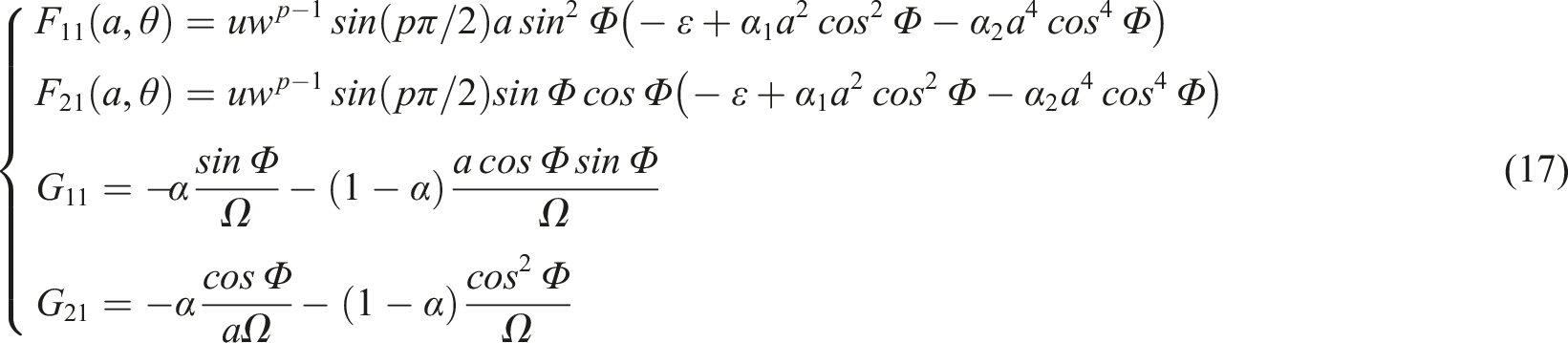
Equation (16) can be regarded as the Stratonovich stochastic differential equation, and by adding the Wong–Zakai correction term, the corresponding Itô stochastic differential equation can be acquired as


Based on the stochastic averaging process and averaging equation (18) over

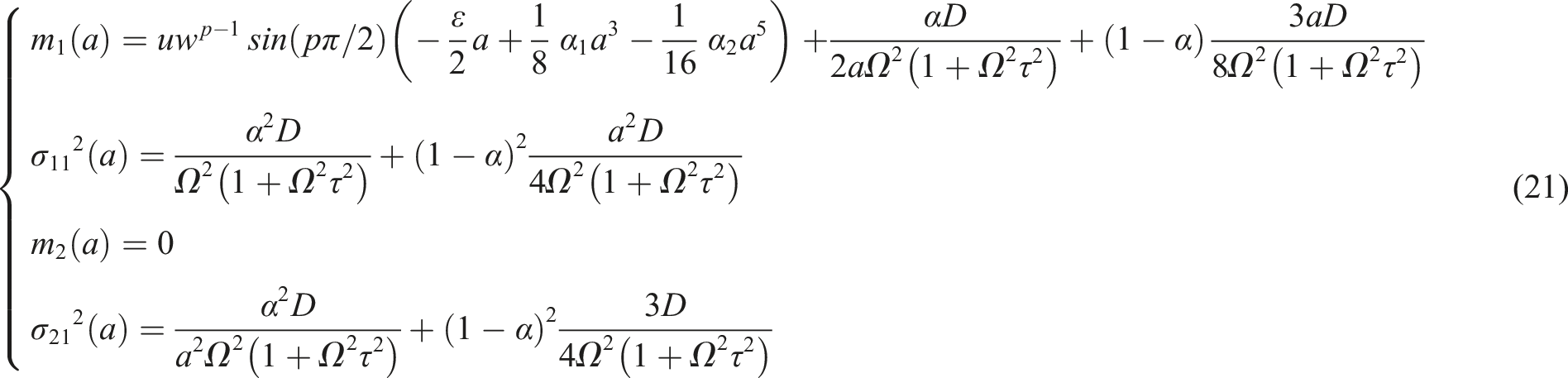
Equations (20) and (21) show that
Hence, the FPK equation of


According to the boundary conditions shown in equation (23), the steady-state PDF of system amplitude


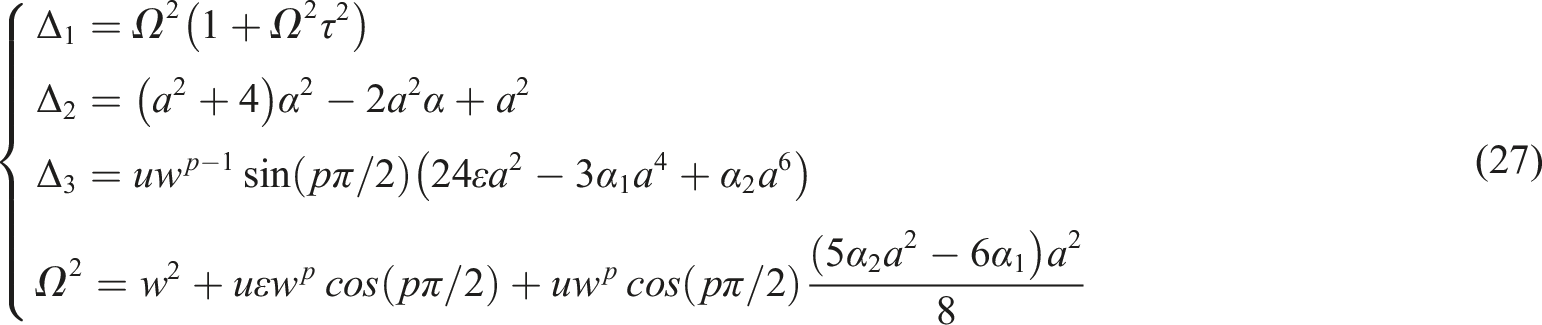
Substituting equation (21) into equation (24), we can get the detailed expression of stationary PDF of the system amplitude

Stochastic P-bifurcation of the system
Stochastic P-bifurcation refers to the variety in the quantity of peaks observed in the stationary PDF curve. In this section, we utilize singularity theory to discuss the effects of parameters on the stochastic P-bifurcation behaviors of the system, and further determine the critical parameter conditions.
For the sake of convenience,

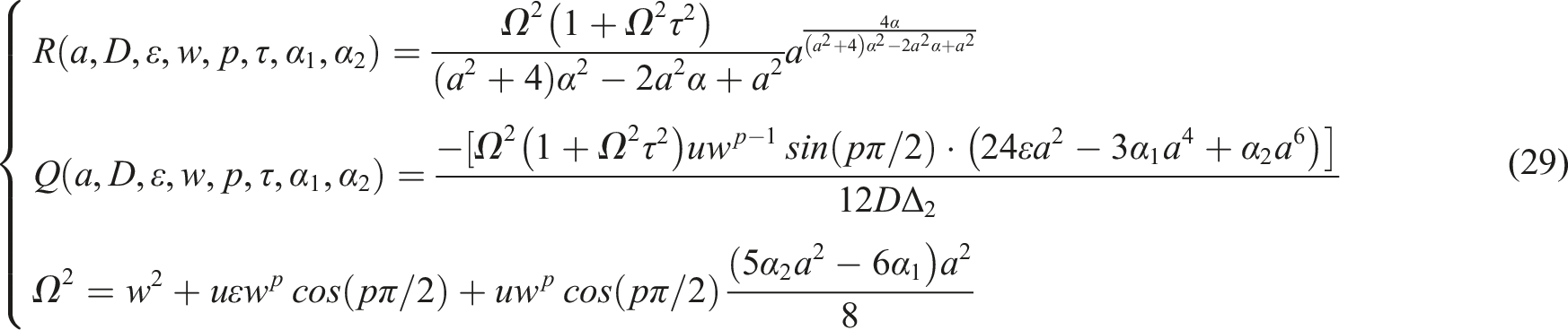
According to the singularity theory,
70
the stationary PDF of system amplitude should satisfy the two conditions as follows


In the following section, we investigate the influences of
The influence of unfolding parameters
and
for stochastic P-bifurcation
Based on equations (29) and (31), we can derive the transition set for stochastic P-bifurcation of the system, and the unfolding parameters Transition set curves (taking 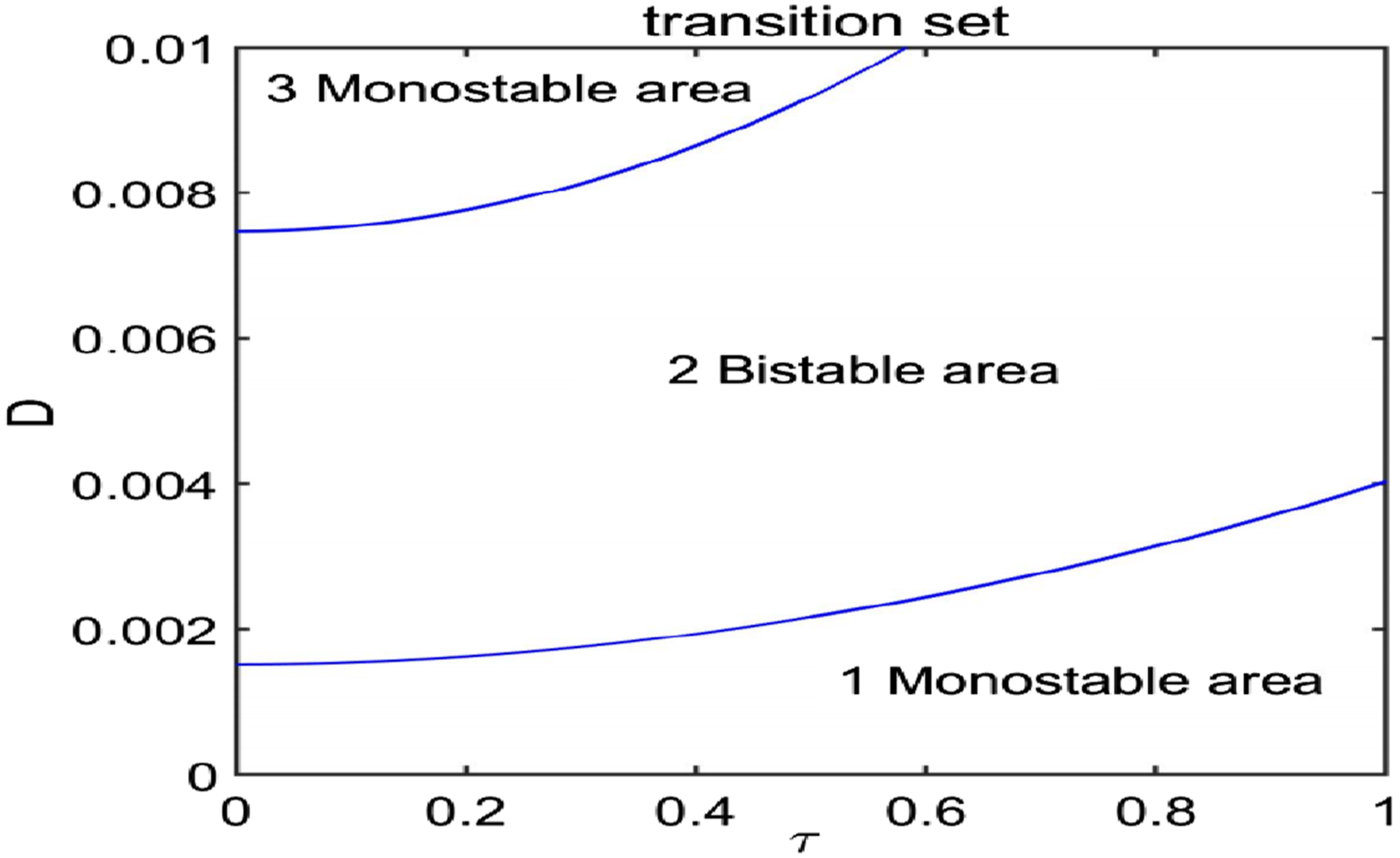
According to the singularity theory, the topological structure of the stationary PDF curves remains qualitatively consistent among various points in the identical region. By selecting one point (
Initially, we investigate the stationary PDF of amplitude 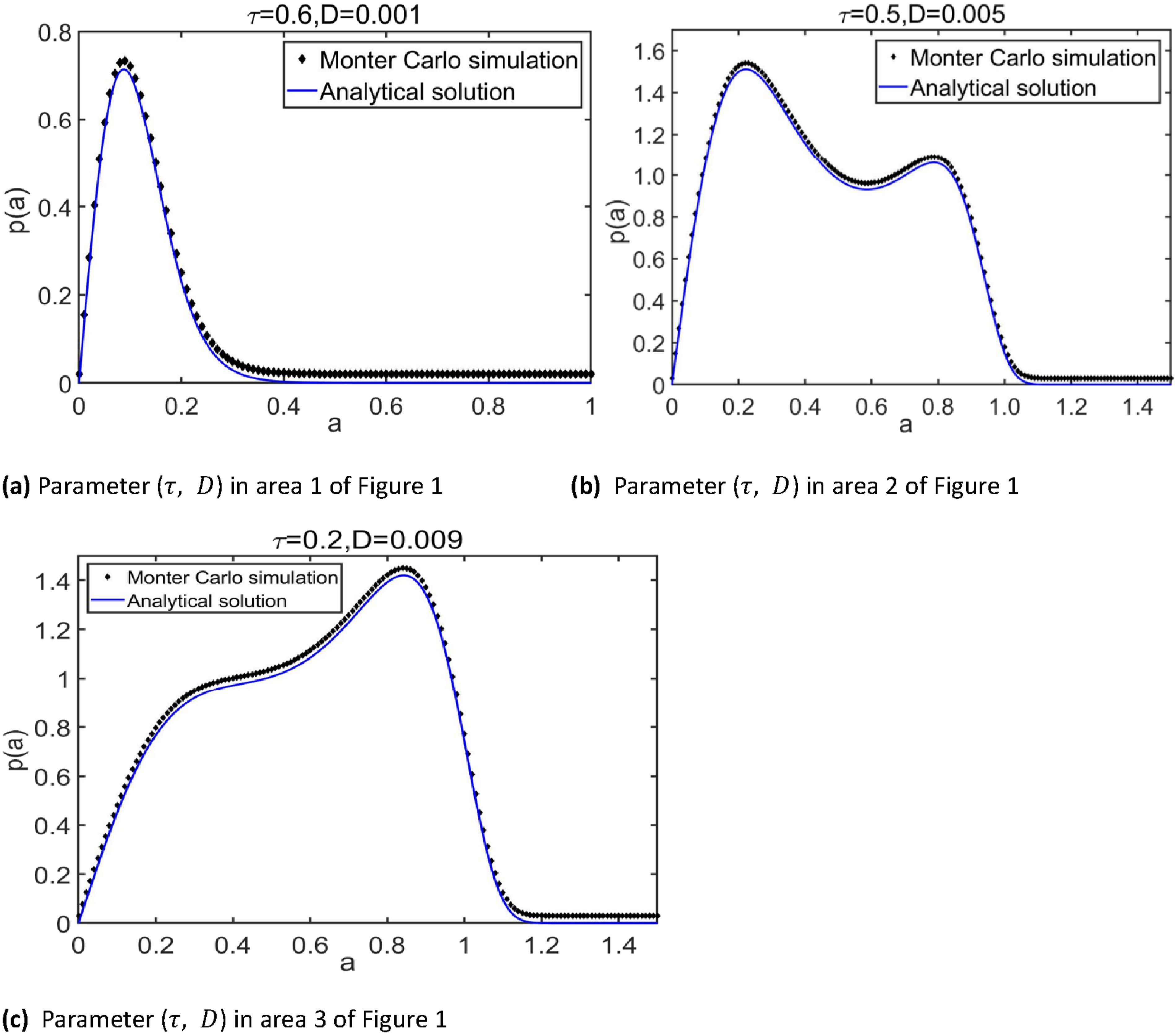
According to Figure 1, the unfolding parametric area where the PDF arises bimodal is surrounded by two curves. When the unfolding parameters (
The influence of unfolding parameters
and
for stochastic P-bifurcation
Without losing generality, we take the value of correlation time Transition set curves (taking 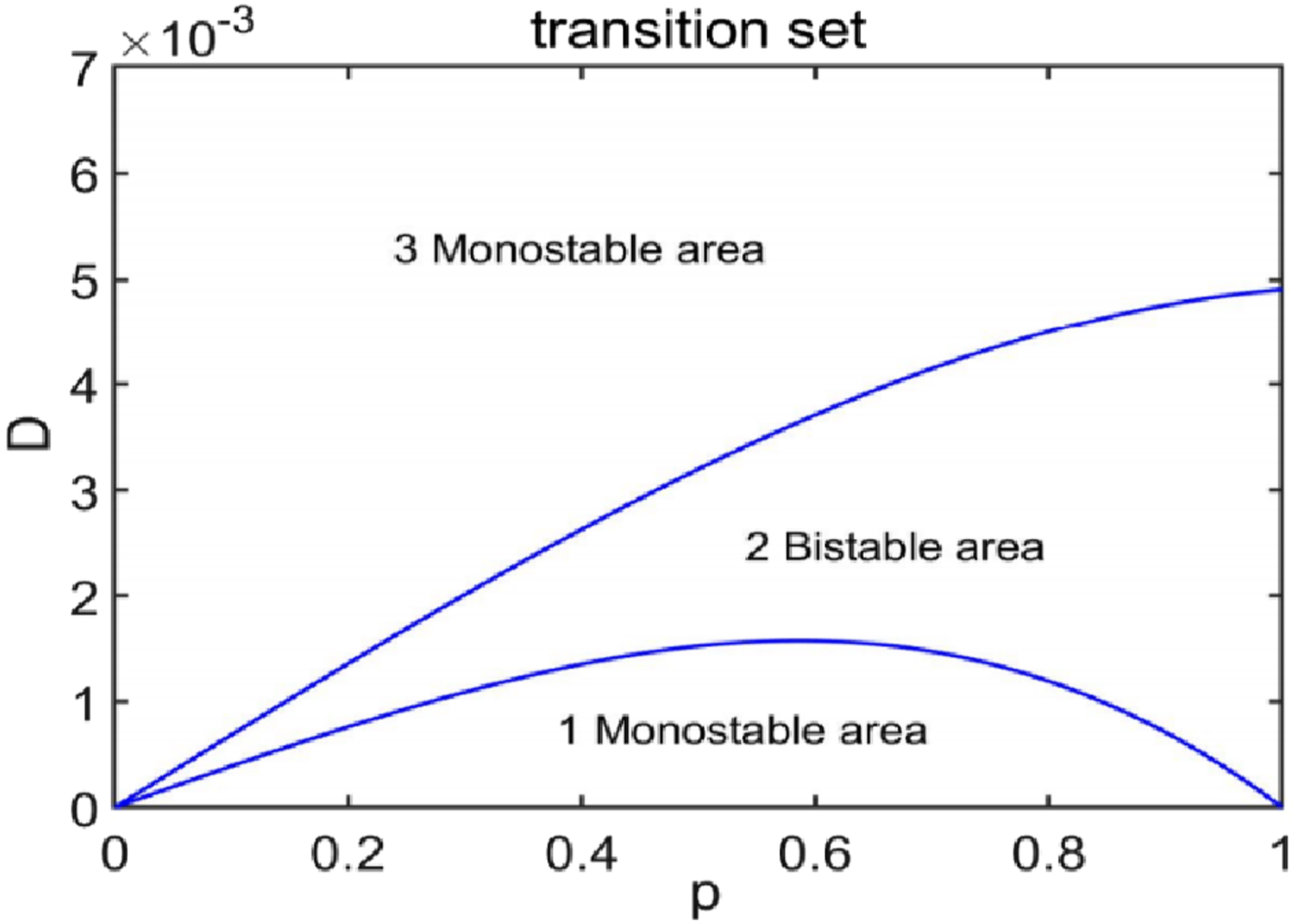
We analyze the stationary PDF 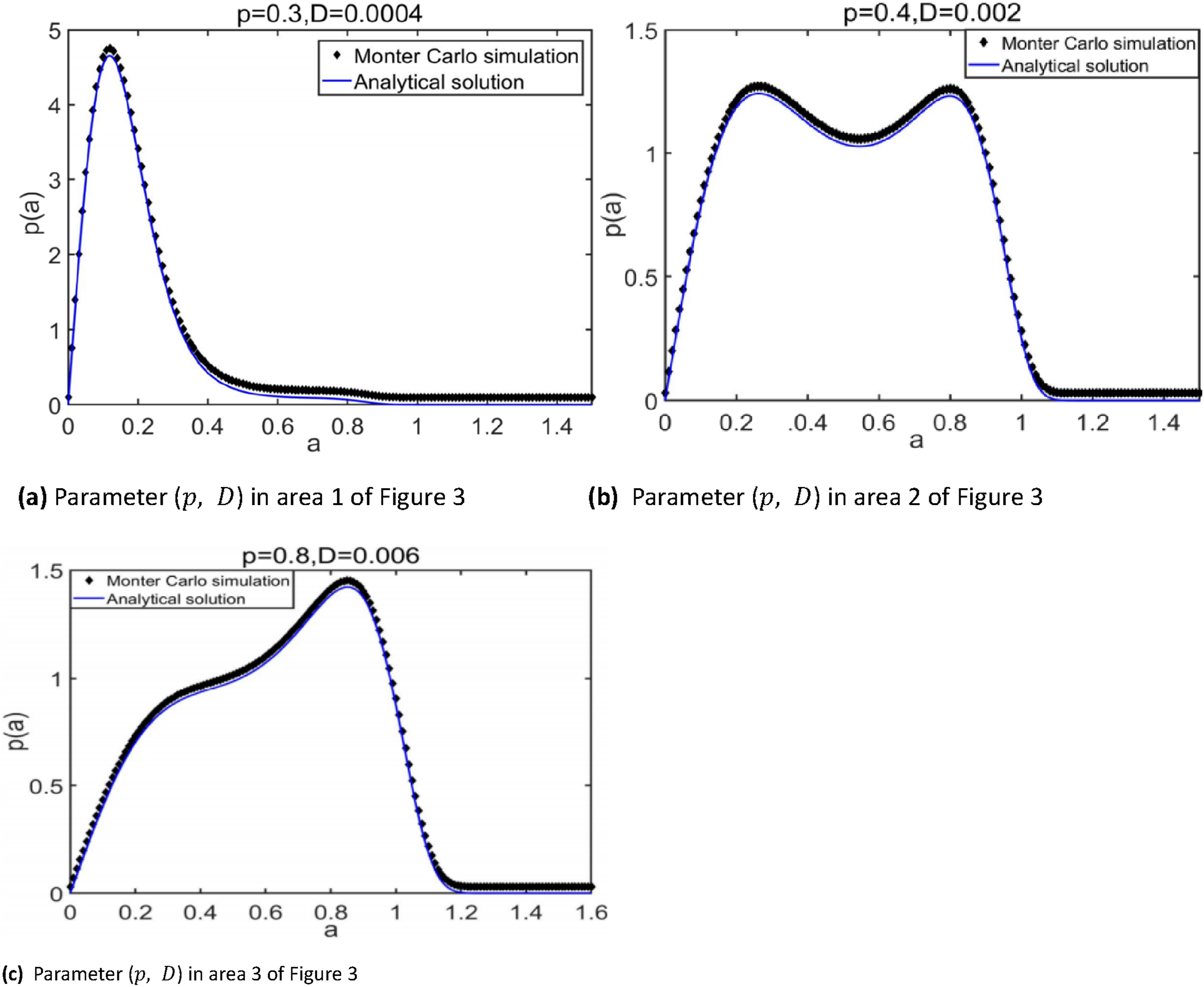
From Figure 3, we can see that the unfolding parametric area where the PDF occurs bimodal is also surrounded by the two transition set curves. And when the unfolding parameter (
In brief, the stationary PDF in any two adjacent areas in Figures 1 and 3 exhibits distinct qualitative property. Regardless of the values of the unfolding parameters, the system will undergo stochastic P-bifurcation behavior as long as the unfolding parameters pass through any line in Figures 1 and 3. Hence, the transition set curves are just right the critical parametric conditions of the stochastic P-bifurcation about the system. The analytic solutions presented in Figures 2 and 4 are well in accordance with the results obtained from Monte Carlo simulation of the original system (3), which provides further validation to the theoretical analysis and demonstrates the applicability of the methods presented in this paper for analyzing the stochastic P-bifurcation behavior of fractional-order systems.
In comparison to the controllers with integer order, the fractional-order controllers exhibit superior dynamic performances and robustness. 71 Over the last few years, a considerable number of controllers with fractional-order derivative have been proposed.72–75 Through the analysis mentioned above, we have identified the critical parameters that the stochastic P-bifurcation will take place in system (3), which can enable the system to convert between monostable and bistable states by choosing the unfolding parameters appropriately. And this should provide the theoretical guidance for analyzing and designing the fractional-order controllers.
Conclusion
This paper investigated the stochastic P-bifurcation of a modified fractional-order Van der Pol system driven by Gaussian colored noise excitation, and the following conclusions can be drawn: (1) The results indicate that each of the fractional derivative’s order (2) The parametric region where the system presents bistable behaviors is surrounded by the two transition set curves, and the transition set curves obtained are just right the critical parametric conditions of the stochastic P-bifurcation about the system. (3) The system’s response can be retained at the monostability or a small vibration amplitude near the equilibrium by selecting the appropriate unfolding parameters, which can provide the theoretical guidance in the design of such systems and prevent damage and instability caused by nonlinear jumps or large amplitude vibrations of the system. (4) It also demonstrates that the theoretical approach utilized in this study is viable to explore the stochastic P-bifurcation phenomena of nonlinear oscillators with fractional-order derivative element.
However, the system studied in the article is the single degree of freedom system, and the complexity as well as the abstraction of state space increase the difficulty to analyze the high-dimensional dynamic system. The investigation of two degree of freedom systems or even higher dimensional and coupled systems should be the next research focus in future.
Footnotes
Acknowledgments
We are very grateful to the anonymous referees for their suggestions and valuable advice.
Declaration of conflicting interest
The author(s) declared no potential conflicts of interest with respect to the research, authorship, and/or publication of this article.
Funding
The author(s) disclosed receipt of the following financial support for the research, authorship, and/or publication of this article: This work was supported by the National Natural Science Foundation of China (Grant Nos. 12002120, 12072222, 12372019 and 11902287); the Key Research and Development (Science and Technology) Project of Henan Province (Grant No. 212102310945); the Youth Backbone Teacher Training Project and the Academic and Technical Leader of Henan University of Urban Construction (Grant Nos. YCJQNGGJS202111 and YCJXSJSDTR202308).

Data availability statement
The data work can be available upon the reasonable request from the authors Zhiqiang Wu (