




Abstract
This study aims to primarily assess the dynamic behavior of ground-supported cylindrical tanks to real near-fault earthquake records with different frequency contents including soil-structure interaction effects. A cylindrical tank’s fluid-tank-soil interaction is modeled using a three-degree-of-freedom lumped mass model for the fluid. A mass-spring-dashpot model with frequency independence is used to model the soil/foundation system. Broad, medium, and slender tank models are developed considering and ignoring the soil flexibility effect. An algorithm based on discrete-time state-space approaches is developed for performing numerical simulations of the modeled tanks excited by the low-, medium-, and high-frequency contents. The obtained results for the modeled tanks in terms of base shear, overturning moment, and connective and impulsive mass displacements incorporating the influence of supporting soils as well as the frequency contents of excitation records are evaluated and compared with the corresponding results for modeled tanks with a fixed base. In addition, the liquid sloshing height for all aspect ratios is also evaluated and compared. The study’s findings clearly indicate that records with low-frequency contents require significantly more seismically demanding than other records for the considered soil types. Remarkably, soil-tank interaction under earthquake motions substantially amplifies the induced response.
Introduction
Ground-supported tanks with significant capacities are integral components of contemporary society and industry, serving as indispensable means of human life. These tanks are designed to store a wide range of fluids, including potable water, firefighting water, chemicals, petroleum, liquid natural gas, spent nuclear fuel assemblies, and various forms of industrial waste. In light of the significance of these kinds of structures, it is of the utmost importance that tanks work adequately in the event of an earthquake. In the event of an earthquake-induced damage, these structures not only pose a threat to the environment but also entail substantial economic burdens on both society and industry.1,2 According to data gathered from previous seismic events, engineers and researchers have concluded that liquid storage containers may experience hydrodynamic pressures generated inertia during earthquakes. As a result, for steel tanks that have been inadequately designed, higher stresses may induce fracturing in the tank walls. There is a possibility that the stresses in concrete tanks could be significant. This is because of the combined effects of the liquid’s weight and the concrete’s huge inertial mass. These tanks suffer a great deal of strain during an earthquake, as a complicated pattern of stress affects them, such that poorly designed tanks have leaked, buckled, or even collapsed during seismic events. This could lead to a range of unfavorable outcomes, including cracking, leakage, or even the collapse of the tanks. 3 Anchorage collapse and buckling of the stainless steel tank wall were among the damage detected in these tanks following the 2010 Maule earthquake. The primary damage noticed during the Napa Valley earthquake was the stainless steel wall’s diamond-shaped buckling failure along with the tanks’ anchorage failure to the concrete base. It should be noted that the conditions for elevated tanks rementioned structural damage caused by previous earthquakes catalyzed the inquiry into this issue, ultimately leading to the improvement of these structures’ behaviors. There have been a great number of investigations conducted on the seismic response of cylindrical tanks located at ground level. It should be noted that the conditions for elevated tanks, rectangular tanks, and underground tanks are not consistent with one another. The majority of the most important studies that have been conducted on this topic can be summed up as follows:
Hoskins and Jacobsen 4 published the initial study of both theoretical and experimental results for rigid rectangular tanks subjected to simulated seismic excitation. Under the presumption that the tank walls and base are extremely rigid, Housner5,6 offered a simple approximation of a method that may be used to determine the hydrodynamic pressures of a rigid rectangular tank excited horizontally by an earthquake. Through the utilization of lumped mass approximation, he devised a model that allows for the separation of hydrodynamic pressure into impulsive and convective components. Floor acceleration spectra for a special concentrically braced frame supporting a cylindrical liquid storage tank subjected to 47 ground motion records and 8 seismic intensities are derived by Merino et al. 7 Cohen et al. 8 conducted a study on the seismic behavior of an elevated steel water tank located inside a reinforced concrete chimney. The purpose was to determine the best position for the tank and assess various tank shapes. The tank is situated at an altitude 63 m lower than the midpoint of the 200 m chimney. An examination of the characteristics of liquid sloshing modes was carried out by Wei et al. 9 using a shaking table test. Furthermore, Wei et al. used the shapes of the first three sloshing modes under unidirectional excitation to validate the symmetry of the modes based on their determinations. Lanzanó et al. 10 conducted a multi-disciplinary study to examine the seismic vulnerability of certain industrial equipment, such as pipelines, underground tanks, and buried basins. A research was conducted to collect data on the damages caused by earthquakes to pipelines. Following significant seismic events that caused extensive damage to tanks of contemporary design at the time, including Niigata and Alaska (1964), Parkfield (1966), Miyagi Prefecture (1978), and Imperial County (1979), numerous investigations were conducted to examine the dynamic interaction of the liquid and the tank’s deformable walls. 11 According to the study’s findings, a flexible tank’s seismic response might be far higher than that of an equivalently rigid tank. In addition, Hashemi et al. 12 introduced an analytical technique to calculate the seismic response of liquid-filled rectangular storage tanks in three dimensions with four flexible walls. They came to the same conclusion as their earlier findings, which was that the seismic responses of a flexible rectangular tank might be significantly amplified in comparison to an analogous rigid tank. Veletsos 13 was the first to study how wall flexibility affects hydrodynamic pressures. He demonstrated a straightforward methodology for assessing the hydrodynamic forces generated in flexible containers filled with liquid.
The dynamic behavior of a flexible rectangular tank under hydrodynamic pressures was examined using various numerical approaches, including the 3-D Lagrangian fluid finite approach,14,15 the 3-D coupled boundary element–finite element approach,16,17 the finite element approach, 18 and the Rayleigh-Ritz approach. 19 The techniques employed for the dynamic analysis of flexible rectangular fluid tanks are quite intricate and not readily reproducible by practical engineers who are currently working in the field. Simpler solutions were suggested to bridge the divide between theoretical research and real-world design issues in rectangular tanks. A generalized single-degree-of-freedom (SDOF) model was presented by Chen and Kianoush 20 to investigate the dynamic behavior of two-dimensional rectangular tanks. A 3-DOF model of a rectangular tank supported by the ground was produced by Hashemi et al. 21 The tank wall’s deformability was considered in this model, and the use of this model resulted in design charts that were utilized to estimate sloshing, impulsive, and stiff masses. The previously mentioned investigations focused exclusively on the structural system. Nevertheless, the investigations did not take into account the impact of soil-structure interaction (SSI).
The coupling effect between the soil beneath the foundation and tank bottom in ground-supported,22–26 elevated,27,28 and base-isolated cylindrical tanks29,30 has been the subject of some exploratory research. Furthermore, an exhaustive investigation is carried out by Veletsos and Tang 23 into the dynamic response of liquid-containing containers in various geometries (rectangular, cylindrical, rigid, or flexible) to an arbitrary time variation in the rocking foundation motion. The well-established mechanical model 24 for rigid tanks that are laterally excited and supported on a non-deformable medium allowed for the incorporation of base rocking and the effects of tank and ground flexibilities. They used their model to gain insight into how the interaction between soil and structure affected the behavior of cylinder-shaped tanks that were shaken horizontally on the ground. An investigation was conducted to determine how the cylindrical tank responds to both lateral and rotational movements of the base, and the relationship between these responses was established. The model that Housner devised for flexible cylindrical tanks was developed by Haroun and Ellaithy. 25 Both the impacts of rocking motion associated with a rigid base and the effects of lateral translation are taken into consideration. In a cylindrical tank, Haroun and Abou-Izzeddine 26 explored the interaction between soil and a cylindrical tank under horizontal seismic excitation. They carried out an extensive parametric analysis to investigate the effects and relative relevance of certain variables that influence a tank-liquid-soil system’s seismic response. Livaoglu and Dogangun 27 put forth a recommended approach for performing seismic analysis on systems comprising elevated tanks, fluid, foundations, and soil. In addition, Livaoglu and Dogangun 28 carried out a further study to investigate the influence that the embedment of the foundation has on the seismic performance of fluid-elevated tank-foundation-soil systems. This investigation was carried out when the fluid-storing tank was supported by a structural frame.
Precise tank design is necessary for acceptable performance, and the first step in accurate design is to identify all relevant factors. Soil characteristics, structural systems, ground motion parameters, and seismic design categories are among some of the important factors. Of all the factors included, the characteristics of the underlying soil and ground motion parameters have a significant amount of uncertainty in the numerical model. Based on a review of the investigations mentioned above, there aren’t many that look into how the relationship between the soil and the tank affects the seismic behavior of cylindrical tanks. Ulloa-Rojas et al. 31 evaluated the effect of soil type on the seismic fragility of two different tank geometries subjected to 21 Chilean seismic records. The work focuses on elephant foot buckling for tanks with both un-anchored and anchored bases and compares the influence of three different types of soil and a no-soil condition. The simultaneous effects of the fixity condition, the supporting base flexibility, and the aspect ratio of a cylindrical liquid storage tank on the response are experimentally investigated by Diego et al. 32 Furthermore, few papers that are now available have investigated the impact that varying levels of earthquake frequency content have on distinct seismic excitations. A shaking table test was performed on liquid storage steel tanks excited by both far- and near-fault ground motions with horizontal unidirectional, vertical unidirectional, and combined horizontal and vertical bi-directional excitations in X-, Z-, XZ-direction. 33 The relationship between the excitation frequency and the formation of strains in the wall of an anchored cylindrical upright water tank has been experimentally studied by Hernandez et al. 34 The tank is attached to a shake table, has a partial water fill, and is constructed of low-density polyethylene. Diego et al. 35 investigated the storage tank’s response experimentally, determining the relationship between excitation frequency and both hoop and axial wall stresses in an upright water storage tank. The chosen excitations are either harmonics, which are a single frequency, or narrow-bandwidth harmonics, which are a range of frequencies that represent the frequency content of a variety of recorded earthquake ground motion. The novelty of the present work is to exhaustively examine the influence of soil-structure-fluid interaction and the frequency content of earthquakes, which constitutes a significant ground motion characteristic, on the structural performance of ground-supported cylindrical storage containers. This increase in understanding is accomplished by using time-histories and their spectrograms.
Tanks are modeled using various geometries, specifically broad, medium, and slender. In each geometry, different base conditions are considered: one case considers fixed-base tanks, while the other considers the underlying soil beneath the foundation to be flexible considering different soil types. The time-history records are consistently scaled to match the designated intensity level. The study aims to accomplish the following specific objectives: (i) to assess the fluid-tank-soil system’s seismic response, taking into consideration both scenarios of supporting soil, namely, soft and extremely stiff soil; (ii) to compute the impacts of rotational and horizontal kinematic responses of the soil supporting the foundation on the induced responses and peak responses of the convective and impulsive masses as a result of using earthquake records with varying frequency contents; (iii) to compare soil-supported cylindrical storage tanks’ seismic responses to different soil types, including base shear, overturning moment, and sloshing height, (iv) to examine the effect of soil-structure-fluid interaction on the induced base response time histories, and (v) to analyze the frequency content’s influences on the seismic performance of cylindrical storage tanks.
It is thought that the current work has the potential to give practicing engineers a straightforward and accurate instrument for predicting the seismic response of cylindrical liquid storage tanks. Additionally, it has the potential to provide some helpful recommendations for potential changes to the code provisions.
Model for fluid-cylindrical tank–soil/foundation system
The dynamic response of an equivalent mathematical model for fluid-cylindrical tank–soil/foundation systems in which, the external soil medium and inside fluid synchronously interact with structures, has been evaluated using a diversity of ground earthquake motions. Using the three-degree-of-freedom lumped mass model for fluid developed by Haroun and Housner, the interaction between a cylindrical tank’s fluid, tank walls, and soil is modeled, and the mass-spring-dashpot model for the soil/foundation system.
Figure 1(a) depicts the complicated effect of the entire system, which is primarily composed of two major components: the fluid–structure interaction subsystem and the SSI subsystem. These techniques, as well as the comprehensive mechanical model given for the fluid-tank-soil system, take into account the influence of the tank wall’s flexibility and are discussed later below. (a) The proposed fluid-cylindrical tank-soil/foundation system; (b) Idealized model of liquid storage tanks.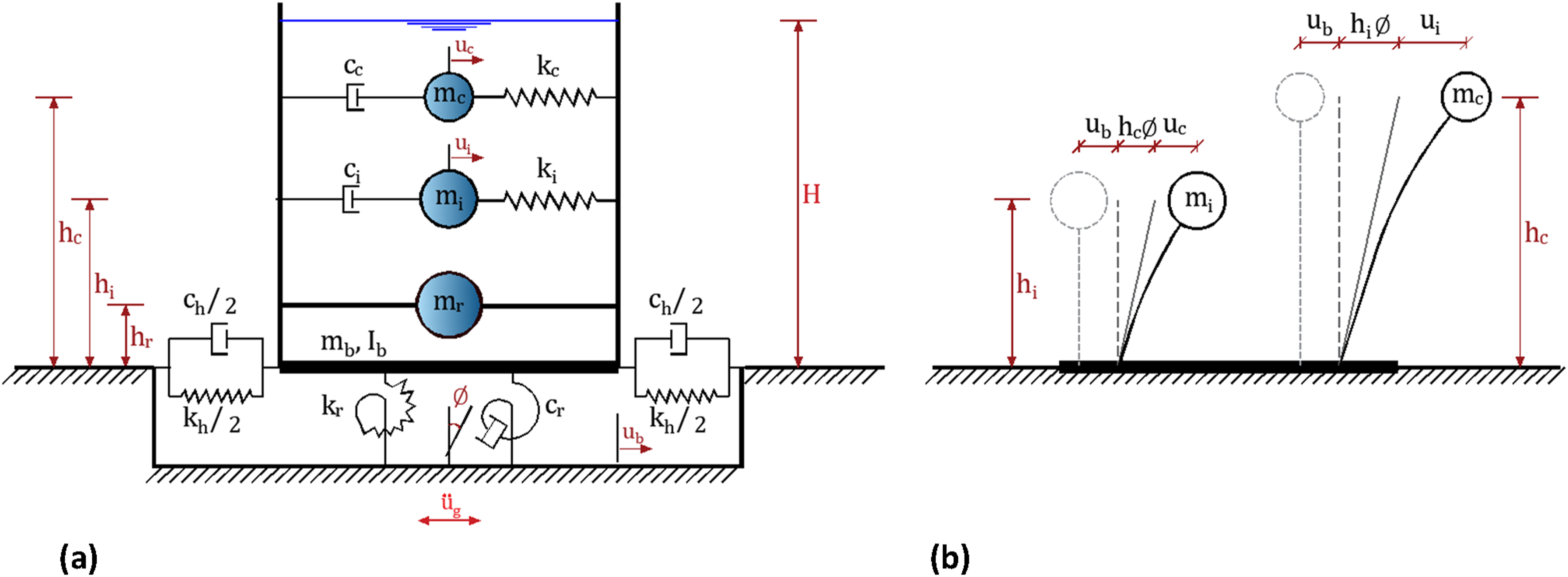
Fluid–structure interaction
Instead of a 3D finite element model for a liquid holding tank that takes a lot of time to compute, the simplified methodology based on Haroun and Housner’s three-lumped mass-spring model36,37 has been employed in the current study for the ground-supported flexible tank’s seismic assessment. The fluid receives seismic energy from the ground through the shaking of the tank. As a result, the fluid in the tank is interacting with the tank wall. While part of the liquid moves with the tank and contributes to its acceleration by acting as additional mass, the remaining part is considered to slosh inside the tank. The sloshing phenomenon is primarily caused by the liquid’s upper portion, which, rather than propagating horizontally along the container’s wall, induces seismic waves.
38
An irrotational-flowing, incompressible, non-viscous liquid is partially filled into the cylindrical storage tank that is being considered here. As illustrated in Figure 1(a), the entirety of the liquid that is contained within the tank is divided into three distinct masses. The convective mass is the upper-part liquid mass that moves in a sloshing motion and alters the free-surface liquid (
Let




The non-dimensional parameters



Equations (8) and (9), respectively, can be used to determine the first natural frequencies of the convective (



It’s worth mentioning that equations (5)–(10) are from Shrimali and Jangid 43 and were developed through the process of curve fitting using the charts that were provided by Haroun. 44
The convective and impulsive masses’ shear stiffness and damping characteristics can be estimated as follows:




In reality, the impulsive and convective frequencies of the tank-water system placed on a flexible supporting base are influenced by the flexibility of the foundation soil. Veletsos,
13
NZSEE,
45
and Malhotra et al.
46
calculated the soil-tank-water system’s fundamental mode of vibration for convective and impulsive modes using Equations (15) and (16), respectively.


Soil–foundation interaction modeling
The direct method 47 and the substructure method48,49 are two distinct modeling techniques that incorporate soil medium for analyzing SSI systems. The direct technique employs the finite element method to integrate the complete structure’s foundation and soil system in a single phase, and then the soil motion is conveyed to the internal component of the structure via finite nodes in the foundation interface. This approach works effectively when considering soil’s nonlinear material laws. In contrast, the substructure technique divides the whole structural system into three independent parts: the soil medium, the foundation, and the superstructure. Modeling and analysis of the SSI system are carried out in multiple stages, and to obtain the final response, the principle of superposition is utilized. The substructure approach’s simplified soil model outperforms a direct approach in terms of computational accuracy as well as effectiveness. Consequentially, the study has utilized the substructure method of SSI modeling where the foundation–soil interaction is represented as frequency-dependent impedance functions. Each impedance function is complex-valued mathematically, with its real and imaginary components modeled by a spring and dashpot positioned between the foundation and the ground to simulate the swaying and rocking response of rigid foundations’ impedance. The translational and rotational springs are utilized to represent the sway and rocking degrees of freedom, and the tank’s base is considered to be rigid with a circular shape as shown in Figure 1(a). Viscous dampers are also employed to represent the supporting soil’s energy dissipation caused by radiation and material dampening.
Most research studies have shown that uplift modeling is intrinsically complex due to the significant material and geometric nonlinearity. Additionally, recent studies have shown that permitting uplift can significantly reduce the damage to tanks and generally reduce the base shear and the base moment.50–52 For these reasons, only the rocking performance of the base of the fluid-tank-soil system was considered in these investigations.
The values of the sway stiffness and damping coefficients are characterized using the following formulas
53
:


The following expressions
53
can be used for expressing the values of rocking stiffness and damping coefficients:


Governing equations of motions
Consider the schematic representation of the equivalent mathematical model of the cylindrical ground-supported model of tank containing liquid considering the SSI effect depicted in Figure 2 under the ground excitation defined by the ground displacement Definition of the kinematics quantities, base translation, rigid base rotation and deformation due to wall deformability, used in the formulation.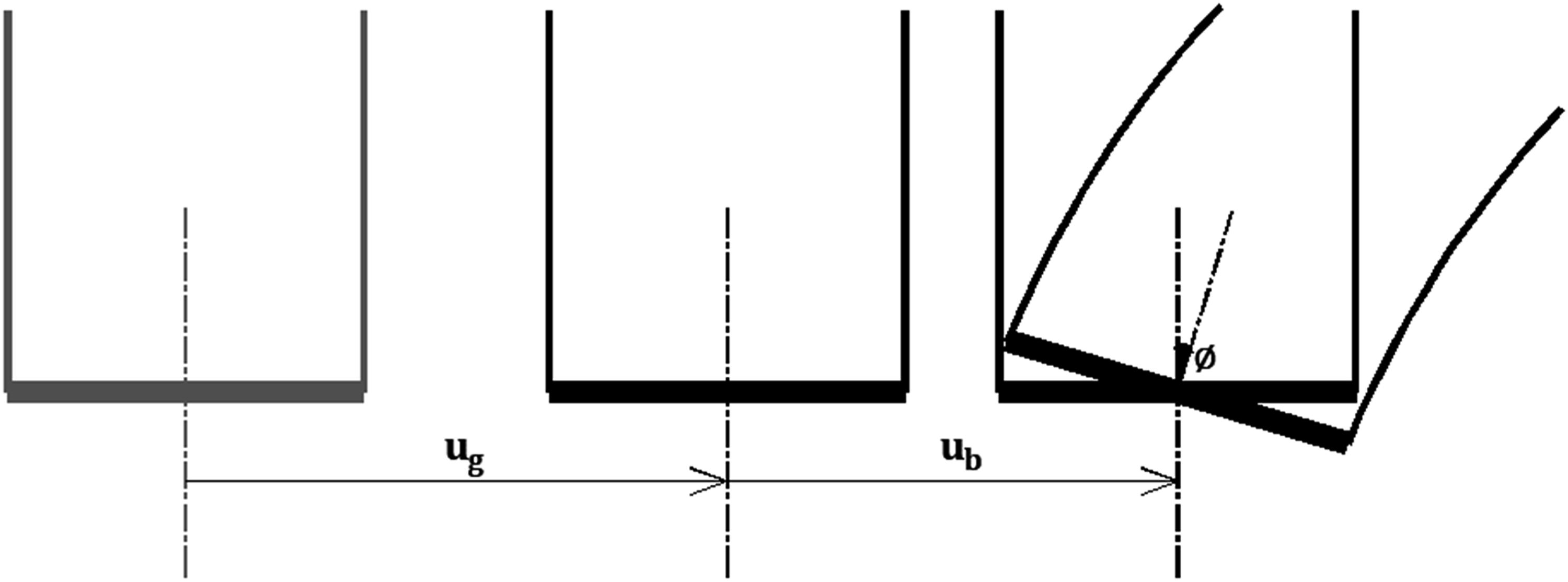
The dynamic governing equations of the analyzed global model in the time domain are described in matrix form (in which the dots represent time-dependent derivatives) as:

The system’s degrees of freedom are accumulated in the displacement vector




Both
The horizontal base shear and base moment are proportional to the wall’s relative acceleration and are calculated as follows:


The liquid surface’s vertical displacement can be calculated using the equation as follows
57
:

Earthquake records
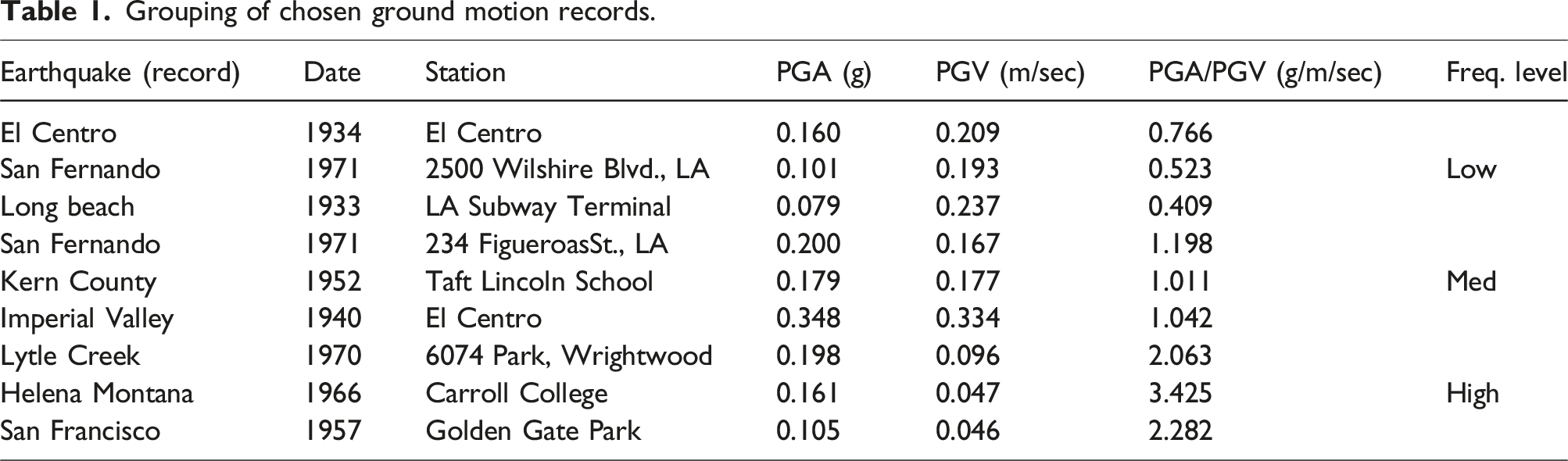
For exciting the models that are being investigated, a collection of nine ground motion recordings originating from seven distinct seismic events have been chosen as input motions. The chosen records all include peak ground accelerations greater than 0.1 g and recorded on stiff soil or rock sites. The acceleration records were then scaled to yield a peak ground acceleration (PGA) value of 0.5 g in the ground response analyses. The ratio
Grouping of chosen ground motion records.
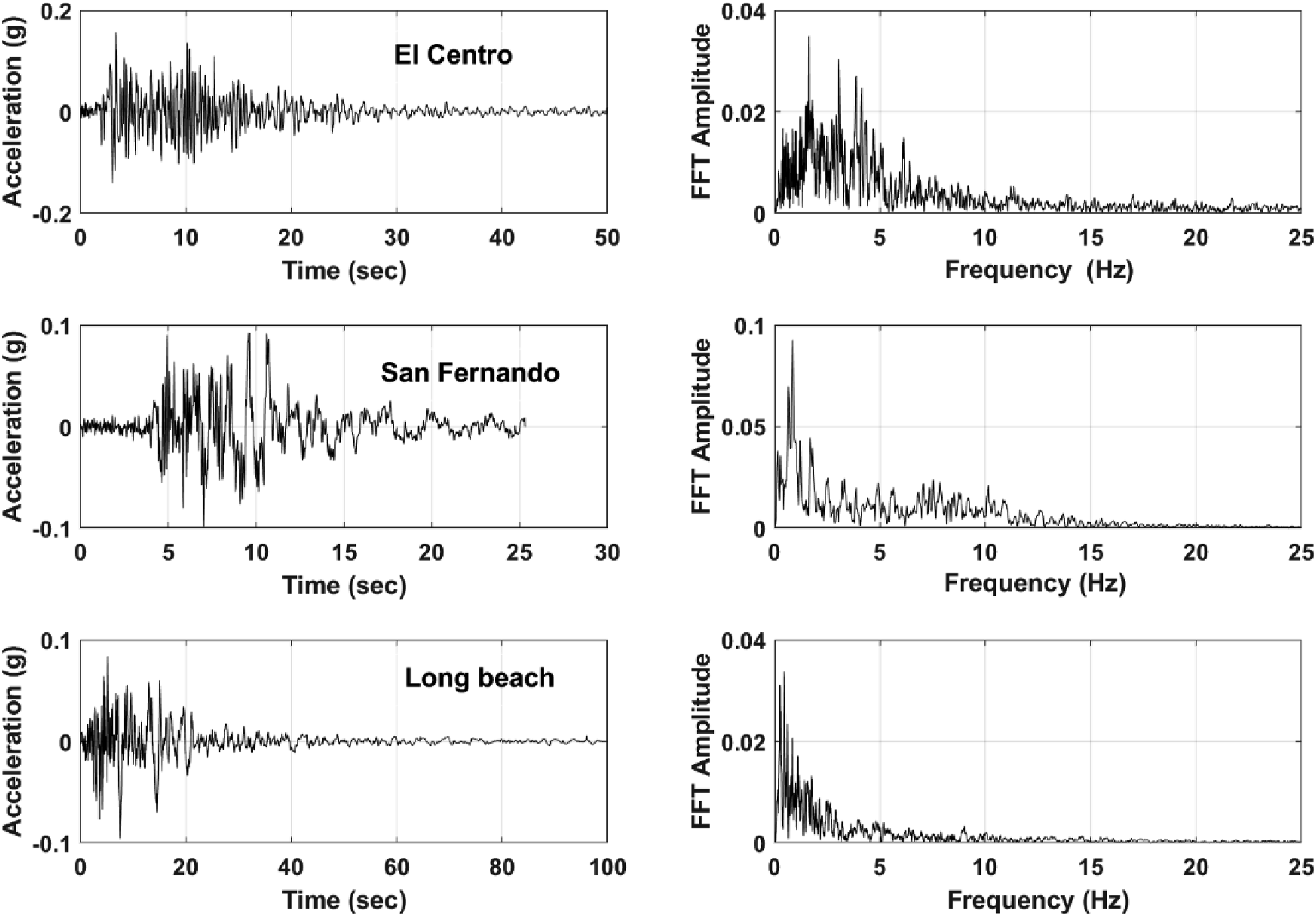
Acceleration time histories and frequency of El Centro, San Fernando, and Long beach as representatives of low-frequency records.
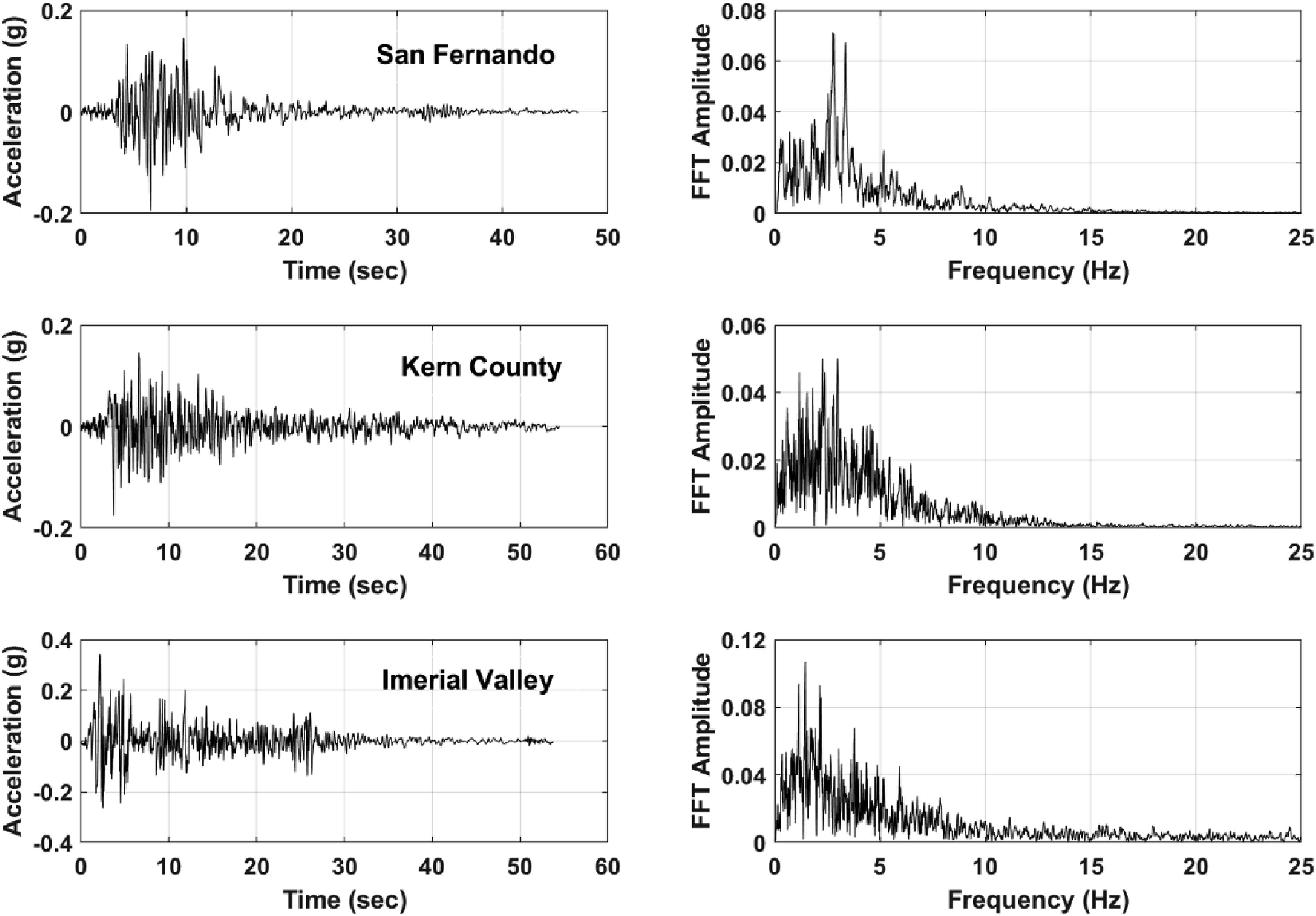
Acceleration time histories and frequency of San Fernando, Kern County, and Imperial Valley as representatives of medium-frequency records.
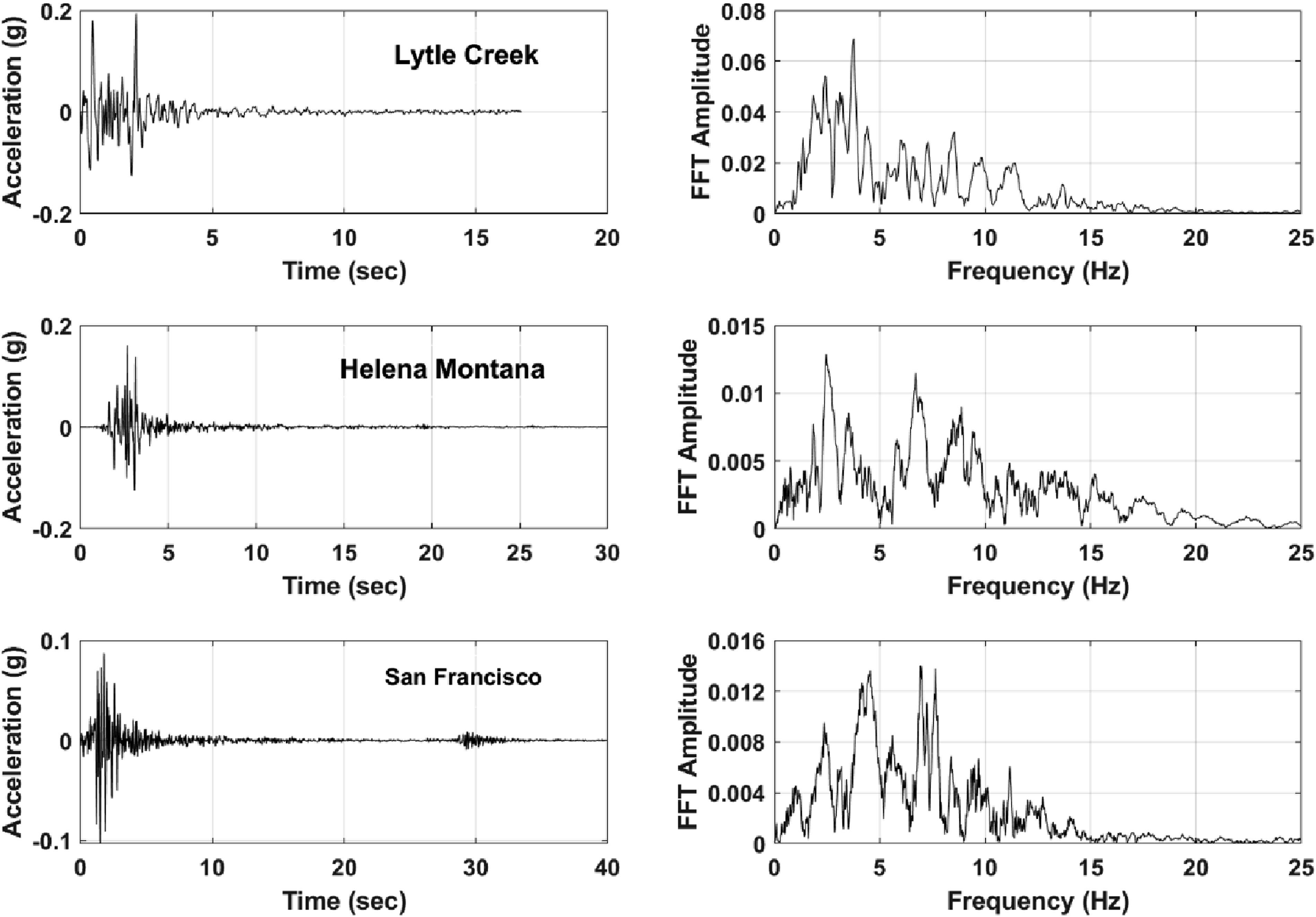
Acceleration time histories and frequency of Lytle Creek, Helena Montana, and San Fernando as representatives of high-frequency records.
Verification of the proposed model
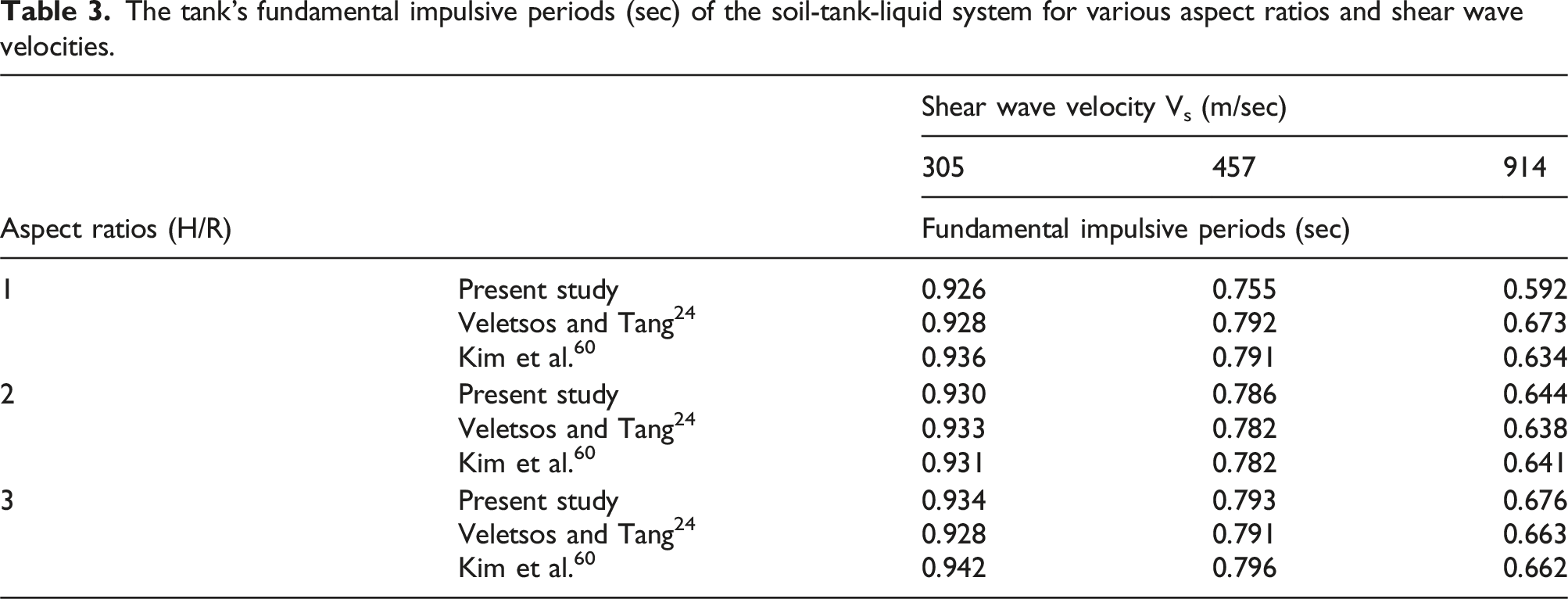
To verify the provided model’s validity and accuracy, a seismic analysis of a steel liquid-filled cylindrical storage tank is implemented. A MATLAB-based computer program is implemented to evaluate the credibility of the current computational algorithm’s results through a comparative analysis of the obtained results and those reported in earlier research. The tank under consideration has the following dimensions: radius R = 7.32 m, height h = 21.69 m, wall thickness ts = 0.0254 m, and liquid mass density ꝭw = 1000 kg/m3. The tank is constructed from steel, which possesses the following attributes: Young’s modulus, Es = 210 GPa; Poisson’s ratio, υ = 0.3; and mass density, ꝭs = 7840 kg/m3. The tank was subjected to an earthquake that occurred in Kobe in 1995 and had a peak ground acceleration (PGA) of 0.834 g.
Verification of the cylinder-shaped fixed-base liquid storage tank’s peak base shear and bending moment, as determined by this study.

The tank’s fundamental impulsive periods (sec) of the soil-tank-liquid system for various aspect ratios and shear wave velocities.
Response analysis and discussions
Soil types and the associated parameters, stiffness, and damping coefficients.

An investigation is conducted on the impact of the slenderness ratio on the overall system’s seismic performance by using tanks with the same radius, R = 25 m, which is maintained constant throughout the analysis. Additionally, the filling water height conditions are varied, with 10% of the height reserved for the sloshing wave. Furthermore, the tank’s roof is of sufficient height to prevent liquid sloshing. The slenderness ratio of the slender tank is 3, the ratio of the medium tank is 1.5, and the ratio of the broad tank is 0.75 (which means that the heights of the liquid columns are taken as 75, 37.5, and 18.75 m, respectively). Consider that the water that has been filled in the tank is incompressible and has a mass density of ꝭw = 1000 kg/m3. It is assumed that the tank walls are thin deformable steel plates with a thickness of ts = 0.004 R, which is supposed to be constant throughout the height of the tank. The elasticity modulus, Es, is set at 200 GPa, and the mass density, ꝭs, is set at 7900 kg/m3. Poisson’s ratio, νs, is set at 0.3. The sloshing and impulsive masses’ fundamental periods in the slender, medium, and broad tanks for fixed-base cases are found to be 7.39, 1.28; 7.42, 0.549; and 7.87, 0.306 s, respectively. The convective mass of the tanks is considered to have a damping ratio (ξc) of 0.5%, while the impulsive mass is assumed to have a damping ratio (ξi) of 2%. The rigid foundation slab’s mass, mb, is considered to equal 5% of the tank’s liquid mass, m, that is, πR2H ꝭw. The inertia moment of mass of a foundation slab with radius R and thickness ts is Ib = mb (3R2 + ts)/12. The stiffness, masses, and effective height of convective and impulsive masses are calculated from the above geometric and material properties of the liquid-tank system and used as inputs in the model, along with the supporting soil properties, to investigate the effect of seismic excitation frequency on the seismic responses of the flexible cylindrical storage tank. For this purpose, the ground-supported cylindrical tanks are subjected to real earthquake ground excitations that are categorized into three different groups according to the intensity of the frequency content. There are three ground motion time histories included in each group, and all of the acceleration recordings are scaled up to 0.5 g.
SSI effect on the liquid sloshing height
Figures 6–8 depict the time histories of liquid sloshing wave heights of the liquid storage tank with different aspect ratios during three earthquakes with varying frequency levels and diverse supporting soil conditions. As a summary, Table 5 compares the peak values of liquid sloshing wave height for fixed-base tanks versus flexible-base tanks for two different types of supporting soil beneath the tank models’ bases, dense and soft soil, under nine ground motions for different aspect ratios. Time histories of the liquid sloshing height of the cylindrical storage tank located on various soil types during the low-frequency El Centro earthquake for (a) the slender tank, (b) the medium tank, and (c) the broad tank. Time histories of the liquid sloshing height of the cylindrical storage tank located on various soil types during the medium-frequency Imperial Valley earthquake for (a) the slender tank, (b) the medium tank, and (c) the broad tank. Time histories of the liquid sloshing height of the cylindrical storage tank located on various soil types during the high-frequency Helena Montana earthquake for (a) the slender tank, (b) the medium tank, and (c) the broad tank. Peak quantities of liquid sloshing heights for the cylindrical storage tanks with different aspect ratios, considering and ignoring SSI under various ground motions.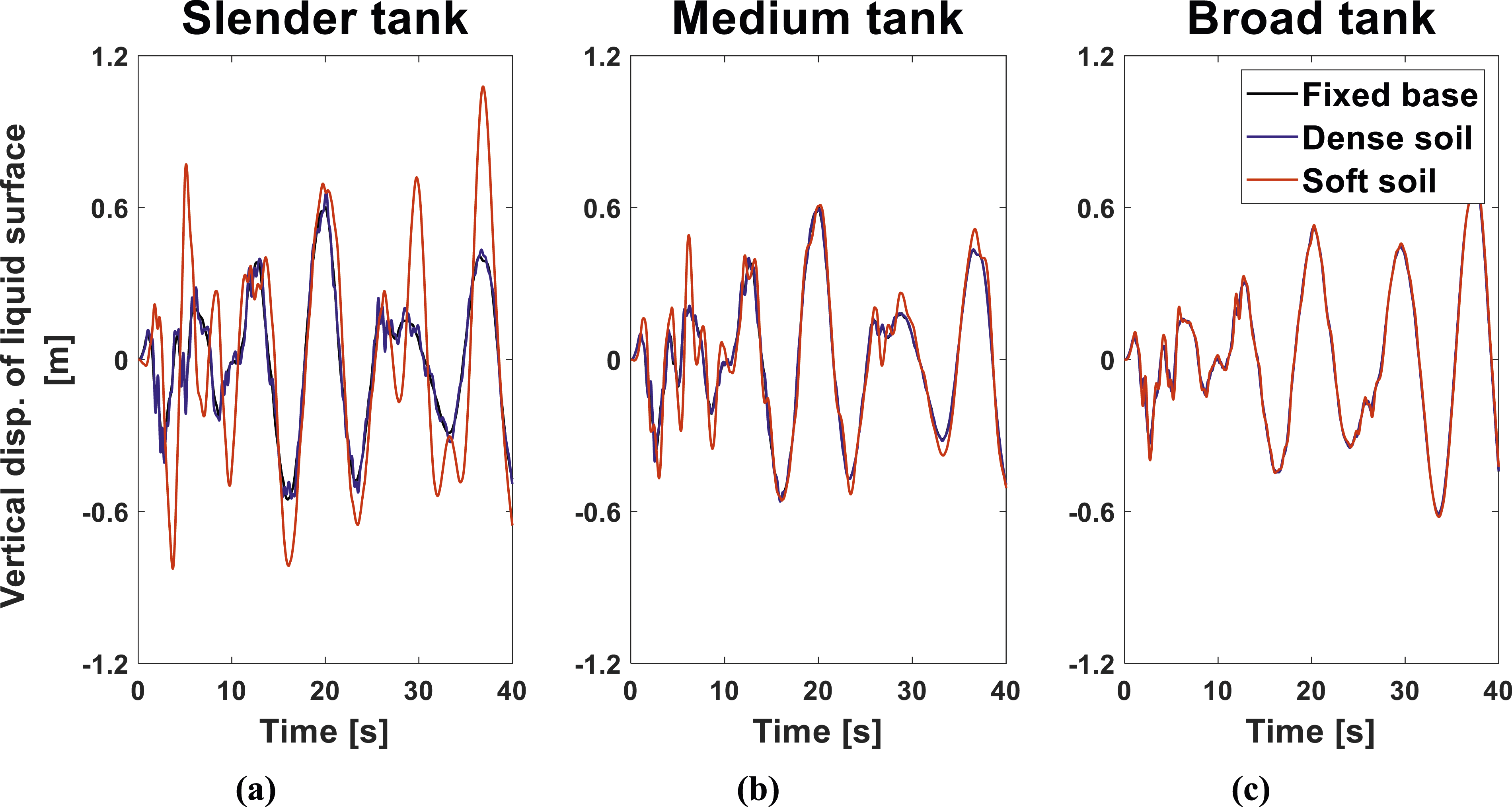
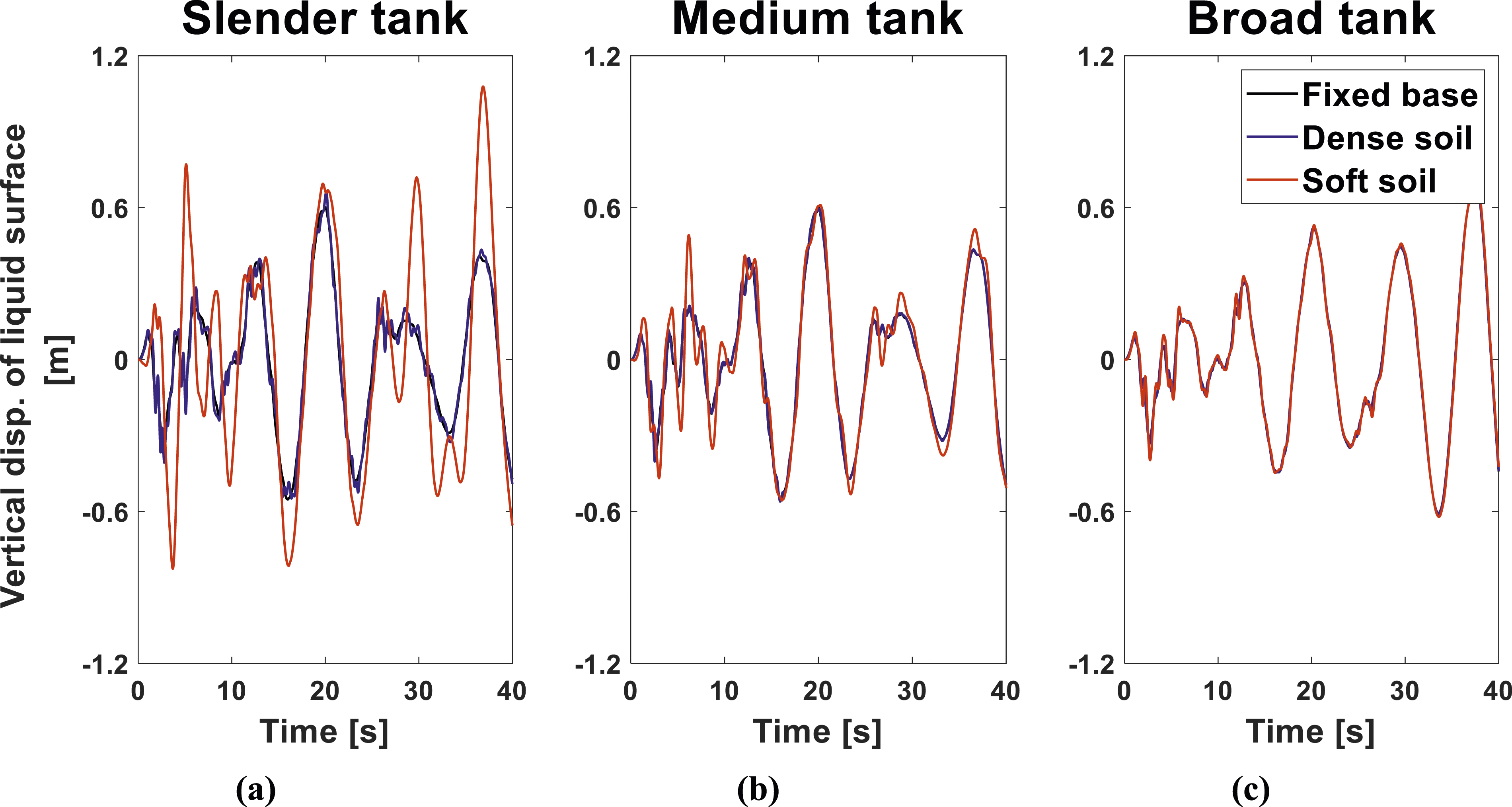
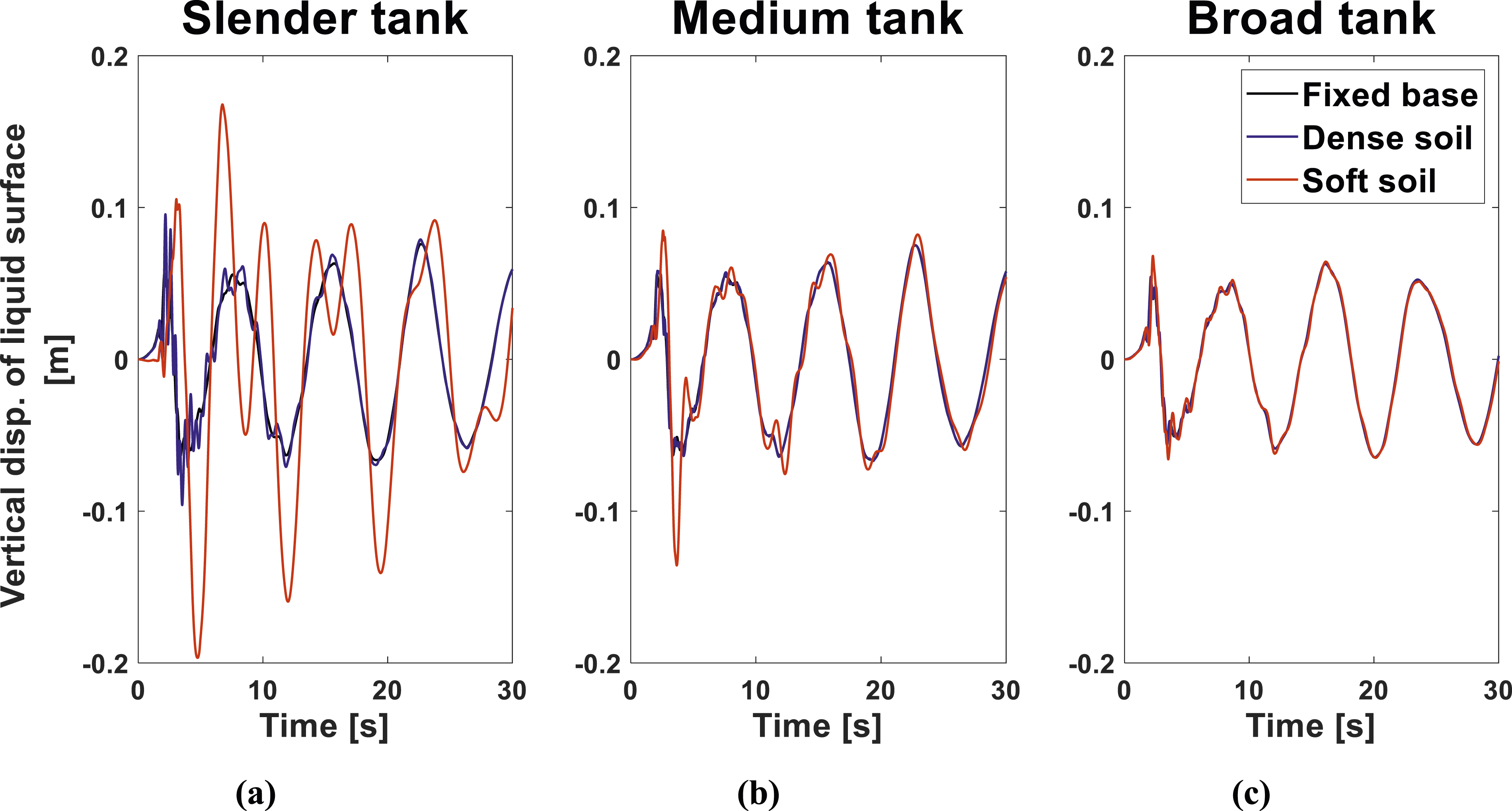
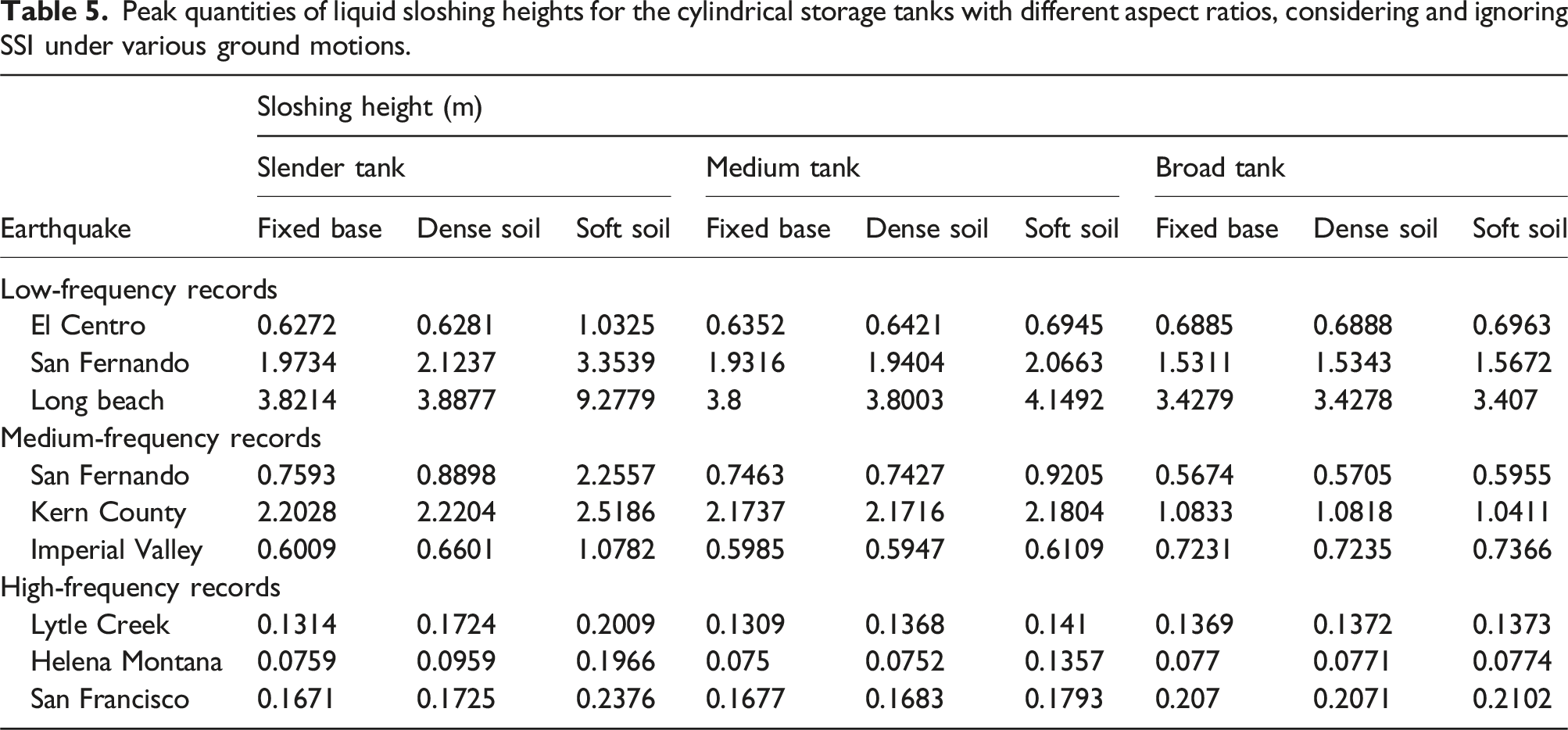
According to Table 5, for flexible-base slender tanks resting on dense and soft soil, the average peak values of liquid sloshing height obtained from algorithms based on discrete-time state-space approaches for the considered low-frequency earthquakes are approximately 3% and 53% higher than for a fixed-base tank, respectively. In a similar vein, the average peak values of liquid sloshing height that were obtained for the flexible-base medium tank offer around 0.2% and 8% percentages of increment, respectively. The percentages that correspond to an increase in sloshing height for broad tank are 0.06% and 0.5%, respectively. In a comparable manner, the percentages of increase in the average peak values of liquid sloshing height in slender, medium, and broad flexible-base tanks resting on dense and soft soil and subjected to medium-frequency earthquakes are 6%, 39%; 0.3%, 5%; and 0.08%, 0.2%, respectively.
On the other hand, due to the high-frequency earthquakes, the aforementioned analogous percentages of increase are 15%, 41%; 1.7%, 18%; and 1%, 0.1%, respectively.
The obtained peak responses indicate that the incorporation of SSI increases the liquid sloshing wave heights, particularly in slender tanks compared to broad tanks. This is owing to the sloshing mass’s considerable flexibility, which causes its natural period to approach that of the flexible-base tank period. Additionally, the excitation frequency plays a key role in the tank response since it can easily amplify the convective displacement due to the alignment of frequencies. The amplification of sloshing leads to an increase in tank wall stress and rocking tank behavior which can modify the tank wall design.
It is also observed that the differences in the maximum heights of liquid surface waves between broad tanks with fixed bases and broad tanks with flexible bases are quite minimal. Therefore, it may be stated that the height of fluid surface waves is unaffected by the decreasing soil stiffness as the tank’s aspect ratio decreases.
SSI effects on the base shear and overturning moment
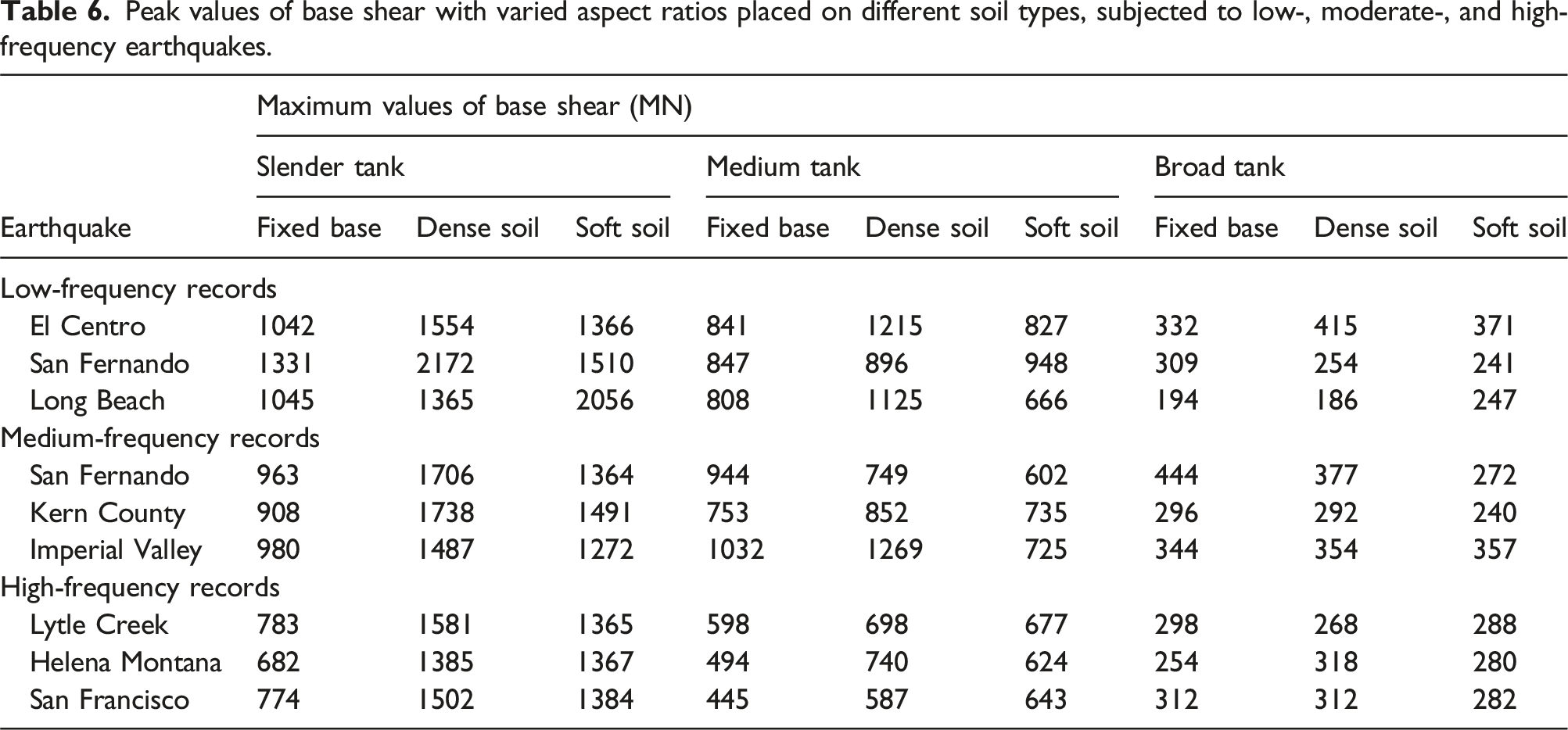
Peak values of base shear with varied aspect ratios placed on different soil types, subjected to low-, moderate-, and high-frequency earthquakes.
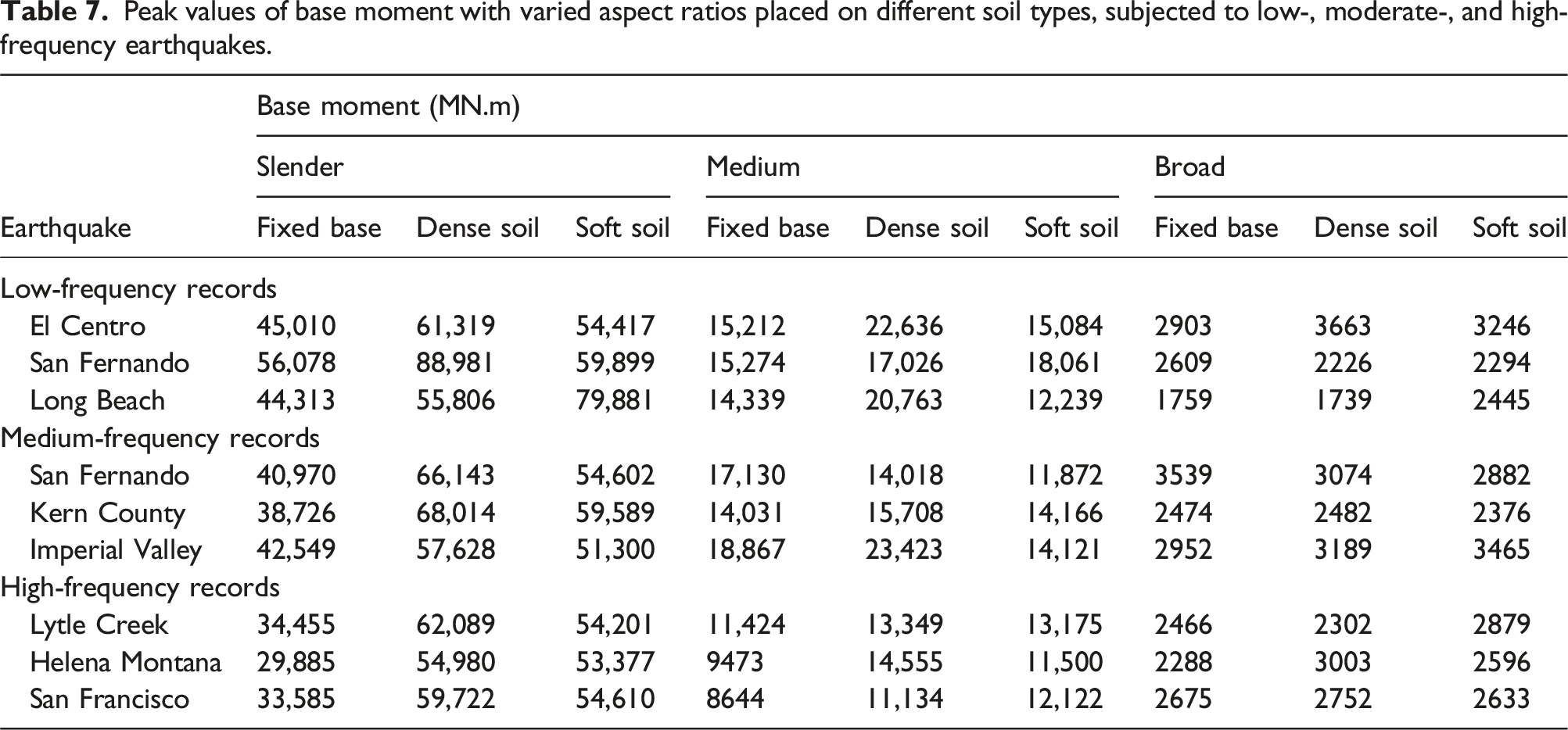
Peak values of base moment with varied aspect ratios placed on different soil types, subjected to low-, moderate-, and high-frequency earthquakes.
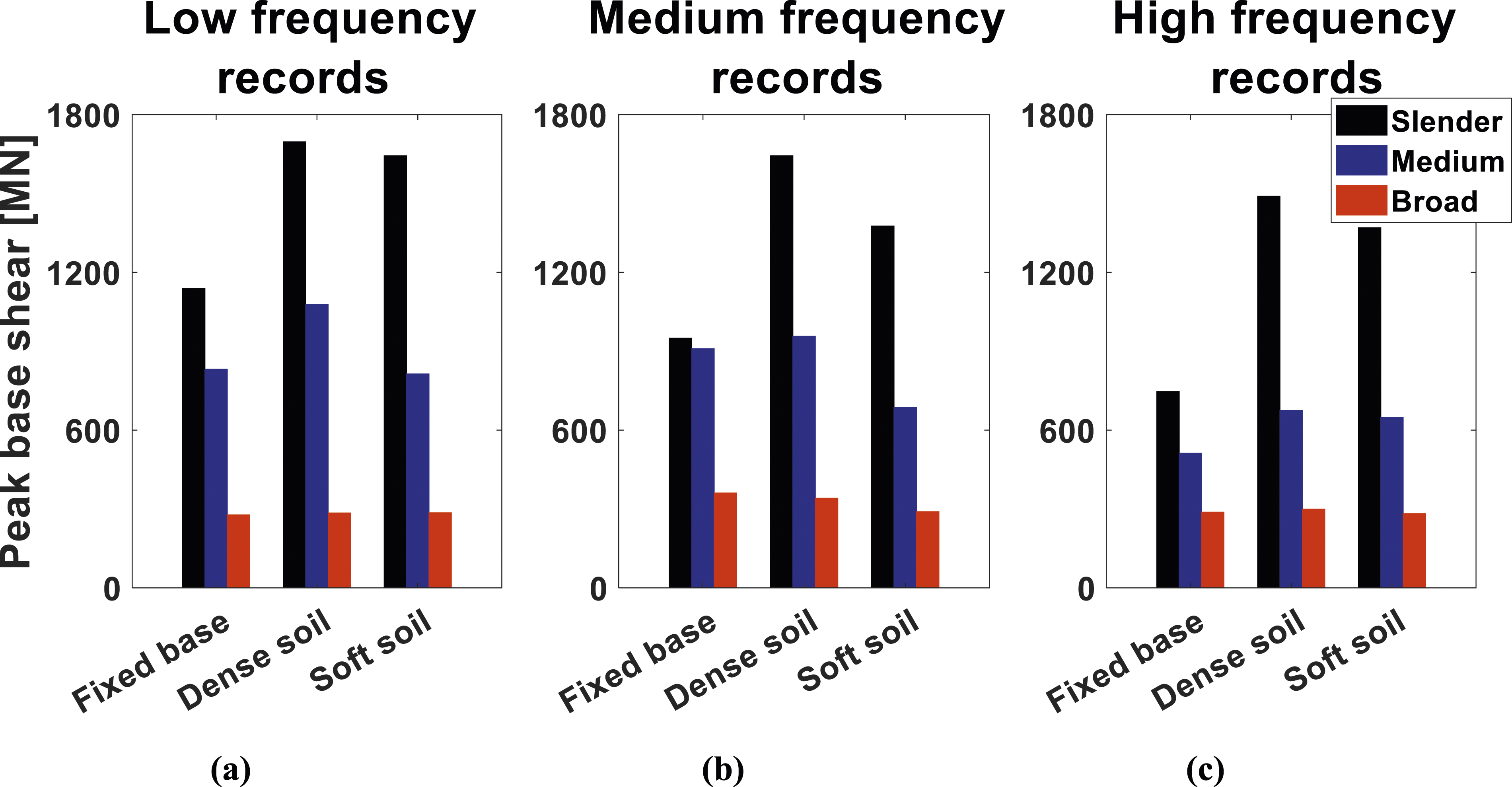
Average values of peak base shear of the cylindrical storage tanks located on various soil types under low, (b) moderate, and (c) high-frequency earthquakes.
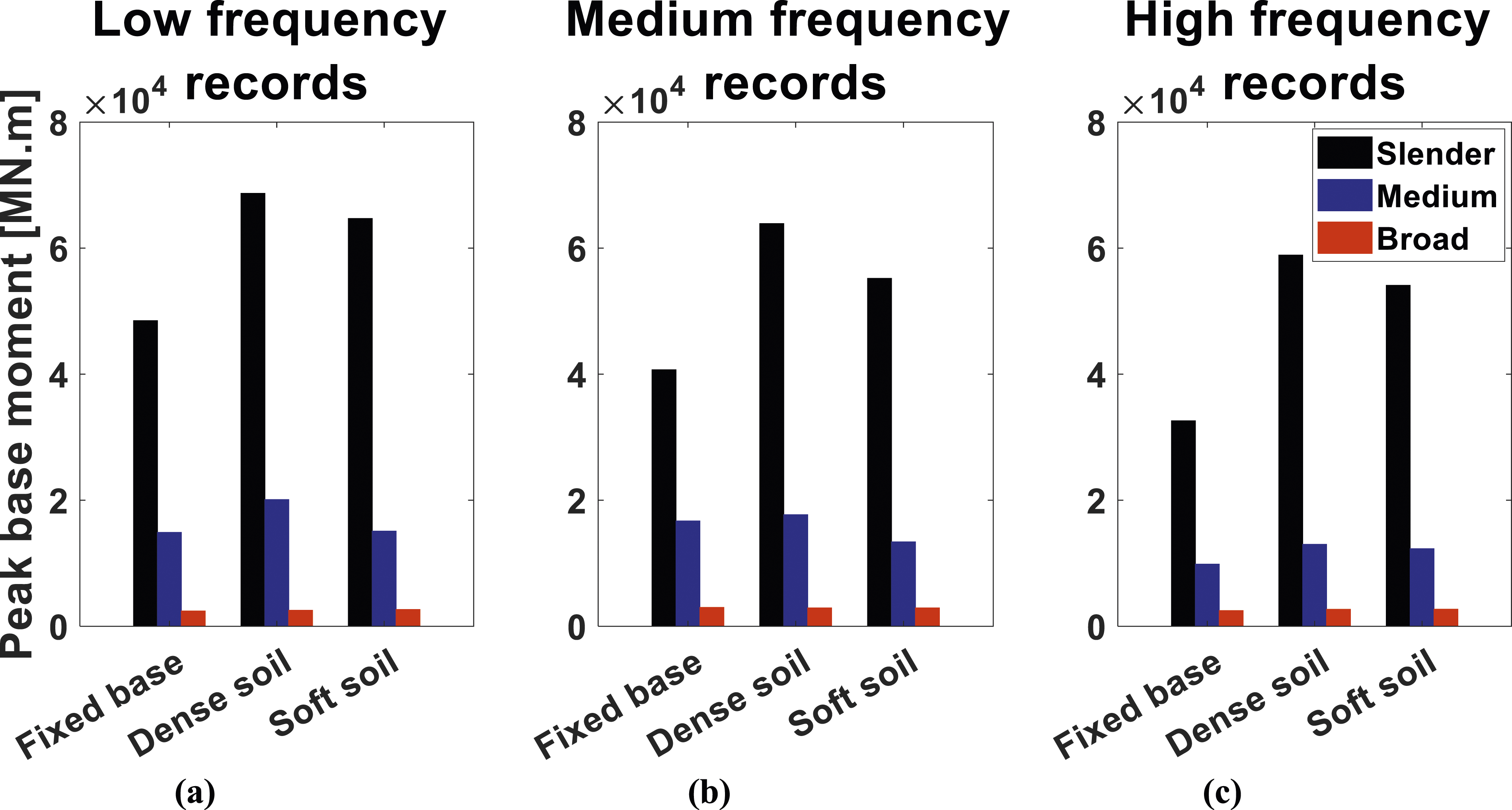
Average values of peak base moment of the cylindrical storage tanks located on various soil types under low, (b) moderate, and (c) high-frequency earthquakes.
The bar graph presented in the figures confirms that the maximum shear forces and overturning moments at the tank base for slender tanks increased substantially, in comparison with the fixed-base condition, when the flexibility effect of the supporting soil was considered. When interaction effects are taken into account, the maximum base shear forces and base moments in medium and broad tanks, compared to the fixed-base condition, may either increase or decrease depending on soil stiffness as well as the frequency content of ground motions. More specifically, for low-frequency content earthquakes, the base shear forces’ average decrease percentage for the slender, medium, and broad tanks supported on soft soil compared with those supported on dense soil is 3%, 25%, and 1%, respectively. Likewise, for medium-frequency content earthquakes, the captured base shear forces for the slender, medium, and broad tanks supported on soft soil compared with those supported on dense soil offer about 16%, 28%, and 15% percentages of reduction, respectively. The percentages that correspond to the decrease in base shear forces that occur during high-frequency earthquakes are 8%, 4%, and 6%, respectively. Further, the percentages of average reduction of the peak values of the base moment for the slender, medium, and broad tanks supported on soft soil compared with those supported on dense soil in the order are 6%, 25%, and −4%; 13%, 24%, and 0.2%; and 8%, 6%, and −0.7% for low-, moderate-, and high-frequency earthquakes, respectively. The results of the investigation show unequivocally that the impact of soil-structure interaction on the structural behavior of liquid tanks is significantly dependent on the frequency characteristics of earthquakes. It is crucial to emphasize that the decrease in base shear and moment results in a decrease in tank wall thickness and, as a result, a more cost-effective design.
SSI effect on convective mass displacement
The impact of variations in soil stiffness and the cylindrical storage tank’s aspect ratio on the convective mass displacement demand can be better comprehended by comparing the displacement amplification factor (DAF) of chosen ground motions with varying levels of frequency content as presented in Figure 11. The DAF is the ratio of the average displacements of convective mass for cylindrical storage tanks resting on flexible soil, dense and soft soil, to the corresponding average convective mass displacement for fixed-base cylindrical storage tanks. Additionally, the peak values of convective mass displacements for fixed-base tanks and flexible-base tanks are compared in Table 8. The comparison is based on two distinct types of supporting soil, namely, dense and loose soil, which are situated beneath the tank models’ bases. Nine ground motions of varying aspect ratios were considered. Peak displacement amplification factors of convective mass for cylindrical storage tanks with varying aspect ratios under the ground excitations with varying frequencies considered for soft and dense soil types. Peak quantities of displacements of convective mass for the cylindrical storage tanks with different aspect ratios, considering and ignoring SSI under various ground motions.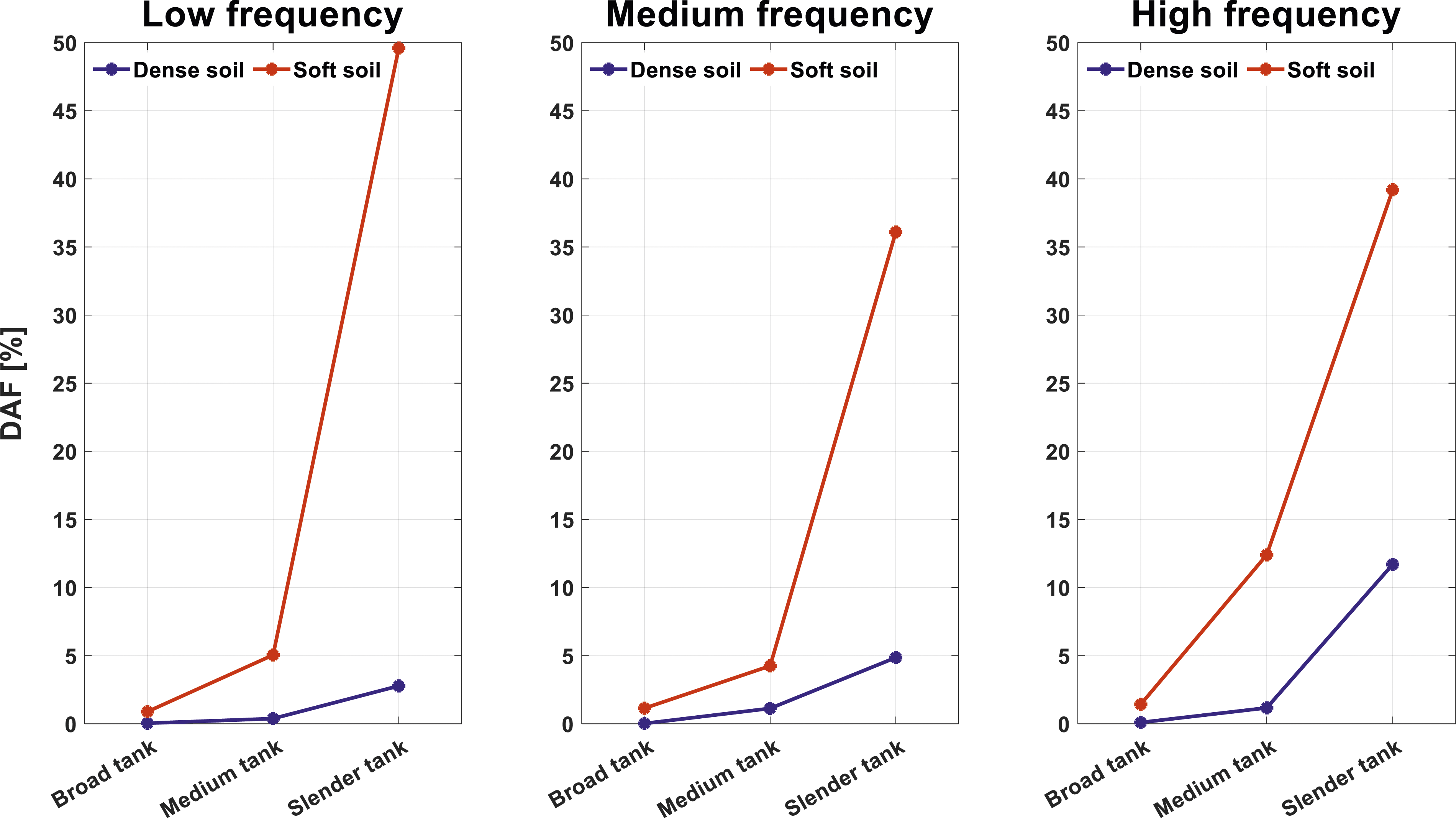
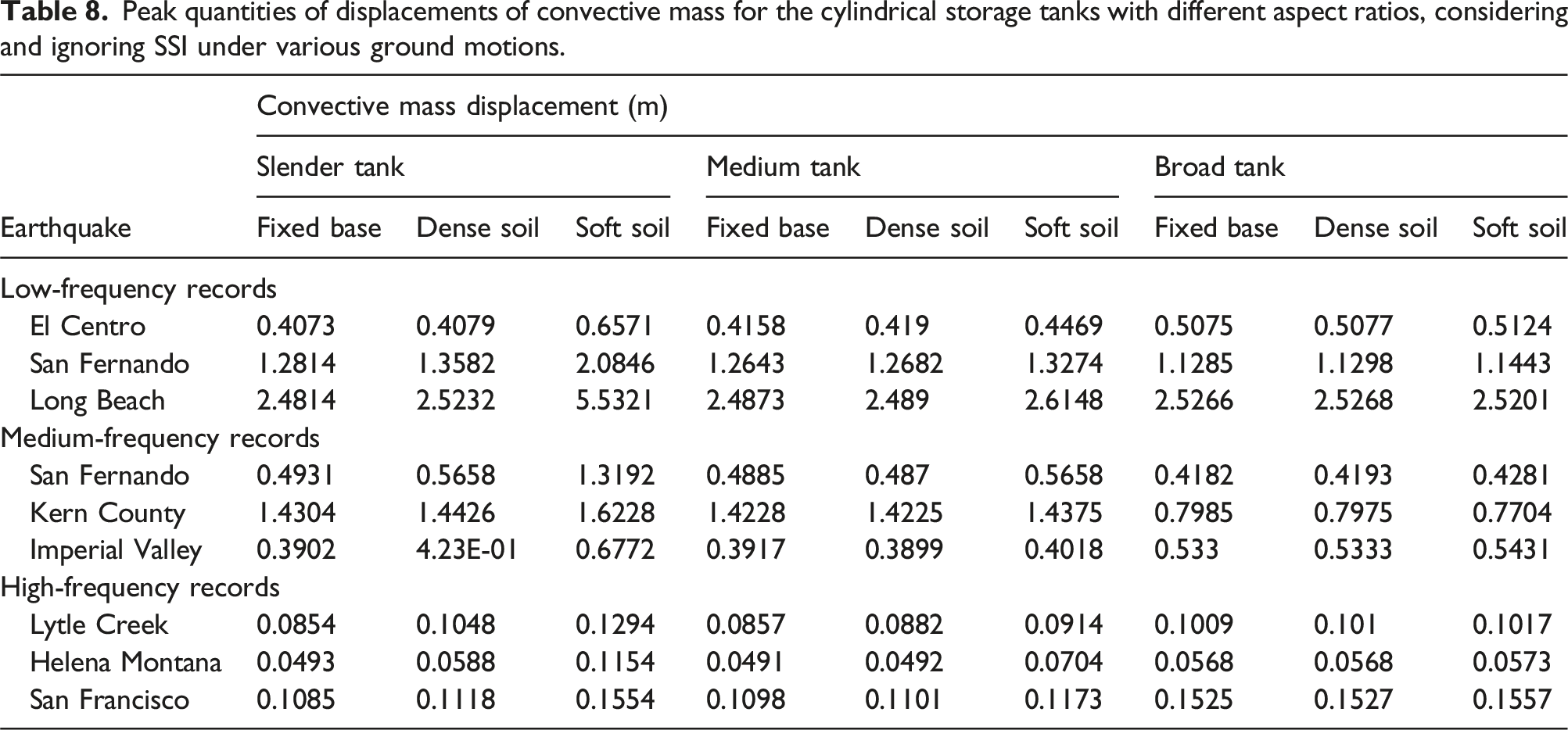
The figure demonstrates that for all ground motion records of low, moderate, and high-frequency content taken into consideration in the study, as well as for both types of sub-base soil, the DAF increases with increases in the slender ratio of the storage tank. However, the DAF plots with light supporting soil varied greatly from the thick soil peak values. Furthermore, the plots demonstrate that increasing soil flexibility results in an overestimation of the peak displacement demand of convective mass, which subsequently leads to an increase in DAF when compared to the results obtained with dense soil for all of the earthquake movements that were taken into consideration. As illustrated in the figure, a decrease in the aspect ratio results in a reduction in the difference between the displayed curves, indicating that the soil stiffness becomes insignificant at lower aspect ratios.
SSI effect on impulsive mass displacement
The impulsive mass time histories of the cylindrical storage tanks without and with SSI for slender, medium, and broad tanks are illustrated in Figures 12–14, respectively, under the El Centro, the Imperial Valley, and the Parkfield earthquake records. According to the results, the incorporation of a rocking motion as well as the lateral translation of the rigid foundation leads to a decrease in the impulsive mass displacements of liquid that occur within the tanks. Furthermore, reduced impulsive mass displacement reduces tank wall local buckling. These reductions will, without a doubt, result in improved tank performance in the event of earthquakes. Time histories of the impulsive mass of the cylindrical storage fixed-base tanks and flexible-base tanks during the low-frequency El Centro earthquake for (a) the slender tank, (b) the medium tank, and (c) the broad tank. Time histories of the impulsive mass of the cylindrical storage fixed-base tanks and flexible-base tanks during the medium-frequency Imperial Valley earthquake for (a) the slender tank, (b) the medium tank, and (c) the broad tank. Time histories of the impulsive mass of the cylindrical storage fixed-base tanks and flexible-base tanks during the high-frequency Helena Montana earthquake for (a) the slender tank, (b) the medium tank, and (c) the broad tank.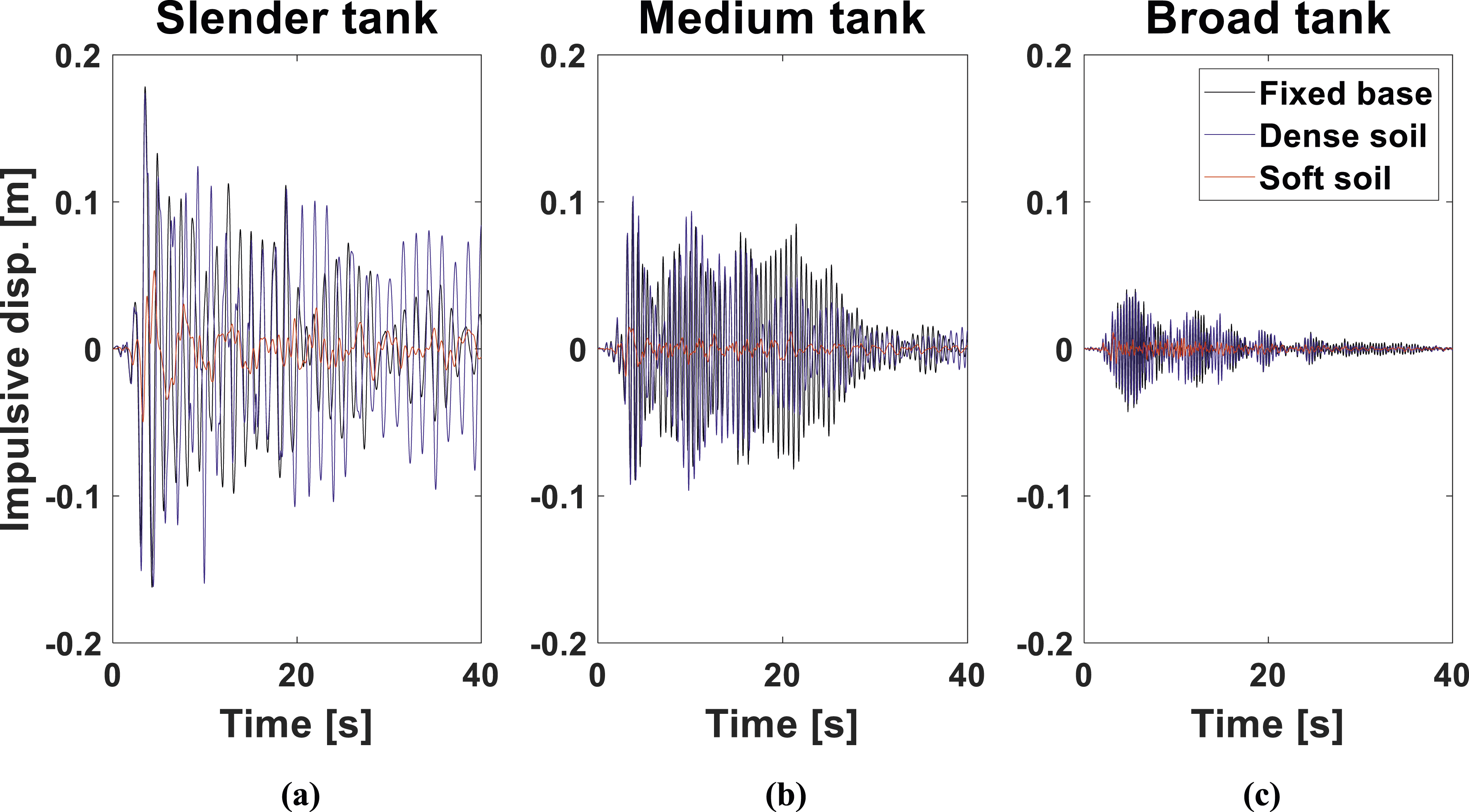
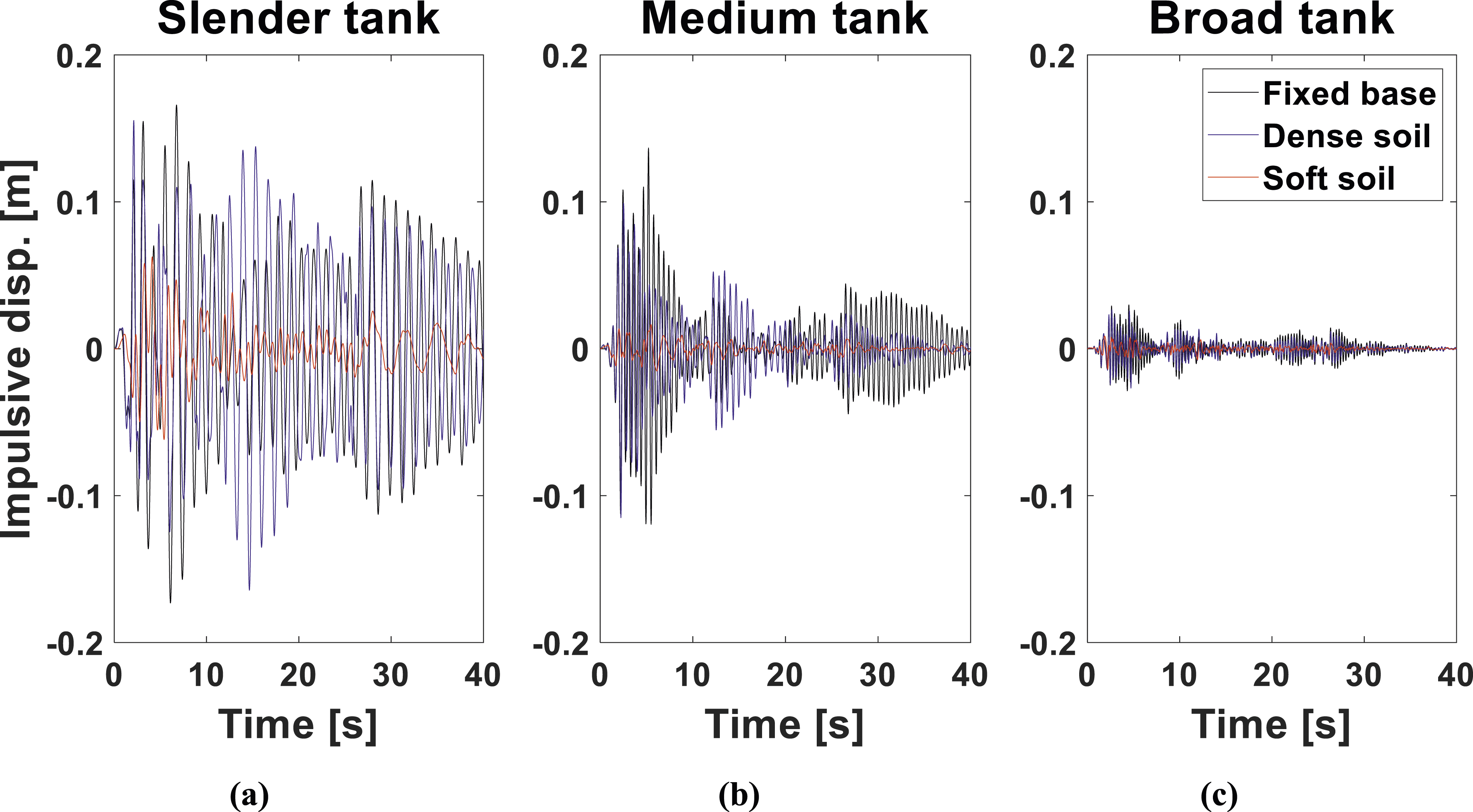
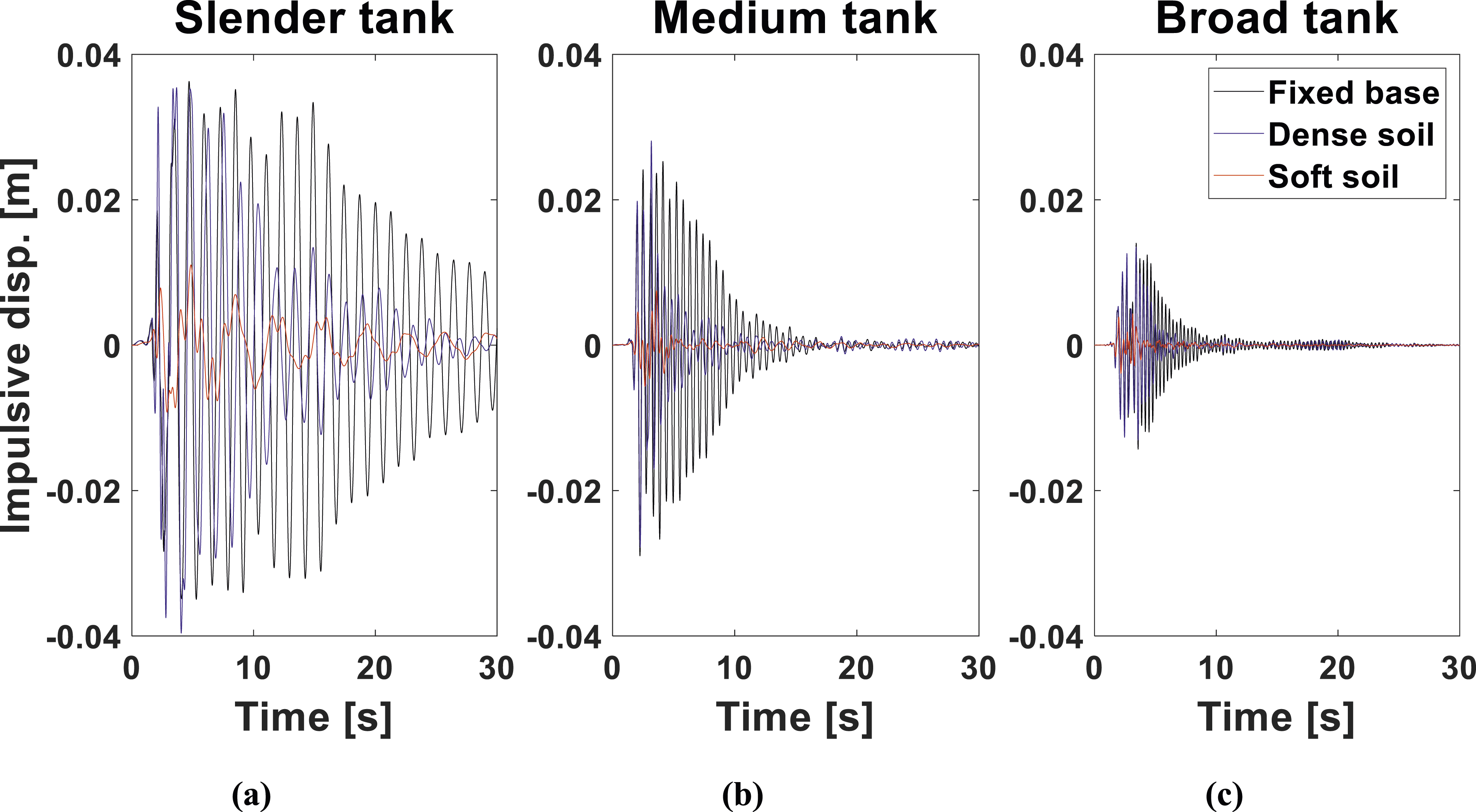
The disparities between the peak impulsive mass displacements developed with and without SSI consideration are significantly greater for the slender tank (which is also lighter and more flexible). Moreover, the peak values of the impulsive mass displacements decrease with decreasing soil stiffness.
Figure 15 presents a comparison between selected ground motions to better understand the effects of slender ratios and changes in the base fixity condition, rigid condition (no SSI), and flexible condition (considering the SSI phenomenon) on impulsive displacement demand and frequency content. Additionally, the average impulsive displacement needs for each of the three sets of earthquake records that were taken into consideration are represented in the same figure as well. Comparisons of the peak impulsive displacement demands for the cylindrical storage tanks during low, moderate, and high-frequency earthquakes with varying base conditions.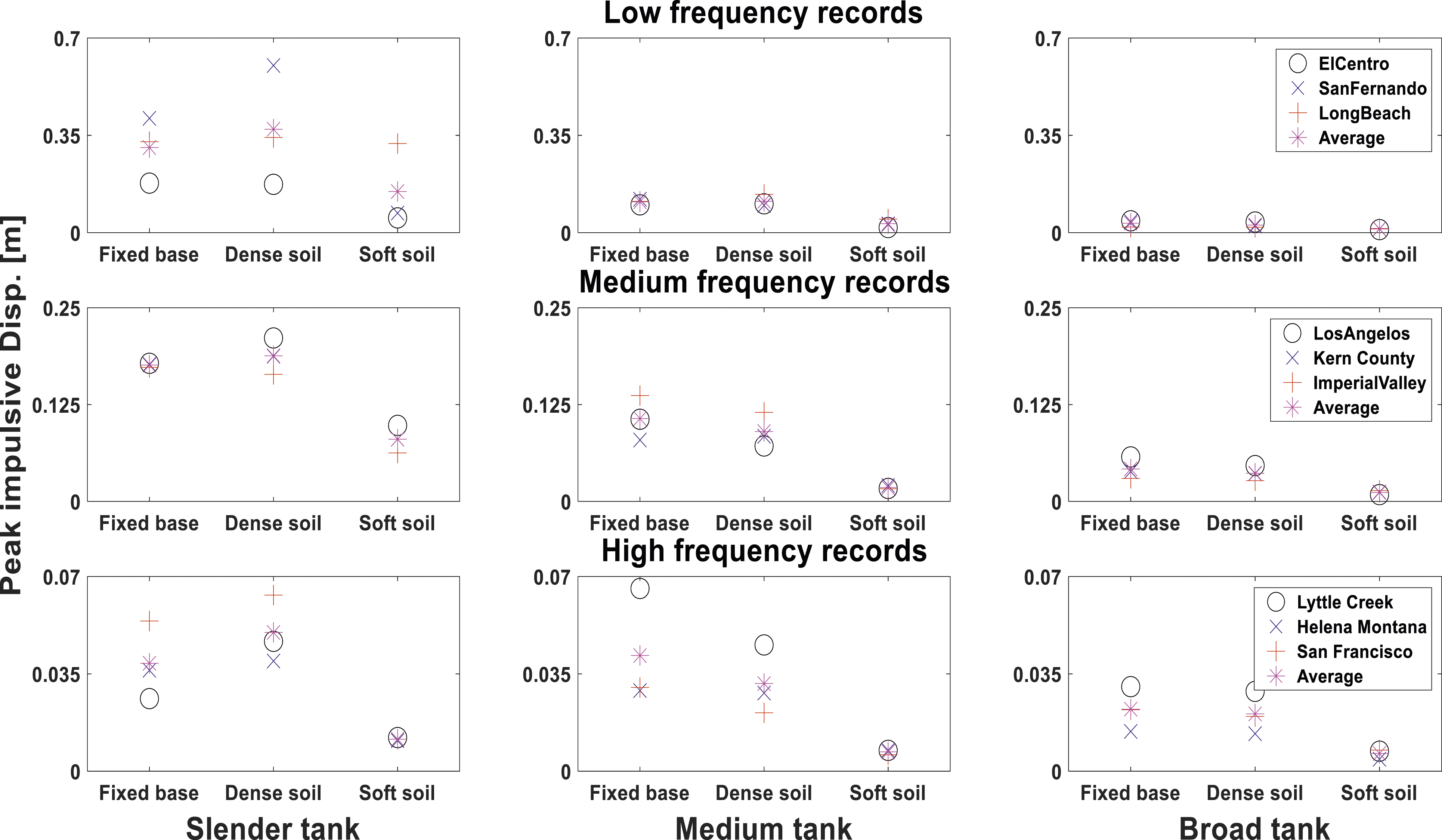
The difference between peek values of impulsive displacement demands is more prominent for slender and medium tanks, particularly for the fixed-base tanks and tanks supported on dense soil. Moreover, the differences between the broad tank models’ impulsive displacements are relatively small for all base conditions compared to the rest of the models. Furthermore, as the soil’s stiffness reduces, it can be observed from Fig. 15 that the peak values of the impulsive mass displacements tend to decrease.
Base responses
The analytical model of a flexible ground-supported cylindrical storage tank was analyzed once more to further investigate the effect of soil-structure-fluid interaction on the induced base response time histories under three sets of actual ground motions, specifically low-, moderate-, and high-frequency content, respectively. Figure 16 depicts the average peak values of the linear and angular responses obtained from nonlinear time-history analyses conducted at the tank base while it was resting on two distinct types of soil: dense and soft. Furthermore, peak values of the linear and angular displacements from all analyses are given in Table 9 for the considered different ground motion records. Comparison of the peak base linear and angular displacements for the cylindrical storage tanks exposed to low, moderate, and high-frequency ground motion records. Peak base response values of liquid storage tanks with different aspect ratios subjected to low-, moderate-, and high-frequency earthquakes.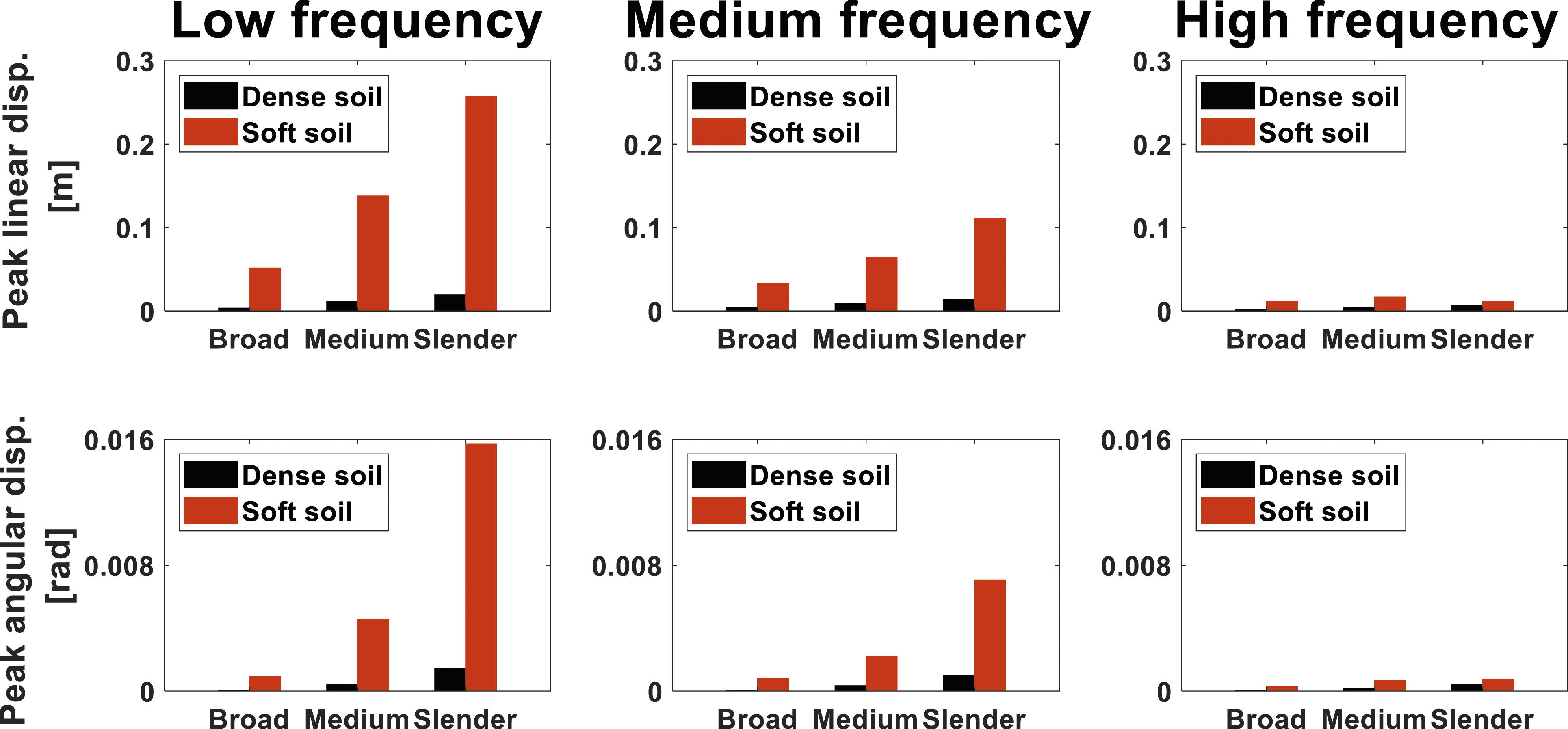
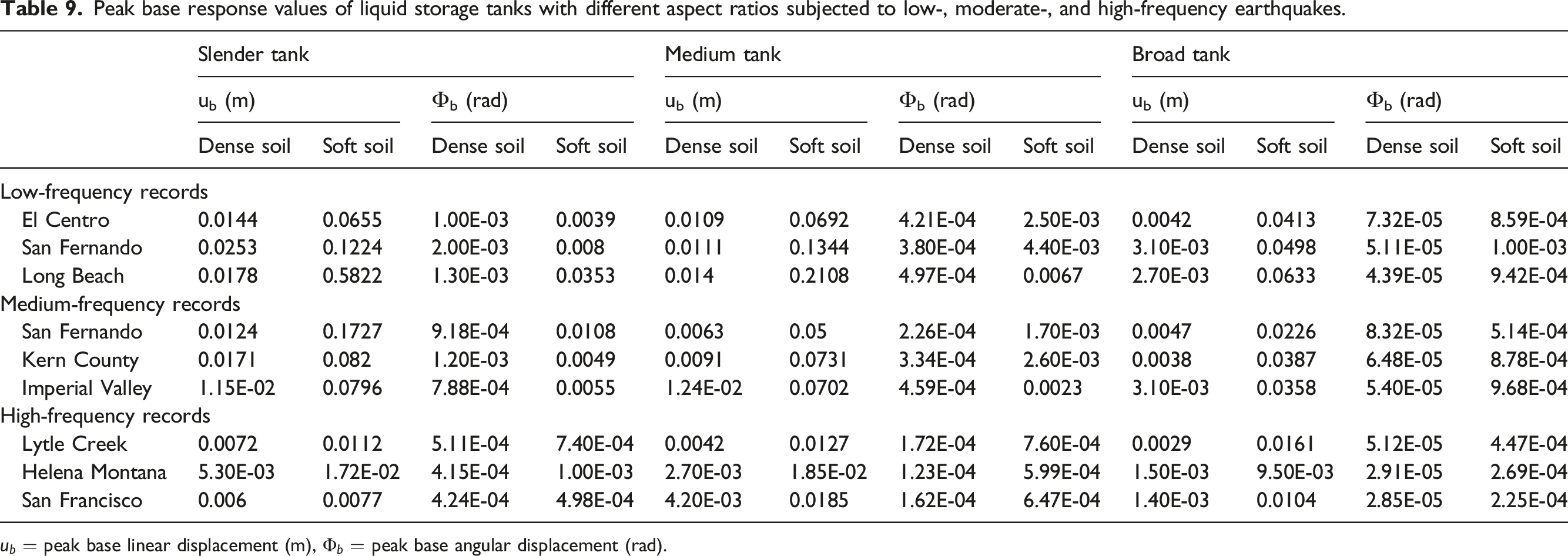
The bar charts demonstrate that reducing the stiffness of the soil leads to a substantial increase in the peak values of both the linear and angular responses. This is particularly clear in the case of low- and moderate-frequency earthquakes when the slenderness ratio is increasing.
For instance, as the soil changes from dense to soft, the recorded peak values of base linear displacement in slender, medium, and broad tanks under low-frequency earthquake records decrease by 91%, 90%, and 93%, respectively. The corresponding percentage reduction due to medium-frequency earthquake records is 87%, 85%, and 88%, respectively. Similarly, due to high-frequency earthquake records, the analogous reduction is 60%, 83%, and 80%, respectively. For the similar tank model, the captured peak values of base angular displacement in slender, medium, and broad tanks under low-frequency earthquake records reduce by 89%, 91%, and 93% as the soil softens from dense soil to soft soil, respectively; 86%, 83%, and 92% for medium-frequency earthquake records, respectively; and 56%, 82%, and 88% for high-frequency earthquake records. According to the findings of the simulation, a reduction in the soil’s stiffness tends to amplify the base responses for all collected time-history acceleration records that are applied, particularly in slender tanks in comparison with broad ones. Furthermore, the base motions, both in terms of displacement and rocking, are affected by the type of soil as well as the frequency level of the earthquakes.
Figure 17 depicts the variation in the peak base linear and angular displacements for the different aspect ratios that were allocated to the cylindrical storage tanks. This variation was considered by taking into account both dense and soft sub-base soil as well as variations in earthquake frequency contents. In order to explore the effect of variations in soil stiffness on the seismic behavior of the liquid-tank system, the aspect ratio varied from 0.5 to 3 throughout the analysis. It has been found, as shown in the figure, that the induced peak base responses when taking into account the two subsoil cases increase with increases in the aspect ratio of the tank-liquid-soil system for all of the applied three ground motion records, namely, El Centro, San Fernando, and Lytle Creek, which are considered earthquakes with low, moderate, and high-frequency content, respectively. As the soil stiffness decreases, the captured peak values for both linear and angular base responses increase significantly, especially in low and moderate earthquake frequency content. It can be seen in the figure that the difference in the plotted curves becomes more pronounced whenever there is an increase in the aspect ratio. It is worth noting that the trend of change in both base responses for the aspect ratios is similar for the different earthquakes. Further, the variation in the aspect ratio of the cylindrical tank is negligible when the tank model is excited by an earthquake with a high-frequency content, as the obtained peak base response values remain nearly unchanged as the aspect ratio increases. The results presented in Figure 17 indicate that the peak responses obtained confirm that the variation in supporting soil stiffness has a greater impact on slender tanks compared to broad tanks. However, the peak results for the two types of supporting soil show some convergence in broad tanks, as observed in the results obtained for the three earthquake records. Induced peak base linear displacements (upper row) and peak base angular displacements (lower row) of cylindrical storage tanks with varying aspect ratios exposed to low (Long Beach), moderate (Imperial Valley), and high (Helena Montana)-frequency ground motion records.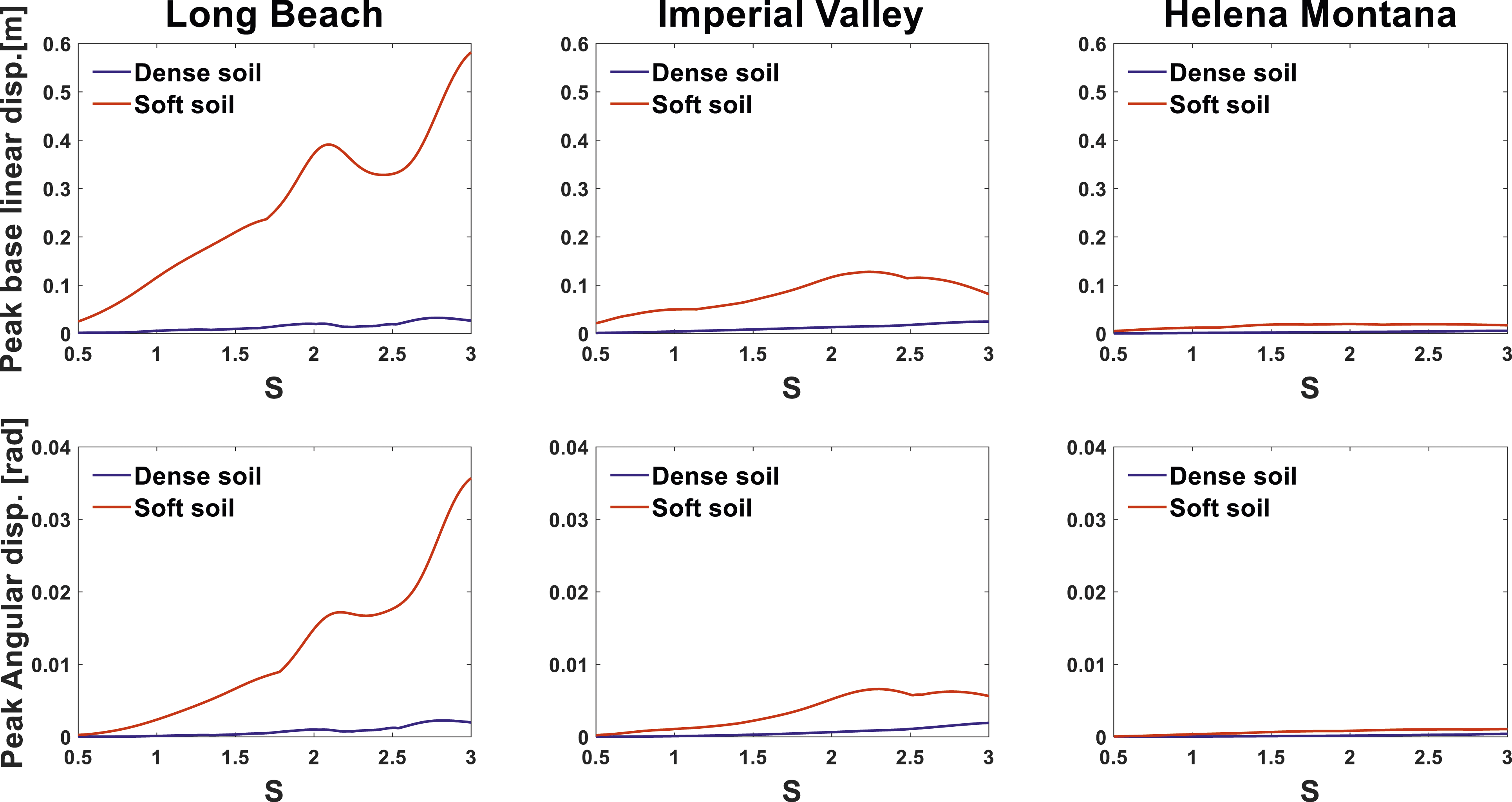
Conclusions
This research is carried out to investigation the simultaneous effect of SSI as well as the frequency content of excitation earthquake records on the seismic performance of cylindrical ground-supported liquid storage tanks. In pursuit of this objective, rigid and flexible soil base conditions together with excitation records with different levels of frequency contents are examined. The tank aspect ratio is also considered in the simulation analysis. Spring-dashpot elements are attached to the tank-fluid system to incorporate the rotational and horizontal foundation movements. A developed MATLAB code is used to solve the whole system’s governing equations of motions. The obtained seismic responses of the tank’s models are evaluated and presented in a comparable manner.
From the aforementioned analysis procedures and comments on the results, the following conclusions can be inferred: (1) Numerical simulations indicate that the ground motion transferred to the tank’s superstructure can be amplified (or even dampened) due to the stiffness differences between the tank (rigid) and the soil (flexible), causing modifications to the period of the soil-foundation-tank system’s impulsive mode. (2) Although the height of fluid surface waves is unaffected by the underlying soil’s flexibility for a low aspect ratio (in the case of medium and broad tanks), it is extremely sensitive to seismic excitation frequency characteristics. (3) The base shear and overturning moment exhibit high sensitivity to variations in the aspect ratio and earthquake frequency content. More specifically, when the flexibility effect of the supporting soil is considered, maximum shear forces and overturning moments at the tank base increased significantly for slender tanks in comparison to the tanks with fixed-base condition. However, in medium and broad tanks, the maximum base shear forces and base moments may either increase or decrease based on the frequency content of ground vibrations and the soil’s stiffness. (4) The maximum convective displacement demand increases as the soil stiffness decreases, especially for high aspect ratios. However, the soil stiffness becomes insignificant at lower aspect ratios. Consequently, the clear height above the liquid surface should be increased to compensate for this disadvantage. (5) The impulsive mass displacements of liquid within the tanks are reduced as a result of the inclusion of SSI effect. Furthermore, reduced impulsive mass displacement reduces tank-wall local buckling. These reductions will result in improved tank performance in the event of earthquakes. (6) The obtained peak values for both linear and angular base responses increase dramatically when soil stiffness decreases, particularly in low and intermediate earthquake frequency content. (7) According to the performed study, the lower the frequency content of the excitation records, the higher the seismic demand of liquid storage tanks for considered earthquakes. Consequently, the frequency content may be considered an influential parameter for seismic performance evaluation using similar records. (8) For the considered tank’s configurations, soil-tank interaction under the utilized earthquakes and similar records significantly amplify the responses of the cylindrical ground-supported tank structure based on supporting soil conditions.
Footnotes
Declaration of conflicting interests
The author(s) declared no potential conflicts of interest with respect to the research, authorship, and/or publication of this article.
Funding
The author(s) received no financial support for the research, authorship, and/or publication of this article.
