




Abstract
This paper proposes a fractal modification of tropical algebra for noise removal and optimal control. Fractal addition, fractal multiplication, and fractal dot product are defined and explained in a fractal space. A fractal tropical polynomials function can model a coastline at any scale, providing a new tool for fractal analysis of any irregular curve. An example is given to solve an optimal control subject to a fractal tropical polynomials function. This paper provides a new window for tropical algebra, combining fractal geometry and algebra.
Keywords
Introduction
Noise appears to be a completely stochastic process, for example, the brake noise 1 and chatter vibration,2–4 thermal perturbation,5,6 and medical images.7–11 Noise is too complex to be modelled effectively, and various neural network–based machine learning techniques12–19 offer a new hope for dealing with noise, but the deep learning depends heavily upon the high operational capability of the computer.
In 2023, Gong et al.
20
and Wang
21
revealed that the tropical algebra
22
can be effectively used for noise removal by an extremely simple tropical addition. The tropical algebra has nothing to do with any topics for the tropics; it was proposed in 1979 by Cuninghame-Green,
22
and it is also called as the max-algebra
23
or the minimax algebra.24,25 The tropical addition and the tropical multiplication are defined, respectively, as follows
22


For the n-dimensional real vector space, the tropical algebra follows the following simple operation
26


The tropical algebra can be considered to be on the tropical linear space.
26
The most amazing property of the tropic algebra is that the tropical polynomials can model any complex curve. We can use a simple tropical polynomials function to describe any a curve with ease, for example


According the above property, a single tropical polynomials function can model a coastline at any scales, while the coastline is the cornerstone for the fractal geometry.
27
Based on this finding, a fractal modification of the tropical algebra can be proposed (Figure 1). Profile of equation (6).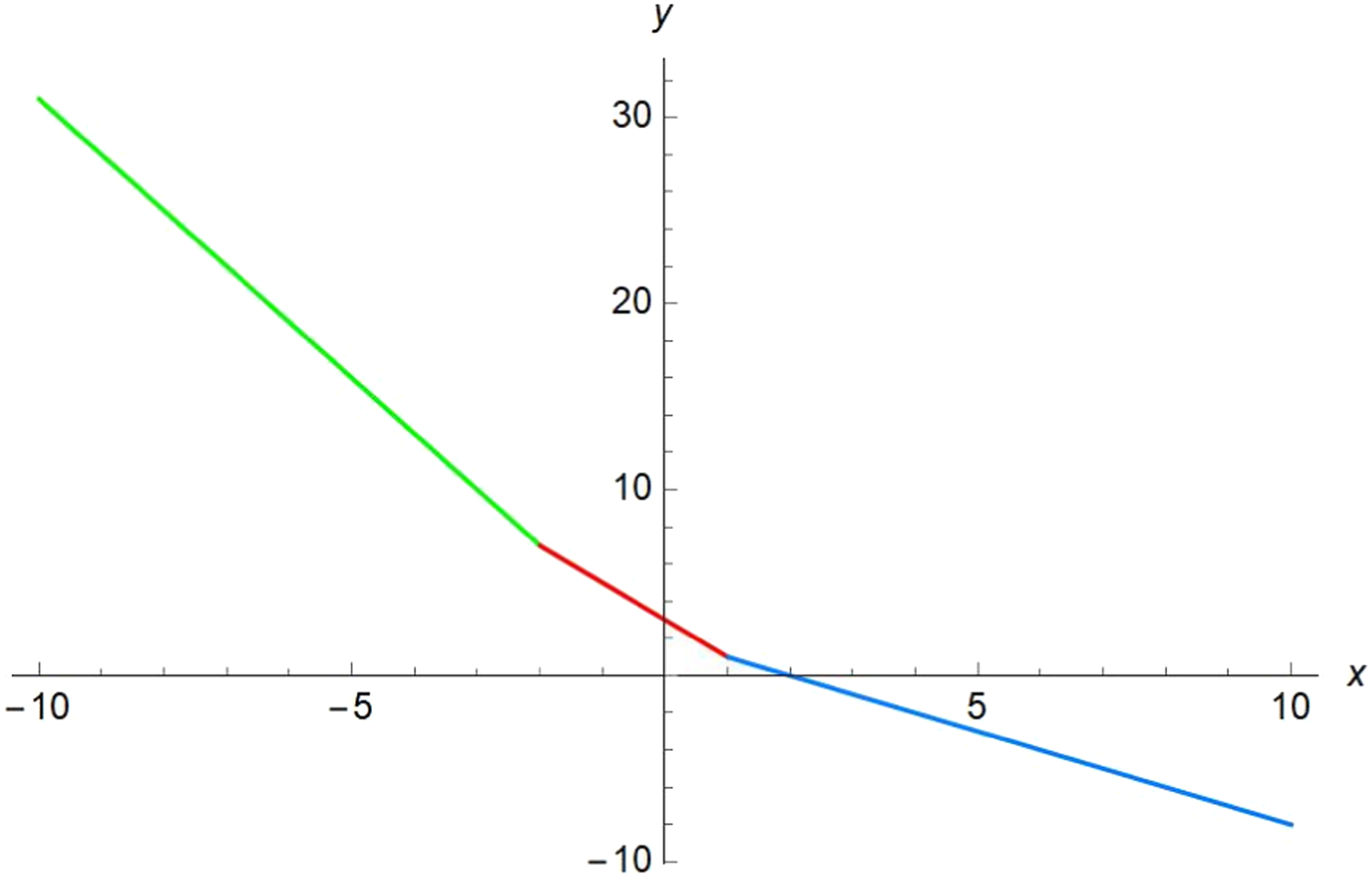
Fractal tropical algebra
Before introducing the fractal modification of the tropical algebra, we recall the basic property of the local fractal calculus; we have the following property28,29

The fractional calculus is now widely used to model physical phenomena in a fractal set. Yang and Wang revealed the solution properties of a local fractional differential equation, 31 Deng and Ge restudied the Whitham–Broer–Kaup system in a fractal set, 32 Sun established the fractal Fisher’s equation using local fractional calculus, 33 and Wang et al. gave an physical explanation of the fractional differential equations.34,35
Fractal theory is of paramount importance in revealing the various complex phenomena. The coast-like boundary can be described by a single tropical polynomials function as discussed above, but the main approach is the fractal theory. Kou et al. 36 revealed the fractal boundary affects greatly the boundary layer, which can explain that a dune has minimal friction under the wind; Mei et al. gave a mountain–river–desert conjecture for the fractal dunes37,38; fractal solitons wave along an unsmooth boundary 39 ; the fractal vibration theory,39–42 the fractal thermodynamics,43–45 and the fractal micro/nanoelectromechanical systems46–48 have become topics in engineering.
Inspired by equation (7), we extrapolate it to the tropical algebra

Similar to the traditional tropical algebra,
22
this paper proposes a new fractal tropical algebra, which follows the following operations



Equation (9) is called the fractal addition. We consider a porous sponge and drip a drop of water onto the sponge; the resultant volume depends upon the porosity and the water volume. Equation (10) is called the fractal multiplication; this can be explained by adding two bags of rice together; equation (11) is called the fractal dot product; it can be explained as the surface area of a porous medium, for example, the area of the Sierpinski carpet.
When the operation happens in two fractal spaces, equations (9)–(11) are modified, respectively, as follows



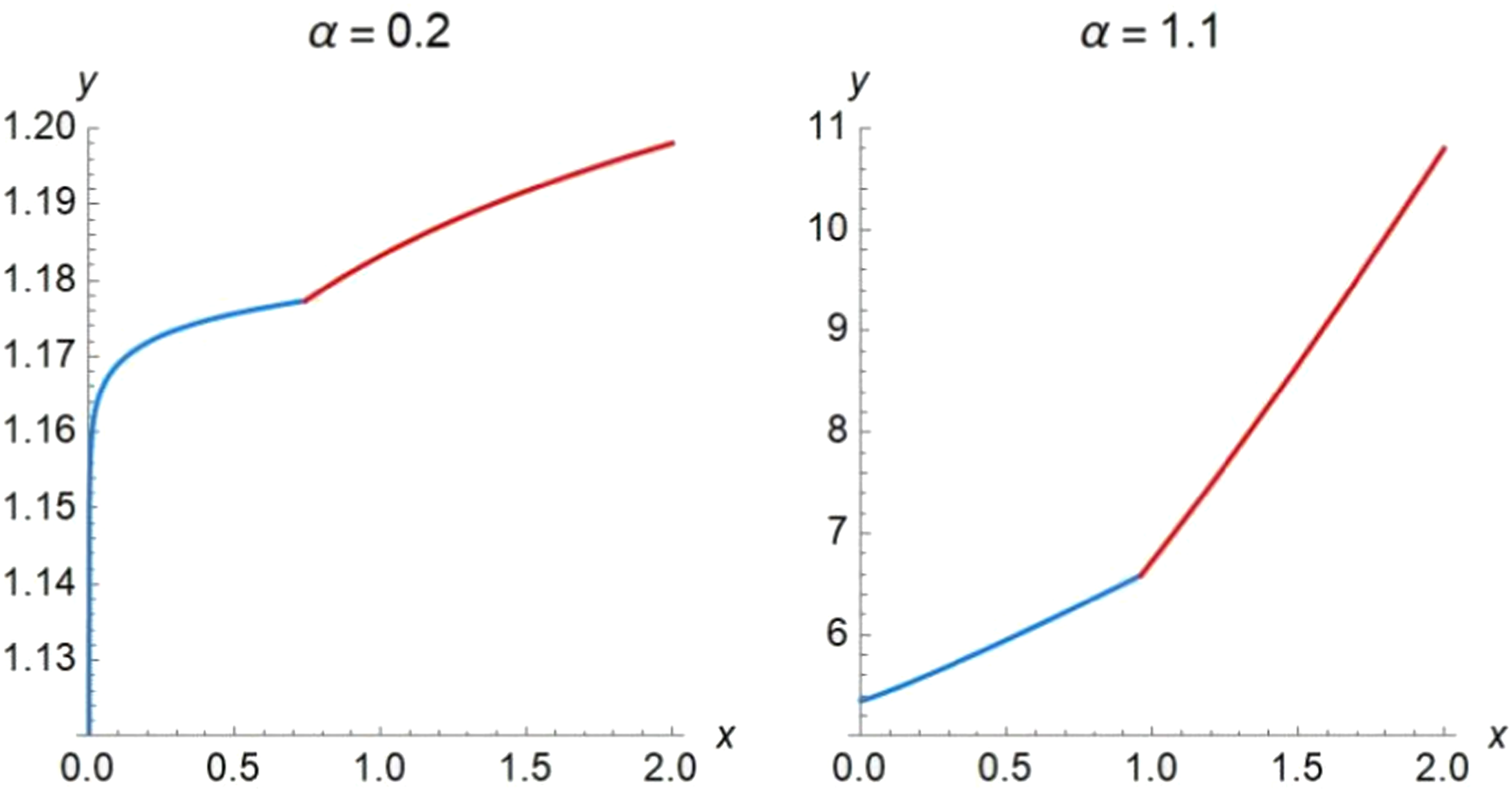
A fractal polynomials function can also model any discontinuous curve, for example

It is a cycloid-like curve, as shown in Figure 2; it is obvious that the fractal dimensions affect greatly the profile. Figure 3 shows the cases when The contour map of equation (15). Profiles of equation (15) for the cases 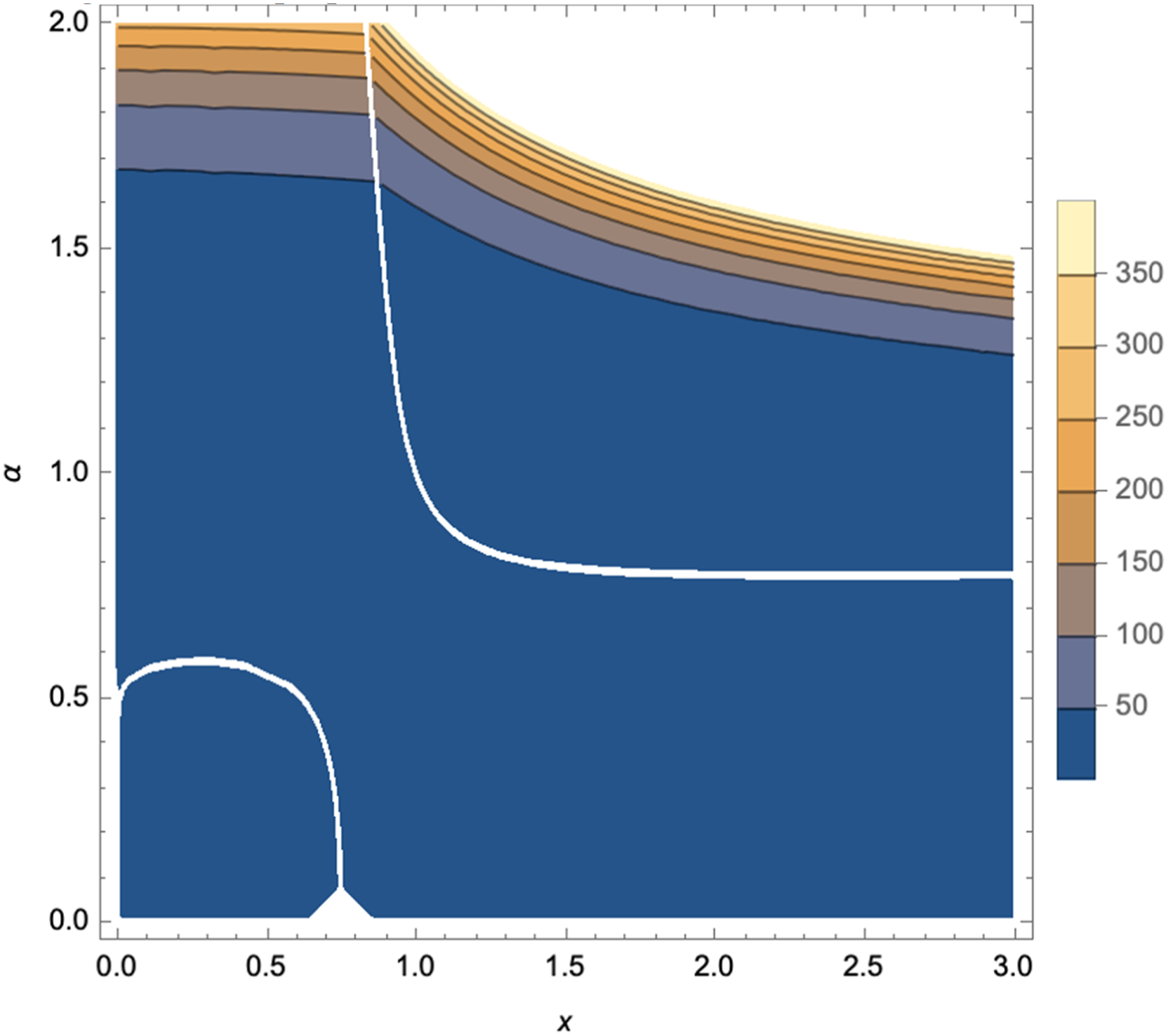
Applications
As a simple application of the fractal algebra, we show that the Pythagorean triples,

Hardy–Ramanujan equation,
49

The Diophantine equation,
50

The Lander–Parkin equation,
51

Now, we consider a simple optimization with constraints with fractal tropical algebra polynomials


It is obvious from Figure 4 that the optimal value is 42.693,156. Optimization with the constraint of the fractal tropical polynomial, equation (17).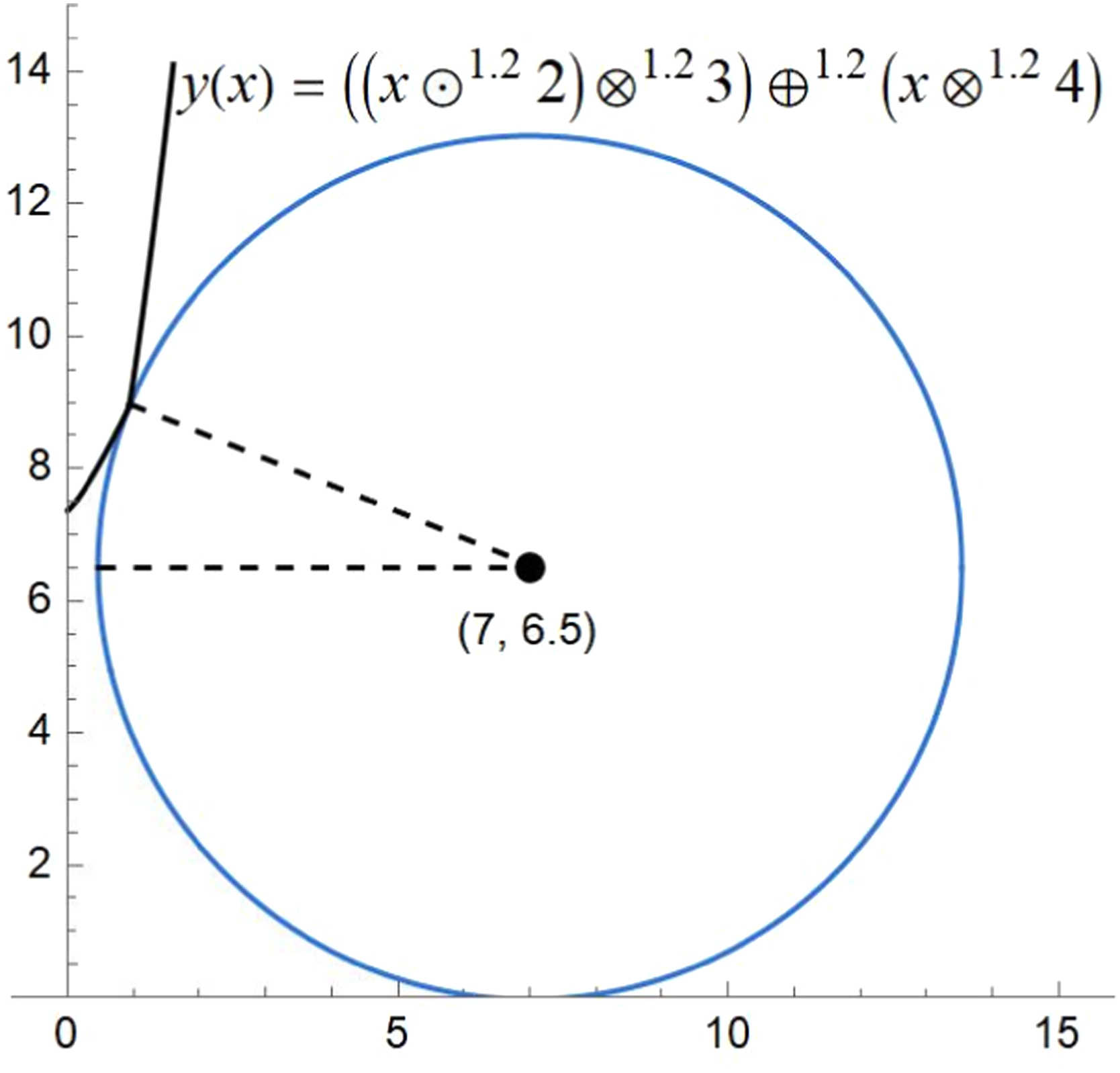
Discussion and conclusion
The tropical algebra was proposed in 1979, and it is also called the minimax algebra. 22 There is much literature on tropical algebra–based adaptive filter for noise removal,20,21,52 and the fractal modification has the same property with higher removal efficiency. The tropical optimization problems53–57 have been also widely studied and tropical polynomials can model an optimization problem in a fractal space. For example, a ship moves to a fractal-like coastline in a shortest line, what is the solution?
If the coastline is one-dimensional, it is the simplest and it can be easily solved by Euclidean geometry. If the coastline is modelled by tropical polynomials, a very complex formulation is obtained; for example, a cascade of the well-known Koch curve as illustrated in Figure 5 can be modelled by A cascade of the Koch curve.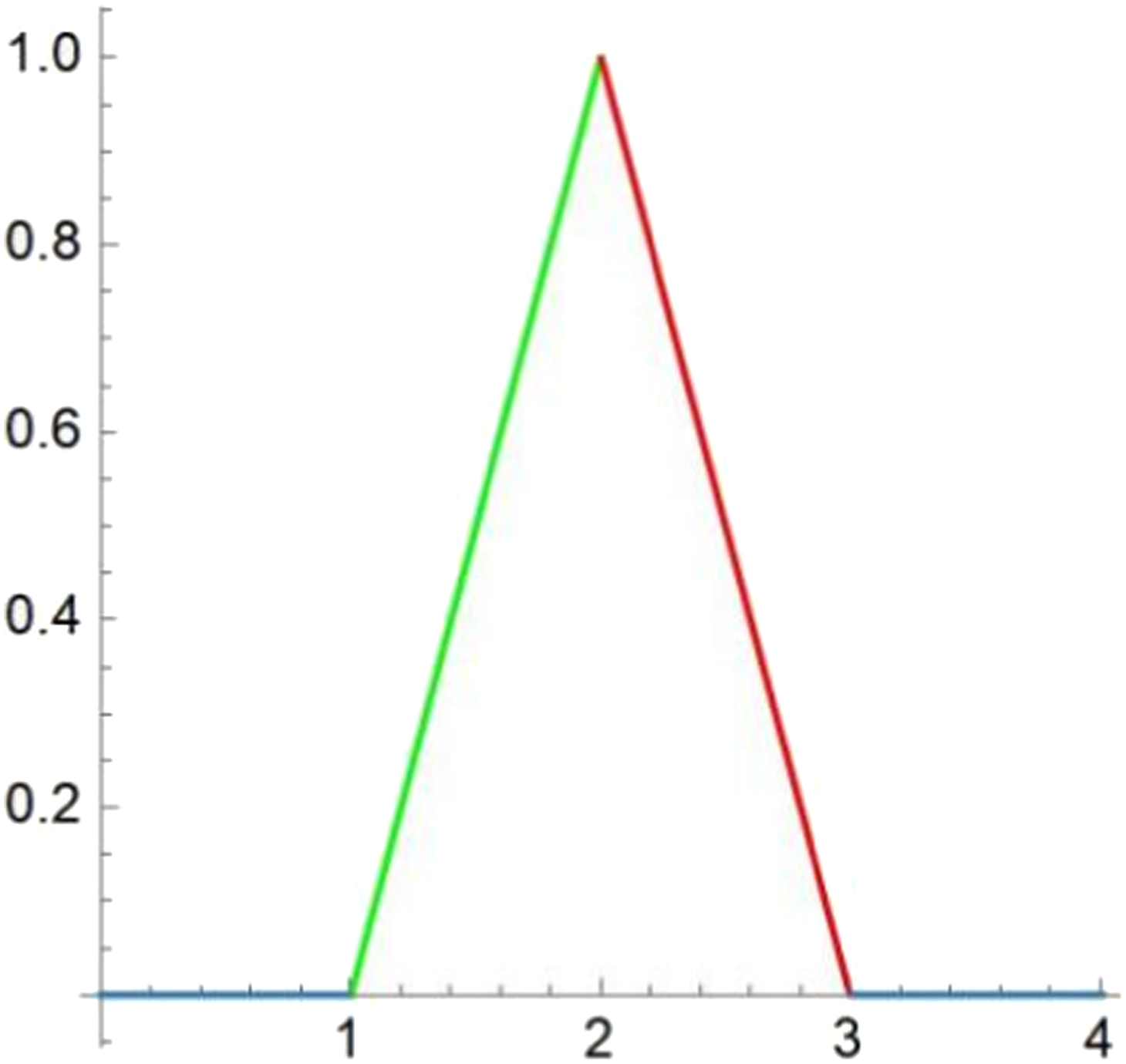

To model the coastline, infinite cascades are required, making it extremely complex; however, it becomes much simpler if the fractal tropical polynomials are used.
The fractal tropical algebra, coupling with the fractal soliton theory, 58 can also model fractal solitary waves in future; furthermore, it becomes a useful mathematical tool to noise removal, machine learning, and image process. This paper proposes a fractal modification of the tropical algebra; the fractal addition, the fractal multiplication, and the fractal dot product are defined for the first time. The fractal tropical algebra offers a promising window for extrapolating the tropical algebra to more complex problems.
Footnotes
Declaration of conflicting interests
The author(s) declared no potential conflicts of interest with respect to the research, authorship, and/or publication of this article.
Funding
The author(s) disclosed receipt of the following financial support for the research, authorship, and/or publication of this article: This work was supported by the National Natural Science Foundation of China (Grant No. 12001418).
