




Abstract
The acoustic wave transmission manipulation ability is the most important performance for the acoustic metamaterials. To manipulate the acoustic transmission, the combination acoustic metamaterials structures are involved, and the two-directional acoustic penetration cloaking scheme are constructed. The combination acoustic metamaterials include chiral metamaterials and self-collimation metamaterials, the acoustic wave transmission path are manipulated to bypass from the acoustic scattering target in the penetration cloaking, and the target scattering stealth problem are effectively solved. In the end, the acoustic transmission manipulation performances are verified by numerical analysis with a finite-width acoustic metamaterial structure plates. The results provide technical support for design and application for acoustic transmission manipulation with acoustic metamaterials.
Introduction
With the development of science and technology, varieties of functional materials have been a topic of wide concern in recent years, and increasing attention has been paid to the acoustic metamaterials or phononic crystals problems.1–5 Theoretical analysis, numerical calculation, and experimental test were conducted to analyze the distinctive acoustic phenomenon, such as unidirectional transmission, acoustic filtering, acoustic focusing, acoustic negative refraction, acoustic waveguiding, acoustic collimating, and so on.6,7 As a kind of artificial inhomogeneous material, acoustic metamaterials are synthetic materials formed by a periodic variation in the mechanical properties of materials (i.e., elasticity modulus and mass density), and it can suppress and manipulate acoustic waves transmission.8–11 Acoustic metamaterials have unique mechanical properties, such as negative equivalent mass density, negative equivalent bulk modulus, and negative shear modulus, which are achieved through topology design of micro-structure and materials distribution design.12–14
Acoustic scattering is caused by acoustic reflection of the interface, obstacles, or targets in the acoustic transmission process; reducing acoustic scattering is of great significance to improve the acoustic stealth ability. 15 At present, attachment of acoustic absorbing materials layer on the structural surface is an effective method to reduce acoustic scattering, it has made great progress both in theoretical analysis and engineering application. To enhance the acoustic stealth ability, acoustic transformation devices, such as acoustic cloaking device, were recently proposed.16–18 Two kinds of technology are involved: one is the formation of a hidden region without reflection, and the other is external cloaking by acoustic cancellation. However, double-negative materials such as pentamode material are required to design acoustic cloaking, and this problem encountered a lot of difficulties, such as manufacturing technology, large cost, restrictions for the working frequency range, and so on.19–21 According to the acoustic manipulation function of the acoustic metamaterials, to study new scattering stealth technology is necessary.
On the basis of the above-mentioned reasons, the main objectives of present work are to construct acoustic stealth cloaking by combination chiral and self-collimation metamaterials. 22 Two-directional acoustic target scattering stealth is discussed with symmetry design. The remainder of present work is organized as follows: The basic concept of acoustic penetration cloaking is introduced in Section 2. The band structure problem of chiral and self-collimation metamaterials are investigated in Section 3. The feasibility and effectiveness of acoustic penetration cloaking is illustrated by numerical analysis in Section 4. Major conclusions are summarized in Section 5.
Model description of acoustic penetration cloaking
In the acoustic metamaterials, the acoustic transmission paths are implemented by adjusting the geometric and material parameters of the micro-structure. Through the acoustic transmission manipulation, the incident acoustic wave will follow the specified transmission path in the acoustic field, and the acoustic stealth zones are formed. If an acoustic scattering target is located in the acoustic stealth area, weak acoustic scattering, even silent acoustic scattering, are obtained. The transmission acoustic wave and the incident acoustic wave will be consistent in acoustic pressure amplitude and phase, as if without acoustic scattering target exist, and the so-called acoustic scattering stealth is realized, and a acoustic penetration cloaking “cloaking” is formed. The basic concept of acoustic penetration cloaking in two-dimensional model are shown in Figure 1(b). The schematic of acoustic penetration cloaking: (a) sketch of half acoustic penetration cloaking model, and (b) two-directional acoustic penetration cloaking model.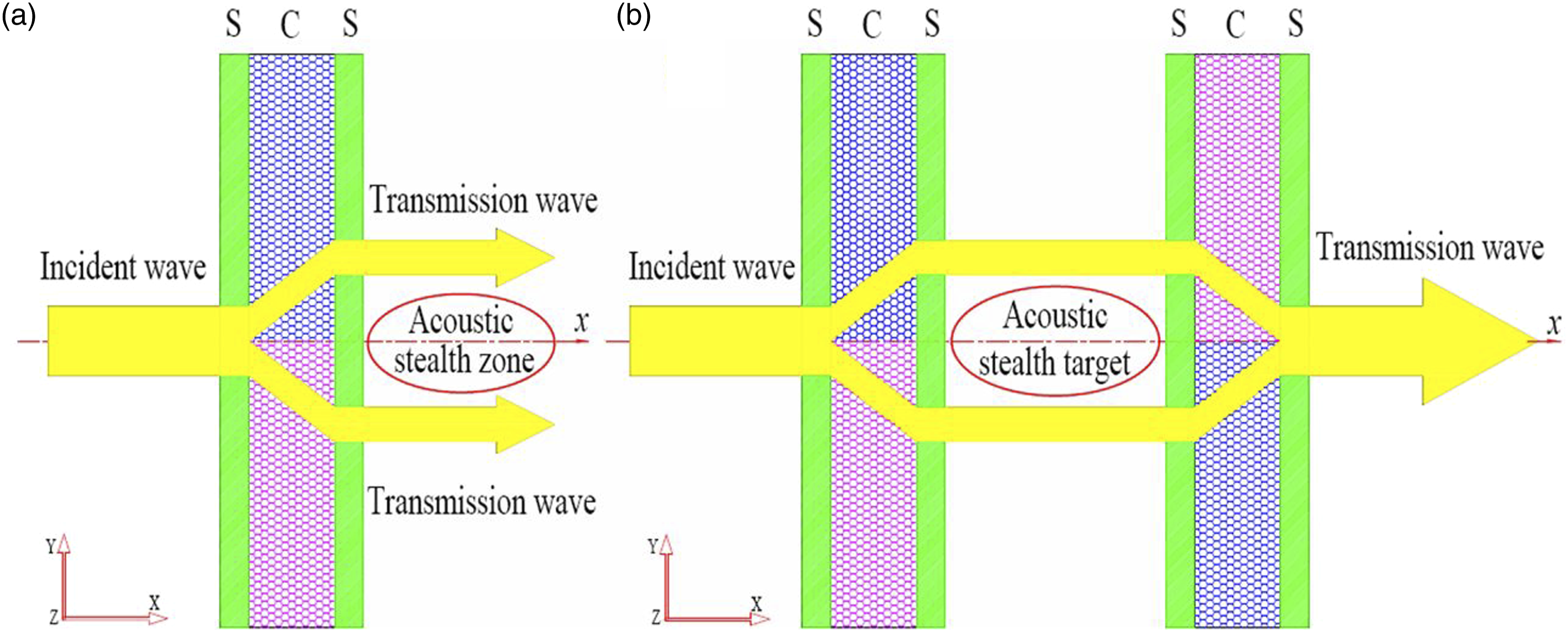
As shown in Figure 1, the acoustic penetration cloaking model consists of two metamaterial structure plates; and the acoustic metamaterial plates have three layers. The core layer is the chiral metamaterials (the C zones), and the skin layers are self-collimation metamaterial (the S zones). The chiral metamaterial layer are symmetrically spliced the chiral metamaterial plates for topological state protection at the boundary (the blue and pink parts in Figure 1) along the x-axis.
The vertical incident acoustic waves, for example, the basic principle of acoustic transmission manipulation are described. As shown in Figure 1(a), a plane acoustic wave beam with a certain width (yellow arrow zone) is incident on the left surface of the self-collimation metamaterial layer (S zone), and the acoustic wave direction is collimated.
When the acoustic wave beam is incident into the chiral metamaterial layer (C zone), the acoustic beam is split into two acoustic beams at the symmetry line x-axis. An angle exists between the direction of the two beams of symmetrical acoustic waves in the chiral metamaterial layer and the direction of the incident acoustic wave. The angle value is determined by the wave vector direction of the micro-structure. The acoustic wave is self-collimated again when it penetrates the self-collimation metamaterial layer (S zone). The split two acoustic wave beams propagate in the acoustic field, and an acoustic stealth zone is obtained. The height of the stealth zone is determined by the angle value and the thickness of the chiral metamaterial layer.
To construct a two-directional acoustic penetration cloaking, two metamaterial structure plates are arranged with parallel, as shown in Figure 1(b). Two acoustic wave beams pass through the acoustic field area and incident on the self-collimation metamaterial layer (S zone) of the right side of the metamaterial structure, then the acoustic wave are self-collimated again. The acoustic wave is incident into the chiral metamaterial layer (C zone) again, and two acoustic wave beams merge. Thus, the amplitude and the phase of the transmission acoustic wave and the incident acoustic wave are consistent. An acoustic stealth zone is formed between the two metamaterial structure plates. If the acoustic scattering target is located in the acoustic stealth zone, then the incident acoustic wave is considered to bypass the scattering target to achieve acoustic stealth, and the goal of acoustic penetration stealth is realized. Bidirectional acoustic stealth is gained according to the symmetry distribution of metamaterial structure.
Band structure analysis of acoustic metamaterials
The band structure, named band gaps, are the key index to evaluate the mechanical performance of acoustic metamaterials, bandgap properties originate from strong scattering and destructive interference of multiple scattered waves
Acoustic metamaterials theory
The acoustic metamaterials is composed of a micro-structured cell in a space infinite period extension, the minimum periodic scale of the periodic micro-structure is called the lattice constant. Acoustic metamaterials are characterized by space periodicity and symmetry, that is, the eigenfield, eigenfrequency, and structural displacement of the acoustic metamaterials are periodic.
In the two-dimensional domain, the periodic boundary conditions are defined to simulate an infinite period of the micro-structured cell, and the x and y directions of the periodic edges for the micro-structured cell are considered. According to the Bloch theory, the displacement vector


Band structure of chiral metamaterials
The band structure properties, named band gaps, are the key index to evaluate the mechanical performance of acoustic metamaterials. The width and position of the band gaps are highly depend on geometric parameters and material parameters of the phononic crystal cell. The wave vector and eigenvalue be defined as the horizontal coordinates and longitudinal coordinates, respectively, the band structure or linear dispersion relationship can be drawn can be obtained. In the band structure, there exist more than one complete bandgap or directional bandgap within the calculated frequency range.
The cell of chiral metamaterial is rectangle, the chiral metamaterial are composed of triangle scatterers (part A), coating (part B), ellipse (part C), and matrix (part D), as shown in Figure 2(a). The triangle scatterers and coating are assumed to be bonded perfectly. The inclination direction of the scatterer indicates the chirality property of the micro-structure. The positions of the three high-symmetry points in irreducible Brillouin zone (IBZ) are as follows: Diagram of band structure for two-dimensional chiral metamaterials: (a) Microstructure parameter, (b) Irreducible Brillouin zone, and (c) Band-gap diagram.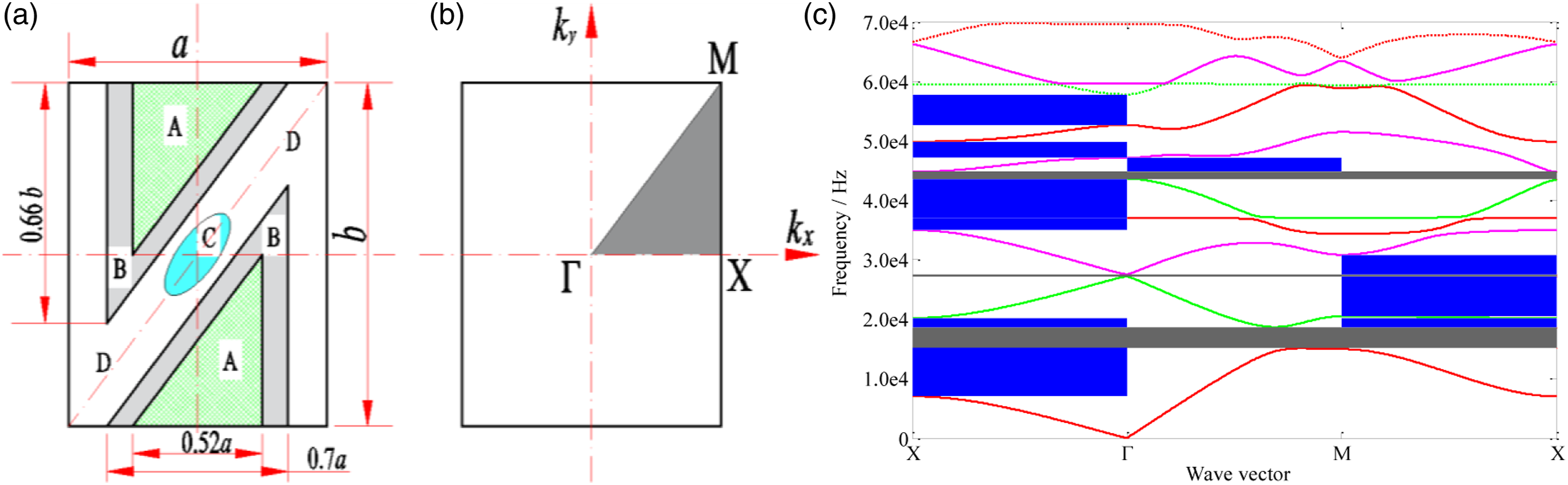
Mechanical properties of metamaterials.

To obtain the band structure properties of micro-structure, the numerical calculation is carried out. The lattice constant of micro-structure are a = 10.0 mm and b = 8.0 mm, respectively. The parameter of the triangle scatterers and coating are shown in Figure 2(a). In addition, the major axis and minor axis of ellipse are 2.25 mm and 0.75 mm, respectively. With the definition of the lattice constant, geometric modeling, finite element division, material definition, periodic-boundary definition, and physical field definition, band properties numerical analysis are implemented. All finite element method (FEM) predictions are calculated by using the acoustics module on the COMSOL Multiphysics 5.6 software code. Since the geometric parameters and the material parameters of the acoustic metamaterials are determined, then the band structure of the chiral acoustic metamaterial can be calculated by sweeping the wave vector
As shown in Figure 2(c), there exist 10-band structure, 3 complete bandgaps are shaded with gray, and 10 directional bandgaps are shaded with blue. The first bandgap is located between the first and second bands structure, with corresponding frequency of 15131.2 Hz–18695.1 Hz; The second bandgap is located between the second and third bands structure, with corresponding frequency of 27171.4 Hz–27551.6 Hz; and the third bandgap is located between the fifth and sixth bands structure, with corresponding frequency of 43639.6 Hz–44784.1 Hz.
According to the bandgap structure property, an acoustic propagation mode exists along the ΓX and ΓM directions, while an acoustic bandgap mode is present along the XM direction in the frequency range 20506 Hz–27171 Hz, as shown in Figure 2(c). Thus, the acoustic wave can be guided to propagate along the ΓM direction in the metamaterial structure within frequency range. If the frequency bands of incident acoustic wave are between 20506 Hz and 27171 Hz, then the deflection angle is present between the acoustic wave propagating in the metamaterial structure and the incident acoustic wave.
Band structure of self-collimation metamaterials
The self-collimation metamaterials are composed of cylinder scatterers and matrix, as shown in Figure 3(a). The micro-structure is square and the side length is t; and r is defined as the cylinder scatterers radius. In the numerical analysis, the lattice constant of micro-structure are t = 5.0 mm and r = 0.362 t, respectively. Diagram of the self-collimation metamaterials: (a) Microstructure parameter, (b) Irreducible Brillouin zone, (c) Equal frequency diagram, and (d) Band-gap diagram.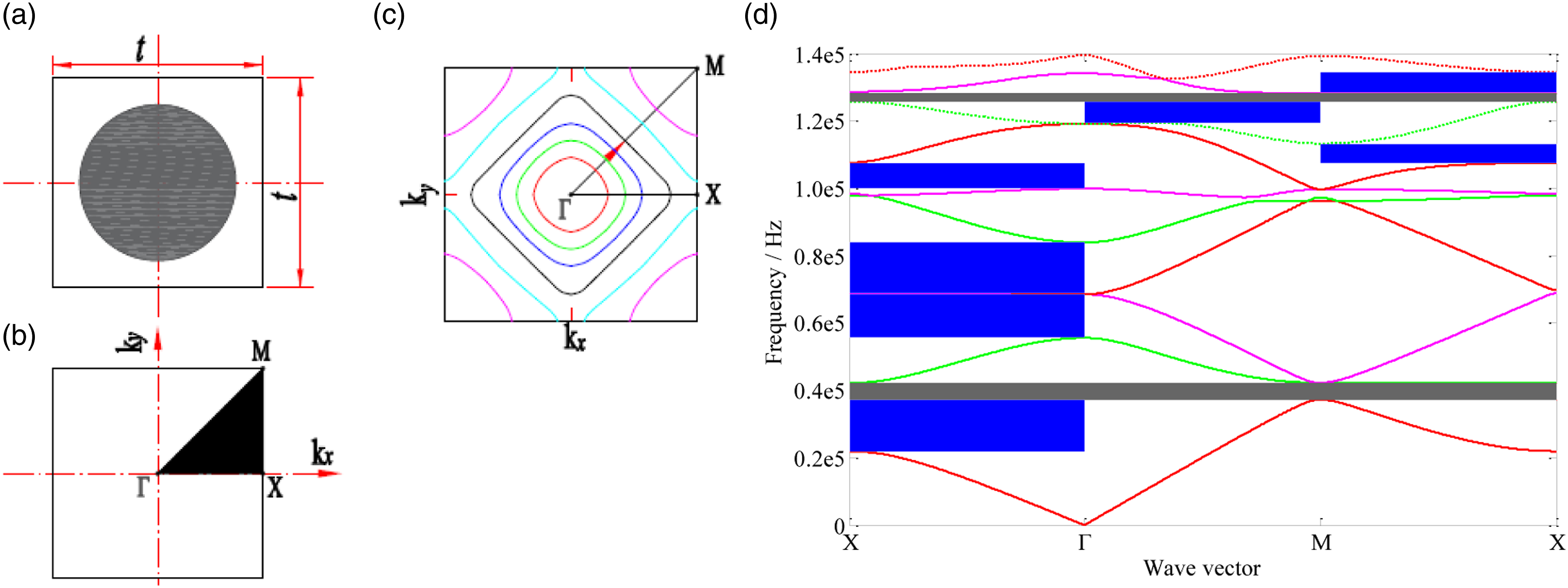
The cell of self-collimation metamaterials is square, the micro-structure of self-collimation metamaterials are composed of round scatterers and matrix, as shown in Figure 3(a). In the micro-structure of self-collimation metamaterial, the positions of the three high symmetry points are as follows:
In the self-collimation metamaterial, the material of matrix is air, and the material of cylinder scatterers is titanium alloy, respectively. The mechanical properties of titanium air and alloy are shown in Table 1.
As shown in Figure 3(d), the complete bandgaps are shaded with gray, and the directional bandgaps are shaded with blue. The first bandgap is located between the first and second bands structure, with corresponding frequency of 37203 Hz–42125 Hz; the second bandgap is located between the seventh and eighth bands structure, with corresponding frequency of 125790 Hz–128215 Hz.
The equal frequency diagram is obtained, as shown in Figure 3(c). The equal frequency contours are nearly flat at the frequency
Numerical analysis of penetration cloaking
To verify the design methodology described about the acoustic penetration cloaking, numerical analysis is implemented.
Overview of acoustic penetration cloaking model
Metamaterials are often assumed to be infinite and arranged periodically along a plane in theoretical analysis. In practical engineering, to analyze the transmission properties of finite micro-structure is necessary. As shown in Figure 4, the width of the chiral metamaterial layer and self-collimation metamaterial layers are 12a and 4.8a, respectively. The width of the acoustic field domain is 25a. The height of the acoustic penetration cloaking is 32b. The left and right boundaries are defined as perfectly matched layers to reduce the interference of reflective waves. The width of perfectly matched layers, wave excitation domain, and wave evaluation domain are 1.6a, 5.5a, and 5.5a, respectively. The height of the perfectly matched layers, wave excitation domain, and wave evaluation domain is 7.2b. Moreover, the periodic boundary condition is applied at the top and bottom edges. Acoustic penetration cloaking model.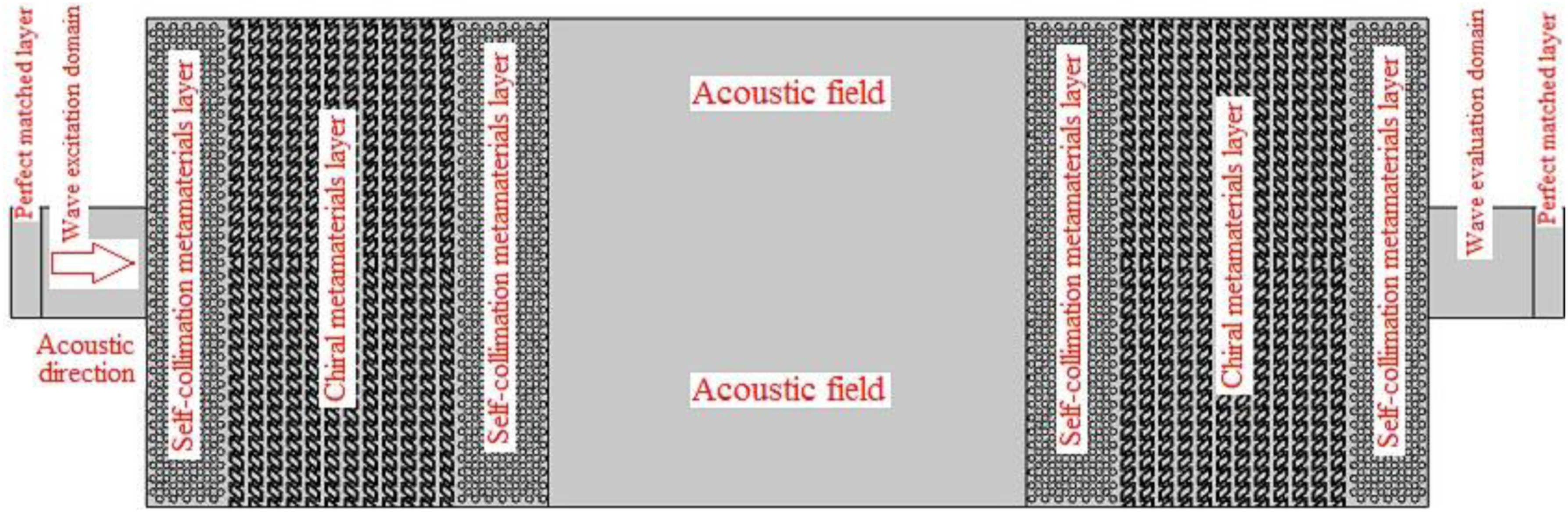
In the numerical analysis, the acoustic wave with unit amplitude is incident perpendicular to the left interface of the penetration cloaking. With the combination of the self-collimation frequency and the directional bandgap frequency, the incident acoustic wave frequency is defined as
Acoustic transmission calculation
To demonstrate the acoustic transmission manipulation performance, the acoustic transmission calculation of acoustic penetration cloaking with finite width ate carried out. In the numerical analysis, the free acoustic transmission and two-direction acoustic penetration cloaking are compared. In order to verify the scattering stealth ability, a scattering target is located in the acoustic field. The width and height of the scattering target are 10a and 7.2b, respectively, as shown in Figure 5. Comparison of the acoustic pressure distributions in acoustic metamaterials structure: (a) pressure distributions in free acoustic field; (b) pressure distributions in free acoustic field with target scattering; (c) pressure distributions in acoustic penetration cloaking; (d) pressure distributions in acoustic penetration cloaking with target scattering.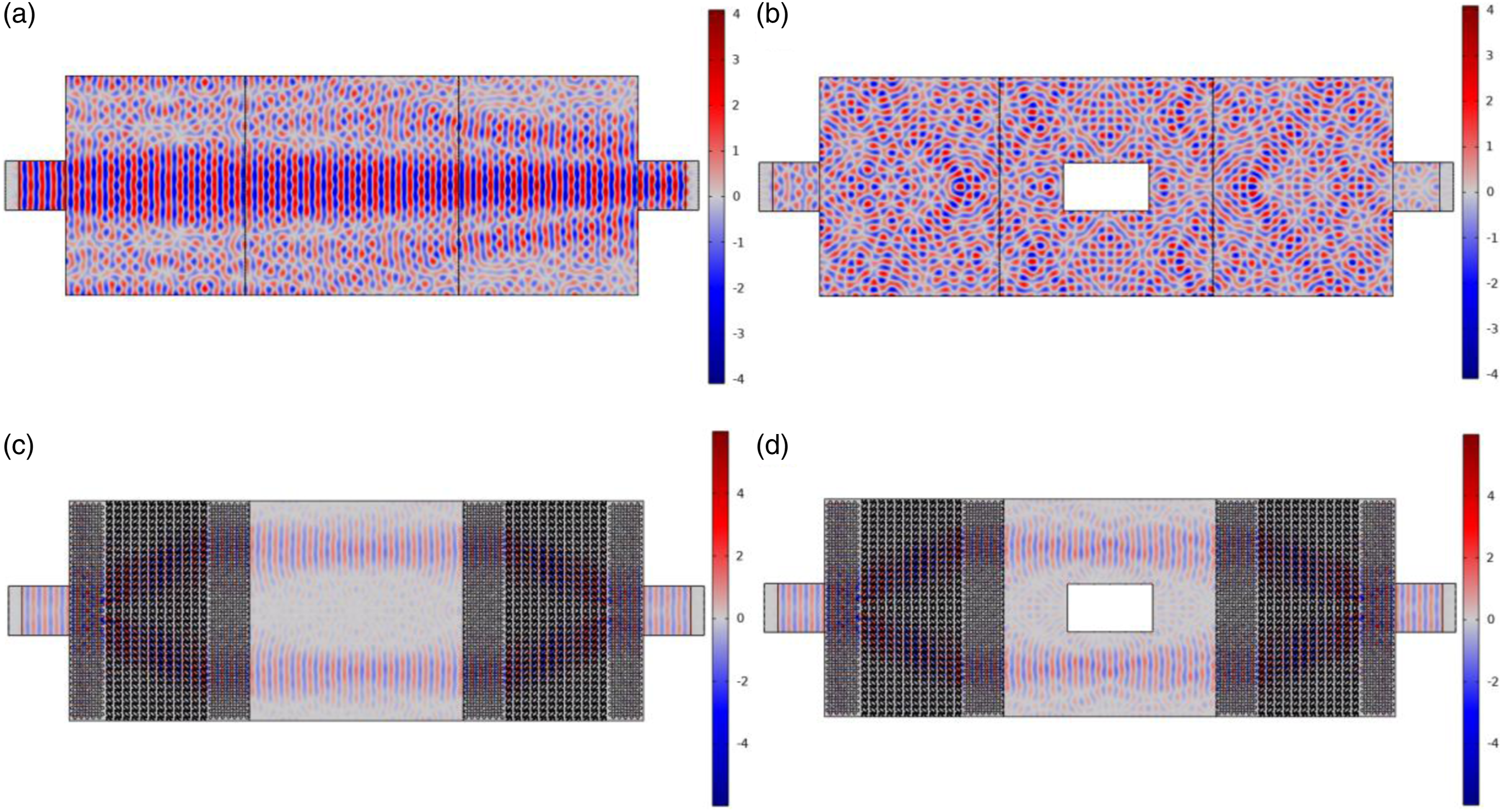
Figures 5(a) and (b) show the acoustic pressure distribution of the free acoustic field transmission with/without scattering target. The influence of the acoustic scattering target in the free acoustic field is obvious (Figures 5(a) and (b)).
Figures 5(c) and (d) show the acoustic pressure distribution of the acoustic penetration cloaking with/without scattering target. When the acoustic wave penetrates through the right metamaterial structure plate, the amplitude and phase of the transmission acoustic wave and the incident acoustic wave are consistent. Compared with the case depicted in Figures 5(c) and (d), if the two acoustic metamaterial structure plates are arranged and the acoustic scattering target is located in the acoustic stealth zone, the influence of the acoustic scattering target on the acoustic field can be omitted (Figures 5(c) and (d)). The results show that perfect penetration of acoustic wave can be achieved by arranging acoustic penetration cloaking.
Half acoustic penetration cloaking
To verify the scattering stealth ability, a half acoustic penetration cloaking is discussed, as shown in Figure 1(a). The width of the chiral metamaterial layer and the self-collimation metamaterial layers are 12a and 4.8a, respectively. The width of the acoustic field domain is 25a. The height of the acoustic penetration cloaking structure is 32b. The widths of perfectly matched layers, wave excitation domain are 1.6a and 5.5a, respectively. The height of the perfectly matched layers and wave excitation domain, are 7.2b. The incident acoustic wave frequency is 25305 Hz. Figure 6 shows the acoustic pressure distribution of the half acoustic penetration cloaking in the acoustic field. Comparison of the acoustic pressure distributions in the acoustic metamaterials structure: (a) pressure distributions in half acoustic penetration cloaking; (b) pressure distributions in half acoustic penetration cloaking with target scattering.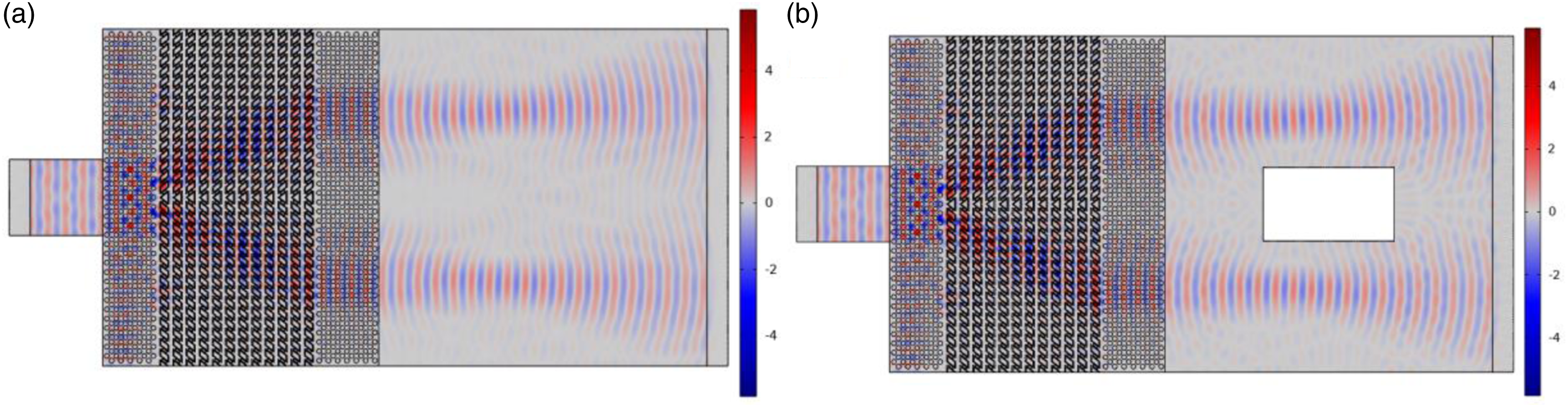
According to Figure 6, the acoustic stealth zone is formed in the acoustic field, and the influence of scattering target can be reduced. The results show that the acoustic transmission manipulation ability of the penetration cloaking.
Conclusion
Based on the bandgap properties, the acoustic penetration cloaking design with acoustic metamaterial is proposed in present work, in which the acoustic transmission manipulation function is obtained by combination metamaterials structure, and its feasibility and effectiveness are illustrated by numerical analysis. The following conclusion are obtained by numerical analysis: (1) The acoustic transmission path can be effectively manipulated by penetration cloaking with combination metamaterial structures; (2) If the acoustic scattering target is located in the acoustic stealth zone, the parameters of transmission acoustic wave are consistent with the incident acoustic wave, the acoustic stealth is achieved; (3) since the symmetry of the penetration cloaking structure, there is no phase difference problem in acoustic transmission; (4) In the experimental work of the future, the processing technology of the model is very important; (5) Acoustic penetration cloaking based on directional bandgaps has advantages such as simple structure, convenient manipulation, and wide adaptability; (6) Only the vertically incident acoustic wave transmission manipulation problems are investigated in present work, and oblique incident problems will be discussed in future. Some conclusions can provide technical support for design and application of innovative acoustic metamaterials.
Footnotes
Acknowledgements
This support is gratefully acknowledged by the authors.
Declaration of conflicting interests
The author(s) declared no potential conflicts of interest with respect to the research, authorship, and/or publication of this article.
Funding
The author(s) disclosed receipt of the following financial support for the research, authorship, and/or publication of this article: This work was partially supported by the Fund of High-tech Ship Research Projects by MIIT and State Key Laboratory of Ocean Engineering.
