




Abstract
Noise pollution is the most serious environmental pollution, which seriously affects people’s normal life and physical and mental health, as well as normal production work. Therefore, noise control is necessary, but before noise control, the first thing to do is to identify the location of the noise source, and the noise control work is meaningless when the noise cannot be identified. Flat plate structures are a fundamental part of complex ship structures, and their vibration, noise, and their interrelationships when excited by the outside world are receiving increasing attention. The core of the research in this paper is the identification of the sound source of the vibrating plate. A method combining phase conjugation with interior boundary element method is developed for the identification of the pressure and normal velocity distribution of a vibrating plate. An interior problem is formed by enclosing the phase conjugation array plane and the plate surface. The pressures at the array elements are phase-conjugated as the specified pressure boundary condition. The impedance relationship between the surface pressure and the surface normal velocity of the plate is utilized as a specified impedance boundary condition. The interior boundary element method is applied to solve the interior problem. The identification of the surface pressure and normal velocity distribution is studied numerically. The numerical results show that with the array located in the near field the proposed method achieves subwavelength focusing to identify the surface pressure and normal velocity distribution and clearly shows the response shapes.
Keywords
Introduction
Plate structures have a wide range of applications in aviation, shipbuilding, machinery, and civil engineering. Flat plate structures are the basic components of complex ship structures, and their vibration, noise, and the interrelationship between the two when subjected to external excitation are gaining more and more attention. 1
The identification of the sound field radiated by the sound source in the shape of the flat plate has important theoretical significance and practical value for the vibration and noise control of ships and offshore engineering structures, as well as improving the vibration and noise reduction technology of ships, and accelerating the modernization of naval equipment
The identification of sound sources plays an important role in the effective noise control. Time reversal can be used to focus sound and is also called phase conjugation (PC) in the frequency domain. The equivalence between phase conjugation in the frequency domain and time reversal in the time domain is established by Jackson and Dowling. 2 Due to its focusing property, the phase conjugation arrays could be used to build the image of a noise source and for source identification. However, the spatial resolution of the focused field of a classical PC array has a half wavelength limit because of diffraction. de Rosny and Fink 3 first showed that this limitation can be overcome by an acoustic sink. Fink et al. 4 also showed that the subwavelength focusing can be achieved inside a microstructured medium. Conti et al. 5 demonstrated the subwavelength focusing could be obtained without a priori knowledge of the source by a near-field time reversal procedure. de Rosny and Fink 6 investigated three species of the time reversal arrays in the near field of the initial source and concluded that only the dipole time-reversal array leads to subwavelength focusing.
The boundary element method (BEM) has been used extensively in acoustic radiation from bodies with known velocity, pressure, or impedance distribution. Typical problem types include interior and exterior problems. 7 For an interior problem, the objective is to solve the Helmholtz equation in a cavity of finite dimensions with cavity boundary surface. For an exterior problem, the objective is to solve the Helmholtz equation in an unbounded fluid domain due to the acoustic radiation from a vibrating structure with boundary surface. Based on the boundary element method, Weiping Yang used the Helmholtz resonator to study the acoustic radiation and suppression of long enclosures without baffles, and proved that the boundary element method is an effective tool for analyzing acoustic radiation phenomena and introducing appropriate noise control strategies. 8
In this paper, a method combining PC with BEM is developed for the identification of the pressure and normal velocity distribution of a vibrating plate. In the proposed method, the measured pressure at the PC array is phase-conjugated as the specified pressure boundary condition of an interior problem, the a priori knowledge of the impedance relationship between the surface pressure and the surface normal velocity of the plate is utilized as the specified impedance boundary condition. With the measured pressure by the array and the a priori knowledge of the impedance relationship on the plate surface, the surface pressure and velocity distribution of the plate could be identified by an interior BEM. The results of the numerical simulation show the proposed method achieves a resolution higher than half a wavelength and obtains subwavelength focusing.
Theory
Forward problem of sound radiation
For structural acoustic radiation problems in free space, the boundary element formulation is based on the Helmholtz integral equation
9


The discretization of the surface Helmholtz integral equation

If a planar surface extends over an infinite half-space, the acoustic pressure at any field point


For the acoustic radiation from a vibrating structure under excitation without consideration of acoustic fluid-structure interaction, the velocity

Then the surface pressure
Backward problem of sound radiation—sound identification using PC arrays
The reason that time-reversed sound waves travel backwards is a direct consequence of the lossless linear wave equation for the acoustic pressure

This equation is time-reversal invariant because it contains only second-order derivatives with respect to time. Equation (7) ensures that if
For a perfect PC array, both the original field


The phase-conjugated field
The phase-conjugated field by the array made of monopole transceivers based on the pressure measurement is

The phase-conjugated field by the array made of dipole transceivers based on the pressure gradient measurement is

In the following numcrical analysis, the pressure calculated at the array element is used as the measurement pressure in the above equations. A double layer of array elements is used to provide the pressure and the pressure gradient. That is, the pressure
Using equations (9)–(11), the surface pressure can be identified and then the surface normal velocity can also be recovered from equation (3) or equation (5).
Sound identification using PC and interior BEM
When the original field
For an interior problem with BEM, the objective is to solve the Helmholtz equation in a cavity of finite dimensions. In the proposed method, PC array is modeled as a surface with known pressure Schematics for the interior problem with source surface and PC array surface.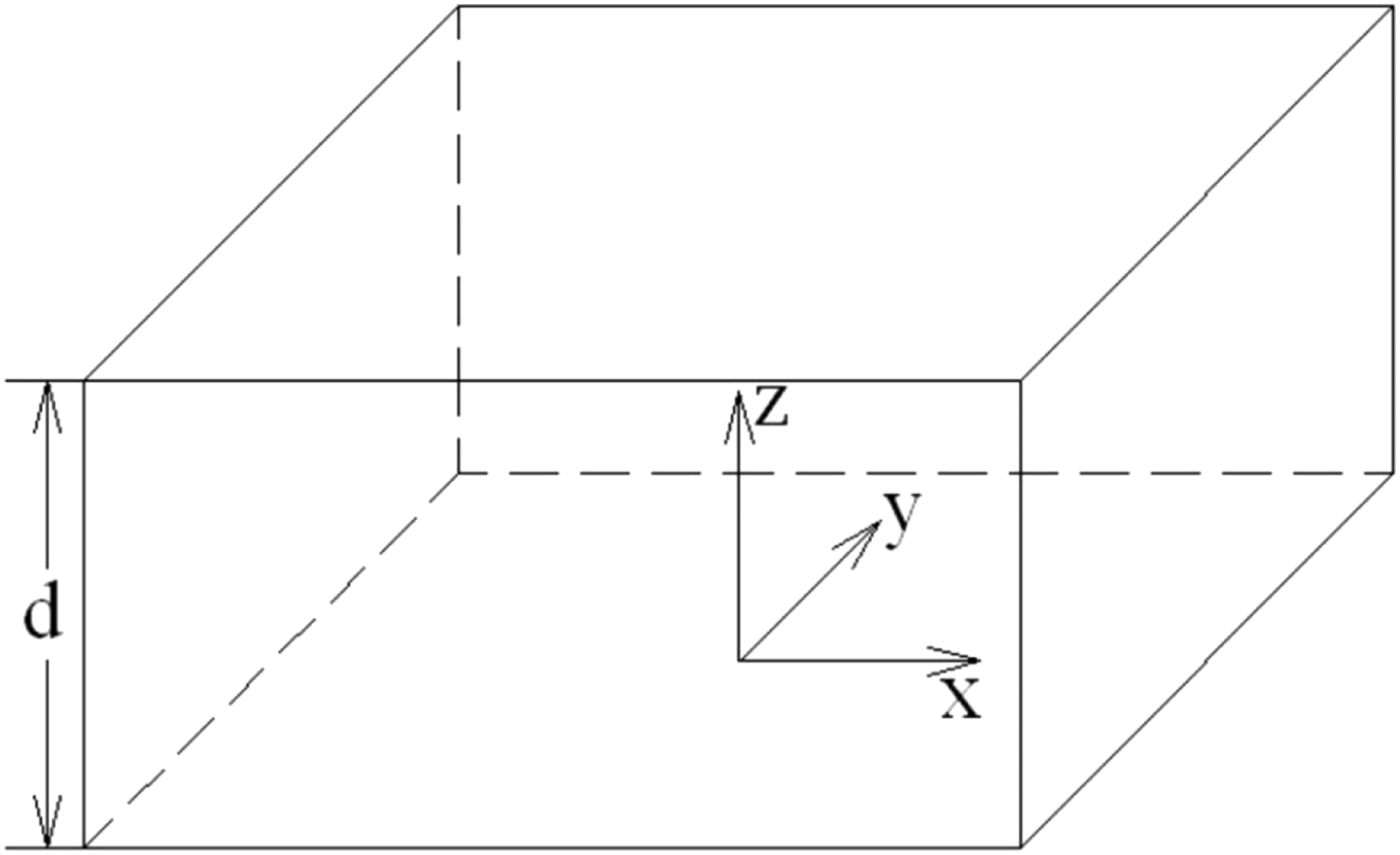
For the interior problem, the Helmholtz integral equation is


Then the link between the acoustic pressure and normal velocity on the surface can be obtained by the discretization of the surface Helmholtz integral equation (12)

The boundary conditions for the solution of equation (14) are as follows: (1) A pressure boundary condition (2) An impedance boundary condition (3) A characteristic impedance boundary condition



Among the above boundary conditions, equation (16) cannot be directly used for solving equation (14);so, we rewrite equation (16) as

Then, equation (16) is related to equation (14) as

With the other two boundary conditions equations (15) and (17), equation (19) can be arranged in such a way that all the boundary unknowns

Equation (20) can be solved by a standard complex matrix solver. Once the
Numerical results
The dimensions of the plate are
The natural frequencies of the steel plate.

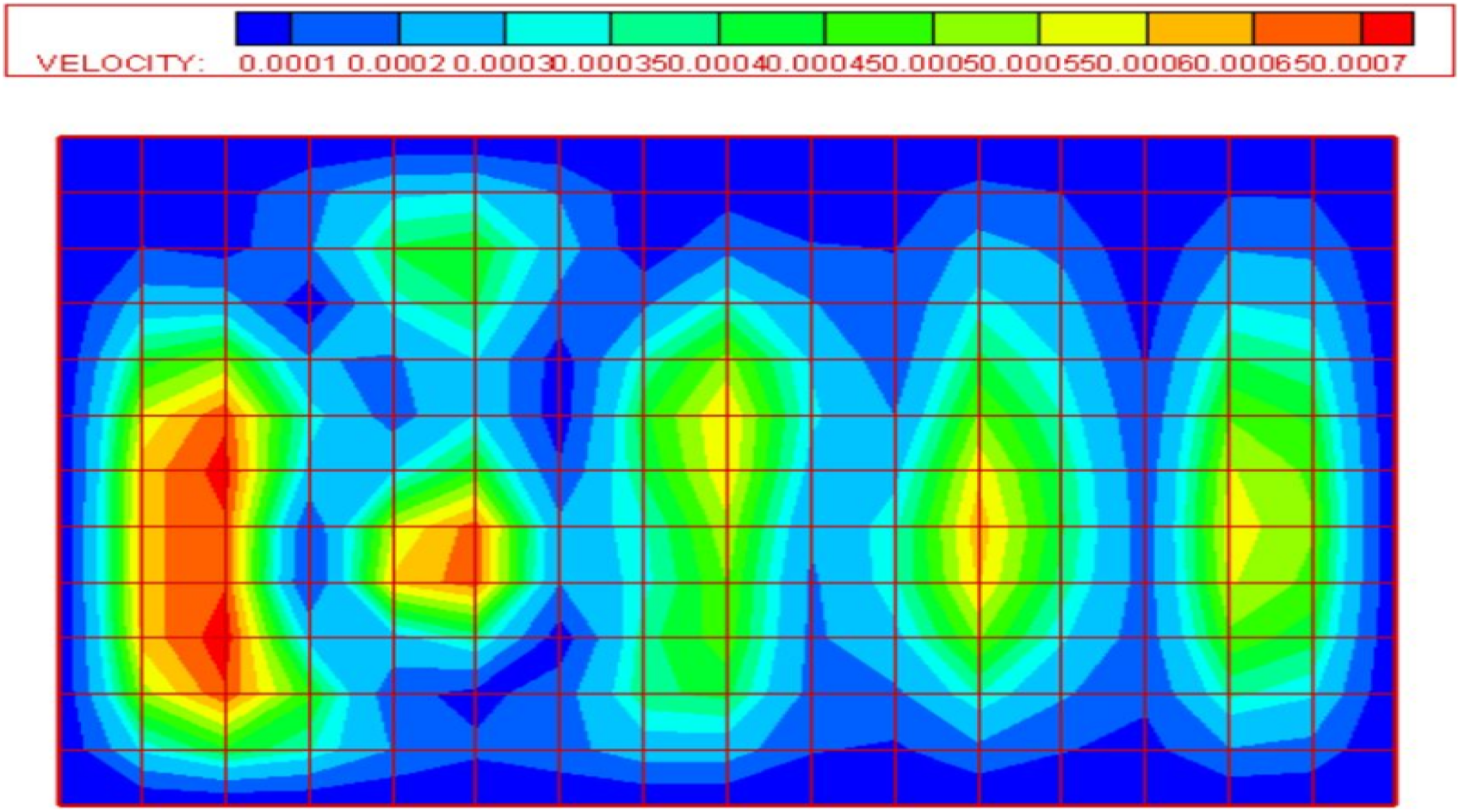
The normal velocity calculated by FEM.
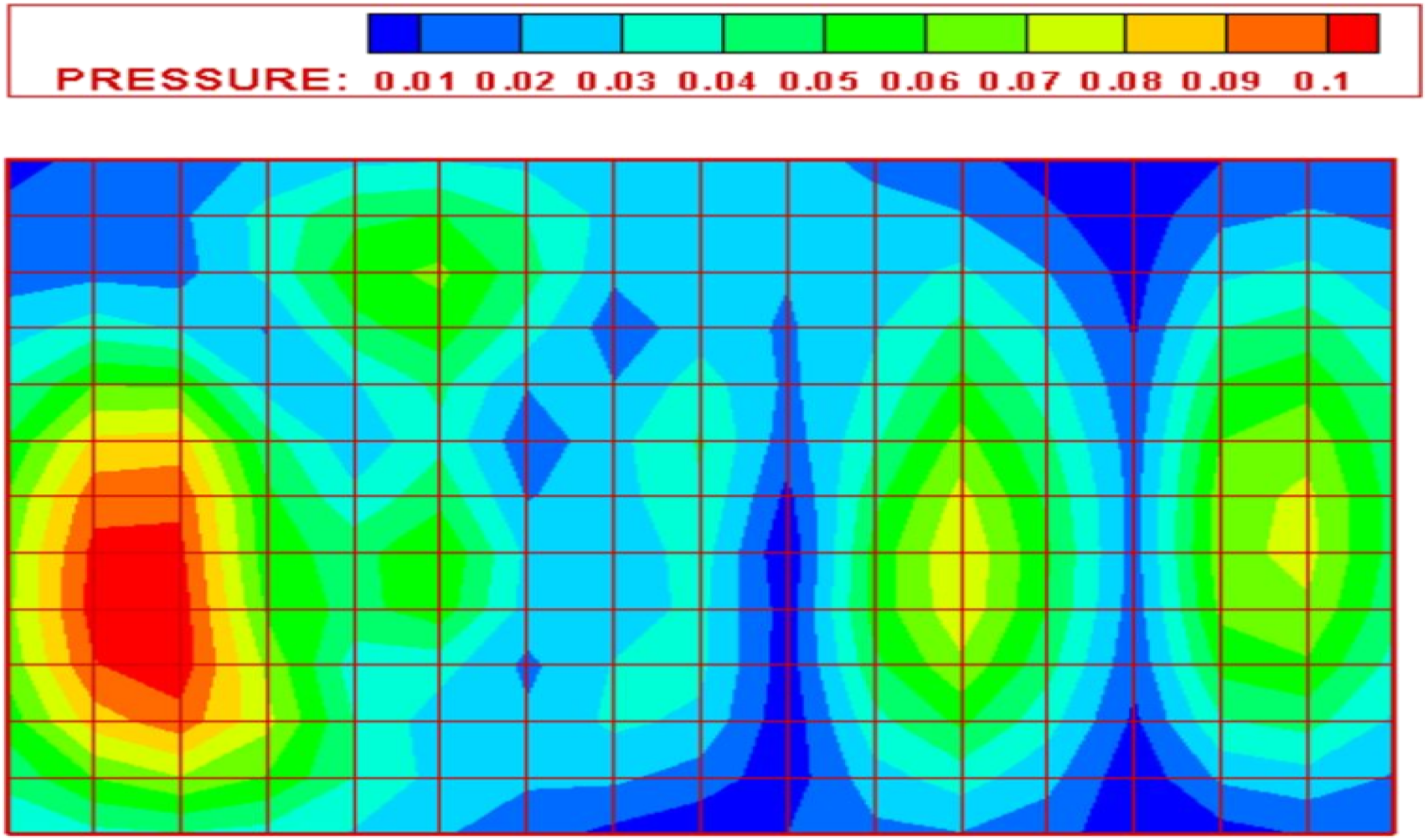
The surface pressure calculated by Rayleigh integral.
The PC array is a plane array that has the same dimension as the plate surface, the number of the uniform distributed array elements is 221, the array element spacing is 0.05 m = 0.07λ. The surface pressures obtained by PC arrays using equations (9)–(11) are shown in Figures 4–6. The surface normal velocities obtained by PCD array are shown in Figure 7. The surface normal velocities and the surface pressures obtained by interior BEM are shown in Figures 8 and 9. The surface of the box is discretized into 776 four-node elements and 778 nodes in the boundary element analysis and the mesh on the plate and the PC array plane are the same The surface pressure obtained by PCP (d = 0.1λ). The surface pressure obtained by PCM (d = 0.1λ). The surface pressure obtained by PCD (d = 0.1λ). The normal velocity obtained by PCD (d = 0.1λ). The normal velocity obtained by interior BEM (d = 0.1λ). The surface pressure obtained by interior.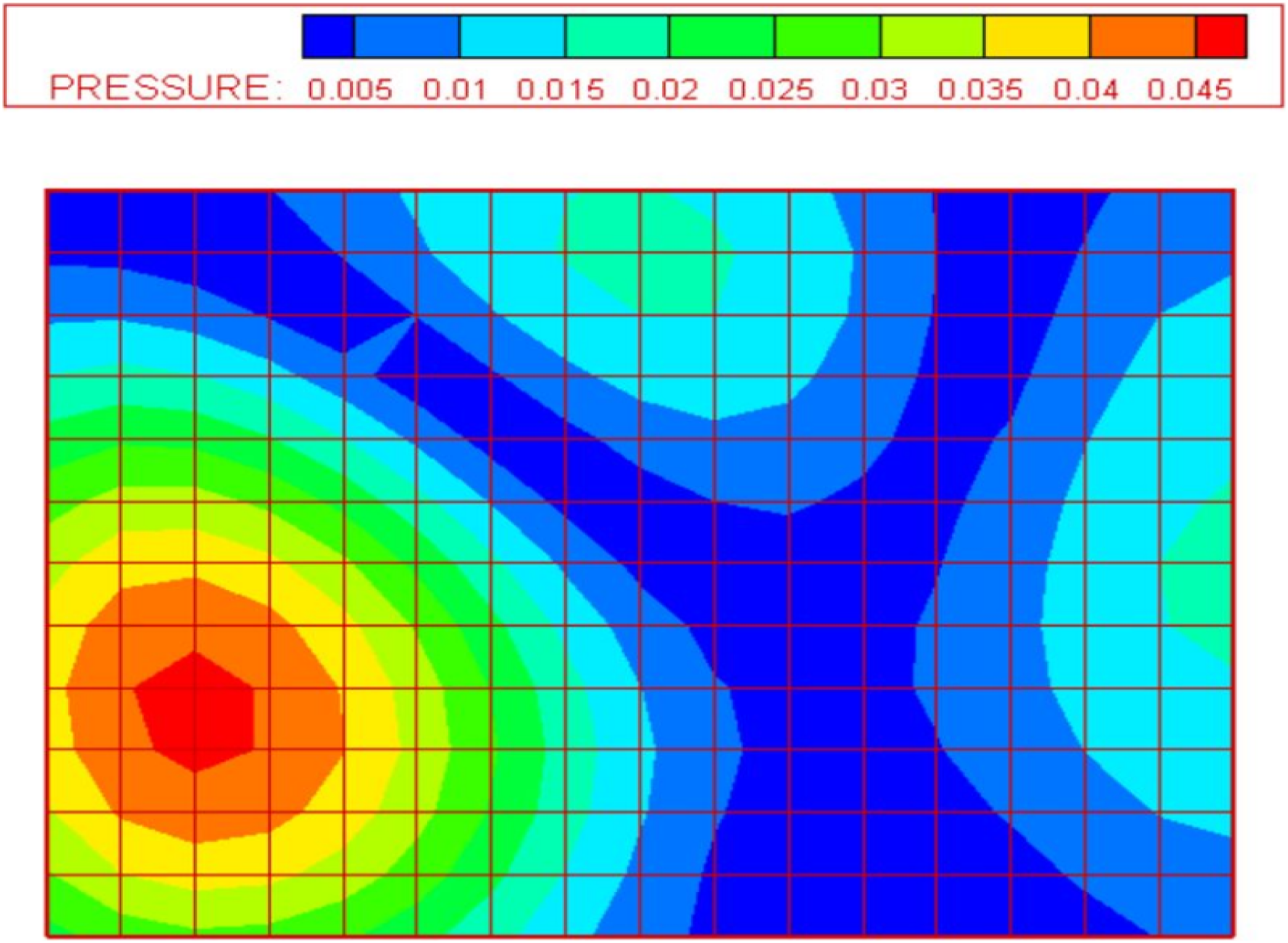
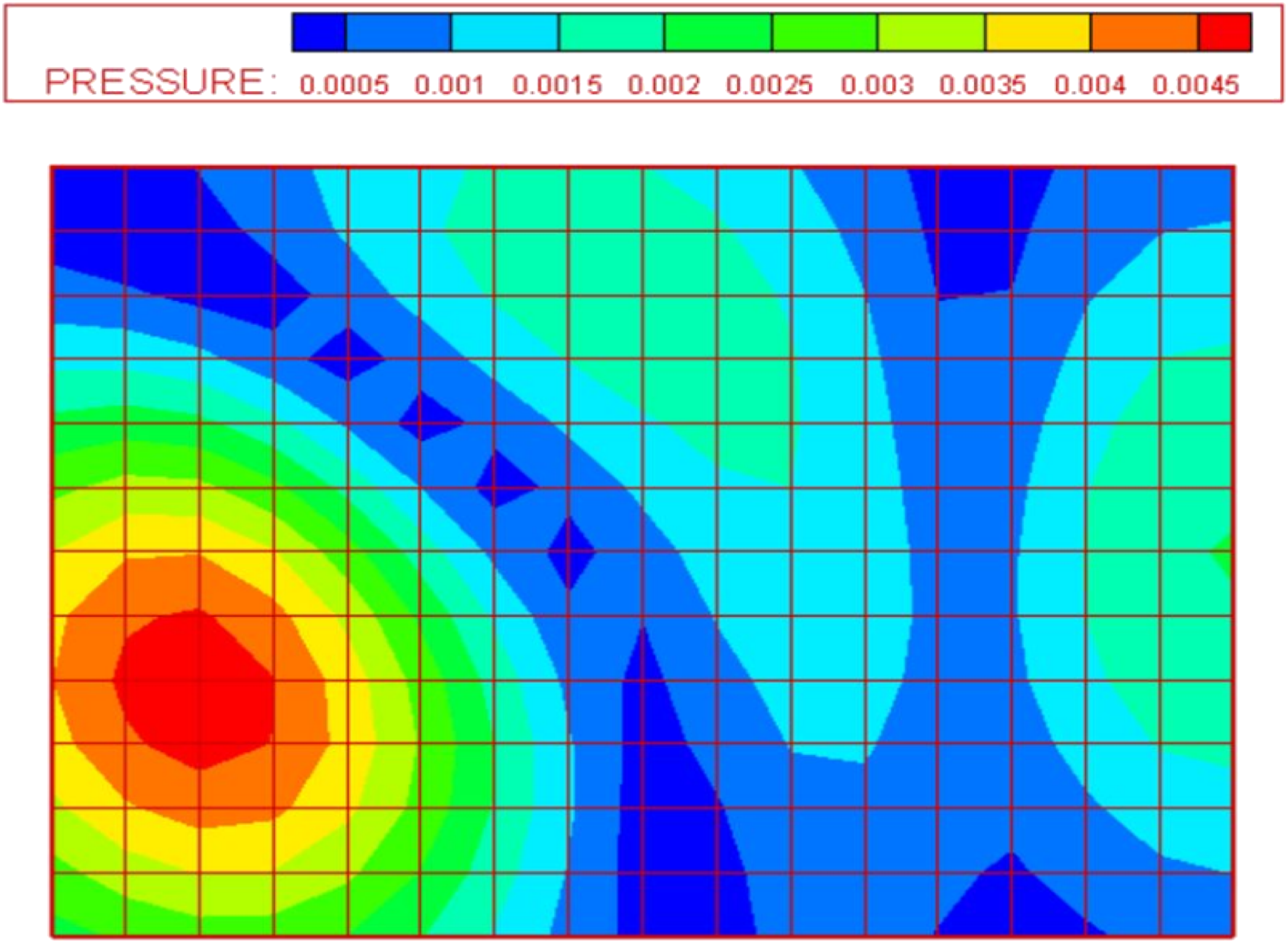
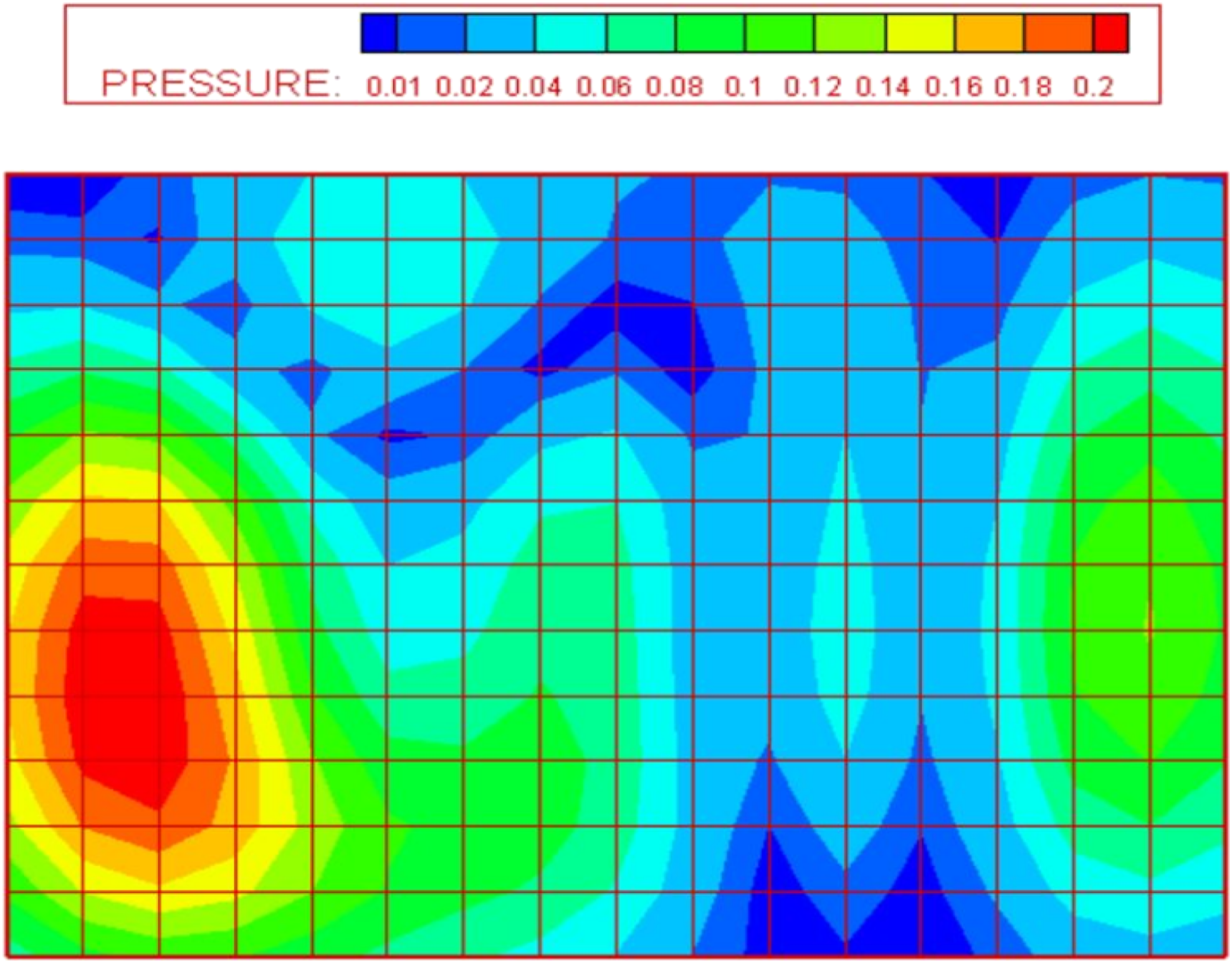
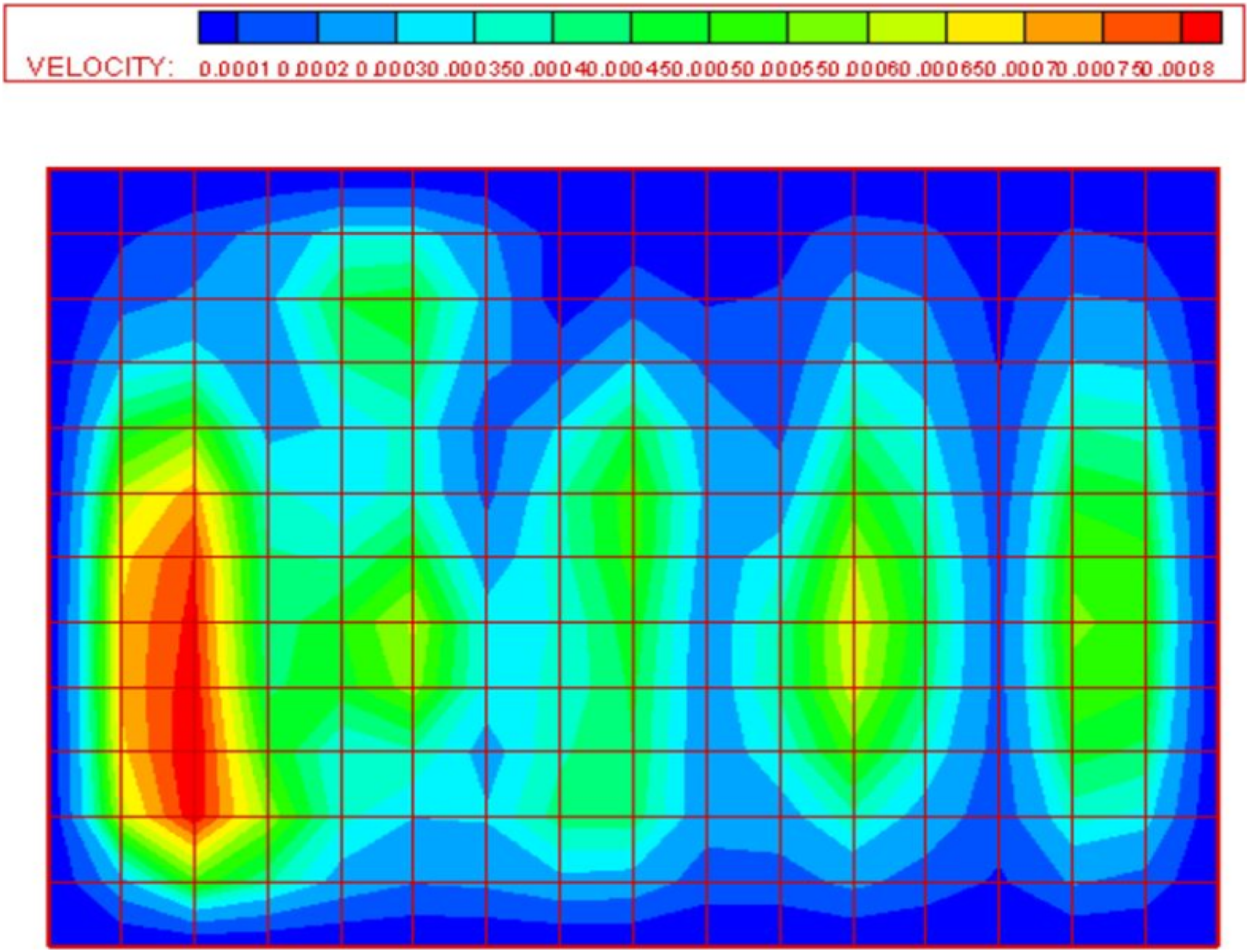
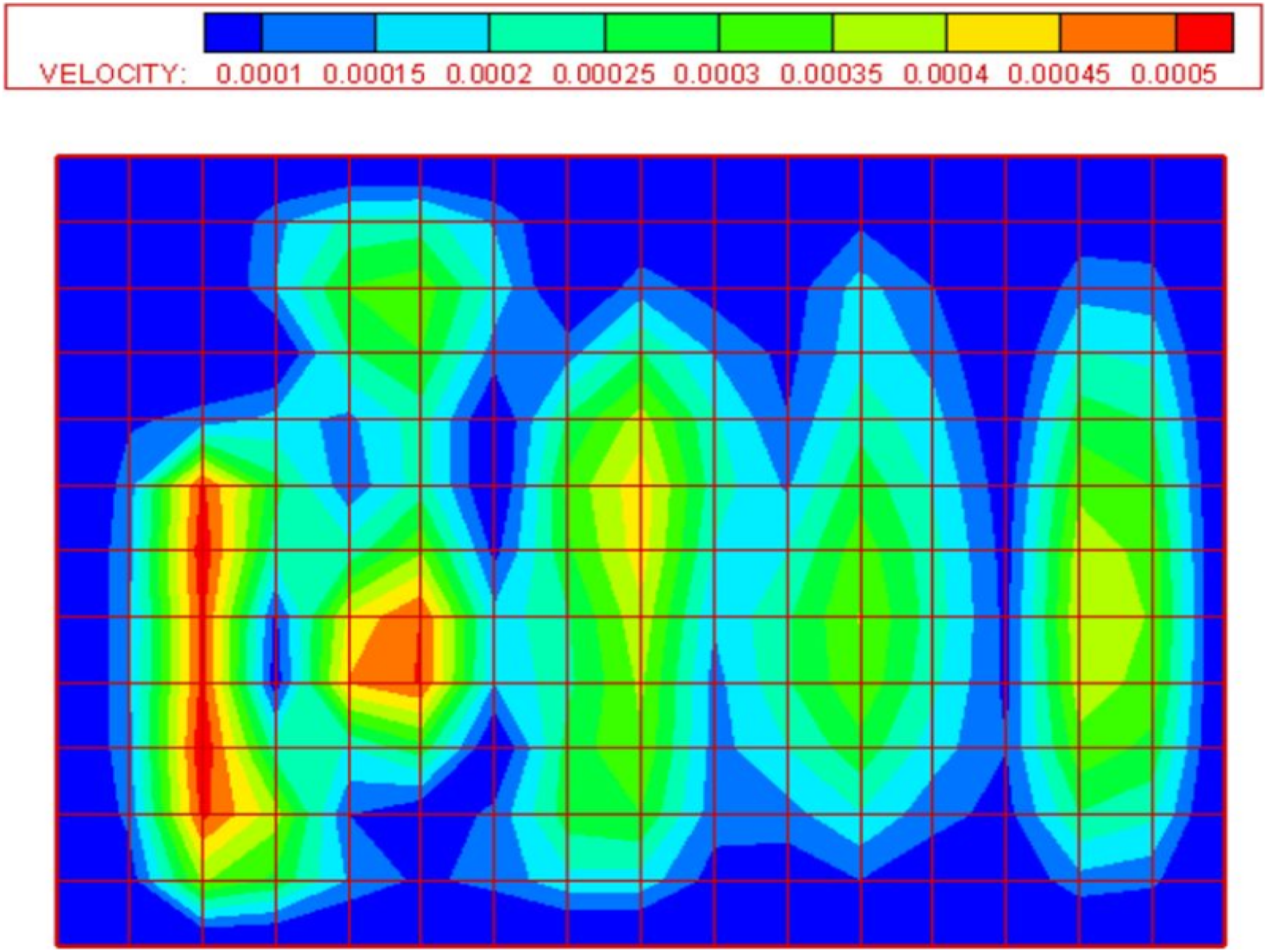
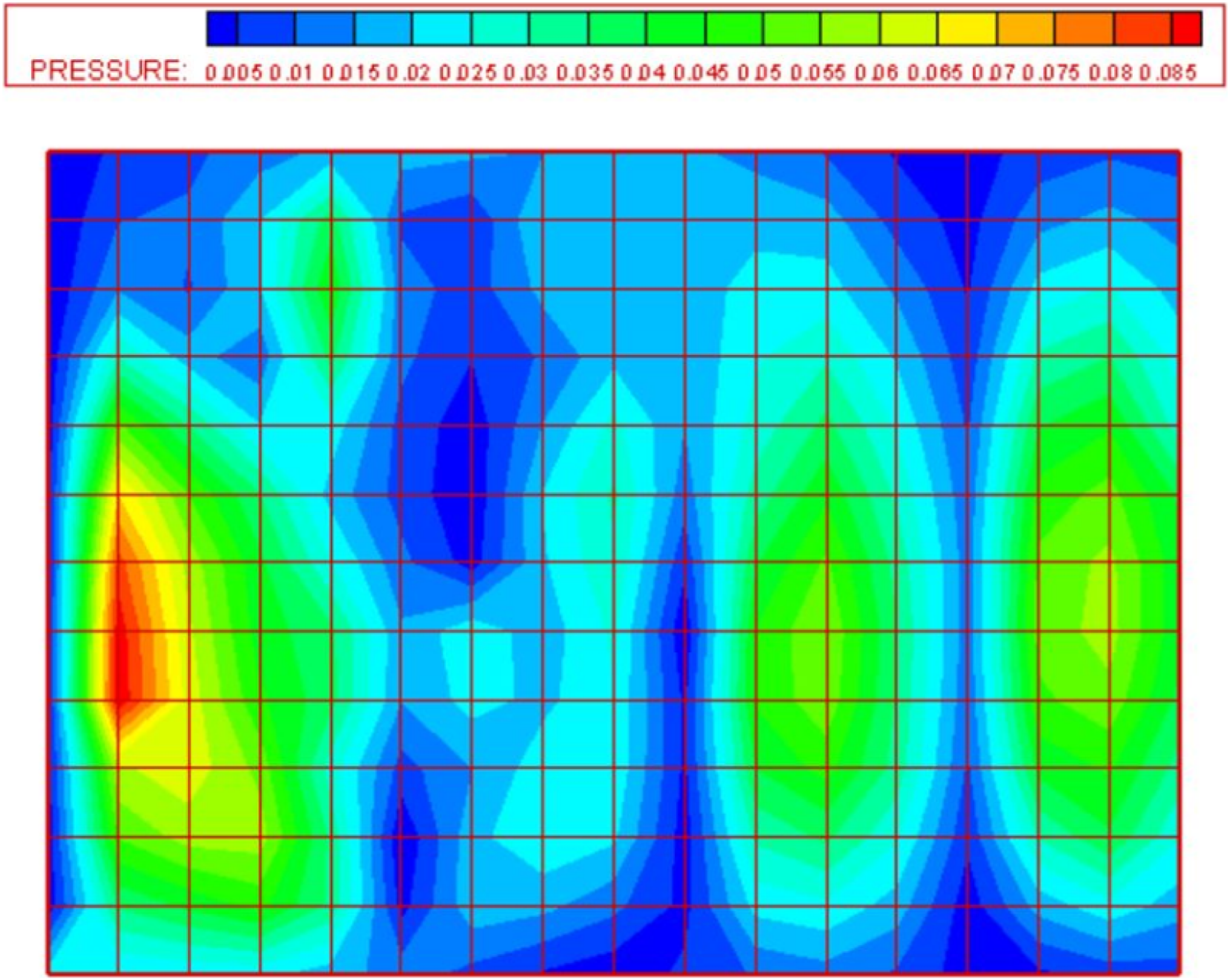
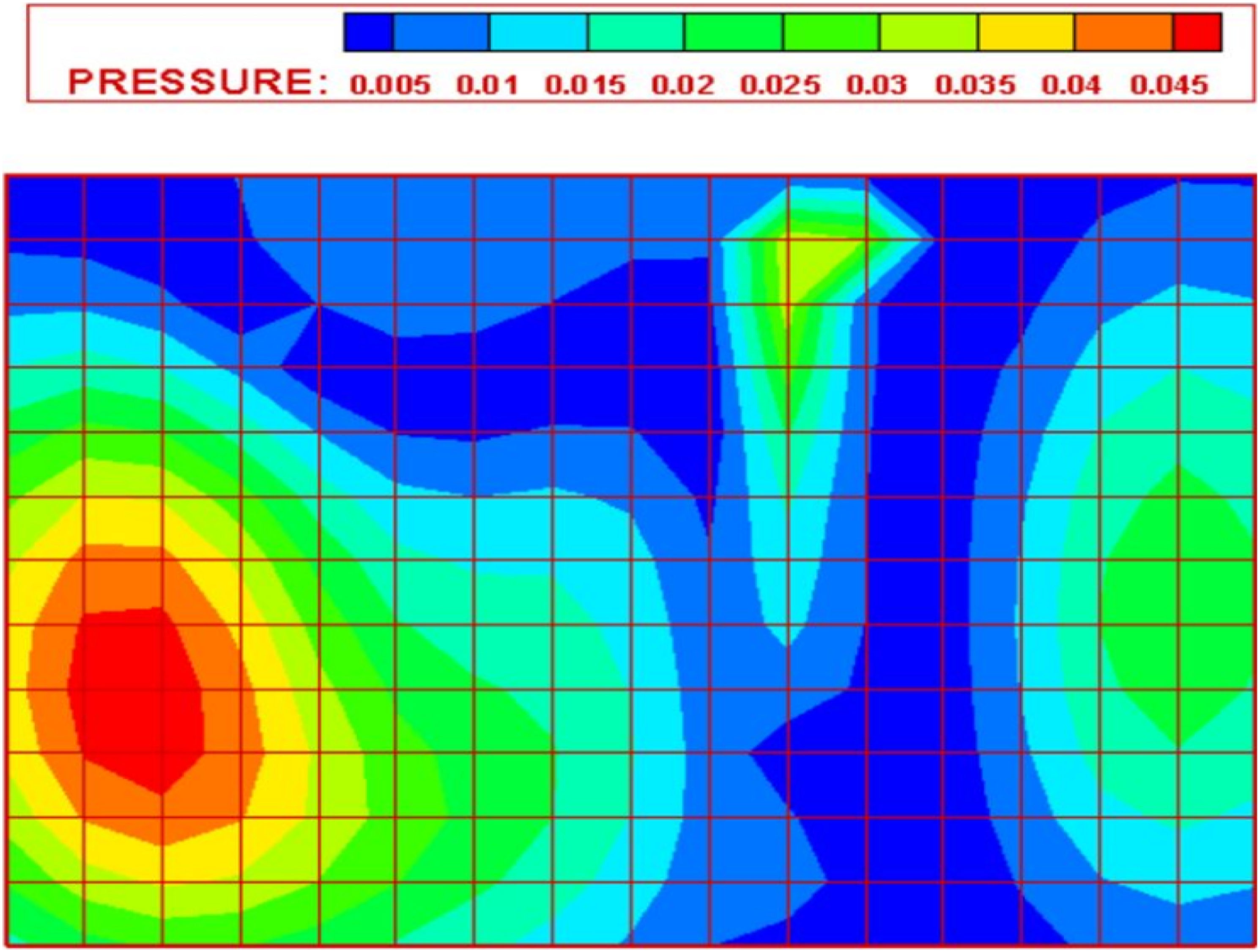
We only change the distance between the PC array and the plate surface from d = 0.1λ = 0.07 m to d = 3λ = 2.1 m. The mesh on the plate and the PC array plane are the same as before, only the elements and nodes of the other four sides of the box are increased with increasing distance, and the surface of the box is discretized into 1504 four-node elements and 1506 nodes for interior BEM. The surface pressures obtained by the PCD and the interior BEM are shown in Figures 10 and 11. We can see that with the array not located in the near field, both the interior BEM and the PCD fail to get high resolution to identify the exact response shape. The surface pressure obtained by PCD (d = 3λ). The surface pressure obtained by interior BEM (d = 3λ).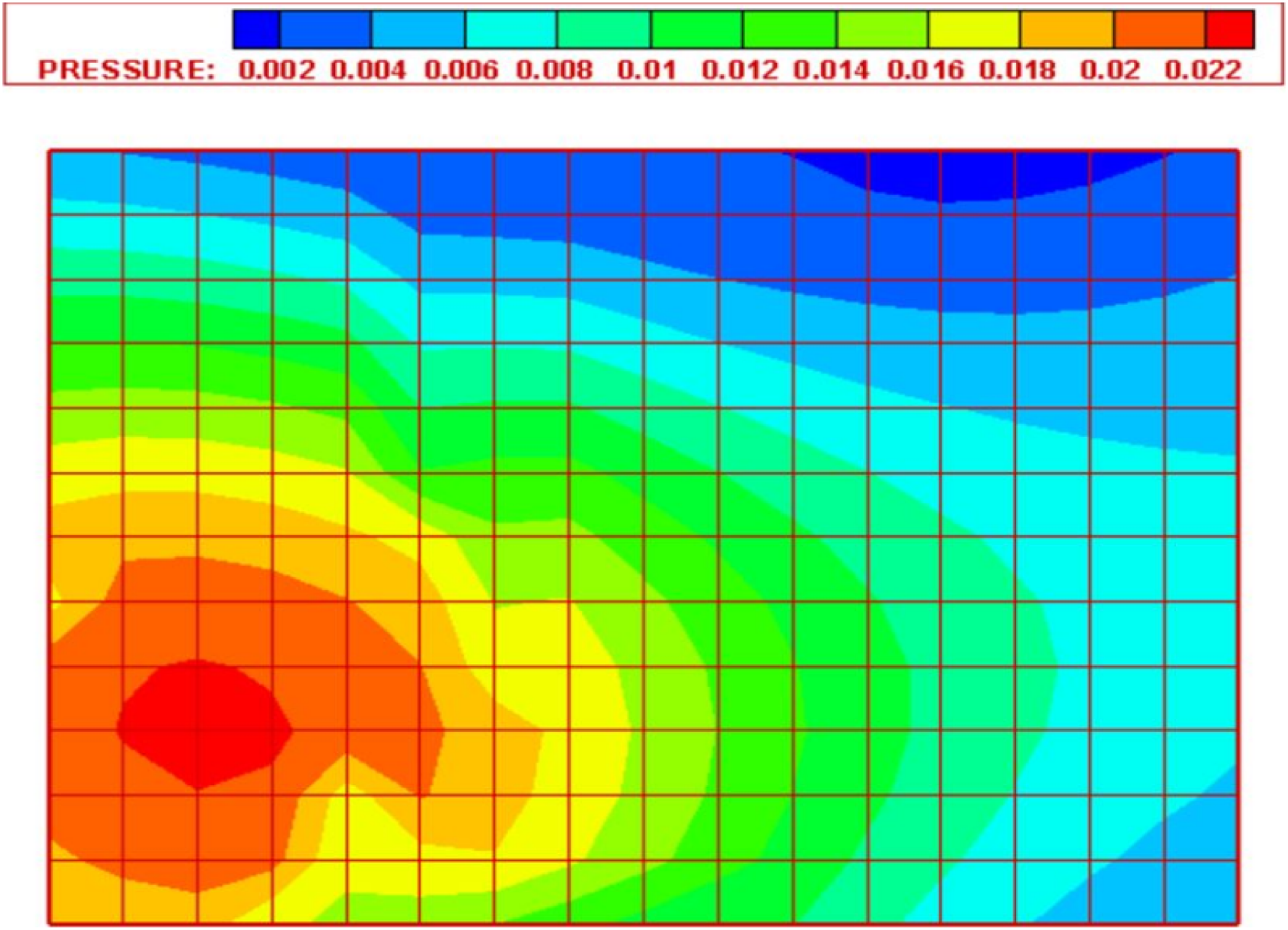
Comparison
To show the result more clearly, the normalized amplitudes of the surface pressures at The normalized pressure amplitudes at y = −0.1 m.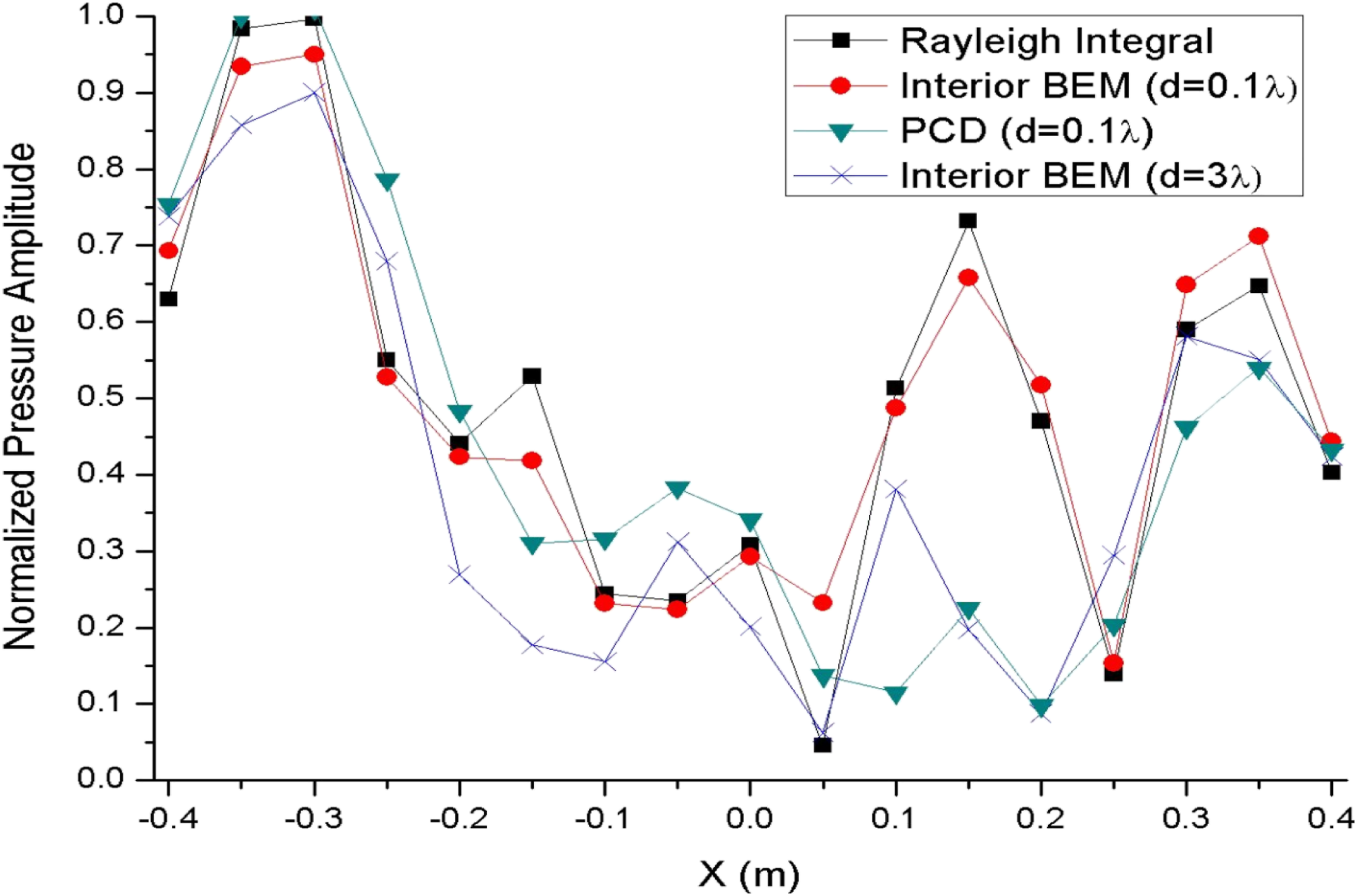
Different excitation location
A different excitation location (−0.25, −0.25, 0) is considered for the identification of the response shape. The surface pressure phases obtained by the Rayleigh integral, interior BEM, and PCD array are shown in Figure 13. It is also clear that from these figures, the interior BEM identifies the response shape excited from a different location by the force. The pressure phases at y = −0.1 m.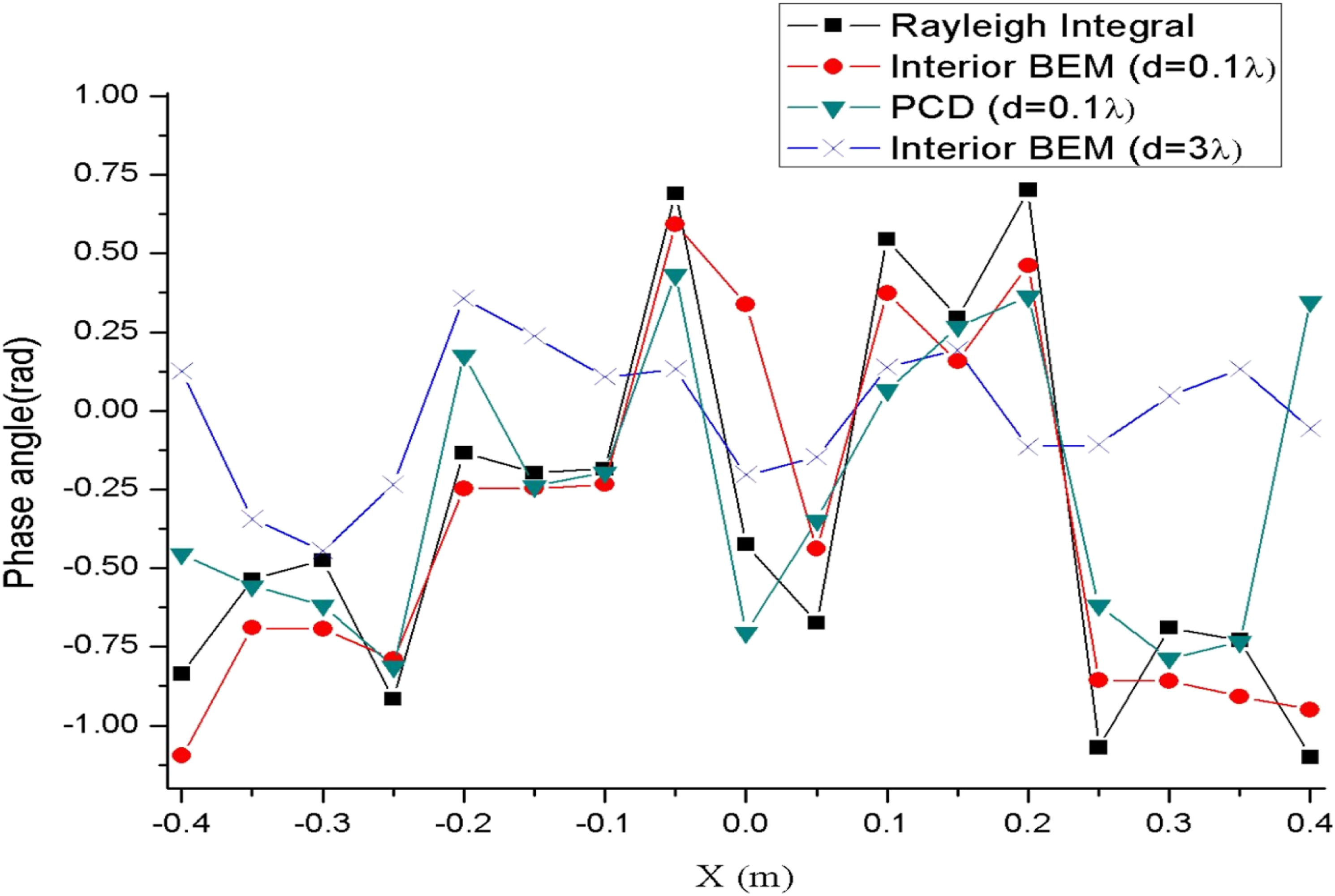
Conclusions
The phase conjugation arrays could be used to build the image of a noise source and for source identification. However, the a priori knowledge of the impedance relationship between the surface pressure and the surface normal velocity of the original source is not utilized in the identification of the surface pressure. In this paper, the phase conjugation has been combined with the interior boundary element method to identify the sound sources. A plate subject to a point force is involved to verify the effectiveness of the method. An interior problem is formed by enclosing the PC array plane and the plate surface. The interior boundary element method is applied to solve the interior problem with the a priori knowledge of the impedance relationship of the plate as an impedance boundary condition and the phase-conjugated pressure at the array plane as a pressure boundary condition. The identification of the surface pressure and normal velocity is studied numerically. The numerical results show that compared to the Rayleigh integral and PCD methods, it can be seen more clearly that the internal BEM gives the best results for the shape of the response, and the spatial resolution achieved by the internal BEM is less than
In this paper, the acoustic radiation acoustic field of vibrating plate is identified by combining phase conjugate method and internal boundary element method, which realizes sub-wavelength focusing when the phase conjugate array is located in the near field to identify the surface pressure and normal velocity distribution, and can clearly display the response shape, which proves that this method has a good application prospect in the study of acoustic radiation acoustic field recognition of vibrating plate, and can be popularized.
Footnotes
Declaration of conflicting interests
The author(s) received no financial support for the research, authorship, and/or publication of this article.
Funding
The author(s) disclosed receipt of the following financial support for the research, authorship, and/or publication of this article: This work was supported by Project of the National Natural Science Foundation of China: Research on the Separation and Identification of Multi target Noise Sources in Complex Sound Fields Based on Phase Conjugation Method (No. 51609037); Basic Research Business Fee Project of Dalian University of Technology: Research on Location and Imaging of Ship Radiated Noise Sources in Complex Marine Environment (No.: DUT22GF206).
