




Abstract
The traditional wave impeding block (WIB) is designed as composite multilayer WIB with the same thickness to improve its vibration isolation effect. Based on the wave theory in unsaturated porous medium and elastic medium, the isolation effect of composite multilayer WIB on P-wave in unsaturated soil is investigated, and the solution of the vertical displacement at surface after setting composite multilayer WIB (as an example for triple-layer) in unsaturated foundation is obtained. The key factors such as incidence angle, frequency, saturation, thickness, and burial depth of the composite multilayer WIB are evaluated on its vibration isolation properties. The results show that the optimum vibration isolation effect can be achieved by controlling the wave impedance ratio among layers of materials. The isolation efficiency of composite multilayer WIB is 33.9% higher than homogeneous WIB with same thickness at l east, and has good vibration isolation effect for low, medium, and high frequency.
Keywords
Introduction
Soil in nature is composed by soil particles and liquid and gas in the porosity of the soil skeleton. 1 Most of the foundations in construction activities such as pile-driven, dynamic compaction, etc., construction engineering such as elevated, highway, and railroad compacted fills are unsaturated soils. 2 Accordingly, to choose unsaturated foundations that better match the actual situation and reflect the common state of the soil, the research of damping and isolation methods for unsaturated foundations under environmental vibration is of great practical importance.
A variety of methods have been proposed by scholars to isolate the source of environmental vibration, that is, vibration isolation and damping in the forms of continuous barriers and discontinuous barriers.3–10 The above studies show that continuous and discontinuous barriers have effective vibration isolation for medium and high frequencies, but the vibration isolation effect is limited by depth and site. Another vibration isolation measure of installing wave impeding block (WIB) in the foundation was proposed by Chouw et al.11,12 whose analysis results showed that the effect of passive vibration isolation of WIB is better than filling the trench. Subsequently, Yang et al.13,14 compared the isolation effect of an open trench and WIB, and the findings show that the WIB is more effective in the range below the cut-off frequency. Peplow et al. 15 investigated the vibration isolation effect of the active vibration isolation of WIB in 2D two-tier foundations by the boundary integral equation method, which showed that the vibration isolation effect of WIB for low-frequency is better than that for high-frequency. Xie et al. 16 analyzed the effect of WIB on the control of subway vibration by numerical software, and the results showed that the vibration isolation and damping effect of WIB are better for the low-frequency vibration of 5 Hz–15 Hz. Li et al. 17 investigated the vibration isolation effect of WIB under moving load by finite element method and concluded that the WIB has a good vibration isolation effect within 10 Hz. Thompson et al. 18 used the boundary element method (BEM) to study the vibration isolation performance of WIB buried under the track, and the results showed that the WIB can reduce the vibration in the range 16 Hz–50 Hz effectively. Gao et al.19,20 investigated the vibration isolation performance of 3D WIB, and the results showed that the WIB has a good vibration isolation effect at low-frequency. As evidenced by the above study, the significant effect of vibration control of WIB is only better in the low-frequency range and the band is narrow, the limitations are greater when the complex vibration source frequency is isolated, and the vibration amplification phenomenon will occur with poor vibration isolation effect for medium frequency vibration and high frequency vibration.
Therefore, to improve the vibration isolation performance of the conventional WIB for the above problems, some scholars carried out improvement on it. Ma et al.21,22 analyzed the vibration isolation effect of graded non-homogeneous WIB in elastic and saturated foundations under moving loads. Tian et al. 23 based on the 2D semi-analytical BEM, the vibration isolation effect of Duxseal material in a 2D homogeneous elastic foundation with active vibration isolation are investigated. Subsequently, Gao et al.24,25 proposed the method of combined vibration isolation by filling Duxseal in the WIB through field tests, and the results showed that DXWIB can improve the frequency bandwidth of vibration damping, and the vibration isolation effect is better in the range of 5 Hz–70 Hz. Yet, although the above-mentioned modified WIB has improved the vibration isolation efficiency, the majority of research studies focus on the case of the WIB in the elastic or saturated foundation.
However, unsaturated soils are the relatively common state of existence of soils in nature, elastic foundations or two-phase saturated foundations are difficult to simulate the actual situation of the field soil medium, and the research needs to be conducted on unsaturated foundations that are more realistic and universal. Accordingly, to address the above problems, it is essential to explore new vibration isolation theories and methods from the structure and material perspectives. Shu et al.26–28 investigated the propagation characteristics of P1 and S wave through composite multilayer WIB in unsaturated foundation, respectively, and the results showed that the wave impedance ratio at the interface between the WIB and the foundation, as well as the density and shear modulus of the material between the interlaminar have great impact on the transmission and reflection coefficients. Jiang et al. 29 investigated the vibration isolation performance of single-layer WIB in unsaturated foundation under S-wave incidence, and the findings showed that the vibration isolation effect of WIB increased with an increase in saturation and shear modulus. In addition, according to the literature, 30 it is known that the greater the difference between the interfaces of multi-layer and thin-layer, the more significant the vibration wave transmission and reflection effect. Based on the theory of wave propagation in unsaturated porous medium and Snell’s theorem, the isolation effect of composite multilayer WIB in unsaturated foundation on P-wave is studied. The analytical solution of the surface displacement after setting a composite multilayer WIB in unsaturated foundation under P-wave incidence are derived and obtained. The wave impedance ratio at the interface between unsaturated soil and WIB and the wave impedance ratio among layers of composite multilayer WIB are analyzed by numerical calculation, and the isolation effect of composite multilayer WIB and single layer WIB with the same thickness is compared. The effect of various key factors such as incidence angle, frequency, saturation, burial depth, and thickness on the isolation effect of composite multilayer WIB in unsaturated foundation is analyzed and studied, which in turn provides reference for the application of composite multilayer WIB in unsaturated foundation.
Mathematical model setup
With a certain thickness of composite multilayer WIB embedded in unsaturated foundation, assuming that the incident P wave with frequency ω is incidence at any angle φ to the WIB in unsaturated foundation, the transmission and reflection are shown in Figure 1. In this case, the horizontal semi-infinite bedrock is covered by an unsaturated soil layer whose thickness is H. Propagation of P-wave when setting the composite multilayer WIB in unsaturated soil foundations.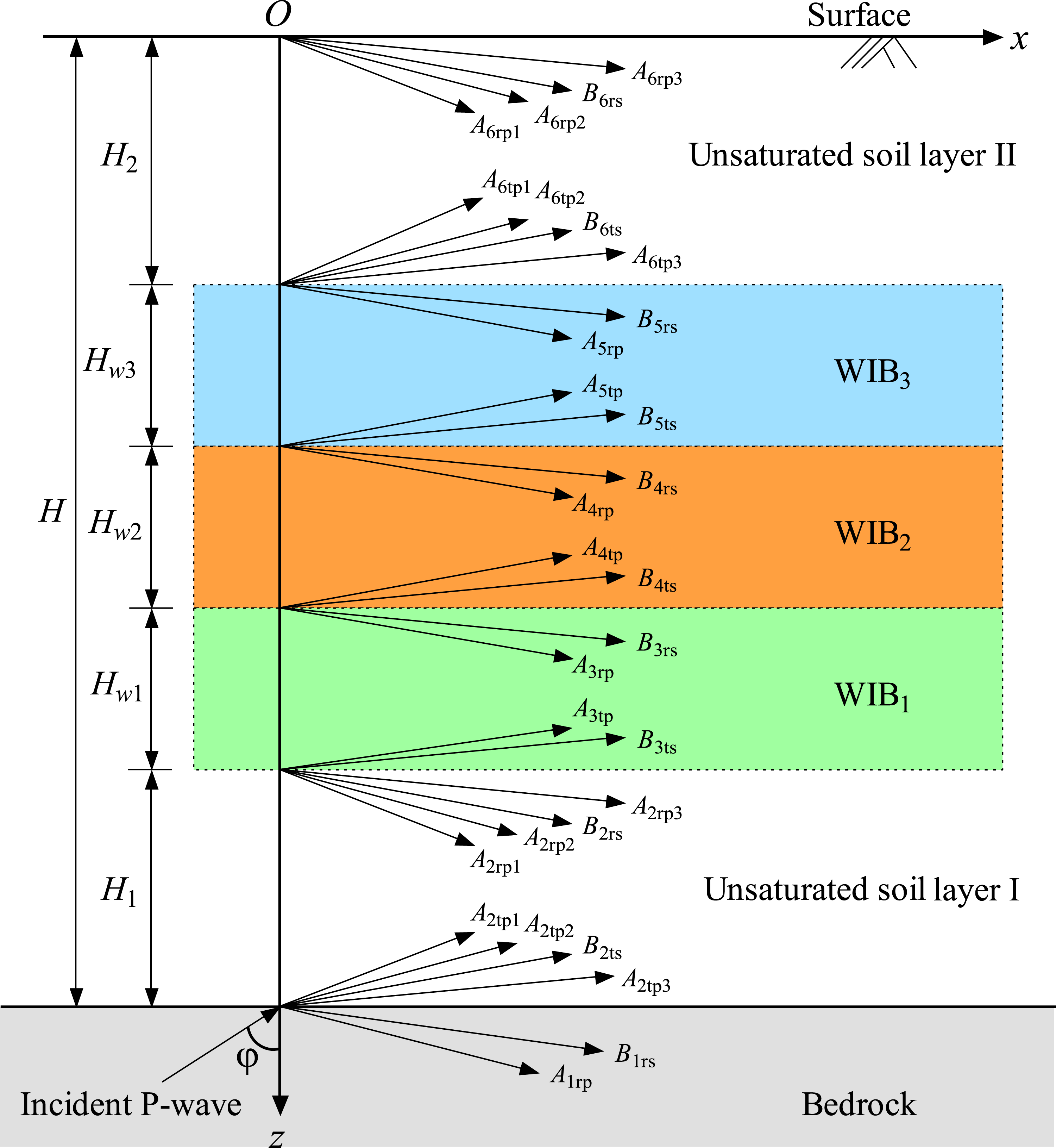
Wave equation for unsaturated porous medium
With the development of the continuum theory of mixtures, the set of motion equations for the unsaturated porous media in the absence of body forces are given by Refs. 31–33 as follows and equations (1a)–(1c), in which the superscripts: “S”, “L” and “G” denote the solid, liquid, and gas phases in the unsaturated foundation soil layer, respectively



Considering the Helmholtz resolution of each displacement vector of the three phases in the following forms







The general solutions to equations (3a)–(3f) are assumed to be


Substituting equations (4a) and (4b) into equations (3a)–(3f), the characteristic equations of P waves and S wave can be obtained


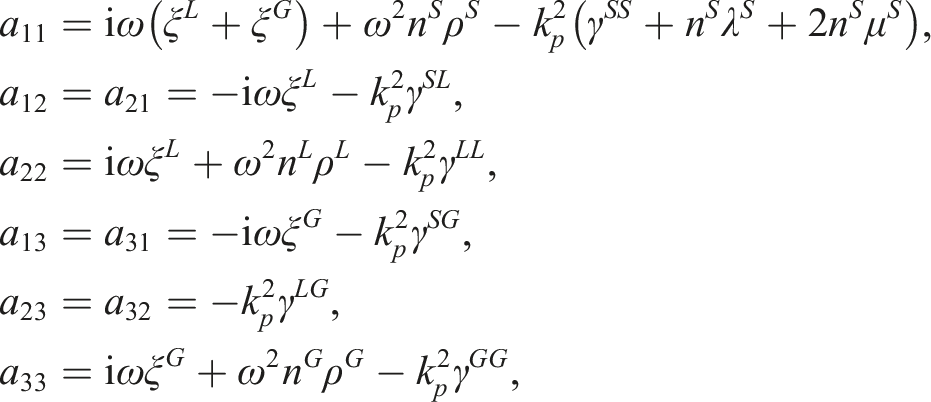
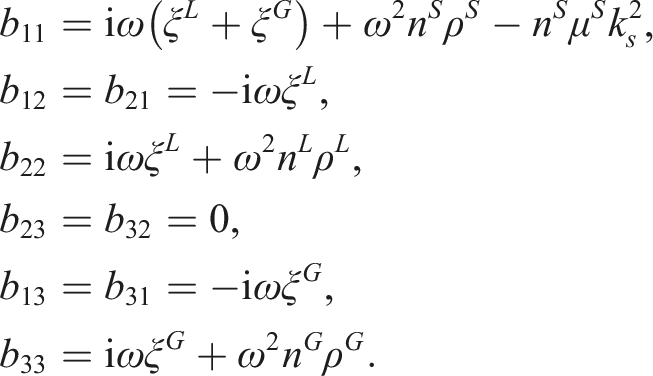
The wave velocities of P1-, P2-, P3- and S-wave in unsaturated foundation can be gotten by solving the above determinants.
Analysis of total wavefields
Wave potential functions
Substituting equation (2) into equations (1a)–(1c), three compression waves: P1, P2, P3 and one shear wave:S can be obtained in the unsaturated poroelastic media, which generates the wavefield in the x-z plane.
The displacement potential functions of the up-going and down-going waves can be indicated as: 1. In bedrock 2. In unsaturated soil layer I:


The solid phase can be indicated as


The liquid and gas phases can be indicated as 3. In the WIB1, WIB2, and WIB3: 4. In unsaturated soil layer II:








The solid phase can be indicated as


The liquid and gas phases can be indicated as



Boundary conditions
The amplitudes A1rp, B1rs, A2tpi, A2rpi, B2ts, B2rs, A3tp, A3rp, B3ts, B3rs, A4tp, A4rp, B4ts, B4rs, A5tp, A5rp, B5ts, B5rs, A6tpi, A6rpi, B6ts, B6rs can be determined by the boundary conditions at the interfaces. The boundary conditions of interfaces are: the continuities of normal stresses, tangential stress, normal displacements, and tangential displacement. 1. At the interface between the bedrock and unsaturated soil layer I 2. At the interface between the WIB1 and unsaturated soil layer I 3. At the interface between WIB1 and WIB2 4. At the interface between WIB2 and WIB3 5. At the interface between the WIB3 and the unsaturated soil layer II 6. At the surface of the free surface (z = 0) are





















The stress and displacement in unsaturated soil layer Ⅰ can be expressed by the potential function as follows

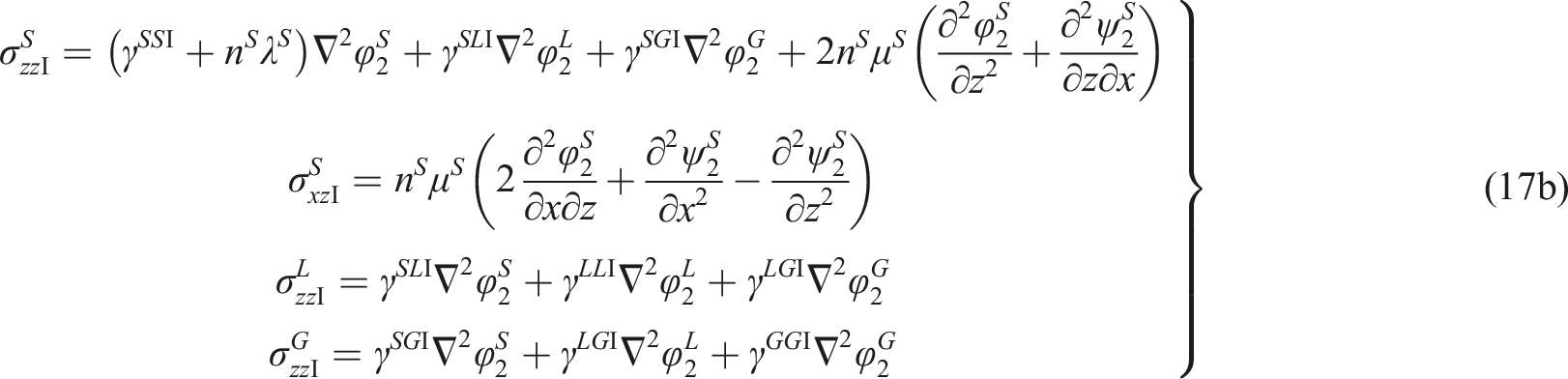
Similarly, the stresses and displacements in unsaturated soil layer II can be expressed in the same way by replacing the corresponding potential functions with equations (17a) and (17b).
The stress and displacement in the bedrock can be expressed by the potential function as follows


Similarly, the stresses and displacements in the WIB1, WIB2, and WIB3 can be expressed in the same way by replacing the corresponding potential functions with the equations (18a) and (18b).
After the boundary conditions are introduced, the linear equation system can be obtained by substituting equations (6a) and (6b)∼(9a)–(9d) into equations (11a)–(11d)∼(16) and Snell’s law (10) is considered as follows

Supposing A1ip = 1, the values of the elements in the matrix
Once the wavefield is determined, the displacements and stresses at various points in the site can be solved. The horizontal displacement u
x
and vertical displacement u
z
at the surface can be obtained by substituting equations (9a)–(9d) into equation (2). This paper focuses on the vertical displacements at the surface

Numerical analysis
Model validation
There is relatively little research on the unsaturated ground motion under P-wave incidence. The composite multilayer WIB is degraded to the same calculated model in the bedrock-unsaturated soil system investigated by Li et al.
34
for comparison to verify the validity of the method in this paper. The physical mechanic parameters consistent with Ref. 34 are taken, and the curve of the surface vertical displacement amplification coefficient versus incidence angle for the dimensionless frequency ω/ω1 = 2.0, porosity n = 0.3 under P-wave incidence is given in Figure 2. It can be seen from Figure 2 that the solution of this paper is well consistent with the literature solution, which verifies the efficiency of the method. Validation of the solution in the present work compared with the literature solution.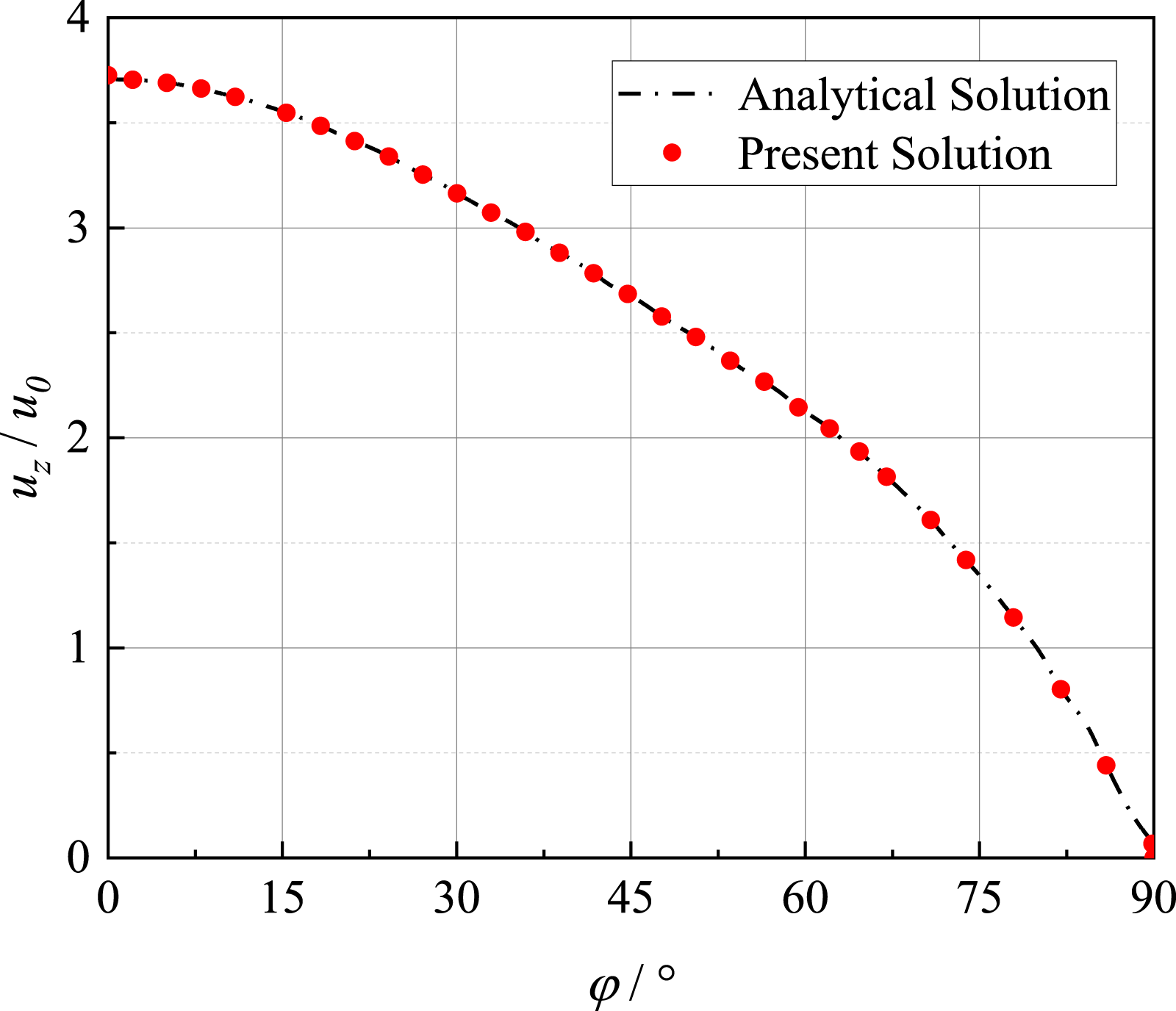
Wave impedance ratio on the effect of composite multilayer WIB isolation barrier
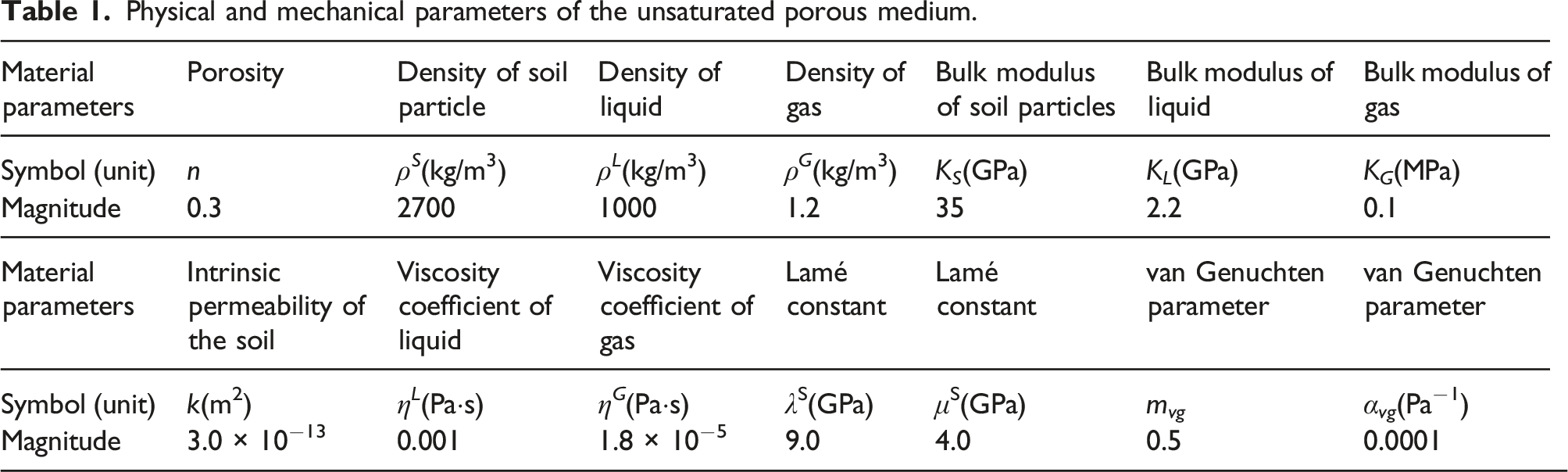
Physical and mechanical parameters of the unsaturated porous medium.
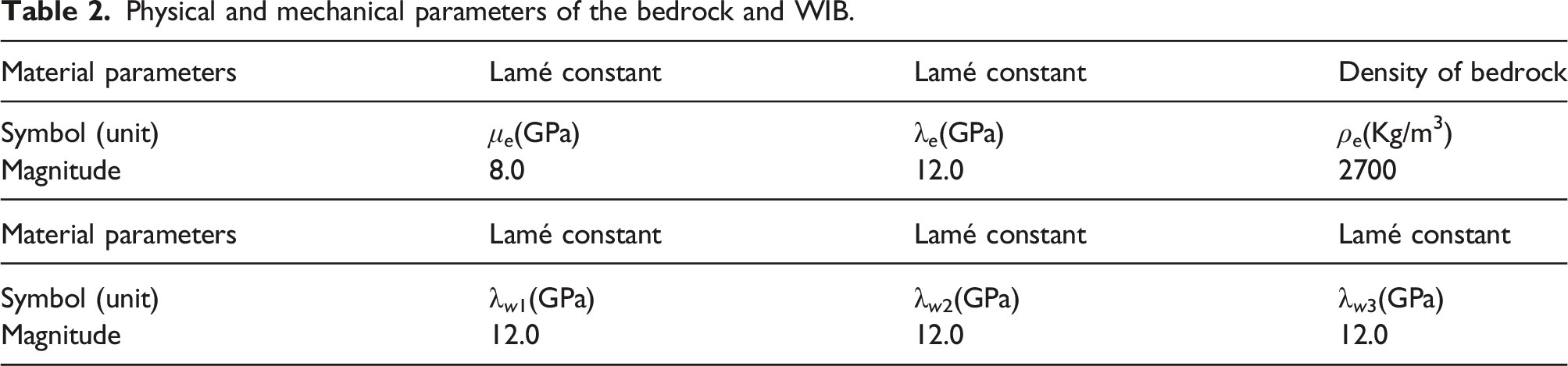
Physical and mechanical parameters of the bedrock and WIB.
First of all, it should be noted that the variation in saturation causes a series of changes in the physical parameters of the soil. Therefore, taking the angle of internal friction 
According to Ref. 30, it is known that the definition of wave impedance is the multiplication of velocity v and density ρ. The ratio between the first medium’s wave impedance and the second medium’s wave impedance is the wave impedance ratio. The wave impedance of unsaturated soil is Z0, the wave impedance of WIB1 is Z1, the wave impedance of WIB2 is Z2, and the wave impedance of WIB3 is Z3. Then the wave impedance ratio at the interface between WIB1 and unsaturated soil would be: 1. Case 1:ρw1 = 2000 kg/m3, ρw2 = 2300 kg/m3, ρw3 = 2700 kg/m3; 2. Case 2: ρw1 = 2000 kg/m3, ρw2 = 2700 kg/m3, ρw3 = 2300 kg/m3; 3. Case 3: ρw1 = 2300 kg/m3, ρw2 = 2000 kg/m3, ρw3 = 2700 kg/m3; 4. Case 4: ρw1 = 2300 kg/m3, ρw2 = 2700 kg/m3, ρw3 = 2000 kg/m3; 5. Case 5: ρw1 = 2700 kg/m3, ρw2 = 2300 kg/m3, ρw3 = 2000 kg/m3; 6. Case 6: ρw1 = 2700 kg/m3, ρw2 = 2000 kg/m3, ρw3 = 2300 kg/m3;
Taking the saturation Sr = 0.8, frequency ω = 10 Hz, incident angle φ = 45°, the thickness Hw1 = Hw2 = Hw3 = 0.3 m, and the burial depth H2 = 1.0 m, the 3-D curves of vertical displacement at the surface with the simultaneous change of wave impedance ratio γ1, γ2, and γ3 under six different density cases are plotted in Figure 3, respectively. 3-D curves of vertical displacement under simultaneous changes of three wave impedance ratios. (a) Case 1, (b) Case 2, (c) Case 3, (d) Case 4, (e) Case 5, (f) Case 6.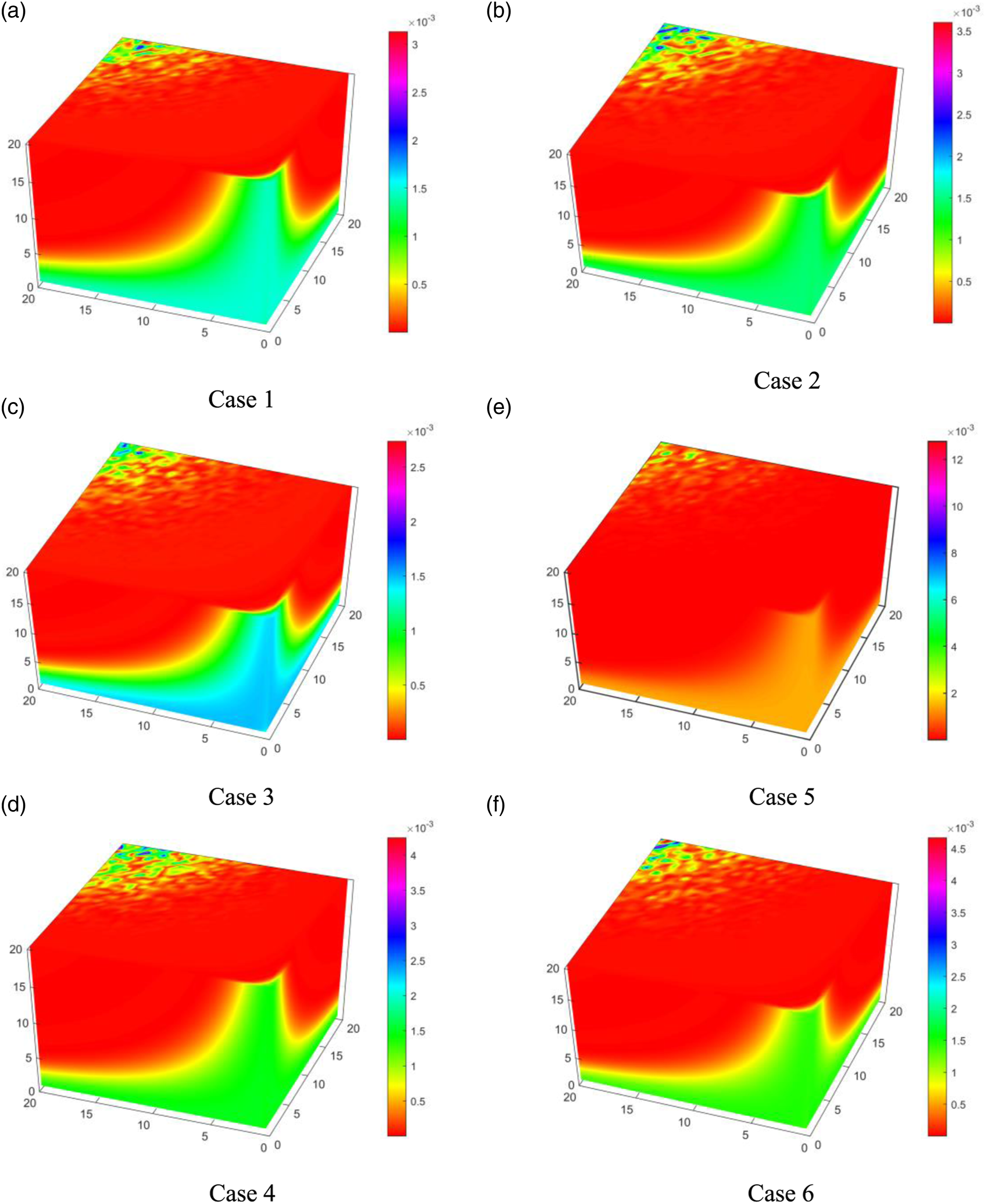
From Figure 3, the minimum value of vertical displacement at the surface and the corresponding wave impedance ratios for the seven cases of composite multilayer WIB vibration isolation can be obtained as: 1. Case 1: γ1 = 9.0, γ2 = 12.5, γ3 = 0.5, u
z
= 1.30 × 10⁻⁸m; 2. Case 2: γ1 = 19.0, γ2 = 3.0, γ3 = 2.0, u
z
= 5.82 × 10⁻¹⁰m; 3. Case 3: γ1 = 10.5, γ2 = 3.5, γ3 = 3.5, u
z
= 1.52 × 10⁻⁸m; 4. Case 4: γ1 = 17.0, γ2 = 1.5, γ3 = 4.5, u
z
= 3.22 × 10⁻⁹m; 5. Case 5: γ1 = 16.5, γ2 = 0.5, γ3 = 7.0, u
z
= 2.52 × 10⁻⁸m; 6. Case 6: γ1 = 19.5, γ2 = 2.0, γ3 = 3.0, u
z
= 3.70 × 10⁻⁹m;
From the calculation results of the above seven cases, it can be seen that Case 2 can achieve the best vibration isolation effect in the range of wave impedance ratio considered in this paper. In this case, the shear modulus is back-calculated from the wave impedance ratio as: μw1 = 3.67 × 10¹² Pa, μw2 = 2.45 × 10¹³ Pa, μw3 = 1.15 × 10¹⁴ Pa.
Analysis of vibration isolation law in composite multilayer WIB
In this discussion, the wave impedance ratio is taken as γ1 = 19.0, γ2 = 3.0, and γ3 = 2.0 at the optimal vibration isolation effect of the composite multilayer WIB to analyze the influence of the vibration isolation effect of the composite multilayer WIB. To evaluate the vibration isolation effect of WIB, the amplitude attenuation coefficient A
R
proposed by Woods
39
is used to measure the vibration isolation effect of composite multilayer WIB, the A
R
is calculated as follows
To compare the isolation effect of single-layer and composite multilayer WIB with the same thickness, the burial depth H2 = 1.0 m, saturation Sr = 0.8, incidence frequency ω = 10 Hz, and other parameters are taken from Table 1. In which, the thickness of vibration isolation system is taken as 0.9 m, the density and shear modulus of the composite multilayer WIB are taken as the corresponding values in Case 2, and the density and shear modulus of the single-layer WIB are taken as the same values as the composite multilayer WIB for each layer. Figure 4 plots the variation curves of the surface vertical displacement amplitude attenuation ratio A
R
with the incidence angle for single-layer and composite multilayer WIB. It can be seen from Figure 4 that the isolation effect of composite multilayer WIB is better than single-layer WIB with the same material, and the isolation effect of single-layer WIB increases and then decreases with the increase of density. The average amplitude attenuation ratio A
R
= 0.297 for single-layer WIB with ρ
w
= 2000 kg/m3, A
R
= 0.1 for single-layer WIB with ρ
w
= 2300 kg/m3, A
R
= 0.129 for single-layer WIB with ρ
w
= 2700 kg/m3, and A
R
= 0.0661 for composite multilayer WIB, so the isolation efficiency of composite multilayer WIB is 77.74%, 33.9%, and 48.76% higher than single-layer WIB, respectively. In the later comparison, the case with optimal isolation effect of single-layer WIB is taken for analysis: ρ
w
= 2300 kg/m3, μ
w
= 1.15 × 10¹⁴ Pa. Comparison of A
R
with incidence angle for single-layer and composite multilayer WIB.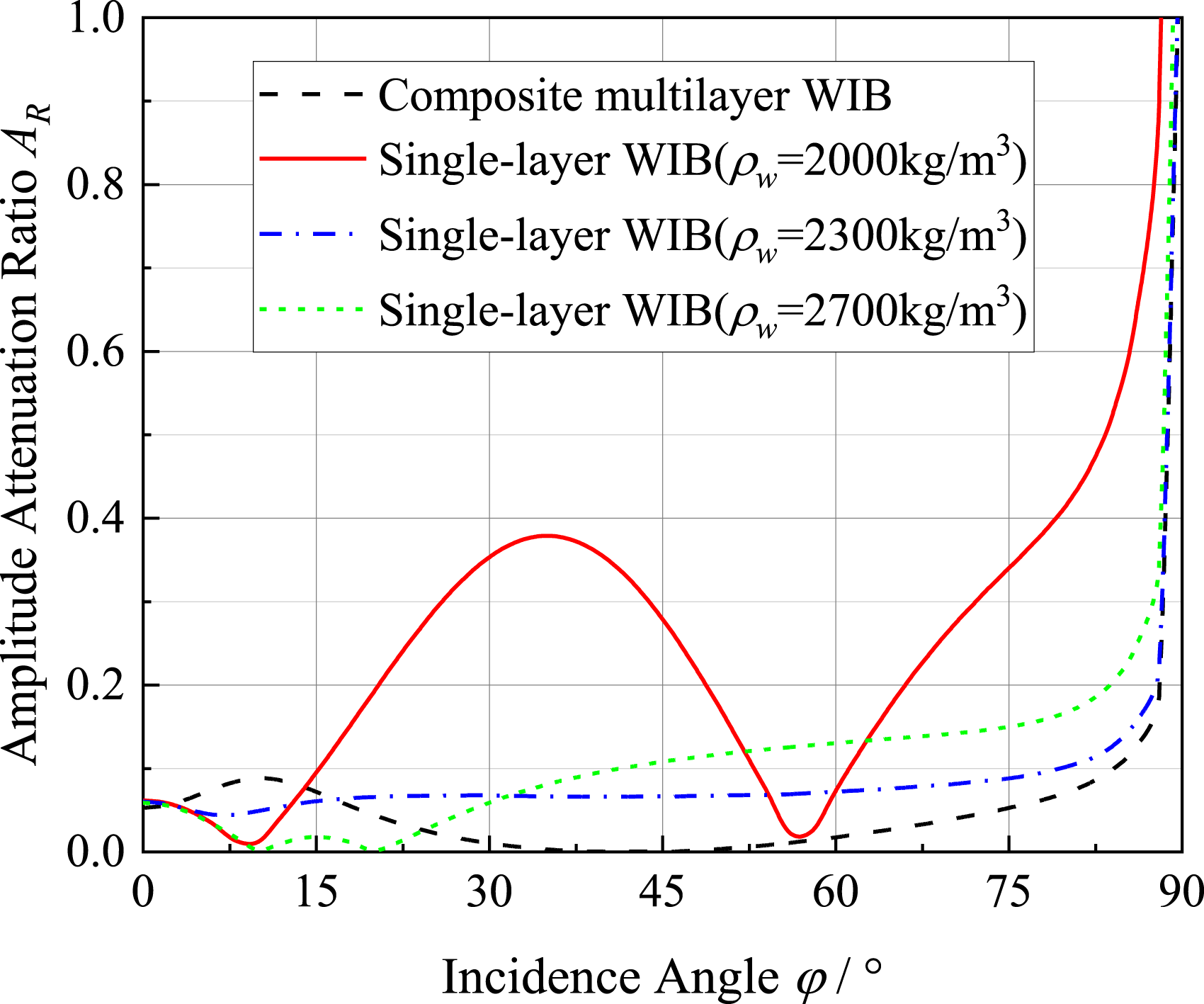
The differences between single-layer WIB and composite multilayer WIB with the same thickness at the same frequency are investigated. The literature
40
shows that the main frequencies of vibration caused by tamping are concentrated in the range of 10–20 Hz, while those caused by elevated roads are concentrated in the range of 20–25 Hz and those caused by subways are in the higher range of 50–80 Hz, but in the general environmental vibration frequencies do not exceed 100 Hz. Therefore, the frequencies ω = 10 Hz, 50 Hz, and 100 Hz will be selected and analyzed next. The thickness of unsaturated soil layer H = 20m, burial depth H2 = 1.0 m, saturation Sr = 0.8, the thickness of composite multilayer WIB Hw1 = Hw2 = Hw3 = 0.3 m, thickness of single-layer WIB H
w
= 0.9 m, and other parameters are taken from Table 1. In Figure 5, the average amplitude attenuation ratio A
R
= 0.18 for single-layer WIB and A
R
= 0.088 for composite multilayer WIB at ω = 50 Hz, the isolation efficiency of composite multilayer WIB is 51.11% higher than single-layer. The average amplitude attenuation ratio A
R
= 0.27 for single-layer WIB and A
R
= 0.15 for composite multilayer WIB at ω = 100 Hz, the isolation efficiency of composite multilayer WIB is 50.59% higher than single-layer. Consequently, for the same thickness of vibration isolation barrier, the isolation efficiency of composite multilayer WIB is higher than that of single-layer WIB. In addition, as the ω increases, the isolation efficiency of the composite multilayer WIB gradually decreases. Variation curve of A
R
with ω for single-layer and composite multilayer WIB.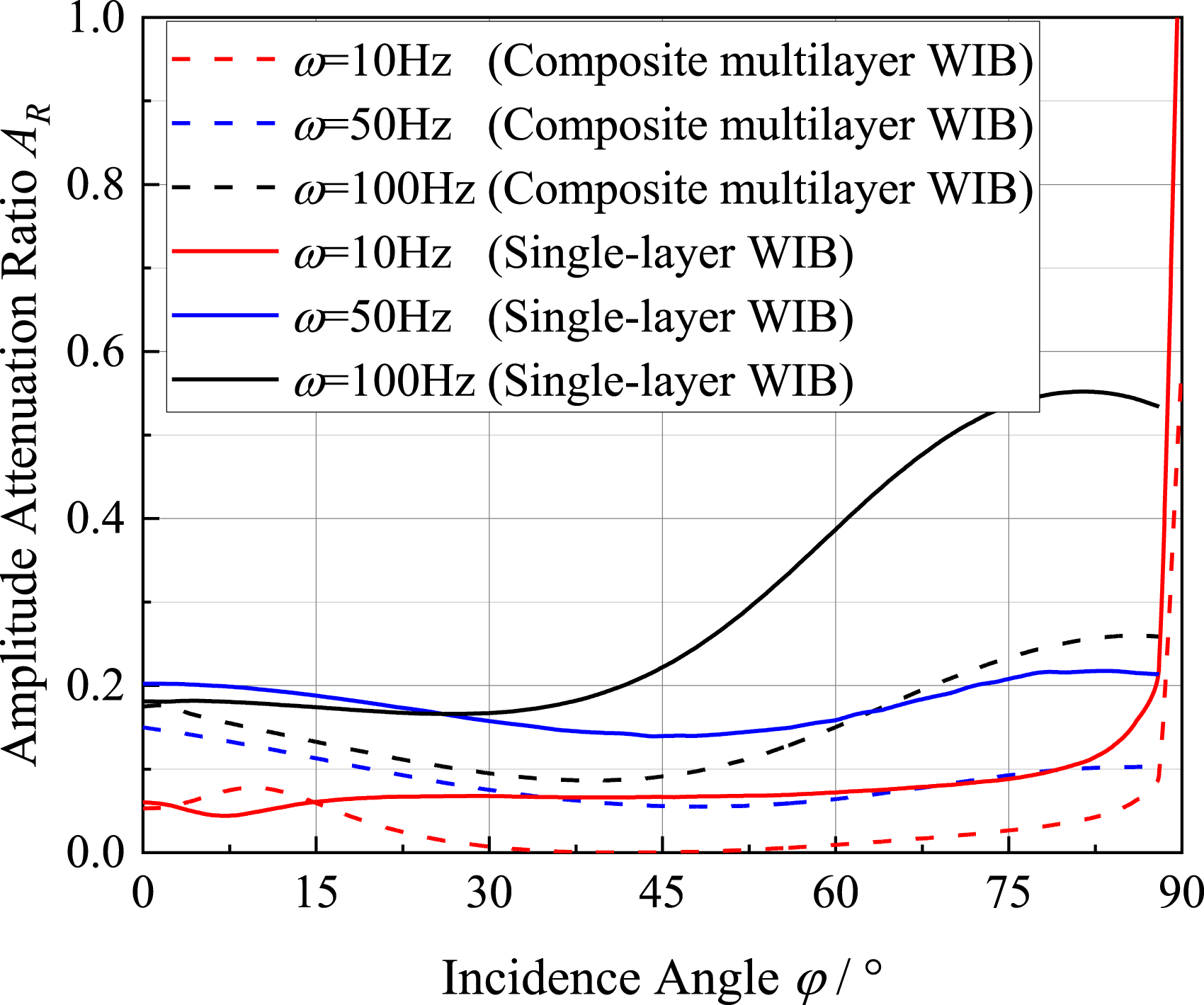
To further investigate the difference of isolation effect between composite multilayer WIB and single-layer WIB by changing the thickness under the same conditions. The burial depth H2 = 1.0 m, saturation Sr = 0.8, incidence frequency ω = 10 Hz, and other parameters are taken from Table 1. Three cases of single-layer WIB H
w
= 0.9 m, 1.5 m, and 2.1 m, composite multilayer WIB Hw1 = Hw2 = Hw3 = 0.3 m, 0.5 m, and 0.7 m are considered, respectively. In Figure 6, the variation curves of the surface vertical displacement amplitude attenuation ratio A
R
with the incidence angle are plotted. It can be calculated from Figure 6 that when the thickness of barrier is 0.9 m, the isolation efficiency of composite multilayer WIB is 33.9% higher than single-layer. When the thickness of barrier is 1.5 m, the isolation efficiency of composite multilayer WIB is 22.67% higher than single-layer. When the thickness of barrier is 2.1 m, the isolation efficiency of composite multilayer WIB is 21.67% higher than single-layer. From this, it is known that the vibration isolation efficiency of the composite multilayer WIB is higher than single-layer WIB with the same thickness, which verifies the superiority in isolation of composite multilayer WIB again. As explained in principle, vibration waves are reflected, transmitted and so on at the interface of different media, which hinder the wave propagation. The greater the difference in the properties of the media between the two sides of the interface, the stronger this hindering effect will be. For the calculation of this paper, the isolation effect of composite multilayer WIB is better than single-layer WIB with the same thickness in most incidence angles. Variation curve of A
R
with thickness for single-layer and composite multilayer WIB.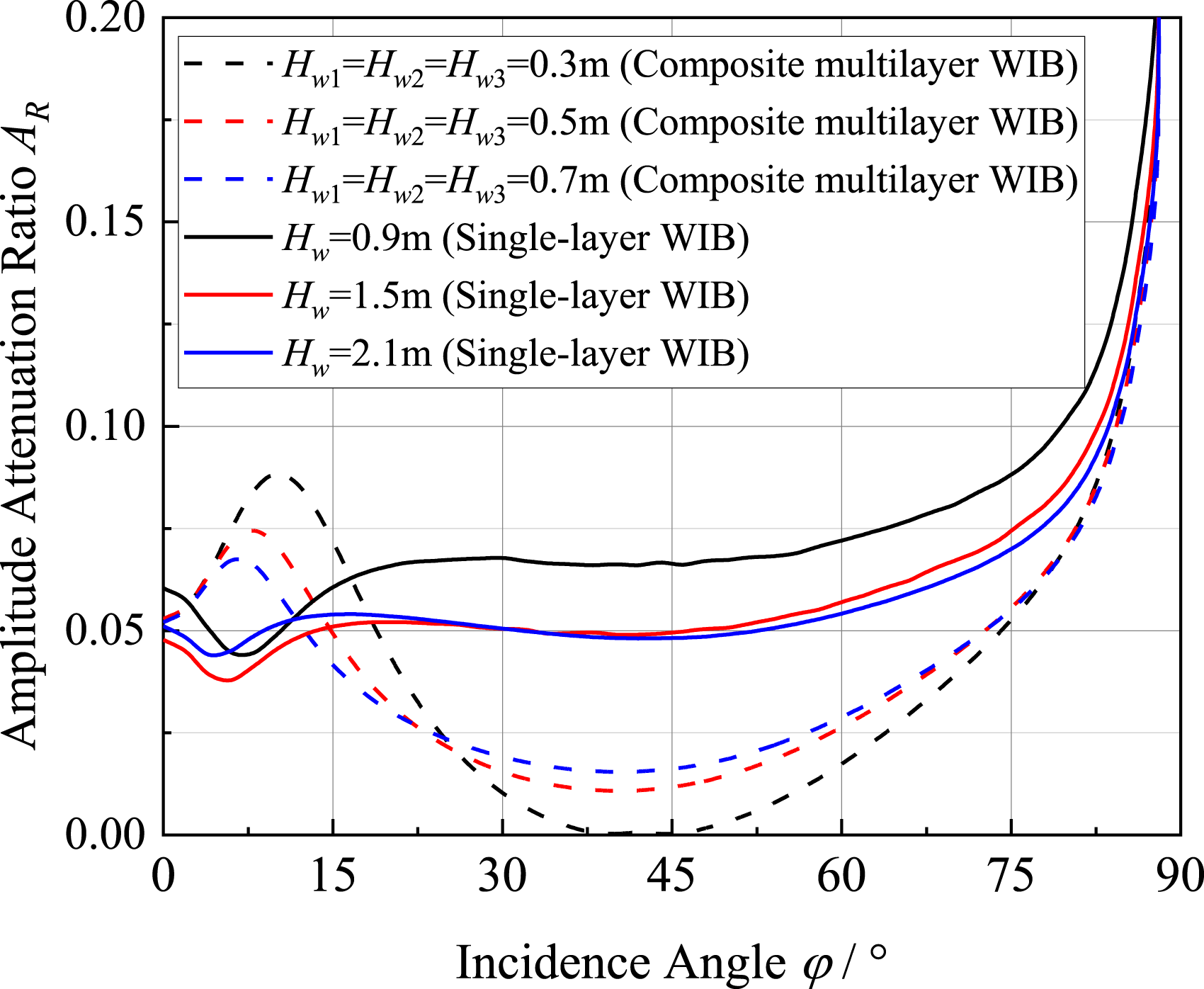
The effect of saturation on the isolation effect of composite multilayer WIB in unsaturated foundation is studied, the thickness of soil layer H = 20m, the thickness of composite multilayer WIB Hw1 = Hw2 = Hw3 = 0.3 m, burial depth H2 = 1.0 m, incident frequency ω = 10 Hz, and other parameters are taken from Table 1. The saturation Sr = 0.2, 0.4, 0.6, and 0.8, respectively. The variation curves of surface vertical displacement amplitude attenuation ratio with the incident angle for different saturations when the WIB setting in unsaturated foundation are given in Figure 7. As seen in Figure 7, when the Sr increases, the amplitude attenuation ratio of surface displacement increases first and then decreases. When Sr = 0.4, whose isolation effect is 6.37% lower than Sr = 0.2. When Sr = 0.6, whose isolation effect is 13.56% lower than Sr = 0.4. When Sr = 0.8, whose isolation effect is 71.99% higher than Sr = 0.6. It means that the vibration isolation effect of composite multilayer WIB in unsaturated foundation decreases first and then increases with an increase in saturation. This is since as the Sr increases, the gas phase of the soil decreases and the liquid phase increases, the equivalent compression modulus of the pore fluid increases rapidly, which makes the velocity of P-wave in unsaturated foundation decrease gradually and the amplitude ratio first increases and then decreases. The above phenomenon is consistent with the conclusions of the literature.
27
Variation curves of A
R
for composite multilayer WIB at different Sr.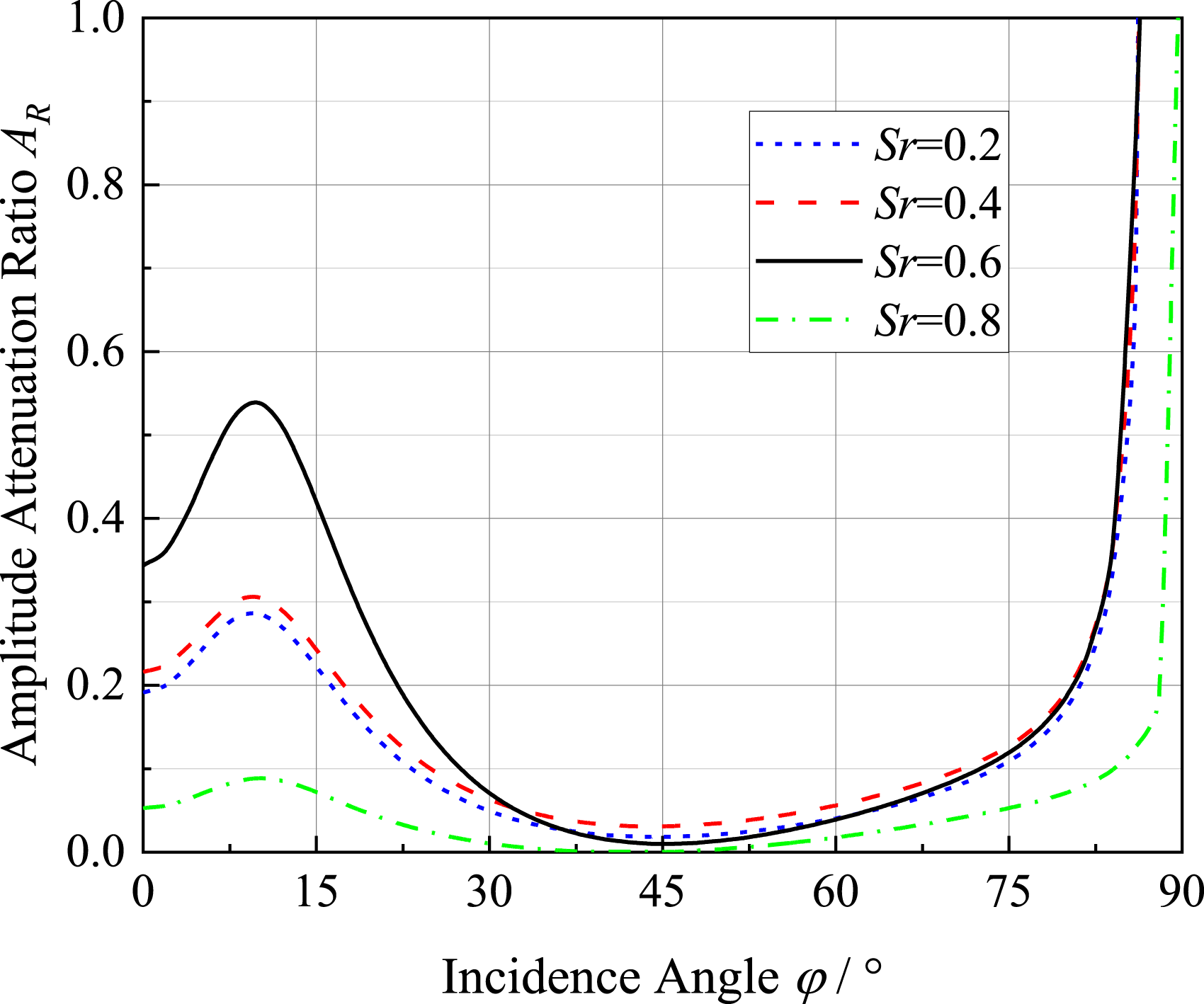
To study the effect of the burial depth of composite multilayer WIB on its isolation effect in unsaturated foundations, the thickness of unsaturated soil layer H = 20m, saturation Sr = 0.8, incidence frequency ω = 10 Hz, the thickness of composite multilayer WIB Hw1 = Hw2 = Hw3 = 0.3 m, other parameters are taken from Table 1. The burial depth H2 = 1.0 m, 2.0 m, and 3.0 m, respectively. The variation curves of vertical displacement amplitude attenuation ratio with the incidence angle when composite multilayer WIB setting in unsaturated foundation are given in Figure 8. It can be calculated from Figure 8 that when H2 = 2.0 m, the isolation efficiency is decreased 7.19% compared for H2 = 1.0 m. When H2 = 3.0 m, the isolation efficiency is decreased 9.15% compared for H2 = 2.0 m. In summary, the overall vibration isolation effect of composite multilayer WIB decreases with the increase in burial depth. This phenomenon is because the WIB vibration isolation takes advantage of the vibration property of the existence of a cut-off frequency of the soil layer on bedrock. That cut-off frequency is inversely proportional to the thickness of the soil layer, which means the burial depth of the WIB must be less than a specified limit. Variation curves of A
R
for composite multilayer WIB at different H2.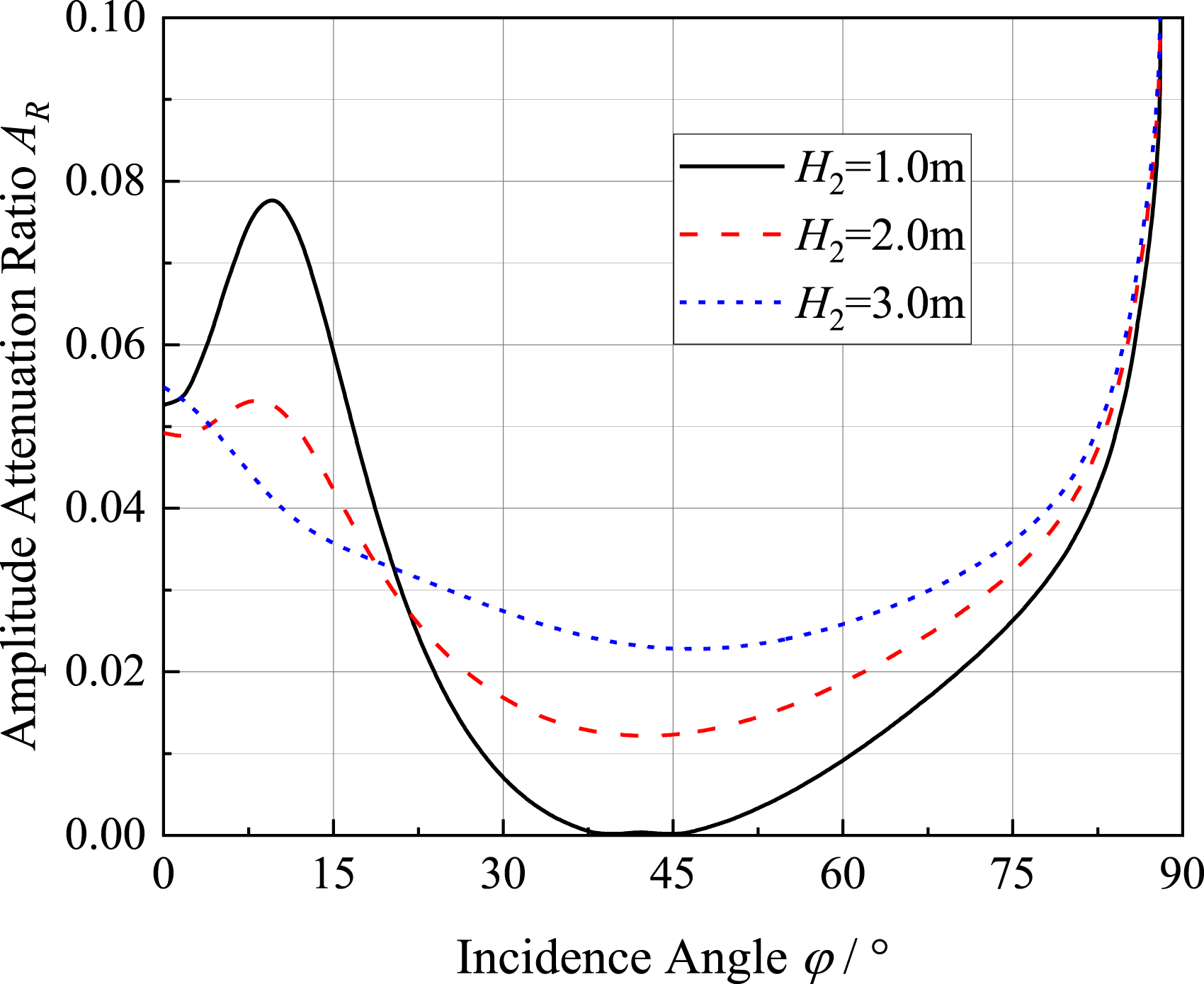
Conclusions
This present study is based on the property that the greater the difference between the interfaces of multi-layer and thin-layer, the more significant the vibration wave transmission and reflection effect. With the combination of wave propagation theory and Snell’s theorem, the vibration isolation properties of the composite multilayer WIB in unsaturated foundation which are more compatible with reality are investigated. The isolation effects of the composite multilayer WIB and single-layer WIB with the same thickness were compared. The various factors such as saturation, frequency, burial depth, and thickness on the vibration isolation effect of composite multilayer WIB in unsaturated foundation are analyzed. The conclusions are drawn: 1. The wave impedance ratio has a significant effect on the vibration isolation effect of the composite multilayer WIB. The optimal vibration isolation effect of the composite multilayer WIB can be obtained by designing the wave impedance ratio at the interface between the WIB and the unsaturated soil and the wave impedance ratio at the interfaces between the layers of the composite multilayer WIB. 2. For the same thickness of the WIB vibration isolation system, the isolation effect of composite multilayer WIB is better than single-layer within most P-wave incidence angles. At low incidence frequency (ω = 10 Hz), the isolation efficiency of composite multilayer WIB is 33.9% higher than single-layer WIB, at medium incidence frequency (ω = 50 Hz), the isolation efficiency of composite multilayer WIB is 51.11% higher than single-layer WIB, and at high incidence frequency (ω = 100 Hz), the isolation efficiency of composite multilayer WIB is 50.59% higher than single-layer WIB. 3. The vibration isolation effect of composite multilayer WIB decreases and then increases with the increase of saturation. Increasing the thickness of WIB can improve the isolation effect of the vibration isolation system, while the increment decreases with an increase in the thickness. The overall vibration isolation effect of composite multilayer WIB decreases with an increase in burial depth.
It should be noted that this work is based on numerical software to simulate the site and not integrated with experiments. The experimental validation is a scope of future work.
Footnotes
Declaration of conflicting interests
The author(s) declared no potential conflicts of interest with respect to the research, authorship, and/or publication of this article.
Funding
The author(s) disclosed receipt of the following financial support for the research, authorship, and/or publication of this article: This work was supported by the authors gratefully acknowledge the financial support of the Chinese Natural Science Foundation (Grant No. 52168053) and Qinghai Province Science and Technology Department Project(No. 2021-ZJ-943Q), the authors are also grateful to editors and reviewers for them helpful advice and comments.
Data availability
The datasets generated during and/or analyzed during the current study are available from the corresponding author on reasonable request.
