




Abstract
Based on single-phase medium theory and unsaturated porous medium theory, the vibration isolation effect of setting a single-phase solid wave impeding block (WIB) in the unsaturated soil foundation under an underground dynamic load is investigated. Using the Fourier integral transform and Helmholtz vector decomposition, the calculation formula of the dynamic response of unsaturated soil foundation under an underground dynamic load is established by combining the boundary conditions. The influence of physical and mechanical parameters such as saturation, load frequency, embedded depth of WIB, thickness of WIB, and elastic modulus of WIB on the vibration isolation performance in unsaturated soil foundation is analyzed. The results show that in the case of underground dynamic load, setting a WIB in unsaturated soil foundation could achieve a better vibration isolation effect. The surface displacement amplitude decreases significantly with the increase of saturation, load frequency, embedded depth, thickness, and elastic modulus of WIB.
Keywords
Introduction
Ground vibration is important in environmental and geotechnical engineering, and it has become public considerable attention and engineering concerns. Ground vibration has different wave field characteristics due to the location of the vibration source, the type of vibration source, and the physical and mechanical properties of the soil foundation, and its vibration propagation process and attenuation law are also different. A series of important research results1–5 have been carried out by scholars from various aspects such as load types and wave characteristics in soil.
Woods 6 first studied the far-field passive vibration isolation and near-field active vibration isolation through in-situ field tests, proposed the basic guidelines for barrier vibration isolation design, and gave the coefficient-amplitude attenuation coefficient to measure the barrier vibration isolation effect. Then scholars have carried out a lot of research on the vibration isolation performance of various vibration isolation barriers,7–14 and the various vibration isolation barriers were divided into continuous barriers (such as hollow ditch, filled ditch, etc.) and discontinuous barriers (such as pile columns and sheet piles, etc.) according to their geometric characteristics.
In addition to the barrier vibration isolation described above, another alternative vibration isolation barrier is the wave impeding block (WIB) buried at a certain depth under the vibration source or the protected structure for vibration isolation. Chouw and Schmid 15 were the first to analyze the active and passive vibration isolation effect of WIB in the elastic foundation and to compare the passive vibration isolation effect of filled trench and WIB, and the results showed that the vibration isolation effect of WIB is better than that of the filled trench. Takemiya et al. 16 studied the vibration isolation effect of group pile foundations in a single soil layer on bedrock by using WIB, and the results showed that WIB is an effective vibration isolation measure. Shi et al. 17 studied the far-field passive vibration isolation of the buried WIB under the protected structure by using the frequency domain elastic boundary element method, and the study showed that reducing the embedded depth of the WIB and increasing the thickness of the WIB can obtain better vibration isolation effect. Ma et al. 18 established a foundation vibration isolation system with a functional gradient WIB in the elastic foundation, and the study showed that the gradient WIB can effectively reduce the vibration amplitude. Gao et al.19,20 proposed a joint vibration isolation method with a perforated WIB filled with Duxseal (referred to as DXWIB) and found that the DXWIB barrier with shallower embedded depth can effectively reduce the vertical displacement of the ground surface through experimental research. Zhou et al. 21 conducted a theoretical analysis of the vibration isolation system of two-dimensional elastic foundation WIB, and showed that increasing the elastic modulus of WIB and reducing the incident angle of the elastic wave would increase the vibration isolation effect of WIB. Zhou et al. 22 analyzed the vibration isolation performance of the combined hollow trench-WIB vibration isolation barrier in elastic foundation and showed that the combined hollow trench-WIB vibration isolation barrier can effectively control the foundation vibration caused by different frequency vibration sources by combining the respective advantages of hollow trench and WIB. Gao et al.23,24 investigated the vibration isolation performance of WIB in saturated soil foundation under rail transit load for the saturated soil foundation model. Based on the improved 3D boundary finite element model, Gao et al. 25 studied the vibration isolation effect of WIB in saturated soil and analyzed the soil foundation WIB interaction. Based on the Biot’s saturated porous medium theory, Ma 26 studied the vibration isolation effect of liquid saturated porous gradient WIB in saturated soil foundation under surface moving load, and the study showed that the liquid saturated porous gradient WIB can significantly reduce the surface displacement amplitude. Xu et al. 27 established a computational model of water-filled concrete composite barrier in saturated soil foundation, and the results showed that the incident angle of the incident wave and the elastic modulus of the barrier had the most obvious effect on the vibration isolation effect of the barrier. There are only Shu et al. 28 study the propagation characteristics of P1 wave passing through WIB in unsaturated soil.
In summary, it can be seen that most of the current studies on WIB vibration isolation barriers are focused on single-phase elastic foundations and saturated soil foundations. However, natural soil in nature is generally a porous multiphase medium composed of solid-liquid-gas phases, and unsaturated soil is the more common state of soil in nature. Therefore, it is of more general significance to study the vibration damping and isolation effects of WIB in unsaturated soil foundations. In this paper, based on the governing equations of unsaturated porous media, the mathematical model of setting homogeneous WIB in the unsaturated soil foundation under an underground dynamic load is established, and the general solutions of displacement and stress of soil in the domain of Fourier transform are derived by using Fourier integral transform and Helmholtz vector decomposition. The effect of vibration isolation of WIB in unsaturated soil foundation under an underground dynamic load is studied by numerical calculation, and the influence of saturation, load frequency, embedded depth, thickness, and elastic modulus of WIB on vibration isolation performance of unsaturated soil foundation is analyzed.
Governing equations
Governing equations for single-phase solid media
Governing equations for an isotropic linear elastic single-phase continuous solid medium are as follows:

The corresponding stress–displacement relation is as follows:

According to the Helmholtz vector decomposition, the displacement vector can be expressed as a potential function as follows:

Substituting equation (3) into equation (1), the single-phase solid wave equation as follows:

Governing equations for unsaturated porous medium
Based on the fact that the model built in this paper is considered to be subjected to strip harmonic loading, all variables in the steady state case can be written as:

For convenience, the asterisk is omitted in the following derivation process.
Based on the theory of continuous medium mechanics and Bishop’s effective stress formula, the dynamic governing equations of unsaturated soil proposed by Xu et al.
29
are as follows:





The stress–strain relationship of unsaturated soil is as follows:

Substituting equations (6d) and (6e) into equations (6a)–(6c) yields:



According to the Helmholtz vector decomposition, the displacement vectors

Substituting equation (9) into equations (8a)–(8c) for divergence and curl operations yields:






Solution of the displacement potential function
Consider the unsaturated soil foundation subjected to an underground harmonic load is Wave propagation diagram of WIB in unsaturated soil under harmonic load.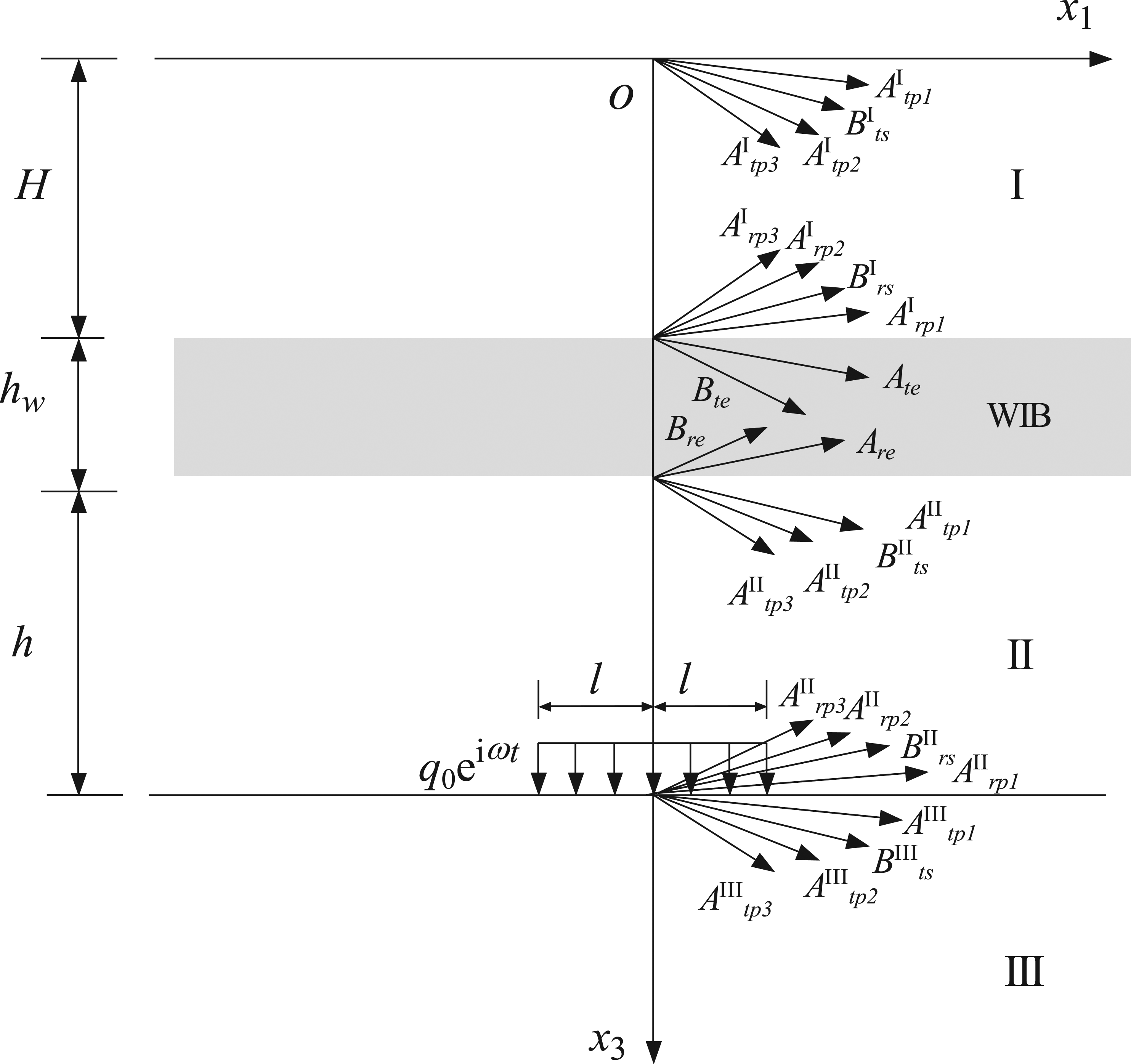
Solution of single-phase solid medium
The Fourier transform with respect to

Substituting equations (5) and (11) into equation (4), after Fourier transform yields:

Therefore, the general solution of displacement potential function in single-phase elastic solid medium can be obtained as follows:

Solution of unsaturated porous medium
Substituting equation (11) into equations (10a)–(10c), after Fourier transform yields:



Assuming that the solution of the equation (14) as follows:

Substituting equation (15) into equation (14) yields the linear equations as follows:

The condition that equation (16) has non-zero solution is that the determinant of its coefficient matrix is 0, namely:

The roots of equation (17) be

The solution of ordinary differential equation (14) can be obtained as follows:



Substituting equation (11) into equations (10d)–(10f), then performing the Fourier transform on them yields:



Assuming that the solution of the equation (20) as follows:

Substituting equation (21) into equation (20) yields the linear equations:

The condition that equation (22) has non-zero solution is that the determinant of its coefficient matrix is 0, namely:

The roots of equation (23) are ± r, r is then given by the following equation:

The solution of ordinary differential equation (20) can be obtained as follows:



Solving the dynamic response problem of unsaturated ground
Dynamic response of unsaturated foundation
In the coordinate system

Substituting equations (13) and (26) into equations (2) and (3) and substituting equations (19), (25), and (26) into equations (6d), (6e), (7), and (9), the displacement and stress expressions in the Fourier transform domain can be obtained for the elastic medium and the unsaturated porous medium, respectively.
In the region










In the region,




In the region,








In the region,




Boundary conditions and solution
For the case where the load acts in the interior of the half-plane, the boundary conditions and the continuity conditions at the interfaces of the layers are as follows:
At

At

At

At

Substituting equations (27–30) into the boundary conditions (31–34), the following matrix equations can be obtained as follows:

By solving the equation (35), the wave amplitudes of various types of waves in
Numerical examples
For unsaturated soil foundation, the change of saturation will cause the change of shear modulus parameters, so the modified dynamic shear modulus29,30 formula is used in this paper:

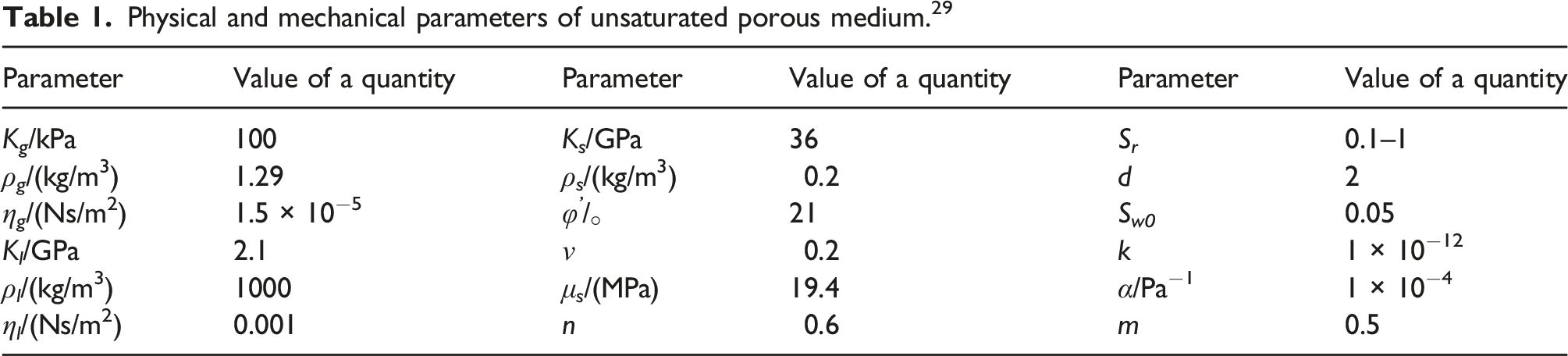
Physical and mechanical parameters of unsaturated porous medium. 29
Validation of the present solution
In order to verify the correctness of the method in this paper, equation (35) is degenerated to the case without WIB. When H + h
w
+ h = 0, the load is degenerated to the surface strip harmonic load. Shi et al.
31
studied the dynamic response of unsaturated soil foundation under strip harmonic load. Saturation is S
r
= 0.8, circular frequency is ω = 1 rad/s, the rest of the unsaturated soil physical and mechanical parameters are shown in Table 1. Figure 2 shows the variation curve of the vertical displacement of the surface along the horizontal direction. It can be seen from the figure that the calculation results of this paper are in good agreement with the results of Shi. Variation curve of vertical displacement of ground surface along the horizontal direction.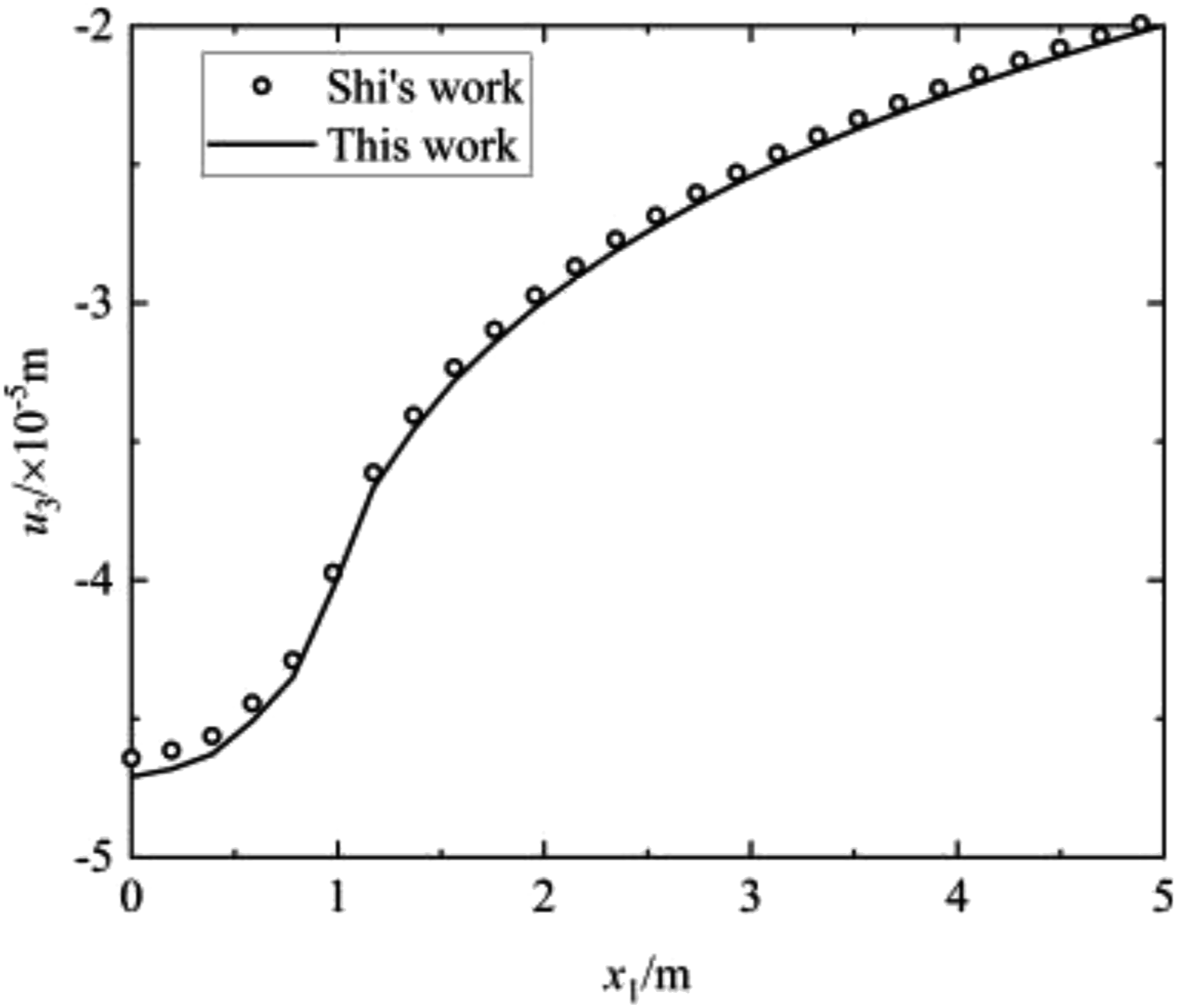
Example analysis
Considering the thickness of the upper cover soil layer is H = 1m, the thickness of the WIB is h
w
= 0.5 m, the distance between the vibration source from the WIB is h = 3.5 m, the elastic modulus of the WIB is E
e
= 6.5 × 10⁸ Pa, the saturation of the soil is S
r
= 0.8, and the load frequency is ω = 1 rad/s. The curves of the vertical and horizontal displacements along the horizontal direction at the surface of the foundation are given in Figure 3(a) and (b) to compare the displacement magnitude of the unsaturated ground foundation with and without the setting of the WIB, respectively. From the two figures, it can be seen that the vibration phase of horizontal displacement and vertical displacement in unsaturated soil foundation changes due to the setting of WIB. The existence of WIB isolation barrier reduces the amplitude of vertical displacement by about 71%, and the amplitude of horizontal displacement by about 41%. The vertical displacement and horizontal displacement are significantly reduced. Therefore, the vibration isolation effect of WIB in unsaturated soil foundation could achieve a good effectiveness under the action of underground dynamic load. (a) Variations of vertical displacement at the ground surface. (b) Variations of horizontal displacement at the ground surface.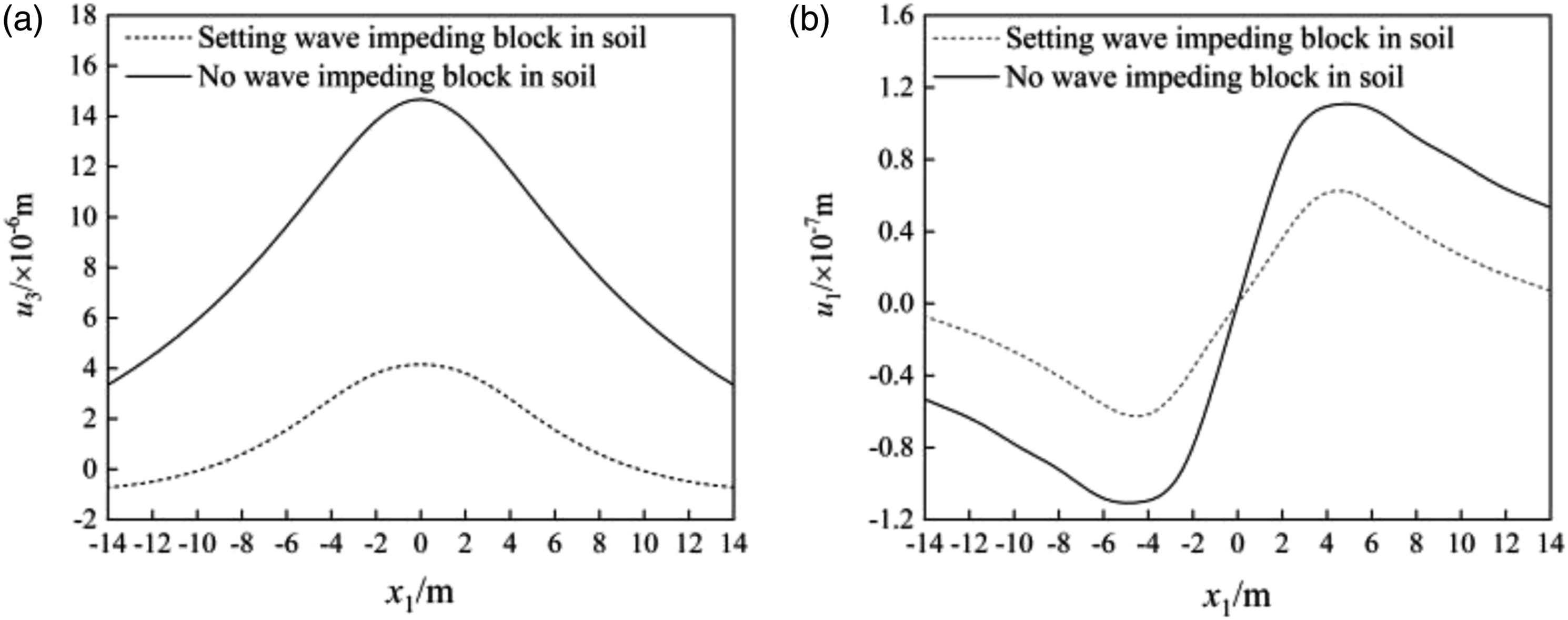
In order to analyze the effect of the saturation of the soil on the vibration isolation effect of the WIB, considering the cases of H = 1 m, h
w
= 0.5 m, h = 3.5 m, E
e
= 6.5 × 10⁸ Pa, and ω = 1 rad/s, the variation curves of the vertical and horizontal displacements along the horizontal direction at the surface of the unsaturated ground foundation under different saturations are given in Figure 4(a) and (b), respectively. It can be seen from Figure 4(a) that the horizontal displacement amplitude at the surface decreases with the increase of soil saturation, and the decrease is larger. The difference is that from Figure 4(b), it can be seen that the amplitude of horizontal displacement at the surface increases with the increase of soil saturation, but the magnitude of increase is smaller. It means that the change of horizontal displacement amplitude with the change of saturation is much smaller than the change of vertical displacement amplitude, and it can be seen that the effect of saturation on vertical displacement is much larger than the effect on horizontal displacement. (a) Variations of vertical displacement at the ground surface. (b) Variations of horizontal displacement at the ground surface.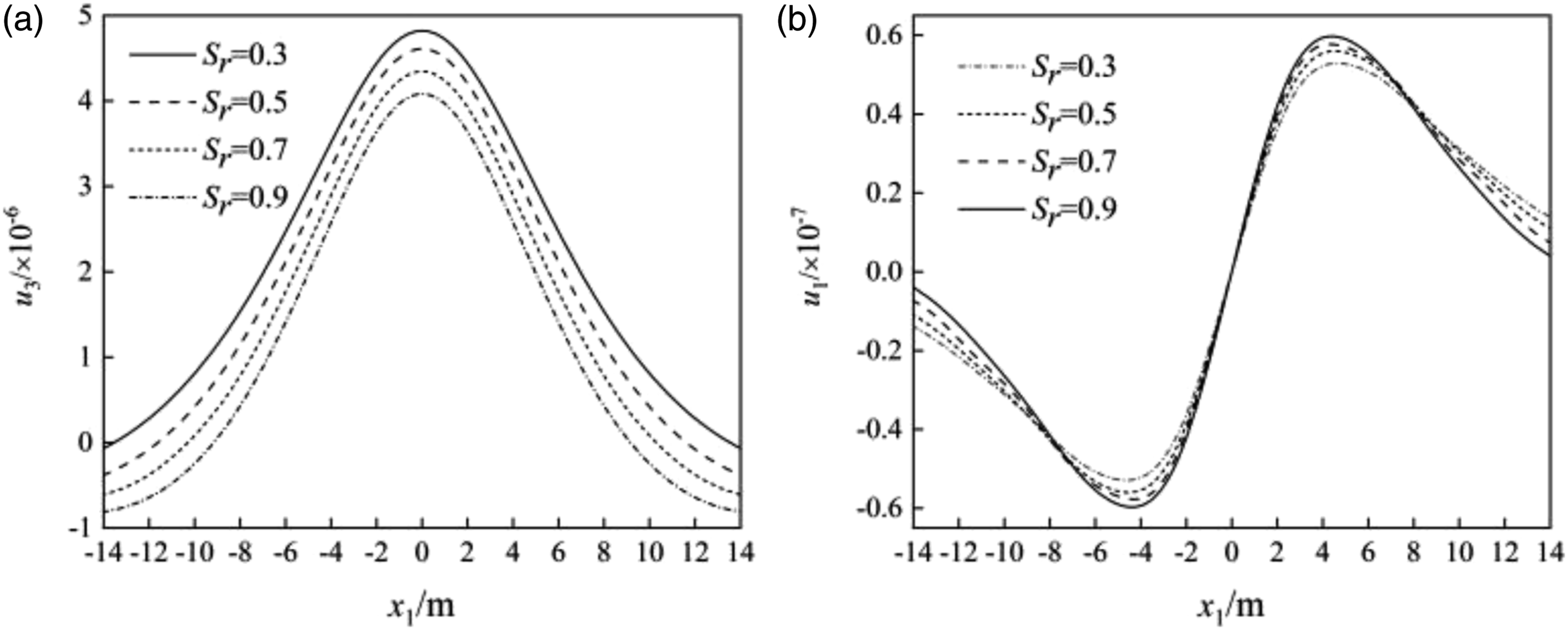
In order to analyze the influence of the embedded depth of the WIB on the vibration isolation effect of the foundation, Figure 5(a) and (b) show the variation curves of the vertical and horizontal displacements of the foundation surface in the horizontal direction when the embedded depth of the WIB increases gradually from H = 0.5, 1.0, 2.0, and 3 m for S
r
= 0.8, h
w
= 0.5 m, h = 5 m−H−h
w
, E
e
= 6.5 × 10⁸ Pa, and ω = 1 rad/s, respectively. It can be seen from Figure 5(a) and (b) that with the increasing distance of embedded depth, the surface vertical displacement and horizontal displacement amplitude decrease sharply, which means that the vibration isolation effect is better when the WIB is closer to the vibration source of underground dynamic load. Therefore, in the actual unsaturated ground foundation with underground dynamic load, the closer the embedded depth of the WIB is to the vibration source, the better the vibration isolation effect. (a) Variations of vertical displacement at the ground surface. (b) Variations of horizontal displacement at the ground surface.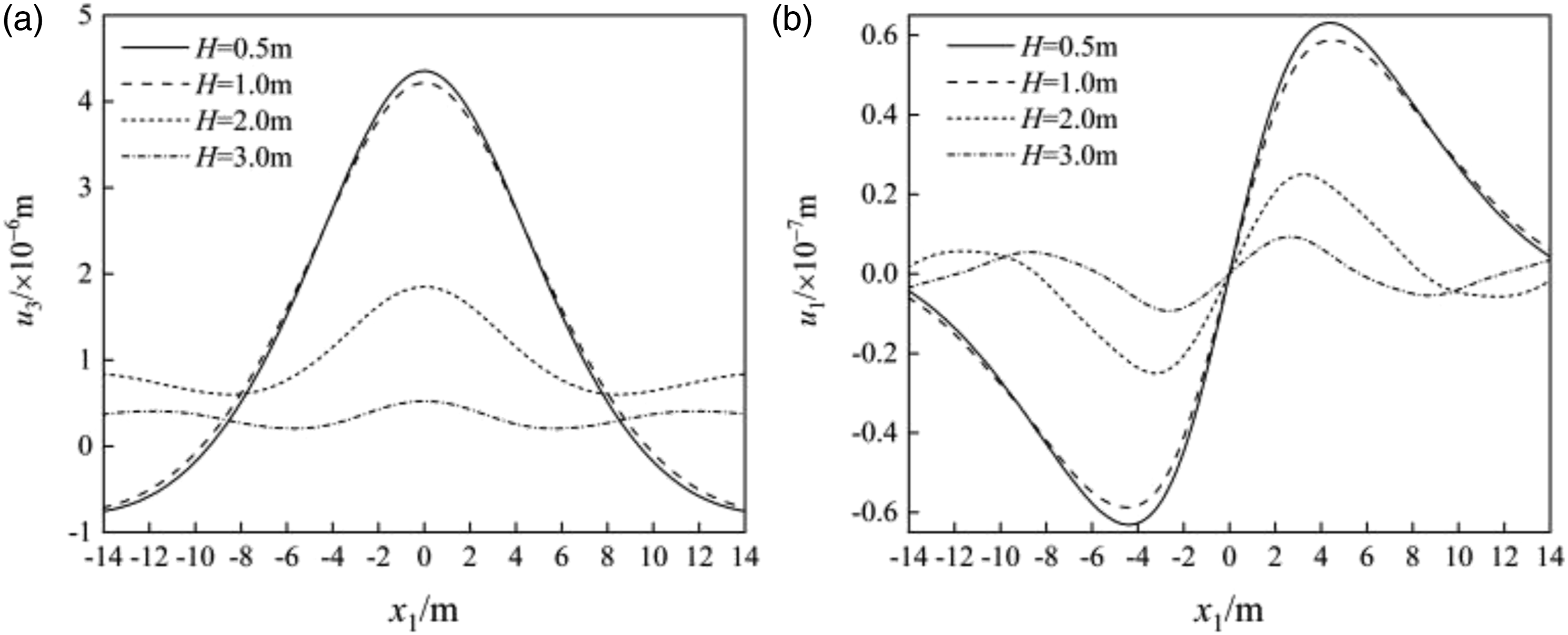
In order to analyze the influence of the elastic modulus of the WIB on the vibration isolation effect of the foundation, Figure 6(a) and (b) plot the vertical displacement and horizontal displacement of the foundation surface along the horizontal direction when H = 1 m, h
w
= 0.5 m, h = 3.5 m, S
r
= 0.8, and ω = 1 rad/s, and the elastic modulus of the WIB increases gradually from E
e
= 1.5 × 10⁷ Pa∼1.5 × 10¹⁰ Pa, respectively. According to Figure 6(a) and (b), it can be seen that as the modulus of elasticity increases, the displacement of the foundation surface decreases sharply, which means that increasing the modulus of elasticity of the WIB is an effective measure to increase its vibration isolation effect. On the other hand, it can be found that when E
e
≥ 1.5 × 10⁸ Pa, the surface displacement amplitude decreases significantly with the increase of elastic modulus, and when E
e
≥ 1.5 × 10⁹ Pa, the surface displacement amplitude also decreases with the increase of elastic modulus, but the decrease amplitude decreases gradually, and when E
e
= 1.5 × 10¹⁰ Pa, the surface vertical displacement and elastic displacement are basically 0. It means that the effect of increasing the modulus of elasticity on the vibration isolation effect of WIB will no longer be obvious. (a) Variations of vertical displacement at the ground surface. (b) Variations of horizontal displacement at the ground surface.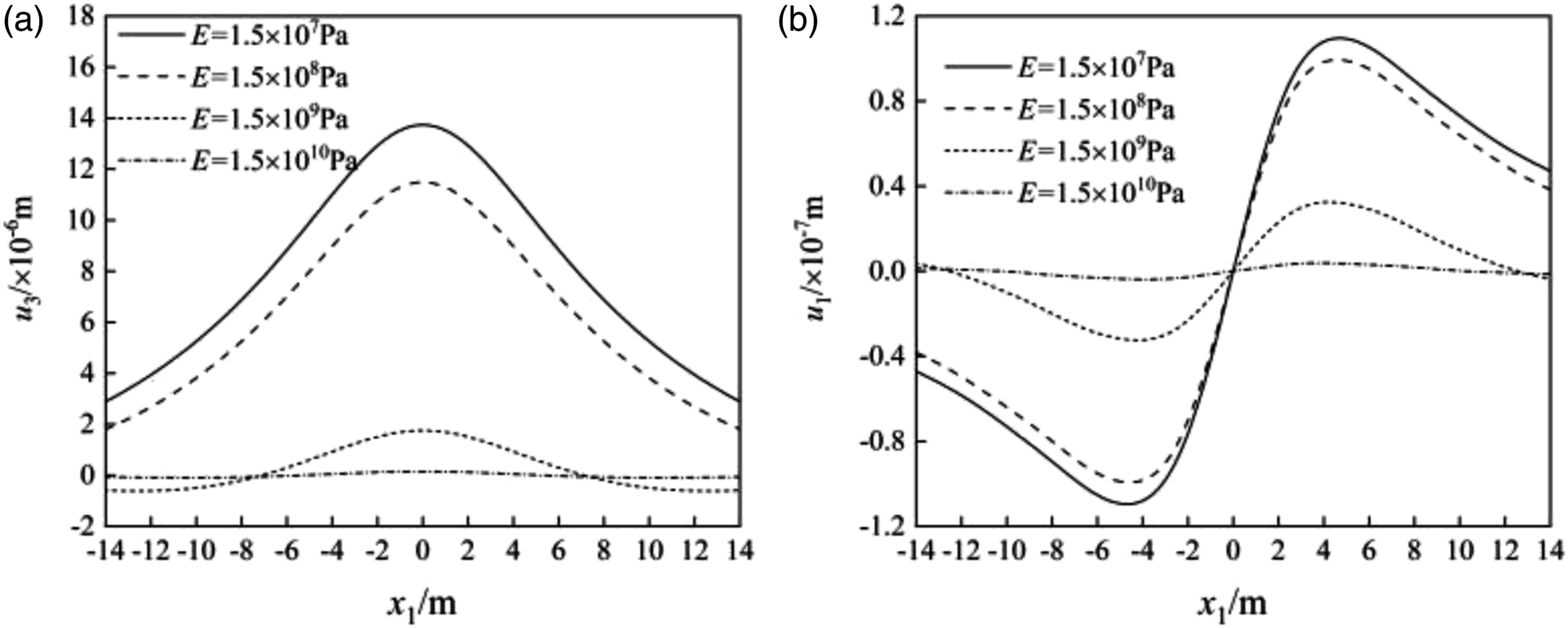
In order to analyze the effect of the thickness of the homogeneous WIB on the vibration isolation effect of the foundation, Figure 7(a) and (b) plot the vertical displacement and horizontal displacement of the foundation surface along the horizontal direction when H = 1 m, h = 5 m−H−h
w
, E
e
= 6.5 × 10⁸ Pa, S
r
= 0.8, and ω = 1 rad/s, and the elastic modulus of the WIB increases gradually from h
w
= 0.5, 1, 1.5, 2 m, respectively. From Figure 7(a) and (b), it can be seen that the vertical displacement and horizontal displacement of the ground surface decrease as the thickness of the WIB increases. The surface displacement amplitude still decreases with the increase of the thickness when the thickness of the WIB h
w
≥ 1.0 m, but the magnitude of the displacement amplitude decreases gradually. Considering the suitable economic cost and good vibration isolation effect, the thickness of WIB should not be set too thick. (a) Variations of vertical displacement at the ground surface. (b) Variations of horizontal displacement at the ground surface.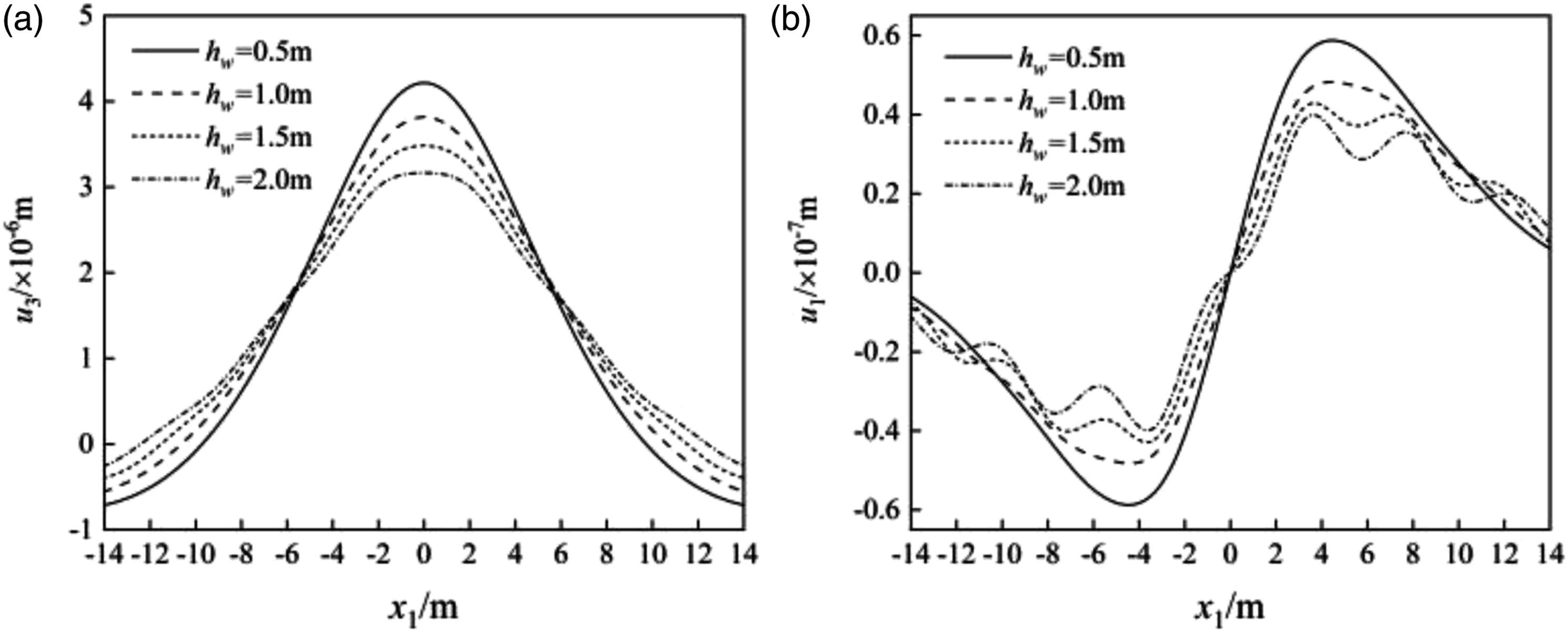
In order to analyze the influence of load frequency on the vibration isolation effect of WIB, Figure 8(a) and (b), respectively, plot the curves of vertical displacement and horizontal displacement of foundation surface along the horizontal direction when the load frequency increases gradually from ω = 1, 20, 40, and 60 rad/s when H = 1 m, h
w
= 0.5 m, h = 3.5 m, E
e
= 6.5 × 10⁸ Pa, and S
r
= 0.8. It can be seen from Figure 8(a) and (b) that with the increase of load frequency, the vertical and horizontal displacement of the surface decrease, but with the continuous increase of frequency, the decrease amplitude of the vertical and horizontal displacement of the surface decreases gradually. However, when the load frequency exceeds a certain limit, although it can still play a vibration isolation effect with the increase of load frequency, the vibration isolation effect is no longer obvious. (a) Variations of vertical displacement at the ground surface. (b) Variations of horizontal displacement at the ground surface.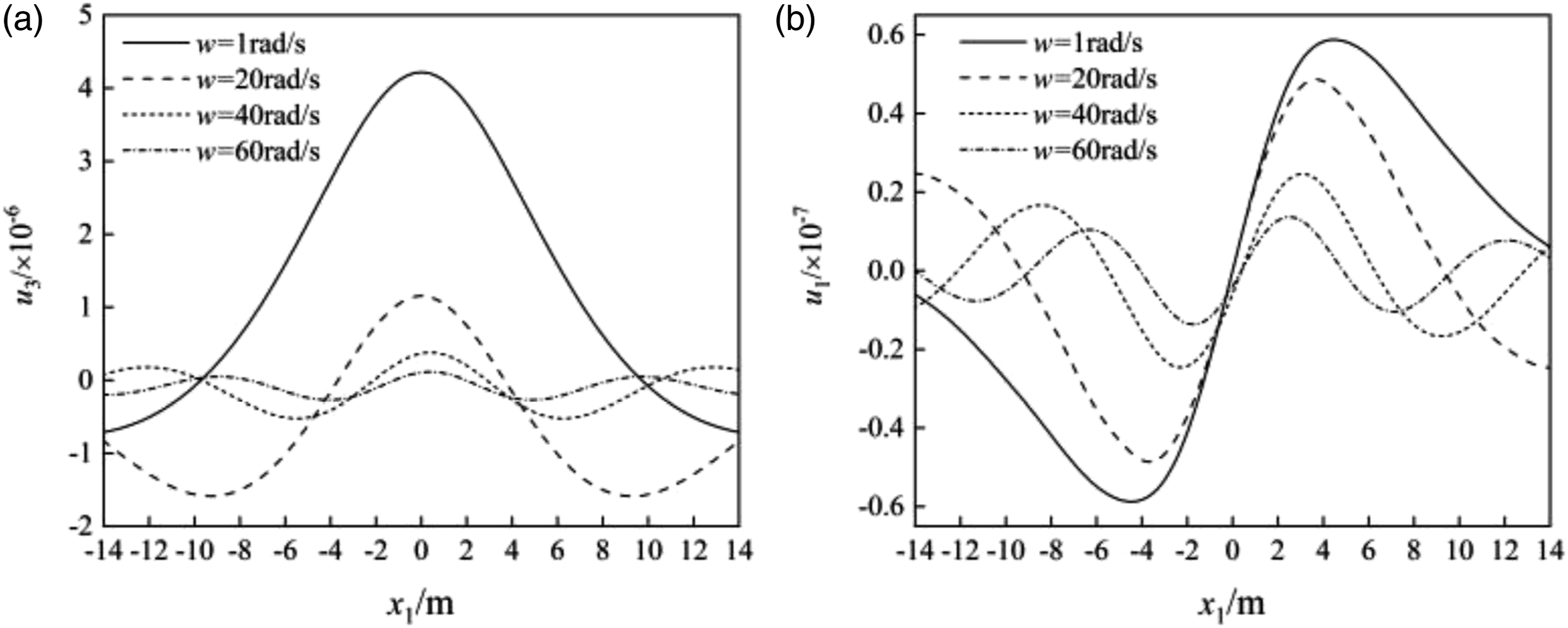
Conclusions
In this paper, based on the theory of single-phase elastic medium and unsaturated porous medium, the vibration isolation effect of WIB in unsaturated soil foundation under an underground dynamic load is analyzed. Using Fourier integral transform, the calculation formula of dynamic response of unsaturated foundation under an underground dynamic load is established. The effects of the physical and mechanical parameters such as soil saturation, load frequency, embedded depth, thickness, and elastic modulus of WIB on the vibration isolation performance in unsaturated soil foundation are analyzed. The results of the study show that: (i) A good vibration isolation effect can be obtained by setting a WIB in unsaturated soil foundation under an underground dynamic load. (ii) The vibration isolation effect of WIB in unsaturated soil foundation increases with the increase of embedded depth and saturation, especially the influence of embedded depth and saturation on the vibration isolation effect is very obvious. (iii) The vibration isolation effect of WIB in unsaturated soil foundation increased with the increasing of load frequency, thickness, and modulus of elasticity, in which WIB can play a better vibration isolation effect under the action of higher load frequency. In addition, the thickness and the elastic modulus of WIB increased to a certain degree, and its effect on vibration isolation effect is no longer obvious.
Footnotes
Acknowledgments
The authors are also grateful to editors and reviewers for them helpful advice and comments.
Declaration of conflicting interests
The author(s) declared no potential conflicts of interest with respect to the research, authorship, and/or publication of this article.
Funding
The author(s) disclosed receipt of the following financial support for the research, authorship, and/or publication of this article: The authors gratefully acknowledge the financial support of the Chinese Natural Science Foundation (Grant No. 52168053) and Qinghai Province Science and Technology Department Project (No. 2021-ZJ-943Q).
Data availability
The datasets generated during and/or analyzed during the current study are available from the corresponding author on reasonable request.

Appendix A
Appendix B
The expression of the system of equation (35) is:
The elements not 0 in matrix T are: