In this paper, the effects of porosity distribution and piezoelectric layers on the natural frequencies and flutter aerodynamic pressure of smart thick porous plates in supersonic airflow are studied. Based on the third-order shear deformation plate theory and first-order piston theory, thick functionally graded porous plates embedded by piezoelectric layers are investigated. The effective porous material properties, such as Young’s modulus and mass density are considered to vary along the thickness direction. The aeroelastic governing equations of motion are obtained using Hamilton’s principle and Maxwell’s equation. By applying Galerkin’s approach, the partial differential governing equations are transformed into a set of ordinary differential equations. The results indicate that the unsteady aerodynamic pressure and natural frequencies decrease as the porosity coefficient increases. Furthermore, the symmetric porosity distribution predicts the highest unsteady aerodynamic pressure and natural frequencies for porous plates. Besides, the results show that the porous plate enclosed by piezoelectric layers in open circuit condition has higher flutter aerodynamic pressure and natural frequencies than the similar plate in closed circuit condition.
In the field of fluid-structure interaction (FSI), the vibration and aeroelastic analysis of structures under supersonic flow have received a great deal of attention in mechanical and aerospace engineering. It is well-known that structures under aerodynamic loads may lose their stability through flutter. Thus, it is important to study this type of instability characteristics in the analysis of structural components. In this regard, Cheng et al.1 investigated the supersonic flutter of composite plates under aerodynamic load, using the finite element method (FEM). Navazi and Haddadpour2 performed the aerothermoelastic analysis of functionally graded material (FGM) panels based on classical plate theory (CPT) by using Galerkin’s approach. Sohn and Kim3 reported the static and dynamic stabilities of FGM panels under aero-thermal loads based on first-order shear deformation plate theory (FSDT). Song and Li4 studied the aerothermoelastic characteristics of a panel subjected to supersonic airflow with various boundary conditions. Hasheminejad and Motaaleghi5 researched the supersonic flutter control of sandwich curved panel with an adaptive electro-rheological fluid core layer. Based on the CPT, Fazelzadeh et al. 6 performed the flutter and divergence instabilities analysis of FG plates reinforced by carbon nanotubes (CNTs) under supersonic airflow using the Galerkin method. Song et al.7 investigated the aeroelastic analysis of FG plates reinforced with CNTs in supersonic airflow based on the higher-order shear deformation theory (HSDT). Zhang et al.8 studied the aerothermoelastic analysis of FG composite panels reinforced with CNTs subjected to supersonic airflow. Asadi et al.9 scrutinized the static and dynamic behaviors of functionally graded carbon nanotube reinforced composite (FG-CNTRC) panels in supersonic airflow and thermal environment. Zhou et al.10 studied the aerothermoelastic flutter of the plates exposed to supersonic airflow with general boundary conditions based on Mindlin plate theory. Besides, recent developments in the aeroelastic analysis of structures under supersonic flow can be pursued in the works of Bahaadini and Saidi,11 Jiang and Li,12 Akhavan and Ribeiro,13 and De Matos Junior et al.14
Recently, FG porous structures have become a top research area for many engineers and material scientists. They have been widely used in lightweight structures, energy absorption, sound attenuation and thermal insulation due to very law specific weight.15 Theodorakopoulos and Beskos16 studied the vibration of the thin rectangular porous plates based on the CPT. Leclaire et al.17 investigated the vibration behavior of homogenous rectangular porous plate using the CPT. The vibration, deflection, and buckling of the circular plate made of porous material were performed by Magnucka-Bland.18 The vibration analysis of porous plates with Levy-type boundary conditions was studied by Rezaei and Saidi.19–21 Chen et al.22 performed the nonlinear vibration of shear deformable sandwich porous beam. Yang et al.23 studied the buckling and vibration of FG porous nanocomposite plates reinforced by graphene platelets. The vibration analysis of longitudinally FGM porous plates was investigated by Wang et al.24
Piezoelectric materials have been widely used in applications such as sensors, actuators and energy harvesting due to the coupling between electric and mechanical fields. Huang et al.25 studied the vibration control of laminated plates surrounded by piezoelectric layers using FEM. The effects of thickness, mass density, and stiffness of piezoelectric layers on the natural frequency of the plates were examined by Liang and Batra.26 He et al.27 employed the active control of the FGM plates bounded with piezoelectric sensors and actuators under different boundary conditions. Askari Farsangi et al.28 investigated an analytical solution for the vibration of FG rectangular plates with piezoelectric layers under Levy-type boundary conditions according to the FSDT. Khorshidvand et al.29 performed the buckling analysis of porous circular plates tunable with piezoelectric layers based on the CPT. Askari et al.30 employed an analytical solution to investigate the vibration analysis of rectangular porous plates surrounded with piezoelectric layers using Reddy’s third-order shear deformation theory (TSDT). Li31 studied the active aeroelastic flutter properties of supersonic plates made of piezoelectric material. The aerothermoelastic analysis and active flutter control of FG-CNTRC panels with piezoelectric sensor and actuator were analyzed by Zhang et al.8 based on the TSDT. The piezoelectric effects on the natural modes and aeroelastic stability of the plate with attached piezoelectric material were studied by Kasem and Dowell.32. Tang and Dowell33 investigated the energy harvesting and aeroelastic behavior of cantilever piezoelectric laminated plates in the yawed flow.
As far as the authors are aware, there have been no previous works on the vibration and aeroelastic analysis of the porous-cellular plates enclosed by piezoelectric layers under supersonic flow. In this study, the vibration and flutter instability analysis of the smart thick porous-cellular plates with piezoelectric layers under supersonic flow are investigated. The porosity distributions are considered uniform and non-uniform. The governing equations for both electrical and mechanical boundary conditions are obtained employing Hamilton’s principle, Maxwell’s equation and the first-order piston theory. The governing equations of motion and boundary conditions are discretized using the Galerkin method. The results are presented to study the effects of porosity distributions, porosity coefficients, different geometrical dimension ratios as well as electrical and mechanical boundary conditions on the unsteady aerodynamic pressure and natural frequencies of the smart thick porous-cellular plates.
Mathematical formulation
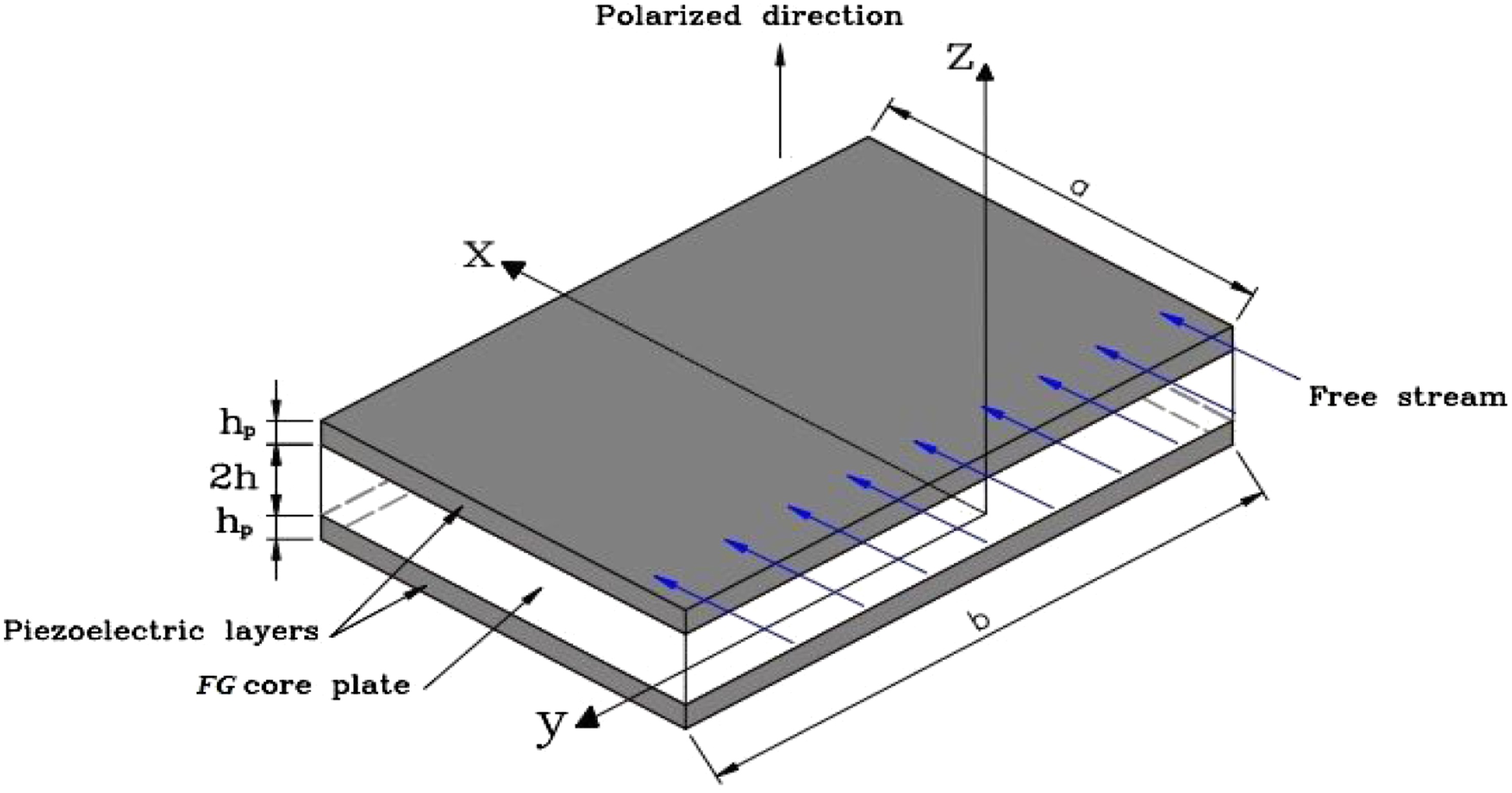
Figure 1 illustrates the rectangular smart thick porous plate with piezoelectric layers under supersonic flow. The length, width, and thickness of plate are represented by , , and , respectively. The thickness of each piezoelectric layer is denoted by . The origin of coordinate system is located at the mid-plane of plate. The coordinate in thickness direction is denoted by as well as in-plane coordinates are defined by and , respectively.
The schematic diagram of porous plate surrounded by piezoelectric layers in supersonic flow.
Kinematic assumption
For the TSDT, the components of the displacement field are30
In equation (1), the components of the displacement field are denoted by , , and in , , and directions, respectively. The in-plane displacements in and directions are represented by and , respectively. The transverse displacement of the middle plane in direction is shown by . Besides, the rotations about and axes are represented by and , respectively. The constant is equal to and is the time variable.
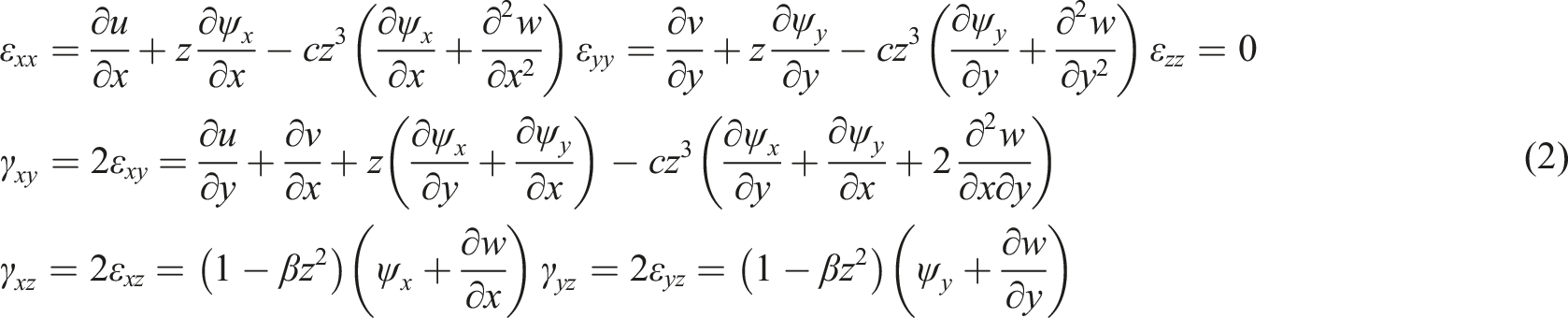
The components of strains can be expressed as follows
where
Governing equations
Based on the extended Hamilton’s principle, the governing equations of the porous-cellular plate with integrated piezoelectric layers under supersonic flow can be obtained as
The mechanical edge boundary conditions are considered as:
(i) Simply supported
(ii) Clamped
In equation (4), the definitions of constant quantities are defined in the .Appendix A It should be noted that clamped and simply supported edges are denoted by C and S, respectively.
Maxwell’s equation
For the mechanical equilibrium equation (4), the variables are satisfied Maxwell’s equation in the following integral form28
where
It can be observed that the electric potential at and is as follows
Furthermore, the electrical boundary conditions at are considered as
In equation (7), the definitions of constant quantities are described in Appendix B.
Porosity distributions
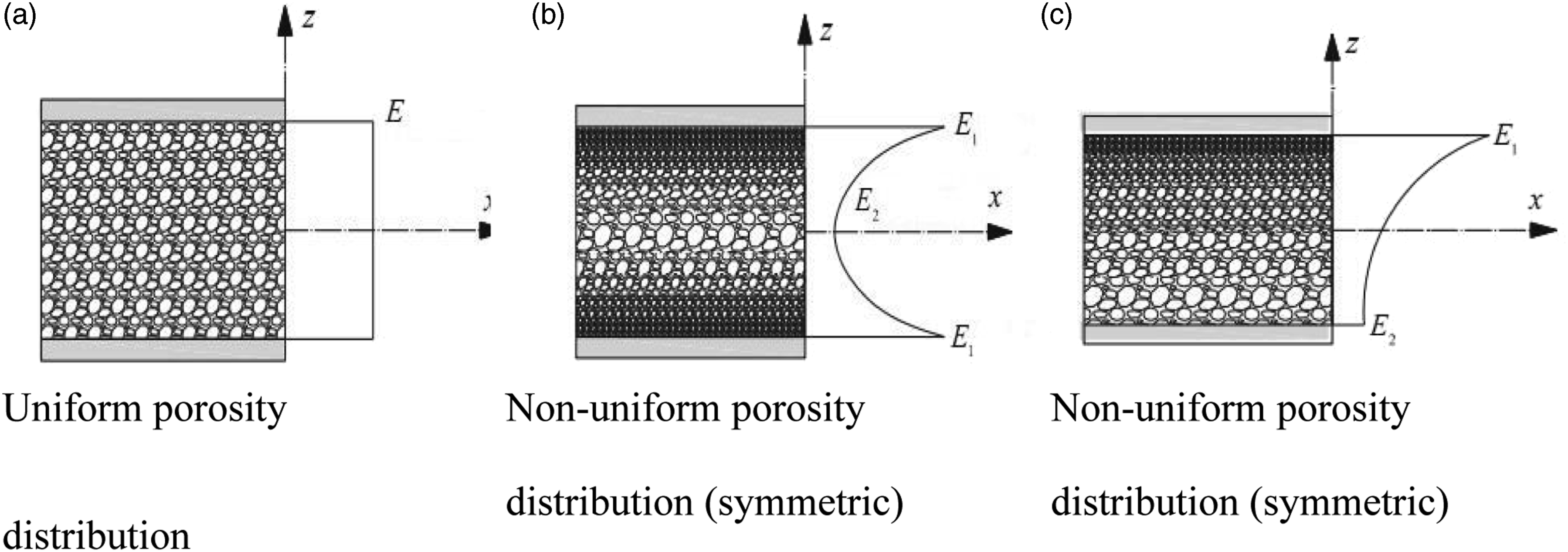
Figure 2 illustrates the uniform porosity distribution and two non-uniform porosity distributions. Two non-uniform porosity distributions are considered as distributions 1 (symmetric) and distributions 2 (asymmetric). As shown in Figure 2, the top and bottom sides of the core plate have the highest values of elasticity moduli and mass density, while the mid-plane of the plate has the lowest values of elasticity moduli and mass density in the symmetric porosity distribution. The elasticity moduli and mass density change gradually from their highest values at the top surface to the lowest value at the bottom surface in the asymmetric porosity distribution. Furthermore, the material properties are constant in uniform porosity. The elastic moduli and mass density of the smart porous-cellular plate with various types of porosity distributions are presented by22
(i) porosity distribution 1 (symmetric)
(ii) porosity distribution 2 (asymmetric)
(iii) uniform porosity distribution
In equation (10), the highest values of elasticity moduli and mass density are represented as and , respectively. Also, the porosity and mass density coefficients are denoted by and , respectively, defined as
where denotes the lowest values of elasticity modulus.
The porous core plate with various porosity distributions.
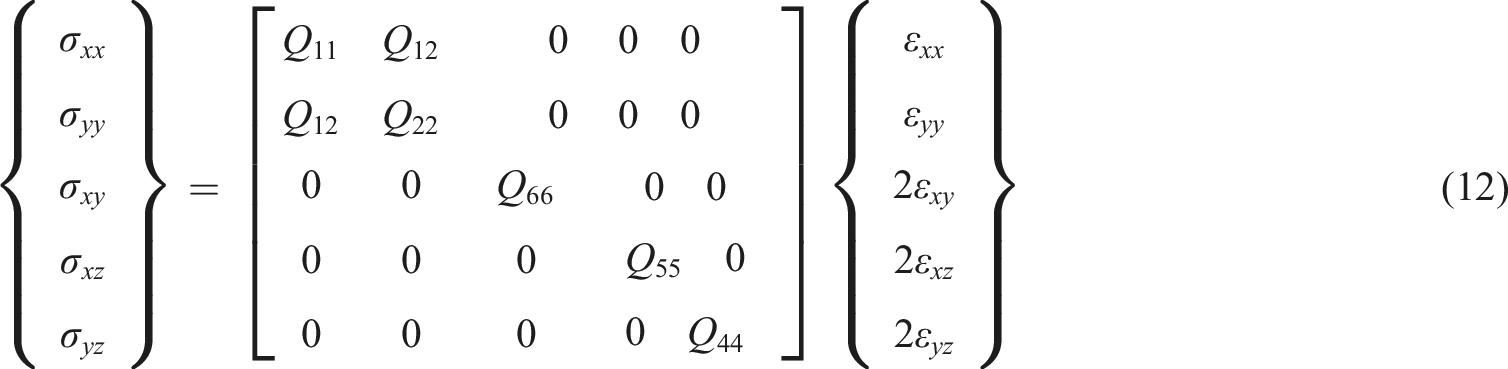
The strain-stress relations for porous-cellular plates can be expressed as30
where
Piezoelectric materials
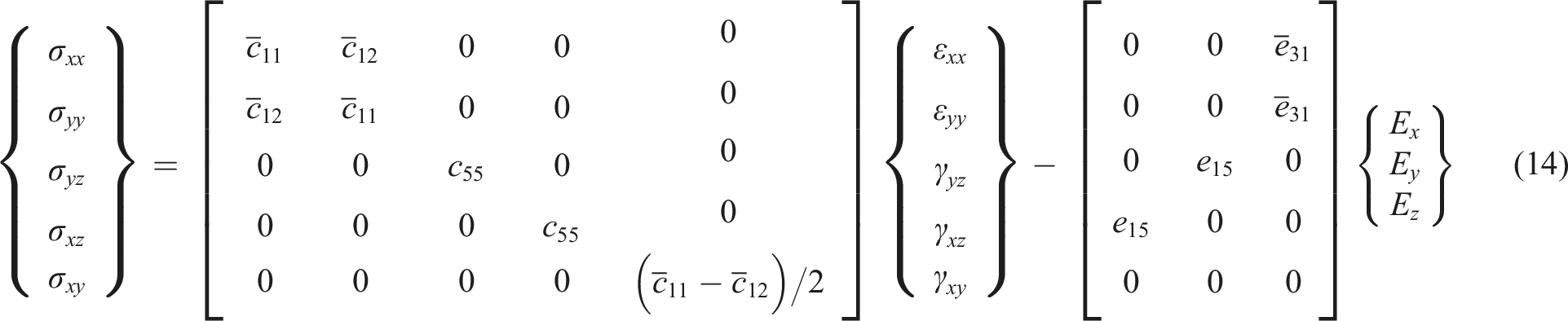
The constitutive relation of isotropic piezoelectric layers is given as30
In which
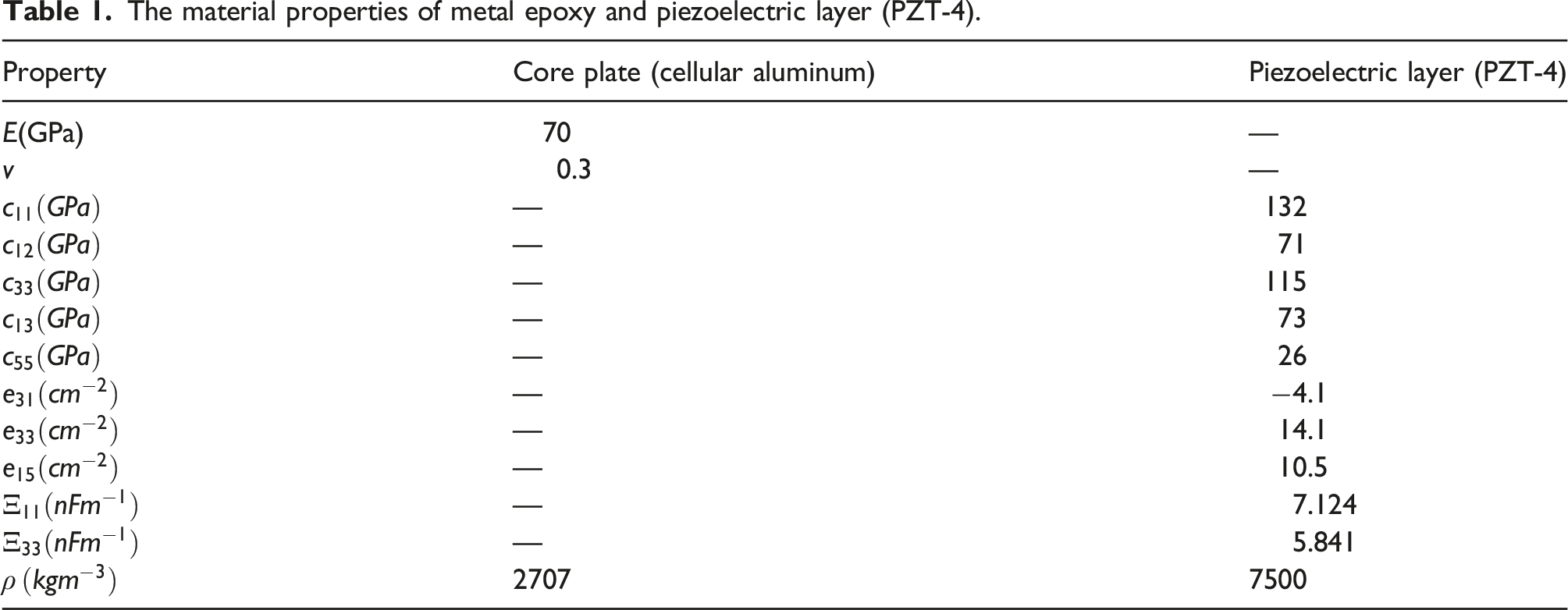
where and () denote the electric field and electric displacement in the piezoelectric layer, respectively. Besides, the piezoelectric elastic moduli, piezoelectric constant, and dielectric permittivity are denoted by , , and (), respectively. The electric field can be expressed in terms of electric potential as below (see Table 1).
The material properties of metal epoxy and piezoelectric layer (PZT-4).
Property
Core plate (cellular aluminum)
Piezoelectric layer (PZT-4)
(GPa)
70
—
0.3
—
—
132
—
71
—
115
—
73
—
26
—
−4.1
—
14.1
—
10.5
—
7.124
—
5.841
2707
7500
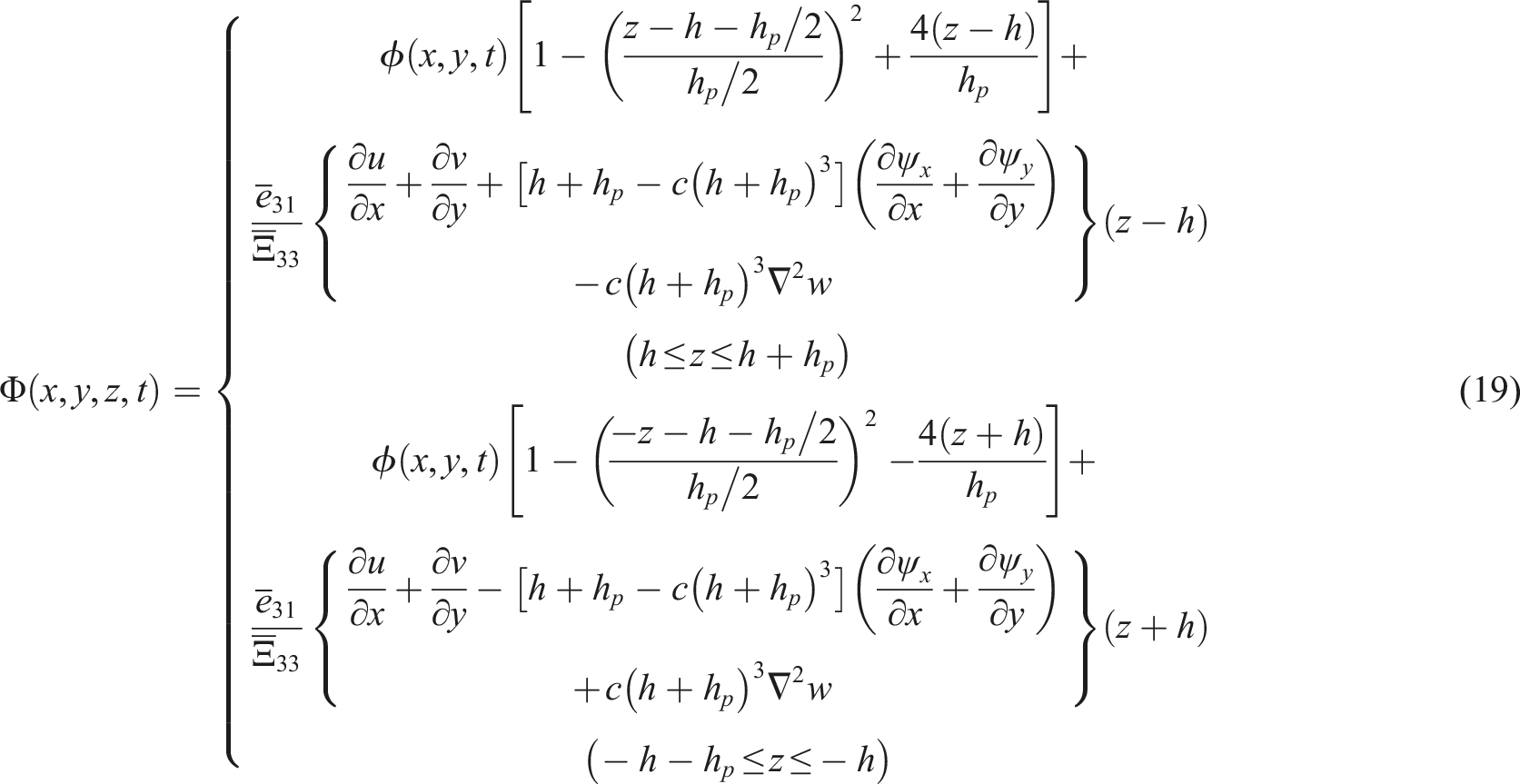
In equation (17), the electric potential of the piezoelectric layer in the thickness direction is indicated by . Furthermore, both open and closed circuit conditions of the piezoelectric layers are used. The electric potential function for closed circuit condition, two major surfaces of the piezoelectric layer are held at zero voltage, is considered as30
where is the electric potential in the mid-surface of piezoelectric layers. The electric potential function for open circuit condition can be considered as30
Aerodynamic load
This study has considered the porous-cellular plate enclosed by piezoelectric layers under supersonic flow. Based on the first-order piston theory, the aerodynamic pressure load can be expressed as34,37
In equation (20), the velocity, Mach number and density of flow are indicated by , , and , respectively.37 Furthermore, the following dimensionless parameters in the numerical simulations are considered as
where denotes the non-dimension natural frequency, is the non-dimension aerodynamic pressure and represents the bending stiffness associated with the fully-metallic plate. Herein, the following simplification is considered for high Mach number37
Solution technique
The Galerkin method is applied to discretize the coupled partial differential equations to the solution of a finite system of ordinary differential equations. The following modal expansions are assumed to approximate the aeroelastic analysis of the smart porous-cellular plates
where , , , , , and denote the generalized coordinates; , , , , , and are the unknown displacements that satisfy appropriate boundary conditions. Applying the Galerkin method to the governing equations and taking advantage of the orthogonal properties in the required integrations, the discretized form of governing equations can be obtained as
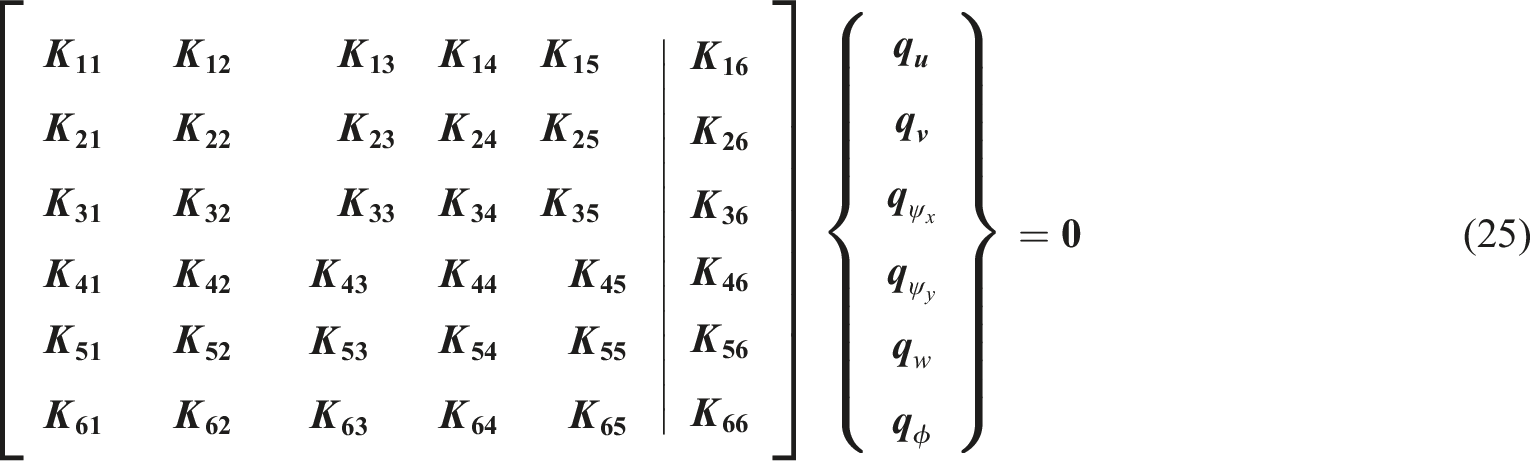
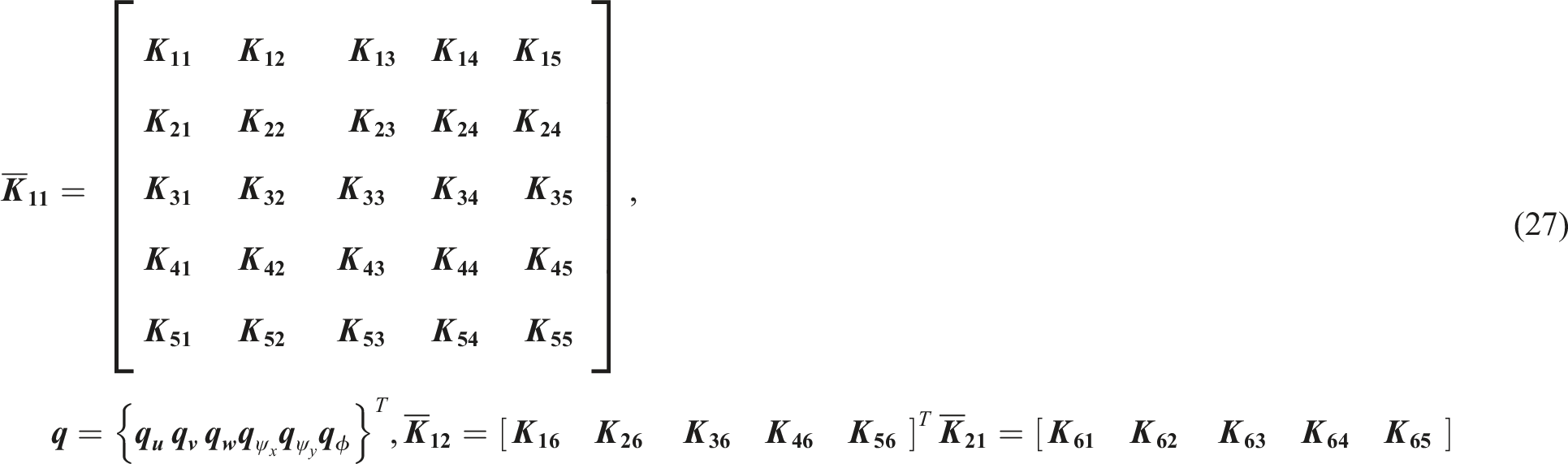
where = is the overall vector of the generalized coordinates. The mass, damping, and stiffness matrices are represented by , , and , respectively. Therefore, the stiffness matrix is written as
After simplification, the above equation can be rewritten as follows
where
Then, the reduced stiffness matrix is obtained as follows
The state vector is defined and the equation (24) can be converted to the first-order state space form as
where
In which, is the unitary matrix. Substituting the state vector into equation (30), the standard eigenvalue problem is obtained as
The eigenvalues are generally complex quantities, that is, . The stability and different types of instability can be obtained based on the sign of the real and imaginary parts of the complex eigenvalues.35,36
Numerical results
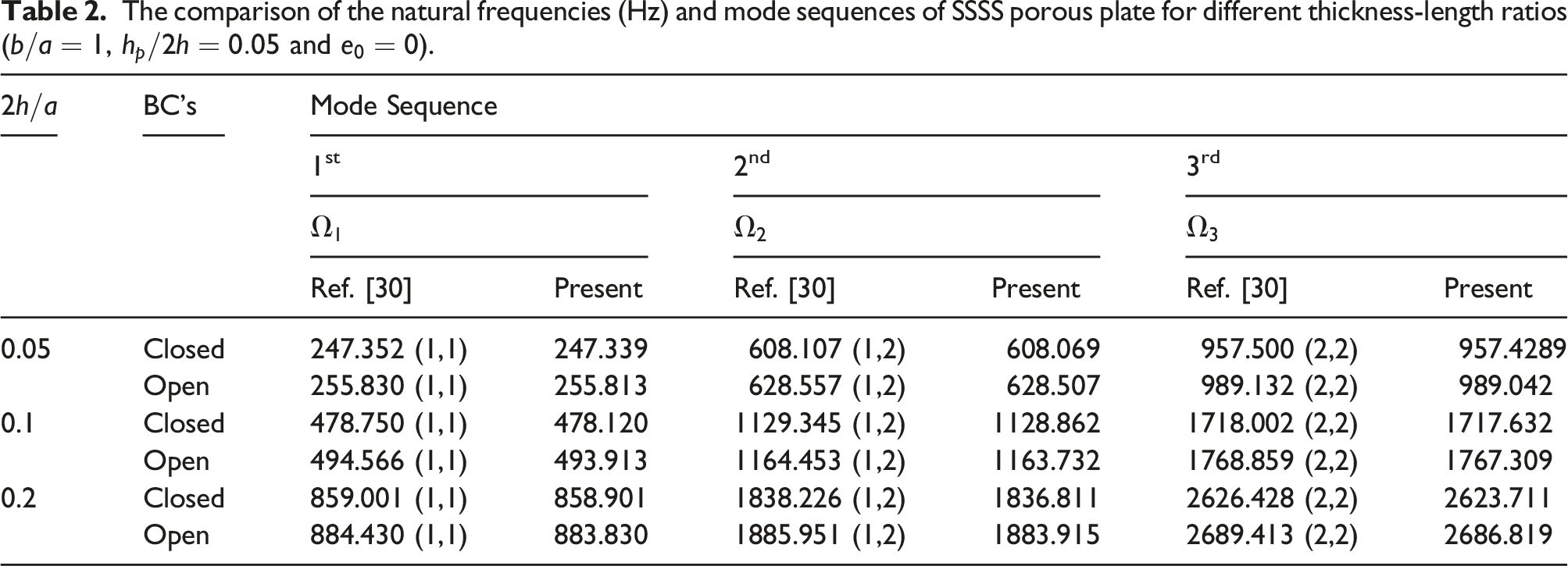
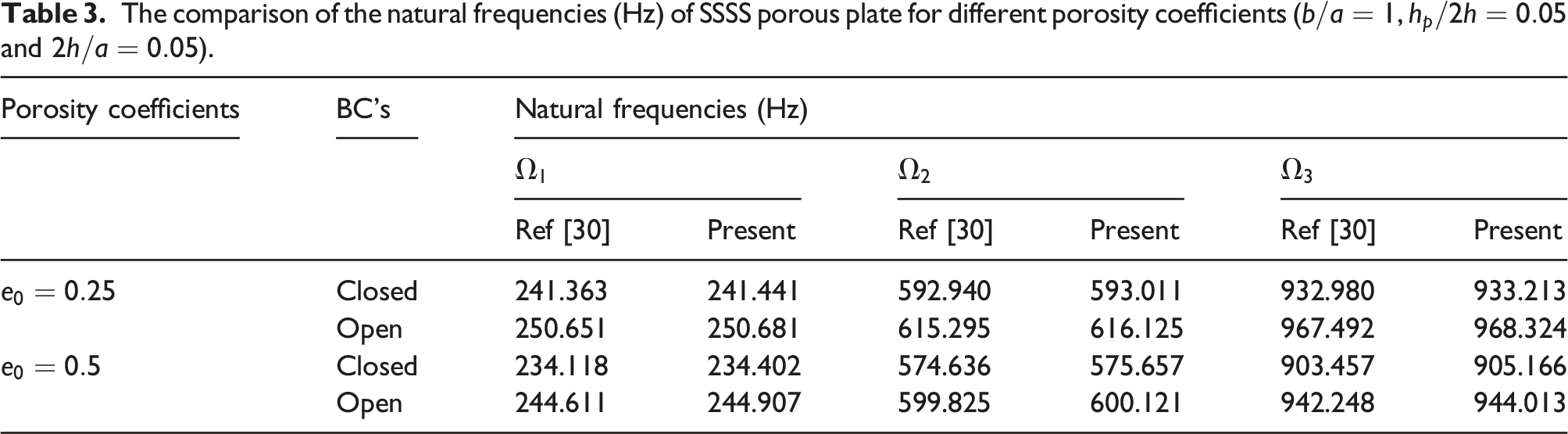
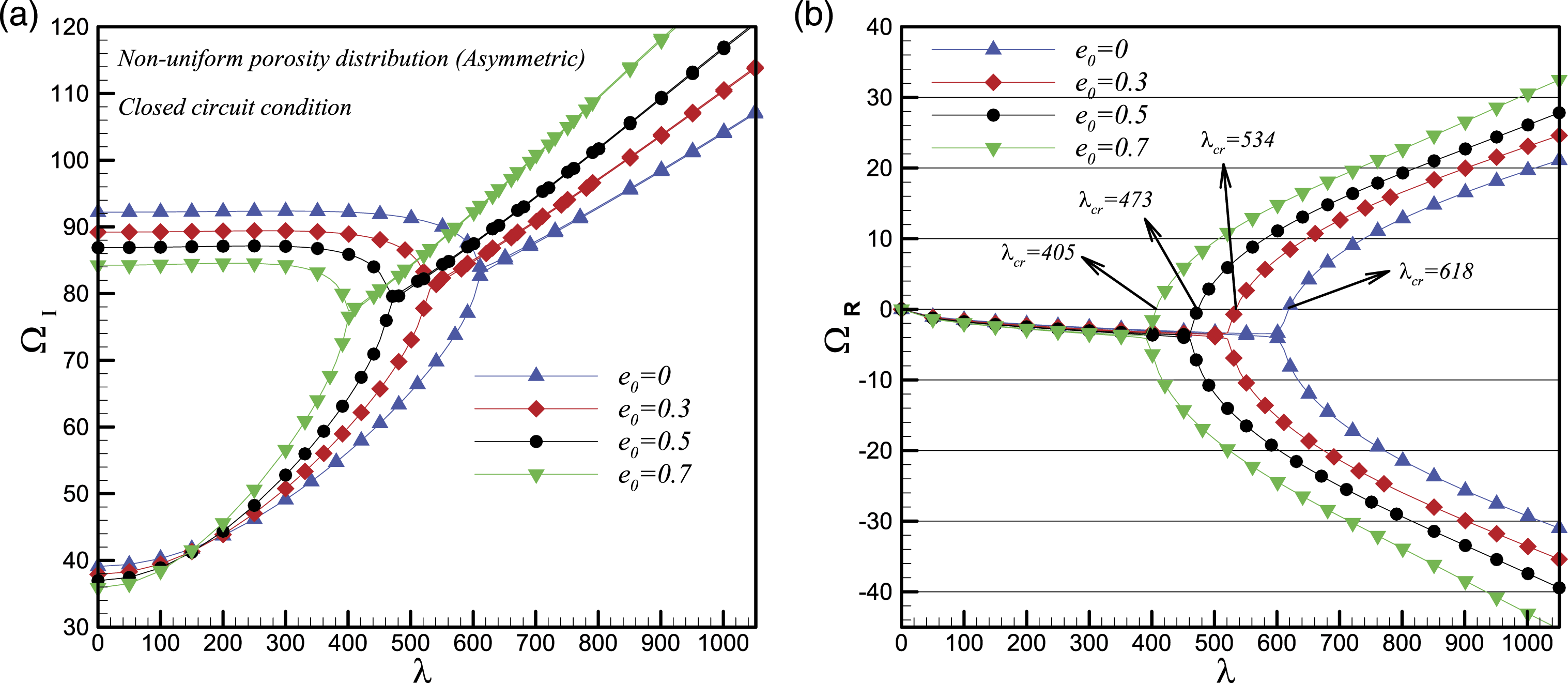
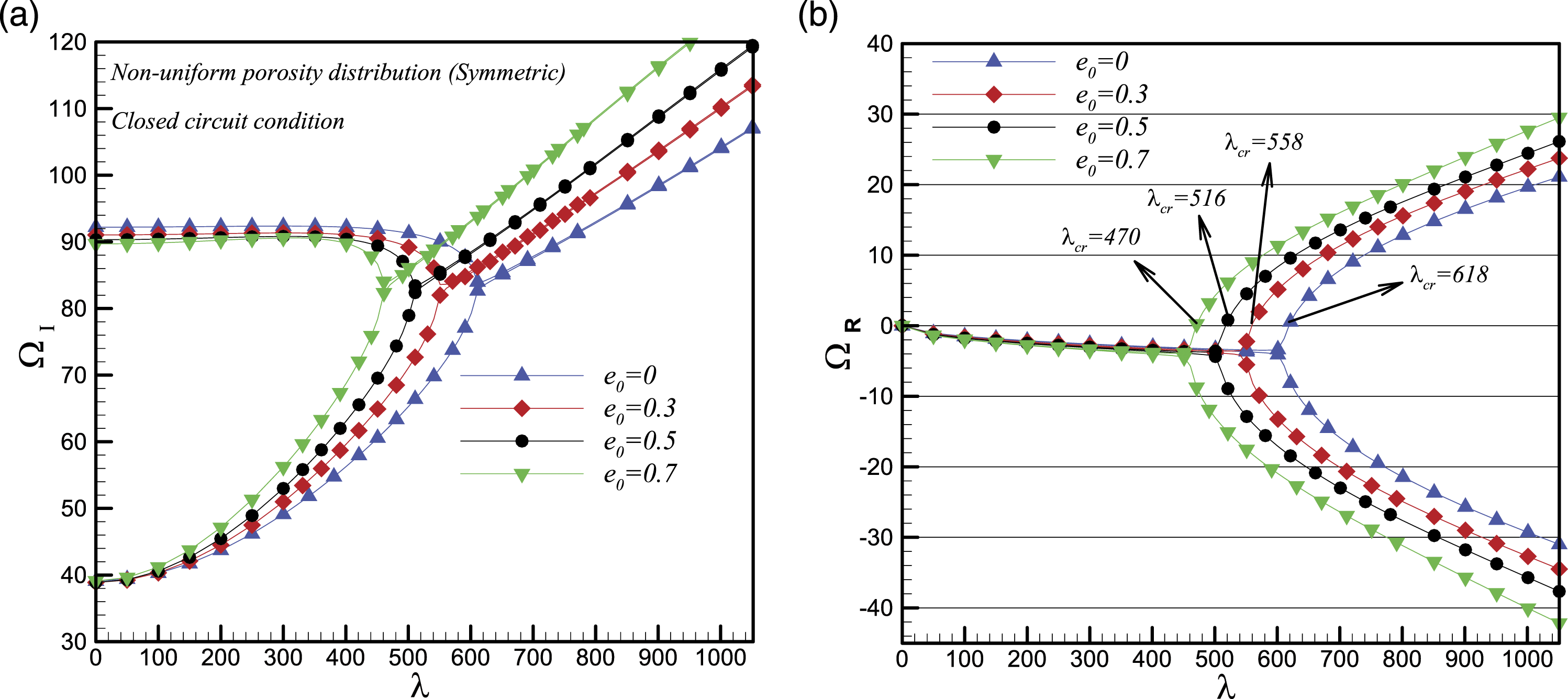
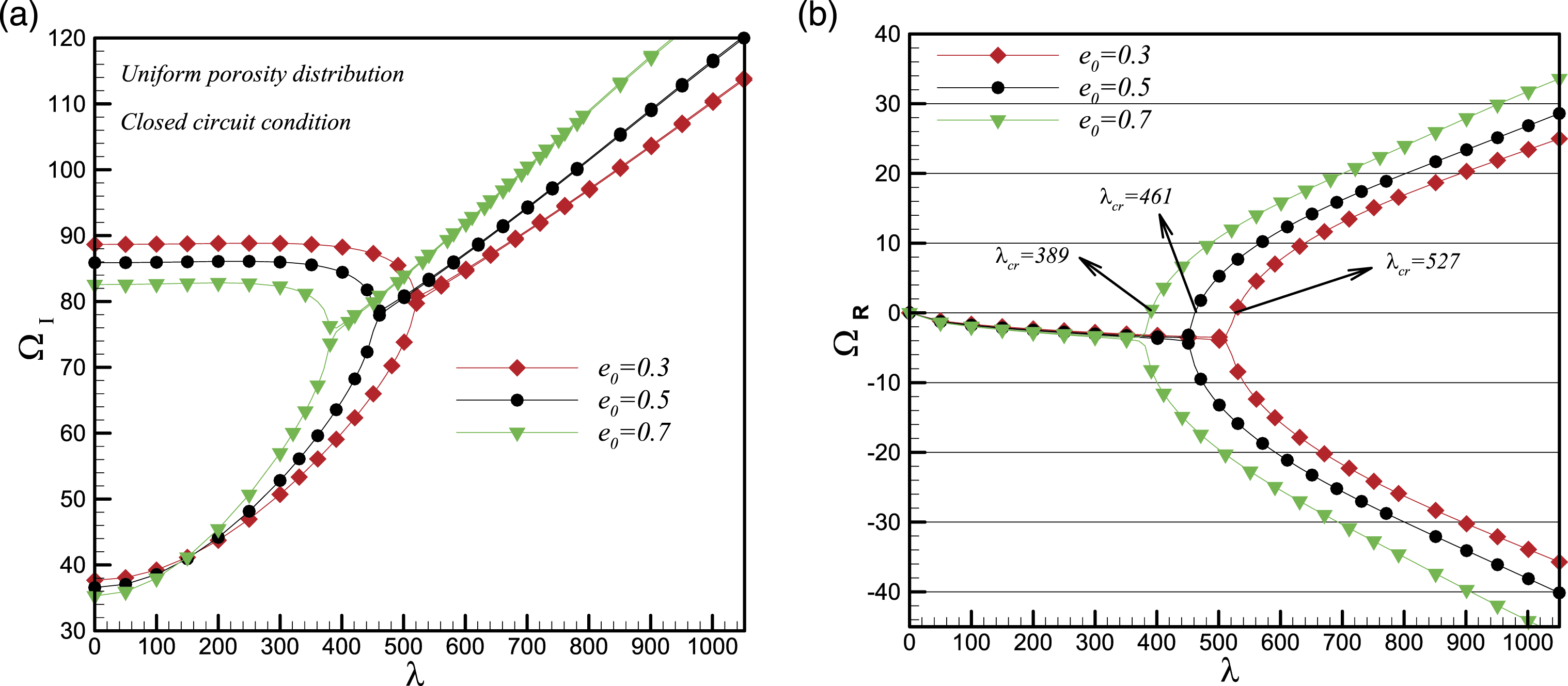
To verify the correctness of the governing equation of motion and the solution method, the variation of the first three natural frequencies of FG porous plates without flow are calculated and compared with those in the literatures as illustrated in Tables 2 and 3. It is evident that the natural frequencies obtained in the present study are in good agreement with those obtained by Askari et al.30 Then, the vibration and aeroelastic analyses of the FG porous plates tunable with piezoelectric layers in supersonic flow are studied. The solution of this problem is obtained through the Galerkin method with six modes. Figures 3–5 show, the variation of eigenvalue versus the aerodynamic pressure for various porosity distributions of the FG porous plate. In these figures, the parameters , , and are considered. As shown, the first and second orders of natural frequencies approach each other when the aerodynamic pressure increases. It is noted that unsteady aerodynamic pressure is the critical value of aerodynamic pressure for the flutter instability. In general, the eigenvalues of this system are complex quantities and the flutter instability can be obtained, using the sign of the real and imaginary parts of the complex eigenvalue. The porous-cellular plate under supersonic flow tends to be in stable condition when the real part of eigenvalue is negative. The system is unstable for the positive real part of eigenvalue. Furthermore, if (the real part of eigenvalue changes its sign from negative to positive) and , the FG porous plate loses its stability through flutter at . It is observed that as the porosity coefficients increases, the natural frequencies of the FG porous plate decrease. Also, an increase in the porosity coefficient yields a decrease in the unsteady aerodynamic pressure. This anticipation is more significant corresponding to the asymmetric and uniform porosity distributions. Furthermore, the porosity coefficient has no more influence on the value of natural frequencies for the symmetric porosity distribution of the FG porous plate. Besides, the results indicate that FG porous plate with symmetric porosity distribution predicts the highest natural frequency and unsteady aerodynamic pressure.
The comparison of the natural frequencies (Hz) and mode sequences of SSSS porous plate for different thickness-length ratios (, and ).
The variation of natural frequencies (a) and real parts of eigenvalue (b) versus the aerodynamic pressure (asymmetric porosity distribution, , , and ).
The variation of natural frequencies (a) and real parts of eigenvalue (b) versus the aerodynamic pressure (symmetric porosity distribution, , , and ).
The variation of natural frequencies (a) and real parts of eigenvalue (b) versus the aerodynamic pressure (uniform porosity distribution, , , and ).
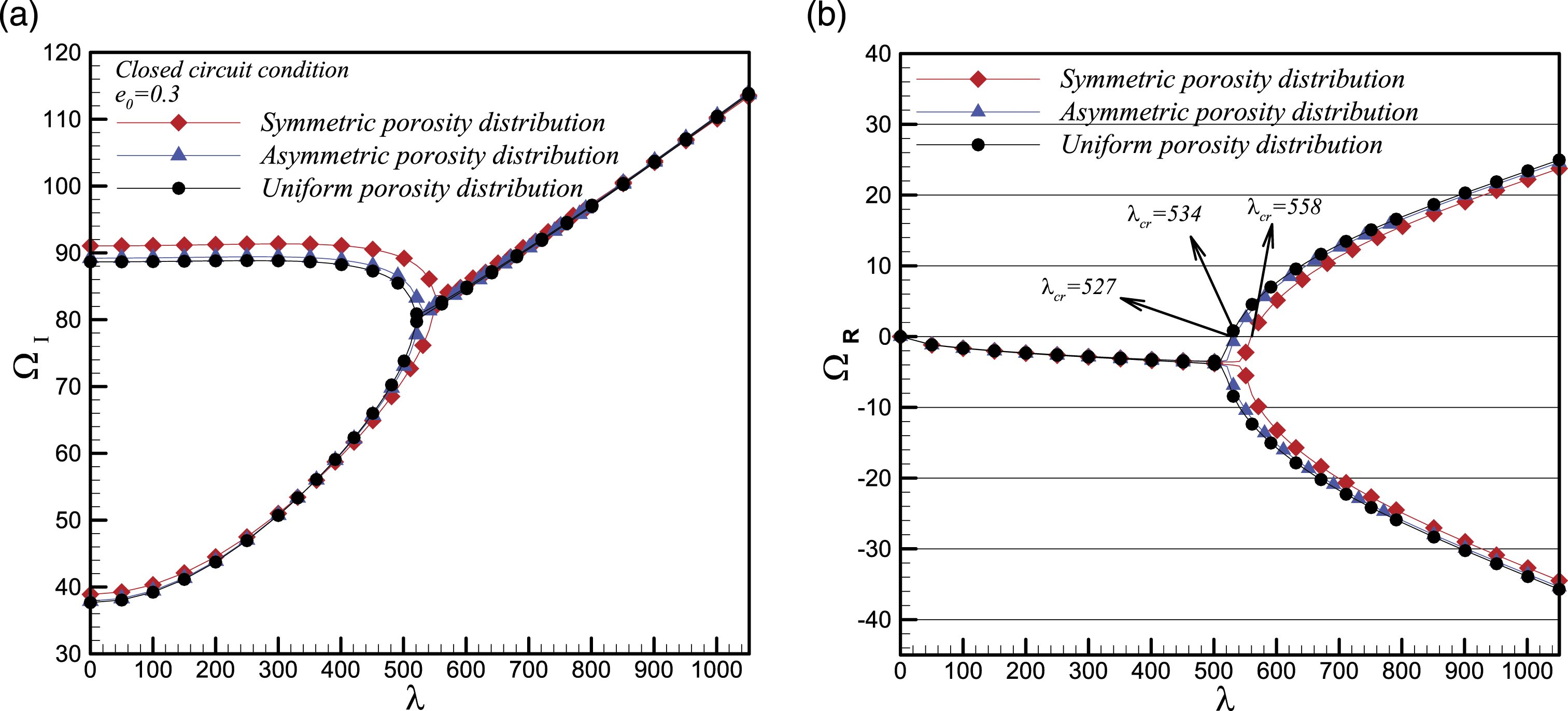
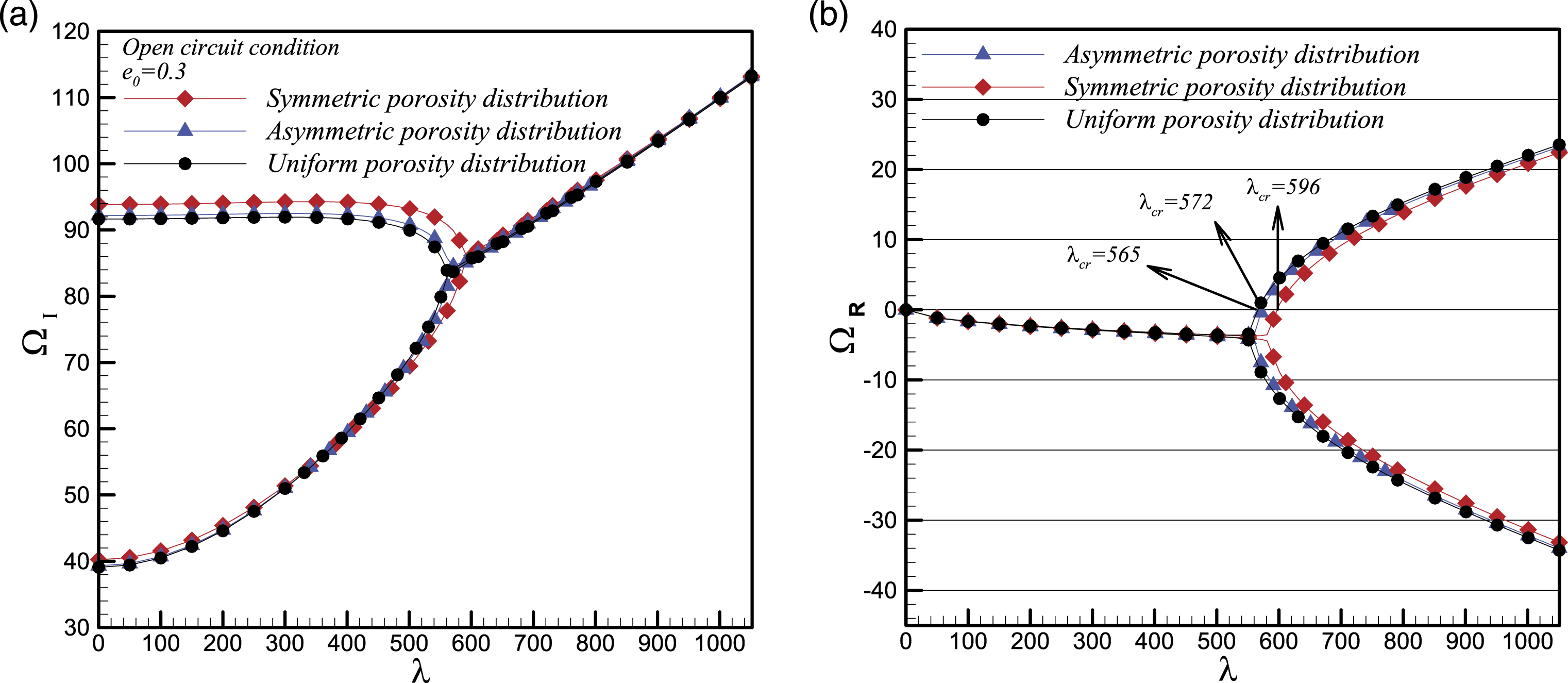
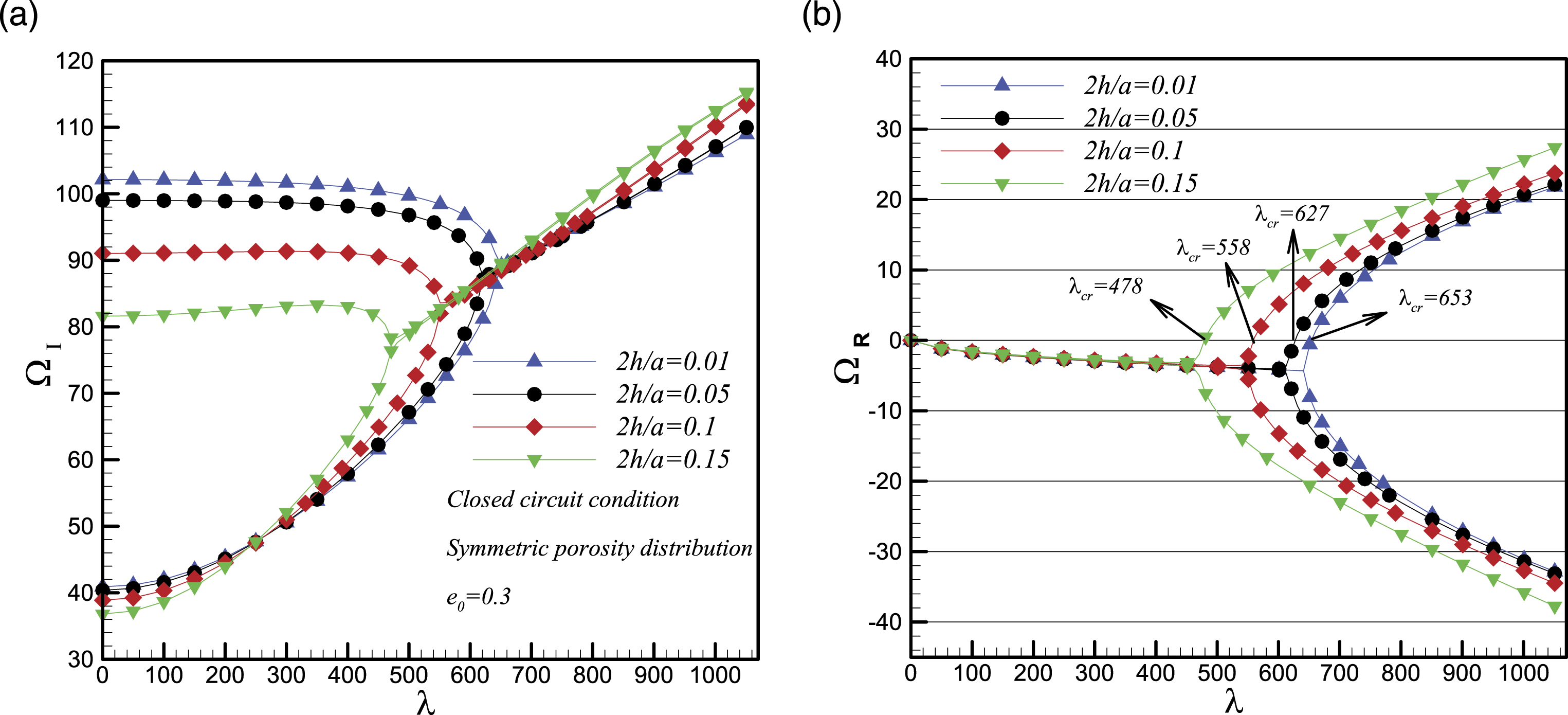
Figures 6 and 7 show the effects of open and closed-circuit conditions of piezoelectric layers on the unsteady aerodynamic pressure and natural frequencies, respectively. In these figures, the parameters are fixed as , , , and . A comparison of the unsteady aerodynamic pressure and natural frequencies of the FG porous plate with various porosity distributions shows that the FG porous plate with uniform porosity distribution possesses the lowest natural frequencies and aeroelastic stability. Furthermore, it can be concluded that the symmetric porosity distribution is more effective in enhancing the aeroelastic stability of the FG porous plates. Besides, in the case of the open circuit condition, the unsteady aerodynamic pressure and natural frequencies are greater than in the case of the closed circuit condition. The open circuit boundary condition converts the electric potential during vibration into mechanical energy, while the closed circuit depletes electric potential.38
The variation of natural frequencies (a) and real parts of eigenvalue (b) versus the aerodynamic pressure (different porosity distribution, closed circuit condition, , , , and ).
The variation of natural frequencies (a) and real parts of eigenvalue (b) versus the aerodynamic pressure (different porosity distribution, open circuit condition, , , , and ).
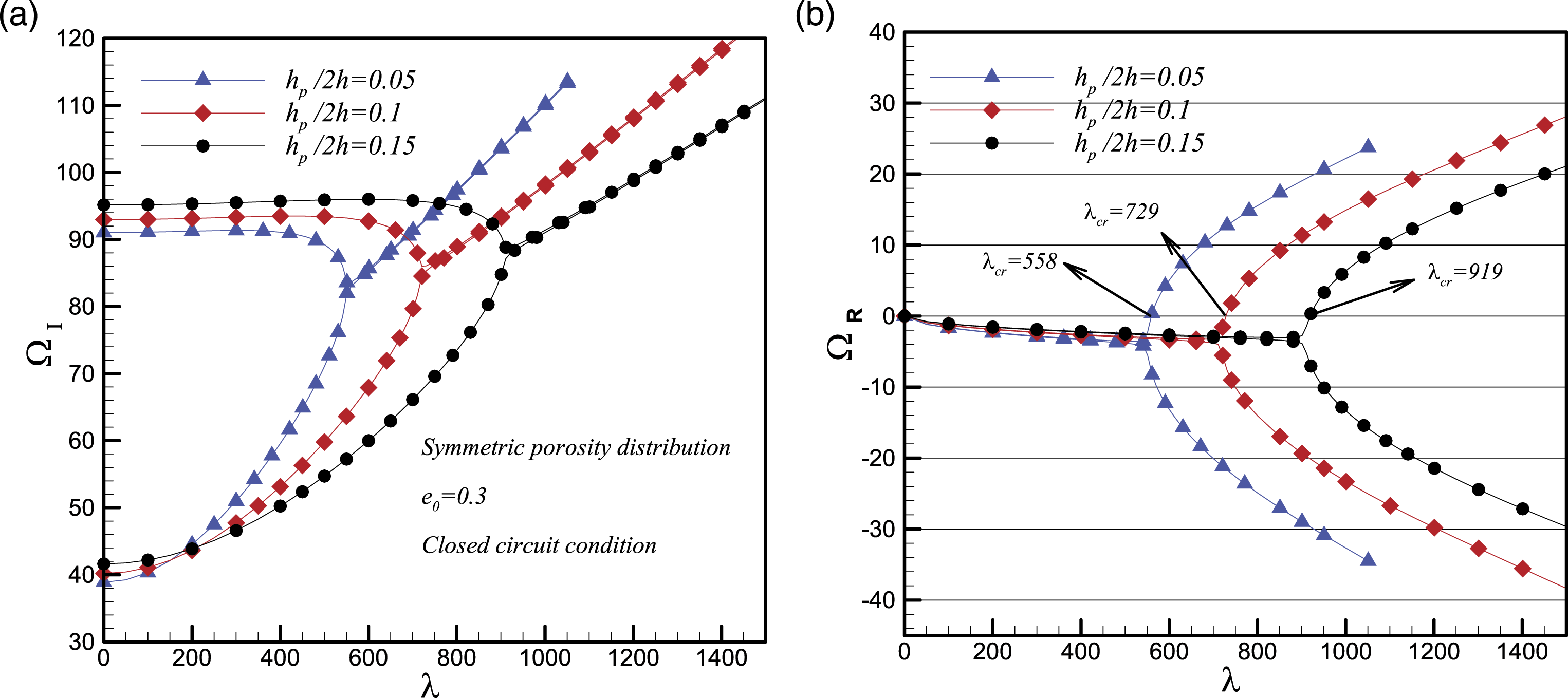
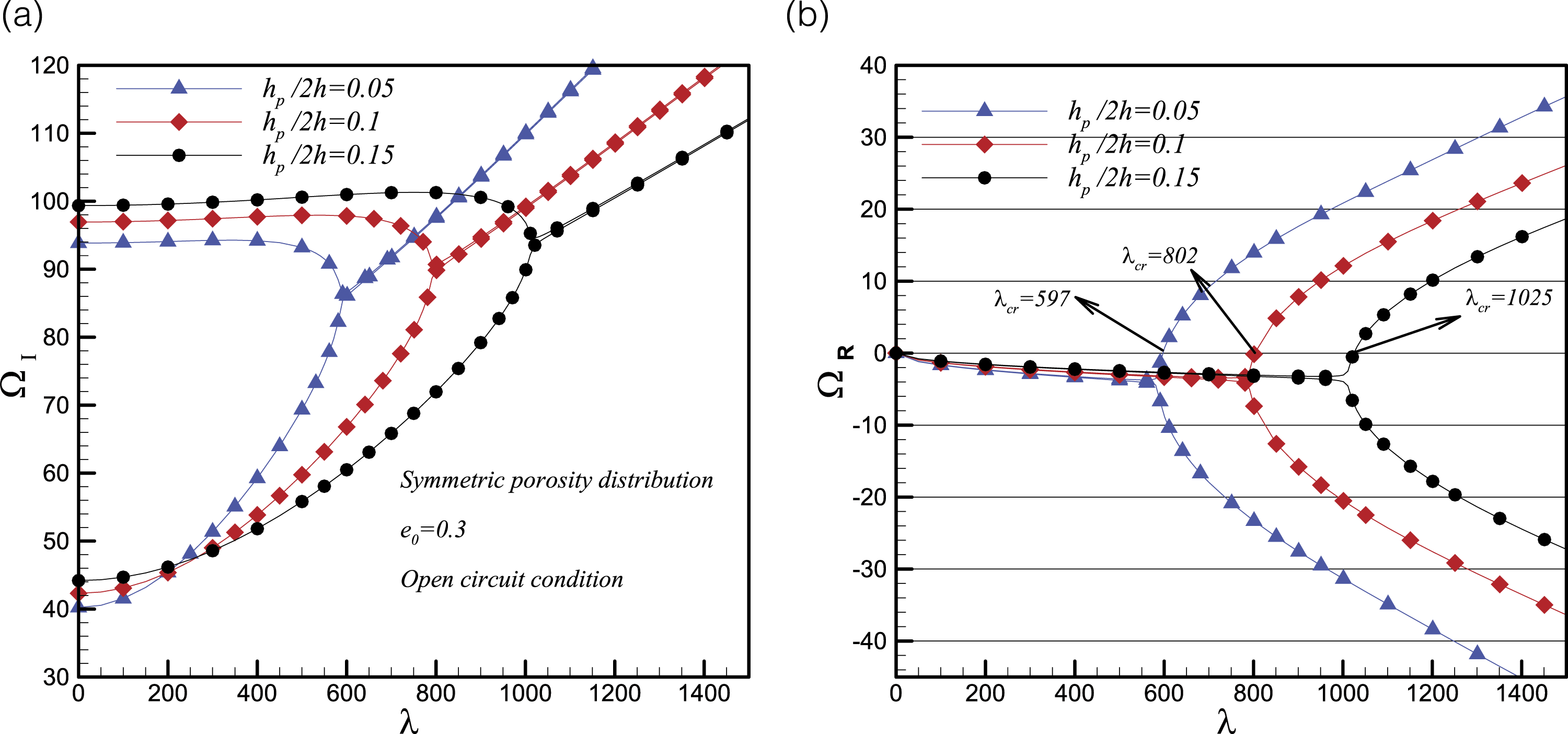
Figures 8 and 9 indicate the variation of natural frequencies versus the aerodynamic pressure of FG porous plates with closed circuit and open circuit conditions for different piezoelectric layers, respectively. The symmetric porosity distribution, , , , and are considered. The results show that as the piezoelectric thickness increases, the unsteady aerodynamic pressure, and natural frequencies increase as well. In other words, the FG porous plate in open circuit condition predicts the highest flutter aerodynamic pressure and natural frequencies compared to the similar plate in closed circuit condition. Furthermore, the stability of the plate is modified by increasing the piezoelectric thickness for both electrical boundary conditions.
The variation of natural frequencies (a) and real parts of eigenvalue (b) versus the aerodynamic pressure (various thickness ratios, closed circuit condition, symmetric porosity distribution, , , and ).
The variation of natural frequencies (a) and real parts of eigenvalue (b) versus the aerodynamic pressure (various thickness ratios, open circuit condition, uniform porosity distribution, , , , and ).
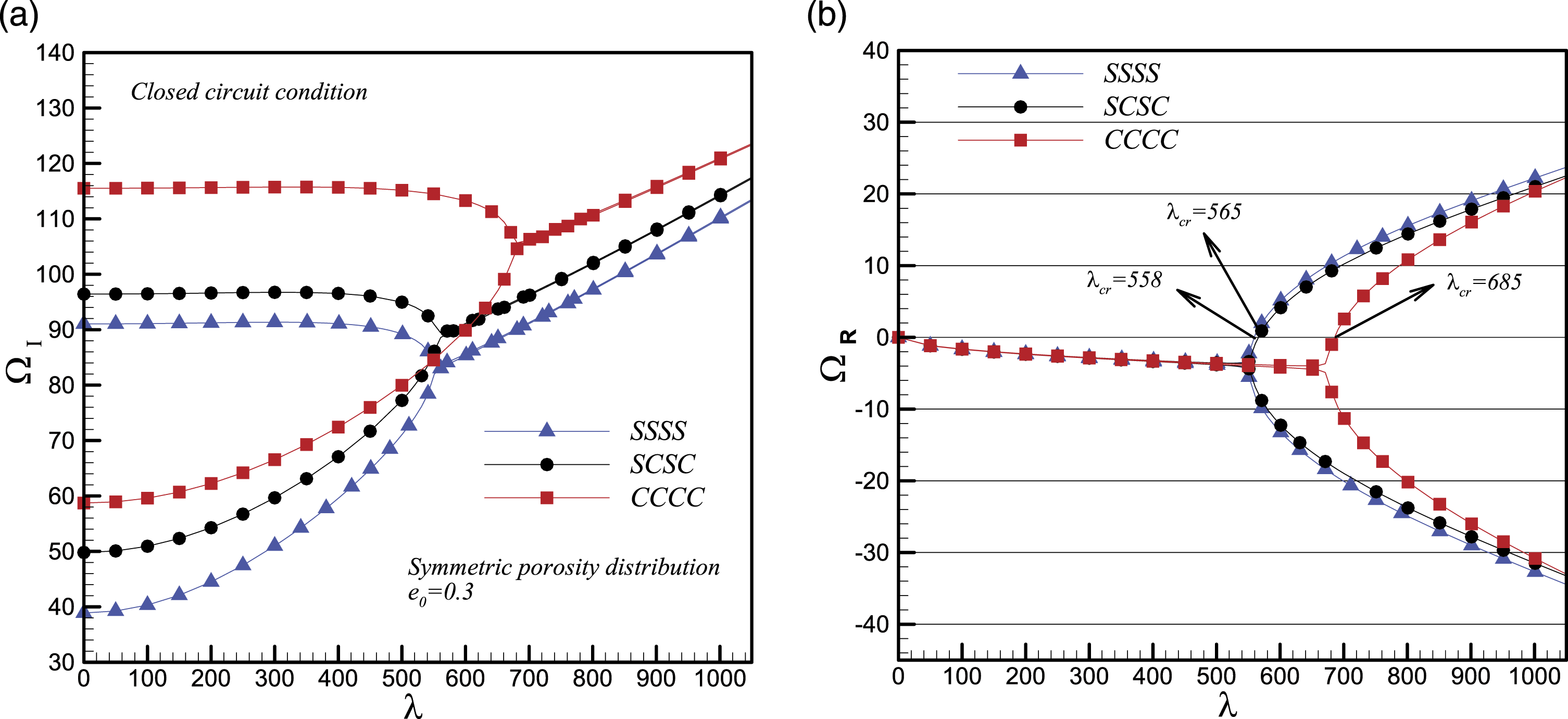
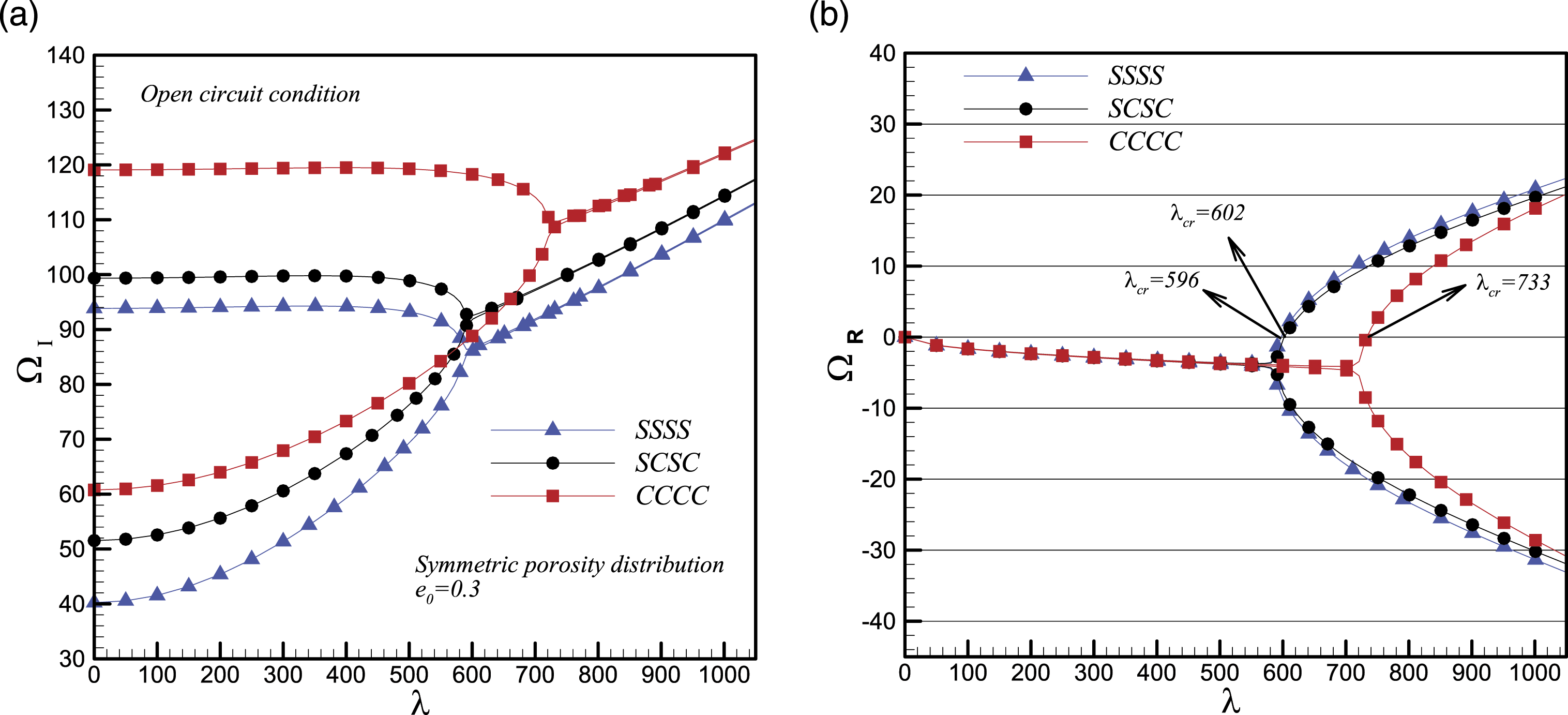
Figures 10 and 11 show the variation of natural frequencies versus the aerodynamic pressure of FG porous plates with closed circuit and open circuit conditions for different mechanical boundary conditions, respectively. In these figures, the parameters are fixed as , , , and . The FG porous plates with symmetric porosity distribution are also considered. A comparison of the flutter aerodynamic pressures of FG porous plates with various mechanical boundary conditions shows that the FG porous plates with CCCC boundary condition offer the highest aeroelastic stability. In this regard, the highest unsteady aerodynamic pressure and natural frequencies correspond to the FG porous plate under CCCC boundary condition and the lowest ones belong to the similar plate under SSSS boundary condition.
The variation of natural frequencies (a) and real parts of eigenvalue (b) versus the aerodynamic pressure (different boundary conditions, closed circuit condition, symmetric porosity distribution, , , and ).
The variation of natural frequencies (a) and real parts of eigenvalue (b) versus the aerodynamic pressure (different thickness-length ratios, open circuit condition, symmetric porosity distribution, , , , , and ).
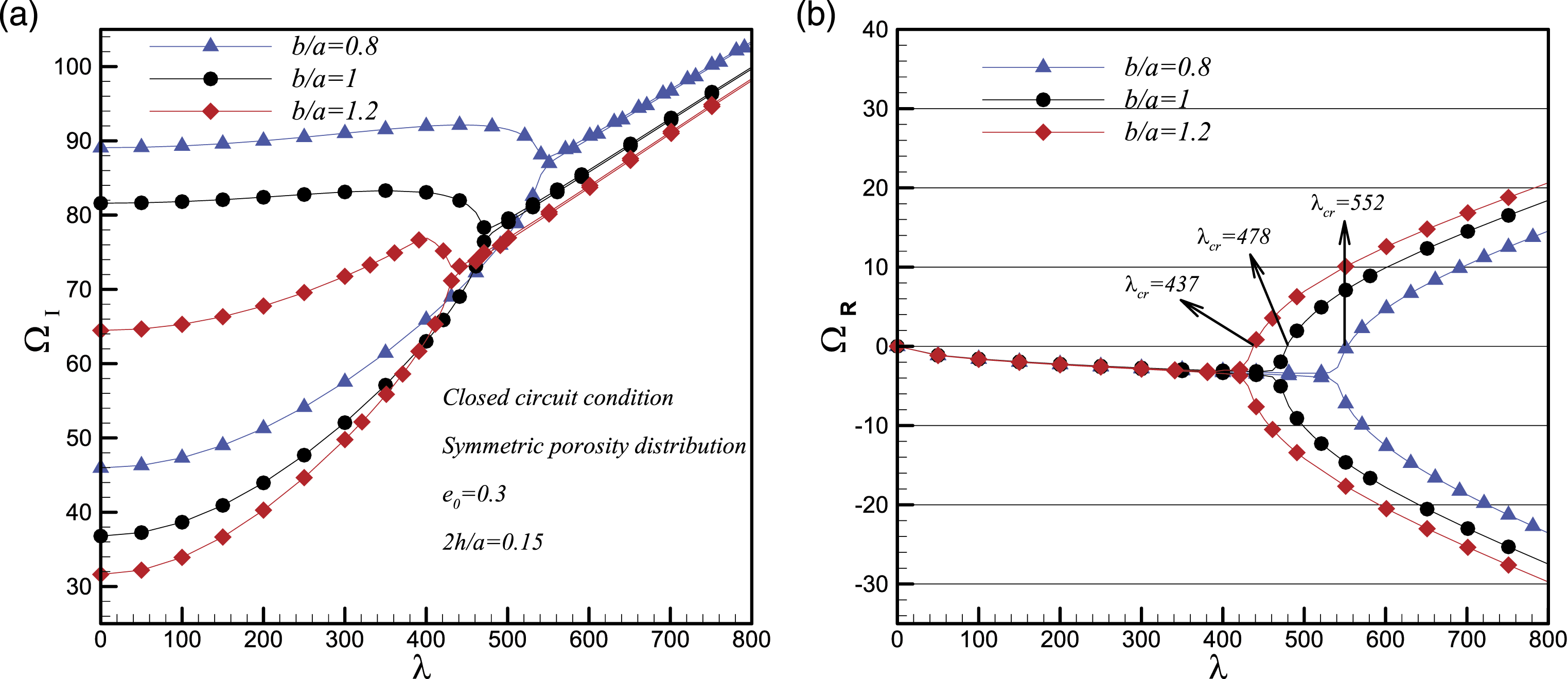
Figures 12 and 13 show the effects of the plate dimensions on the unsteady aerodynamic pressure and natural frequencies for the FG porous plate with symmetric porosity distribution and closed circuit condition. The effect of the core plate’s thickness on unsteady aerodynamic pressure and natural frequencies of the FG porous plate for , , , , and are observed in Figure 12. This figure reveals that the unsteady aerodynamic pressure and natural frequencies decrease when the thickness-length ratios increase. Figure 13 indicates the variation of natural frequencies versus the aerodynamic pressure for different aspect ratios. The parameters , , , and are also considered. The results show that with the increase in the aspect ratios, the unsteady aerodynamic pressure, and natural frequencies decrease.
The variation of natural frequencies (a) and real parts of eigenvalue (b) versus the aerodynamic pressure (different aspect ratios, closed circuit condition, symmetric porosity distribution, , , and ).
The variation of natural frequencies (a) and real parts of eigenvalue (b) versus the aerodynamic pressure (different values of , closed circuit condition, symmetric porosity distribution, , , , and ).
Conclusion
The study examined the natural frequencies and unsteady aerodynamic pressure of smart thick porous plates embedded by piezoelectric layers in supersonic flow. Applying Hamilton’s principle and Maxwell’s equation, the governing equations of the smart thick porous plate under supersonic flow based on Reddy’s third-order shear deformation theory were formulated. The Galerkin approach was applied to solve the coupling set of differential equations of motion. The results indicated that the natural frequencies and unsteady aerodynamic pressure of smart thick porous plates decrease as the coefficient porosity increases. Furthermore, the porous plate with piezoelectric layers in open circuit condition predicts the highest natural frequencies and the unsteady aerodynamic pressure. It was also concluded that the most efficient way to increase the stability of the system is considering symmetric porosity distribution and open circuit condition. Besides, it was observed that the geometrical dimension ratios have more significant influence on the natural frequencies and the unsteady aerodynamic pressure of thick porous plates.
Footnotes
Declaration of conflicting interests
The author(s) declared no potential conflicts of interest with respect to the research, authorship, and/or publication of this article.
Funding
The author(s) received no financial support for the research, authorship, and/or publication of this article.
ORCID iD
Reza Bahaadini
Appendix
References
1.
ChengGLeeYYMeiC. Flow angle, temperature, and aerodynamic damping on supersonic panel flutter stability boundary. Journal of Aircraft2003; 40: 248–255.
SohnK-JKimJ-H. Structural stability of functionally graded panels subjected to aero-thermal loads. Composite Structures2008; 82: 317–325.
4.
SongZ-GLiF-M. Investigations on the flutter properties of supersonic panels with different boundary conditions. International Journal of Dynamics and Control2014; 2: 346–353.
5.
HasheminejadSMAghayi MotaaleghiM. Aeroelastic analysis and active flutter suppression of an electro-rheological sandwich cylindrical panel under yawed supersonic flow. Aerospace Science and Technology2015; 42: 118–127.
6.
FazelzadehSAPouresmaeeliSGhavanlooE. Aeroelastic characteristics of functionally graded carbon nanotube-reinforced composite plates under a supersonic flow. Computer Methods in Applied Mechanics and Engineering2015; 285: 714–729.
7.
SongZGZhangLWLiewKM. Aeroelastic analysis of CNT reinforced functionally graded composite panels in supersonic airflow using a higher-order shear deformation theory. Composite Structures2016; 141: 79–90.
8.
ZhangLWSongZGLiewKM. Computation of aerothermoelastic properties and active flutter control of CNT reinforced functionally graded composite panels in supersonic airflow. Computer Methods in Applied Mechanics and Engineering2016; 300: 427–441.
9.
AsadiHSouriMWangQ. A numerical study on flow-induced instabilities of supersonic FG-CNT reinforced composite flat panels in thermal environments. Composite Structures2017; 171: 113–125.
10.
ZhouKSuJHuaH. Aero-thermo-elastic flutter analysis of supersonic moderately thick orthotropic plates with general boundary conditions. International Journal of Mechanical Sciences2018; 141: 46–57.
11.
BahaadiniRSaidiAR. Aeroelastic analysis of functionally graded rotating blades reinforced with graphene nanoplatelets in supersonic flow. Aerospace Science and Technology2018; 80: 381–391.
12.
JiangGLiF. Aerothermoelastic analysis of composite laminated trapezoidal panels in supersonic airflow. Composite Structures2018; 200: 313–327.
13.
AkhavanHRibeiroP. Aeroelasticity of composite plates with curvilinear fibres in supersonic flow. Composite Structures2018; 194: 335–344.
14.
de Matos JuniorODDonadonMVCastroSGP. Aeroelastic behavior of stiffened composite laminated panel with embedded SMA wire using the hierarchical Rayleigh–Ritz method. Composite Structures2017; 181: 26–45.
15.
BanhartJ. Aluminum foams: on the road to real applications. MRS Bull2003; 28: 290–295.
16.
TheodorakopoulosDDBeskosDE. Flexural vibrations of poroelastic plates. Acta Mechanica1994; 103: 191–203.
17.
LeclairePHoroshenkovKCummingsA. Transverse vibrations of a thin rectangular porous plate saturated by a fluid. Journal of Sound and Vibration2001; 247: 1–18.
18.
Magnucka-BlandziE. Axi-symmetrical deflection and buckling of circular porous-cellular plate. Thin-Walled Structures2008; 46: 333–337.
19.
RezaeiASSaidiAR. Exact solution for free vibration of thick rectangular plates made of porous materials. Composite Structures2015; 134: 1051–1060.
20.
RezaeiASSaidiAR. Application of Carrera Unified Formulation to study the effect of porosity on natural frequencies of thick porous–cellular plates. Composites Part B: Engineering2016; 91: 361–370.
21.
RezaeiASSaidiAR. An analytical study on the free vibration of moderately thick fluid-infiltrated porous annular sector plates. Journal of Vibration and Control2017; 24: 4130–4144.
22.
ChenDKitipornchaiSYangJ. Nonlinear free vibration of shear deformable sandwich beam with a functionally graded porous core. Thin-Walled Structures2016; 107: 39–48.
23.
YangJChenDKitipornchaiS. Buckling and free vibration analyses of functionally graded graphene reinforced porous nanocomposite plates based on Chebyshev-Ritz method. Composite Structures2018; 193: 281–294.
24.
WangYQWanYHZhangYF. Vibrations of longitudinally traveling functionally graded material plates with porosities. European Journal of Mechanics-A/Solids2017; 66: 55–68.
25.
HwangW-SParkHCHwangW. Vibration control of a laminated plate with piezoelectric sensor/actuator: finite element formulation and modal analysis. Journal of Intelligent Material Systems and Structures1993; 4: 317–329.
26.
LiangXQBatraRC. Changes in frequencies of a laminated plate caused by embedded piezoelectric layers. AIAA Journal1997; 35: 1672–1673.
27.
HeXQNgTYSivashankerS, et al.Active control of FGM plates with integrated piezoelectric sensors and actuators. International Journal of Solids and Structures2001; 38: 1641–1655.
28.
Askari FarsangiMSaidiARBatraRC. Analytical solution for free vibrations of moderately thick hybrid piezoelectric laminated plates. Journal of Sound and Vibration2013; 332: 5981–5998.
29.
KhorshidvandARJoubanehEFJabbariM, et al.Buckling analysis of a porous circular plate with piezoelectric sensor–actuator layers under uniform radial compression. Acta Mech2014; 225: 179–193.
30.
AskariMSaidiARRezaeiAS. On natural frequencies of Levy-type thick porous-cellular plates surrounded by piezoelectric layers. Composite Structures2017; 179: 340–354.
31.
LiF-M. Active aeroelastic flutter suppression of a supersonic plate with piezoelectric material. International Journal of Engineering Science2012; 51: 190–203.
32.
KasemMMDowellEH. A study of the natural modes of vibration and aeroelastic stability of a plate with a piezoelectric material. Smart Materials and Structures2018; 27: 075043.
33.
TangDMDowellEH. Aeroelastic response and energy harvesting from a cantilevered piezoelectric laminated plate. Journal of Fluids and Structures2018; 76: 14–36.
34.
DowellEH. Aeroelasticity of plates and shells, The Netherlands, Noordhoff, Leyden, 1975.
35.
BahaadiniRSaidiARHosseiniM. On dynamics of nanotubes conveying nanoflow. International Journal of Engineering Science2018; 123: 181–196.
36.
BahaadiniRSaidiAR. Stability analysis of thin-walled spinning reinforced pipes conveying fluid in thermal environment. The Netherlands, European Journal of Mechanics-A/Solids, 2018; 72: 298–309.
37.
DowellEH. Nonlinear oscillations of a fluttering plate. AIAA Journal1966; 4: 1267–1275.
38.
ChevallierGGhorbelSBenjeddouA. A benchmark for free vibration and effective coupling of thick piezoelectric smart structures. Smart Materials and Structures2008; 17: 065007.