




Abstract
The deconvolution approach for the mapping of acoustic sources (DAMAS) based on orthogonal matching pursuit (OMP-DAMAS) has attracted much attention due to its advantages of high spatial resolution and excellent capability to suppress spurious sources. In this paper, we propose an improved version of OMP-DAMAS based on fast Fourier transformation (FFT), abbreviated as FFT-OMP-DAMAS. This method assumes that the array point spread functions (PSFs) are spatially shift-invariant. The sum of the product of the acoustic source distribution and PSFs is converted into a convolution form, which is further converted into a product in the wave number domain. With these conversions, FFT can be used to improve the solving speed. Both simulations and experiments show that the proposed method not only inherits the advantages of OMP-DAMAS in terms of spatial resolution and spurious source suppression but also significantly improves the computational efficiency compared with OMP-DAMAS.
Keywords
Introduction
Noise control is an important research work in the fields of automobiles,1–2 aero-engines,3–5 high-speed rail,6–7 propeller plane,8–9 and other fields. How to accurately identify noise sources is the premise and foundation of noise control. Beamforming noise source identification technology based on microphone array measurement has attracted much attention due to its fast measurement speed and convenient layout.10–11 Delay and sum (DAS) 12 is one of the classic beamforming algorithms. However, it cannot clearly locate the sound source due to the poor spatial resolution at low frequencies and the heavy pollution of spurious sources at high frequencies.
To overcome the above issues of DAS, the deconvolution approach for the mapping of acoustic sources (DAMAS) was first proposed.13–14 The method removes beamforming features from the output representation and employs a unique system of linear equations to account for interactions at different locations within the measurement region of the array. It is solved by introducing positive constraints in the iterative process to extract the real acoustic source information. The spatial resolution is significantly improved, and the spurious sources caused by the high-level side lobes are effectively suppressed. Once DAMAS was proposed, it attracted extensive attention and continuous research from scholars, and a series of deconvolution methods have been proposed one after another, such as non-negative least-squares (NNLS), 15 Richardson-Lucy (RL),15–17 sparse constrained-deconvolution acoustic source imaging (sparsity constrained-DAMAS, SC-DAMAS),18–19 covariance matrix fitting (CMF),18–19 fast iterative shrinkage-thresholding algorithm (FISTA),20–21 orthogonal matching pursuit deconvolution acoustic source imaging (OMP-DAMAS), 22 and so on. Among the above methods, OMP-DAMAS is based on the theory of compressive sensing and utilizes the assumption of sparsity of acoustic source distribution to reconstruct the original signal. It not only improves the spatial resolution and suppresses spurious sources but also has significant advantages in computational efficiency compared with other deconvolution methods mentioned above.
This paper is devoted to further improving the performance of OMP-DAMAS and proposes FFT-OMP-DAMAS based on fast Fourier transformation (FFT). This method assumes that the array point spread functions (PSFs) are spatially shift-invariant and converts the sum of the product of the acoustic source distribution and the PSFs into a convolution form. Then, the Fourier transform is used to further convert the convolution into a product in the wave number domain. Consequently, the size of the matrix involved in the operation is dramatically reduced, greatly improving the solving speed. FFT-OMP-DAMAS not only inherits the advantages of high spatial resolution and strong spurious source suppression capability of OMP-DAMAS but also significantly improves the computational efficiency compared with OMP-DAMAS, which brings great convenience to practical engineering applications.
The paper is organized as follows: The Theory section presents the theory of the proposed FFT-OMP-DAMAS; the Numerical Simulation section and the Experiment section perform the numerical simulations and experiments, respectively; the final section summarizes the full text.
Theory
DAS
Figure 1 shows the model of beamforming acoustic source identification. The symbol “•” represents the microphone. Beamforming acoustic source identification model.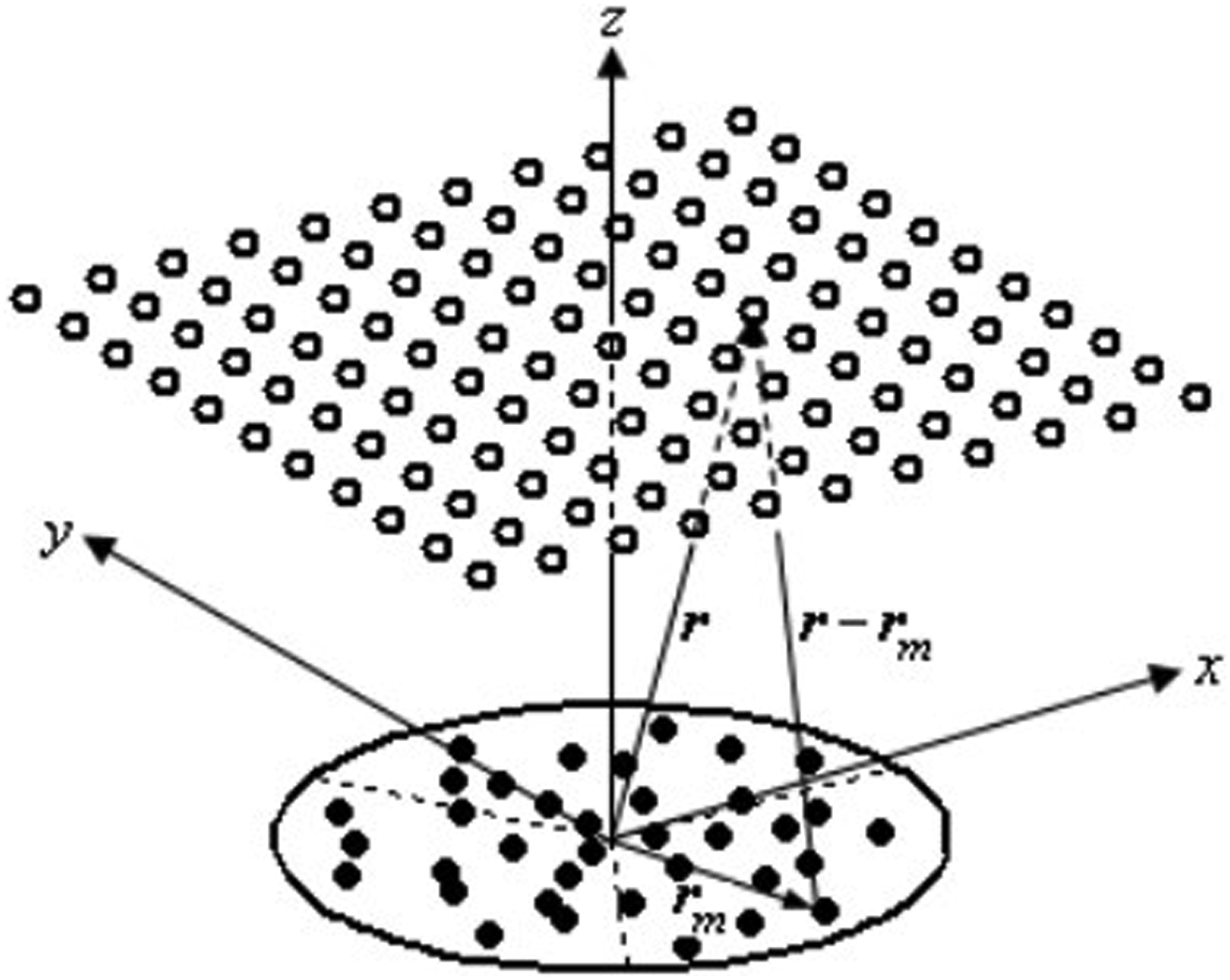


Assuming that the acoustic sources are independent of each other, the cross-spectrum of the acoustic pressure signals received by the microphones is equal to the linear superposition of the cross-spectra generated by each acoustic source at the microphones, so there is

DAMAS
DAMAS establishes the following system of linear equations


DAMAS imposes positive constraints on the components of
Initialize 1. Calculate the residual 2. Calculate


Then,
OMP-DAMAS
For the system of linear equations
Initialize 1. Determine the index of the 2. Update the index set 3. Calculate the projection matrix 4. Update the residual vector




Return to step 1) and stop iterating until

FFT-OMP-DAMAS
Define the function


The array PSF of the acoustic source located in the center of the calculation plane, which is denoted by
Rotate Schematic diagram of spatial convolution of 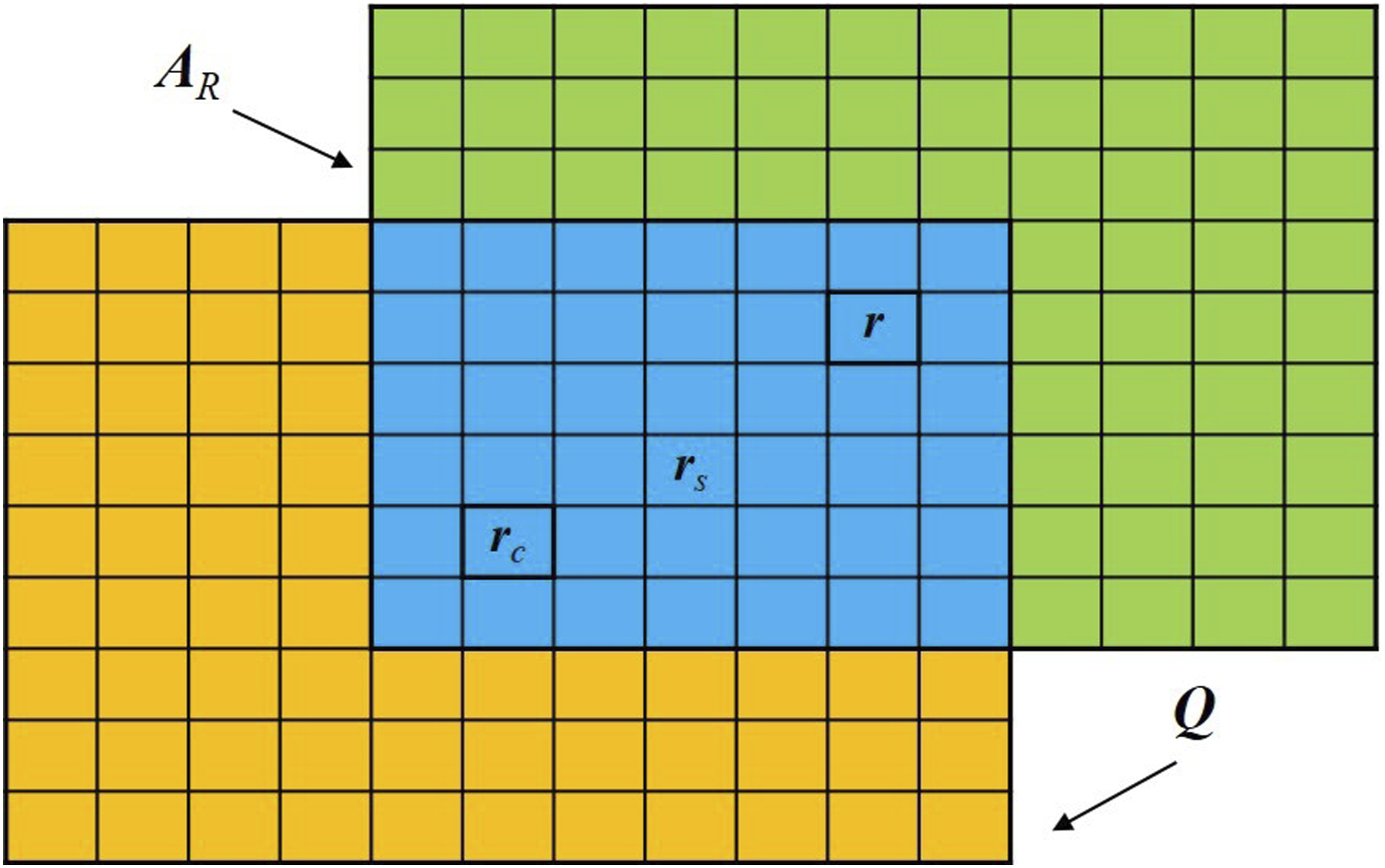


Obviously,
Further converting the convolution of the spatial domain to the product of the wave number domain, equation (16) can be written as

Similarly, for arbitrary variable


Let

According to shift-invariance of PSF, the element in

Combine equations (18), (19), and (21), equation (20) can be written in the following form

Consequently, equation (8) can be converted into

In summary, converting the product operation between the large-dimensional matrix (
Numerical simulation
In order to verify the advantages of the FFT-OMP-DAMAS method proposed in this paper, simulations are first performed. A 36-channel sector wheel array with a diameter of 0.65 m is used. The measurement distance is 1 m. The imaging plane of acoustic sources is 1.6 m
Figure 3 shows the results of acoustic source imaging based on the existing DAS, DAMAS, OMP-DAMAS methods, and the proposed FFT-OMP-DAMAS method, respectively. The coordinates of four acoustic sources are Acoustic source imaging results of simulations. The 1/3 octave band center frequencies from left to right are 2000 Hz, 3150 Hz, and 5000 Hz, respectively. (a)–(c) DAS, (d)–(f) DAMAS, (g)–(i) OMP-DAMAS, and (j)–(l) FFT-OMP-DAMAS are used.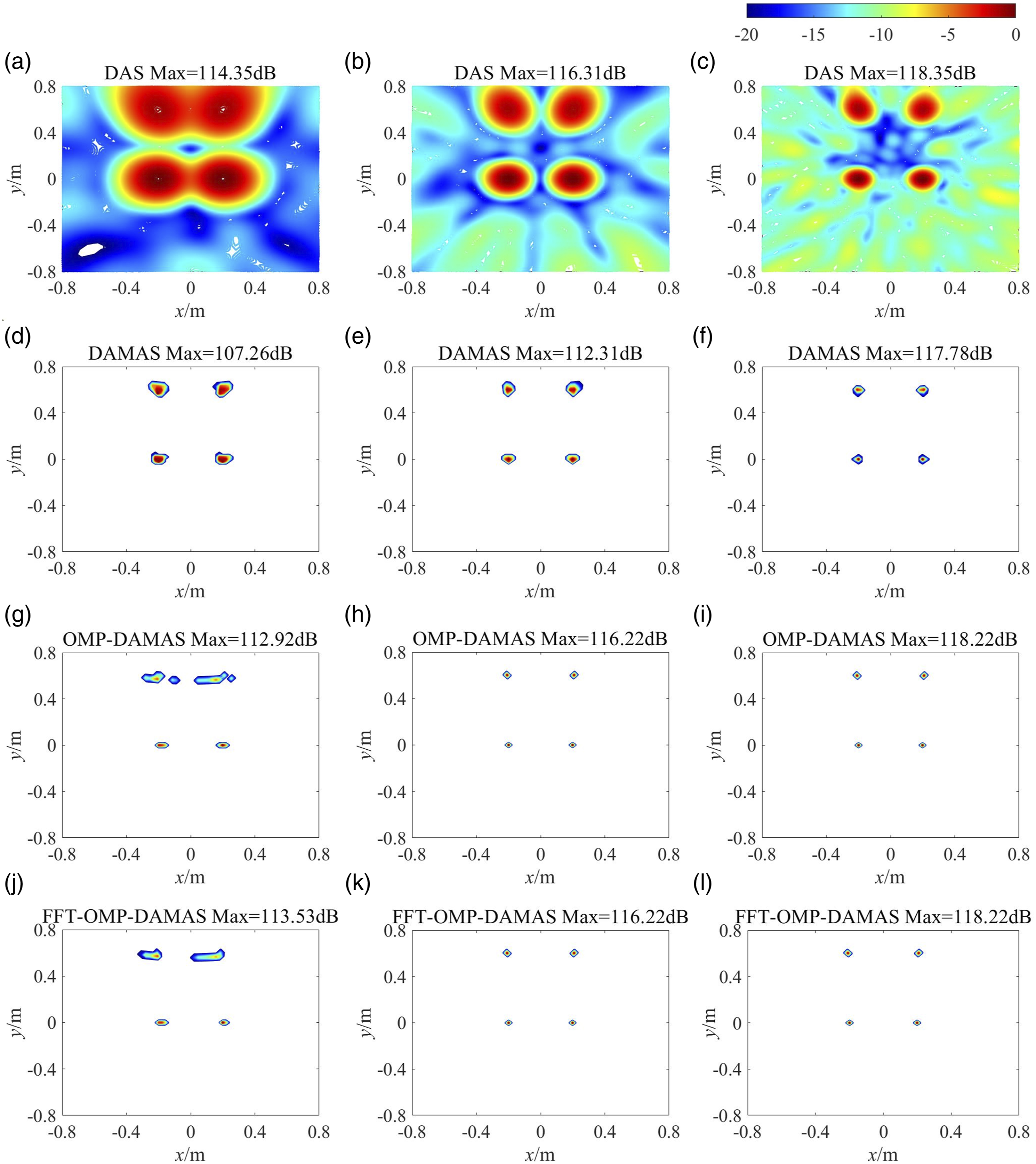
Consuming time of the deconvolution methods in the simulations.

DAMAS: deconvolution approach for the mapping of acoustic sources; OMP-DAMAS: DAMAS by using orthogonal matching pursuit; FFT-OMP-DAMAS: OMP-DAMAS by using fast Fourier transformation.
In summary, the proposed FFT-OMP-DAMAS not only retains the advantages of high spatial resolution, strong spurious source suppression capability, and high quantification accuracy of OMP-DAMAS but also enjoys significantly higher computational efficiency than OMP-DAMAS.
Experiment
Verification experiments based on loudspeakers
In order to verify the effectiveness of the proposed FFT-OMP-DAMAS and the conclusions of the above numerical simulations, a loudspeaker-based validation experiment was carried out in a semi-anechoic chamber. The experimental layout is shown in Figure 4. The four loudspeakers are located approximately at Experimental layout.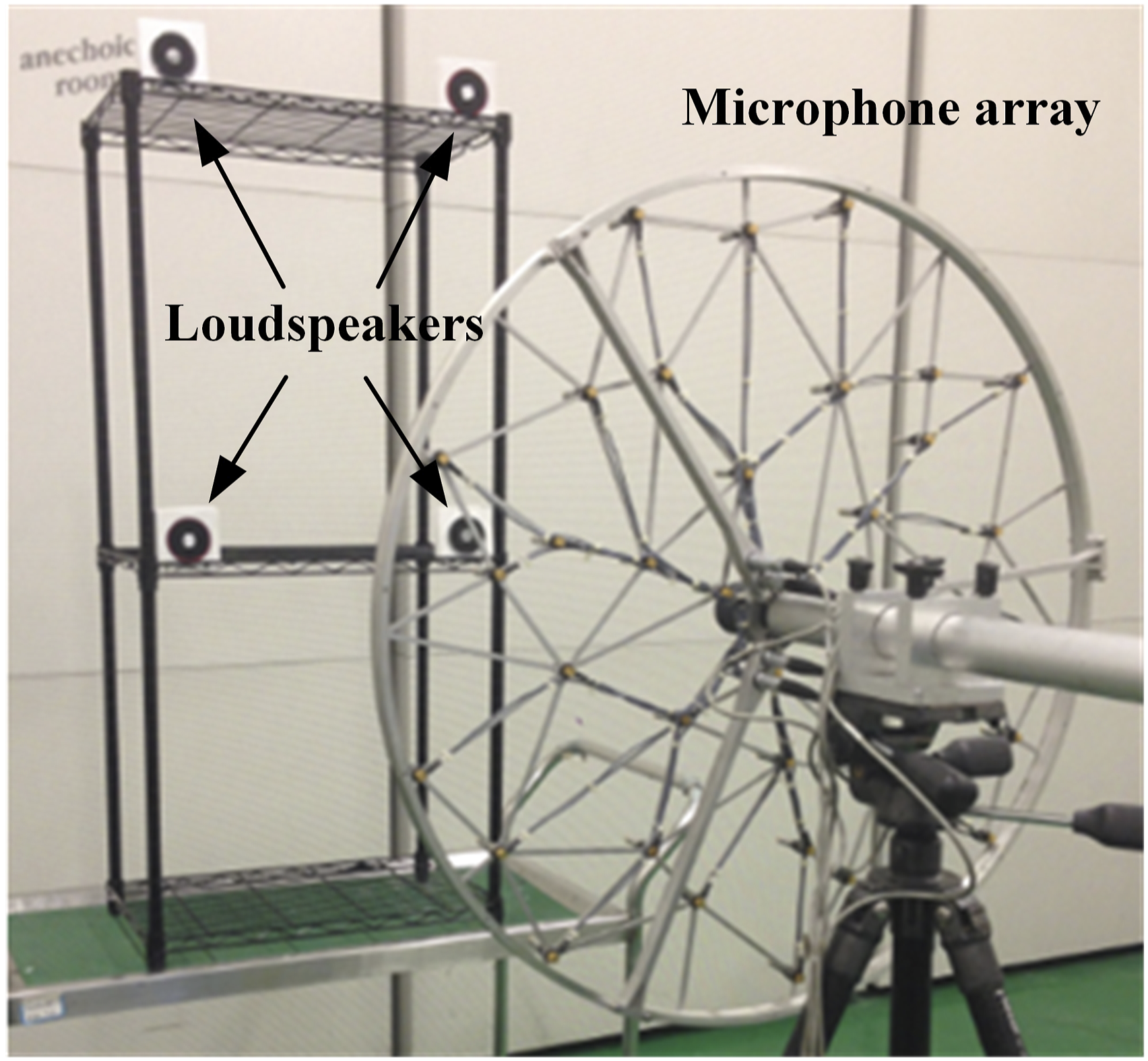
The acoustic source identification results using DAS, DAMAS, OMP-DAMAS, and FFT-OMP-DAMAS at 1/3 octave bands with the center frequencies of 2000 Hz, 3150 Hz, and 5000 Hz are shown in Figure 5, respectively. Acoustic source imaging results of loudspeaker-based experiments. The 1/3 octave band center frequencies from left to right are 2000 Hz, 3150 Hz, and 5000 Hz, respectively. (a)–(c) DAS, (d)–(f) DAMAS, (g)–(i) OMP-DAMAS, and (j)–(l) FFT-OMP-DAMAS are used.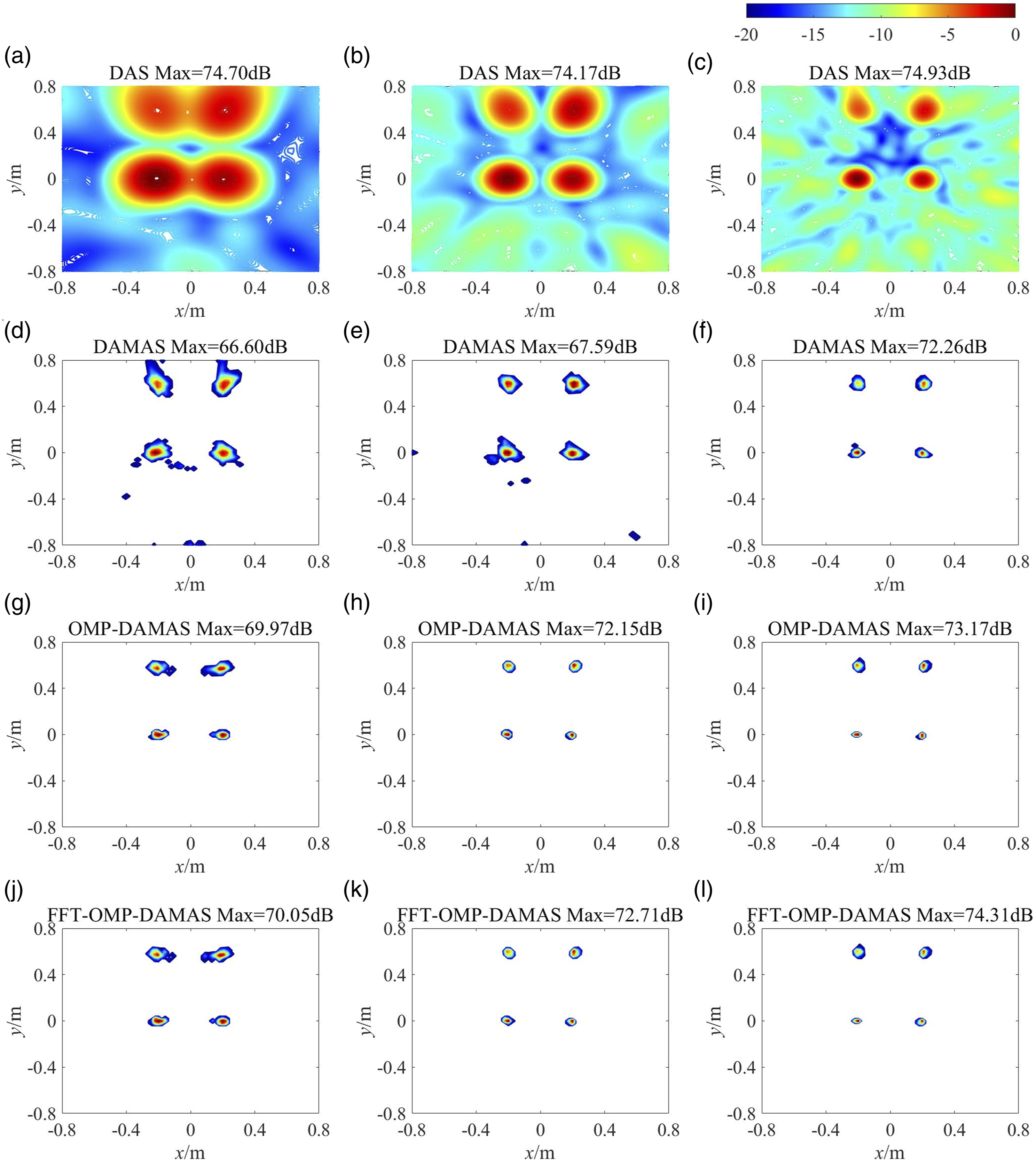
Consuming time of the deconvolution methods in the loudspeaker-based experiments.

DAMAS: deconvolution approach for the mapping of acoustic sources; OMP-DAMAS: DAMAS by using orthogonal matching pursuit; FFT-OMP-DAMAS: OMP-DAMAS by using fast Fourier transformation.
In each frequency band, the maximum main lobe peaks of DAS are 74.70 dB, 74.17 dB, and 74.93 dB, respectively. When the sound sources are separated, the main lobe peak of the DAS can be used to measure the quantification accuracy of the deconvolution method. 23 As can be seen from Figure 5, the AAPC errors of DAMAS are 8.10 dB, 6.58 dB, and 2.67 dB; the AAPC errors of OMP-DAMAS are 4.73 dB, 2.02 dB, and 1.76 dB; and the AAPC errors of FFT-OMP-DAMAS are 4.65 dB, 1.46 dB, and 0.62 dB. Obviously, the proposed FFT-OMP-DAMAS has the smallest AAPC errors and more accurate quantification.
In summary, the verification experiments show that the proposed FFT-OMP-DAMAS not only has high acoustic source identification performance due to the narrow main lobes and strong side lobes suppression but also significantly improves the computational efficiency.
Application experiment for a car dash panel
The proposed method is further used to identify weak acoustic insulation areas of a car dash panel. The experiment is conducted in a reverberation chamber-anechoic chamber kit, which is specifically designed to measure the acoustic insulation performance of a panel. Figure 6 shows the experimental layout with the dash panel mounted on the window between the reverberation and anechoic chambers.
26
As shown in Figure 6(a), an omnidirectional sound source is used to generate random sound in the reverberation chamber. As shown in Figure 6(b), a 36-channel sector wheel microphone array with a diameter of 0.65 m is placed in an anechoic chamber to capture the sound passing through the panel. The distance between the array and the window surface is approximately 1.2 m. The imaging plane of acoustic sources is 1.6 m Application experiment layout.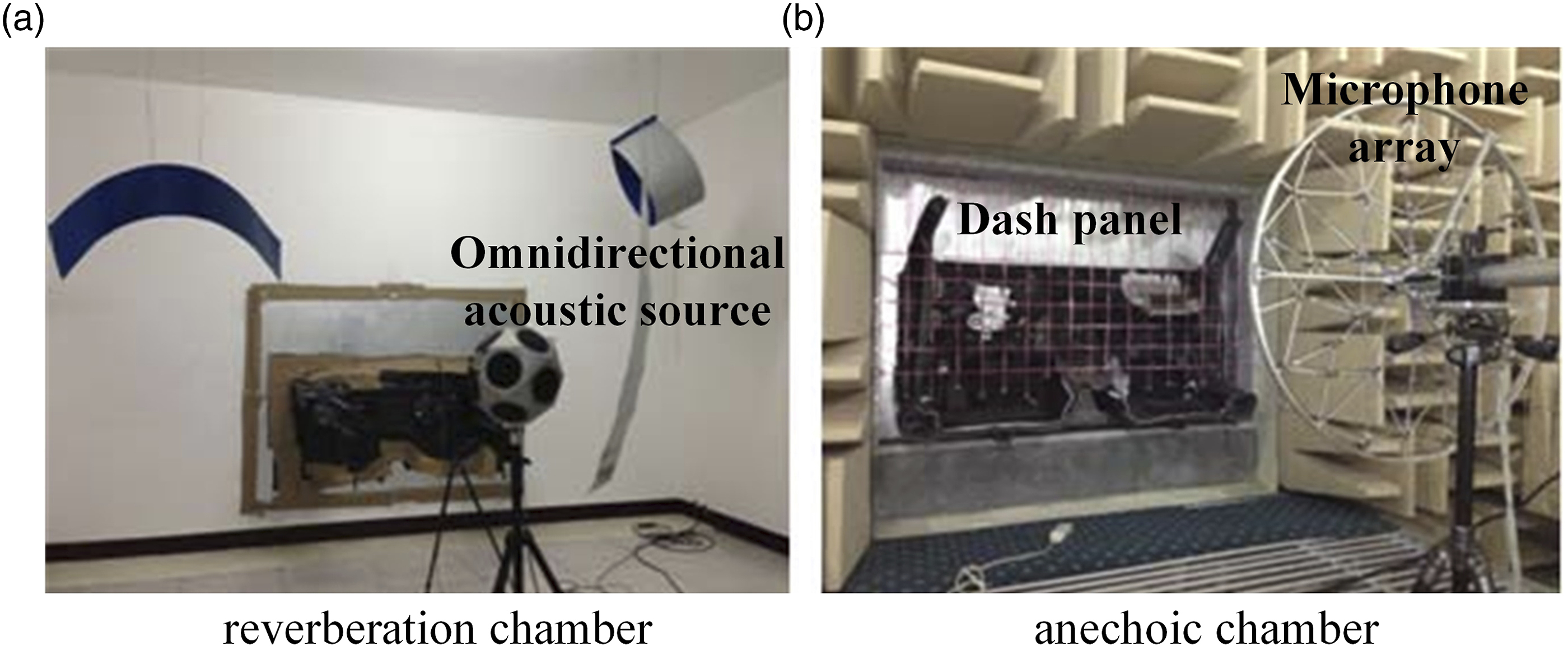
Figure 7 shows the acoustic imaging results of DAS, DAMAS, OMP-DAMAS, and FFT-OMP-DAMAS at 2000–3000 Hz, with a display range of 10 dB. The results of all four methods show the presence of acoustic hot spots to the left of the air conditioning intake in the dash panel, indicating that this area is a weak point for sound insulation. We deduce that the reason for the poor sound insulation in this area is the poor sealing of the internal and external circulation switching valves and intake valve ports of the air conditioning system. The imaging result of FFT-OMP-DAMAS is similar to that of OMP-DAMAS, and both are cleaner than the imaging results of DAS and DAMAS. This case demonstrates the effectiveness and superiority of the proposed FFT-OMP-DAMAS in identifying acoustic sources. In addition, in terms of computational consumption time to obtain the above imaging results, DAMAS takes 219.31 s, OMP-DAMAS takes 5.15 s, and FFT-OMP-DAMAS takes only 2.45 s. Among these three deconvolution methods, FFT-OMP-DAMAS enjoys the highest computational efficiency. Results of identifying weak sound insulation areas for a car dash panel. (a) DAS, (b) DAMAS, (c) OMP-DAMAS, and (d) FFT-OMP-DAMAS are used.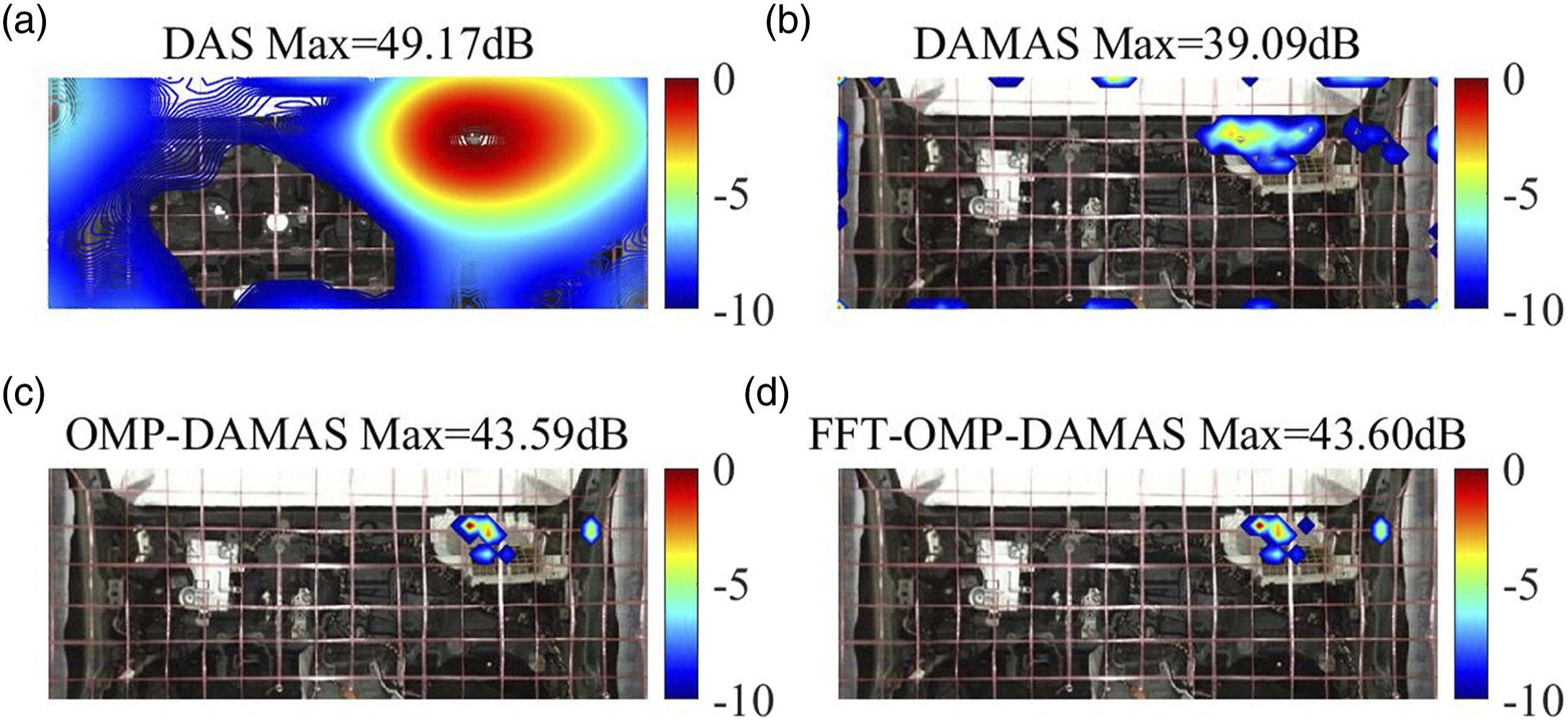
Conclusion
Compared with the traditional DAS beamforming method, the deconvolution methods can greatly improve the spatial resolution and reduce the side lobe contamination, thus making the acoustic source identification more accurate. In this paper, we propose the FFT-OMP-DAMAS deconvolution method, which is obtained by improving the existing OMP-DAMAS deconvolution method using spatial shift-invariant point spread function and fast Fourier transform. Compared with OMP-DAMAS, the proposed FFT-OMP-DAMAS has comparable acoustic source imaging performance and enjoys significantly higher computational efficiency. The conclusion is verified by numerical simulations and experiments.
Footnotes
Declaration of Conflicting Interests
The author(s) declared no potential conflicts of interest with respect to the research, authorship, and/or publication of this article.
Funding
The author(s) disclosed receipt of the following financial support for the research, authorship, and/or publication of this article: The study was supported by the Science and Technology Research Program of Chongqing Municipal Education Commission (Grant No. KJQN202103206) and the Graduate Research and Innovation Foundation of Chongqing, China (Grant No. CYB22012).
