




Abstract
The existence of the derivative with a fractional-order in a class of differential equations could lead to complicating the analysis. In this paper, a novel approach has been introduced to facilitate the analysis of the oscillation having fractional-order derivatives and to obtain the analytical solution easily. The present technique is formulated to provide an easy way of understanding. The suggested technique has been utilized to study two examples for illustration. The similitude between the analytical and numerical solution verifies and gives satisfactory precision to the equivalent solution. The new technique is represented to be the best tool for solving the nonlinear oscillation problems in physics and engineering which have a fractional-order.
Keywords
Introduction
The dynamics of real-world complicated problems are mostly related to fractional calculus. Due to the non-local nature of fractional operators, several natural phenomena are described systematically.1–3 In this regard, fractional-order differential equations are the generalization of the classical integer-order differential equations.4–6 The fractional approach is now considered to be the most powerful tool for modeling and it is applied to many physical and engineering problems.7,8 It plays a very important role in modeling the frequency-dependent damping behavior of many applications in biomedical engineering, finance, probability theory and hydrology, electrochemistry, computational biology, physics, fluid mechanics, and many other fields.9,10 Much literature focused on simple fractal oscillators.11,12
In many nonlinear dynamical systems, such as van der-Pol, Duffing oscillators, Toda oscillators, Klein-Gordon oscillators, and other systems, a large number of results can be found in the literature.13–16 The numerical methods 17–20 and analytical perturbation solutions21–24 of fractional oscillators are found to be hard work of research.25–28 Therefore, the researchers have given full attention to developing strong and novel techniques to handle this complicated class of fractional mathematical tools. 29 In this regard, a new technique is urgent to simplify and reduce the hard work required for obtaining an asymptotic solution that is closer to the exact numerical solution.
In the current work, a new simple technique will be introduced to reduce the hard work. The approach depends on replacing the original fractional equation with an equivalent linear oscillation with the integer derivatives. Based on the awareness of the non-perturbative method,30–32 one could obtain a good asymptotic solution for a fractional-order dynamical system, and then analyze some important properties such as the amplitude-frequency equation. Accordingly, it may present more information about fractional-order differential equations. Galerkin’s method for fractional expression has been introduced. The non-perturbative approach has been applied to two examples for illustration. The fractional damping Duffing oscillator 33 or oscillator with full fractional-order derivatives 34 is analytically studied by the equivalent linearized method. Also, two kinds of damping fractional-order derivatives of the van-der-Pol-Duffing 35 oscillator can be easily handled by using the present technique.
Fractional problem statement
The goal is to try to obtain the solution of the fractional oscillator by a simple approach based on the equivalent linearized method. In this section, a new approach is introduced to convert the fractional nonlinear oscillation to an equivalent linear oscillator with an integer derivative. The established method leads to finding a quasi-exact analytic solution for the fractional nonlinear oscillator. Thus, the following class of fractional nonlinear oscillators

is aimed to turn into the following ordinary linear differential equation of integer-order concerning the same independent variable



Since equation (2) is assumed to be a linear second-order damping oscillator, then it is convent to introduce the trail solution in the form

Since the trial solution (5) is not exact, then there will be a residual or error remaining. Based on the principle of minimum mean-square error,
36
the located displacement point, and the velocity point are estimated as given below


When the oscillator is described by the fractional derivative


To highlight the main results of this work and to show the effectiveness of solving nonlinear fractional oscillators, two illustrative examples are studied to illustrate the aims: the fractional-Duffing oscillator 33 and the fractional Van-der-Pol-Duffing oscillator. 34
Example 1: Duffing oscillator with the fractional-order
This example is concerned with how to solve the following class of second-order fractional-Duffing equations
37
using the non-perturbative approach


Therefore, equation (10) may be rewritten in the form

The equivalent integer-order can be formulated using the principle of the minimum mean-square error to yield



At this end, equation (13) can be linearized and solved with the non-perturbative approach.31–33
In the simplest approach, the equivalent linearized form of equation (10) can be sought in the form

To estimate the coefficients

In terms of the restoring force

and based on He’s frequency formula,38–41

The linear damping equation (16) has the following solution


Employing equations (17) and (19) into equation (21) gives the explicit frequency in the form

The above equation is the frequency-amplitude relationship which contains the frequency

The frequency



Substituting equations (25) and (26) into equation (24) yields the approximate frequency formula that could be expressed as

Now, the function (20) and the frequency formula (27) represent the approximate solution of the fractional damping Duffing equation (10).
Remark
In the current example when the operators in Duffing equation (10) become of full fractional forms as

It is noted that the solution of equation (28) as a first-order differential equation is not suitable because the original equation has order greater than the first-order. Without the fractional-order derivatives and based on the methods mentioned above, it is convenient to convert equation (28) into the following second-order equation


The parameters in equation (29) are evaluated with those of equations (14) and (15). equation (29) can be simply rewritten in the form

The solution of the equivalent equation (31) and its corresponding frequency in terms of the values of

and

The obtained solution (32) with its frequency formula (33) will be numerically illustrated.
Comparison with the numerical solution of the traditional integer-order
Comparing the solution of the fractional-order with the traditional integer-order can be accomplished, especially, for the two cases of

Also, the limiting case of solution (20) is reduced to

In addition, considering

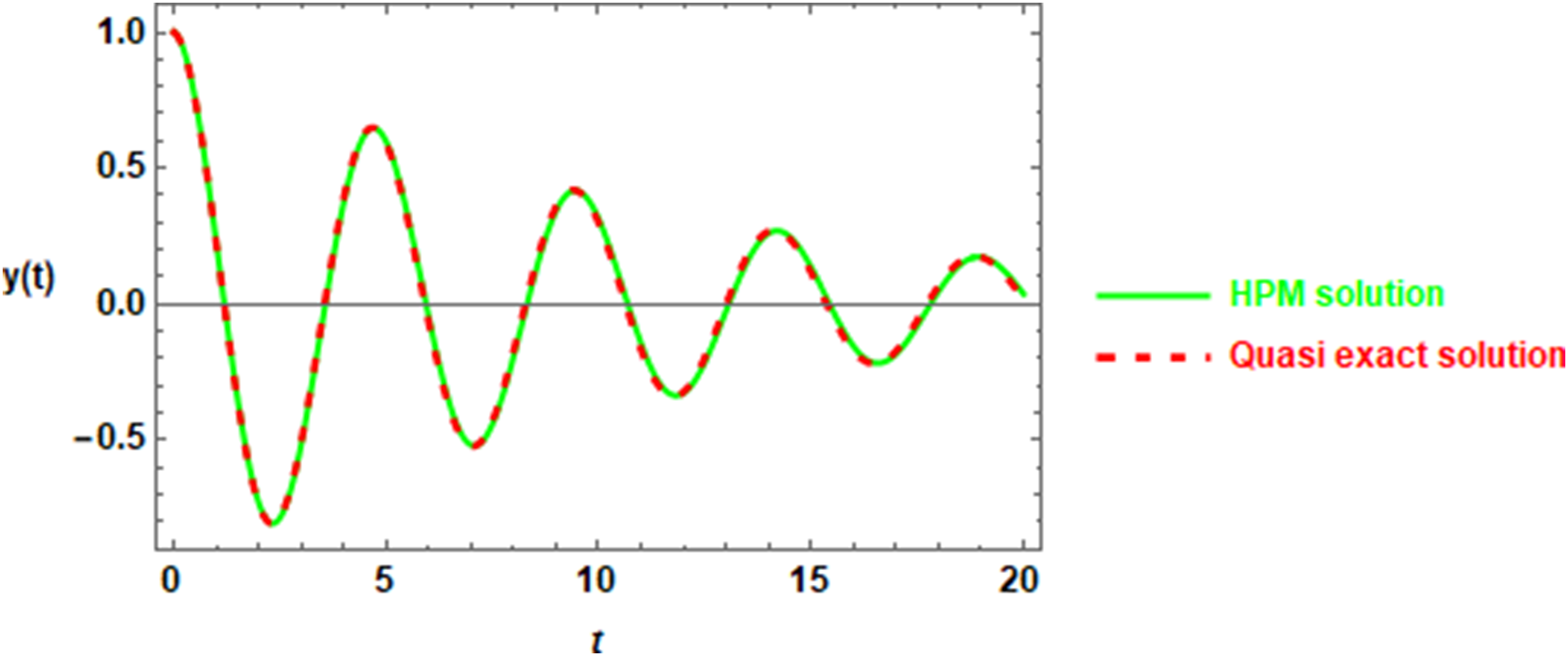
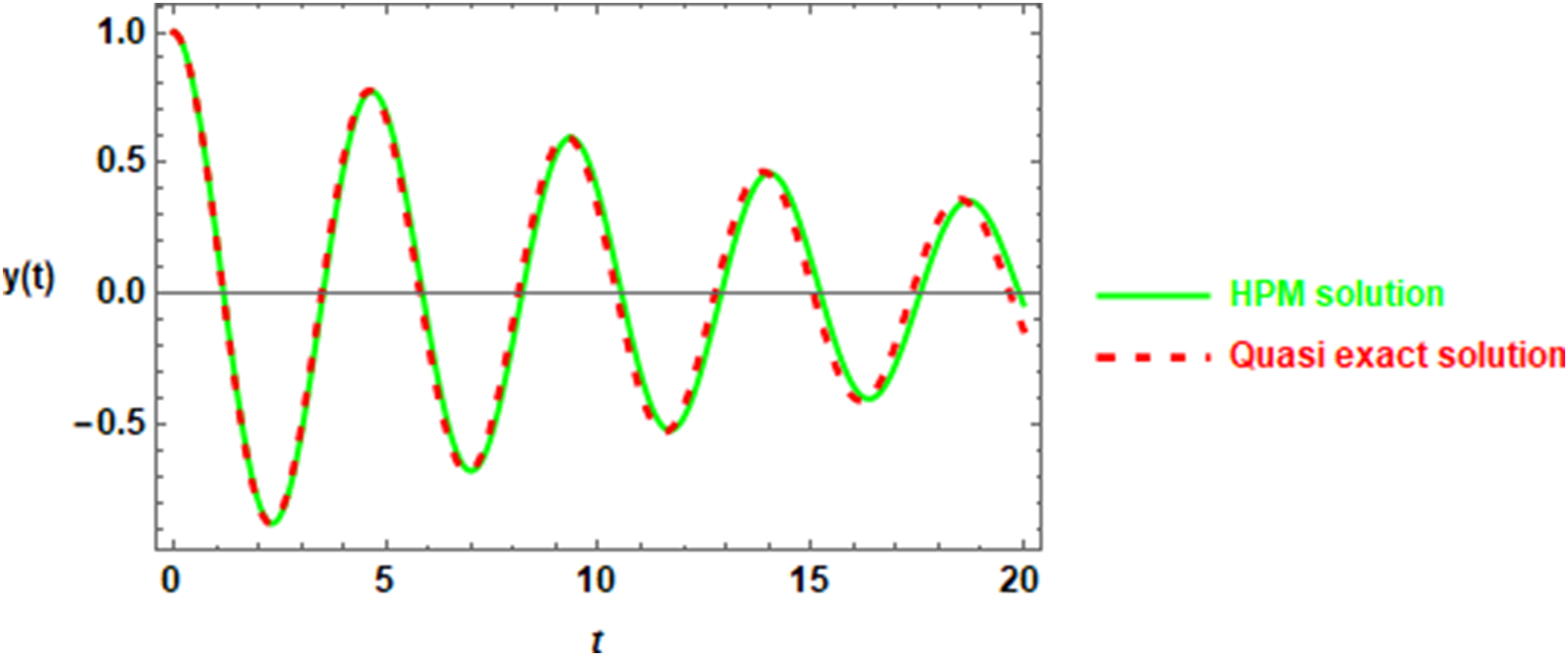
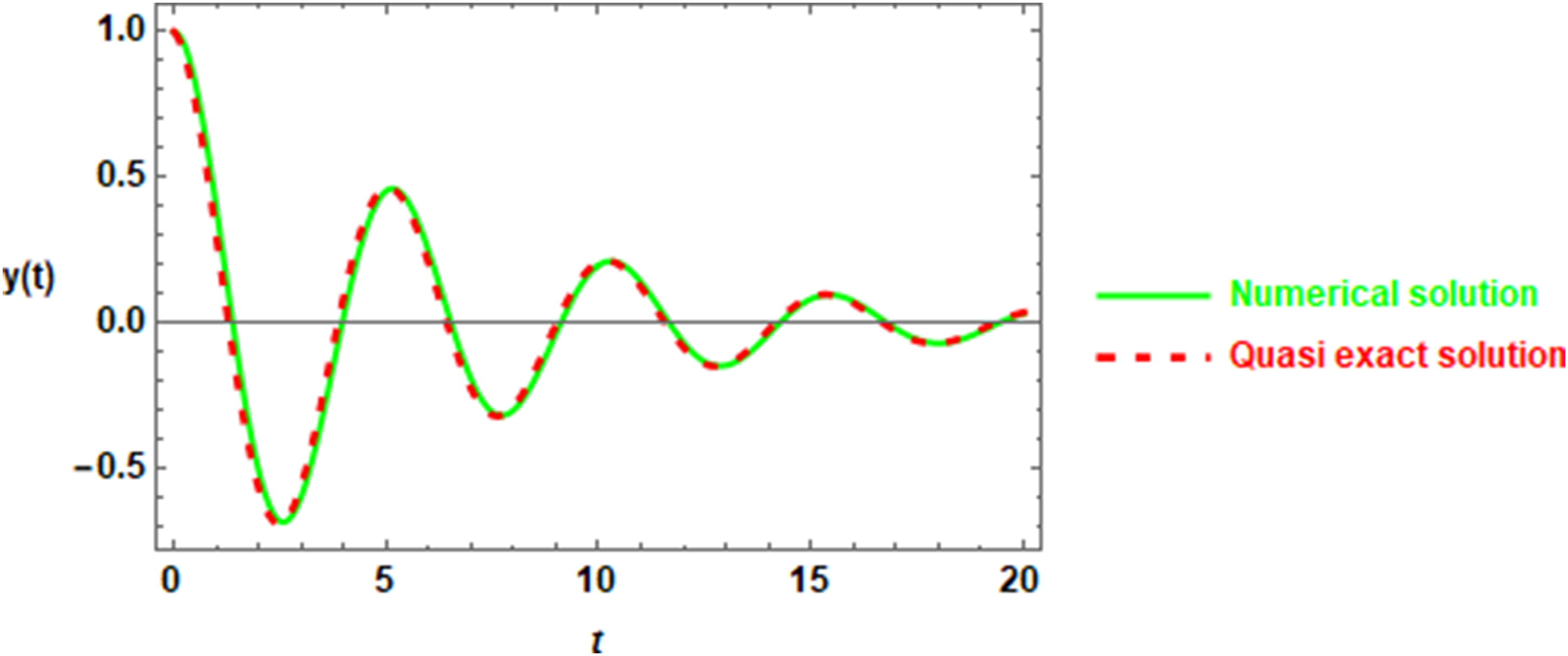
Consequently, the periodic solution arises. In what follows, a numerical illustration is made to compare the obtained quasi-exact solution (20) with the numerical solution. The numerical simulation is performed using the Mathematica software. The calculations are displayed in Figures 1 and 2. In Figure 1, the comparison is made for a system having Comparison of the quasi-exact solution with the numerical solution in the case of 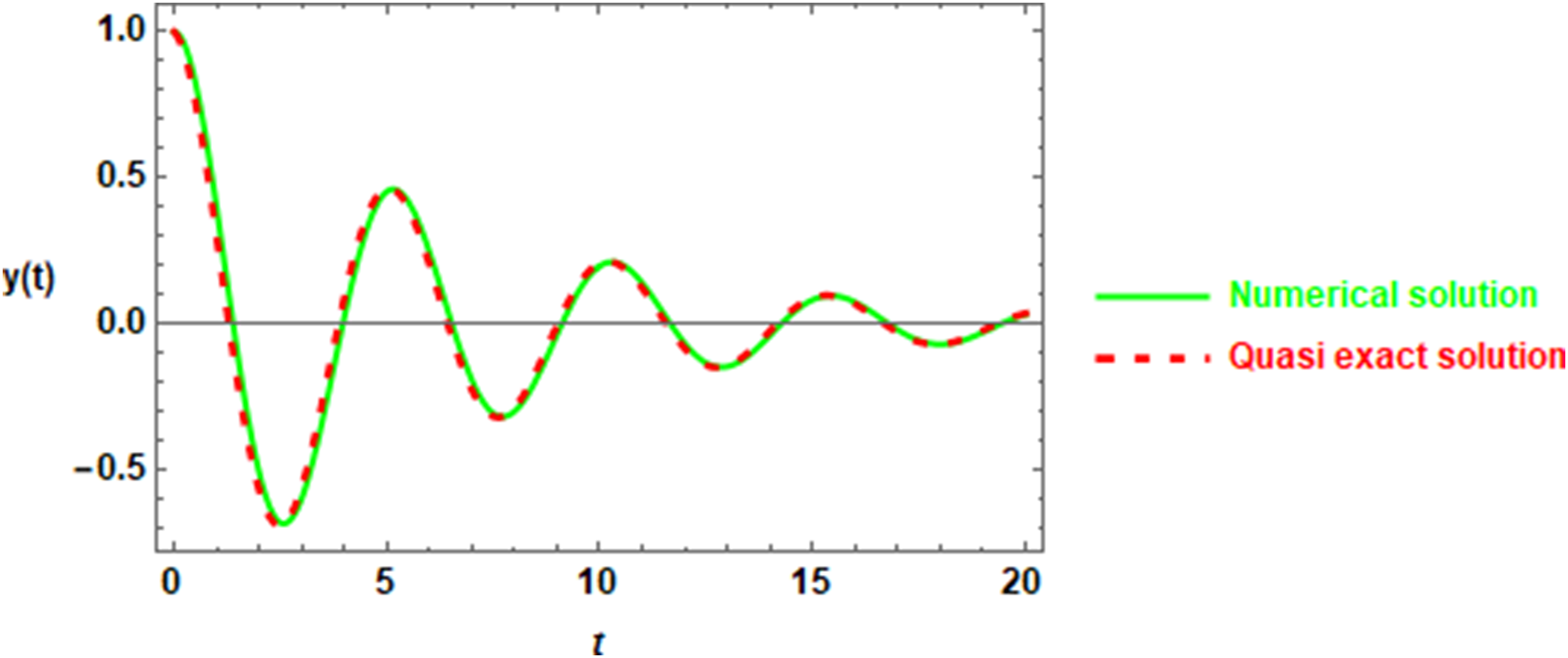
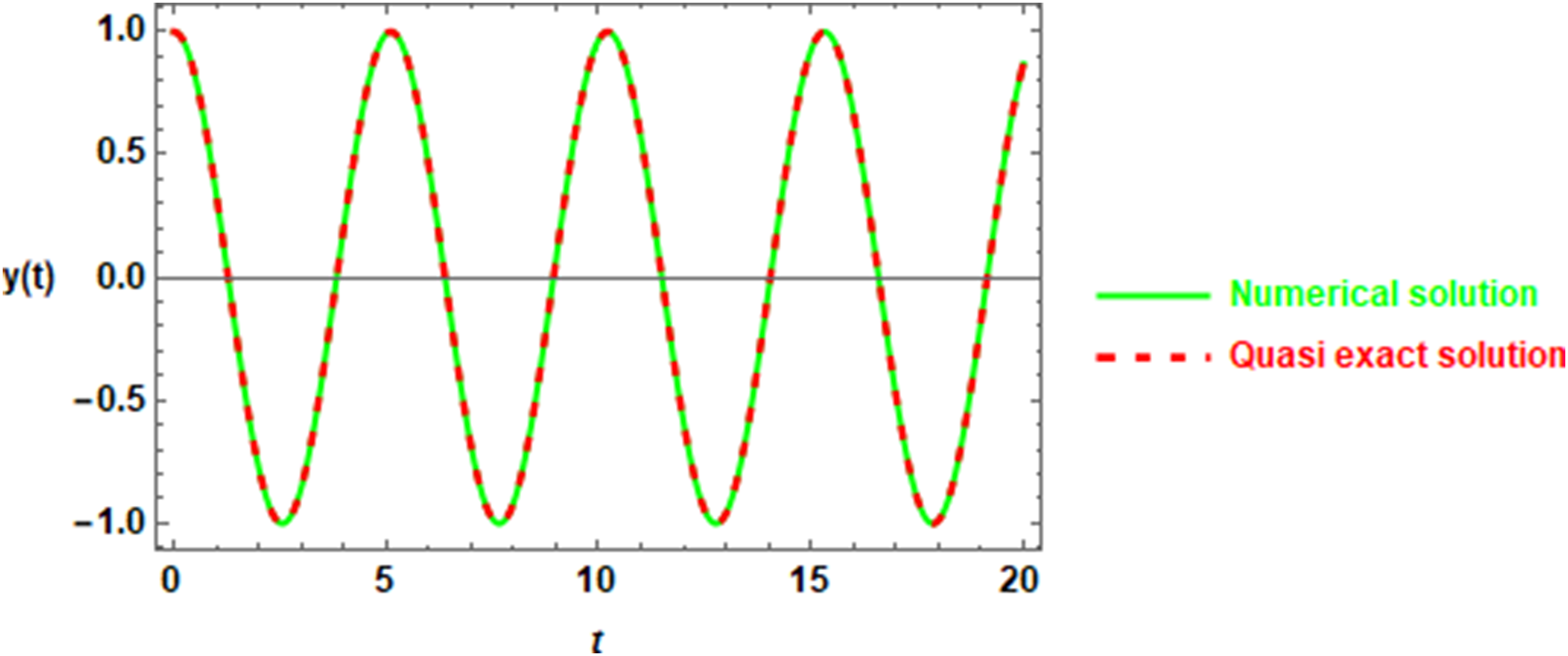
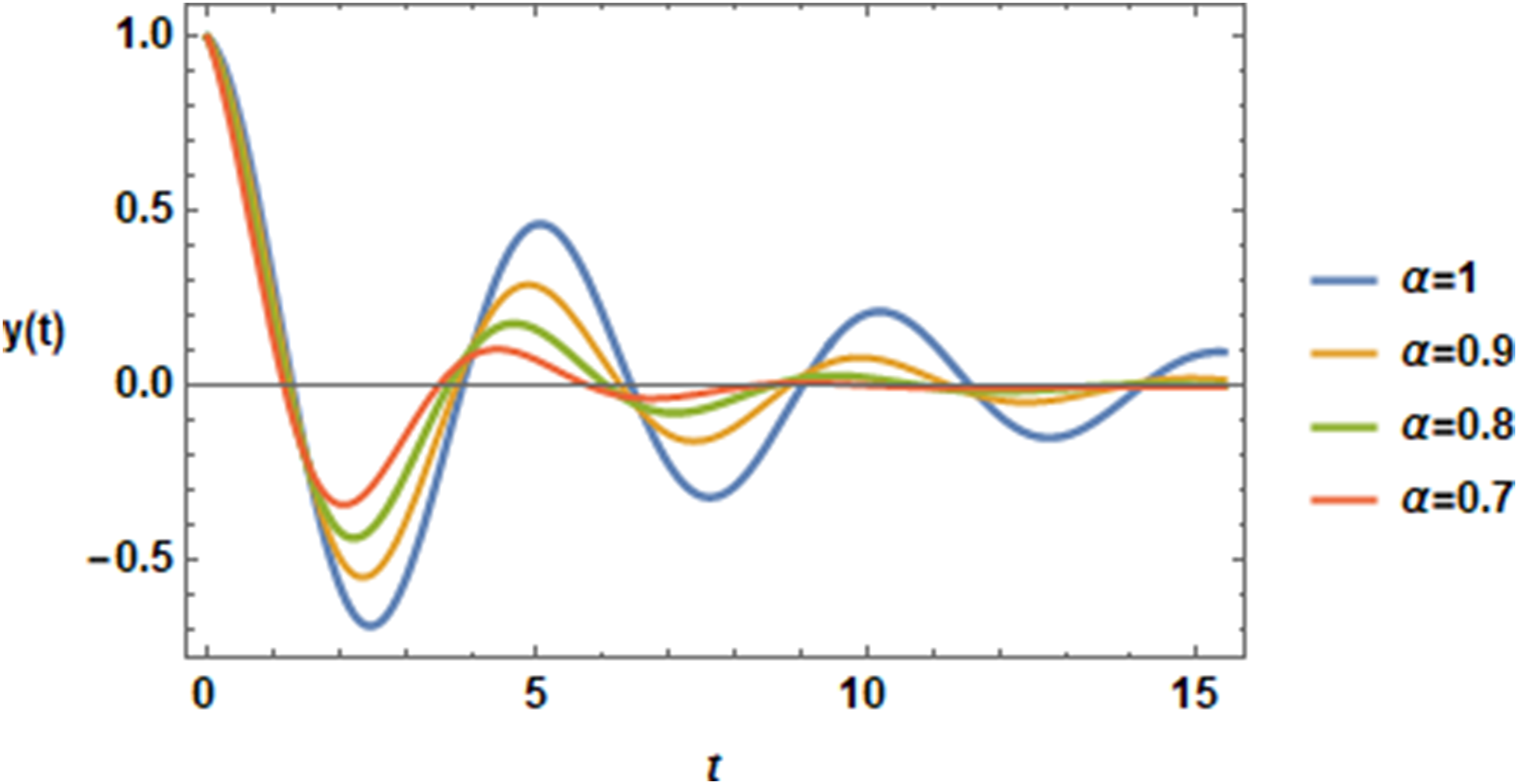
To examine the influence of the variation in the parameter


The comparison between the solutions (20) and their frequency (22) with the solution (36) and its frequency (37) shows that the damping factor in both solutions is identical, while the frequency (22) is more accurate than the frequency (37).
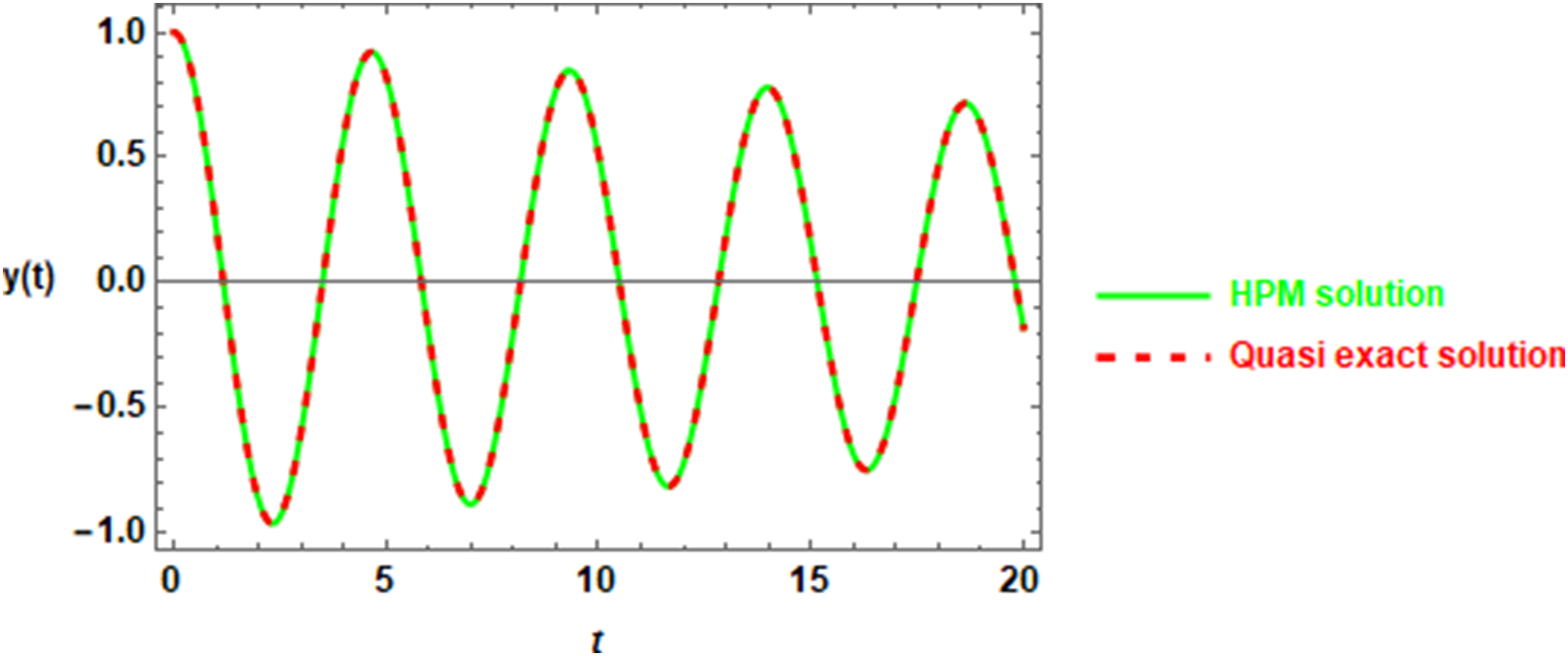
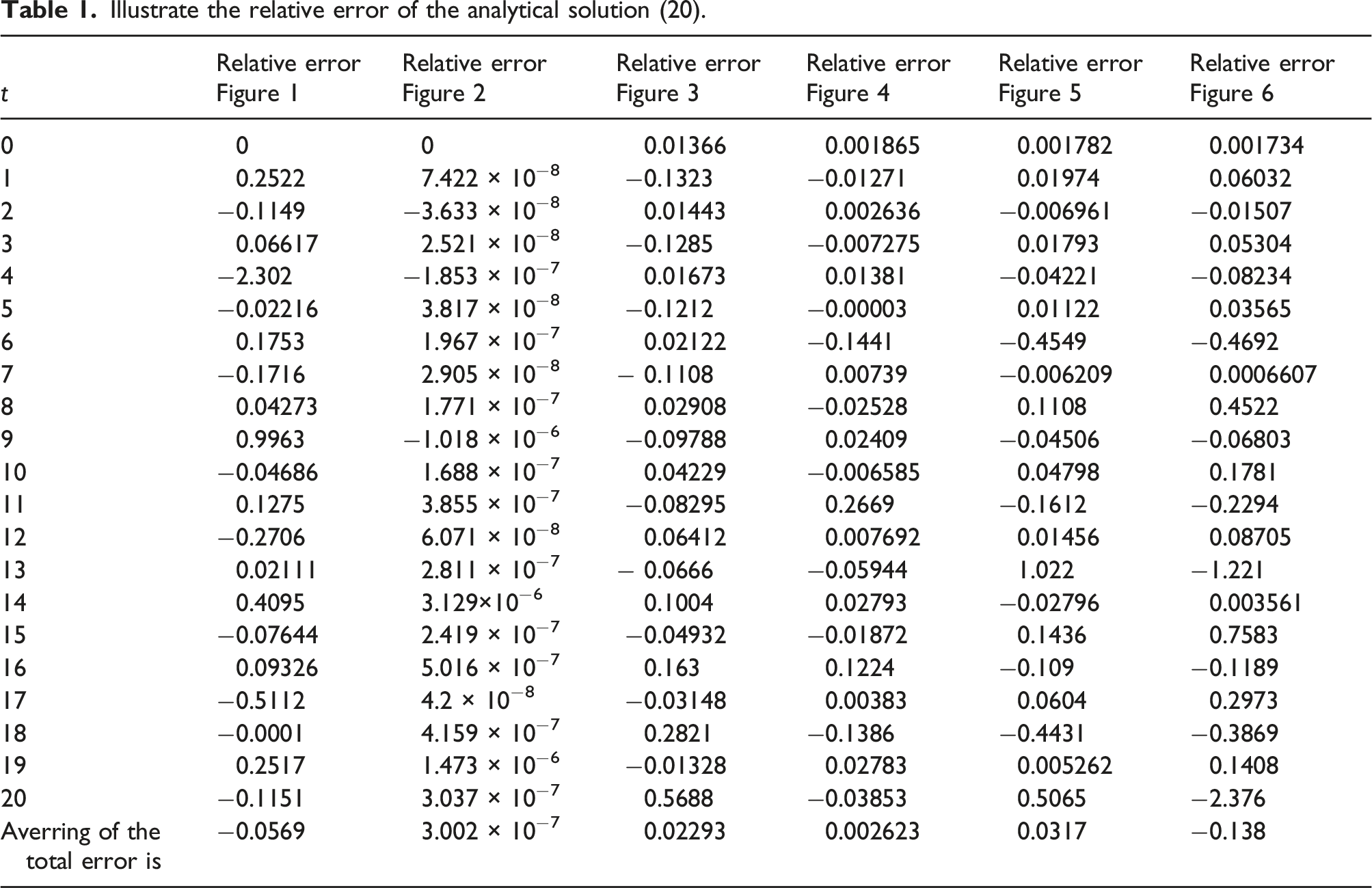
To demonstrate the accuracy to achieve the solution (20), the comparison with the result obtained by the HPM is plotted at various fractional-orders of the derivatives in Figures 3–7. The response diagram in these graphs shows that the decrease in the parameter Illustrate the relative error of the analytical solution (20).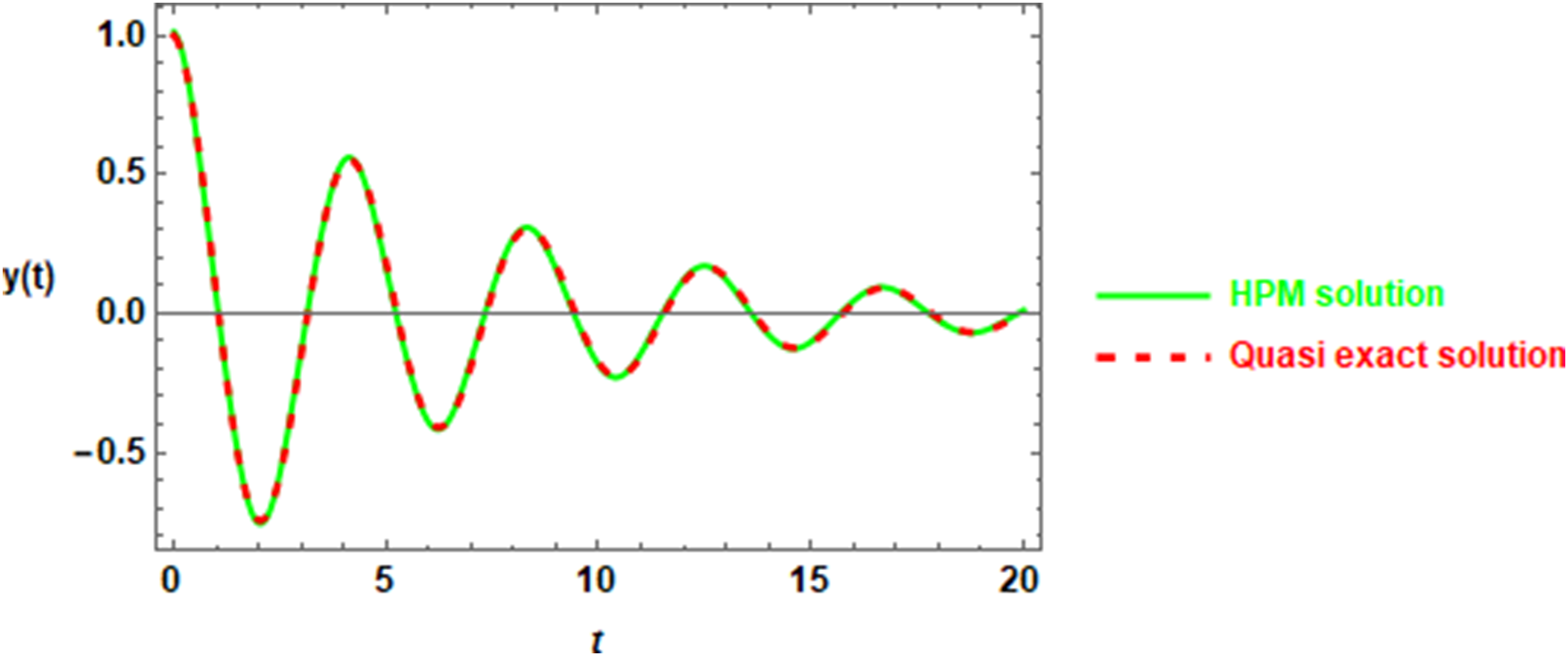
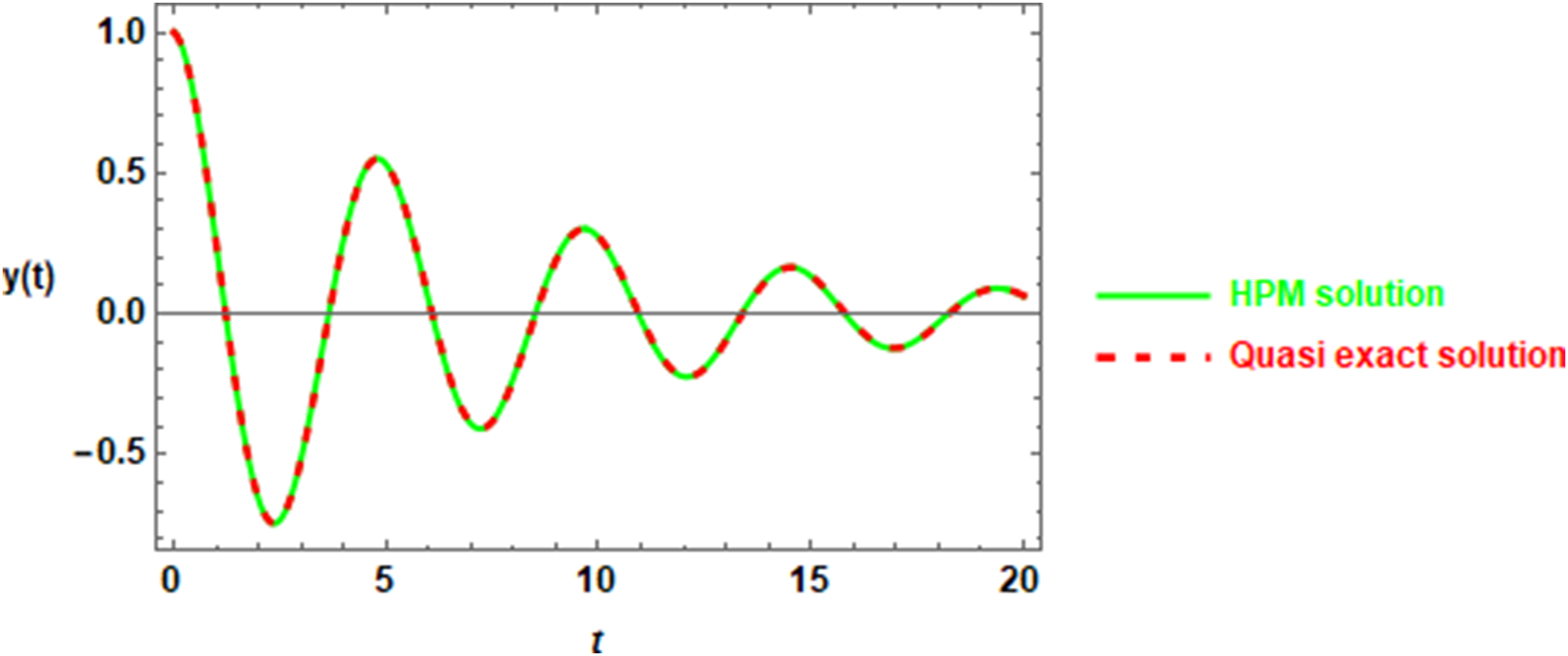
In Figure 8, when the order changes from integer to fractional, the amplitude of the curve of the fractional differential model increases. From the variation in the curves in Figure 8, it could be seen that the decrease of 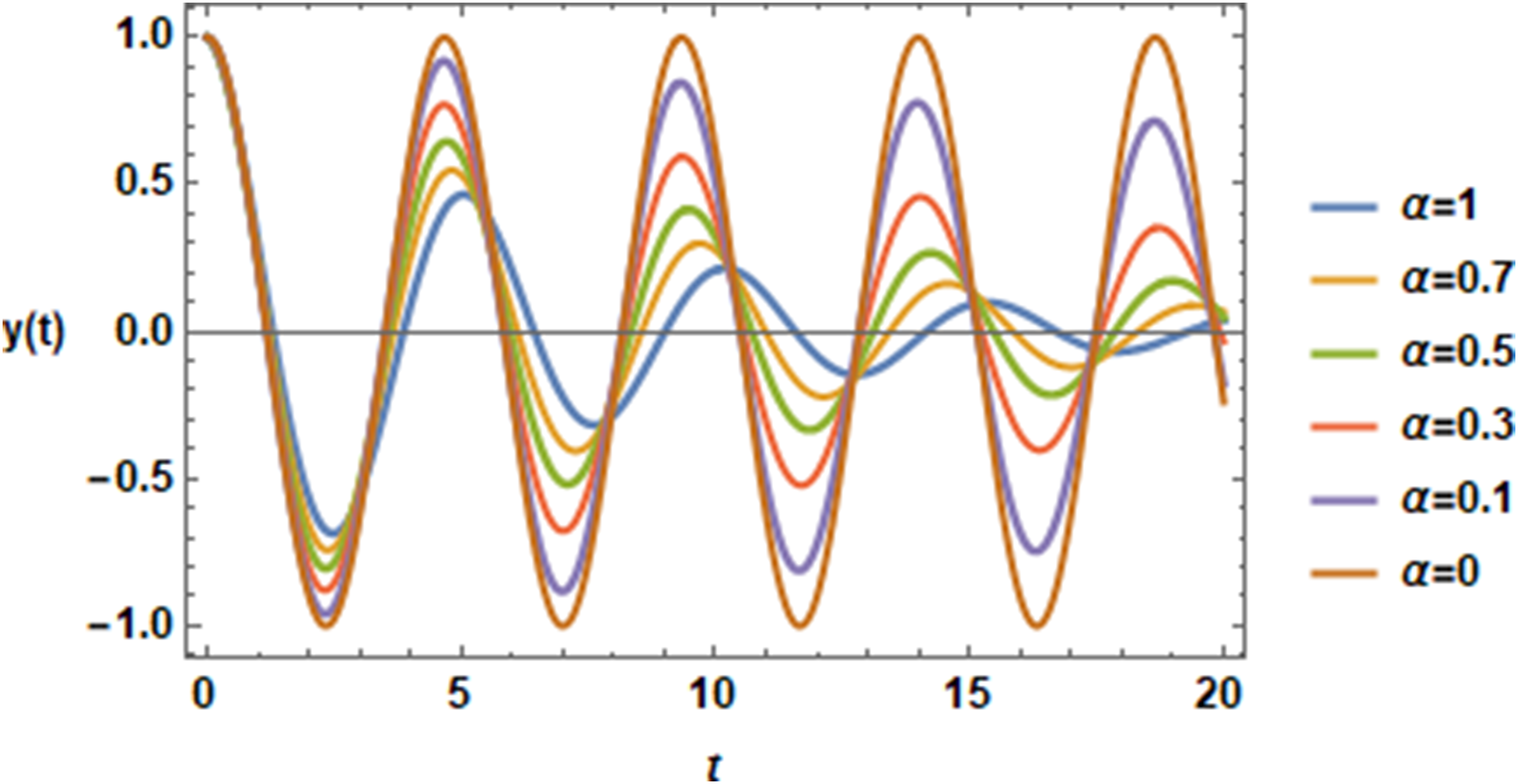
Example 2
Application of the suggested method to the fractional Van-der-Pol-Duffing oscillator
In this example, the quasi-exact analytical solution of the problem van-der-Pol Duffing oscillator will be discussed. The problem is selected with two kinds of fractional-order derivatives. The solution will be obtained based on the equivalent approach established in the present paper.
Consider the fractional Van-der-Pol-Duffing oscillator having two kinds of fractional-order
35
given in the following form

This configurative represents a nonlinear oscillator having a nonlinear damping force with a restoring force 
Nonlinear equation (39) could be solved with the non-perturbative approach. The linearization configuration is performed in the form

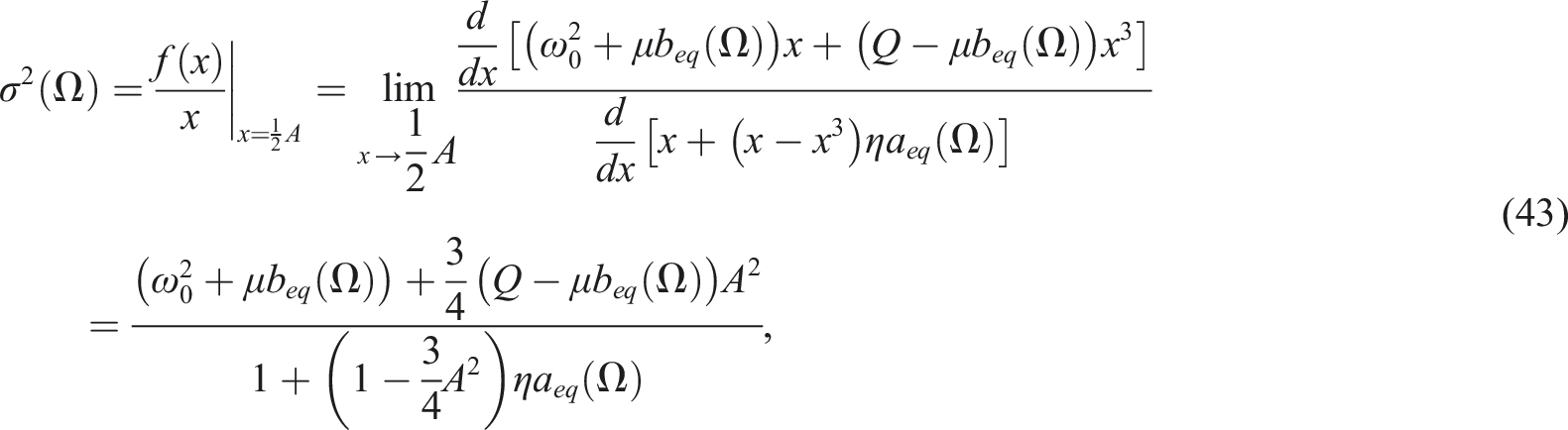


Employing equations (14) and (15) with equations (42) and (43) yields the frequency formula in the form
Numerical verification of the quasi-exact solution
To demonstrate the accuracy achieved by using the linearized approach to find the quasi-exact solution (44), a comparison with the numerical solution has been made and displayed in Figures 11–14. In Figure 11, the comparison is made for the case The variation of the parameter 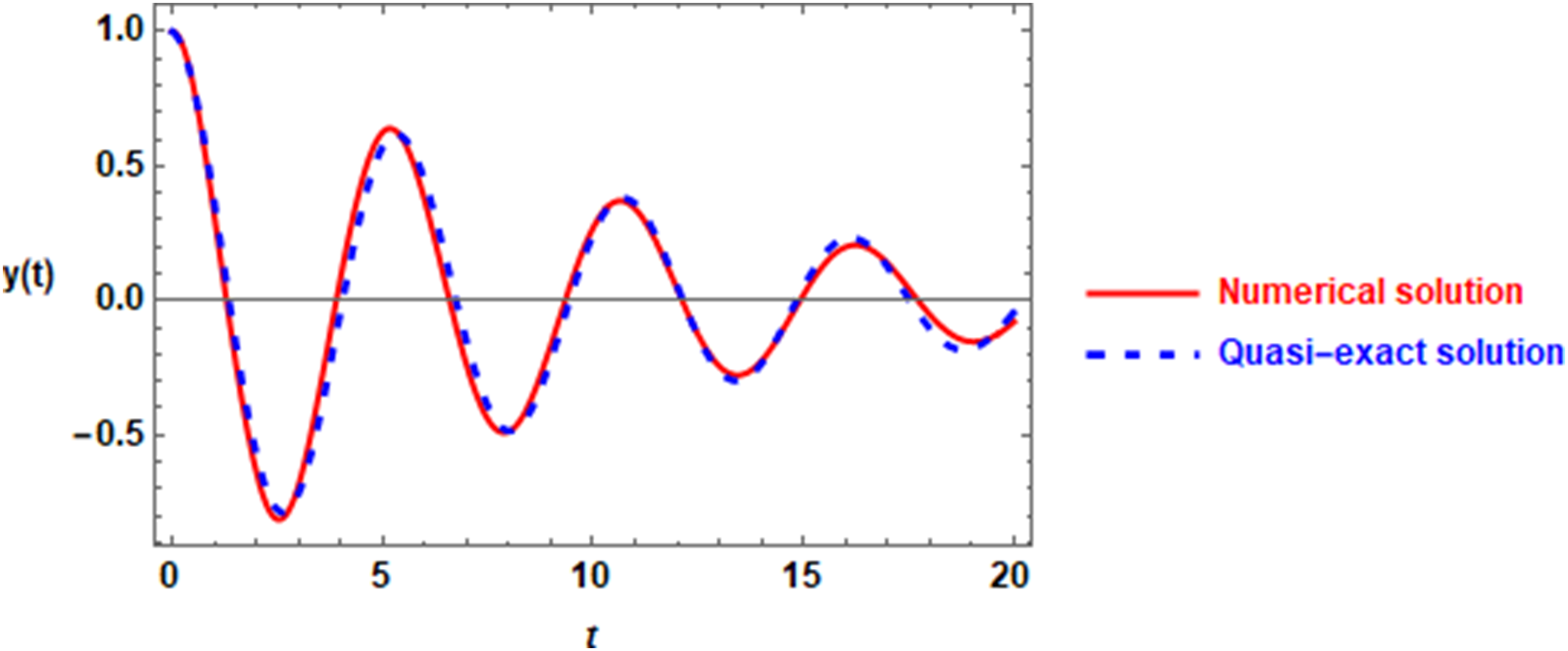
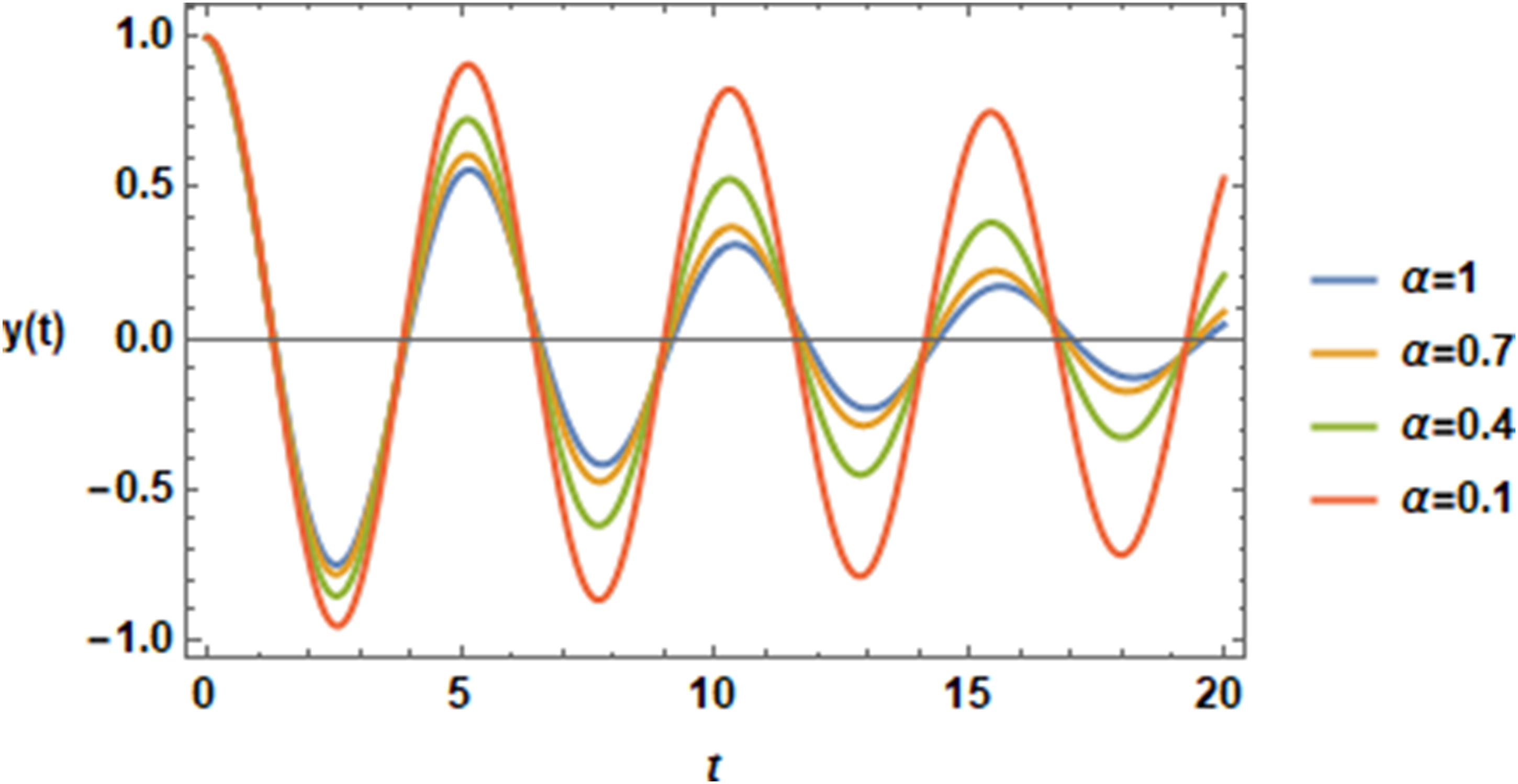
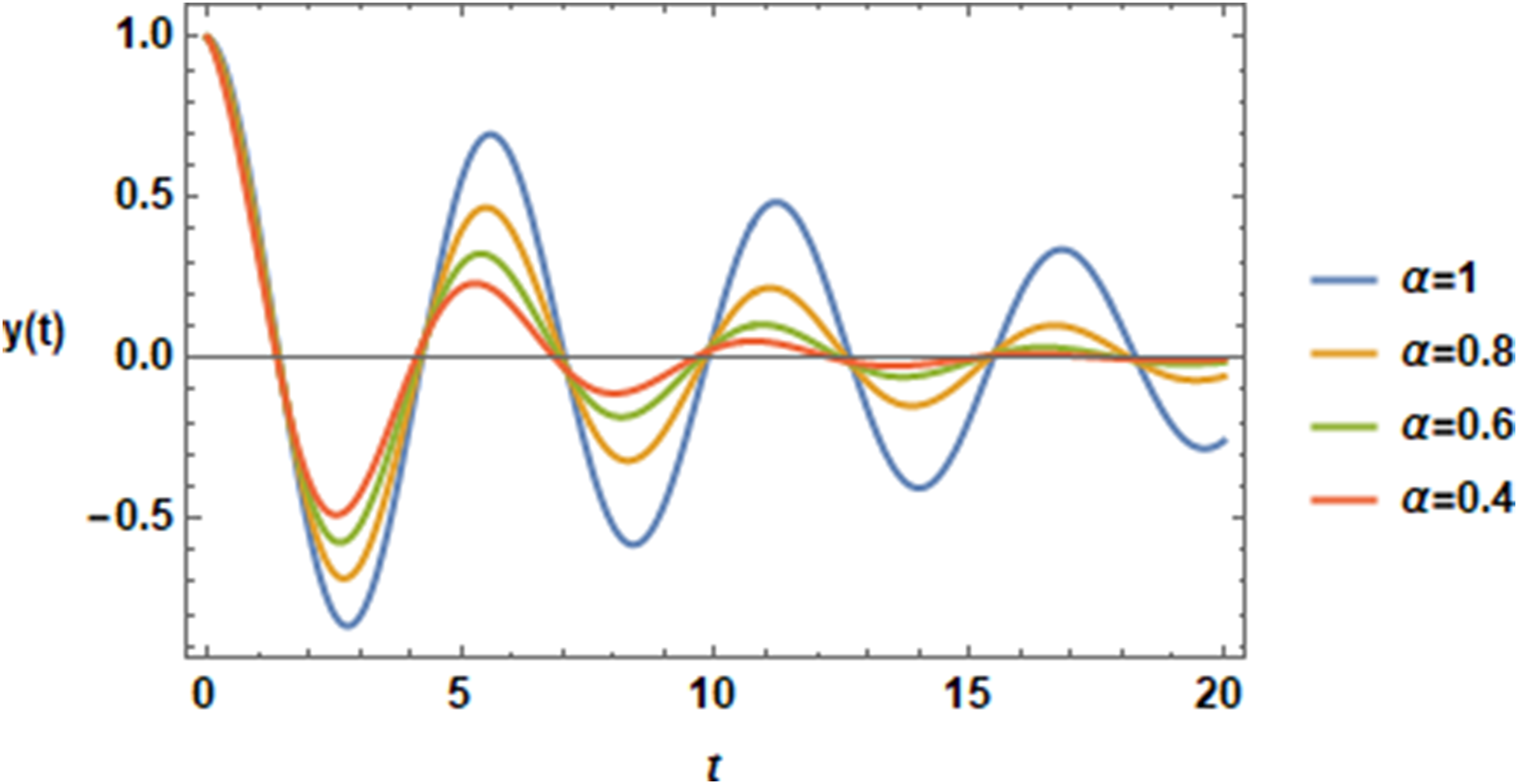
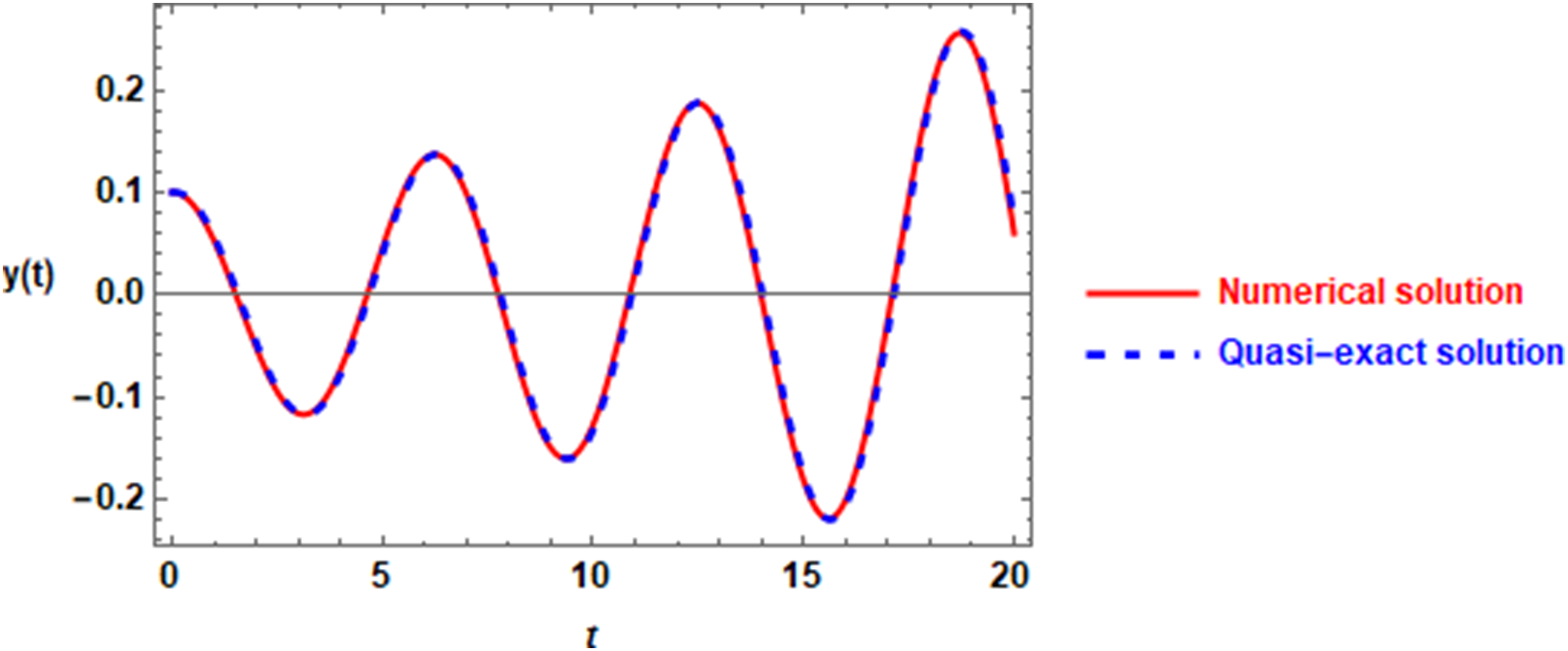
The case of the growing behavior that can occur for negative values of both the coefficient 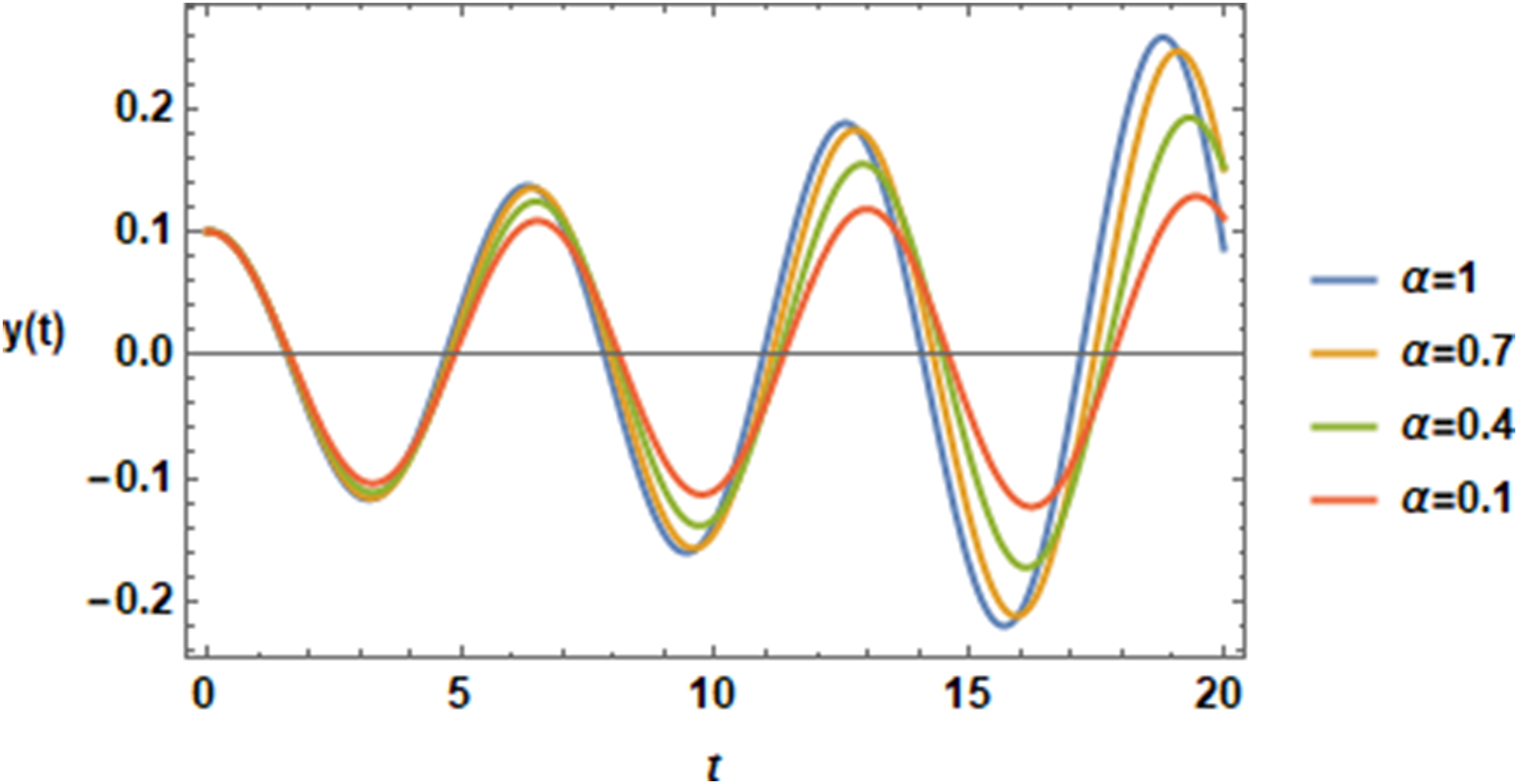
Conclusion
There are two main methods for research on fractional-order dynamical systems, namely, the numerical simulated and the approximately analytical perturbation methods. In the present work, a new approach is introduced to obtain an approximate solution without utilizing perturbation techniques to solve the fractional-order oscillation. In the new approach, two equivalent system parameters, that is, equivalent damping coefficient and equivalent stiffness coefficient, are defined, which could characterize the impacts of the fractional parameters on the conduct of the fractional-order Duffing oscillator. Also, the same approach has been used to perform the solution of the Van-der-Pol-Duffing oscillator with two fractional-orders is analytically investigated in this article. The confirmation between the traditional integer-order and the equivalent solution when the fraction factor has the value
Footnotes
Declaration of conflicting interests
The author(s) declared no potential conflicts of interest with respect to the research, authorship, and/or publication of this article.
Funding
The author(s) received no financial support for the research, authorship, and/or publication of this article.
