




Abstract
The sounds that are high enough, which negatively affect our understanding, are called noise. Although students are one of the main sources of noise at schools, noise adversely affects students’ success. Schools’ acoustics and the time when the noise measurement is made are usually considered to be other reasons for noise. In this study, noise measurements are collected in several of a metropolitan city’s primary and secondary schools, and factors that affect noise significantly are investigated using 23 full factorial experimental designs. In addition, school teachers’ perception of noise is analyzed by the Apriori algorithm. Results indicate that noise values exceed the limit values set by the WHO and noise regulations currently in effect in Turkey. Also, the schools with no acoustic insulation were noisier than those with minimum insulation. From the Apriori analysis, it is concluded that female teachers are more sensitive than male teachers about noise annoyance.
Introduction
Access to quality education is one of the most important opportunities in our lives; however, there is increasing indication that extreme noise levels can create an undesirable learning environment. Especially elementary and secondary school students have a right to stay in quiet zones for study, teaching, and examinations nevertheless classroom noise in schools, colleges, and universities is on the rise.
According to research conducted by the World Health Organization (WHO) and the International Labor Organization, 0 dB (A) is the hearing threshold of the human ear and there is no discomfort with voices between 0 and 30 dB (A). Psychological symptoms are observed depending on personal sensitivity in sounds between 30 and 60 dB(A). Psychological, physiological, and otological disorders occur in sounds between 65 and 85 dB(A). 1
If we look at the regulations pertaining to noise in schools we see many examples in the World, for example, Republic of Turkey Ministry of Environment and Urbanization,2–4 since the year of the publication of the first noise regulation in Turkey, 2 important steps have been taken. Finally, according to the regulation made by the Ministry of Environment and Urbanization, 5 buildings were classified from class F up to A depending on their acoustics qualities. Also for the first time in regulations, reverberation time was bounded, that is, 0.8 s for classes and 1.2 s for corridors. For class C, which is the lowest level that buildings need to include, limits were set 49 dB(A) in class and 39 dB(A) in corridors. The World Health Organization (WHO) has set the noise limit for schools at 55 dB(A). 1
Noise does not just affect people. Depending on the traffic noise, the areas where the animals are located vary. 6 Nassiri, et al. 7 have examined the completion time of tasks by assigning university students to perform in various noisy environments. They have seen that discrete high-level noise is more harmful than the constant high-level continuous noise. People expect improvements to be made to reduce environmental noise not only from a technically appropriate point of view but also from an aesthetically appropriate point of view. 8 Recently, there is also research regarding noise formation on automobiles’ breaks, especially the squeal forming positions and their simulations to design better brakes with less noise.9,10
Lepore et al., 11 while investigating the effect of noise on blood pressure, found that students in noisy schools had a higher body mass index than noiseless schools, and also might cause obesity. Choi and McPherson 12 have argued that teachers, who speak loudly for a long term to be heard in the classroom, have some health problems. Besides, they argued that schools in Hong Kong need to be acoustically improved. There are many examples in the literature that demonstrate the negative impact of noise on students’ academic success. Ronsse and Wang 13 observed that background noise affects the success of the language exam in Nebraska, and Dockrell and Shield 14 similarly observed that, in the UK, students who are speaking loudly in the classroom during exams affected the performance of other students. Hygge 15 reported the effects of airport, train, and road noise on students. Nevertheless, Klatte et al. 16 found that the reverberation time did not directly affect the students’ success in the study they conducted in Germany.
In a study in Torino, Astolfi and Pellerey 17 examined the effect of La,max (the maximum sound level that is measured), La,90 (the sound level that exceeds %90 of the measured sound), and La,eq (average sound level according to “A” filter) on students’ noise-induced disturbances and found a high correlation between La,max and students’ noise-induced disturbances. In the study mentioned in Trane Engineers Newsletter, 18 it is stated that measured background noise level exceeds recommended level 10–15 dB(A) even when the air conditioners are turned off. Also, it is reported that, because of architectural structure, one out of three students does not understand their teachers. In another study, a survey performed in university shows that students are most disturbed by the noise in the common halls. 19
Mealings 20 set the optimum conditions by examining noise standards in countries worldwide. In research conducted in Nigeria, 21 the researchers have seen that noise effects on teachers increase as age increases. Also in another research, completed in Nigeria, Ana et al. 22 uttered that the most reported health problems potentially associated with acute (large or episodic) or chronic (continuous or intermittent) exposure to noise within the school environment were lack of concentration and tiredness.
Dockrell and Shield 23 did a review about the effects of noise on children at school. In the early 1970s, Crook and Langdon 24 stated that in schools around Heathrow aircraft noise had a significant impact on teaching by interfering with speech and causing changes in teachers’ behavior in the classroom. In the UK, road traffic noise has been found to cause dissatisfaction with the classroom environment among teachers; Sargent et al. 25 found that there was a greater incidence of complaints about noise at levels above 60 dB(A) LA,10. 23
By using the Apriori algorithm, interesting rules can be found in marketing, tourism sectors, and also in the education field.26–28
In this study, to investigate the causes of noise pollution, measurements were made in primary and secondary schools in one of the biggest cities in Turkey, and these measurements were used for analysis in experimental designs. Moreover, surveys about noise perception of primary and secondary school teachers were analyzed. 15 schools and 407 teachers participated in conducted surveys. The number of students and the physical structures of the schools which measurements were made are briefly as follows: Mustafa Münevver Olağaner (MMO) Elementary School, which is a state school with dual education, consists of 1162 students and 19 classrooms. It is an example of a primary school where no acoustic insulation measures are taken. Another state school, Sadettin Türkün Secondary School, provides full-time education and consists of 804 students and 25 classrooms. In the corridor and classes, there is a minimum level of acoustic insulation (e.g., panels on corridor walls, suspended ceilings in classrooms and corridors). The third school, Çağdaş Eğitim Kooperatifi (ÇEK) 3 Mart Azizoğlu School, is a private school where primary and secondary school students get full-time education and consists of 34 classes and 816 students. ÇEK has acoustic insulation similar to Sadettin Türkün Secondary School. Schools, where analyses are made, are separated from each other with features such as acoustic insulation, primary school–secondary school difference, and private school–state school difference. In addition, these schools set a good example group for Bursa and also for big metropolitans in Turkey and the World.
The lack of any experimental design study on noise pollution in schools in the literature is another important point of this study. Also, noise pollution in schools in Turkey and its reasons have not been investigated in this detail before.
As a result, this study innovatively closes the gap between the experimental design and the survey results. In the literature, there are many survey results, most of which only provide statistical results, and there are experimental results, which only provide regression results. This paper combines both using a data mining analysis for the survey results.
Materials and methods, the results obtained from measurements, and the discussion of these results will be given in the following sections.
Materials and methods
The measurements used in this study were collected with a Brüel & Kjaer Type 2250-A sound level meter with a ½" microphone. The device’s calibration is controlled by the Brüel & Kjaer 4231 calibrator. R Studio, MINITAB 17, and Brüel & Kjaer Measurement Partner Suite programs were used for data analysis.
Schools’ number of students.

Apriori algorithm
Apriori algorithm was used for the analysis of surveys in the literature before.26–28 Also, the physical fitness of college students can be analyzed.
30
Moreover, supermarket layout research can also be studied.
31
Below, the pseudo-code of the Apriori algorithm is displayed:
c.count ++; end Answer = ∪
k
L
k
;
Here, “L” and “C” are defined as frequent itemsets and candidates, respectively. This algorithm finds frequent “k”-itemsets from frequent “k-1”-itemsets, 32 which produces rules for survey results. The advantages of the apriori algorithm are that it is simple and easy to understand, does not use labeled data, and users can specify support and confidence level. On the other hand, there are some disadvantages or limitations of the algorithm, such as its execution time being relatively long, and it is inadequate with big datasets. 33
Results and discussions
Factors and levels.

Experiment results.
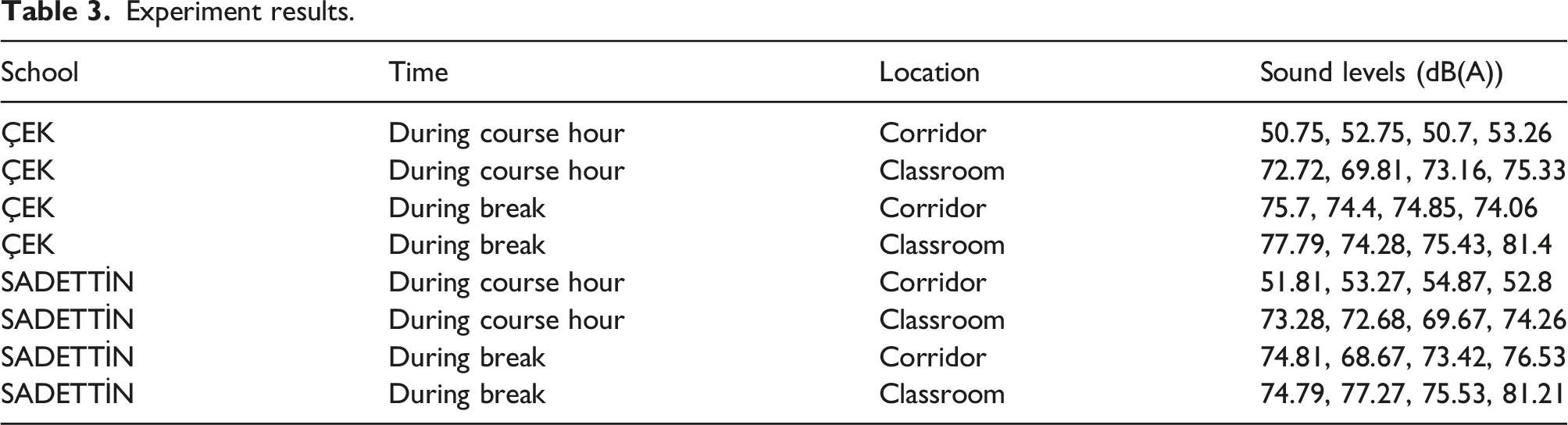
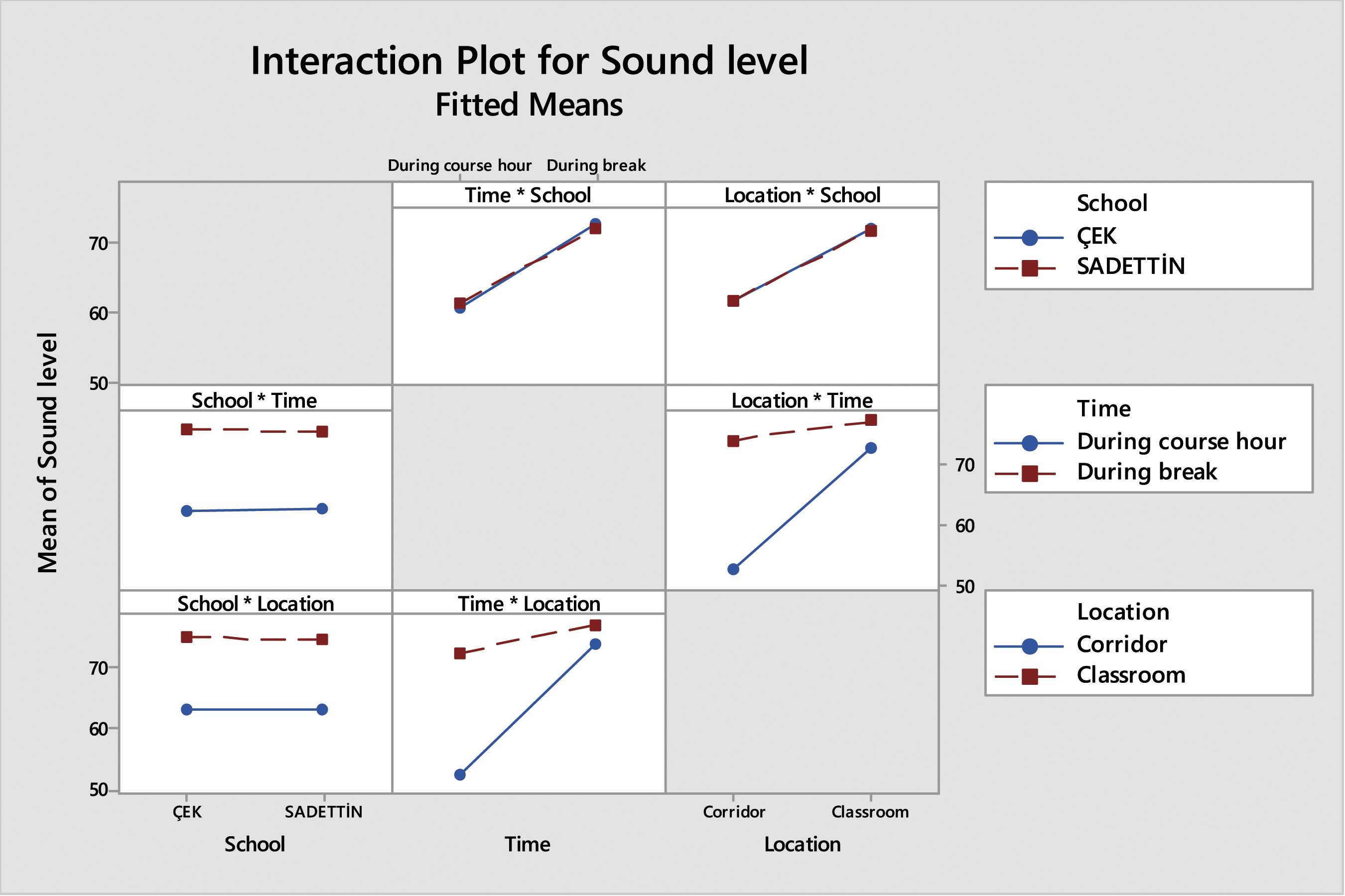
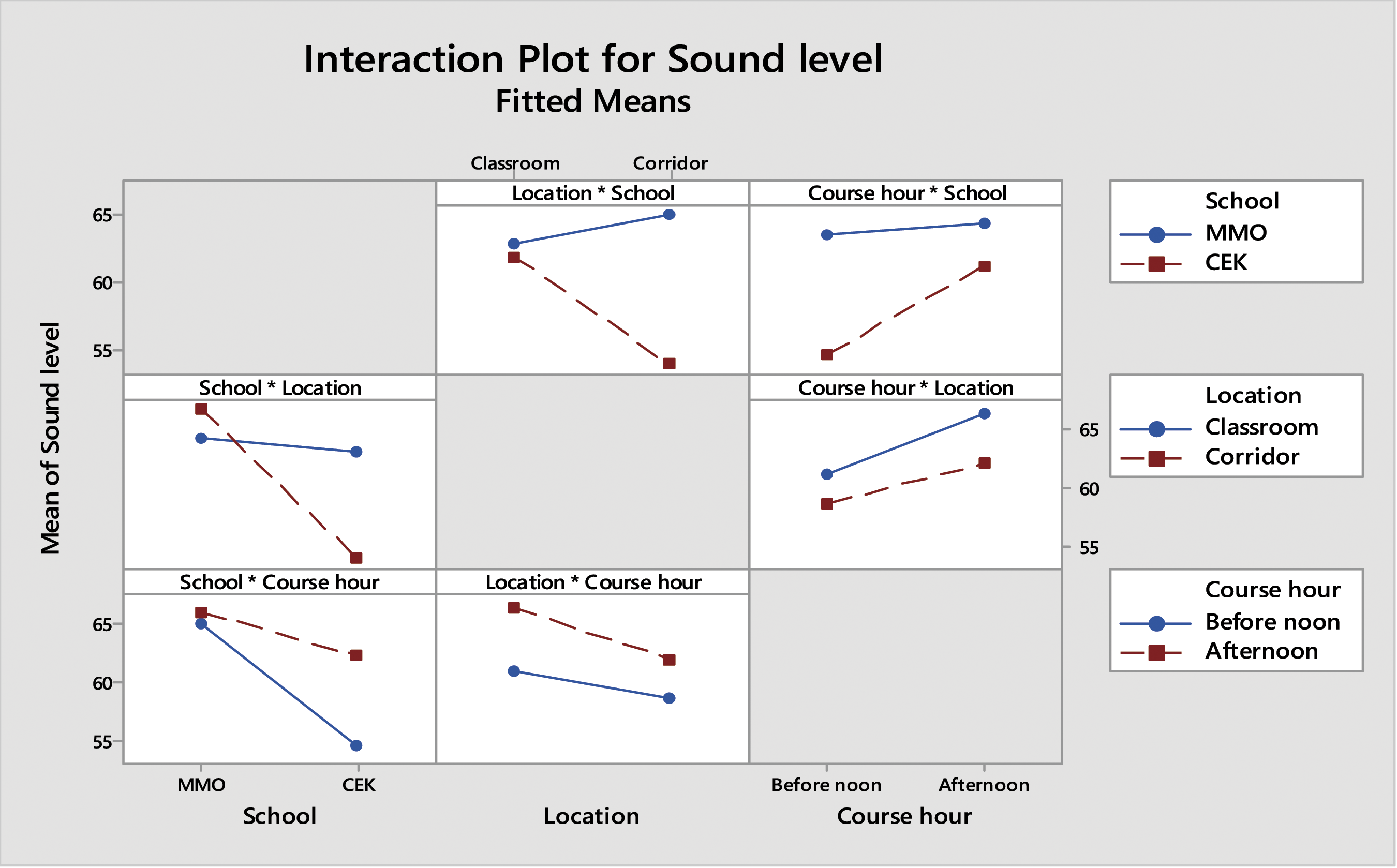
After obtaining relevant data, the design of experiment analysis is conducted. When the analysis results are examined, the main effects graph in Figure 1 shows that the measuring time is the most effective factor. According to the graph in Figure 2, the time and the location seem to affect each other, which indicates an interaction effect. Main effects graph. Interaction plot.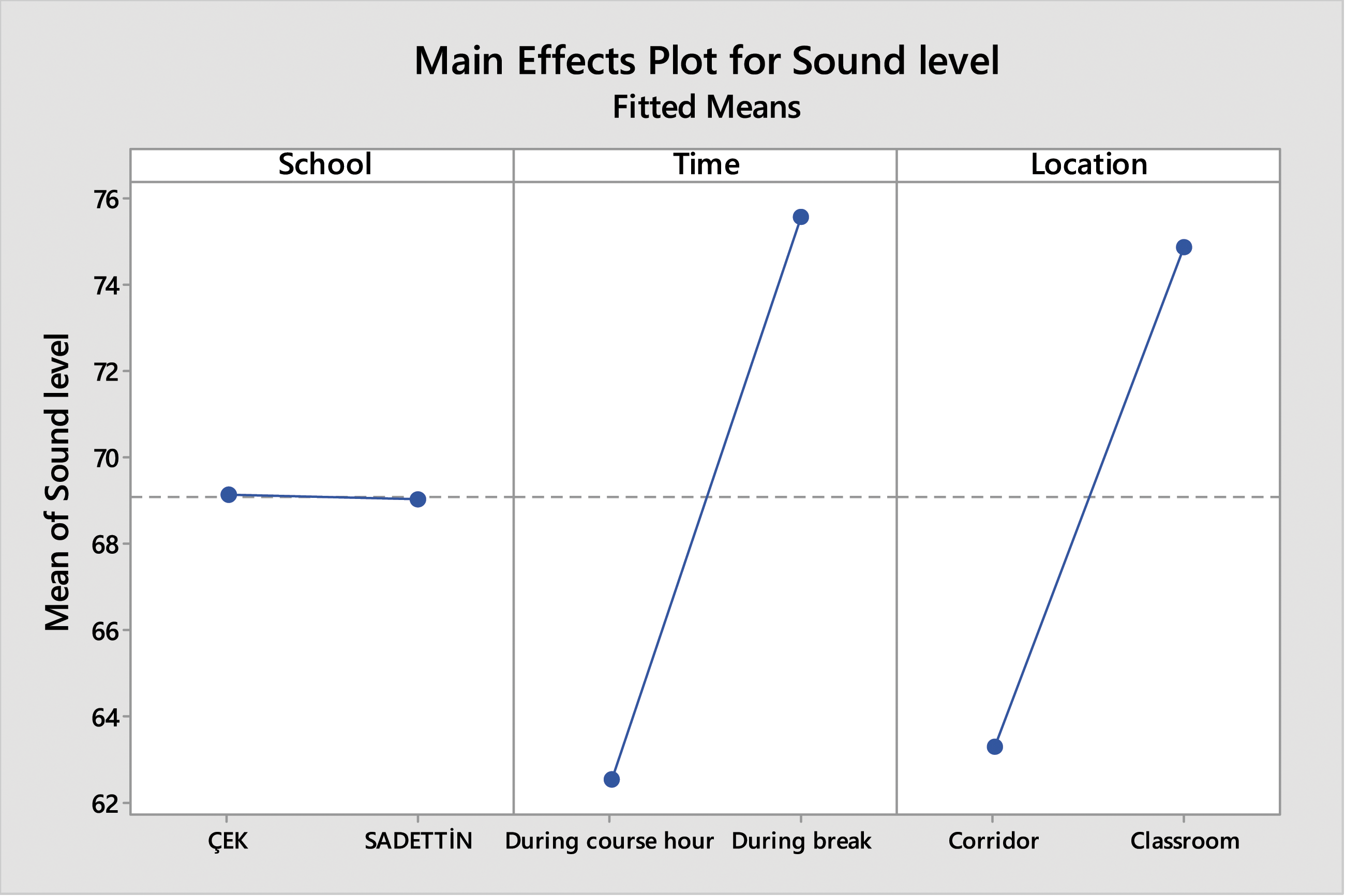
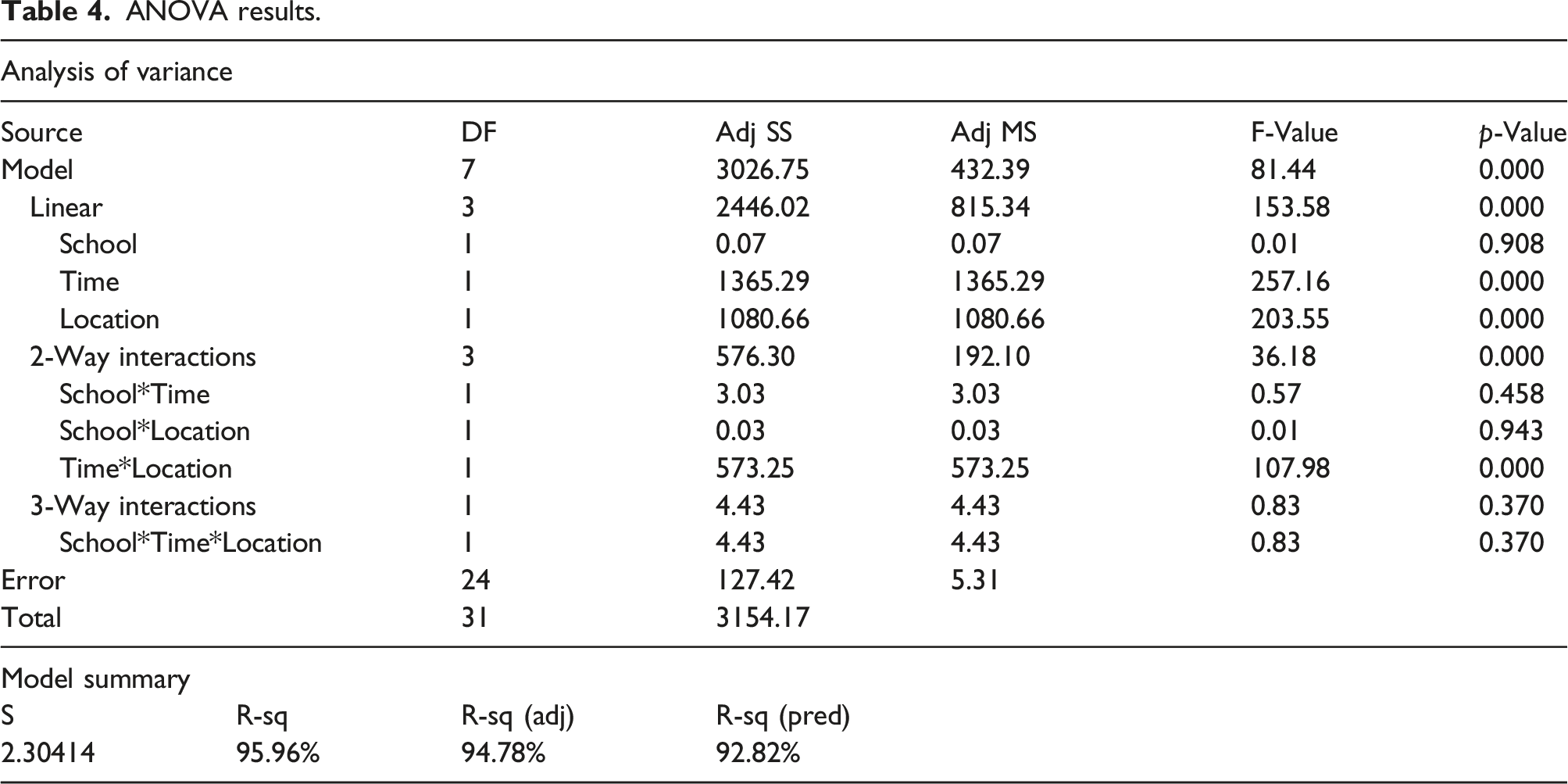
The normal plot of the standardized effects is shown in Figure 3 and the ANOVA results are given in Table 4. When Figure 3 and Table 4 are considered together it is concluded that time, location, and interaction between time and location are statistically significant effects with p<0.01. Additionally, the regression is valid, as R2 = 95.96%. Effective factors were determined by taking p-value=0.01. Statistically significant test result (p ≤ 0.05) means that the test hypothesis is false or should be rejected. Furthermore, a p-value greater than 0.05 means that no effect was observed. In most analyses, an alpha of 0.05 is used as the cutoff for significance. Hence, the smaller the p-value, the stronger the evidence for rejecting the hypothesis. According to this experimental design, the noise level during breaks is higher than the noise level during course hours, and the noise level in the classroom is higher than the noise level in the corridor. This claim, although feels trivial, is important. This indicates that young children sometimes stay in the classrooms during breaks and continue to make noise. The important point is that most classrooms are not noise isolated and they are substantially smaller than corridors, leaving the children in a more harmful environment. Using this result, the authorities may implement a necessary action, such as using wall/floor noise isolators or making all the students leave the classrooms during breaks. It will be shown later that the same result was also obtained by analyzing surveys via the apriori algorithm. Additionally, there is no significant effect of different schools, which indicates that the situation is the same for most schools. Normal plot of the standardized effects. ANOVA results.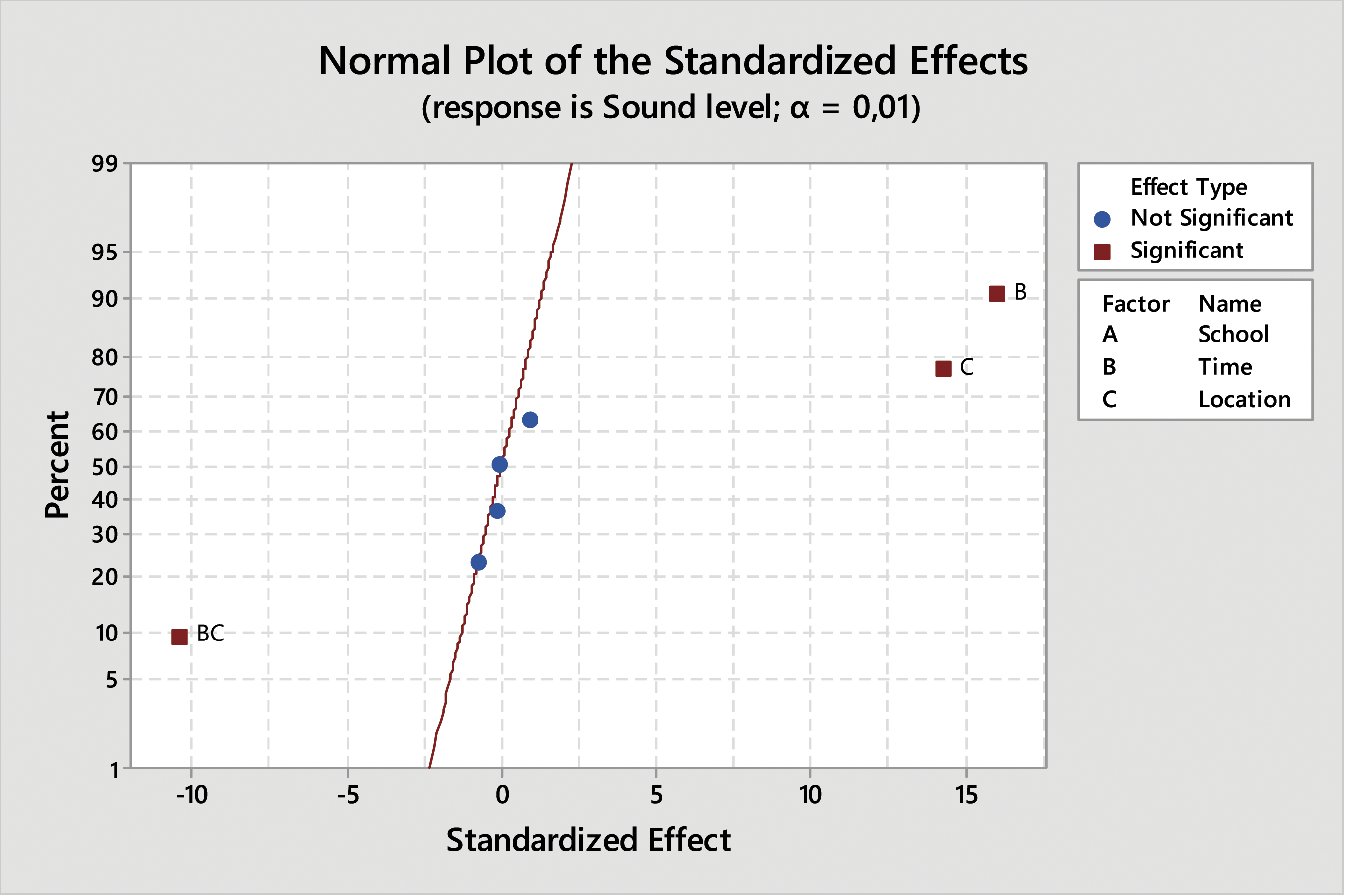
Factors and levels.

Experiment results.
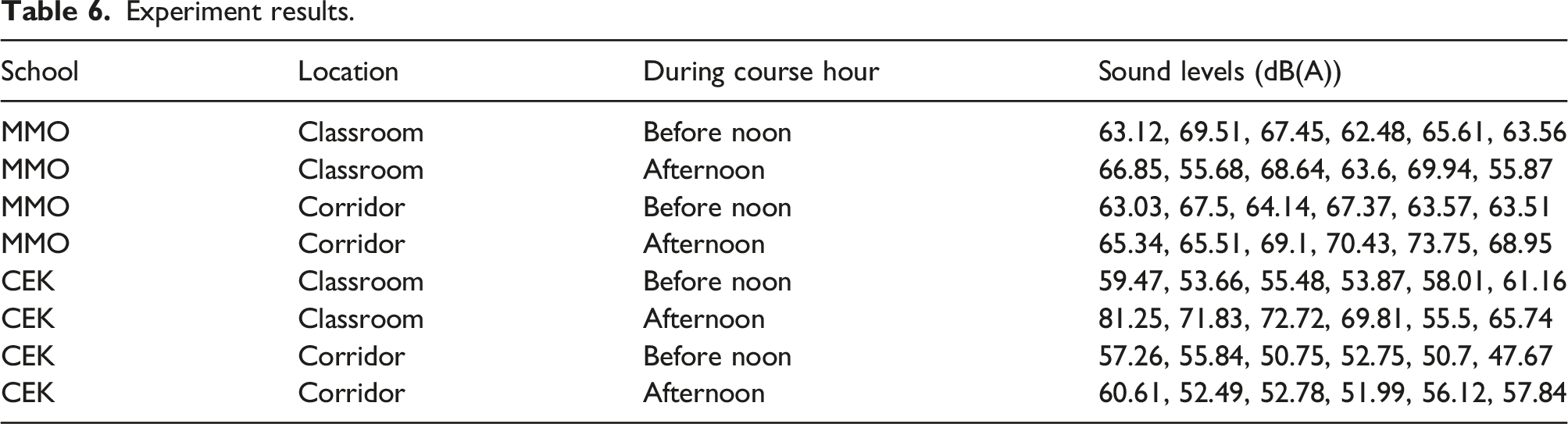
With a similar analysis, it is concluded that all three factors are effective when the main effects graph in Figure 4 is examined. It is also concluded that interactions between different schools (MMO and ÇEK) and course hours (before noon and afternoon) and also between different schools and location (classroom and corridor) are important when we examine the interaction plot in Figure 5. Main effect graph. Interaction plot.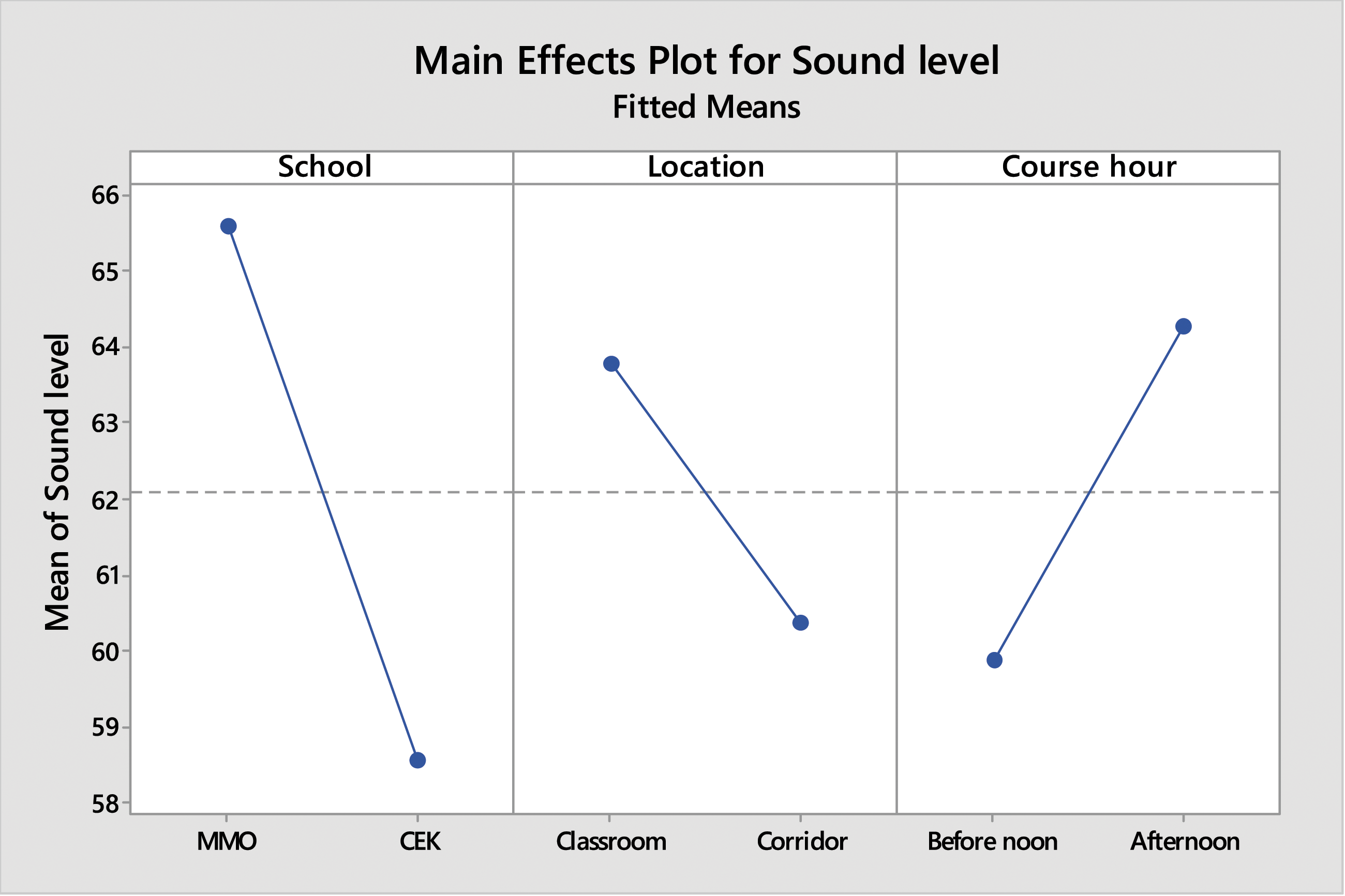
When the Pareto chart of the standardized effects in Figure 6 is examined, it is determined that the most effective factors are school-course hour and location, respectively. In addition, the interaction between the location-course hours is not effective and the other two interactions are effective. Moreover, it can be considered that the interaction of the three factors has more effect than the location factor. For this experimental design, R2 is 66.93%. This value indicates that this experimental design is convenient and useful but there may be overlooked factors. Pareto chart of the standardized effects.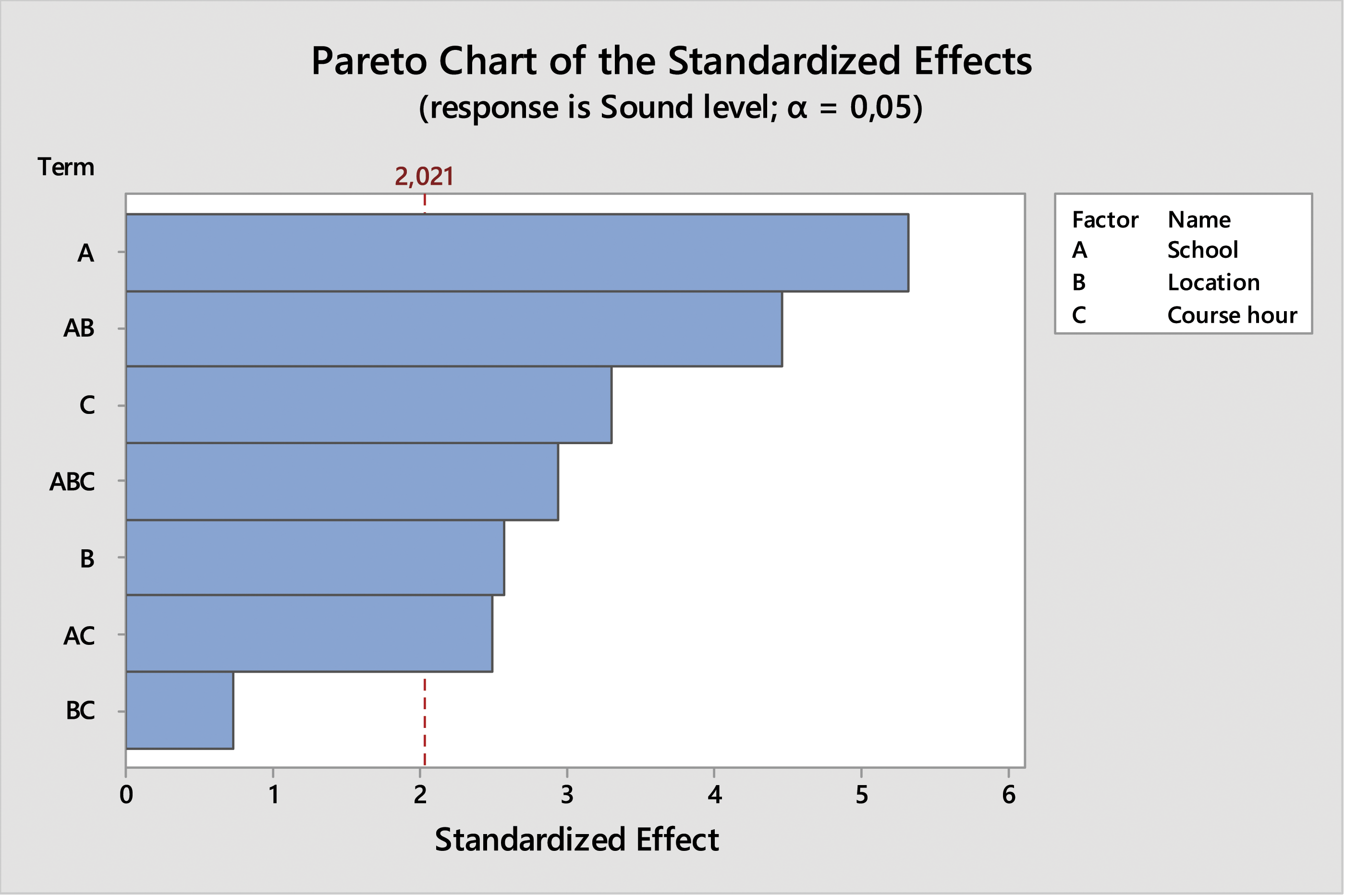
According to this 23, full factorial experimental design in which the statistically difference between the primary schools was investigated for noise levels during course hours, different from the first experimental study, it is observed that MMO’s noise levels are higher than ÇEK.
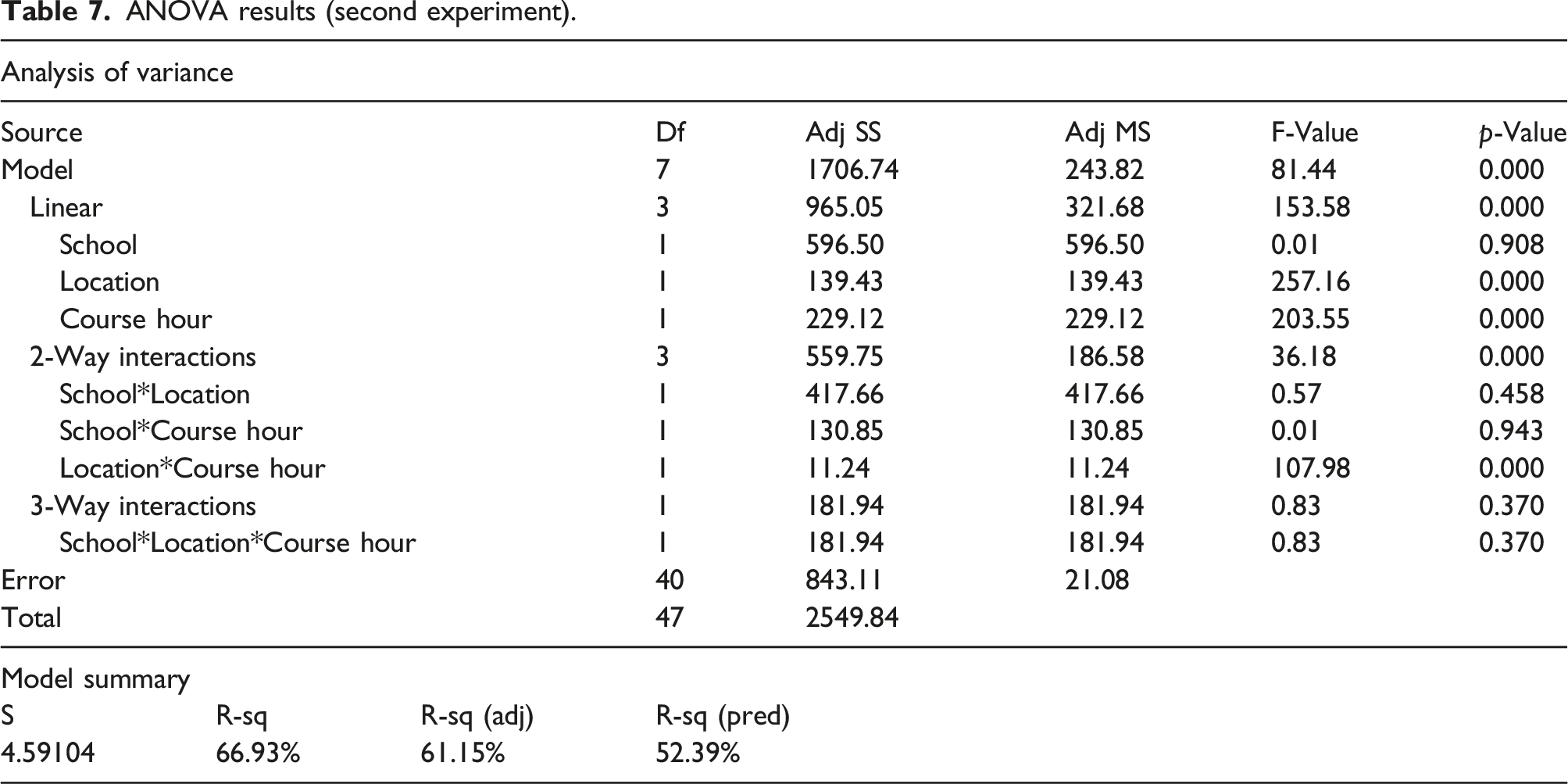
ANOVA results (second experiment).
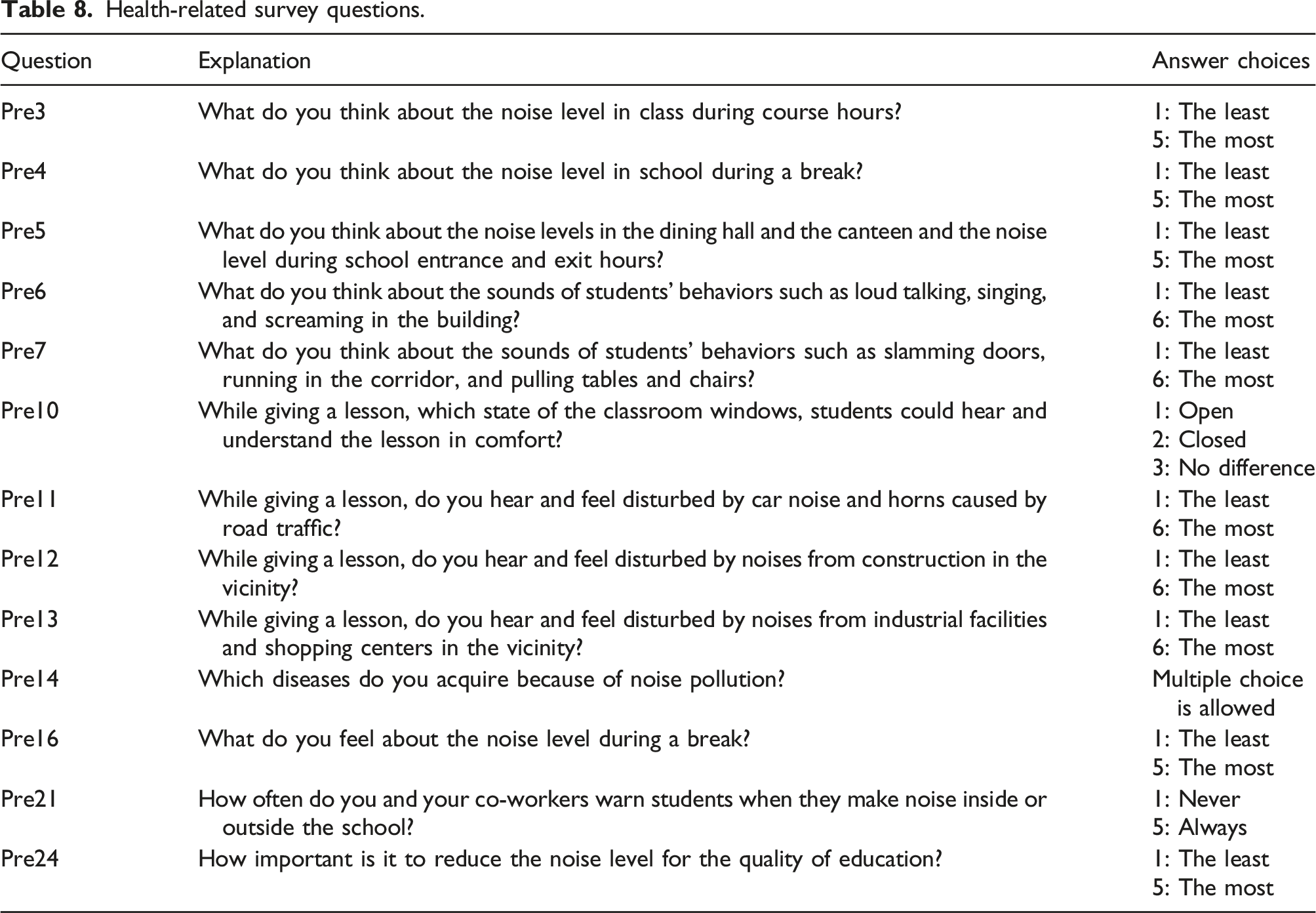
Health-related survey questions.
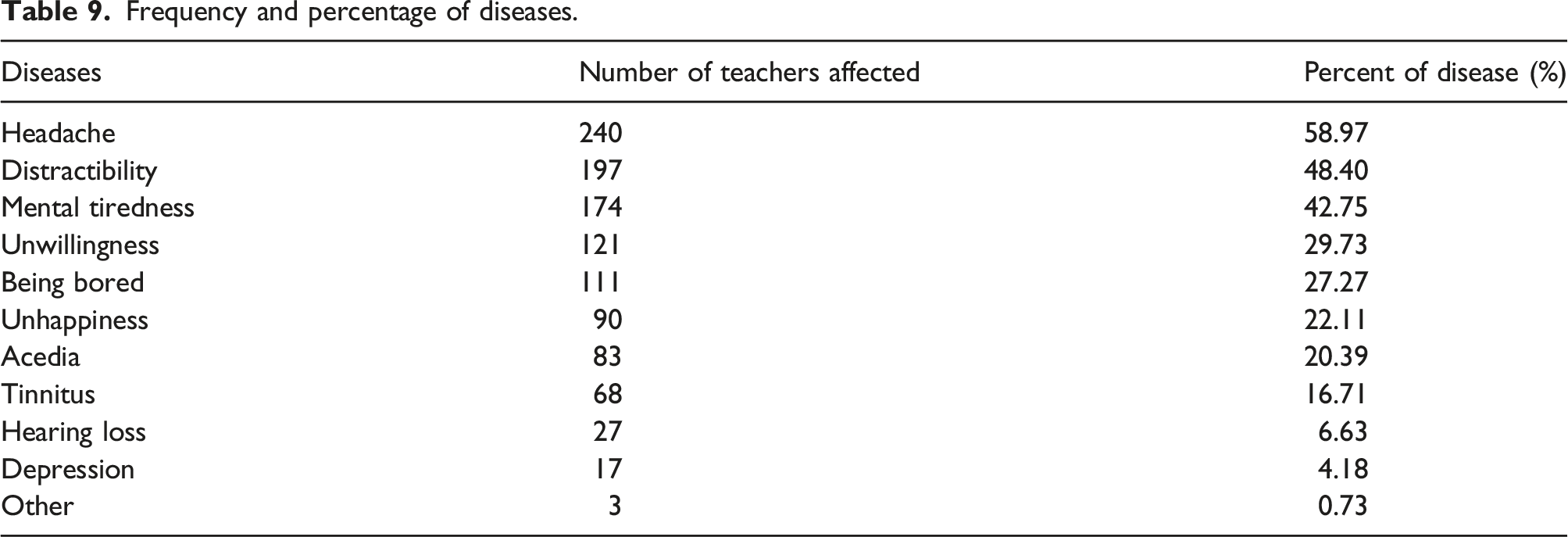
One of the survey questions (pre14) was the actual diseases the teachers acquire because of noise pollution and teachers are allowed to pick more than one disease in this question. In Figure 7, it shows that headache, distractibility, and mental tiredness are the most effective three diseases that affect teachers and they are above 40%. Percentages of teachers affected by diseases.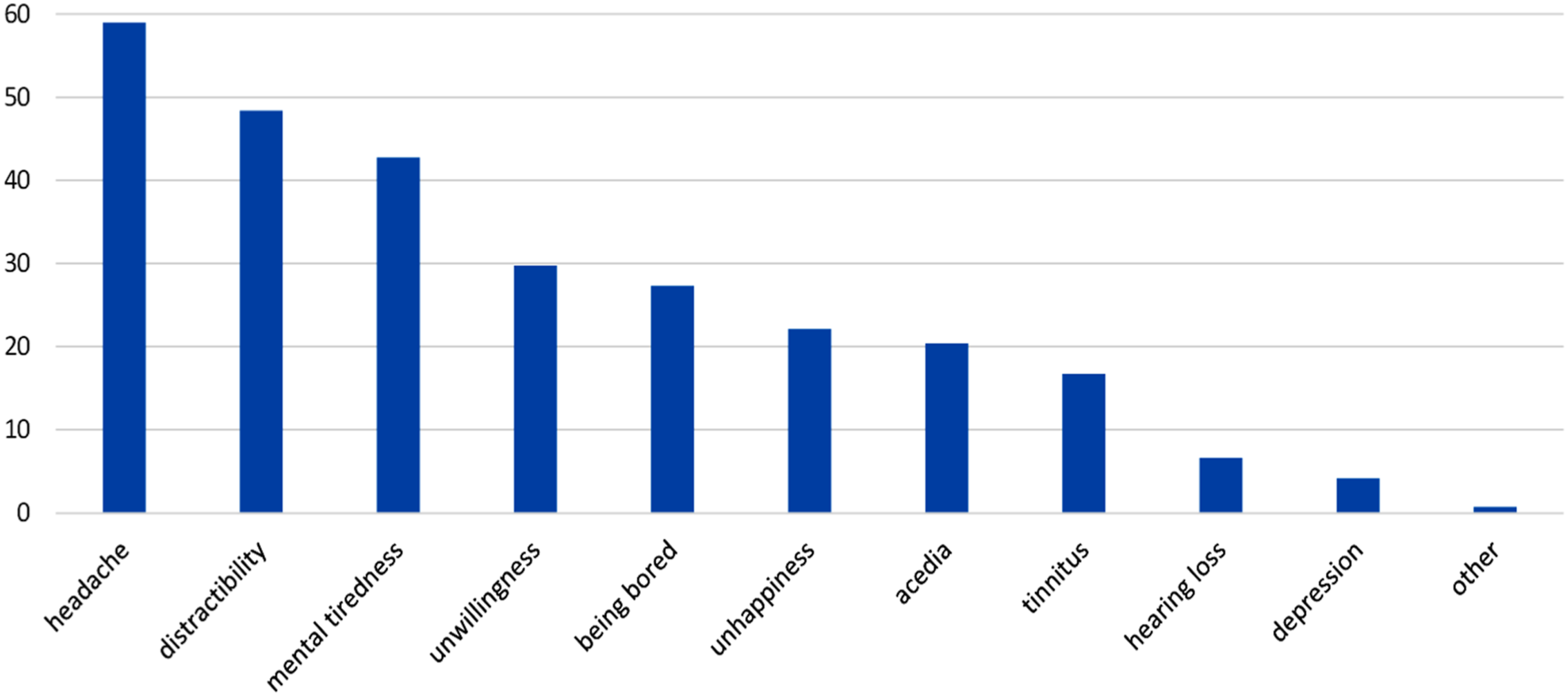
Frequency and percentage of diseases.
Rules obtained by the apriori algorithm.
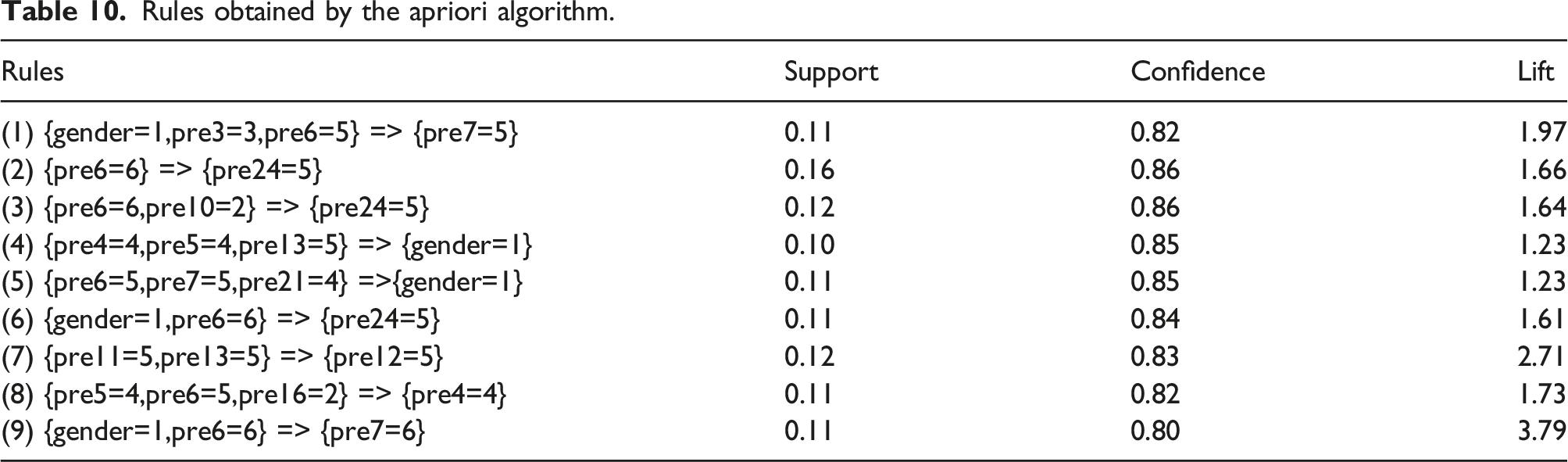
Eighty-two percent of female teachers (gender = 1) who think that the noise level in class during course hour is medium, also think that the sounds of students’ behaviors such as loud talking, singing, and screaming in the building are heard by them and disturb themselves, stated that the sounds of students’ behaviors such as slamming doors, running in the corridor, and pulling table and chairs are heard by them and disturb themselves. Eighty-six percent of teachers who state that they hear and are disturbed very much by sounds of students’ behaviors such as loud talking, singing, and screaming in the building, phrased that reducing the noise level is very important for the quality of education. Eighty-six percent of teachers who state that they hear and are disturbed very much by sounds of students’ behaviors such as loud talking, singing, and screaming in the building, also who tell that the students could hear and understand the lesson in comfort which teachers give while classroom windows are closed, phrased that reducing the noise level is very important for the quality of education. Eighty-five percent of teachers who think that the sounds of students’ behaviors such as slamming doors, running in the corridor, pulling table and chairs, loud talking, singing, and screaming in the building are heard by them and disturb themselves, and stated that their co-workers frequently warn students when students make noise inside or outside the school, are female teachers. While giving a lesson, 83% of teachers who hear and are disturbed by car noise, horns caused by road traffic, and noises from industrial facilities and shopping centers in the vicinity expressed that they hear and are disturbed by noises from construction in the vicinity. Eighty-two percent of teachers who tell that the noise levels in the dining hall and canteen and the noise level during school entrance and exit hours are high, also who state that they hear and are disturbed by sounds of students’ behaviors such as loud talking, singing, and screaming in the building, and who phrased that they are disturbed by the noise during break hours, declared that the noise levels in school during breaks are high. Eighty percent of female teachers who state that they hear and are disturbed very much by sounds of students’ behaviors such as loud talking, singing, and screaming in the building, uttered that they hear and are disturbed very much by the sounds of students’ behaviors such as slamming doors, running in the corridor, and pulling table and chairs.
Conclusions
In this paper, the analysis of factors that affects the schools’ noise level is investigated using data mining and experimental design. Two experimental designs are conducted for the analysis. In the first experiment, the investigation of the difference between a primary school (ÇEK) and a secondary school (SADETTİN TÜRKÜN) is explored via a 23 full factorial design with four replications. It was observed that the noise level during a break is higher than the noise level during course hours, and also the noise level in the classroom is higher than the noise level in the corridor. In addition, school types (primary or secondary school) were found to have no significant effect on noise. When 2-way interactions were examined, it was noted that noise levels during breaks in the corridors and classrooms were similar. Moreover, the noise level during course hours in the classroom, as expected, was higher than in the corridor’s noise level during course hours.
Apart from these analyses, according to several experimental designs with a primary school (MMO) and a secondary school (SADETTİN TÜRKÜN), similar to the study above, there was no difference between the schools, and also a minimum of 75.27% R2 value was calculated. As discussed above R2 was 95.96% for the first experiment. Analysis of schools with similar acoustic insulation characteristics provides more explicable results than schools with different acoustic insulation properties.
According to the second 23 full factorial experimental design (MMO-ÇEK) in which the statistical difference between the primary schools was investigated for noise during course hours, it was observed that MMO is noisier than ÇEK. As it can be considered that there is some acoustic insulation because of the suspended ceiling in the ÇEK school, it is not surprising that the noise level in the MMO school is higher than in the ÇEK school. When other main factors were examined, it was concluded that the noise level in the classroom is higher than the noise level in the corridor. Besides, during course hours, the noise level in the afternoon is higher than before noon. Since it is predicted that students are not physically more active before noon, it is determined that noise level changes depending on course hours. When two-way interactions were examined, it is observed that noise levels before noon and afternoon are similar in MMO school. In addition, the noise level before noon is lower than afternoon in ÇEK school.
Although the noise levels are low before noon, these noise levels are well above according to the WHO (55 dB(A)) and to the Ministry of Environment and Urbanization’s regulation. 5 To extend the situation before noon (low noise level) to all day, or even to reduce noise levels, noise awareness education should be given to students. In addition to education, acoustic insulation should be applied inside the buildings.
According to the applied surveys, 85% of teachers who declared that the noise levels in school during break are high, also who tell that the noise levels in the dining hall and canteen and the noise level during school entrance and exit hours are high, and who state that they hear and are disturbed by noises from industrial facilities and shopping centers in the vicinity, are female teachers. This rule supports the research. Also in another rule, 84% of female teachers who expressed that they hear and are disturbed very much by sounds of students’ behaviors such as loud talking, singing, and screaming in the building, phrased that reducing the noise level is very important for the quality of education. It can be concluded that female teachers are more sensitive than male teachers about noise annoyance in schools.
ORCID iD
Âli Yurdun Orbak https://orcid.org/0000-0002-4921-4275
Footnotes
Declaration of conflicting interests
The author(s) declared no potential conflicts of interest with respect to the research, authorship, and/or publication of this article.
Funding
The author disclosed receipt of the following financial support for the research, authorship, and/or publication of this article: This work was supported by the Scientific and Technological Research Council of Turkey (TUBITAK) supported Project: 114K738 Noise Pollution at School: Causes, Effects, and Control.