




Abstract
Nonlinear oscillation is an increasingly important and extremely interesting topic in engineering. This article completely reviews a simple method proposed by Ji-Huan He and successfully establishes a fractal undamped Duffing equation through the two-scale fractal derivative in a fractal space. Its variational principle is established, and the two-scale transform method and the fractal frequency formula are adopted to find the approximate frequency of the fractal oscillator. The numerical result shows that He’s frequency formula is a unique tool for the fractal equations.
Keywords
Introduction
Nonlinear oscillation is a very common phenomenon in nature, such as water waving and bridge vibration. Many oscillation problems can be modeled by differential equations, which, however, become invalid for the fractal space, and fractal models have to be employed.1–10 Generally, a fractal model with fractal derivatives is difficult to be solved, and even if an accurate solution exists, the solution is too complicated to be used for practical applications. Due to the shortness of finding exact solutions, these nonlinear equations are extremely imperative to be solved by employing analytical and numerical methods, for example, the variational iteration method,11–13 the homotopy perturbation method, 14 the Hamiltonian approach,15,16 and the Taylor series method.17–19 Fractal calculus especially provides a powerful tool for characterizing the mechanical behavior of a nonlinear oscillator in a fractal space,20–27 which cannot be revealed by the classical differential models. For examples, some interesting properties of the fractal Toda oscillator was first revealed, 20 Fangzhu’s passive water harvesting was explored using a fractal oscillation model,21–25 the fractal MEMS oscillator can eliminate the pull-in instability, 26 which is an intrinsic property of the traditional MEMS oscillator. The fractional Schrodinger equation, 9 the fractional Camassa–Holm equation, 9 and the fractional Kundu–Mukherjee–Naskar equation 27 also showed plenty of solution properties.
Recently, Chinese mathematician, Dr Ji-Huan He suggested a simple method for a conservation nonlinear oscillator, 28 which has attracted much attention to solve various fractal oscillators.20–25,29 The most important feature of a nonlinear oscillator is the relationship between frequency and amplitude, and He’s frequency formula28,29 is a simple method to estimate this relationship, which was initially inspired by an ancient Chinese algorithm.29–32
Duffing oscillator was first proposed by Duffing in 1918 to investigate the vibration of the electromagnetic vibrating beam,
33
it can be written in the form

Duffing equation
Consider the following undamped simple for


where

Equation (3) can model the vibration property in a fractal space. Now the two-scale fractal calculus can be applied to various discontinuous problems, for examples, the wool fiber’s biomechanism
35
and the electrospinning process.36–39 The variational principle for equation (3) can be obtained according to the semi-inverse method,40–45 which reads

The fractal two-scale transform method1–3 and fractal frequency formula 28 are adopted to find the approximate analytical solution of equation (3) in the fractal space.
We use the two-scale fractal transform method1–3 to convert equation (3) into its differential partner.
Assume

Equation (4) has the following form

The square of frequency is given by
28

where
Equation (6) is called as He’s frequency formulation, 28 and it has been widely used in various nonlinear oscillators, for example, the nonlinear vibration of nanoparticles in the electrospinning process, 37 the attachment vibration of geckos,38,39 and Fangzhu’s oscillator.22,25
So, we have

Assume
We can obtain the approximate analytical solution of equation (3) as follows

We compare the numerical solution with the analytical solution according to equation (8) in Figure 1 for
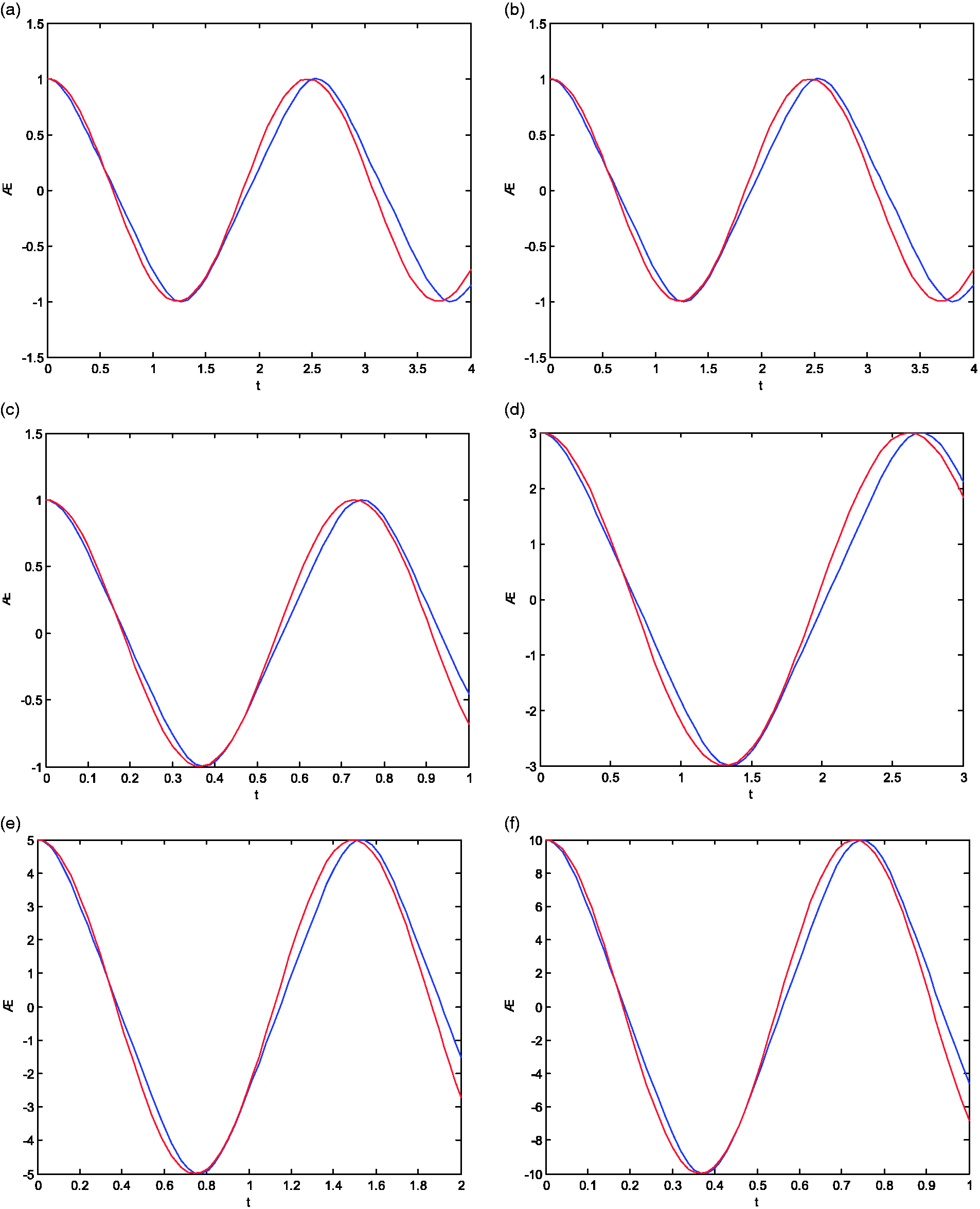
The numerical solution (the blue line) and analytical solution (the red line). (a) (A = 1, Q = 5, K2 = 1) (b) (A = 1, Q = 10, K2 = 1) (c) (A = 1, Q = 100, K2 = 1) (d) (A = 3, Q = 1, K2 = 1) (e) (A = 5, Q = 1, K2 = 1) (f) (A = 10, Q = 1, K2 = 1).
In Figure 2, we show the different α values for equation (8) when
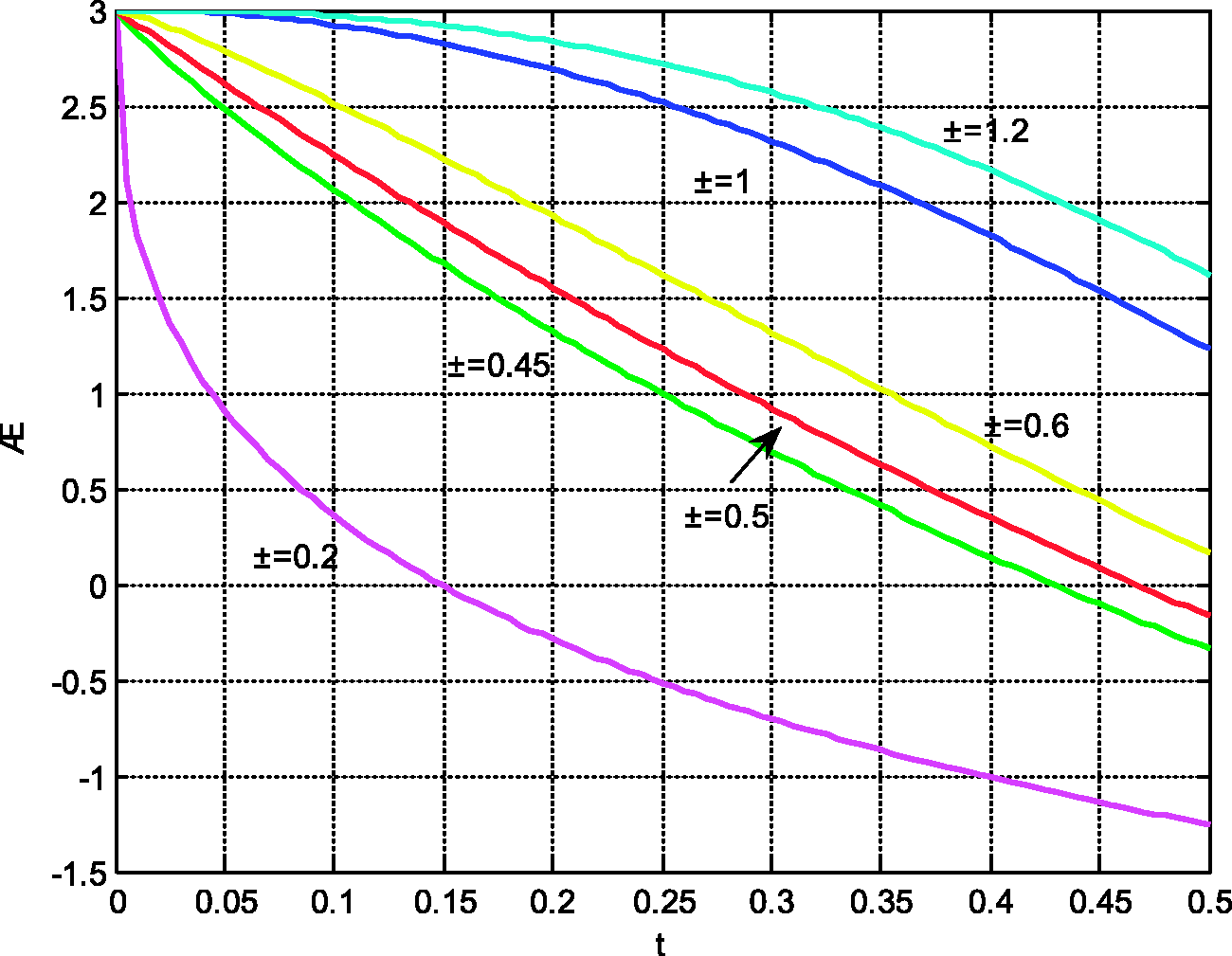
Equation (8) for different α values.
Conclusion
In this paper, the undamped Duffing equation is described by the two-scale fractal derivative in a fractal space. Its variational principle is established, and the two-scale transform method and the fractal frequency formula are adopted to find the approximate frequency of the fractal equation. The example shows He’s frequency formulation is a simple and accuracy tool to fractal oscillators.
Footnotes
Declaration of conflicting interests
The author(s) declared no potential conflicts of interest with respect to the research, authorship, and/or publication of this article.
Funding
The author(s) received no financial support for the research, authorship, and/or publication of this article.
