



Abstract
Nonlinear vibration arises everywhere in a bistable system. The bistable system has been widely applied in physics, biology, and chemistry. In this article, in order to numerically simulate a class of space fractional-order bistable system, we introduce a numerical approach based on the modified Fourier spectral method and fourth-order Runge-Kutta method. The fourth-order Runge-Kutta method is used in time, and the Fourier spectrum is used in space to approximate the solution of the space fractional-order bistable system. Numerical experiments are given to illustrate the effectiveness of this method.
Keywords
Introduction
Fractional partial differential equations are becoming widely used as a suitable modeling approach for many fields in science and engineering.1–6 We mainly study models arising in the application areas of theoretical biology, physics, and chemistry, modeled by some space fractional bistable systems

where u = u (x, y, t) and v = v (x, y, t) are unknown functions.

Many approaches are used to solve the reaction-diffusion system. These methods include the finite difference method, 7 reproducing the kernel method (RKM),8–17 variational iteration method (VIM),18–19 homotopy perturbation methods (HPM),20–22 etc.23–27 There are few numerical methods for higher order space fractional reaction-diffusion system.
In this article, in order to numerically simulate space fractional-order reaction-diffusion system, we introduce a novel numerical approach based on the modified Fourier spectral method28–30 and fourth-order Runge-Kutta method. Some pattern formations are shown by using this new approach, and the results have good agreement with theoretical results. Simulation results show the effectiveness of the method.
Bifurcation analysis of system
In this section, we give the Turing bifurcation conditions of system (1). We assume the equilibrium point of the non-diffusive system (1) is E∗ = (u0, v0), so

Now, we do linear stability analysis of the equilibrium point E∗. We evaluate the Jacobian matrix A0 of the system at E∗ as

The characteristic roots for


and

In general, if real part of eigenvalues λ1,2 (0) is negative, then the non-diffusive system (1) is stable.
Next, we derive cross-diffusion driven instability conditions and show that these are a generalization of the classical diffusion-driven instability conditions in the absence of cross-diffusion.

The characteristic roots for

where

and

Turing bifurcation occurs when the equilibrium state is stable in absence of non-diffusion but it becomes unstable in presence of cross-diffusion. Thus, the only way for the E∗ to become an unstable point of the cross-diffusion system (1) is when the real part of eigenvalues λ1,2 (k) is positive; then, the cross-diffusion system (1) is unstable.
Fourier spectral method
For any integer N > 0, consider

and the inverse formula is

It is easy to know u (x, y, t) =
For system (1) with

We use the fourth-order Runge-Kutta method to solve the ordinary differential equation (10) which is as follows
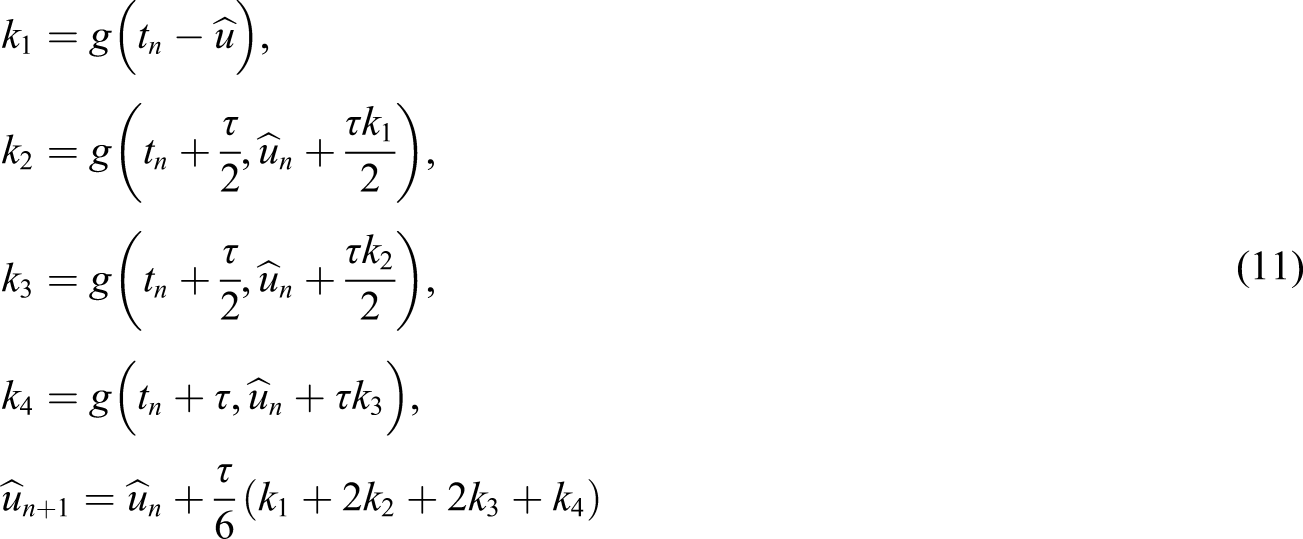

Equation (10) is reduced to
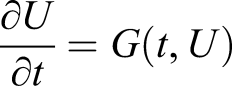
Next, we can obtain the standard fourth-order Runge-Kutta formula
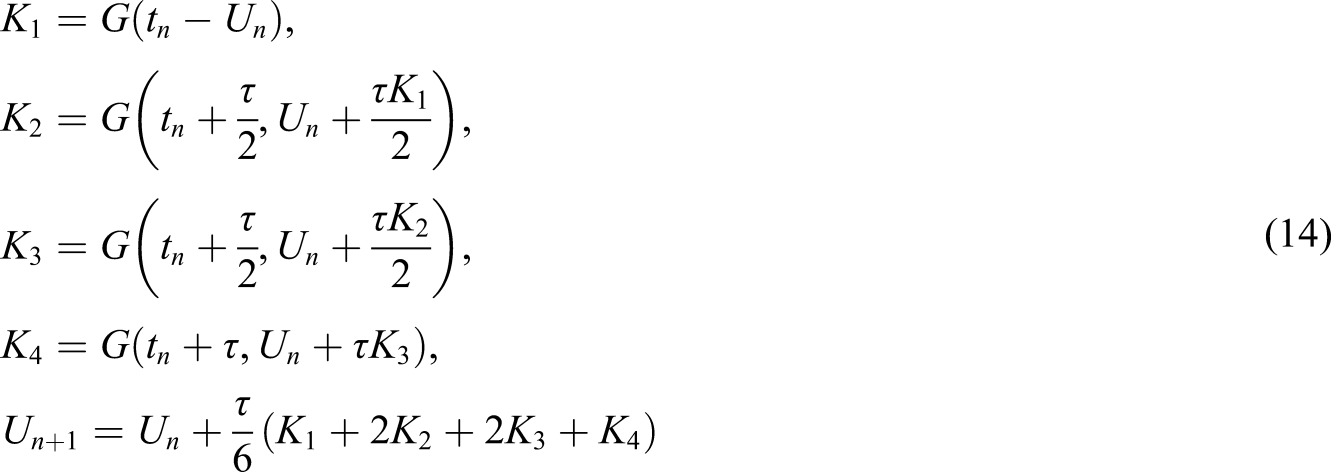
Then, we can derive that by solving the following formula
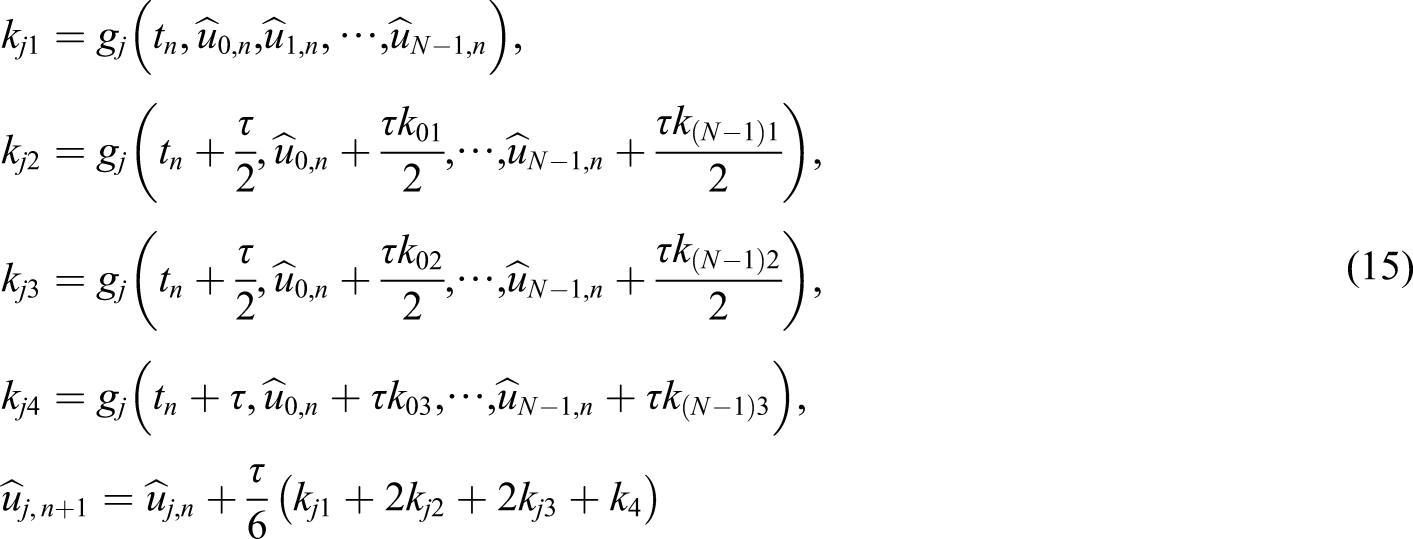
Finally, we find the numerical solution using the inverse discrete Fourier transform. 28
Numerical simulation
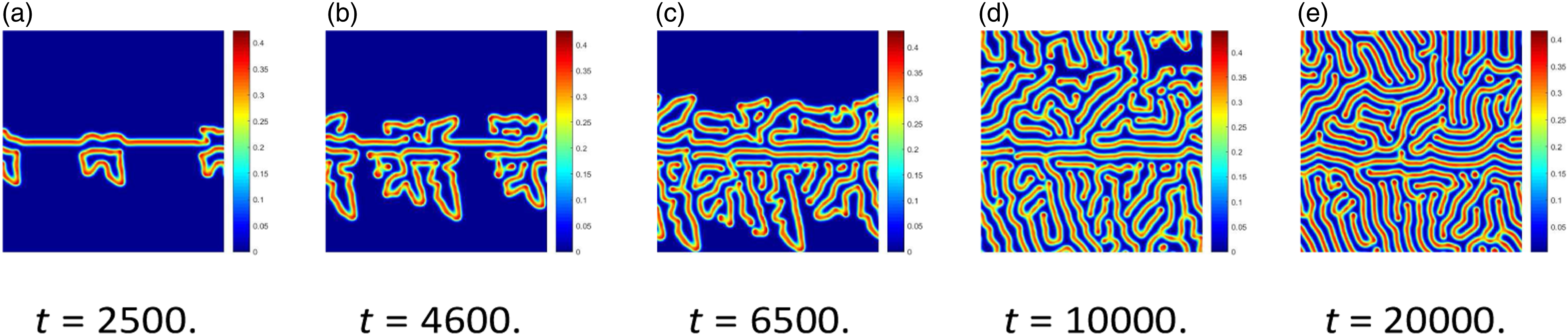
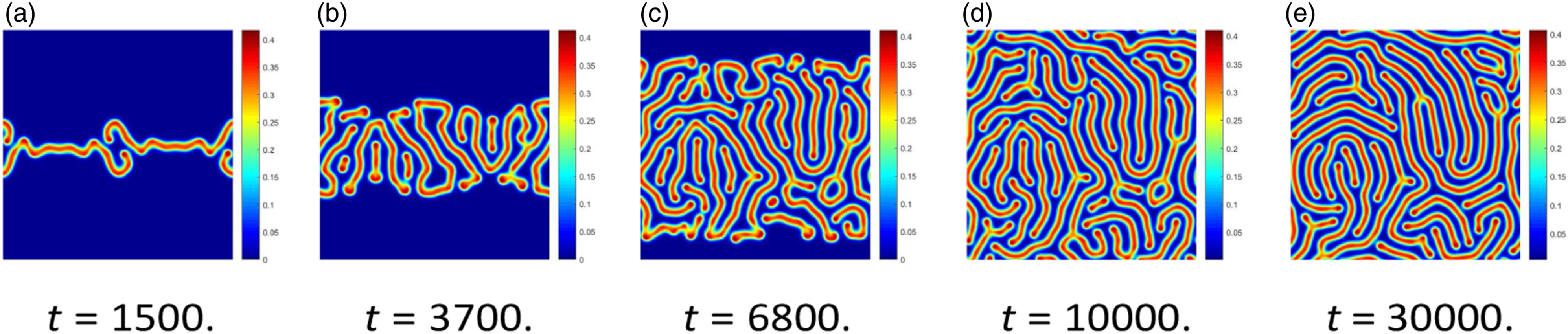
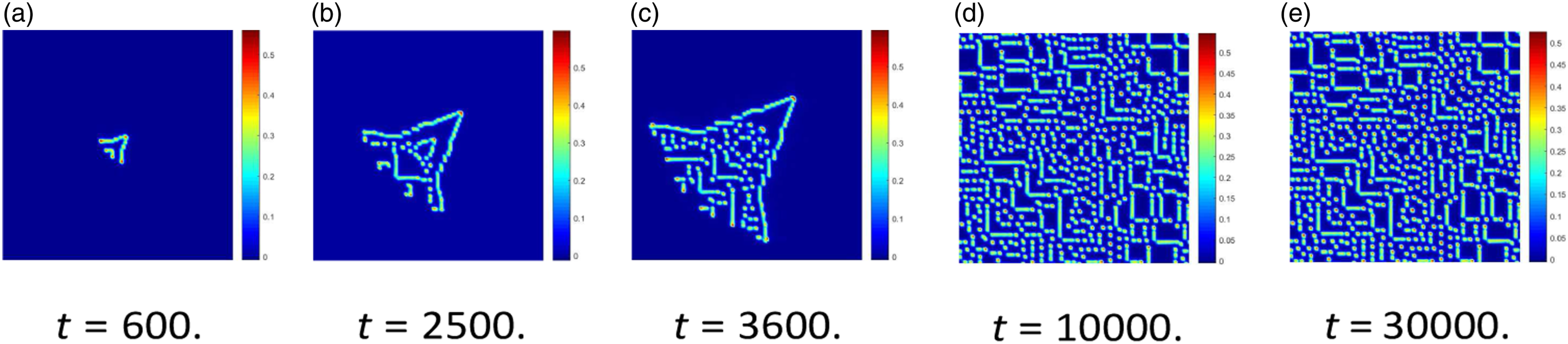
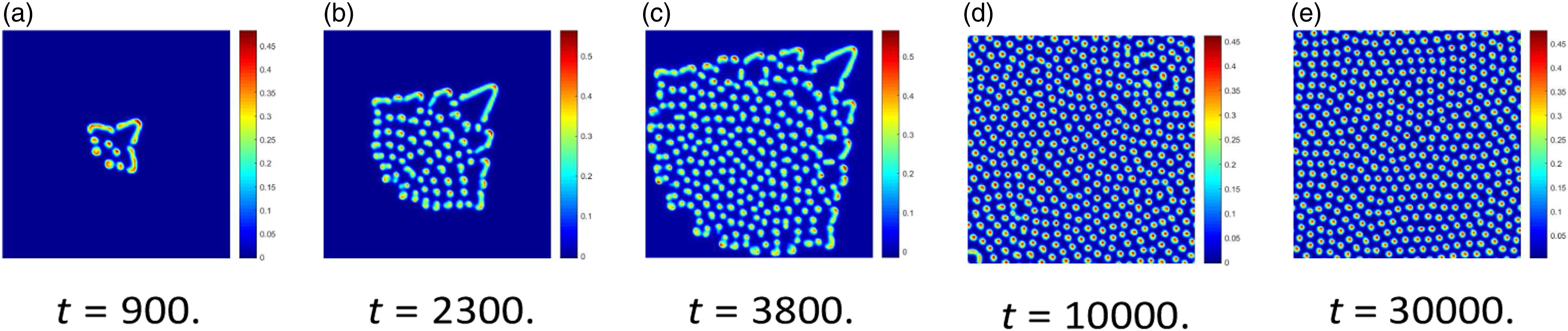
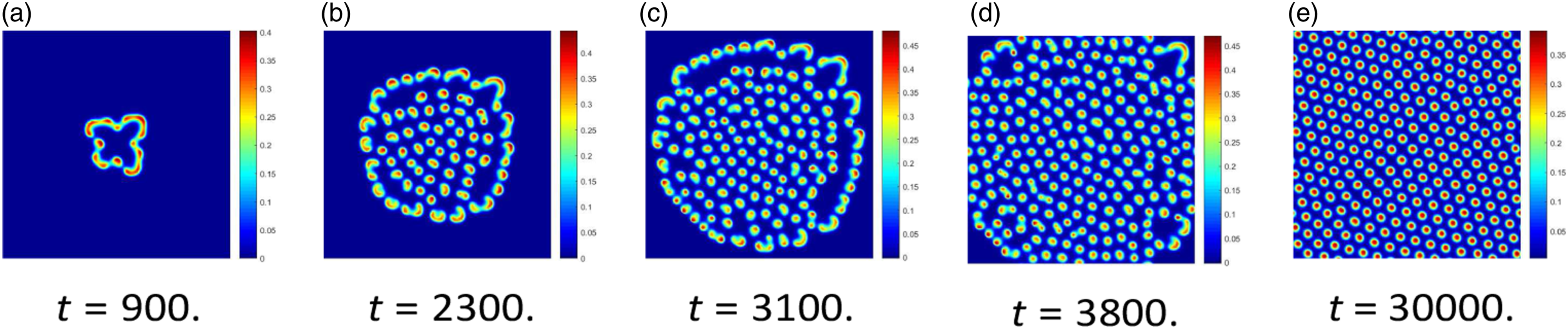
In this section, numerical simulation of the fractional Gray-Scott (GS) model with a perturbation to the spatially homogeneous steady-state equation is obtained. The domain of interest is taken to be Ω = [−1, 1]2, discretized using N = 128 points in each spatial coordinate. On account of the evolution of the numerical solution, u is similar with that of the v, but we will not present it in this article.
Numerical experiment Consider the following fractional Gray-Scott (GS)
31
model:

We take d1 = 2 × 10⁻⁵, d2 = 1 × 10⁻⁵, F = 0.045, k = 0.0625, u = ones (N), v = zeros (N), Numerical solutions at different α = 2, d1 = 2 × 10⁻⁵, F = 0.045, k = 0.0625. (a) t = 2100. (b) t = 4400. (c) t = 6700. (d) t = 10,000. (e) t = 30,000. Numerical solutions at different α = 1.9, d1 = 2 × 10⁻⁵, F = 0.045, k = 0.0625. (a) t = 2500. (b) t = 4600. (c) t = 6500. (d) t = 10,000. (e) t = 20,000. Numerical solutions at different α = 2, d1 = 2 × 10⁻⁵, F = 0.045, k = 0.0625. (a) t = 600. (b) t = 2500. (c) t = 3600. (d) t = 10,000. (e) t = 30,000. Numerical solutions at different α = 1.7, d1 = 3 × 10⁻⁵, F = 0.015, k = 0.055. (a) t = 900. (b) t = 2300. (c) t = 3800. (d) t = 10000. (e) t = 30000. Numerical solutions at different α = 1.8, d1 = 3 × 10⁻⁵, F = 0.015, k = 0.055. (a) t = 900. (b) t = 2300. (c) t = 3800. (d) t = 10,000. (e) t = 30,000 Numerical solutions at different α = 1.9, d1 = 3 × 10⁻⁵, F = 0.015, k = 0.055. (a) t = 900. (b) t = 2300. (c) t = 3100. (d) t = 3800. (e) t = 30,000.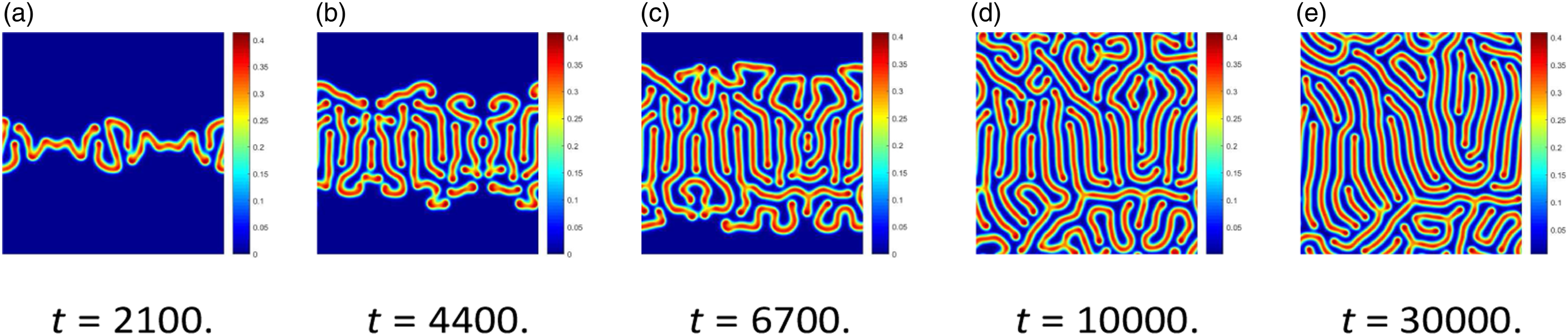
Conclusion and remarks
In the article, a numerical method that combines the Fourier spectral method with the Runge-Kutta method is proposed to study a class of space fractional bistable system. This approach has general meanings and thus can be used to solve same types of nonlinear space fractional partial differential equations with periodic boundary condition in science and engineering. Some pattern formations are shown by using this new approach, and the results have good agreement with theoretical results. Simulation results show the effectiveness of the method.
All computations are performed by the MATLABR2017b software.
Footnotes
Acknowledgments
The authors would like to express their thanks to the unknown referees for their careful reading and helpful comments.
Declaration of Conflicting Interests
The authors declared no potential conflicts of interest with respect to the research, authorship, and/or publication of this article.
Funding
The authors disclosed receipt of the following financial support for the research, authorship, and/or publication of this article: This work is supported by Inner Mongolia Natural Science Foundation under grant numbers (2021MS01009 and 2019MS07008).
