




Abstract
Sandwich structures are widely applied in modern industry such as aerospace, automobile as well as marine structures. However, the vibroacoustic properties of sandwich structures are adversely influenced by low effective mass. In this study, the flexural wave propagation characteristics and vibration mitigation performances of the periodic sandwich plate-type metastructures are investigated. The proposed sandwich plate-type metastructures are constituted of a sandwich plate with periodic thin-wall circular tube cores and periodically attached local stepped resonators. A finite element method combining Solid-Shell coupling numerical method and Bloch theory is presented to calculate the dispersion relations and the displacement fields of the eigenmodes of the infinite periodic sandwich plate-type metastructures. In addition, the acceleration frequency responses and vibration attenuation performances of finite periodic sandwich plate-type metastructures are numerically investigated and compared with the experimental measurements. Furthermore, the influences of geometric parameters on flexural wave band gaps are conducted. Results show that the sandwich plate-type metastructures can yield a low-frequency broad flexural wave band gap, in which the flexural wave propagation is conspicuously suppressed, resulting in significant flexural vibration attenuation. The flexural wave band gap and vibration attenuation performances can be effectively manipulated by designing geometric parameters of the sandwich plate-type metastructures.
Keywords
Introduction
Sandwich structures have been widely used in the field of aerospace, high-speed train, and marine structures due to their excellent mechanical performances.1-5 In addition to their mechanical properties of sandwich structures, increasing attention has been paid to vibration behaviors and sound transmission properties of sandwich structures because lightweight and stiff structures usually suffer from poor vibro-acoustic performances at low frequency resulting in adverse impact on human comfortableness.6-10 Many researchers focus on flexural vibration (out-of-plane) characteristics of sandwich structures as their multifunction in vibration and sound transmission attenuation.11-13
In recent years, the wave propagation characteristics in elastic metamaterials have attracted extensive attention owing to their sub-wavelength physical characteristics and tremendous potential application in the low-frequency vibration isolation and sound attenuation. Early studies on elastic metamaterials are mainly concentrated on the wave propagation and sub-wavelength band gap characteristics for bulk waves, where elastic metamaterials are considered infinite.14-16 In addition to the propagation characteristics of bulk wave in elastic metamaterials, extensive investigation of wave propagation and flexural vibration band gap properties in plate-type elastic metamaterial structures have been presented.17-20 Assouar et al. 21 demonstrated the enlargement of locally resonant acoustic band gap in two-dimensional phononic crystals based on a double-side stubbed plate. A significant enlargement of the relative bandwidth by a factor of 2 compared to the classical one-side stubbed plates was achieved due to the double-side configuration effect. Li et al.22,23 investigated the Lamb waves propagation characteristics in composite plate-type elastic metamaterial composed of locally resonant stubs periodically deposited on a two-dimensional binary locally resonant phononic plate. Bilal et al. 24 demonstrated the trampoline phenomenon in 3D-printed homogeneous pillared metamaterials with holes. Zhang et al. 25 studied the flexural wave band gap characteristics of two-dimensional periodic frame structures composed of locally resonant composite beam by using the spectral element method. Langfeldt and Gleine 26 investigated the vibro-acoustic behavior of membrane-type and plate-type acoustic metamaterials with non-rigid grid and demonstrated that membrane- and plate-type acoustic metamaterials can efficiently reduce low-frequency noise. Miranda et al. 27 investigated theoretically the band structure of flexural waves propagating in an elastic metamaterial thin plate based on Kirchhoff–Love thin plate theory. An experimental analysis was conducted with a real elastic metamaterial thin plate with resonators to validate the theoretical and finite element results.
Obviously, above plate-type elastic metamaterials are generally constituted of locally resonators deposited on the homogenous monolayer plate. Recently, the wave propagation characteristics and vibration behaviors of sandwich plate-type metamaterials have been paid increasing attention. Chen et al. 28 studied wave propagation in sandwich structures containing periodic cores and internal local resonators theoretically and experimentally. Wu et al. 29 theoretically investigated the vibration band gap of sandwich structures with different lattice structures by using the spectral element method. Sharma and Sun 30 adopted the phrased array method to obtain dispersion curves of a sandwich beam containing periodically inserted resonators in low-frequency range. Chen et al. 31 developed an analytical method based on transfer matrix method and Bloch theorem for a sandwich beam with periodic multiple dissipative resonators. Liu et al. 32 encapsulated stepped resonators inside the sandwich plate and studied the acoustic properties of this sandwich plate metamaterial theoretically and numerically. Li et al. 33 developed the dynamic modeling of multilayer sandwich beams with pyramidal lattice truss cores and investigated the natural frequencies of the sandwich beams with finite method and experimental tests. Song et al.34,35 numerically investigated the vibro-acoustic characteristics of a periodic sandwich plate consisting of a host plate and periodically attached resonators. Nevertheless, sandwich cores in those studies are simplified as homogeneous materials with calculated effective material constants, and the influences of the microstructures of the honeycomb cores on the vibration behaviors are neglected. In addition, the forbidden band gaps are located in the mid frequency range and the widths of band gaps are relatively narrow. Li et al. 36 proposed sandwich plate-type metastructures with thin-wall tube cores and studied the flexural wave propagation properties numerically and experimentally. The vibration suppression and acoustic performances were improved by periodic design on sandwich structures. However, the host plate of a unit cell consists of only one thin-wall tube and the starting frequency is higher than 1000 Hz. Consequently, it is still quite important to investigate the low-frequency band gap and vibration attenuation properties of sandwich metastructures to improve the engineering application of vibration and sound control.
In the present work, we investigate the flexural wave propagation and vibration attenuation performances of periodic sandwich metastructures consisting of a sandwich plate with periodic thin-wall circular tube cores and periodic stepped resonators. Dispersion relations and displacement fields of eigenmodes are calculated by using efficient finite element method combining Solid-Shell coupling method with Bloch boundary conditions. Experimental measurement of the acceleration frequency responses is carried out to validate the accuracy of Solid-Shell coupling numerical method. Finally, the effects of geometrical parameters of sandwich structures and local resonators on flexural wave band gaps are discussed.
Physics model and calculation method
The sandwich plate-type metastructures considered here are constituted of a sandwich plate with periodic thin-wall circular tube cores and periodically attached local stepped resonators. Figure 1(a) illustrates the schematic of the proposed sandwich plate-type metastructures periodically along x-direction and y-direction. The z-axis is perpendicular to the sandwich plate and parallel to the periodic stubs axis. Figure 1(b) shows the unit cell of the proposed sandwich metastructures which is constructed by depositing stepped resonators squarely onto the surface of a sandwich plate with 5 × 5 thin-wall circular tube cores. The local stepped resonator is composed of a rubber layer and a steel stub. As shown in Figure 1(c), the lattice constant and the face sheet thickness of sandwich plate are denoted by a and e, respectively. The inner diameter, the outer diameter, and the height of thin-wall circular tube are defined as d1, d2, and H, respectively. The heights of the steel stub and rubber layer are h1 and h2, while the length and width of the steel stub and rubber layer along x and y directions are defined as D. Schematic view of sandwich plate-type metastructures: (a) 4×4 finite periodic sandwich plate-type metastructures; (b) unit cell of periodic sandwich plate-type metastructures; and (c) two-dimensional geometric sketch of the unit cell of sandwich plate-type metastructures.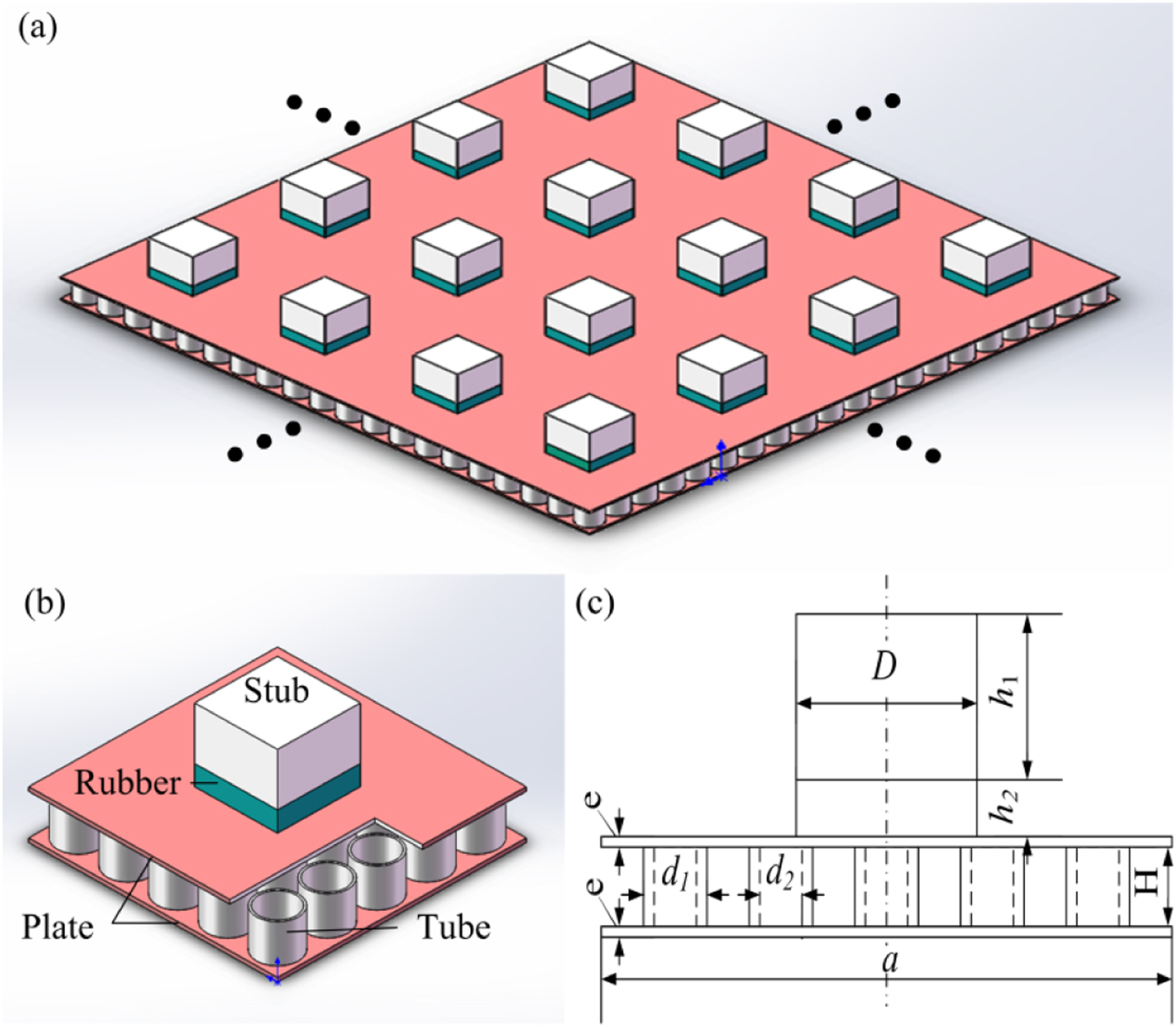
To theoretically study the flexural wave propagation and vibration mitigation characteristics of the proposed sandwich plate-type metastructures, an efficient finite element method is presented to calculate the dispersion relations and transmission spectra. For the elastic wave propagation in solid structures, the wave equations can be written as

In an attempt to calculate the dispersion relations and displacement fields of the eigenmodes, only one representative unit cell of the proposed sandwich plate-type metastructures needs to be employed owing to spatial symmetry and translational periodicity according to energy-band theory and solid lattice theory. Since the local stepped resonators are solid structures and the thin-wall facesheets as well as periodic thin-wall tube cores are typically thin-wall shell structures, the three-dimensional Structural Mechanics Module with Solid-Shell coupling Application Mode in commercial software COMSOL Multiphysics is employed to solve the wave equation. The local stepped resonators are built as solid structures by using the Lagrange-Quadratic element type in the Solid Stress–Strain Application Mode. Besides, the sandwich plate with periodic thin-wall tube cores is established as shell structures in the Shell Application Mode. The thicknesses as well as the material properties of the shell structures should been further defined, and the shell element type needs to been chosen as Argyris shell. In addition, stress-free boundary conditions are applied for free surfaces and edges, and periodic boundary condition with Bloch theory is applied at the edges of the sandwich plates

During our numerical calculation of dispersion relations, eigenfrequency analysis and direct SPOOLES linear system solver in Solid-Shell coupling Application Mode are chosen. Hermitian transposition matrix should be activated in the advanced solver parameter settings. Dispersion relations are constituted by eigenfrequencies and corresponding Bloch wave vectors. A series of eigenfrequencies and eigenmodes can be obtained, and the dispersion relations can be achieved by sweeping the reduced Bloch wave vector along the boundary of the irreducible Brillouin zone.

Geometric parameters of proposed metastructures.

Results and discussions
Material physical parameters.

Figure 2(a) displays the calculated dispersion relations for the infinite periodic sandwich plate-type metastructures by using the presented finite element method combination with Solid-Shell coupling analysis. It can be observed that there are six bands in the dispersion relations. The three bands originating from Г point represent transversal wave (T) plate mode, longitudinal wave (S) plate mode, and shear wave (SH) plate mode, respectively. With the introduction of the local resonators, flat bands appear. One complete band gap occurs in the dispersion relations in the range from 352 Hz–485 Hz. In addition, the sound radiation of sandwich structures is mainly generated by the flexural vibration of plate structures, the flexural wave propagation and vibration band gap characteristics should be paid much attention. We can find that broad flexural wave band gap appears in the range of 246 Hz–1067 Hz as shown in the shadow area, which means the flexural wave cannot propagate in the proposed sandwich metastructures in the frequency range. The flexural wave band gap is located about two orders lower than Bragg scattering band gaps. (a) Dispersion relations of sandwich plate-type metastructures and (b) the flexural vibration transmission spectrum of finite periodic sandwich plate-type metastructures.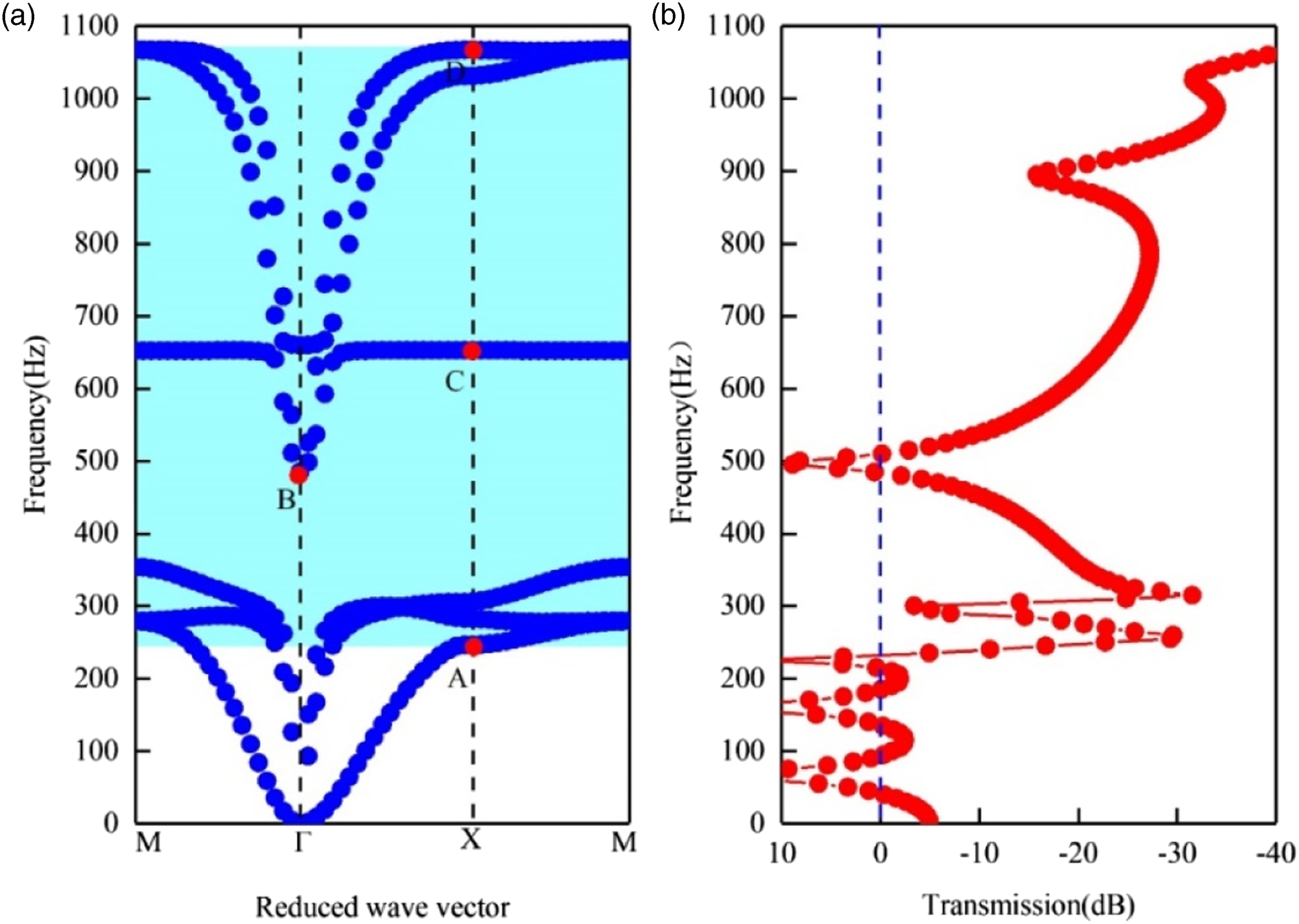
In an attempt to further demonstrate the existence of low-frequency flexural vibration band gap and investigate the flexural vibration mitigation performances, acceleration frequency response of finite periodic sandwich plate-type metastructures along ГX direction is calculated as shown in Figure 2(b). Due to the cell number perpendicular to the ГX direction has a small impact on the acceleration frequency response, the finite periodic sandwich plate-type metastructures have 4 unit cells along ГX direction and 1 unit cell in the vertical direction. It can be found that significant attenuation zone in the flexural vibration frequency response is visible in the frequency range of 0–1100 Hz. The flexural vibration transmission spectrum is in good agreement with the dispersion relations.
To profoundly reveal the physical mechanisms of the flexural wave band gap and vibration mitigation performances in the proposed periodic sandwich plate-type metastructures, the displacement fields of several special eigenmodes (A–D labeled in Figure 2(a)) are calculated as illustrated in Figure 3. First, the eigenmodes A and D in Figure 3(a) and (d) corresponding to lower and upper edges of flexural vibration band gap are discussed. For eigenmodes A and D, the bending vibration around y-axis of stepped resonator and the transverse vibration of sandwich plate are coupled. The displacement field of eigenmodes B as shown in Figure 3(b) indicates that the stepped resonator manifests a bending vibration opposite to the displacement of the sandwich plate. The sandwich plate moves along diagonal direction in x-y plane. Figure 3(c) reveals that in eigenmodes C, torsional vibration around z-axis of stepped resonator occurs while the edges of sandwich plate keep stationary. In conclusion, the flexural vibration band gap is mainly dependent on the coupling between local resonant modes of the stepped resonator and the flexural vibration traveling modes in sandwich plate. Displacement fields of eigenmodes of sandwich plate-type metastructures and the flexural vibration mitigation of finite sandwich metastructures at specific frequencies.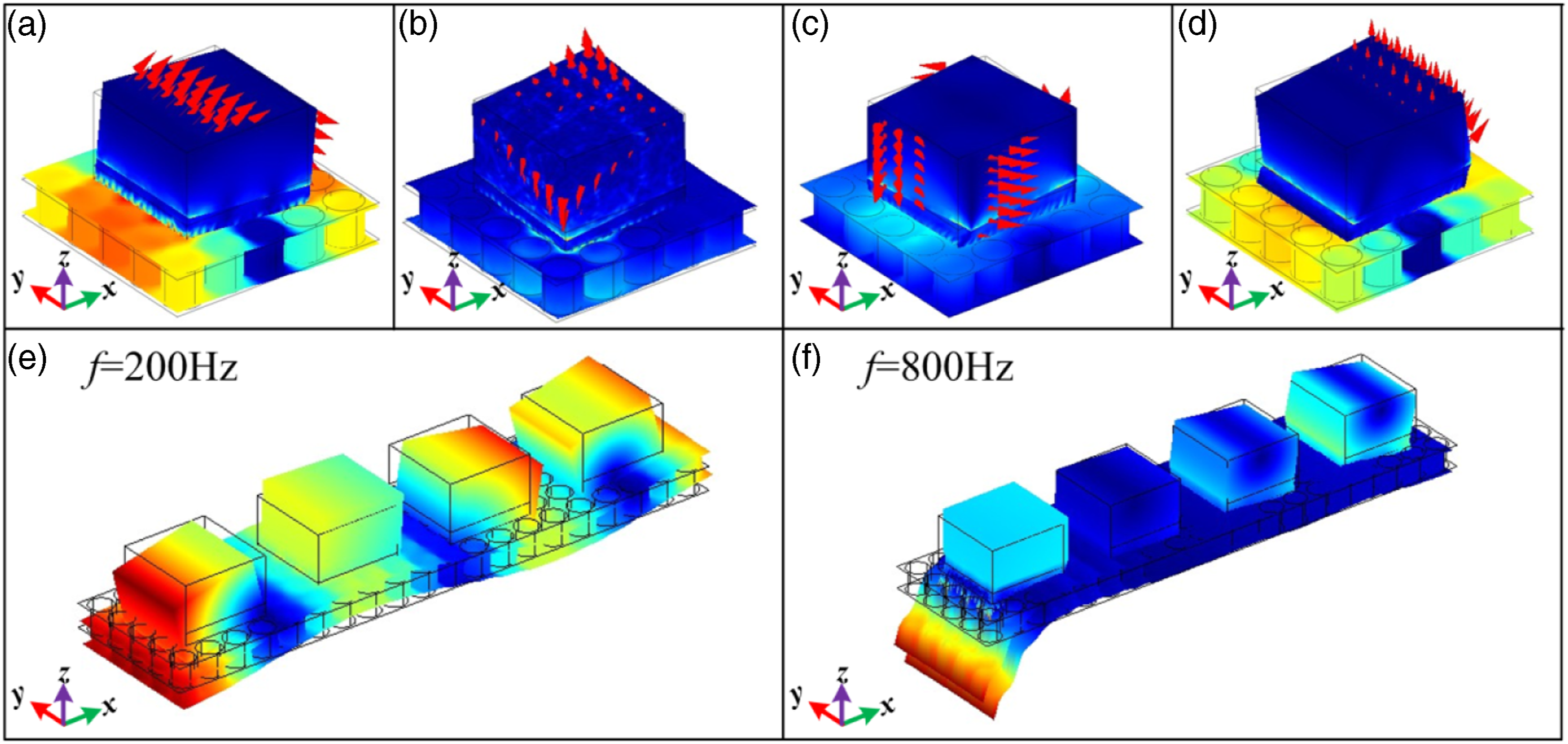
In order to further intuitively illustrate the flexural vibration mitigation performance of proposed sandwich metastructures, Figure 3(e) and (f), respectively, display the frequency response of finite periodic metastructures with incident excitation in 200 Hz and 800 Hz. It can be found that the flexural vibration wave outside the flexural vibration band gap can effectively propagate along x-direction in proposed metastructures. On the contrary, the flexural vibration wave propagation in the flexural vibration band gap range is significantly prohibited.
Experimental validation
To demonstrate the flexural wave band gap and vibration mitigation characteristics, the experimental measurements of flexural vibration responses of finite periodic sandwich plate-type metastructures were conducted. The schematic diagram of experimental measurement is depicted in Figure 4(a). The vibration measurement system was constituted of vibration exciter, power amplifier, piezoelectric crystal accelerometers as well as computer data system. On the basis of the schematic diagram, the vibration measurements of the proposed finite array sandwich metastructures were conducted. The fabricated sample is composed of 4 unit cells in x-direction and one unit cell in y-direction as shown in Figure 4(b). (a) Schematic diagram of experiment and (b) setup of the experimental measurement.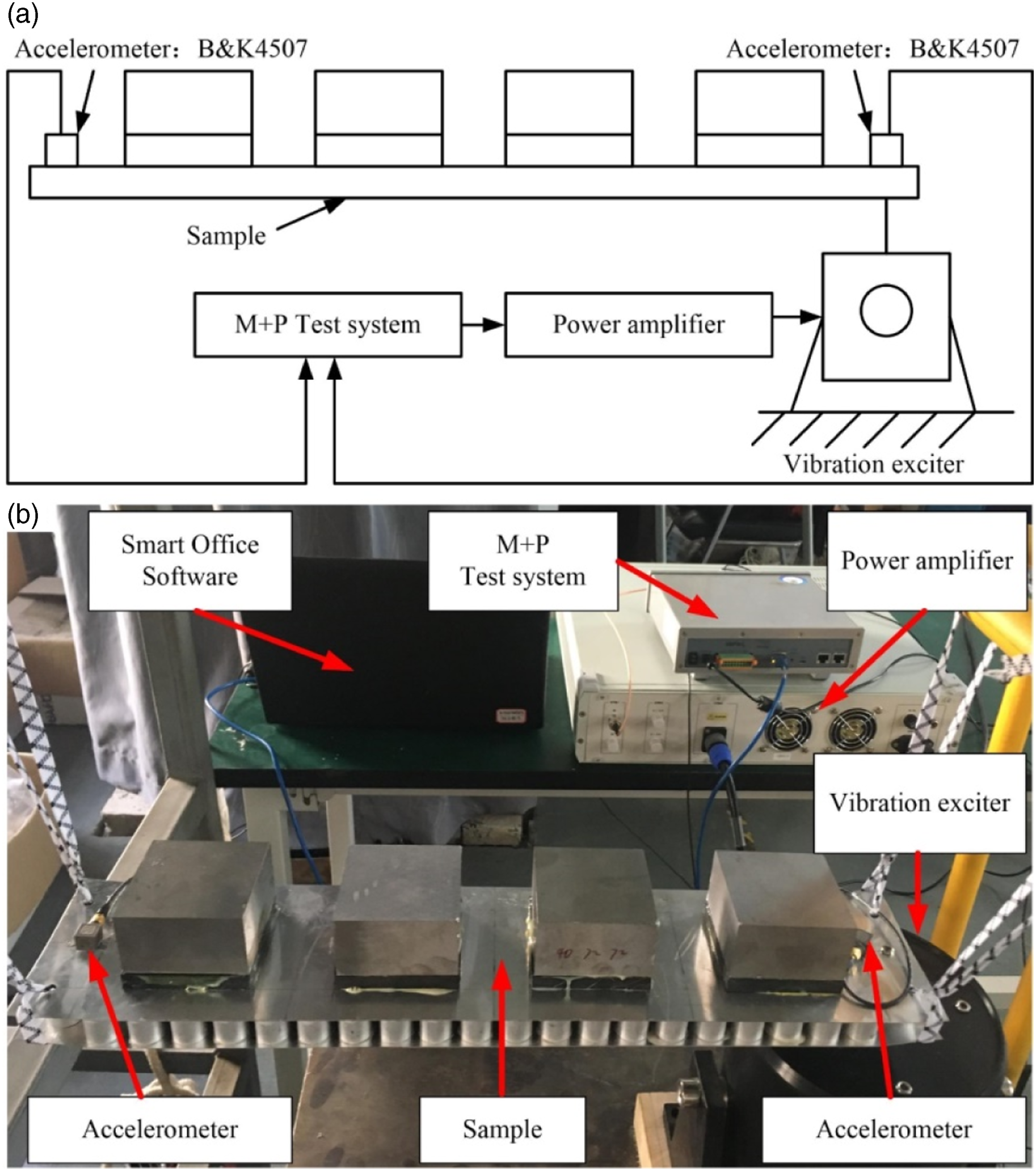
The geometry and material parameters of the sample are consistent with those of numerical model in finite element method. The components of the metastructures are connected by superglue to guarantee the accuracy of location with each other. In this experiment, the sample hangs by elastic ropes for free boundary condition. The measurement machines are set up based on experimental measurement diagram. One B&K accelerometer is placed on acceleration excitation point to detect the incident acceleration signal, and the other one is placed on the end of opposite side to test the acceleration transmission response. M+P test system and power amplify are used for signal controlling and experimental data collection. Vibration exciter can generate a white-noise random signal with frequency range from 0 to 1200 Hz by controlling M + P test system with smart office software. The vibration amplitude can be manipulated by power amplifier. The frequency responses of the test sample can be obtained through signal processing and spectra analysis.
Figure 5 shows the comparison between experimental and numerical results of acceleration frequency responses. It is obvious that two experimental results are almost coincident, which means the repeatability of the experiment is satisfactory. In addition, there is a significant vibration attenuation zone in the band gap frequency range according to experimental result, which is generally consistent with the numerical transmission spectrum. The disagreements between experimental and numerical results are probably attributed to the superglue in test sample and material damping effect as well as machining or assembly errors. Consequently, it can be concluded that the proposed sandwich plate-type elastic metastructures with periodic thin-wall tube cores can yield large flexural wave band gaps, resulting in significant flexural vibration mitigation performance in the low-frequency region. Transmission spectra of the test sample and the numerical model.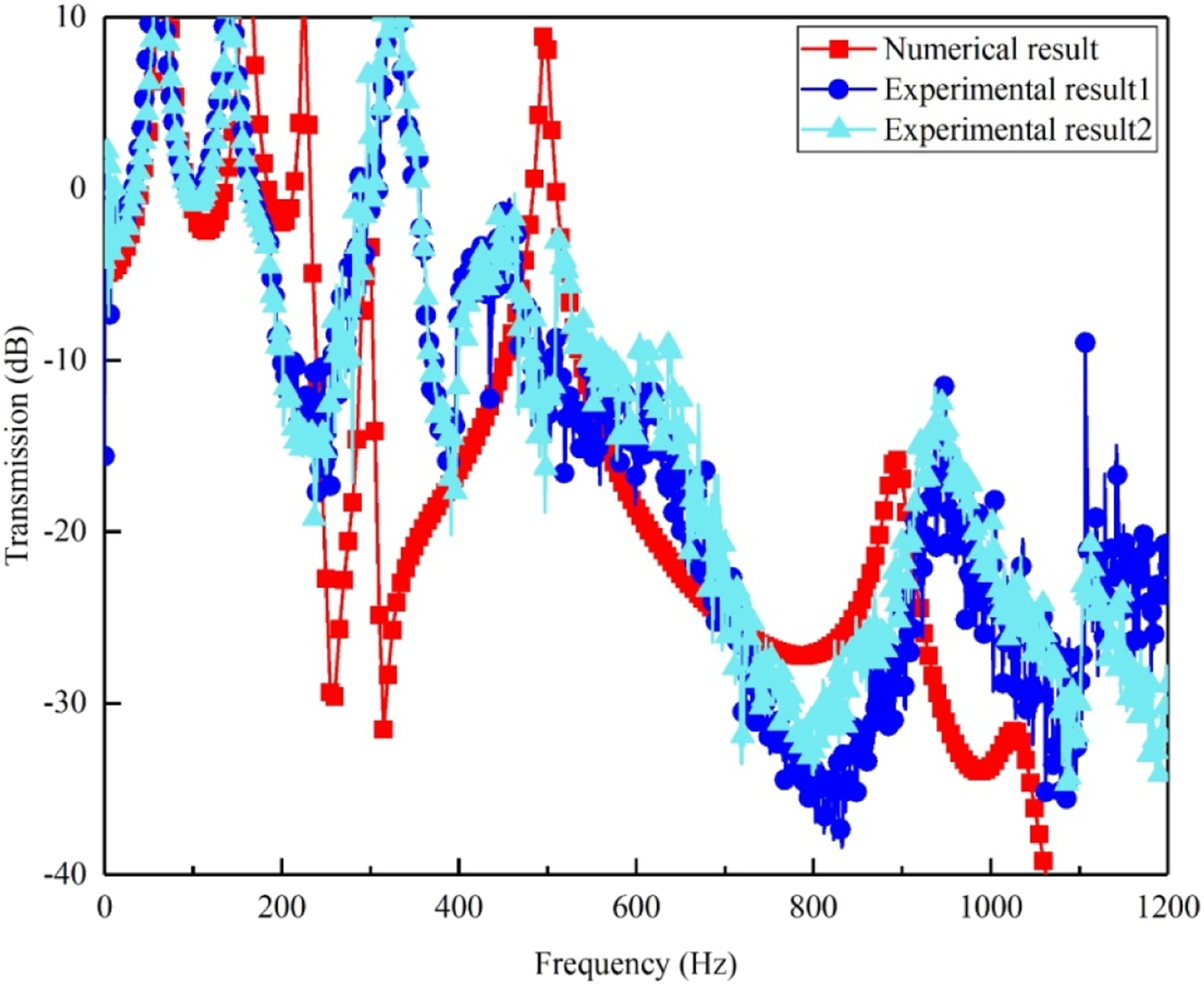
Parameter study
To investigate the effects of geometry parameters on the flexural vibration band gaps, some dispersion relation calculations are conducted. During our calculations, only one geometry parameter changes and the other parameters remain unchanged. The effects of geometry parameters on the flexural vibration band gaps are depicted in Figure 6. The lower edges of band gaps represent by green line with square point and the upper edges are drawn as pink lines with circle point. Effects of the geometry parameters on flexural vibration band gap. (a) Plate thickness; (b) tube thickness; (c) tube diameter; (d) tube height; (e) stub height; and (f) rubber height.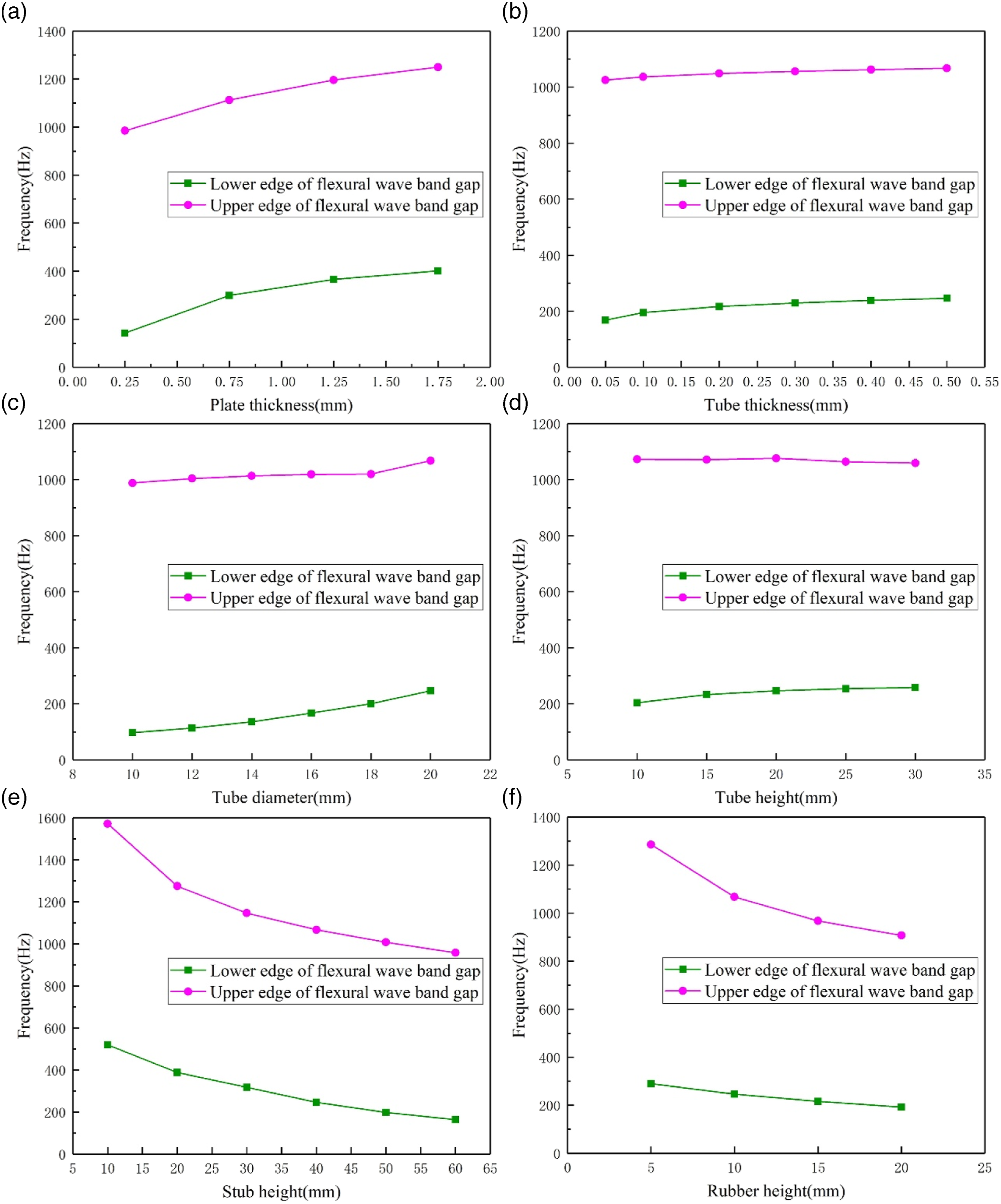
We can find from Figure 6(a) that the lower and upper edges climb steadily from 985 Hz–1250 Hz and 142 Hz–402 Hz, respectively, as the increase of plate thickness because the equivalent stiffness increases. As shown in Figures 6(b) and (c), the lower and upper edges are around 200 Hz and 1000 Hz and both trend upward slightly as the tube thickness and diameter going rising from 0.05 mm to 0.5 mm and from 10 mm to 20 mm, respectively. However, both lower edges shift quickly than the upper edges. Figure 6(d) displays that the upper edge remains flat as the lower edge ascending slowly with the increase of tube height, which resulting in the bandwidth decrease from 868 Hz–801 Hz. It can be observed in Figure 6(e) and (f) that the lower and upper edges shift to low-frequency region while the stub height and rubber height increasing with the bandwidth almost unchanging. It can be observed from Figure 6 that the flexural vibration band gaps are more sensitive to the sandwich plate thickness except for the height of resonators. Consequently, the flexural vibration band gap can be tunable by improvement design of geometry parameters of proposed metastructures, which would be helpful in the engineering application.
Conclusion
In this study, the flexural wave propagation characteristics and vibration mitigation performances of periodic sandwich plate-type metastructures composed of periodic stepped resonators attached on a sandwich plate with periodic thin-wall tube cores are studied numerically and experimentally. Based on the combination of Solid-Shell coupling numerical method and Bloch theory, the dispersion relations, the flexural vibration transmission spectrum, and the displacements fields of eigenmodes are calculated. To further validate the reliability of Solid-Shell coupling numerical method, experimental measurement of acceleration frequency responses of finite periodic metastructures was conducted. The results show the existence of broad flexural wave band gaps in the proposed sandwich plate-type metastructures. The formation mechanisms of flexural vibration band gaps as well as the influences of geometry parameters are further explored. The low-frequency broad flexural vibration band gap in the proposed metastructures is mainly attributed to the coupling between local resonant modes of the stepped resonator and the flexural vibration traveling modes in sandwich plate. It is shown that the flexural wave band gap can be well tuned to control the flexural wave speed and vibration mitigation by choosing proper geometry parameters of the metastructures. The research of the present work could provide an effective way to achieve broadband flexural wave band gap in low-frequency range, which is of great importance on noise and vibration reduction in engineering application.
Footnotes
Declaration of conflicting interests
The author(s) declared no potential conflicts of interest with respect to the research, authorship, and/or publication of this article.
Funding
The author(s) disclosed receipt of the following financial support for the research, authorship, and/or publication of this article: The authors gratefully acknowledge financial support from the project of National Natural Science Foundation of China (Grant Nos. 11972269 and 11602182), and the State Key Laboratory for Strength and Vibration of Mechanical Structures (No. SV2019-KF-21).
