




Abstract
A fractional model for the release oscillation of silver ions from hollow fibers was established recently, this paper gives an experimental verification of the release property, showing the concentration of the released ions increases exponentially at initial stage and it becomes stable when the time tends to a threshold, as predicted by the fractional oscillator.
Introduction
Antibacterial silver ions play a great role in the medical dressing; however, the higher concentration of the silver ions could be harmful to the cell.1,2 As a result, the concentration of silver ion is an important factor on antimicrobial properties. The hollow fiber could be produced by various methods, the most advanced one is the bubble electrospinning.3–11 In the paper, the Ag/PET hollow fiber was prepared by the silver mirror reaction with a pressure difference. 12 The silver particles, which are adhered to the inner wall of the fiber, are avoided to contact with skin directly. In an aqueous solution, silver ions can be released from both ends of the fibers, and the concentration should be less than a critical value, beyond which it will be harmful. 13 It is, therefore, important to find an optimal concentration of silver ions. 14 Recently, Liu et al. suggested a fractional model for silver ions from hollow fibers, 15 this paper gave an experimental study on the model.
Experimental verification of the fractional model
Figure 1 shows the diagram of the Ag/PET hollow fiber. The silver particles are attached to the inner wall of the fibers and distributed evenly. Silver ions will be released from the ends of the hollow fiber when it is immersed in water; however, the release law is not clear yet, because it does not follow the any continuum models.
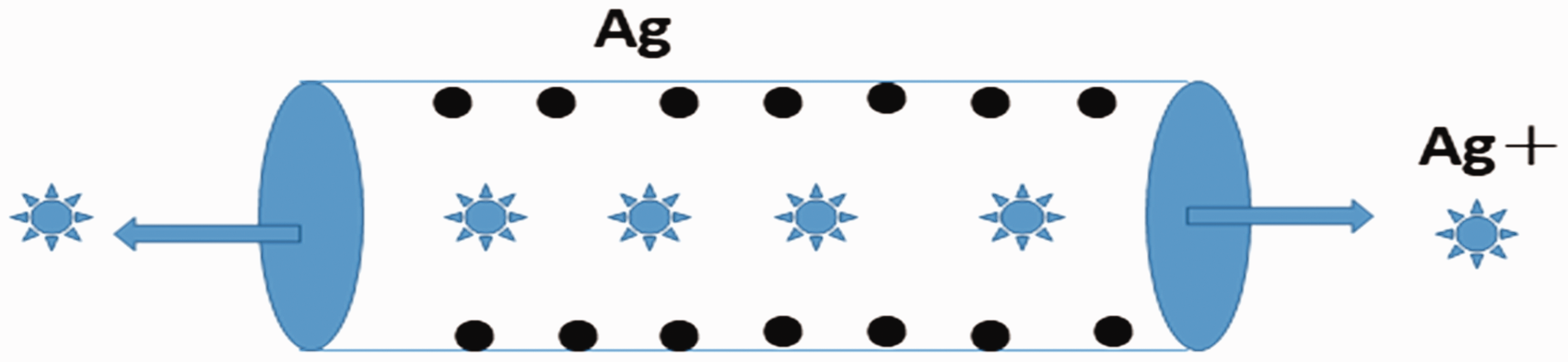
Diagram of the silver hollow fiber with silver ions on its inner surface.
The experimental results showed that the silver ions in the solution can be expressed as

The above equation shows that the concentration of silver ions (y(t)) increases exponentially in the release process of the silver from the Ag/PET hollow fiber. It is approaching the saturation concentration (ys) when time tends to infinity.
For the study of the silver release behavior, 10 g Ag/PET hollow fiber with the 38 mm length was used as a sample which was soaked in glass vials with 2 L deionized water. The fibrous mats were incubated at 37°C. At various periods (0, 8, 16, 24, 48, 72, 168 and 360 h, respectively), 5 mL of supernatant was retrieved from the vial and an equal volume of fresh medium was replaced. The concentrations of silver ions were measured by ICP-AS under optimal measurement conditions. All the results in this part of experiments were the mean values of three determinations.
The test data were shown in Figure 2, and the fitting equation was obtained as follows

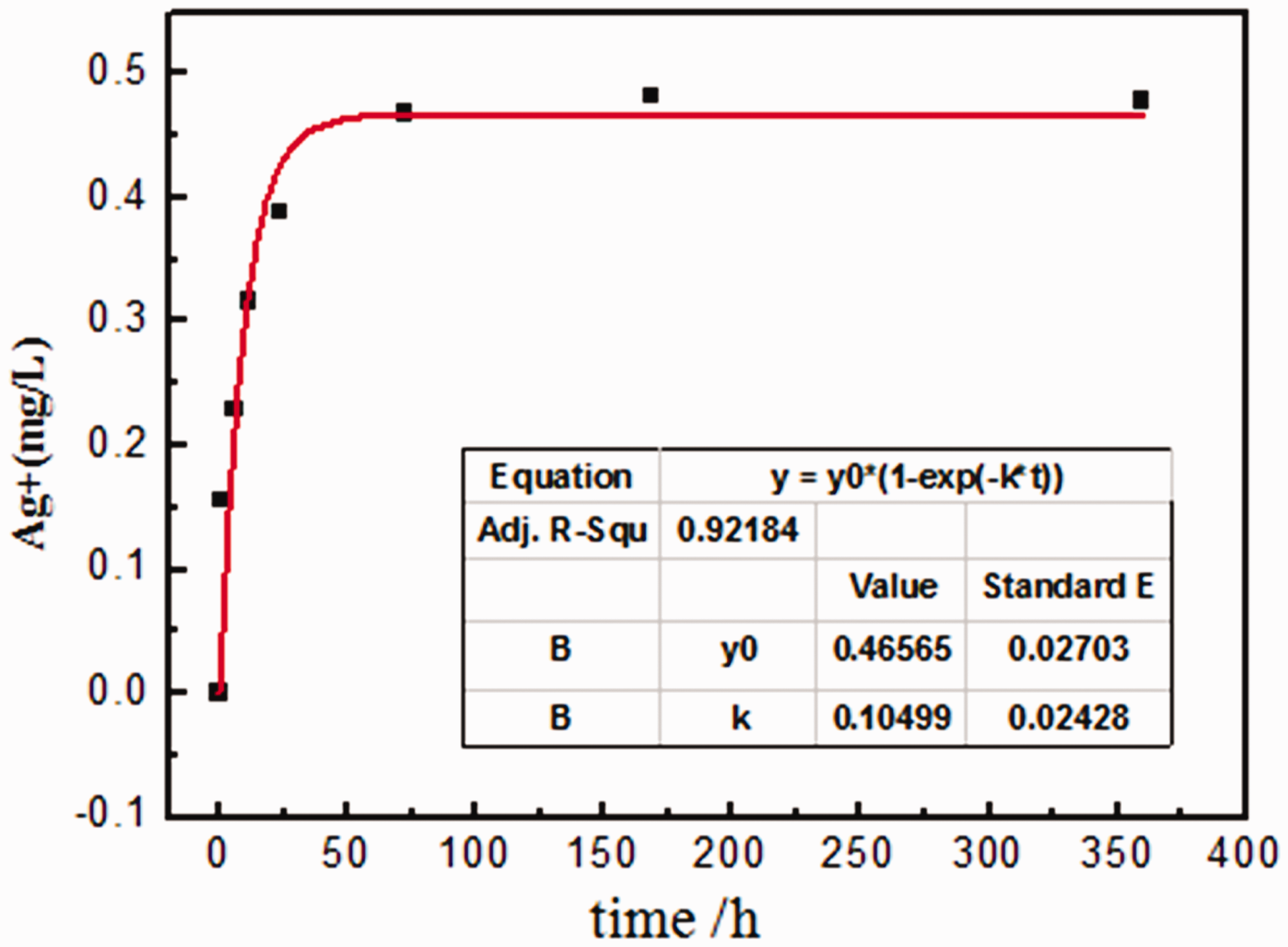
In vitro release behavior of incorporated silver ions.
Fractional oscillator for ion release
In order to elucidate the fractional oscillation property of ion release from the hollow fiber, we consider a hollow fiber in water as illustrated in Figure 3.
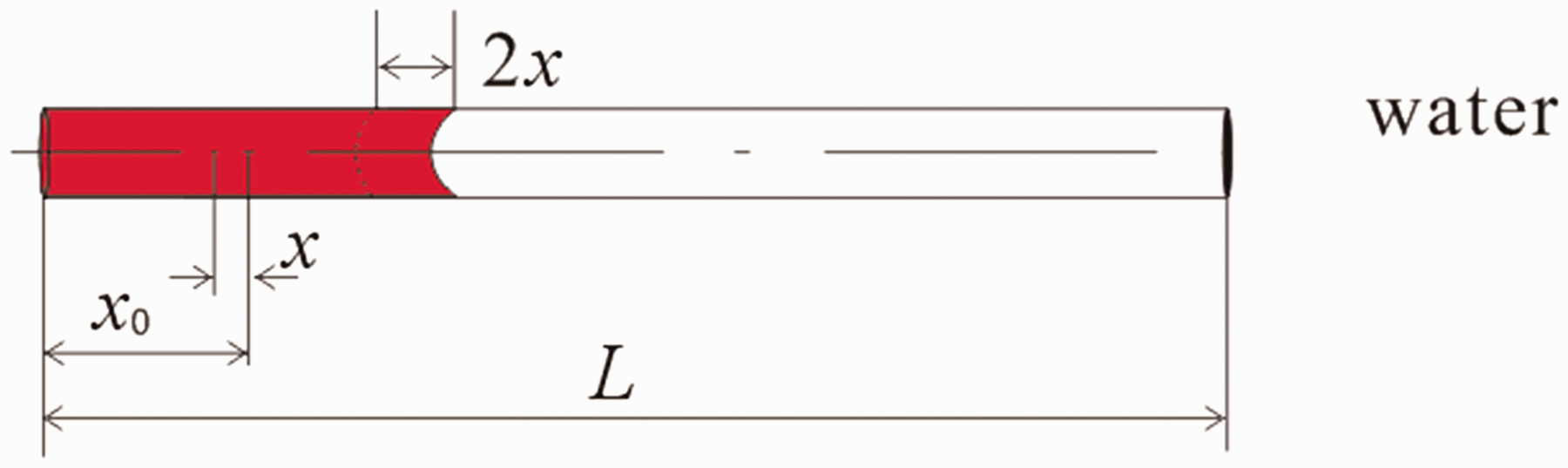
A fractional oscillator in a hollow fiber, where
According to Newton’s second law in a fractal space, the free oscillation of the fluid in the hollow fiber can be written as16–20


We assume that the amplitude is A, the solution of the fractional oscillator can be solved by the fractional homotopy perturbation method21,28,29

To show the fractional law of the ion release, we study the initial stage of ion release. The first and second derivatives of x read


Considering α < 1, we have


This property is exactly illustrated in Figure 2.
Conclusions
This paper shows the primary property of the ion-release from a hollow fiber: the release is extremely fast at initial stage, and it becomes remarkably slow after a threshold time. The property of the fractional oscillator can be effectively applied to the optimization of hollow fibers containing ions. This property can be best modeled by the fractional calculus.16–20
Footnotes
Declaration of conflicting interests
The author(s) declared no potential conflicts of interest with respect to the research, authorship, and/or publication of this article.
Funding
The author(s) received no financial support for the research, authorship, and/or publication of this article.