




Abstract
This article proposes an artillery structural dynamic response optimization method based on the Stackelberg game theory. The artillery multi-flexible body dynamic model is constructed firstly, and the live firing experiment is carried out to verify the accuracy of the constructed model. The multi-objective optimization model of artillery structural dynamic responses is established, and the sensitivity analysis and fuzzy c-means cluster algorithm are used to split the design variable set and, more importantly, transform the optimization model into a two-leader-one-follower Stackelberg game model. The process of solving Stackelberg equilibrium is a bi-level optimization, where the two leaders play a Nash sub-game first and impose the decision to the follower and then the follower makes its own optimization with considering this decision. Until the leaders cannot obtain more profits, the Stackelberg equilibrium is reached. The results demonstrate that the artillery structural dynamic responses have been greatly improved.
Keywords
Introduction
Artillery is a super-powered mechanical system that uses gunpowder as its energy source. The huge pressure generated by the burning of gunpowder not only represents the power of the artillery but also the reason for the dynamic response of the artillery structure. The structural dynamic response, which directly affects the firing accuracy of artillery, mainly includes muzzle vibration and carriage body vibration. Therefore, the structural dynamic responses are the core performance of the artillery weapon system. Optimization is an important technical means to improve the performance of artillery. Obviously, the optimization of artillery structural dynamic responses is a complex multidisciplinary multi-objective problem. For complex multi-objective optimization problems, computation consumption and complex organization are the two biggest bottlenecks. 1 There are three approaches to solve the multi-objective optimization problem, at present. The first approach is the weighting method in which the multiple objectives are aggregated into a single objective with different weights. However, when dealing with many independent objectives, the weight allocation is rather difficult and usually full of arbitrariness, so it is rarely applied in artillery system optimization.
The second approach is the Pareto-based evolutionary algorithm (EA) which is the most popular method in engineering practice. The Pareto front can provide detailed information to decision maker. Yang and Xiao 2 utilized the radial basis function-back propagation neural (RBF-BP series combine) network surrogate model and the non-dominated sorting genetic algorithm (NSGA-II) to optimize the firing accuracy and stability of artillery. Esen and Koc 3 proposed a new passive vibration absorber and used the genetic algorithm (GA) to optimize the outer and inner diameter of the mass block of the absorber. Wang and Yang4 utilized the stochastic programming method and NSGA-II to optimize the overall ballistics of artillery. Li and Zhang 5 optimized the interior ballistic performance of the artillery by using the NSGA-II. In the field of artillery structural dynamic response optimization, Wang et al.6, 7 have carried out tremendous effective works combined with the GA and interval method. Although the Pareto-based evolutionary method has excellent robustness in front of the convex or non-convex problem, it still has many drawbacks. 8 Such as the convergence of EA is very time-consuming, the individuals in the Pareto front have no hierarchy between each other and the poor performance when dealing with complex high dimensional multi-objective problems. 9
The third approach is the non-cooperative game theory–based method10,11 which is suitable to overcome the bottlenecks of multi-objective optimization problems. The most famous non-cooperative game theory is the Nash game proposed by John Nash in the 1950s. In the Nash game, the players make decisions independently, without any communication with each other to make his profit to be maximum. Nash equilibrium (NE) is the core concept of Nash game, in which each player cannot further get more profits due to the constraint of the other players’ decisions. Over the past decades, the Nash game theory has been widely used in various fields, such as control,12, 13 market,14–16 water management, 17 and multi-objective optimization.18–21 In the Nash game optimization method, all the players are equivalent to each other. However, in many practical engineering problems, the objective functions are not equally important. In other words, there is a hierarchical relationship between the objective functions. For instance, in artillery systems, fire precision and power are the most important index and have a higher priority than other technical indexes.
For this hierarchical multi-objective optimization problem, the Stackelberg game theory is very suitable. As a hierarchical game model, the players in the Stackelberg game are divided into leader and follower. The leader who has a strong position makes the decision first and the follower must accept and consider the leader’s decision when making their own decisions. In a standard Stackelberg game, there are two players, a leader and a follower. In addition, the Stackelberg game can also be extended to multiple players, where the leaders (followers) play a sub-game with each other. Wang and Zheng 22 utilized the Stackelberg/adjoint method to perform the aerodynamic shape optimization and found that the iteration number, the splitting of design variable set, and the allocation strategies of players have a significant impact on the result of Stackelberg equilibrium. Tang 23 solved the multi-objective shape optimization problem of hypersonic air-breathing vehicle by employing the multi-leader–follower Stackelberg game approach and adjoint method. Eltoukhy and Wang 24 formulated the flight delay-based operational aircraft maintenance routing optimization problem and the maintenance staffing optimization problem as a leader–follower Stackelberg game. Ramos and Boix 25 introduced the multi-leader–follower Stackelberg game into the eco-industrial parks industrial water networks optimization and studied the difference of multi-leader single-follower and single-leader multi-follower games. Sinha and Malo 26 solved the multi-period multi-leader–follower Stackelberg competition problem with nonlinear cost and demand functions and discrete production variables. Yoshihara and Namerikawa 27 utilized the Stackelberg game to deal with the charging scheduling optimization problem of electric vehicles. Nevertheless, no such efforts were ever made for artillery systems.
In this study, the multi-leader single-follower Stackelberg game theory is applied in artillery structural dynamic response optimization. The artillery multi-flexible body dynamic model is first constructed. The muzzle vibration and the maximum chamber pressure have a significant impact on the power and fire precision of the artillery, so they have higher priority than any other indexes and should be set as leaders. The firing stability is set as a follower. The multi-objective optimization model is not equal to game model. The objective functions in multi-objective optimization share all the design variables. However, in game theory, each player has an independent strategy set, which is opposite of the multi-objective optimization model. Hence, the most critical step is to divide the design variable set into different subsets. Then the sensitivity analysis method and fuzzy C-means (FCM) cluster algorithm are combined to divide the design variables set into independent strategy sets belong to each player. Whereby, the two-leader-one-follower Stackelberg game model is constructed. Finally, the Stackelberg equilibrium is reached.
The rest of this study is organized as follows. In artillery multi-flexible body dynamic model, an artillery multi-flexible body dynamic model and live ammunition firing experiment are introduced. Then the overview of game theory is given in overview of game theory. The artillery structural dynamic responses optimization model is presented in artillery structural dynamic responses optimization model. In Stackelberg game model of artillery structural dynamic responses, the Stackelberg game model of artillery dynamic responses is constructed and solved. Finally, conclusions are summarized in Conclusion.
Artillery multi-flexible body dynamic model
Multi-flexible body model
The research subject of this study is a large caliber artillery. The multi-flexible body model of the artillery is constructed by utilizing the modal synthesis method. 7 The flexible body is used to model the barrel, cradle, and top carriage, which can more accurately describe the launch dynamics of the artillery. In order to simplify modeling, the other parts of the artillery are regarded as rigid bodies. In addition, the coupling effect between the projectile and barrel is not considered in this study. The artillery is at its maximum angle (51°) of fire.
The modal synthesis method is used to complete the coupling of various rigid–flexible dynamic models of the artillery. Based on the modal contribution factor theory, adopting the modal parameters with a larger modal contribution factor can significantly reduce the calculation cost under the premise of ensuring the modeling accuracy. The artillery system is a fairly complex system. Thus, the first 20 modalities are employed.
The connections between the barrel and front (retral) bush, the elevating gear, and the toothed sector are flexible–rigid contact. In general, the multi-flexible body model contains three flexible bodies, 10 rigid bodies, five revolute pairs, three sliding pairs, 11 fixed joints, and a total of 133 degrees of freedom. Figure 1 shows the sketch of the artillery multi-flexible body model. Artillery multi-flexible body dynamic model.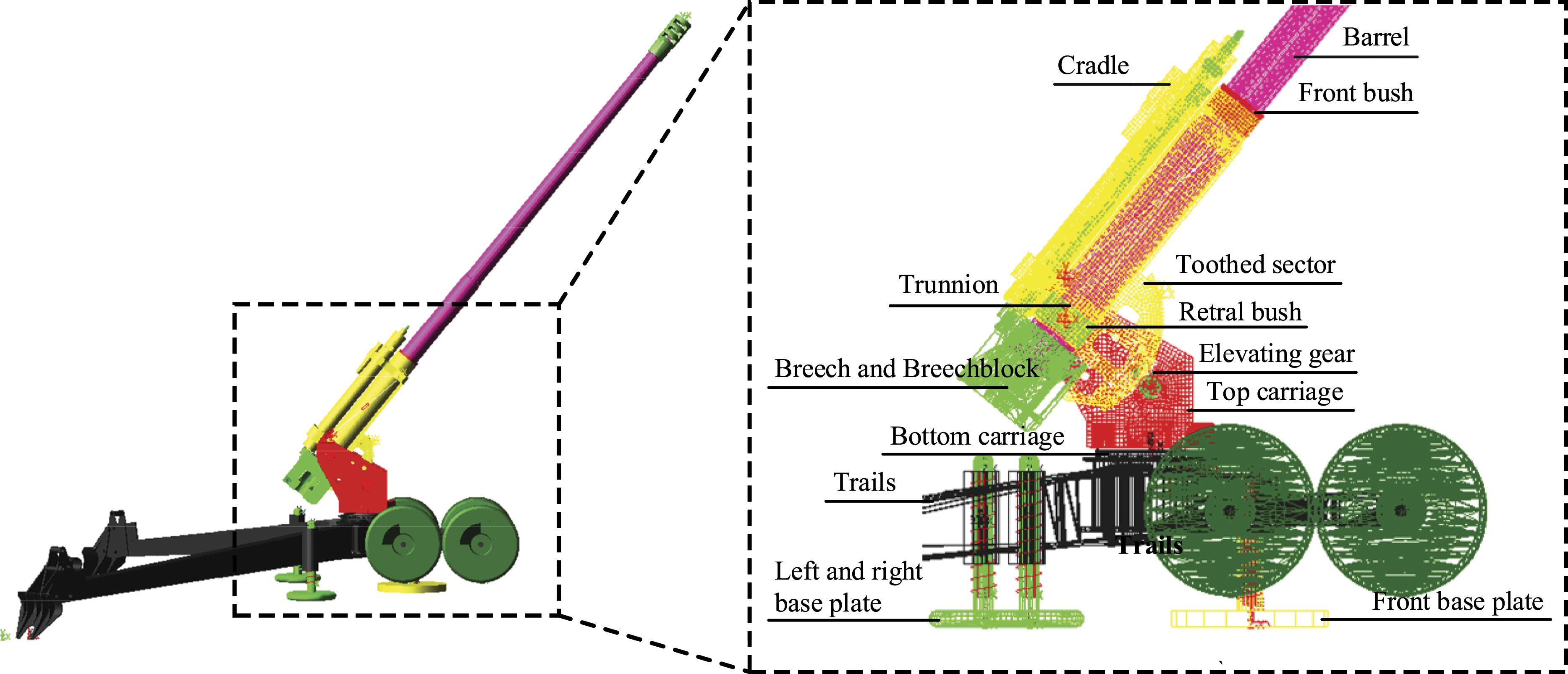
Load models
Interior ballistic model
The gunpowder is the energy source of the artillery launch process. The gunpowder burns in the bore and produces considerable gas with huge pressure. The gas pushes the projectile forward and makes the barrel setback. In this study, the classical interior ballistic equations are utilized to describe the gas pressure during the interior ballistics. The interior ballistic equations with two kinds of gunpowder are shown as
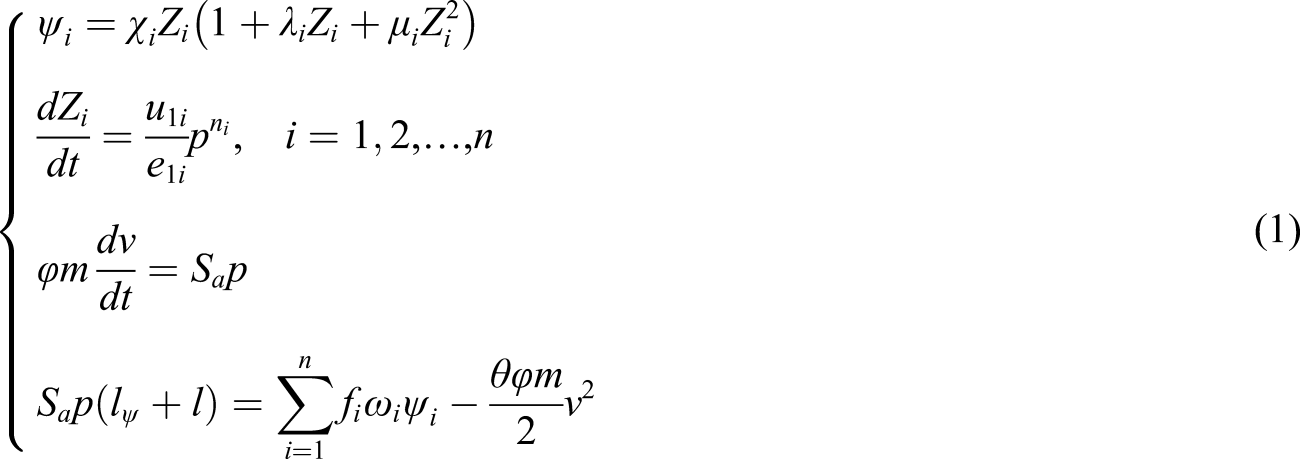
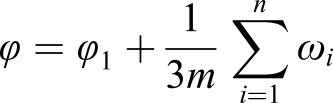

Runge–Kutta method is utilized to solve the above equations. The gas pressure history curve P-t can be obtained. Then the artillery barrel resulting force can be calculated according to the gas pressure.
Recoil force model
Recoil mechanism can effectively control the force and movement of the artillery during firing. The recoil mechanism in this study consists of the throttling bar recoil brake and the hydropneumatic counter-recoil mechanism. Figure 2 shows the structural sketches of the recoil mechanism. Structural sketch of counter-recoil mechanism.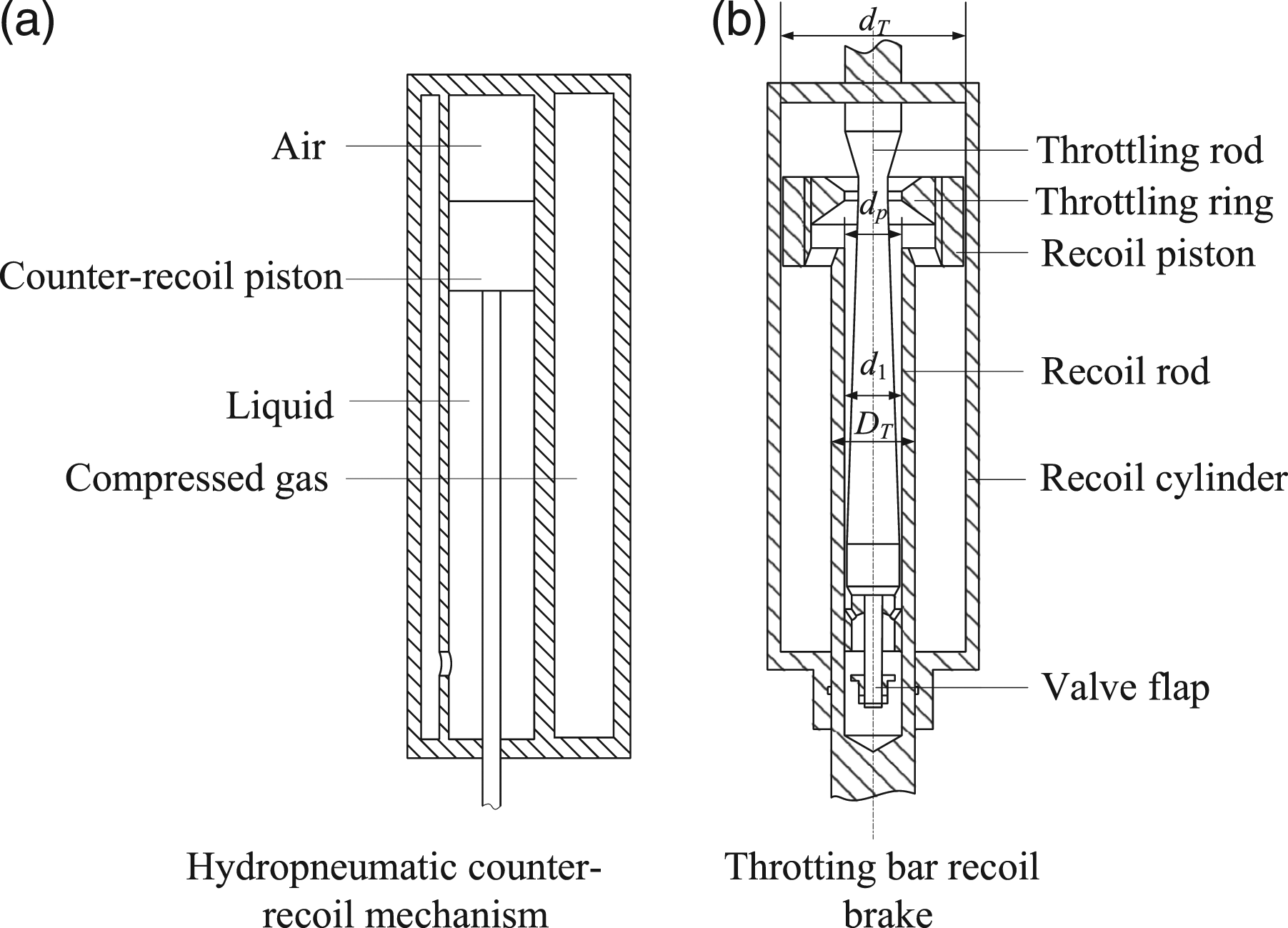
The recoil mechanism is connected to the cradle. When the barrel is recoiling, the recoil rod and the recoiling parts move together. The mathematical model of the hydraulic resistance (recoil absorber) force

Additionally, when the barrel is recoiling, the counter-recoil rod drives the recoil piston. The piston compresses the gas in the counter-recoil mechanism, thereby generating the recuperator force R
f
. The mathematical model of R
f
is shown as

Balance mechanism force model
The center of mass of the elevating part of the artillery cannot coincide with the center of the trunnion, so the natural balance cannot be achieved. Therefore, there must be a balance force to offset the weight moment of the elevating part, otherwise, the artillery cannot fire. In this study, the pneumatic balancing mechanism is employed to provide the balance force. The mathematical model of the balance force model is shown below.

Relationship between load models and multi-flexible body dynamic model
Each load is not only related to structural parameters but also a function of generalized coordinates and generalized speed. The relationship between the load model and the dynamic model is shown in Figure 3. To realize this coupling relationship, the Fortran language is used to write the calculation program of each load, and the dynamic link library file (*.dll) of each load is generated through the application program interface of ADMAS. In this way, the dynamic real-time calculation of the load can be realized, and the structural dynamic responses can be obtained. Coupling relationship between load models and multi-flexible body dynamic model.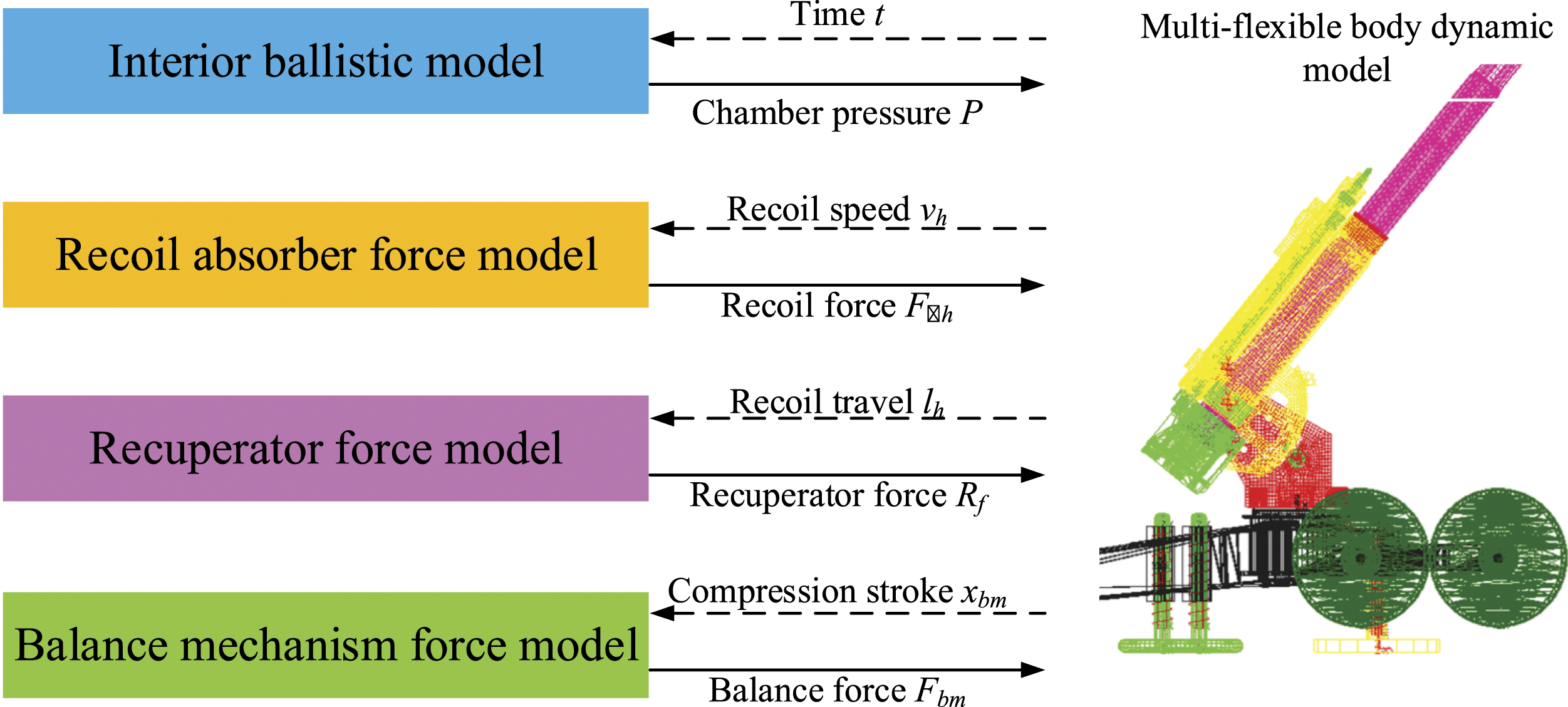
Live ammunition firing test
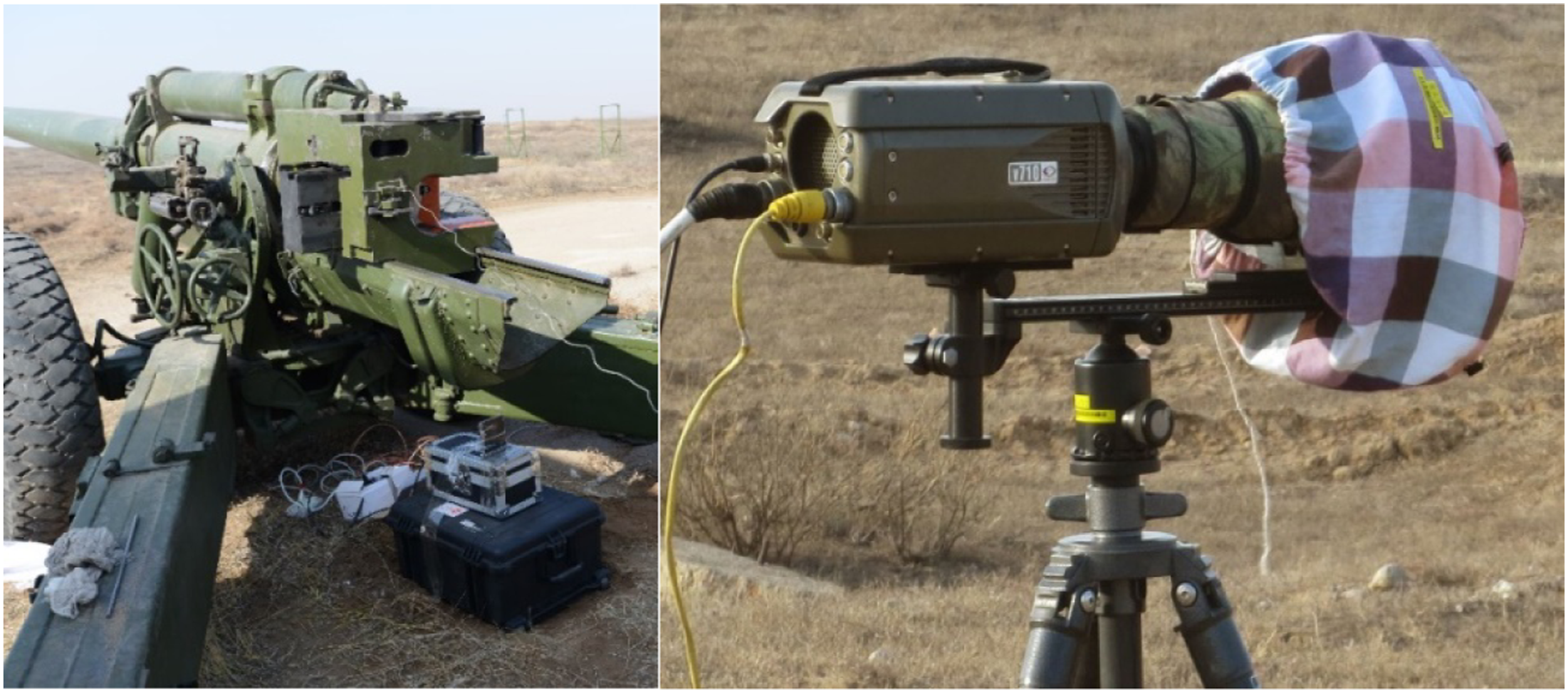
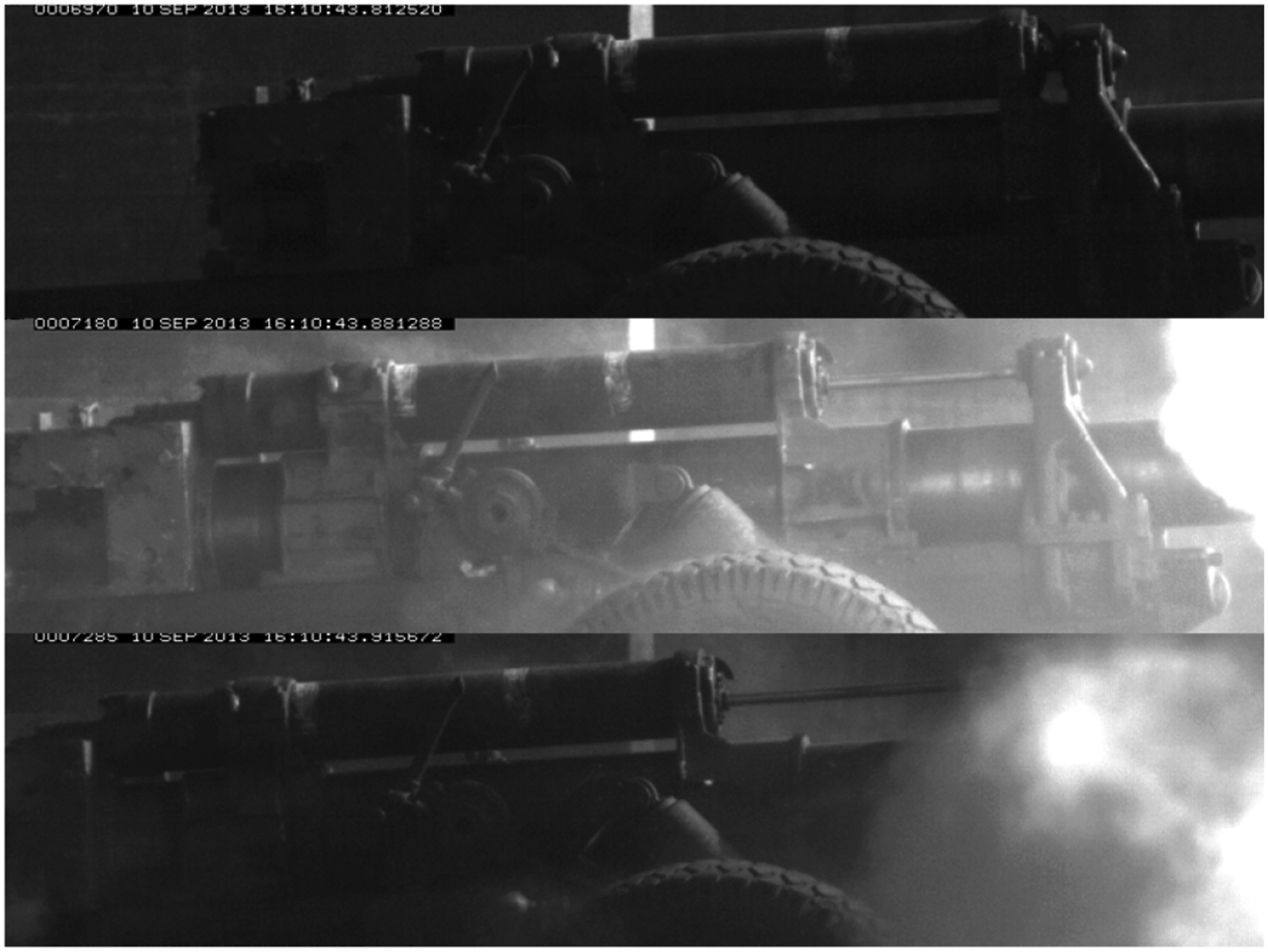
A suite of measurements is employed to verify the rationality of the artillery multibody dynamics modeling. The projectiles used in the test were hollow base cartridges, and the charge scheme is full charge composed of six unit modules. The pressure sensor, angular gyroscope, and high-speed photography system are used to test the chamber pressure, recoil displacement, and muzzle vertical angular displacement, respectively. Trepan holes in the breech chamber and connecting conical chamber, respectively, and install pressure sensors. After that, the breech pressure can be directly measured. Figure 4 shows the chamber pressure test system. The utilized piezoelectric crystal pressure sensor is KISTLER 6229A. The DEWETRON 1201 data acquisition system is employed to record the pressure history. High-speed photography system shown in Figure 5 captured the recoil movement of the breech during and after the launching transient. The major components of IDT3−S2 high-speed photography system are Phantom V710 high-speed camera, Nikkor AF-S 400 mm F2.8D ED lens, camera quick-release plate bracket, Kangrinpoche NB1-A tripod video head, Gitzo GT5531S tripod, and trigger signal line. Analysis is carried out on the Xcitex company’s image processing software, Pro Analyst, to obtain the recoil displacement with time; further differentiating the measured recoil displacement curve could obtain the recoil velocity with time. The output results of high-speed photography system are shown in Figure 6. Chamber pressure test system: (a) pressure sensor (left) and the test section (right) and (b) (b) pressure sensors location on the barrel. High-speed photography system for artillery recoil movement. Images captured by a high-speed camera.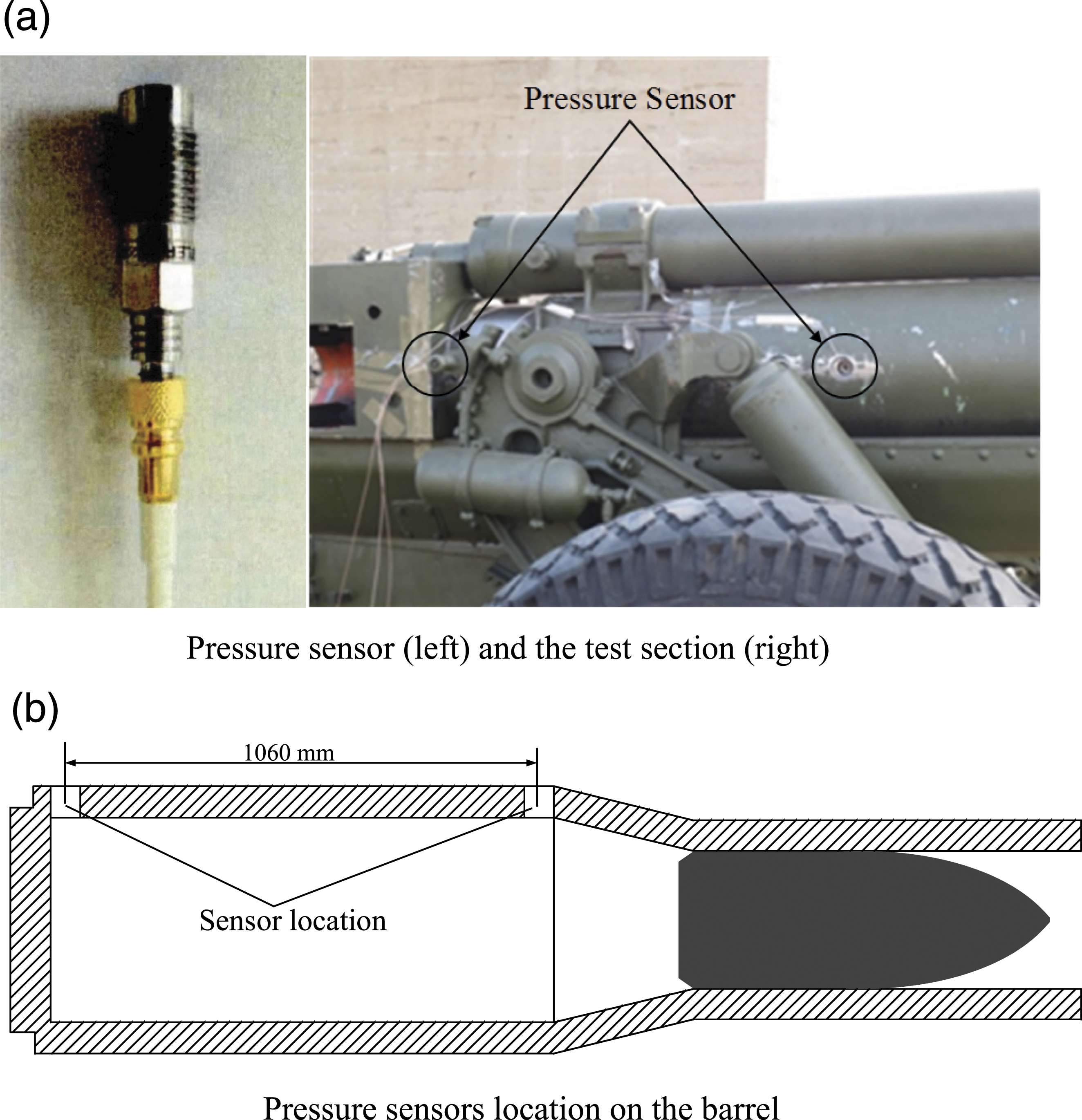
Another measurement is the nonlinear dynamic responses, such as the muzzle vibration parameters, to evaluate the artillery’s tactical level. Figure 7 shows the core sensor of the muzzle vibration test section which is an SDI-ARG-720 angular velocity gyroscope. A protective box wrapping the gyroscope is necessary to attack the muzzle strong impact and is fastened on the bracket by screws. The two elastic brackets are further fixed on the barrel (located nearly the tail of the muzzle brake) by bolts. Schematic diagram of muzzle vibration test.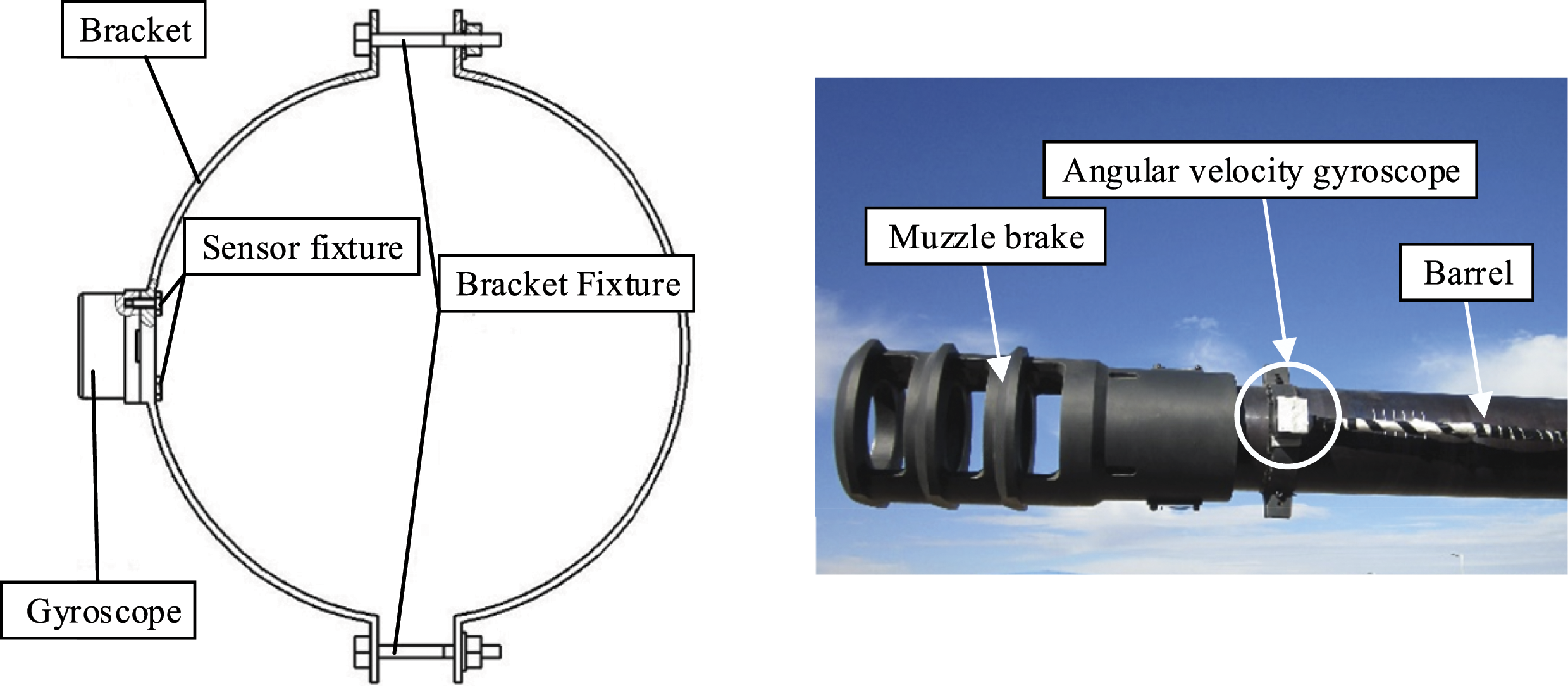
The measured and simulated time history curve of breech pressure history, recoil displacement history, and muzzle vertical angular displacement history is shown in Figure 8(a)–(c). The detailed values of these curves are shown in Table 1. Simulated solutions in Figure 8 and Table 1 are obtained using the commercial MBS software ADAMS®. Figure 8(a) shows that in addition to the time delay of the calculated breech pressure curve, the maximum pressure, as well as the entire pressure curve, matches the actual measured result well, especially during the pressure rise period. Figures 8(b) and (c) and Table 1 also show that the dynamic characters of the simulation perfectly match the measured responses. The less relative errors demonstrate that the established artillery multi-flexible body dynamic model has a good ability to simulate the artillery launching process. It provides a reliable model basis for the later Stackelberg game optimization. Comparison between simulation results and actual measured results of artillery dynamic responses: (a) breech pressure history, (b) recoil displacement history, and (c) muzzle vertical angular displacement history. Comparison between measured and simulated values.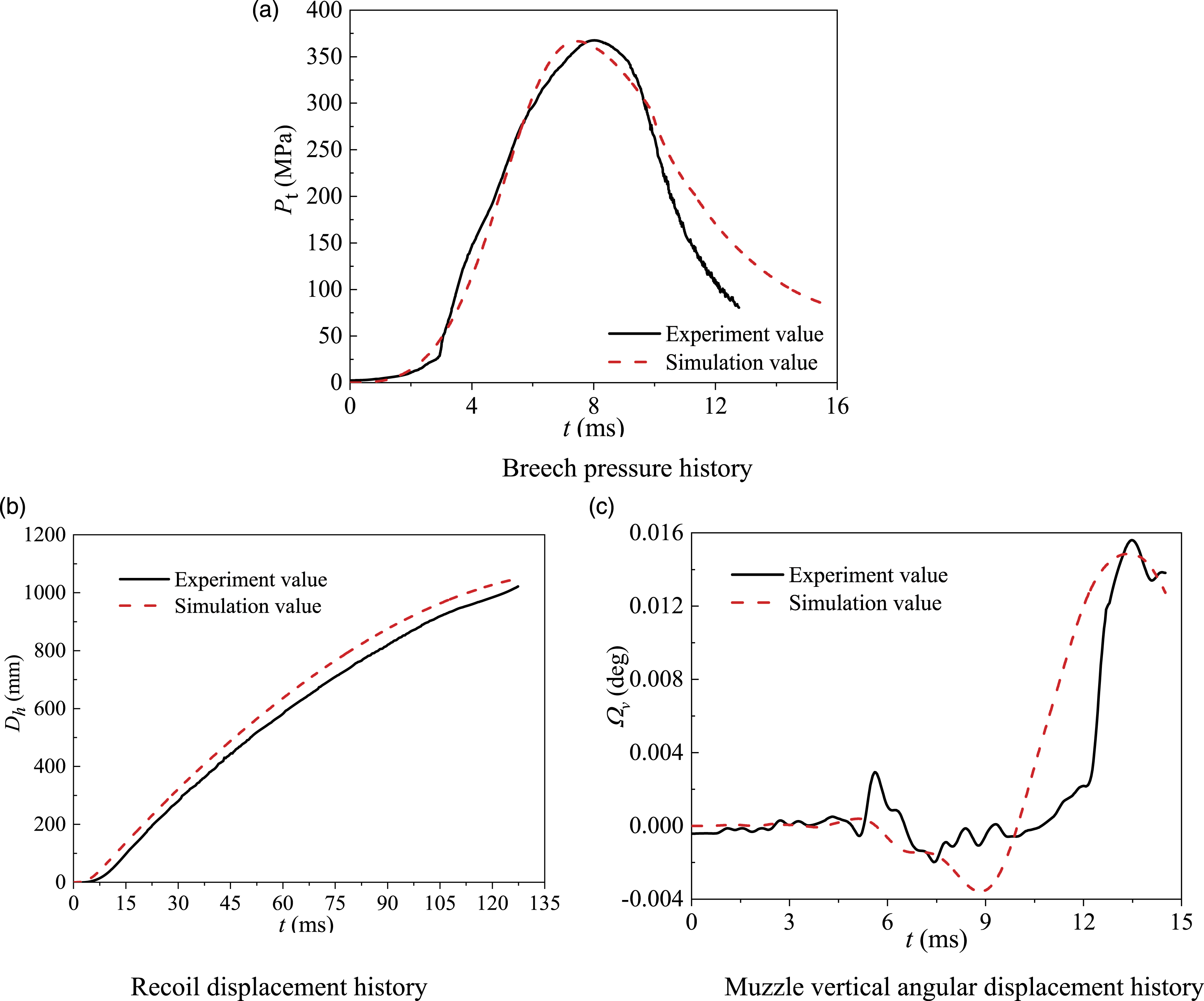

Overview of game theory
Nash equilibrium
Let assume that a game consists of N players. Each player i = 1, …, N has its variables also called strategy
All the player’s variables together form a vector
A NE is a combination of strategies where each player’s strategy is an optimal response to the other players’ strategies. A vector 
Nash equilibrium
Stackelberg equilibrium
Different from the Nash game, the players in the Stackelberg game are split into leaders and followers. In Nash game, none of the players can observe the other players’ actions before they do their own. But in a dynamic game, players act in order. The player who acts later can observe the decision of the pioneer before making the decision and make the next decision accordingly. Stackelberg game is a typical dynamic game of complete information. In the standard Stackelberg game, the players are split into the leader and the follower, and there are one leader and one follower. The leader makes decisions first, followed by the follower. The follower can observe the decisions of the leader and make a rational response to the leader’s decision. More importantly, the leader can predict the rational response of the follower which is the pioneer advantage. Therefore, the leader can gain more benefits than the follower.
In practical problems, there are usually multiple leaders and followers. Let assume that a Stackelberg game consists of N players including M leaders and N–M followers. Each player i = 1, …, N has its variables also called strategy 
A vector 

The leader (follower)’s optimization can be seen as a sub-Nash game. First, the leaders play the Nash game and pass the strategies to the followers. Then the followers play the Nash game on account of the leaders’ strategies and pass their strategies and benefit function values (rational response) to the leader.
Artillery structural dynamic responses optimization model
Design variables
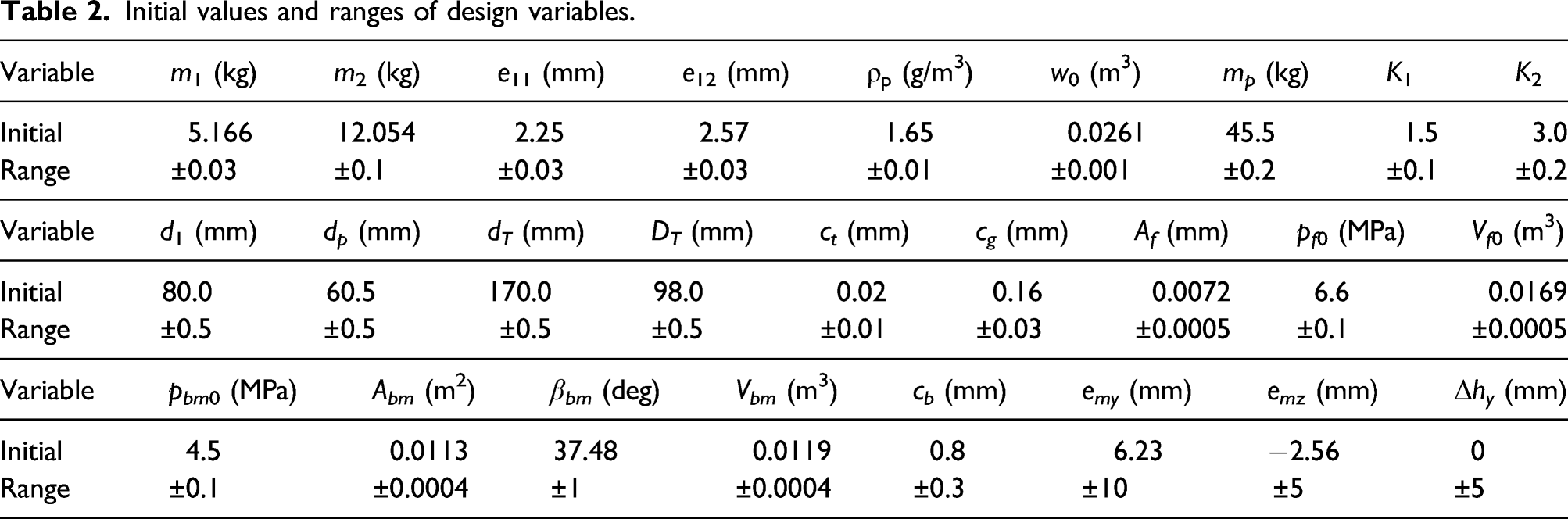
The artillery structural dynamic responses are affected by numerous factors. In this study, the interior ballistic parameters and structural parameters are considered. Those parameters are divided into four categories and listed in Table 2. The interior ballistic parameters: m
i
, e1i (i = 1, 2), ρp, m
p
, and w0. The recoil mechanism parameters: K1, K2, A
f
, pf0, Vf0, the inner diameter of the recoil ring d1, the inner diameter of the throttling ring d
p
, the outer diameter of the recoil rod D
T
, the gap between the recoil cylinder and recoil cylinder and recoil piston c
t
, the inner diameter of the recoil cylinder d
T
, and the gap between the recoil rod and speed-regulating cylinder c
g
. The balance mechanism parameters: V
bm
, pbm0, A
bm
, and the angle formed by two connecting lines between the upper and lower fulcrum of the balance mechanism and the trunnion β
bm
. The carriage body parameters: the clearance between the barrel and front bush c
b
, the vertical (horizontal) mass eccentric of recoiling parts e
my
(e
mz
), and the height at the center of the trunnion Δhy. Initial values and ranges of design variables.
Optimization model
The dynamic response of artillery structure includes many indexes. Power, fire precision, and stability are the core performance of the artillery weapon system. In this study, the maximum chamber base pressure Pdmax, the muzzle vibration index Sketch of muzzle vibration and firing stability: (a) the muzzle vibration and (b) the firing stability.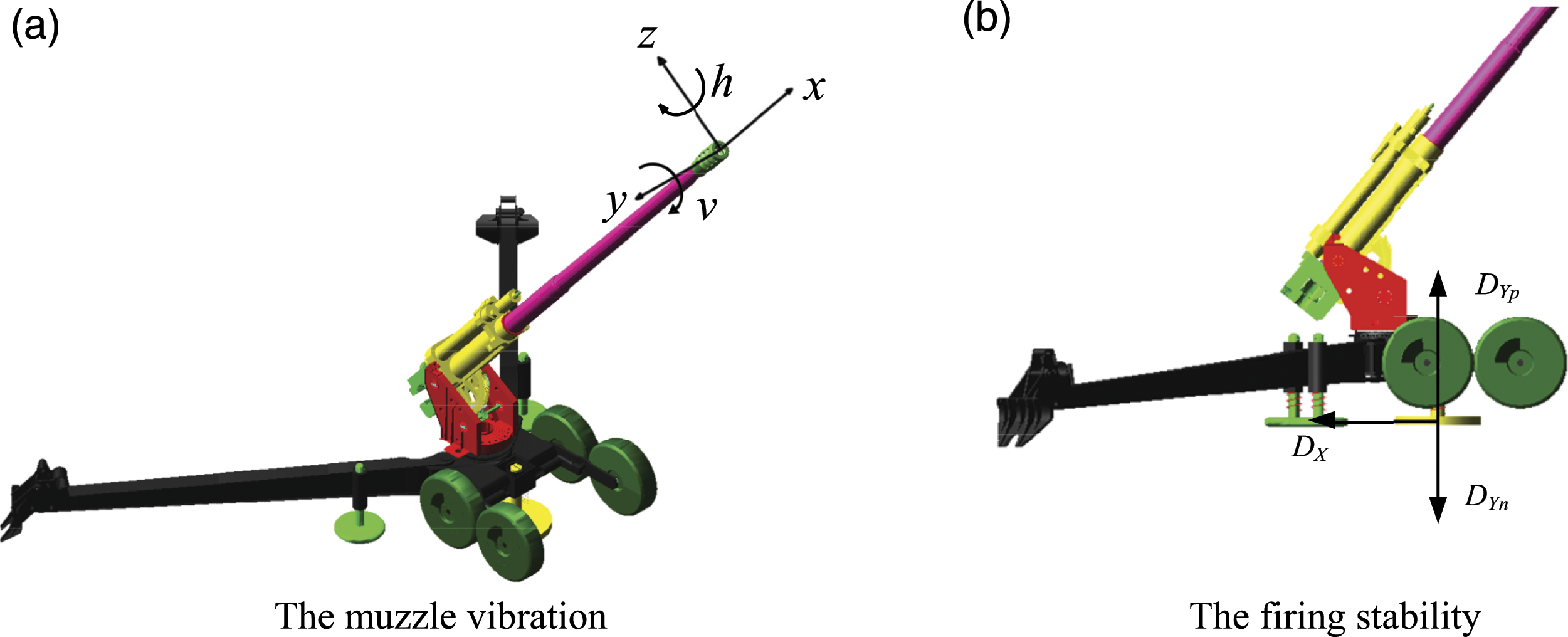
The muzzle vibration 
The firing stability coefficient index 
The multi-objective optimization model of artillery dynamic responses is constructed as follows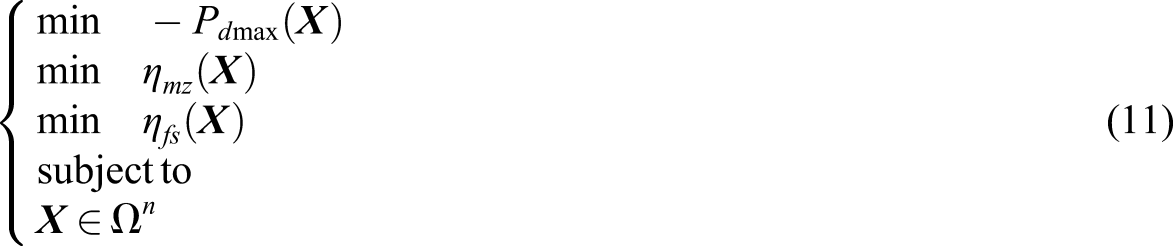
Determination coefficients of the surrogate models.

Stackelberg game model of artillery structural dynamic responses
In this section, the artillery structural dynamic responses optimization model is transformed into a Stackelberg game model. First, through parameter sensitivity analysis, the influence degree of each design variable on each game player is obtained. Then the FCM cluster method is employed to classify the sensitivity indexes, and the design variable set is split into each player’s strategy.
Sensitivity analysis
Applying game theory to engineering optimization problems requires converting the optimization model into a game model. The most important step is to divide the original set of design variables into strategy sets that belong to each player. When splitting the design variable set, the sensitivity character of variables to the players must be considered.
22
Regression analysis of design variables can obtain detailed sensitivity data.
28
As a whole, it replaces complex models with simple polynomials, where the coefficients of the polynomials are fitted with existing data. Then the contribution rate of each parameter to the result is evaluated according to the coefficient of the polynomial. Figure 10 shows the sensitivity analysis method of the dynamic response of artillery multi-flexible body dynamics model based on regression analysis. The method can be divided into the following steps: Flowchart of sensitivity analysis.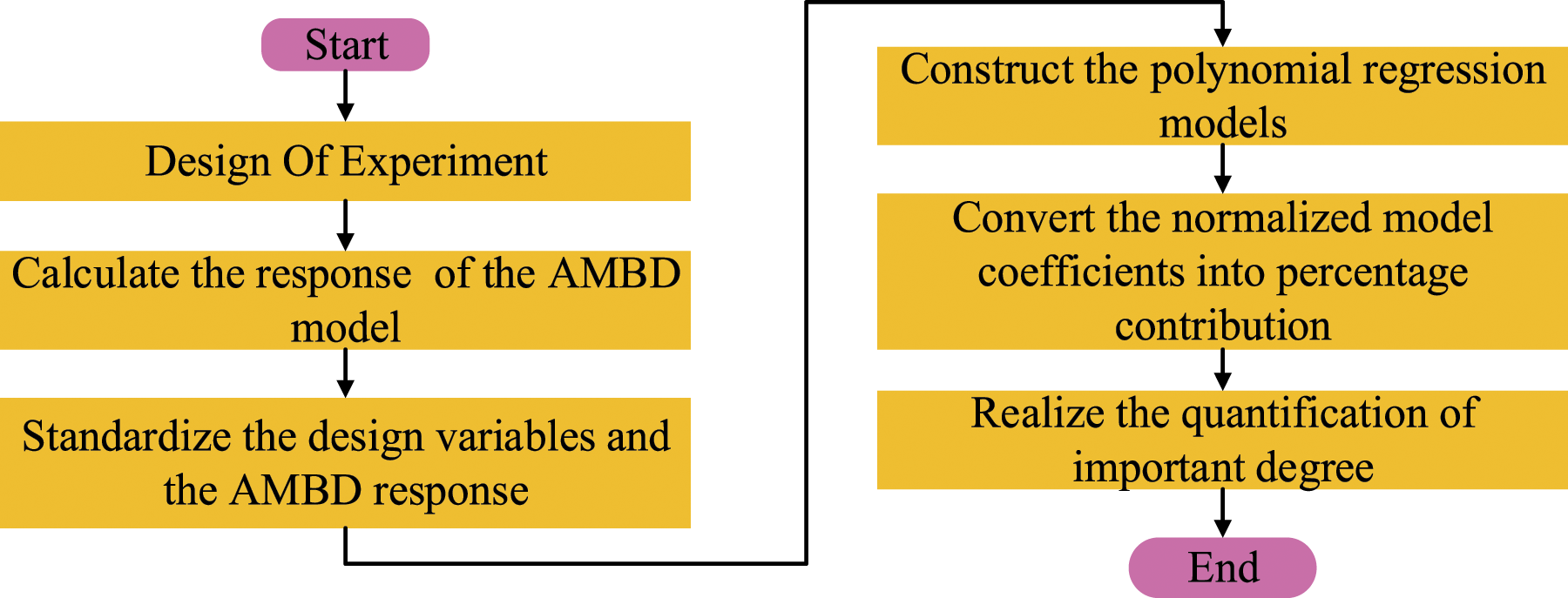
In order to eliminate the impact of different data orders, the design variables and response values are normalized.
The least-square method is adopted to construct the polynomial regression model as shown in equation (12)
convert the polynomial coefficient to the percentage contribution. The sensitivity analysis results are shown in Figure 11. It should be noted that parameters with a percentage contribution less than 2% are excluded from the results. It can be seen from Figure 11(a), the parameter that has the greatest influence on the maximum base pressure Pdmax is e11. The parameters that have an effect on the maximum chamber pressure greater than 2.0% are all interior ballistic parameters. The cumulative influence of interior ballistic parameters on the maximum base pressure is 96.46%, which is consistent with the actual situation. It can be seen from Figures 11(b) and (c), the parameters that affect the firing stability index η
fs
and the muzzle vibration index η
mz
are almost artillery structural parameters.
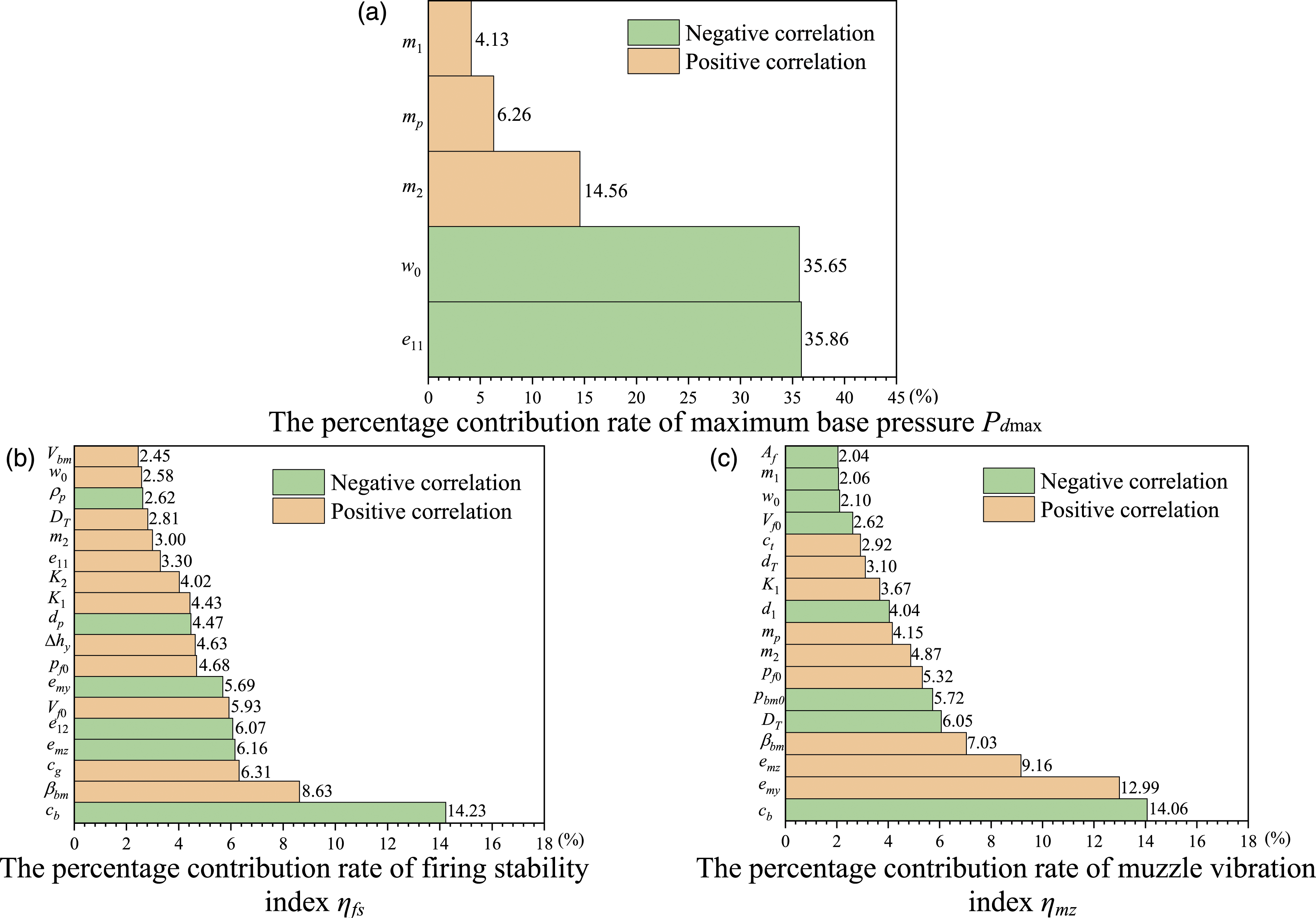
Sensitivity analysis results: (a) the percentage contribution rate of maximum base pressure Pdmax, (b) the percentage contribution rate of firing stability index η fs , and (c) the percentage contribution rate of muzzle vibration index η mz .
Fuzzy C-means cluster algorithm
Let the observation data matrix denoted as T.
The aim of FCM is to divide n samples into c clusters.
The FCM problem can be written as an optimization problem, which denoted as
The steps of FCM are as follows:
Set c = 3, m = 3, and ε = 1 × 10⁻⁶.
Initialize the fuzzy membership matrix U(0) = [u
ik
(0)], and let l = 1.
Calculate the cluster center 
Calculate the membership matrix U(l) and the objective function J(l)

If After the above iterations, the minimum value of the objective function The observation data matrix is constructed based on the sensitivity analysis results, and all the parameters are divided into 3 clusters using the FCM method. The clustering results are shown in Figure 12. Combining the sensitivity analysis results and the clustering results, Cluster 1 is regarded as the strategy set S1 of the maximum chamber pressure Pdmax, Cluster 2 is regarded as the strategy set S2 of the muzzle vibration index η
mz
, and Cluster 3 is regarded as the strategy set S3 of the firing stability index η
fs
.
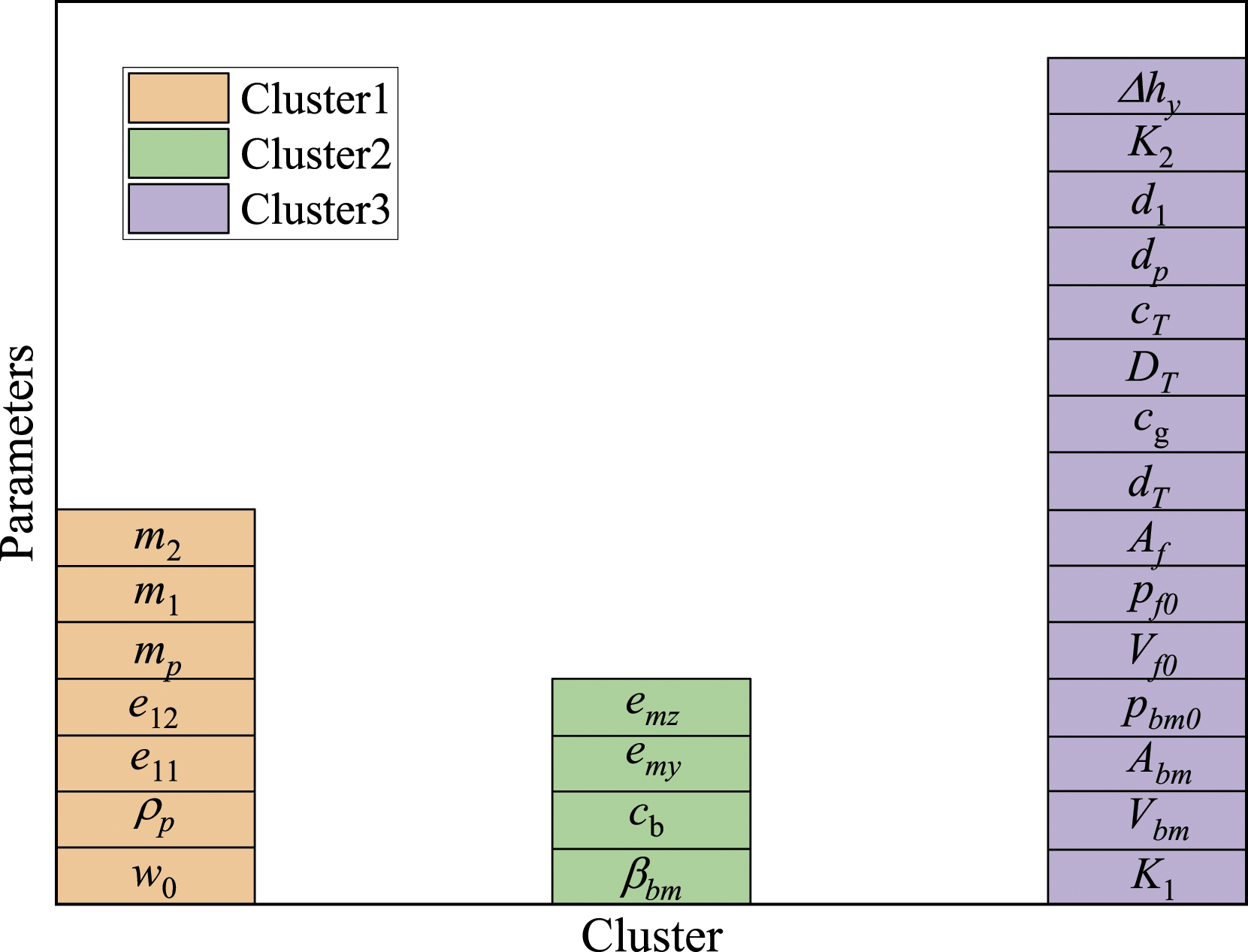
Clustering result of design variables.
Procedure for solving the Stackelberg equilibrium
Fire precision and power are the most important performance of artillery. Almost every artillery technical revolution is about how to improve these two indexes. Hence, the muzzle vibration index η
mz
and maximum chamber pressure Pdmax are set as leaders, and the firing stability index η
fs
is set as a follower. The two-leader-one-follower Stackelberg game model is shown as follows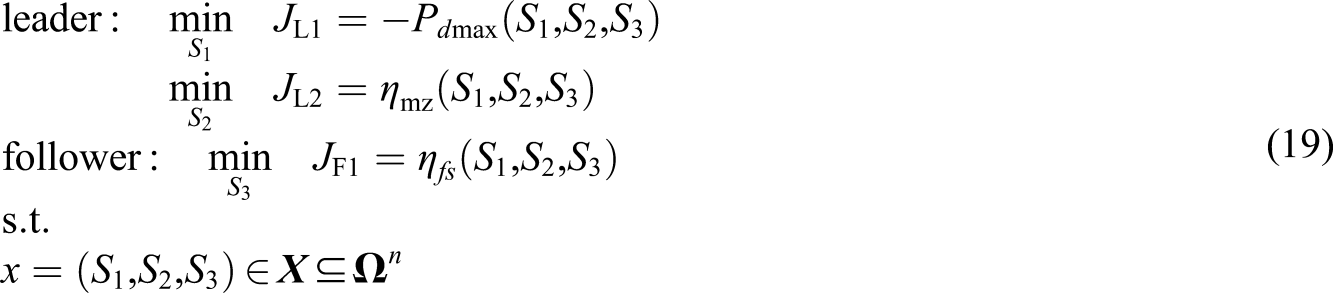
In above Stackelberg game model, the leaders act first and play sub-Nash game with each other. When the leaders reaching the NE, the leaders deliver the decisions to the follower. Then the follower carries out its own optimization by considering the leaders’ decisions to get more profits. The leaders and follower act alternately until the leaders cannot obtain more profits. At this time, the game has reached the Stackelberg equilibrium. The following steps give the complete solution process of Stackelberg equilibrium. The basic optimizer chosen in this study is GA, and the detailed workflow of the Stackelberg game model for artillery structural dynamic responses optimization is shown in Figure 13. Flowchart for solving Stackelberg equilibrium.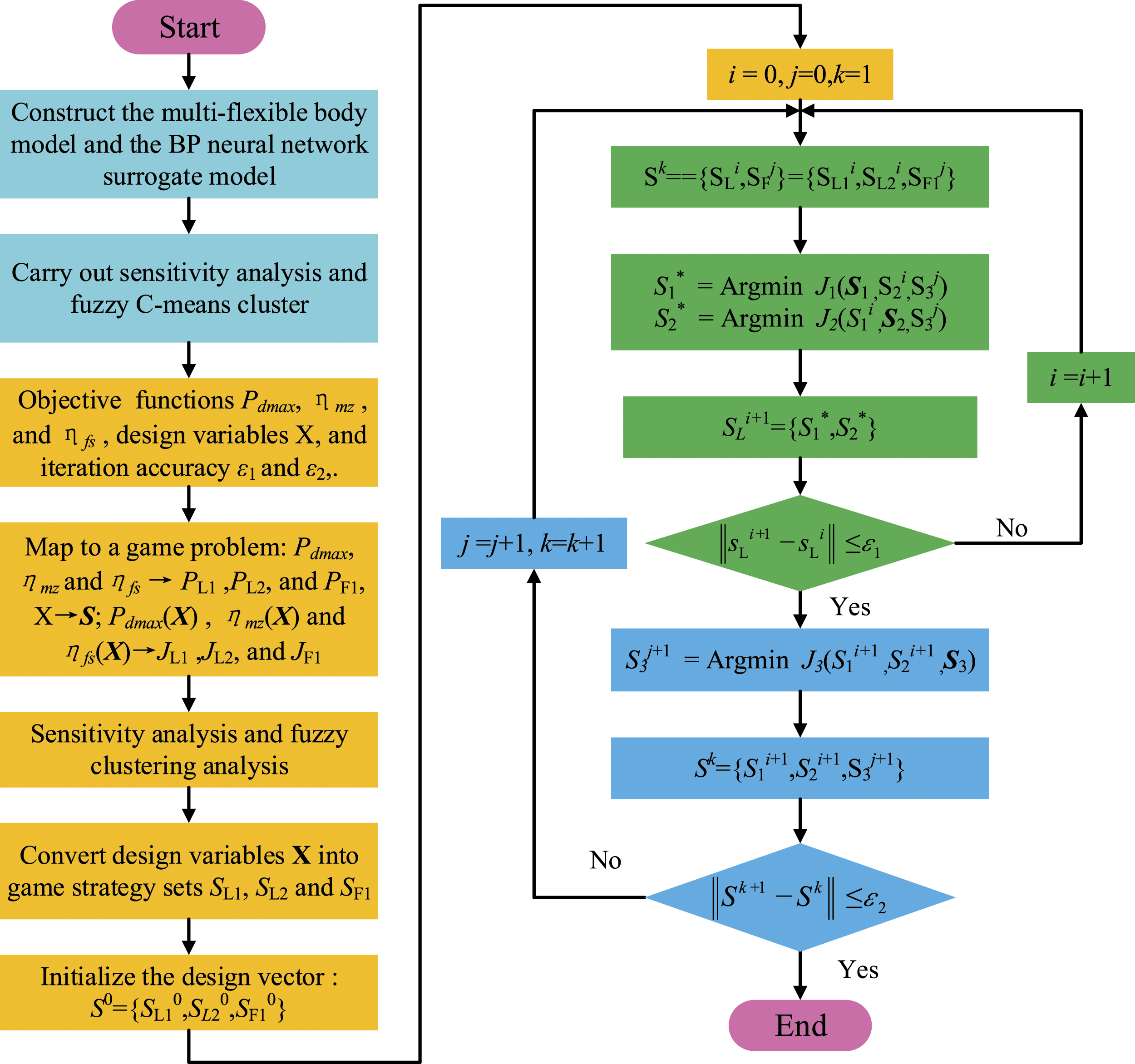
Given the initial strategy set S0 = (SL0, SF0) = (S10, S20, S30)
Leaders’ Nash game starts at (S10, S20, S30) Keep S20, S30 as constant and adjust S1 to minimize JL1 by basic optimizer. Obtain optimal solution (S1new, S20, S30). Keep S10, S30 as constant and adjust S2 to minimize JL2 by basic optimizer. Obtain optimal solution (S10, S2new, S30).
Exchange the optimal information of design variables between leader1 and leader2. Leader1 sends S1new to leader2, and leader2 sends S2new to leader1. The current strategy of leaders is (S1new, S2new, S30).
Repeat Step 1 and Step 2 until no leader can obtain more profits.
Pass the leaders’ NE to follower, that is, follower’s optimization starts at (S1new, S2new, S30). Keep S1new, S2new as constant and adjust S3 to minimize JF1 by basic optimizer. Obtain optimal solution (S1new, S2new, S3new).
The leaders obtain the follower’s rational response, that is, the leaders’ current strategy is (S1new, S2new, S3new).
Repeat Step 1 to Step 5 until no leader can obtain more profits.
Results and discussions
Figure 15 presents the convergence histories of the Stackelberg game. It can be seen that the game gradually stabilizes after four iterations and reaches Stackelberg equilibrium at the eighth iteration. The leader’s sub-game of eighth iteration is shown in the upper right corner of Figure 15. It is shown that after five iterations, the sub-game of muzzle vibration and maximum chamber pressure reaches NE and gradually converges to 0.9214 and 317.06, respectively. Obviously, it reflects the conflict between the muzzle vibration and maximum chamber pressure. Figure 15 shows that a large chamber pressure will increase the power of the artillery, but it will also have an adverse effect on muzzle vibration. This indicates that the game model established in this study correctly reflects the nature of the artillery system. Pareto front of the multi-objective optimization model of artillery dynamic responses.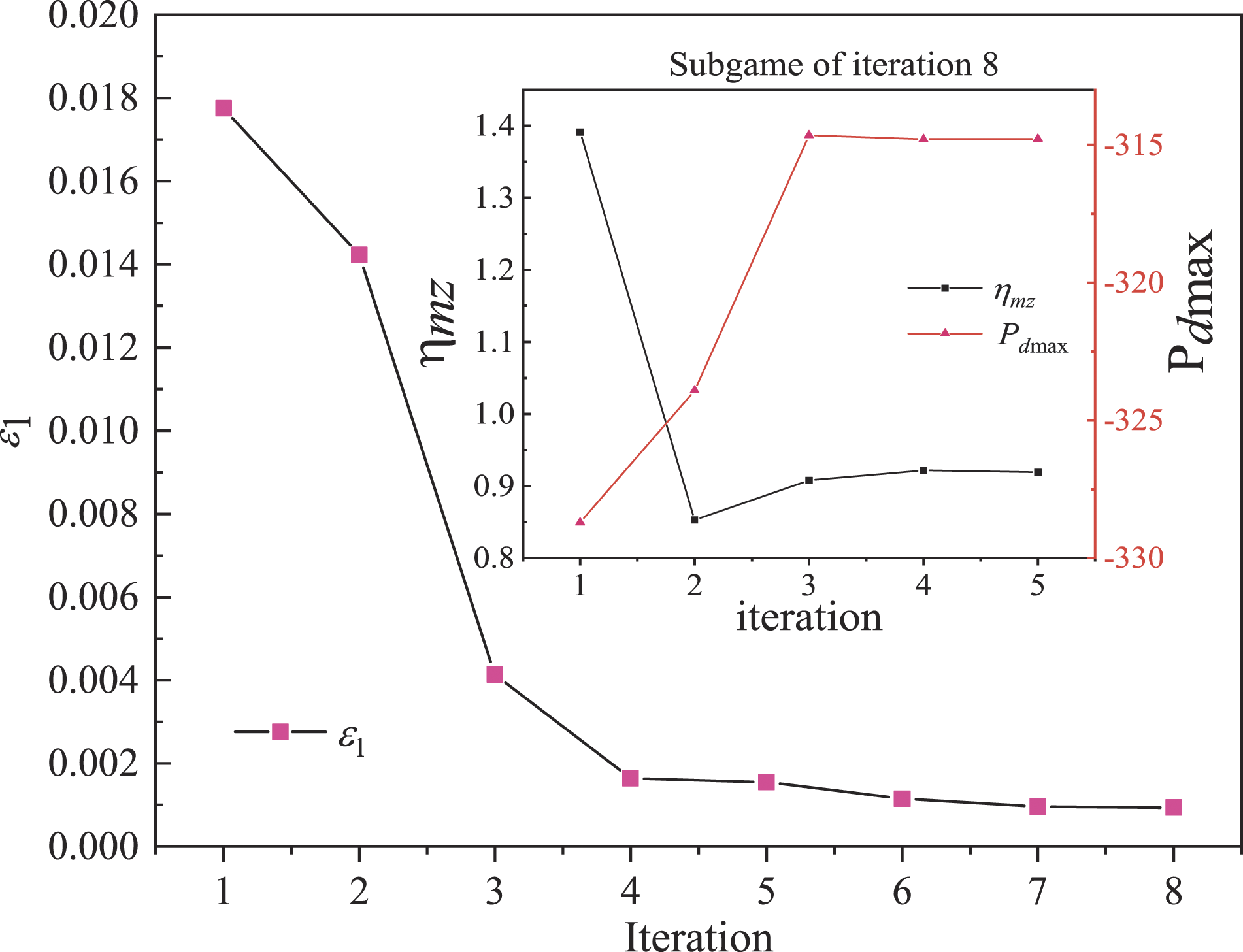
In order to explain the merits of adopting Stackelberg game theory, the GA is employed to solve the multi-objective optimization problem of expression (11). The Pareto front is given in Figure 14. It clearly shows that the Stackelberg equilibrium and Pareto front locate in the same solution space. But the Stackelberg equilibrium is not included in the Pareto front. Traditionally, we need to select a point in the Pareto front as the final design according to a preference. However, the solutions in the Pareto front lack hierarchy. Hence, it is hard to find a satisfactory solution that can simultaneously achieve excellent performance about all the objectives. In particular, when the number of optimization targets is greater than three, the Pareto front in the form of graphics cannot be obtained. At this point, the advantage of game theory is rather significant. The players can adjust their own strategy to optimize their cost function. When the game reaches equilibrium, the equilibrium has strong stability. In summary, game theory is very suitable for solving artillery structural dynamic responses optimization problems. Convergence history of the Stackelberg game.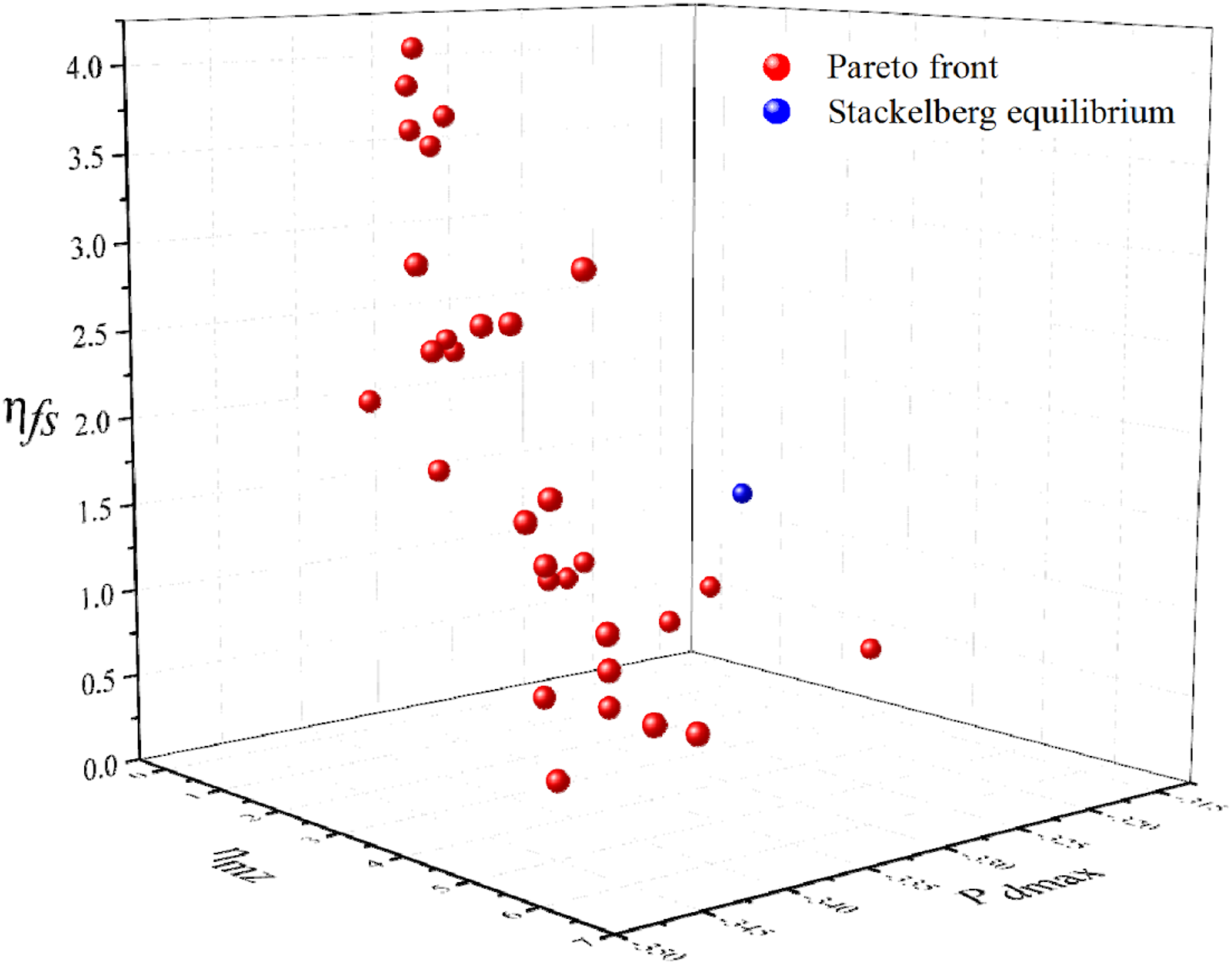
Details of strategies about Stackelberg equilibrium.

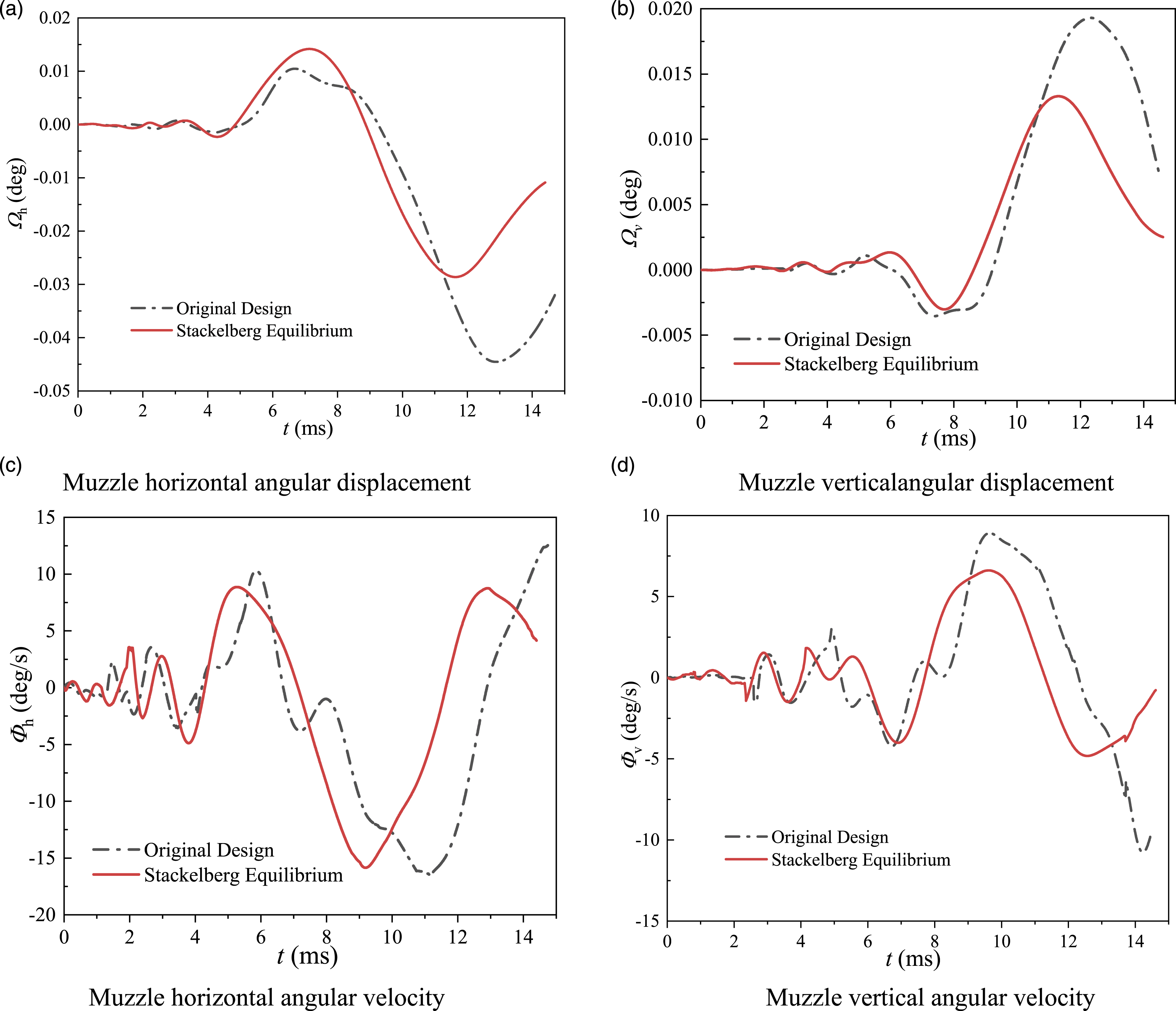
Original dePareto front of the multi-objective optimization modelsign and Stackelberg equilibrium of the muzzle vibration: (a) muzzle horizontal angular displacement, (b) muzzle vertical angular displacement, (c) muzzle horizontal angular velocity, and (d) muzzle vertical angular velocity.
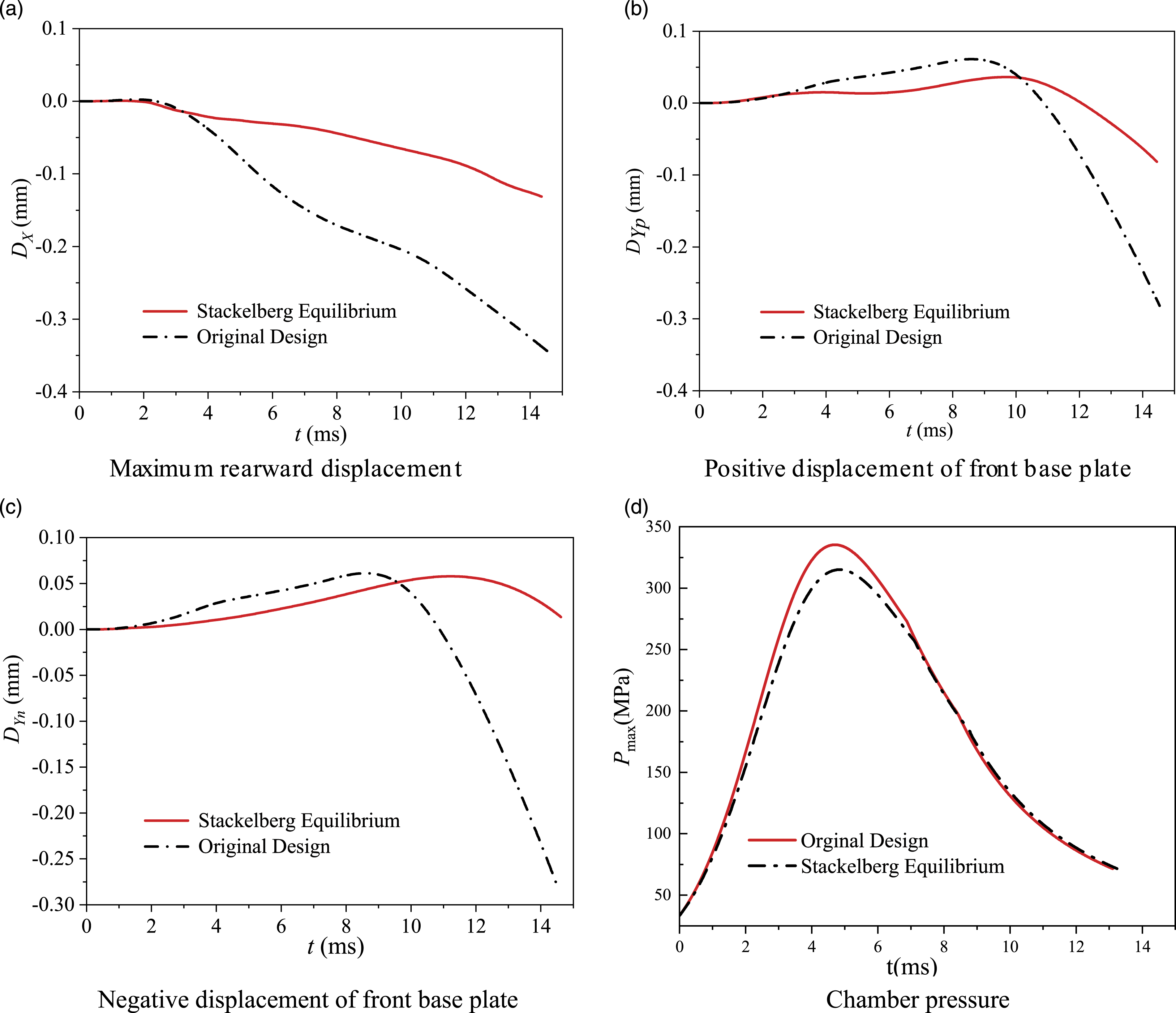
Original design and Stackelberg equilibrium of the firing stability and the chamber pressure: (a) maximum rearward displacement, (b) positive displacement of front base plate, (c) negative displacement of front base plate, and (d) chamber pressure.
Detailed optimization results.

Figure 16 shows that the four muzzle vibration indexes are improved compared with the original design. In particular, the muzzle angular velocity is rather critical in artillery design. As illustrated in Figures 16(c) and (d), the angular velocity in both horizontal and vertical directions is greatly declined, which is very beneficial for improving the fire accuracy. Figures 17(a)–(c) shows that the three firing stability coefficient indexes are greatly improved compared with the original design. It is worth noting that in the entire time range, the displacements of the front base plate in three directions are smaller and the curve trend is smoother. Figure 17(d) shows that the maximum chamber pressure of the optimal design is smaller than the original design, which means that the power of the artillery is reduced. Although high power is the eternal pursuit of artillery design, as shown in the game process in Figure 15, a large chamber pressure will result in a decrease in fire accuracy. In addition, large chamber pressure will also adversely affect the structural strength and launch safety. More importantly, the maximum chamber pressure has only lost 6%, but the muzzle vibration performance and firing stability performance have been greatly improved.
Conclusion
In this study, the multi-leader–follower Stackelberg game theory is applied to artillery structural dynamic responses optimization. The artillery multi-flexible body dynamic model considering interior ballistic parameters, load parameters, and structural parameters is constructed. And the live firing experiment is carried out to verify the accuracy of the established model. The BP neural network surrogate model is used to reduce the optimization time. The artillery structural dynamic responses multi-objective optimization model is established, which includes three objectives: the maximum chamber pressure, muzzle vibration index, and firing stability index. In order to accurately convert the optimization model into a game model, the sensitivity analysis and FCM cluster algorithm are utilized to split the design variables into three independent strategy sets belonging to each player. Then from the perspective of artillery design, set maximum chamber pressure and muzzle vibration index as the leader and firing stability index as the follower. Whereby, the two-leader-one-follower Stackelberg game model is constructed. The Stackelberg game method for artillery structural dynamic responses is proposed based on elitist information exchange and the sub-Nash game method. The results show that the muzzle vibration performance and firing stability performance are greatly improved with only a small loss of the chamber pressure.
Footnotes
Declaration of conflicting interests
The author(s) declared no potential conflicts of interest with respect to the research, authorship, and/or publication of this article.
Funding
The author(s) disclosed receipt of the following financial support for the research, authorship, and/or publication of this article: This work was financially supported by the China Postdoctoral Science Foundation (Grant No. BX2021126).
