



Abstract
The low-frequency harmonic components of urban substation noise are easy to annoy the residents. Multi-frequency perfect sound-absorbing metasurface based on the Helmholtz resonator (HR) is an alternative solution to suppress the low-frequency harmonic noise. This paper proposes an efficient design method of structural parameter for the multi-frequency perfect sound-absorbing metasurface. Taking the perfect sound absorption at the target frequency as objective and the structural parameters of HR as optimization variables, the structural parameter optimization model of multi-frequency perfect sound-absorbing metasurface is established and solved by the sequential quadratic programming algorithm. The proposed design method effectively overcomes the deterioration of sound absorption performance caused by the combined design of multiple perfect sound absorption units. Utilizing the proposed method, we designed a multi-frequency perfect sound-absorbing metasurface to absorb the four harmonic components of an urban substation noise simultaneously. The finite element simulation results and the experimental results of the physical sample indicate that the designed multi-frequency perfect sound-absorbing metasurface can satisfy critical coupling to achieve perfect sound absorption at all target frequencies.
Keywords
Introduction
According to the analysis of an urban substation noise, it is a common low-frequency noise composed of multiple harmonic components, of which 300, 400, 500, 600 Hz have a significant contribution on annoyance. Traditional materials for sound-absorbing, such as porous materials, 1 have tiny inherent dissipation, making it challenging to absorb low-frequency noise with a subwavelength structure. Nevertheless, the subwavelength acoustic metasurfaces, such as Helmholtz resonator (HR),2–15 micro-perforated plates (MPPs),16–18 coiling space,19–22 and membrane,9,23–26 manifest a promising prospect in absorbing low-frequency noise in the past years. Besides, acoustic metasurfaces with extraordinary physical properties are widely adapted to energy harvest, 27 time reversal, 28 acoustic focusing, 29 and acoustic holography. 30 The subwavelength perfect sound-absorbing metasurfaces based on different structures are proposed to improve the sound absorption performance. Yang et al. 23 constructed a deep subwavelength sound absorber with a membrane structure. Ma et al. 24 obtained a perfect acoustic metasurface based on a decorative membrane resonator (DMR) whose structural thickness is approximately 1/133 of the wavelength of the target frequency. Auregan 25 designed an ultra-thin perfect low-frequency metasurface by combining DMR, resistance layer, and cavity. Tang et al. 26 designed a multifrequency perfect acoustics metasurface based on the combination of different DMRs. Although the membrane can achieve perfect sound-absorbing at low frequency with a deep subwavelength structure, a tiny change of prestressing could cause the deterioration of sound absorption performance, which increases the nuisance for application. 2
The sound absorption performance of the perfect sound-absorbing metasurface with local resonant structures based on common hard materials is more robust. The traditional HR is a classical local resonant structure, is easy for processing, and can absorb low-frequency noise with a deep subwavelength structure. The low-frequency property of metasurface based on HR is similar to Fangzhu,31,32 an ancient water collector in China. The internal cavity of HR is equivalent to the “hydrophilic concavity of Fangzhu” for storing sound energy, while the outer surface of HR is equivalent to the “hydrophobic convex of Fangzhu” for channelizing sound energy. Li et al. 2 achieved perfect sound absorption at a target frequency and efficient sound absorption in broadband by the coherent coupling between two various HRs with adjacent resonance frequencies. Huang et al. 12 constructed a broadband subwavelength perfect sound absorber by utilizing the coherent coupling among imperfect HRs with an extended neck and analyzed its sound absorption performance by introducing complex frequency. Ryoo et al. 13 designed a perfect two-frequency sound absorption metasurface through the coherent coupling among four HR units. Guo et al. 14 and Duan et al. 15 attained perfect sound absorption by coiling the extended neck of HR and roughening the extended neck of HR, respectively; both methods increased acoustical mass and thermoviscous loss, making it achieve perfect sound absorption at a lower frequency. Li et al. 22 achieved quasi-perfect sound absorption with a coiling space whose thickness is only 1/223 of the wavelength of the target frequency.
Perfect sound-absorbing metasurfaces based on HR are quite suitable for controlling these harmonic components of the urban station noise, reducing noise interference, and improving sound quality. For a single HR, the quasi-perfect sound absorption at the target frequency could be achieved by repeatedly sweeping and adjusting specific structural parameters, but such sweeping and adjusting are cumbersome and time-consuming. As for a metasurface composed of multiple HRs for multiple harmonic frequencies, the sweeping and adjusting become more strenuous to achieve the quasi-perfect sound absorption because of the coupling among HRs. Therefore, this paper focuses on studying an efficient design method to obtain the structural parameters of perfect multi-frequency sound-absorption metasurface (MPSM) based on HR and designing a MPSM to reduce the multiple harmonic components of an urban station noise based on the design method. The structure of this paper is as follows: first, the complex frequency is introduced to analyze the influence and sensitivity of structural parameters of HR on the “zero,” peak absorption coefficient, and the frequency of maximum sound absorption; second, the structural parameters of HRs are optimized to achieve single-frequency perfect sound-absorbing metasurface (SPSM) and MPSM. The results are verified by simulation and experiment.
Theory and verification
Theory
Figure 1 illustrates a typical HR-based metasurface. The confined air inside the unit of the acoustic metasurface is an equivalent HR with a cylindrical neck and a coaxial square cavity. For an acoustic metasurface in Figure 1, the surface acoustic impedance represented by the transfer matrix 33 can be applied to calculate the sound absorption coefficient.
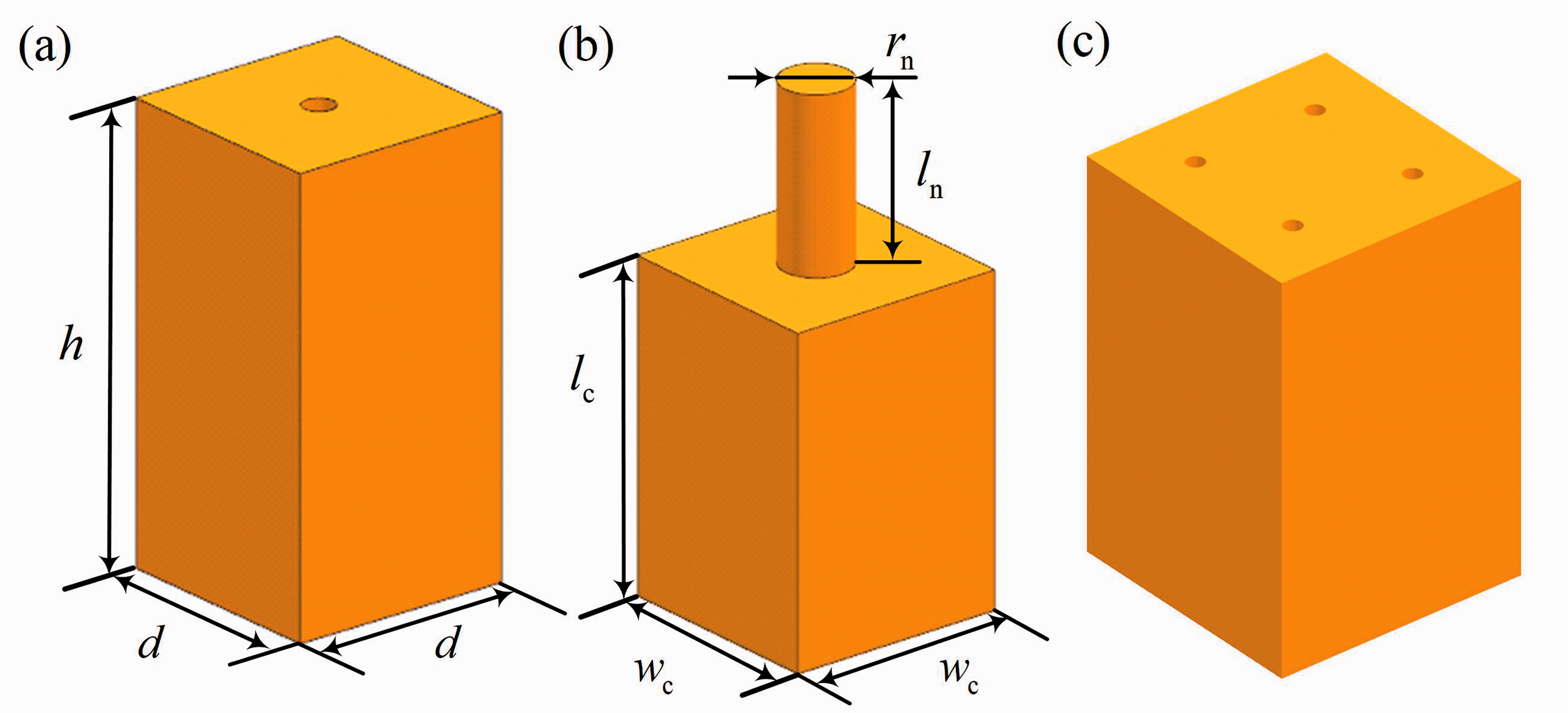
(a) The HR unit
The transfer matrix of the neck


Here
The equivalent mass density


Here
The equivalent mass density


Here
Since the pressure radiation at the discontinuities from neck to external air and from neck to cavity, the correction of neck length should be included, and the corresponding transfer matrix is, respectively, expressed as
35


Here
The transmit relationship of the normal volume velocity and the sound pressure from the metasurface to the bottom of the cavity is as follows

Here


Here
Single-frequency perfect sound-absorbing metasurface (SPSM)
Perfect sound absorption indicates that the sound absorption coefficient
The structural parameters of HR determine the resonance frequency and the balance between thermoviscous loss and energy leakage, i.e. the sound absorption coefficient. By changing only one parameter and fixing the other parameters, we can analyze the influence and the influence sensitivity of this parameter on the “zero”, peak absorption coefficient, and the frequency with maximum sound absorption under the initial HR structure. Figure 2 shows the example of the following initial structural parameters: neck radius
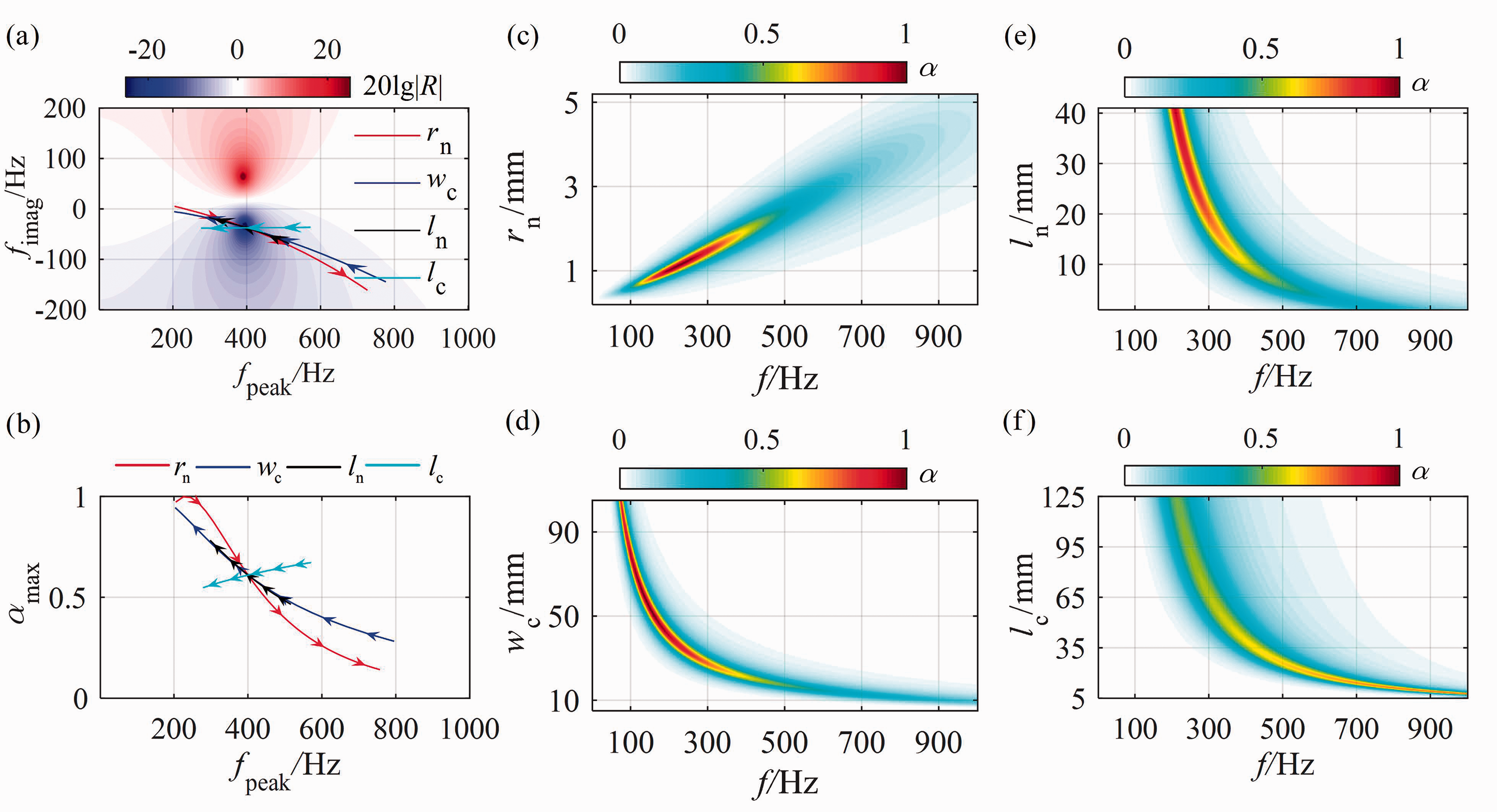
The trajectory of (a) “zero” and (b) peak absorption coefficient and corresponding frequencies (
As shown in Figure 2(a) and (b), the influence sensitivity of neck radius
In conclusion, by optimizing the structural parameters of HR, it is expected that the thermoviscous loss could balance energy leakage at any target frequency to achieve critical coupling and perfect sound absorption. Taking absorption coefficient equal 1 at the target frequency as the objective and structural parameters as the optimization variables, the structural parameter optimization model of HR is established. The neck radius

The objective function of the structural parameter optimization model is complex and nonlinear, so this paper applies fmincon integrating sequential quadratic programming algorithm (SQP) in Matlab to solve the model. SQP is one of the most excellent algorithms for solving such nonlinear programming problems, and the most outstanding advantages of SQP are good convergence, high computational efficiency and strong ability of boundary search. SQP obtains the optimal solution by transforming the original problem into a series of quadratic programming subproblems. The objective function of quadratic programming subproblems is the quadratic approximation of the Lagrange function of the original optimization problem, and the constraints are linear approximations of the original constraints. 36
The target frequencies are
Optimal structural parameters of SPSMs.

SPSM: Single-frequency perfect sound-absorbing metasurface.
Using the pressure acoustic module of COMSOL Multiphsics, the sound absorption coefficients of the designed SPSMs at different frequencies are calculated. The normal incidence of a unit plane wave is applied to simulate the experimental conditions in the impedance tube. The maximum mesh size should not exceed 1/6 of the shortest wavelength to ensure the accuracy of the calculation results. The narrow region acoustics are applied to the neck and cavity of HR to introduce thermoviscous loss. The sound hard boundary (volume velocity equals 0) is employed on the wall of the structure. As shown in Figure 3, the “zero” of each designed sample falls on the real frequency axis and coincides with the target frequency, indicating that the thermoviscous loss of the system could balance the energy leakage at each target frequency through the parameters optimization. The theoretical results of the sound absorption coefficient are consistent with the simulation results, and the perfect sound-absorbing is achieved at each target frequency. The thickness of each designed sample accounts for about 3.3%, 2.7%, 2.3%, and 2.0% of the wavelength of the corresponding target frequency, which indicates that each designed metasurface achieves perfect sound absorption with a deep subwavelength structure. With the increase of the target frequency, the neck radius increases, and the cavity length decreases.
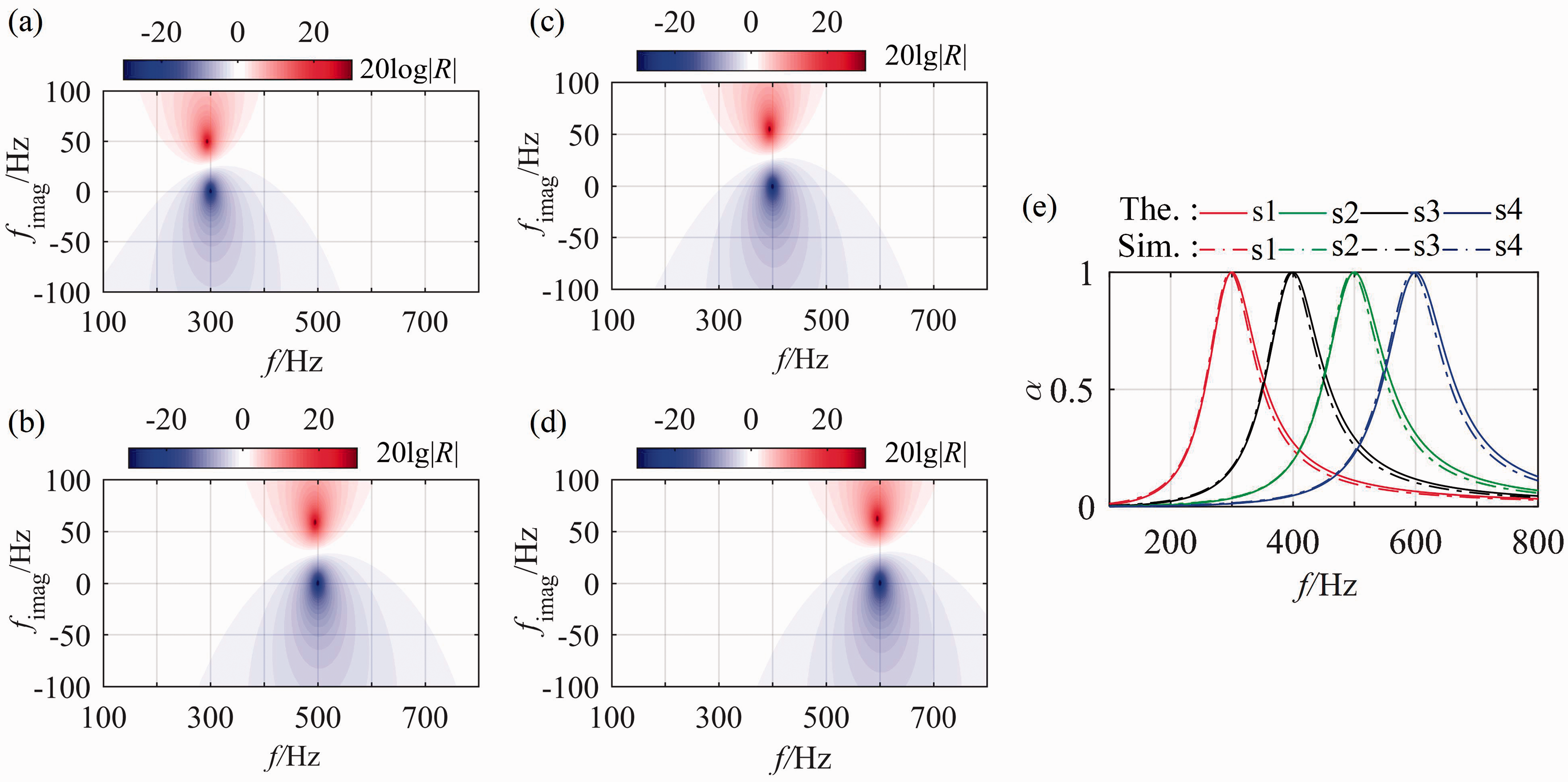
(a to d) demonstrate the distribution of
Multifrequency perfect sound-absorbing metasurface
The combination of multiple SPSMs
As far as the above-mentioned urban substation noise is concerned, four target frequencies need to be controlled simultaneously, and a metasurface composed of the four parallel installed SPSMs as mentioned above could be used. The acoustic impedance of metasurface composed by multiple SPSMs in parallel is expressed as the following formula
Figure 4(a) demonstrates the sound absorption coefficient of the composite metasurfaces composed of the four SPSMs as mentioned above. The sound absorption coefficient of composite metasurface drops significantly at the original target frequency due to the coupling among different SPSMs. In the view of energy, the thermoviscous loss of the composite metasurface at the original target frequency has been fixed due to the determined structural parameters of the HR unit, but the energy leakage increases because the total sound receiving area of the composite metasurface is the superposition of the sound receiving areas of multiple HRs, making the “zeros” move away from the real frequency axis as shown in Figure 4(b), which destroys the achieved critical coupling and decreases the sound absorption coefficient. In summary, perfect multi-frequency sound absorption cannot be achieved by simply combining different SPSMs. It is necessary to establish and solve the structural parameter optimization model for MPSM to achieve perfect sound absorption at multiple target frequencies simultaneously.
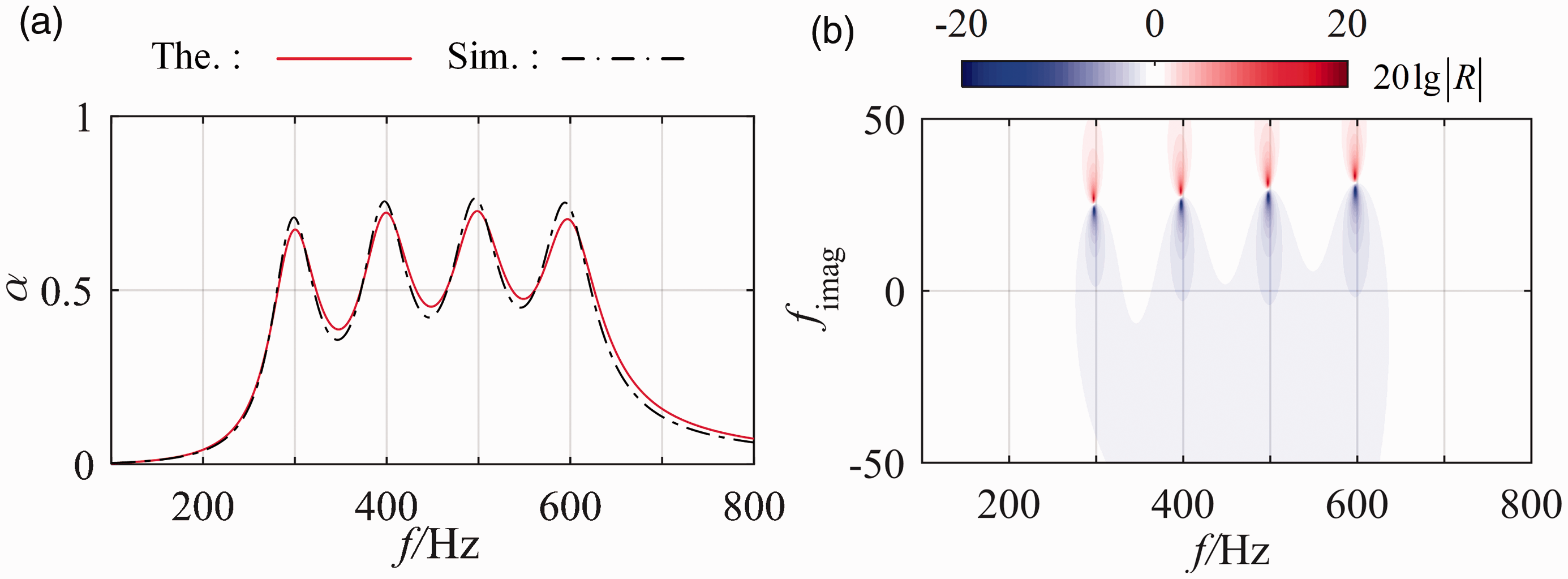
(a) Absorption coefficient spectrum of composite metasurface composed by four SPSMs. (b) Distribution of
The optimization design method of structural parameter for MPSM
By maximizing the sum of the absorption coefficients at multiple target frequencies, the multi-objective optimization model is transformed into a single objective optimization model so that the metasurface can achieve the perfect sound absorption at the target frequencies simultaneously. In this paper, the structural parameters of the 4-units metasurface are jointly optimized to achieve the perfect sound absorption at 300, 400, 500, and 600 Hz. The cavity length and neck radius are selected as optimization variables. The sound-absorbing area of MPSM equals the impedance tube’s cross-sectional area to match the experimental equipment, which is equivalent to a square with a width of 88.62 mm. Each HR unit’s cavity width and neck length are fixed at 30 mm and 10 mm, respectively. The structural parameter optimization model for the MPSM is as follows
Optimal structural parameters of MPSM.

MPSM: Multi-frequency perfect sound-absorbing metasurface.
The simulation analysis results based on the COMSOL are used to verify the theoretical results. The simulation settings are the same as those of SPSMs. Figure 4(a) demonstrates the distribution of
A 3 D printed physical sample using photosensitive resin as raw materials is used to verify the analysis results experimentally. The processing method of 3 D printing is stereo lithography apparatus (SLA). The composition of the experimental system and the photos of the experimental site are shown in Figure 5(c) and (d). The impedance tube (Bruel & Kjaer type 4206, Nærum, Denmark) integrated with two pressure field microphones (Bruel & Kjaer type 4187, Nærum, Denmark) is used to measure the sound absorption coefficient. The impedance tube complies with the ISO-10534–2 standard, its inner diameter is 100 mm, and the distance between two microphones is 50 mm. The distance between the sample and the nearest microphone is 100 mm. The gap between the test sample and the impedance tube is sealed by playdough during the test, as shown in Figure 5(c).
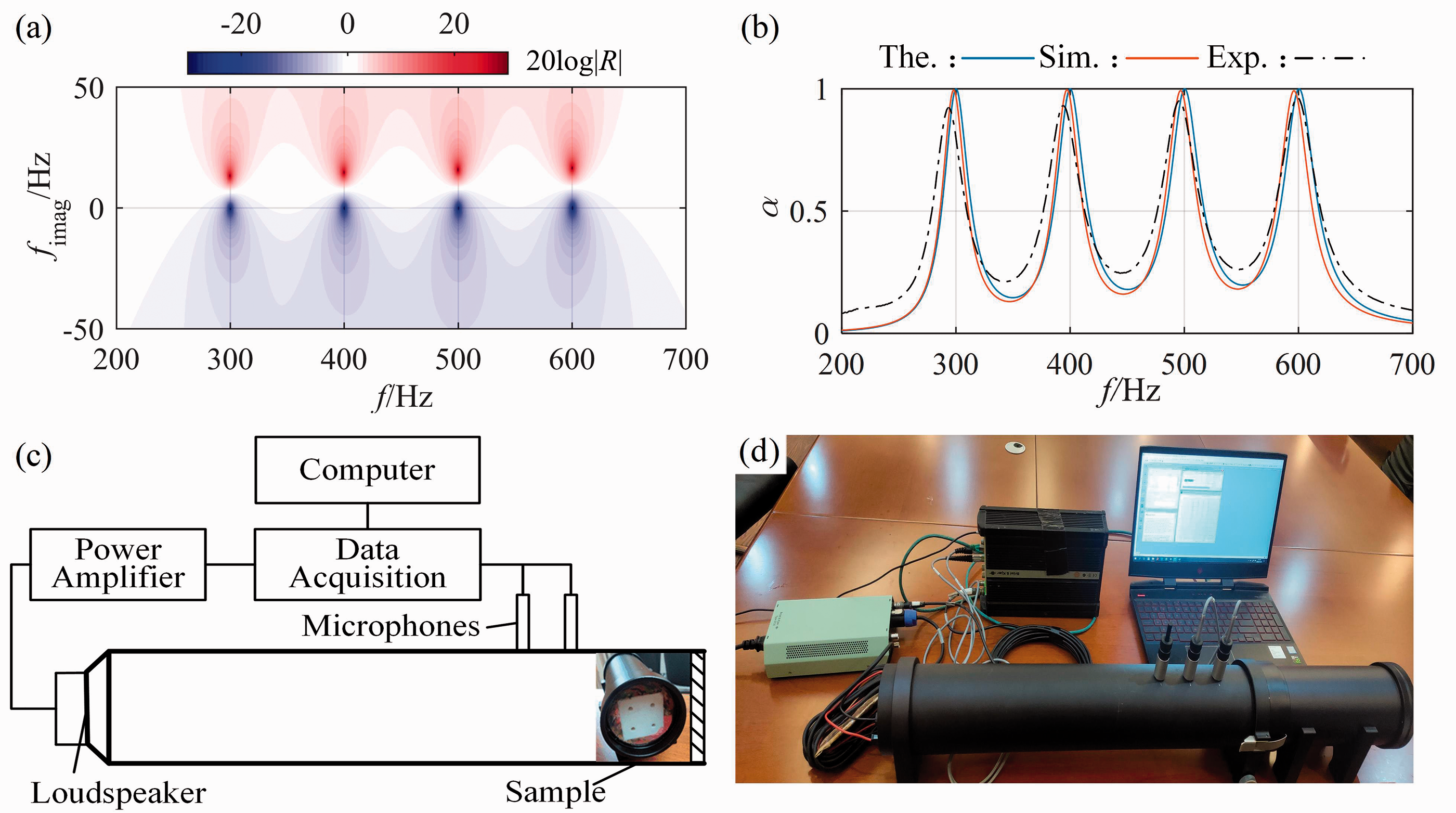
(a) The distribution of
Figure 5(b) shows that the experimental results of the four-frequency perfect sound-absorbing metasurface are basically in agreement with the simulation and theoretical results. The minor errors between simulation and experimental results should mainly come from manufacturing errors of physical samples. These results show that the MPSM can be obtained by joint optimization of multiple HRs structural parameters, and each unit can reach the critical coupling condition at its resonance frequency to achieve perfect sound absorption.
Conclusion
This paper proposes a design method of structural parameter for MPSM based on HR, which is suitable for absorbing the low-frequency harmonic noise in urban substations. Taking the sum of the sound absorption coefficients at the harmonic frequencies of 300, 400, 500, and 600 Hz equal to the number of the target frequency as the objective and the structural parameters of HR units as the optimization variables, the structural parameter optimization model is established. The optimization model is solved by SQP to obtain the structural parameters of subwavelength MPSM. The simulation results and experimental results indicate that the designed MPSM can achieve perfect sound absorption at each target frequency with critical coupled HRs. We hope that this study can provide a reference for the design of similar metasurfaces.
Footnotes
Declaration of conflicting interests
The authors declared no potential conflicts of interest with respect to the research, authorship, and/or publication of this article.
Funding
The authors disclosed receipt of the following financial support for the research, authorship, and/or publication of this article: This work is supported by the Science and Technology Project of China Southern Power Grid (no. GDKJXM20200377).
