Abstract
Rotating blade is one of the most important components for turbomachinery. Blade crack is one of the most common and dangerous failure modes for rotating blade. Therefore, the fault mechanism and feature extraction of blade crack are vital for the safety assurance of turbomachinery. This study is aimed at the nonlinear dynamic model of rotating blade with transverse crack and the prior feature extraction of blade crack faults based on the vibration responses. First and foremost, a high-fidelity breathing crack model (HFBCM) for rotating blade is proposed on the basis of criterion for stress states at crack section. Since HFBCM is physically deduced from the perspective of energy dissipation and the coupling between centrifugal stress and bending stress is considered, the physical interpretability and the accuracy of the crack model are enhanced comparing with conventional models. The validity of the proposed HFBCM is verified through the comparison study among HFBCM, conventional crack models, and finite element-based contact crack model (FECCM). It is suggested that HFBCM behaves best among the analytical models and matches well with FECCM. With the proposed HFBCM, the nonlinear vibration responses are investigated, and four types of blade crack detection indicators for rotating blade and their quantification method are presented. The numerical study manifests that all these indicators can well characterize the occurrence and severity of crack faults for rotating blade. It is indicated that these indicators can serve as the crack-monitoring indexes.
Introduction
Rotating blades, one of the core components of rotating machines, are extensively applied in modern industry such as gas turbines, jet engines, power plants, pumps, helicopters, and wind turbines. The blade-related failures (up to 42% of the total failures 1 ) are often classified as the major sources of failures in many gas turbines since rotating blades suffer extreme operating conditions such as high mechanical loading due to extreme changes in both temperature and pressure, high/low-cycle fatigue (HCF/LCF) loading, high centrifugal loading due to high spinning speed, and foreign object damage (FOD). One of the most common failure modes of rotating blades is crack, which is related to a variety of factors including FOD, LCF/HCF, manufacturing flaws, stress corrosion, ingested debris, and resonant fatigue. 2 For example, an F35A fighter caught fire during liftoff due to blade off of F135 engine which is induced by fatigue crack failure and accelerated by excessive blade-casing rubbing, 3 and the Trent 1000 engine installed on Boeing 787-9 has been suffering from the severe blade crack problem caused by corrosion-related fatigue since 2016. 4
Recent years have witnessed a growing interest in blade damage detection and an imperative need to develop an effective and robust blade health monitoring (BHM) technique to enhance the operational reliability and safety of the bladed rotating machines. Among all the conventional BHM techniques (such as vibration analysis, acoustic emission, infrared thermography, strain gage measurements, and pressure field assessments), vibration analysis is the most popular since it provides the longest lead time to blades failure.5,6 However, despite the advances in theory and technology of blade fault diagnosis over many years, effective and accurate measurement of blade vibration performance still encounters with some significant challenges, which in turn triggers the need for further improvements on the comprehending of blade (with or without damage) vibration phenomenon. 6
Over the past decades, numerous interests and efforts are dedicated to the investigation on blade vibrations.7–9 Some general dynamic models, including lumped-mass model, 10 analytical model based on beam theory11–13 and plate theory,14,15 and finite element (FE) model,16,17 have been proposed to predict the vibration behavior of rotating blades. Through numerical simulations, natural vibration, 14 and nonlinear behavior 11 of rotating blades considering the Coriolis effect, spinning softening and centrifugal stiffening effects, shaft-disc-blade coupling vibration,10–12 impact effects of shrouded blades,13,18 blade-casing rub-impact faults,16,19 blade-disk systems’ mistuning,17,20 and blade-off effects on the aero-engine vibration 21 are extensively investigated. Several vibration indicators for abnormal vibrations especially including those due to excessive blade-casing rubbing, vibration localization induced by mistuning, nonlinear effects owing to blade off, and sophisticated impact behavior caused by shrouded blades are found based on the existing dynamic models and numerical simulations. However, current researches are seldom focused on the nonlinear effects of blade cracks that frequently result in gas turbine failures and further cause huge financial losses, including safety implications.
Cracks in mechanical structures have been facing significant difficulties in accurate modeling and effective detection because of its complexity such as various crack modes, sophisticated crack geometries, and nonlinear crack surface contacts. 22 By adopting the assumption of stationary blade, the linear and nonlinear dynamic behavior of blades (stationary cantilever beams) with crack are extensively studied. Several crack models including local compliance model (LFM), 23 strain energy release rate (SERR)-based model (SERRM), 24 wavelet-FE model (WFEM), 25 two-dimensional-FE model (2D-FEM), 26 and three-dimensional-FE model (3D-FEM) 27 have been proposed to predict the dynamic behavior of cracked beams.
In earlier research, the crack was assumed as an open one, that is, linear model. For example, the LFM 23 and SERRM 24 used for multiple cracks identification assumed crack effects as a constant stiffness reduction, and the WFEM 25 utilized for single crack localization dealt with the crack as an additional constant stiffness matrix to merit the continuity conditions. Among all the conventional researches based on linear crack models, most are focused on the free vibration of cracked beams and identify the crack through natural frequency shift and localization the intersection point of three different frequency contour lines.23–25 For example, Liu et al.28,29 investigated the effects of crack depth and location on the natural frequencies and mode shapes of the cantilever beam with open crack, indicating that the phenomenon of abrupt changes of single-level SWT decomposition detail coefficients of the normalized mode shapes for the cracked beam can serve as an indicator for crack identification and localization. Linear models pose many advantages since an integrated theoretical foundation makes it easy to obtain analytical solutions and extract crack features. However, owing to the sophisticated contact behavior between two crack surfaces during vibration, dynamic characteristics of a cracked beam are nonlinear rather than linear, which obstructs the application of conventional linear vibration analysis tools, such as modal analysis and harmonic response analysis, and further adds challenges to crack detection.
The nonlinearity of cracks is introduced on account of the closing behavior of two crack surfaces, which assumes that the crack opens and closes alternately during vibration. 30 This phenomenon is also called “breathing effect” of cracks. Generally, there are two approaches to simulate the “breathing effect” of cracks, that is, (i) analytical method, which is often based on LFM or SERRM;31–33 (ii) numerical method, which is normally based on FE numerical simulation and contact theory.27,34,35 The key to nonlinear crack models is to obtain the time-varying structural parameters including stiffness, damping, and excitation force induced by cracks. As for analytical model, the most extensively adopted model is bilinear crack model which assumes that there are two crack-state configurations, that is, fully open configuration and fully closed configuration and the crack alternates between the fully closed configuration and fully open configuration during vibration. 34 Therefore, the breathing behavior of cracks is simulated by assuming that the system’s stiffness alternates within two piecewise stiffness coefficients, wherein one corresponds to the fully open configuration and the other is related to the fully closed configuration. Considering the practical engineering, the crack does not always directly switch from one configuration to the other, and some transition states that the crack is neither fully open nor fully closed may exist. To more accurately simulate the crack-breathing behavior, the bilinear model is further extended from a piecewise model to a continuous model that assumes the stiffness changes continuously from the fully open configuration to the fully closed configuration. 32 In view of this, some numerical models were proposed to solve better the above issue, among which the contact crack model is the most extensively applied.27,35–37 For example, by assuming crack as a pair of two frictionless contact surfaces, nonlinear breathing behavior of cracks is simulated by 2D-FEM, 35 and a mixed-beam/solid 2D-FEM is proposed to reduce the computation time. 27 Based on the mixed-beam/solid 2D-FEM, the effects of elastic support on the vibration responses of cracked beam are explored. 37 To consider the simulation accuracy and, meanwhile, promote the computation efficiency, Liu et al. 38 derived a cracked hexahedral element to simulate the breathing effect. By comparing the analytical models and numerical models, it is worth noting that analytical models may be less accurate than numerical models, but analytical models are much more efficient and easier to solve than numerical models. Also, most of the basic nonlinear dynamic characteristics can be captured by analytical models. Based on both analytical and numerical models, several vibration indicators have been found for the breathing cracks, where one of the most significant indicators is the super-harmonic resonance in the sub-critical region. However, among all the above-mentioned investigations, most consider the blade to be stationary, and few involve the effects of high-speed spinning of blade including spin softening and centrifugal stiffening on the cracked blade.
Some researchers explored the coupling effects of blade crack and high-speed spinning. For example, Kuang and Kuang39,40 proposed a cracked blade-disk model based on SERRM to predict stability and the mistuning behavior of blade-disk systems. Later, Panigrahi and Pohit 41 put forward a model for the rotating cracked blade with functionally graded materials by assuming the crack to be an additional spring at the crack location which adds a local flexibility to the system stiffness of blade. However, in their model,39–41 the crack is assumed to be an open one. Namely, the nonlinear effects of crack are neglected. To further analyze the nonlinear vibration of rotating cracked blades, Kim and Kim 42 developed a breathing model using the bilinear assumption of cracks to investigate the coupling effects of cracks and spinning. Nevertheless, the conventional modal analysis method is adopted in their research to predict the natural frequency of cracked blade, which, in turn, neglects the influence of nonlinear effects of cracks. Based on lumped-mass blade model and local flexibility crack model, Xu et al.43,44 derived a nonlinear model of rotating blades with breathing crack to identify weak crack using vibration power flow analysis and predict the mistuning behavior of blade-disc system using conventional modal analysis. Since the lumped-mass blade model is simplified to a single-degree-freedom system, the accuracy of their model will be significantly reduced. Given this, the FE method is employed, which significantly promotes the model accuracy. For example, the FE-based contact crack model (FECCM) is used to investigate the nonlinear vibration and mistuning behavior of rotating blades with breathing crack, 45 and the accuracy and efficiency are further promoted by introducing the cracked hexahedral element to simulate the breathing crack. 38 However, their investigations are mainly focused on the free vibration analysis and mistuning behavior prediction rather than the nonlinear vibration of rotating cracked blade. Ma and coworkers 6 further proposed a cracked beam element method for the dynamic modeling of rotating blade crack, employing the rotating and pre-twisted effects of the blade, based on which the nonlinear vibration characteristics are explored.
Recently, motivated by the FECCM, a stress-based breathing crack model (SBCM) was proposed based on stress state at the crack section, making it possible to consider the coupling of breathing crack, centrifugal effect, and bending effect in analytical crack model. 47 However, the effects of blade radial deformation and Coriolis force are neglected, which may lead to accuracy decreases. Besides, SBCM also suffers following two defects: (i) it is assumed that the closing behavior of the breathing crack is controlled by a breathing function that is proportional to the inertia moment of the open crack area, thus reducing the physical interpretability; (ii) due to the assumption about the breathing function, a correction factor has to be adopted in the original and also incomplete model to improve the accuracy, which in turn, actually, results in the overestimation of crack effect, and thus makes the accuracy reduced in the complete model. In this study, the most widely applied transverse crack models for rotating blade are briefly reviewed, and their limitations are specifically discussed in detail. To conquer the limitations of conventional analytical models, a novel analytical breathing crack models with high physical fidelity for rotating blade is proposed based on the criterion of stress states at crack section.
A high-fidelity crack model provides the basis for the fault mechanism study for blade crack. An effective indicator for blade crack offers the benchmark for blade detection. Over the past decades, several scholars have been dedicated to studying the fault mechanism of blade crack based on conventional crack models and intended to propose some useful crack detection indexes through the feature analysis of vibration responses of cracked blade. In the early stages of the research about blade crack, most were focused on the free vibration analysis of stationary blades. For example, Chasalevris and Papadopoulos 23 conducted a comprehensive investigation about the modal characteristics of the cantilever beam with crack. Saito et al. 48 studied the effect of edge crack on the natural frequency of cantilever plate based on FECCM. These studies suggest that the crack will lead to the decrease of natural frequency and the distortion of blade modal shape (such as the discontinuity of gradient for modal shape) for stational blade. However, for rotating blade, the natural frequency is simultaneously affected by centrifugal stiffening, spinning softening, and the crack fault. Therefore, it is hard to determine the occurrence of crack only based on the natural frequency shift through one time of testing, as indicated in the research of Huang and Kuang. 40 Only if we monitor the alteration of free vibration characteristics continuously, it is possible to monitor and predict the occurrence of crack fault for rotating blade. However, the acquisition of the operational modal characteristics remains a big challenge.
Compared with the modal properties, the dynamic behavior of cracked blade under forced excitation is more attractive for blade crack detection since they are easy to be measured under operational conditions. Among the forced vibration characteristics, the nonlinear vibration caused by the breathing crack is the most extensively investigated. Andreaus et al. 34 and Ma et al. 36 investigated the nonlinear vibration responses of cracked blade based on FECCM under stational condition and found some super-harmonic components including 2×, 3×, and 4× may show up in the spectrums. As for the rotating blade, it is believed that the coupling effect of centrifugal force and bending moment may affect the nonlinear vibration features. 49 However, only a few researchers are dedicated to the nonlinear vibration of rotating blade with crack due to the lack of a high-fidelity breathing crack model (HFBCM). Some of them conducted explorations about this issue. Saito 45 analyzed the free and transient vibrations based on FECCM and suggested that some more complex nonlinear phenomena, such as periodic bifurcation and vibration “jump,” may show up. Xu et al. 43 investigated the nonlinear dynamic behavior of rotating blade with breathing crack and believed that the breathing crack would lead to the presence of sub-harmonic component 1/2×. However, in their model, the coupling effect of centrifugal force and bending moment is neglected. Obviously, most of the nonlinear vibration features for stational cracked blade are deeply investigated, while the validity of these features or indicators for rotational cracked blade needs further study, and the quantification of these indicators remains a big challenge for rotational cracked blade.
Considering these sufferings of conventional investigations, the main contribution of this study are as follows: (i) a HFBCM for rotating blade is proposed based on the criterion for stress states at crack section, and both the physical interpretability and the accuracy are enhanced; (ii) with the proposed HFBCM, some blade detection indicators are constructed and analyzed, and the quantification of these indicators are offered, which makes it possible to track and monitor the alteration of crack severity. The remainder of this paper is organized as follows. In “Dynamic modeling of rotating blade” section, the dynamic model of rotating blade is briefly given. In “Dynamic modeling of blade crack” section, limitations of conventional analytical crack models for rotating blade are first presented, and then the HFBCM for rotating blade is formulated through the energy method. In “Model verification” section, the validity of HFBCM is verified through comparison with FECCM. In “Blade crack detection indicator analysis” section, the blade crack detection indictors are analyzed, and their quantification methods are also given in this section. The limitations of this study are also discussed in “Discussions of limitations of the proposed method” section. Finally, conclusions are drawn in the final section.
Dynamic modeling of rotating blade
In this paper, the Euler beam assumption is utilized to establish the dynamic model of rotating blade. The kinetic and deformation of rotating blade are shown in Figure 1. The rotating blade that is fixed on a rotating rigid disk is simplified as a cantilever Euler beam with the uniform section as shown in Figure 1(a).
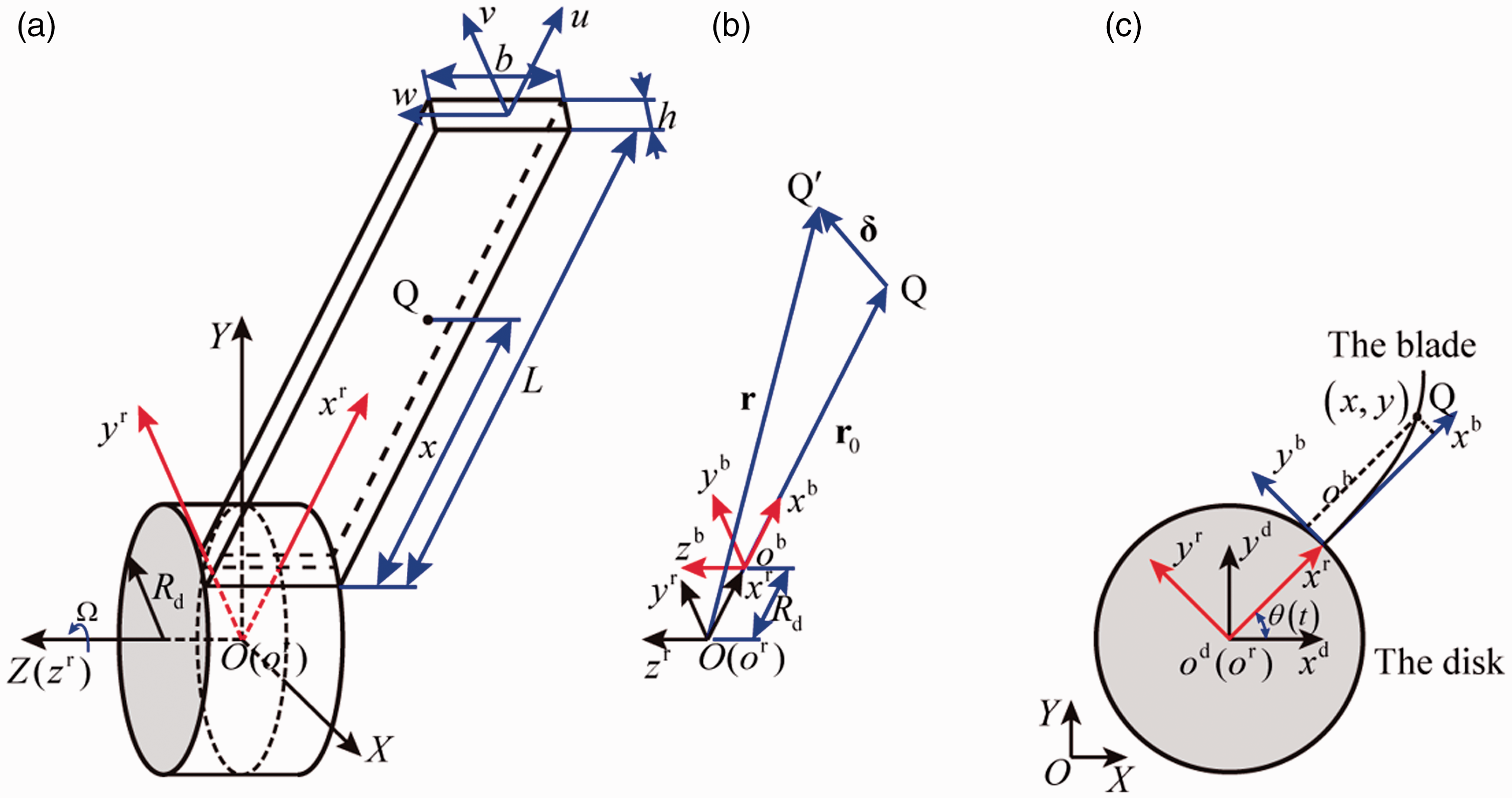
(a) Schematic of the rotating blade, (b) motion of the blade, and (c) schematic diagram of the blade deformation. 13
According to literature,13,50 the dynamic differential equation of the rotating blade can be obtained and expressed in matrix form as

Dynamic modeling of blade crack
In this section, the limitations of conventional crack models for rotating blade are discussed first. Based on theoretical and numerical analysis, a general nonlinear crack model for rotating blade that conquers the defects of conventional crack models is developed.
Limitation of conventional models
The typical analytical dynamic models for transverse crack of rotating blade are systematically reviewed at first, and then their limitations in predicating the nonlinear dynamic behavior of rotating blade with crack are discussed in the following section.
Brief review of conventional models
There are four types of analytical crack models generally used to simulate the crack effect on dynamic characteristics of rotating blade with crack. They are open crack model (OCM), 40 bilinear breathing crack model (BBCM), 34 cosine breathing crack model (CBCM),43,50 and SBCM. 47
The OCM, a linear model, is the earliest transverse crack model applied to study the vibration of rotating blade with crack, and it is also the basic model for the development of other models. The linear elastic fracture mechanics theory is often used to formulate the OCM. The effect of crack is considered as a local flexibility increment or system stiffness decrement, both of which can be derived through the SERR of blade crack. As shown in Figure 2, there are three typical crack modes for mechanical structures, and they are described as follows: (i) mode I—the crack surfaces moving directly apart, (ii) mode II—the edge sliding mode, and (iii) mode III—the tearing mode. 51 If the crack is initiated under the bending fatigue load, the stress field around the crack tip will be dominated by the mode I loading. 24 According to Dimarogonas et al., 52 the reduction of the elastic energy in the presence of crack caused by bending moment is the only significant change in the case of slender beams. The stiffness reduction is often adopted to describe the crack effect, and it can be calculated according to the literature. 51
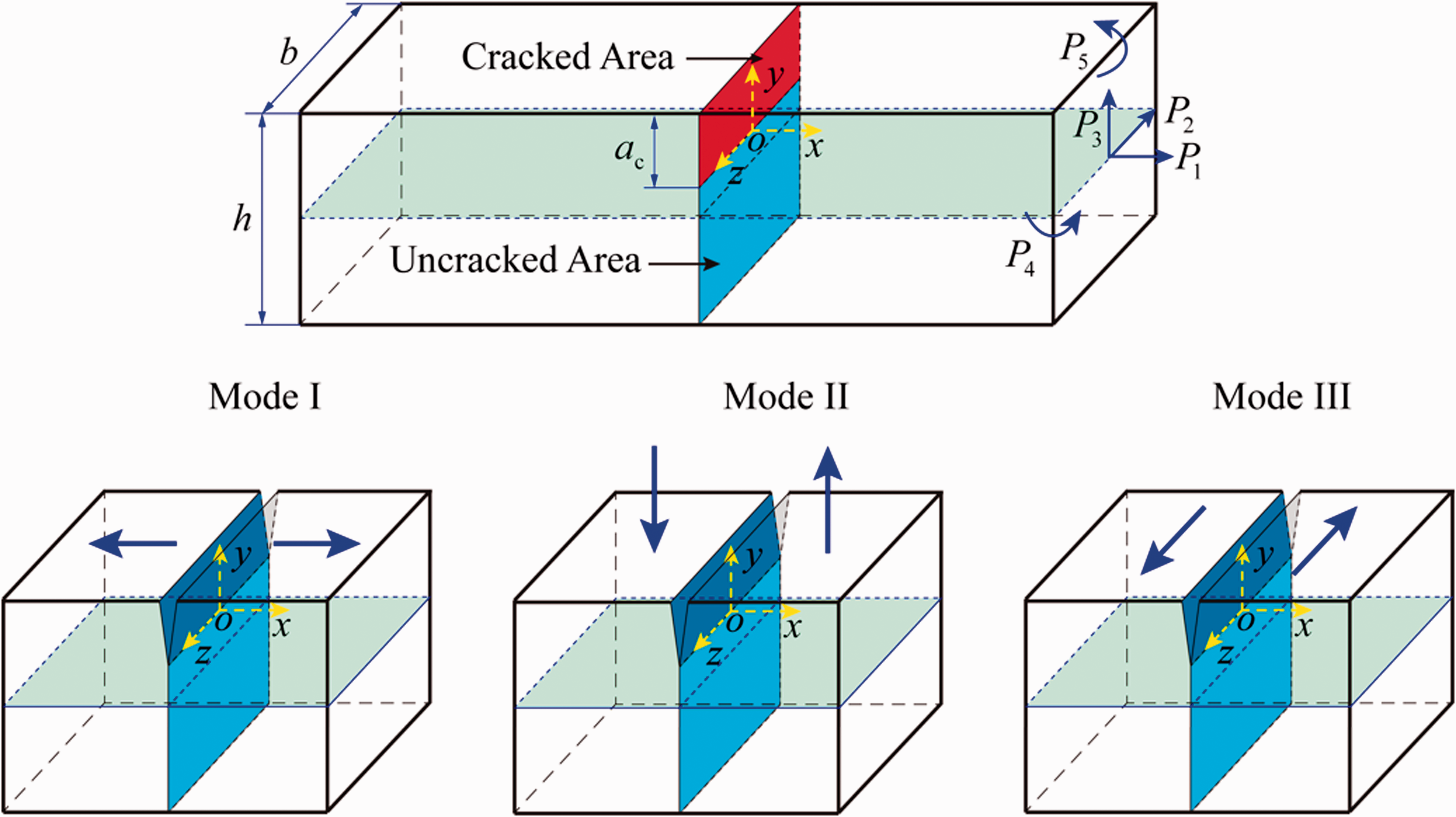
Loaded beam element with transverse crack and the basic modes of crack surface displacements.
Since OCM is a linear model, it cannot characterize the closing behavior of cracks, which presents with the blade vibration. The nonlinear crack model is then introduced on account of the closing behavior of two crack surfaces, which assumes that the crack opens and closes alternatively during blade vibration. 30 This phenomenon is also called “breathing effect” of cracks. The essential part of nonlinear crack models is to obtain the time-varying structural parameters including stiffness, damping, and excitation force induced by cracks. As for analytical model, the most extensively adopted model is BBCM that assumes two crack states, that is, fully closed configuration (see Figure 3(a)) and fully open configuration (see Figure 3(b)), and the crack alternates between these two states during blade vibrations. 34
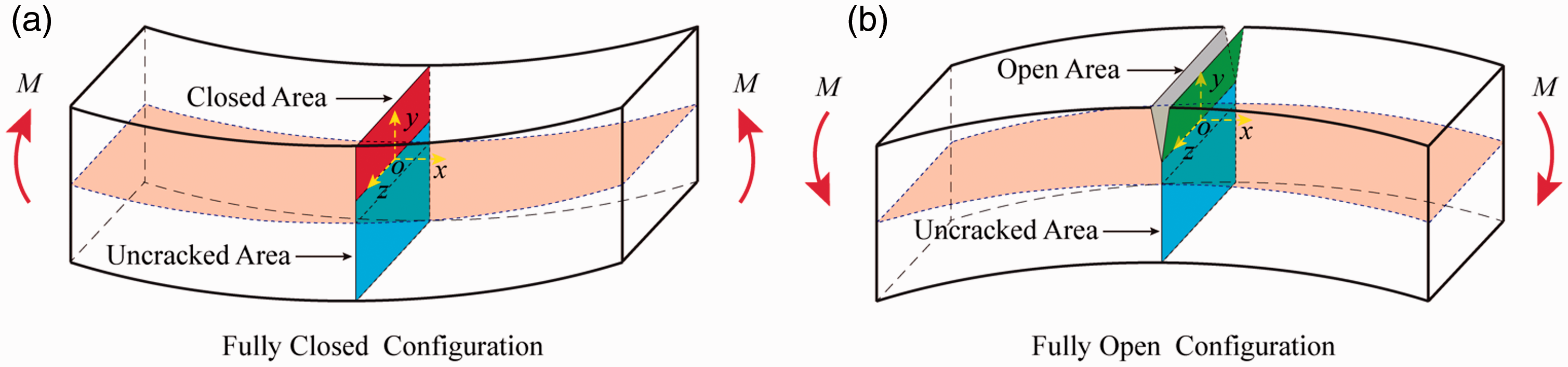
Crack configurations of BBCM: (a) fully closed configuration and (b) fully open configuration.
As known to all, the breathing behavior of the crack is determined by the tensile and compressive stress distribution at the crack section. For a cracked blade under stationary condition, the stress field at the crack section is absolutely controlled by the bending moment. As a result, the crack opens and closes stepwise with the change of bending moment. However, for a cracked blade under rotational state, the stress field at the crack section is not only affected by the bending moment due to aerodynamic force but also influenced by the centrifugal force due to blade spinning. Therefore, the crack of the rotating blade does not always alternately switch from fully closed configuration to fully open configuration. In other words, excessive states, that is, partially closed configurations, may exist between two critical states. Considering the partially closed configurations of the blade crack, some fitting breathing crack models are proposed,43,50 among which CBCM is the most widely applied. It is assumed in CBCM that the crack alternately closes and opens continuously in the cosine way rather than stepwise during blade vibrations.
As mentioned in CBCM, the “breathing” behavior of blade crack is simultaneously controlled by bending and centrifugal stress at crack section. However, the CBCM does not characterize the detailed contact behavior of two crack surfaces. Thus, the SBCM proposed in Xie et al.
47
is introduced to elaborate the interaction between the bending stress and centrifugal stress, with which the closing behavior of the crack is determined during blade vibrations. During the vibration of rotating blade, the stress at the crack section is the superposition of bending stress and centrifugal stress, as shown in Figure 4(a). The centrifugal stress depends on the rotating angular speed (
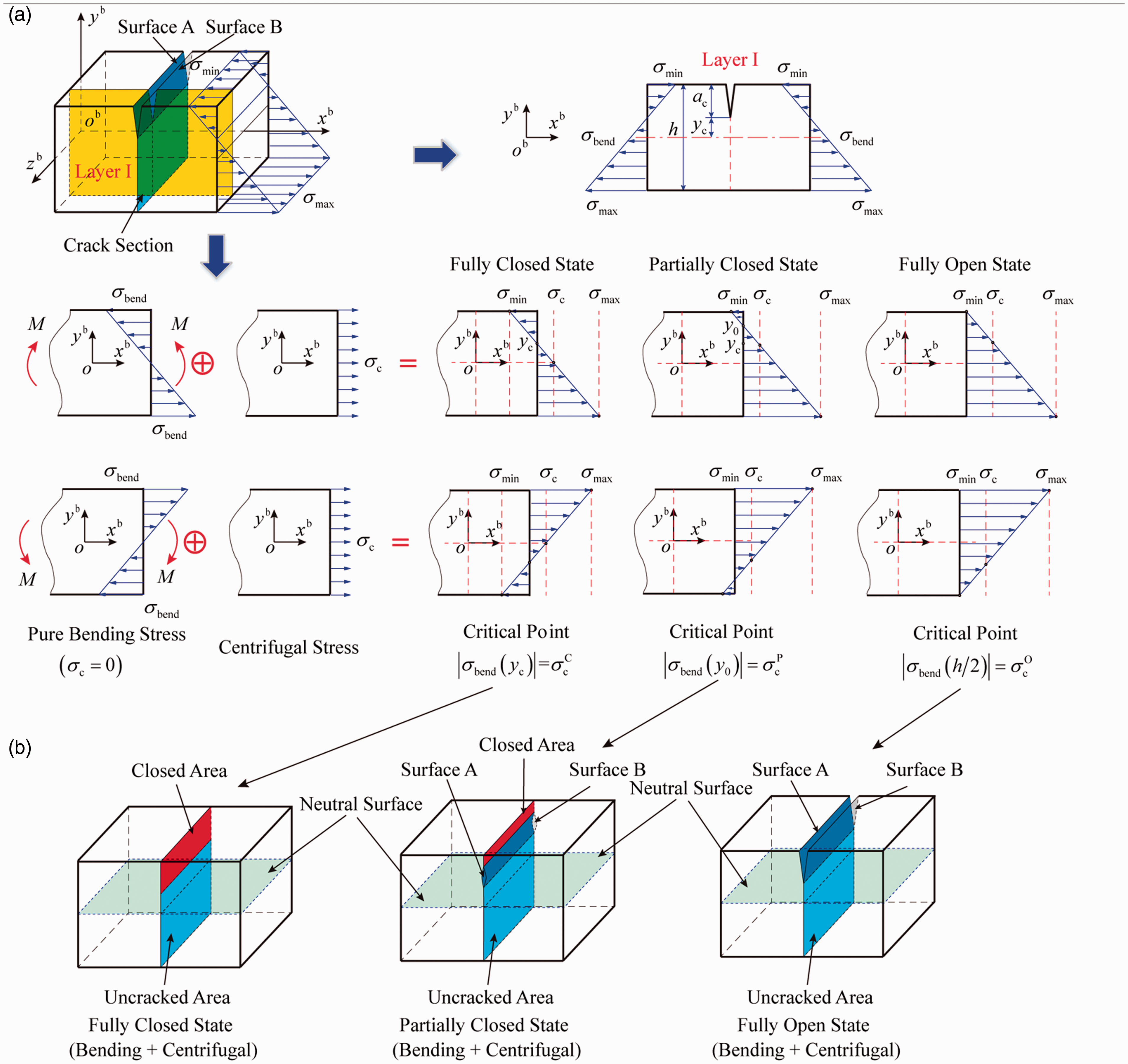
(a) Schematic diagram of the stress state and (b) the crack configurations of SBCM.
It can be seen that, in the open area, the region near the neutral surface always remains in tensile stress because of the tensile states induced by centrifugal force, as shown in Figure 4(a). The critical point between the open area and closed area (
In partially closed state, as shown in Figure 4(b), the crack area near neutral surface is in open state while the area near the blade edge is in closed state, which is similar to the internal crack in the structure. However, the stress field near the crack tip formed by the closed crack differs from the one near the real crack tip. In Xie et al.,
47
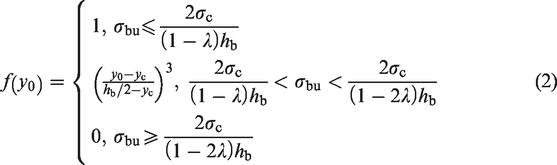
the stiffness alteration coefficients corresponding to three crack states, that is, breathing function, are estimated according to the effective inertia moment of the open crack area as follows

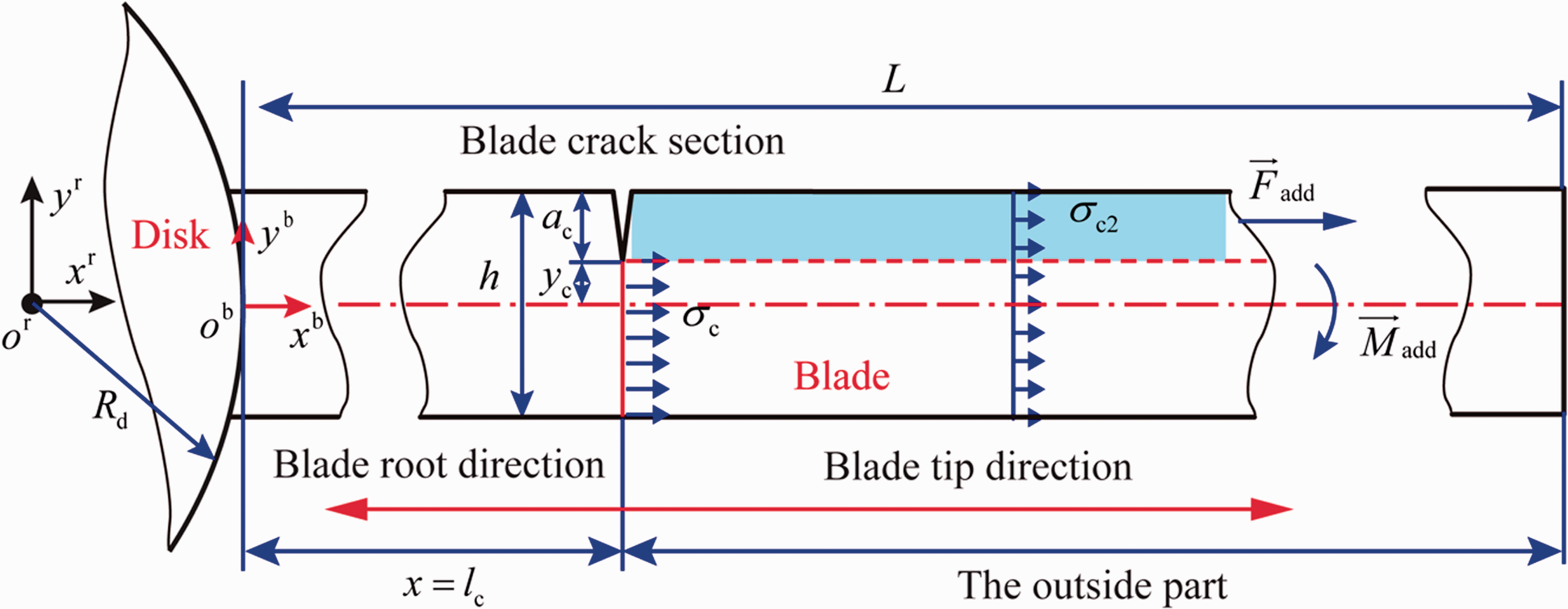
Schematic diagram of the cracked blade.
Considering the effect of crack, the nonlinear dynamic model of rotating blade with crack can be rewritten in the following expression according to equation (1)

Limitation discussion
To discuss the limitations of conventional models, the FE contact crack model (FECCM) is introduced. The vibration responses obtained by FECCM are taken as a benchmark for the comparison. A mixed-2D FE blade model with eight-node Plane 183 elements (plane stress state considering the thickness) and Beam 188 elements is employed to establish the FE model of rotating blade with crack, where the plane elements are used in crack region, and the beam elements are applied in two regions far away from the crack, as shown in Figure 6. Between two joint surfaces of sub-models, the bonded contact model is applied. Since the influence of the friction between two crack interfaces is negligible, a frictionless contact model is used here to simulate the breathing crack.
34
The validity of FECCM is verified in literatures.
36
Thus, in this study, the FECCM is adopted to analyze the defects of conventional models and verify the proposed analytical model by comparison investigation. The structural damping coefficients for FECCM and analytical models are the same. The Newmark-
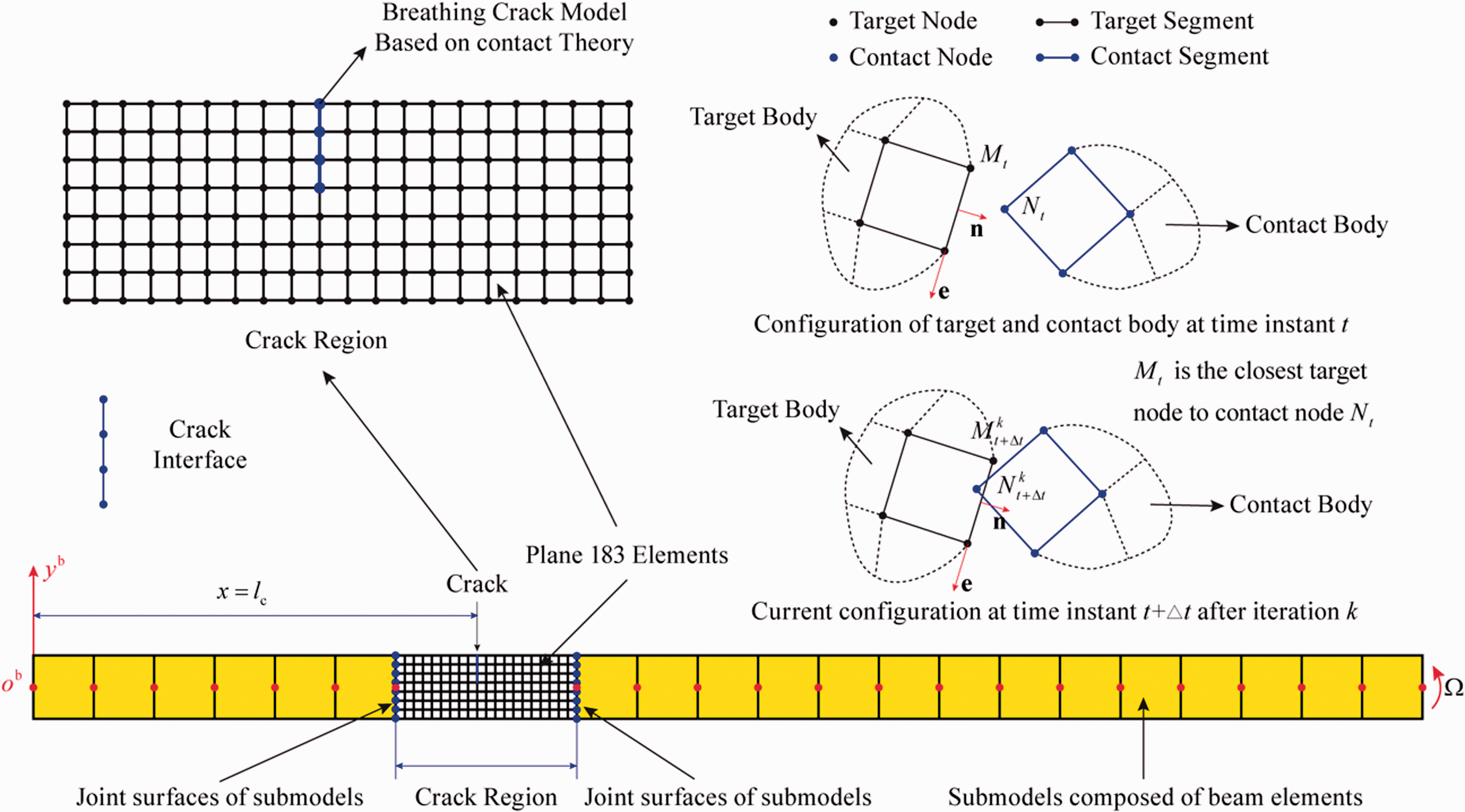
FE model of the cantilever blade with breathing crack. 36
The vibration responses under following three conditions are compared to analyze the performance of the aforementioned crack models. Harmonic load
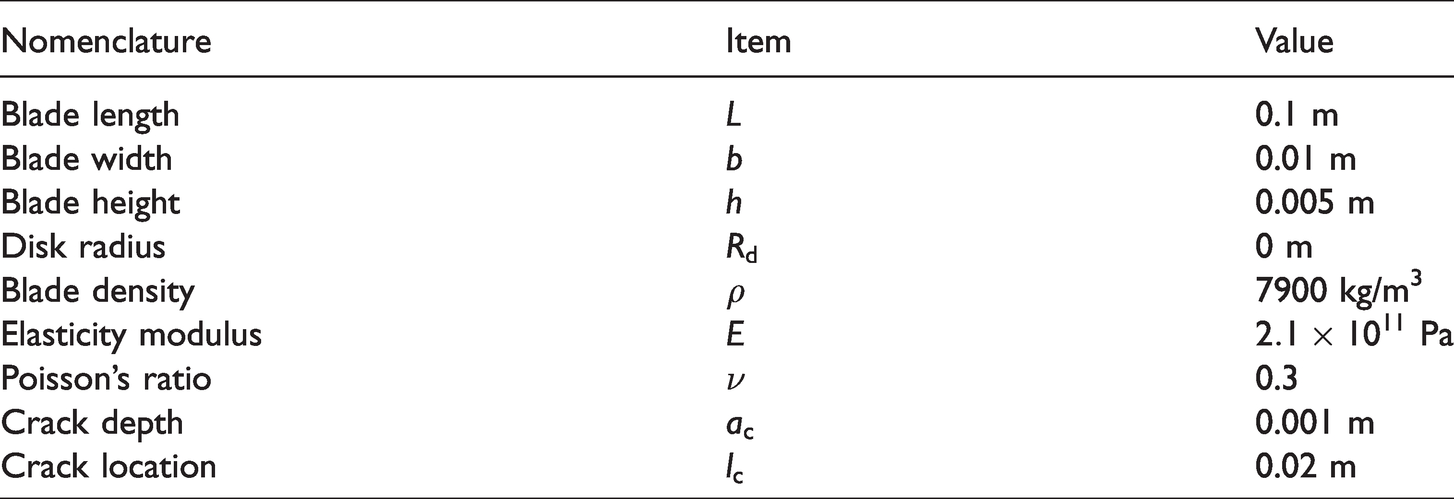
Structural parameters of the rotating blade used for numerical simulation.
Condition parameters for numerical simulation of rotating blade with crack.

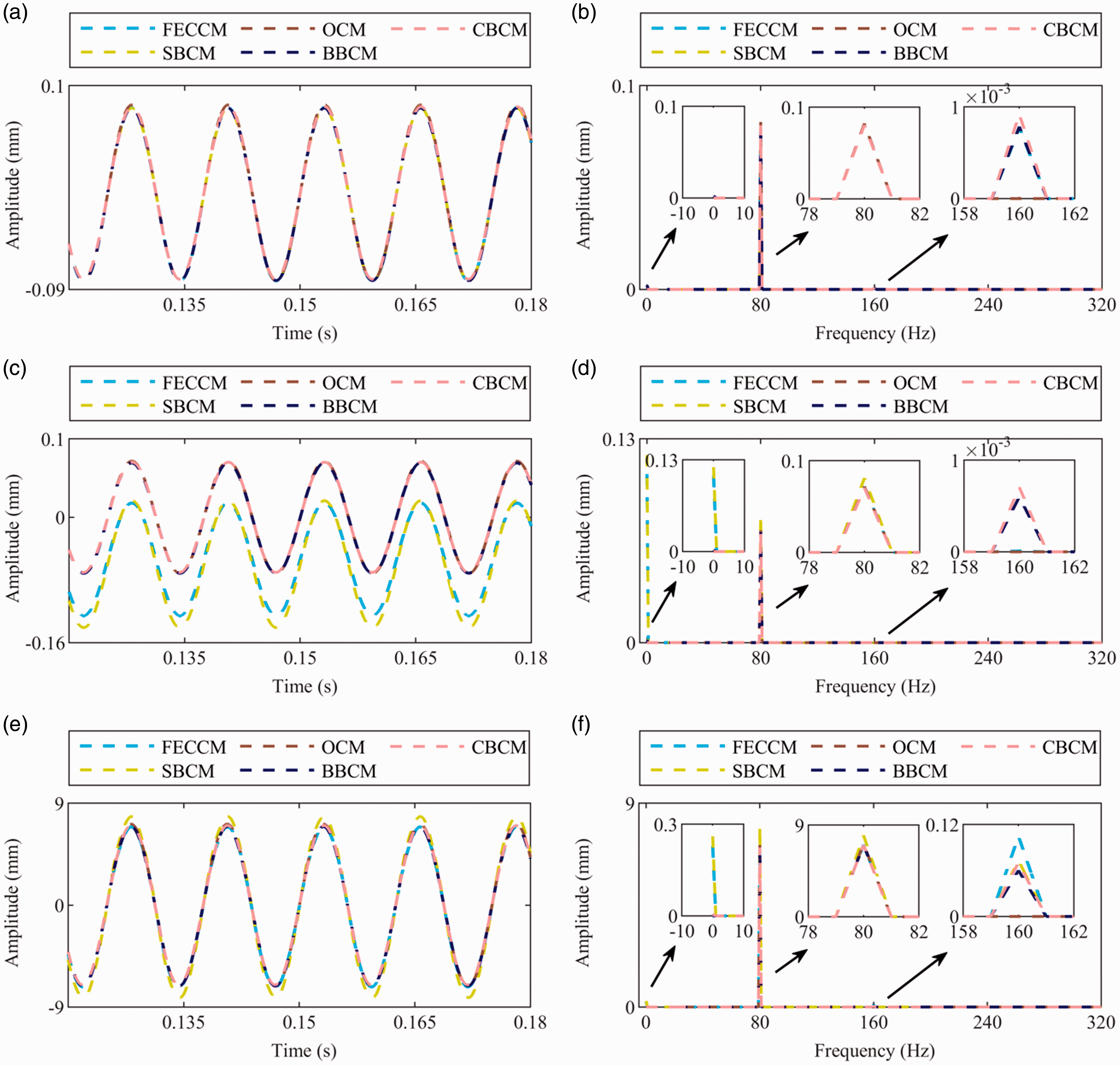
Vibration responses under different conditions: (a)–(b) Condition I, (c)–(d) Condition II, and (e)–(f) Condition IV.
As shown in Figure 7(a) and (b), under stationary Condition I (0 rev/min, 5 N, 80 Hz), it is observed that the vibration responses obtained by the analytical breathing crack models (BBCM, CBCM, and SBCM) match well with the one obtained by FECCM. The weak nonlinear super-harmonic feature is also successfully captured by these breathing crack models, which is absolutely in accordance with the results obtained by FECCM. However, since OCM is a linear model, it cannot simulate the nonlinearity induced by the breathing behavior of crack.
Under rotational Condition II (20,000 rev/min, 5 N, 80 Hz), since the rotating speed (20,000 rev/min) is too high and the excitation amplitude is very small (5 N), we have
It is indicated that the crack will always remain in fully open state under Condition II. As a result, the cracked system degrades to a linear system, and thus, there is no breathing behavior that can be observed under this condition, as predicted by FECCM (see Figure 7(c) and (d)). This phenomenon can also be accurately predicted by SBCM. However, since BBCM and CBCM ignore the coupling effects of crack and centrifugal force, they cannot accurately predict the vibration responses of cracked blade under this condition. It can be noted that the weak 2× component still shows up in the spectrums obtained by BBCM and CBCM under Condition II, as shown in Figure 7(d). In addition, because of the additional bending moment induced by the centrifugal force of the outside part of blade (see Figure 5), a strong 0× (DC-component) will occur in the spectrum of cracked blade system, which is accurately predicted by FECCM and SBCM. But it is not observed in the spectrums obtained by BBCM and CBCM, since the additional bending moment is neglected in these two crack models. As for OCM, since it assumes that the crack always remains open which is the same with the case for SBCM and FECCM under Condition II, and the harmonic components can be accurately predicted. However, since the additional bending moment is not involved in OCM, the DC-component does not show up in the spectrum of OCM.
Under rotational Condition IV (20,000 rev/min, 500 N, 80 Hz), the excitation amplitude is greatly increased compared with Condition II, which enables the presence of the closing behavior of crack. Under this condition, we have
According to the theoretical analysis in “Brief review of conventional models” section, partially closed configuration of the crack will occur during blade vibrations under this condition. The vibration responses of displacements obtained by different crack models under Condition IV are shown in Figure 7(e) and (f). It can be seen from Figure 7(f) that the 2× component induced by the closing behavior is well characterized by the breathing crack models including FECCM and analytical breathing crack models, but OCM fails to capture the nonlinear phenomenon of 2× component. Similar to Condition II, under Condition IV, only FECCM and SBCM can well predict the DC-component, while other three models fail to do that.
Furthermore, by comparing the vibration responses obtained by SBCM and FECCM in Figure 7(c) and (f), it is worth noting that the amplitudes of the vibration responses obtained by SBCM are always larger than those obtained by FECCM. This phenomenon can be attributed to the overestimation of stiffness weakening effect caused by crack and can be interpreted as follows. According to literature,36,50 the centrifugal tensile stress at the crack section can be calculated as
Improved analytical dynamic model of blade crack
As indicated in last section, both BBCM and CBCM suffer from the significant defects of ignoring the coupling effects of centrifugal tensile stress and the bending compression stress and the additional bending moment induced by the centrifugal force loading at the outside part of the cracked blade. As a result, both BBCM and CBCM cannot capture the nonlinearity of rotating blade with crack, especially under the condition with high speed and low load. In addition, SBCM also suffers from the defect of the assumption for equivalent estimation of breathing function and the overestimation of crack effect, which, consequently, results in the low physical interpretability and the overestimation of vibration responses, respectively. Given these issues, a novel HFBCM for rotating blade is proposed based on the criterion for stress states at crack section.
Criterion for stress states at crack section
During the blade vibration under rotational conditions, the stress at an arbitrary blade section is the resultant of bending stress and centrifugal tensile stress, as shown in Figure 4. According to the theory of material mechanics, the resultant stress (
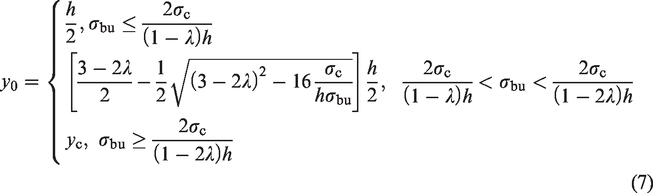
Correspondingly, criterion for stress states at crack section can be summarized in Table 3.
Criterion for stress states at crack section.

The states of the breathing crack can be determined by the following rules: (i) if
High-fidelity breathing crack model
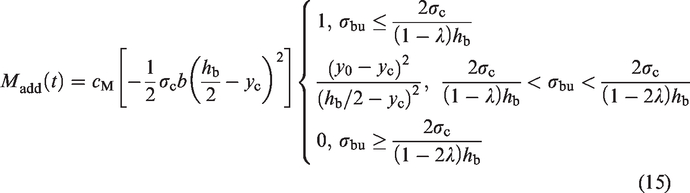
According to the criterion for stress states at crack section, the breathing function can be formulated. However, instead of utilizing the assumption in SBCM, the time-varying stiffness coefficients are physically derived according to the released energy induced by the crack opening. Since no assumption is adopted, the deduced time-varying stiffness coefficients is the breathing function, which means that the effect of crack is fully considered in the improved crack model, and thus, the modification of centrifugal stiffening stiffness is no longer needed. Based on the deduced breathing function, the additional bending moment is assessed. The formulation of the breathing function and additional bending moment can be summarized as follows.
First and foremost, according to the theory of linear elastic fracture mechanics theory, the effect of crack can be expressed as the transient released energy of the open crack area and calculated as follows Under fully open state, that is, Under fully closed state, that is, Under partially closed state, that is,
with


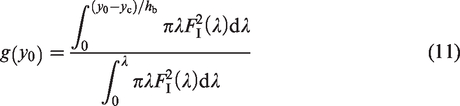
It is worth noting from equation (11) that (i) 
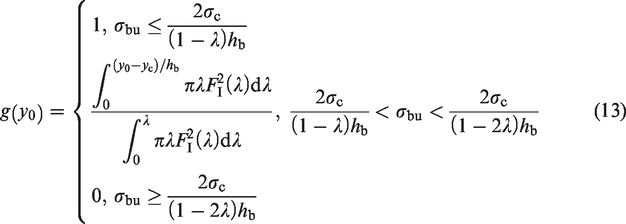
By neglecting the variation of 
Model verification
In this section, the validity of the proposed HFBCM is verified by comparing the vibration responses obtained by the HFBCM, conventional models, and FECCM. The same geometrical and condition parameters used in last section are adopted in this section. The vibration responses obtained by HFBCM under the conditions listed in Table 2 are displayed in Figure 8. For comparison, the vibration responses predicted by conventional models and FECCM are also shown in this figure.
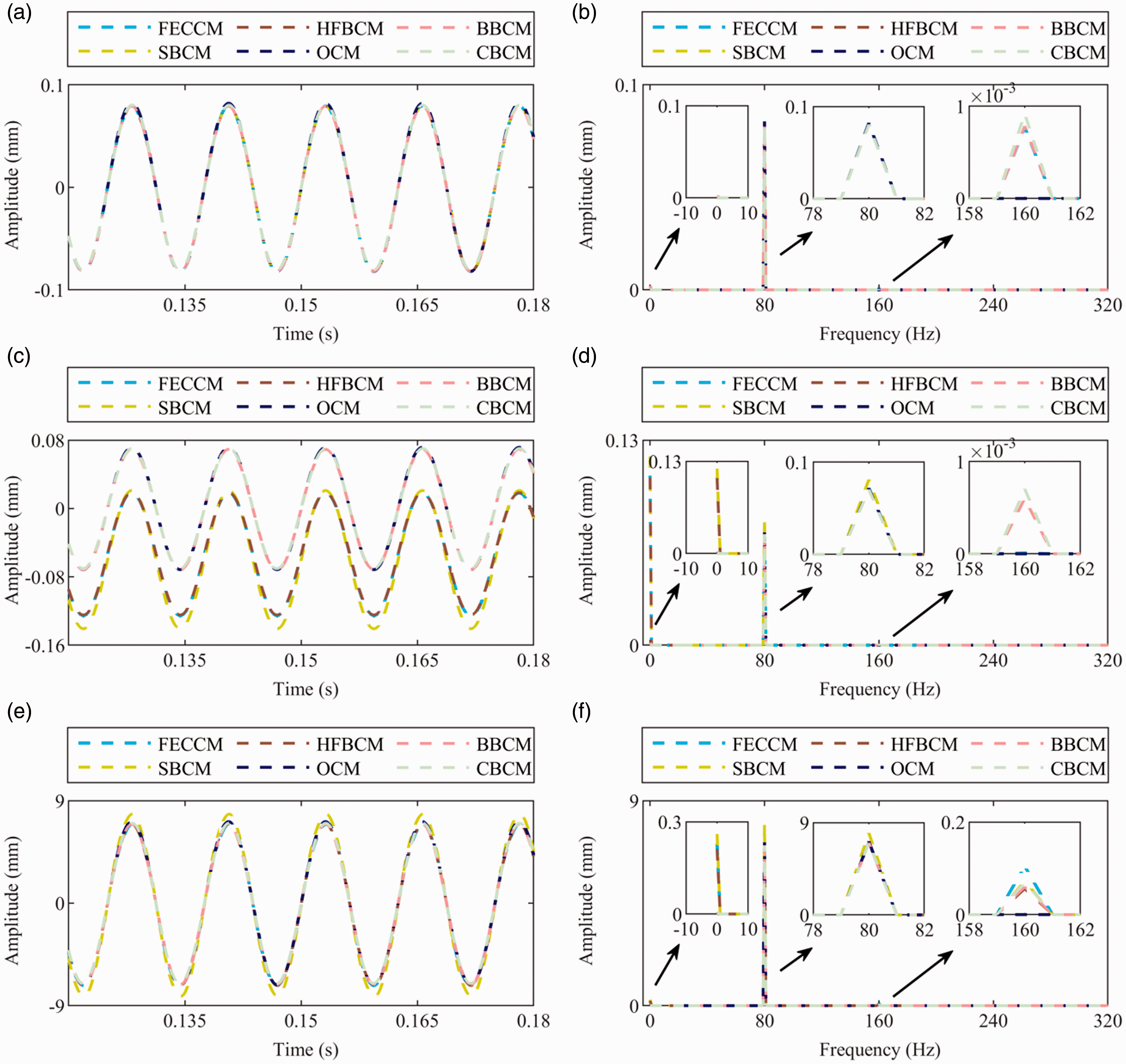
Vibration responses under different conditions: (a)–b) Condition I, (c)–(d) Condition II, and (e)–(f) Condition IV.
By comparing the results obtained by different crack models, as shown in Figure 8, it is indicated that the proposed HFBCM significantly improves the accuracy of nonlinear vibration responses prediction under rotating conditions. First, it can be noted that the vibration responses obtained by HFBCM matches well with those obtained by FECCM. Second, the comparison among the vibration responses obtained by three models (FECCM, HFBCM, and SBCM) indicates that the overestimation of weakening effect for SBCM caused by the modification of stiffening stiffness (
To further compare the accuracy of the improved crack model and conventional crack models, the errors of the vibration responses obtained by HFBCM and conventional crack models are compared in Figure 8. In this study, the response error is defined and calculated as
According to the comparative results presented in Figure 9, the following conclusions can be drawn: (i) the proposed HFBCM behaves best among all the models under the illustrated four conditions; (ii) under stationary Condition I, the three models (HFBCM, SBCM, and BBCM) have the same accuracy for the vibration prediction since there is no centrifugal effect; (iii) under rotational Condition II, since conventional crack models (BBCM, CBCM, and OCM) cannot capture the vibration characteristics induced by additional bending moment, there are large errors showed up, which can also be observed in Figure 8(b) and (c); (iv) under rotational Conditions III and IV, the breathing behavior of blade crack is predominant by the bending stress since the excitation load is large enough compared with the centrifugal force. It can be seen that, under these two conditions, the error induced by the additional bending moment becomes much weaker than the one under condition II; (v) finally, with the comparison among all the models, it is worth noting that, under rotational conditions, SBCM always behaves worse than the proposed HFBCM.
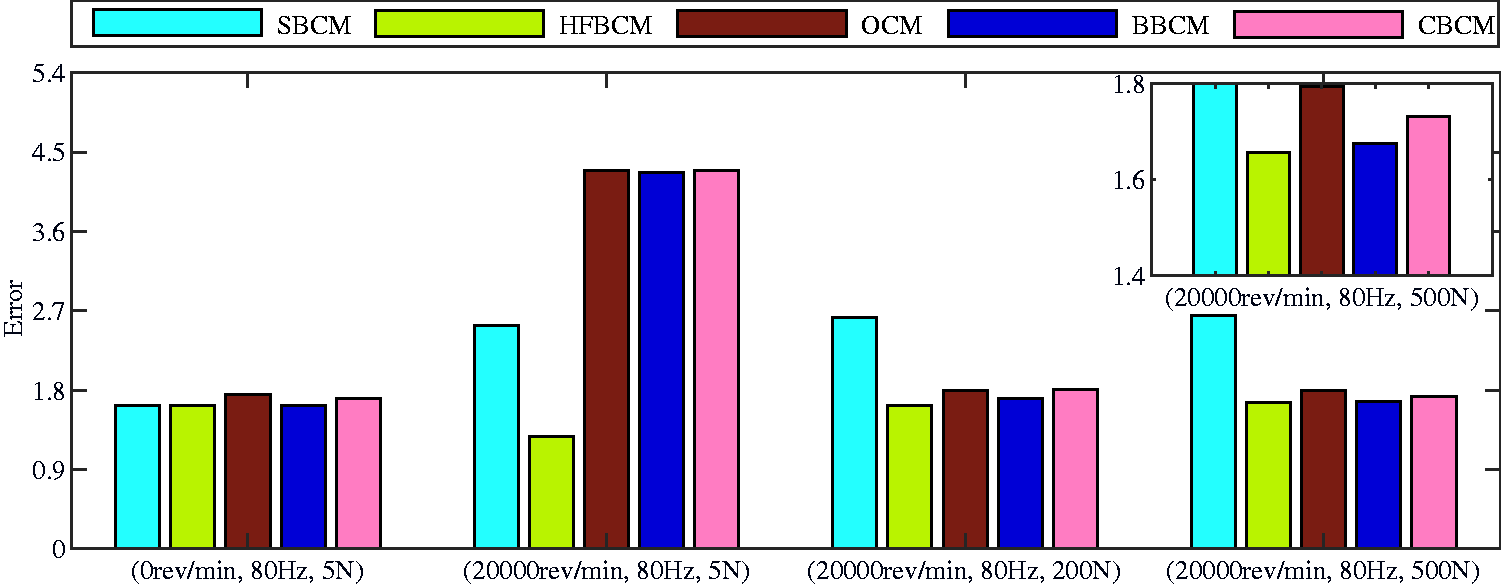
Errors of the vibration responses of different crack models.
To further verify the proposed crack model’s capability for the dynamic analysis of rotating blade with large crack depths, the nonlinear vibration responses and natural frequencies for rotating blade with different crack depths are further compared and analyzed. The nonlinear vibration responses of the rotating blade with cracks in depth of
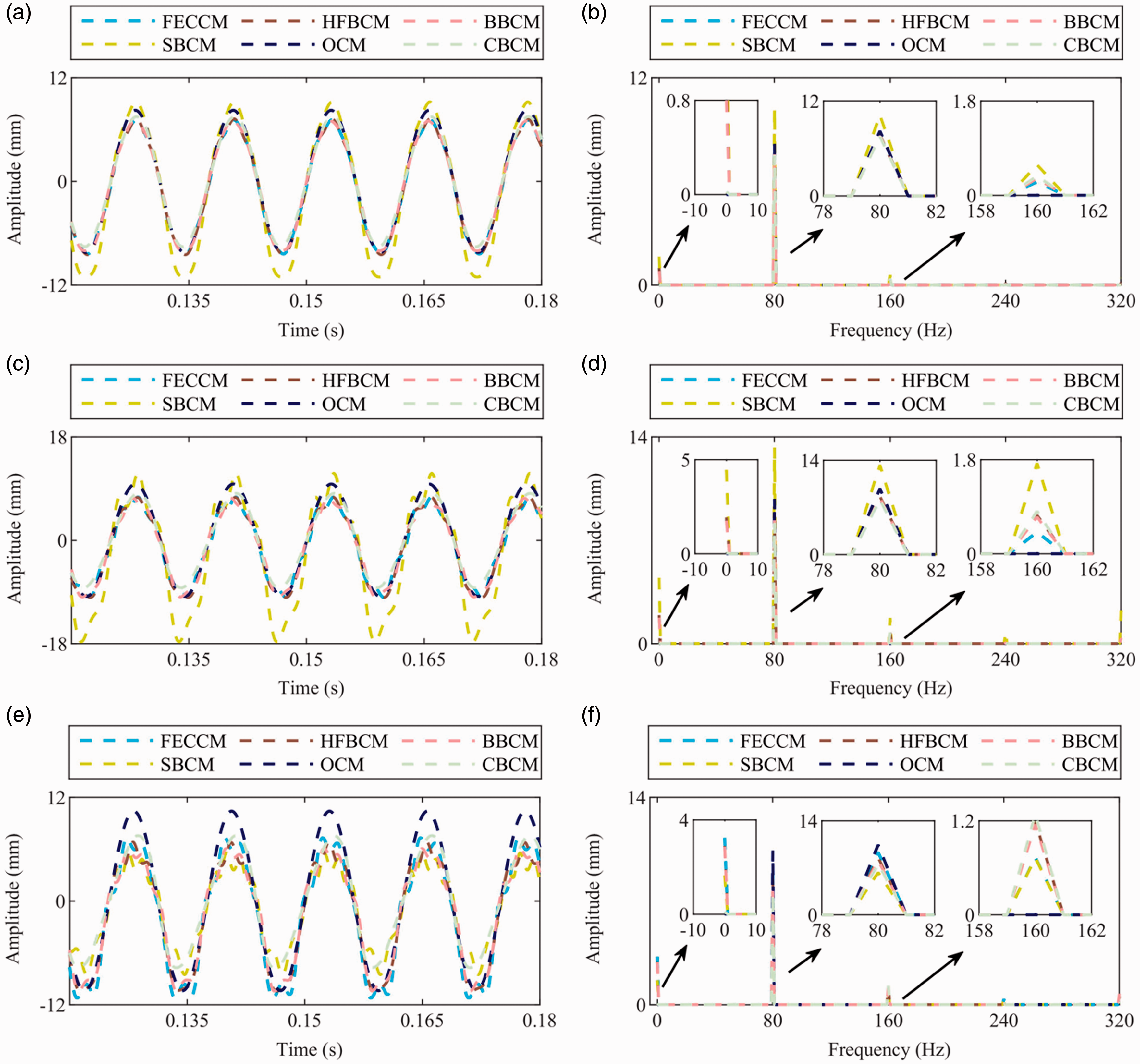
Vibration responses of the rotating blade with cracks in depth of (a)–(b) λ = 0.4, (c)–(d) λ = 0.5, and (e)–(f) λ = 0.6 under condition IV.
The natural frequencies are further compared in Table 4. Since the nonlinear effect is involved in the breathing crack models, the conventional modal analysis is unable to obtain the accurate natural frequency of rotating cracked blade. In this study, the sweeping test is utilized to obtain the natural frequency. The comparative results (
Natural frequencies for the rotating blade with different crack depths.

In summary, the proposed HFBCM is of high accuracy for vibration prediction of blade under both stationary and rotational conditions. Because of the inaccurate estimation of centrifugal effect, conventional crack models suffer from several defects in vibration prediction of cracked blade, which can be summarized as follows: (i) OCM is a linear model, which means that it cannot characterize the nonlinear features induced by the closing behavior of crack; (ii) BBCM and CBCM neglect the coupling effect between centrifugal stress and bending stress, resulting in their failure in accurate vibration prediction under the condition with high rotating speed and low excitation load; (iii) SBCM overestimates the crack weakening effect of centrifugal stiffening stiffness, leading to the overestimation of vibration responses under all rotational conditions. Due to the above sufferings for conventional crack models, they are infeasible to accurately characterize the dynamic behavior of rotating blade with breathing crack. Therefore, only the proposed HFBCM is utilized in the following analysis. In addition, when the crack depth (
Blade crack detection indicator analysis
Remarkable features extracted from the vibration responses are significant indicators for blade crack detection. Over the past decades, several indicators are utilized and analyzed for the crack damage detection of blades. However, the validation of these indictors is only verified in the case of stational blades. In this study, some typical indicators for blade crack detection under rotational conditions are analyzed with the proposed HFBCM.
Nonlinear damage indicator
The most widely applied indicator for blade crack detection is the nonlinear effect caused by crack. Nonlinear damage indicator (NDI) is usually introduced to quantify the nonlinear effect of crack faults. It is defined as the relative amount of magnitude (
If the crack is in fully open state (Condition II), the nonlinear effect will disappear as shown in Figure 8(b) and (c). Therefore, in this study, only the vibration responses for the closing crack are analyzed. In this case, the rotating speed is set as 20,000 rev/min, the load amplitude is set as 200 N, and the harmonic excitation force with the frequency of 220 Hz is applied. The transverse crack locates at the section
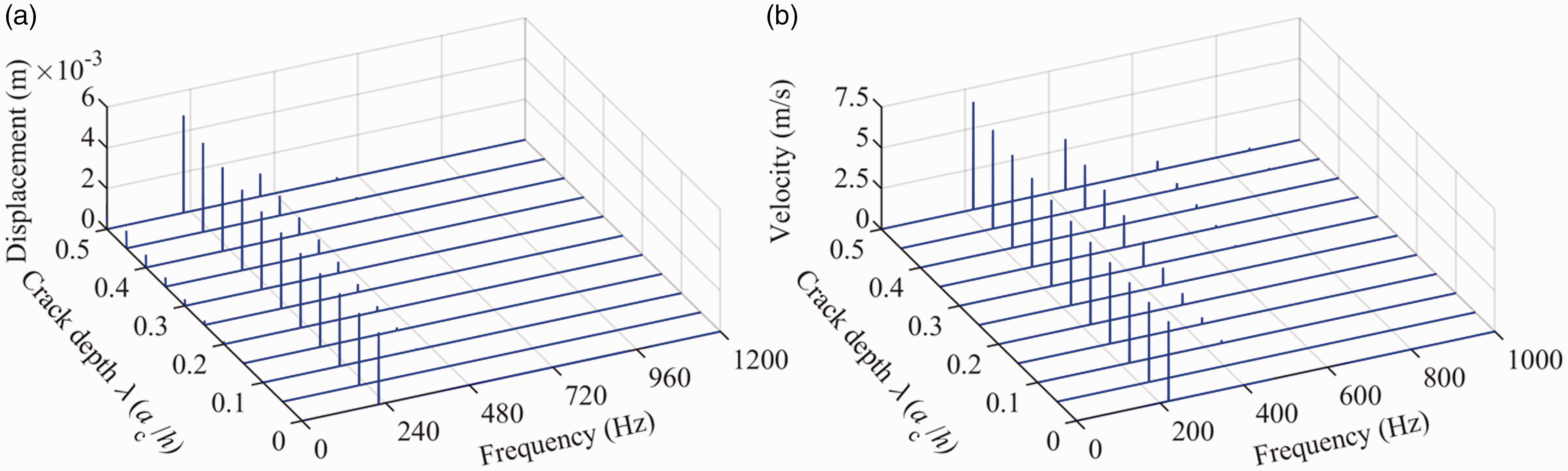
Cascade spectrums for rotating blade with breathing crack: (a) displacement and (b) velocity.
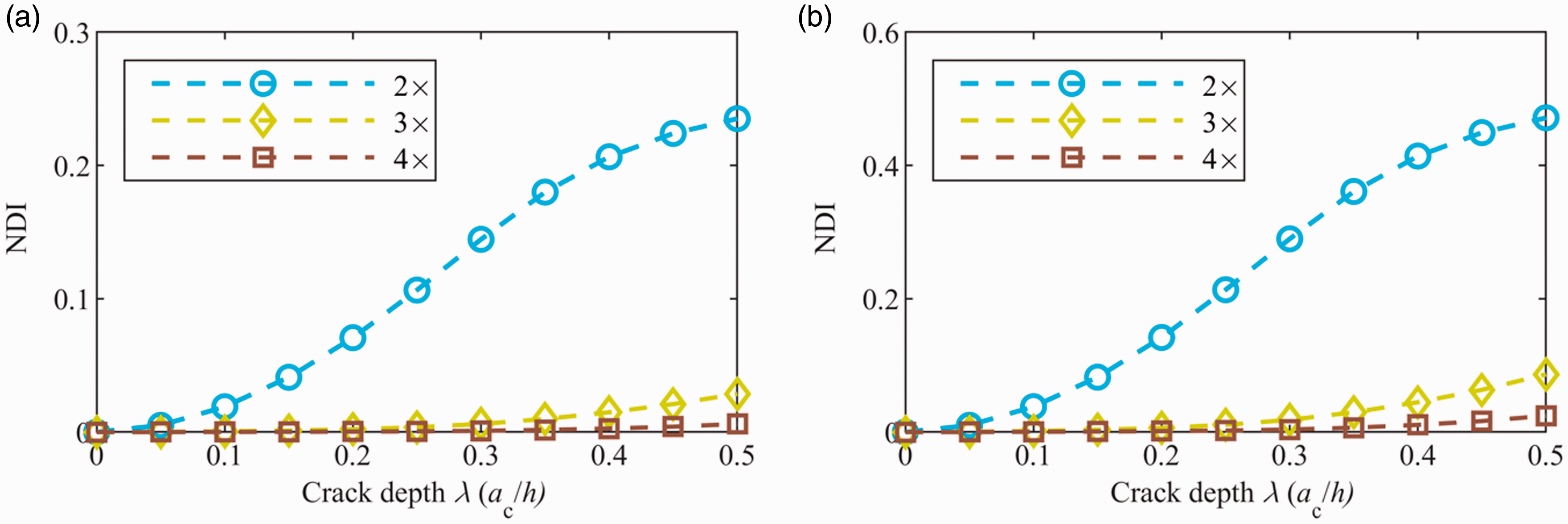
Variation of NDI for rotating blade with breathing crack: (a) displacement and (b) velocity.
It can be noted from Figure 11 that the presence of crack will lead to the occurrence of nonlinear super-harmonic components, such as 2×, 3×, and 4×. By comparing the vibration spectrums in Figure 11(a), it is found that the super-harmonic components are pretty weak when the crack is very shallow, for example,
To further analyze the nonlinear effect of blade crack, the NDIs of 2×, 3×, and 4× for both displacement and velocity are assessed and shown in Figure 12. From the NDIs shown in Figure 12, it can be noted that, for the normal blade, that is,
The above comparative analysis suggests that both super-harmonic component and the corresponding NDI show the feasibility to predict the crack severity through the variation tendency of them. The presence of higher order of super-harmonic components (3× and 4×) and the corresponding non-zero NDIs may indicate the occurrence of severe crack.
Phase diagram indicator
As shown in last subsection, the super-harmonic component and NDI can well characterize the nonlinear behavior of breathing crack. However, only the amplitude information of blade vibration is considered while the phase information which may contain some vital crack damage indexes is ignored. In this subsection, the phase diagram is introduced to further analyze the nonlinear steady vibration responses of rotating blade with breathing crack. To quantify the crack effect, a state-space-based damage indicator called phase diagram indicator is presented. The same condition parameters mentioned in last subsection are adopted here to obtain the vibration responses. The phase diagrams of the blade with crack in different depths are presented in Figure 13.
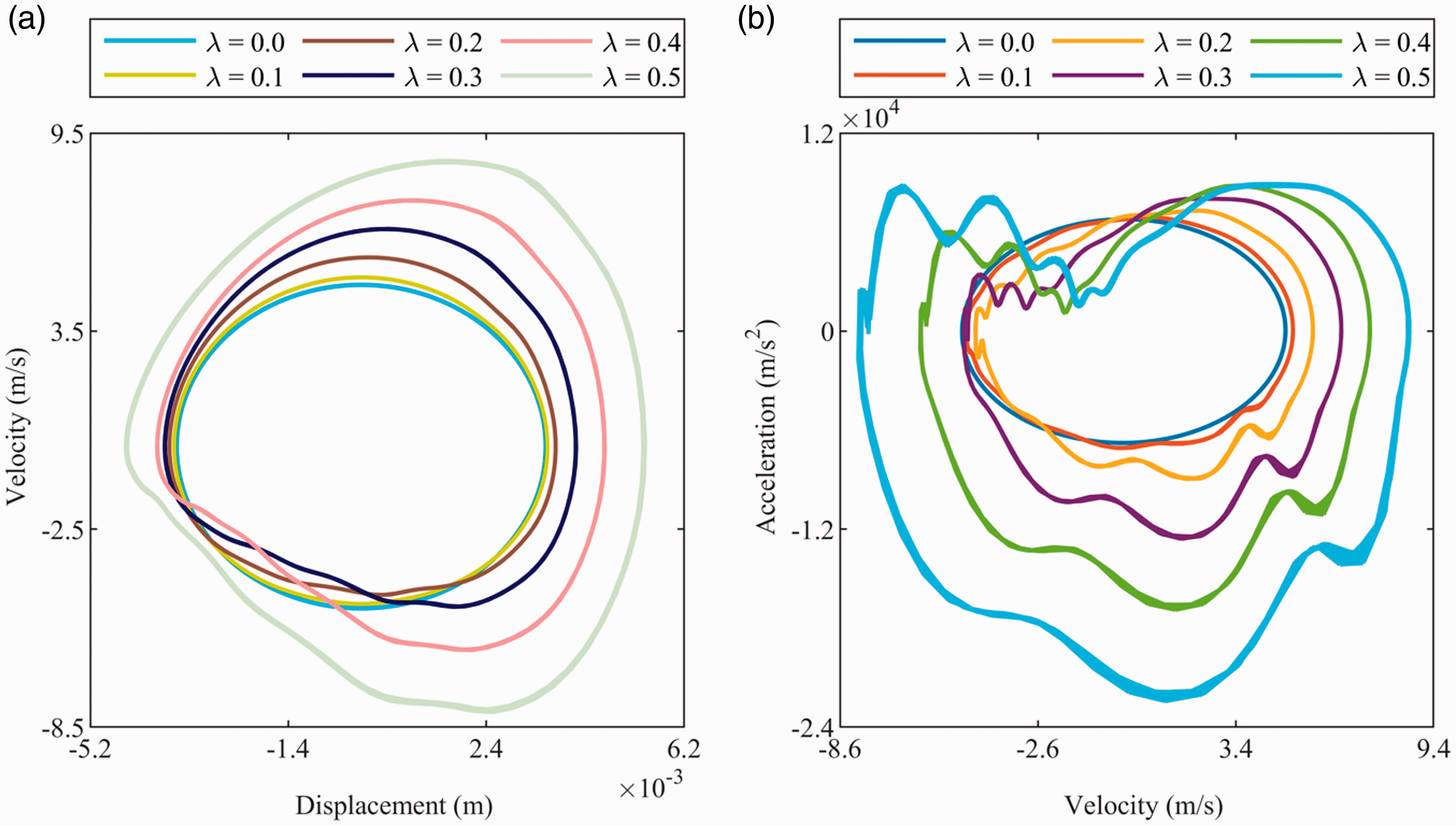
Phase diagram: (a) D–V and (b) V–A.
From Figure 13(a), it can be noted that the D–V phase diagram is in the shape of a standard ellipse for the normal blade, while the presence of crack will make the shape of phase diagram more complex. The comparison among different crack depth indicates that the complexity of the phase diagram is significantly improved with the increase of crack depth, which is attributed to the amplitude increase of the super-harmonic components. Moreover, under the same operating condition, the increasing vibration amplitude with the increasing crack depth (see Figure 11) will enlarge the range of the phase diagram. From Figure 13(b), it is interesting to find that the V–A phase diagram has the similar shape of D–V phase diagram. A more obvious feature presenting with the presence of crack and the increase of crack depth is asymmetricity of acceleration response. It is worth noting that the asymmetricity becomes more and more obvious with the increasing crack depth, indicating that the asymmetricity of D–V phase diagram may serve as the indicator for crack severity.
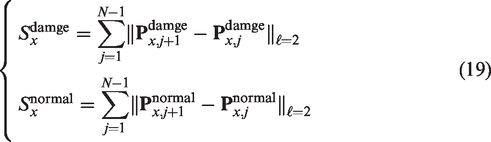
To quantify the effect of blade crack on the phase diagram of blade vibration, a damage indicator based on the state-space representation is introduced as follows

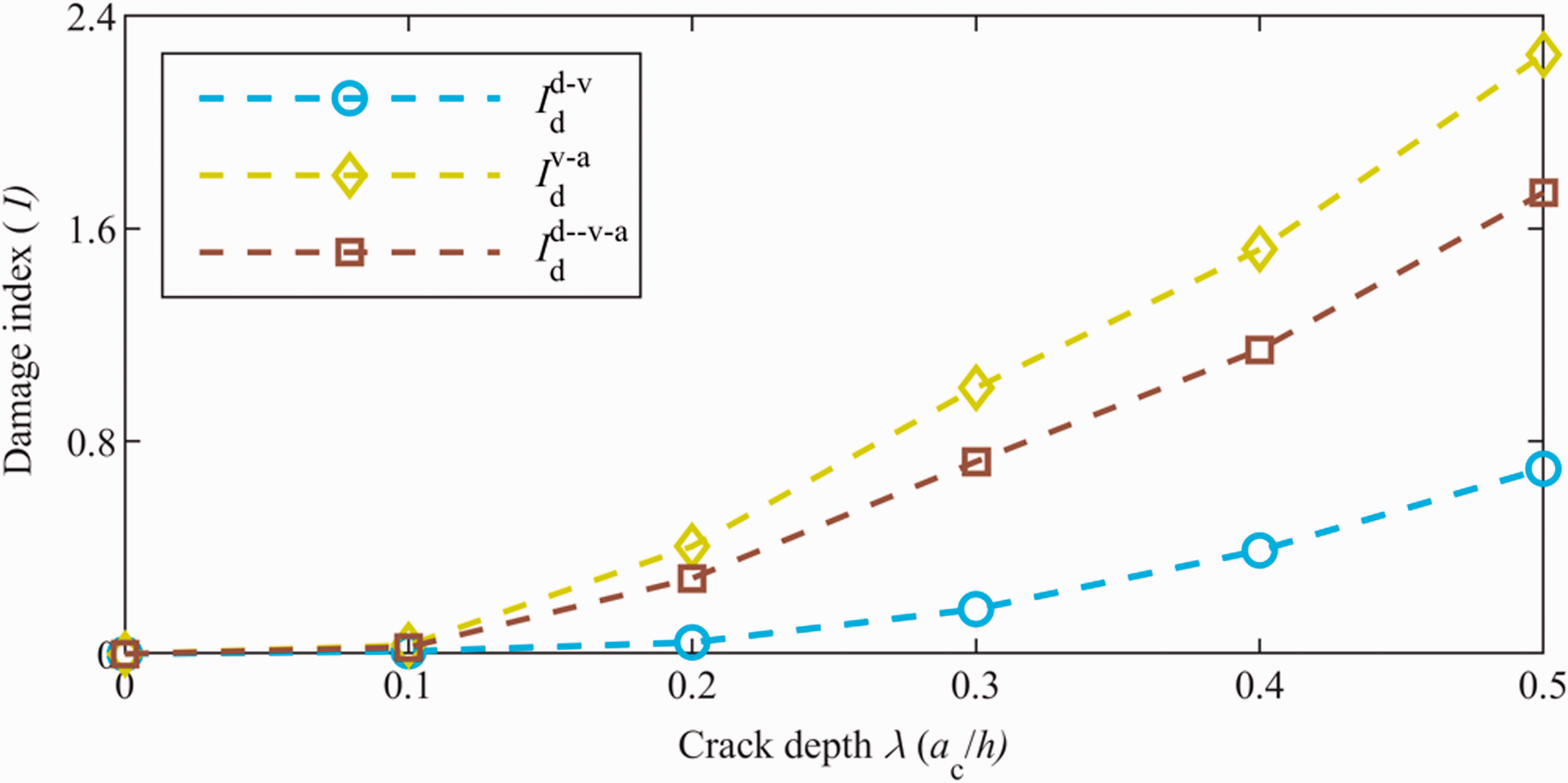
Variation of damage indexes with the alteration of crack depth.
It is suggested that all the indexes present a monotone increasing tendency with the increase of crack depth, which means that all of them are capable of characterizing the nonlinear effect of breathing crack on the blade vibration under rotational condition. However, by comparing the values of
Time-frequency indicator
From equation (4), it is easy to figure out that the cracked blade is a nonlinear system with time-varying stiffness for the case of breathing crack. According to our previous research,3,22 the time-varying stiffness will result in the fast time-varying vibration of the cracked blade system. In essence, the instantaneous frequency (IF) of the blade with breathing crack varies with the closing behavior of crack. Since the IF is a concept in time-frequency domain, in this study, it is called time-frequency indicator. To verify the validity of IF for crack detection, the IF of the vibration responses for the blade with crack in different crack depths is extracted through the method proposed in Yang et al. 3
Figure 15(a) presents the IF of the vibration responses for both normal and cracked blade. First and foremost, for the normal system, the IF of the vibration response remains unchanged at the forced excitation frequency, and no fluctuation phenomenon can be observed. However, once the crack occurs, the periodic fluctuation of IF shows up, as shown in Figure 15(a). It is obvious that the IF of vibration responses for cracked blade varies periodically up and down around the excitation frequency. Further observation indicates that the periodic is the excitation frequency, which is attributed to the periodic-1 motion (see Figure 13) for the cracked blade system, as shown in Figure 15(b). More importantly, by comparing the extracted IF for cases with different crack depth, it is found that the increasing crack depth will enlarge the range of IF fluctuation, indicating that the time-frequency indicator IF can serve as a quantified crack identification indicator.
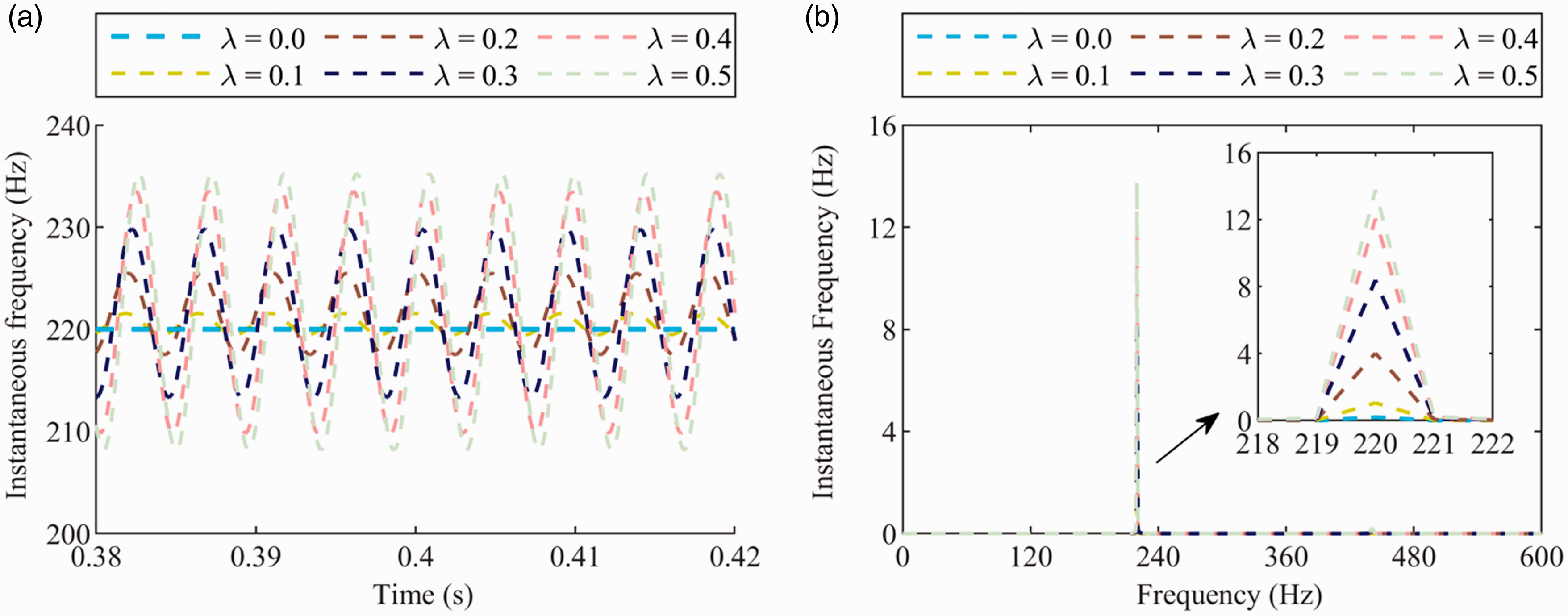
The IF of the vibration responses for rotating blade with breathing crack in different crack depth, (a) the waveforms of IF, (b) the spectrums of IF.
Disturbance indicator
Compared with the forced vibration characteristics mentioned above, the free vibration characteristics are more robust to the noise and other disturbance. However, how to obtain the natural vibration characteristics under operation condition remains a big challenge. In this study, the disturbance method is introduced and applied to excite the free vibration characteristics. Through the identification of the natural frequency shift induced by the crack, the impact-disturbance indicator and stochastic-disturbance indicator are introduced to characterize the crack severity.
Impact-disturbance indicator
The impact disturbance is usually applied to simulate the mutation of operation condition parameters, such as the mutation of load amplitude and rotating speed. These mutations can be taken as impact loads applied to the mechanical vibration systems. As a result, the free vibration characteristics may be excited by the impact disturbance, which can serve as the damage detection indicator. In this study, only the load amplitude mutation is considered. It is assumed that there is a load disturbance (50%) at
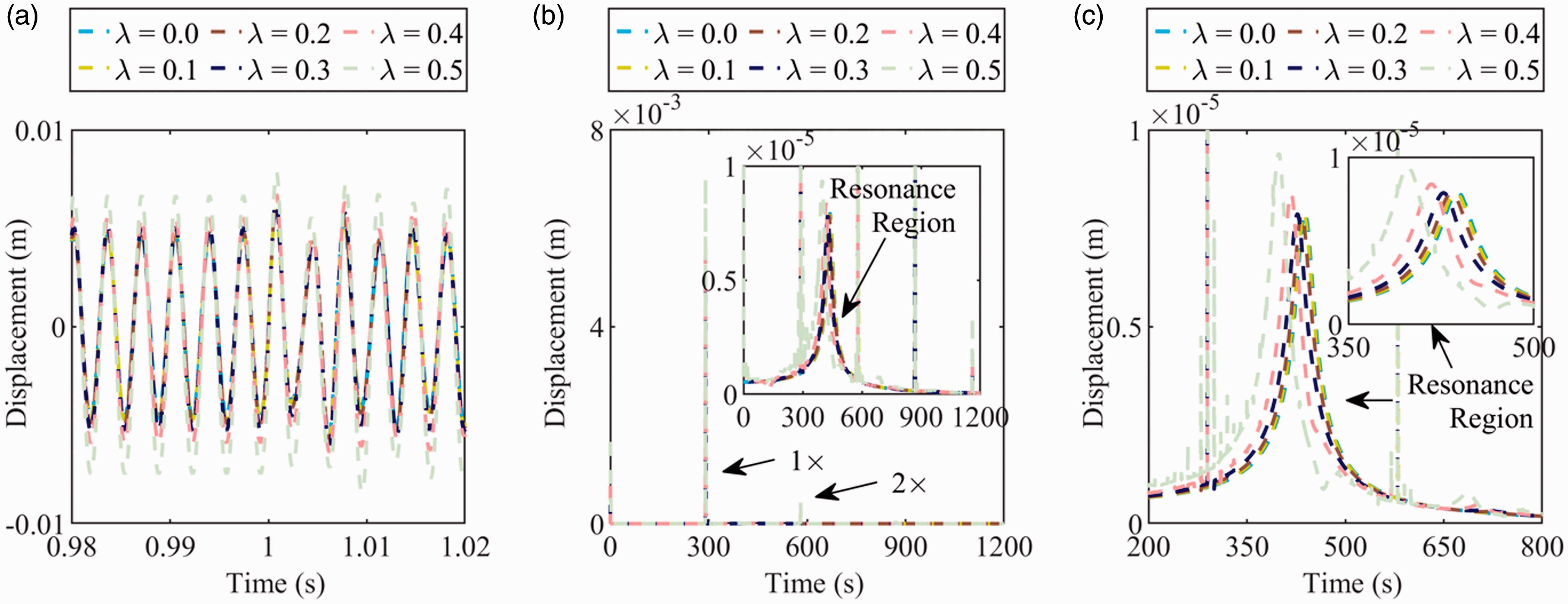
Vibration responses under the influence of impact-disturbance load: (a) time-domain waveforms, (b) frequency-domain spectrums, and (c) the zoomed view of (b).
Figure 16(a) shows the time-domain waveforms. It is found that the impulse vibration responses appear in the time-domain waveforms at the start of impact disturbance. The corresponding spectrums are presented in Figure 16(b). The steady-state vibration components are still clearly shown in the spectrums. However, in addition to the basic harmonic components corresponding to the steady-state vibration, a broadband indicating the resonance region of rotating blade shows up in the spectrum. From the zoomed view in Figure 16(c), it is noted that the increase of crack depth will lead to a larger range of natural frequency shift to the left; meanwhile, the peak of the broadband also increases with the increasing crack depth, both of which may serve as the indicators for crack severity. These phenomena can be explained as follows. According to the formulation in “Dynamic modeling of blade crack” section, the increasing crack depth will result in a larger stiffness reduction of the blade system. As a result, the natural frequency will decrease with the increasing crack depth, while the resonant vibration amplitude will increase with the increase of crack depth, when the impact disturbance remains the same.
Stochastic-disturbance indicator
Compared with the artificially applied impact disturbance, the stochastic disturbance, usually existing in the process of operation, is easier to be obtained. The feature extraction for the vibration responses under the influence stochastic disturbance is of great significance for the health monitoring of rotating blade. In the process of numerical simulation, a white noise 
With the same condition parameters applied in last subsection, the dynamic behavior of rotating blade with breathing crack under the influence of
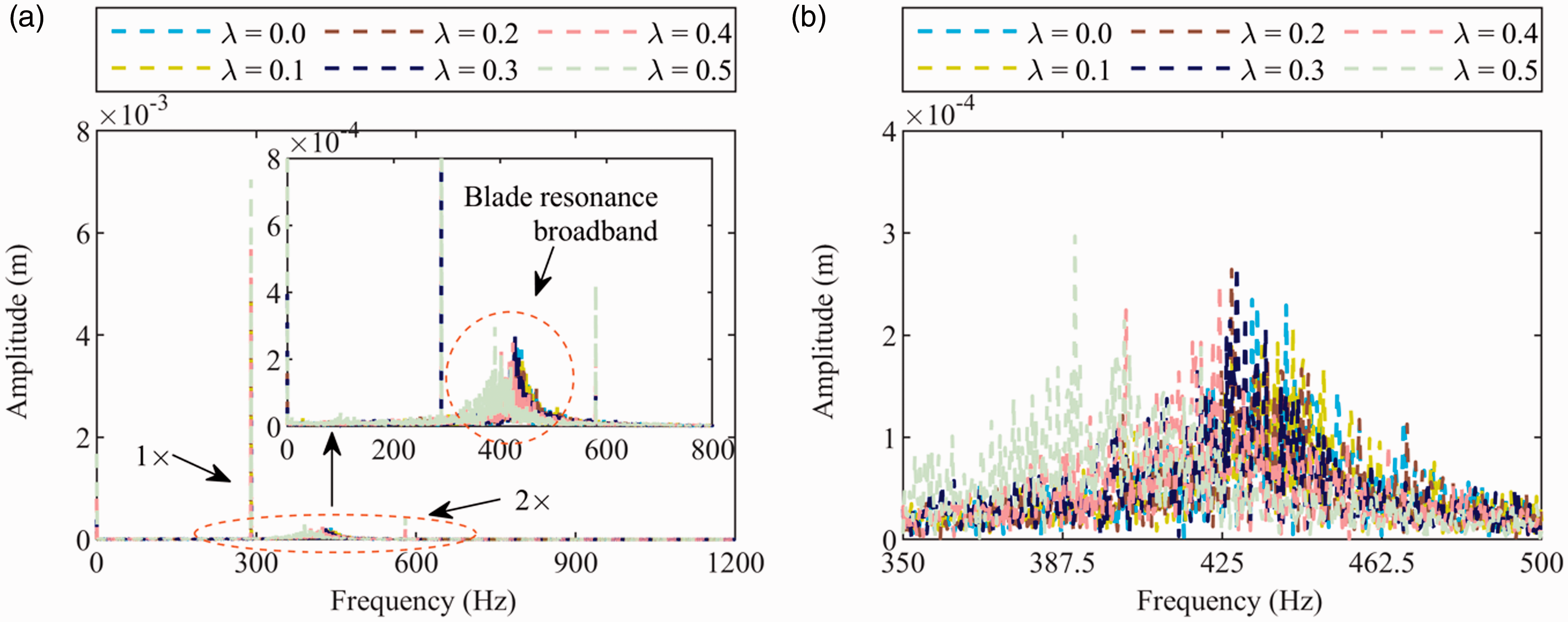
Vibration responses under the influence of stochastic disturbance: (a) spectrums and (b) zoomed view of blade resonance broadband.
In order to quantify the effect of stochastic disturbance on the cracked blade, a characteristic index in frequency domain is introduced and defined as

In this case, the range of the analyzed broadband is set as
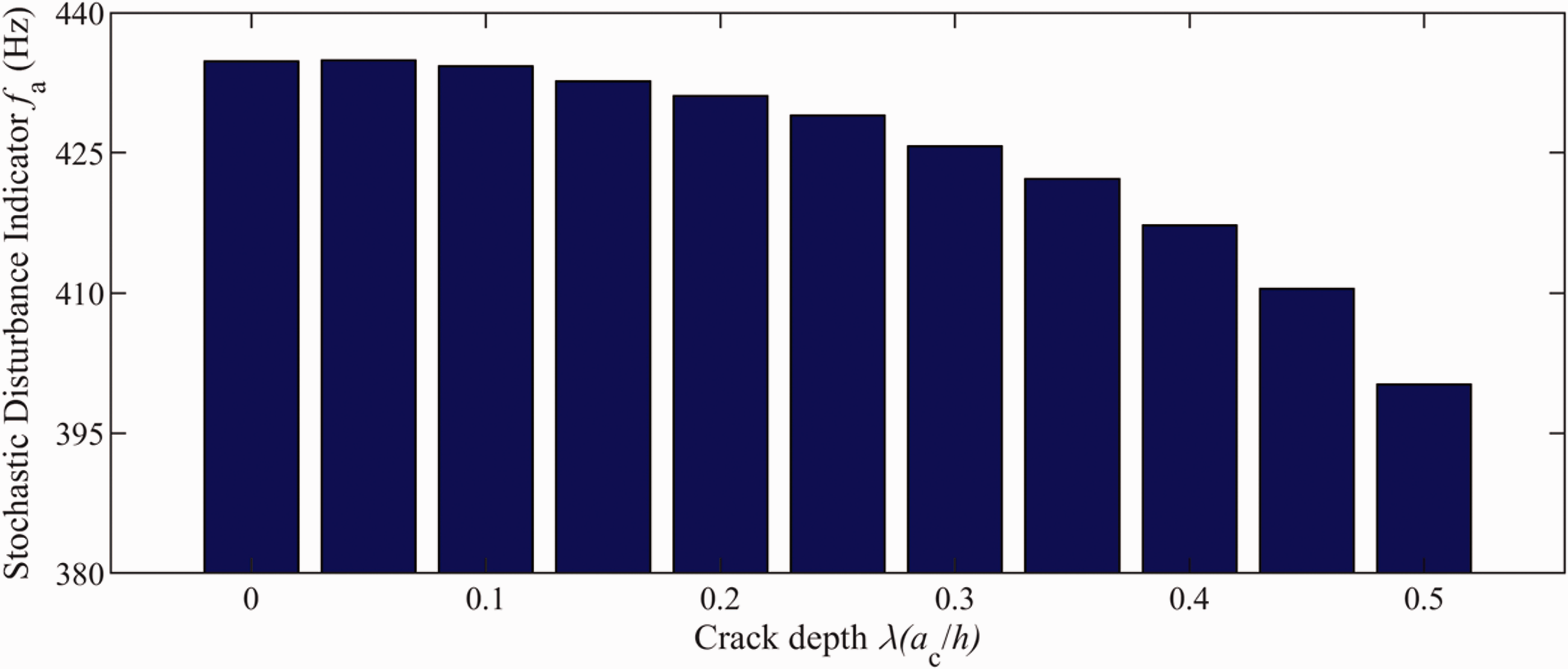
The variation of the stochastic disturbance indicator with the alteration of crack depth.
It can be seen from Figure 18 that when the crack is relatively shallow, the shift of natural frequency is very small when the crack is relatively shallow. For example, when
Summary
Through the above analysis, it is worth noting that all these indexes including NDI, phase diagram indicator, time-frequency indicator, and disturbance indicator present a monotonous variation tendency with the increasing crack depth, which indicates that they can serve as the condition indexes for blade crack monitoring. However, in real engineering, it is difficult to determine the occurrence of crack or monitoring the severity of crack through any single crack detection indicator. Thus, a comprehensive monitoring for these condition indexes should be performed.
Discussions of limitations of the proposed method
First, since the crack model proposed in this study is formulated based on the assumption of
Conclusions
This study is focused on the nonlinear dynamic model of rotating blade with transverse crack and the crack detection indicator analysis for rotating blade. First and foremost, a HFBCM for rotating blade is proposed based on criterion for stress states at crack section. With the proposed HFBCM, the nonlinear vibration responses are investigated, and some crack detection indexes for rotating blade are analyzed and quantified. Through the comprehensive investigations conducted in this study, the main findings can be summarized as follows. Through the comprehensive analysis about the stress states at the crack section, the criterion for stress states at the crack section for rotating blade is presented. Based on the stress-state criterion and energy method, the HFBCM is physically deduced without using the assumption adopted in conventional stress-based crack model, which enhance the physical interpretability and the accuracy. Comparison study with conventional crack models and FECCM is conducted through numerical analysis. It is demonstrated that the proposed HFBCM behaves best among the analytical crack models, and the coupling effects between centrifugal stress and bending stress at the crack section for rotating blade can be well characterized and explained by HFBCM, which fails to be featured through conventional analytical crack models. The comparative results indicate that the proposed HFBCM is of high fidelity and can be used to simulate the effects of crack for rotating blade. With the proposed HFBCM, following four blade crack indexes, that is, NDI, phase diagram indicator, time-frequency indicator, and disturbance indicator are analyzed. For breathing crack in rotating blade, the quantification method of each indicator is offered. Through numerical analysis, it is found that all the indexes show a monotonous variation tendency with the increasing crack depth, indicating that these indexes may serve as the condition indexes for blade crack monitoring, but the comprehensive monitoring for these condition indexes is in demand in practical engineering.
Footnotes
Acknowledgements
The first author acknowledges the host and support from the Structural Dynamics and Acoustic Systems Laboratory at the University of Massachusetts Lowell.
Declaration of conflicting interests
The author(s) declared no potential conflicts of interest with respect to the research, authorship, and/or publication of this article.
Funding
The author(s) disclosed receipt of the following financial support for the research, authorship, and/or publication of this article: This work is sponsored by the National Major Project of China (No. 2017-V-0009) and the National Natural Science Foundation of China (Nos. 52075414, 52075415).

Appendix 1. Matrices and vectors related to the blade
2. The mass matrix 3. The Coriolis force matrix of the blade is denoted by 4. The structural stiffness matrix 5. The spin-softening matrix 6. The centrifugal stiffening matrix 7. 8. 9. The external force vector
where