



Abstract
Lithium-ion batteries are being increasingly used as the main energy storage devices in modern mobile applications, including modern spacecrafts, satellites, and electric vehicles, in which consistent and severe vibrations exist. As the lithium-ion battery market share grows, so must our understanding of the effect of mechanical vibrations and shocks on the electrical performance and mechanical properties of such batteries. Only a few recent studies investigated the effect of vibrations on the degradation and fatigue of battery cell materials as well as the effect of vibrations on the battery pack structure. This review focused on the recent progress in determining the effect of dynamic loads and vibrations on lithium-ion batteries to advance the understanding of lithium-ion battery systems. Theoretical, computational, and experimental studies conducted in both academia and industry in the past few years are reviewed herein. Although the effect of dynamic loads and random vibrations on the mechanical behavior of battery pack structures has been investigated and the correlation between vibration and the battery cell electrical performance has been determined to support the development of more robust electrical systems, it is still necessary to clarify the mechanical degradation mechanisms that affect the electrical performance and safety of battery cells.
Introduction
Lithium-ion (or Li-ion) batteries are the main energy storage devices found in modern mobile mechanical equipment, including modern satellites, spacecrafts, and electric vehicles (EVs), and are required to complete the charge and discharge function under the conditions of vibration, shock and so on.1–17 For example, the Li-ion batteries used to power satellites or spacecrafts must be sufficiently resistant to withstand vibrations, particularly the severe vibrations occurring during launch. In addition, the Li-ion batteries in EVs are consistently subjected to random vibration caused by uneven road surface and the mechanical abuse due to extreme road condition and vehicle collision can cause severe battery safety problems.18–27 The safety of Li-ion batteries is key to the safety of EVs. Therefore, the batteries should be designed to meet the requirements of mechanical bearing, working safety and reliability under changeable operating environment and driving conditions. Li-ion batteries consist of not only battery pack structure but also cells that present an anode and a cathode separated by a separator material which avoids the contact between them, as demonstrated in Figure 1. The separators used in Li-ion cells, as shown in Figure 2, are typically made of polymers and can break owing to the dynamic loading conditions occurring inside the battery cell.28–33 Somerville et al. 34 found that the failure of the separator material has a negative impact on the battery life, performance, and safety. Also, the battery pack structure can be damaged under vibration and shock environments,43–50 and electrical connection inside the battery pack can be unstable under the vehicle vibration environment.35 As the demand for Li-ion batteries for spacecrafts and automobiles is rapidly growing, it is necessary to expand our understanding on the failure mechanisms occurring inside batteries under shock and vibration environment to thus improve the safety and performance of Li-ion batteries and power systems used in spacecrafts and automobiles.
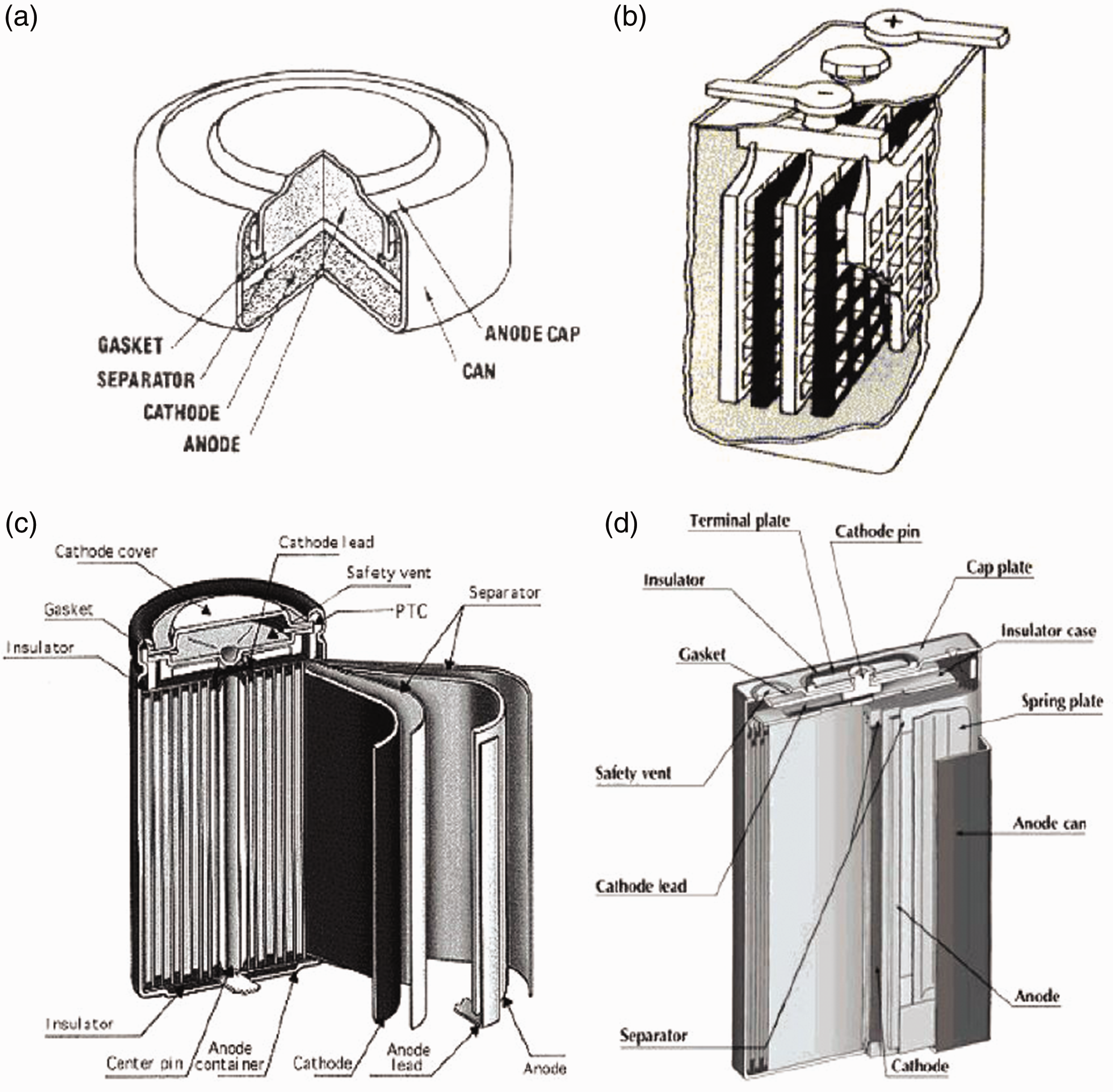
Schematic of typical Li-ion battery cells: (a) button cell; (b) stack lead-acid cell; (c) spiral wound cylindrical cell; (d) spiral wound prismatic cell.29
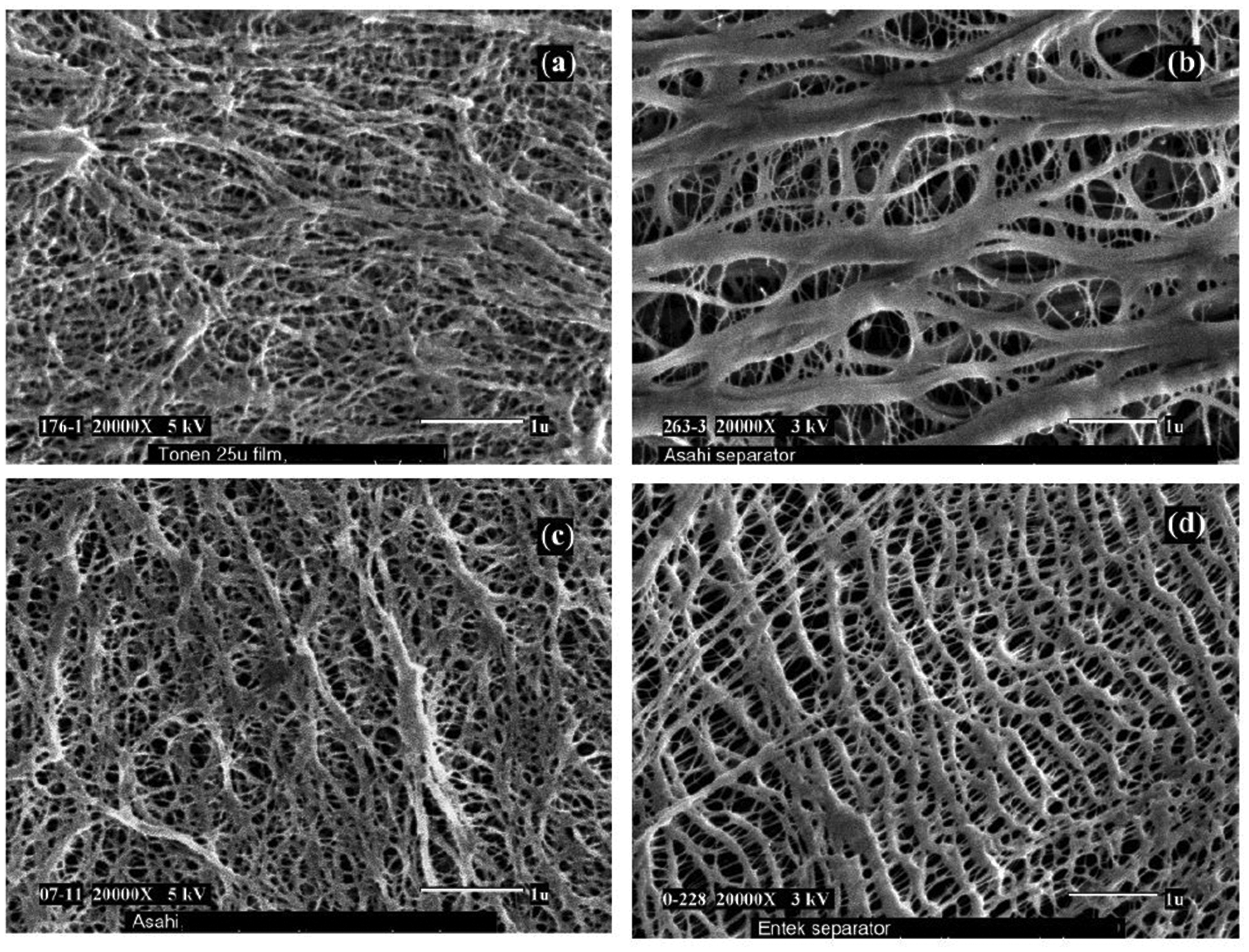
Scanning electron micrographs of separators of Li-ion battery cells: (a) Tonen (Setela); (b) Asahi (Hipore-1); (c) Asahi (Hipore-2); (d) Entek (Teklon).29
Effect of vibrations on battery cells
As Li-ion batteries become more common, research is needed to determine the effect of standard vibration and shock tests as well as that of long-term vibration on battery cells. Accordingly, studies on the effect of vibrations and shocks on Li-ion battery cells have been recently conducted. Brand et al. 35 examined the effect of sine vibrations according to the United Nations (UN) 38.3 T3 standard, mechanical shocks according to the UN 38.3 T4 standard, and long-term vibrations with sine sweep vibrations over six months on both cylindrical and pouch battery cells. Two cells of each type were identically tested to determine whether the results were reproducible. Additionally, two cells were not stressed to use them as references and thus determine the extent of deformation in the stressed cells. During the tests, the cells were inspected for failure to ensure that they were not leaking or damaged. Additionally, all cells were scanned via microcomputer tomography to ensure that they were not damaged before or after testing. The authors concluded that the pouch cells showed no degradation or failure in any of the tests; however, the cylindrical cells shaken in the y-direction experienced mandrel loosening during the shock and long-term vibration tests. In addition, it was found that the cylindrical cells stressed in the z-direction also experienced degradation and failures. For example, after 10 runs of sine sweep vibration application, loose mandrels were found when the cells were removed from the testing apparatus although the capacity measurement is not able to detect the degradation. In the shock tests, no degradation was initially detected by the capacity determination; however, the images collected before and after the tests revealed that the circuit interrupt device (CID), which helps to regulate the pressure within the cells, was damaged as shown in Figure 3. In addition, loose mandrels were observed, which came into contact with the current collector and the CID. These findings are important because they indicate that although the cells looked completely intact on the outside and would have passed standard tests, they were near the failure state internally. Loosened mandrels were also observed at the end of the long-term vibration tests, and as mentioned previously, the mandrels were able to come into contact with the terminals. Subsequent scanning electron microscope imaging showed a damaged separator as demonstrated in Figure 4, which caused internal short circuits. In conclusion, these tests provided details about the resistance to stress of the studied Li-ion battery cell types and indicated an important problem in current Li-ion battery testing: batteries can pass standard tests if complete failure is not achieved within the testing period. However, the relationship between the intense loads applied during testing and the everyday loads battery cells are able to support is still unclear. Specifically, the cylindrical cells failed both the long-term vibration and shock tests.
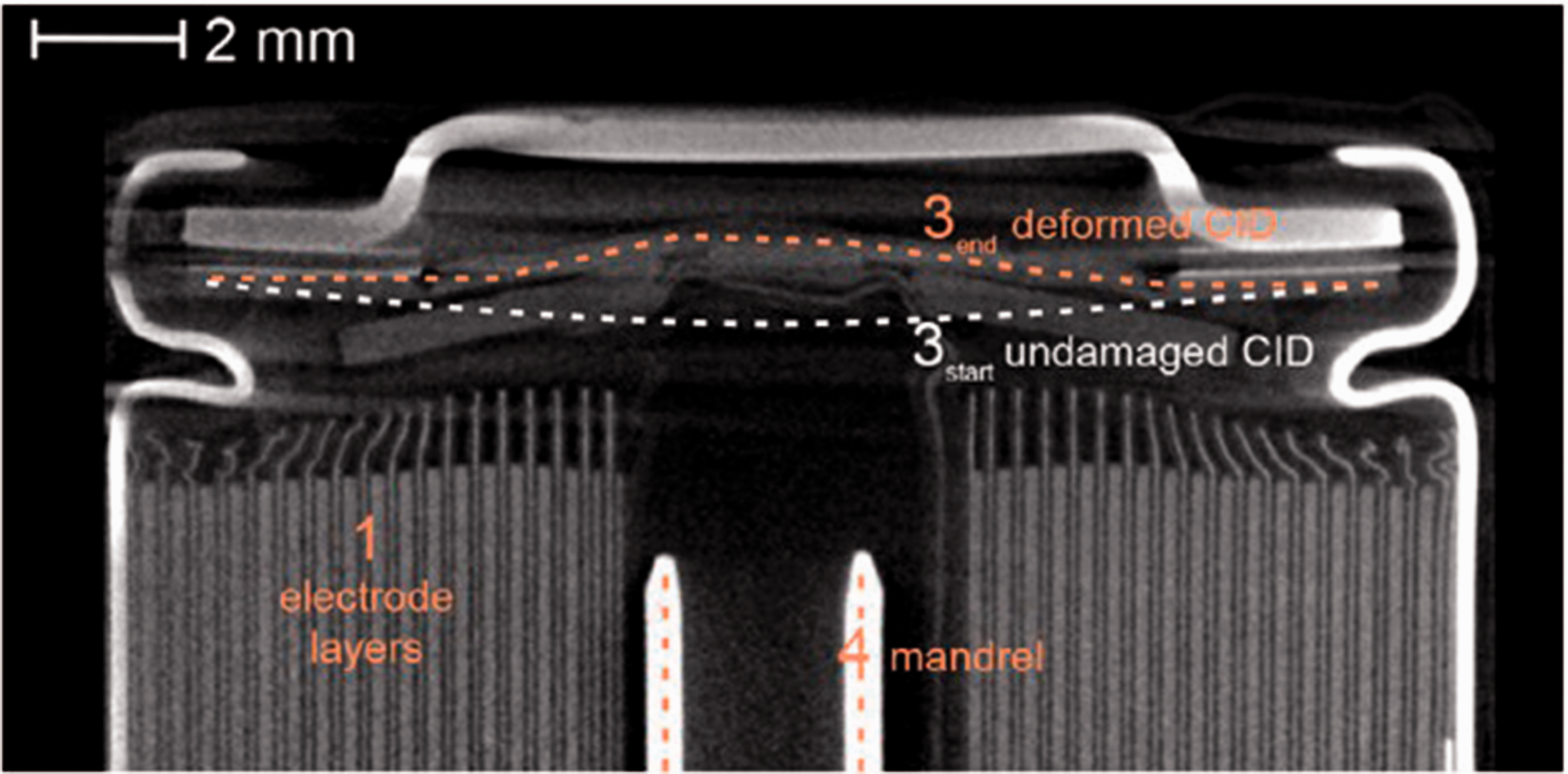
Deformed 18650 cylindrical lithium-ion cell after 300 shocks in z-direction according to UN 38.3 T4 standard, visible in µCT image.35
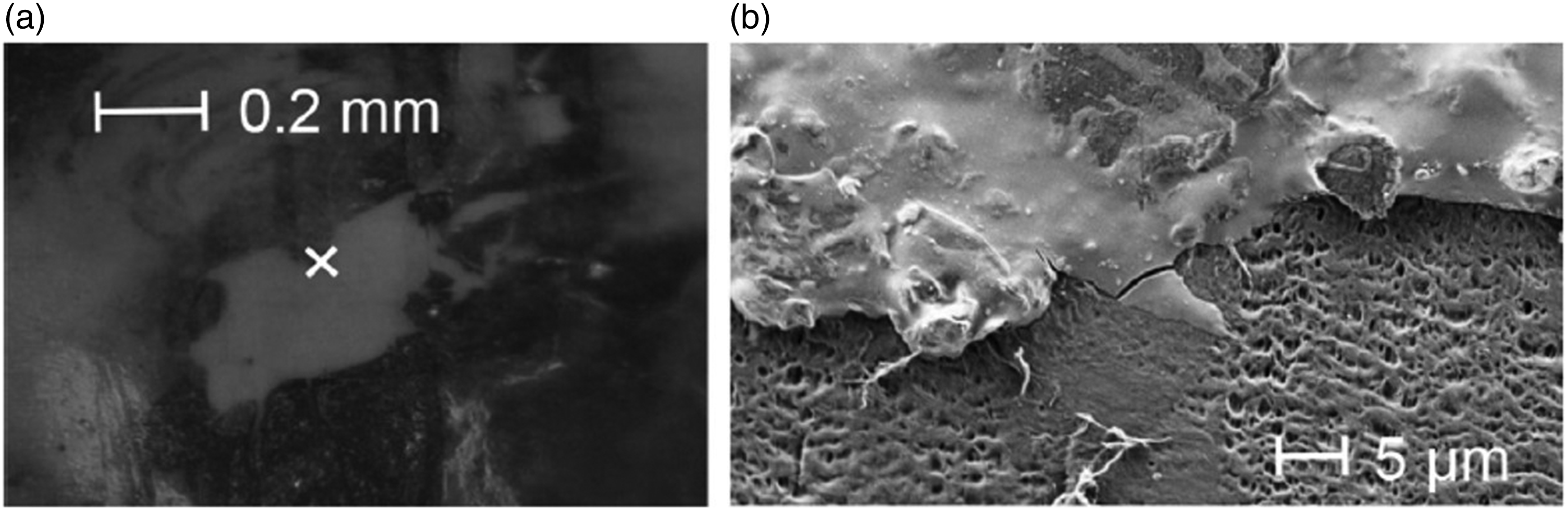
Demonstration for internal shorts in 18650 Li-ion battery cell after long-term vibration tests: (a) optical micrograph of the scorched separator; (b) scanning electron micrograph of partially melted separator layer.35
The aim of the study conducted by Hooper et al. 36 was to quantify the cell material degradation caused by vibrations. They performed vibration tests on the 18,650 battery cell, analyzed the cell material behavior under the testing conditions, and assessed the degradation of the mechanical and electrical properties of the cell material over time during the application of excessive vibrations, such as those occurring during automobile operation. They also described the experimental tests performed to evaluate the degradation of a nickel manganese cobalt (NMC) oxide cylindrical cell, caused by exposure to excessive and repetitive vibrations. It was found that the natural frequency of the cell changes with internal cracking, delamination, fracture, and orientation with respect to the vibration. It was also found that there is a relationship between the cell state of charge and performance degradation; however, this relationship could not be quantified exactly. Hooper et al. 37 also conducted an experimental study using another type of 18650 battery cell—a nickel cobalt aluminum oxide (NCA) cell—and found that the influence on the cell electrical performance and mechanical properties is minor under vibrations that are commensurate with the vehicle life.
Zhang et al. 38 conducted an experimental and theoretical study by using a statistical method to analyze experimental test data from Li-ion batteries. The analyzed data was obtained by subjecting 32 individual Li-ion 18,650 cells to single-axis vibration. The authors chose the z-axis as the primary investigation target because it has been demonstrated to be the most impactful on battery performance, although the cells experience vibrations in the three primary axes. They ignored the possible effects of resonance because previous studies indicated that this phenomenon is not prevalent enough in 18,650 cells to be worthy of investigation. They mainly found a significant increase in the internal resistance of the battery after the vibration test and a subsequent decrease in battery capacity. Additionally, they introduced the idea of statistical modeling and presented an accurate model to theoretically estimate the battery life (from an electrical point of view) without the need to perform experiments. Zhang et al. 39 employed the Neware BTS4000 battery test platform to measure the electrical performance of commercial 18,650 Li-ion batteries under different temperature and vibration conditions. They evaluated the influence of the temperature, vibration frequency, and vibration direction on the discharge performance of the batteries and found that the three factors influence the battery discharge capability, with the temperature having a more significant impact than the vibration frequency and direction.
Hooper et al. 40 extended their previous research, 36 which quantified the influence of vibrations equivalent to 100,000 miles of vehicle durability test on NMC oxide cylindrical cells. Compared with their previous research using single-axis vibration methods, they used a six-degree-of-freedom (DOF) simultaneous testing approach to study the effect of vibration on cell durability, which is more representative of the vibration experienced by the EV battery. The evaluation of the electrical properties of the cell was performed based on the cell’s impedance, open-circuit potential, and energy capacity, whereas the mechanical properties of the cell were evaluated based on the cell’s natural frequency. The experimental results demonstrated that when subjected to a vibration representative of a 10-year European vehicle life, the direct current resistance of the cells increases significantly, while the overall electromechanical performance does not experience a significant degradation.
Somerville et al. 34 conducted the first study that identified the electromechanical mechanism causing vibration-induced performance degradation in Li-ion cells. To investigate the aforementioned mechanism, the authors performed X-ray photoelectron spectroscopy on NMC cells during vibration tests. They discovered that under vibration, the selectively formed surface film is removed and is then replaced by the surface film caused by electrolyte decomposition. This surface film formed by vibration results in an increased cell degradation, capacity loss, and cell impedance.
Berg et al. 41 investigated the effect of the inner cell design on the vibration durability of battery cells. They performed vibration tests on 18 different 18,650 cells by applying two random vibration load profiles, including the standard Society of Automotive Engineers J2380 profile and an upscaled, more severe profile. After the experiments, they assessed the performance of the cells via electrochemical impedance spectroscopy, capacity analysis, and post-vibration computed tomography. Although there was no significant electrical performance degradation, they discovered that the negative current collector tabs of certain cell designs were mechanically damaged, underscoring the significance of inner cell design for vibration durability. Berg et al. 42 also conducted an experimental investigation on the structural dynamics of individual Li-ion prismatic cells. Their results show that the cell structural dynamics, including natural frequencies, damping ratios, and mode shapes, is highly sensitive to the cell state of charge and temperature. In addition, it was found that the structural dynamics of the cell changes significantly with aging.
Effect of vibrations on the battery pack structure
Shui et al. 43 investigated the deformation and vibration behavior of a battery pack enclosure subjected to dynamic loading and random vibrations. A four-phase design optimization methodology for battery pack enclosures was developed to minimize the maximum deformation (i.e., achieve a higher strength), maximize the first natural frequency (i.e., achieve a higher vibration resistance), and minimize the battery pack mass (i.e., minimize the battery pack weight). First, ANSYS software was employed for creating the basic battery pack enclosure design and conducting finite element analysis. Then, empirical models were developed, and multi-objective optimization was performed for selecting the optimum design parameters for the battery pack enclosure. The optimized design increased the battery strength and first natural frequency by 22% and 3%, respectively, and reduced the battery pack weight by 12%.
Similarly, Zhou et al. 44 developed a simulation procedure for performing fatigue analysis on a bus battery bracket; the road spectrum was simulated using software. The transient dynamics analysis of an electric bus was then performed using Adams software to simulate the vehicle body acceleration and the dynamic loads acting at the battery bracket. ANSYS was subsequently employed for the finite element stress analysis of the battery bracket and calculation of the battery bracket fatigue life in accordance with the SN curve of the bracket materials.
Hong et al. 45 proposed a new method for predicting the structural dynamics of hybrid electric vehicle battery packs. In contrast to other studies, while performing the structural dynamics analysis, they considered not only the battery pack enclosure but also the cell structures and cell-to-cell structural variations. This approach requires a significant computational time if a full finite element model is used; however, the model proposed by Hong et al., 45 named parametric reduced-order model (PROM), can significantly reduce the computational burden. The authors validated the accuracy of the PROM by comparison with dynamic predictions obtained via full finite element models. By using PROMs, they studied the effect of small cell-to-cell structural variations on the dynamic responses in a battery cell and found that the vibration amplitude in the cell and consequently, the cell fatigue life are highly sensitive to such variations. Lu 46 furthered the development of PROMs, aiming to reduce the computational burden encountered when a full finite element model is used and enable statistical optimization analysis considering linear and nonlinear structural variations. Using this new method, Lu 46 demonstrated that optimizing the space arrangement can largely reduce the vibration response of the entire battery pack.
Choi et al. 47 proposed a single-axis acceleration test method for battery fixing brackets to replace the slower, less reliable, and more expensive six-DOF acceleration test method. To develop the proposed experimental method, they converted the measured vibrational acceleration signals into a power spectrum diagram, correlated the testing time with the acceleration factor, and developed a conversion formula for the driving distance according to the testing time. Hooper and Marco 48 examined the typical vibration levels experienced by a range of battery packs of EV batteries while driving on customer representative road surfaces. They drove a battery electric vehicle (BEV) at the proving ground and measured the vibration behavior of the battery pack installed in the BEV. They found that the typical vibration frequencies for battery durability were below 7 Hz. They also found vibration frequencies above 300 Hz, which were potentially induced by electric devices, the transmission system, or the cooling mechanism. Lang and Kjell 49 performed battery vibration measurements while driving a BEV. In contrast to existing standards, they found that it is important to consider the three directions for standard battery vibration testing. They also discovered wide vibration ranges with frequencies above 200 Hz, which were caused by electronic devices. Hooper and Marco 50 experimentally evaluated different EVs under high-voltage battery vibration inputs and different road conditions in comparison with a representative vehicle service life. They found that battery packs can experience vibration frequencies beyond the frequency range defined by current standards.
Conclusions
The safety and performance of Li-ion batteries are critical to the development of modern spacecrafts, satellites, and electric vehicles. The reliability analysis and optimization of internal and external complex structures are urgently needed in the development of battery pack to eliminate all kinds of potential safety hazards in the design stage especially under the shock and vibration environment. Existing studies have investigated the mechanical behavior of battery pack structures subjected to dynamic loading and random vibrations. In addition, they have demonstrated the correlation between vibrations and the reduced electrical performance of battery cells. However, these studies ignored the mechanisms that cause the reduction in performance, thus leaving research opportunities to gain a more thorough understanding of the mechanical degradation that causes this electrical performance reduction, which is crucial to support the development of more robust electrical systems. In addition, future works should consider the health monitoring of battery cells for assessing the degradation of internal materials. This understanding would be highly important to industries associated with Li-ion batteries, such as the aerospace, automotive, and renewable energy industries.
Footnotes
Acknowledgements
The authors would like to thank Mr Eric Gandee of Marshall University for his help in this research.
Authors’ contributions
For research articles with several authors, a short paragraph specifying their individual contributions must be provided. The following statements should be used: conceptualization: XH and AT; validation: XH and AT; investigation: XH and AT; resources: XH and AT; writing—original draft preparation: XH and AT; writing—review and editing: XH; visualization: XH; supervision: XH; project administration: XH; funding acquisition: XH. All authors have read and agreed to the published version of the manuscript. Please turn to the CRediT taxonomy for the term explanation. Authorship must be limited to those who have contributed substantially to the work reported.
Declaration of conflicting interests
The authors declared no potential conflicts of interest with respect to the research, authorship, and/or publication of this article.
Funding
The authors disclosed receipt of the following financial support for the research, authorship, and/or publication of this article: This research was made possible by NASA WV EPSCoR, Grant No. 80NSSC20M0055.
