




Abstract
The research object of this paper is the L-shaped plate–cavity coupling system established by a cuboid acoustic cavity with rigid-wall or impedance-wall and L-shaped plate with numerous elastic boundary conditions in view of the Fourier series method. The main research content of this paper is the vibro-acoustic coupling characteristics. In this paper, the displacements admissible functions of the L-shaped plate are generally set as the sum of two cosines’ product and two polynomials. Sound pressure admissible functions of the cuboid acoustic cavity can be considered as the sum of three cosines’ product and six polynomials. The discontinuity of coupling system at all boundaries in the overall solution domain is overcome in this way. Through the energy principle and the Rayleigh-Ritz technology, it can be got that the solving matrix equation of the L-shaped plate-cavity coupling system. Based on verifying the great numerical characteristics of the L-shaped plate–cavity coupling model, they obtained both the frequency analysis and the displacement or sound pressure response analysis under the excitation, including a unit simple harmonic force or a unit monopole source. The advantages of this method are parameterization and versatility. In addition, some new achievements have been shown, based on various materials, boundary conditions, thicknesses, and orthotropic degrees, which may become the foundation for the future research.
Keywords
Introduction
In recent years, the plate–cavity coupling structures have been widely applied in transportation vehicles such as airplanes, ships, and automobiles. The study of the plate–cavity coupling mechanism is very important. The research status of the coupled plate and the coupled plate–cavity system is mainly introduced in this section.
Some literatures about the L-shaped coupled plate structures are listed here. Boisson et al. 1 discussed the relationship between factors such as thickness, damping, area and excitation type, and the vibration energy transmission characteristics. Kim et al. 2 used a modal analysis way to study the energy situation in coupling rectangular plates in middle or high frequency ranges. Shen and Gibbs 3 expressed the vibration displacement function and obtained the displacement value of the coupling plate. All factors, including the excitation force position, excitation frequencies, boundary conditions (BC), and material parameters, were studied taking into consideration the response of the coupling plate. Chen and Sheng 4 applied a mobility power flow method and determined natural frequency of the L-shaped coupled plate. The above articles investigate different tools to consider the vibration characteristics of the coupling plate. But the existing theoretical analysis of the L-shaped coupled plate considers the bending moment between the elastic plates, while ignoring the lateral shear, longitudinal, and in-plane shearing effects in the plate. Studies have shown that large deviations occur in the displacement response of the coupled plate structure using the modeling technique that does not include the in-plane vibration component. Therefore, it is very important to establish a more general vibration model.
The L-shaped plate and cuboid cavity coupling system is the emphasis of this paper. Most of the current research is focused on the single-plate coupled with cuboid acoustic cavity. Pirnat et al. 5 proposed a rectangular single plate–cavity model with point sound source. Chen et al. 6 presented a general plate–cavity coupling modeling method to analyze the vibro-acoustic characteristics. Koshigoe et al. 7 applied a plate–cavity coupling model to study active control of sound transmission. Sadri and Younesian 8 studied harmonic response about the plate–cavity system. Hamdi et al. 9 studied the vibration of the plate–cavity model by using a displacement method. Sum and Pan 10 proposed a mathematical description which allowed the acoustic modal cross-coupling and structural modal cross-coupling to be studied independently. David and Menelle 11 expressed a numerical method to verify the natural features of the coupling system. Nefske et al. 12 summarized the finite element method (FEM) for plate–cavity coupling structures and investigated the acoustic properties of vehicles with closed structures. Du et al. 13 analyzed a plate–cavity system composing of the cuboid cavity with rigid wall and the plate with elastic BC. Li and Cheng 14 introduced characteristics of plate–cavity coupling system by utilizing fully coupled vibro-acoustic model. Guy 15 employed the multimodal analysis method to point out the response about the plate–cavity coupling system under point sound source. Pan and Bies 16 considered the effects of fluid–structural coupling when analyzing the sound pressure. Ang et al. 17 discussed the effects of material kinds and geometric sizes on the vibro-acoustic characteristics. Frendi et al. 18 described the numerical calculation of plate–cavity coupling system. Pretlove 19 dealt with forced vibrations of plate–cavity coupling system by using theory for free vibration. Suzuki et al. 20 examined boundary vibration velocities by calculating with the structural–acoustic coupling effect. Pates et al. 21 harnessed the method that combined boundary element with the FEM to accurately model plate–cavity interaction of a composite plate resting on an acoustic cavity. Maxit 22 used a dual modal formulation to analyze the response of plate–cavity coupling system. Wang 23 introduced a power flow analysis of finite coupled plate using the method of reverberation-ray matrix. Jain and Sonti 24 proposed a matrix analytical solution to obtain the coupled resonances of plate–cavity coupling system. Cui et al. 25 analyzed the coupled sound field problem by the modal analysis method. Dozio and Alimonti 26 proposed a variable structure finite element analysis model to study the acoustic vibration characteristics of plate–cavity coupling system. Sarıgül and Karagözlü 27 studied the structural–acoustic system of a rectangular plate structure coupled with a rigid wall acoustic cavity. The above papers give several modeling methods and related numerical algorithms and analyze the forced responses. As can be seen from the above research literature, there are some defects in the existing research. The factors considered in the modeling process of the plate–cavity system are not complete. The lateral shear, longitudinal, and in-plane shear effects in the plate are not ignored during the modeling of this paper. In order to better comprehend this more complex coupling phenomenon, a more comprehensive forecasting model needs to be established.
The vibro-acoustic characteristics of the multi-layer plate-cavity coupling system have also attracted researchers' attention. Xin et al. 28 harnessed the vibro-acoustic properties of a square double-plate with the clamped BC in an infinite acoustic rigid wall by adopting a double Fourier series method. Lee 29 obtained the natural frequencies of the cuboid cavity. Li and Chen 30 proposed a study on the plate–cavity–plate characteristics by using modal superposition method. Carneal and Fuller 31 and Chazot and Guyader 32 conducted theoretical and experimental studies on the acoustic energy transfer of double-layer plates on simply supported boundaries. Tanaka et al. 33 solved the eigenvalue problem of the coupling system with various coupling conditions. Cheng and Ji 34 proposed a Chebyshev–Ritz based analytical model to study plate–cavity system. The multi plate–cavity coupling system is mainly considered at this stage. They are less than the researches about the L-shaped plate–cavity coupling system. Therefore, the studies about the line coupling and the surface coupling are rare.
It can be seen from the above research literature that they mainly study the coupling structures based on classical BC and isotropic materials. But there are some defects in the existing research. Specially, the factors of the coupling relationship are incomplete during the modeling of the L-shaped plate-cavity system. Many articles do not consider the phenomenon of large deviation in the displacement response of the coupling plate structure caused by ignoring transverse shear, longitudinal, and in-plane shear effects in the plate. In order to better study this more complex structure–acoustic coupling phenomenon, more comprehensive forecasting model needs to be established. The Fourier series method 35 has good properties such as convergence and orthogonality. The Rayleigh–Ritz technology 36 is a method of solving the unknown function by the stationary condition of energy functional. Therefore, it is established that a vibro-acoustic examine model of the L-shaped plate and the cuboid cavity coupling system is based on the improved Fourier series method and Rayleigh energy technology.37–39 This method overcomes the discontinuity of the L-shaped plate–cavity coupling system at many boundaries in an entire solution domain. The significance of this method is to facilitate parameterization research and commonality. Furthermore, some results are attained through examining the influence of factors including various materials including isotropic and orthotropic, plate thicknesses, and orthotropic degrees. This model has obvious advantages in dealing with displacement and sound pressure response.
Theoretical knowledge
Description of the L-shaped plate–cavity coupling system
The model composes of the L-shaped plate that has any BC and a cuboid acoustic cavity which has various impedance walls (Figure 1). And this makes it easy to develop the vibro-acoustic coupled characteristics. From Figure 1, the x, y, and z in the coordinate system, respectively, represent length, width, and height directions of the L-shaped plate and the cuboid cavity coupling system. The geometric sizes of the coupling system are a1, b, and a2. The length, width, and thickness of plate 1 and plate 2 can be, respectively, noted as a1, b, and h1 and a2, b, and h2. The L-shaped coupled plate structure is formed by connecting a common boundary of the plate 1 and the plate 2 (x1=0 or x2=a2). Among them, the plate 1 is located in the plane of x1–y1. The BC of the bending vibration can be imitated by the linear and the rotational springs that are uniformly distributed along the boundary. Analogously, the BC of the in-plane vibration are imitated by the linear springs that are uniformly distributed along the boundary in the plane of x1–y1. For example, for the boundary at x1=a1, the symbols kbx11 and Kbx11 represent the stiffness coefficient of the linear and the rotational springs, which are used to simulate bending vibration. The symbols knx11 and kpx11 represent the stiffness coefficient of the linear springs, which are used to simulate in-plane vibration. The x1–y1–z1 is selected as the primary coordinate. And the relative position between the plates 1 and 2 can be described by defining the coupling angle
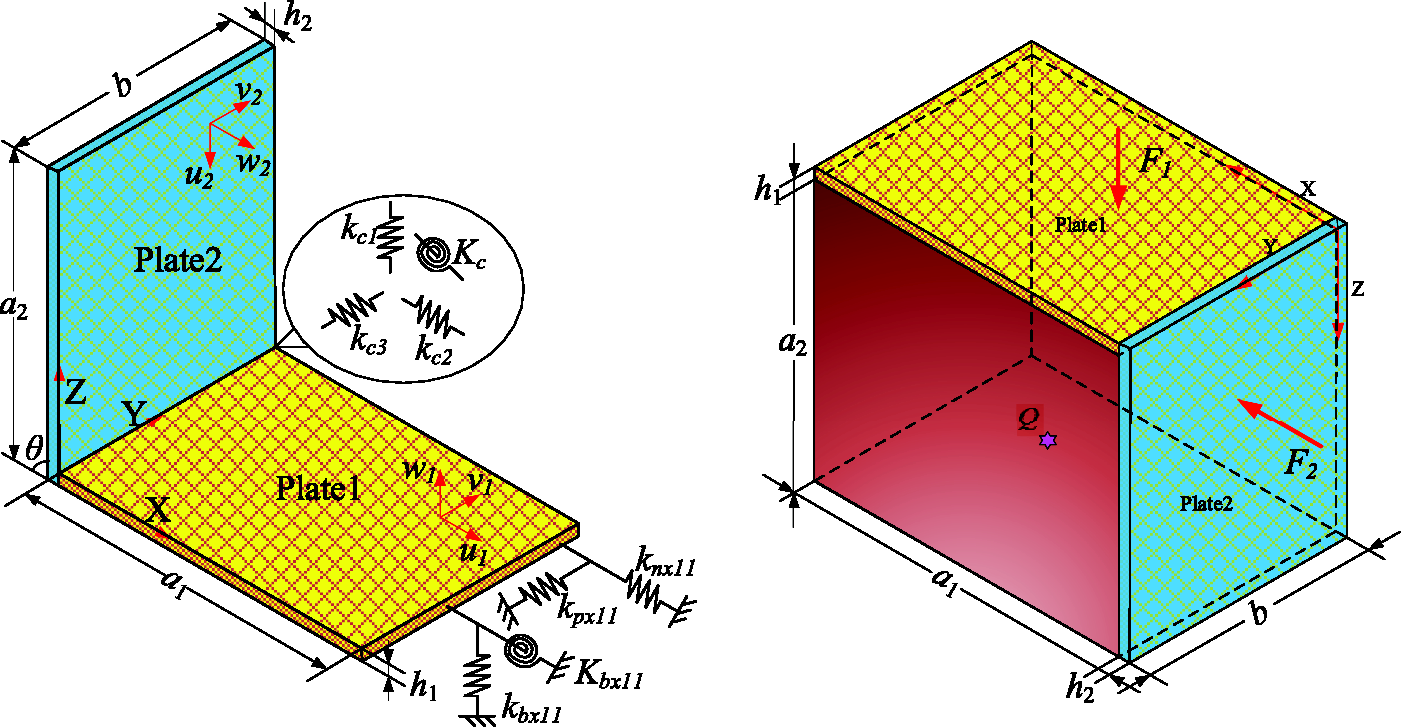
Coordinate system and geometry model of the L-shaped rectangular plate–cavity coupling system.
Admissible displacement and sound pressure functions
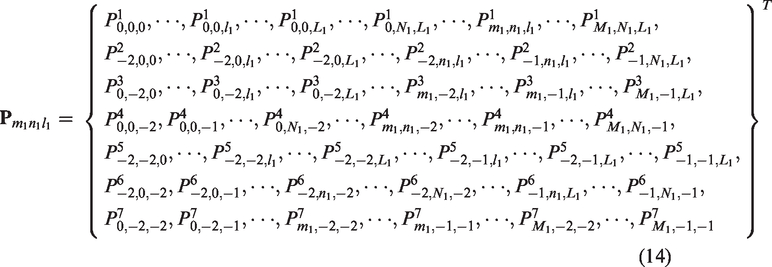
By introducing the Fourier series method, the displacements admissible functions of the L-shaped plate are generally set as the sum of two cosines’ product and two polynomials. The sound pressure admissible functions can be written as the sum of three cosines’ product and six polynomials.40–42 The advantage of this method is that it helps to clear up the phenomenon of the boundary discontinuities. The displacements functions of the L-shaped coupled plate and the sound pressure functions of cuboid cavity can be written as follows























Energy equation of the vibro-acoustic coupling system
Based on the established model, this article is devoted to investigating the vibro-acoustic features of system, which consists of the L-shaped plate under any elastic BC and a cuboid acoustic cavity. The energy expression is got by using Rayleigh–Ritz energy method.43–45 In the first place, the Lagrangian energy function of the L-shaped plate can be shown

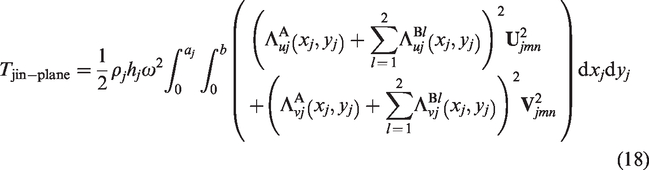
Here, Tplate is the entire kinetic energy


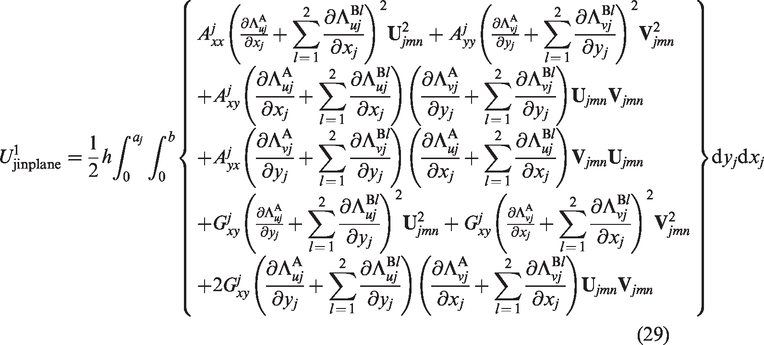
The entire potential energy is Uplate, and its expression can be written as















Because the coupling angle is non-zero, coupling relationship needs to be considered. This structural coupling can be described, and Ucoupling is noted as representing the elastic potential energy stored in the coupling boundary spring.

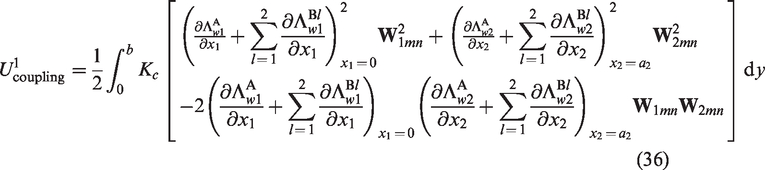
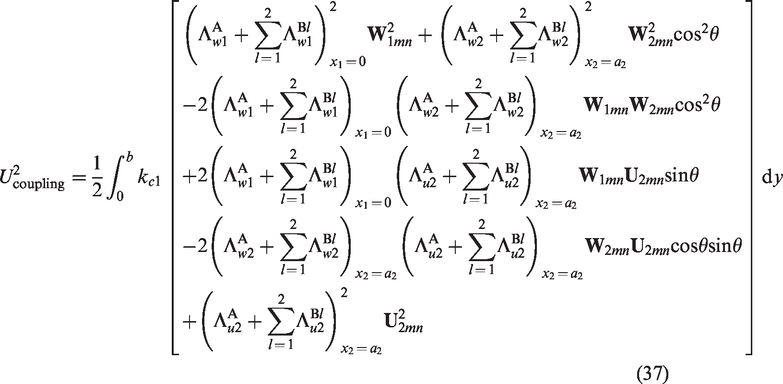
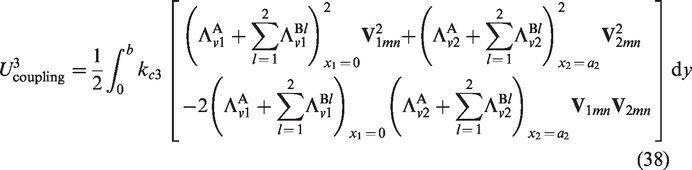
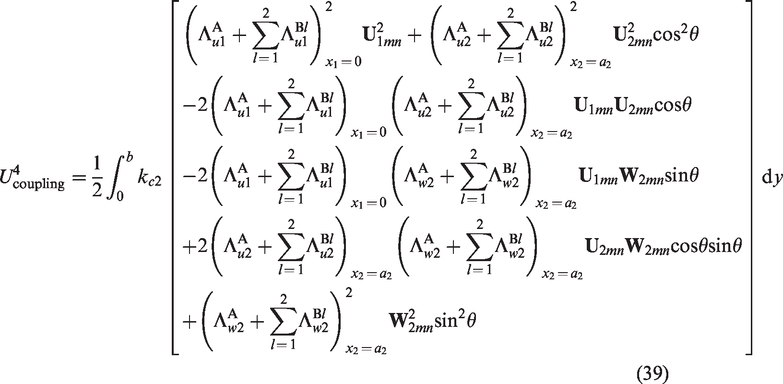
In the plate–cavity coupling system, the plate–cavity coupling interface needs to satisfy the particle vibration velocity continuity condition. For the continuity equations that need to be satisfied at the internal interface of the structure–acoustic coupling system, the mutual work between the structure and the sound field will be described in the energy principle analysis framework. Wa&p shows that the sound pressure on the coupling surface does work on the plate. It can be expressed as




The Lagrangian energy function Lcavity for the cuboid cavity is supplied as






Solution process of the structural–acoustic coupling system
We can get by the solving equation of L-shaped plate and cuboid cavity coupling system by using the equations (15) and (49) based on the Rayleigh–Ritz energy method.
48
The specific method is as follows




In order to solve eigenvalue problem easily, we can convert the matrix to the following matrix

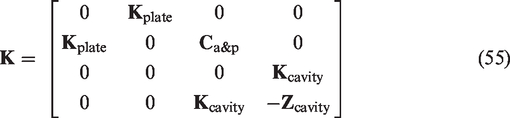
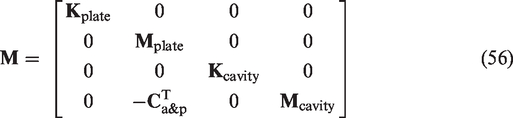

The simple matrix described above is more conducive to solving unknowns.
Numerical results and discussions
In order to study the natural features and forced responses, several numerical examples will be carried out in this section. The influence of impedance of the cuboid acoustic cavity and materials of the L-shaped plate on the coupling system is exploited importantly. Regarding the effects of the plate thickness, BC, and orthotropic degrees for the coupling system, we will summarize some new conclusions. Since some parameters in the article are repeated, some statements will be given here for the convenience of the following narrative. The mass density is ρair=1.21 kg/m3, and the sound speed in air is cair=344 m/s in all the following numerical cases. The BC of L-shaped plate are described by alphabetic strings. Specifically, F, S, C, and E i (i = 1, 2) indicate that BC are free, simple, fixed, and elastic. For the elastic boundary, the E1 elastic boundary is between free and simple, and the E2 elastic boundary is between the simple and the fixed. This selection principle fully considers the BC of each stage. The order of the BC is y = 0, x = a1, y = b, and x = 0 in plate 1. The boundary situations of the plate 2 are the same as those of the plate 1. The BC of E1 means that all linear spring values are set to 0 N/m, and all rotational spring stiffness values are set to 1E3 Nm/rad. When all linear and rotational spring stiffness values are 1E6 N/m and 1E6 Nm/rad, respectively, the BC of E2 will form. In Table 1, we list four types of material properties.
Four different types of material properties used in this paper.

Natural characteristics analysis of the L-shaped plate–cavity coupling system
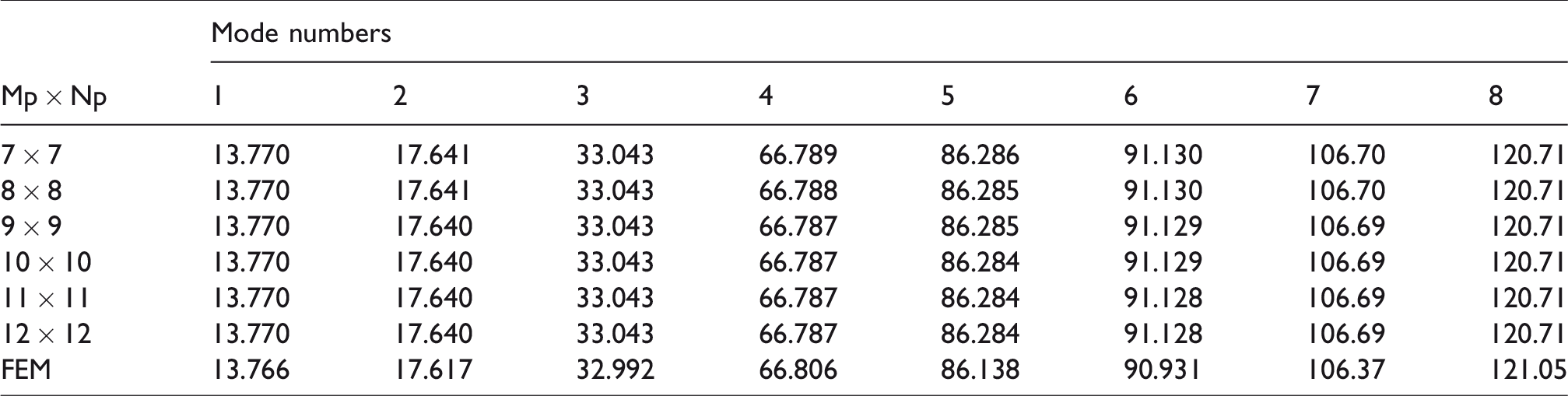
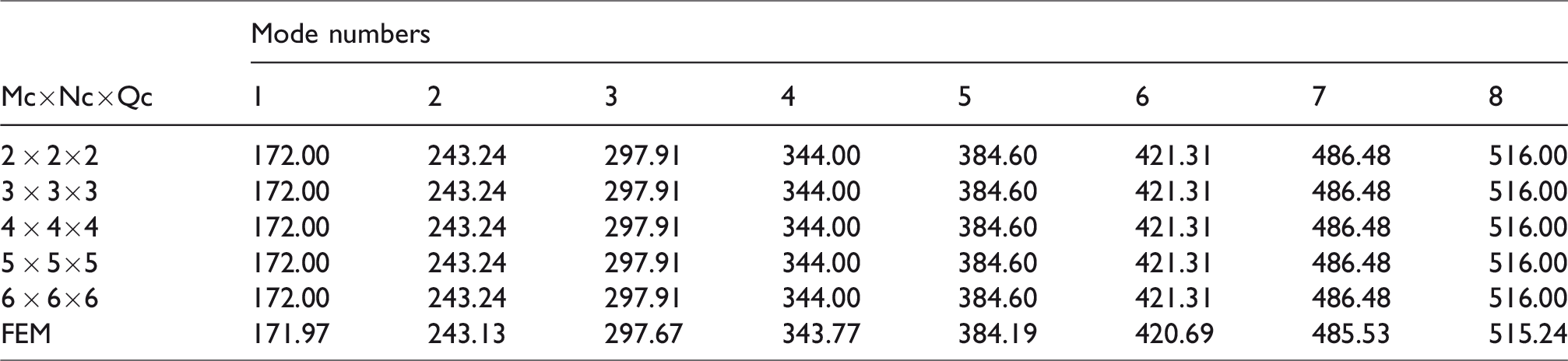
First of all, in order to guarantee the correctness of present method, evaluating its convergence and accuracy is necessary. Convergence degree of the L-shaped plate–cavity coupling system is made known by the cutoff value, which are represented by Mp and Np and Mc, Nc, and Qc. The convergence degree analysis is given in Tables 2 to 4. Compared with the results of FEM, the results got by this method are very consistent. The dimension symbols are the same as those shown in Figure 1. a1 = 1 m, b = 1 m, a2 = 1 m, and h1 = h2 = 0.008 m. As shown in Table 2, material of the L-shaped plate is Material I. And the BC are the coupled-edge fixed branches and the uncoupled edges free supported. The six faces of the cuboid acoustic cavity are rigid faces in Table 3. In Table 4, the materials and BC of the L-shaped coupled plate are the same as Table 2, and the non-coupling surfaces of the cuboid acoustic cavity are rigid surfaces. From Table 4, the convergence and accuracy of the L-shaped plate and a cuboid cavity coupling model directly are examined. It can be found that the coupling frequencies calculated based on different cutoff values have fluctuation phenomenon. However, the maximum fluctuation range is controlled within 0.5%, which can fully satisfy the convergence requirements. In addition, the Table 4 gives the comparative data calculated by the FEM. The maximum error of the results obtained by the method and the FEM is not more than 0.9%, which fully proves the correctness of the vibration characteristics analysis model of L-shaped plate–cavity coupling system established in this paper. In order to fully satisfy the convergence and accuracy, Mc = Nc = Qc = 3 and Mp = Np = 9 are selected as the cutoff values in the following numerical examples.
Convergence and accuracy of the first eight frequency f (Hz) for the L-shaped plate.
Convergence and accuracy of natural frequencies f (Hz) for the rigid-walled acoustic cavity.
Convergence and accuracy of natural frequencies f (Hz) for the L-shaped plate–cavity coupling system.
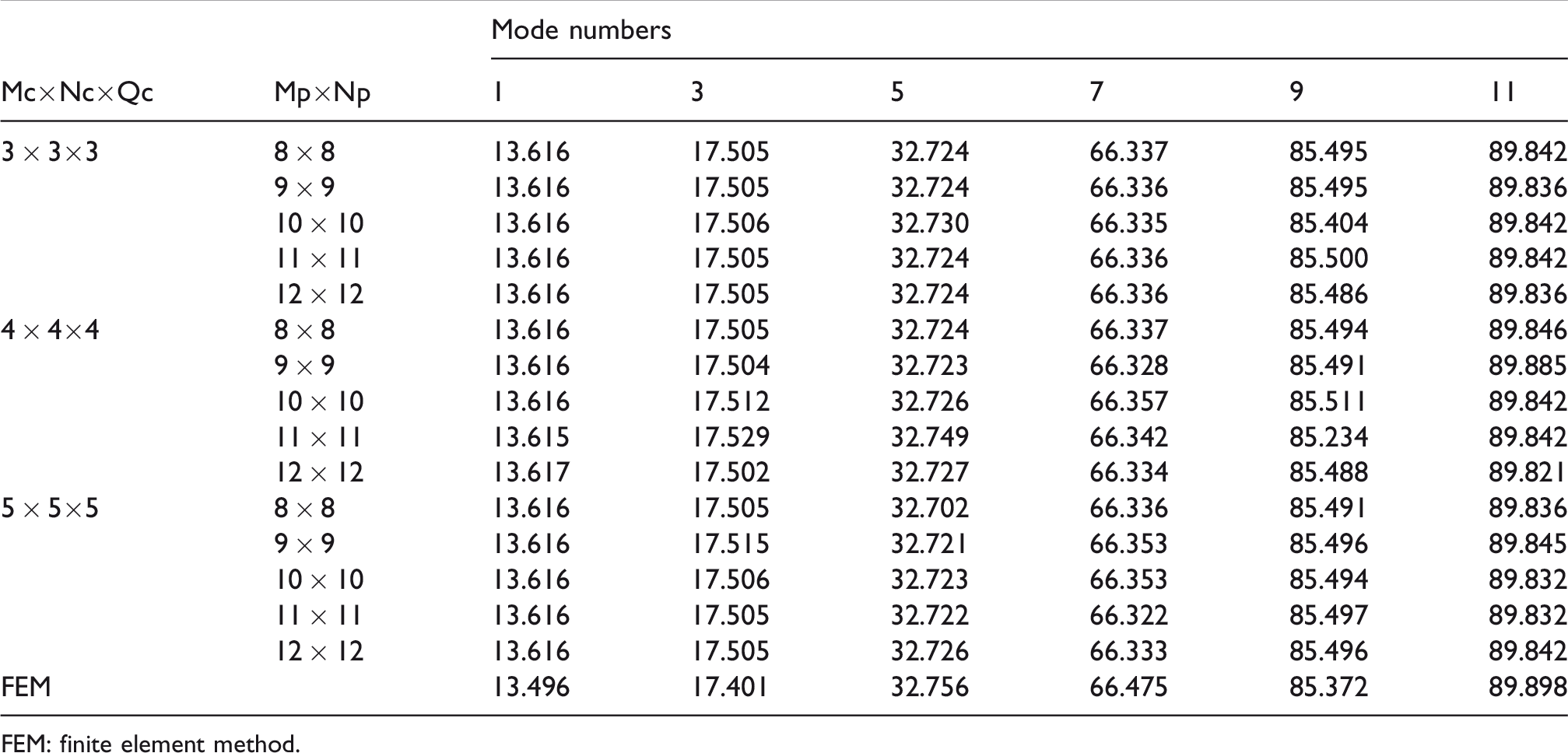
FEM: finite element method.
In order to deepen the intuitive understanding of the vibration characteristics of orthotropic L-shaped plate–cavity coupling system, the displacement mode shapes of the L-shaped plate are given in Figure 2, as well as the corresponding acoustic pressure mode shapes of the acoustic cavity. The dimension symbols are the same as those shown in Figure 1. a1 = 1 m, b = 1 m, a2 = 1 m, and h1 = h2 = 0.008 m. Material of the L-shaped plate is Material III. The BC are all fixed branches. From the mode shapes, we can directly see the displacement distribution of the L-shaped plate and the sound pressure distribution of the acoustic cavity at the natural frequencies. The mode shapes provide the basis for the analysis of the vibration characteristics of the structural system.
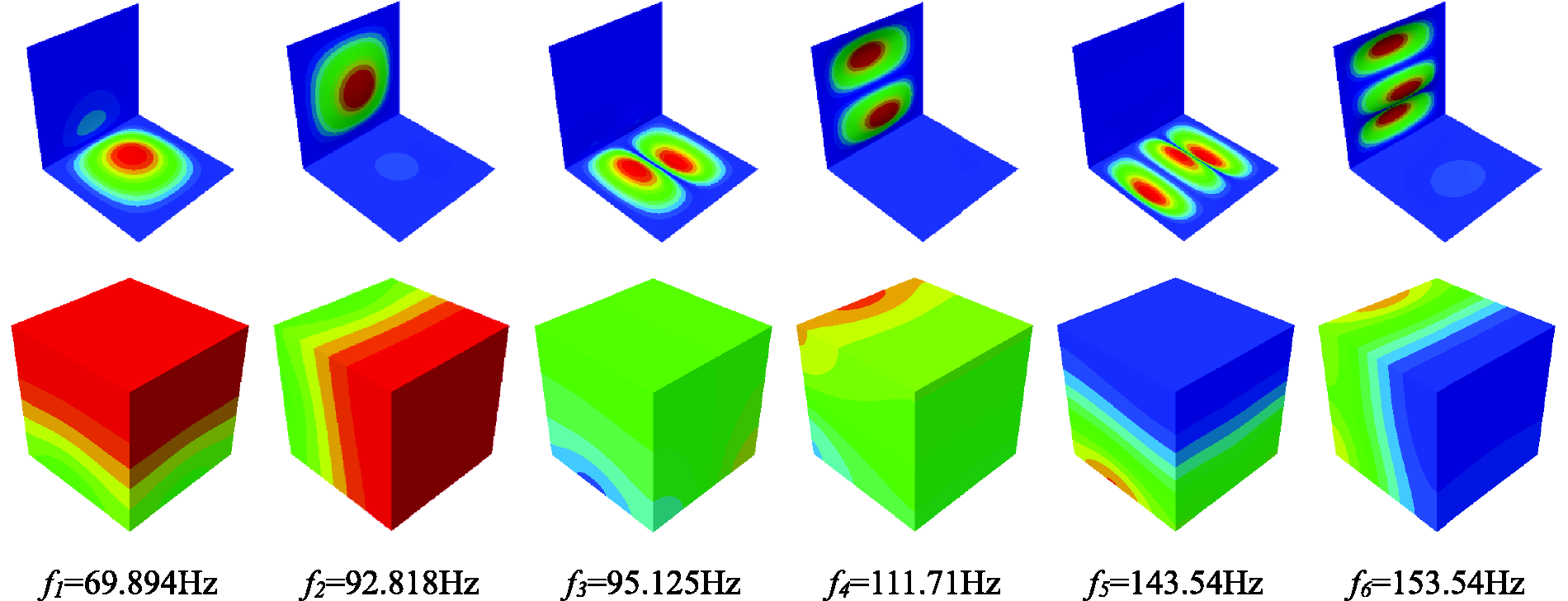
The mode shapes and natural frequency f (Hz) of the L-shaped plate–cavity coupling system.
Then we probe the coupling theory of the coupled system by Table 5. The degrees of change in the natural frequencies can be expressed by ratios, and the degrees of coupling can be visually displayed. The ratios is δ = coupled natural frequencies/structural natural frequencies = CNF/SNF. The sizes of the cuboid acoustic cavity are a1×b×a2 = 1.4 m × 1.0 m × 1.2 m. Remaining walls are all rigid, all but the L-shaped plate surface for the cuboid acoustic cavity. The thickness of the L-shaped plate with classic (F, S, and C) and elastic BC is h1 = h2 = 0.008 m and materials I and III are used in table. Typically, the CNF are slightly less than the SNF, but all the ratios are exceedingly close to 1. Moreover, the BC have a great impact on the CNF and SNF. It is obvious which frequencies of the structural and the coupled increase as the increase of stiffness value. It is worthy to mention that no matter which stiffness value we chose, it does not change which all the ratios are exceedingly close to 1.
The natural frequencies f (Hz) and coupling degrees of the L-shaped plate–cavity coupling system filled with air.
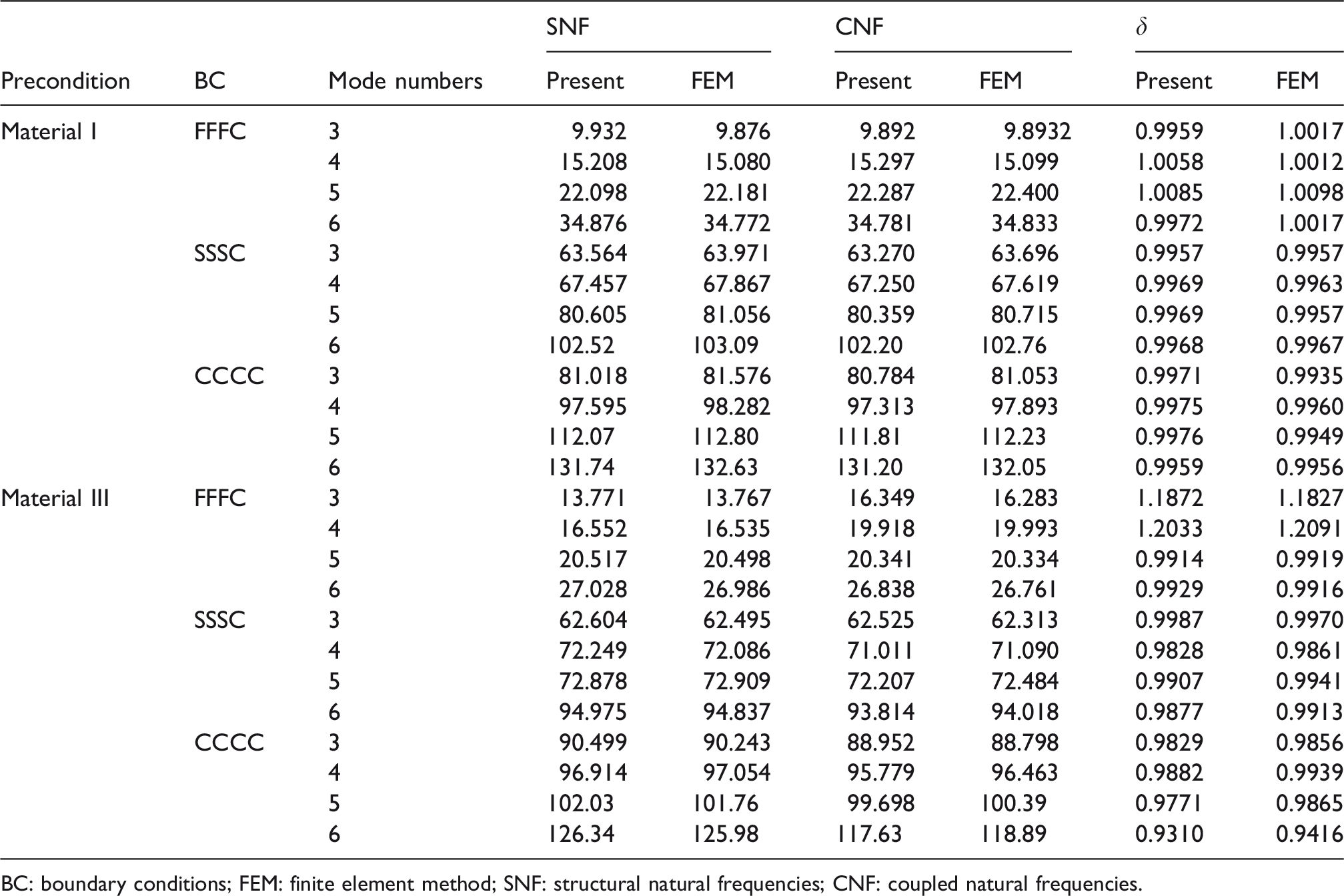
BC: boundary conditions; FEM: finite element method; SNF: structural natural frequencies; CNF: coupled natural frequencies.
To further check the versatility and accuracy of the present method, the natural frequencies of the L-shaped plate-cavity coupling model with different materials and BC are given (Table 6). Four materials are used in Table 6, including two isotropic materials and two orthotropic materials. In the use of the formula, the property parameters of isotropic materials are special cases of the property parameters of isotropic materials. The specific changes are as follows E1 = E2, G12 = E1/(2 + 2μ12). Therefore, the properties of Material I are given as E1 = E2 = 216 GPa, G12 = 83.1 GPa, μ12 = 0.3, and ρ = 7800 kg/m3. The geometrical parameters of the cavity are a1×b×a2 = 1.4 m × 1.2 m × 1.0 m, and the geometrical parameters of the plate are a1×b×h1 = 1.4 m × 1.2 m × 0.008 m and a2×b×h2 = 1.0 m × 1.2 m × 0.008 m. Except the coupling surface, other walls are acoustically rigid. At the end of the table, the natural frequencies of elastic BC are also given. It is easy to know that the results received by this method are consistent with the results got by FEM. From the data given in Table 6, we can come to a conclusion that the more fixed BC, the higher the natural frequencies of the L-shaped plate and cuboid cavity coupling model.
The natural frequencies f (Hz) of the L-shaped plate–cavity coupling system with different materials and boundary conditions (h1 = h2 = 0.008 m).
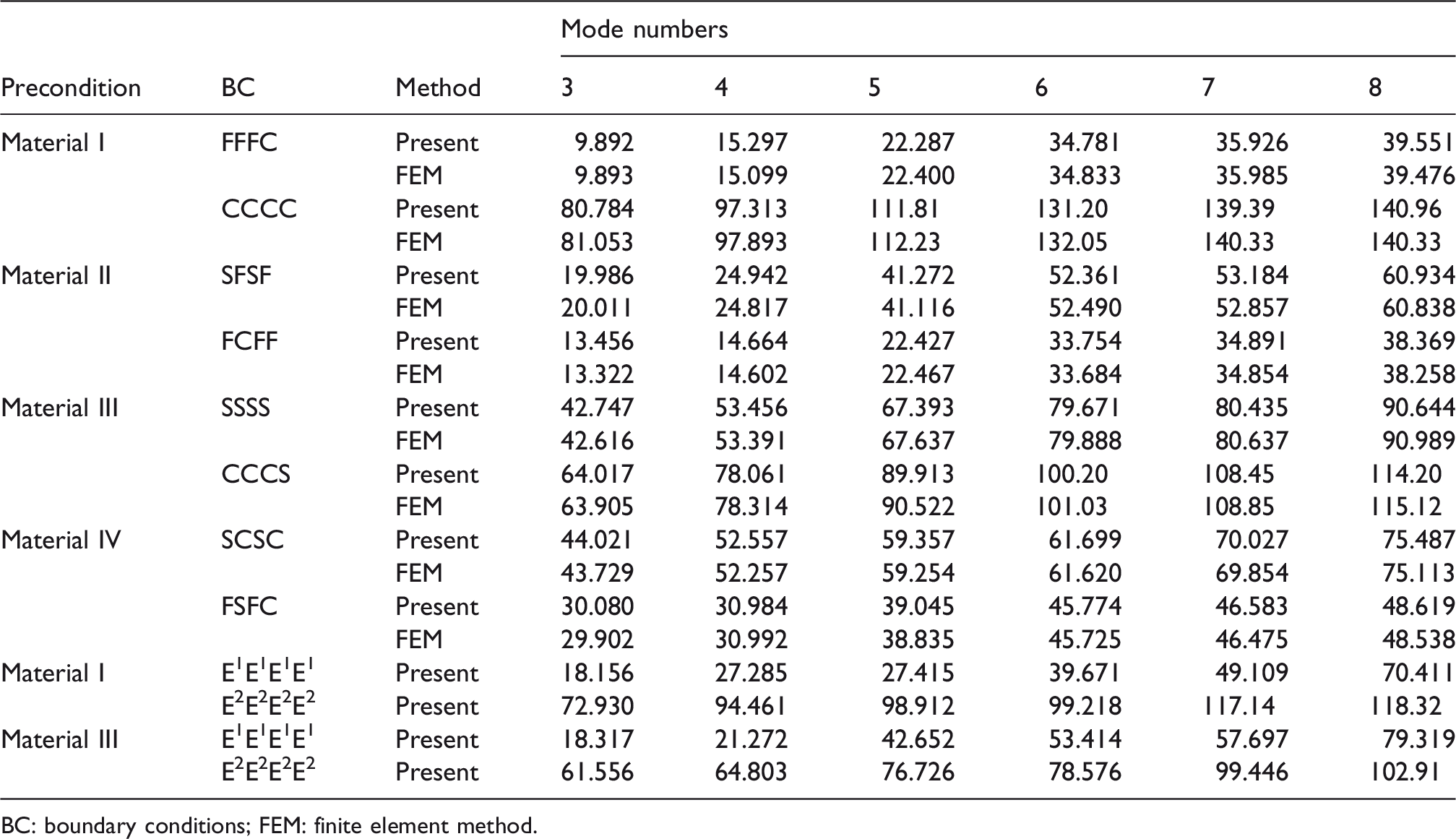
BC: boundary conditions; FEM: finite element method.
As shown in Table 7, we mainly analyze effects of different thickness ratios. The sizes of the cuboid acoustic cavity are a1×b×a2 = 1.4 m × 1.0 m × 1.2 m. Except the L-shaped coupling surface for the cuboid acoustic cavity, other four walls are all rigid. The thickness of L-shaped plate 1 with simple BC is h1 = 0.008 m and Material III is used in Table 7. It can be summarized from the table that when the thickness of the two plates is different, as the thickness ratio of the two plates increases, the natural frequency increases.
The natural frequencies f (Hz) of the L-shaped plate–cavity coupling system with various plate thicknesses (Material III, SSSS, h1 = 0.001 m).
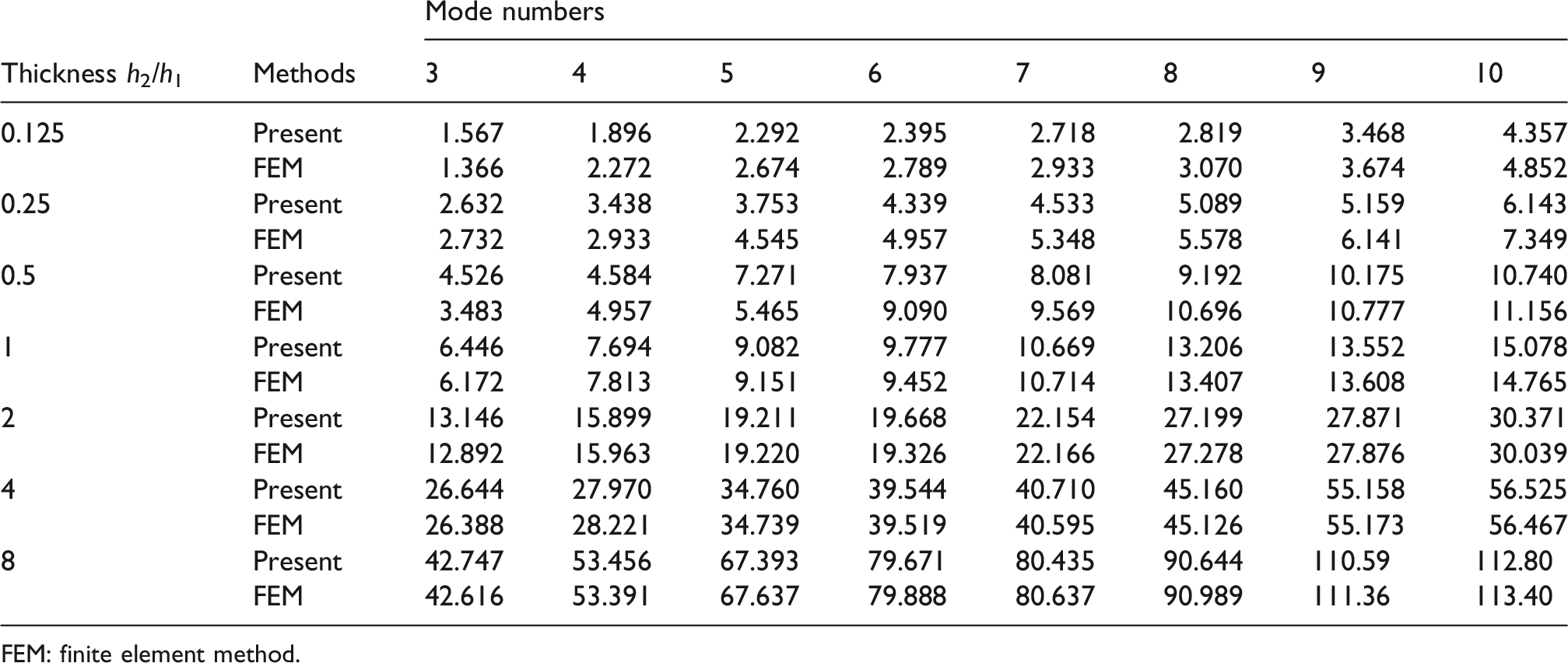
FEM: finite element method.
For the orthotropic L-shaped plate–cavity coupling system, an important factor is orthotropic degree. The influence of different orthotropic degrees and BC on the natural frequencies is shown in Table 8. The sizes used in Table 8 are same as Table 6. And related property parameters are as follows: E2 = 10 GPa, G12 = 5 GPa, μ12 = 0.25, and ρ = 1300 kg/m3. The non-related surfaces are rigid walls. At the end of the table, the natural frequencies of two groups of elastic BC are also given. The natural frequencies are different under any BC and several orthotropic degrees from Table 8. Specifically, with increasing the spring stiffness value and the anisotropic degree, the natural frequencies will increase. In the case where the BC are the same, the natural frequency increases as the orthotropic degrees increases. It has important value of engineering guidance. By picking a group of different BC and orthotropic degrees, the frequencies which have a good match for specific requirements can be utilized.
The natural frequencies f (Hz) of the L-shaped plate–cavity coupling system with varying boundary conditions and orthotropic degrees (h1 = h2 = 0.008 m, E2 = 10 GPa, G12 = 5 GPa, μ12 = 0.25, and ρ = 1300 kg/m3).
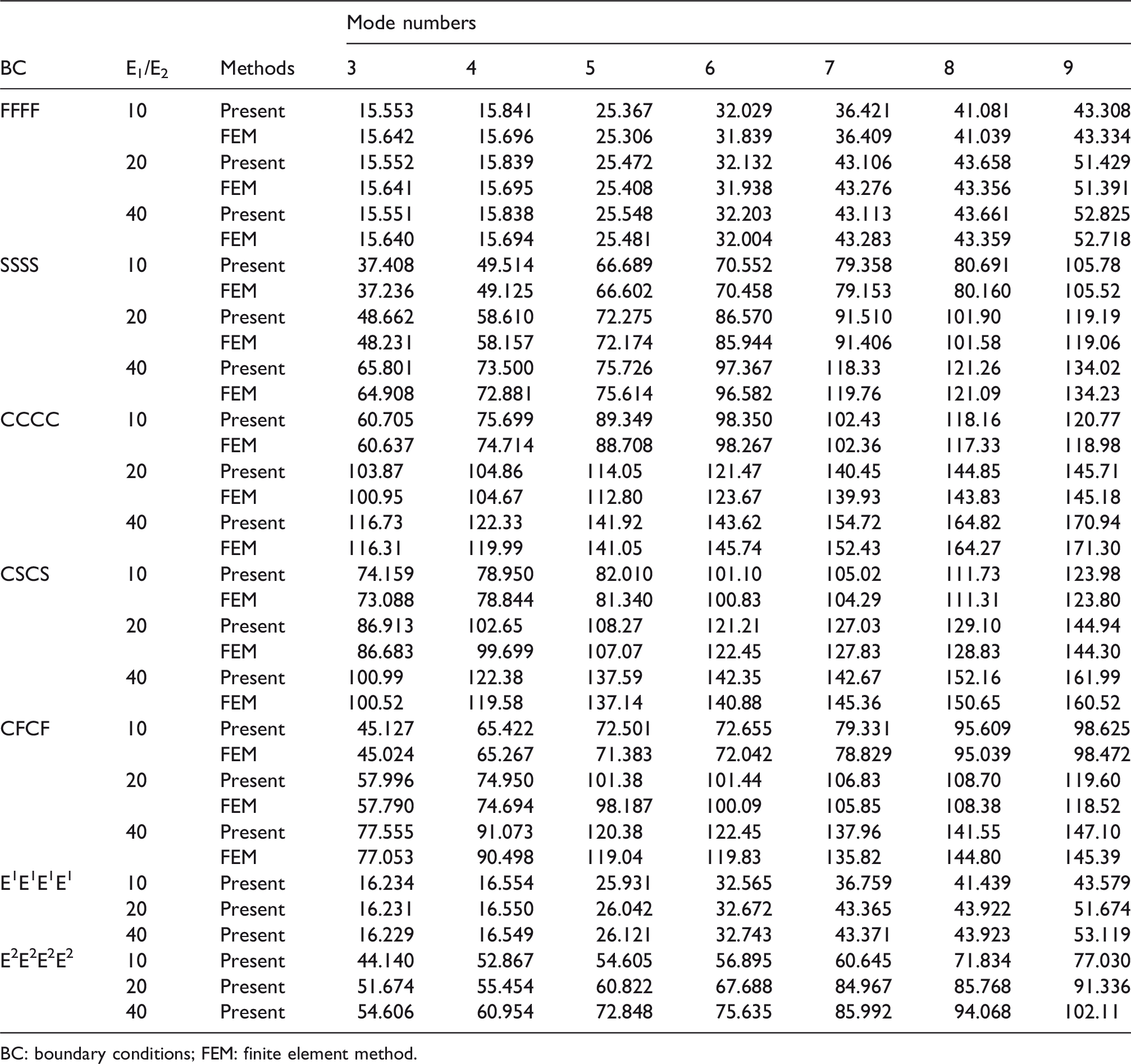
BC: boundary conditions; FEM: finite element method.
In fact, there are also cases where two plates use different materials, so the relationship of the materials of the L-shaped plate on the natural frequencies is shown in Figure 3. The dimensions and BC are the same as those shown in Table 4. In the first picture, the influence of isotropic materials is mainly investigated. It can be seen that the change of isotropic materials has little influence on the natural frequencies. In the second picture, it is obtained that the connection of the orthotropic materials for the natural frequencies. From the figure, it can safely come to conclusion that the change of orthotropic materials has a tremendous influence on the natural frequencies. More specifically, when the materials of the plate 1 and the plate 2 are different, the natural frequencies are between the natural frequencies of the same material used separately. The third picture studies the natural frequencies of both isotropic and orthotropic materials. All these data clearly prove the fact that the natural frequencies in the presence of isotropic and orthotropic materials are mainly affected by orthotropic materials. We can choose the materials of the two plates to obtain the natural characteristics that meet the concrete requirements.
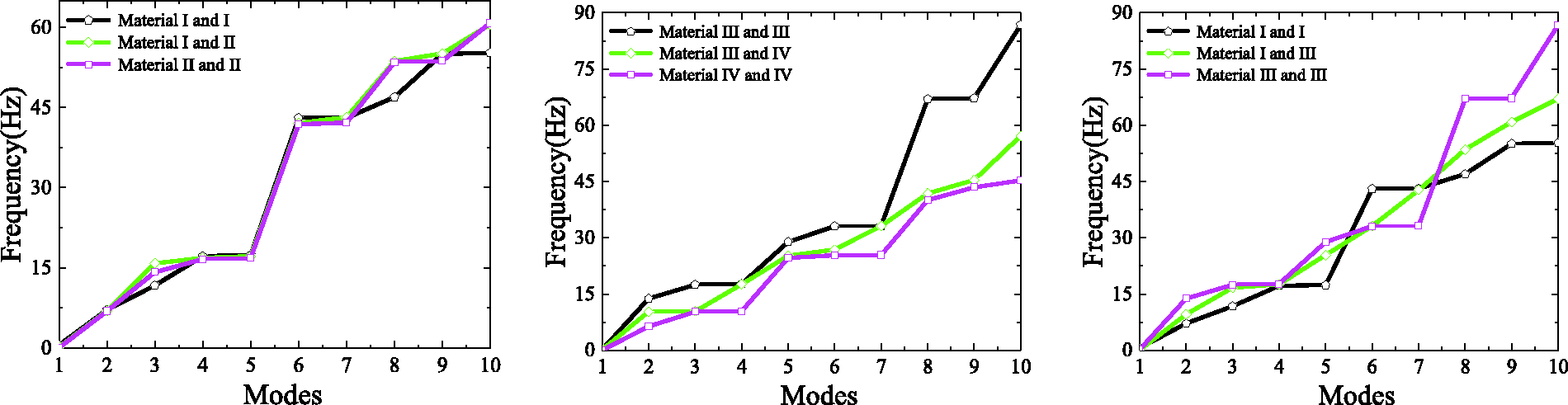
The natural frequency f (Hz) of the L-shaped plate–cavity coupling system under different materials of two plates.
Displacement and sound pressure analysis of the L-shaped plate–cavity coupling system
Forced response of L-shaped plate–cavity coupled system is analyzed in this part. First at all, Figure 4 shows the displacement and sound pressure response of the L-shaped plate and cuboid cavity model under the action of point force. The sizes of the L-shaped plate used in Figure 4 are a1 = 1.4 m, a2 = 1.0 m, b = 1.2 m, and h1 = h2 = 0.008 m. The isotropic material in the figure is selected from Material I. The orthotropic material is selected from the Material III. The BC of the coupled boundary shown in the figure are fixed. And the remaining boundaries situations are fixed and free, respectively. The boundary situations named in the figure represent only the BC of non-coupled boundary. The L-shaped plate is forced to two forces. The unit point force is applied to point (0.65,0.15) of plate 1 and point (0.65,0.15) of plate 2. In this figure, two points on the plate 1 and the plate 2 are selected to study displacement response analysis, and sound pressure responses analysis also are performed. Obviously, comparing the responses of different materials under different boundary situations, it can be deduced which BC cause deviation of the response curve, because the change of the spring value with the simulated BC changes the inherent of the coupled system. By comparing the results of this paper with the results of the FEM, the results of the present method can be obtained with good consistency.
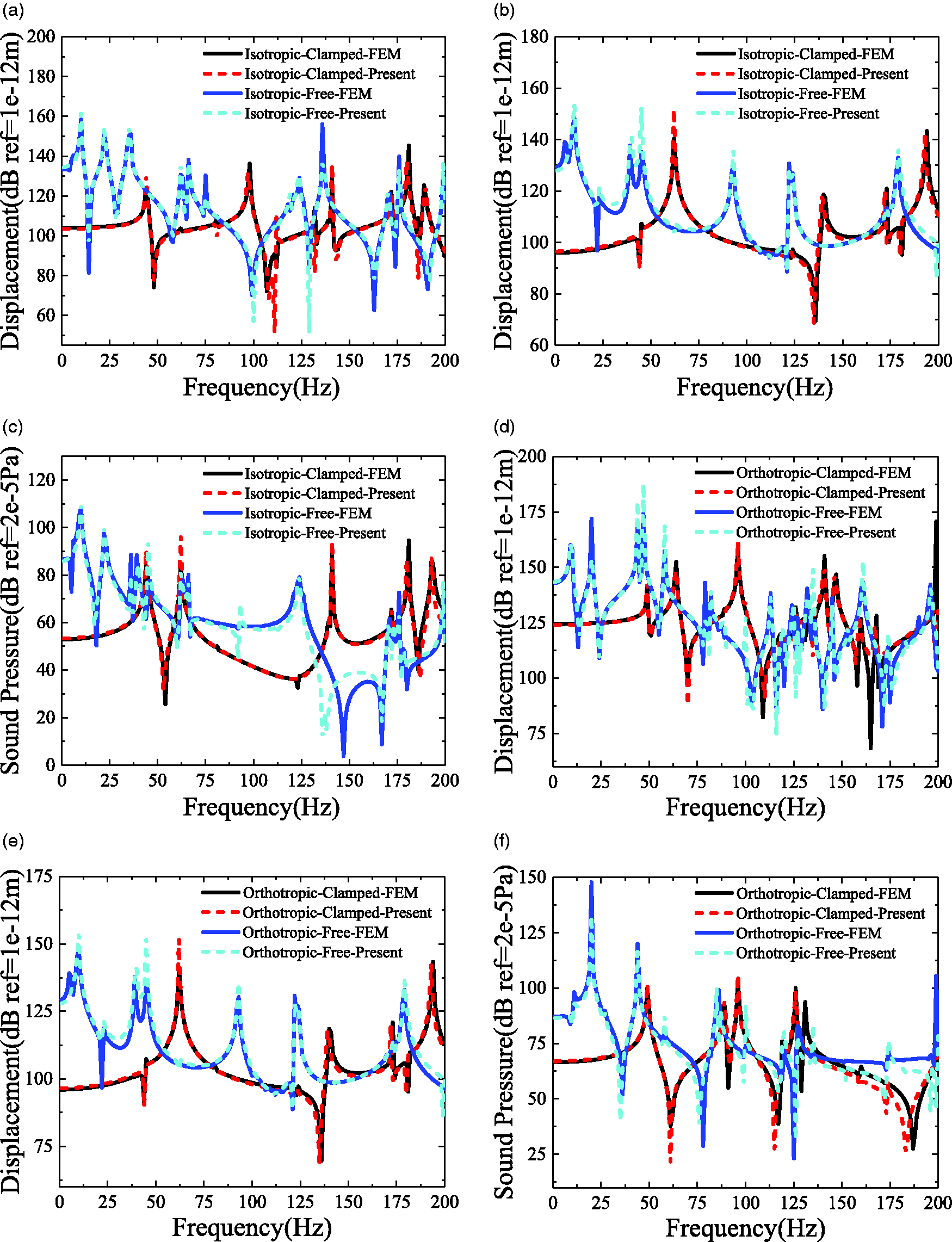
Responses of the L-shaped plate–cavity coupling system filled with air under the excitation of point forces (F1 and F2). (a) Displacement at (0.65,0.15) in plate 1. (b) Displacement at (0.5,0.6) in plate 2. (c) Sound Pressure at (0.7,0.6,0.5). (d) Displacement at (0.65,0.15) in plate 1. (e) Displacement at (0.5,0.6) in plate 2. (f) Sound Pressure at (0.7,0.6,0.5).
Next, we discuss the coupling mechanism between the coupled systems. In order to understand the forced response research under the action of point forces, we select the plate structure and coupled system. The Figure 5 explains the displacement value of the L-shaped plate and L-shaped plate–cavity system under the excitation of point forces. Here, materials of the L-shaped coupled structure are selected as the Material I (Figure 5(a) and (b)) and Material III (Figure 5(c) and (d)). And the boundary situations of the L-shaped structure are full clamped support. The dimensions are same as those of Figure 4. It can be known from the figure that the trend of the displacement curve is generally consistent. The displacement at the natural frequency is slightly offset. And the ratio of the displacement value of the L-shaped plate and the L-shaped plate–cavity model at the peak is close to 1. It can be seen from the figure that the displacement of plate under the coupling system is smaller than the displacement before the coupling, indicating that the displacement has a weakening effect before and after the coupling. When using the orthotropic materials, the displacement response is also affected at the local frequency due to the presence of the cuboid cavity.
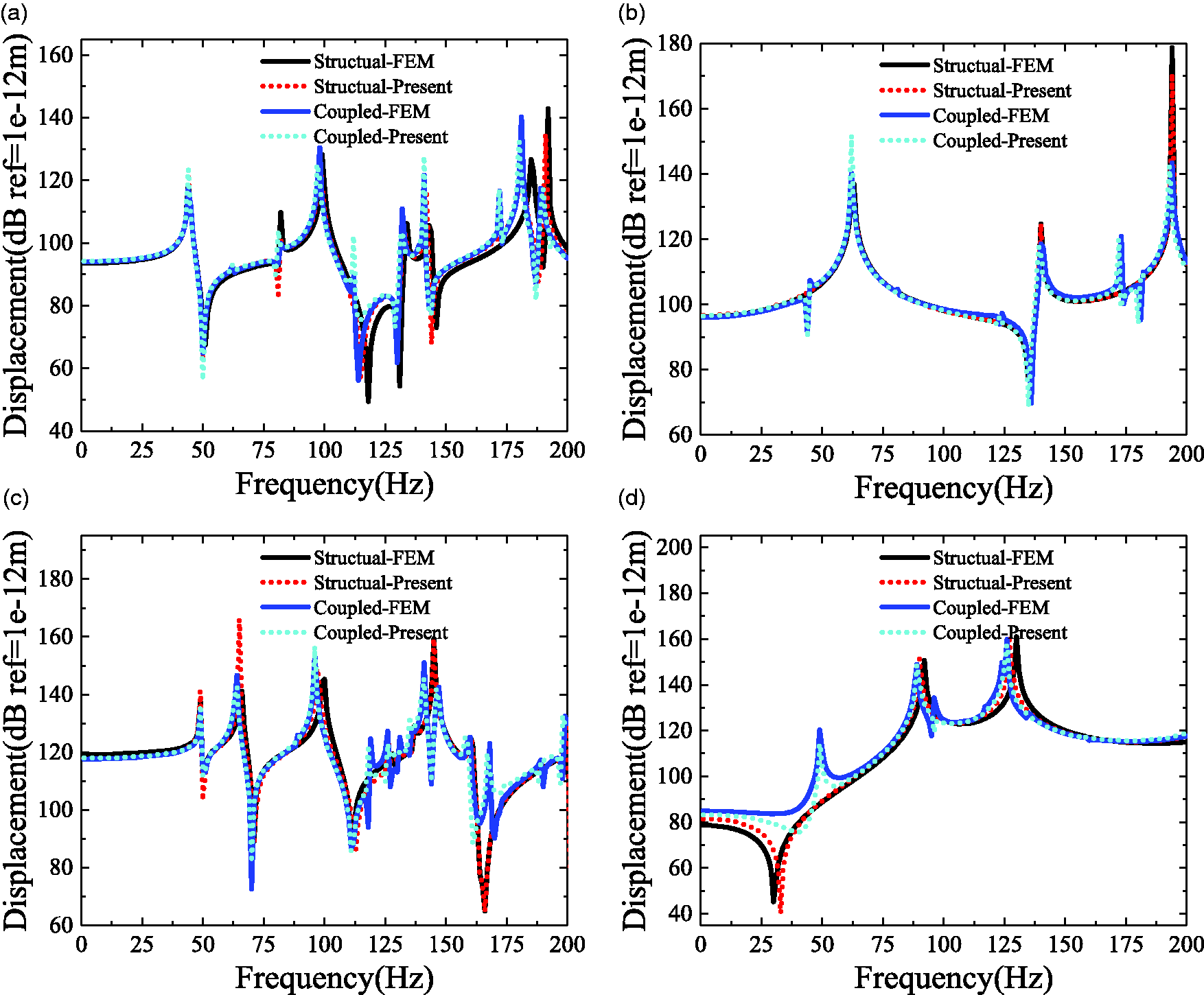
Responses of the L-shaped plate and the L-shaped plate–cavity coupling system filled with air under the excitation of point forces (F1 and F2). (a) Displacement at (0.8,0.1) in plate 1. (b) Displacement at (0.5,0.6) in plate 2. (c) Displacement at (0.8,0.1) in plate 1. (d) Displacement at (0.5,0.6) in plate 2.
It is shown which response of coupling model with various BC and various materials under point source excitation in Figure 6. The coupling system dimensions and materials used in Figure 6 are identical to those of Figure 4. The unit point sound source position in Figure 6 is located at the center point (0.7, 0.6, and 0.5) of the cavity. It can be known that the response consequents calculated by the Fourier series method are correct by comparing with the response consequents obtained by the FEM.
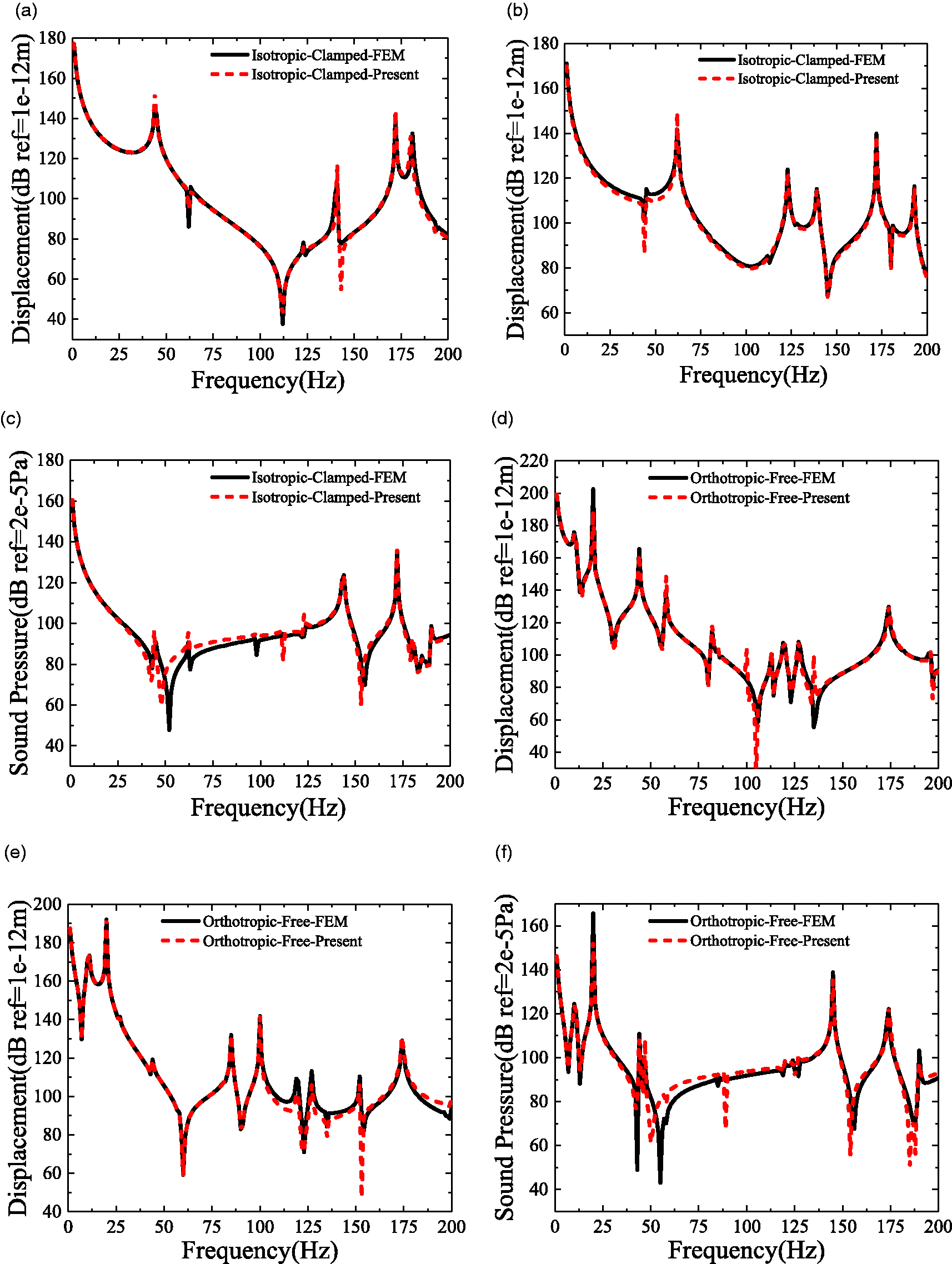
Responses of the L-shaped plate–cavity coupling system under the excitation of a point sound source under different boundary condition and material. (a) Displacement at (0.7,0.6) in plate 1. (b) Displacement at (0.5,0.6) in plate 2. (c) Sound Pressure at (0.75,0.15,0.2). (d) Displacement at (0.7,0.6) in plate 1. (e) Displacement at (0.5,0.6) in plate 2. (f) Sound Pressure at (0.75,0.15,0.2).
Then, we explore the impact of impedance on the forced response. Figure 7 shows the response curve of the coupling model under the effect of forces and sound source. Here, the model parameters and the locations of the forces and sound source are identical to those in Figures 4 and 6. Plates’ material is selected as the Material I. The impedance values of the four non-related surfaces are set as rigid and Z = ρaircair(100-j), respectively. It can speculate from Figures, which the existence of impedance affect the vertex value of the response curve, however, the tendency of the displacement and sound pressure curve does not change.
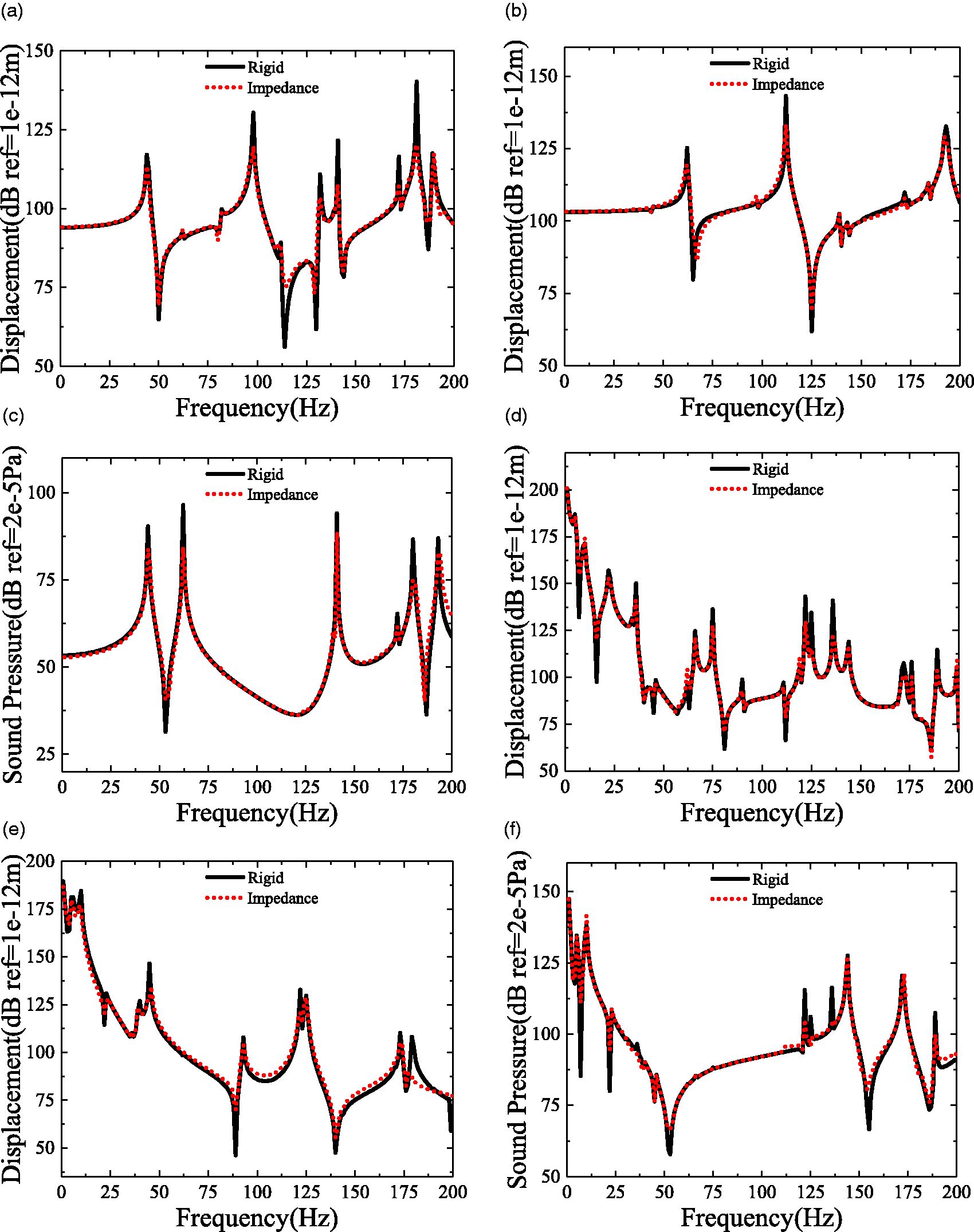
Responses of the L-shaped plate–cavity coupling system with impendence value under the excitation of point forces (F1 and F2) (a) to (c) and a point sound source (d) to (f). (a) Displacement at (0.8,0.1) in plate 1. (b) Displacement at (0.65,0.15) in plate 2. (c) Sound Pressure at (0.75,0.15,0.2). (d) Displacement at (0.8,0.1) in plate 1. (e) Displacement at (0.5,0.6) in plate 2. (f) Sound Pressure at (0.75,0.15,0.2).
Finally, effects of the L-shaped plate’ materials on the forced response are investigated. The results of the L-shaped plate–cavity system filled with air under different materials of two plates and the excitation of point forces are studied. The dimensions and BC of Figure 8 are the same as those shown in Table 4. Since the two plates of the L-shaped plate have the same sizes, and the action points are at the midpoint of the plate, the two positions on the plate 1 including the force point and the non-force point and the center point of the cavity are selected as response analysis. It can be seen from the figure that when the two plates are selected as isotropic materials, the trend of displacement response curves of the L-shaped plates are consistent, and the displacement response of any plate on the L-shaped plates has a relationship with the material of the plate. The trend of sound pressure curve is consistent, and sound pressure curve is located inside the two curves, which are the sound pressure response curves, when the two plates are selected from the same materials. When the two plates are made of orthotropic materials, the displacement curve in the 0–50 Hz is related to the two plates. When the frequency is greater than 50 Hz, the displacement response is related to the material of the plate where the test point is located. The trend of displacement response is consistent with the displacement response under the same materials, but the displacement slightly reduced and offset at the peak. The sound pressure of the cuboid cavity is related to the materials of L-shaped plates. Figure 9 displays the response of the L-shaped plate–cavity coupling model existed air under different materials of two plates and the action of the point source. The dimensions and boundary situations of Figure 9 are the same as in Figure 8. The position of the point source is displaced from the center of the cuboid cavity. The same conclusions, as in Figure 7, can be obtained by response analysis.
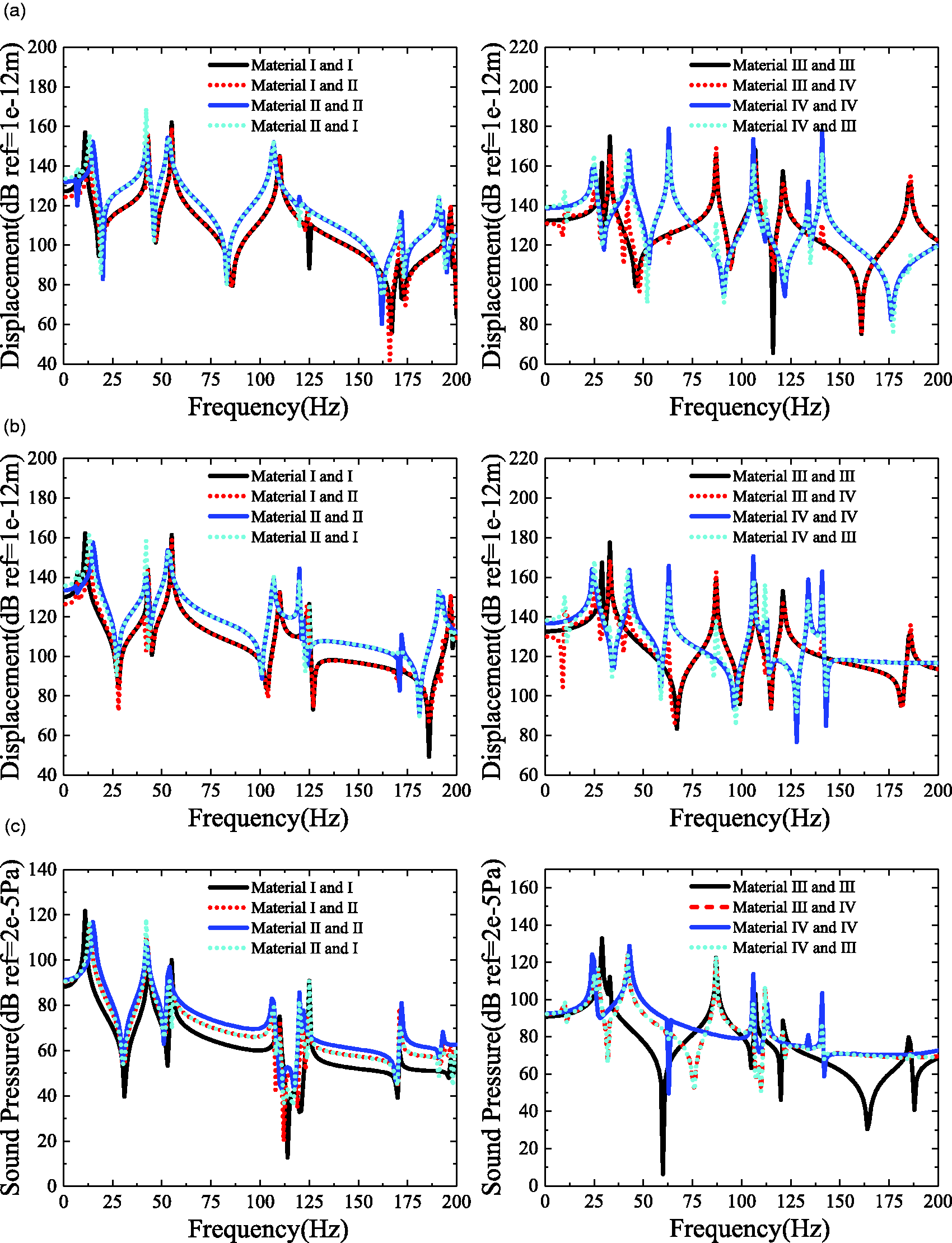
Responses of the L-shaped plate–cavity coupling system filled with air under different materials of two plates and the excitation of point forces (F1 and F2). (a) Displacement at (0.5,0.5) in plate1. (b) Displacement at (0.7,0.6) in plate1. (c) Sound Pressure at (0.5,0.5,0.5).
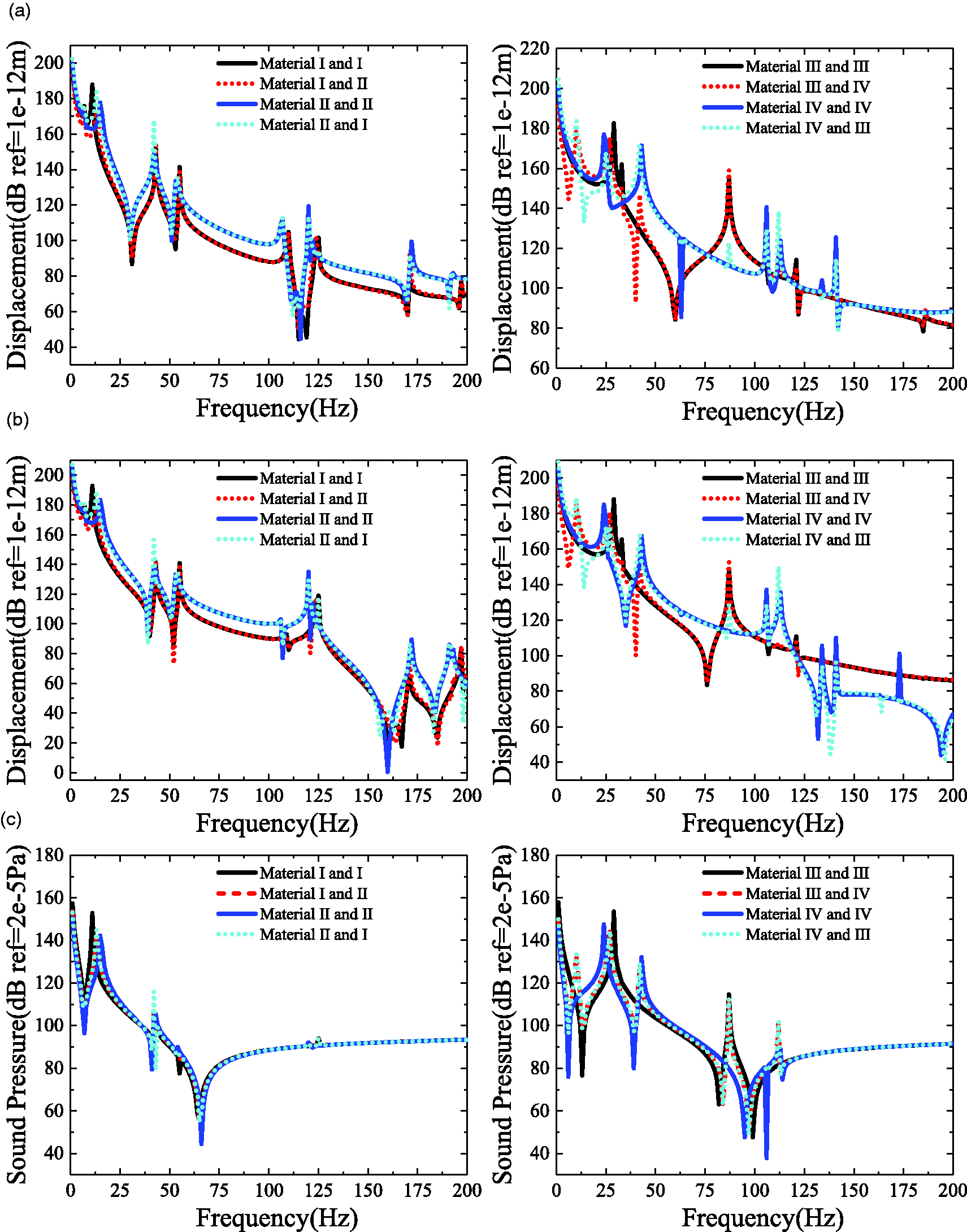
Responses of the L-shaped plate–cavity coupling system filled with air under different materials of two plates and the excitation of a point sound source. (a) Displacement at (0.5,0.5) in plate1. (b) Displacement at (0.7,0.6) in plate1. (c) Sound Pressure at (0.5,0.5,0.5).
Conclusions
In this paper, it is studied by Fourier series method that the vibro-acoustic behaviors of coupling model including the L-shaped plate and a cuboid cavity. The natural frequency of the L-shaped plate–cavity coupling system is analyzed in this paper. In this paper, the displacements admissible functions of the L-shaped plate are generally set as the sum of two cosines’ product and two polynomials. Sound pressure admissible functions of the cuboid acoustic cavity can be written as the sum of three cosines’ product and six polynomials. By contrasting with the results of FEM, the good convergence and consistency of the method are demonstrated. The vibro-acoustic research of the L-shaped plate–cavity coupling system under a point force or a point source is studied particularly in this paper. This method in this paper is further extended to the analysis of other plate structure problems, such as U-shaped plate–cavity system.
Here are some guiding conclusions:
The natural frequency will increase as the increase of the spring stiffness value. At the same time, the response curves will change with it. The cuboid acoustic cavity has impedance wall that effectively attenuates the resonance. This is important to reduce vibration and control noise. By selecting orthotropic degrees and plate thicknesses, it can be controlled that the natural frequencies of the coupling system. For example, increasing the orthotropic degree will raise the natural frequency. When the materials of two plates are selected from different materials of the same type, the displacement response is related to the material of the plate where the test point is located. But the sound pressure result is related to materials of the two plates of the L-shaped plate.
Footnotes
Declaration of conflicting interests
The author(s) declared no potential conflicts of interest with respect to the research, authorship, and/or publication of this article.
Funding
The author(s) disclosed receipt of the following financial support for the research, authorship, and/or publication of this article: The authors gratefully acknowledge the financial support from the National Natural Science Foundation of China (Grant nos. 51705537 and 51679056) and Natural Science Foundation of Hunan Province of China (2018JJ3661). The authors gratefully acknowledge the supports from National Key Laboratory of Science and Technology on Helicopter Transmission, Nanjing University of Aeronautics and Astronautics (HTL-O-18G03).