




Abstract
In engineering, a fast estimation of the periodic property of a nonlinear oscillator is much needed. This paper reviews some simplest methods for nonlinear oscillators, including He’s frequency formulation, the max-min approach and the homotopy perturbation method. A mathematical insight into He’s frequency formulation is given, and the weighted average is introduced to further improve the estimated accuracy of the frequency. Fractional oscillators are also discussed.
Keywords
Introduction
Nonlinear oscillations arise everywhere in our everyday life and engineering. As an exact solution might be too complex to be used for a practical application, many analytical methods have been used in open literature, for example, the variational iteration method,1–7 the homotopy perturbation method,8–20 He–Laplace method,21–23 the variational approach24–29 and the Hamiltonian approach.30,31 The most important property of a nonlinear oscillator is the relationship between the frequency and its amplitude, the simplest method to estimate the frequency–amplitude relationship might be He’s frequency formulation32–34 and the max-min approach,35,36 which are still under development and many modifications were proposed to improve the accuracy.37–45
Consider a nonlinear oscillator in the form

The simplest criterion for the existence of a periodic solution of equation (1) is
1

This criterion can be understood by a pendulum-like oscillator




So equation (4) has a periodic solution.
In this paper, we will review some simplest methods for fast calculation of the frequency–amplitude relationship.
He’s frequency formulation
He’s frequency formulation was initially inspired by an ancient Chinese algorithm 36 ; now this formulation has gained much attention and has been under development, with various modifications appearing in open literature.37–45
We define a residual function R(t) as

He’s frequency formulation is to choose two trial solutions




The residuals are time-dependent, and we can use their weighted average



If the weighted function is chosen as



For simplicity, we can use discrete weighted average


If we write the trial solution as


This implies

We, therefore, obtain another simple frequency formulation, which reads
34

In some previous publications,
34
we choose

We can use the weighted average of equation (23) as discussed above.
If we write


This formulation is widely used in the max-min approach
35

We can also use instead of equation (27) the weighted average of equation (26).
Variational approach
The variational approach24,29 is to establish a variational principle for equation (1)


The functional equation (28) becomes

By setting

Hamiltonian approach
The Hamiltonian approach
30
is a further extension of the variational approach. In equation (28),

If we begin with


Using the weighted average, the frequency can be easily determined. The most simple calculation is to set

Homotopy perturbation method
The homotopy perturbation method8,9 is to change gradually from a homotopy equation when p = 0 to its original one when p = 1

When p = 0, we have a linear oscillator with a frequency of
We can also construct the following homotopy equations in case the Duffing equation’s frequency is known



Li and He 18 suggested a modification of the homotopy perturbation method coupled with the enhanced perturbation method, which is extremely effective for forced nonlinear oscillators; Adamu et al. 20 proposed the parameterized homotopy perturbation method, which gives a high accurate solution for a nonlinear oscillator.
An example
We consider a nonlinear oscillator in the form

We write equation (40) in the form

The coefficient of u in equation (41) is larger than zero, so equation (41) has a periodic solution.
When

The frequency of equation (42) by the homotopy perturbation method is

When

Its frequency is

Now we check the correctness of He’s frequency formulation discussed above.

It is extremely easy to calculate its derivative with respect to u, that is

Setting u = A/2, we have

When
The max-min approach leads to the following result

The variational principle of equation (40) reads

Its Hamiltonian can be written as

We choose
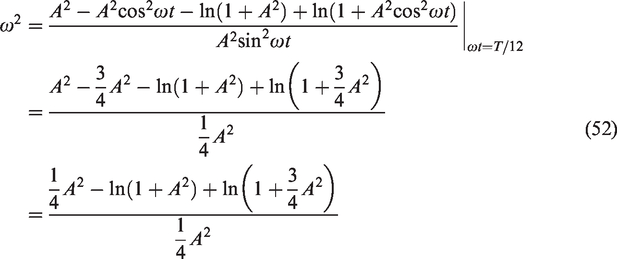
The accuracy can be improved by weighted average discussed above.
Discussion and conclusions
The above methods are also valid for fractional oscillators.46–49 We consider a nonlinear oscillator with a fractal derivative50,51

The fractal derivative

For equation (54), we assume that the minimal scale of time is a day, and scales less than one day are not considered. If we observe the stock change in a scale larger than two days, for example, a week or a year, we can consider continuity of a stock change. We assume that the large time scale is s, according to the fractal theory, we have50,51

Under a large time scale, equation (53) becomes

Equation (56) can be solved analytically by various analytical methods including those discussed above.
The fractal derivative can be used to search for a variational principle for an equation with a damping term

The Hamiltonian invariant can be obtained as

To conclude, this paper explains some simplest frequency formulae for nonlinear oscillators, the mathematical insight into the formulae reveal all frequency formulae can be improved by choosing a suitable weighted function. This paper can be used as a paradigm for practical applications.
Footnotes
Declaration of conflicting interests
The author(s) declared no potential conflicts of interest with respect to the research, authorship, and/or publication of this article.
Funding
The author(s) received no financial support for the research, authorship, and/or publication of this article.