




Abstract
The lateral vibration of monatomic chains considering atomic longitudinal displacements is studied by using the string vibration theory. The modes of lateral vibration of monatomic chains are assumed as the modes of string vibration. Based on the string assumption, the equation of string vibration for monatomic chains is established. Coordinates of the vibration atoms can be calculated by utilizing boundary conditions and symmetry conditions of monatomic chains. The natural angular frequencies of transverse vibration of monatomic chains are calculated by the string vibration method. The tension of the quantum limitation is given and the value of limitation can be used to distinguish nanoelectromechanical systems from quantum-electromechanical Systems. Natural angular frequencies and resonant frequencies of the monatomic chain string are associated with the axial tension acting on the string and the length of monatomic chains, and they can be altered by changing the length of the string and the axial tension acting on the string. The nonlinear vibration of single atomic chain can be analyzed using the improved Lindstedt–Poincaré multiscale method. The study found that the stiffness of the carbon monatomic chain can be altered by changing the length of the string and the tension acting on the string.
Introduction
Monatomic chains can be considered as a kind of ideal one-dimensional (1D) conductor and can be applied to nano-devices of optics, sensors, and electronics. The reduction of the material structure from two dimensions to one dimension had revealed a new world of physical phenomena and technological applications in the past few years. Monatomic chains are currently one of the most intensively studied objects because of their unique properties such as nanometric dimensions, quantized conductance, high aspect ratios, modulus of elasticity, unusual optical features, and electromagnetic response. With their 1D structures, monatomic chains have an extremely large surface area-to-volume ratio compared with bulk materials. 1D structures have also shown a number of valuable nonlinear properties such as conductance switches and negative differential resistance.1–4 As a building block of nanoelectronic devices in a molecular scale, monatomic chains show particular potential in molecular logical switches.5–7 So, it is important to carry out the research on monatomic chains owing to their scientific value and technological potential.
The research on vibration of monatomic chains has attracted widespread attention of the scientific community in recent years. The dispersion relation, the distributions of electron density and the amplitudes of the characteristic vibrational modes are obtained by the transfer matrix method. 8 The Green’s function is constructed for steady-state vibrations of atomic chains at all possible frequencies. The applicable conditions of differential equations with fourth-order spatial derivative are analyzed to describe the long wave vibrations of the atomic chain. 9 Fano resonances are found to exist in the monatomic Mn chains with spin-spiral structure by means of the density functional theory combined with nonequilibrium Green’s function method. 10 Hoogeboom et al. 11 developed a systematic examination of the existence, stability, and dynamical properties of a discrete breather at the interface between a diatomic and a monatomic granular chain. Hizhnyakov et al. 12 studied the anharmonic vibrations of monatomic chain and graphene in transverse with respect to the chain/plane direction with the analytical and numerical method. An atomistically meaningful pseudo-continuum representation for the nontrivial lattice dynamics of a finite monatomic chain with linear elastic interactions between nearest-neighbor atoms was analytically deduced by mean of a dynamic mechanical analysis. 13 A relation between discrete breathers and nonlinear normal modes in some nonlinear monoatomic chains was discussed. 14 However, the research on the lateral vibration of monatomic chains is conducted less frequently than that on the longitudinal vibration of lattice monatomic chains. With the rapid development of the technology in monatomic chains production, the theoretical investigation on the lateral vibration of monatomic chains is urgently needed nowadays.
The frequency of the resonator can grow by increasing the tension in the vibrating string or beam. 15 With the technique of physical stretching in the resonator, the resonance frequency of a resonator has been tuned. 16 The most commonly used high-stress material is silicon nitride. Under appropriate growing conditions, thin films with stresses can be obtained and resonators made of this material have extremely high-quality factors.17,18 The large deflection vibration characteristics and stability of the moving printing membrane were analyzed. 19 The authors proposed a new scheme that relies on the nonlinearity, which utilizes nonlinear time history analysis results. 20 However, the microscopic origin of the damping lies in localized defect states in the material and degrades the quality factor.
The localization of vibrations in 1D linear and nonlinear lattices was investigated.21–23 The localization frequencies were determined and the attenuation factors were calculated. Discrete and continuum models were developed and compared. 21 Wave propagation in 1D nonlinear periodic structures was investigated through a novel perturbation analysis and accompanying numerical simulations. Several chain unit cells were considered featuring a sequence of masses connected by linear and cubic springs. 22 A perturbation approach is used to obtain both propagation and attenuation constants, which are amplitude dependent for such a nonlinear system. 23 A chain composed of classic harmonic oscillators with alternating masses and one mass impurity was studied using the recurrence relations method. 24 The monatomic mass-spring chain with a cubic nonlinearity was studied by the multiple scales analysis of wave–wave interactions. 25 Free wave propagation properties in one-dimensional chains of nonlinear oscillators were investigated by means of nonlinear maps. 26
The nonlinear chain represented as a new class of strongly nonlinear multidimensional mechanical systems whose degenerate dynamics and potential applications, such as shock and vibration absorption and mitigation, are worthy of exploring further. A finite chain of particles with next-neighbor interactions, undergoing in-plane nonlinear oscillations with fixed–fixed boundary conditions was studied. 27 The strongly nonlocal nonlinear term in governing equations of motion generated by the near-uniform axial tension of the fixed boundary conditions were studied with a nonlinear acoustic vacuum. 28 A weightless string without preliminary tension with two symmetric discrete masses with cubic characteristics of elastic supports was investigated both by numerical and analytical methods. 29 The dynamics of a string with uniformly distributed discrete masses without tension and the nonstationary planar dynamics of a string with uniformly distributed discrete masses without preliminary tension and taking into account the bending stiffness were studied. 30 Singular perturbation approach was used to divide the dynamical system into a fast subsystem for cable vibrations and a slow subsystem for trolley motion and cable swing. 31 The above research provides a theoretical reference for monatomic chains modeling and nonlinear vibration analysis.
The purpose of this paper is to analyze the vibration of monatomic chains considering the longitudinal displacement of the atoms. The assumption of the string-like vibration is introduced in the lateral vibration of monatomic chains. The equation of string vibration for monatomic chains is established by using Newton’s second law. The lateral vibration modes of atomic chains are assumed as the modes of the string vibration. The relationship among the natural angular frequency, the tension and length of nano-strings is studied. The numerical solutions to nonlinear equation groups are solved with the Newton iterative method. The nonlinear vibration of single atomic chain can be analyzed by using the improved Lindstedt–Poincaré (L–P) multiscale method.
Dynamic model of monatomic chains
Monatomic chains are made of atoms connected by chemical bonds. The length of chemical bonds or the distance between atoms is not fixed. Hence, atoms vibrate as a whole. Atomic vibration can be considered as the motion of particles connected by springs. For the lateral vibration of monatomic chains, the vibration amplitude of atoms in the direction of longitude is far smaller than that in the lateral vibration so it is negligible in the study. As the amplitude of the thermal vibration is smaller than that of the lateral vibration, the thermal vibration of monatomic chains can be ignored.
The force field of monatomic chains can be studied by using a series of simplified or empirical formula to describe the influence of the lateral and longitudinal vibration of atomic chains on two neighboring atoms. The forces between two atoms change with the alteration of distances between the atoms and the forces can be decomposed into vertical and longitudinal forces. For small deflection and slope of a string, the restoring forces in the vertical displacement of the string are entirely due to the axial tension in the string.
As monatomic chains are not continuous systems, we cannot use the theory of string vibration to obtain the equations of vibration directly (see as Figure 1). The following assumptions are proposed in order to simplify the vibration model of monatomic chains:
1.1 All the atoms are in a straight line when monatomic chains are arranged in equilibrium positions without lateral external excitation.
1.2 The vibration of monatomic chains can be assumed as the vibration of nano-strings, and the lateral vibration modes of atomic chains are assumed as the modes of vibration strings.
1.3 The elastic stiffness between two neighboring atoms in the nano-string of monatomic chains is assumed as a fixed constant and the flexible stiffness is ignored. Only the case of the single bond between two carbon atoms is considered.
Lateral vibration of monatomic chains is assumed as the harmonic vibration with the same natural frequency. We have the eigen routine to elucidate the eigenvalues and eigenvectors of a single atom. The eigenvalues correspond to frequencies, and at the same time, the eigenvectors to atomic displacements.
Considering a monatomic chain consisting of N + 1 atoms with mass m
k
(k is the numbering of the atoms, see as Figures 2–3), the lateral vibration modes of the nano-string of monatomic chains are expressed as

Using Newton’s second law, one can get


Equations (2) and (3) can be simplified as




The time domain functions of the k−1th and k + 1th are written as


The vibration equation of string of the monatomic chains is expressed as

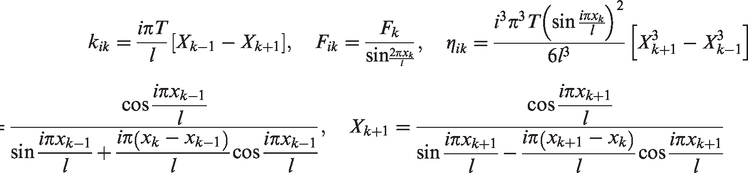
To simplify the equations, equation (6) can be expressed as

Calculation of coordinates of monatomic chains
For the free vibration of monatomic chains, the dynamic equation can be written as

Each atom laterally vibrating in monatomic chains has the same vibration frequency according to the principle of displacement deformation coordination for discrete body movement. We can have

As both of the clamped ends of monatomic chains are fixed, the equation group of frequencies is made of N-2 equations. In order to simplify the calculation of the equation group, the nondimensional variables are introduced in the equations and
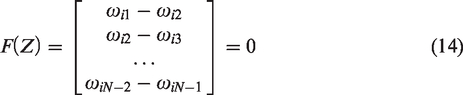
As the equation group (12) is a nonlinear one, it is difficult to get the analytical solution but easy to have the numerical solution of equations. Newton iterative method is used to work out the numerical solution to the nonlinear equation group.
The iterative calculation formula can be written as

Analysis of the quantum limitation
Microelectromechanical systems (MEMS) have experienced substantial development since they came into being, and the nanoelectromechanical systems (NEMS) likewise have increasingly taken shape with the evolution of nanotechnology. Besides, in the past few years, quantum-electromechanical systems (QEMS) has also boomed in its significance. NEMS and QEMS are distinguished by the thermal occupation number and the equation of which can be expressed as
32

The tension of the quantum limitation can be expressed as

On the condition that the tension is smaller than or equal to TLimit, the vibration of monatomic chains is in the regime of the NEMS. Otherwise, the quantum effect of vibration of monatomic chains should be considered. The energy of the modes is quantized and can be expressed as

Nonlinear vibration analysis of the single atomic chains
Introducing the nondimensional analysis, the forced vibration equation (11) of an atom with damping can be written as


The frequency of the excitation force

Introducing a parameter transformation, we have




By the multiple scales method,
15
the uniform solution of equation (20) can be represented in the form

In the dimensionless equation of motion, the natural frequency ωk0 is equal to 1. Substituting equations (23) to (26) into equation (20) and equating coefficients of like powers of αk, the following differential equations can be expressed as


The general solution of equation (27) can be written as

Substituting equation (29) into equation (28) and eliminating secular terms, one yields

Letting

Eliminating θik from equation (31) the following nonlinear algebraic amplitude–frequency equation for the steady state can be written as

There can be either one or three solutions of the above amplitude equation. The first approximation solution of equation (10) is

The stability of the solutions is determined by the eigenvalues of the corresponding Jacobian matrix of equation (30). The corresponding eigenvalues are the roots of

The sum of the two eigenvalues is –2μ
ik
, which varies with the feedback gains. If μ
ik
>0, the sum of two eigenvalues is negative, which means at least one of the two eigenvalues will have a negative real part. Based on the analysis mentioned above, the sufficient conditions for guaranteeing the system stability are
16

The value of
When there are two real solutions of equation

As the image of
Case study and discussion
The vibration of the string of the carbon chain is studied in this paper. The distance r0 between two neighboring carbon atoms is 1.282 × 10⁻¹⁰ m. The stiffness K of the atoms is 642 N/m. 32 The length of the monatomic chain is l=(N–1)(r0+T/K). Mass of carbon atoms is 1.993 × 10⁻²⁶ kg. The second atom is studied as the research object in the calculation cases.
Table 1 gives the iterative solutions to the nonlinear equation group by using the method of iterative algorithm for a seven-atom chain. In the calculation, nondimensional coordinates of z0, z6, and z3 are set to 0, 1, and 0.5, respectively. We can find that the fourth iterative solution is convergent, which indicates that its convergence of iterative algorithm is quick. The coordinates of z1( j ) and z5( j ), and z2( j ) and z4(j) is 1. The analysis above indicates that the vibration of seven-atom monatomic chains is symmetrical.
Iterative solutions to the nonlinear equation group for a seven-atom chain.

Table 2 gives the iterative solutions to the nonlinear equation group by using the method of iterative algorithm for an eight-atom chain. In the calculation, nondimensional coordinates of z0 and z7 are set to 0 and 1, respectively. The nondimensional coordinate of z3 is set to 0.5–1/14 and that of z4 to 0.5 + 1/14. We can find that the third iterative solution is convergent, which means that its convergence of iterative algorithm is quick.
Iterative solutions to the nonlinear equation group for an eight-atom chain.

Figure 4 depicts the tensions of the quantum limitation for the first-order vibration mode changing with temperature for different length of nano-strings of the carbon monatomic chains. The value of the tensions increases with the growth of the environmental temperature. For a fixed environmental temperature, the value of the tensions of the quantum limitation decreases with the shortening of the length of the nano-string. The tensions of the quantum limitation for the vibration of seven-monatomic chains are calculated as 1.196 × 10⁻¹⁴ N.
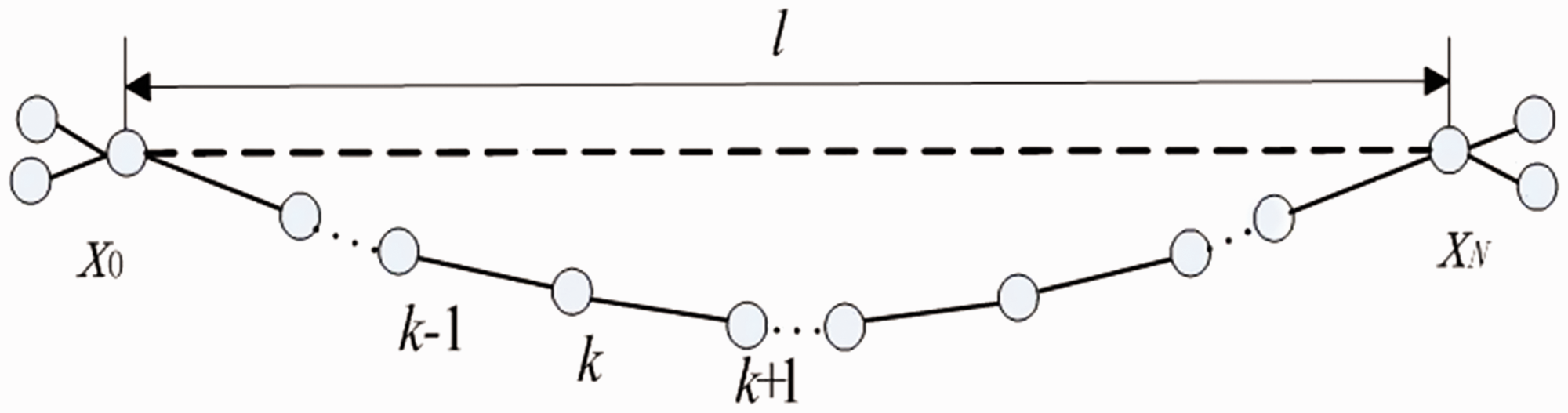
Monatomic chains diagram.
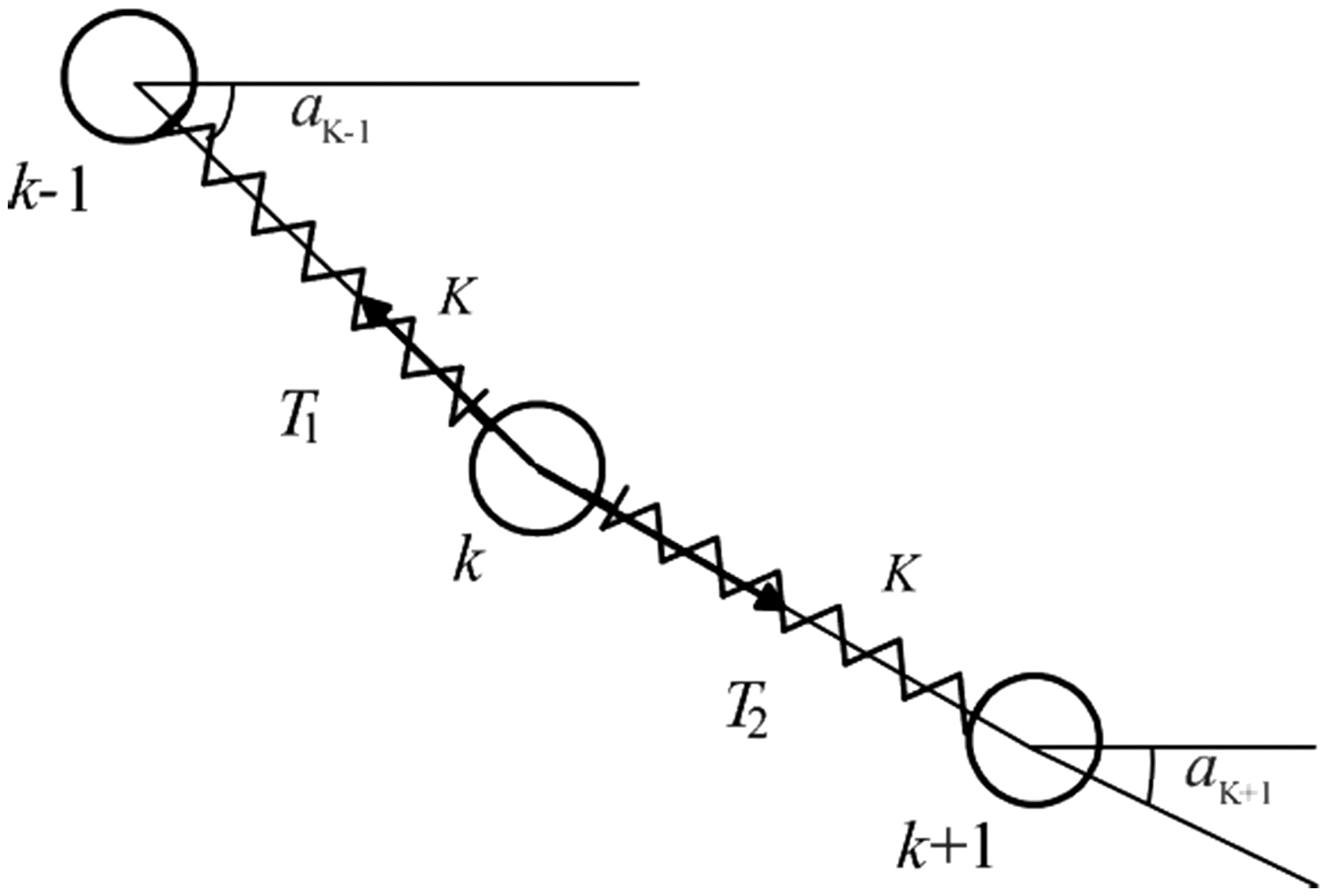
Force analysis of the atoms of monatomic chains.
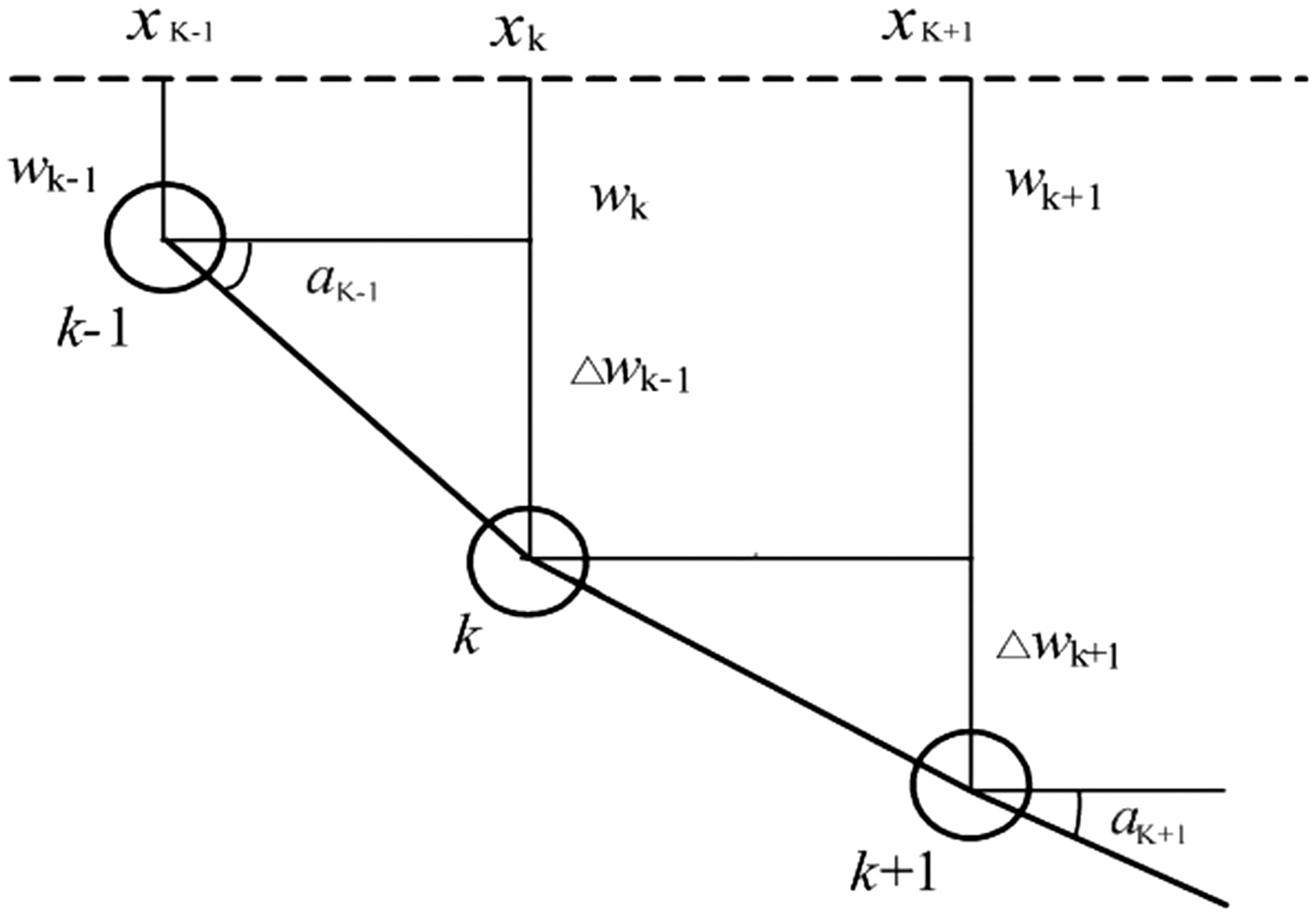
Deflection variation analysis of the atoms of monatomic chains.
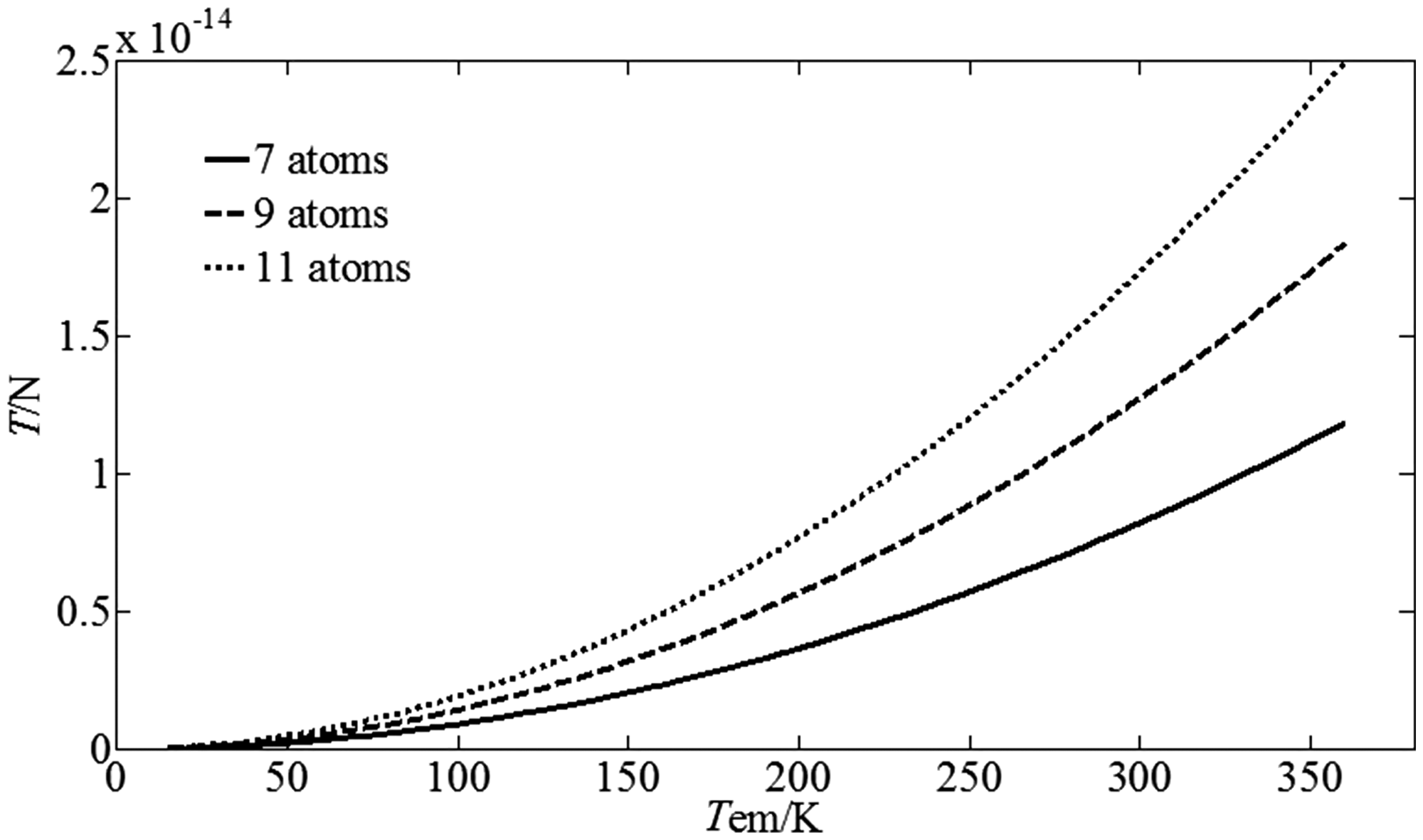
Tensions of the quantum limitation for the first-order vibration mode changing with temperature for different lengths of nano-string of the carbon monatomic chains.
Figure 5 depicts the variation of natural angular frequencies for the first-order vibration mode. Frequencies increase with the growth of tension of nano-strings of the carbon monatomic chains made of 7, 9, and 11atoms, respectively. These curves show that the axial tension acting on the carbon monatomic chain has a great influence on natural angular frequencies. The values of natural angular frequencies of the atom increase with the growth of the axial tension acting on the carbon monatomic chain. When the tension acting on the carbon monatomic chain is a constant, the inherent values of natural angular frequencies and resonant frequencies will increase with the length of strings shortening. The natural angular frequencies of the carbon monatomic chain can be altered by changing the length of the string and the tension acting on the string.
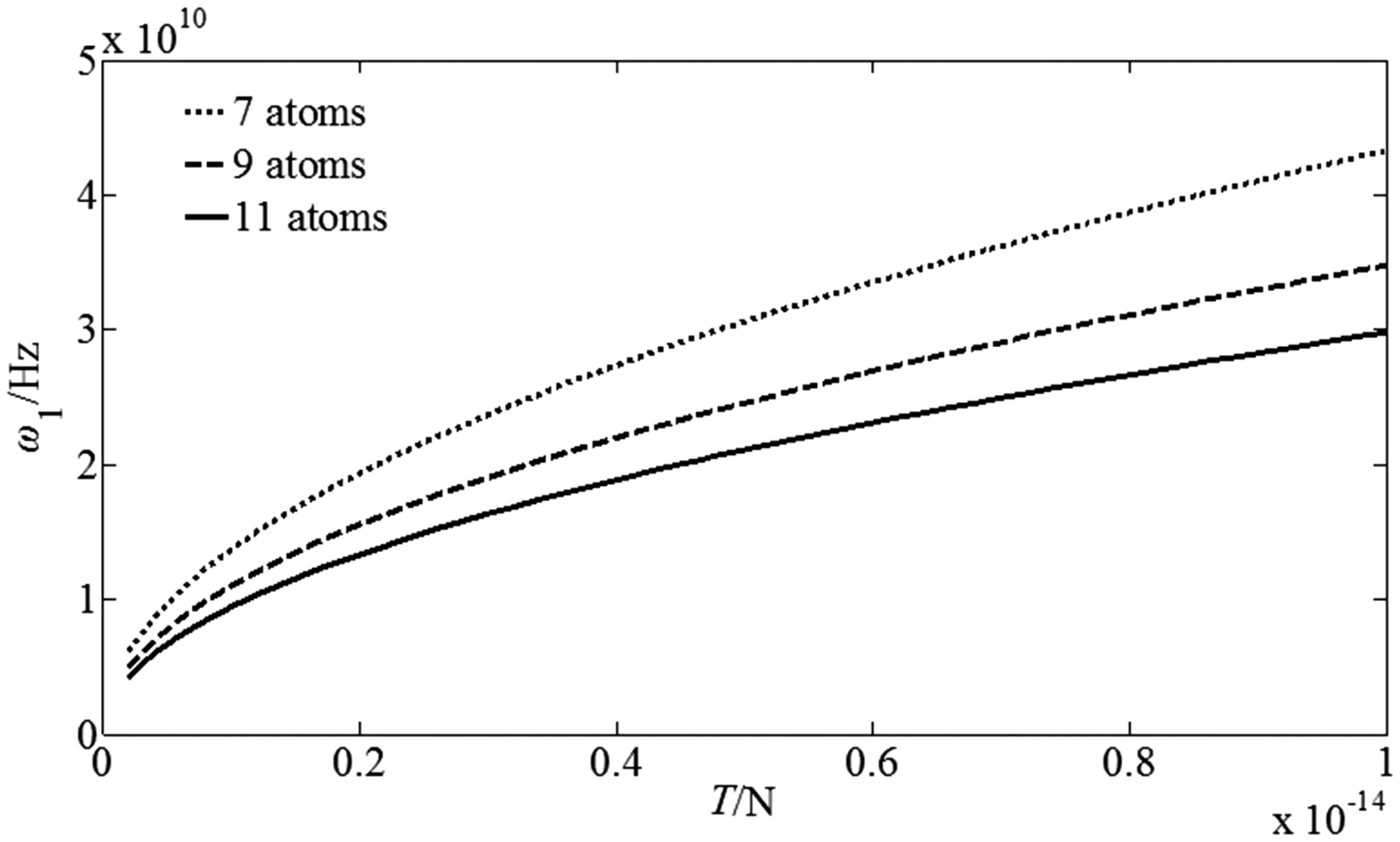
Variation of the natural angular frequency for the first mode changing with tensions acted on nano-string for different carbon monatomic chains.
Figure 6 shows that resonant frequencies of the first-order mode vary with increasing tensions of the nano-string of the carbon monatomic chain made of 7, 9, and 11 atoms, respectively. The growth of resonant frequencies can be resulted from the increase of the axial tension acting on the carbon monatomic chains. When the tension acting on the carbon monatomic chain is a constant, the inherent values of angular frequencies and the resonant frequencies can increase with the shortening of the string length. Resonant frequencies of carbon monatomic chains can be altered by changing the length of the string and the tension acting on the string.
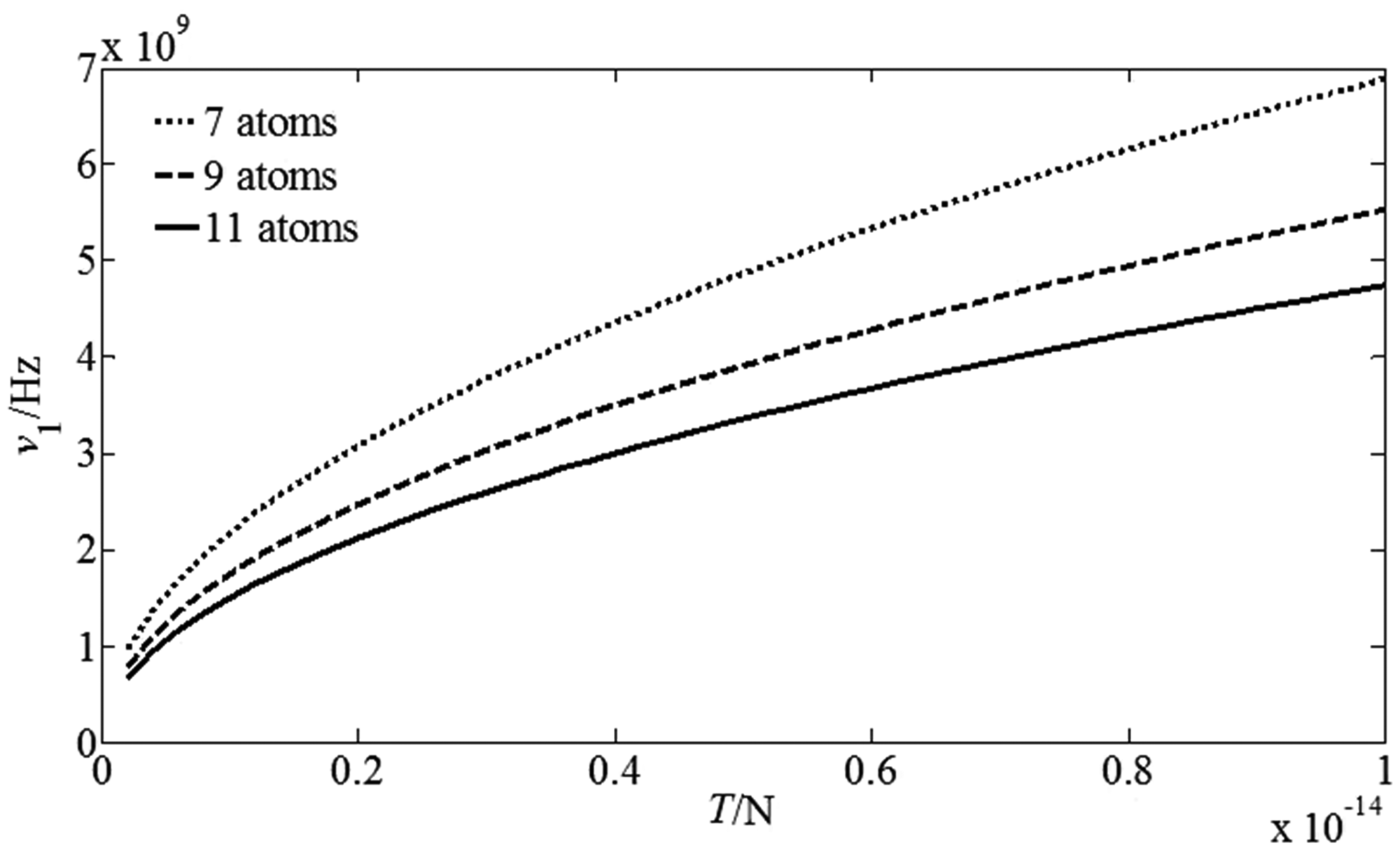
Variation of the resonant frequency for the first mode changing with tensions acted on nano-string for different carbon monatomic chains.
Figures 7 and 8 show the variation of natural angular frequencies and resonant frequencies of the first-order mode. The natural angular frequencies change with lengths of carbon monatomic chains of 8, 10, and 12 atoms, respectively. The values of resonant frequencies of atoms increase with the length shortening of the carbon monatomic chain. When the length of the carbon monatomic chain is constant, the values of angular frequencies and resonant frequencies increase with the growth of the axial tension. Both natural angular frequencies and resonant frequencies of the carbon monatomic chain can be altered by changing the length of the string and the tension acting on the string.
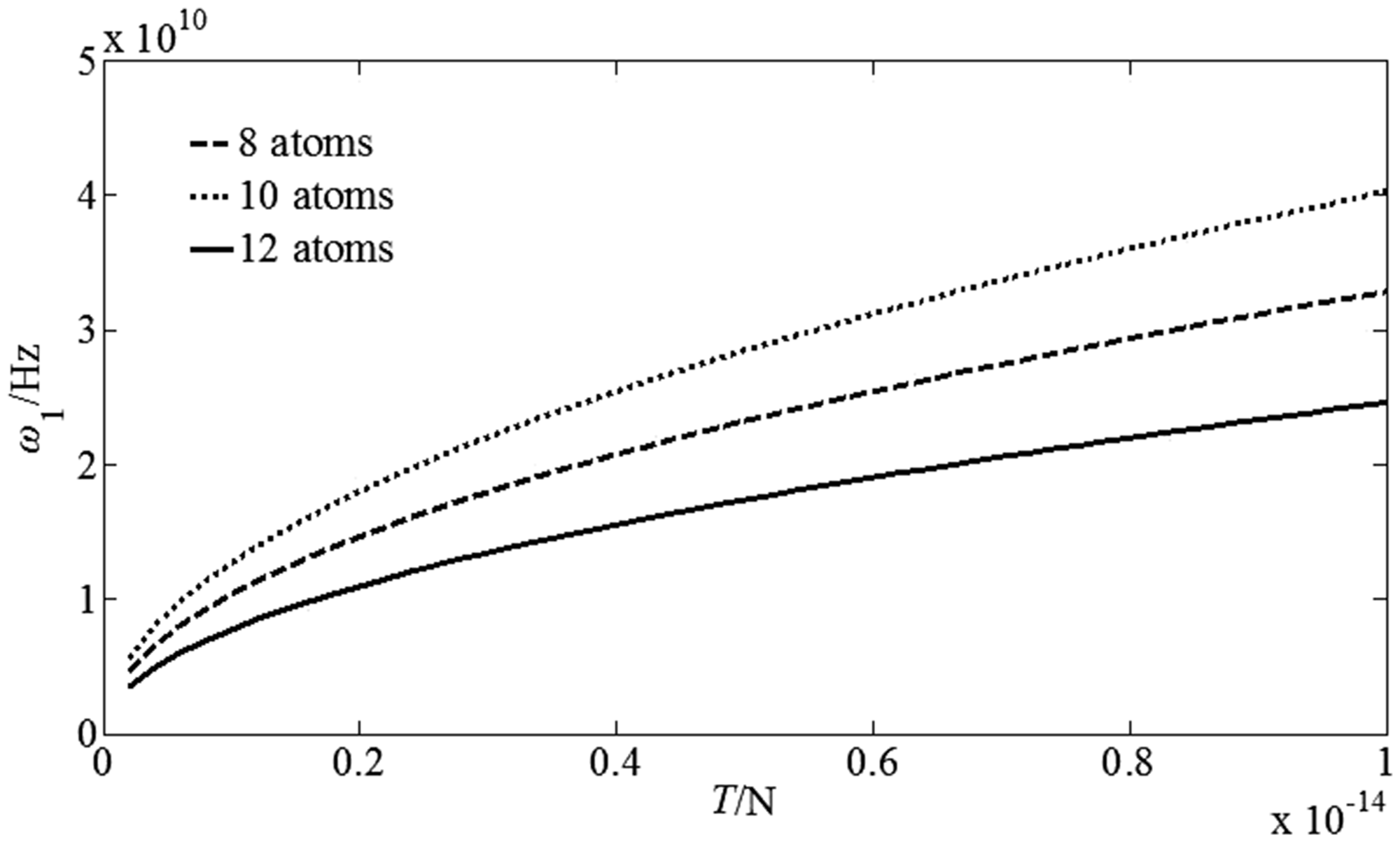
Variation of the natural angular frequency of the carbon monatomic chain for the first mode changing with tension for different atoms.
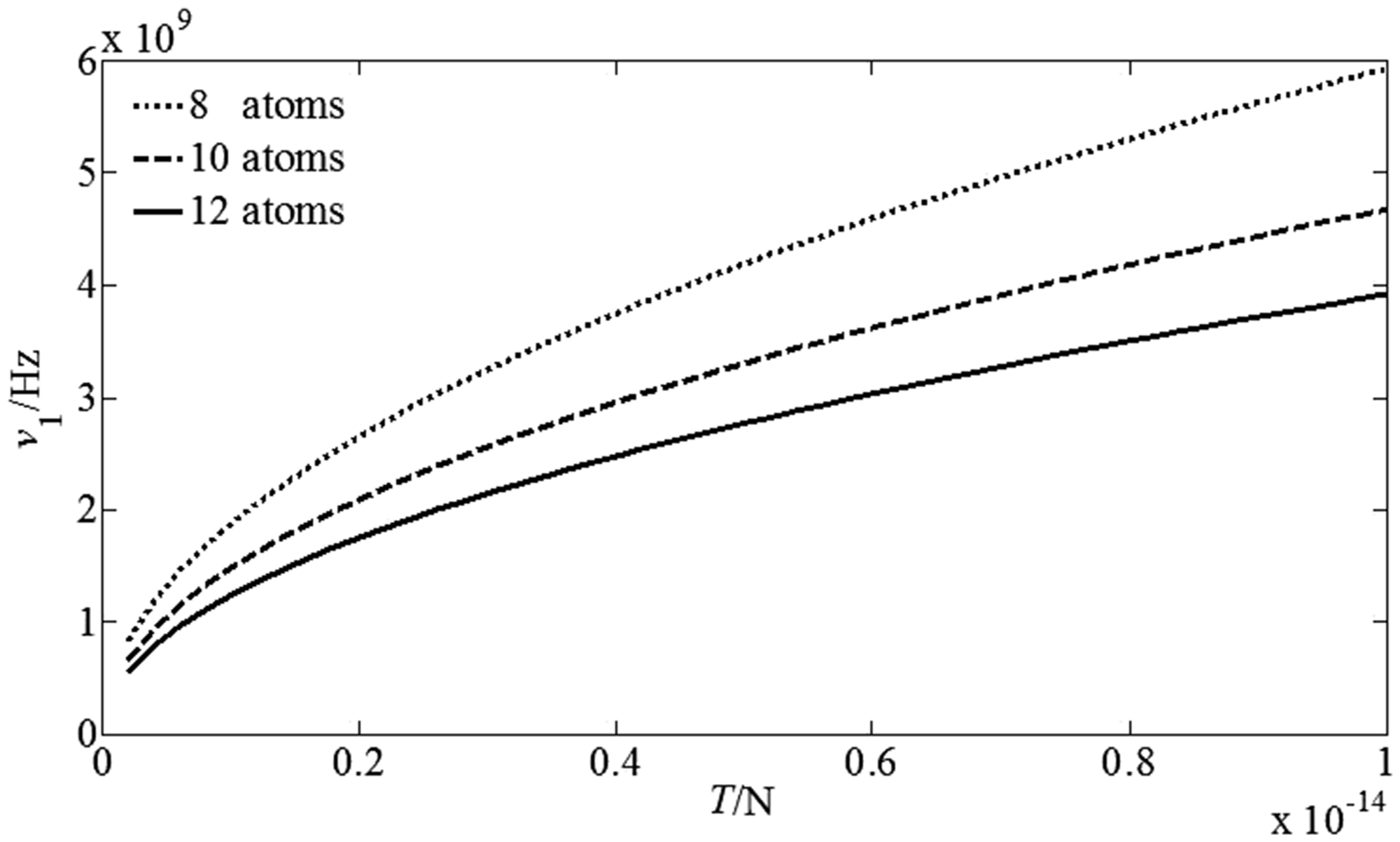
Variation of the resonant frequency of the carbon monatomic chain for the first mode changing with tension for different atoms.
The formula of natural angular frequencies indicates that natural angular frequencies of monatomic chains are functions of the axial tension acting on the string, the length of atomic chain and the coordinates of the position of atoms. When the length is a constant, the values of natural frequencies increase with the growth of the axial tension. The larger the tension value is, the greater the values of natural and resonant frequencies will be. It is in accordance with the principle that vibration frequencies increases with the increasing of tension of strings. When the tension is zero, there is no vibration for the monatomic chain, so the vibration frequency is zero. Furthermore, when the axial tension of monatomic chain strings is a constant, the value of natural frequencies of the monatomic chain string will increase with the decrease of the length of chains. As the force of the C–C bond-breaking is 2.6–13.4 nN, 33 there is a lager designing space for the axial force. Natural angular frequencies can be designed by choosing the suitable axial tension acting on the string and higher resonant frequencies vibration can be gotten.
Figure 9 shows the variation of the nonlinear stiffness of the string of the carbon monatomic chain for the first mode changed with tension for differential length 7r0, 9r0, and 11r0, respectively. The values of the stiffness of the string of the atom increase with the axial tension acting on the carbon monatomic chain. When the tension acting on the carbon monatomic chain is a constant, the values of stiffness of the string increase with the shortening of the string length. The stiffness of the carbon monatomic chain can be altered by changing the length of the string and the tension acting on the string.
Figure 10 shows the variation of the nonlinear stiffness of the string of the carbon monatomic chain for the first mode changing with axial tensions for differential length 8r0, 10r0, and 12r0, respectively. The values of the nonlinear stiffness of the string of the atom decrease with the increasing of the length of the carbon monatomic chain. When the tension acts on the carbon monatomic chain is a constant, the values of nonlinear stiffness of the string increase with the shortening of the string length.
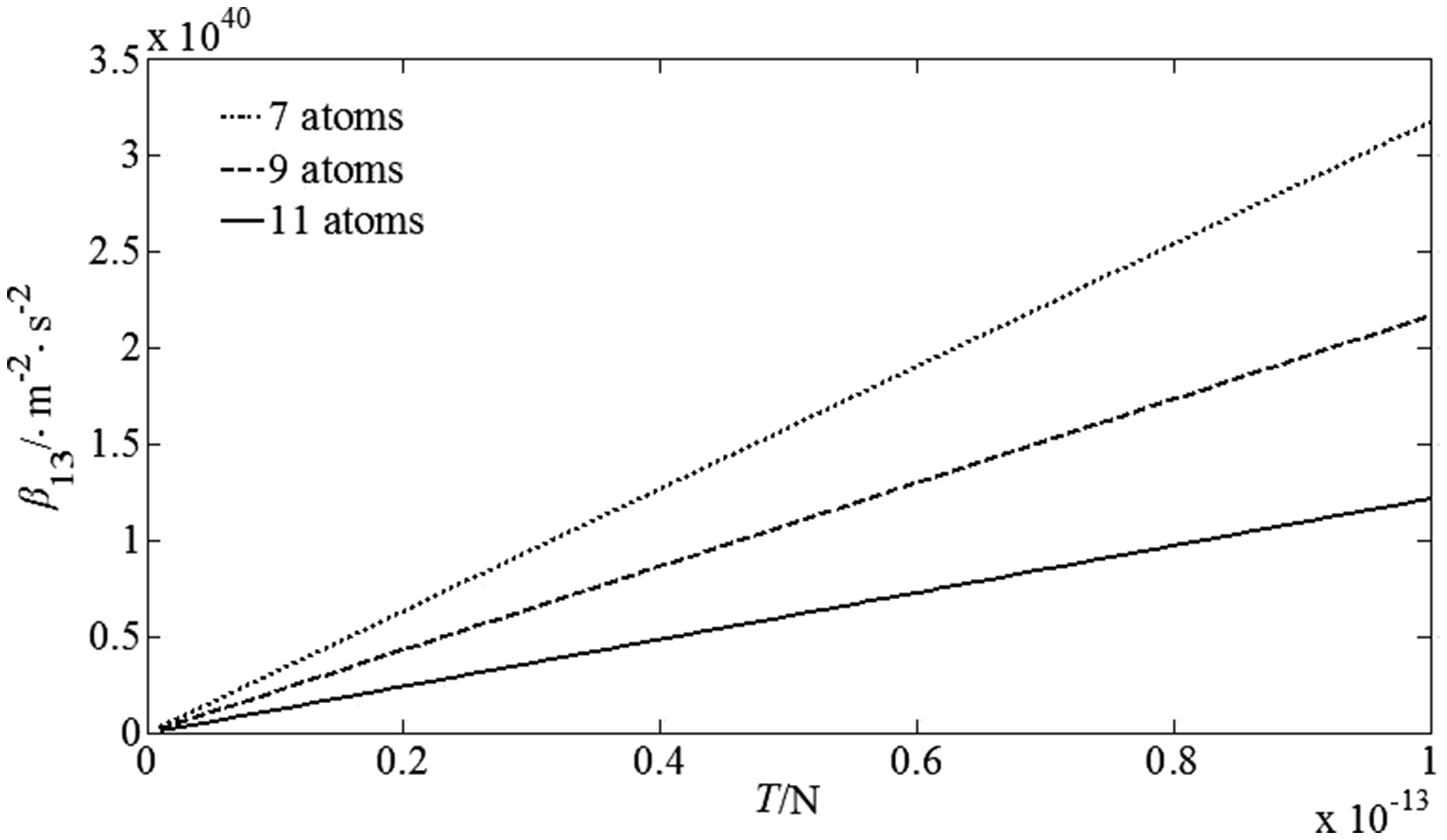
Variation of the stiffness of the string of the carbon monatomic chain for the second-order modal changing with tension for different lengths of 7r0, 9r0, and 11r0.
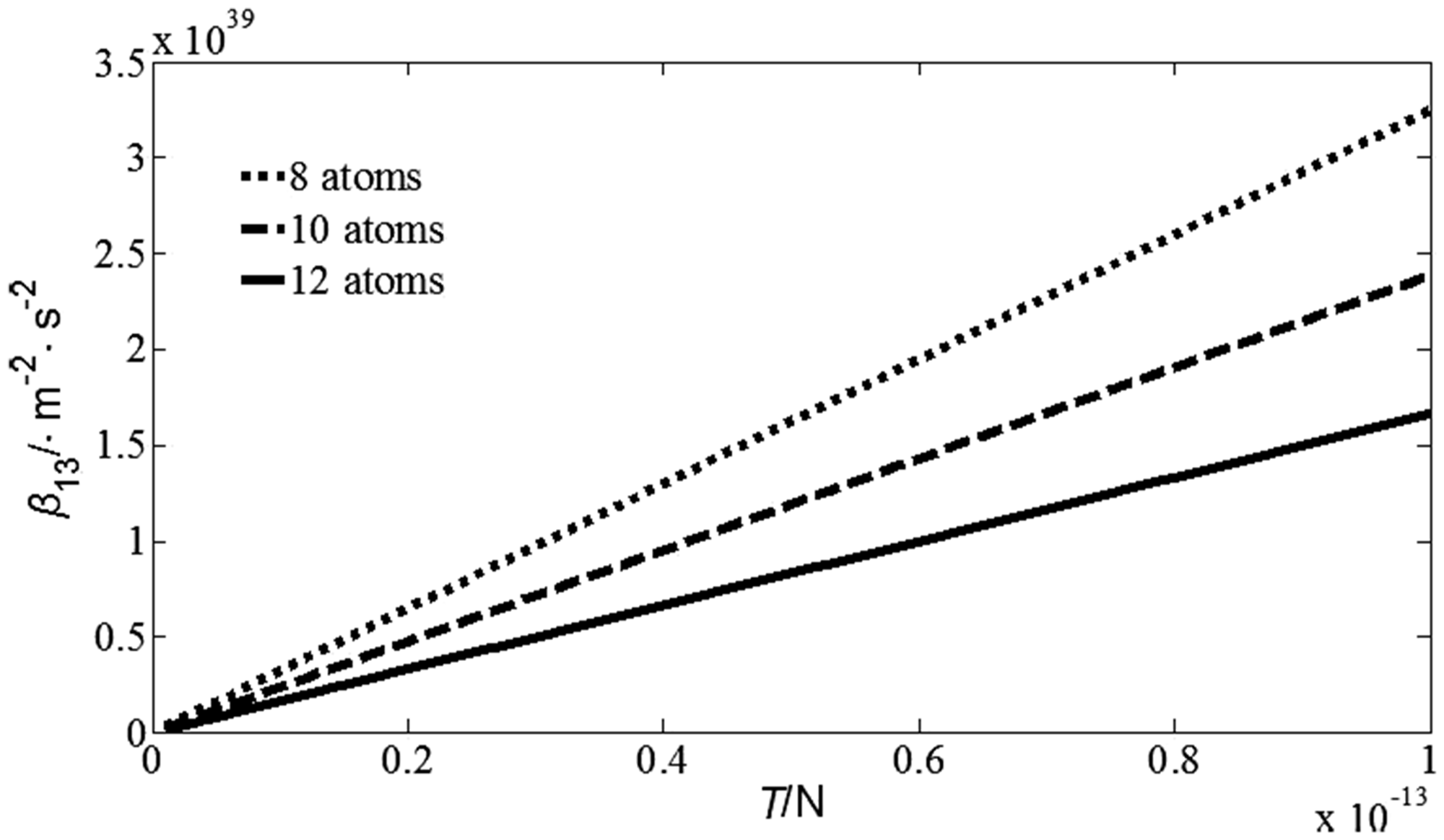
Variation of the nonlinear stiffness of the string of the carbon monatomic chain for the first mode changing with axial tensions.
Figure 11 shows the variation of the nondimensional nonlinear stiffness of the string of the carbon monatomic chain for the first mode changing with tension for different lengths. The values of the nondimensional stiffness of the string of the atom do not increase with the axial tension acting on the carbon monatomic chain. However, the values of nondimensional stiffness of the string increase with the increasing of the string length. The nondimensional stiffness of the carbon monatomic chain can be altered by changing the length of the string. It is also shown that the absolute values of nonlinear parameters of nonlinear vibration system are greater than 1. As the nonlinear parameters of the vibration system are more than 1, the vibration system can be regarded as the strongly nonlinear vibration system. The methods of improved Lindstedt–Poincaré and multiple scales are applied to study the strongly nonlinear vibration.
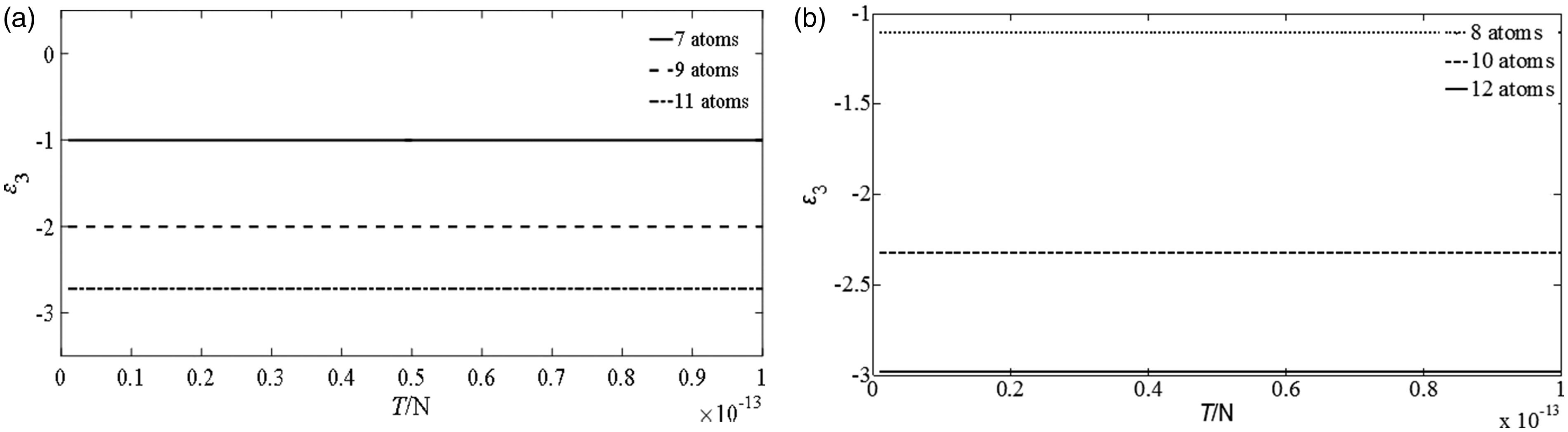
Variation of the nonlinear nondimensional stiffness of the string of the carbon monatomic chain for the first mode changing with tension for different lengths.
Figure 12 shows the primary response curves of the first mode of the monatomic chain for different lengths of 7r0, 9r0, and 11r0. If a frequency sweep is performed from higher frequencies to lower frequencies of resonance, the amplitude increases until it reaches the turning point, then the amplitude drops and moves along the low curve. There exist jump and hysteresis phenomena for the vibration of the monatomic chains. This suggests that saddle node bifurcation and jump phenomena can be exist. The bending of the frequency response curves is the cause of a jump phenomenon.
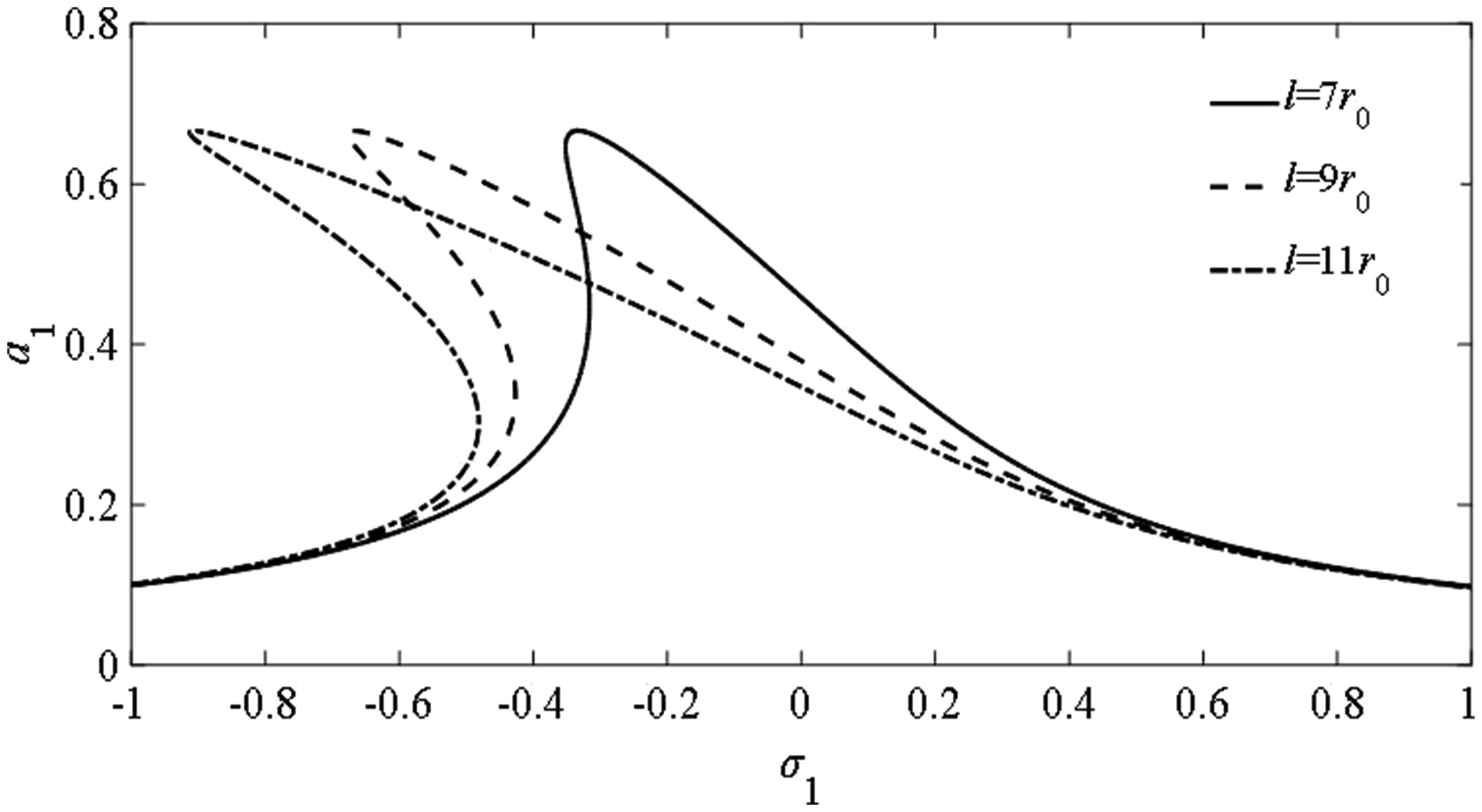
Primary response curves of the first mode of the monatomic chain for different lengths of 7r0, 9r0, and 11r0.
Figure 13 shows the primary response curves of the first mode of the monatomic chain for different damping. There exist jump and hysteresis phenomena for the vibration of the monatomic chains for a small damping. With the increasing of the value of the vibration damping, the amplitude of the vibration decreases and the nonlinear phenomenon disappears. Figure 14 shows the primary response curves of the first mode of the monatomic chain for different forces. There exist jump and hysteresis phenomena for the vibration of the monatomic chains for a large force. This suggests that saddle node bifurcation and jump phenomena can be exist for a large force. With the decreasing of the value of the driving force, the amplitude of the vibration decreases and the nonlinear phenomenon disappears.
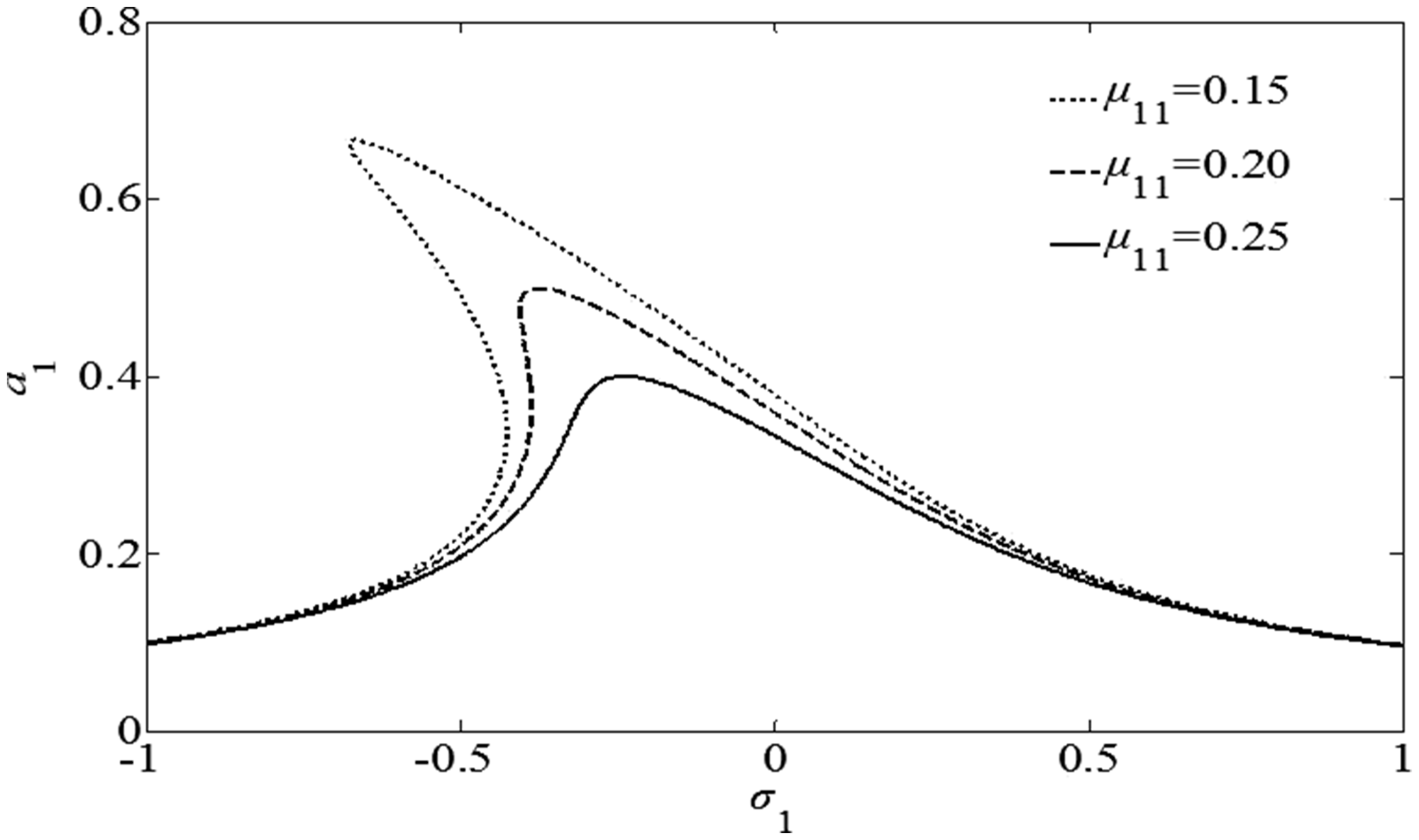
Primary response curves of the first mode of the monatomic chain for different dampings.
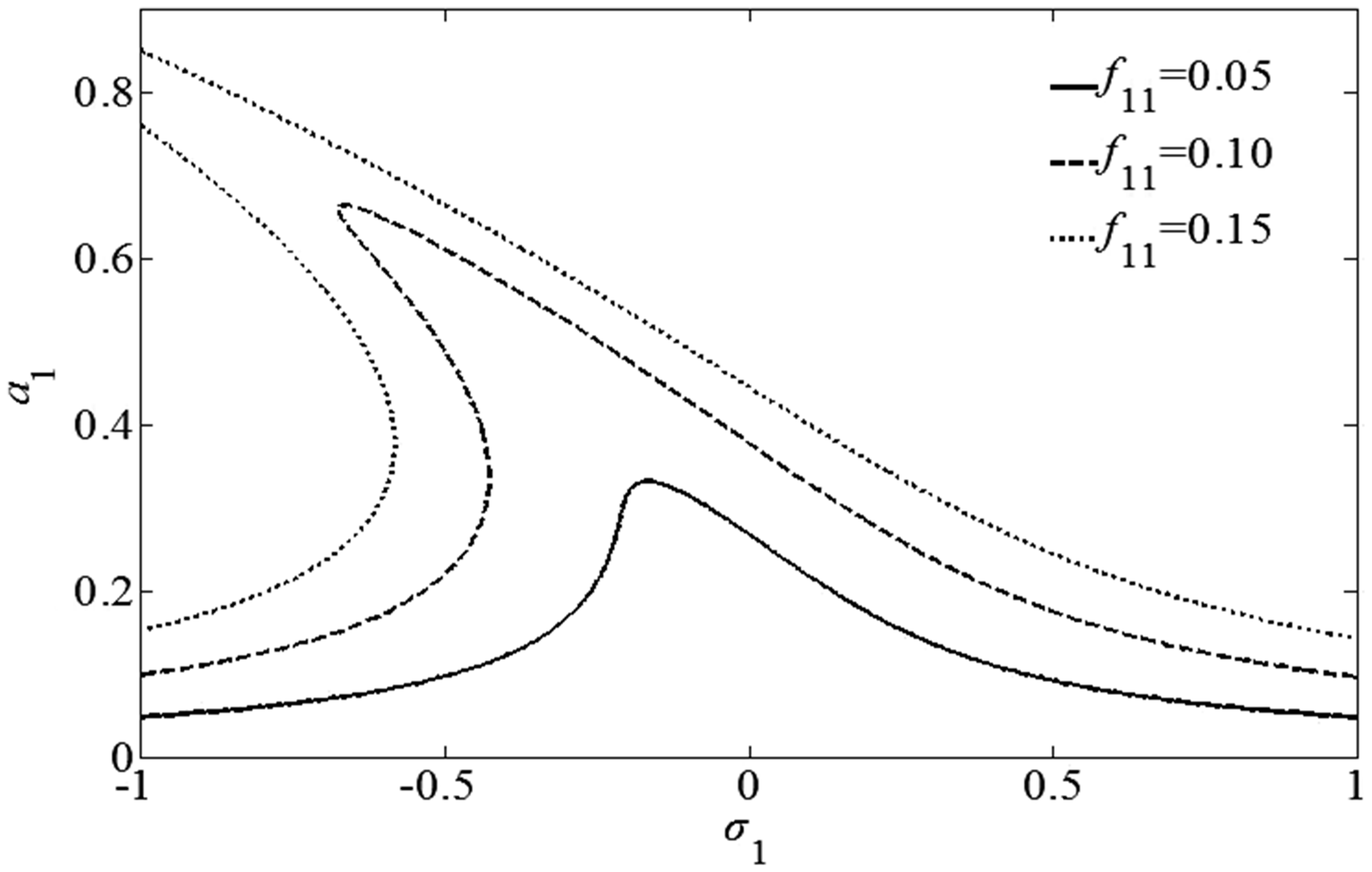
Primary response curves of the first mode of the monatomic chain for different forces.
Figure 15 gives the comparison between numerical solution and approximate solution for primary response curves of the first mode of the monatomic chain. The basic idea of the improved L–P method is to expand the power series nearby
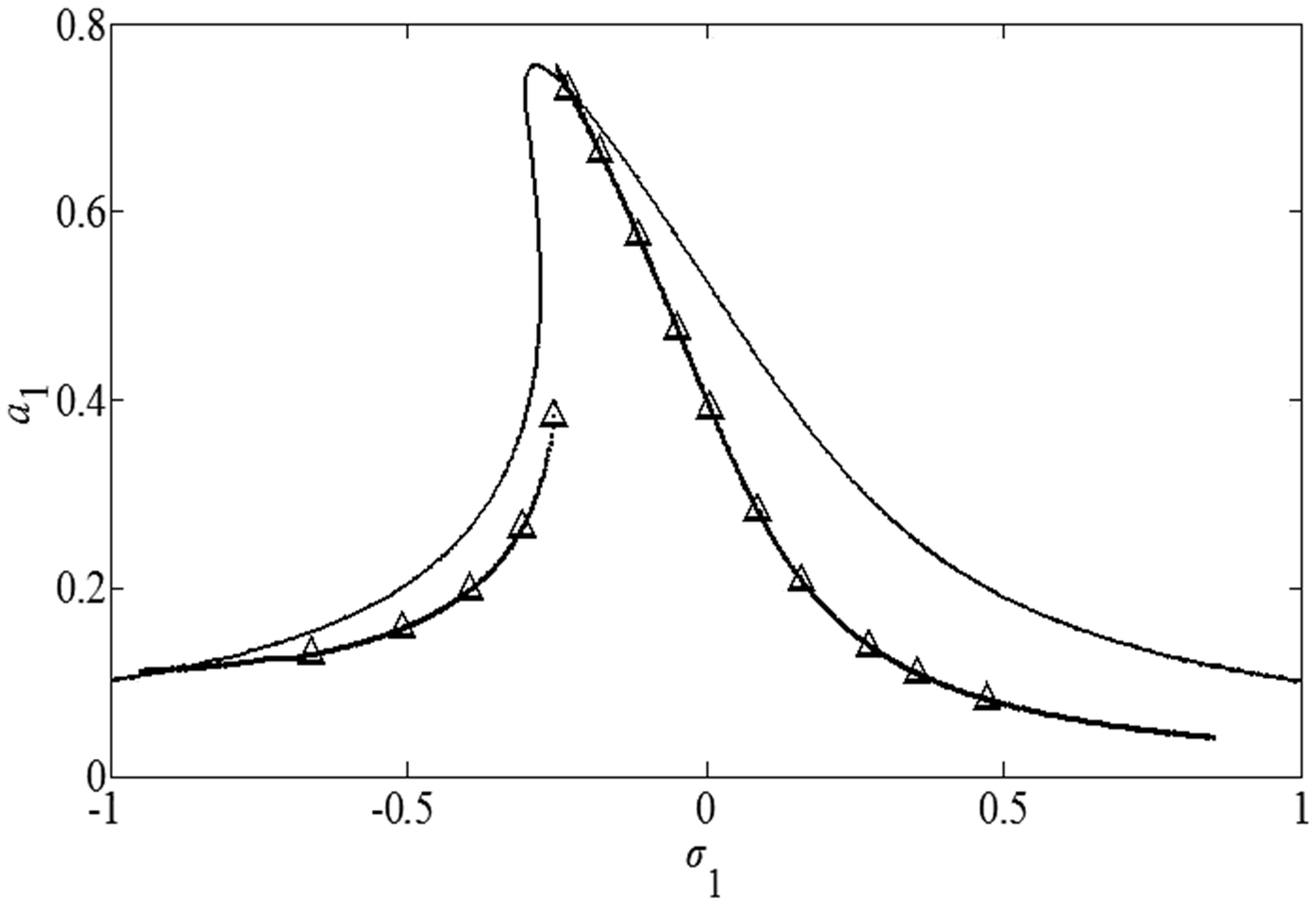
Comparison between numerical solution and approximate solution for primary response curves of the first mode of the monatomic chain. In the figure, —represents the approximate solution for seven-atom chain, -▲- represents the numerical solution.
Figure 16 depict the time–amplitude and velocity–amplitude solutions for primary resonance response. Pictures of time–amplitude and velocity–amplitude response are obtained with the initial values of amplitude and phase equal to zero by using the method of MATLAB ode45. It indicates that the vibration response finally tends to be stable.
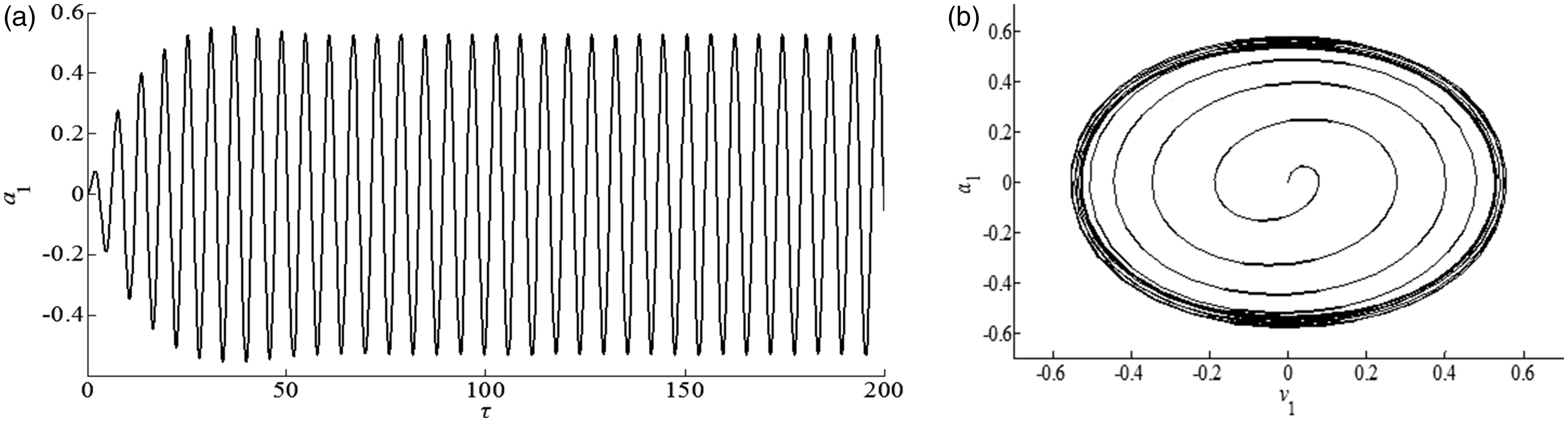
Time–amplitude and velocity–amplitude response of the carbon monatomic chain for the first-order mode.
Conclusions
The vibration equation of strings in monatomic chains is built by assuming lateral vibration modes of monatomic chains as modes of string vibration.
The relationship between the natural angular and resonant frequencies of a single atomic chain and its length and the tension on the string is found. The natural angular and resonant frequencies of the single-atom chain can be changed by changing the length of the string and the tension acting on the string. The stiffness of the carbon monatomic chain can be altered by changing the length of the string and the tension acting on the string.
Newton iterative method is used to solve the numerical solution to nonlinear equation groups. The algorithm of iterative solutions is quickly convergent. NEMS and QEMS can be distinguished by the dimensionless number of the thermal occupation number. Besides, the tension of the quantum limitation is given.
The nonlinear vibration of monatomic chains can be analyzed using the improved L–P multiscale method. The influence of monatomic chains length, damping, and excitation force on nonlinear vibration is given.
Footnotes
Declaration of conflicting interests
The author(s) declared no potential conflicts of interest with respect to the research, authorship, and/or publication of this article.
Funding
The author(s) disclosed receipt of the following financial support for the research, authorship, and/ or publication of this article: This study was supported by the National Natural Science Foundation of China (Grant No. 51575325) and Shandong Natural Science Foundation (Grant No. ZR2017LA004).