This paper attempts to propose and investigate a modification of the homotopy perturbation method to study hypersingular integral equations of the first kind. Along with considering this matter, of course, the novel method has been compared with the standard homotopy perturbation method. This method can be conveniently fast to get the exact solutions. The validity and reliability of the proposed scheme are discussed. Different examples are included to prove so. According to the results, we further state that new simple homotopy perturbation method is so efficient and promises the exact solution. The modification of the homotopy perturbation method has been discovered to be the significant ideal tool in dealing with the complicated function-theoretic analytical structures within an analytical method.
In the mathematical modeling for which the hypersingular integral equations1 own significant place in different scientific fields, elasticity, solid mechanics and electrodynamics, vibration, active control and nonlinear vibration2–4 can be modeled into the hypersingular integral equations. In Liu and Rizzo,5 a weaker singular form of the hypersingular boundary integral equation which applied to acoustic wave problems, was proposed. Moreover, a hypersingular integral equation for acoustic radiation in a subsonic uniform flow was presented in Zhang and Wu.6 The role of hypersingular integral equation in the dual boundary element method for the acoustic problem with a degenerate boundary was examined in Chen.7 In Chang and Yeih,8 the dual boundary element method was used in conjunction with the domain partition to solve the vibration problem for a rod subjected to a time harmonic loading modelled by this kind of integral equation. In Avramov et al.,9 the system of the hypersingular integral equations with respect to the aerodynamic derivatives of the shell pressure drop is obtained to analyze the interaction of the shallow shell with three-dimensional incompressible potential air flow. This system of the integral equations is very applicable to analyze aeroelastic vibrations of thin-walled structures.
What makes a certain hypersingular integral equation efficient is the extent to which that it could be a significant tool for solving a large class of mixed boundary value problems showing up in mathematical physics; especially, the crack problems of fracture mechanics, or water wave scattering problems concerning obstructions; diffracting electromagnetic waves and also aerodynamics problems might be decreased to hypersingular integral equations rather single or disjoint multiple intervals. Ideally, there is an imperative example of hypersingular integral equations of the first kind which has been exercised in dealing with most problems arising in vibration and active control10–17
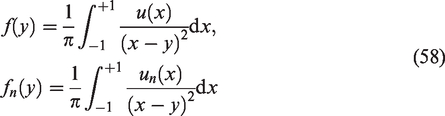
Here, f(y) and u(x) are presented as a known function and an unknown function on the finite interval considering the end points conditions . In equation (1) the sense of Hadamard finite part is given by18
The following equation can be useful in clarifying the exact solution of equation (1) which has been referred in literature.16,17
We may say that, in equation (3), evaluating the exact solution could be successful.
Obviously, in the case of evaluating the approximate solution of the hypersingular integral equations, plenty of methods need to be prepared.19–33 To improve a solution to a general hypersingular integral equation of the first kind, one simple but precise approximation method is chosen and investigated in Mandal and Bera.34 Consideration should be given to the kernel which should be divided to hypersingular and regular parts.
The solution of Cauchy type of singular integral equation in two disjointed intervals has been employed by Dutta and Banerjea35 to solve a hypersingular integral equation in two intervals. On the other hand, Chen and Zhou36 took account of an efficient method to adequately solve hypersingular integral equation of the first kind. In reproducing kernel space, they aim to disestablish the singularity of the equation. The rough solutions for hypersingular kernels and Fredholm integral equation of second kind have been achieved by Mandal and Bhattacharya15 using Bernstein polynomials as a basis. Mahmoudi37 actually formed a new modified Adomian decomposition method to solve a class of hypersingular integral equations of the second kind. Also, Eshkuvatov et al.13 have presented a work regarding to the modified homotopy perturbation method for solving hypersingular integral equations of the first kind. In the present paper, we consider the method mentioned in literature33,37 and then determine a new modified homotopy perturbation method to actually solve hypersingular integral equation of the first kind. The validity and reliability of the new method is not in question and it is simple to be used. To achieve the goals of the paper, we proceed as follows:
In the Preliminaries section, the preliminaries of solving equation (1) by applying the homotopy perturbation method are discussed. In the Modification of the Homotopy Perturbation Method section, identifying the perspective, a new modified homotopy perturbation method is introduced to obtain the solution of equation (1). The Illustrative examples section dedicates to reveal the simplicity and efficiency of the MHPM by solving some sample examples through the proposed algorithm. In the last, the conclusion remarks are placed in the Conclusion section.
Preliminaries
As time passes, new methods are created and others fall into disfavor. He38 has observed the homotopy perturbation method which recently has been employed in the literature for seeking the solution to linear and nonlinear problems. We do believe that the HPM aims at coupling a homotopy technique of topology and a perturbation technique.38–46 Some of the recent developments of the HPM have been discussed in literature47–52 and references therein.
In this work, the proposed scheme is derived and provided in, in essence, bunch of relevant equations which were efficiently taken care of. We should also acknowledge that the coupling of the perturbation method and the homotopy method has been successful in dropping the limitations of the traditional perturbation technique. Accordingly, by using the HPM, we are able to deal with the hypersingular integral equations of the first kind.
Speaking of the basic ideas, the HPM is likely to be discussed by looking at the following equation
Embedding the boundary condition
where A, B, f(x), Γ would be called the general differential operator, a boundary operator, a known analytical function and the boundary of the domain Ω, respectively. Two parts are provided having operator A, namely, L (linear) and N(nonlinear). Following this, equation (4) is broken down to the following
We, on the other hand, may need to establish a homotopy to equation (4), , which for satisfies
which is equivalent to
where is designed to be an embedding parameter and u0 is regarded to be an initial approximation which fulfills the boundary condition (5). That is, it is acceptable to take equation (8) as
From one point of view, the process of p is turning from 0 into 1 is just that of y(x, p) from to u(x). In topology, that would be called deformation and and are called homotopic. Besides, the embedding parameter is expected to be defined much more tangible and unaffected by introducing artificial factors; further we shall consider that as a small parameter for . The solution of equation (7), in turn, should attempt to be stressed as
Certainly, in making a decision on substituting equation (10) into equation (8) and jumping to new results in terms of relative emphasis placed on powers of p, an infinite number of differential equation is determined. Now, the solution to this simple differential equation with proper initial conditions is then promised. This process is directed in such a way that an approximate solution to equation (4) is introduced as53–55
The convergence of series equation (10) as has been envisaged by He.38,39
where from Mandal and Bera,34 it is essential that we have
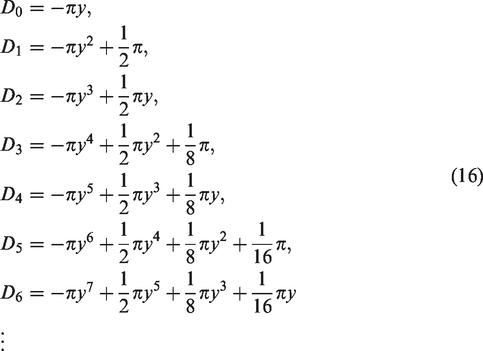
Here, some of the first Dj’s can be stated as follows
Likewise, applying the new method, the hypersingular integral equations of the first kind mentioned in equation (13) is appropriate to be transformed into the second kind. Such being the case, we may have the following problem
Of course equation (17) is being transformed into the following
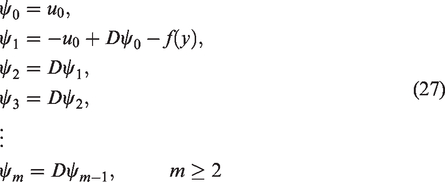
Thus, we announce
Now, the HPM is considered to be applied to create a solution to equation (19) which is an integral equation of the second kind. To do so, consider the following
Now, by applying the HPM on equation (19), it is advisable to suppose
Along the same line, we can rewrite equation (19) to the operator form as follows
Now, it is also recommended that, we define the homotopy equation (7) as
having equation (21), since L is the identity operator, we can jump to the conclusion that .
Performing the modified homotopy perturbation method (MHPM) should be carefully done to ensure that we are able to expand and establish the homotopy as follows
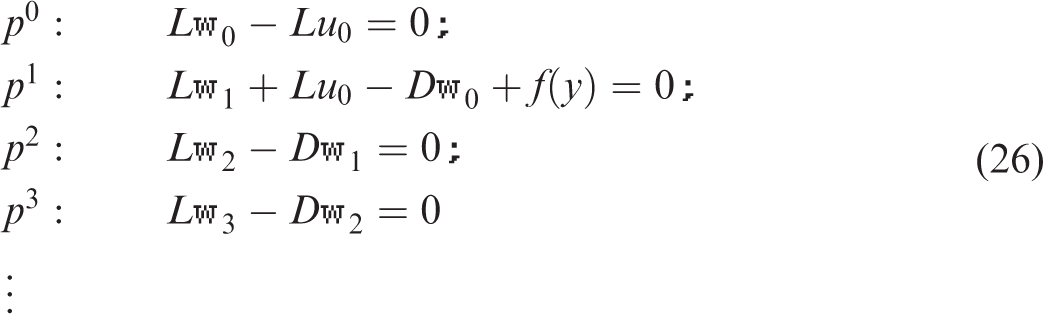
After substituting equation (24) and simplification, it can be obtained
which provides
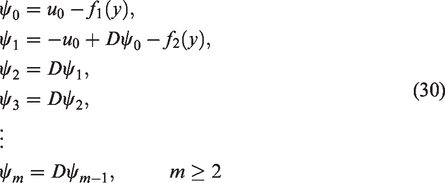
Let us emphasize that selecting the functions f1 and f2 is a very vital task to understand the rate of convergence of the MHPM. In fact, they should be chosen in such a way that . Not any functions can make a suitable performance of the MHPM.
In order to increase the rate of convergence, f1 and f2 need to be chosen wisely. In the case that f(y) is a polynomial, the new method is going to be employed. The MHPM is required to be named in which to be helpful in choosing f1 and f2 conveniently.
Modification of the homotopy perturbation method
Based on the assumption that the function f can be broken down into two parts, such as f1 and f2, the modified form of the HPM was established. Having this assumption we can write
As mentioned above, selecting the functions f1 and f2 is a very vital task to understand the rate of convergence of the MHPM. Still there are not such rules to be followed. Now,using Mahmoudi37in two manners will give us the best resultswhere f in equation (1) is either a polynomial or a non-polynomial analytic function, such procedure should be accomplished as follows.
Case I: Let f be a polynomial of degree n.
We employ the new method for the case that f(y) be a polynomial.
At the same time, we add and subtract to the left side of equation (33).
Now, we have
where represents a complete standard form of polynomial with coefficients bi, equal to the order of polynomial as
It is considered that, in the HPM, the following relation provides the infinite series of solution for the function which is unknown. When we replace equation (23) with equation (34), it is clear that
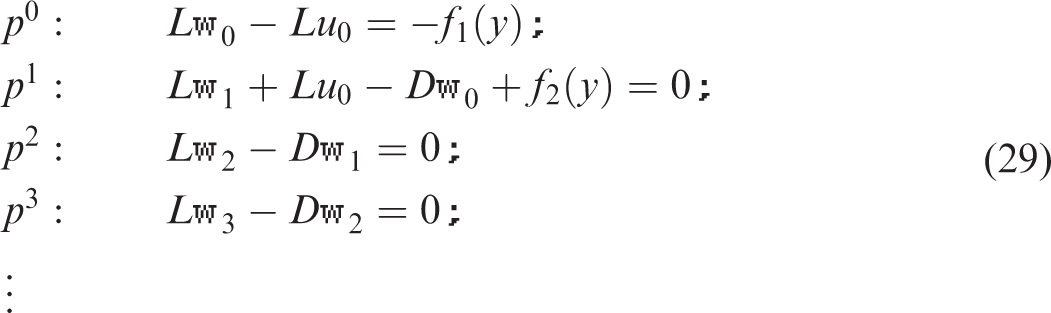
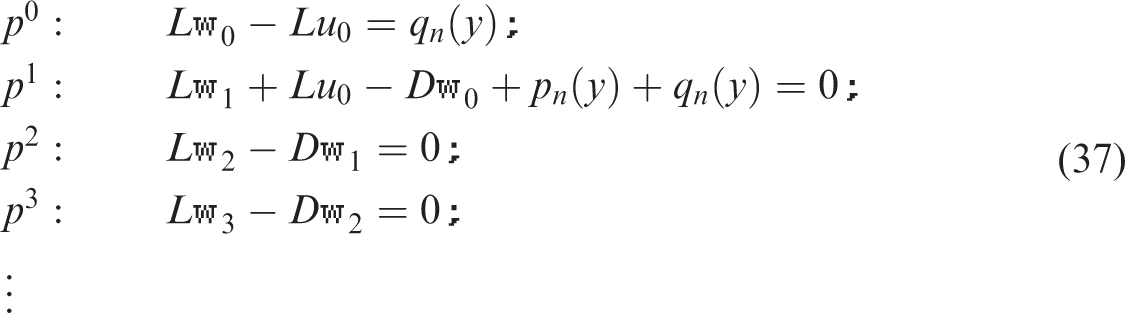
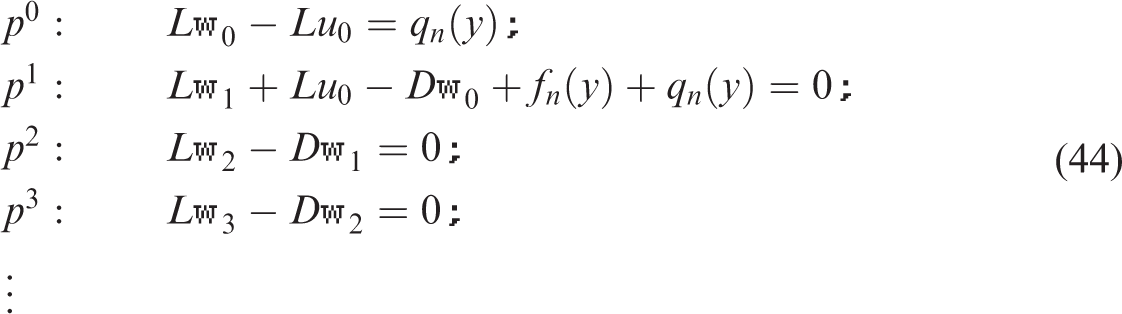
Substituting equation (24) and of course, simplifying, serves the benefit of following set
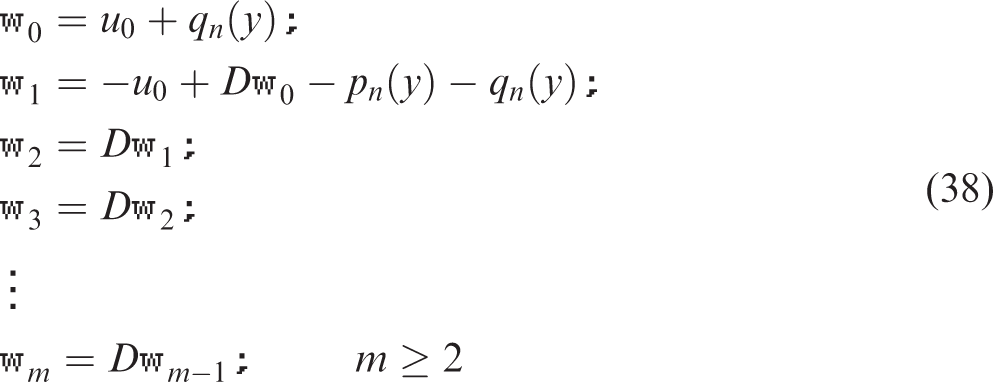
which illustrate
It seems very important to note that, the rate of convergence of the MHPM depends on selecting the functions f1 and f2. They are usually chosen in such a way that . In performing the MHPM, of course, it is difficult to choose f1 and f2 in such a way that the rate of convergence could be increased. To be clear on determining the method, we set
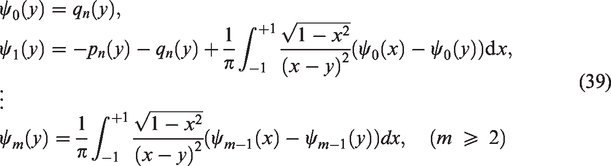
The unknown coefficients of the polynomial is promised by solving , through the fact that f is a polynomial, the exact solution is obtained with no error around. In comparison with the HPM, two terms of the series are calculated. Thus, in this method calculating and finding the solutions are straightforward. The MHPM is applied to some examples; therefore, the capability of this method will be noticed. Note that the method of standard HPM to solve equation (32) converges if f is a polynomial of degree zero, otherwise diverges.
Case II: Let f not be a polynomial.
Through Taylor series expansion of a function, assume that
where
It can be stated that, , now we can elicit from equation (34) as follows
where , whose formula is mentioned in equation (35), refers to a complete standard form of polynomial equal to the order of polynomial .
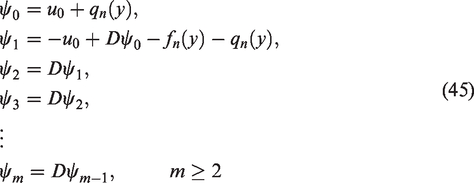
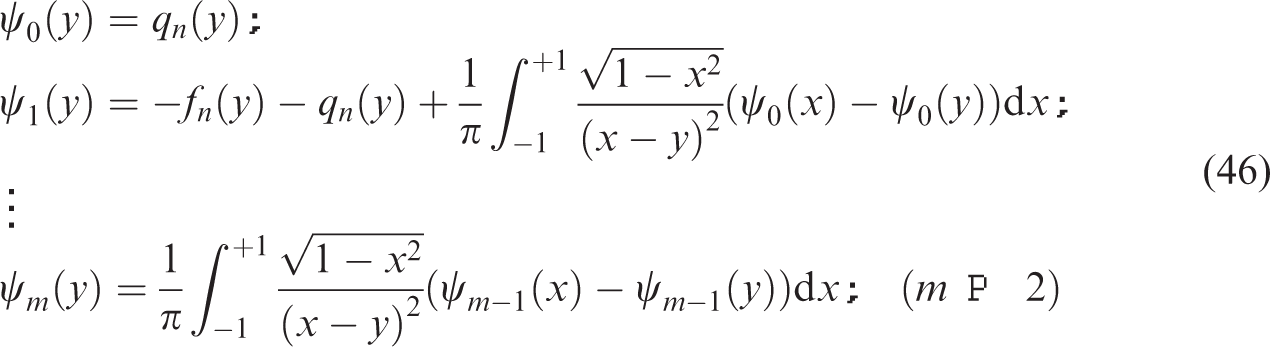
Substituting equation (24) and of course, simplifying, serves the benefit of following set
which gives
In Taylor series expansion of the function for f(y) in equations (41), (45) and (45), the function we get depends on choosing point n that can be written as
The unknown coefficients of the polynomial will be provided by reaching the solution to .
Lemma 1. Let f in equation (1) be a polynomial of degree n, and considering , and using the MHPM, the exact solution of equation (32) is obtained.
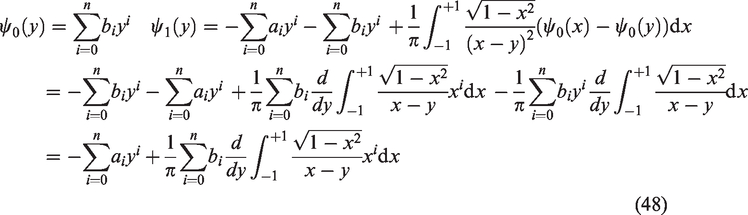
By understanding equation (46), we equip with the following statement
Considering the nature of the MHPM with respect to lies in the system n + 1 leading to
where we regard ai as known and bi as unknown () through the system which required to be determined. Now, to reach the values to ai and bi, we should go through the following term
Presenting that is a polynomial of order j + 1, the following statement is valid
where the formula makes it possible to the coefficient yi in .
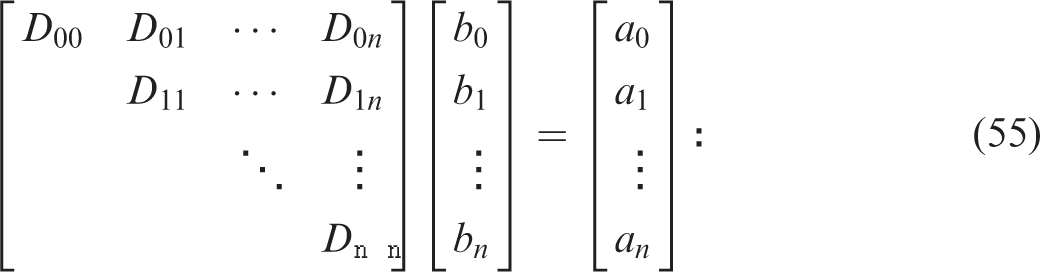
If that was the case, we should think of equation (54) as a linear equation system with an upper triangular coefficient matrix, and it implies
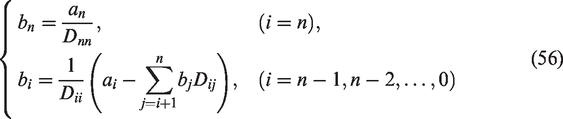
As we are interested in applying backward substitution, equation (55) should be written as follows
Having , if i = j, then it is , since is a polynomial of degree i + 1, and consistently .
Finally, the exact solution to equation (1) is clarified as follows
determined the corrections.
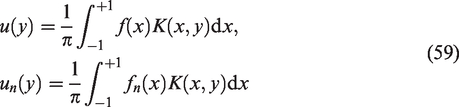
Lemma 2. If f is an analytic function and, subject to , where and are presented as truncated Taylor series of f(y) and the remaining part and respectively, (un(y) is the approximate solution of equation (1) obtained from equation (3), then we have
where
Proof. Let f be an analytic function, and , where is plugged in equation (32), and assuming that is the approximate solution to the MHPM, the following would be written
By supporting the idea of subtracting both sides of equation (59), the following is recommended to be made
Furthermore, based on the integration of both sides with respect to t that lies in the interval and employing Cauchy-Schwarz inequality, the following relation is obtained
where
Note that the norm used in the computation is of the L2 and assistance of numerical integration MAPLE software has been employed. Then, checking equation (60), the approximate value of C is promised as follows
With these pieces of information from the above theorem, when n increases since fn tends to f, therefore un tends to u, too. The following results are obtained.
Corollary 1. If f refers to a polynomial of order n, in equation (1) and finally giving equation (1) the exact solution to equation (32) is supposed to be of degree n.
Corollary 2. If f refers to a polynomial of degree n, however, the approximation error from the MHPM falls to zero.
Illustrative examples
The purpose of this section is to develop some of the most common examples to prepare the overriding characteristics of efficiency and simplicity of the MHPM to provide the appropriate solution to hypersingular integral equations of the first kind. In order to solve the following examples, we have used the MAPLE package throughout the paper.
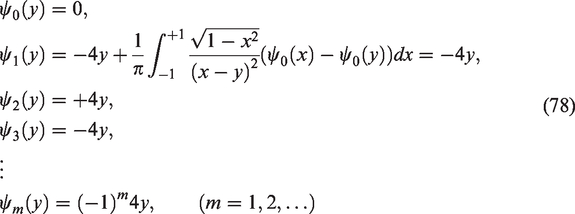
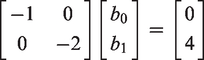
Example 1. Consider the simple hypersingular integral equation of the form15 presented
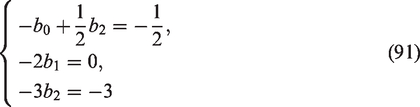
equipped with the additional requirement that . Running , in equation (65) we obtain
Accordingly, for n = 10 and n = 20, the following statements could be arranged as follows
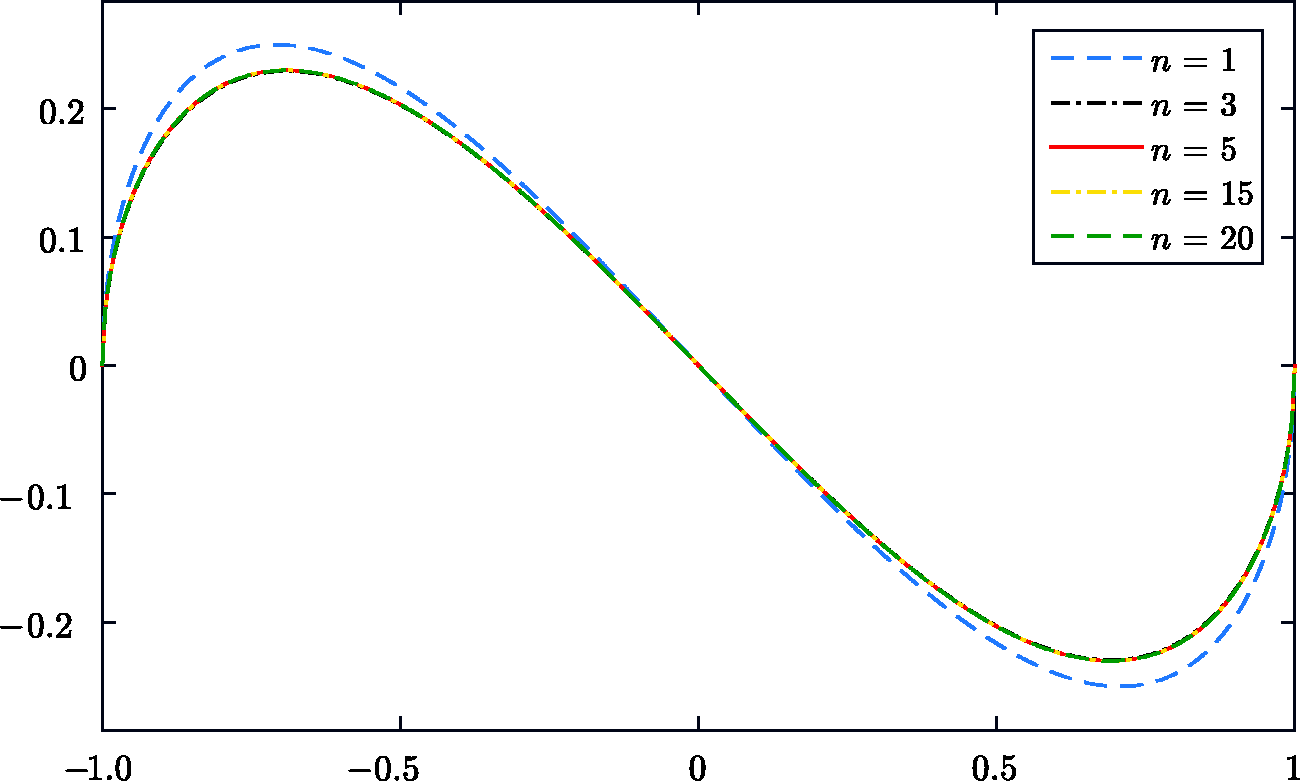
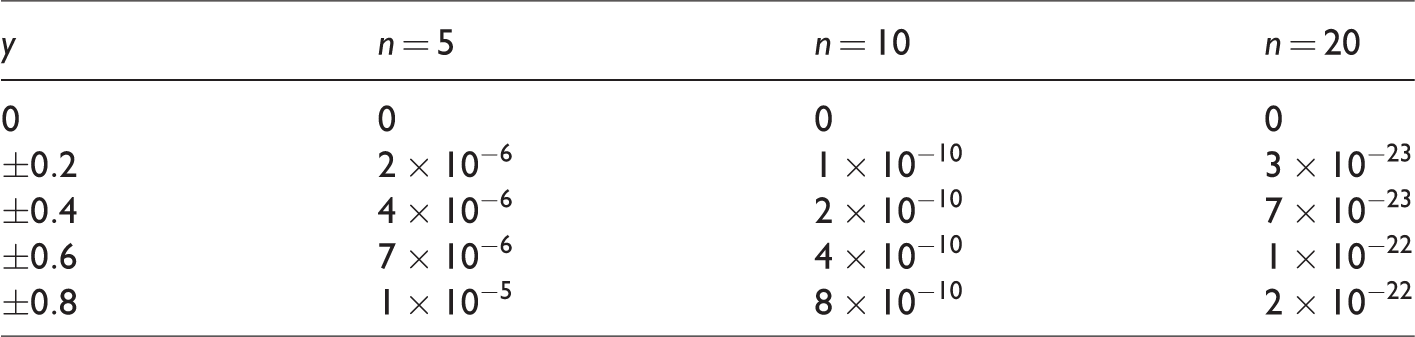
having the proposed procedure, applying equations (3) and (46), the absolute errors of the approximate solution via the MHPM are illustrated in Table 1 for the given y and n. Also, the graph of for different n is to be illustrated in Figure 1.
Graph of for different n, in Example (5).
Absolute error for different values of n of equation (104).
y
n = 5
n = 10
n = 20
0
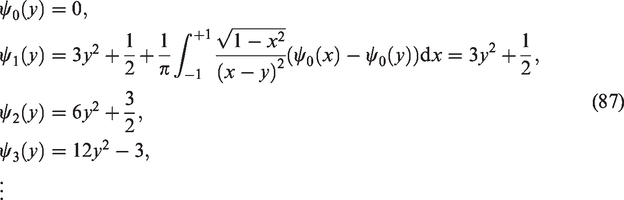
Example 6. The following hypersingular integral equation of the first kind33 can be worked out
in which expanded using Taylor-polynomial
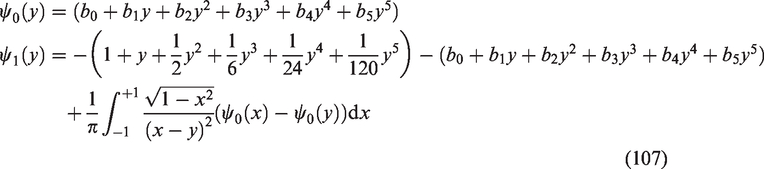
Running the MHPM, using equation (34) for n = 5, the following statement is promised
By employing equation (46), it is suitable to announce
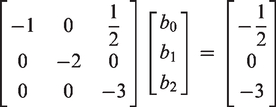
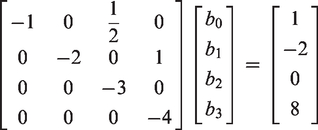
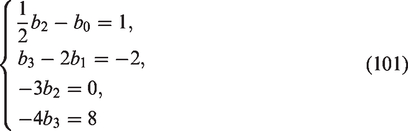
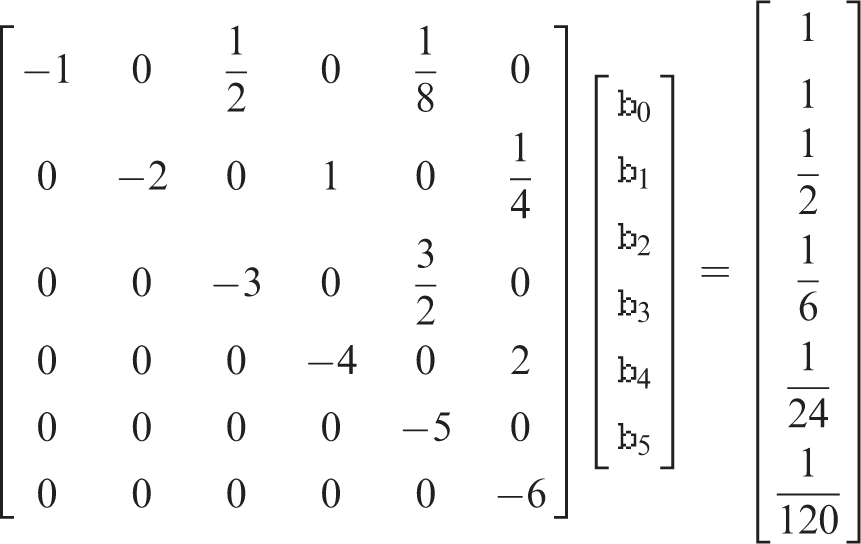
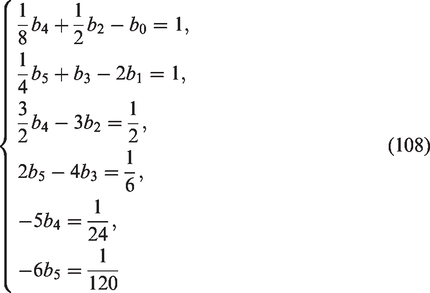
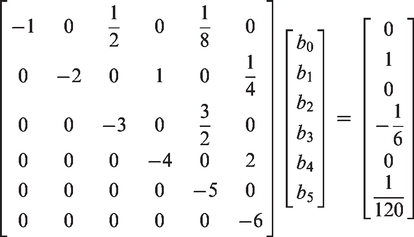
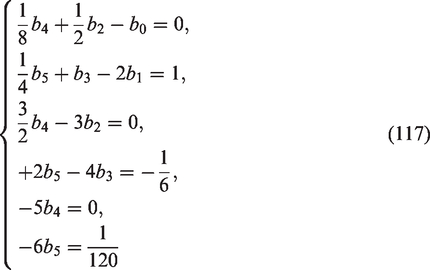
By placing , and according to equation (55), the following system is written
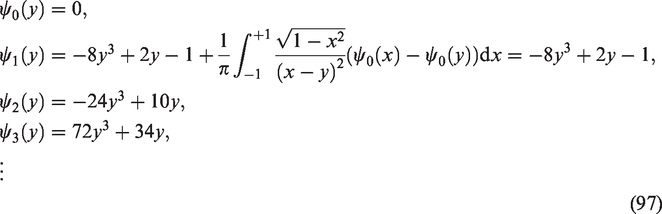
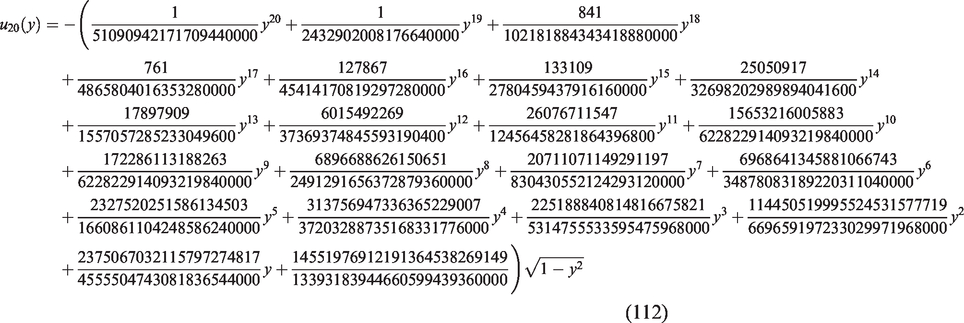
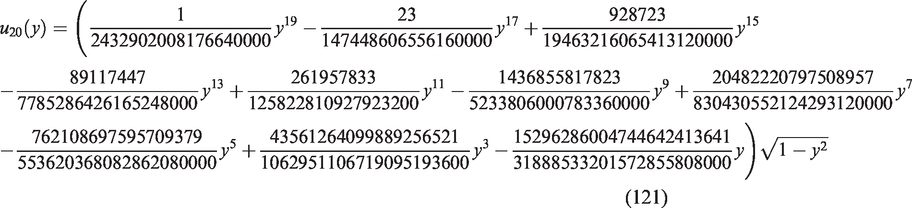
Estimations show that, for n = 10 and n = 20. Now we comprehend the following statements
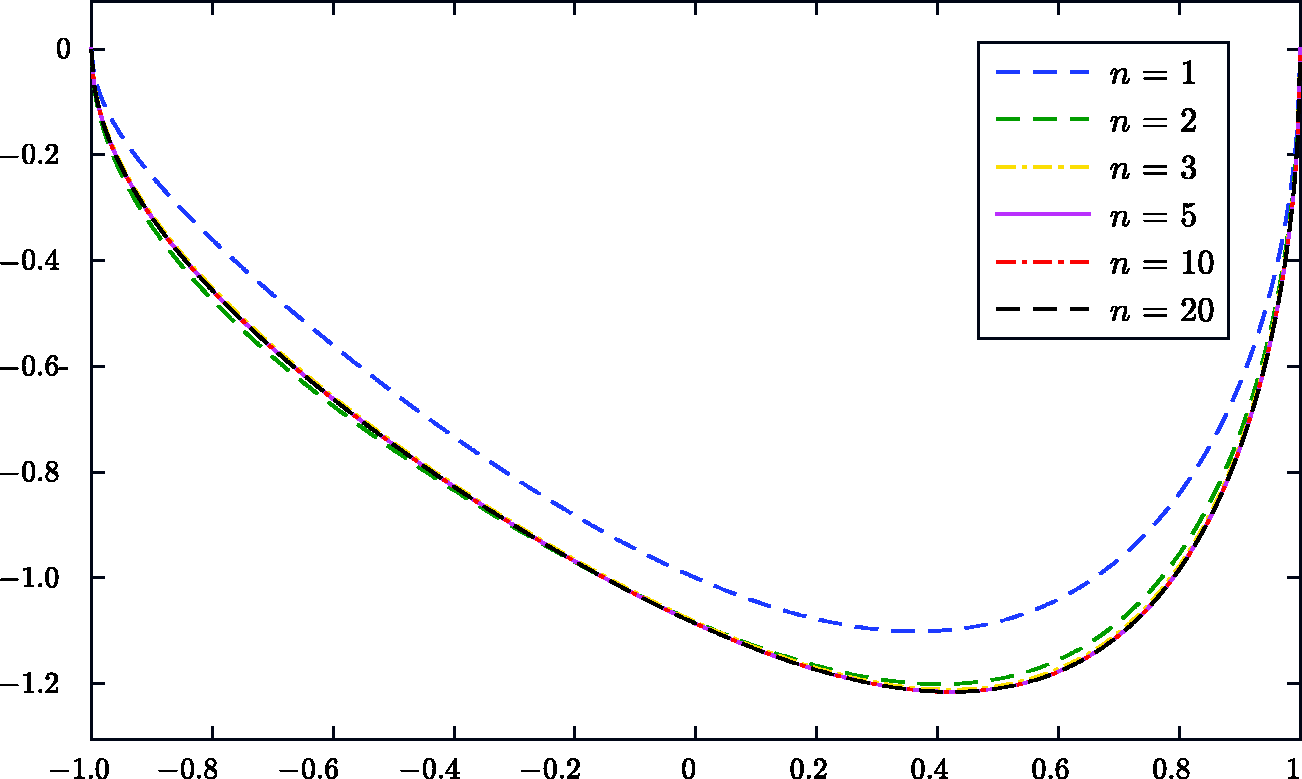
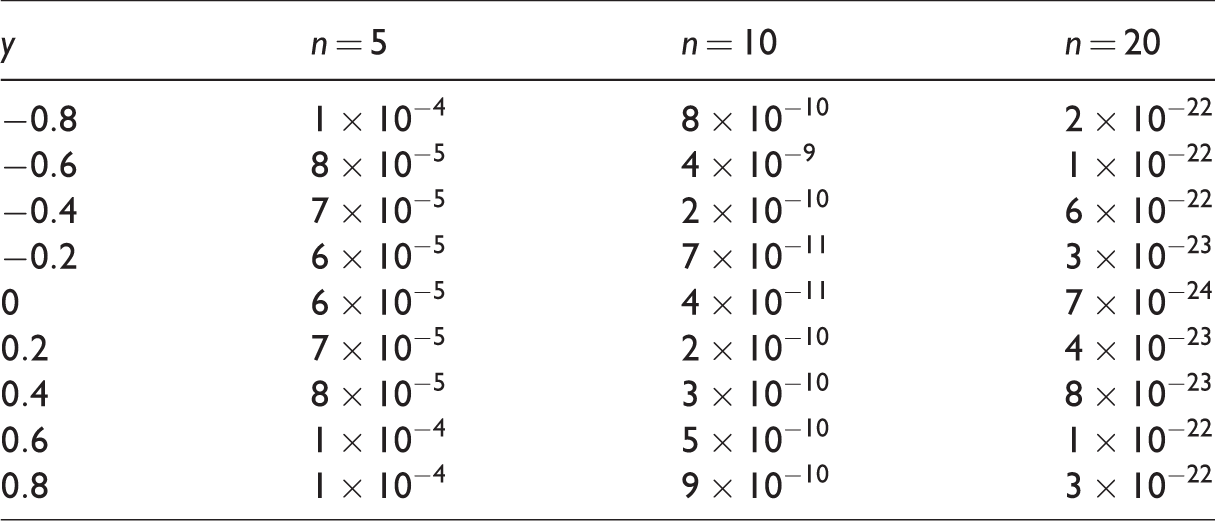
By applying equations (3) and (46), the absolute errors of the approximate solution via the MHPM are illustrated in Table 2 for the given y and n. Also, the graph of for different n is plotted in Figure 2.
Graph of for different n, in Example (6).
Absolute error for different values of n of equation (113).
y
n = 5
n = 10
n = 20
0
0
0
0
Conclusion
A vigorous research was provided here to propose a new modified homotopy perturbation method which happened to vacillate achieving solution to a class of hypersingular integral equations of the first kind. Then, the MHPM to which more researchers refer, was discovered to be the most ideal tool in dealing with the complicated function-theoretic analytical structures within an analytical method. Ideally, in this new method, the MHPM, reaching the exact solution can be accomplished where two terms of the series are feasible to be calculated. In addition, results obtained from considerable examples report a high degree of validity and accuracy of the MHPM.
Footnotes
Declaration of conflicting interests
The author(s) declared no potential conflicts of interest with respect to the research, authorship, and/or publication of this article.
Funding
The author(s) received no financial support for the research, authorship, and/or publication of this article.
References
1.
ChanY-SFannjiangACPaulinoGH.Integral equations with hypersingular kernels–theory and applications to fracture mechanics. Int J Eng Sci2003;
41: 683–720.
2.
MartynowiczP.Real-time implementation of nonlinear optimal-based vibration control for a wind turbine model.J Low Freq Noise Vibrat Active Control2018, https://doi.org/10.1177/1461348418793346 (accessed 24 August 2018).
3.
Currie-GreggNJCarneyK.Development of a finite element human vibration model for use in spacecraft coupled loads analysis.J Low Freq Noise Vibrat Active Control2018, https://doi.org/10.1177/1461348418757994 (accessed 27 April 2018)
4.
LeeSJungS.Detection and control of a gyroscopically induced vibration to improve the balance of a single-wheel robot. J Low Freq Noise Vibrat Active Control2018;
37: 443–455.
5.
LiuYRizzoFJ.A weakly singular form of the hypersingular boundary integral equation applied to 3-D acoustic wave problems. Comput Meth Appl Mech Eng1992;
96: 271–287.
6.
ZhangPWuTW.A hypersingular integral formulation for acoustic radiation in moving flows. J Sound Vibrat1997;
206: 309–326.
7.
ChenJT.Recent development of dual BEM in acoustic problems. Comput Meth Appl Mech Eng2000;
188: 833–845.
8.
ChangJRYeihWC.Applications of domain partition in BEM for solving the vibration problem of a rod subjected to a spatially distributed harmonic loading. J Chinese Inst Eng2001;
24: 151–171.
9.
AvramovKVPapazovSVBreslavskyID.Dynamic instability of shallow shells in three-dimensional incompressible inviscid potential flow. J Sound Vibrat2017;
394: 593–611.
10.
YuD-NHeJ-HGarciaAG.Homotopy perturbation method with an auxiliary parameter for nonlinear oscillators.J Low Freq Noise Vibrat Active Control2018, https://doi.org/10.1177/1461348418811028 (accessed 18 November 2018).
11.
LiX-XHeC-H.Homotopy perturbation method coupled with the enhanced perturbation method. J Low Freq Noise Vibrat Active Control2018, https://doi.org/10.1177/1461348418800554 (accessed 23 September 2018).
12.
WuY.Periodic solution to nonlinear oscillators without artificial noises by the homotopy perturbation method.J Low Freq Noise Vibrat Active Control2018, https://doi.org/10.1177/1461348418800902 (accessed 23 September 2018)
13.
EshkuvatovZZulkarnainFLongNNet al.
Modified homotopy perturbation method for solving hypersingular integral equations of the first kind. SpringerPlus2016;
5: 1473.
14.
DarderySMAllanMM.An approximate solution of hypersingular and singular integral equations. Canadian J Pure Appl Sci2011;
5: 1685–1992.
15.
MandalBBhattacharyaS.Numerical solution of some classes of integral equations using Bernstein polynomials. Appl Math Computat2007;
190: 1707–1716.
16.
MartinP.Exact solution of a simple hypersingular integral equation. J Integral Equations Appl1992;
4: 197–204.
17.
ObaiysSJEskhuvatovZKNik LongNet al.
method for the numerical solution of hypersingular integral equations based Chebyshev polynomials. Int J Math Analysis2012;
6: 2653–2664.
18.
MandalBChakrabartiA.Applied singular integral equations.
Boca Raton, FL:
CRC Press, 2011.
19.
NovinRFariborzi AraghiMAMahmoudiY.A novel fast modification of the Adomian decompositions method to solve integral equations of the first kind with hypersingular kernels. J Computat Appl Math2018; 343: 619–634.
20.
NovinRFariborzi AraghiMAMahmoudiY.Solving the Prandtl’s equation by the modified Adomian decomposition method. Commun Adv Computat Sci Appl2018; 2018(1): 9–14.
21.
CriscuoloG.A new algorithm for cauchy principal value and hadamard finite-part integrals. J Computat Appl Math1997;
78: 255–275.
22.
KressR.On the numerical solution of a hypersingular integral equation in scattering theory. J Computat Appl Math1995;
61: 345–360.
MonegatoG.Definitions, properties and applications of finite-part integrals. J Computat Appl Math2009;
229: 425–439.
25.
ChakrabartiAMandalBBasuUet al.
Solution of a hypersingular integral equation of the second kind. Z Angew Math Mech1997;
77: 319–320.
26.
KayaACErdoganF.On the solution of integral equations with strongly singular kernels. Quart Appl Math1987;
45: 105–122.
27.
MandalBBeraG.Approximate solution of a class of singular integral equations of second kind. J Computat Appl Math2007;
206: 189–195.
28.
HuiC-YMukherjeeS.Evaluation of hypersingular integrals in the boundary element method by complex variable techniques. Int J Solids Struct1997;
34: 203–221.
29.
IovaneGLifanovISumbatyanM.On direct numerical treatment of hypersingular integral equations arising in mechanics and acoustics. Acta Mech2003;
162: 99–110.
30.
KuttHR.On the numerical evaluation of finite-part integrals involving an algebraic singularity. PhD Thesis. Stellenbosch: Stellenbosch University, 1975.
31.
GoriLPellegrinoESantiE.Numerical evaluation of certain hypersingular integrals using refinable operators. Math Comput Simul2011;
82: 132–143.
32.
AbdulkawiMNik LongNMAEskhuvatovZK.Numerical solution of hypersingular integral equations. Int J Pure Appl Math2011;
3: 265–274.
33.
MahmoudiYBaghmishehM.Modified Adomian decomposition method for solving a class of hypersingular integral equations of first kind. Life Sci J 2013; 10: 292–297.
34.
MandalBBeraG.Approximate solution for a class of hypersingular integral equations. Appl Math Lett2006;
19: 1286–1290.
35.
DuttaBBanerjeaS.Solution of a hypersingular integral equation in two disjoint intervals. Appl Math Lett2009;
22: 1281–1285.
36.
ChenZZhouY.A new method for solving hypersingular integral equations of the first kind. Appl Math Lett2011;
24: 636–641.
37.
MahmoudiY.A new modified Adomian decomposition method for solving a class of hypersingular integral equations of second kind. J Computat Appl Math2014;
255: 737–742.
HeJ-H.A coupling method of a homotopy technique and a perturbation technique for non-linear problems. Int J Non-Linear Mech2000;
35: 37–43.
40.
HeJ-H. Bookkeeping parameter in perturbation methods. Int J Non-Linear Sci Numer Simul 2001; 2(3): 257–264.
41.
HeJ-H.Linearized perturbation technique and its applications to strongly nonlinear oscillators. Comput Math Appl2003;
45: 1–8.
42.
HeJ-H.Homotopy perturbation method for solving boundary value problems. Phys Lett A2006;
350: 87–88.
43.
HeJ-H.Asymptotology by homotopy perturbation method. Appl Math Comput2004;
156: 591–596.
44.
HeJ-H.A simple perturbation approach to blasius equation. Appl Math Computat2003;
140: 217–222.
45.
HeJ-H.Homotopy perturbation method: a new nonlinear analytical technique. Appl Math Computat2003;
135: 73–79.
46.
HeJ-H.Comparison of homotopy perturbation method and homotopy analysis method. Appl Math Computat2004;
156: 527–539.
47.
HeJ-H.Homotopy perturbation method with two expanding parameters. Indian J Phys2014;
88: 193–196.
48.
HeJ-H.Homotopy perturbation method with an auxiliary term.Abstract Appl Analys2012. Article Number 857612; 2012, 1–7.
49.
LiuZ-JAdamuMYSuleimanEet al.
Hybridization of homotopy perturbation method and Laplace transformation for the partial differentional equations. Therm Sci2017;
21: 1843–1846.
50.
GuptaSKumarDSinghJ.Analytical solutions of convectiondiffusion problems by combining Laplace transform method and homotopy perturbation method. Alexandria Eng J2015;
54: 645–651.
51.
HeJ-H.Research highlights in this issue. Nonlinear Sci Lett A2017;
8: i–iii.
52.
WuYHeJ-H.Homotopy perturbation method for nonlinear oscillators with coordinate dependent mass. Results Phys2018;
10: 270–271.
53.
GhadiriMSafiM.Nonlinear vibration analysis of functionally graded nanobeam using homotopy perturbation method. Adv Appl Math Mech2017;
9: 144–156.
54.
MatinfarMSaeidyMVahidiJ.Application of homotopy analysis method for solving systems of Volterra integral equations. Adv Appl Math Mech2012;
4: 36–45.
55.
SinghMGuptaPK.Homotopy perturbation method for time-fractional shock wave equation. Adv Appl Math Mech2011;
3: 774–783.