




Abstract
The surface vibration velocities and near-field pressure of the underwater cylindrical shell, which are excited by external force, were calculated using wave propagation method. In fact, the main goal is to explore the measures to suppress vibration of structure and near-field radiation noise. The wave number frequency spectrum method that combined the vibration wave number with the frequency domain method can be applied for the analysis of wave propagation in shell structures; based on the method and calculated results, the wave propagation spatial characteristics of vibration and near-field acoustic radiation of the underwater cylindrical shell were also analyzed. It is shown that there are three waves in cylindrical shell: flexural wave, shear wave, and extended wave; the first two belong to transversal wave, while the last belongs to longitudinal wave, and the wave propagation directions and velocities are all obtained. Near-field radiation sound waves are more complex than in surface acoustic field. In isotropic solid medium, wave numbers of the same type of waves at one frequency are the same. In order to reduce the vibration and noise, the dampers should be installed in the direction of wave propagation, and the types of dampers are determined by the wave propagation velocities. This work will give some guidelines for vibration and noise reduction of this kind of shells.
Introduction
Thin cylindrical shells are widely used in various engineering structures such as aircraft fuselages and submarine hulls. Reducing the vibration of marine power machinery can improve warships' capabilities of concealment and reconnaissance.1–4 The vibration and sound radiation characteristics from cylindrical shells are of special concern to vibration and acoustic engineers, and for submarine structures, the structure vibration and the near-field sound radiation affect their detection performance. The purpose of this paper is to provide evidence for reducing the vibration and near-field radiation noise.
Although many papers on the calculation of vibration characteristics of cylindrical shells have been published over the past years, but few papers are present on the calculation of near-field acoustic field characteristics, because it is difficult to calculate the sound radiation pressure from near field which is caused by structure vibration of the shells. The near-field radiation noise has been obtained by experiments or sound field reconstruction method, these results are limited by conditions. The vibration and sounds are waves, the wave propagation method is effective for long thin cylindrical shells.5,6 Shear, extensional and flexural wave propagations in shells and framework structures were studied by Nilsson, who developed mathematical models. 7 The wave number frequency spectrum (WNFS) method that combined the vibration wave number with the frequency domain method is a powerful solution procedure, by which wave propagation may be analyzed. 8 Periodicity and sound amplitude-frequency characteristics of wave propagation in periodically stiffened structures were investigated by Chapman, he performed real experiments for the first time. 9 The frequency–wave number spectrum was applied to the analysis of wave propagations in thin shells of revolution, 10 the testing results and experimental treatment presented herein are of practical importance for the design. in the paper, the surface vibration signals of the thin cone shell were obtained by experiments, the acceleration sensors were placed on the parts of shell and thought to be flat, so in view of the current research activities, the data were mainly obtained by experiment, the results were influenced on human factors.10,11
It is difficult to calculate and measure the sound radiation pressure from near field which caused by structure vibration of the complicated cylindrical shell, however the sound radiation pressure information can provide a very important basis for vibration and noise reduction Research on the fluid loaded of finite length shells is significantly more complex than the infinite length shells. In the present paper, the vibration and sound radiation characteristics of the finite length shells supporting by simply-supported were investigated. Green function in conjunction with FFT transformation was proposed, 12 and the surface vibration velocity and near-field sound radiation pressure were calculated and analyzed with WNFS. The information on wave propagation (wave number, velocities and direction) in the shell will be obtained, which can provide evidence for reducing the vibration and near-field radiation sound. For example, the reinforcing ribs, damping layers and active control piezoelectric sheets can be placed according to the wave propagation direction, while their optimal arrangement and selection can accord the wave propagation velocities.
Subject and methods
The cylindrical shell is excited by external force in underwater. Surface normal velocity and near-field sound radiation pressure of 0.05 m from the shell are analytically calculated. The shell’s thickness is h, radius is a, density is ρ, and length L = 2 m. They are shown in Figure 1.
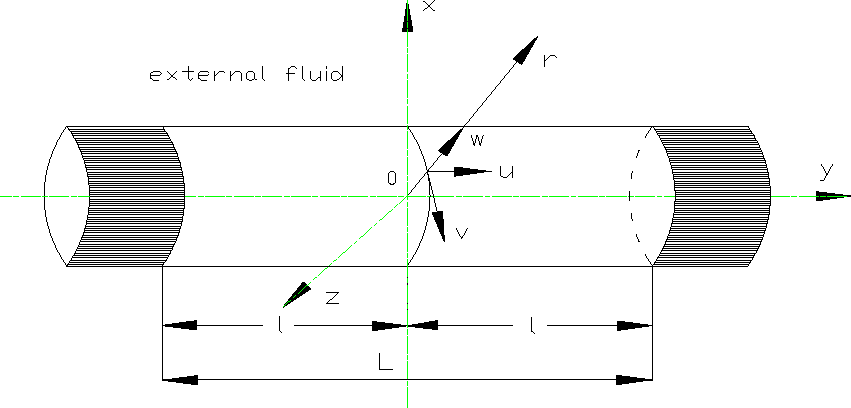
Simply-supported finite length cylindrical shell.
Calculation of the surface normal direction vibration velocities of the simply-supported cylindrical shell consult to literature. 13 The surface and near-field acoustic pressure are obtained as follows.
Three-dimensioned Helmholtz equation for the acoustic pressure is
14

Green's function in Newmann boundary conditions is15,16


Converted into cylindrical coordinate system

The surface vibration velocity can be expanded into the form of normal displacement mode
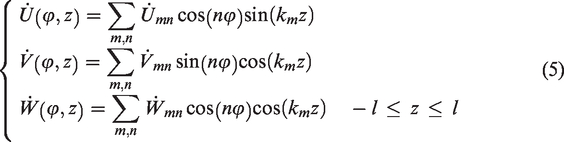
So the surface normal vibration velocity is

With equations (2) and (5), equation (4) is derived as

Donnell's shell equation is adopted. Excited by the point force, surface normal vibration velocity of cylinder shell is
14

Here
Surface vibration velocity of cylinder was calculated by equation (8), so the acoustic pressure of any one random point from equation (7) is

The results computed are analyzed by WNFS method, and spatial characteristics are analyzed.
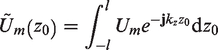
In order to make sure the wave propagation direction, Mx points of surface vibration velocity in x axis and My points in y axis are supposed. Vibration velocity value of any point F(x, y) computed is transformed by Fourier integration
10


Spectrum matrix composed by Mx × My velocity spectrums is obtained. If frequency f0 is fixed, corresponding to Mx × My spatial spectrum matrix, which is transformed by 2D Fourier transformation, 2D frequency wave number spectrum of f0 will be obtained.
When 2D Fourier transformation is adopted by wave number spectrum computation, wave number spectrum values are within –π/d∼π/d, and wave number resolution is 1/Nd. Wave number resolution in axial is related closely to the length of shell, which does not depend on the points number of Fourier transformation selected.kx and ky are wave number coordinates in axial and circumferential directions, respectively; Mx and My are wave number dimensions in axial and circumferential directions; and dx and dy are array distances in axial and circumferential directions, respectively.
Results
The shell for computation is built by aluminum with mass density ρ of 2700 kg/m3, the Poisson ratio μ is equal to 0.33, and Young’s modulus E = 7.1 × 10¹⁰ N/m3, 20-order modes overlap in axial and circumferential directions is adopted. The shell’s thickness h = 0.01 m and the same length L = 2 m. Assume that the excitation force is concentrated at Z = 0, ϕ = 0°, and the radial point force of peak F0=1 N. When calculating, the frequency band below the ring frequency was mainly considered.
Results of surface vibration
The sound radiation power is calculated with equations (8) and (9) as follow

Sound radiation power levels are defined as

In Figure 2, the wave propagation method was used in conjunction with beam functions,5,6 the sound-radiated powers with simply-supported in boundary was calculated.
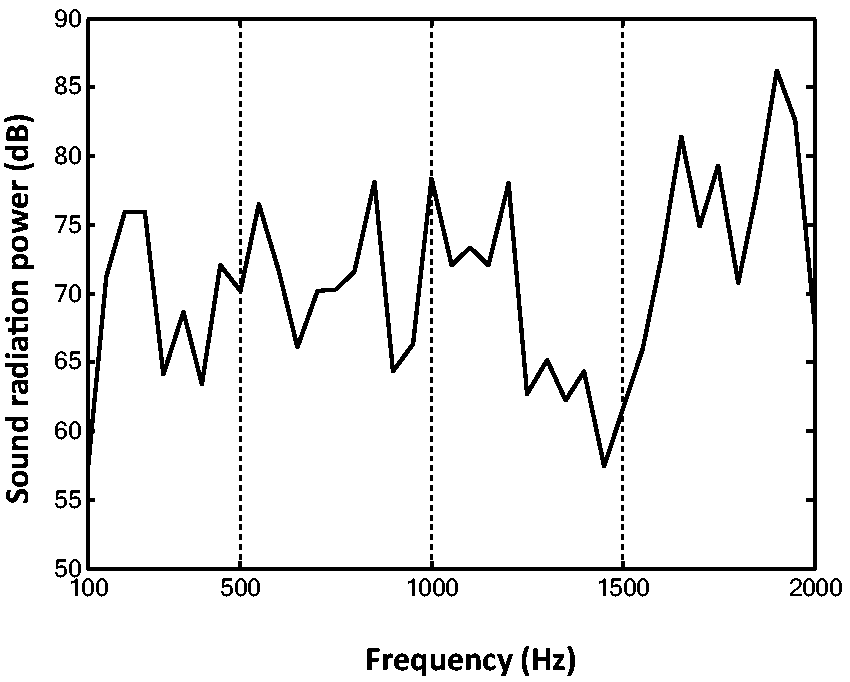
Shell’s sound radiation characteristics.
The position and value of the curves’ peaks changed, that is to say the shell’s resonance characteristics changed. It is showed that resonance exists on near 500 Hz, 1000 Hz and 1500 Hz whose curve waves activated are complicated. So the vibration field and spatial characteristics analysis of vibration wave field in different frequencies (500 Hz, 1000 Hz, 1500 Hz) will be compared using WNFS.
Following is the information on wave propagation in the shell:
In order to be calculated by WNFS method, discrete processing is applied to the shell surface vibration velocity and near-field sound pressure along the surface of cylindrical shell. The coordinate origin is selected in the middle of the shell, and the shell extends along the axis at φ = 0°. The results computed in axial direction length, from −1 to 1, are divided into 40 parts with 0.05 m distance; circumferential angle φ, from 0° to 360°, is divided into 36 parts with 10° distance. The direction of x is the axial direction of the cylindrical shell, and the direction of y is circumferential direction.
Figures 3 to 5 show 2D WNFS of vibration field in different frequencies and spatial characteristics analysis of vibration wave field.
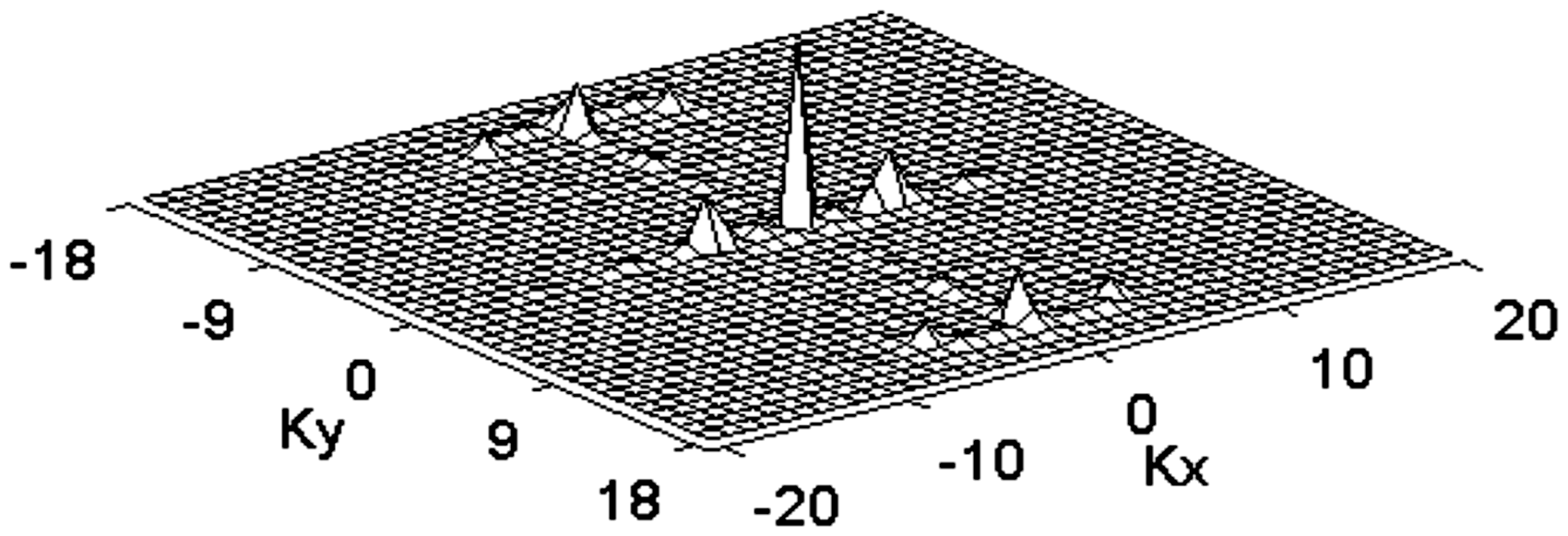
WNFS of shell surface vibration velocity in 500 Hz.
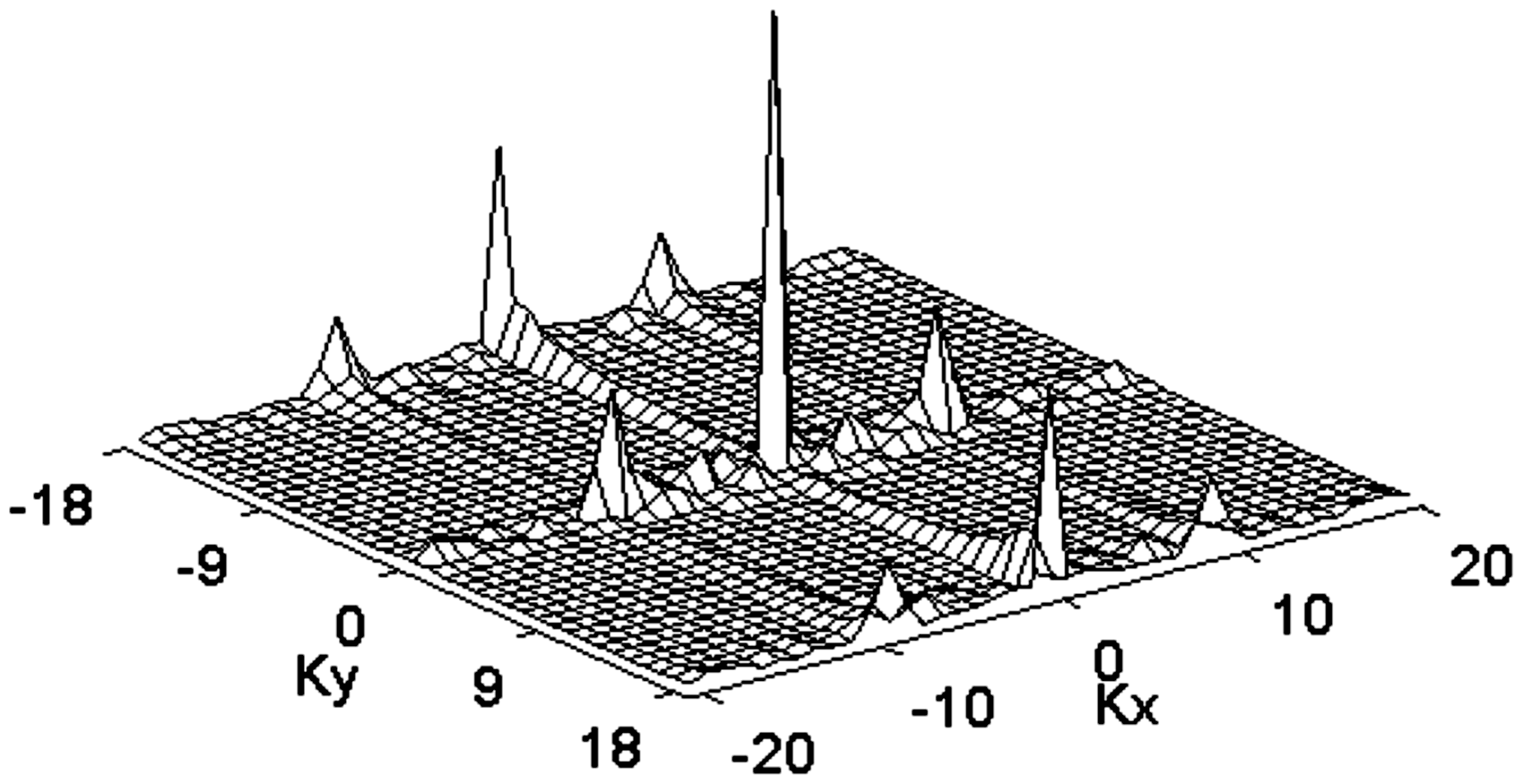
WNFS of shell surface vibration velocity in 1000 Hz.
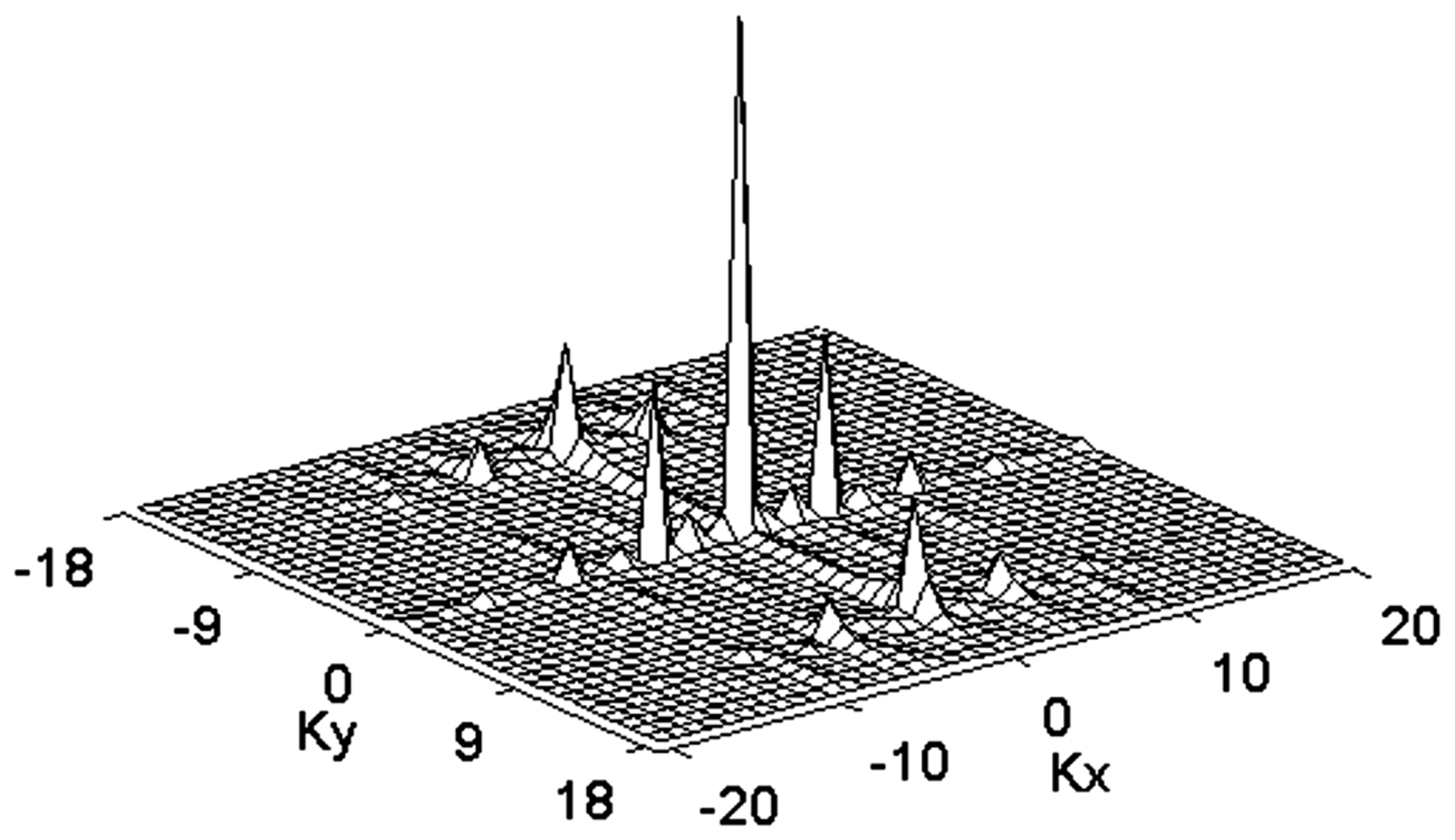
WNFS of shell surface vibration velocity in 1500 Hz.
From the calculation results, it can be seen that three kinds of travelling waves appear in the structure (Table 1).
Main wave numbers k, wave velocities c, and propagation directions of sub-waves θ in 500 Hz, 1000 Hz, and 1500 Hz.

Inferior numbers (1, 2, 3) represent three types of waves.
From Figures 3 to 5 and Table 1, some conclusions can be obtained:
The WNFS of shell surface vibration velocity in 1000 Hz are more volatile and complex, as obviously depicted in Figure 2, 1000 Hz is exactly the resonant frequency. With analysis of WNFS for shell internal vibration field, propagation information can be obtained. For instances, propagation direction, propagation velocity, etc. There are three waves in cylinder shell: flexural wave (k1), shear wave (k2), and extended wave (k3). The first two belong to transversal wave, while the last belongs to longitudinal wave. In isotropic solid medium, the same types of waves at one frequency have the same wave numbers. In 2D WNFS, spectrum peak of the same type wave distributes on the same circumferential, while different waves are on different circumferences. The number of flexible waves is the largest but its velocity is the lowest and the number of extended waves is the smallest while its velocity is the fastest. From the figures, it is shown that the flexible waves are in the external area and the extended waves are located in the internal area; from the direction, three waves are also easily discriminated. Wave propagation direction is important for vibration resistance, which would be realized by adding ribs or damping layers in vertical direction. In consideration of vibration reduction and insulation, adding ribs on axial direction is better than that on circumferential direction. If vibration wave propagation velocity is known, then wave lengths of are also known. If ribs are added in one wave length, then the vibration reduction is improved. When using active control method to reduce vibration, in order to enhance the control effect, the piezoelectric sensor should be pasted in the direction of flexural wave propagation.
Results of near-field sound pressure
Figures 6 to 8 show 2D WNFS on different frequencies of acoustic field.
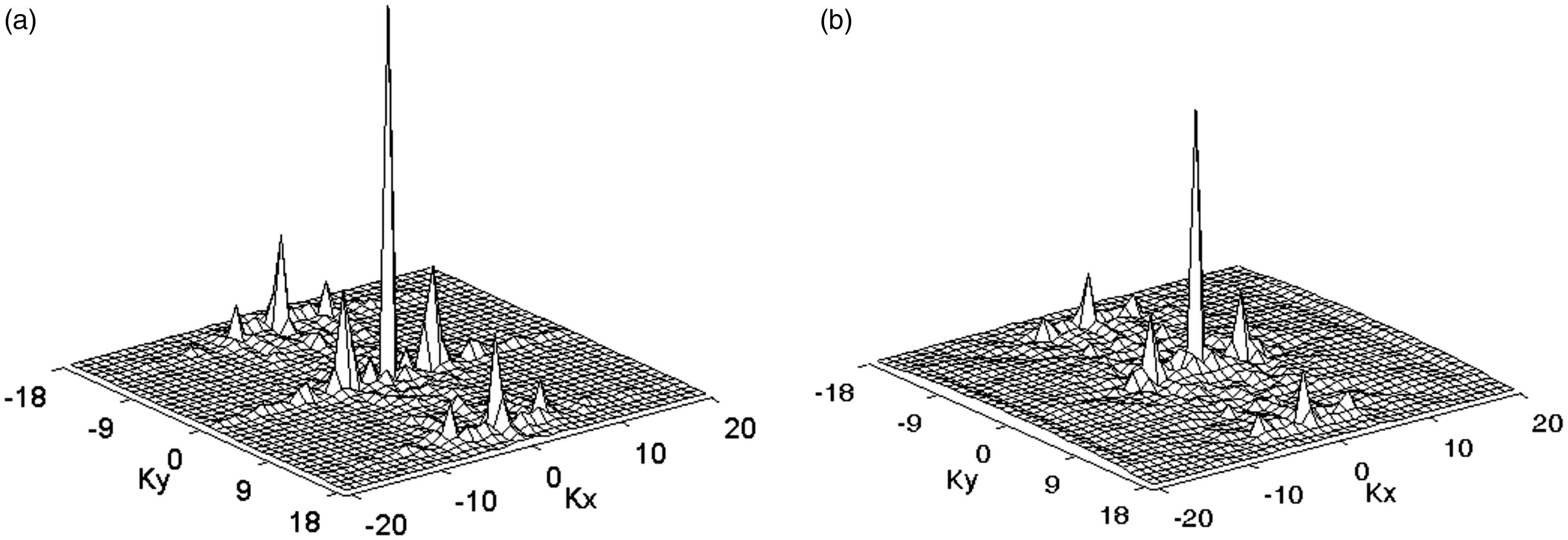
Surface acoustic pressure WNFS and near-field acoustic pressure WNFS in 500 Hz. (a) Surface acoustic pressure; (b) near-field acoustic pressure.
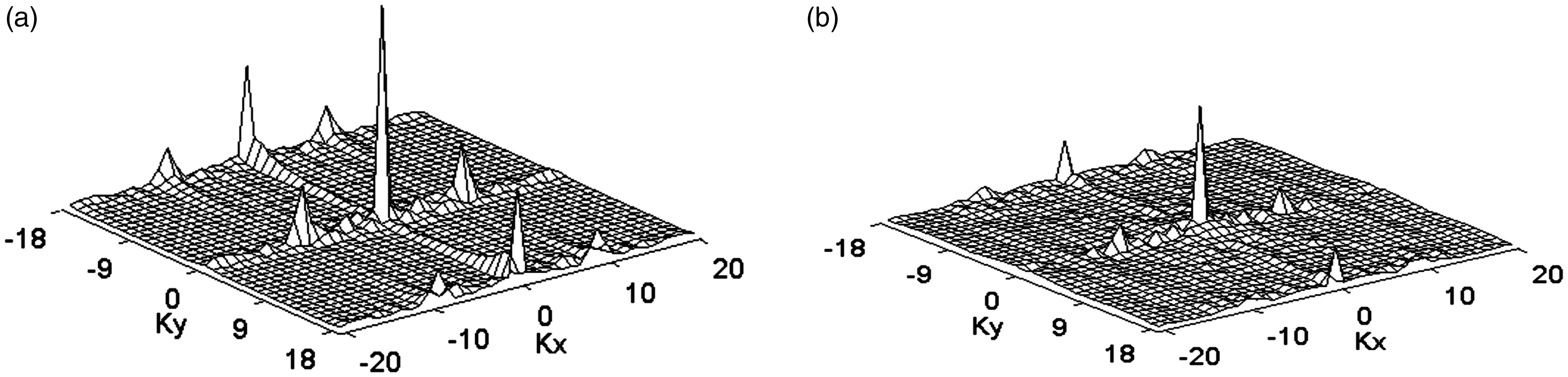
Surface acoustic pressure WNFS and near-field acoustic pressure WNFS in 1000 Hz. (a) Surface acoustic pressure; (b) near-field acoustic pressure.
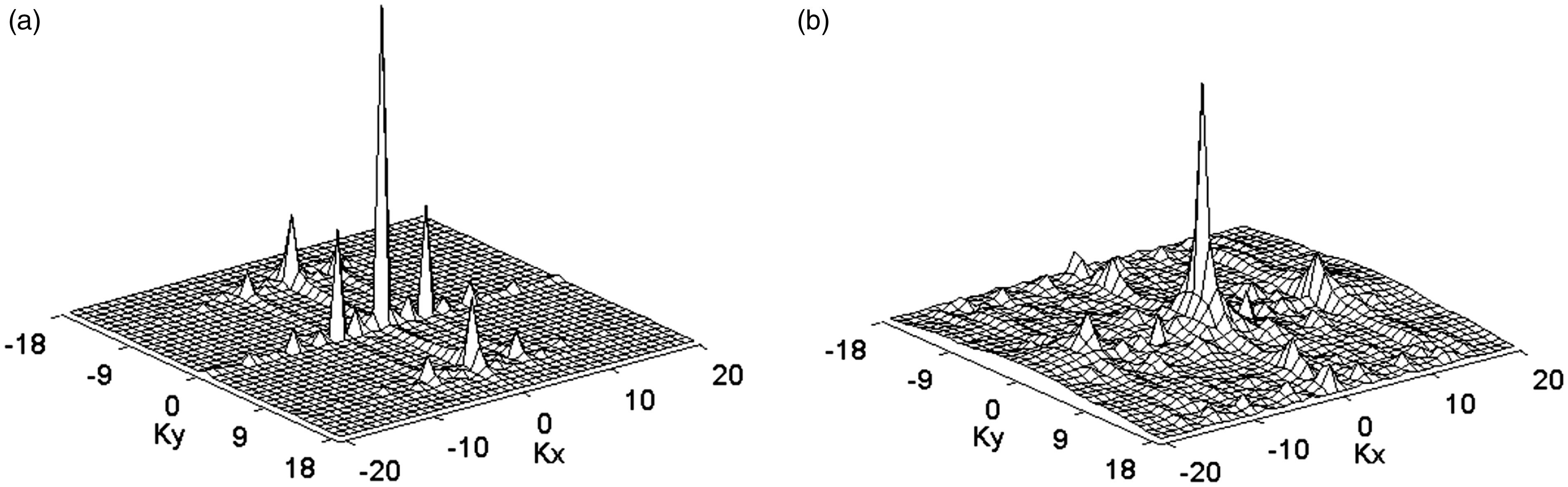
Surface acoustic pressure WNFS and near-field acoustic pressure WNFS in 1500 Hz. (a) Surface acoustic pressure; (b) near-field acoustic pressure.
From these figures, with analysis of shell near acoustic field characteristics, it is concluded:
The complexity of the wave propagation of surface and near-field acoustic radiation is independent of the resonance frequency of the shell. The WNFS of surface acoustic pressure and near-field acoustic pressure in 500 Hz and 1500 Hz are more complicated than in 1000 Hz. Near-field acoustic radiation fluctuates in space, which is more complex than surface acoustic field. In order to know its distribution, more hydrophones deployed are needed on the shell surface. When measuring hydrophones are deployed near the surface, their sensitivities are affected by boundary conditions and structural sound field scattering, whose on-line sensitivity measurements are difficult. In order to evaluate and independently analyze the contributions of near-field acoustics radiated, it is better to reduce the hydrophone-shells’ vibration passed from the structures installed. Damping basement installed on the hydrophones are needed, which are not ideal on low frequencies. Reducing noise is an important way to improve sonar signal-to-noise ratio. To increase the detection probability of the sonar in flank arrays, the near-field sound radiation of platform-mounted sonar should be controlled, so the hydrophone arrays will be placed avoiding the wave propagation direction.
Conclusion
In the paper, the surface vibration velocities and the acoustic pressure of any one random point are calculated using the wave propagation method; with the results and the WNFS method, the near-field vibroacoustic spatial characteristics are obtained and analyzed.
It is shown that there are three waves in cylinder shells: the flexural wave, the shear wave and the extended wave, for which the wave numbers, wave propagation velocities, and wave propagation directions are also obtained. The information is very important for vibration control, including passive and active control. The reinforcing ribs, damping layers and active control piezoelectric sheets can be placed for an optimal arrangement according to the wave propagation direction, while their numbers and selection can accord the wave propagation velocities etc.
Three waves are also in near acoustic radiated field, which is more complex than surface acoustic field, because it is affected by boundary conditions and structural sound field scattering. So in order to evaluate and independently analyze the contributions of near-field acoustics radiated, it is better to reduce the hydrophone shells’ vibration passed from the structures installed. According to the calculation results, adopting reasonable vibration reduction measures will be further studied.
Footnotes
Acknowledgment
The authors are grateful for the financial assistance provided by the National Science Foundation of China (contract no. 51109051) and the Science and Technology on Sonar Laboratory Foundation of China (contract no. 6142109KF201803).
Declaration of conflicting interests
The author(s) declared no potential conflicts of interest with respect to the research, authorship, and/or publication of this article.
Funding
The author(s) are grateful for the financial assistance provided by the Science and Technology on Sonar Laboratory Foundation of China (contract no. 6142109KF201803) and the National Science Foundation of China (contract no. 51109051).