




Abstract
Needle-disk electrospinning is a new technology for mass production of nanofibers. During the spinning process, the needle fixed on the rotating disk will vibrate. A vibration model is established, and the vibration frequency and largest deflection are obtained. The effect of the inertia force due to needle’s vibration on the spinning process is elucidated. All theoretical results are in well agreement with the experiment data. The present theoretical results are helpful to optimize the needle-disk electrospinning.
Introduction
Due to many superior properties, nanofibers have been drawing much attention in various areas, such as separation, 1 , 2 biomedicine, 3 , 4 and energy production. 5 , 6 However, electrospinning, as the most popular method of manufacturing nanofiber, is limited by the low nanofiber productivity.7–9 To overcome the shortcoming, many new technologies for mass-production of nanofibers were appeared in open literatures, for examples, the bubble electrospinning,10–17 the bubbfil spinning,18–20 the wire electrode electrospinning, 21 the bowl edge electrode electrospinning, 22 and the needle-disk electrospinning. 23
The needle-disk electrospinning includes a needle-disk, a solution vessel, a motor, a collector and a voltage supply. The schematic diagram of spinning process is presented in Figure 1.
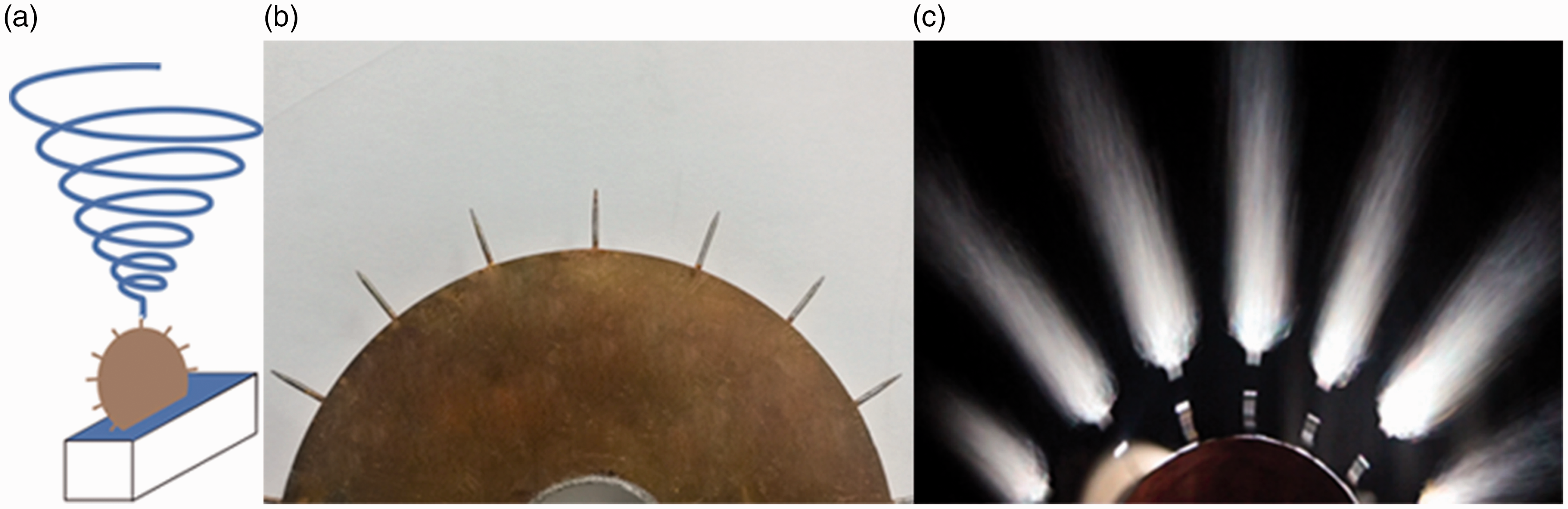
The needle-disk electrospinning: (a) electrospinning process; (b) needle-disk system; (c) experimental spinning process.
During a spinning process, a high voltage is applied on the needle-disk system, the thin film of the spun solution on the needle tip is acted by the electrostatic force and centrifugal force and inertia force due to needle’s vibration. When the acting force is large enough to overcome the surface tension of the thin film, multiple jets are ejected as illustrated in Figure 1(c).
In the spinning process, many parameters: (1) solution parameters such as solution concentration, solution viscosity 24 , 25 ; (2) spinning parameters, such as voltage supply, ambient humidity; 3) electrodes parameters, such as needle number, needle thickness, affect the spinning process, and nanofiber morphology.26–28
However, except for the parameters above, the vibration of the needle on the disk also plays an important role in the spinning process. The vibration induces additional inertia forces, which can be used as an external force for accelerating the ejecting jet. Any perturbation on the tip of the needle will induce an force imbalance acted on the thin film, so the effect of vibration of the needle on the spinning process can never been overlooked. However, much less literatures focus on the effect of needle vibration on the spinning process.
Therefore, in the present study, the effect of needle vibration on the spinning process and nanofiber morphology will be investigated theoretically and experimentally.
Theoretical model
The vibration of the needle in the disk plays an important role in the spinning process. Figure 2 is the needle-disk system, where the needle is fixed on the rotating disk. In the spinning process, the disk rotation will induce the needle vibration.
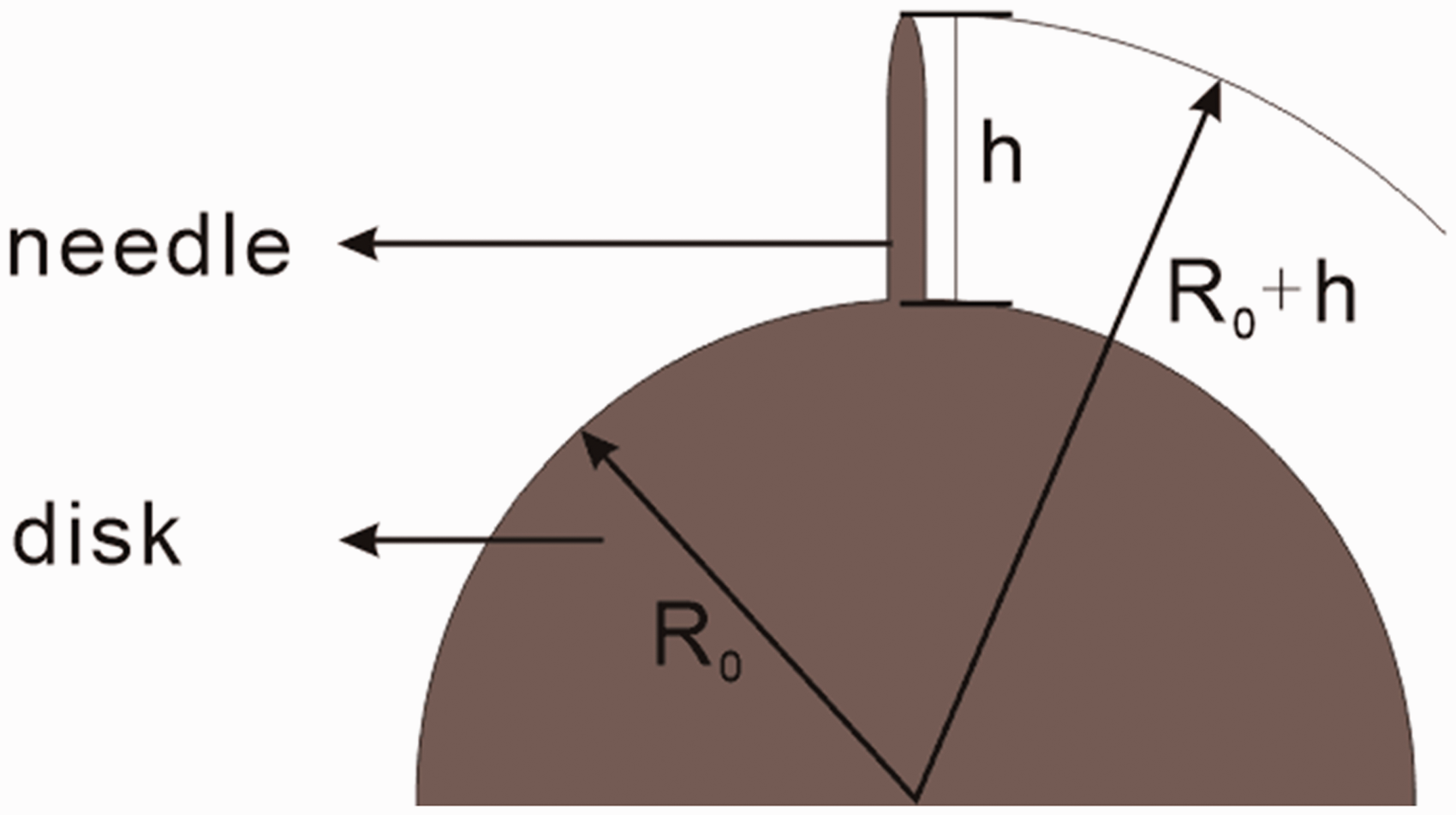
The schematic diagram of the R0 (disk radius) and h (needle length) in the needle-disk system.
The needle’s deflection can be written as

The needle rotates with a constant angular frequency of

The deflection equation becomes

This is a linear oscillator with frequency of

The maximal deflection locates at the free end the needle, which can be approximately written in the form

The needle vibration follows the energy conservation law



We consider the energy conservation law for the needle’s free end (Figure 3), which vibrates with a frequency of

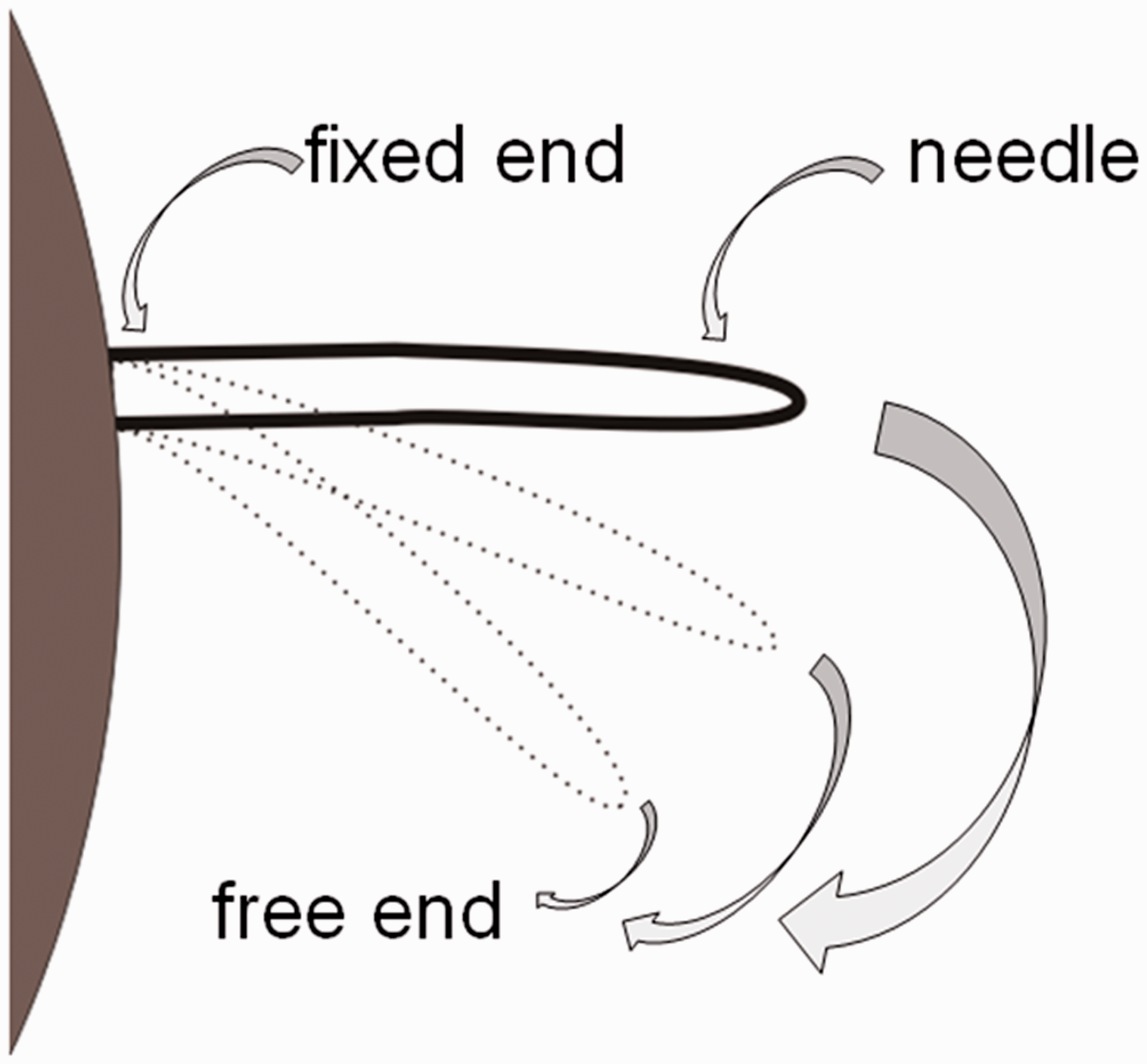
The schematic diagram of the free end and fixed end in the vibration of needle.
The energy conservation requires


We assume the maximal deflection velocity of the free end of the needle is

In view of equation (11), we have

The maximal deflection velocity provides the initial velocity of the ejecting drop, which is further accelerated by centrifugal force and the electrostatic force.
During the spinning process, the mass conservation requires


The jet radius can be obtained as

The jet is solidified when the solvent is evaporated, so the fiber diameter scales with the jet radius

Experimental
Poly (vinylidene fluoride-co-hexa-fluoropropylene) (PVDF-HFP, Mw 400,000) was dissolved in a binary solvent of N,N-dimethyl formamide/acetone (weight ratio of 5:5) at room temperature, to achieve a 12 wt.% solution. In the spinning process, the applied voltage is 25 kV, the collector distance is 25 cm, and the needle length is choosing as 4, 8, 12, and 16 mm, respectively. The ambient relative humidity and temperature used in the spinning process are 50 ± 2% and 25 ± 2°C, respectively and kept constant.
The morphology of electrospun PVDF-HFP nanofibers was observed using an SEM (Hitachi S-4800, Tokyo, Japan). The diameters of PVDF-HFP fibers were calculated by measuring at least 100 fibers at random using Image J program. Optical images were photographed by a digital camera (SONY, α35, Japan).
Based on the ***(17), we know that the fiber diameter decreases with the increase of needle length. To verify the theoretical result, the needle lengths of 4, 8, 12, and 16 mm were selected, respectively. Then, the resulting nanofiber morphology was shown in Figure 4. Using the experimental data, m and n in equation (17) can be determined, thus the relationship between the fiber diameter and needle length can be expressed as

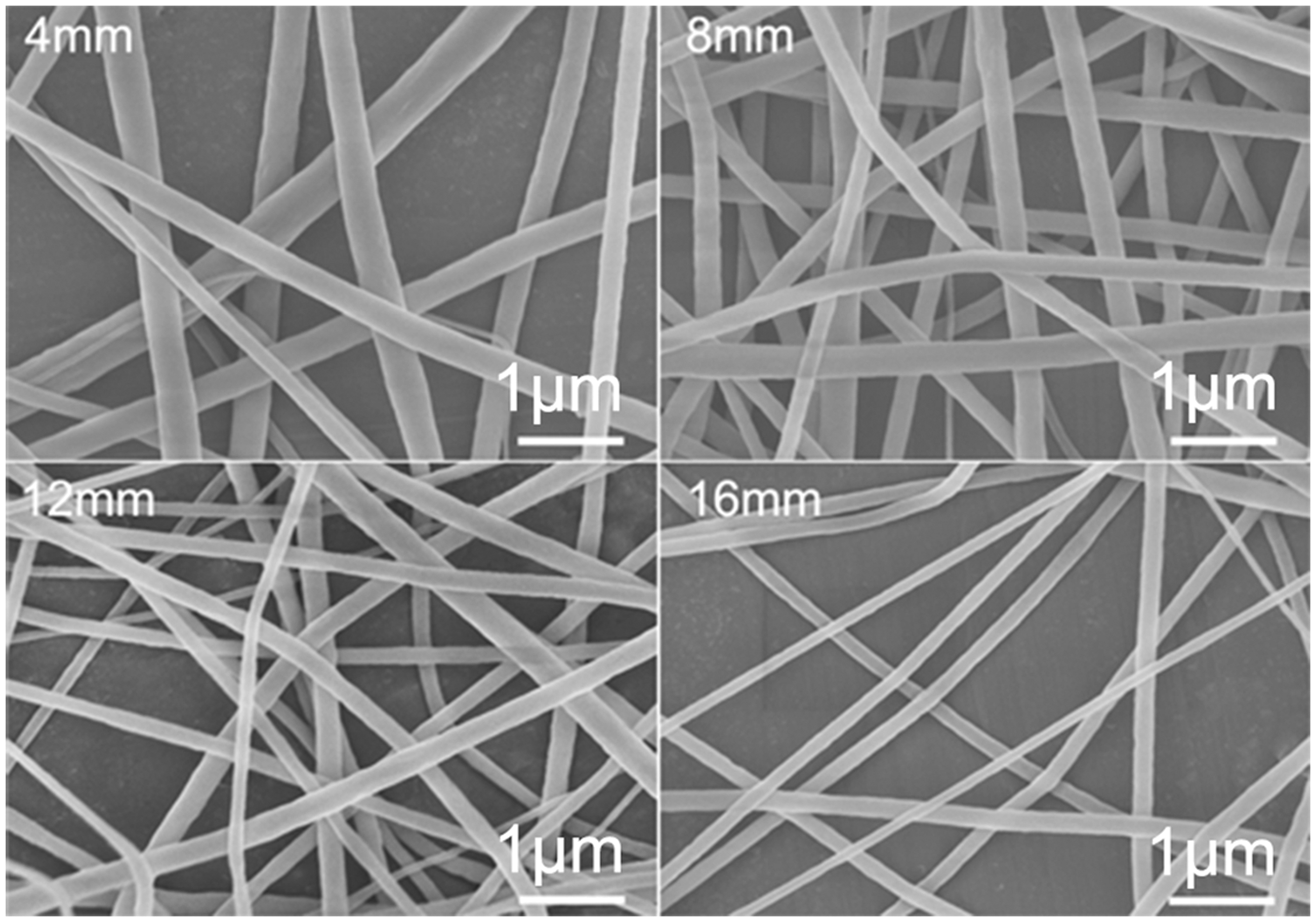
The PVDF-HFP fiber’s morphology of 4, 8, 12, and 16 mm needle length.
The comparison results is illustrated in Figure 5, suggesting a good agreement between the theoretical prediction of equation (18) and experimental data.
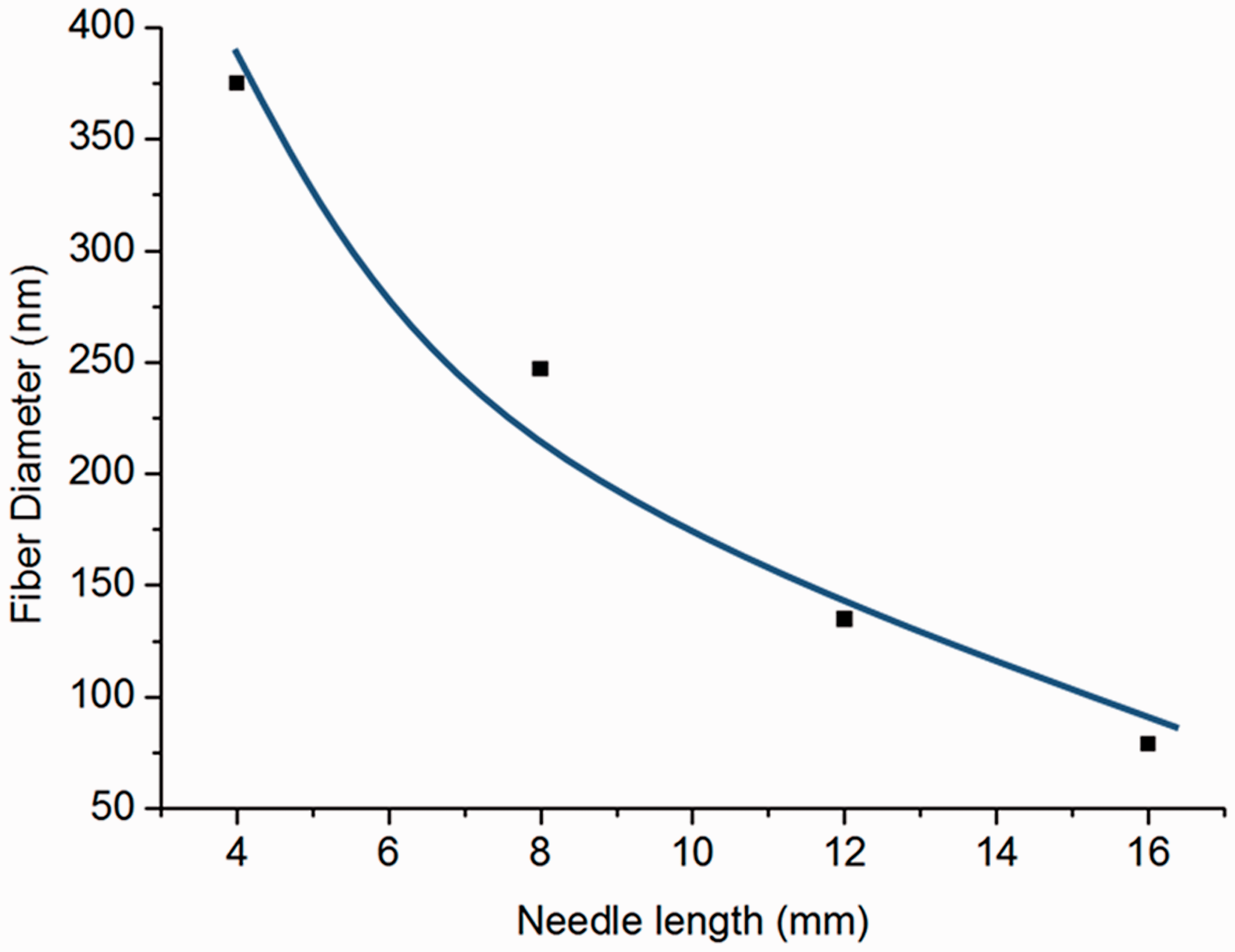
The relation between the needle length and the fiber diameter.
Discussions and conclusions
The fiber diameter is main affected by disk’s rotation frequency, needle deflection frequency, needle’s length. When the needle’ length tends to zero, the needle-disk electrospinning becomes the disk electrospinning. 29 As shown in Figure 5, it is obvious that the disk electrospinning with h = 0 produces fibers with larger fiber diameter than that by the needle-disk electrospinning. This merit of needle-disk electrospinning is first theoretically verified in this paper.
The theoretical analysis is preliminary. The approximate result gives a good theoretical insight into the effect of the disk rotation frequency and needle’s deflection frequency on the fiber diameter. Meanwhile, the theoretical result can be used for optimal design of the needle-disk system or to control the fiber morphology by controlling needle’s length and disk’s rotation frequency. Therefore, the theoretical model and experimental verification of needle-disk electrospinning benefits the nanofiber preparation and further applications.
Footnotes
Declaration of conflicting interests
The author(s) declared no potential conflicts of interest with respect to the research, authorship, and/or publication of this article.
Funding
The author(s) disclosed receipt of the following financial support for the research, authorship, and/or publication of this article: The authors would like to thank the support by Talent Start-up Foundation of Anhui Polytechnic University (2017YQQ012), Open Project Program of Anhui Province College Key Laboratory of Textile Fabrics (2018AKLTF07).