




Abstract
The fiber reinforced polymer is popularly applied for structural reinforcement and, however, usually suffers from long-term environmental effects, for example exposed to the ultraviolet radiation, alternating changes of moist-heat, and submerged in water chronically. As a result, the material aging and structural performance degradation are inevitable, which could eventually lead to the deterioration of mechanical behavior of fiber reinforced polymer, hence the attenuation or failure of repaired structures. It is very expensive and time consuming to use the experimental method to find out the aging patterns of fiber reinforced polymer. For fiber reinforced polymer with different volume fraction, the upper and lower limit of elastic modulus can be deduced by the energy principle. Combining this theory with tests, a semi-empirical deteriorating method can be used to analyze the change of fiber reinforced polymer mechanics behavior. And a series of empirical coefficients, determined by natural aging tests, are introduced. The coefficients are applied in the revised formula for the prediction of mechanics behaviors of fiber reinforced polymer. The elastic modulus of deteriorating fiber reinforced polymer is influenced by the fiber, the resin matrix, and the volume fraction of the fiber. For different fiber volume fraction, the experimental test is not the unique way to assess the durability of fiber reinforced polymer, as long as the laws of fiber aging, the laws of resin aging, and the fiber volume fraction are already known. The proposed model shows good agreement with the test results, hence can be used to predict the elastic modulus of aging fiber reinforced polymer, which can be utilized as references for engineering design and research in the future.
Introduction
Fiber reinforced polymer (FRP) is a type of high-performance material composed of certain proportions of fiber and resin substrate material and is widely applied for the reinforcement of engineering structures. In actual reinforcement engineering cases, due to different environmental conditions, e.g. exposed to ultraviolet (UV) radiation,1–3 subjected to freeze–thaw cycling,4 and soaked in water for a long time,5 FRP material will inevitably suffer from aging and performance deteriorating problems. This will eventually lead to the decrease of the strength of FRP and change of material elastic constants,6,7 leading to performance deteriorating of the repaired structures and even structure failures.8,9
The durability performances of FRP under the natural environment and durability design for FRP in structures always attract engineers’ attention. Luo et al.10 performed an experimental research to study the durability performance of different brands of FRP and resin substrate under climatic condition exposure in China; Cromwell et al.11 carried out a series of experimental program to investigate the behavior of three FRP systems subjected to nine different environmental conditioning protocols. The effect of environmental conditioning was assessed using four different standard test methods. Arun et al.12 carried out experiments on the glass/textile fabric reinforced hybrid composites under normal condition and sea water environments. Results show that the damage in hybrid composite under sea water environment is entirely different. The nature of fracture as a function of the reinforcement volume, loading, and environmental conditions has been analyzed with the aid of scanning electron microscopy.
Many factors, including fiber types, resin substrates, and the volume fraction of FRP, will affect the durability of FRP. It is expensive and very time-consuming to use test methods for the aging law of FRP.13–15 The best way to predict the aging performance of FRP is to combine both macro mechanics analytical method and experimental method.
In this study, a deterioration model for prediction of the elastic modulus of the aging FRP under complex environmental effects is proposed. The proposed method, a semi-empirical method, combines the energy theory and experimental test, which can be used to analyze the change of FPR mechanics behavior. The organization of this paper is summarized as follows: (1) Using energy principle to determine the upper and lower limit of elastic modulus of FRP. (2) Based on the theoretical analysis, using semi-empirical methods, a deteriorating model for the prediction of elastic modulus of the aging FRP under complex environmental effects is proposed, where the empirical coefficients are determined by natural aging test. (3) For different fiber volume fraction, the experimental test is not the unique way to assess the durability of FRP, as long as the laws of fiber aging, the laws of resin aging, and the fiber volume fraction are already known. (4) Conclusions are drawn to provide valuable information for the engineering design considering the deteriorating process of FRP.
Determine the upper and lower limit of elastic modulus by energy principle
FRP is a structure mixed with a polymer matrix reinforced with fibers. For fibers embedded in matrix, the strength and elastic performance have obvious directivity, which makes it anisotropic. From the perspective of macroscopic mechanics, considering the fact that the function of FRP is determined by average apparent performance, the material can be assumed uniformly distributed. Assumptions are listed as follows:
FRP is macro homogeneous, orthotropic linear elastic and none initial stress. Constituent materials of FRP, both fibers and matrix are homogeneous, isotropic, and linear elastic. FRP, fibers, and matrix are assumed to have small deformation. The shape of fibers and its distribution in resin matrix are in regular forms. Strain distribution at the fiber–matrix interface is continuous without relative slip.
Based on the above assumptions, a fraction of representative volume unit is chosen to study the deterioration of elastic modulus after natural aging. This fraction is small enough to reveal FRP microstructure composition, yet big enough to represent FRP performance. Figure 1 shows a single fiber of the representative volume unit. The fiber direction (x axis) is taken as the first direction, fiber spacing of the unit (y axis) as the second direction, while the thickness of fiber spacing (z axis) as the third direction. The cross section perpendicular to the x axis is assumed to always be plane.
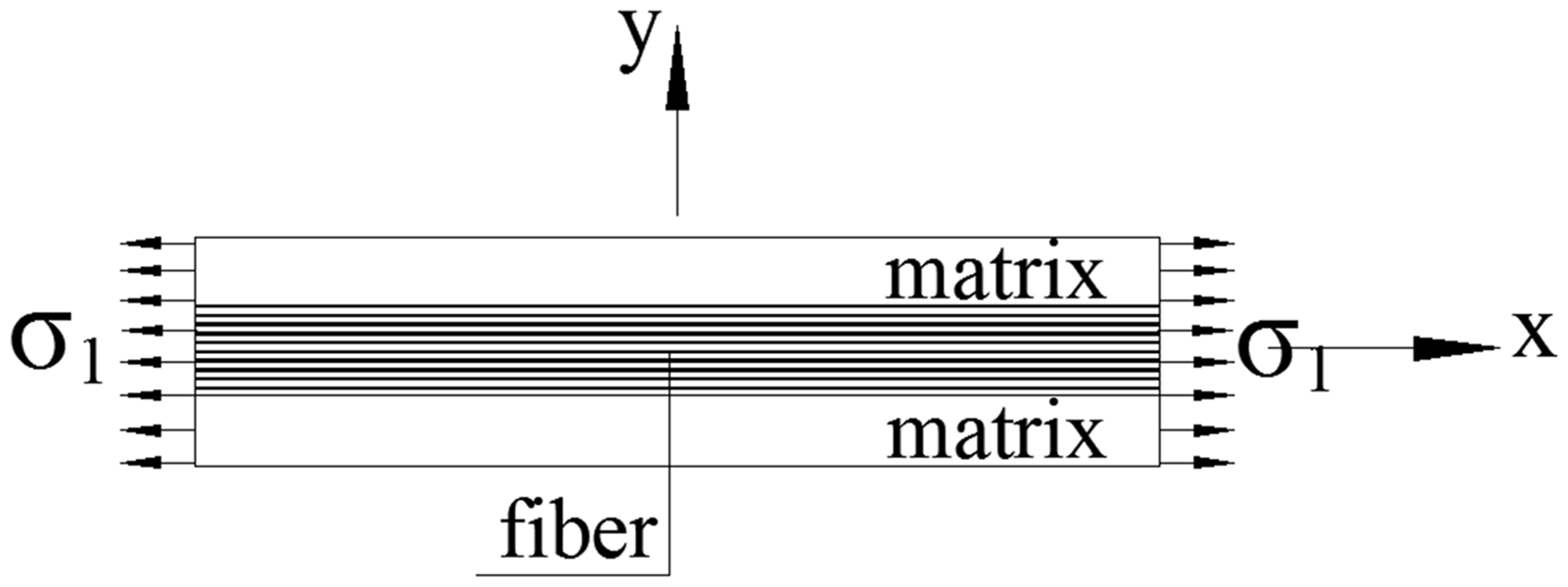
Representative volume unit.
As to the representative volume unit,

The volume of FRP is equal to sum of the volume of each fiber and matrix. Therefore

Define the fiber thickness

For linear elastic body, strain energy

The relationship between stress and of the linear elastic body follows the generalized Hooke's law. Therefore, equation (4) can be expressed as a function of the complementary energy

For the elastic body, the principle of minimum complementary energy indicates that, of the required equilibrium equation and the stress boundary condition, the complementary energy

The principle of minimum potential energy indicates that, of the required displacement boundary condition, the strain energy

The lower limit of elastic modulus

The complementary energy

where equation (9) is the whole volume integral of a representative volume unit, and could be decomposed into the integrals of fiber and resin matrix, respectively

For a representative volume unit, the complementary energy

Equation (6) can be further written as follows

Therefore, the lower limit of the elastic modulus
Determine the upper limit of elastic modulus

Apply the generalized Hooke's law

The fiber and resin substrate stress of allowable strain field can be obtained respectively
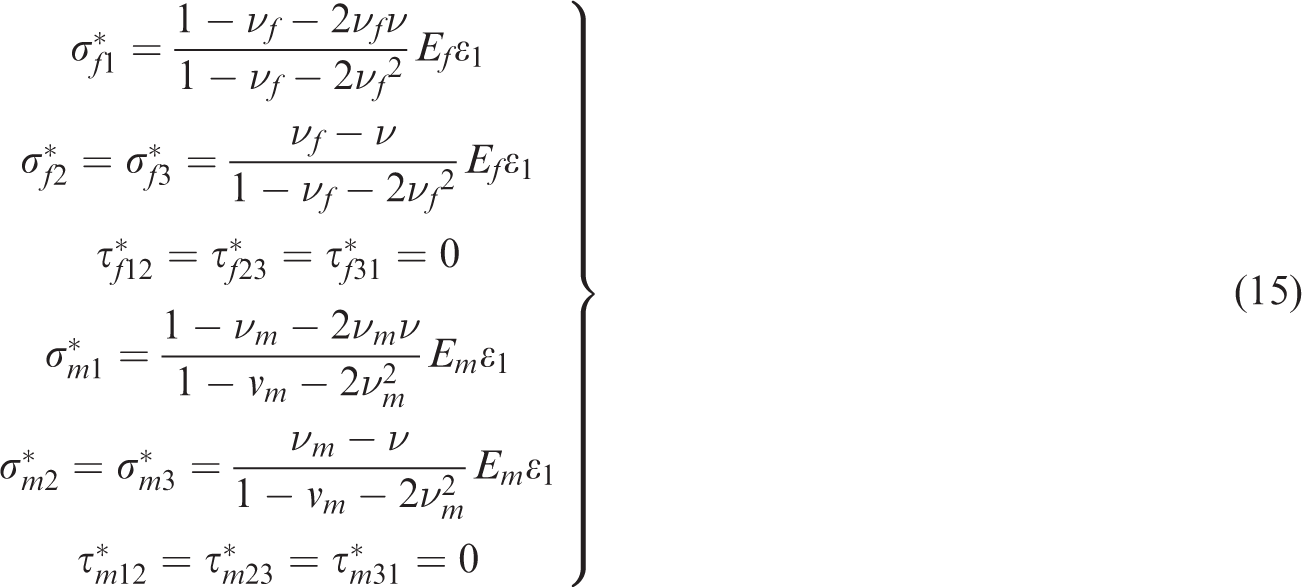
Substitute equation (13) and equation (15) into equation (4), and integrate in the fiber volume and resin substrate volume, respectively

For a representative volume unit, the corresponding potential energy of the real strain field can be expressed as

Substitute equations (16) and (17) into equation (7)

The apparent Poisson’s ratio
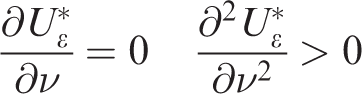
Take the derivative of equation (16) with respect to

Assume equation (19) be zero, and the solution can be obtained as follows

In addition, take the derivative of equation (19) with respect to

For the isotropic resin matrix and fiber, with Poisson’s ratio
While

If the gap in deteriorating FRP is ignored, equation (22) can be expressed as

Therefore,

Equation (24) shows that elastic modulus
Only resin substrate will remain in the natural aging FRP when
Elastic modulus deteriorating model for FRP natural aging
Equation (24) is employed to predict the upper and lower limit of the elastic modulus of deteriorated FRP induced by natural aging with different volume fraction, where

The upper and lower limits of elastic modulus are deduced from energy principle. Based on the theoretical analysis, the empirical coefficients are determined by the semi-empirical methods and natural aging test. The theoretical formula is revised to as simple as possible and is consistent with the test results. Since the degradation of fiber is generally slower and lighter than that of the resin matrix, the elastic modulus of deteriorated FRP is mainly determined by the elastic properties of the fiber, considering the influence of resin matrix. Coefficients

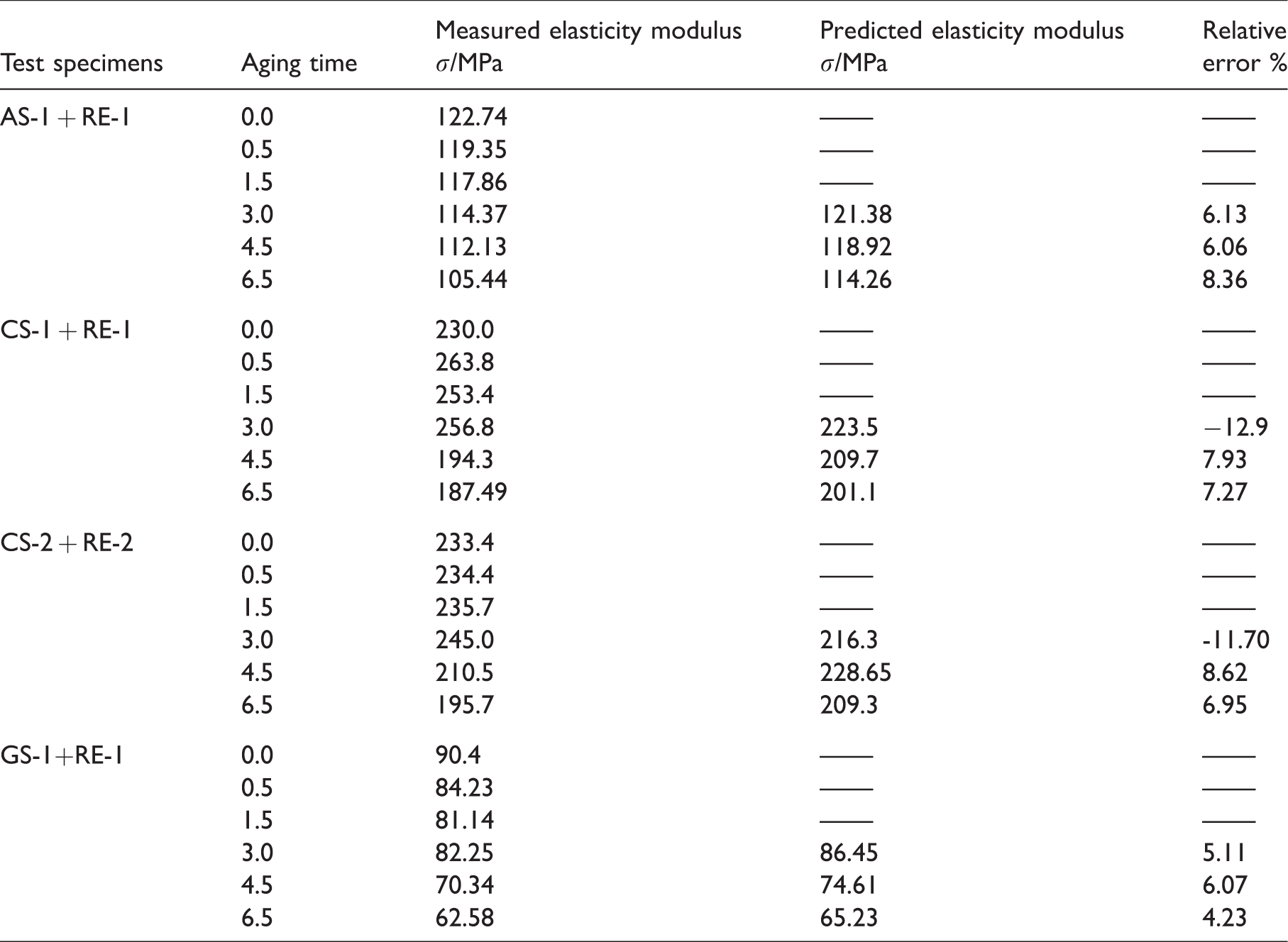
An experimental research to study the durability performance of different brands of FRP and resin substrate under climatic condition in East China has been done for more than 6.5 years.10 There are three different kinds of test specimens, which are carbon fiber reinforced polymer (CFRP) CS-1+RE-1, CS-2+RE-2, aramid fiber reinforced polymer (AFRP) AS-1+RE-1, and glass fiber reinforced polymer (GFRP) GS-1+ RE-1. According to the durability test data of elastic modulus for four different kinds of aging FRP under complex environmental effects after 0, 0.5, and 1.5 years, the coefficients in equations (26) is calculated as
Measured and predicted elasticity modulus of fiber reinforced polymer (FRP) after aging.
Conclusions
The deteriorating model for the prediction of the elastic modulus of the aging FRP under complex environmental effects is proposed. The proposed model, based on a semi-empirical formula, is simple and convenient for engineering application. For different fiber volume fraction, the experimental test is not the unique way to assess the durability of FRP, as long as the laws of fiber aging, the laws of resin aging, and the fiber volume fraction (or fiber nominal thickness
Footnotes
Declaration of conflicting interests
The author(s) declared no potential conflicts of interest with respect to the research, authorship, and/or publication of this article.
Funding
The author(s) disclosed receipt of the following financial support for the research, authorship, and/or publication of this article: This work is financially supported by National Natural Science Foundation of China (Grant No. 51878302, 51478197 & No. 51578255) and Natural Science Foundation of Fujian Province, China (Grant No. 2017J01093).