




Abstract
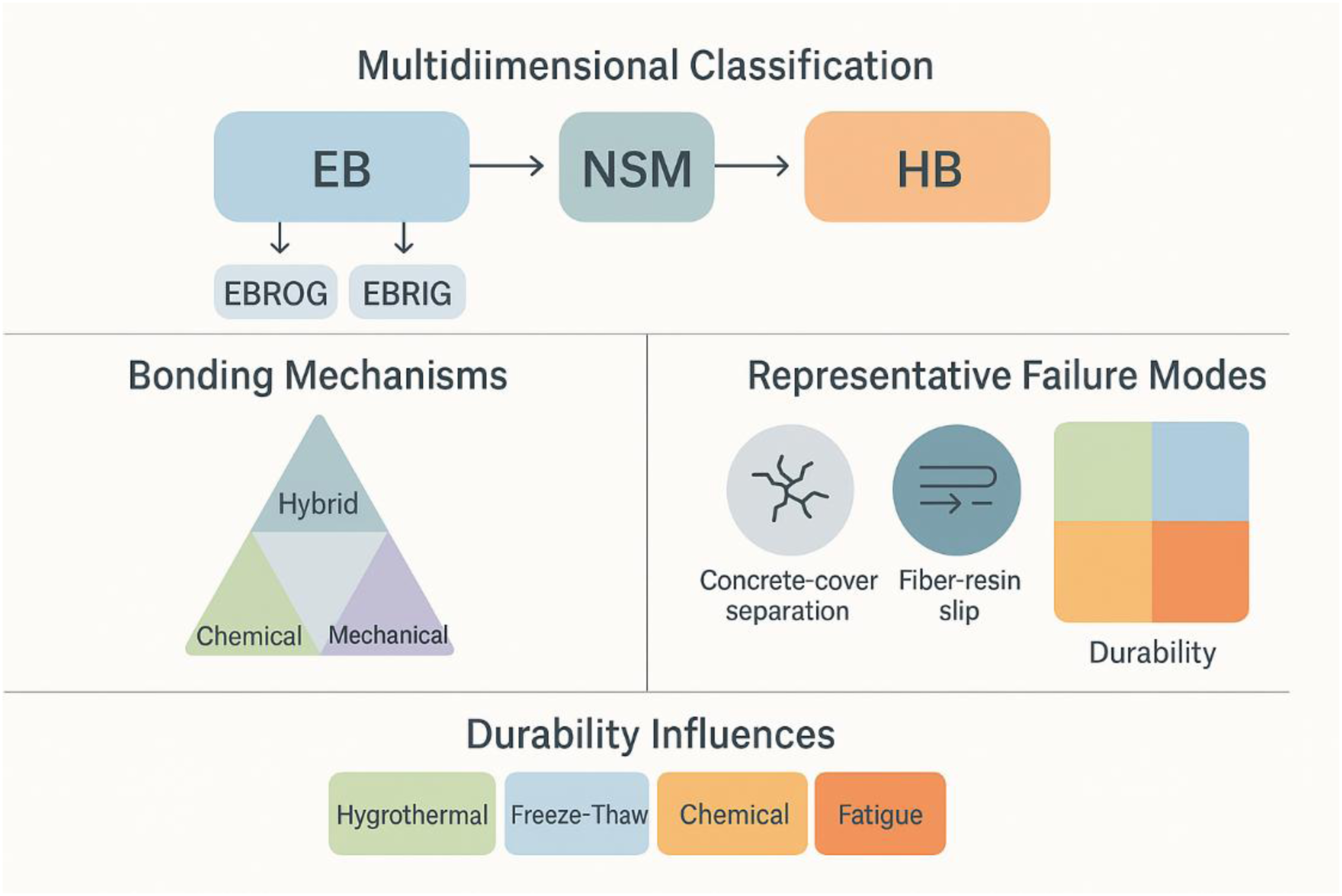
Due to its outstanding specific strength, corrosion resistance, and fabrication flexibility, Fiber Reinforced Plastic (FRP) presents considerable potential as an alternative to conventional reinforcement materials in the strengthening and rehabilitation of concrete structures. However, the issue of premature debonding at the FRP–concrete interface poses a critical challenge, significantly affecting the stability and reliability of its strengthening performance. To address this problem, researchers have proposed a variety of connection configurations aimed at mitigating interfacial failure, leading to the development of representative systems such as externally bonded (EB), near-surface mounted (NSM), and hybrid bonded (HB) techniques. This paper systematically reviews the developmental trajectories and structural evolution of these typical FRP connection technologies, compares their differences in load-bearing capacity, interfacial behavior, applicable scenarios, and durability performance, and summarizes key advances in experimental investigations and theoretical developments. The main challenges in mechanistic understanding and standardized application are identified. Finally, future research directions are proposed, including interface regulation, environmental adaptability assessment, and integration into engineering systems. This study provides a comprehensive understanding and forward-looking perspective for advancing the theoretical foundation and practical implementation of FRP connection technologies.
Keywords
Get full access to this article
View all access options for this article.