




Abstract
The smart structures with the harmonic nonlinear vibration are used widely to broaden the frequency range of vibrations energy harvesting. However, it is presently considered that the smart materials have some hysteresis properties. These hysteresis properties have much negative influence on the harvested energy not to be supplied more quickly and more accurately to the micro-systems applications. In the paper, the super-harmonic vibration of a piezoelectric energy harvester is discussed with considering the hysteresis phenomenon, and the piezoelectric energy harvester is described by the Bouc–Wen equation. Moreover, it is observed that there is a stronger hysteresis property when the piezoelectric energy harvester is applied with an external excitation at the harmonic frequency. It is analyzed that the hysteresis will bring about a delay of the harmonic vibration frequency of the energy harvester compared with that without considering hysteresis. Furthermore, it is concluded that the hysteresis decreasingly impacts the super-harmonic vibration of the bi-stable piezoelectric energy harvester when the external excitation is gradually increasing.
Introduction
In recent years, the energy harvesters have been attracted wide attention to scavenge small amounts of the ambient energy from the environment by making full use of super-harmonic vibration property with smart structures. 1 It is indicated that the nonlinear behavior can not only offer new capabilities to capture energy available from more complex excitations but also have the advantage of broadening the frequency range of vibrations energy harvesting.2,3 By the super-harmonic vibration behavior, a nonlinear resonator is designed and fabricated for ultra-wide-bandwidth energy harvesting applications, 4 the nonlinear resonances can activate large-amplitude motions at fraction integers of the fundamental frequency of the system, 5 a mathematic model for the nonlinear energy harvester may be simplified as the form of a Duffing oscillator 6 and a new method for the dynamical features of stochastic nonlinear oscillators is proposed, 7 and the performances of nonlinear energy harvesters are researched by exploiting benefits of a periodically forced double-well oscillator. 8
However, it has been thought that the smart structures have other nonlinearity, for example, hysteresis phenomenon.9,10 This phenomenon will affect the accuracy of the energy harvesters. Many mathematical models of smart structures have been constructed without considering hysteresis property. 11 Especially for the self-powered microsystems, 12 a vibration-powered characteristic equation for a magnetostrictive-piezoelectric composite generator is presented. 13 Some researchers have validated experimentally the bidirectional hysteresis model of a nonlinear energy harvester to broaden the frequency range of energy harvesting 14 and many mathematical models have been presented, for instance, a method is proposed to avoid hysteresis in magnetostrictive-piezoelectric sensor. 15 Furthermore, a numerical technique developed to compensate the effects of hysteresis of a hybrid piezoelectric fiber optic voltage sensor is shown. 16 But it is not investigated how the hysteresis has influence on the super-harmonic vibration property of the energy harvester for describing the hysteresis property of smart materials as sensors or actuators. Therefore, the hysteresis properties in energy harvesters with smart materials must be considered and be explored for the harvested energy to be supplied more quickly and more accurately to micro-systems applications. A model describing the mechanical behavior of electrostrictive polymers with taking into account the mechanical losses is presented, 17 and a study is explored through macroscopic and local measurements of nonlinear behavior in mechanically clamped and released PZT films. 18
In the paper, we focus on the energy harvesting of a Duffing oscillator with the hysteresis property in piezoelectric material. A model of the Duffing oscillator characterizing electro-mechanical coupling 5 with the Bouc–Wen equations19,20 is proposed to describe the hysteresis and to explore its influence on dynamical characteristic of a Duffing system. The rest of the paper is as following: the nonlinear energy harvester is dynamically modeled to depict the influence of hysteresis property in piezoelectric material on the energy harvesting in the next section. Then the numerical simulation results of small and large based excitations for the nonlinear model are given. Finally, the last section presents some conclusions.
Modeling the nonlinear energy harvester
Figure 1 shows a cantilever beam bonded with a piezoelectric patch. When the beam suffers from a constant force P at vertical direction, an induced voltage in piezoelectric material is produced to scavenge small amounts of the ambient energy from the environment.
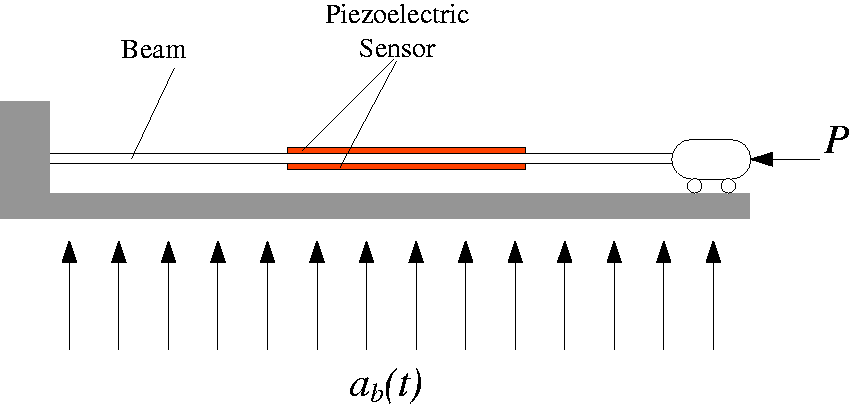
Smart beam.
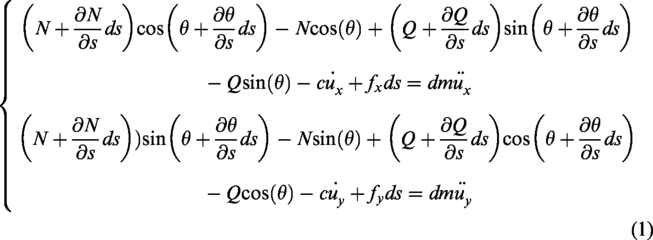
An infinitesimal element method is proposed to model the nonlinear property for the smart beam as shown in Figure 2. N, Q and M are the axial force, the shearing force and the bending moment, respectively. Moreover, θ is the angle between the x-axis and the center axis of the beam. And ds is the length of the infinitesimal element. ‘b’ and ‘s’ represent ‘beam layer’ and ‘sensing layer’, respectively. A equation set is gained by force balance principle and is expressed as

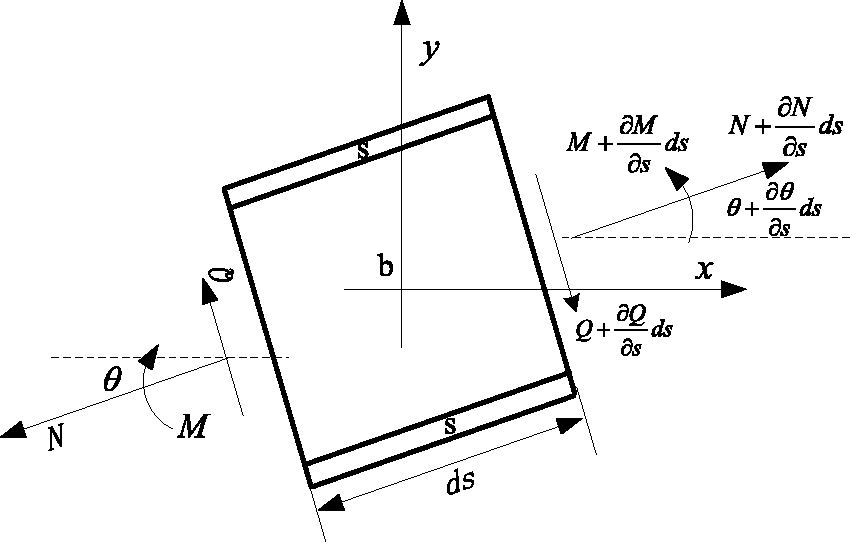
Infinitesimal element of the bimorph.
Therefore, submitting dm, ds and equation (2) into equation (1), and
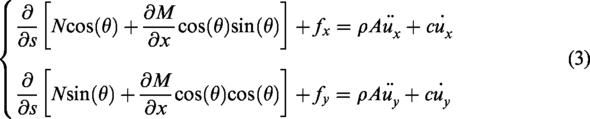
Then, because of
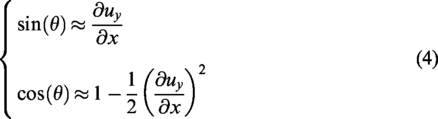
In addition, the longitudinal displacement
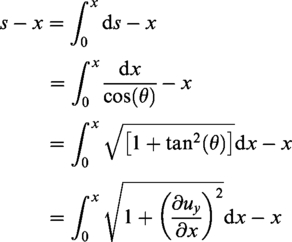
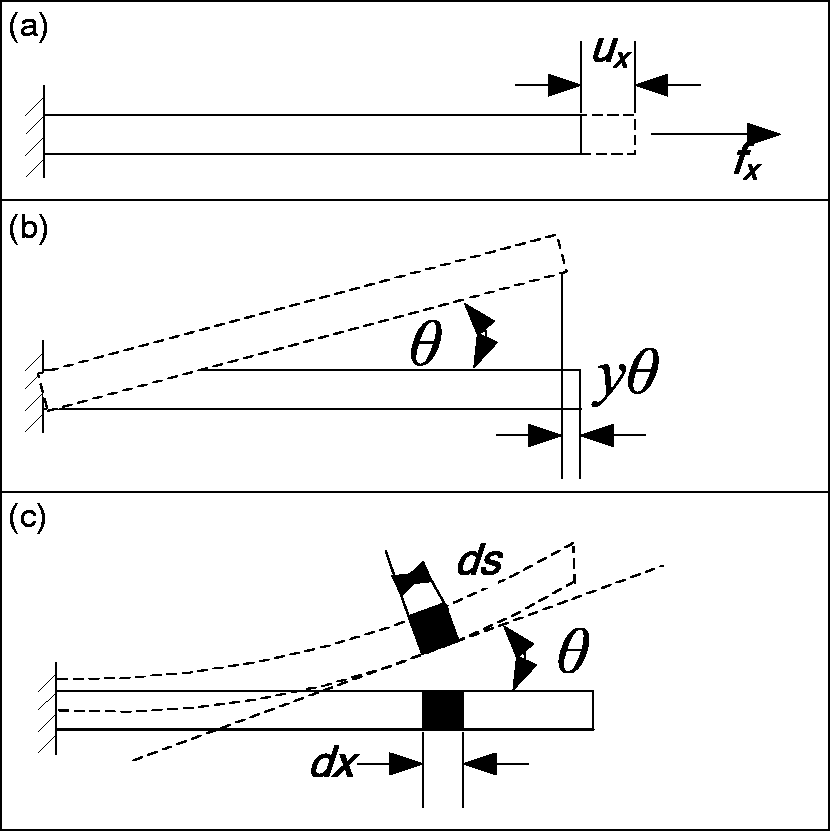
Longitudinal displacement.
Therefore,

And the corresponding stress is expressed as

Hence, the axial force is derived as
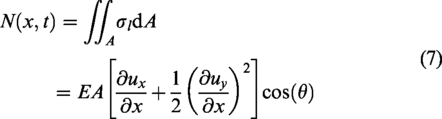
And the bending moment is gained as
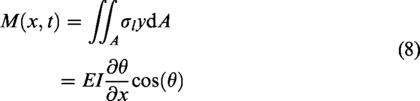
Because of

Assuming
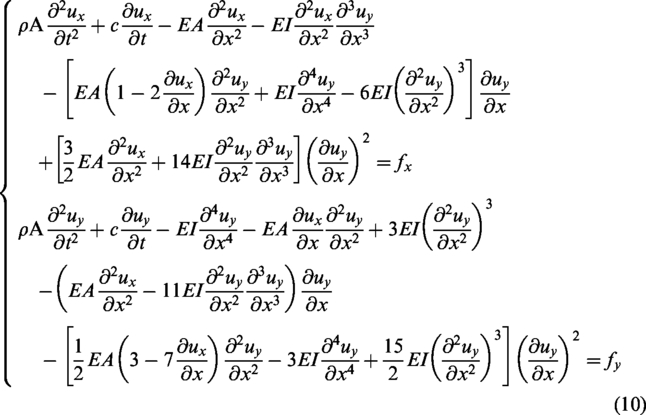
Compared with the displacement along the horizontal direction, the displacement

Through the force analysis for the beam, the boundary condition is given as

If the beam is subjected to a constant force at right end, the axial force is presented as

Therefore, the partial derivative of the axial force N with respect to x is gained as

Because the beam is a continuum structure, the displacement

Then equation (15) is substituted into the second equation of equation (10), yielding to



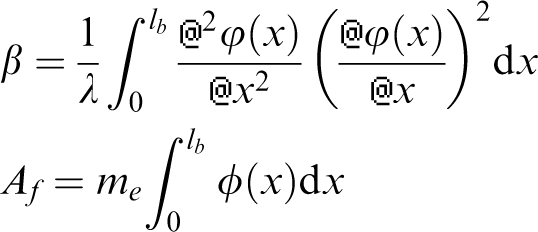
The output voltage

However, no matter whether the piezoelectric materials are used as actuators or sensors, the hysteresis property appears in the piezoelectric crystals. Therefore, considering the hysteresis characteristic in energy harvester is necessary for micro-electronics equipments. Compared with other models describing hysteresis phenomenon, it is found that the Bouc–Wen model has more intuitive way for rebuilding the inherent hysteresis curve only by few identified parameters.
6
Bouc–Wen model is merely consisted of a first-order nonlinear differential equation, while the model with its parameters may well shape the hysteresis loop.
5
The Bouc–Wen equation is as follows

Equation (17) is combined with equation (18), yielding to

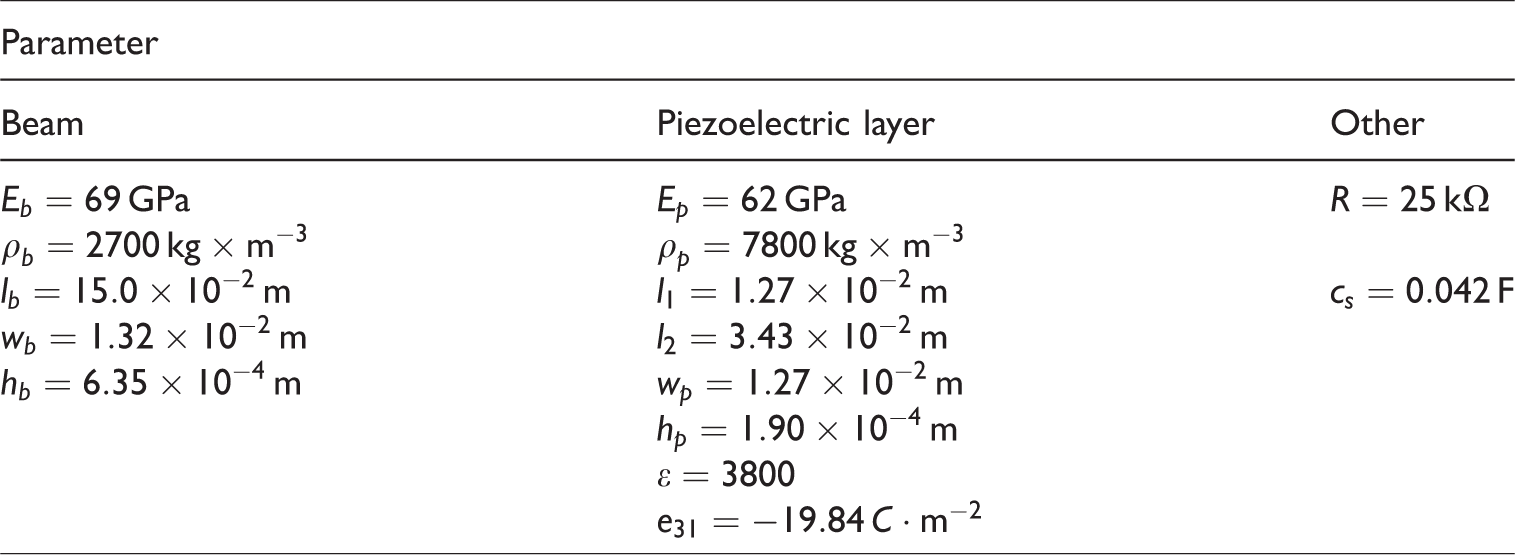
Some simulations are implemented for equation (19) and the corresponding parameters are given in Table 1. Furthermore, when the external excitation accelerations
The corresponding parameters.
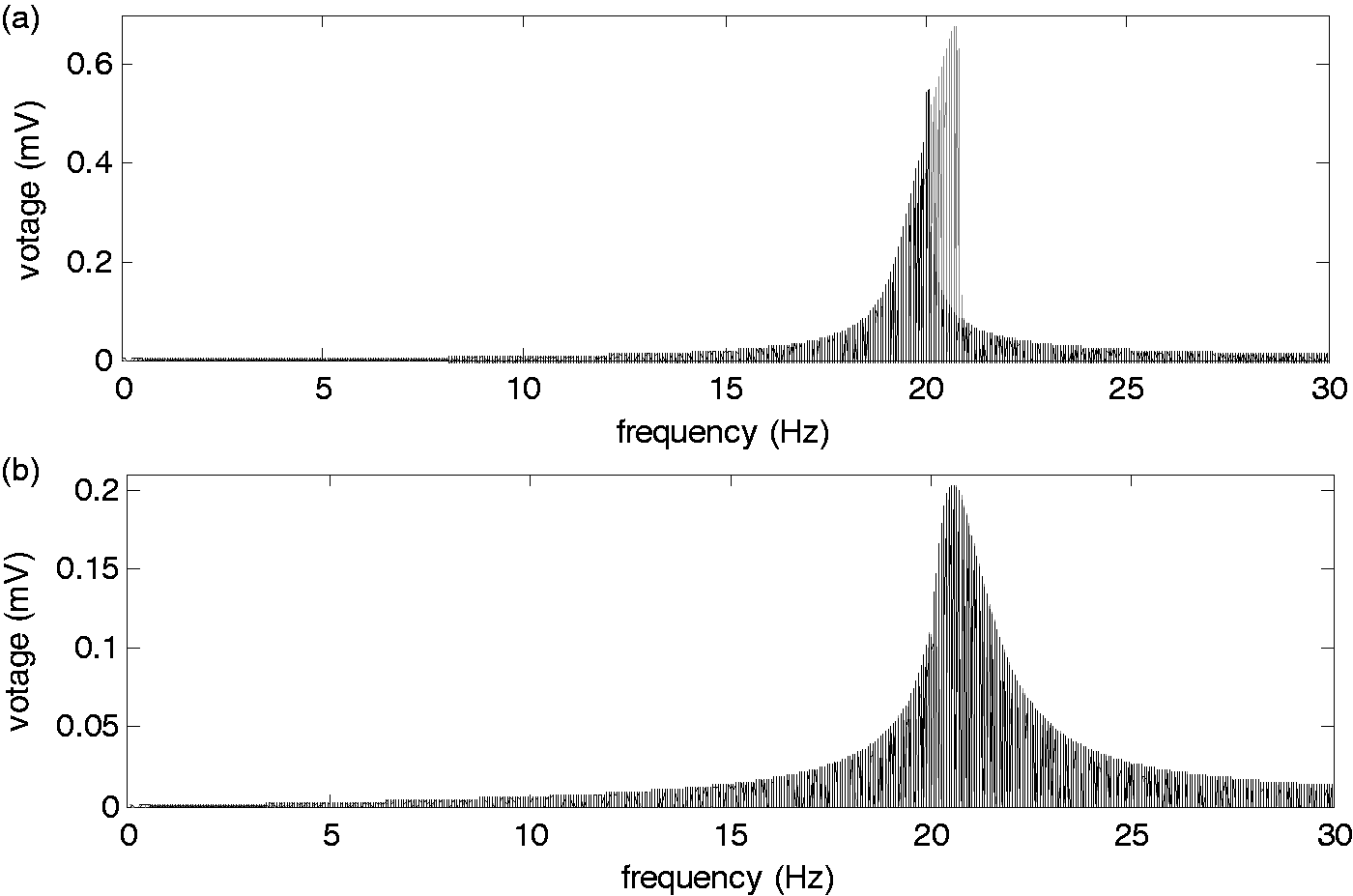
Amplitude–frequency response of voltage at acceleration 0.01 m2/s and frequency 0–30 Hz.
Figure 4 shows the amplitude–frequency response of voltage at acceleration 0.01 m2/s and frequency 0–30 Hz. When the sweep frequency of the acceleration is increasing gradually from 0 Hz to 30 Hz, the black curve falls behind the gray curve at natural frequency for about 20 Hz on the horizontal axial as shown in Figure 4(a). Especially, the voltage amplitude with hysteresis lags to that without considering hysteresis at frequency about 1.5 Hz. However, when the sweep frequency of the acceleration is decreasing gradually from 30 Hz to 0 Hz, the amplitude–frequency response is different from the increasing case. It appears to be little different between the black curve and the gray curve as shown in Figure 4(b). Therefore, the hysteresis property does not affect the case when the frequency of the chirp acceleration is decreasing.
The amplitude–frequency response of voltage at acceleration 0.1 m2/s and frequency 0–50 Hz is given in Figure 5. Obviously, when the excitation acceleration amplitude is enlarged under an increasing frequency from 0 Hz to 50 Hz, the voltage amplitude curve with hysteresis lags to that without hysteresis at frequency for about 4 Hz as shown in Figure 5(a). And it is clear that there is little difference between the black curve and the gray curve as shown in Figure 5(b) when the sweep frequency of the acceleration is decreasing gradually from 50 Hz to 0 Hz.
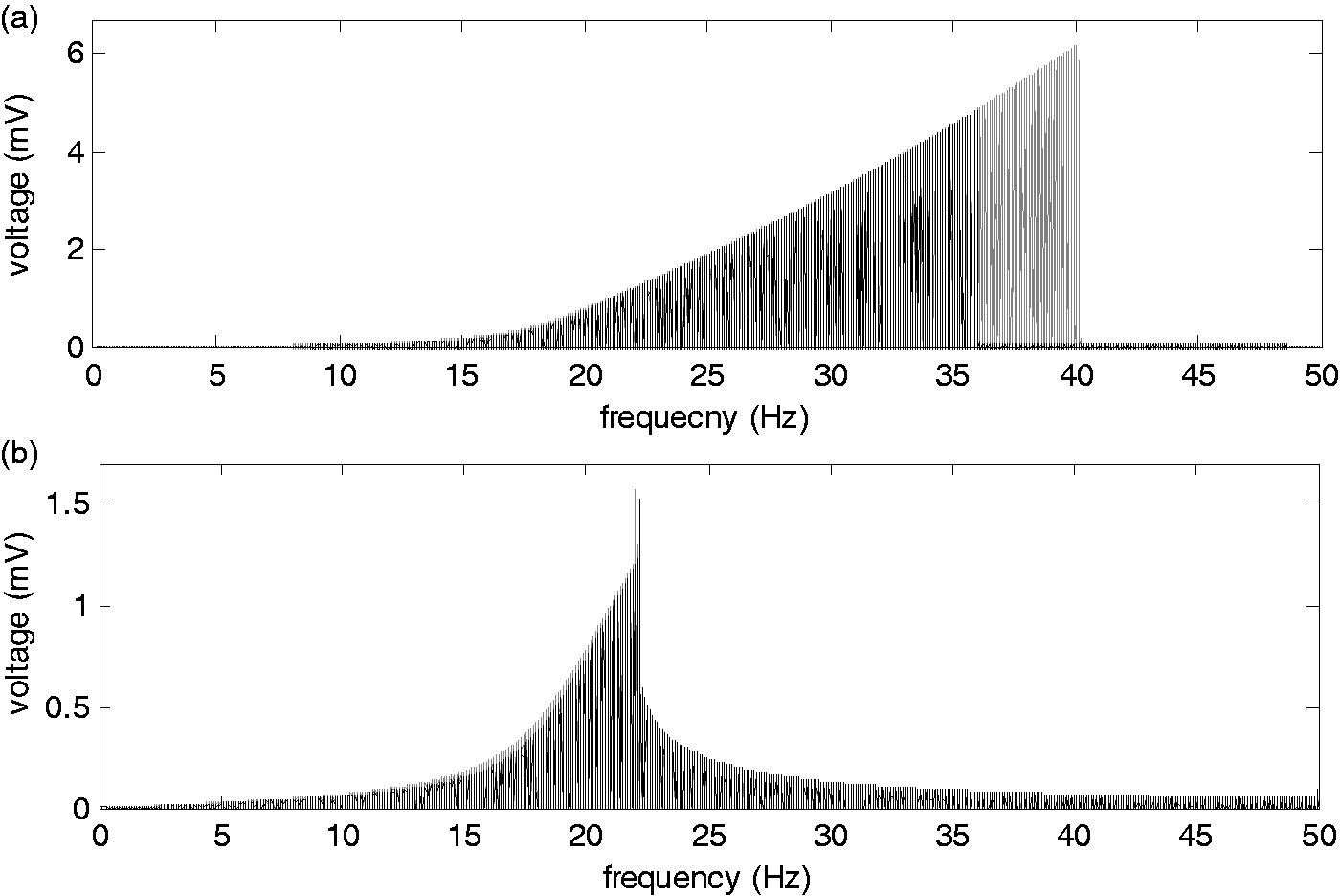
Amplitude–frequency response of voltage at acceleration 0.1 m2/s and frequency 0–50 Hz.
In Figure 6, the amplitude–frequency response of the output voltage at excitation acceleration amplitude 1 m2/s and frequency 0–125 Hz is presented. When the excitation acceleration frequency is increasing, the amplitude–frequency response with hysteresis lags to that without hysteresis at frequency for about 3 Hz as shown in Figure 6(a). Moreover, when the acceleration amplitude is increasing to a certain degree, the amplitude–frequency response has a super-harmonic property at low frequency of about 8 Hz and 30 Hz for the decreasing frequency case as shown in Figure 6(b). Similarly, the black curve and the gray curve almost overlap together.
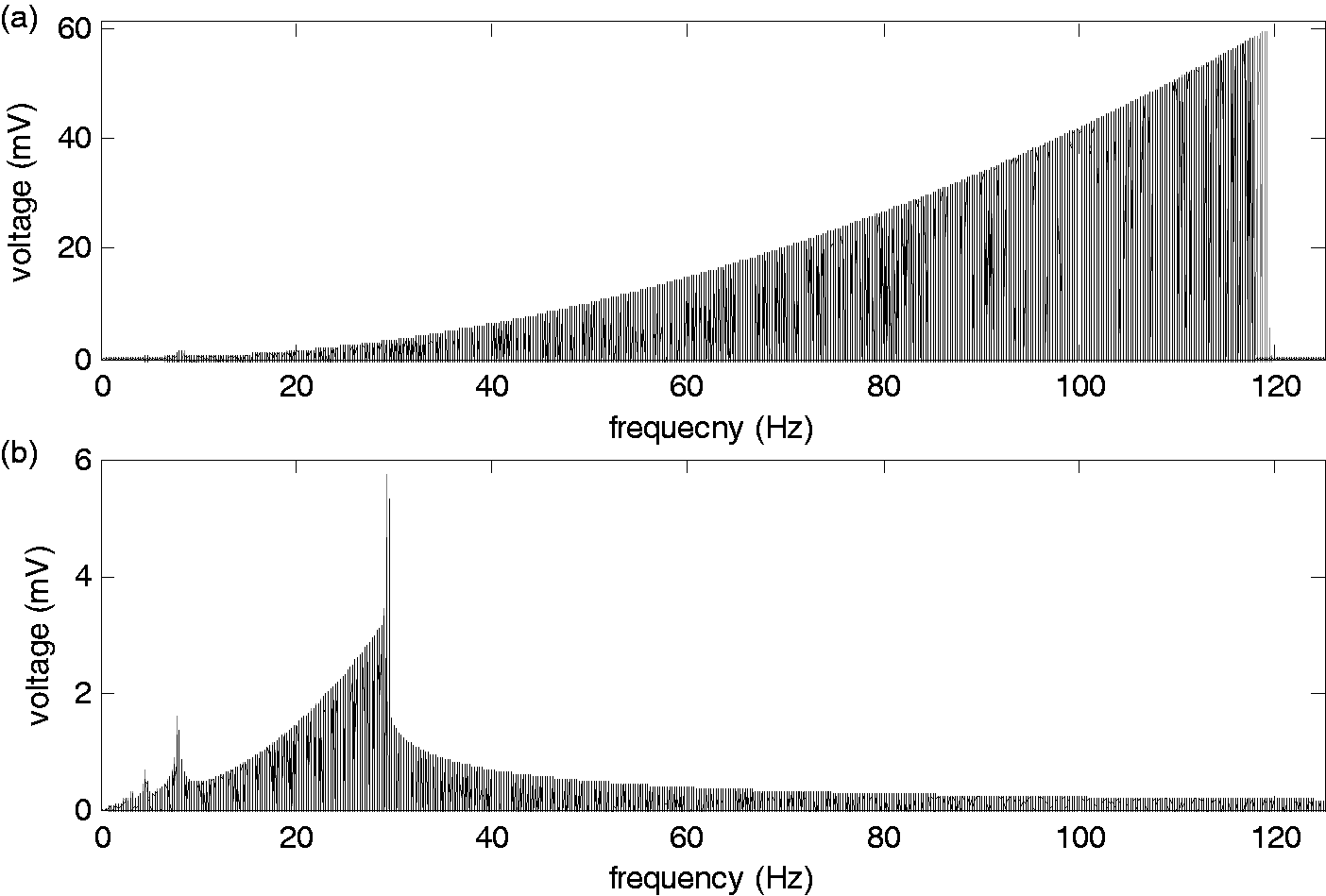
Amplitude–frequency response of voltage at acceleration 1 m2/s and frequency 0–125 Hz.
From the energy harvesting description of equation (19) and the simulation results, the hysteresis property has negative influence on the amplitude–frequency response of the output voltage from piezoelectric layer, and it makes the output voltage response lag behind that without considering hysteresis when the frequency of the external excitation acceleration is increasing. However, it appears little different between the voltage response with hysteresis and that without hysteresis when the frequency of the excitation acceleration is decreasing.
Results and discussion
For the above mathematical model, when the smart beam suffers from a weak or strong excitation acceleration, the frequency response of the output voltage with an increasing frequency has a lag to the case of decreasing frequency. Moreover, the frequency response has super-harmonic property with a strong excitation. But many researchers only give analysis results of the frequency lag,22,23 and they did not study how the time delay through the time history affects the super-harmonic response when the piezoelectric material is considered with hysteresis phenomenon. Therefore, by the dynamical model of the smart beam equation (19), a hysteresis influence on the energy harvestor is analyzed. Moreover, the hysteresis property and super-harmonic characteristic for the smart beam are proposed at small- and large-based excitations. From Figures 7 to 10, it is shown how these properties affect the super-harmonic vibration of the energy harvester, which are discussed in the following sections.
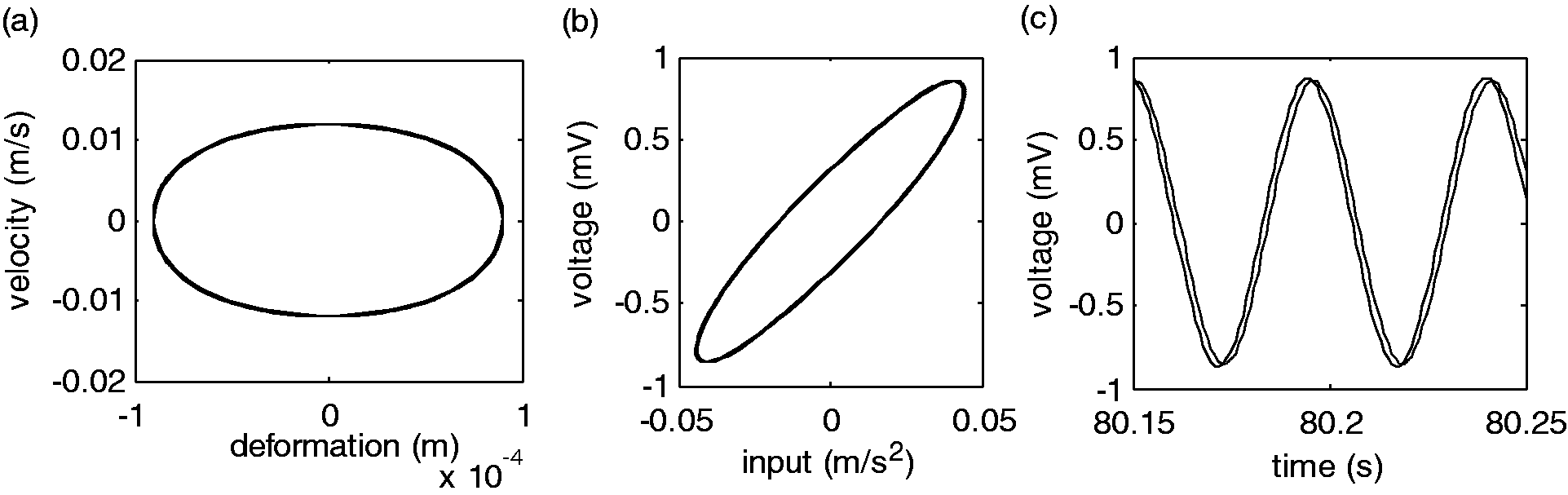
Phase portrait, hysteresis property and time histories at acceleration 0.044 m2/s and frequency 22 Hz.
Small-based excitations
Figure 7 gives the descriptions of phase portrait, hysteresis property and time histories at acceleration 0.044 m2/s and frequency 22 Hz. Figure 7(a) shows a simple loop of phase portrait, Figure 7(b) presents the hysteresis property between acceleration excitation and output voltage of piezoelectric layer, and Figure 7(c) indicates two curves: one solid curve is the voltage with hysteresis, and the other dotted curve is the voltage without hysteresis.
When the acceleration amplitude is increasing, the two properties have different expression forms. From Figure 8(a), it can be seen that the phase portrait is presented with three loops. Figure 8(b) shows the hysteresis property with three loops. And the time histories are not harmonic vibration but periodic vibration as shown in Figure 8(c). Moreover, the time history (solid line) with hysteresis lags to the time history (dotted line) is shown in Figure 8(c).
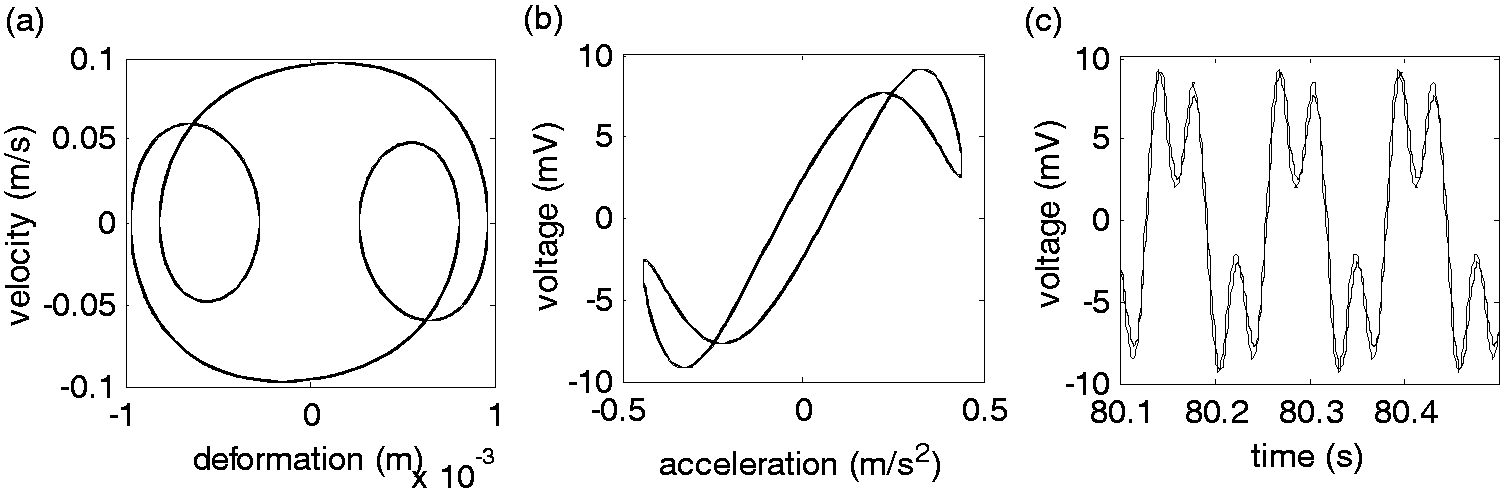
Phase portrait, hysteresis property and time histories at acceleration 0.44 m2/s and frequency 7.9 Hz.
Figure 9 shows the phase portrait, hysteresis property and time histories at acceleration 1.77 m2/s and frequency 18.7 Hz. Figure 9(a) gives the phase portrait with two loops. Then Figure 9(b) presents hysteresis between the acceleration and output voltage with two loops. Furthermore, from Figure 9(c), the two time histories almost overlap. It is indicated that the hysteresis property is less and less when the acceleration amplitude is increasing gradually.
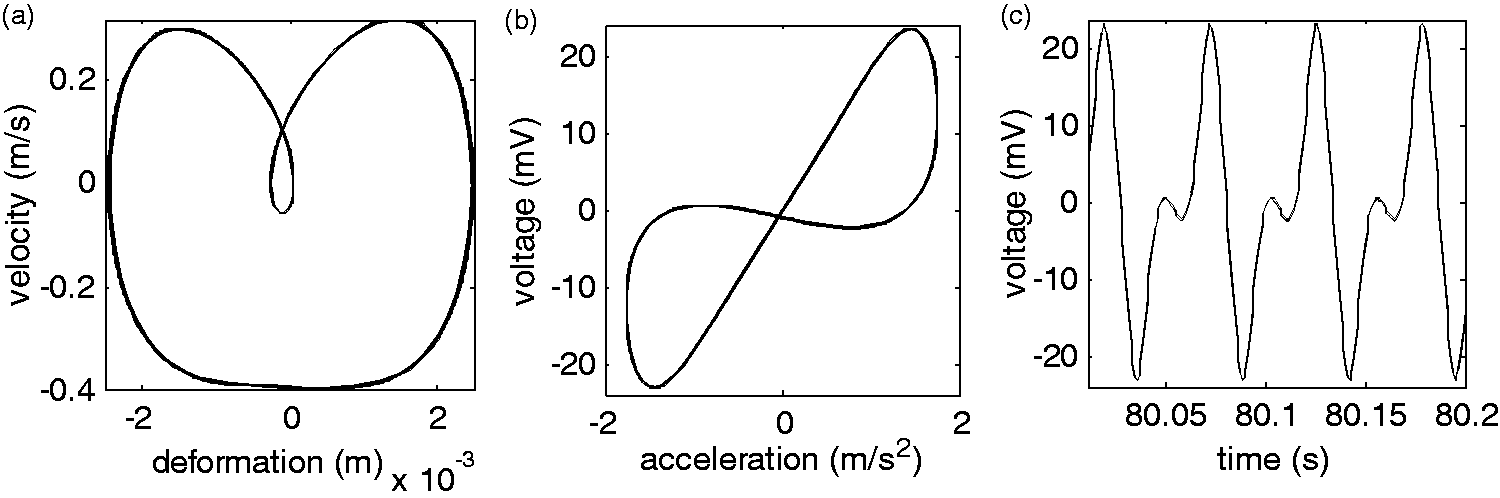
Phase portrait, hysteresis property and time histories at acceleration 1.77 m2/s and frequency 18.7 Hz.
Large-based excitations
When the acceleration amplitude is 10 m2/s and its frequency is 8.5 Hz, Figure 10 shows the chaotic characteristic for the smart beam. Figure 10(a) gives the phase portrait between the deformation and velocity. Figure 10(b) presents Poincare phase plane. Then, the time history of the voltage is shown in Figure 10(c). However, when the acceleration amplitude is overlarge, it appears that the hysteresis property has less influence on the voltage response of the piezoelectric layer on the smart beam.
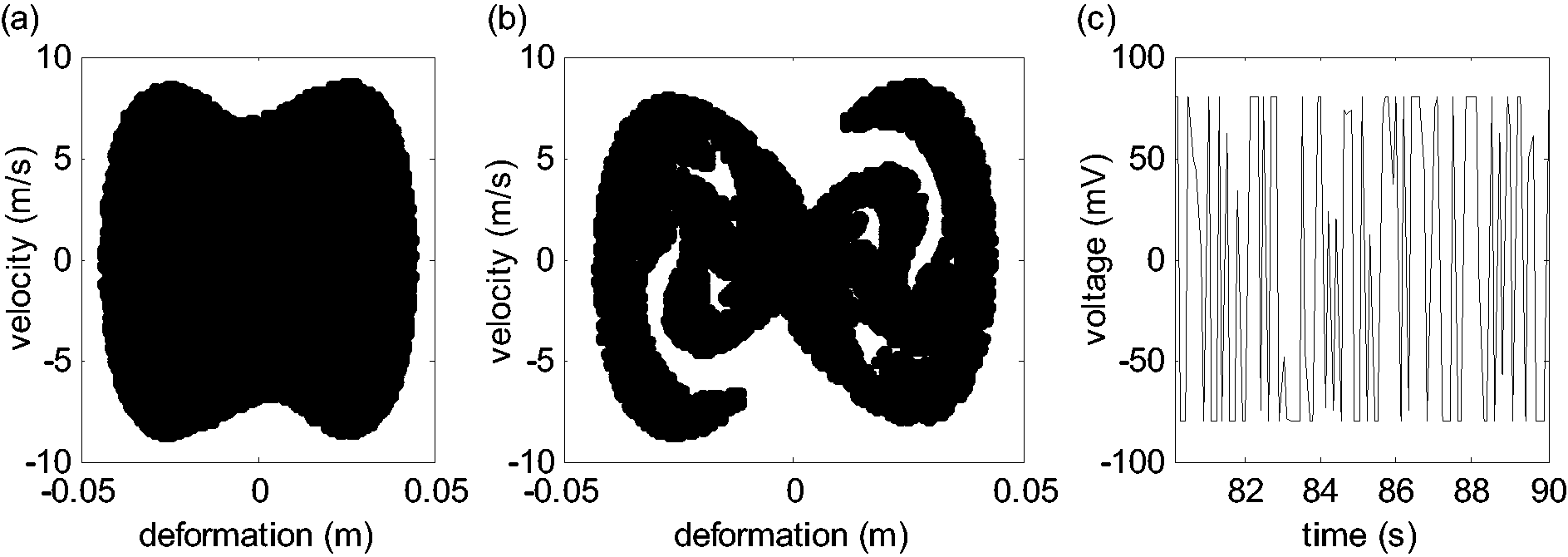
Phase portrait, Poincare phase plane and time histories at acceleration 10 m2/s and frequency 8.5 Hz.
For the above results and discussion, the hysteresis property has much influence on the voltage of the piezoelectric layer when the acceleration is a small-based excitation. However, if the acceleration amplitude is overlarge, the hysteresis property almost affects the voltage response of the smart beam. Even the chaos appears when the excitation acceleration is applied at overlarge amplitude and resonant frequency. In a word, when the piezoelectric voltage has large response with a gradually increasing large excitation applied on the beam, the hysteresis property has less and less influence on the voltage response through harvesting energy for the smart beam. Compared with the recent studies from other researcher,22,23 they only focused on the softening nonlinearities, coupling nonlinearities or hysteresis alone. However, under a small excitation, the hysteresis of smart materials is not allowed to be ignored because it has significant effect on the frequency response of the energy harvestor. Or to be more specific, the hysteresis property from smart materials may affect the softening nonlinearity and super-harmonic nonlinearity of energy harvestor.
Conclusions
In the paper, a dynamical model is constructed to a smart beam for the purpose of harvesting energy with the coupling theory of transverse and lengthwise vibrations. It is used to describe the hysteresis property and super-harmonic vibration of the smart beam. Through some simulations and discussions, it is concluded that the hysteresis property has a negative influence on the frequency response of the output voltage, and it makes the voltage have a lag to that without considering the hysteresis. However, when the external excitation amplitude is increasing gradually and overlarge, the hysteresis in piezoelectric layer almost do not affect the voltage response. Moreover, it appears to be super-harmonic vibration or even chaos. From other point of view, the hysteresis property from smart materials may affect the softening nonlinearity and super-harmonic nonlinearity of energy harvestor.
Footnotes
Declaration of conflicting interests
The author(s) declared no potential conflicts of interest with respect to the research, authorship, and/or publication of this article.
Funding
The author(s) disclosed receipt of the following financial support for the research, authorship, and/or publication of this article: This work was supported by National Natural Science Foundation of China (11702168).