




Abstract
Keywords
Introduction
The seamless integration of “health and life science,” “information science and technology,” and “mathematics and statistics” has paved the way for digital health and health informatics (DHHI) and unlocked endless possibilities for continuous innovation, which is becoming an essential part of wellness, healthcare, and medicine. The fundamental goal of DHHI is to ensure the delivery of safe, efficient, and accessible healthcare to every individual. Therefore, scientific projects now involve multicentric teams from different countries and cultures with diverse capabilities and expertise, speaking different languages. Thus, projects with partners are challenging and growing increasingly complex.
The European Federation for Medical Informatics (EFMI) aims to improve broadly health-related informatics research, education, knowledge, and industrial transfer. The EFMI Working Group (WG) on Health Informatics for Inter-regional Cooperation (HIIC) is committed to enhancing the quality of communication between international health informatics research partners.1,2 Also, EFMI partnered with 23 other partners in 12 European countries and worldwide in the Horizon 2020 European project “HOspital SMART development based on Artificial Intelligence” (HosmartAI). HosmartAI aimed to transform the healthcare system through technological developments in AI and robotics to make it more effective and efficient. 3
One leading objective of the EFMI WG HIIC, starting in 2018, is to develop a multilingual controlled vocabulary that moved to MIMO, a medical informatics and digital health multilingual ontology, frequently updated, focusing on DHHI.2,4 MIMO has been developed collaboratively, involving experts in digital health, health informatics, and applied artificial intelligence. This approach makes MIMO relevant to every health professional interested in these fields. Accordingly, MIMO is, in this context, a structured set of terms and concepts, an innovative tool to enhance digital health training.5,6 From a technological perspective, MIMO was developed as a formal ontology using Protegée; then, it was integrated into HeTOP as a terminology (without means of inference at this level). After modification in HeTOP, exporting to OWL to return to Protégé is still possible.
Below, we introduce the methodology we used to develop MIMO as a ubiquitous component supporting healthcare education transformation and helping introduce artificial intelligence and digital health to healthcare practitioners in emerging smart hospitals. Then, we present some in-practice use cases of MIMO before discussing them and looking at further perspectives.
Material and methods
In 2018, the MIMO project began as a basic resource (a multilingual dictionary) and evolved into a more advanced one (a multilingual ontology) by 2022.2,4 During its development, the MIMO team extensively researched established health terminologies and ontologies, such as the Medical Subject Headings (MeSH), the Systematized Nomenclature of Medicine Clinical Terms (SNOMED CT), the National Cancer Institute thesaurus (NCIt), the Medical Dictionary for Regulatory Activities (MedDRA), and various editions of the ICD.7–11 Over time, both MeSH and NCIt were the most comprehensive resources for DHHI concepts. Subsequent revisions and updates were made between 2022 and 2024. Indeed, the current version comprises 3734 concepts, meaning an increase of 250% since 2022. This change is due to terms and concepts imported from existing broader terminologies (e.g., MeSH, NCIt, SNOMED-CT) and the addition of hundreds of new concepts (e.g., “smart watch”, https://www.hetop.eu/hetop/en/#rr=EFMI_TE_300174&oti=T_DESC_EFMI_TERM&q=smart+watch; “International Medical Informatics Association”, https://www.hetop.eu/hetop/en/#rr=EFMI_TE_69&oti=all&q=IMIA).
Moreover, unique hierarchies were defined into MIMO to handle terms and concepts missing in other reference systems. For example, considering specifically HosmartAI, we have added to MIMO a branch dealing with “Smart Health” (available at the following link: https://www.hetop.eu/hetop/?la=en&q=#rr=EFMI_TE_300171&tab=1) organized as presented in Figure 1. Screenshot of “Smart Health” hierarchy in HeTOP.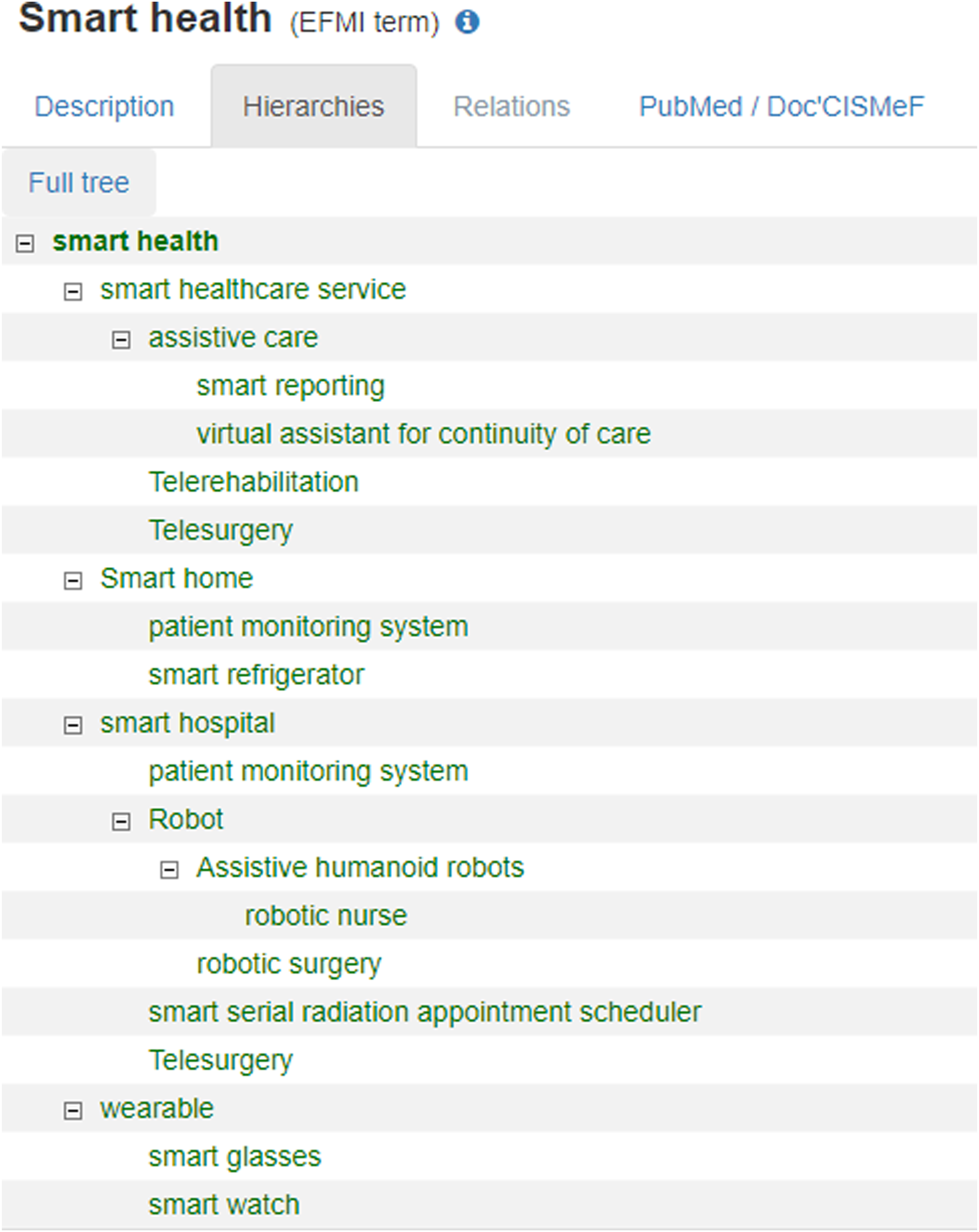
Some terms refer to HosmartAI Pilots such as “Robotic Nurse” (HosmartAI Pilot 5), 12 “Smart Serial Radiation Appointment Scheduler” (HosmartAI Pilot 2), 13 “Telesurgery” (HosmartAI Pilot 4), 14 “Telerehabilitation” (HosmartAI Pilot 3), 15 “Virtual Assistant for Continuity of Care” (HosmartAI Pilot 6), 16 and “Smart Reporting” (HosmartAI Pilot 7). 17
As presented below, we conducted case studies to assess the feasibility and impact of integrating MIMO into real-world healthcare settings.
Results
MIMO is a readily available knowledge resource
A continuous objective of the MIMO’s initiative is to make it available to the digital health and health informatics community. By considering development, hosting, maintenance, integration of resources from other existing controlled vocabularies, and the need to be easily accessible with a user-friendly interface, encouraging regular utilization of the dictionary, the HeTOP terminology server has been selected as a first choice.4,18,19 HeTOP is a comprehensive cross-lingual health terminology and ontology server offering resources with over 2 million concepts, over 100 terminologies, and ontologies in more than 50 languages.18,19
MIMO is open-source, free, and accessible, which enables its dissemination, growth, and maintenance to be more efficacious. 4 MIMO is available on HeTOP 19 at the following link: https://www.hetop.eu/hetop/rep/fr/EFMIMIMO/. Additionally, it can be accessed on-demand as an OWL (Web Ontology Language) file, which can be requested via email at cismmtREPLACE_WITH_ATchu-rouen.fr. It is also available through the HeTOP API (Application Programming Interface). Considering that the French Digital Health Agency (in French: Agence du Numerique en Sante, ANS) has its own terminology server (available at the following link: https://smt.esante.gouv.fr/), including 28 reference terminologies, HeTOP does not provide any dissemination process, as ANS aims to disseminate reference terminologies in a centralized manner from a governmental perspective. Nonetheless, the HeTOP team may quickly develop this dissemination process in the future and concertation with said ANS. Thus, HeTOP’s management team and MIMO’s development team are considering sharing MIMO on other platforms, such as Bioportal. In March 2024, MIMO comprises 3730 concepts, partially imported from MeSH (708/3730; 19.0%), NCIt (2500/3730; 67.0%), SNOMED-CT (230/3730; 6.2%) concepts, and 253 (6.80%) newly (and constantly increasing) created concepts. The overall number of concepts overshoots with an initial target of 2500 defined in 2022 (33.0% more than expected).
The new versions of several reference terminologies are systematically reviewed, particularly MeSH, SNOMED-CT, and NCIt. For example, the concept of “digital health” was created in MeSH in 2024, and the initial record in MIMO was dated 2019 and updated accordingly in February 2024.
Being hosted on HeTOP, MIMO benefits from its compliance with the FAIR principles, emphasizing Findability, Accessibility, Interoperability, and Reusability.20,21 Moreover, the terminologies and ontologies hosted on HeTOP are frequently updated, allowing for dynamic enrichment of MIMO through alignment processes when relevant (Figure 2). The HeTOP user interface is thoughtfully designed to be accessible in multiple languages, creating an inclusive environment for a diverse community of users who may not be comfortable with English. This approach aligns with other popular platforms, demonstrating a commitment to global accessibility and user satisfaction. Screenshot of HeTOP card of the concept “Robotic nurse”.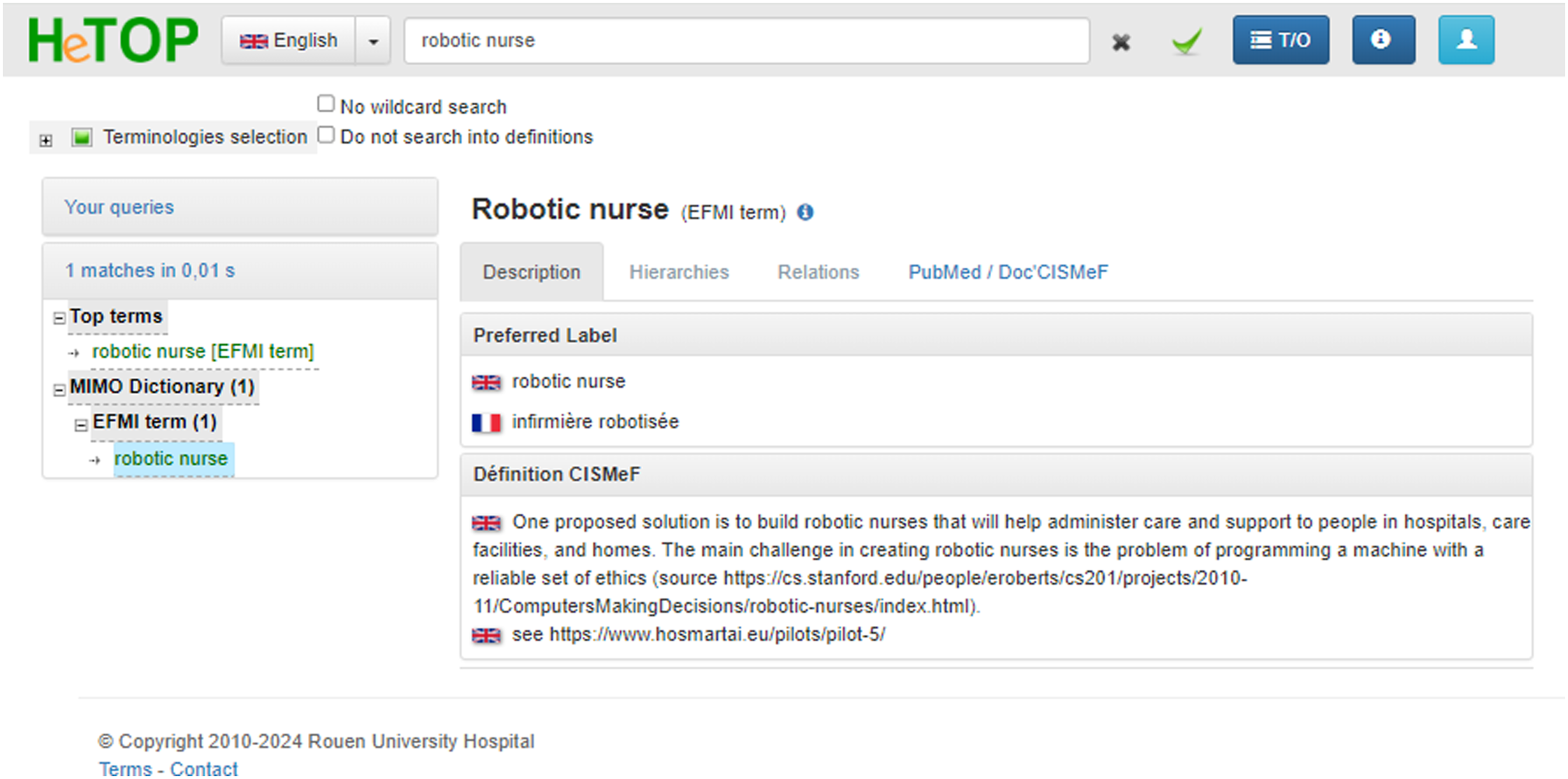
Deploying MIMO for actual practice scenarios
Continuous improvement is an essential aspect of MIMO’s development. Getting feedback is crucial at both individual and collective levels to achieve this. We have received input regarding the integration of MIMO into two projects. The first is a European one, HosmartAI, wherein MIMO supports multilingual knowledge sharing and dissemination of research products. 3 The second project is a French one, SaNuRN, to support academic training in digital health of all health-related professions.22,23
Integration within the HosmartAI European project
In January 2021, MIMO development received partial funding through HosmartAI. 3
In the context of this project, MIMO integration aims to increase and expand the initial corpus by including terms and concepts related to cutting-edge technology-oriented healthcare in hospitals.
One key focus of HosmartAI is developing a universal open integration platform called the HosmartAI Marketplace. This website is not business-oriented and is designed to provide support and assessment tools for integrating digital technologies such as robotics and AI into the healthcare system (available at the following link: https://hhub.hosmartai.eu/marketplaceb). The main objective of this initiative is to improve interoperability among different tools.
Consequently, MIMO has been selected to support the indexation and annotation of the different capabilities of the other research products offered (e.g., mobile apps and software assisting and enhancing the abilities of healthcare practitioners, patients, and their caregivers) in the HosmartAI Marketplace to the project partners and to future healthcare institutions interested in using them, particularly those in the “Smart Health” branch introduced above.
To facilitate the MIMO integration to the HosmartAI Marketplace platform, the MIMO team shared an OWL file with the HosmartAI team in charge of developing this environment. This approach also complies with the current dissemination process disclosed above. Thus, MIMO is a component of the whole development. Each new product in the platform is tagged for a “Technical category” and an application “domain.” This tagging is processed manually using MIMO terms and concepts. Figure 3 shows an example of this use (highlighted in red in Figure 3). Screenshot of the HosmartAI Marketplace page dedicated to MIMO.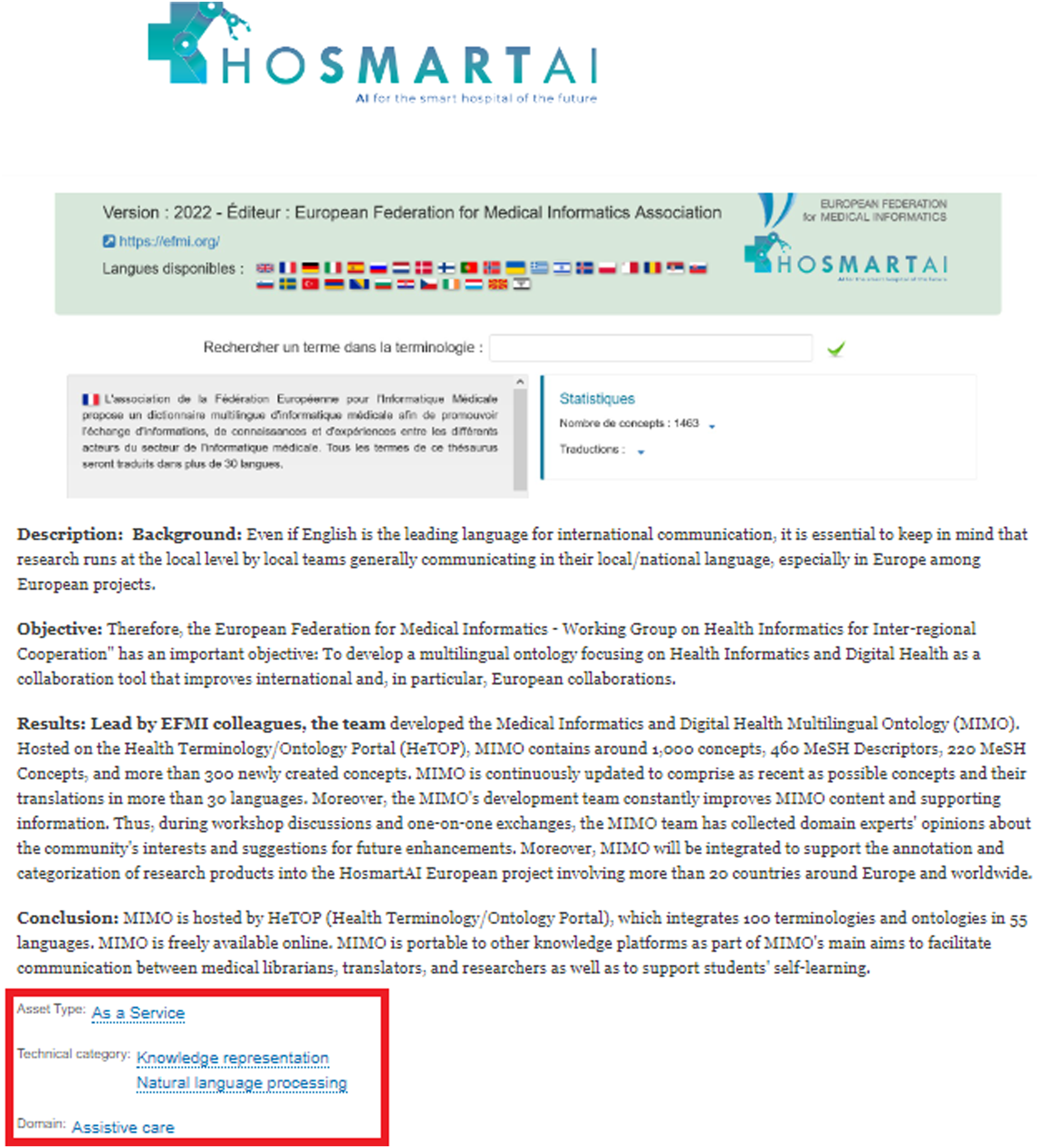
Moreover, like for SaNuRN, the HosmartAI partners can use and integrate MIMO over HeTOP at the local level as an education tool to train the future generation of healthcare practitioners who will be involved in smart health organizations.22,23
Integration within the SaNuRN educational project
In collaboration with the French National Research Agency, the French Ministry of Health’s Delegation of Digital Health has announced an open call for projects in 2022 to advance digital health teaching and learning technologies. The focus is on developing resources in French tailored to health-related professions students and practitioners in France. The goal is to train a community of 210,000 members in France by 2027, including postgraduates and continuous learners.5,6
As part of this effort, the University of Rouen Normandy (URN) and Côte d’Azur University (CAU) are collaborating on the implementation of the SaNuRN (Santé Numérique Rouen Nice) project. This 5-years project, which began in September 2022, has received funding of €3,951,200 out of a total cost of €6,891,923 and is part of the aforementioned open call (grant #ANR_22-CMAS-0014). The government has allocated an overall budget of €71 million for digital health education.22–24
Accordingly, in the SaNuRN framework, a French-speaking knowledge catalog in the digital health domain has been developed and is called the “Catalog and Index of Digital Health Teaching Resources” (CIDHR). 6 CIDHR is crucial to bridge the language gap. Indeed, while English dominates scientific literature and teaching platforms, it excludes a significant portion of the global population, particularly those more comfortable with other languages, precisely French.2,3,18 This language barrier can impede the dissemination of critical information and hinder knowledge transfer in digital health education. A dedicated platform in French that can include resources in other languages is indispensable, similar to the Wikipedia and Wiktionary projects.2,25–27 Since 2023, MIMO has been used in the CIDHR search engine to retrieve digital health resources for French-speaking health and allied health students (expecting to train, in this way, 210,000 students at the national level in 2027). Resource indexation is a vital step in the CIDHR knowledge management process and a critical component of the SaNuRN project. The ultimate aim is to employ CIDHR to bolster digital health learning and teaching by seamlessly integrating medical and health-related curricula for undergraduate, postgraduate, and lifelong continuing education. It is crucial to provide personalized and relevant resources to users, such as students and lecturers, based on their degree, field of study, and teaching area. Doing so can ensure they have access to the most up-to-date and high-quality resources, enabling them to excel in their studies and teaching endeavors. In this context, indexing a digital health teaching resource using MIMO is more than helpful in optimizing the information search and retrieval query of any health or paramedical student and practitioner.
Discussion
Overview
Integrating digital technologies in healthcare and medical education is imperative. To ensure the quality and efficiency of international educational projects, developing multilingual controlled vocabularies, such as thesauri and ontologies related to digital health, should be pursued with utmost ambition and dedication.
The MIMO project started in 2018 as a multilingual dictionary and evolved into a multilingual ontology by 2022. aims to make DHHI resources available to the community. Unique hierarchies were defined in MIMO to handle terms and concepts missing in other reference systems. MIMO is available on the HeTOP terminology server and is open-source and free. In March 2024, MIMO comprised 3730 concepts (an increase of 250% - around 1500- in 2022), partially imported from MeSH, NCIt, and SNOMED-CT, with more than 250 newly created concepts. Moreover, MIMO benefits from HeTOP’s compliance with the FAIR principles.
MIMO has been integrated into two projects: HosmartAI and SaNuRN. These projects support multilingual knowledge sharing and academic training in digital health, respectively. In the context of the HosmartAI project, MIMO integration aims to support the indexation of technology-oriented healthcare in hospitals. As part of the SaNuRN project, the related CIDHR search engine utilizes MIMO as a pillar component for retrieving digital health resources for health students. The ultimate goal is to integrate medical and health-related curricula and provide personalized, relevant resources to users for effective learning and teaching.
Globally, MIMO addresses challenges in integrating diverse languages and terminology within the DHHI space. Thus, a need exists for a comprehensive multilingual ontology that can effectively integrate diverse languages and medico-technical terms. MIMO is dealing with this by filling this gap by providing continuously updated terminology in dozens of languages, ensuring that professionals and practitioners can access high-quality resources in their preferred language. This endeavor is particularly relevant in the context of semantically enriching the digital health sector because it enables seamless communication and knowledge sharing among multidisciplinary teams from different countries and cultures. MIMO empowers digital health and applied artificial intelligence education and training in smart hospitals by bridging the language barrier and providing a common framework for understanding professional and technical terms.
Strengths and limitations
Globalizing healthcare is a vital and challenging process that involves various stakeholders, including clinical practitioners, administrative teams, and technology developers. Despite its complexity and length, this process presents significant opportunities to enhance healthcare delivery and improve patient outcomes. Each country has specific rules and regulations and unique spoken languages, which can lead to different interpretations when translating terms. MIMO’s primary strength lies in facilitating communication in a more unified language framework for all involved in healthcare technology projects. MIMO allows users to search for translations of medical informatics and digital health-related terms in their native language, with validated and automated translations from various sources for languages commonly used worldwide.2,4,27 Its strength lies in its ability to remain up-to-date with new technologies’ latest terms and concepts. MIMO is embedded into HeTOP with a user-friendly interface, efficient hosting, and ongoing maintenance. Non-native speakers of English who are domain experts play a critical role in updating the terminology and thesaurus.2,4
The main goal of MIMO is to be used in various educational tools, such as CIDHR, or embedded in research projects like HosmartAI. France’s health and allied health students use MIMO to access digital health teaching resources via CIDHR. MIMO can be extended worldwide, particularly in other European countries. MIMO enables individuals to effortlessly search for MIDH terms and concepts in their native language and get an accurate and validated translation in another European language. Furthermore, they can cross-check the meaning of the translated term with yet another language, such as English, to ensure its accuracy. Looking at the future, this will make communication and information exchange between individuals of different languages in the medical field more seamless and efficient.
As with all the terminologies in HeTOP, MIMO can be exported in various formats: CSV, RDF, SKOS, and OWL. HeTOP is also queryable via a specific Web service. Nevertheless, this possibility is restricted to French public servants (i.e., researchers, educators, hospitalists). Although HeTOP is freely accessible to anyone (including private companies), this terminology server is not an open-source tool. Accordingly, private companies or institutions may access more than 100 terminologies under a financial agreement.
MIMO, while powerful, does have some limitations.
A significant hurdle in achieving accurate translations for less common languages is the scarcity of native-speaker experts in specific fields. While their involvement in validating automated translations is critical, their time is precious. To overcome this limitation, international collaboration is vital. Establishing international consortia or developing dedicated working groups as a part of professional organizations focused on “digital health and health informatics” vocabulary translation can facilitate the development of a centralized pool of expert reviewers for less common languages. These consortia or working groups can establish best practices and training programs, ensuring consistent, high-quality translations.
Furthermore, multinational projects focused on specific lesser-known languages can be initiated. This kind of project, involving universities, research institutions, and private companies from countries where the languages are spoken, can share the workload of data collection, training, and validation of translation models. Finally, developing shared infrastructure and resources specifically for less common languages is crucial. HeTOP is an example of such a solution by hosting versions of terminologies and ontologies in less popular languages (e.g., Greek, Hebrew, Romanian). HeTOP is an example of this platform, fostering knowledge exchange and accelerating advancements in translation capabilities in initiatives such as the MIMO one. By implementing these collaborative efforts, the MIMO initiative can build a more robust and efficient system for handling translations in less common languages, ultimately improving accuracy and fluency, as well as empowering wider communication and knowledge sharing across the DHHI community, particularly in the educational context.
Not all terms and concepts are fully translated into all supported languages simultaneously, leading to discrepancies over time and human resource limitations in multilingual projects.2,4 Establishing a community of global volunteers can be instrumental in addressing these challenges or using resources developed by other multilingual or crosslingual projects such as Wikipedia and Wiktionary.25,26
Due to DHHI’s constantly changing nature, the MIMO team and community must remain informed and establish a system for incorporating new terms and concepts. With this in mind, it is essential to integrate HeTOP and its capabilities, which involve determining the initial languages for input and curation and the frequency of MIMO updates.
Future perspectives
The upcoming stages of the MIMO project entail a strategic progression towards enhancing its capabilities and reach within the realm of DHHI. Central to these efforts is establishing a dynamic community comprising volunteer domain experts proficient in various facets of these fields. These experts must possess multilingual capabilities crucial for broadening the scope of translations and implementing a rigorous cross-validation process involving human expertise and AI-based systems.
Simultaneously, tools are being developed to capture and integrate existing translations sourced from open data repositories (similar to WikiMeSH 27 ). This initiative aims to harness linguistic resources effectively, thereby enriching the comprehensiveness and accuracy of MIMO’s terminology. Additionally, the project will expand its vocabulary to incorporate terms pertinent to emerging trends and areas within DHHI. Accordingly, this includes embracing concepts such as (1) One Digital Health 28 and related application projects such as OneAquaHelth investigating the interconnection of urban freshwater ecosystem health and human wellbeing, 29 (2) Accident and Emergency Informatics,30,31 and (3) advancements in robotics and image processing applied in healthcare systems and industry.32–34
Furthermore, MIMO will undergo a transformative transition into a complete multilingual ontology. This evolution will streamline its maintenance processes and facilitate further expansion, enabling it to support a diverse range of international health technology projects efficiently. By embracing a multilingual framework, MIMO will adapt seamlessly to various linguistic contexts, fostering collaboration and innovation on a global scale.
Conclusion
Creating and managing successful cross-border and global projects, partnerships, and collaborations requires significant effort. While virtual workspaces and online communication have made it easier to find new research partners, there is still a risk of misunderstandings that can impede innovation, leading to delays and failures. To effectively manage complex MIDH projects, it is essential to have a solid grasp of relevant vocabularies such as technology, informatics, engineering, health, and medical sciences.
MIMO is a multilingual tool focusing on health informatics and digital health technologies. The MIMO development team is dedicated to integrating MIMO as a fundamental component that supports diverse activities of health sciences information professionals, fosters mutual understanding among researchers, and enhances self-learning for students in a globally connected world. A unified vocabulary and reduced translation-related misunderstandings are crucial in academic and industrial settings. MIMO is a game-changing opportunity to drive progress in scientific, technical, educational, and industrial collaborations related to medical informatics and digital health. By leveraging MIMO, it can bring together worldwide experts with different mother tongues and a heterogeneous knowledge of the same languages (e.g., English or French) to tackle pressing challenges facing the DHHI landscape and find innovative solutions to improve patient care and outcomes.
Footnotes
Acknowledgements
The contribution of EFMI, by its open access policy, made this publication in “open access” possible.
Author contributions
Declaration of conflicting interests
The author(s) declared no potential conflicts of interest with respect to the research, authorship, and/or publication of this article.
Funding
This work was partially supported by the HosmartAI (Hospital Smart development based on AI) project that received funding from the European Union’s Horizon 2020 research and innovation program under grant [#101016834] (AB, PW, LST, SJD). This work was partially supported by the SaNuRN project, which was granted by the Delegation of Digital Health of the French Ministry of Health and the French National Research Agency [ANR_22-CMAS-0014 3.951.200] (PS, SJD).
