



Abstract
Introduction
Over 1 billion people–approximately 15% of the world’s population–are currently living with disability, and this number is increasing due in part to population aging and an increase in the prevalence of non-communicable diseases. 1 Fact-finding surveys in several countries found that people with disabilities subjectively feel worse about their health. According to a national health and nutrition survey conducted in 2018 in South Korea, 2 only 8.8% of the general population evaluated subjective health status as poor versus 17% of the population with disabilities. These results are similar to those in other countries and populations 3 such as the US (people with disabilities were four times likely to report having fair or poor health compared with the general population [40.3% vs 9.9%]). 4 People with disabilities particularly have a higher rate of unmet medical needs experience than people without disabilities, and they face distinctive barriers when accessing healthcare services.5,6 In addition, the rate of unmet medical needs experience of people with disabilities increased after the coronavirus disease 2019 (COVID-19) pandemic. 7
Unmet healthcare needs refer to the inadequacy of individuals or communities in accessing necessary medical services, treatments, consultations, or medical support, indicating limited or unavailable provision of healthcare services.2,8 Providing necessary medical services at the appropriate time can prevent the deterioration of physical health, reduce feelings of depression, and promote emotional stability. 9 Moreover, the mere perception that necessary healthcare services are not adequately provided can detrimentally impact health. 10 Previous studies have categorized the causes of unmet medical needs based on availability, accessibility, and affordability, discussing the current status and associated factors. 11 Therefore, several related barriers and factors need to be considered together in assessing the unmet medical needs experience. 12
Many studies on the disability and unmet medical needs experience among population with disabilities have focused on medical use, access to medical care, factors influencing the unmet medical needs, and the status of unmet medical needs.6,13 However, to our knowledge, no study has reviewed the research trend in relation to the unmet medical needs experience of people with disabilities from a macroscopic point of view. With the COVID-19 pandemic, alternatives such as telemedicine are being proposed and implemented. 14 The importance of unmet medical needs, an indicator of access to medical services, would increase in this trend. Hence, we aimed to identify and compare the research trends by period of unmet medical needs among people with disabilities through social network analysis targeting the English abstracts of these studies. Moreover, based on these findings, we aimed to understand the field from a macro perspective and provide a direction for further study.
Methods
In this study, we conducted a quantitative text analysis that organized a network based on co-occurrence among research keywords to identify the knowledge structure and relationships among research papers on the unmet medical needs of the people with disabilities using text network analysis. Furthermore, we identified research trends by topic and trend analyses in order to provide a broader view of the field. This study used the NetMiner version 4.4.3 (Cyram Inc, Seongnam, Korea), a social network analysis program from Cyram, Seoul, for data analysis and visualization of results. The study has been approved by the institute review board of the University (IRB No. 2020-07-039). Since the study used abstract of published paper, we did not need to get written informed consent.
The process of the study is as follows: (1) collection of articles on the unmet medical needs of the people with disabilities and extraction of their abstracts, (2) standardization of abstracts, (3) development of keyword co-occurrence network, (4) keyword network analysis, and (5) topic analysis.
Text network analysis
Text network analysis is a quantitative research method 15 that applies scientific methods to analyze not only the semantic structure clearly revealed in the text, but also the potential semantic structure inherent in the context. 16 For text network analysis, we first extracted the keywords from atypical text through morpheme analysis. At the same time, we obtained the relationships of keywords, which appeared together. Then, we identified the relationships and core keywords shown in various papers. There are two types of core keywords: (1) those based on frequency (appearing in various studies) and (2) those based on centrality (keywords with high centrality means that the keywords’ surroundings are highly linked). 17 When the results are obtained, text network analysis programs visualize keywords through network and word cloud.
Meaningful concepts are extracted by deconstructing the words constituting the text, and the relationship between the words is expressed in the form of a network (connection network). Through this, it is possible to grasp the main concepts, relationships between concepts, and boundaries including the main concepts in the text, and reveal the clearly expressed and inferable contexts in the text. 18
Data collection
Three databases (i.e., PubMed, CINAHL, and Embase) were used to collect papers related to the unmet medical needs of the people with disabilities. The following search terms were set: #1: (“disabl*” [Ti/Ab]) AND (“needs” [Ti/Ab]) #2: (“disabled persons” [MeSH Terms]) AND (“health services needs and demand” [Mesh Terms] OR “needs assessment” [Mesh Terms]). A total of 5,908, 2,340, and 3748 studies were obtained from PubMed, CINAHL, and Embase, respectively, using the search terms “#1 AND #2” until November 2020. We used the EndNote program to extract all papers and excluded duplications.
Inclusion criteria
Three inclusion criteria were used to select articles. First, articles had to be written in English; studies in a language other than English were excluded. Second, in order to obtain authoritative information, we included only peer-reviewed journal articles; books, conference abstracts, and reports were excluded. Third, as we extracted text from the abstracts of the paper, we included articles with abstracts; articles without abstracts were excluded. This process remained 4723 papers in final.
Data standardization
From the 4723 papers of abstracts, we remained only 23,707 meaningful words by automatically filtering out those with a length of one through natural language processing. In order to standardize the words used in the abstracts, we created a dictionary. The exception list included search terms such as need and disability and common words such as aim, discussion, and results. Words with similar meanings and written in different uppercased/lowercased letters were included in the thesaurus list. Different terms with similar meanings were merged into a single term in the thesaurus list. For example, illness, disease, and disorder were standardized to illness. Through this process, 17,295 keywords remained.
Development of the keyword network for keyword analysis
The two-mode network data with rows of documents (4723) and columns of words (17,295) was obtained through the NetMiner program. In this program, each word is expressed as a “node,” and the connections between nodes appear as a “link.” Nodes with a frequency lower than three and the number of nodes’ appearance were deleted to clarify the network structure. For the next step, the two-mode network was transformed into a one-mode network by applying the concept of collocation to analyze the co-occurrence frequency of two specific words. Collocation is defined as a case in which two keywords appear side by side or with one keyword in between (i.e., window size = 3) in a single sentence. A link frequency more than two remained through this transformation. Using this refined network, we analyzed quantification values including frequency, degree centrality, and betweenness centrality.
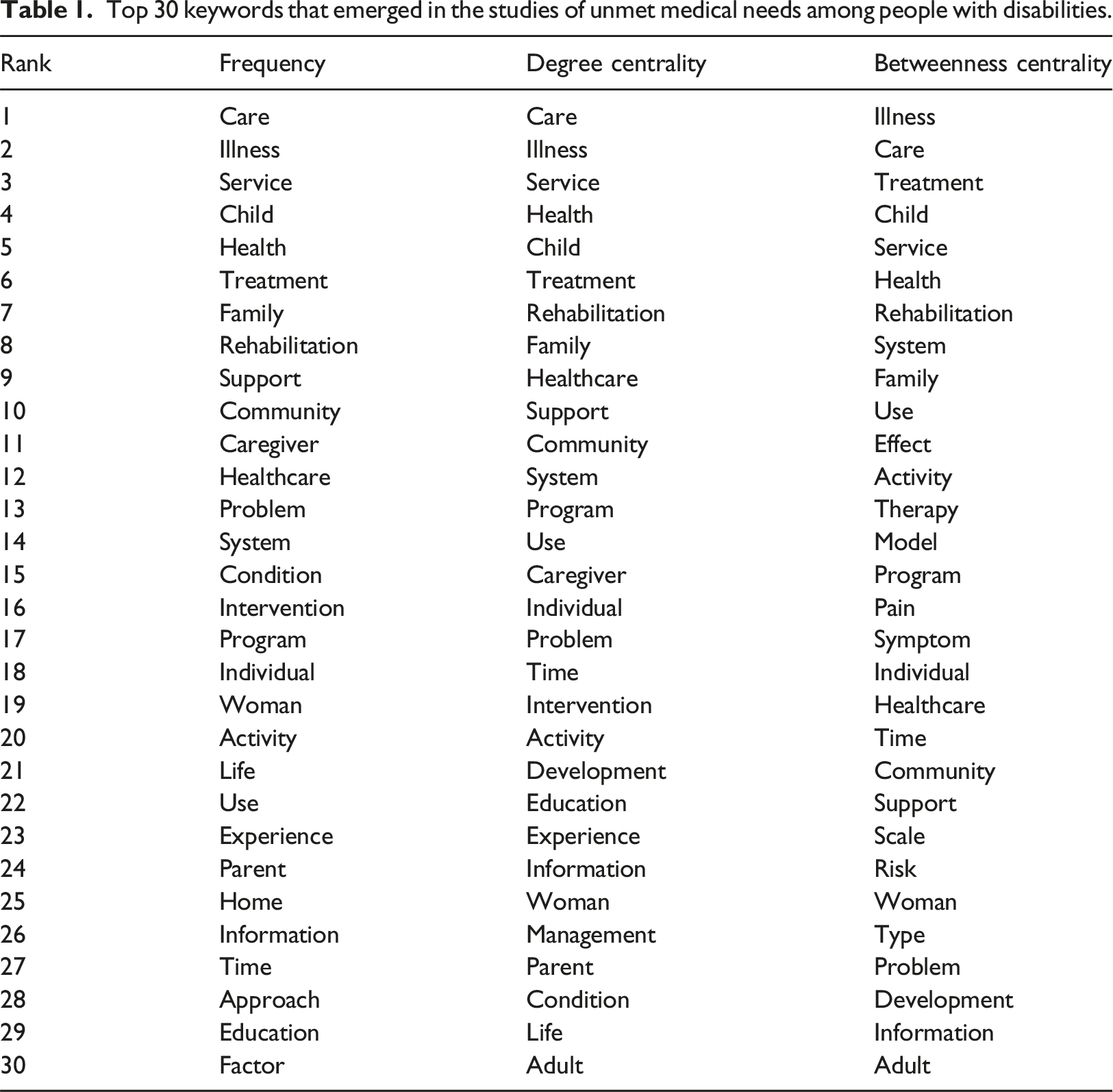
For analysis, we placed the top 60 keywords as core keywords based on degree centrality, betweenness centrality, and frequency. A frequency measures the number of times the keyword occurs in all included studies and a degree centrality measures how many connections the nodes have; thus, it measures the level of influence and co-occurrences of keywords. Betweenness centrality measures the mediation level in a network. 19 To identify and compare key keywords at a glance, we visualized the data using word clouds, and the relationship between the top 30 words based on frequency, degree centrality, and betweenness centrality was visualized through centrality analysis.
The pathfinder network (PF-net) preserves the significant links between nodes based on the pairwise distance between them, revealing an organizational structure. This approach has been widely used to characterize differences in knowledge structure. 20 This network analysis was additionally conducted to prioritize the importance of keyword among top 30 core keywords.
Topic modeling
Topic modeling is a probabilistic modeling to automatically discover topics from a collection of documents. 21 It allows researchers to analyze and understand vast amounts of text data. 22 We captured the research topic and the change of topic trend/proportions by this analysis. In the study, we utilized the latent Dirichlet allocation (LDA) analysis, which is the most frequently used algorithm among topic modeling methods. 21 The basic principle behind LDA is that documents exhibit multiple topics. This method extracts multiple topics and their probability distribution in each document. It defines a topic to be a distribution over a fixed vocabulary. 21 For example, the “social service” topic contains words about social service with high probability. Since each document exhibits different proportions of topics, every document could be classified within one topic, and this method helps to distinguish each document. 21
In order to identify the optimal number of topics in LDA modeling, we used varying numbers of topics with alpha of 0.1 and beta of 0.01 using the standard method of Bayesian statistics. 23 In addition, LDA analyses were performed on varying numbers of topics (K = 3, 4, 5) to identify the best number of topics. In the case of K = 3, it was difficult to derive meaningful content because a few topics were included (the number of topics is 3); thus, the remaining topics were meaningless. Since K = 5 or more included a large number of topics, there was a problem of overlapping between topics. After we analyzed the LDA analysis results, K = 4 topics were finally identified, and we defined the characteristics of each topic.
Results
Keyword structure
Top 30 keywords that emerged in the studies of unmet medical needs among people with disabilities.
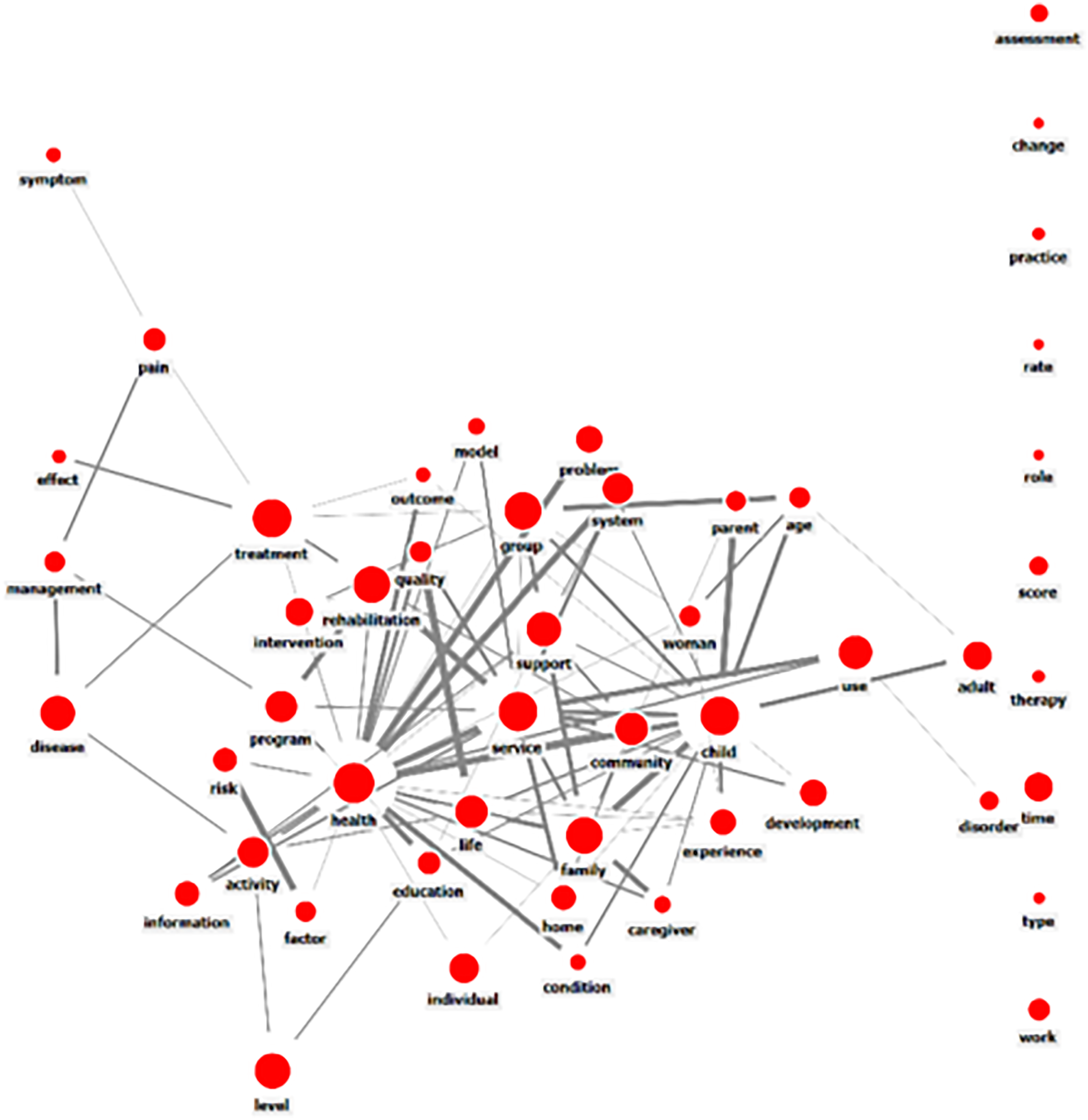
Knowledge structure of the unmet medical needs of people with disabilities.
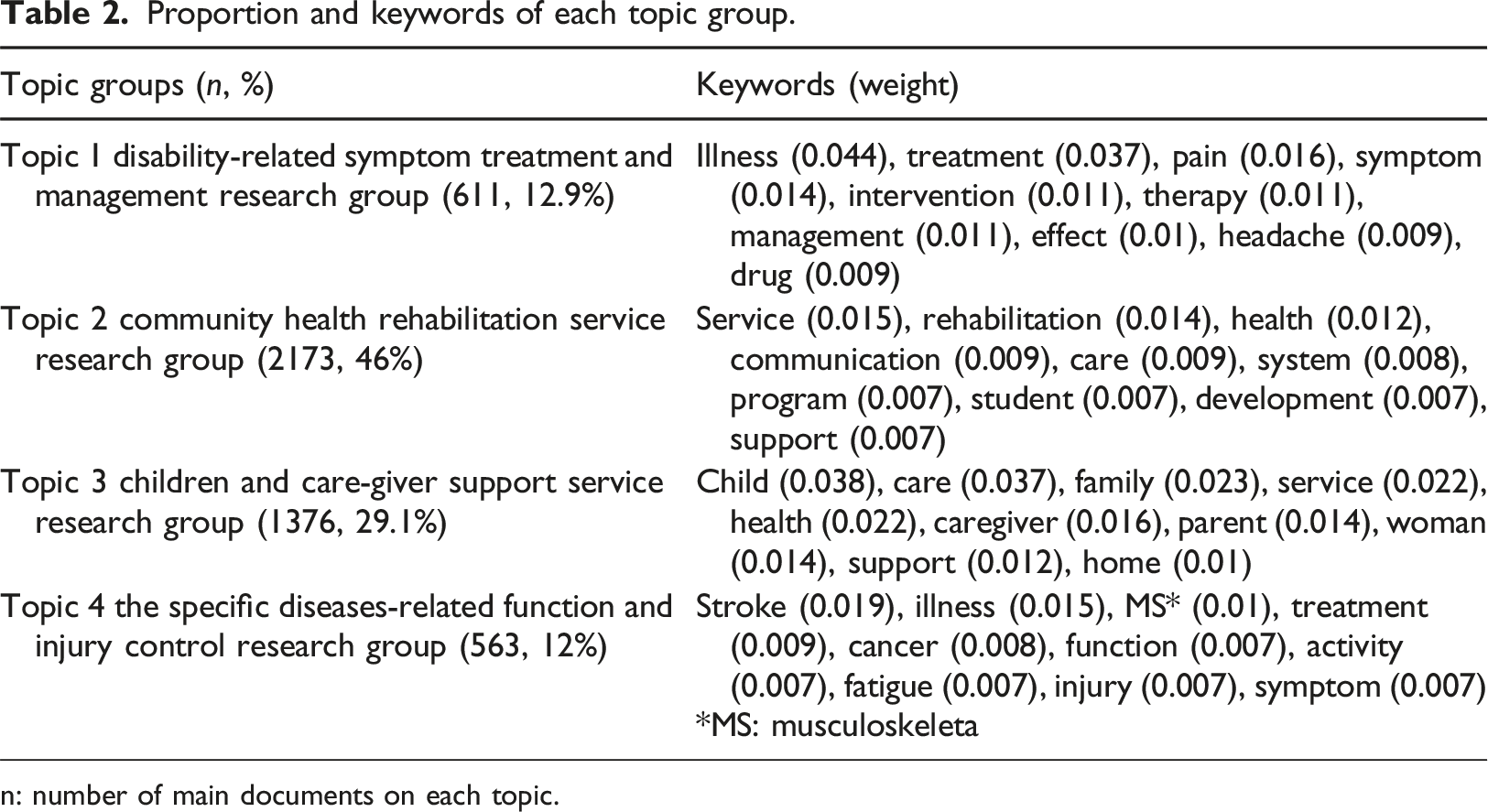
We figured out four topics with specific characteristics by topic modeling (Figure 2, Table 2). Topic 1 (disability-related symptom treatment and management research group) includes the keywords “ Results of topic modeling. Proportion and keywords of each topic group. n: number of main documents on each topic.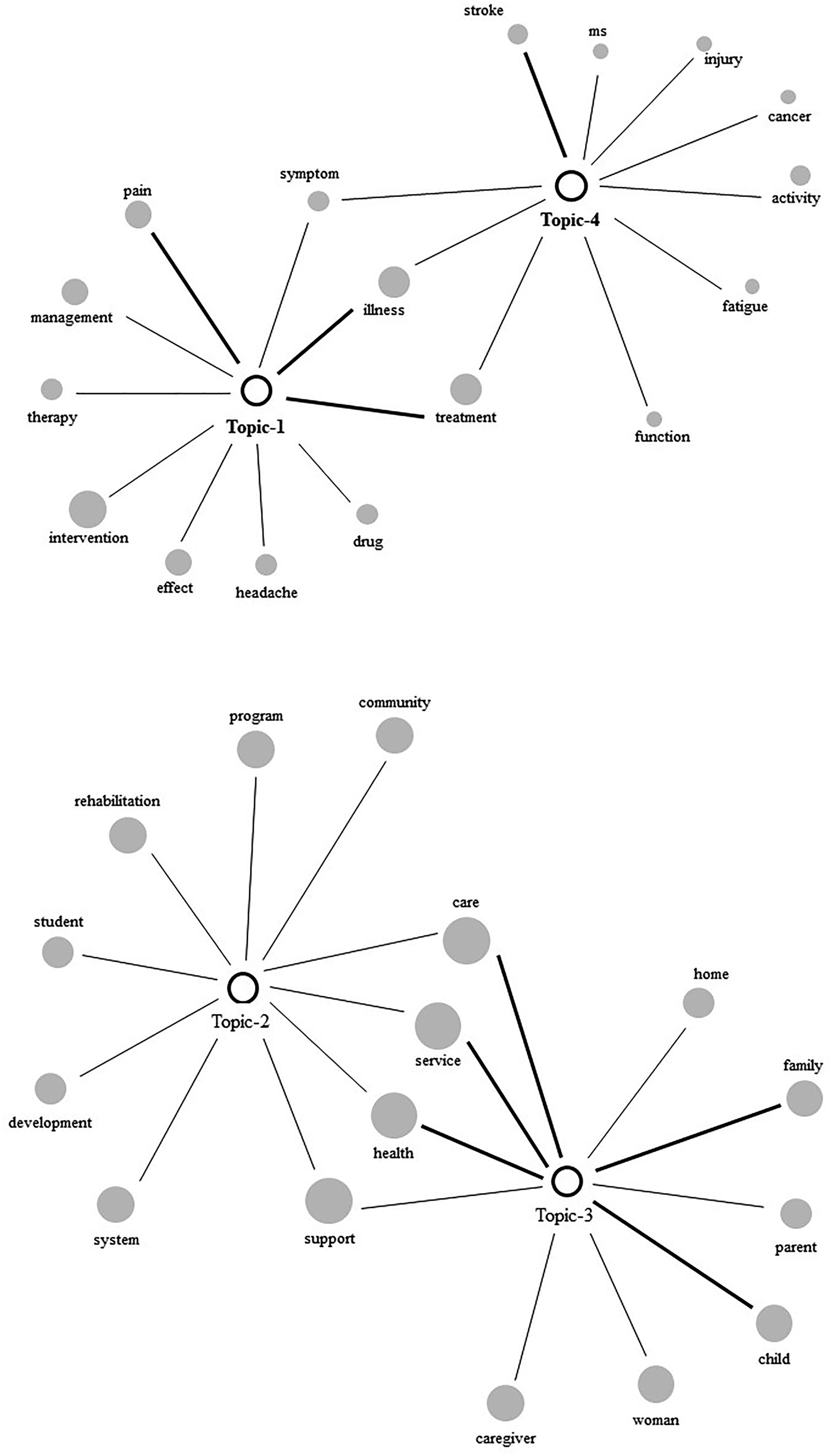
We also analyzed the research trends for each period and uncovered changes in the proportions of each topic group by time (Figure 3). The proportion of topic 1 and topic 4 showed a gradual increase. Meanwhile, the proportion of topic 2 decreased with time. The proportion of topic 3 was relatively similar. Trends of topic group proportions by time.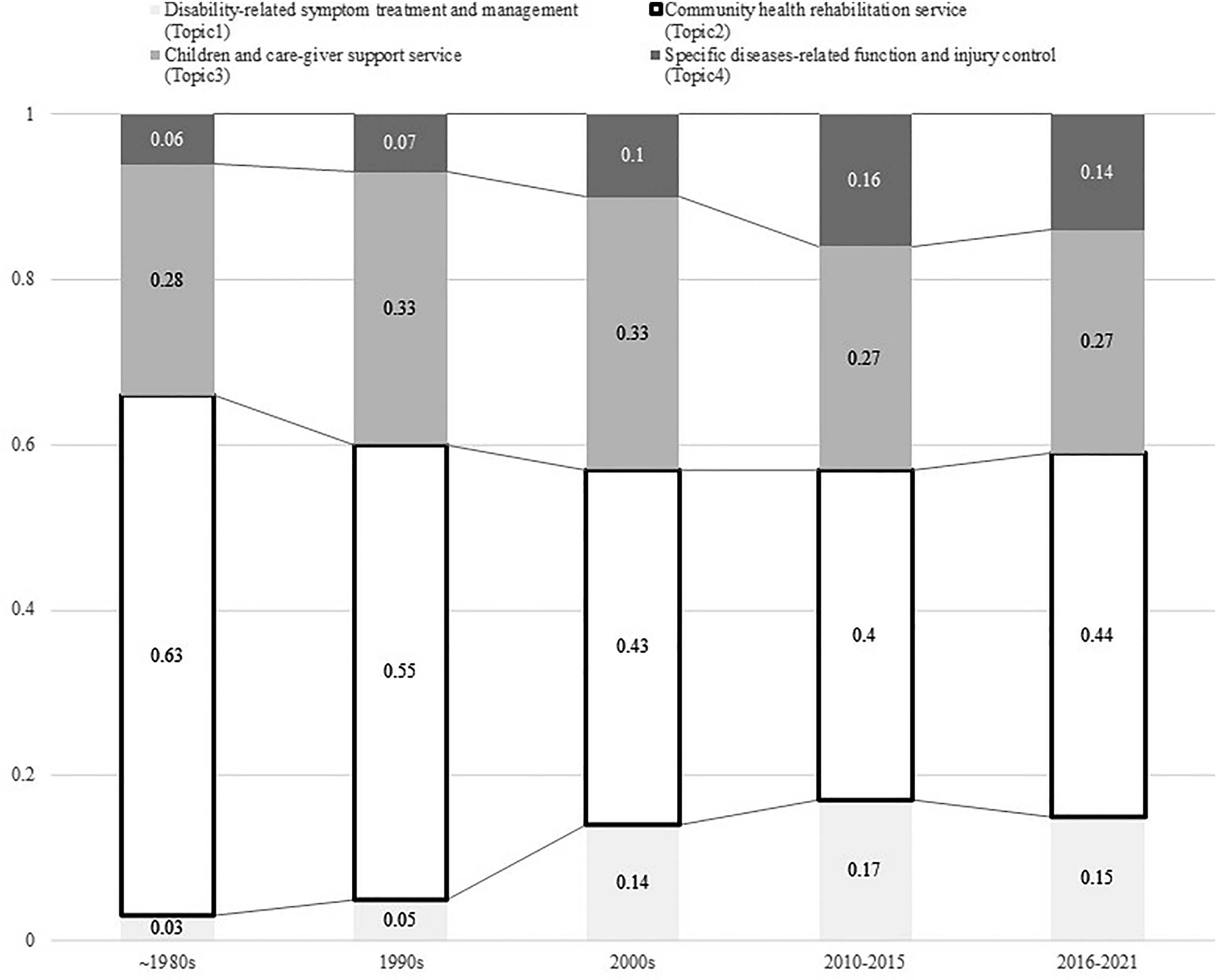
Discussion
We identified the knowledge structure of studies related to the unmet medical needs of the people with disabilities and determined the main keywords of studies. Moreover, we verified the research trends by period using topic modeling methods.
As a result of the keyword analysis in this study, it is revealed that “service” is one of the most highly correlated keywords with others in the knowledge structure. It is connected to “care,” “illness,” “system,” “community,” and “health.” A number of studies have been conducted to identify and improve the current status of various services (including rehabilitation and various health services) provided to the people with disabilities. 24 These research trends suggest that the medical needs of people with disabilities cannot be simply addressed within the medical system and that a wider range of educational and social services should be implemented. In addition, people with disabilities often experience unmet needs when seeking medical services related to health and illness. 25 Numerous studies have regarded services as a tool to address and mitigate these unmet needs among people with disabilities. These studies have highlighted accessibility issues as a significant barrier. 26 Such issues extend beyond healthcare services to encompass rehabilitation services, transportation, the labor market, and information access. 27 In this context, the consideration of home-based or community-based care becomes imperative. To ensure accessibility, medical services, hospital interiors, and building designs should be made barrier-free, and efforts need to be undertaken to expand services and eliminate accessibility barriers.
In addition, digital literacy emerges as a crucial paradigm since issues related to digital literacy or accessibility in information have contributed to unmet medical needs among individuals with disabilities. 28 This intersection of digital technology and information accessibility holds the promise of fostering independent living and meaningful community inclusion. 29 Particularly noteworthy is the impact of access to reliable health information during health emergencies such as the COVID-19 pandemic; it significantly influences health conditions and needs. 30 Even though the proportion of studies or keywords about digital literacy or digital medicine is small because of relatively recent emergence of issues, it is imperative to recognize the importance of ensuring digital information accessibility as a mitigation tool for addressing unmet medical needs.
It is also revealed that “child” is connected to “family,” “caregiver,” “education,” “parent,” “support,” “care,” and “health.” These keywords are connected again to “development,” “experience,” and “adult,” which means that many studies that considered these keywords together have been conducted. For the case of children with disabilities, the most important thing for medical needs is the role of family members who support health and care, and this important role has appeared as one of the research themes. 31 Additionally, many education programs related to medical care are accompanied by family members. 32 In other words, the participation of the primary caregivers (usually parents for the case of children) and education including them are important when children with disabilities receive treatment or visit a hospital. Currently, research that considers them together is being conducted. In particular, “family” appears together with “child” as many research topics, and psychosocial support for children with brothers/sisters who have disabilities was also found to be one of the important research topics. 33
In the topic modeling, we found that topics 1 and 4 are research topic groups that deal with people who have acquired disabilities due to disease or trauma and their treatment, management, medication, quality of life, and intervention. The increase of their proportion showed the increased demand for treatment of acquired disorders. The papers included in this topic are related to methods of managing problems (such as pain 34 or mood 35 ) caused by disability and interventions to improve quality of life. The increase in research on this subject is thought to be due to the increased demand for their medical treatment as the number of people with acquired disabilities and chronic health conditions is increasing. 1
Topic 2 showed that research has been conducted on healthcare-related guidelines; literature; or health strategies, developments, and approaches. 36 This group will be a subject affected by the research trend by year according to the demand of public health. The proportion of topic 3 was relatively similar throughout the study period compared with those of other topics. Before the 1990s, in the case of children with disabilities, many studies related to polio have been conducted because of the increasing number of patients with polio (poliovirus). 37 Effective vaccines were developed in the 1950s, and the world has made progress against the disease since the introduction of a global vaccination campaign in 1988. This decrease in polio cases also decreased the proportion of research related to the disease. 38 However, interest in cerebral palsy, the most common group of childhood disorders that affect a person’s ability to move and maintain balance and posture, and support for families who have disabilities have increased. As a result of increased interest, many studies have been conducted. 39 The proportion of topic 3 remained unchanged because of these studies.
In fact, since the 2000s, a number of papers have focused on the families of people with disabilities and the care burden of families and caregivers. 40 As such, the change in the research trend related to the unmet needs of the people with disabilities is in line with the paradigm shift from the medical model, which approached the disabilities from the disease-centered perspective to the welfare model. 41 In relation to unmet medical needs, they are thought to have expanded from the point of view of disease treatment to the areas of rehabilitation, social services, and care.
This study is subject to the following limitations. Non-English-language articles and gray literature were excluded since we included English-language articles only. The research subject is also in a paradigm that focuses on welfare and services rather than medical and disease perspectives on the unmet medical needs of the people with disabilities. The results may have been drawn based on topics of interest. Therefore, it may be difficult to generalize in interpreting the results. Nevertheless, we contend that examining the longitudinal evolution of this subject from a macroscopic standpoint holds substantial significance, marking a pioneering endeavor within this domain.
Conclusion
We identified the knowledge structure about the unmet medical needs of the population with disabilities through social network analysis. “System,” and “care” appeared as the main keywords, and the research subjects into the four research topics. These findings may contribute to the establishment of a knowledge structure related to the unmet medical needs of population with disabilities with increasing size and high rates of unmet medical needs. Further studies should be conducted to determine the level of unmet medical needs of the population with disabilities before and after the COVID-19 pandemic in the global perspective and to discuss how telemedicine plays a role in improving accessibility of medical centers.
Footnotes
Acknowledgements
Thank you to In A Kim, Jeong-Hyun Kim for reviewing this manuscript and providing feedback. Additionally, the manuscript, or any part of it, has not been published and will not be submitted elsewhere for publication while being considered by the journal.
Author contributions
Study design: Kyung-Hwa Choi and Mi So Kim. Data collection and analysis: Mi So Kim, Eun-Hye Jeong, and Jinah Park. Manuscript authorship: Jinah Park, Mi so Kim, and Jung Ae Kim. Critical manuscript revisions: Mi So Kim.
Declaration of conflicting interests
The author(s) declared no potential conflicts of interest with respect to the research, authorship, and/or publication of this article.
Funding
The author(s) disclosed receipt of the following financial support for the research, authorship, and/or publication of this article: This research was supported by Basic Science Research Program through the National Research Foundation of Korea (NRF) funded by the Ministry of Education (No. 2020R1I1A1A01062990).
Authorship statement
All authors meet the authorship criteria, and they all agree with the content of the manuscript.
