




Abstract
The increased use of eHealth and information systems impacts health care work broadly, including cultural and social aspects of work such as the roles of health care professionals. This qualitative descriptive study examined the perceptions of health care professionals in terms of how eHealth and information systems have changed their roles. The data was collected via 15 semi-structured thematic interviews and analysed using content analysis with an inductive approach. The analysis indicated mainly unconscious changes in the roles of professional groups. The professionals perceived that the role of digitally competent professionals in the working community was important. Moreover, high digital competency was seen to have led to an increase or change in work tasks. Professionals’ own working environments and job opportunities were seen to have affected to their roles when using information systems. eHealth was perceived to have created inequalities in work tasks, increased skills gaps and complicated work. However, eHealth made cooperation between professionals easier than before. Organisations should pay more attention to equal opportunities to increase professional’s digital competency, even out workloads between professionals, and provide equal access to eHealth and information systems.
Introduction
eHealth and information systems have become inevitable elements of health care, and the demand for eHealth usage is increasing constantly.1,2 Digitalisation has created changes in the world of work and society and has affected jobs and the labour market.2–6 Changes in multiple fields including skills, workflow, workload, roles, autonomy, relationships, policies, practices, actions, expectations, and cultural and social aspects are expected from professionals and organisations with the increased use of eHealth and information systems.1,4–14 Work tasks may disappear, move between professionals or merge, while new tasks may arise that will affect the job descriptions and roles of professionals.3,10–12 Patients’ new health technology, involvement, employee autonomy and new responsibilities are also driven by eHealth and are changing the roles of the professionals and health care.7,8,15 The integration between professional roles depends on a range of factors, including supportive leadership, role clarity and transitional planning. 16
Nurses and physicians make up the two largest professional groups in health care, and eHealth and information systems are intended to support collaboration in their work.17,18 Health care professionals work in multidisciplinary teams and each team member has a unique role in this system and everyone’s skills are needed to ensure effective health care. 19 Effective and fluent nurse-physician collaboration is described as essential to providing high-quality patient care and for nurses and physicians to be successful in their roles. 20 However, it has been suggested that the implementation of eHealth may change the social order and authority among nurses and physicians. 11 For example, strict restrictions on who has access to which systems and services can hamper cooperation between professionals. 21
eHealth is implying new work processes and professionals need to understand that their work is changing from routine work to tasks that include new skills, learning and continuous changes in work practices. 22 When tasks change and the use of eHealth and information systems increases, it changes the demand for competence to perform those tasks.3,10,14,23 Professionals are using eHealth and information systems, electronic health records, telemedicine, sensors, clinical decisions support systems, online consultations, networks and other medical devices, services, and applications to communicate, collect data, diagnose and to monitor patients.4,7,8 The increased use of AI, robotics, automated surgery and monitoring and virtual reality have also changed health care and increased the competency level of professionals.7,8
eHealth and information systems require nurses and physicians to have basic or high-level digital skills. 8 Competence in using eHealth and information systems requires versatile skills, including experience in using ICT tools, basic computer skills, the ability to use technological solutions in different platforms, the ability to connect, share, communicate, evaluate, provide quality care, and understand technological opportunities.1,24,25 It is possible that the increased need for different digital skills may change professional roles and even generate new tensions between professionals. 5
Previous studies have shown that the increasing use of eHealth and information systems has multiple effects on health care organisations and on professionals’ work.1–15,23–25 However, little is known about the potential effects of eHealth and information systems on the changing roles between health care professionals. This study captures the effects of the increased use of eHealth and information systems on the roles of nurses and physicians. It is important to gain updated knowledge about the roles and responsibilities of health care professionals and how increased use of eHealth may have affected them. Therefore, to address this knowledge gap, the present study examined how eHealth and information systems have affected the roles of nurses and physicians in the working community.
Materials and methods
Design, setting and participants
This study was a qualitative descriptive study. The participants were physicians (n = 6) and nurses (n = 9) working in one Finnish health care district. Nurses included practical nurses, registered nurses and public health nurses and physicians represented were general practitioners and specialists in different medical fields. The study was conducted in one health care district, which provides both primary health care (e.g. in/outpatient clinics, maternity and child health clinics and services for the elderly and the disabled) and specialised medical care (e.g. mental health and substance abuse wards and emergency rooms). In 2021 there were 20 health care districts in Finland, and in 2023, after the health and social services reform, there are now 21 wellbeing services counties and one city (Helsinki). This specific health care district was chosen because it is a forerunner in eHealth, and it has implemented multiple digital systems and ways of working in recent years. However, all of the wellbeing services counties are comparable with other wellbeing services counties in Finland as all of them are using eHealth and information systems.”
Health care professionals were recruited by posting a public interview invitation on the internal data network and by sending an invitation to all professionals via email by one researcher. In the interview invitation, professionals were informed about the aim of the study, and about the voluntary nature of participation. Those who were willing to participate in the interviews contacted the researcher and provided their written informed consent. Professionals had an opportunity to ask questions related to the research and interviews by email and phone.
Most of the nurses were female (n = 7) and their age varied between 26 and 57 years. Their total working experience in the health care setting ranged from two to 30 years and in the current organisation from two to 20 years. Interviews were also conducted with three male and three female physicians. The age distribution of physicians ranged from 27 to 54 years. Physicians’ total working experience varied from one to 24 years and working experience in the current organisation from less than a year to 20 years.
Data collection
The data was collected through semi-structured single interviews in March 2021. The design was chosen because it allowed us to gain a deeper understanding of the meanings, opinions, experiences and perspectives of health care professionals about the phenomenon of interest. 26 The framework for the interviews was defined in collaboration with the research team, who had previous experience and knowledge of the digitalisation of health care. The interview guide included questions about possible eHealth-induced changes in working habits, tasks, collaboration, communication and division in work.
The interviews were conducted as individual interviews via the Microsoft Teams application by two researchers from the research team. The researchers have different backgrounds and were able to help interviewees with questions from their different perspectives. One researcher represented health sciences and the other represented administrative sciences.
The interview guide was tested with two health care professionals prior to the interviews. Based on the feedback from the first interviewee, some of the questions were slightly altered. After the second pilot interview no further changes were required, thus they were included in the study with the permission of the participant. The interviews were recorded and then transcribed verbatim by a transcription company. The interviews varied between 30 min to 90 min and the average time of the interview was approximately 60 min. All the transcribed recordings amounted to 92 pages in Helvetica Neue font, size 12.
Data analysis
The data was analysed inductively using qualitative content analysis. The data saturation, meaning that the interviews did not reveal any new information was reached between the 13th and 15th interview and thus researchers considered that no additional interviews were required. Physicians and nurses were analysed separately to allow comparison. Content analysis makes it possible to organise extensive amounts of data into a clear and concise form, without losing the main content of the information. 26
First, the interview transcripts were read and re-read to get an overall picture of the data. Then expressions that were relevant to the research questions were underlined, condensed and transformed into a code list using Microsoft Excel. A total of 82 codes (35 from the physicians and 47 from the nurses) were created from the interviews. These codes were sentences and statements where the participants described their experiences and thoughts. After creating the code list, one researcher grouped these codes into categories based on the similarity of their content. One researcher was responsible for the initial coding and categorisation, but the final codes and categories were determined in collaboration with two other researchers. The subcategories of physicians (n = 11) and nurses (n = 10) were partly the same, but there were also professional group-specific categories. The subcategories were further classified into main categories (n = 5). Figure 1 illustrates an example of how the content analysis process was developed. An example of how the content analysis process was developed.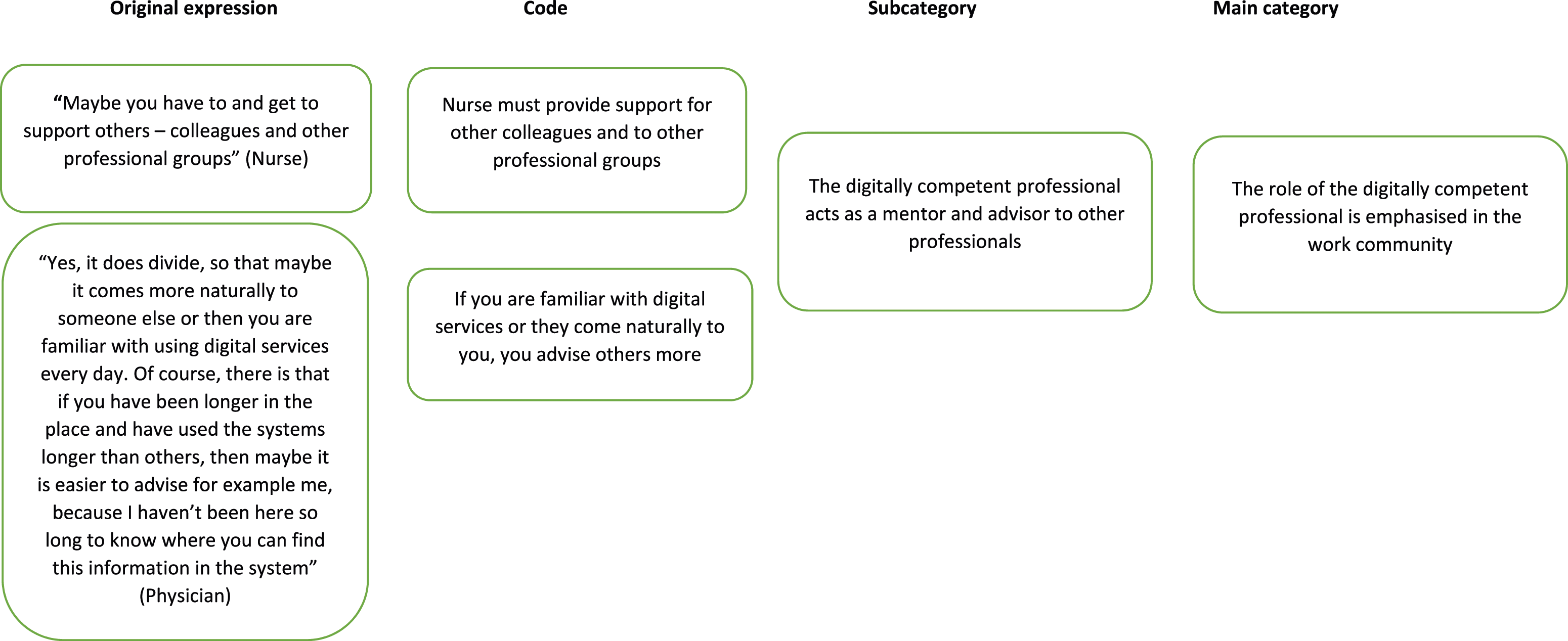
Results
Five main categories emerged from the perceptions of the professionals: (1) According to professionals there has been unconscious changes in the roles of the professionals; (2) the role of the digital competent professional in the work community is significant; (3) eHealth has increased and changed the division of work tasks; (4) the work environment and job opportunities have affected the roles of professionals; and (5) cooperation between professionals is easier than before.
Unconscious changes in the roles of professional groups
As can be seen in Figure 2, professionals did not recognise any significant changes to their working habits or basic work, which leads us to the assumption that these role changes were simply so minor that professionals did not recognise them. However, some nurses and physicians acknowledged that in some situations there may have been a slight change in their roles, for example in secretarial work. Several professionals used words like “maybe”, “probably” and “perhaps” to describe how their work has not changed. “In my opinion, major changes to my role at work have not come about because of the information system” (I6, P3) How the main category “unconscious changes in the roles of professional groups” was developed.
The role of digitally competent professionals is emphasised in the work community
As can be seen from Figure 3, the important role of the professional with significant digital competency in the working community was raised by both professional groups. Physicians and nurses agreed on the significant role of this kind of health care professional, who were described as digital mentors and digital advisers. Furthermore, physicians and nurses mentioned that these digitally competent professionals did not only act as mentors and advisers for their own professional group but also for others. How the main category “The role of the digitally competent professional is emphasised in the work community” was developed.
Nurses and physicians agreed that these competent professionals were also taking greater responsibility for eHealth in their work and did more work related to information systems. For example, they used the systems more often, acting as mentors and receiving new systems. Professionals saw that the workload of the digitally competent professional is greater than that of others.
Physicians mentioned that digital competence divides work tasks between professionals, meaning that it may divide what everyone does in the system. Those professionals with low competency are not given tasks that require high digital competency. Nurses highlighted that the digitally competent professional was usually younger. According to nurses, older nurses rely on younger colleagues with regard to digital systems because they believe that younger nurses have better digital competency. It was also mentioned by nurses that for older colleagues it takes more time to internalise digital systems. They also described how some older nurses do not even want to learn how to use the systems and leave it to younger nurses, which may increase younger nurses’ work tasks related to eHealth and information systems. According to nurses, this may even lead to some nurses never learning how to use the system if they know that there is someone in the working community who knows how to use the system better. It may also make it easier to transfer digital working tasks to those who already use a lot of these systems. One nurse even suggested that as a younger nurse, if you have knowledge of eHealth and information systems, you may also get given other work responsibilities. It was also brought up that being digitally competent in your work community might look better in the eyes of management. Nurses stated that even students had to act as digital support because they have better digital competency than some other professionals. “Well, maybe… we have a lot of students and one comment that I received was funny, that it is great that I have such a young supervisor who is able to use the systems without me being the digital support.” (I8, N3) “Well, I don’t know if it is appreciation or what that you get to do all those digital things. People don’t necessary even care to learn (to use information system), when you know that there is someone in the unit who already knows how to use it.” (I5, N2)
It was also pointed out by nurses that professionals who are enthusiastic about eHealth also drift into doing more eHealth-related tasks. This was seen to divide professionals’ work roles and even further increase the existing skill gaps between professionals related to eHealth.
eHealth has increased or changed work tasks
Figure 4 shows that professionals’ eHealth and information systems have transferred work tasks from different professional groups to others. Nurses felt that they have received work tasks from physicians and secretaries. The physicians agreed with the nurses that their work tasks have shifted to nurses. They also mentioned that the number of ward secretaries are reduced because of eHealth but at the same time some work tasks have been transferred to secretaries because they know how to use some parts of the system better than other professional groups. Also, nurses pointed out that more functional work has been transferred to secretaries for the same reason. How the main category “eHealth has increased or changed work tasks” was developed.
According to nurses, eHealth increases nurses’ responsibility as client instructors while physicians focus more on examining and diagnosing the patient. Similarly, ultrasounds and the updating of patients’ drug lists have been transferred from physicians to nurses. Nurses also see that they are doing work tasks with computers and information systems that secretaries used to do. “All the time they reduce the numbers of head nurses and ward secretaries, it tends to go the way that their tasks will run to nurses. We kind of do the ward secretaries’ jobs in information systems that they used to do.” (I15, N7)
Physicians also felt that even though some work tasks have been transferred to secretaries, they themselves do more of what were previously secretaries’ work tasks than before because of the increasing use of eHealth. More specifically, physicians pointed out that it has affected younger physicians’ work in particular, as they have to do more administrative work such as printing and installation. In addition, they pointed out that due to digital systems and services, they do more tasks that should not belong to them. However, they mentioned that it is usually easier and quicker to do them instead of finding and waiting for someone else to do them. “After all, we are doing the work of a secretary, social worker, priest, everything possible. And that’s a real wise comment from a physician. What’s the point in being trained at such a high cost to end up doing very different things. I’m sure general practitioners are in trouble. And it’s the curse of the whole ‘digi’ word. With its help, as surely you know, it is easy to put things under it.” (I18, P6)
The working environment and job opportunities affect the roles of professionals
Figure 5 shows that the working environment and job opportunities affect the roles of professionals. Some of the physicians and nurses talked about their access to different information systems. These professionals thought that the systems’ access rights have changed the roles of professionals. Nurses perceived that their access rights to patients’ information have decreased and narrowed due to information systems. Physicians agreed, and suggested that the information systems limit professional roles as they have a strict standard with regard to who is able to do what in the system. How the main category “The working environment and job possibilities affects the roles of professionals” was developed.
According to both professional groups, the working environment also affects the use of and access to information systems. Nurses and physicians perceived that working practices in an organisation can vary, depending on the organisation’s own information systems regulations. In some organisations the secretaries and nurses do a lot together, while elsewhere this can be more separated. Nurses stated that those responsibilities shape the use of digital services and systems, meaning that some responsibilities require more digital systems than others. The nurses also suggested that work responsibilities affected how much time is spent using the systems. “I think registered nurses are spending more time … of course, as responsibilities are different and greater … are using maybe more time on computers than for example our practical nurses.” (I5, N2)
Cooperation between professionals is easier than before
Figure 6 shows that physicians only brought up the issue of the increase in multidisciplinary cooperation and the ease of consultation with other physicians and nurses. They perceived that working together was easier than before due to eHealth and they were doing more consultations than before. Physicians mentioned that with digital systems, there is a feeling that nurses and physicians have a shared responsibility for the patients. “Well, in a way, of course, it allows us to do more consultations. Ask a physician with some other specialty about not needing to call or be physically in contact. You can just do the consultation request for them.” (I16, P5) How the main category “Cooperation between professionals is easier than before” was developed.
All of the main categories has been collected in the figure below. Figure 7 illustrates the main categories of the study and the professionals related to them. How eHealth and information systems have affected to the roles of nurses and physicians.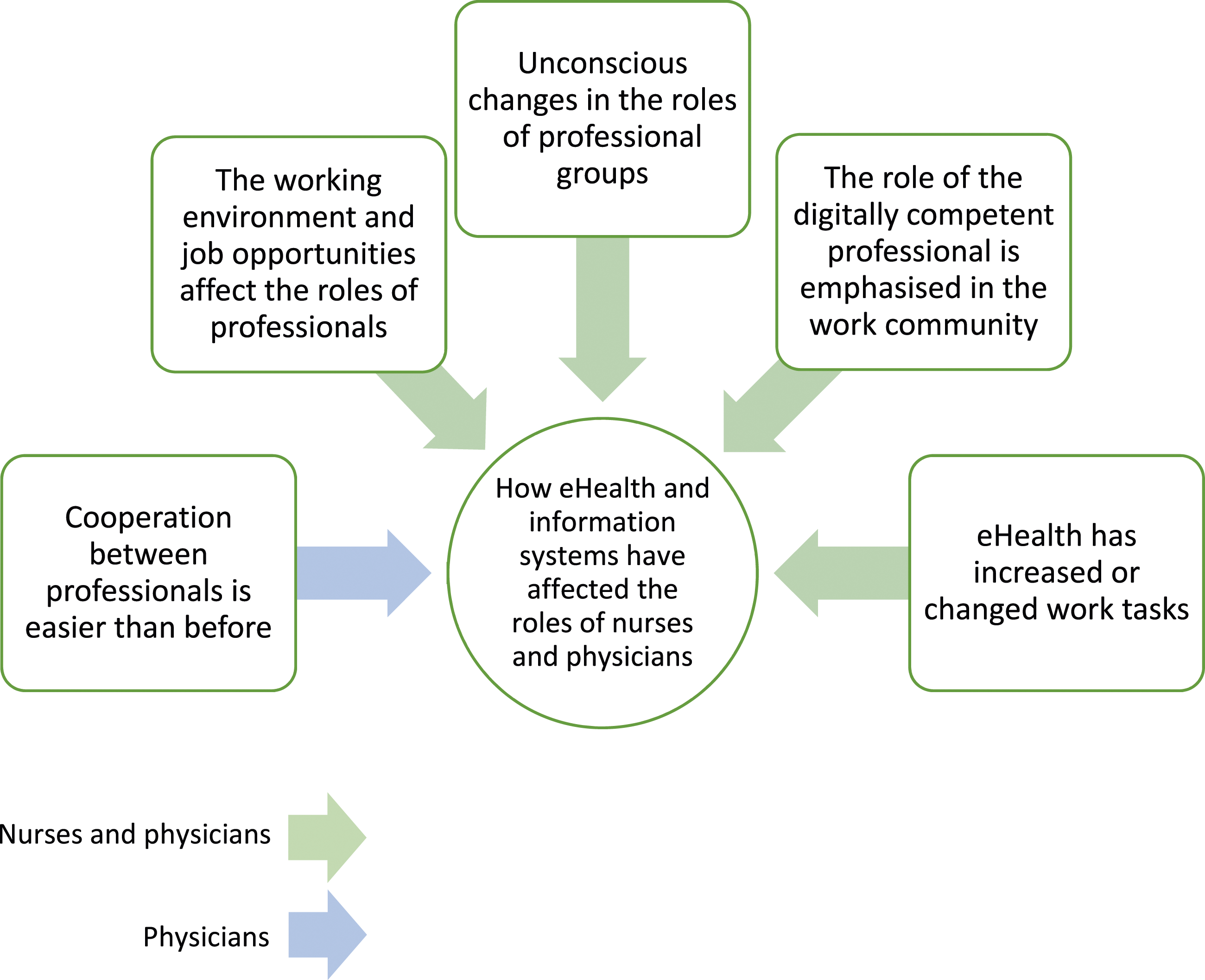
Discussion
This descriptive qualitative study examined how the increased use of eHealth and information systems affects the roles of health care professionals. We found that increased eHealth and information systems use has changed the roles of health care professionals. In particular, the role of digitally competent professionals has become more important in the work community. Moreover, the work tasks of health care professionals have increased or changed. For example, work tasks have shifted from different professional groups to others. Access to digital systems and job opportunities have affected the roles of professionals. In addition, cooperation between professionals seems to be easier with digital systems than it was before. Nonetheless, eHealth was seen to have created inequalities in work tasks, increased skills gaps and complicated functions. According to our findings, many changes in the roles are, however, unconscious.
According to Gibbs, digitalisation has changed the world of work and job descriptions. 3 Our study is in line with the suggestion that the roles of health care professionals have changed as the use of eHealth and information systems have increased. Our study is also in line with Cijan et al., 15 who argue that sometimes the changes brought about by eHealth are so small or even unconscious that the professionals themselves cannot even recognise them. Our interviews revealed that although professionals do not fully feel that their roles have changed, it was possible to find some features from the data that showed that there have been a number of changes to working roles and job descriptions. This leads us to the assumption that professionals did not fully understand the changes in their work and that the role changes are part of a much bigger digital reform.9,27,28
When the use of eHealth and information systems increases, the skills to perform those tasks also change. 3 Digital change also removes routine labour and it increases demand for non-routine work, which usually requires more education. 2 eHealth and information systems also require professionals to have basic or high-level digital skills.2,8 Our study added to these previous findings, showing that the role of digitally competent professionals is highlighted, that professionals in the working community are aware of digitally competent professionals, and that competent professionals act as mentors and take greater responsibility for digitality. Burri 11 showed that some professionals’ lack of experience and skills with new technology has a major impact on their social roles and affects their disciplinary and professional identities. Good digital skills seem to depend more on an individual’s competence, rather than their professional background. 11 Our study supports both of the previous claims, as we found that new technology may have an impact on social roles between professionals and it may even also affect professionals’ self-esteem in the working community. We also noticed that competence was not linked to a specific professional group but to a specific professional as an individual.
Previous studies have found that professionals’ attitudes towards eHealth and information systems has an effect on their digital competency. 1 The professionals in our study perceived that attitudes affect the competency to use and the likelihood of using systems. Our study highlighted that if there is a digitally competent professional in the working community, other professionals might not even bother to learn how to use the system. Some professionals might fear asking for help from more digitally skilled colleagues, whereas other professionals willingly ask for help from them regularly. 5 The professionals in our study highlighted that age plays a significant role in the use of eHealth. It was easier for younger professionals to use the systems, while older professionals seemed to have more difficulties. It can be assumed that older professionals might find it more difficult to acquire the required digital skills. 5
Our study highlighted that physicians have taken a greater role in diagnosing patients, whereas nurses feel that they are more responsible for instructing the patient. Task-shifting from physicians to nurses has become common in many countries worldwide. 16 According to Győrffy et al.7,29 physicians may see technology as a new hope that allows them to increasingly focus on more interesting things and to make their work more efficient. The introduction of digital technology has caused a shift in tasks from physicians to nurses, which means that the tasks and responsibilities that were originally done by physicians are now being transferred to other professionals. 28 In addition to tasks shifting from physicians to nurses, nurses also delegate tasks to other professional groups. 27 Many countries in Europe, as well as the United States, Australia, Canada, Israel, and so on, have been considering the introduction of expanded roles for nurses that require advanced education and clinical expertise. In these advanced roles, it is planned that more responsibilities that have traditionally been the preserve of physicians will be transferred to nurses.16,30
In their study, Maier & Aiken 30 argued that traditional role boundaries between physicians, nurses and other health care professionals have been shifting for decades. Previous studies suggested that digital health care technologies may lead to a shift in professional boundaries in the future.4,16 The professionals in our study perceived that access rights to systems affect their roles and boundaries. Vos et al. 21 suggest that strict restrictions on who has the access to systems and services can hamper or complicate cooperation between professionals. Our study is in line with Vos’, but the professionals in our study also perceived that even though access rights have narrowed the roles of the professionals, eHealth and information systems have still increased multidisciplinary cooperation. Furthermore, they perceived that collaboration was easier than before. Physicians mentioned that with increased use of digital systems they feel like nurses and physicians share responsibility for the patients, which was seen as a positive ramification among professionals.
Our results indicate that the core role of the professionals may not have changed. However, based on our findings minor and partly unconscious changes still seem to have taken place. The study showed that professionals with high competence in digital systems often guide and support other professionals with lower digital skills. Our interviews indicated that professionals may not always want to guide others, but due to circumstances they end up guiding other professionals. For this reason, the core role of the nurse or physician may not change but the supporting actions of the role might change. In addition, digital communication might change the role of the professional, if other professionals know how to use digital communication systems better. A professional does not need to have an ICT degree or to be highly competent, but the study shows that some professionals do not have basic skills for digital systems or communication.
Strengths and limitations
The qualitative study and the interview guide gave professionals the opportunity to share their opinions and thoughts freely and they were able to communicate the points that were important to them. The data was analysed, and the codes were developed by three researchers from the research team. Every researcher brought their own expertise to the study. The interviews were attended by two researchers, which improved the reliability of the study and made it easier to ask questions of the participants and then share thoughts with the other researcher after the interviews. The interviews were attended by professionals from multiple different departments from health care. The nurses and physicians from diverse fields of health care can also be seen as a strength of this study.
The interviews were attended by 15 professionals and the study was also conducted in one single organisation. Conducting the study in multiple organisations and with a larger number of participants would increase its reliability. Some of the participants were young and did not have many years of work experience, so it was difficult for them to answer some of the questions. Some of the interview questions were also quite broad, and by asking more specific questions about changes in professional roles, even more detailed answers could have been obtained. However, the interview guide was piloted before the interviews began, and it was found to serve the purpose of the study. The interviews were also conducted online via Microsoft Teams, which could have affected the process. It is possible that the interviews would have been more natural in a face-to-face setting. The study was only conducted with health care professionals and the results cannot be generalised to social care professionals.
Conclusions
This study confirmed that the increased use of eHealth and information systems have brought about role changes between health care professionals. These role changes might be unconscious shifts between professionals that happen over time. Skills levels of the professionals vary between professionals, and this highlights the importance of the digitally competent professional in the working community. These digitally competent professionals take greater responsibility for eHealth and information systems and their digital workload is bigger than that of other professionals. This might lead to bigger gaps in professionals’ digital skills in the organisation. More attention should be paid to how work tasks are shared equally between professionals and to their opportunities to improve their digital skills. The increased use of eHealth and information systems have also transferred work tasks between professionals, and organisations should pay attention so that some professional groups’ workloads do not become too overloaded.
Access rights to eHealth and information systems were perceived as limiting professionals’ work, while also favouring physicians. Redefining access rights between professionals would increase collaboration and improve the workflow between professional groups. This could lead to more efficient health care.
Footnotes
Acknowledgement
The authors would like to express their great gratitude to all the professionals who attended the interviews.
Authors’ contribution
All of the authors have made substantial contribution to the study conception, design, data collection and analysis, interpretation of data and drafting of the manuscript. All of the authors have approved this final version of the manuscript to be submitted.
Declaration of conflicting interests
The author(s) declared no potential conflicts of interest with respect to the research, authorship, and/or publication of this article.
Funding
The author(s) disclosed receipt of the following financial support for the research, authorship, and/or publication of this article: This study was supported by Strategic Research Council (SRC) at the Academy of Finland (project 327145/352501).
