



Abstract
Nurses need professional competencies for safe and effective care. In this regard, nursing informatics competence is a significant need for intensive care unit nurses. In this study, the Delphi method was used during four rounds. The participants included 30 panelists selected by purposive sampling method. The data were analyzed using qualitative content analysis and descriptive statistics. During the rounds, the items were evaluated for importance, necessity, relevancy, and percentage of agreement. The findings of nursing informatics competencies in the intensive care units (ICU) were classified in three categories including basic computer skills (7 subcategories and 20 items), skills to use information management software (2 subcategories and 9 items), and specific nursing informatics skills (2 subcategories and 22 items). In order for nurses to perform successfully in ICU, they must meet some abilities such as computer skills, available software management, nursing information systems familiarity, nursing databases, web search methods, and English proficiency.
Introduction
Nurses play an essential role as one of the largest providers of health services in the continuum of care, promotion, and health at different levels of healthcare services. 1 In this regard, the responsibility of nurses in critical care units is unique; in this ward, services and care provided require more vigilance and higher quality than other departments. 2 Nurses working in intensive care units (ICU) are more capable of improving their personal development skills and advance their career, due to the kind of healthcare they provide. 3 Providing effective care of nursing has always been dependent upon the quality of information available to the nurse, because nurses have been rendered as key collectors and users of patient information.4,5 In addition, information exchange and data transmission among healthcare team members are both considered as important roles of a nurse to make patient follow up and to continue treatment. 6 In general, information systems are required for every nurse to gather, save, evaluate, and exchange their professional information. 7
One of the new and important concepts in the healthcare system is the use of information systems and technologies to improve the quality and safety of patient care.8–10 Nurses are directly involved in information systems and information technology as a basis for evidence-based practice, clinical decision support (CDS) systems, and electronic health records (EHR).11–16 Nurses who are sufficiently capable in information systems and computer literacy have more opportunities to provide quality patient care. On the other hand, the nursing profession is constantly changing; therefore, specific competencies are needed to address specific areas of nursing to provide safe and effective care. One of the main required competencies is informatics in nursing. 17 Today, nursing informatics is a nursing specialty, and the American Nursing Informatics Association declares that an informatics nurse is one who combines nursing, computer, and information science to collect, process, and manage data in order to provide the principles of nursing, clinical care, education and research and develop nursing knowledge.18–21 Nevertheless, all nurses need to be familiar with health information technology and information management and should have more training with informatics.17,22 Informatics competency is necessary for every nurse to enable them to provide high-quality care and safe healthcare services. 23
Knowledge and skills in nursing informatics exert some influence on the optimal use of technology; nursing leaders have come to the consensus that all nurses should participate in nursing informatics.24,25 In such a data-rich period, nursing informatics can lead to improved patient care outcomes.26,27 But it seems that nursing informatics does not have the desired effect on the outcomes of nursing services. This can be due to nurses’ lack of knowledge and skills about informatics. It can also be caused by nurses’ not getting involved in primary system design, not having a useful instruction for designed software, lack of computer skills and digital systems, lack of labor force, the caring burden on nurses, lack of sufficient support, and management methods. 28 Moreover, in spite of the potential capacity of information technology, it does not help to improve the healthcare system, reduce healthcare costs, and satisfy healthcare providers as it is expected. 29 Since nurses cooperate the most with health-related technologies and patients, it is essential to get involved in primary system design and learn required information skills. 27
Nursing informatics as a science and specialty can be used to support every nursing activity. This specialty in nursing can support all aspects in any nursing field at all levels from beginner to advanced at healthcare center. So, training and learning the science of nursing informatics and familiarity with the required features of informatics in nursing is critical in every aspect of the nursing practice. Also, the integration of nursing with computer science can be helpful in identifying, collecting, and managing data and information in all areas of nursing such as clinical practice, education, management, and research. This will improve the quality of nursing services and patient care. Therefore, first it is necessary to identify the needs of nurses to achieve these goals. This research was performed on the basis of Technology Informatics Guiding Education Reform (TIGER). The TIGER was developed in 2006 in the United States to define main areas of informatics in nursing. The TIGER has provided a competency scaffold to be used in the integration of informatics in nursing. 30 The TIGER was developed to deal with a series of skills required by all nurses who will work in the profession in the 21st century. 31 This collection of skills entails informatics competencies that vary from basic computer skills to advanced-level information technology and literacy competencies and tactfulness.31–33 In addition, determining nursing informatics competencies will enable inter-professional conversations around nursing informatics specialty program accreditation, nursing workforce preparation and training, and nursing informatics advanced certification. 34 Also, can help developing and emerging project of technology in healthcare such as Topol review in the UK that it’s for preparing the healthcare workforce to deliver the digital future. 35 Accordingly, ICU is an area in a hospital for hospitalized patients where critically-ill patients receive intensive medical care and monitoring. 36 Intensive care units nurses are constantly in clinical practice and are a mediator between the patient, family, and healthcare team. 37 This ward can represent a fully developed hospital. Considering what was mentioned above and the importance of nursing informatics in the present era, this study was conducted to determine the required dimensions of nursing informatics for nurses in ICU.
Method
The present study used the Classic Delphi method in four rounds. In practice, the Classic Delphi method is a set of sequential rounds with controlled feedback attempting to reach a consensus among a group of experts on a particular topic. 38
This study was performed after approval by the Committee of Ethics with code of ethics: IR. SSU.REC.1398.007. In addition, for ethical considerations in this study, before sending the items to the experts, their oral or written consents were obtained, and the confidentiality of information was explained to them.
At the beginning of the study, a pool of items was prepared in two stages. Initially, after reviewing 255 items of nursing informatics competencies of the TIGER Project in the Health Information Systems Management and Management Association by researchers, the items related to the nursing informatics of ICUs were extracted and endorsed by the team. In addition, at this stage, by reviewing the literature in the English and Persian databases of PubMed, Web of Science, Google Scholar, Ovid, SID, and MAGIRAN using the keywords: Nursing Informatics, Nursing informatics competencies, Information Technology, Informatics Competency, and Critical Care Unit, some data pertaining to 2000–2019 were obtained. Related items were extracted after evaluating the selected articles.
Following the first step, some items pertaining to nursing informatics in the ICU were obtained on the basis of the results of TIGER Project and also through review of the related literature and integrated by the researcher to form the pool of items. Moreover, it was submitted to experts with an open-ended question to provide their views on the purpose of the study. Accordingly, the pool of items was sent to seven informatics and nursing experts by e-mail along with a preliminary letter explaining the aims and procedures to check its validity.
In the second stage, the responses to the first open-ended question were categorized based on similarity, congruence, and proportional content; content analysis was then performed, and in this way, qualitative items were merged with the quantitative items from the first stage and then the items were sent to seven informatics and nursing experts to confirm the validity. After evaluating the responses at this stage, the items were re-examined and then Delphi rounds were conducted in the presence of the experts.
In the first round, the items from the first two stages of the study were sent to the experts to determine the degree of importance based on a 5-point Likert scale (ranging from “5 = very important” to “1 = not at all important”). Then, the first round responses were collected and evaluated. At this point, the items that gained a mean score of 2.5 reached the second round.
In the second round, the items confirmed in the first round were sent to the experts to investigate the necessity of having a 3-point Likert scale (1 = not necessary, 2 = useful but not necessary, and 3 = necessary). After analysis, the items with a mean score of 2.6 and above were reached to the third round.
In the third round, items confirmed in the second round were sent to the experts for reviewing their relevancy based on a 4-point Likert scale (1 = not relevant, 2 = somewhat relevant, 3 = quite relevant, and 4 = highly relevant). After analysis, the items with a mean score of 3 and above reached the fourth round.
In the fourth round, the endorsed items in the third round were sent to the experts in the form of agreement and disagreement and they were asked to have a final evaluation on the items. After calculating the frequency of the percentage of agreement, the final items were yielded.
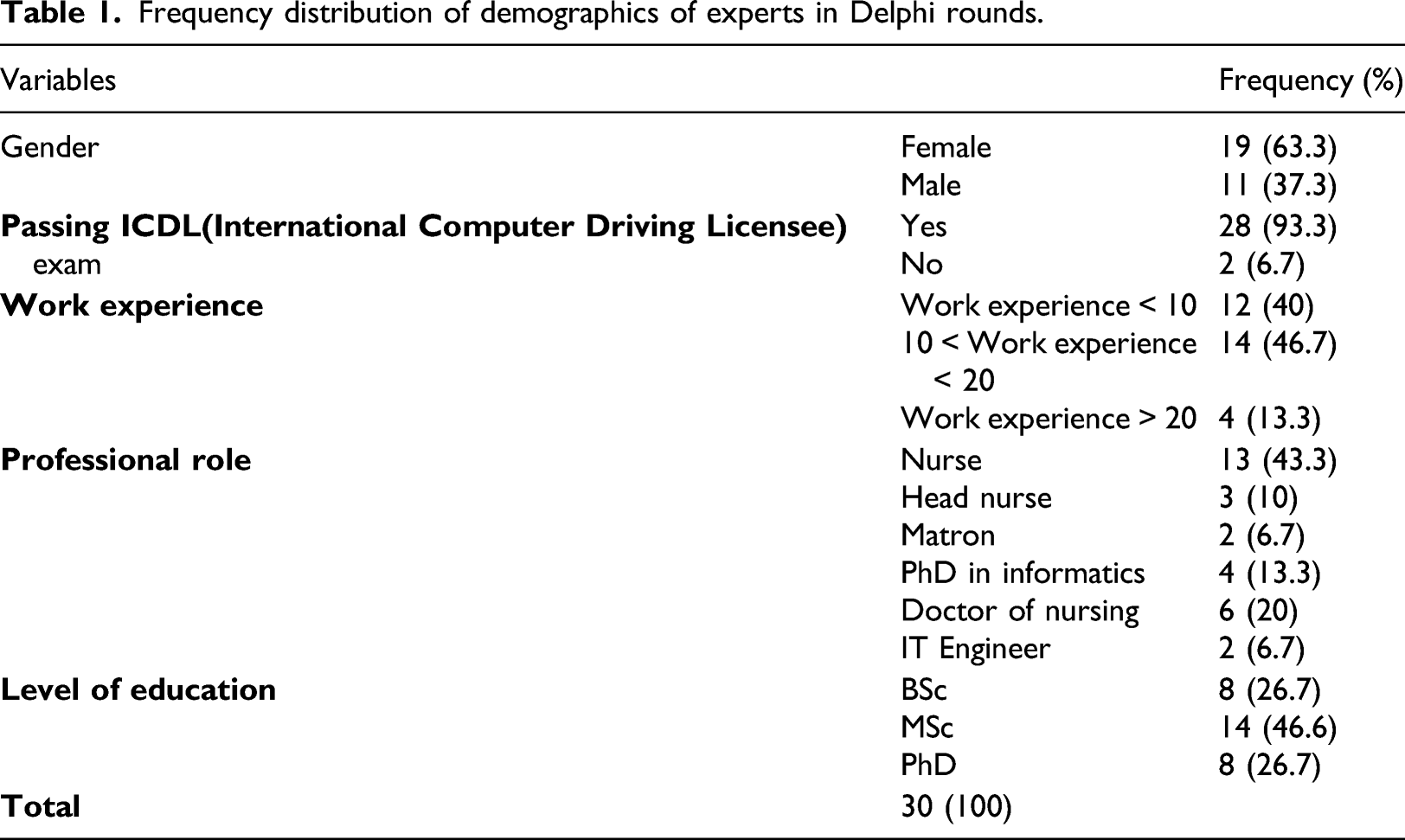
The population of this study in all four Delphi rounds consisted of 30 nurses and head nurses in ICU and other wards, matrons, IT managers, as well as professors of nursing and medical informatics (with at least 3 years of experience). To communicate with the participants, e-mail, contact number, as well as What’s up App were applied. Two weeks were given for the experts to respond to each Delphi round. The data were analyzed with descriptive statistics (mean and frequency) using SPSS16.
Findings
Frequency distribution of demographics of experts in Delphi rounds.
In the first phase of the study, in the TIGER project review, 255 competencies were examined, of which 123 items were extracted based on the agreement of the researchers. In addition, by the literature review, 32 articles were selected and following the reviewing of the full text of the articles, 11 articles related to the purpose of the study were selected. Then; after content analysis, 53 items were extracted. At this stage, the pool was formed with 176 items. After being reviewed by 7 informatics experts and nurses 71 items were removed due to being partial, elementary, unrelated, and repetitive and 105 items, which were required in nursing informatics, were approved.
Moreover, in the second phase of the study, following the qualitative analysis of the open-ended question from the first stage, 28 items were extracted and merged with 105 extracted items in the first phase; after being examined by the research team and by 7 informatics and nursing experts, 120 items were approved at this stage.
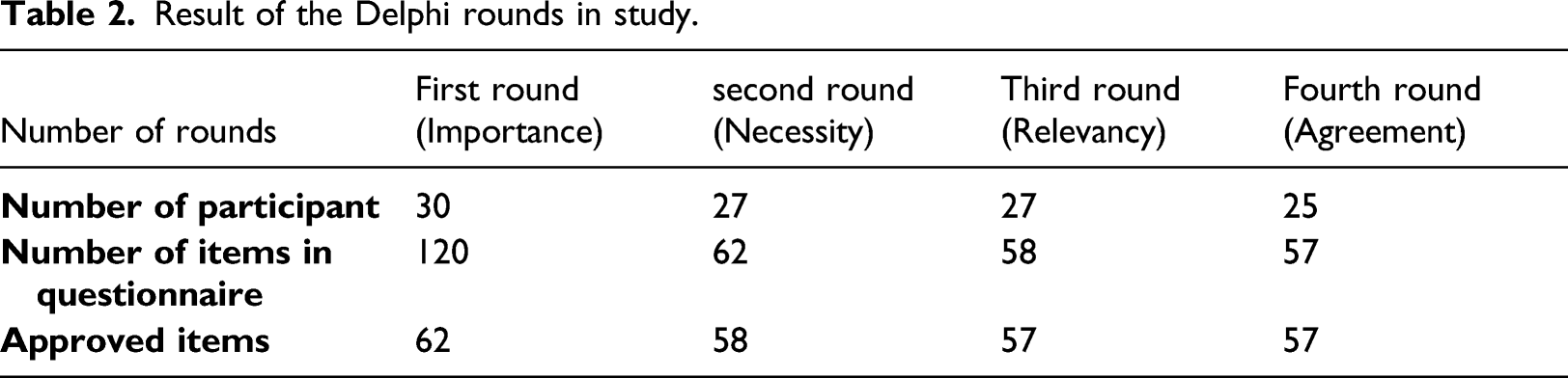
In the first round, out of the 120 extracted items, only 62 items with mean scores amounting to 2.5 or higher reached the second round. The items were also categorized into three categories by the research team in terms of similarity, conformity, and appropriateness: general and basic computer competence, competency to use information management software, and proprietary nursing informatics skills.
In the second round, after the items were evaluated by the experts in terms of necessity, 58 items received a mean score of 2.6 or higher and were considered as the third round items and then four items were eliminated. In this round, 27 experts helped the research team.
In the third round, after sending the items to the participants, 27 of them participated in this study. In this round, 57 out of the 58 items gained a mean score of three or higher by the experts in terms of relevancy and reached the fourth round.
Result of the Delphi rounds in study.
Categories and subcategories of nursing informatics competencies in the intensive care unit.
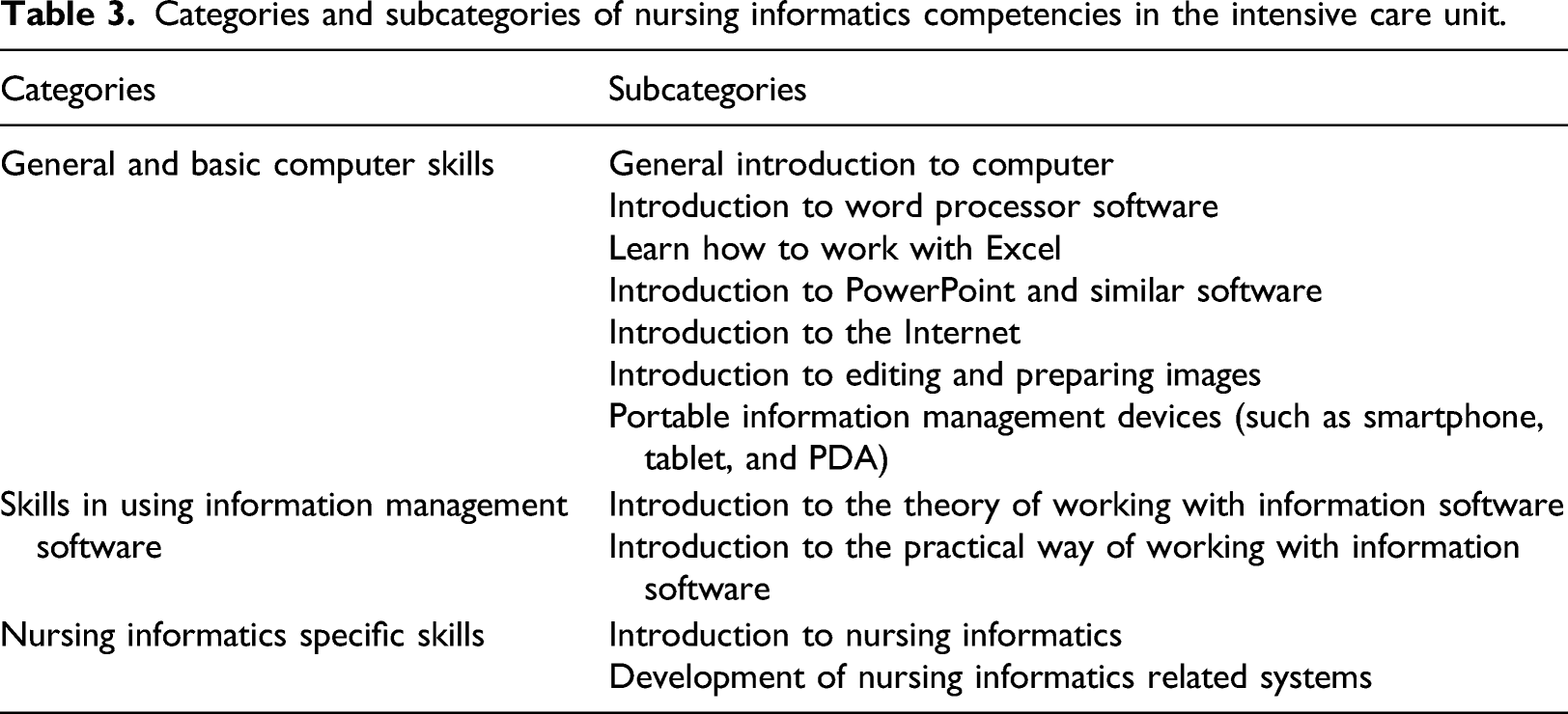
The general and basic computer skills (consisted of seven subcategories and including 20 items) 1. The subcategory: “general introduction to computer” including the items “windows operating system, control panel, concept of files and folder types and their management, 10-finger typing ability, familiarity with shortcuts in various applications ،general concepts of information security, general understanding of the general behavior of viruses and potentially dangerous software and their counteracting general network concepts, resource sharing, access control related security issues, introduction to computer hardware and peripherals, general knowledge of network hardware, types of computer connections and how to check them, and familiarity with the concepts of backup and data recovery.” 2. The subcategory: “introduction to word processor software” including the items “how to create, edit, and adjust the format of reports and documentation and to provide different output types, principles of designing forms and questionnaires (suitable for printing and completing paper or suitable for completing files on a computer.” 3. The subcategory of “learn how to work with excel” including the items “charts, reports, and formulas.” 4. The subcategory “introduction to PowerPoint and similar software” including the items “principles of slide design and the features of suitable slides, how to make attractive slides, and how to present content.” 5. The subcategory “introduction to the internet” including the items “search tools, information sources, and validation methods, internet security issues and potential risks, introduction to e-mail, virtual communication, public, and specialized networks, content sharing, cloud storage and teamwork on online documents, introduction to virtual education and video conferencing tools (e.g., adobe connect).” 6. The subcategory “introduction to editing and preparing images, common images” including the items “file formats and important features of each, and introduction to simple image editing tools (such as paint).” 7. The subcategory “portable information management devices (such as smartphone, tablet, and PDA)” including the items “ability to transfer files between pc and mobile, using the phone as a webcam, scanner, and microphone and internet connection, and using content matching tools on the phone and computer (e.g., one drive drop box).”
The skills in using information management software (consisted of two subcategories and including 9 items) 1. The subcategory “introduction to the theory of working with information software” including the items “introduction to software name, getting acquainted with different parts of the software, and getting to know all the features available, software security tips, and understanding the duties and responsibilities in working with software.” 2. The subcategory “introduction to the practical way of working with information software” including the items “how to make basic settings and definitions in the software, how to enter information, possible ways to get the information you want and edit it, how to prepare the desired outputs (reporting, statistics, printing, etc), understanding alternative methods and tools for use in the event of a temporary system failure (e.g., in the event of a power failure), and ability to detect the source of possible errors or malfunction (error messages, unexpected results).”
The nursing informatics specific skills: consisted of two subcategories and including 28 items 1. The subcategory “introduction to nursing informatics” extracted from items of “introduction to nursing information system, awareness of the role of nursing in health information systems, introduction to ergonomics of working with hardware systems, awareness of ethical and legal issues and confidentiality of patient information related to the nursing information system.” 2. The subcategory of “Development of Nursing Informatics Related Systems” extracted from the items of “ability to access, enter and retrieve patient information with the HIS nursing information system or electronic health record, ability to use information systems to record continuous patient information such as vital signs, designing and development skills of electronic systems for nursing reporting, patient care planning skills in computer applications, ability to apply alarm systems and reminders of nursing interventions for the hospitalized patients in ICU, ability to combine information from different sources of information and use in clinical practice, ability to integrate all critical care processes with the information technology system, ability to apply CDS systems, ability to review care data such as tests and x-rays for clinical decision-making, designing and use of clinical decision tools such as algorithms and clinical guidance in nursing information systems, clinical decision-making skills using IT Systems, ability to integrate ergonomic principles with portable technology, patient beds and work stations, skills for using nursing proficiency database use (nursing proficiency/citation databases), ability to use informational data and electronic nursing documentation to evaluate and improve performance, nursing research skills and electronic documents, skills in designing data collection tools for reviewing nursing literature, ability to use information technology for evidence-based practice, ability to choose the right search strategy for evidence review, participate in the processes of changing nursing information systems, participate in continuing education programs using nursing information systems, collaboration and negotiation with information technology planners in the field of nursing information systems, ability to use other information systems such as pharmacy information system, ability to use other information technologies such as barcode scanning, to ensure patient safety, and providing continuity of home care with the use of nursing information system.”
Another noteworthy point mentioned by the experts was that nurses needed to know English, but because it was not related to nursing informatics, it was not evaluated during the rounds. It seems that nurses should also be fluent in English because almost all devices have English language included by default. This is about the countries which are not native speakers of English or where the official language of the country is not English.
Discussion
Based on the findings, critical care nurses’ required competencies for using nursing information services are placed in three categories including the general and basic computer skills, use of information management software, and proprietary nursing information skills.
In the category, “basic computer skills,” the items such as general computer skills, familiarity with Word software, Excel, Internet, image editing and preparation, as well as effective use of portable information management devices (such as smartphones, Tablet, and PDA) were obtained. In line with the results of the present study, Khezri and Abdekhoda (2019) showed that developing the nurses’ basic computer skills can enhance nurses’ informatics competency. 39 Schleyer et al. (2011) investigated the skill of working with Word and Excel software in their studies. 40 Sun and Falan (2013) and Verma and Gupta (2019) studied skills in working with Word and PowerPoint software and familiarity with the Internet.41,42 Hwang and Park (2011) and Kaminski (2011) have also maintained Excel software skills in addition to working with Word software, PowerPoint and Internet familiarity.43,44 The studies conducted by Rahman (2015) and Verma and Gupta (2019) have also gained the ability to make effective use of portable information management devices.23,42 Moreover, TIGER Project and Kaminski (2011) have been stated the skills of editing and preparing images.29,44 This is consistent with our results. They indicated that nurses, especially nurses in ICUs, need basic computer skills as one of the required nursing informatics competencies to perform nursing professional interventions.
Other competencies explained in this study were the competency of using information management software. In this regard, familiarity with software was theoretically and practically mentioned as one of the important issues, including familiarity with the name and different parts of the software, all the capabilities available, how to make its settings and initial definitions, how to enter information, possible ways to get the desired information and edit it, and how to get the desired output (reporting, statistics, printing, etc). In addition, paying attention to software security tips, familiarity with their duties while working, identifying alternatives to use in the event of a temporary system failure (e.g., in the event of a power failure), and the ability to detect the source of possible errors or malfunction (error messages, unexpected results) were also extracted.
In line with the results of TIGER Project, some items were included such as familiarity with the software name, familiarity with different parts of the software, how to prepare the desired outputs (reporting, statistics, printing, etc), and the security tips about software as nursing informatics competence in the basic skills section of all nurses. 29 Stagers et al. (2002) also considered the necessity of different skills of using information management software at all levels of nursing. 6 Moreover, Verma and Gupta (2019), Huang and Hwang and Park (2011), Pordlei (2017), and Hill et al. (2014) also reported the necessity of information technology software along with basic computer skills. In addition, they reported the need for understanding and developing hospital care software such as EHR, appropriate software for the Nanda nursing process, qualitative and statistical data management, and as examples.42,43,45,46 All these indicate that the nurses' knowledge of how to work with software and the ability to solve software-related problems can lead to more rapid work by nurses and, additionally, increase nurses' ability and independence in providing better care to patients.
Other findings of the study included specialized nurses' informatics competence, which comprised acquaintance with nursing informatics and acquiring the skills needed to achieve these competencies. Other mentioned issues addressed introduction of information system to nursing, ergonomics, working with hardware systems, awareness of the role of nursing in health information systems, awareness of ethical and legal issues, and confidentiality of patient information related to the nursing information system. Similar to our findings, Verma and Gupta (2019) also referred to these informatics competencies, which included awareness of the role of nursing in health information systems, awareness of ethical and legal issues, and the confidentiality of patients' information related to the nursing information system. 42 In addition to the competencies reported in the studies by Sun and Falan (2013), Verma and Gupta (2019), and Kaminski (2011), they have also referred to knowing the ergonomics of working with hardware systems as well as the informatics competencies.41,42,44
The present study extracted, Some skills needed to develop nursing informatics systems were included; the skill to access, enter, and retrieve patient information with nursing informatics system in EHR as well as the skill of applying the patient information systems such as recording some vital signs, the skill of designing and finally developing electronic stems for nursing reporting.
Other skills noted for specialized nursing informatics competence included computer-based patient care planning skills, the ability to use alert systems and reminders of nursing interventions for patients admitted to the ICU, the skill of combining information from different sources of information and using in the clinic, the skill of integration of all ICU work processes with information technology systems, the skill of using CDS systems and reviewing care data such as tests, graphs, etc. for clinical nursing decision-making and clinical decision-making skills using technology information system. These skills are useful in accurately recording information for patients, managing data, and then helping nurses make clinical decisions. In addition, these skills are very effective in meeting the information needs of nurses in the patient care, helping them organize the patient information and then advancing clinical practice and implementing a quality nursing process.
It should be noted that in order to gain specialized ICU nurses' competence, other skills are required; including the ability to integrate ergonomic principles with portable technology, patient beds and workstations, the skill of the usage of informatics data and electronic nursing documentation to evaluate and improve performance, the skill of using nursing profession databases (skill in using nursing profession citation/information databases), skill in using information technology for evidence-based practice, and skill in using other information systems such as pharmacy information system. Other skills such as the using of barcode scanner can improve the patient safety and provide continuity of care at home with nursing information system development.
In addition, Participation in the processes of changing nursing information systems and continuing education programs using nursing information systems, collaboration, and negotiation with information technology planners in the field of nursing information systems have been highlighted.
In light of the results obtained for nurses' informatics specific competence, the findings by Sun & Falan (2013) and Kaminski (2011) also revealed the above skills for nurses.41,44 The TIGER Project has named some other skills such as the skill of performing the nursing-related research and electronic documents, the skill of designing data collection tools for reviewing nursing literature, designing and usage of clinical decision tools such as algorithms and clinical guidance in information systems, and the skill of selecting the appropriate evidence-based search strategies for all nurses. These results are consistent with our results. 29
In a study aimed at designing a curriculum of nursing informatics master’s degree in Iran, Elahi et al. (2019) have identified some issues such as the need for documentation and rapid service presentation, the design of new software, the scientific need of the nursing community for evidence-based nursing, the ideal orientation in nursing, empowering nurses, and increasing the efficiency of healthcare systems as the reasons for the need to design and build information systems in the field of healthcare. In this study, nursing information management systems and decision support systems were considered as six units of mandatory specific courses, indicating the need for empowering nurses to become familiar with nursing information systems. 47 Olajubu et al. (2014) also report the nursing competencies of working with nursing information systems and how to manage and extract software-related information to store client/patient electronic records; these results confirm our findings as well. 48
Nurses in ICU are required to learn informatics skills and work with advanced software due to the high sensitivity of care and the need for high precision and speed in performing nursing interventions. Therefore, lack of familiarity with the skill of working with different electronic systems and devices built on new technologies can confuse nurses and reduce their quality of care.
Conclusion
Based on the findings of the present study, nurses are involved in a high level of care in the ICU and have to work with nursing information systems and also with advanced devices. In doing so, nurses need to have some skills such as computer skills, management of existing software, familiarity with nursing information systems, databases related to nursing and web search methods for obtaining nursing informatics competence to provide effective and safe care, and increase the quality of care in the ICU. In addition, nurses should have such an English proficiency. Therefore, given the progress and development of information technology and its use in the healthcare industry, it is necessary to prepare and evaluate these competencies in nurses and they should be considered in nursing education and performance evaluation programs. Also, it is recommended that future studies focus on investigating the digital competency of nurses.
Footnotes
Acknowledgments
The present paper has been extracted from the master's degree in critical care nursing in Shahid Sadoughi University of Medical Sciences and Health Service. The authors would like to express my sincere gratitude to all the participants for their participation in the study.
Author contributions
All authors contributed to the design and implementation of the research, to the analysis of the results and to the writing of the manuscript.
Declaration of conflicting interests
The author(s) declared no potential conflicts of interest with respect to the research, authorship, and/or publication of this article.
Funding
The author(s) disclosed receipt of the following financial support for the research, authorship, and/or publication of this article: This work was supported by Shahid Sadoughi University of Medical Sciences.
