




Abstract
Digitalization is the future and, simultaneously, a challenge for nursing. In addition, health literacy is increasingly associated with the use of technology. Older adults are greatly underrepresented in the use of digital technology and regarded as a vulnerable group. Consequently, training programs for technological knowledge and improving technological competencies are indispensable to promote equal opportunities and health literacy. The researchers inquire what characterizes nursing informatics as an expanding field in relation to the roles and competencies of nurses in technical appropriation processes of older adults. We conducted a scoping review based on a systematic literature search. We identified 23 relevant studies and developed a modular system to characterize the potential of nursing informatics: nursing informatics as a profession, competencies of nurses and nursing informatics, assessments, and eHealth literacy. Nursing informatics is a new field in some countries, but competence profiles and role descriptions clearly show that nurses act as educators, supporters, advocates, and mediators.
Introduction
Technical assistance systems, digital technologies and information and communication technologies (ICTs) are constantly being developed, particularly for the care and support of care recipients. A great amount of research is invested in home care and assistive technology projects. The objectives are to improve healthcare and patient outcomes, to exchange information between service providers and, particularly, to facilitate access to health information. In this context, terms such as eHealth, digitalization, telemedicine, and digital skills are used. What is the perspective seen through the lens of technology use and the digital transformation of nursing? Digitalization is a challenge as much for society as it is for nursing. The increasing use of technology in certain parts of the care process requires further theoretical and methodological development.
In addition, people worldwide are increasingly reliant on their health literacy in more complex health systems. Sørensen et al. (2012) proposed a ‘all inclusive’ definition of Health literacy which “is linked to literacy and entails people’s knowledge, motivation and competences to access, understand, appraise, and apply health information in order to make judgments and take decisions in everyday life concerning healthcare, disease prevention and health promotion to maintain or improve quality of life during the life course.”
1
The concept of health literacy in Europe is not comprehensively integrated into education, healthcare, politics, and research. 1 New media offer new possibilities in teaching and learning. However, the appropriation of new knowledge and skills in dealing with technology, especially for older adults, is a critical challenge. This needs to be considered against the background of the digital divide. Which describes, among other things, the lack of information on the ability of older adults to use technology among those who have access to ICTs and new media in healthcare.2–5 Consequently, the e-integration of this marginal group is necessary for better handling of technology and easier access to health-relevant information.
Regarding digitalization and technological progress, care structures and tasks of nursing will change in various areas, for example, through the use of wearable technologies and in data analysis. 6 There is a growing need in some countries for support of health information technology (IT) competencies of healthcare professionals who fit specific needs in a particular country or region. 7 In this context, a new role for nurses is to model, support and promote patients’ (electronic) Health literacy through inclusion and education.8,9 The literature indicates that to fulfill this new role nurses must be strengthened in their eHealth literacy as well.10,11
Since nursing informatics (NI) as a field of experts is already dealing with these circumstances in various countries, we focused on the question: “What potential does nursing informatics offer to improve the technical competencies and eHealth literacy of older adults?” Besides, our goal was to approach the fast-changing and expanding field of NI, identify literature gaps, and generate new aspects for future research, education, and healthcare.
Methods
We conducted a scoping review as a technique to “map” relevant literature in the field of interest and to identify the nature and scope of the research evidence. The scoping review “provides a preliminary assessment of the size and scope of available research literature.” 12 There are many articles on the subject of nursing and technology, but there is a lack of evidence-based literature on NI interventions and older adults. The subject of NI has not been well researched in Europe in recent years. We opted for a scoping review based on Arksey & O’Malley 13 which is recommended for scoping studies. We utilized the following steps: (1) identifying the research question, (2) identifying relevant studies, (3) study selection, (4) charting the data, and (5) collating, summarizing, and reporting the results. 13 Also, we oriented ourselves to the recommendations of Levac et al., 14 which describe these steps with potential methodological challenges and give recommendations for their descriptions.
Framework stage 1: identifying the research question
We approached the research subject based on the question “What is understood by NI as a new and expanding field used by nurses regarding their understanding of roles and competencies in the processes of technical appropriation of older adults?” The first search in PubMed (June 2017) did not reveal any articles on the role of nurses in the educational processes of older adults. Consequently, we extended the search to general competency profiles and tasks in the field of NI with an analysis of educational appropriation settings. There was a connection between keywords, such as digitalization and digital divide and between nursing, technical education, and strengthening health literacy. We clarified the question as follows: “What characterizes NI as an expanding field in relation to the roles and competencies of nurses in technical appropriation processes of older adults to promote their eHealth literacy?” The steps are explained in the following section.
Framework stage 2: identifying relevant studies
We searched in subject-related databases using relevant MeSH terms and keywords, as described in the “Electronic databases” section. We searched through reference lists (see section “Reference list”) and conducted hand-searching in addition to the results of our database search to identify relevant articles that had not appeared so far (see section “Hand searching”). We also searched for relevant networks, organizations, and conferences (see section “Existing networks, relevant organizations, and conferences”).
Electronic databases
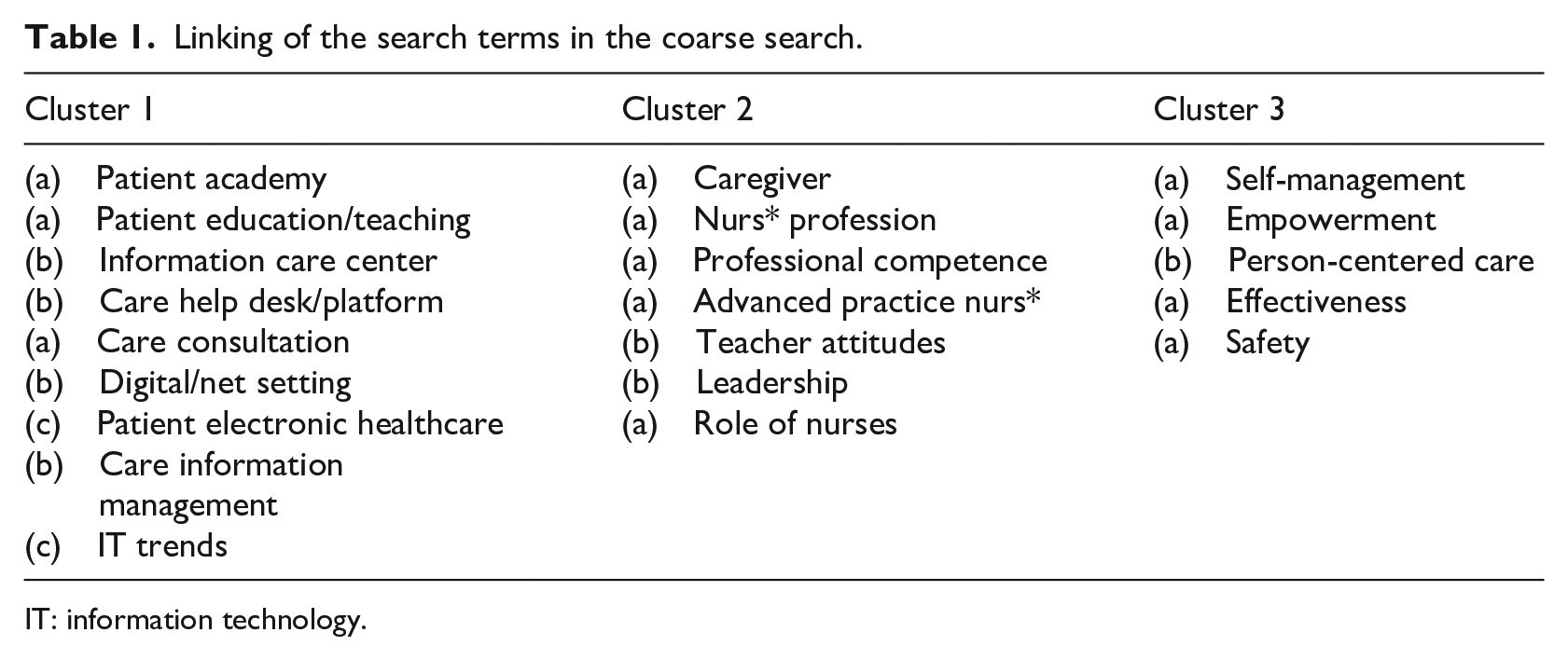
We defined related terms from our research question and searched in PubMed initially to identify suitable search and MeSH terms (July 2017). On this basis, we were able to create three clusters with topic-related search terms. The clusters (1–3) were linked with AND. We linked the subordinated keywords with OR for each cluster with the same letter and with AND for the others (see Table 1).
Linking of the search terms in the coarse search.
IT: information technology.
Based on linking the search terms, we identified relevant MeSH terms and subheadings and arranged them in four main modules (see section “Selection of articles”). We searched in the subject-related databases, PubMed, CINAHL, and the Cochrane Library, and the German-language databases, DZI SoLit and Base between October and December 2017. Furthermore, we used the meta-database ScinOS of the University of Applied Sciences Osnabrück. Based on the commercial index of the company EBSCO, ScinOS generates the results from the catalog of the university, various databases, and open access sources. This includes the databases ACM Digital Library, ERIC, MEDLINE, PsycARTICLES, and many more, as well as databases from other disciplines. In addition, we used Google Scholar.
The search through the databases was carried out in three cycles. In the first search cycle (July 2017), we searched with the keywords “Nursing Informatics” AND “Professional Competence” (PubMed: MeSH terms, CINAHL: subject headings) and sifted the abstracts (see section “Selection of articles”). In the second search cycle (May/June 2018), we added the keyword “health literacy” (“Nursing Informatics” AND “Professional Competence” OR “health literacy”). In the third cycle (July 2018), we updated the systematically conducted search.
Reference list
We found it valuable to review the references of the articles found through the database searches to find new references and identify standard works. This process resulted in further references. The broad research subject of technology and the transformation of care is because new publications are appearing every day; thus, a saturation point cannot be reached. Therefore, we have not used citation searches as an additional method.
Hand-searching
Find articles, which had been missed because of incomplete and out-of-date databases. Besides that, we searched for authors who are experts in the field of NI and scanned their publications.
Existing networks, relevant organizations, and conferences
Various country-specific initiatives try to integrate NI competencies into nursing education. The results showed many articles about the Technology Informatics Guiding Education Reform (TIGER) initiative from the United States, the Data, Information, and Knowledge Wisdom (DIKW) framework, and the Quality and Safety Education for Nurses (QSEN). Furthermore, we identified an Atlas of eHealth country profiles published by the World Health Organization (2015). Some of the numerous organizations and networks act as an umbrella for NI professions and also providing international conferences: The Special Interest Group of the International Medical Informatics Association on Nursing Informatics (IMIA-NI), Alliance for Nursing Informatics (ANI), Canadian Nursing Informatics Association (CNIA), and American Nursing Informatics Association (ANIA).
Framework stage 3: study selection
Our initial perusal of the articles showed that the search strategy contained 404 irrelevant articles. In our case, this exposed some specific difficulties, such as the different education laws for nurses and the fact that the political and structural frameworks in different countries are not comparable. We needed a mechanism that would help us to exclude studies that did not address our central research question and approach to the research subject. Therefore, we established inclusion and exclusion criteria (see section “Inclusion and exclusion criteria”), similar to those used in systematic literature research, for the classification of articles into modules (see section Selection of articles).
Inclusion and exclusion criteria
The definition of inclusion and exclusion criteria was broad. This seemed to be useful considering the new field of research. The inclusion criteria were:
An article in English or German
Articles published between January 2007 and July 2018
Scientific literature
Occupational group: nurses
Systematic reviews were also included, as these presented a good overview of existing literature and findings to approach the research question.
The exclusion criteria of the systematic research are analogous to the inclusion criteria. We excluded articles that were not written in German or English and publications that were not published between January 2007 and July 2018. Articles could be included from the hand-searches that were published before 2007 if they were identified as standard works. Furthermore, we excluded qualification papers (bachelor’s, master’s, diploma, and doctoral theses) and articles that did not meet the scientific requirements. This included congress contributions without publication, articles without references and interviews (excluding expert interviews), or columns without references. We also excluded articles that are not related to the professional group of nursing staff. In the process of the search, we considered “older adults” and “interventions” as inclusion or exclusion criteria for the articles. In addition, we decided to maintain the explorative character due to the methodology of the scoping review.
Selection of articles
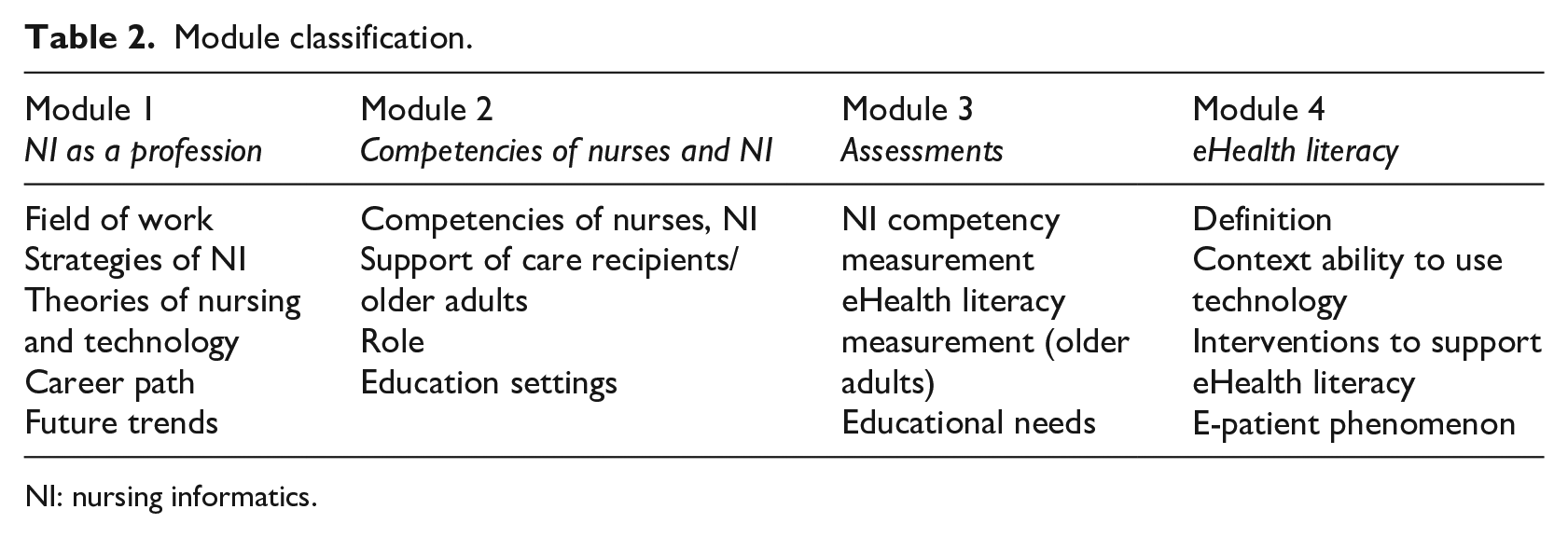
Two reviewers applied the inclusion and exclusion criteria to all the abstracts based on the Preferred Reporting Items for Systematic Reviews and Meta-analyses (PRISMA) criteria. 15 The abstracts were classified according to the inclusion and exclusion criteria. If the relevance of a study was unclear from the abstract, then the full article was ordered. We screened a total of 427 abstracts and categorized them into four modules (Table 2).
Module classification.
NI: nursing informatics.
We categorized the abstracts with a color scheme for systematization and a better overview. Relevant abstracts were marked green and those where the relevance was initially unclear were marked yellow, also if the topic of the article was not clearly described but could be relevant to the research question. We marked abstracts which were not relevant or those with one or more of the exclusion criteria in red. After completion of the abstract review, the full texts for all abstracts marked green and yellow were obtained (n = 74).
Table 2 illustrates the resulting module classifications and the respective main terms.
We also categorized the full texts into the color scheme in the same way as the abstracts. The articles of the yellow category have been included or excluded after a common consideration of the relevant aspects for inclusion criteria. Figure 1 depicts the flow of information through the different phases of the search process.
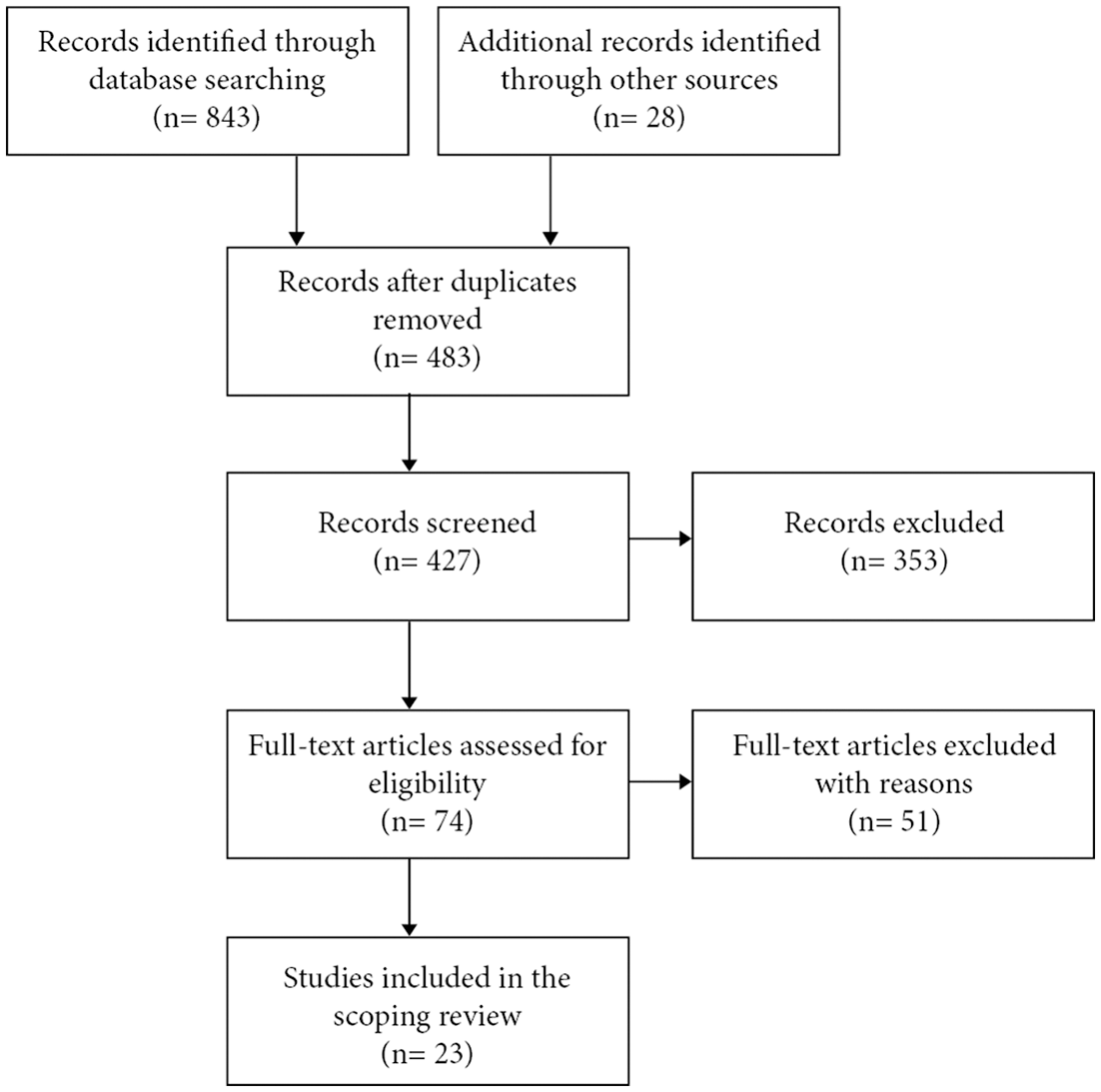
PRISMA diagram empowering the eHealth literacy potential of the NI literature search.
Framework stage 4: charting the data
We used a “descriptive-analytical” approach to summarize the key aspects of the articles. Against the background of the research question, the module classification (Table 2) formed the common framework for identifying the key aspects. As recommended for scoping reviews, the researchers extracted data independently from the same first five articles and met to determine whether their approach to data extraction was consistent with the research question and purpose. 14 The data we collected were entered into a table using the Excel database program.
Framework stage 5: collating, summarizing, and reporting the results
Regarding the results part, the relevant aspects of the articles included were structured thematically according to the modules (1–4). The included studies are shown in Table 3.
Studies included in the scoping review.
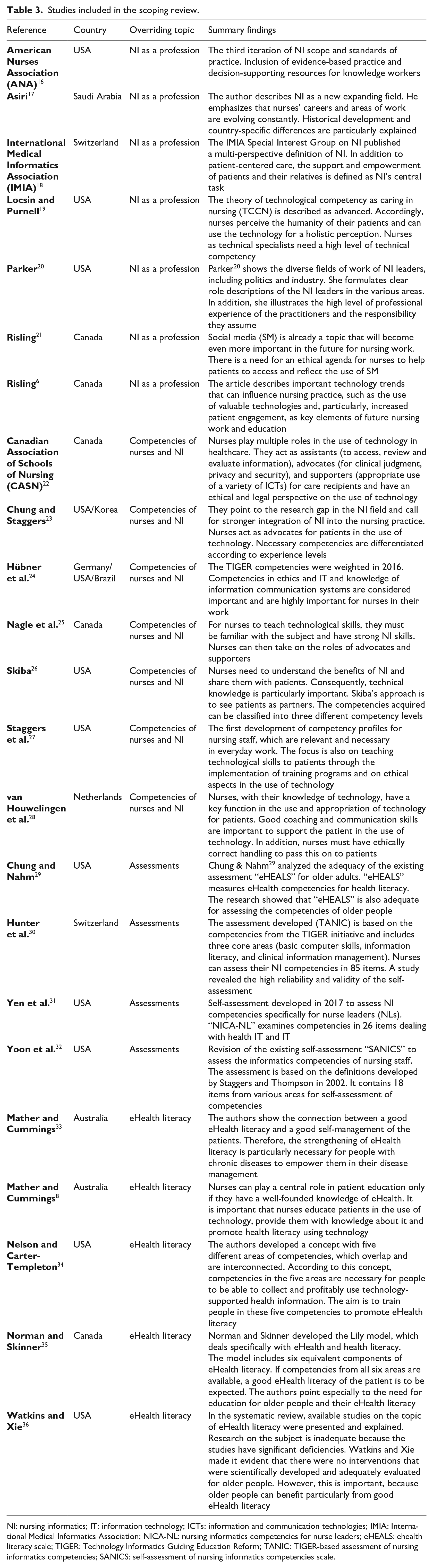
NI: nursing informatics; IT: information technology; ICTs: information and communication technologies; IMIA: International Medical Informatics Association; NICA-NL: nursing informatics competencies for nurse leaders; eHEALS: ehealth literacy scale; TIGER: Technology Informatics Guiding Education Reform; TANIC: TIGER-based assessment of nursing informatics competencies; SANICS: self-assessment of nursing informatics competencies scale.
Results
To answer the research question “What potential does nursing informatics offer to improve the technical competencies and eHealth literacy of older adults?,” we present the summarized aspects of the included articles in the four associated modules.
Module 1 NI as a profession
The term NI first appeared in 1976 and, since then, there has been a multitude of definitions and characterizations of NI. In some countries, the state of development of ICTs and technology is further advanced and integrated, thus, NI must always be seen in the context of the respective health system. 17 The work of Staggers and Thompson 37 included, for the first time, the dynamics between information structures, communication paths, and care recipients. They defined NI as a discipline which “facilitates the integration of data, information, and knowledge to support patients, nurses, and other providers in their decision-making in all roles and settings.” 17 This definition was also adopted by the American Nurses Association Nursing Informatics Scope and Standards in 2008. 16 The IMIA-NI 18 added more multifaceted aspects, such as “science and practice (that) integrates nursing, its information and knowledge, with management of ICTs to promote the health of people, families, and communities worldwide.”
Parker 20 described the role of NI leaders in the United States in one word: “experienced,” with more than half having a masters or doctoral level and 41 percent had over 16 years of professional experience. The NI nurses, such as those in the United States, work in various environments in addition to hospitals in healthcare organizations, government, academia, and the business world. They are responsible in these non-clinical fields, in addition to the design and implementation of electronic healthcare records (EHRs), for putting the patient at the center of politics and law, for patient engagement and to support technologies, such as simulation labs for (nursing) education. The article concludes that NI leaders, with their clinical experience and informatics competencies, contribute to improving healthcare, quality of care and patient outcome. In today’s digital world, social media (SM) is becoming increasingly important in the field of nursing. The SM @WeNurses, UK, for example, has over 76.6 thousand followers on Twitter. This presence is also reflected in the growth of publications on SM nursing research, the access of caregivers to health information and the potential to promote SM by NLs. The NL’s role in this context is described as twofold: To “advance an SM agenda for the profession by engaging in appropriate and effective use.” 21 An important component here is compliance with and adherence to ethical standards for SM. Patient engagement and empowerment is also incorporated and is named explicitly as the one dominant field for the next decade for nursing care 2025. Thus, “nurses should take the lead in either providing the needed patient education or making referrals to community resources that will allow all patients to get connected, digitally speaking.” 6
Against this background, the theory of technological competency as caring in nursing (TCCN) can also be used as a theoretical framework. The TCCN as an approach is “the harmonious coexistence of nursing, technology, and caring.” 19 Technology brings nurses closer to the patient and helps them to perceive the patient holistically. “Being technologically competent is being caring” 19 and comprises a high level of competency to use technology in a meaningful way. Accordingly, nurses in high-tech fields can be considered technology experts. They can be a bridge to the technological world while maintaining the humanity of their patients. 19
Module 2 competencies NI
The standard work by Staggers et al., 27 describes a total of 304 nursing competencies from six work fields (computer skills, informatics knowledge, informatics skills, research, practice, and education). Nurses play different roles in processes of technical appropriation and its use of patients, such as educator, supporter, advocate, and mediator. The following competencies should be mentioned as the role of an educator and supporter: The nurse implements, plans, and evaluates training programs for users and clients (nos. 93, 94), teaches effective and meaningful use of technology (no. 97), and supports “patients to use databases to make informed decisions” (no. 73). The nurse “act as an advocate of system users in including patients or clients” (no. 76) and “as a liaison to support communication among providers, patients, and technical communities” (no. 240). 27 Thus, the role of the advocate is also named in some of the articles included.22,25–27 According to the TIGER informatics competencies model (2009), an “information literate nurse” promotes patient education, accessibility to care and improves practice patterns and the results of healthcare, taking into account needs-based media. 38
The need for an ethically sound handling of technology and its communication to patients is described by van Houwelingen et al. 28 as a core competency. They also refer to a “supportive attitude” for which good “communication skills” and “coaching skills” are particularly necessary. The focus is on enabling patients to use technology for their benefit and health. Individual support concerning ethical, legal, and socio-economic issues of technology use and its consequences for the patients are also described as an area of responsibility. 28
In addition, an international survey was conducted in 2016 to weight core competencies within the framework of the TIGER Competency Synthesis Project. 24 Similar to the works described above, originating IT competencies and the field of law and ethics play an overriding role alongside these. This underlines the importance of the different roles of nurses in the digital world and the diversity of NI to use ICTs more effectively and support care recipients in their health literacy.
Module 3 assessments
Three assessments serve to evaluate the NI competencies of the nurse. These assessments are used to determine whether specific tasks, acts, or jobs can be performed in this field. The self-assessment of TIGER-based assessment of nursing informatics competencies (“TANIC”) is based on the competencies developed as part of the TIGER initiative. The nursing staff’s necessary skills are tested (85 items) in three core areas (basic computer skills, information literacy, and clinical information management). The reduction to 85 relevant items (previously 153 items) was carried out by an expert group. After completion, the self-assessment was tested in an online version as part of a pilot project and a high degree of validity and reliability was determined. Besides that, it was found that nursing staff rated their competencies least in the area of “information literacy and rated them best in the area of ‘basic computer skills.’” 30
The revised self-assessment of nursing informatics competencies scale (“SANICS”) was published in 2015. It contains 18 items ranked by relevance from the areas “Basic computer skills,” “Role,” and “Applied computer skills: clinical informatics.” The assessment is based on the definitions developed by Staggers and Thompson in 2002 and on standardized terminologies, such as the “International classification of disease.” 32
A self-assessment specially developed for the competencies of NLs dates from 2017. The nursing informatics competencies for nurse leaders (“NICA-NL”) assessment serves to determine the competencies for dealing with health IT and IT. Finally, the authors note critically that to date the specific NI competencies for NLs have not been sufficiently defined. 31
The valid and reliable eHealth literacy scale (eHEALS) assessment by Norman and Skinner 35 measures eHealth competencies for health literacy. This assessment is interesting regarding the competencies of nurses, and is also a tool for the targeted teaching of care recipients. The assessment was tested for its adequacy for older adults in 2015. The analysis by Chung and Nahm 29 showed that eHEALS is a useful assessment for the appraisal of eHealth literacy competencies for older adults. Chung and Nahm, 29 for their part, point to a need for research that tests the use of the eHEALS assessment in older adults in different settings and, thus, provides more meaningful results.
Module 4 eHealth literacy
Norman and Skinner were among the first to explore the term eHealth and the concept of eHealth literacy in 2006. The Lily model developed by the authors includes six equivalent components of eHealth literacy (health literacy, traditional literacy and numeracy, computer literacy, media literacy, science literacy, and information literacy). If competencies from all six areas exist, a good eHealth literacy of the patient can be expected. The Lily model is based on the definition of eHealth literacy by the US Institute of Medicine as the ability to search for and evaluate health information using technology and to use it in a targeted and profitable way for their health. Besides, the authors point out that especially older adults face difficulties and lack of knowledge in some of the domains (especially, computer literacy, science literacy, and health literacy), which consequently leads to limited eHealth literacy. 35
Nelson and Carter-Templeton 34 also have a similar concept in terms of content. According to this concept, competencies in five areas (basic literacy, computer literacy, information literacy, digital literacy, and health literacy) are necessary, so that, care recipients can record technology-supported health information and use it profitably for themselves. These five areas overlap and are connected. The aim is to integrate these literacies into everyday life and, consequently, to strengthen eHealth literacy. Therefore, educational programs for patients are especially important for the area of digital health. 34
The publication by Watkins and Xie 36 identifies the research gap in the field of eHealth literacy interventions for older adults. In the systematic review, available studies on the topic were presented and explained. The poor research situation was revealed, as existing studies showed clear weaknesses (lack of underlying theory and lack of evaluations of programs). The authors made clear that there are no interventions for older adults that have been scientifically developed and adequately evaluated. 36 Older adults, however, have an increased need for eHealth literacy education. 35 The need to simplify access to the World Wide Web and to strengthen and promote eHealth literacy for older adults through specific interventions is demanded. 36
Mather and Cummings 33 mention that nurses play a central role in supporting eHealth literacy. The prerequisite is that the nurses themselves have a strong knowledge of eHealth. If this is the case, nurses can act as educators for patients to train them in the use of technology and understand its benefits. 8 The authors concluded that there is a link between good eHealth literacy and good patient self-management. As a result, the promotion of eHealth literacy is particularly necessary for patients with chronic illnesses to empower them in their disease management and everyday life. Well-founded education programs are necessary to be able to use technology profitably for health, as has already been described. In their publication, the authors name the triad model as a solution approach that can be used by nurses to plan and implement interventions for a specific group. 33
Discussion
The modules show that there is a great potential of NI, but that there is also fragmentation in terms of professional progress, country-specific structures, and different competency profiles. On one hand, the discipline of NI is a 21st-century science, which is underlined by the fact that nurses spend 50 percent of their time collecting, coordinating and documenting information. 39 On the other hand, the integration of NI competencies in some curricula is only partially included or omitted completely and varies from country to country. Due to this contradiction and the fact that technology development is advancing rapidly, NI is today regarded as a new expanding field in some parts of the world. 17
When talking about healthcare and digitalization in Europe, politicians, professional associations, and other related disciplines agree that there is a high need for education, especially in nursing. Thereby, new tasks always require new skills, and this is so in all areas of the working world; we all have to become lifelong learners. For example, an average of 101 training days per employee will be required in all areas by 2022 to compensate for skills gaps in the field of digitization. 40 Nursing care is in a digital transformation and countries, such as the United States and Canada, where NI leaders have been taking on specific roles in dealing with technology for some time, are leading the way.
The evolution of NI’s characteristics from the focus of data collection, storage, and information management to a multi-perspective approach shows how diverse the field of work is and what comprehensive competencies nurses need today. The multi-perspective aspect of the NI definition of IMIA-NI 18 emphasizes the task of promoting the health of people, families, and communities. The NI NLs are already advocating for a primary focus on the patient in different sectors (the headquarters of healthcare organizations, government, academia, and the business world). 20
The potential of NI should not be underestimated. The articles included the modules competencies and NI as a profession describe central tasks, competencies, and roles of nurses, which are important for the mediation, and support of technology application processes of care recipients. Nurses who have this well-founded knowledge can contribute to the sense of promoting the eHealth literacy of the care recipients. In terms of the TCCN, it is also the nursing profession that, like all other professions, is exposed to risks when technology is used, but like no other profession, nursing takes a holistic view of nursing recipients. Nurses have the chance to grasp people even better through technology if they manage to maintain their human image. 19
The purpose of our scoping review was to identify the characteristics of the potential of NI to promote and support eHealth literacy of older adults. In this context, the results of the module assessments and eHealth literacy are interesting regarding the extent to which the support of eHealth literacy has already arrived in the everyday work of nurses, the extent to which assessments are validated and reliable, and the settings in which they are used. It must be noted that a targeted search for eHealth was not carried out, as this term has not yet been defined uniformly. In addition, the term is often equated with similar terms, such as mobile health and telemedicine. Consequently, we have decided not to include the term eHealth as a keyword in our search. Instead, we specifically searched for educational settings and interventions in the literature. Thus, we have identified the eHEALS assessment by Chung and Nahm 29 and will apply it to future research on eHealth literacy and older adults. It is interesting regarding the design of curricula that nursing students consider their skills in health literacy to be insufficient and need more support. 41 Aspects of SM also need to be integrated into teaching. 21
The choice of our research method is due to the lack of evidence-based literature on NI interventions that specifically aim to improve the eHealth literacy of older adults. The results reflect these circumstances. Therefore, the first step was to describe the NI field against this background. Based on the characteristics of NI as a profession, we conclude that the field has great potential to support older adults in their future eHealth literacy by expanding their competencies.
Conclusion
NI as a profession is multifaceted at various levels. This potential, even if it is still at the very beginning in some places, should preferentially be seen and exploited. NI is more than just using healthcare technologies
These summaries and descriptions of NIs seem to be self-evident, but so far, not enough attention has been paid to this area concerning these aspects. Moreover, eHealth literacy as a research subject is still too rarely considered and all too rarely associated with the tasks of nurses, especially in Europe. It is not enough to enable nurses in the sense of technology competencies alone; only by involving the different levels: political, ethical–legal, and business, can a digital reform of the healthcare system succeed in Europe. A global NI agenda and the expansion of international forums for experts from different sectors are needed to implement this in a country-specific way. In the future, it would be desirable for digitalization initiatives to give special consideration to the patient-centred, holistic perspective of nursing and to exploit the potential of the digital nursing transformation. Nursing as a profession must position itself in this transformation process to assume responsibility and prevent the challenges of digitalization from being identified solely at the level of competencies of nurses. Consequently, we consider the potential of NI in terms of older adults and their technological appropriation as a research topic and field of practice for improving eHealth literacy.
Footnotes
Author contributions
A.H. was responsible for the conception, design, data interpretation and writing of the manuscript. V.E. and S.S. assisted to analyze the data and summarize the results. A.H. handled the revisions and re-submission. All authors critically reviewed the manuscript and approved the final version submitted for publication.
Declaration of conflicting interests
The author(s) declared no potential conflicts of interest with respect to the research, authorship, and/or publication of this article.
Funding
The author(s) disclosed receipt of the following financial support for the research, authorship, and/or publication of this article: This paper is published as part of a project (Grant Number: 16SV7453) funded by the German Federal Ministry of Education and Research.
