




Abstract
The past decade has seen the proliferation of health information portals; however, consumer acceptance of the portals has proven difficult and rate of use has been limited. This study developed a consumer acceptance model by integrating usability and social cognitive theories with the technology acceptance model to explain young Internet users’ acceptance of health information portals. Participants (n = 201) completed a self-report questionnaire measuring model constructs after attending a usability testing with a typical health information portal. Results showed that the hypothesized model accounted for 56 percent of the variance in behavioral intention to use the portal and explained consumer acceptance well. Both subjective usability and application-specific self-efficacy served as significant antecedents in the model, while application-specific self-efficacy also moderated the effect of subjective usability on perceived ease of use. The findings can help practitioners with the design and implementation of health information portals and other health informatics applications in support of consumer acceptance.
Introduction
The rapid development and availability of the Internet make it one of the most important platforms for varied health informatics applications to deliver health information, support and services to consumers. 1 Statistics shows that one third of American adults have searched online for health information and services within the past year, 2 half of young French Internet users have used the Internet for health purpose, 3 and one in five Chinese Internet users rely partly on the Internet for acquisition of health information and services. 4
In light of this, Internet-based health information portals (HIPs) have been proliferating in the past decade and become one of the commonly encountered health informatics applications by consumers. 5 HIPs can benefit consumers in several ways, including improving health knowledge and self-care skills and achieving more suitable healthcare decision-making through online personalized healthcare advisory services. 6 HIPs can also improve healthcare efficiency and relieve healthcare burden, as a number of healthcare tasks can be completed online, which otherwise can only be performed by face-to-face contact with medical professionals.
Young adults, who represent the vast majority of Internet users, are suitable candidates for studies relating to HIP use.3,7 They tend to search for health information and services online rather than to ask a medical professional for advices.8,9 Therefore, HIPs that are designed for or dedicated to them can be especially beneficial for their disease prevention and health promotion.
Despite their potential benefits, the acceptance of HIPs has proven difficult and rate of use has been limited.10,11 It has been reported that only 13 percent of online health information seekers searched health information using a specific portal. 2 Consumers often encounter difficulty in retrieving information and obtaining timely services from HIPs.12,13 The poor interaction experience with HIPs might finally lead to user abandonment. In fact, the history of the development of health informatics applications is littered with a number of projects that were rejected or under-used by intended users, because designers fail to attend to key factors underlying consumer acceptance. 14 Therefore, mechanisms behind consumer predilection to accept HIPs are not yet fully understood and deserve further exploration.
Studies into consumer health technology acceptance have primarily used the technology acceptance model (TAM) or its updated versions as a central theoretical framework.15,16 Despite the wide applicability of TAM, the model needs to be modified with the addition of contextual and theoretically justified factors that are able to increase the model’s predictive power in specific context. 16 Specifically, in the context of HIPs, the non-acceptance issue could be related to users’ initial interaction experience with the applications, which is largely determined by application usability and self-efficacy (i.e. users’ self-perceptions on whether they are capable of using the applications).17–19 HIPs, like all user-oriented applications, rely heavily on usable interfaces to present information and allow for appropriate interaction with users. It has been repeatedly shown that interface usability has a significant impact on user performance and perceptions.18,20,21 Usability barriers could result in frustration and irritation and a high likelihood of technology abandonment.22–24 Consequently, usability might influence users’ emotional and behavioral responses to health informatics applications and decision-making on application acceptance.24,25 In addition, self-efficacy is also likely to be a contributing factor to HIP acceptance. The theory that gives prominent explanations to self-efficacy is social cognitive theory (SCT). SCT suggests that self-efficacy plays a dominant role in guiding individual behavior in technology usage. 26 If people consider that they are unable to perform given tasks with an application, they might fail to continue to use it. Therefore, self-efficacy, especially application-specific, could play an essential role in encouraging usage behavior and in determining consumer acceptance.
The popularity of HIPs prompted this study’s interest in better understanding the factors influencing users’ acceptance of HIPs for acquiring health/healthcare information and services among Chinese young Internet users. Specifically, the study’s novelty lies in its aim of testing an expanded version of TAM with the integration of usability and social cognitive theories to examine consumer acceptance of HIPs. The rest of the article is organized as follows. In the next section, the theoretical background and research hypotheses are presented. The methodology of the study is then described, followed by statistical analysis and results with the final model. The article concludes with discussions about the study’s findings, implications, limitations and opportunities for future research.
Theoretical background and research hypotheses
In this section, we described the TAM and the rationale of variables in the expanded model. Then, we developed the hypotheses among the model variables.
TAM
TAM is one of the most influential models for explaining technology usage behavior.27–29 TAM suggests that an individual’s technology usage behavior (or behavioral intention to use the technology) is determined by her or his attitude toward technology usage. Attitude toward usage has two primary predictors, that is, perceived usefulness and perceived ease of use. Perceived usefulness is defined as the extent to which an individual believes that using a technology will enhance his or her task performance, and perceived ease of use refers to the extent to which an individual believes that using a technology will be free of effort. 30 In addition, perceived ease of use influences attitude indirectly through perceived usefulness.
TAM models are consistently shown to be able to explain a large amount of variance in technology usage and acceptance behavior across varied contexts.31–36 While the models have been widely tested, validated and extended in health informatics applications used by medical professionals,37–39 they have seldom been applied to the modeling of consumer acceptance of health informatics applications.15,40,41 In fact, consumers’ acceptance may be different from that of professionals, 42 as consumers are more likely to encounter difficulties in using health informatics applications due to their lack of self-efficacy and usability issues. Therefore, consumer acceptance deserves further examination. In this study, we chose the original TAM as the theoretical framework because of its parsimony and effectiveness in explaining usage behavior. 30 Based on previous evidence on TAM, the following hypotheses were developed:
H1: Attitude toward using HIPs will positively affect behavioral intention to use the portals.
H2a: Perceived usefulness of HIPs will positively affect attitude toward using the portals.
H2b: Perceived usefulness of HIPs will positively affect behavioral intention to use the portals.
H3a: Perceived ease of use of HIPs will positively affect attitude toward using the portals.
H3b: Perceived ease of use of HIPs will positively affect perceived usefulness of the portals.
Potential antecedents
This study intended to examine consumer acceptance from the perspective of user experience by integrating usability and social cognitive theories with TAM. Specifically, we incorporated three variables (i.e. two usability metrics and application-specific self-efficacy) into the model and assessed whether they were significant antecedents of consumer acceptance.
Application-specific self-efficacy
SCT is a widely accepted, empirically validated framework for analyzing human motivation and action. 26 It argues that an individual’s behavior is partially shaped by his or her cognition (e.g. expectations, beliefs). One of the core cognitive dimensions in SCT is self-efficacy, which refers to an individual’s judgment regarding his or her capability to organize and execute courses of action required to perform a task. 43 According to SCT, self-efficacy affects the behaviors that individuals choose to perform and the effort and persistence they are likely to exert in the face of obstacles to the performance of those behaviors. Previous studies have shown that self-efficacy can affect perceived usefulness and perceived ease of use on technology in general44,45 and health informatics applications in particular.46–48 In addition, it is suggested that the construct of self-efficacy would achieve stronger predictive power if it is contextualized by domain-specific measure rather than by its general form.44,49 Therefore, this study examined application-specific self-efficacy, which was defined as an individual’s judgment about his or her own ability to use HIPs to acquire health information and services. Accordingly, the following hypotheses were proposed:
H4a: Application-specific self-efficacy will positively affect perceived usefulness of HIPs.
H4b: Application-specific self-efficacy will positively affect perceived ease of use of HIPs.
Usability
Usability indicates the extent to which a system interface can be used to achieve specified goals with effectiveness, efficiency and satisfaction. 50 Accordingly, usability can be divided into two types, termed as objective usability and subjective usability. Objective usability allows for evaluation of technology based on users’ actual levels of efforts required to complete specific tasks (i.e. effectiveness and efficiency), while subjective usability catches users’ feelings and perceptions of the technology after their interaction with the technology (i.e. perceived satisfaction). How users perform with a technology is likely to influence their perceptions of the technology. It is also likely that users will feel more confident in and are capable of using the technology if they yield better performance. Previous studies showed that usability is correlated with users’ satisfaction, loyalty and attitude toward a technology51–53 and therefore likely contributes to acceptance. However, few studies exerted efforts to examine the impact of usability on user acceptance in a systematic theoretical framework.24,54,55 For example, Venkatesh 54 pointed out that users’ actual behavioral experience (i.e. objective usability) and performance of such experience could shape system-specific perceived ease of use. Green and Pearson 55 found that subjective usability affected both perceived ease of use and perceived usefulness of an electronic commerce website. Lazard et al. 24 demonstrated that usability dimensions, such as simplicity, could influence perceived ease of use of patient portal use. However, these studies examined either objective 54 or subjective usability only24,55 and failed to allow for a comprehensive understanding of simultaneous effects of both objective and subjective usability on user acceptance. Based on these arguments, we proposed the following:
H5a: Objective usability of HIPs will positively affect subjective usability of the portals.
H5b: Objective usability of HIPs will positively affect application-specific self-efficacy of the portals.
H5c: Objective usability of HIPs will positively affect perceived usefulness of the portals.
H5d: Objective usability of HIPs will positively affect perceived ease of use of the portals.
H6a: Subjective usability of HIPs will positively affect perceived usefulness of the portals.
H6b: Subjective usability of HIPs will positively affect perceived ease of use of the portals.
H6c: Subjective usability of HIPs will positively affect application-specific self-efficacy of the portals.
Figure 1 illustrates the hypothesized relationships among the model variables.
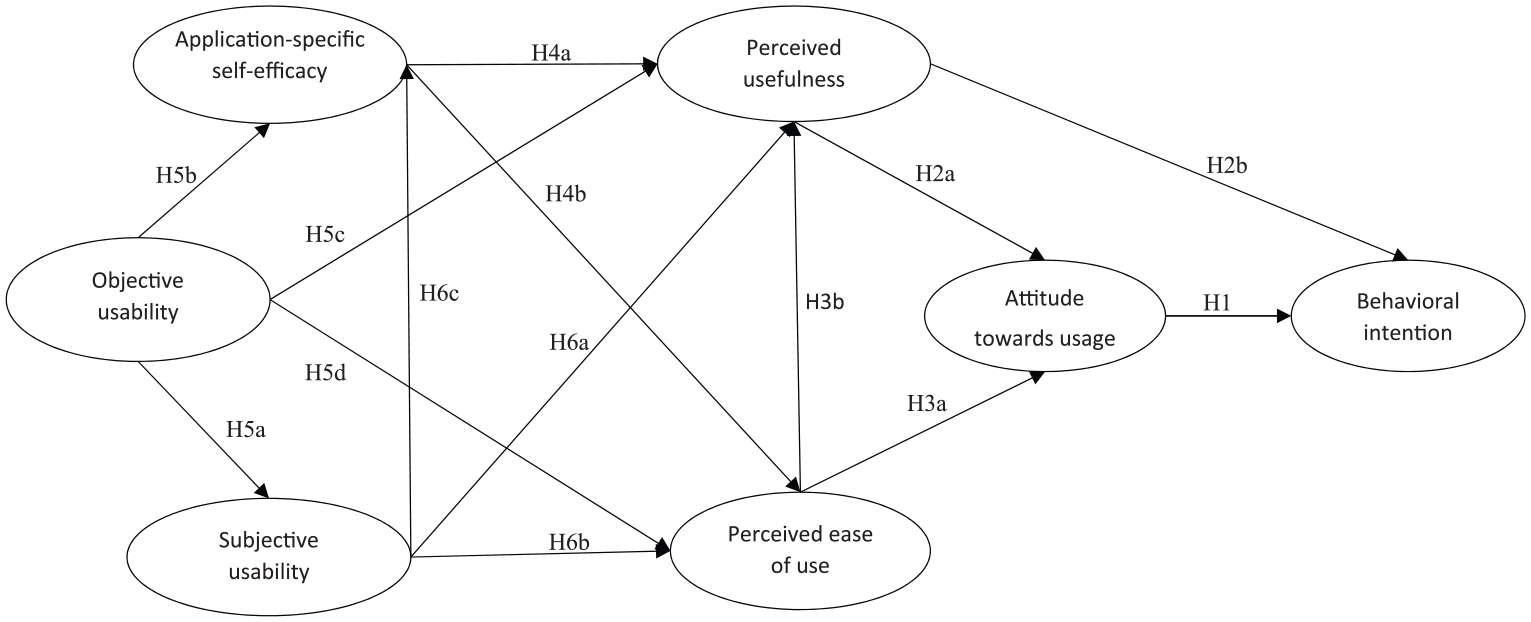
The proposed research model.
Materials and methods
Participants
Participants, who had self-reported normal or correct-to-normal vision, and basic literacy skills, were recruited by poster announcement. After deleting three invalid samples (one did not complete all questionnaire items and two chose multiple answers for questionnaire items), we obtained 201 valid samples for data analysis. The sample consisted of 103 males and 98 females, with a mean age of 21.5 (standard deviation (SD) = 2.5) years. Most participants (N = 199) received university education or above. On average, the participants spent 5 (SD = 3) h on the Internet daily. Their preferred ways to look for health information was the Internet (53%), followed by families or friends (27%) and medical professionals (20%). The study protocol was approved by the Institutional Review Board of Shenzhen University.
Materials and procedures
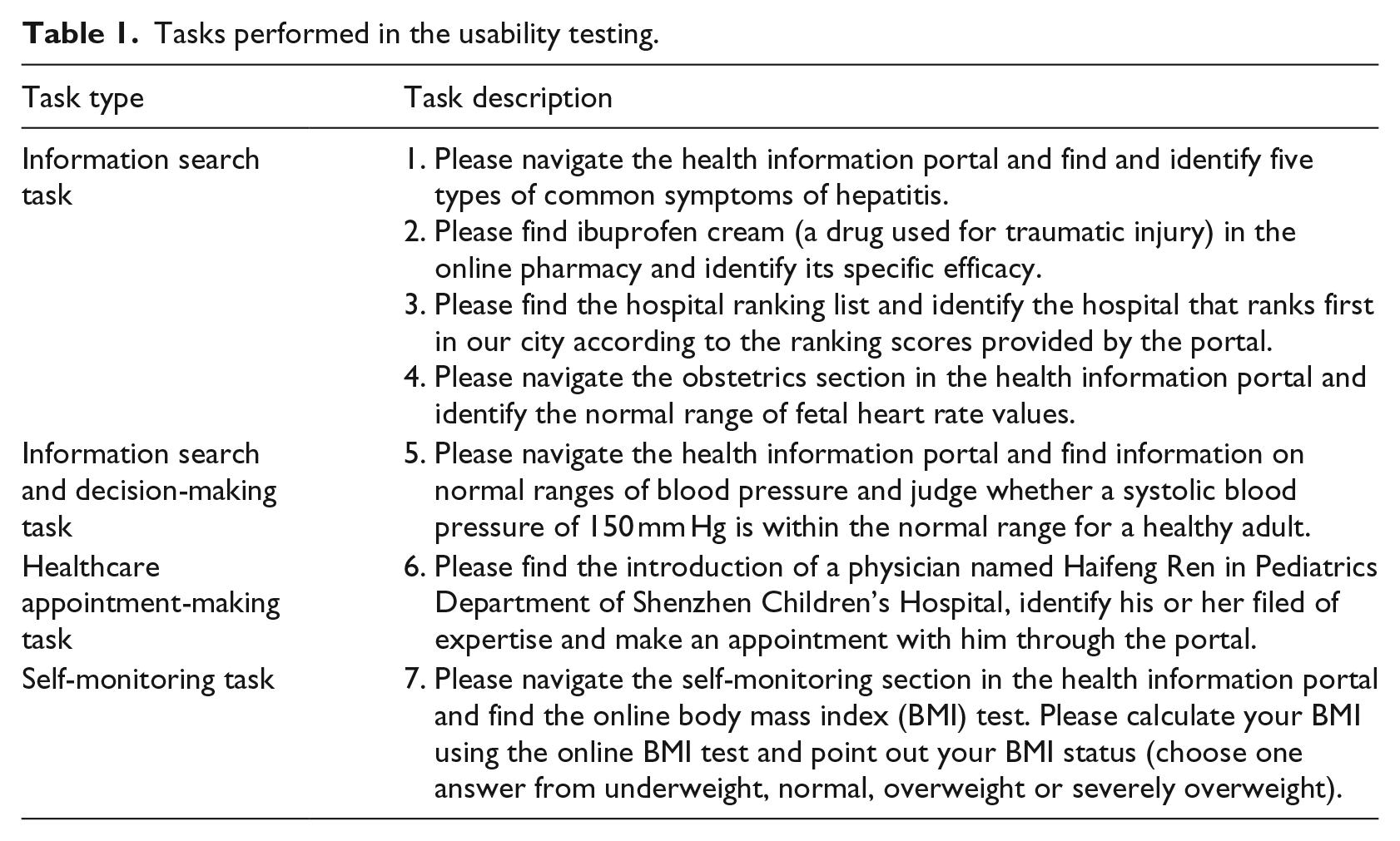
A laboratory-based usability testing was conducted with 99 Health Portal (www.99.com.cn), one of the most popular HIPs in China. 56 This portal was selected because it provides consumers with a wide range of health information and healthcare services and has appropriate breadth and depth in its structure and interface design. This made it neither too complex nor too simple for participants to perform health information/services acquisition tasks. During the usability testing, participants were presented with the experimental portal on a computer and were required to complete seven healthcare tasks as quickly and successfully as possible (see Table 1 for details of the tasks). The tasks were designed according to typical healthcare activities that consumers would perform with the portal. Participants were required to report their answers to a research assistant when they completed each of the tasks. The usability testing was videotaped so that data on task performance (i.e. task completion time and number of tasks that had been successfully completed) could be extracted. After task completion, they were asked to fill in a paper-based questionnaire to elicit their perceptions on variables in the proposed model. It took approximately 40 min to complete the experiment.
Tasks performed in the usability testing.
Instruments
The questionnaire was designed by adaption from validated measurement scales. It was revised based on feedback from three rounds of cognitive interview with eight postgraduate students (potential portal users). The cognitive interview is a widely used method to identify sources of confusion in questionnaires by focusing on the cognitive processes that respondents use to answer the questionnaire items. 57 We also consulted two questionnaire design experts to guarantee the quality of the questionnaire. The operationalization and sources of the questionnaire items are shown in Table 2. All the tested constructs, except objective usability, were measured using 7-point Likert-type scales ranging from “strongly disagree” to “strongly agree.” Objective usability was measured by task performance, that is, the number of tasks successfully completed per unit time (minute).
The operationalization, sources, reliability and validity of the questionnaire items.
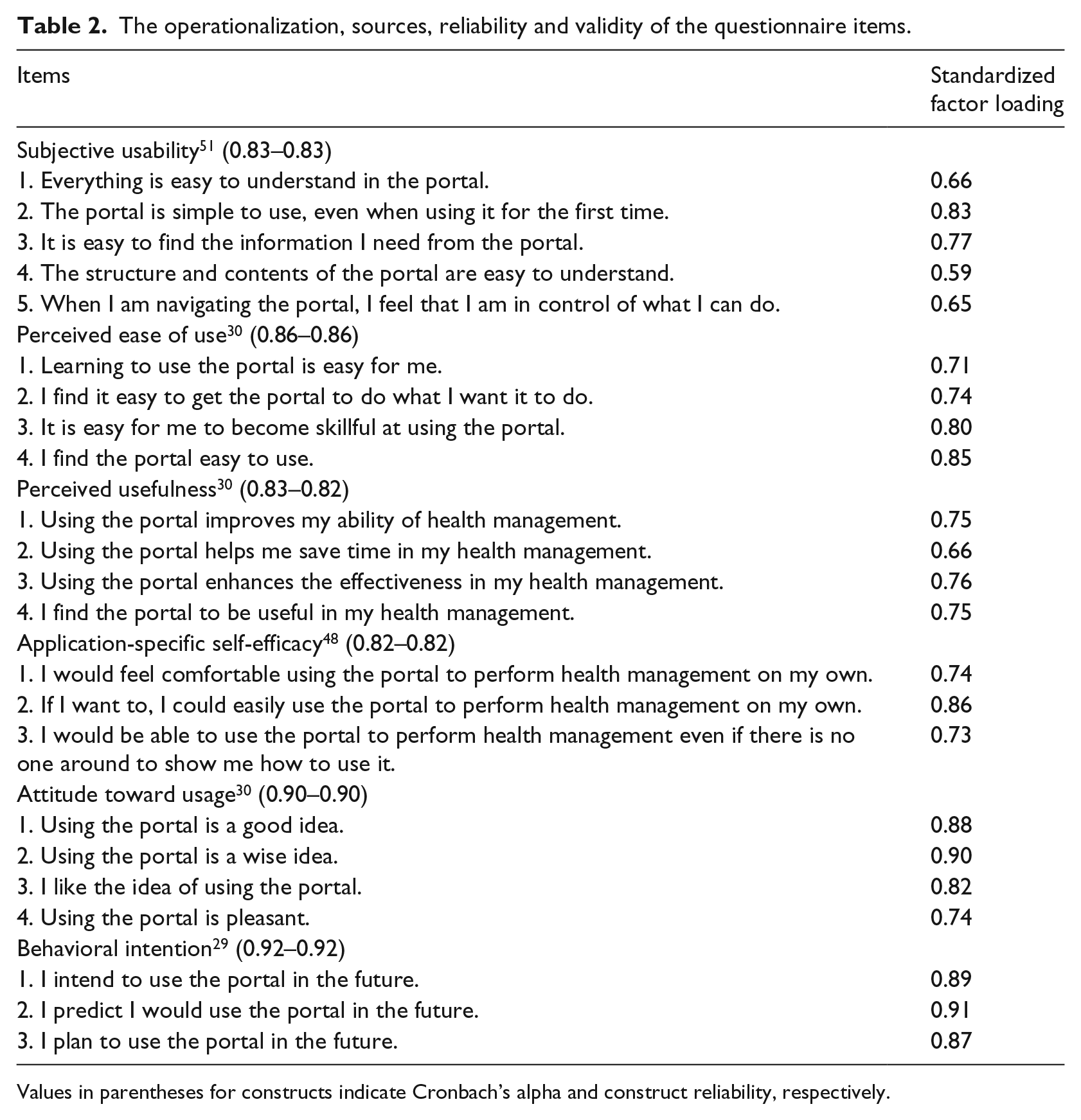
Values in parentheses for constructs indicate Cronbach’s alpha and construct reliability, respectively.
Data analysis
The internal consistency of the constructs was assessed by Cronbach’s alpha reliability (acceptable if >0.7) 58 and construct reliability (acceptable if >0.6) 59 . The convergent and discriminant validity of the measurement model was assessed by confirmatory factor analysis. Convergent validity was verified if all item factor loadings were significant and greater than 0.50. 60 Discriminant validity was examined using chi-square difference test, which compares an unconstrained confirmatory factor analysis of the model with a constrained one. 60 The discriminant validity was verified if the chi-square difference value was statistically significant. Structural equation modeling was employed to examine the hypothesized model with IBM Amos 21. Six commonly used goodness-of-fit indices were employed to assess the overall model fit. A good fit was indicated by the ratio of chi-square statistic to the degree of freedom (χ2/df < 3), the adjusted goodness-of-fit index (AGFI ⩾ 0.80), the comparative fit index (CFI ⩾ 0.90), the incremental fit index (IFI ⩾ 0.90), the Tucker–Lewis index (TLI ⩾ 0.90) and the root mean square error of approximation (RMSEA < 0.06). 61
Results
Descriptive statistics
Means and correlations of the examined variables are presented in Table 3. The major predictor variables were moderately correlated, indicating an acceptable degree of multicollinearity among the predictors. There was no significant difference between female and male on the variables except for objective and subjective usability measures. Female performed better for objective usability (t = 2.29, p = 0.023) and rated higher on subjective usability (t = 2.44, p = 0.016).
Descriptive characteristics of and correlations among major variables.
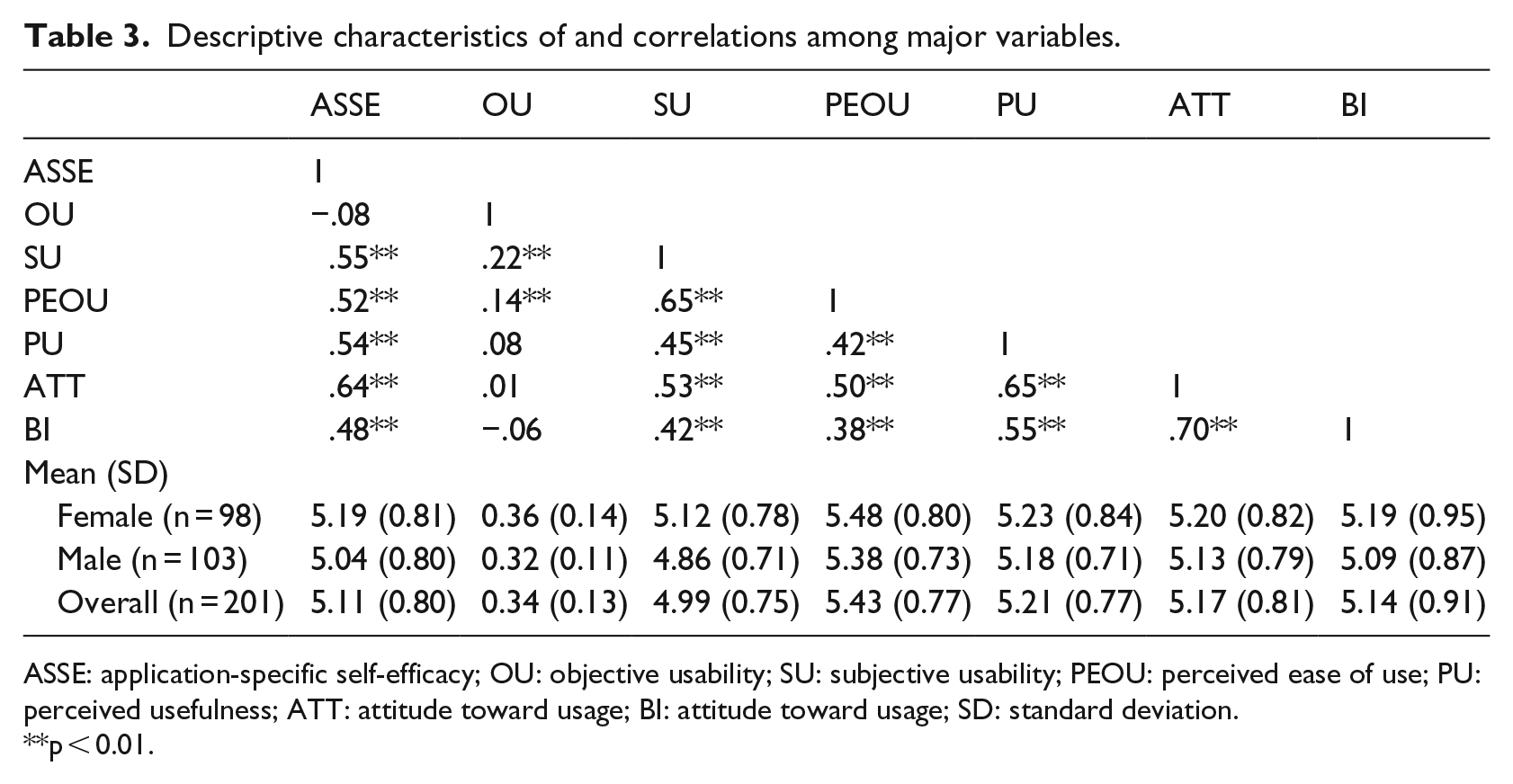
ASSE: application-specific self-efficacy; OU: objective usability; SU: subjective usability; PEOU: perceived ease of use; PU: perceived usefulness; ATT: attitude toward usage; BI: attitude toward usage; SD: standard deviation.
p < 0.01.
Reliability and validity of the measurement model
Both Cronbach’s alpha value and construct reliability value for each construct were above the recommended thresholds (Table 2), suggesting sufficient internal consistency of the construct. The standardized factor loadings of all the items for each construct were higher than the suggested level of 0.50 and statistically significant. Therefore, the convergent validity was adequate. In addition, the chi-square difference value was statistically significant (χ2 = 513.981, p < 0.001). Thus, the discriminant validity was confirmed.
Structural model
Table 4 presents fit indices for the tested model. All the fit indices indicated that the tested model fit the data well. Figure 2 shows the results of the estimated structural model, and Table 5 summarizes the results of the hypothesis testing. The amount of variance in behavioral intention accounted for by attitude toward usage was 56 percent. Perceived usefulness and perceived ease of use explained 63 percent of the total variance in attitude toward usage. Application-specific self-efficacy and subjective usability accounted for 52 percent of the variance in perceived usefulness, while application-specific self-efficacy and subjective usability accounted for 62 percent of the variance in perceived ease of use.
Fit indices for the tested model.
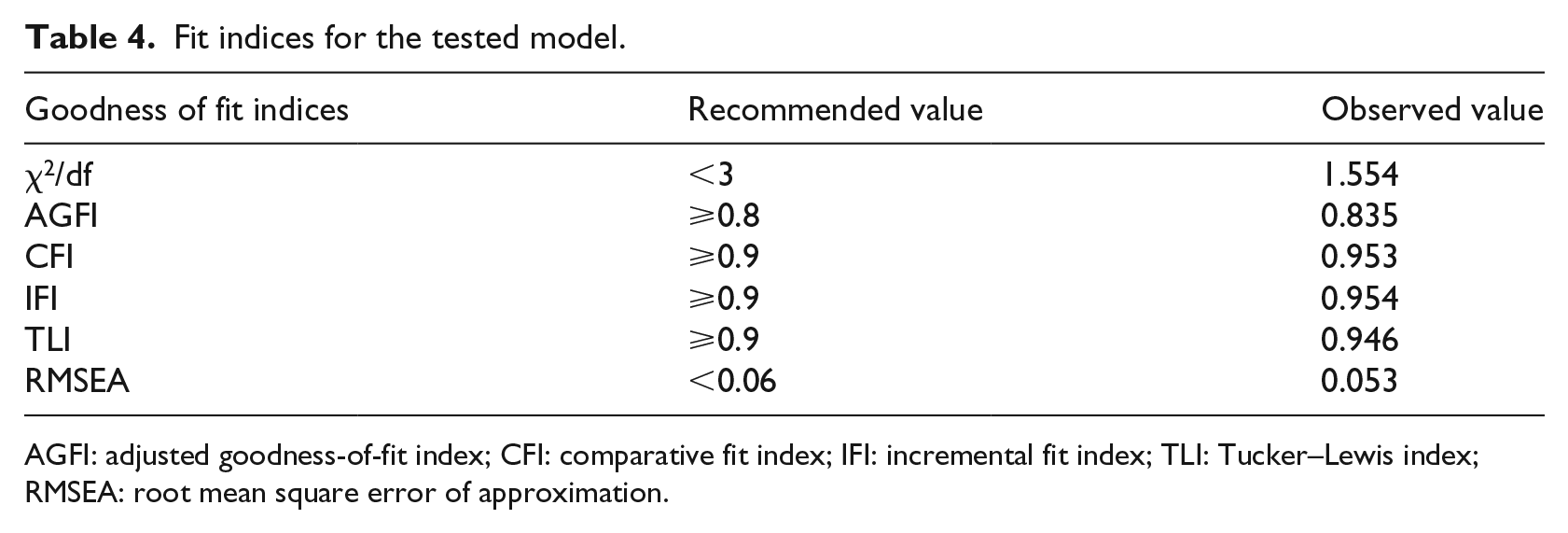
AGFI: adjusted goodness-of-fit index; CFI: comparative fit index; IFI: incremental fit index; TLI: Tucker–Lewis index; RMSEA: root mean square error of approximation.
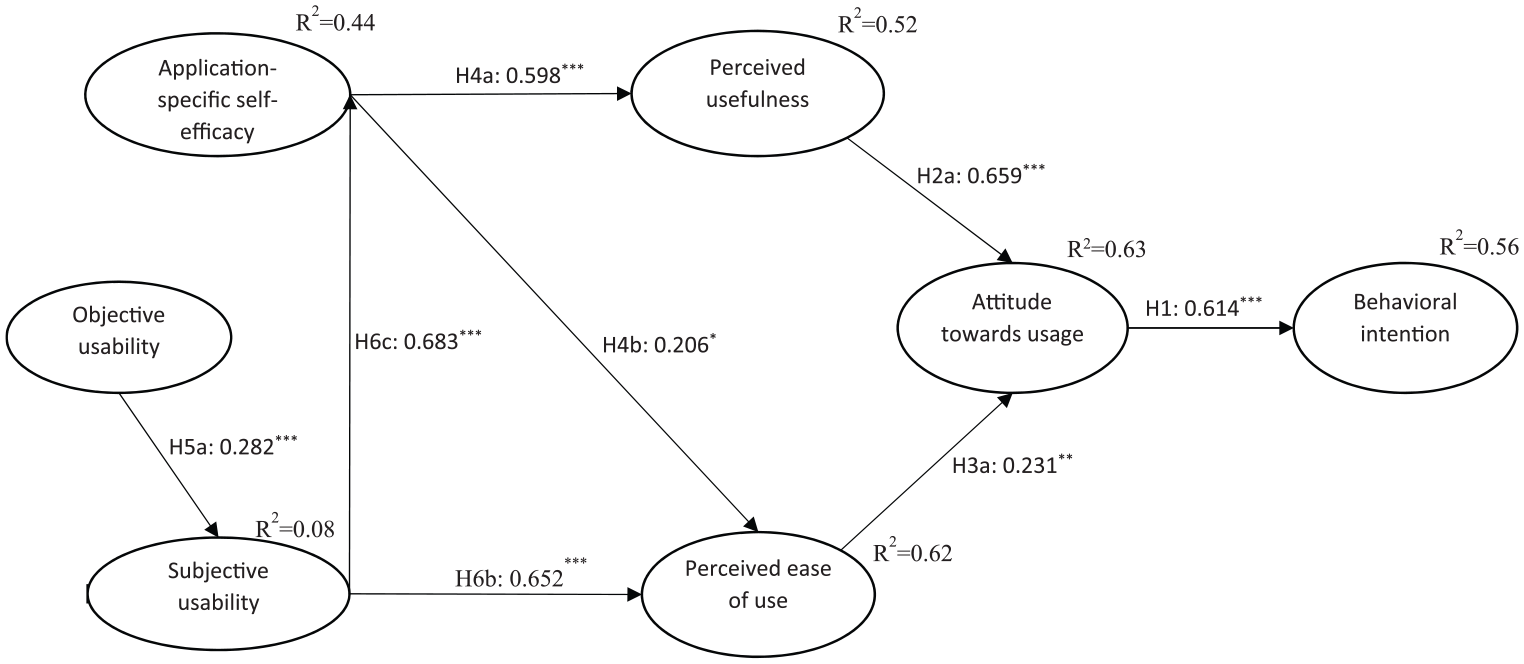
The final model with parameter estimates of the significant paths.
Results of hypothesis testing.
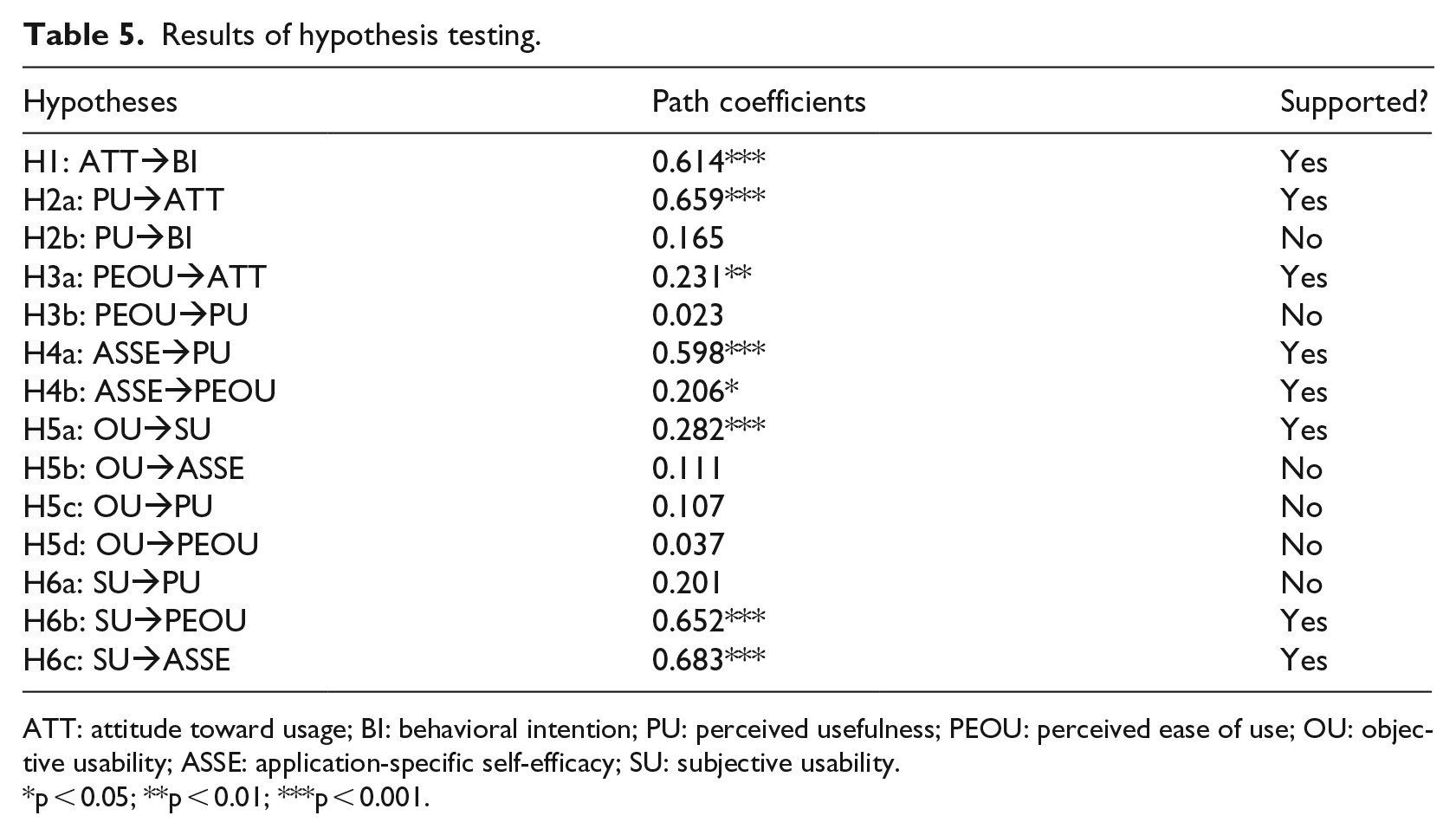
ATT: attitude toward usage; BI: behavioral intention; PU: perceived usefulness; PEOU: perceived ease of use; OU: objective usability; ASSE: application-specific self-efficacy; SU: subjective usability.
p < 0.05; **p < 0.01; ***p < 0.001.
The results provided support for H1, as attitude toward usage positively influenced behavioral intention (β = 0.614, p < 0.001). Perceived ease of use (β = 0.231, p = 0.001) and perceived usefulness (β = 0.659, p < 0.001) were found to positively affect attitude toward usage. Therefore, H2a and H3a were supported. H2b was not supported, as perceived usefulness showed no effects on behavioral intention. H3b was not supported, as perceived ease of use yielded no effects on perceived usefulness. Application-specific self-efficacy had a positive influence on both perceived usefulness (β = 0.598, p < 0.001) and perceived ease of use (β = 0.206, p = 0.028). Therefore, H4a and H4b were supported. Objective usability had a positive effect on subjective usability (β = 0.282, p < 0.001), while it yielded no effect on other constructs. Therefore, H5a was supported, while H5b, H5c and H5d were not supported. The effects of subjective usability were significant on perceived ease of use (β = 0.652, p < 0.001) and application-specific self-efficacy (β = 0.683, p < 0.001), but not on perceived usefulness. Therefore, H6b and H6c were supported, while H6a was not supported.
Discussion
Primary findings
The dramatic increase in demands on health/healthcare information and services from consumers has led to worldwide initiatives toward consumer-driven and patient-centered healthcare in the age of information technology. 62 Health informatics applications like HIPs are promising to play an important role in consumers’ healthcare, especially among young Internet users. However, to actually deliver on this promise, the applications must be designed and implemented in a way that they can be well adopted by the users. In light of this, this study proposed and tested a consumer acceptance model by integrating usability and social cognitive theories with TAM to examine consumer acceptance of HIPs among Chinese young Internet users. The work in this study, to the best of our knowledge, is among one of the first studies49,63 to explore critical antecedents that affect the formation of consumer acceptance of health informatics applications in Chinese context.
Not surprisingly, the proposed model was found to be robust in previously less examined contexts of consumer health informatics and among young adults. The results show that consumers would be more willing to adopt the HIP if they have developed a positive attitude toward using it. The findings also indicate that a positive attitude could be effectively reinforced if consumers perceive the portal easy to use and believe that using the portal would enhance their ability and effectiveness in health management. In addition, we found that perceived usefulness explained a larger proportion of the variance in attitude toward usage than did perceived ease of use. Therefore, perceived usefulness appears a more important factor in determining attitude toward usage. This suggests that young consumers care more about the helpfulness of the portal in their healthcare than the ease of using it. However, it should be noted that this may not be the case for older people. For example, Wong et al. 63 found that perceived ease of use, rather than perceived usefulness, was a significant predictor of behavioral intention to use online health information among older people. Moreover, no significant relationship between perceived ease of use and perceived usefulness was found, contrary to what was expected. The result, unlike those of others that mostly included older adults,40,41,49 may indicate that perceived ease of use and perceived usefulness influence behavioral intention independently for young adults.
Importantly, this study explored potential antecedents from usability and social cognitive theories and examined three user interaction experience-related variables. The results demonstrated that subjective usability is an effective predictor to young adults’ acceptance of HIPs, mirroring the evidence in other technology domains.55,64 In particular, we found that subjective usability yielded a large, direct impact on perceived ease of use, and an indirect impact on perceived usefulness through application-specific self-efficacy. In contrast, objective usability only exerted significant impact on subjective usability with a small portion of variance being explained. This may be because that objective usability is not an effective indicator of subjective usability and other perception measures, as participants’ perceptions based on task performance may be subject to cognitive and social bias 65 and therefore may not accurately reflect task performance. As argued by Moore and Benbasat, 66 perceived rather than objective technology attributes are more relevant to users’ technology acceptance decision-making. It is speculated that users’ perceptions on the experience that how they acquire the information and services may matter more than the objective performance of the experience. This finding provides empirical corroboration that designing HIPs to increase subjective usability can indirectly influence consumers’ behavioral intention to use the portals and therefore deserve a higher priority than to improve objective usability in the development of the portals.
Application-specific self-efficacy was also a significant predictor of consumer acceptance of HIPs through its effects on perceived usefulness and perceived ease of use. While prior TAM studies have shown that self-efficacy was a determinant of perceived ease of use,46,49 they seldom addressed its direct effect on perceived usefulness, which, in contrast, was verified by our study. This may be that people who feel more confident and capable of using the portal are more skillful in obtaining desired information and services from the portal. Therefore, they are more likely to perceive the portal useful. However, whether the relationship between application-specific self-efficacy and perceived usefulness is unique in Chinese culture awaits confirmation by future cross-cultural studies. Moreover, it should be noted that application-specific self-efficacy could be largely enhanced by a usable system, again confirming the importance of subjective usability. This indicates that consumers would feel more in control of their healthcare activities (and therefore feel more confident) when they interact with a usable portal that is featured by well-designed interfaces.
Implications
Our study has both theoretical and practical implications. Theoretically, our study, with Chinese young adults, supports for the well-established links of perceived ease of use/perceived usefulness-attitude-behavioral intention,30,67 demonstrating the applicability of the extended TAM for understanding consumer acceptance of health informatics applications. In addition, this study made an important step to integrate usability and social cognitive theories with TAM and verify the roles of subjective usability and application-specific self-efficacy in consumers’ intentional use of health informatics applications. While the inclusion of such variables into the acceptance model is encouraging, more contextual and application-related variables, such as application features, credibility of health information, offline healthcare support and training could be considered to improve the predictive power of the model. Moreover, our study represented a rare attempt to model consumer acceptance based on an empirical usability testing. Unlike previous cross-sectional studies where users usually had little interaction experience at the time of data collection,46,47 the use of usability testing in our study enabled users to have sufficient and “fresh” interaction experience with the portal and possibly allowed for more accurate response to questionnaire items.
Practically, findings from this study can help portal developers and managers determine better practice for the design and implementation of HIPs. Our results suggest that, to increase the likelihood of consumer acceptance of HIPs, the applications should provide health/healthcare information and services in a way that could “please” consumers and elicit their favorable perceptions (ease of use), in addition to the provision of useful information and services (usefulness). To be useful, the portals should be designed to help achieve information seeking and service acquisition purpose, save time and enhance the effectiveness of healthcare activities. In addition, usable HIPs would improve comprehension of the content and structure of portals and offer more comfortable user experience. The efforts to improve usability levels of HIPs are especially helpful due to the complexity of the portals, given that users found difficult to conduct some healthcare tasks, such as navigation, information search and online appointment tasks, as shown in the usability testing. Practically, a usable and easy-to-use portal can be achieved through a user-centered design approach, where a set of human factors design principles and iterative usability evaluation process could be utilized to maintain good user experience23,24,68 Specifically, the portals should be designed with simple and natural dialogue, minimal irrelevant information and distracting features, consistent layout and structure and informative feedback so that consumers can easily distinguish content, identify information and reduce confusion in decision-making. Thus, to evaluate and ensure usability levels of HIPs is a crucial aspect of the business strategy in the whole life circle of the portal development and management. More importantly, consumers’ acceptance and intentional use of HIPs could be largely reinforced by improved application-specific self-efficacy. It is therefore worthwhile for designers to pay their attention to the “cultivation” of self-efficacy when consumers use the applications. Simple hands-on tips, demonstration and short training of how to use the applications could be practical strategies to achieve such purpose.
Limitations and future research
This study had several limitations. First, we tested our model with a homogeneous sample, as our sample was restricted to well-educated, young adults, results from whom may not be generalized to other groups, such as less-educated or older adults. Future studies are recommended to include a diverse range of participants to address the limitation. Second, our study used an overall scale to measure subjective usability, while in fact subjective usability can be operationalized with multiple dimensions (such as interactivity, navigability, consistency and simplicity).24,55 Use of multiple dimensions to measure subjective usability would be helpful and is encouraged, as the examination of specific facets of usability may provide more practical guidelines for designers to improve the design and accessibility of health informatics applications. 24 Finally, like most of previous studies,24,37,38,67 our study employed a cross-sectional survey only. It is suggested that an individual’s perceptions on technology may change over time. 49 Therefore, the current results could serve as a baseline for future longitudinal research to examine possible changing roles of the predictors in consumers’ acceptance and subsequent use of health informatics applications.
Conclusion
As health informatics applications become more ubiquitous, examination of consumer acceptance may contribute to the increased accessibility and use of the applications. This study assuaged the absence of empirical data on Chinese young adults’ acceptance of health informatics applications. It demonstrated that subjective usability and application-specific self-efficacy are significant antecedents for young adults’ acceptance of HIPs. The findings provide important implications for design and implementation strategies to increase the likelihood of consumer acceptance of the portals.
Footnotes
Declaration of conflicting interests
The author(s) declared no potential conflicts of interest with respect to the research, authorship and/or publication of this article.
Funding
The author(s) disclosed receipt of the following financial support for the research, authorship and/or publication of this article: This work was supported by the Natural Science Foundation of Guangdong Province, China (grant no. 1914050003170), the National Natural Science Foundation of China (Grant No. 71801156), and the Natural Science Foundation of Shenzhen University (grant nos 827000228 and 827000033).
