



Abstract
Facebook long-term care groups have been established by long-term care workers, and few studies have explored the related drivers of participation from the perspective of caregivers. This study applied a mixed-methods approach; the qualitative component conducted a pilot study to explore the drivers of participation in Facebook long-term care groups and found that the use and gratification theory provides a valid approach for explaining these drivers. Subsequently, the quantitative component, based on the use and gratification theory, proposed a conceptual model to examine the effect of these drivers on the social identity of these groups as well as the modulating effects of extraversion and group diversity in terms of age and educational background. The results showed that the most important social identification–related driver underlying participation in these groups was self-discovery. In addition, the relationship among these drivers and social identification was found to be modulated by extraversion, age, and educational background.
Keywords
Introduction
Online support groups allow their members to interact unencumbered by the limits of time and space. Prior to the era of social network sites (SNSs), members communicated by writing messages and posting these to chat rooms. In the present SNS era, members of online support groups may interact in cyberspace via multiple formats. Facebook, one of the most popular SNSs, provides a variety of applications on their platform. Facebook Groups is the most useful of these applications, allowing members to create discussion forums based on common interests. 1 The various mutual-help groups set up on the Facebook platform represent a form of computer-mediated social or online social support. 2
Many health-related support groups on the Facebook platform allow patients, friends, and families to interact for mutual support on health-related issues. 3 Prior studies have investigated the effects of different Facebook support groups (FSGs) that focus on issues such as diabetes, autism, weight loss, sexual health, and smoke cessation,4–8 with findings showing that FSGs offer positive psychological effects, providing emotional social support and informational social support to their members.6,9 In addition, other related studies have treated Facebook as a tool for enhancing self-esteem, life satisfaction, mental health, and well-being. 10
However, FSG-related studies have been conducted primarily from the perspective of care recipients such as patients and their family members, with few studies conducted from the perspective of caregivers. Having a sufficient and effective long-term care (LTC) workforce is a critical healthcare management issue in countries with rapidly aging populations such as Taiwan. Facebook long-term care groups (FBLTCGs) have been established by Taiwanese LTC workers, allowing the sharing of long-term care-related knowledge and experience in order to improve the overall care abilities of FBLTCG members and allowing individual members to communicate on relevant issues. LTC workers in Taiwan provide care for a variety of dysfunctions in people, especially in the elderly. These workers, broadly defined, include medical doctors, occupational therapists, physical therapists, nutritionists, registered nurses, licensed practical nurses, certified nursing aides, and family caregivers who provide care in residential, community, or home settings. They provide their service mostly in a standalone format and thus require and benefit greatly from mutual support. LTC workers who participate in FBLTCGs not only share LTC knowledge and related information but also have an outlet to ameliorate their work pressure through mutual support. Aging population is a very serious problem in Taiwan. Caring for the elderly, especially the disabled, is not only increasing dramatically the demand for LTC workers but also necessitating improvements in job quality and satisfaction.
FBLTCGs have been running in Taiwan since 2012. The most important FBLTCGs are currently the “Elder baby home care group” (https://www.facebook.com/groups/340808172669696/), “Long-term care you, me, and they” (https://www.facebook.com/groups/longtermcare95/), and “Home care worker communication zone” (https://www.facebook.com/groups/481651241846449/). As these groups allow their members to share information and accomplish specific tasks, 11 it is reasonable to expect that FBLTCGs wield a positive influence on its members in terms of professional capabilities and professional satisfaction. Therefore, increasing participation and improving the coherence among FBLTCG members are issues worth further study.
Method
FBLTCGs are typically initiated by LTC workers. Few FSG studies have been conducted from the perspective of caregivers. This study applied a mixed-methods approach that contained both qualitative and quantitative components.
Qualitative component
A pilot study was conducted to investigate the possible underpinning theory for exploring the drivers of caregiver participation in FBLTCGs. A total of 30 FBLTCG members from the “elder baby homecare group,” “Long-term care you, me, and they,” and “Home care worker communication zone” were interviewed. In total, 10 members who were LTC workers and who volunteered to participate in the interview were recruited from each of the three groups. The interviews were conducted via Facebook Messenger. The semi-structured interviews were designed to understand why participants had joined the FBLTCG and had continued participating in the group.
Quantitative component
The results of the qualitative interviews showed that the important drivers included getting and sharing information, participating in interactive communication, venting grievances, and learning more about LTC as a potential career (please refer to the Data analysis section for details). All of these drivers may be explained under the use and gratification (U&G) theory in terms of purposive value (PV) and interpersonal interconnectivity value (IIV).
U&G theory has been applied widely to explain how media usage satisfies the needs of media users. More recently, U&G has been applied to explore online information behavior related to chat rooms, the Internet, online gaming, online newspapers, and SNS.11–14 Hence, this theory provides a strong theoretical base for exploring the behaviors of FBLTCG members. Moreover, as age and extraversion may modulate Internet behavior,15,16 this study takes the roles of these two variables into consideration in order to achieve a more comprehensive understanding of the behavior of these groups.
Theoretical background and hypotheses in the quantitative component
Researchers have linked SNS usage to psychological outcomes such as sense of community and social support.3,10 Possible mechanisms of these psychological outcomes include the amount of supportive interaction, the quality of interaction, and the perception of available social support. 3 However, SNSs include not only virtual communities but social media as well. U&G has previously been applied to investigate the drivers of participation in virtual communities.11,17 Dholakia et al. proposed that joining a virtual community is a goal-directed action intended to fulfill a set of values. For online patient-support groups, patients may want to collect disease-related information, to discuss or chat, or to encourage other patients. 17
The underpinning assumption of U&G is that cognitive and affective needs motivate individuals to use media, which includes communication media such as virtual communities, social networking sites, online gaming, and so on.11,12,18–20 U&G not only explores the choice of media but also reveals the behaviors that come after making a choice. 18 The motivators of U&G cover a broad range of factors that may evolve as the nature of communication media changes and that are derived using diverse theories. For example, Li et al. 19 derived these motivators from motivation theories, hedonic theory, self-determination theory, and social presence theory. The keys motivators of U&G that were identified in previous studies include PV, self-discovery, interpersonal interconnectivity, social enhancement, and entertainment.11–13,20,21
PV refers to values that an individual derives from accomplishing something with a predetermined informational and instrumental purpose, for which the informational value is derived from getting and providing information and the instrumental value is derived from accomplishing specific tasks.11,21 Initially, informational value and instrumental value were distinct concepts. However, Dholakia et al. 17 integrated the two into a single construct, termed “purposive value,” for more appropriate application in SNS settings. As members of Facebook groups regularly share information within their groups, the information-seeking motivation is an essential factor for encouraging individuals to share information in the SNS. 22 In LTC online groups, members are motivated to seek related LTC information in order to improve their caring abilities. Therefore, this study uses PV rather than informational value or instrumental value. Self-discovery value (SDV) refers to the process by which an individual works to understand him/herself through participation in an online group; 11 IIV is a benefit that is derived by establishing and maintaining interaction with a group;11,23 social enhancement refers to the benefits gained by earning acceptance and recognition from group members and from enhancing social status within a group;11,23 and entertainment value is the fun and enjoyment gained through interacting with other group members.18,23
These drivers may also be distinguished into three categories of gratification, including utilitarian gratification (utility), social gratification (status), and hedonic gratification (fun).19,24 Utilitarian gratification comprises information sharing, pursuing achievement, and generating a particular self-image to others;19,24 social gratification refers to feelings of connectedness with, interaction with, and recognition from a group; and hedonic gratification refers to related perceptions of enjoyment and fun. 24
The initial pilot study interviewed 30 members of Taiwan-based LTC online groups to elicit their motivations for participation. The motivators identified included getting and sharing information, venting grievances, communicating with others, and learning more about LTC careers. These motivators all fall within utilitarian and social gratification categories.
Social identification is the sense of self-identifying with a specific group. 25 When individuals perceive that they belong to a specific group, they will begin comparing their group to other groups in order to maintain the advantage of belonging to “their” group instead of other groups. 26 Social identity (SI) consists of three distinct, but related, components: cognitive, affective, and evaluation. 27 These three components may also be used to depict the identification process.28,29 Cognitive sense is the similarities judgment about a particular social group or about the extent that one’s self-image overlaps with the image of the group, which then produces an in-group preference.28,29 This process was termed by Bergami and Bagozzi 27 as the “depersonalized process.” The cognitive process increases the involvement of an individual in a target group and produces feelings of attachment or kinship. 28 Eventually, an evaluation is made, which produces either a favorable or unfavorable attitude toward the target group.
Dholakia et al. 17 investigated participation behaviors in virtual communities (e.g. website bulletin boards, Usenet newsgroups, instant messenger apps, and chat rooms) and reported that higher levels of PV and entertainment value within a particular virtual community yielded a stronger sense of SI in that community. Zhang et al. 30 reported that functional value (information value) and hedonic value influence positively the stickiness to a social network. Thus, the inferred assumptions of this study are as follows:
H1. PV affects SI in LTC groups positively.
H2. Entertainment value affects SI in LTC groups positively.
Self-discovery is the process of better understanding oneself, and social interactions within a group setting may more clearly define and elaborate an individual’s personal preferences, tastes, and values.17,21 Furthermore, SI is the process of achieving self-awareness as a member of a group. 21 Thus, the higher the level of self-discovery achieved through social interaction, the higher the level of emotional preference that an individual should hold toward the related group(s). Therefore, it is further hypothesized that
H3. SDV affects SI in LTC groups positively.
PV and SDV are both derived from self-reference and referrers to oneself.11,17 The IIV is derived from receiving social support and feeling friendship or intimacy; the social enhancement value is derived from accepting and finally enhancing social status within a group.17,21 PV and SDV refer to social gratification, while IIV and social enhancement value refer to social benefit.11,24,26 Ho and Lin 31 investigated the behavior of participants in virtual classrooms on the Facebook platform and reported that affective commitment and emotional support both significantly and positively affect the identity of this virtual classroom. Affective commitment includes interactions with other group members, acceptance by these members, and self-perceiving as part of the group, which in turn determine the degree of identification, involvement, and feeling of emotional attachment for this group. Affective commitment is similar to social gratification. Thus, the inferred assumptions of this study are as follows:
H4. IIV affects the SI of LTC groups positively.
H5. Social enhancement value affects the SI of LTC groups positively.
Offline activities (OA), such as making voice phone calls and having face-to-face meetings, are frequent occurrences on the Facebook platform. OA may help group members further develop their sense of belonging, strengthen mutual relationships, and improve mutual understanding.32,33 Intensive offline interactions may increase the intention of group members to participate in further developing the group. 33 Furthermore, OA may enhance social ties with others and subsequently increase the social capital. 34 Thus, the study proposes the following hypothesis:
H6. OA affect the SI of LTC groups positively.
Modulation effects of group diversity and extraversion in the quantitative component
Group diversity refers to the degree of difference among group members. 35 Due to its potential effect on group outcomes such as satisfaction and turnover, group diversity is an important issue for organizations. 36 Group diversity covers many categories. For example, Milliken and Martins 36 categorized group diversity into observable attributes such as age and gender and less-visible attributes such as educational background and personality. Harrison et al. 37 proposed surface-level diversity with regard to demographic characteristics such as age, gender, and race and deep-level diversity with regard to psychological characteristics such as attitudes, beliefs, and values. With regard to deep diversity, Shemla et al. 38 had similar findings and proposed that personality plays an important role in the perception of difference.
The effects of group diversity may be interpreted through the social categorization and information/decision-making processes.35,38 The social categorization process refers to the straightforward interpretation of intergroup relationships through, for example, the stereotyping of dissimilar others and the acceptance of similar others as the “in-group.” This perspective is called “viewed diversity” and may impede group performance.35,38 The information/decision-making perspective postulates that diversity may increase the range of knowledge and expertise and positively influence performance.35,38
The five-factor model (FFM) is a widely used approach for modeling personality traits. The FFM presumes that most individual differences in human personality may be classified into five broad domains, including extraversion, agreeableness, conscientiousness, neuroticism, and imagination
With regard to Internet behavior, researchers report that young adults have a relatively high preference for social media and that introverts prefer to socialize online, whereas extraverts prefer face-to-face interaction.15,16 Moreover, the group process affects online participant behavior, and similar individuals associating with one another form ties through the mediating influence of sociodemographic factors such as age and education. 43 As age is a surface-level diversity attribute and educational background and extraversion are deep-level diversity attributes, the study proposes the following hypotheses:
H7. Age has a modulating effect on the relationship among the model constructs.
H8. Educational background has a modulating effect on the relationship among the model constructs.
H9. Extraversion has a modulating effect on the relationship among the model constructs.
Instruments and participants in the quantitative component
Measurement items for all of the constructs were adopted and modified from a scale that had been applied previously in validated researches.
PV, entertainment value, SDV, maintaining interpersonal connectivity value, and social enhancement value were adapted mainly from Dholakia et al. 17 and Ifinedo. 11 OA were adapted from Lin. 32 SI was adapted from Tsai and Bagozzi 28 and Wang and Sun 44 and conceptualized as a reflective second-order construct composed of cognitive SI, affective SI, and evaluative SI. In the measurement model analysis, the item loadings for all three of the first-order constructs were above 0.85. All of the measurement items were measured on a 7-point Likert-type scale, ranging from “disagree strongly” (1) to “agree strongly” (7). Extraversion adapted the 10 items from Goldberg’s IPIP-BFM-50 that related to extraversion. 45
Participants were solicited from the main FSGs in Taiwan related to LTC: “Elder baby home care group,” “Long-term care you, me, and they,” and “Home care worker communication zone.” The study received permission from the administrators of these three groups. Recruitment for the quantitative component used a convenience sampling method, and a link to the questionnaire was posted so that group members could volunteer to join and participate. Recruitment was conducted in two phases: pretest and formal study. All of the participants were assured anonymity and researchers informed them that the questionnaire would not collect any identifiable information, and only information provided by participants who self-identified as LTC workers was retained and used as valid data.
Pretest: The study conducted a pretest of the questionnaire on 30 participants to test the reliability of all of the constructs, the threshold values of which should exceed 0.7. The Cronbach’s alpha values for the eight constructs (PV, entertainment value, SDV, interpersonal interconnectivity, social enhancement, OA, SI, and extraversion) were .942, .805, .851, .835, .775, .932, .824, and .804, respectively, indicating that the measured items had high internal consistency for each construct. Thus, all of the construct items were validated and used in the formal questionnaire.
Formal study: Participants in the formal study were recruited in the same manner as the pilot study. All of the three Facebook LTC support groups that were approached for this study gave permission for their members to participate if interested. Due to this study’s focus on the perspective of caregivers, the authors excluded responses from those who were not LTC workers. The study collected 314 valid responses.
Data analysis
Qualitative components
The pilot study interviewed 30 FBLTCG members who self-identified as being LTC workers. Of these, 26 were certified nursing aides and 4 were family caregivers. These two categories represented the majority of members on the FBLTCG. The interviews were recorded verbatim, and the reasons for participating in the FBLTCG were extracted as post-formed keywords (codes). The frequency of these keywords was as follows: getting and sharing information (18 times), participating in interactive communication (6 times), venting grievances (6 times), and learning more about LTC as a potential career (5 times). The results show that all of the participants were satisfied with their groups and expressed willingness to continue participating in the FBLTCG. All of these reasons (keywords) may be illustrated under U&G theory (see the Method section for details).
Quantitative component
This study used IBM SPSS 22.0 and structural equation modeling (SEM) with partial least square (PLS) approach using SmartPLS version 3.2.6 software for statistical analysis. 46 PLS is a component-based SEM technique that estimates both the measurement model and the structural model and is suited to assessing the validity of antecedent variables and exploratory studies. 46
Demographics
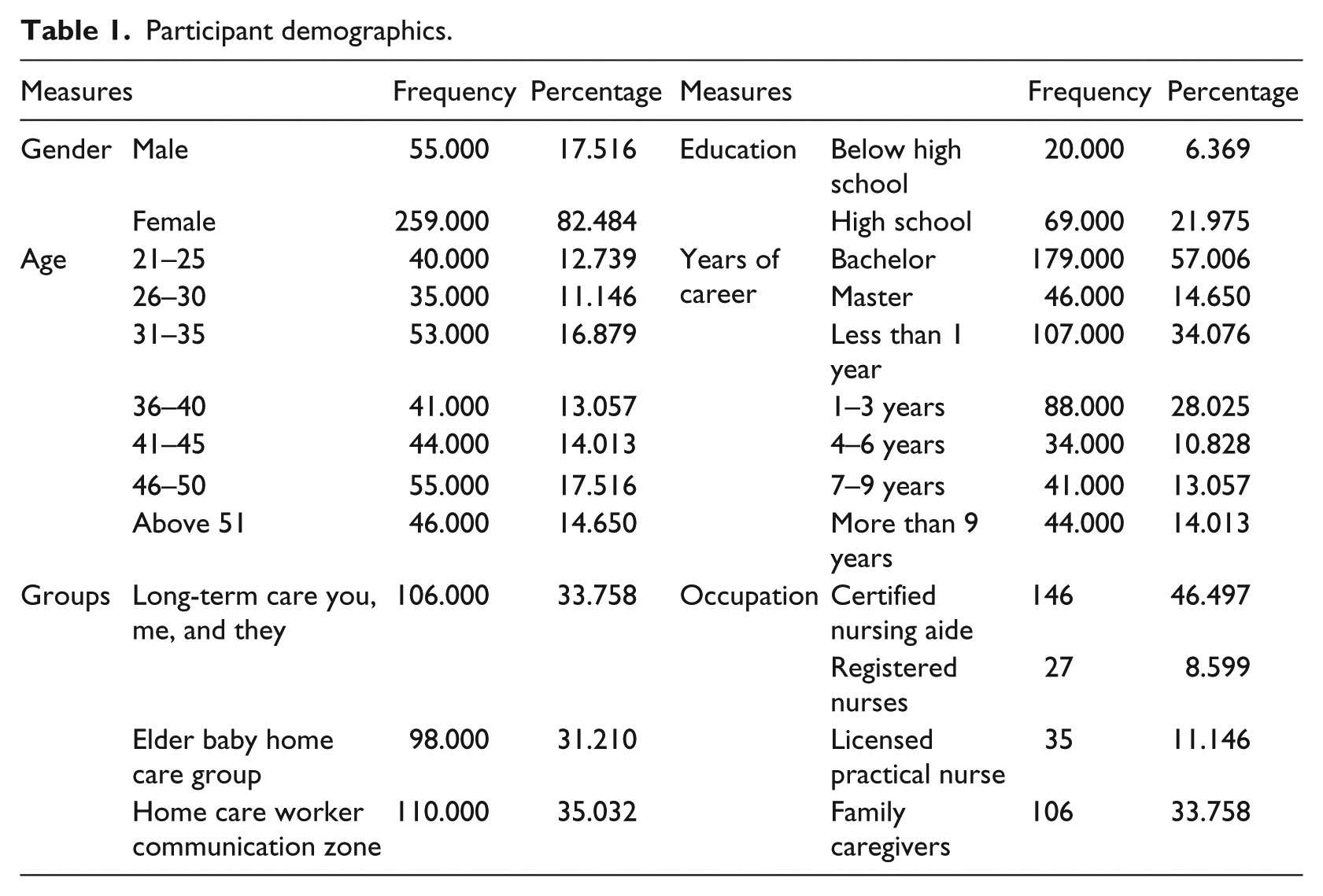
The study collected 314 valid questionnaires. A majority of participants were female (259, 82.4%); half (179, 57.0%) held baccalaureate degrees; one-third (107, 34.1%) had less than one year of LTC working experience. In terms of occupation, most participants were certified nursing aides (146, 46.5%), with family caregivers as the second largest group (106, 33.8%; Table 1).
Participant demographics.
Assessing the measurement model
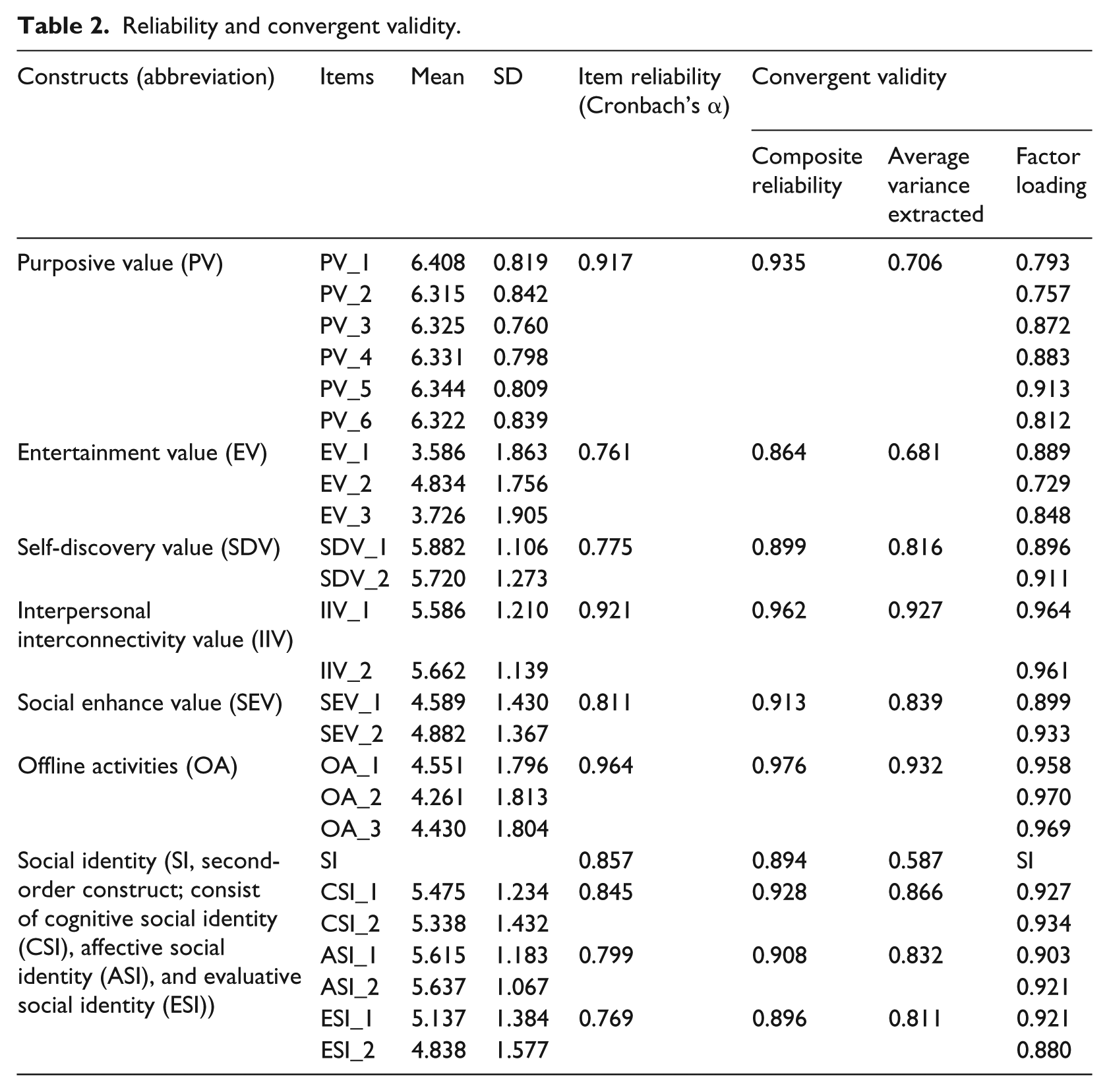
The measurement model was assessed using convergent validity and discriminant validity. The convergent validity included items loading (criterion > 0.7), Cronbach’s α (criterion > 0.7), composite reliability (CR, criterion > 0.7), average variance extracted (AVE, criterion > 0.5), and discriminant validity. 47 Regarding discriminant validity, the study compared the square root of the AVE with correlations among constructs, with the square root for the AVE greater than the correlation with other constructs, indicating good discriminant validity. Results showed that factor loading values for all of the items were between .729 and .970, CR values for all of the constructs were between .864 and .976, and AVE values for all of the constructs were between .587 and .932. All of the obtained values exceeded the required minimum value and the discriminant validity was also confirmed (Tables 2 and 3).
Reliability and convergent validity.
Discriminant validity.
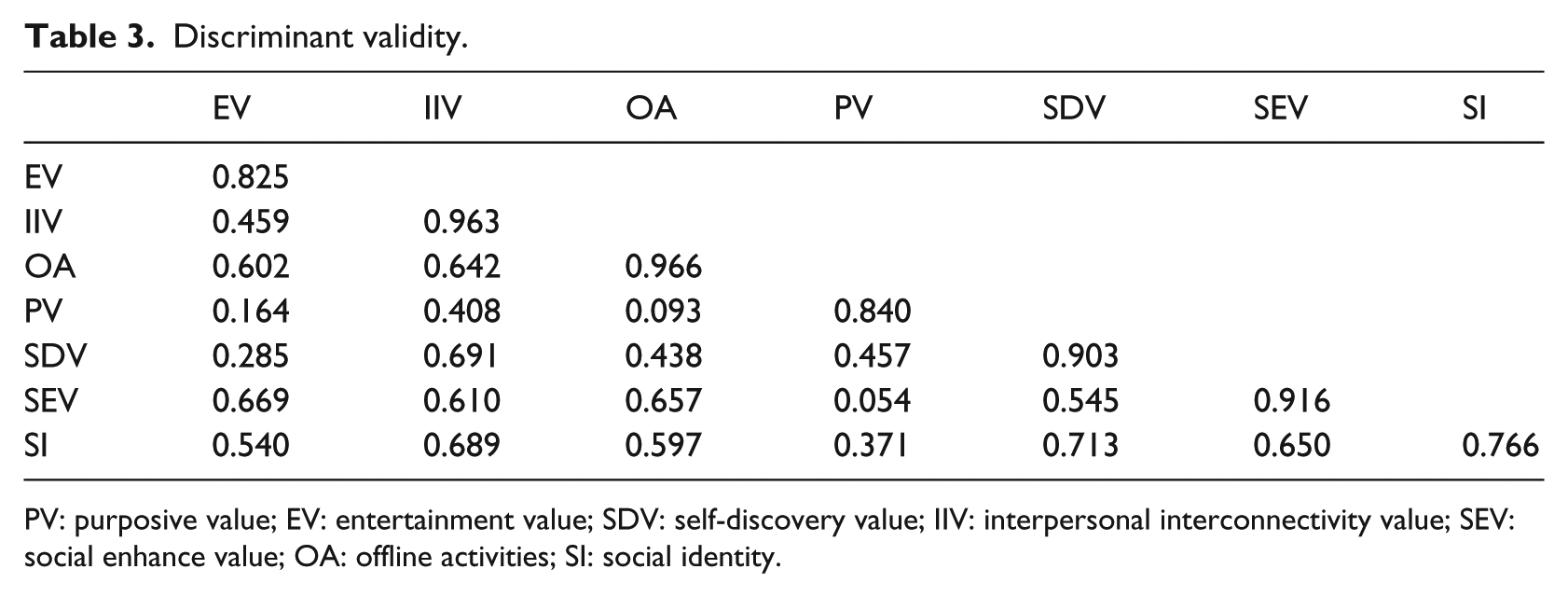
PV: purposive value; EV: entertainment value; SDV: self-discovery value; IIV: interpersonal interconnectivity value; SEV: social enhance value; OA: offline activities; SI: social identity.
Assessing the structural model and testing the hypotheses
The PLS technique was used to investigate the structural model by providing information about the standardized path coefficients (β) among the constructs, significant value (p value), and the explained construct variances (R 2 ). As hypothesized, the path from PV to SI (H1) was found to be positive and significant, with a path coefficient of 0.201 (t = 5.034, p < 0.001); the path from entertainment value to SI (H2) had strong significant and positive effects, with a path coefficient of 0.275 (t = 4.505, p < 0.001); the paths from SDV to SI (H3) had strong significant and positive effects, with a path coefficient of 0.372 (t = 7.691, p < 0.001); the paths from social enhancement to SI (H5) had strong significant and positive effects, with a path coefficient of 0.134 (t = 2.400, p < 0.017); and the paths from OA to SI (H6) had significant and positive effects, with a path coefficient of 0.120 (t = 2.944, p < 0.003). However, the data did not support H4, as the paths from IIV to SI (H4) were not significant, with a path coefficient of 0.065 (t = 0.984, p = 0.315). The structural model explained 69.2 percent of the variance (R 2 ) in social identification in LTC online groups.
To examine the modulation effect, partial least squares–based multi-group analysis (PLS-MGA) was carried out to test H7, H8, and H9. 47 PLS-MGA used the respective two data sets to test path coefficients with significantly differences. To conduct PLS-MGA, the study classified participants with an education level of high school or below as the low education group and those with a bachelor’s degree or higher as the high education group; those less than 40 years of age the young group and those 40 years of age or older as the elderly group. In addition, the study used median split to separate age into the young and elderly groups and extraversion to distinguish participants into the introvert group and extravert groups.
With regard to age, the results indicated that two path coefficients of the model had significant differences, with the PV→SI of the young group showing significantly higher path coefficients and the social enhance value (SEV)→SI of the elderly group having higher path coefficients. Regarding educational background, four path coefficients had significant differences: the IIV→SI and OA→SI of the low education group had higher negative path coefficients, and the PV→SI and SDV→SI of the low education group had higher path coefficients. Regarding extraversion, the results indicated that four path coefficients had statistically significant differences: the IIV→SI and OA→SI of the extravert groups had higher path coefficients, and the PV→SI and SEV→SI of the introvert group had higher path coefficients (Table 4).
Multi-group analysis results.
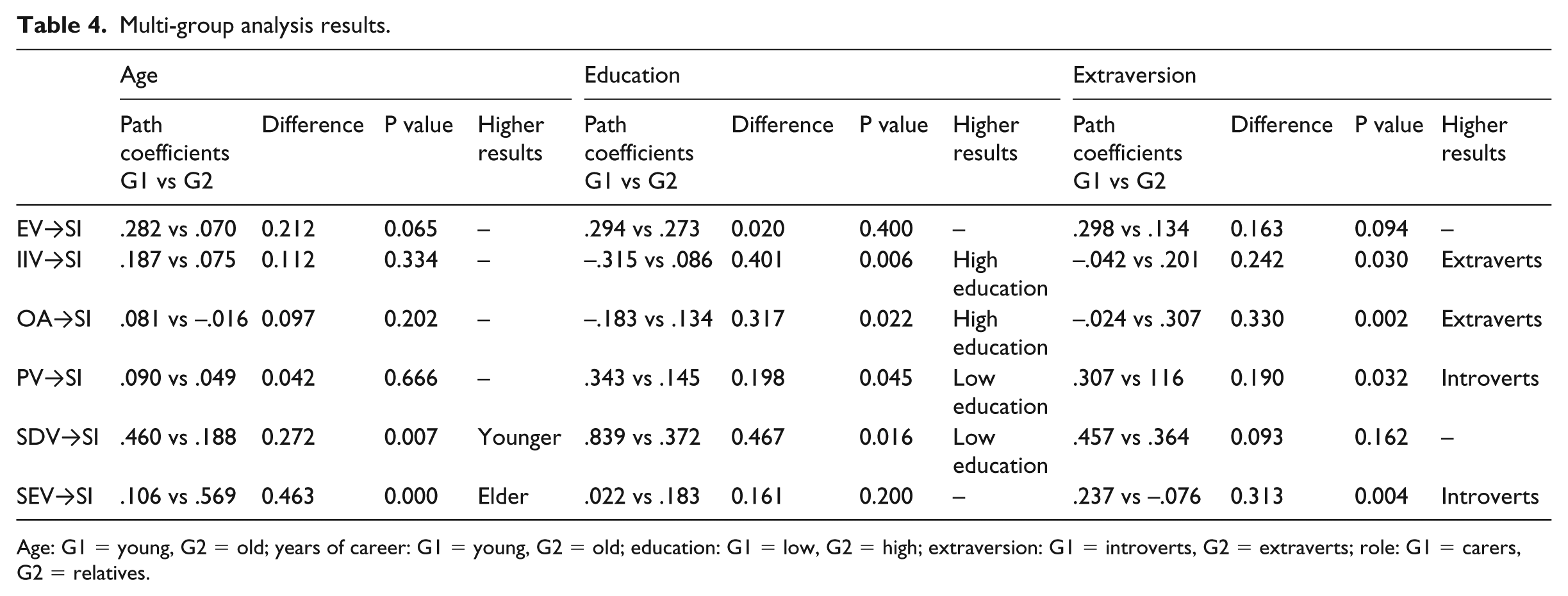
Age: G1 = young, G2 = old; years of career: G1 = young, G2 = old; education: G1 = low, G2 = high; extraversion: G1 = introverts, G2 = extraverts; role: G1 = carers, G2 = relatives.
Discussion
U&G theory is an important theory that is widely used to explain the drivers underlying participation in SNSs. Although the drivers identified in previous studies have varied, the major drivers identified include PV, SDV, maintain interpersonal interconnectivity, social enhancement value, and entertainment value,11,17,21 with other lesser drivers including information search/sharing, achievement, habitual pass time, and enjoyment.12,13,20 However, these drivers are neither well defined nor widely agreed upon with regard to their effect. For example, some studies, including this study, have defined PV as including instrumental value and informational value,11,17 while some have included informational value only.13,20 Achievement value, proposed by Li et al., 19 is one form of utilitarian gratification that, when driven by a desire to gain power or improve status within a group, may be classified as a social enhancement value. Habitual pass time was proposed by Smock et al. 20 to explain the behavior of posting birthday greetings to the “walls” of Facebook friends, which, as a form of “social grooming” on the site, may be classified as an IIV. Enjoyment is a form of hedonic gratification that belongs to entertainment value. 19 Hence, the U&G drivers applied in this study were self-discovery, entertainment value, PV, social enhancement value, and interpersonal interconnectivity.
Regarding the influencing factors (drivers) of the LTC online group’s social identification, the results showed that in terms of U&G drivers, self-discovery, entertainment value, PV, and social enhancement value had positive effects and that interpersonal interconnectivity was not supported. According to a review of related studies, only the effect of entertainment value earned support. Entertainment value incorporates the meanings of fun, relaxation, and passing time.11,17 Furthermore, SNS has a hedonic facet in terms of its allowing the posting of meme images and animated/funny poses. PV was supported by the data, a result that is consistent with Dholakia et al. 17 However, two other studies that used Facebook users as participants obtained different results, with Smock et al. 20 reporting that information sharing positively influenced time spent on Facebook and Ifinedo 11 reporting that PV did not influence intention to use SNS. These inconsistent results may be due to the different dependent variables used in these studies and is an issue worth further study. SDV and social enhancement value were supported by the data in this and Ifinedo’s 11 study, the participants of which were also Facebook users. Members of LTC online groups may post the related problems that they encounter for group discussion and response. Those who post helpful responses not only show their expertise, enhance their reputation, and improve their status within the group but also enhance their caring ability through the question and answer process. Thus, these processes allow those who post responses to realize social enhancement value and SDV. However, the effect of IIV was not supported by the data. The explanation for this result may be that the participants in this study are network-based groups rather than small groups. The major difference between these two types of groups is that the former holds no expectation that members meet or communicate in person with other members of the group. 17 Dholakia et al. 17 pointed out that the social influence process is different for small groups and network-based groups, with self-referent predominating in network-based groups and group-referent predominating in small groups. Moreover, Dholakia et al. 17 argued that interpersonal interconnectivity should be stronger in small groups than in network-based group because interactions are easier in small groups. The result in this study, related to OA, was in line with the findings of Lin 32 and Lai and Chen. 33 OA involve face-to-face forms of interaction, with more frequent interactions forming stronger interpersonal ties.
Furthermore, this study conducted multi-group analyses to test the strength of the relationships between gratification drivers (self-discovery, entertainment value, PV, social enhancement value, and interpersonal interconnectivity) and SI based on respective age, educational background, and extraversion status. PV was shown to exert higher effects on SI in the young group and low education group. This result may be due to the relatively shorter duration of these groups in caring for the elderly or due to diffidence. Thus, these two groups require relatively more information from the LTC groups in order to improve their ability. SDV had a relatively high effect on SI in the elderly group and the low education group. SDV means learning more about oneself or another or obtaining insight through group participation. Therefore, participation in LTC groups tends to benefit the low education group more than the other groups. Moreover, the results of this study revealed that extraverts were inclined toward interpersonal interaction and participating in OA, while introverts were inclined to experience higher effects in the realms of PV and SDV. This result is consistent with previous studies as well as the known characteristics of extraverts. Orchard and Fullwood 16 postulated that Internet consumption patterns are possibly influenced by personality and found that extraverts tend to be sociable, prefer face-to-face interactions, and use social networking as a supplementary method of communicating with friends, while introverts prefer to locate the “real me” through online social communication.
Implications for practice
LTC workers are increasingly important in aging societies. Thus, retaining the current LTC workforce and encouraging new talent to take up LTC careers are crucial issues for healthcare institutions and the government. Certified nursing aides and family caregivers are both entry-level LTC positions that directly perform many of the basic difficult duties of LTC. However, these positions are affected by poor wages, low social status, heavy workloads, considerable occupational stress, and high levels of burnout and turnover.48,49 Social support outside of work may help ameliorate these dilemmas. 49 In total, 80 percent of the participants in this study were certified nursing aides and family caregivers. Our findings demonstrated that participation in FBLTCGs provides important social support for this LTC group. Thus, joining FBLTCGs may be one solution for providing social support for LTC workers.
Continuing education is a critical issue for all healthcare professionals, including entry-level LTC workers. The findings of this study show PV (i.e. obtaining LTC-related information) as one of the drivers identified for participating in FBLTCGs, especially among the participants with less formal education. Healthcare institutions and governmental agencies may encourage LTC workers to participant in FBLTCGs as a vehicle for obtaining social support and improving rates of retention. Furthermore, these institutions and agencies may cooperate with FBLTCGs to deliver related education materials to enhance their members’ care skills. The effects of FBLTCG on LTC workers should be investigated and clarified in future studies.
Conclusion
This study explored FBLTCG participation behavior from the perspective of caregivers; used U&G theory to investigate the drivers of FBLTCG member social identification; and considered the modulating roles of age, educational background, and extraversion. The results showed that the most important influence driver of social identification was self-discovery, followed in sequence by entertainment value, PV, social enhancement value, and OA. In addition, the relationship among these drivers and social identification was shown to be modulated by age, educational background, and extraversion. Although OA may generally help FBLTCG group members develop stronger interpersonal ties, the results of this study indicate that these activities may have the most significant effect in those who are more highly educated or who are extraverts, with benefits also applicable to IIV.
Footnotes
Declaration of conflicting interests
The author(s) declared no potential conflicts of interest with respect to the research, authorship, and/or publication of this article.
Funding
The author(s) received no financial support for the research, authorship, and/or publication of this article.
