




Abstract
The aging population and economic crisis specially in developed countries have as a consequence the reduction in funds dedicated to health care; it is then desirable to optimize the costs of public and private healthcare systems, reducing the affluence of chronic and dependent people to care centers; promoting healthy lifestyle and activities can allow people to avoid chronic diseases as for example hypertension. In this article, we describe a system for promoting an active and healthy lifestyle for people and to recommend with guidelines and valuable information about their habits. The proposed system is being developed around the Big Data paradigm using bio-signal sensors and machine-learning algorithms for recommendations.
Introduction
The aging population and the increase in people with chronic diseases is a common scenario in developed countries. According to the World Health Organization, chronic diseases are the leading cause of death worldwide, as they cause more deaths than all other causes together and affect more people of low and middle income. While these diseases have reached epidemic proportions, they could be reduced significantly by combating the risk factors and applying early detection; the indoor and outdoor monitoring joined with prevention measures and a more healthy lifestyle can help so that millions of lives would be saved and to avoid untold suffering. For both chronic and pre-chronic people, several dangerous clinical situations could be avoided or better monitored and managed with the participation of the patient, their caregivers and medical personnel. This requires research and information gathering about socio-economic and environmental factors, dietary impact and life habits using sensors and devices, including software applications for monitoring personal activities and health signs. However, the use of recommender systems to promote a healthy lifestyle and wellbeing improves interaction with healthcare professional for better disease management.
The rapidly growing popularity of healthcare and activity monitoring applications for smart mobile devices like smart phones and tablets provides new ways to collect information about people’s health status, both manually and automatically. Also, there are appearing new COTS (Commercial Off-The-Shelf) wearable medical sensors that can easily connect with smart phones or tablets via Bluetooth and transfer the sensing measures directly to a public or private cloud infrastructure. This has provided a more efficient and convenient way to collect personal health information, like blood pressure (BP), oxygen saturation, blood glucose level, pulse, electrocardiogram (ECG) and so on, that can be analyzed for generating alarms or furthermore; it would also be possible to track the patient’s behaviors on a real-time basis and over long periods, providing a potential alert for signs of physical and/or cognitive deterioration. 1
It is beyond doubt that an active lifestyle can improve health conditions; 2 a person with a poor physical health condition has a high risk of developing a chronic disease, such as diabetes or cardio-vascular disease (CVD); nowadays, advances in information and communication technologies (ICT), as for example, mobile communications, wearable computing, cloud and Big Data infrastructures make it more easy to develop integrated and cost-effective solutions for providing people feedback about their general health status and avoiding reaching a chronic disease, for example, 21 percent of the population in the United States uses some kind of sensor to track aspects related to their health, as for example, the level of glucose in blood, weight, physical activity, BP, or calorie consumption. An appropriate online track of such data could prevent consultation assistance or prevent the start of diseases resulting from unhealthy habits. Although there are a large number of wearable devices available in the market, the ways data are managed are not standard. Each manufacturer tends to have its own platform in the cloud for storing and analyzing the information that are usually also closed platforms. All this is a problem when it comes to analyzing the information, as we have to deal not only with the large amount of data but also with the heterogeneity and difficulty of access. In a Big Data scenario, the vast amount of information and the speed the data are generated, stored and analyzed have to be taken into account when designing the way the problem is going to be approached.
Related work
Empowering citizens to manage their own health and diseases can contribute to having a more effective utilization of health services, reducing costs and offering improvements in the quality of life in general. Continuous health monitoring may offer benefits to people with diseases (e.g. with chronic diseases like CVD or Chronic Obstructive Pulmonary Disease (COPD) and in need of some monitoring in their treatment), and also for healthy people, which can maintain their good state of health, preventing diseases thanks to the modification of their behavior and adoption of new healthy habits.
Some recent solutions focus on the use of sensors and bio-signals, such as devices for the measurement of BP, heart rate, pulsioximeters, physical movements and distance walked that are calculated using accelerometers or other mechanisms. These new systems are aimed mainly at users with chronic diseases, which need a deeper monitoring in some cases. Other systems are more oriented to healthy people who use them to improve their health status, or as prevention by incorporating healthy habits, favored with this kind of technology. There are also systems that offer a broad spectrum of functionalities and services and may be suitable for both types of users. The research effort in this direction has increased over the past years, and in the current European R&D Programme Horizon 2020, for example, the thematic priorities in “Health Demographic Change and Wellbeing” play an important role in the framework of the program of Social Challenges. 3
The latest projects with similar orientation, and previously in the framework of FP7, have a significant focus on the development of these types of solutions based on ICT to promote self-management of health and disease. In some cases, the projects focus on remote monitoring and self-management of diseases such as CVD and COPD; CVD systems have a major focus on providing patient services that allow the patient to manage his or her health and be monitored with guarantees at home, without having to go as far as possible to the health center or hospital. 4 This approach is pursued in long monitoring treatments for life, and also in situations of short monitoring periods after discharge from the hospital, after a serious episode. The systems are oriented for persons who have had more acute episodes of major CVD diseases (e.g. congestive heart failure, myocardial infarction and chronic heart disease), and also to other CVD without traumatic episodes, but which otherwise tend to affect an even higher percentage of the population (as prehypertension, reaching a percentage of the population above 30%), and with a significant focus on earlier detection and prevention of the progression of the disease to more severe states. This preventive approach especially combines improvements in quality of life and cost-effective approaches to health care.
On the other hand, the COPD systems also include facilities for monitoring patients at home, trying to avoid the need to travel to hospital for maintenance. 5 Systems for monitoring include both questions to answer by the patient about symptoms daily and monitoring of health data that can be obtained by specific sensors or measuring devices (e.g. pulse rate, blood oxygen saturation and frequency respiratory) that the patient may have at home, also seeking to minimize the cost to the patient in terms of disruption in the activities of daily living. As COPD has as main cause smoking or being exposed to smoke (between 20% and 25% of smokers develop the disease), in the systems that address a preventive approach, to include facilities to quit smoking can play an important role. Thus, to support smoking quitting is a specific challenge from the point of view of prevention, and also for maintenance of more advanced COPD patients whose treatment also includes this issue as relevant.
Other projects put the focus on promoting healthy behaviors in individuals, without health problems, with a more general preventive character. 6 Recent research projects with this kind of orientation used to also have a special focus on the aging population. As representative, City4Age 7 defines a model to provide sustainability and extensibility to the offered services and tools by addressing the unmet needs of the elderly population in terms of detecting risks related to health-type problems, but also stimulating and providing incentives to remain active, involved and engaged, contributing to the design and operation of the ultimate Age-friendly City. My-AHA project 8 proposes early detection and intervention as crucial in sustaining active and healthy aging (AHA), preventing possible frequent problems such as cognitive decline, physical frailty, depression and anxiety, social isolation and poor sleep quality.
Companies like Corventis, MicroStrain, Lord or AT4Wireless are focused on the development of services and/or biomedical devices related to telemedicine and monitoring of chronic patients based on the use of data retrieved from biosensors. Other products and services are more oriented toward the monitoring of healthy activities and prevention (e.g. hours of sleep and daily walk distances to prevent prehypertension) and are offered by companies like FitBit, Jawbone or Garmin. Finally, other manufacturers like Tactio or iHealth offer products that are suitable for both types of users. Smartphone with sensors are commonly being combined with an app to process data, interpret the signals and show statistics to users. These apps carry out simple processing, so the functionality is sometimes extended by transferring the data to the cloud. These data can be processed by servers with complex algorithms. Another option is to use specific wearable tracking devices. Generally, these devices do not have a user interface for processing and showing data. So data must be sent to another system to be stored, usually a mobile device, to be analyzed and to show the results to users.
Proposed architecture
The proposed architecture for collecting data in order to promote wellbeing and physical activity is based on the need for a scalable data storage and high-performance computing infrastructure for efficiently storing, processing and sharing health and activity sensor data. With this situation in mind, we propose a simple, coherent, activity monitoring solution that takes into account several factors like using non-invasive sensors, allowing the processing of high volumes of data coming from them including information from other sources as for example clinical texts; search and retrieval of medical related information from forums and designing appropriate visualization interfaces for each user type (patients, healthcare professionals, caregivers, relatives, etc.) among the implementation of security and ethical mechanism concerning the treatment of medical information.
According to the above features, our general architecture for activity monitoring as well as its associated services is presented in Figure 1. The components shown are being developed under the project ipHealth; 9 the architecture allows monitoring of both chronic or non-chronic patients and healthy people who need to be monitored by different circumstances in both home and external environments, and moreover, it allows interaction with their family, the emergency systems and the hospitals through the application of cloud computing, Big Data and Internet of things approaches. From the technological point of view, the architecture consists of the following main elements:
A smart mobile phone being used by user and which in turn accepts the data from wearable vital signs or activity sensors and sends this information to Internet via the mobile network 3G/HDSPA or Wi-Fi connection using sensor’s proprietary applications running in the mobile device. Sensors establish communication with the mobile device through a Bluetooth connection.
A cloud-based (public as Amazon Web Service or private) infrastructure for data storage and analytic module for activation of alarms to be sent to the patient and/or patient’s caregivers, nursing or medical personnel. In fact, this is the core of the system in order to produce alarms or early diagnose and produce new e-health services based on the analysis of historical data using Big Data approach. 10
Interoperability and messaging platform for delivery of information to all involved actors in the system, using the latest technological advances in communication (SMS, mail, voice automated systems and PUSH technology).
A website platform that allows both medical personnel and family caregivers to consult the associated patient information from desktop computer as well as from mobile devices.
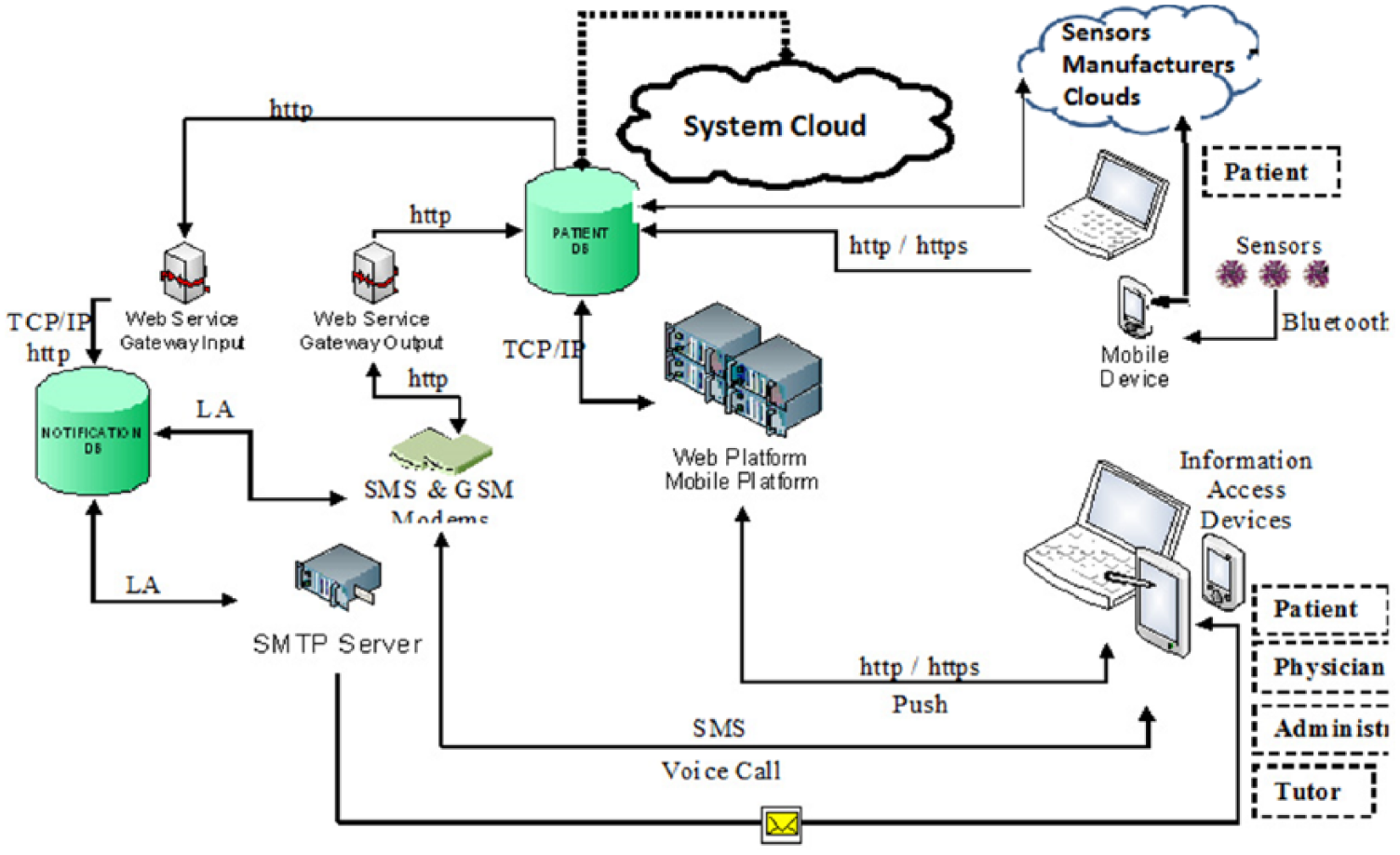
Proposed architecture for patient’s remote monitoring.
For our system, health and activity data are taken mainly from sensor’s manufacturer’s clouds using open application programming interfaces (APIs) that allows developers to establish a connection between applications and health data generated by users with their products; it means we have to deal with those different APIs, which ends in a great heterogeneity of formats and services, a task that is difficult to manage from a more abstract and global point of view. In order to solve this problem, we also use “The Human API” 11 initiative, which aims to integrate, in a simple and convenient way for researchers, health data from many sensors and devices that are available in the market. Human API is a platform for working with health data that allows developers to retrieve information from different data sources (devices, wearables, APPs, services web and others) and allows users to share these data with other applications of their choice. Human API can also handle synchronizations with data from third-party sources; handles the administration of users to manage all their identities across all devices, integrated services and processes; and standardizes all data in through an API Rest that follows HIPAA (Health Insurance Portability and Accountability Act) regulations (for privacy and security of health data).
On the cloud side and due to the large amount of data to be processed, we have decided not to use the classical Structured Query Language (SQL) relational databases and file systems; instead, we decided to use NoSQL databases and a Hadoop ecosystem; 12 it enables us to implement machine-learning algorithms in both batch and stream processing. This ensures the possibility of implementing different types of analysis algorithms keeping a horizontal scalability. Recently, there have been reported experiences of using similar architectures on hospital environments of equivalent sizing. 13
From the medical point of view, the architecture will allow the development of applications suitable for different scenarios, as for example, monitoring a prehypertensive patient who has just been diagnosed and for whom it is necessary to start a new set of healthy habits in conjunction with beta blockers that are usual drugs used as first option in these cases, and the treatment that has unfavorable effects on the patient’s heart rate that needs to be determined. Controlling treatment adherence and drug effects using wireless BP monitor supposes a significant benefit for patients and doctors.
Wearable devices
About the wearable devices used in our architecture, despite there being an increasing number of applications using mobile devices and sensors for health care, such systems have a major disadvantage; in general, they do not offer a general architecture for data processing and analysis and also that approach does not consider major aspects like scalability and data security. Until recently, continuous monitoring of physiological parameters was possible only in the hospital setting, but today, with developments in the field of wearable technology, the possibility of accurate, continuous, real-time monitoring of physiological signals is a reality. Table 1 summarizes the sensors that we are considering for use in our research about physical activity and cardio-vascular conditions.
Considered sensors and applications.
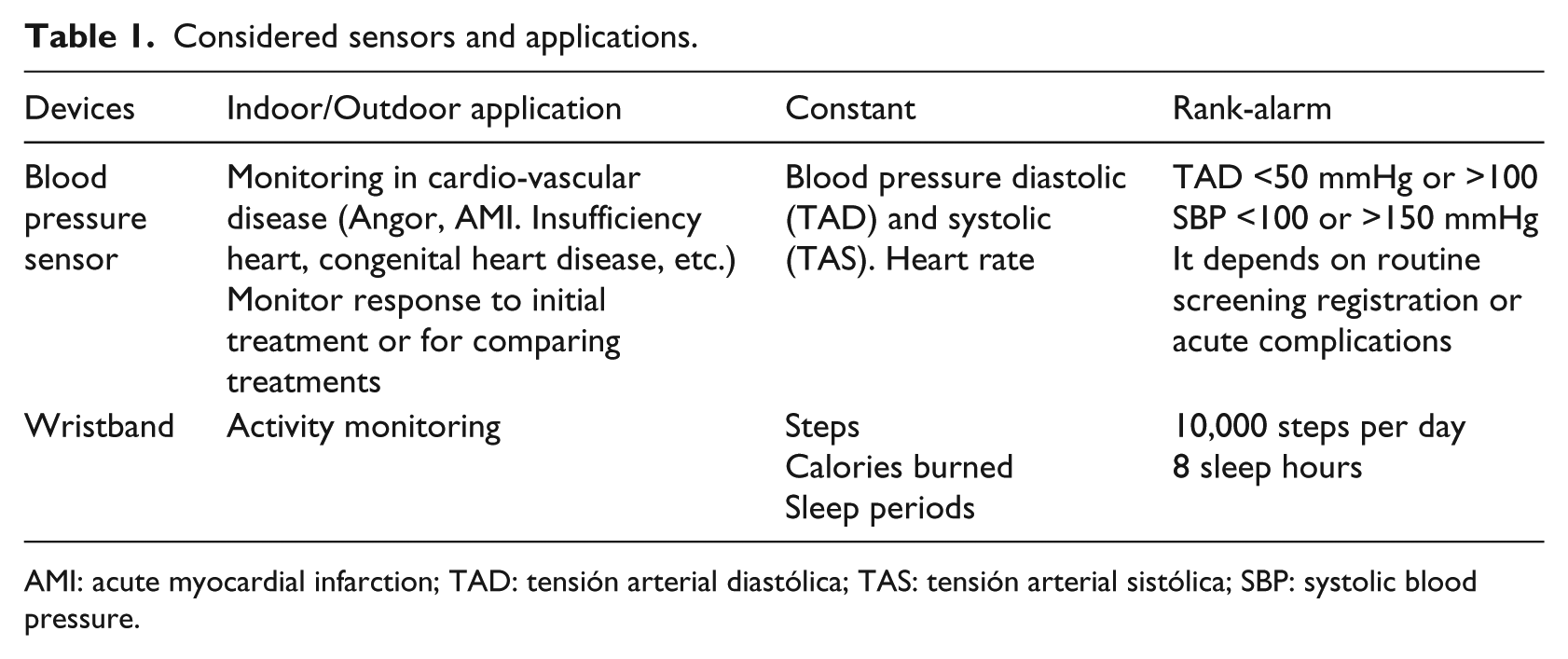
AMI: acute myocardial infarction; TAD: tensión arterial diastólica; TAS: tensión arterial sistólica; SBP: systolic blood pressure.
At present, we are conducting tests for monitoring physical activity and cardio-vascular status using Bluetooth-enabled BP sensor and a FitBit Flex wristband. The iHealth BP7 wireless BP self-monitor 14 is an oscillometric device that can test, keep a history of measurements and share BP data and pulse rate with iOS (version 5.0 or higher) or Android mobile devices (version 3.0 or higher). Last firmware version is 1.3.5.
The method of measure is through automatic inflation. Regarding the validity and reliability of this monitor, it has received CE medical certification (Europe), as well as Food and Drug Administration (FDA) approval (USA) and ESH (European Society of Hypertension (HT)) Certification. The accuracy for pressure is ±3 mmHg and for pulse rate ±5 percent. iHealth Labs provides an open API that allows developers to interact with cloud iHealth’s data. This API uses OAuth (Open Authorization) 2.0 protocol for authentication and authorization, the same as Facebook, Google or Twitter among others.
FitBit Flex 15 is a wrist monitor with a Micro-Electro-Mechanical Systems (MEMS) three-axis smart accelerometer that collects data about user’s movement such as steps taken, distance walked and calories burned. FitBit Flex also has a sleep tracker that informs you about how many hours you sleep and the quality of your sleeping by counting significant movements. The sleep sensitivity can be configured to normal or sensitive. Flex also contains a vibration motor, which allows it to vibrate when alarms go off. Data collected by FitBit can be synced with an online website that provides graphs with the comparison of daily activity, including the activity of several months ago. Thus, the user can know which months are more active and which are less. Moreover, those functionalities can be optionally completed by filling out the menu each day. In this way, users can have complete information about the total calories consumed and the total calories burned to help them to balance both of them. Again a free app, FitBit, compatible with iOS, Android, Windows Phone, OS X and Windows, is available. This app enables to sync the monitor statistics with the mobile through BLE (Bluetooth Low Energy) 4.0 which supports encryption and authentication. Among the functionalities we can find the following: establish daily objectives and check the progress; if the user completes the menu each day into the app, then the calories consumed each day are known and it is compared with the burned; and finally the data are shared with your friends or family. As same as in other social networks, privacy preferences should be well configured in order to preserve data privacy.
The reliability of the device has been tested in several studies, 16 probing to be a valid device to measure energy consumed during physical activity. FitBit provides an API to integrate third-party applications getting and modifying user’s data from Fitbit.com. The process begins with the registration of the new application which is given an API consumer key and secret. Applications must be authenticated using OAuth as same as iHealth. But FitBit uses OAuth 1.0 (it has 2.0 in a beta state) which has several vulnerabilities discovered.
Scenarios and use cases
In our project, we have worked on defining a set of scenarios and use cases applications of the proposed architecture. The scenarios include as primary users, the patients (or person improving healthy habits), health professionals who can keep track of their, and we have also considered medical students in their training process. The platform services presented here aim at enabling an integrated and intelligent access to related information for extracting useful knowledge in the context of the personalized medicine access. The scenarios considered for now are the prehypertension and the HT for young pregnant.
Prehypertension is the situation in which the patient has low BP, but it is advisable to introduce changes in his lifestyle preventively, such as weight reduction, smoking cessation, low diet in fat and sodium, physical activity and moderation in alcohol consumption, avoiding stressful situations and monitoring the adequacy of sleep. This type of data can be obtained from sensors in our architecture, and self-monitoring and its tracing facilitate the introduction of changes in lifestyle.
On the other hand, HT is the most common and important risk factor during pregnancy. There are experiences that have already proven useful in monitoring BP at home, providing accurate values. For example, in Denolle et al., 17 the device used for this purpose automatically sends the data to be processed in order to alert the obstetrics when severe HT is produced. Moreover, that study showed that BP was higher in clinical visit than when tension was recorded automatically. Therefore, the use of sensors that automatically register the pressure levels in pregnant women proved to be useful as it may avoid unnecessary treatments for HT. In this scenario, the parameter being studied right now to be self-monitored is the BP. Other measures such as glucose in blood could be very interesting too because of the implications that could have on the mother and the baby in future.
Preliminary results
Data obtained from wearable sensors need to be processed; health data mining approaches are often used for tasks like prediction, detection of outliers (anomaly detection), clustering and decision making. 18 Depending on the kind of task, supervised or unsupervised learning methods are applied. Supervised learning is mainly used for prediction or decision making. The models obtained through learning algorithms are predictive “classifiers,” that is, sets of rules or other types of models in which other attributes are used to predict the class of new examples with unknown classes. Unsupervised learning can be used for tasks like clustering or finding association rules among data attributes. Therefore, the use of sensors that automatically register the pressure levels in pregnant women proved to be useful since it may avoid unnecessary treatments for HT. Figure 2 shows results about the physical activity and BP of a monitored patient; from above to below and left to right, we can see current values about heart rate and BP among other personal data; the graphics show the amount of steps taken in a 30-day period, the steps in a day each 15 min, the percentage of BP range in a 1-month period, the sleep hours in a month, and the measures of BP and heart rate in 1 month.
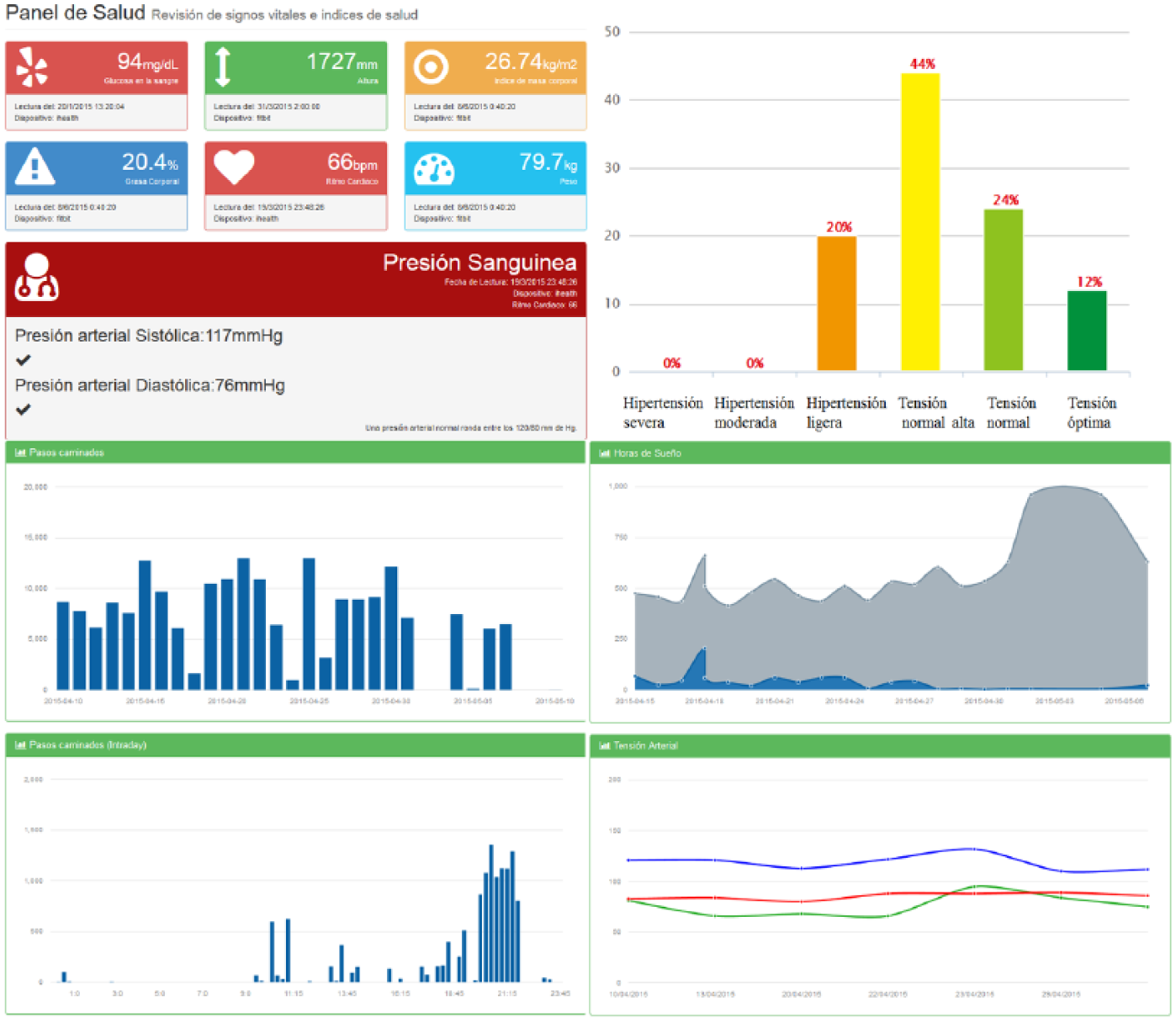
System user interface showing information about activity and blood pressure.
This is valuable information for having an idea about the habits and daily patterns of a person and permits us to apply machine-learning algorithms to implement recommender systems and detect tendencies about their general health status.
Health Recommender Systems are part of Recommender Systems being applied in the health industry. 19 It has been used for diagnostic assistance by physicians and for personal health advising tools by users. 20 As the communication platform, Internet has been the main source for users to access health information and recommendations. Recommender Systems used as an enabler in health intervention bring some new functionalities, 21 for example, based on the patient’s reported data, a recommender system can guide the patient about the necessary medical tests that need to be done. 22 Wiesner and Pfeifer 23 have presented a method where, by exploiting the existing semantic health network, a health-graph is constructed. The nodes of such a graph contain information that can be compared against a particular user’s health-graph and essential health recommendations can be recommended. Zanker 24 has simplified the method of evidence collection by constructing rule-based preferences from historical data. According to those values, the recommender system for physical activity needs to take into account parameters and factors such as weight, age and sex. The recommendation is based on the change in BP, physical exercise and weight values of the person. Recommendations can also include the following:
Dietary-hygienic measures. Relaxation therapies depending on high BP, avoid canned food, avoid salt, reduce stress and avoid smoking.
Food. Suggestions on the best dietary changes that will improve health based on information collected in this regard.
Recommendations on harmful substances. Avoid smoking and smoky environments, alcohol.
Recommendations for relaxation. High values of heart rate during day may vary to normal levels during sleep, which may indicate stress. In this case, the recommendations include relaxing therapies like yoga. Otherwise, in case of high levels, medical assistance is recommended.
Sending information to healthcare or medical assistance.
Alerting a physician if any parameter is too high.
Request for consultation on the basis of combination of parameters indicating that a medical supervision is needed.
Also in our system, we consider as very important the user-generated content, like the information present in specialized forums with people with similar problems. From the point of view of the functionality in the scenarios that we have presented before, it is particularly suitable its use, allowing patients to share their concerns about certain health problems, progress associated with activities, methods to achieve goals and many other related issues with their situation of health. From the forums, users can provide indications to other relevant sources and it also allows users with professional profile to provide authorized information and monitor further comments. For the analysis of these information sources, current systems use advanced text analysis and natural language processing (NLP) techniques.
The algorithms of analysis incorporate, increasingly, the use of semantic resources, including ontologies and domain-specific databases, such as UMLS (Unified Medical Language System) or SNOMED, 25 providing a greater capacity of semantic interpretation, demanding growing computing capacity and data storage. From the point of view of automatic text analysis, our system is focused on the calculation of the similarity of consultations, giving the user direct access to the more similar that have been previously raised, finding sometimes satisfied his need or his problems resolved with previous contents. To do this, we use a similarity function 26 in a text analysis system based on Gazetteer of General Architecture for Text Engineering (GATE) and medical terms covered by the Open Biomedical Annotator (OBA) and Freebase, 27 allowing us to address synonymy and more broader lexical issues present in this domain.
Conclusion and future work
The demographic change will lead to significant and interrelated modifications in the healthcare sector and in the increasing development of technologies promoting independence for the elderly, dependents and chronic. The iPHealth project has as goal the design and development of a technological platform allowing both people with chronic diseases and healthy to increase their quality of life before more acute episodes. In this article, we have focused on the main architecture description with some details about sensors and preliminary scenarios to be considered in order to demonstrate the functionality of the developed architecture.
Footnotes
Declaration of Conflicting Interests
The author(s) declared no potential conflicts of interest with respect to the research, authorship, and/or publication of this article.
Funding
The author(s) disclosed receipt of the following financial support for the research, authorship, and/or publication of this article: This work is still being developed with funds granted by the Spanish Ministry of Economy and Competitiveness under project iPHealth (TIN-2013-47153-C3-1).