




Abstract
Our article aims to give an overview of the most mentioned smartphones’ pregnancy-related applications (Apps). A keywords string with selected keywords was entered both in a general search engine (Google®) and PubMed. While PubMed returned no pertinent results, a total of 370 web pages were found on Google®, and 146 of them were selected. All the pregnancy-related Apps cited at least eight times were included. Information about App’s producer, price, contents, privacy policy, and presence of a scientific board was collected. Finally, nine apps were considered. The majority of them were free and available in the two main online markets (Apple® App Store and Android® Google Play). Five apps presented a privacy policy statement, while a scientific board was mentioned in only three. Further studies are needed in order to deepen the knowledge regarding the main risks of these devices, such as privacy loss, contents control concerns, the digital divide and a potential humanization reduction.
Background
In the last two decades, internet has become an essential tool for people who are looking for health information, thus defining the concept of e-Health.1–6 Nowadays, smartphones are gaining more value among the technological tools available to search for health-related information7,8 since they enable users to accomplish tasks anywhere and anytime. A survey conducted in 2011 by Ipsos MediaCT Germany reported that smartphones ownership and the number of consumers using a smartphone are overcoming the computer users .The majority of smartphones’ users are women, people with an higher education level, living in urban and suburban areas, and with a satisfying average income 9 .
The capabilities of these devices can be extended by the implementation of the so called applications - or “Apps”- that are end-user softwares designed for mobile devices operating system. These features are intuitive and easy to download and use, not requiring any training or specific informatics knowledge. A recent survey promoted by Ipsos OTX MediaCT reported that the download of applications nearly doubled from 2009 to 2011in the USA, rising from 22% to 38%. People interviewed declared to have used 11 Apps in the last month on average. 10
A survey conducted on 658 Apps downloaders by Pew Research Center during 2011 showed that 29 percent of them have downloaded health Apps, confirming the huge popularity of this topic (ninth place among most downloaded applications).11,12 The health Apps cover a wide range of health monitoring tools, from those counting calories to more advanced apps that monitor vital signs and help users in managing serious health conditions. 11
Several studies have pointed out the great potentialities of these applications, particularly when used by health professionals and doctors13–17. Conversely, to date only few data are available about the use of such tools by the general population18,19.
Within the general population, it is stated that pregnant women are more prone to seek health information on the web 20 . Pregnancy, indeed, is a condition characterized by continuous care and regular medical checks and for these reasons pregnant women are more sensitive to look for a digital help in order to manage their health status 20 . International studies report that 97 percent of pregnant women use the web to have information on pregnancy, 94 percent want to deepen the information received from health professionals, and 83 percent make decisions based on the information found.20,21 Another European study reported that 91 percent of women have access to the Internet and 84 percent use it to search for information, especially during the early stages of pregnancy. 22
To our knowledge, in the scientific literature, there are several studies focused on e-Health and m-Health were conducted,20,23,24 but no specific articles describing the main pregnancy-related apps available on the market have been published yet.
Our article aims to give an historical overview of the smartphones’ pregnancy-related applications available and to discuss the possible impact of their use on health of pregnant women.
Methods
On January 2014, we performed a structured search on the web in order to find and describe the most mentioned “pregnancy-related” applications developed in the recent years for smartphones and tablets. We used both a general and a scientific search engine. The general search engine selected was Google®, since recent statistics have identified this tool as the most popular search engine in the USA and Europe 25 . We entered the following string on Google® and Pubmed: (smartphone OR tablet OR “mobile phone”) AND (application OR app) AND (pregnancy OR “pregnant women” OR “pregnant woman”).
While the search on Pubmed retrieved no results pertinent with pregnancy-related applications, using Google® a total of 370 results were returned. Since the keywords were in English, all the results retrieved were in the same language, with only two exceptions in Italian. The pertinence of the websites consulted was assessed using an ad hoc checklist grid (Table 1). We considered “high/very high pertinent” those websites that explicitly mentioned one or more applications for smartphones or tablets related to pregnancy, “pertinent” those that were specifically focused on health-related apps without mentioning any, “not pertinent” all the pages obtained by the search but not specifically focused on this topic. For each “high/very high pertinent” web page, we collected information about the website category (personal blog, online newspaper blog, specific website article, official application stores, unofficial application stores, official producer website of the application, forum) and the name of the app or the apps mentioned were retrieved. Finally, all the pregnancy-related applications mentioned at least eight times were selected for the present overview. Information on the producer, the price, the tools included, the privacy policy and the source of medical contents, were retrieved from each of the selected app.
Checklist grid for Google search.
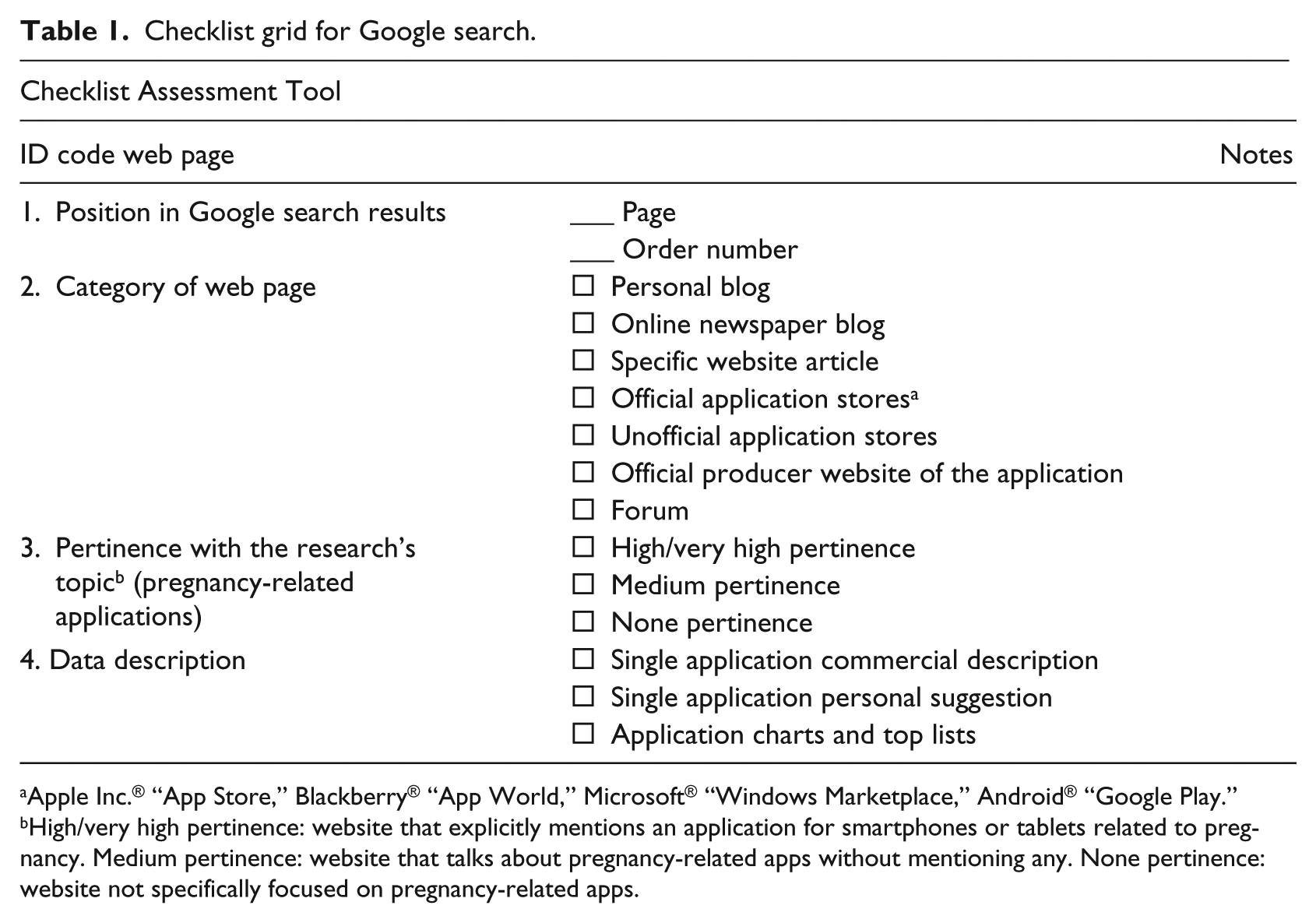
Apple Inc.® “App Store,” Blackberry® “App World,” Microsoft® “Windows Marketplace,” Android® “Google Play.”
High/very high pertinence: website that explicitly mentions an application for smartphones or tablets related to pregnancy. Medium pertinence: website that talks about pregnancy-related apps without mentioning any. None pertinence: website not specifically focused on pregnancy-related apps.
Results
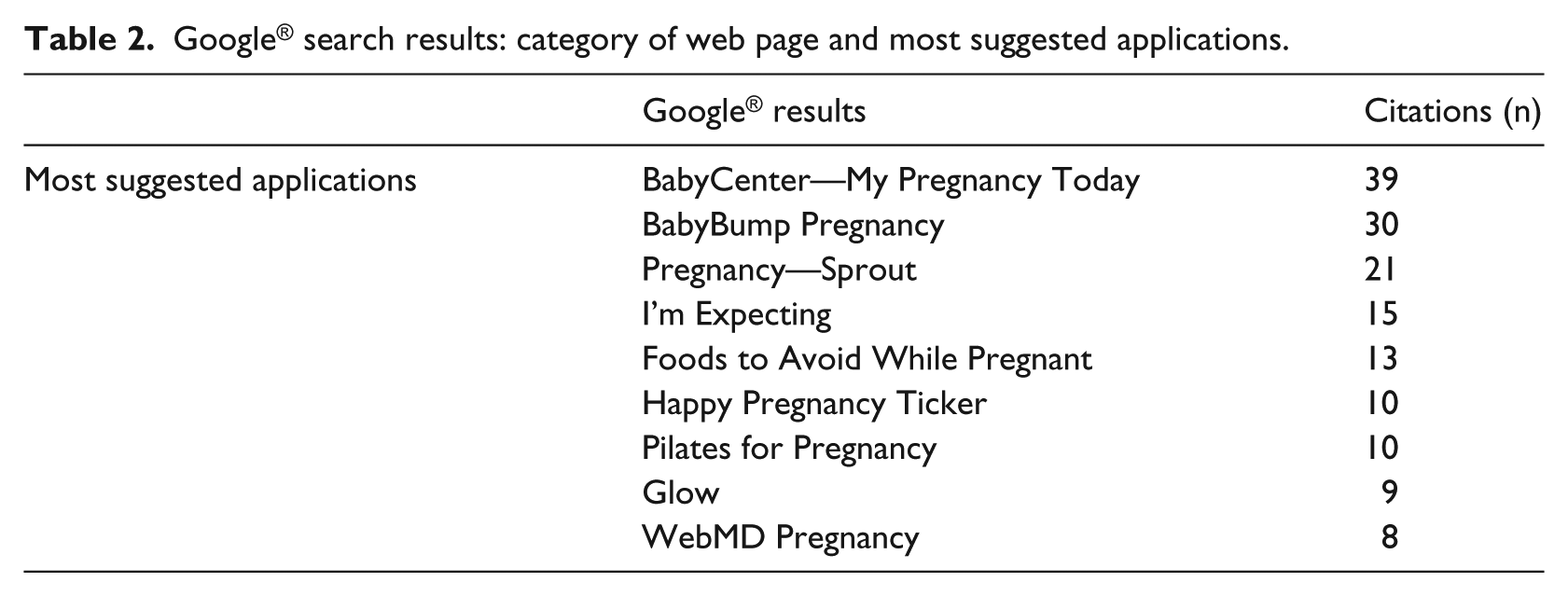
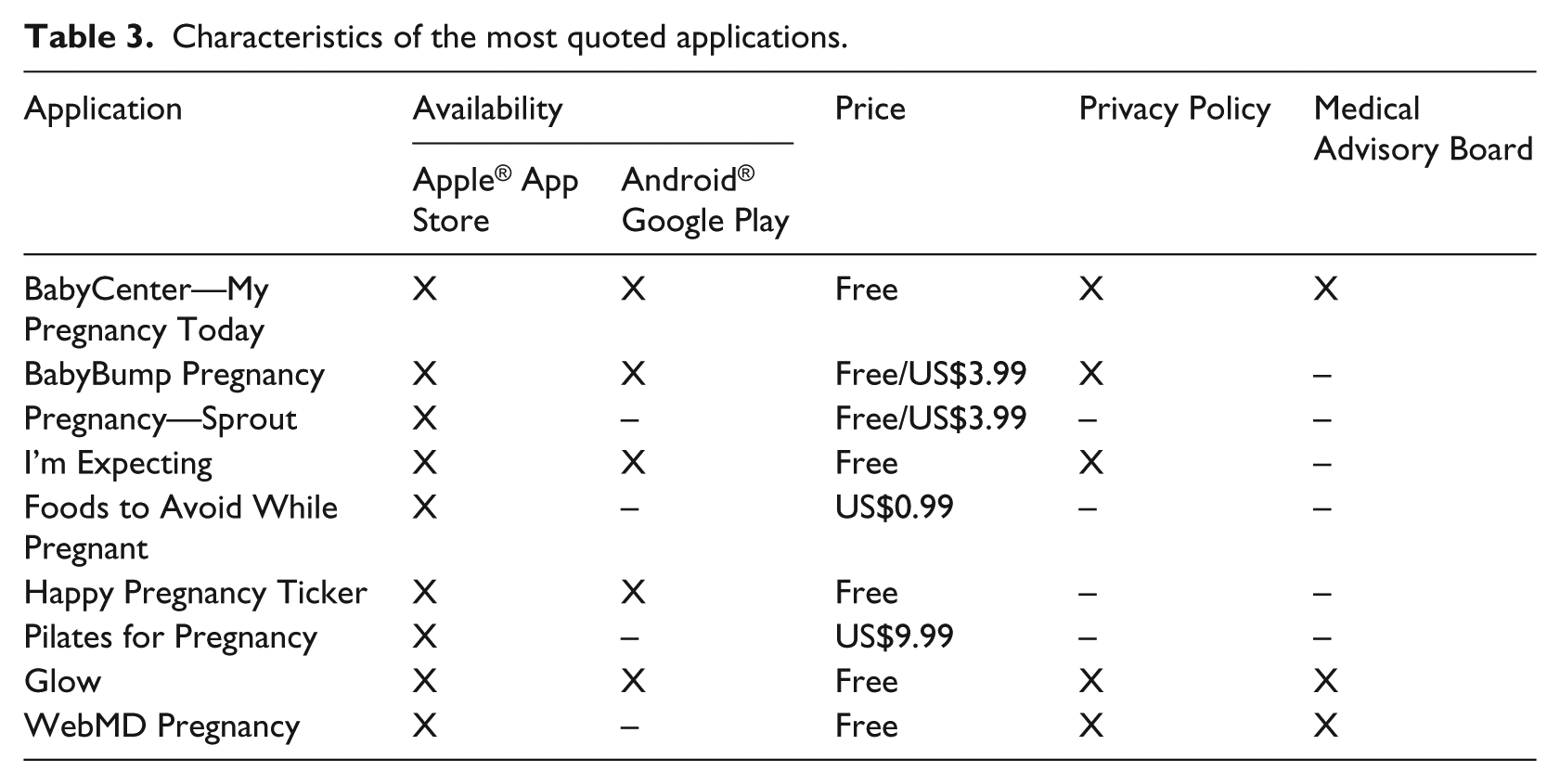
Finally, we analyzed 146 websites fulfilling the pertinence criterion. “BabyCenter my Pregnancy Today” was the most quoted app (39 times). The other two most mentioned applications were “Baby Bump” (30 times), designed to supply information about normal and abnormal symptoms during pregnancy, and “Pregnancy / Sprout”, mentioned 21 times (Table 2). A total of nine apps were mentioned at least eight times and therefore included in our overview (Table 3).
Google® search results: category of web page and most suggested applications.
Characteristics of the most quoted applications.
BabyCenter—My Pregnancy Today 26
“My Pregnancy Today”, developed by “BabyCenter” in 2010, and achievable for free on Apple® Store and Android® Google Play, is available in five different languages (English, French, German, Chinese, Korean, Brazilian). It is addressed to pregnant women, and it contains several tools such as a “pregnancy checklist,” with both medical and everyday life advice, a kick counter, and videos and drawings of a hypothetical baby in the different period of the gestation. The app contents are accessible after providing an e-mail address and creating a personal account. For the registered users is available a blog, divided in subsections on the basis of the gestation period. Terms and conditions of use and a privacy policy section, providing information about personal data collection and usage, are included. On its website, the Company (BabyCenter L.L.C.) declares that “with only a few exceptions, our content is all originally reported, fact checked, and reviewed by our Medical Advisory Board.” This board is composed by obstetrics, midwives, pediatricians, anesthesiologists, and other specialists (whose names are shown on the website). 26
BabyBump
“BabyBump” (cited 30 times) is an application for smartphones, available both in a free and a pro version (US$3.99) on the App Store and Android® Google Play. 27 It was produced in 2009 by “Alt12 Apps, Inc.,” a company headed in San Francisco, United States. It is available in English, French, and Spanish. After a registration (Name, Surname, e-mail address), the app offers tools as a countdown (to calculate the due date), pictures of how the fetus should be in the different periods of the gestation, a diary in which it is possible to insert both anthropometric data and “feelings” like mood, energy, appetite, cravings, and morning sickness, and a forum to exchange opinions and experiences with other moms-to-be. Added features of the Pro version are a kick counter and a contraction tracker. Terms of use and a privacy policy sections are included to acknowledge the ways of collection, use and sharing of personal data. These data (in particular the e-mail address) may be used for sending “newsletters, changes to features of the Services, or special offers.” However, it is possible to unsubscribe in order to avoid receiving this type of information. Apparently, no information regarding the source of contents and/or the presence of a scientific board are available.
Pregnancy—Sprout
“Pregnancy - Sprout” (mentioned 21 times), was developed in 2010 by “Med Art Studios,” 28 a company self-described as “specialized in family and home-health software applications for hand-held mobile devices.” This application is available on App Store both free (named “Essentials” ) and as Premium version, costing 3.99$, and in several languages (English, German, Italian, Japanese, Portuguese, Russian, Chinese, and Spanish). A registration is not needed and no personal data are required, with the only exception of the date of delivery. The main tools consisted in a weight tracker, a kick counter, a pregnancy checklist and timeline, a list of questions that you may ask to your doctor, three-dimensional (3D) weekly images of the fetus, and a contraction timer. Concerning the app’s medical contents, apparently on the website of the company and on the application, there is no detailed information about any evidence-based data and/or a scientific board.
I’m Expecting
“I’m expecting,” mentioned 15 times, is a free app available in English and Japanese on the App Store and Android® Google Play. It was produced in 2010 by “MedHealth,” an American private corporation aimed to provide health information on the web. 29 It is available in English and Japanese. The registration is required only if the user wants to personalize data and to receive specific advice. Terms and conditions are reported in a specific section, where details about privacy policy are included. In the privacy policy statement, it is explained that once you register, you are automatically signed up “to receive periodic informational newsletter,” informing “about upcoming features an partners.” This app allows to record the symptoms and to get tips on how to alleviate them, to track the pregnancy weight gain, to connect with the doctor in order to receive information, and to book appointments.The producers’ team includes medical doctors but, apparently, no further information about the scientific board is provided.
Foods to Avoid When Pregnant
“Foods to avoid when pregnant” 30 (cited 13 times) is an application produced in 2009 by “LitCharts” and never updated. It is available on the Apple® Store and only in English for 0.99$. It offers a list of foods and drinks that women cannot eat during pregnancy, and tips about the ways of cooking in order to make sure some specific foods for pregnant women. No personal data are required to receive for these specific advice; therefore, the privacy policy is not present. No indication about the source of contents or the presence of a scientific board is given.
Happy Pregnancy Ticker
“Happy pregnancy ticker,” cited 10 times, is a free app produced in 2011 by “Softcraft systems and solutions,” a society specialized in the development of smartphones’ applications. It is available in English in the Apple® Store and Android® Google Play. 31 The main features include a weight gain estimator, a contraction timer, information about the weight and the size of the fetus in every week of the gestation, tips and advice, and a forum with several discussions. The registration is not required, and no information about privacy policy is given. There is no information about the presence of a medical advisory board in the app and on the creator’s website.
Pilates for Pregnancy
Pilates for pregnancy” 32 (mentioned 10 times) is an application available in English language, created in 2009 by “Dramatic Applications” (website inexistent) and never updated, sold in the Apple® Store only for 9.99$. It basically includes a list of pilates exercises suitable for pregnant women. Among the additional tools, there are also a list of useful tips about the gestation and a section for writing down the doctor’s suggestions. Since no personal data are required for using this application, a privacy statement is not included. The app does not give information about any medical advisory board, but it is stated that the exercises were designed by a certified pilates instructor.
Glow
“Glow,” 33 cited nine times, is an application produced by “HVF” and launched in May 2013. It is the most mentioned app related to fertility and ovulation. This app is available, for free, in English on Apple® Store and Android® Google Play. It is addressed to all the women who want to track their periods and their fertility signs. On the basis of several information (such as attempts to conception, number of previous deliveries, time spent on daily physical activity, weight, height, and length of menstrual cycle), the app helps to calculate the fertile period. The creation of an account and the provision of the personal e-mail address is needed to access the app contents. Terms of service and privacy policy are described in specific sections. In these statements, it is declared that personal information may be shared with other companies for joint marketing purposes. As declared in the company’s website, 33 the app was developed with the help of three medical advisors.
WebMD Pregnancy
“WebMD Pregnancy,” 34 cited eight times, is a free app available in English on the App Store. It has been produced by “WebMD,” a company created to widespread medical information on the web. Concerning the contents of this application, several tools are included: symptom tracker, kick counter, contraction tracker, prenatal tests, and any other advice concerning the pregnancy. A registration is needed and the producer guarantees the privacy of personal data in a specific section. However, on the privacy policy statement, it is claimed that information collected may be used for sending “relevant offers and information” on behalf of Company’s sponsors. On the website of this company, it is underlined that all the information is given by certified and qualified physicians. 34
Discussion
Our overview aimed to identify and describe the most web-mentioned applications for smartphones and tablets related to pregnancy. Although several studies already investigated use and peculiarities of health applications,23,24 to our knowledge, this is the first research describing the features of new e-health tools (such as smartphones and tablets) specifically designed for this topic. There are two main reasons why we decided to use a non-scientific search engine, such as Google®. Firstly, the scientific literature existing on the investigated topic is still lacking on the international databases. Indeed, a research performed on a scientific database (Pubmed) using the same search strategy did not return any relevant results. These facts highlight the existing gap of information between scientific literature and information retrieved through general search engines. Moreover, the search through the most popular search engine gave us the possibility to identify the most common applications in this field.
As expected, the results of our study showed how the most mentioned pregnancy-related apps are free and cover all the different aspects of the gestation (such as growth of the fetus, symptoms during pregnancy, lists of medical check-ups, kick counter). Another important feature is the direct link with forums where the users can be connected with other moms-to-be and exchange opinions, information, and tips.
Recently, several applications were specifically designed and developed in order to help women during the pregnancy, to clarify their doubts, and to keep them updated on their health status. This behavior could be highly useful but, on the other hand, it is important to acknowledge the hazards related to the lack of contents control. As our results showed, in some cases, these applications do not contain any indications about the reliability of information included and/or the presence of a scientific board to ensure evidence-based contents. A similar concern rises from our results, when considering the protection of personal data. The privacy policy explains how data collection, treatment and sharing are in most cases guaranteed. However, these companies clarify that data could be used for commercial and marketing purposes also, although this information is often not easily detectable. Considering that health data are particularly sensitive, the public health agenda cannot ignore this phenomenon.
In the last years, several studies demonstrated the role of information found on the Web in inducing changes in health choices,1,35 often with negative implications. This is even more worrying considering that most women completely trust in this information. In a survey conducted by Larsson, 22 it is reported that 70 percent of the women interviewed do not discuss anything about the information retrieved from the Internet with their midwife and they used to search only in the web the topics suggested by the specialists. Gynecologists, general practitioners, and public health professionals have to deal with the possible misinformation provided by these applications and to educate and train pregnant women in order to make them able to avoid risks for their health and to recognize the reliable contents and to prefer institutional applications when available. The need for professional advice is important, especially when considering that some authors suggest that women seem to be less likely to change their behavior after medical advice when compared to men. 36
Another important consideration is the potential emergence of the phenomenon known as “digital divide” related to socioeconomic status or informatics skills of the pregnant women.37,38 Indeed, as reported by the present research, not all the apps were downloadable for free, and for some of them, premium versions with extra contents are available. Moreover, our findings suggest that not all the applications are available on the different online stores (that are often linked to specific brands, such as “App Store” for Apple® products). Given that Apple products are generally more expensive than other brand’s ones, the possibility to own an Apple device (smartphone or tablet) and to download the above-mentioned apps could be affected by the economic resources of the potential users. To limit the occurrence of inequalities among those who own a smartphone and those who do not could be a task for health professionals. Indeed, they should pay attention to the patient’s socioeconomic status and eventually give an informative support in order to fill the gap.
Furthermore, the risk of a reduction of humanization in the relationship between the woman and the health care system is also worthy of attention by the medical staff, especially in the context of recognized gender inequalities (women have lower access to health care and less benefits from prevention programs). 39 As a matter of fact, these tools should not substitute the gynecologist advice and they should be used only in addition to the standard medical visits and check-ups. The risk is that these applications, for their technical features and attractive presentation of contents, will become more effective than doctor’s speech in influencing pregnant women’s choices.
In our opinion, there is a strong need to create an instrument for assessing the quality of these applications in order to assure a good utilization and to guide the consumers to a better choice of these apps. This could be an important new target to be addressed in the public health agenda. Finally, we suggest the development of a specific regulatory framework on this issue in order to ensure the reliability of the information provided by these apps, such as regular review or endorsement by specialist societies or non-governmental regulatory authorities. However, the implementation of such regulatory instrument seems to be difficult to be applied in the free and global market of smartphones’ applications. Some attempts in this direction have been made by institutional bodies such as the US Food and Drug Administration (FDA) and the English National Health Service (NHS). In the first case, the American authority has decided to regulate all the applications for smartphones that can be considered as medical devices, and to exercise enforcement discretion on medical apps that cannot be considered medical devices. 40 The NHS has instead implemented an electronic library in which all the medical apps that comply with certain criteria are included. 41
An important limitation of our research is represented by the exclusive use of Google® as search engine, even if, at the current status, the general search engines seem to be the only way to retrieve information about this topic. Moreover, this search engine may give different results depending on the location in which the search has been performed and the previous search history on the browser and on Google®. Finally, another limitation is associated with the decision to include in our overview the most mentioned apps and not the most downloaded ones. However, considering that the pages retrieved are in most cases blogs or forums, we are confident that the present work could be a plausible representation of the most popular applications.
Conclusion
The present work represents the first attempt to give an overview on this emerging topic. Smartphones and applications are radically transforming the society and the health field, enabling a greater ease of access to the knowledge available on the web and facilitating the ways of communication among people. The potentialities of these tools are remarkable and worthy of further research, for their possible impacts and consequences on public health. This article can be a major stimulus for doctors to learn more about the most used applications related to pregnancy in order to advise pregnant women on advantages and risks of each app.
Footnotes
Acknowledgements
F.B. conceived the research, participated in the research, and drafted the manuscript. S.P. and G.S. participated in the research on blogs and forums and contributed to draft the manuscript. M.R.G. contributed to draft the manuscript and revised the manuscript. R.S. coordinated the research and revised the manuscript. All authors read and approved the final manuscript.
Declaration of conflicting interests
The author(s) declared no potential conflicts of interest with respect to the research, authorship, and/or publication of this article.
Funding
The author(s) received no financial support for the research, authorship, and/or publication of this article.