




Abstract
Social media and electronic news media activity are an important source of information for the general public. Yet, there is a dearth of research exploring the use of Twitter and electronic news outlets during significant worldly events such as the recent Ebola Virus scare. The purpose of this article is to investigate the use of Twitter and electronic news media outlets in communicating Ebola Virus information. A cross-sectional survey of Twitter data and Google News Trend data from 30 September till 29 October, 2014 was conducted. Between 30 September and 29 October, there were approximately 26 million tweets (25,925,152) that contained the word Ebola. The highest number of correlated activity for Twitter and electronic news outlets occurred on 16 October 2014. Other important peaks in Twitter data occurred on 1 October, 6 October, 8 October, and 12 October, 2014. The main influencers of the Twitter feeds were news media outlets. The study reveals a relationship between electronic news media publishing and Twitter activity around significant events such as Ebola. Healthcare organizations should take advantage of the relationship between electronic news media and trending events on social media sites such as Twitter and should work on developing social media campaigns in co-operation with leading electronic news media outlets (e.g. CNN, Yahoo, Reuters) that can have an influence on social media activity.
Introduction
The development of Social Media and Electronic News Media has provided opportunities for people and organizations to communicate and share information. It is estimated that there are 1.73 billion people around the world that use social networks, which is equivalent to one out of four people worldwide. 1 Social media tools and electronic news outlets have changed the way people interact with information and how they use it in their day-to-day lives. 2 Healthcare and all of its related industries have benefited from the use of social media and electronic news outlets to share information and create public awareness campaigns. For example, the US Centre for Disease Control (CDC) has updates through Twitter on a variety of services such as health campaigns; centers; disease and conditions emergency preparedness; and injury, violence and safety. 2
Recently, social media and electronic news outlets have been communicating vast amount information about the Ebola Virus (EboV). The spread of EboV is worrisome because it has an estimated mortality rate of 52 percent in West African countries, and there are no drugs available on the market today that can treat the virus. 3 In countries such as Sierra Leone or Guinea, EboV has killed nearly 5000 people. 4 Social media and news media outlets have been covering the story since its development. For example, in 1 week, between 23 October and 29 October 2014, there were close to 3.4 million tweets on the topic of the EboV. 5 The use of social media and electronic news outlets has allowed people and organizations unrestricted access to share information, opinions, and facts about many health-related issues.
The work presented in this article investigates the use of Twitter and electronic news outlets in communicating EboV information. This work will provide insight into the number of tweets shared on the topic of EboV, social media sentiments regarding EboV, and the identification of the primary influencers for sharing EboV information. Understanding how EboV information is communicated through the Internet will assist healthcare organizations and healthcare policy makers recognize the role social media and electronic news sources in spreading of healthcare-related information.
Methods
Data sources
Topsy
A web-based tool Topsy (http://www.topsy.com) was used to identify daily, weekly, and monthly occurrences of the word “Ebola” from 30 September 2014 to 29 October 2014 in public tweets and retweets sent from anywhere worldwide. Topsy is a social search and analytics organization that provides analysis of Twitter and other web related data. Twitter was selected as a source of inclusion in this study because it is one of the fastest growing social media platforms where news is immediately disseminated in 140 characters to a wide audience. There are over 500 million tweets posted daily. Topsy provides users with free Twitter searches, social analytics, and data on social trends. Topsy houses all Twitter data from 2006 till present. Users are able to obtain free reports with trends and drill down menus for 30 days of data.
Only tweets in the English language were included. No other key words or filters were applied for the search. Other Topsy data were collected as well: top daily tweet where with more than 1 million tweets; data on the hourly, daily, weekly, and monthly tweets; and sentiment data. Sentiment score is a measure of temperament where people may share more positive related tweets.
Google Trends
Google Trends is an analysis tool that searches news, web, image, and YouTube using key words entered by the user. 6 Users are able to enter multiple search terms, search individual countries, search from 2004 till the present, and search using multiple categories such as arts and entertainment, computer and electronics, and health. Google Trends calculates a proportion for the keywords identified by the user and relates them to all the searches performed on Google Search for that particular time period. 7 Google Trends also provides a relative search volume (RSV), which “is the query share of a particular term for a given location and time period, normalized by the highest query share of that term over the time-series.” 7 Users can exclude search terms and quotations can be used to provide exact search phrases.
A variety of Google Trends data were included in the study. The search was conducted between 30 September and 30 October 2014. The key search term used was “Ebola.” A worldwide search was conducted and the search was not limited to one geographic location. Only the Google Trends news filter was applied. Regional interest at both the region and city level were included in the study. Related searches and queries relating to Ebola were also included as data sources in the study.
Data analysis
The results of the collected metrics are reported using descriptive statistics.
Ethics
The tweets used in the study were based on publicly shared data. No consent for the Twitter data used in the study was needed as all users who sign up for Twitter electronically sign the Twitter terms and agreements forms. Nagar et al. 8 have put forward similar arguments and claims. Nevertheless, all tweets used in the analysis were anonymized, and no specific user IDs identifying individuals were collected or used in the analysis.
Results
Topsy
Frequency of messages (tweets and retweets) on Ebola
Between 30 September and 29 October, 2014 there were approximately 26 million tweets (25,925,152) that contained the word Ebola. The 9th of October registered the highest number of tweets at 1,447,306, which is approximately 5.58 percent of the total tweets for the 30-day time period. The lowest number of tweets occurred on 29 October 2014 where 383,107 tweets were registered, approximately 1.5 percent of the total tweets for the study time period. On average, there were 864,171 registered tweets per day.
Peaks in tweets about Ebola
The daily occurrences of Ebola tweets during the study period are shown in Figure 1. According to the search selection threshold of the study, there were sharp peaks and declines in activity of Ebola tweets. The following major peaks that occurred during the time period of the study are shown below:
1 October: Top Tweet: @reutersus: All three members of Dallas ambulance crew exposed to Ebola patient test negative for Ebola: City of Dallas. There were a total of 1,467,684 tweets on this day, representing approximately 5.7 percent of the total tweets for the time period of the study.
6 October: Top Tweet: @nytimes: Spain Reports First Case of Ebola Contracted Outside West Africa. There were a total of 1,458,797 tweets on this day, representing approximately 5.7 percent of the total tweets for the time period of the study.
8 October: Top Tweet: @nytimes: The Ebola Ward: Life, Death and Grim Routine Fill the Day at a Liberian Ebola Clinic. There were a total of 1,523,563 tweets on this day, representing approximately 5.9 percent of the total tweets for the time period of the study.
12 October: Top Tweet: @cnnbrk: Health care worker who has tested positive for Ebola was wearing protective gear at Dallas hospital, official says. There were a total of 1,029,543 tweets on this day, representing approximately 4 percent of the total tweets for the time period of the study.
16 October: Top Tweet: @ap: BREAKING: Obama authorizes call-up of National Guard, reserves if needed to address Ebola. There were a total of 1,178,372 tweets on this day, representing approximately 4.5 percent of the total tweets for the time period of the study.
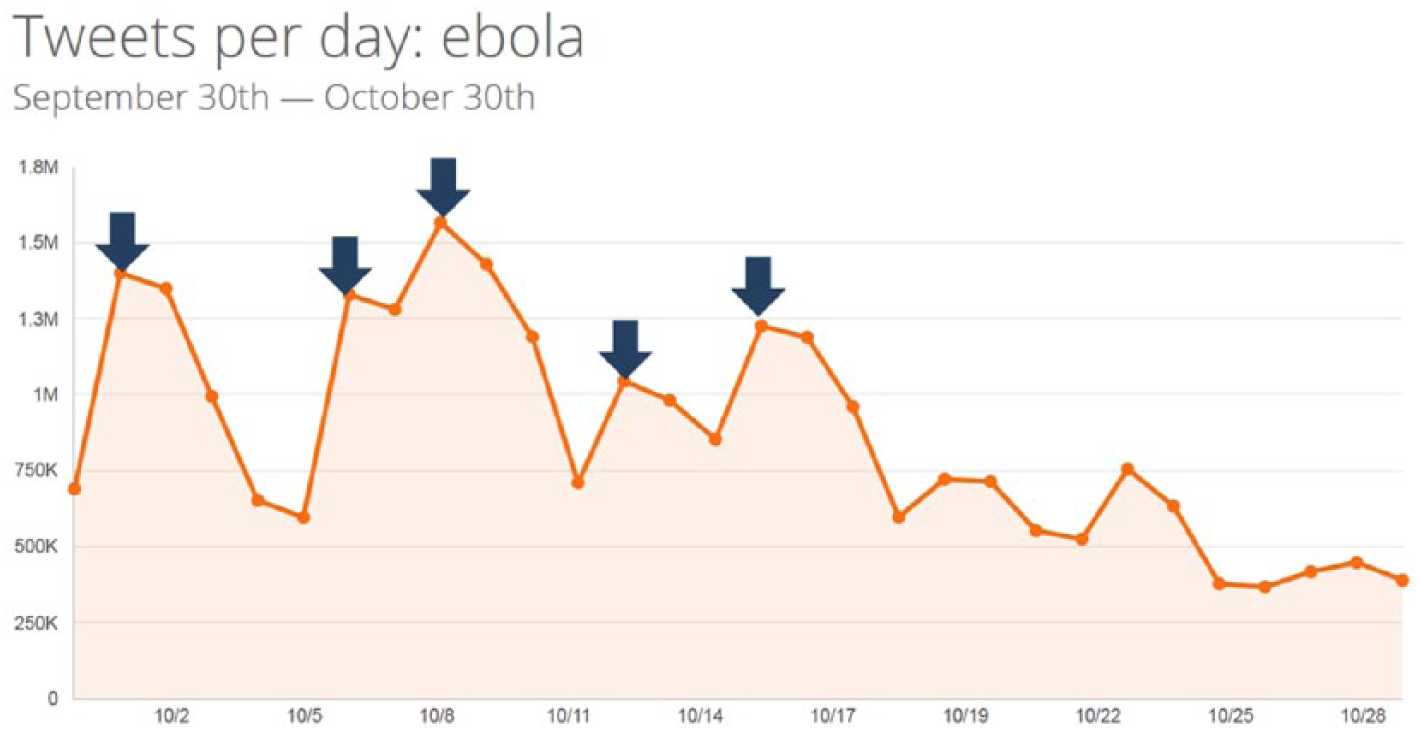
Topsy Ebola statistics trends from 30 September to 29 October.
Top influencers and sentiment
The top influencers relating to Tweets for the EboV were the major news networks. In no particular order, they were Yahoo News, ABC News, The New York Times, Time.com, and CNN Topsy Ebola Stats. The Topsy sentiment score for Tweets on Ebola was 35, which means the majority of the Tweets had a negative sentiment (see Figure 2).
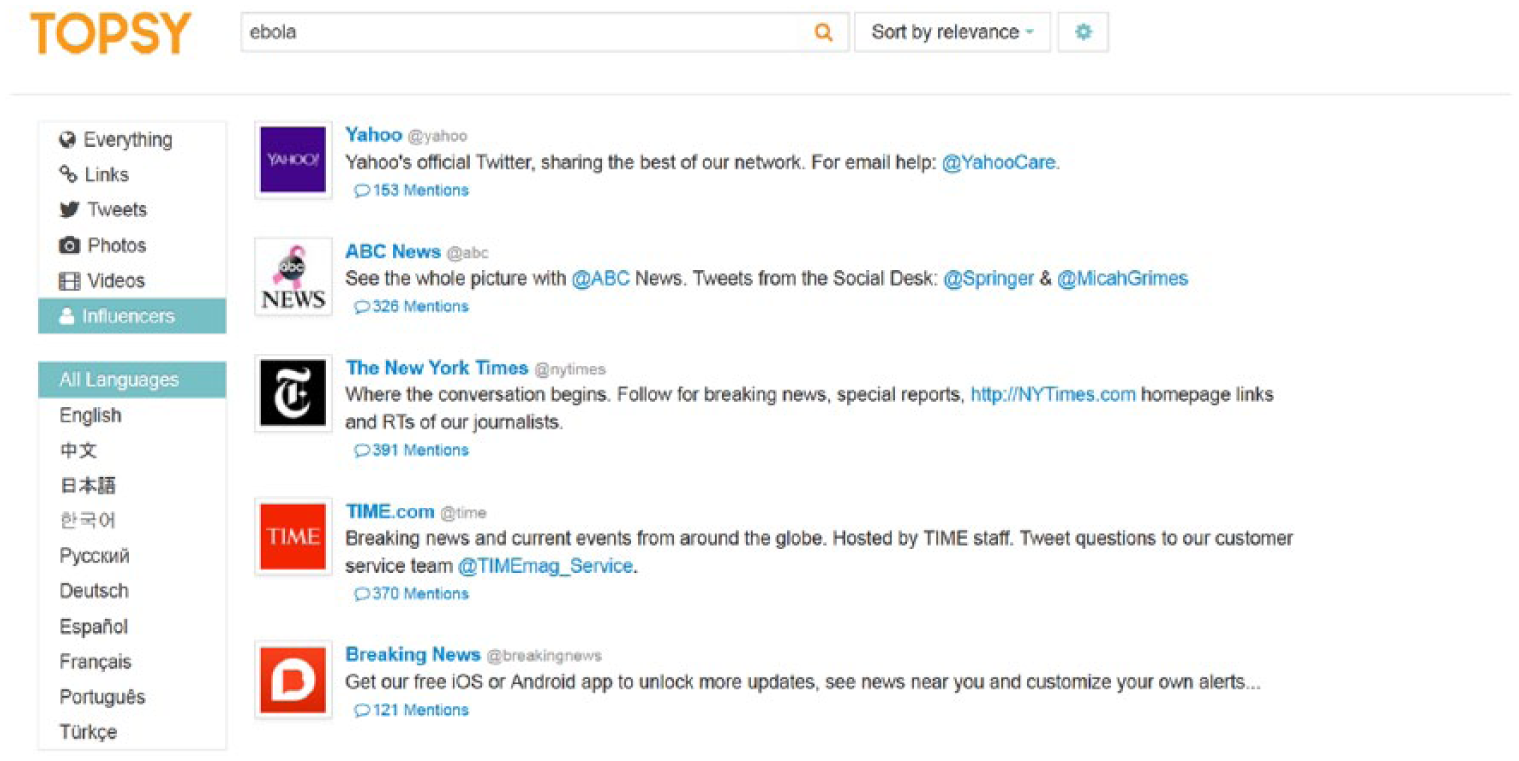
Topsy top influencers for Ebola tweets.
Google Trends
Interest over time
As shown in Figure 3, 16 October has the highest index score of 100, when compared to other days during the 30 September to 29 October period. On this particular day, President Obama issued a press release calling upon the National Guard reserves to help in containing the Ebola virus. The date October 10, 2014 conquered a high index score of 86. There were multiple major headlines on that day, one of which TIME magazine reports about the Hazmat crew that boarded a plane after a man exclaimed he may be infected with the deadly EboV. However, the interest overtime for Ebola decreased between 20 and 29 October, and it reached its peak on October 16, 2014 (Figure 4).
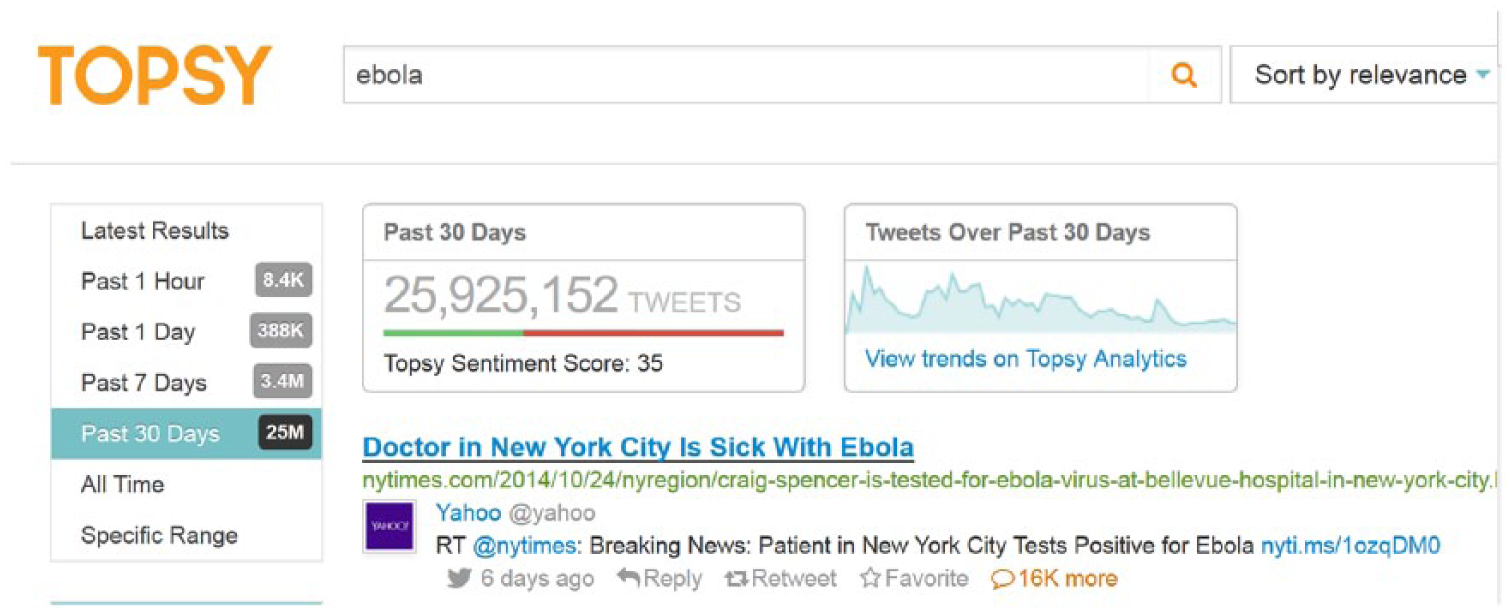
Topsy Ebola statistics.
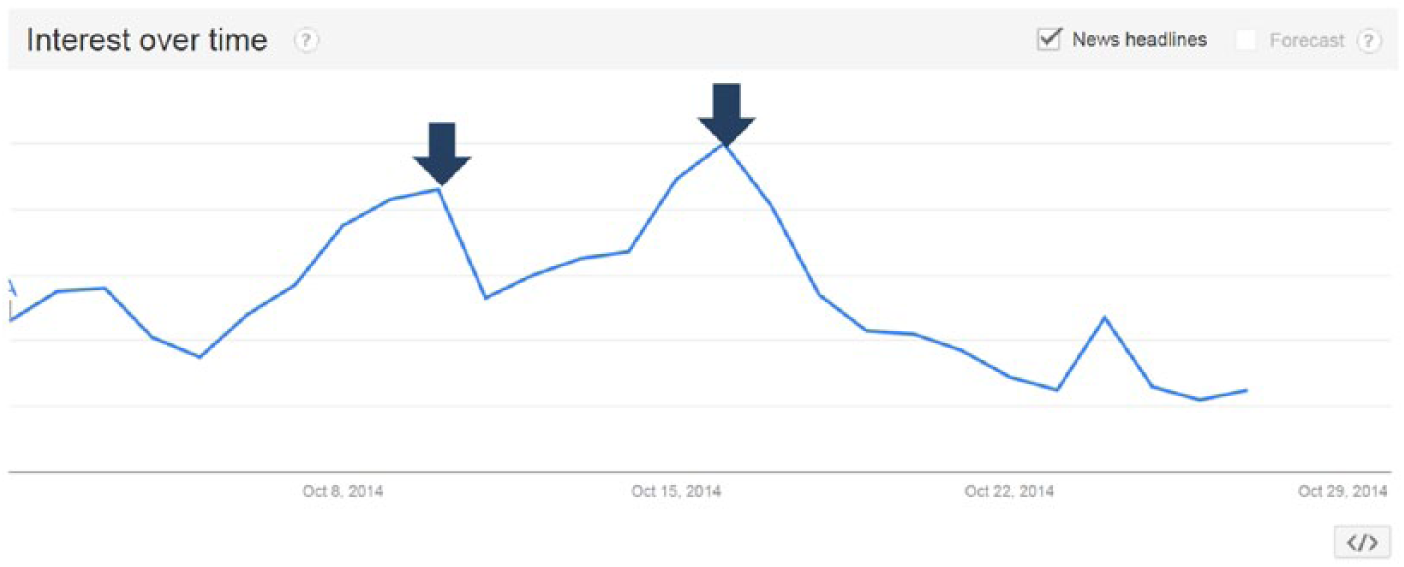
Google news trends for Ebola.
Regional interest
Between September 30 and October 29, 2014, the highest regional interest for Ebov was in Liberia (100), Sierra Leone (67), Jamaica (57), Belize (49), Guyana (43), Guinea (41), and Trinidad and Tobago (37). These were the countries that were most affected by the EboV.
With regards to regional cities, around the world with greatest interests were all based in the United States with the exception of Madrid, Spain: Dallas (100), Goldsby (85), Richardson (84), New York (66), Washington (64), Madrid (63), and Houston (63).
Top searches for Ebola
The top searches or queries for Ebola news through the Internet were as follows: EboV (100), Ebola symptoms (55), Ebola outbreak (30), Ebola U.S. (15), News Ebola (15), and symptoms of Ebola (15). Furthermore, some of the highest rated Ebola topics searched were: virus-type of infectious again (15), Outbreak—1995 Film (5), and United States of America—Country.
Discussion
Using two web-based tools, http://www.topsy.com and http://www.google.com/trends, the researcher was able to produce a rapid analysis of social media and electronic news media outlets on the term “Ebola” with over 500 million registered users from around the world. Although the majority of the Tweets were from the United States, there was a large presence of electronic news media stemming from other countries such as Liberia and Sierra Leone, which were dramatically affected by the EboV. The daily global discussions on EboV were not homogenous in content or volume during the period of 30 September till 29 October and there were visible peaks in activity relating to the term Ebola. On 16 October, both Google Trends and Topsy recorded the highest number of activities where President Obama authorized the call-up of National Guard reserves to help contain the Ebola virus. This stimulated a large amount of discussion through social media and electronic news media. This also shows that there is correlation between electronic news media outlets and social media discussions where the process of sharing news spurs large spikes in Twitter discussion. Evidence from the analysis may justify this assertion as the main influencers of the Twitter discussion on Ebola were not individual Twitter accounts, but news organizations such as Yahoo News, ABC News, The New York Times, and Time.com. In a related research study, Kwon et al. 9 discuss the impacts of electronic news media on Twitter discussions where the authors reveal that news articles can impact social media discussions.
In both Google Trends and Topsy, all the activity peaks reached maximal activity within the first 24 h and would decline. There was no evidence of sustained level of activity for more than 24 h. Therefore, although the Twitter messages and electronic media sources spread rapidly in response to a news event, they do not continue a sustained level of discussions subsequent to a 24-h period. Dyar et al. 10 found similar results in their study on the analysis of the word antibiotics through Twitter. Similarly, Kairam et al. studied social media trending events where the authors note that, in general, all social media trending activity, for both information seeking and sharing activities, lasts for 4.3 h on average. Furthermore, the authors note that there is a lag, at times, of several hours between peak content production and peak search activity, meaning that it takes time for social media tools to index content causing delays for users in finding relevant information. 11 This highlights the need for concerted efforts from healthcare organizations to plan for possible social media information dissemination delays in relaying information to others at times of distress or emergency.
While the Ebola events primarily have impacted people living in West African countries, the Twitter and electronic news outlets have focused more on the possible threat of Ebola reaching the United States. The top tweets during the study period were not related to Ebola awareness and educational campaigns, but rather focused on the events that were occurring in the United States, and in particular, the city of Dallas. Although the discussions through Twitter and electronic news outlets focused on US events, people were still searching the news for the EboV and EboV symptoms.
Although the interest around Ebola seemed to subside during the last week (23 October till 29 October), there appears to be a general receptiveness to sharing and receiving information through Twitter and electronic media outlets relating to EboV. Healthcare organizations should take advantage of the relationship between electronic news media and trending events on social media sites such as Twitter. Healthcare organizations need to develop social media campaigns in co-operation with leading electronic news media outlets (e.g. CNN, Yahoo, Reuters) that can have an influence on social media feeds. Robinson et al. 12 systematically reviewed the use of social media and other mass media relating to health awareness campaigns coupled with product distribution to improve healthy behaviors. The authors found that the use of a variety of media for health communication campaigns coupled with reduced-price health-related products can have a positive impact on promoting healthy behaviors. Other social media campaigns have focused on cancer awareness, chronic kidney disease, outbreak investigations, smoking, immunization, and obesity,13–17 and understanding the role of social media in healthcare.18–23
As far as this researcher is aware, this is the first study that attempts to characterize the events and occurrences of Ebola Twitter discussions and electronic news media output. Our study has several limitations. First, by focusing on Ebola as the only search term, we have underreported the number of Tweets and electronic news media output related to Ebola, as others may have used other search terms such as “EboV.” We used Ebola as a general term to capture the information used in the study because it was a general term that is used by the general public. Second, our search was limited to the English language, which limited the amount of tweets and electronic news media sources included in the study. Third, our study only used Twitter data as part of the analysis excluding other popular social media platforms such as Facebook. Care is needed when trying to generalize the findings of this work to other social media platforms and populations.
Conclusion
Social media and electronic news outlets have been communicating vast amount information about EboV. People worldwide and in a variety of languages are reading online newspapers and social media feeds on Ebola. Electronic news media reports have influenced the number of social media discussions that occur. Activity increases in both social media and electronic news media sources are global, but for Ebola, they have primarily focused on the United States. There is a need for healthcare organizations and policy makers to understand the relationship between electronic news media sources and social media activity. The study showed that there is a relationship between electronic news and social media, but this study did not explore the nuanced details of this relationship. More evidence is still needed to understand the impact of electronic news media on social media activity to determine the optimal strategy for health communication interventions, especially, with the rise of a possible epidemic. Furthermore, there is a need to develop more tools to be used by researchers, healthcare organizations, and policy makers to further our understanding of online social media activity and how it can impact health communication with a global audience.
Footnotes
Declaration of conflicting interests
The author(s) declared no potential conflicts of interest with respect to the research, authorship, and/or publication of this article.
Funding
The author(s) received no financial support for the research, authorship, and/or publication of this article.