




Abstract
Interventions aiming to help ethnically diverse emerging adults engage in healthy eating have had limited success. The aim of this study was to assess the feasibility of and adherence to an intervention capitalizing on mobile technology to improve healthy eating. Participants created an online photo food journal and received motivational text messages three times a day. Satisfaction with the intervention was assessed, as were control variables including depression and body dissatisfaction. In addition, weight and height were measured. Levels of adherence to the photo food journal were high with approximately two photos posted a day at baseline. However, adherence rates decreased over the course of the study. Body dissatisfaction positively predicted adherence, while body mass index negatively predicted study satisfaction. Mobile technology provides innovative avenues for healthy eating interventions. Such interventions appear acceptable and feasible for a short period; however, more work is required to evaluate their viability regarding long-term engagement.
Background
Late adolescence and emerging adulthood have been identified as critical periods for weight gain, accompanied by rising rates of obesity.1–3 Accumulating evidence points to the college years, in particular, as a period of risk for weight gain, leading to high rates of overweight and obesity among college students.3–5 Furthermore, ethnic minority college women appear to be particularly vulnerable.6,7 Poor nutrition is believed to contribute to weight gain during college years6,8–12 Although a number of obesity prevention and healthy eating programs have been developed and evaluated,13,14 only a small number have been developed specifically for college students15–17 and even fewer have specifically targeted ethnic minority college women. 18 This lack of programs targeting minority women college students is particularly alarming given that weight gain in college is likely to be sustained into adulthood.6,19
Mobile phones, ubiquitous on college campuses, provide novel opportunities for promoting healthy lifestyles. While studies have demonstrated the efficacy of using technology for obesity prevention, primarily in the form of internet-based programs, 20 smartphone applications (apps) may also be useful in weight management. 21 Emerging evidence suggests that app-based interventions are feasible and have high rates of compliance.22,23 Furthermore, the use of technology increases adherence to dietary self-monitoring. 24
Although numerous fitness, health, and nutrition apps exist, few evaluations of these applications have been conducted. A recent review of weight loss apps revealed that many smartphone apps have insufficient evidence-informed content.22,25 That said, food diaries were the most frequent evidence-informed feature present, with 43 percent of apps including this function, highlighting the importance of self-monitoring. 25 The lack of long term examinations of the efficacy of technology-based interventions has also been documented. 26
One of the most important strategies for behavior change is participant self-monitoring; 25 however, traditional paper-and-pencil food diaries present low adherence due to the time-consuming nature of completing them in real-time, furthermore, they are vulnerable to recall bias.27,28 Mobile technology may help to decrease these barriers by making it easier to transport records, record food intake, and remember to log entries. Consistent with this, participants using mobile technology for self-monitoring have displayed greater adherence,27,28 greater satisfaction, 28 and lower drop out rates, 28 when using mobile technology for self-monitoring than when using other methods. The use of digital photography for self-monitoring has also received some interest, and initial data suggest that this method is acceptable and accurate among adolescents and young adults.29–31 Furthermore, photographs have advantages in terms of accuracy regarding content but also portion size estimation.32,33
As an additional advantage, some research has suggested that mobile phones may offer opportunities to enhance self-monitoring and goal adherence by using reminder text messaging.34,35 Consistent with this, studies have shown that text messaging is successful in helping participants lose weight, 26 improving adherence to weight loss programs, 36 and increasing the efficacy of existing weight loss programs. 35 Despite the existence of online nutrition interventions for college students 16 and the high potential for mobile intervention among this group, to date, mobile phone resources to support healthy eating among college students are lacking.
A number of psychological variables may influence adherence and satisfaction with healthy eating interventions, including depression and body dissatisfaction.16,37,38 Furthermore, adolescents with higher weights may also be particularly motivated to engage in self-monitoring of food intake. 39 Thus, in studies based upon photo food journals, participants with higher weight and associated body dissatisfaction might display higher satisfaction and engagement with the program.
The aim of this pilot study was therefore to explore the acceptability and feasibility of using mobile technology as a self-monitoring intervention tool to assist ethnic minority college women to engage in healthy eating. Specifically, we assessed satisfaction with this intervention using quantitative and qualitative methods. In addition, we explored whether factors such as study satisfaction and baseline participant characteristics influenced adherence.
Methods
Participants
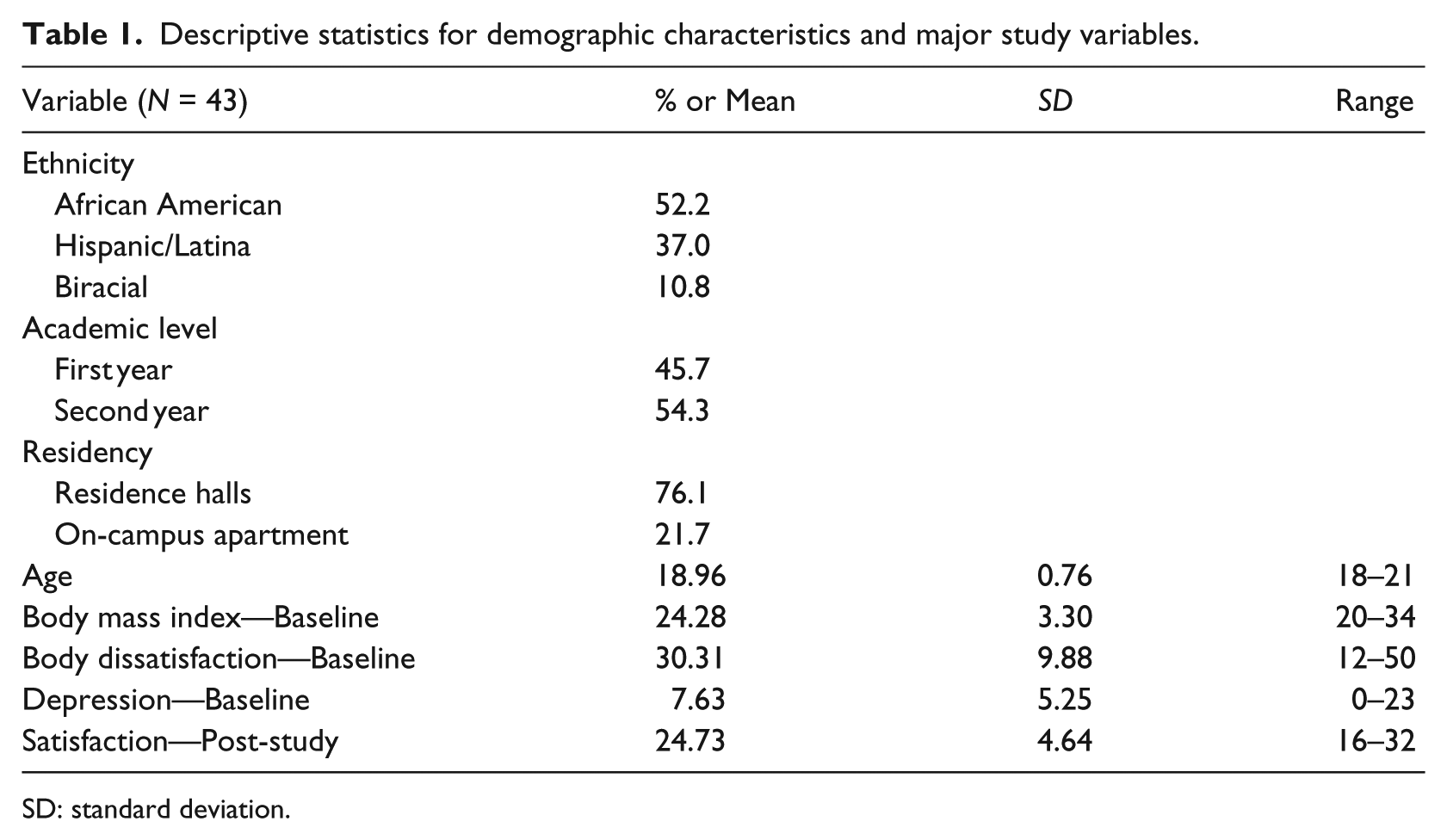
This study recruited female undergraduate Latina/Hispanic and African American students via advertisements posted around an urban northeastern college campus during a 4-week period. Initially, 46 students responded to the advertisements and the final sample consisted of 43 eligible participants. In order to participate in the study, participants were required to own a phone with camera and Internet access. The female participants self-identified as African American (52.2%), Hispanic/Latina (37%), or biracial (10.8%) and were either first-year (45.7%) or second-year (54.3%) students. The mean age of the participants was 18.9 years (standard deviation (SD) = 0.76) with the majority of students living in residence halls on campus (76.1%) or in on-campus apartments (21.7%). Only one participant reported living off campus in an apartment.
Measures
Participants were asked to provide basic demographic information such as age, race, and marital status. In addition, they were weighed and measured to calculate body mass index (BMI).
At baseline, before starting the intervention, participants completed the Beck Depression Inventory (BDI 40 ), a widely used 21-item self-report measure of the affective, cognitive, and behavioral manifestations of depression. Research indicates high internal consistency for the BDI with psychiatric and non-psychiatric populations, with Cronbach alpha coefficients of .86 and .81, respectively. 41 In our sample, α = .81. Participants also completed the body dissatisfaction subscale Eating Disorder Inventory-2 (EDI 42 ), a widely utilized multi-scale measure designed to assess psychological and behavioral traits common in disordered eating and eating disorders. Test–retest reliability of the EDI body dissatisfaction subscales has been reported to be good, 43 and it has been shown to be strongly correlated with disordered eating pathology. 44 In our sample, α = .89.
At 10 weeks after the baseline assessment, participants completed an online questionnaire on program satisfaction. Nine questions were developed to gather feedback from participants following the completion of the study regarding their satisfaction with the experience. The nine questions included evaluations of the user friendliness of the photo-sharing website used to house the photo food journal (Photobucket), difficulty of remembering to upload meal pictures, the usefulness and attractiveness of Photobucket, the helpfulness and acceptability of the text messages, and the extent to which Photobucket, the text messages, and the overall study helped the participants pursue their health goals. A total score was calculated to provide an overall index of satisfaction (negatively worded items were reversed), with a potential range from 5 to 49. In addition, participants were invited to provide additional comments on their satisfaction with the study.
Procedure
At baseline, participants chose two nutrition goals to work toward over the course of the 3-week study from a list of 10 options that included the following: (1) eat green veggies every day, (2) include salad in my meal, (3) have a banana every morning, (4) eat one piece of fruit with every meal, (5) take a daily vitamin, (6) bring homemade lunch to school, (7) eat a healthy breakfast every day, (8) have a healthy snack like nuts or fruit, (9) choose whole grain breads and low-fat milk every day, and (10) have a soda-free day. Following the baseline assessment, participants engaged in two activities over the course of the following 3 weeks: (1) self-monitoring by taking photographs of each meal with their phone, and then uploading their photographs using the online platform “Photobucket” and (2) receiving three text messages per day from the investigators at mealtimes encouraging attention to the healthy eating goals set by the participant.
Food journal
Participants self-monitored by taking photographs at each meal. They then used the online photo-sharing platform “Photobucket” (http://beta.photobucket.com) to upload pictures to the private photo blog, either by logging onto the website or from the mobile application. The participants’ Photobucket accounts were created specifically for this study and only shared with the research staff. Participants were asked to choose a private setting and set up a password to protect their photos.
Text messages
Over the 3-week study period, text messages were sent to all participants three times a day around general mealtimes (9:00 am, 12:00 pm, 4:00 pm) prompting participants to be mindful of their identified personal nutritional goals. Examples of such text messages include the following: “Remember to make healthy choices,” “Include a fruit or vegetable with every meal,” “Think about drinking water instead of soda,” “Limit fried foods,” and “Try to include protein at each meal.” While these messages aimed to serve as general reminders for participants, they were not specifically tailored to each participant’s selected nutritional goal. Participants were not required to answer the text messages they received.
All participants were compensated with a US$100 Visa gift card upon study completion. Institutional Review Board approval for this project was obtained from Northeastern University. All participants provided written informed consent.
Data analysis
We first investigated the overall end-of-the-study satisfaction and predictors of satisfaction. The overall satisfaction score was computed as the sum of the nine satisfaction questions. A general linear model was used to regress the overall study satisfaction on indicators of adherence (expressed as the total number of adherent days and the total number of posted pictures), year in the university, baseline body dissatisfaction, depression scores, and BMI.
The second research question aimed to describe adherence to picture posting and factors related to adherence. Our intervention included two active components: receiving daily text messages and creating a photo food journal as a self-monitoring tool. As all participants received, and were not required to respond to the text messages, there was no variability associated with the text messages. Thus, the extent to which participants engaged in creating the food photo journal was used as a measure of adherence. Adherence was conceptualized in two ways: as a dichotomous indicator of daily picture posting (yes/no) and as the total number of photos posted. Rates of adherence were examined both cross-sectionally and longitudinally. First, we modeled daily adherence, with the total number of adherent days regressed on major study predictors (study satisfaction, year in the university, baseline body dissatisfaction, depression scores, and body mass index) in the framework of general linear modeling. Furthermore, we examined changes in daily adherence over time, while controlling for study covariates (depression, body dissatisfaction). A generalized multilevel model with a logit link function was used to account for the binary scale of the outcome (yes/no) and the nested data structure (days within individuals). Time was centered at baseline and measured on a scale from 0 (day 1) to 20 (last day). Both linear and non-linear (i.e. quadratic) effects were examined. Dummy indicators were created to test for the effect of days (with Monday as a reference category) and weekdays versus weekends. Second, a similar set of analyses was carried out for the total number of photos posted per person (a general linear model) and the daily number of posts per person (multilevel model with a Poisson link function). As this was a pilot trial, for all analyses, the alpha level was set at 0.05, but results significant at the 0.1 level were also considered. 45 Analyses were performed using R software 46
Results
Descriptives
Descriptive data for major study variables are summarized in Table 1. The mean age of the participants in the study was 18.9 (SD = .76) and mean BMI = 24.3 (SD = 3.30), ranging from 20 to 34.
Descriptive statistics for demographic characteristics and major study variables.
SD: standard deviation.
Satisfaction
Of the entire sample, 40.6 percent found the photo-sharing website very helpful or extremely helpful for self-monitoring and 60.9 percent liked using Photobucket to track their meals (Yes/No). Approximately one-third (33.4%) found it at least somewhat easy to remember to take pictures, 11.9 percent were neutral, and 54.8 percent found it at least somewhat difficult. With regard to the Photobucket program, only 14.3 percent found Photobucket difficult or somewhat difficult to use. With regard to the text messaging, 52.3 percent found the text messages helpful as a reminder of their health goals and 82.9 percent liked the text message reminders. Finally, 42.9 percent thought that Photobucket overall helped them work toward their nutrition goals (Yes/No); 66.7 percent thought that overall the text messages helped them work toward their nutrition goals (Yes/No); and 76.1 percent thought that the study at least somewhat helped them feel motivated about cultivating healthier eating habits.
For the total satisfaction score, the average score was 24.49 (SD = 4.63, min = 16, max = 32). Results of the linear model demonstrated that only BMI differentiated between levels of satisfaction (p = .028), such that for every point increase in BMI satisfaction scores would decrease by half of a point (β = −.5, standard error (SE) = .22).
In the qualitative feedback, several of the participants commented on the helpfulness of Photobucket as a visual assessment of their overall nutrition. However, participants also noted that reminders to upload photos (in addition to those reminding to pursue nutrition goals) would have been helpful, as well as personalizing the reminders to coincide with individual mealtimes. Some participants also suggested the use of more popular social media photo-sharing applications such as Instagram.
Adherence
Across all study participants, 16 individuals (37.2%) demonstrated a perfect daily adherence to picture posting at least once a day for the entire study period of 3 weeks. An additional 21 (48.8%) provided daily posts over the course of at least 2 weeks, and six (14%) provided less than 2 weeks of daily posts. Daily average adherence for the sample was 17.5 days out of 21 days (median = 19, SD = 5.4, min = 1, max = 21). Based on the results of logistic multilevel modeling, the of daily adherence declined in a linear fashion (p < .001). At baseline, adherence was about 100 percent, and with every additional study day, the chance of non-adherence increased by 10 percent. None of the baseline predictors of adherence found to be significant.
In addition, a total of 1722 photo records were collected across the 43 study participants. On average, every participant provided 40.05 (SD = 20.92; min = 1; max = 84) photos across the 21 study days. Based on the results of general linear model, none of the background covariates differentiated between the total number of posted photos per person.
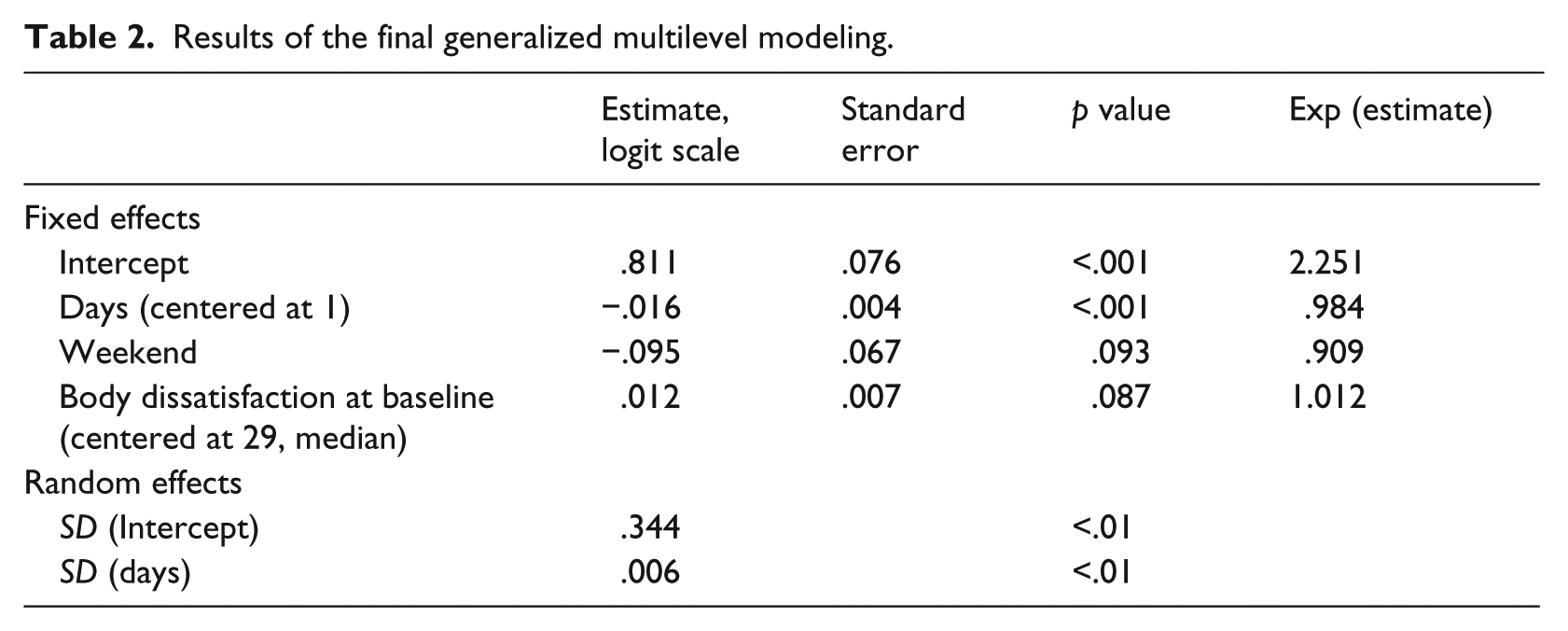
Overall, there was a downward linear trend in daily posting rates, supported by the results of the generalized multilevel model (p < .001, Table 2). Controlling for body dissatisfaction scores and indicators of weekends, at baseline participants posted on average slightly over two pictures per day. Each additional study day resulted in a 2 percent decrease in posting rates. No differences were found between each day of the week; however, overall, on weekends, participants tended to post fewer photos (p = .093), associated with a 10 percent rate reduction. Finally, those with higher baseline body dissatisfaction tended to be more adherent than those with lower body dissatisfaction scores (p = .087). Every point increase in body dissatisfaction was associated with an improvement of 1 percent in posting rates.
Results of the final generalized multilevel modeling.
Discussion
The aim of this study was to examine the adherence, acceptability, and feasibility of using mobile technology to assist ethnic minority college women to engage in healthy eating. The intervention relied on publicly available technology ensuring it was low-cost and provided a model that participants could replicate and continue to use. Overall, our findings suggested that mobile technology is an acceptable and feasible way of delivering healthy eating interventions among this population. However, the findings also highlighted that, even under conditions in which the self-monitoring was being overseen by researchers who had access to the food photo journals, adherence decreased over the short 3-week span of the intervention. One of the challenges in designing mobile interventions therefore resides in developing the capacity to sustain engagement over a period of weeks.
Feasibility was examined in multiple ways through using daily metrics of adherence with a binary indicator of adherence to the photo-posting protocol and a count indicator of the total number of posted pictures per day. In addition, we computed overall person-level summaries of adherence for both measures. These methods present advantages and disadvantages in the context of our study, so we chose to consider them concurrently. Adherence to the intervention was broadly conceptualized as posting food pictures as requested. However, as participants were not required to eat a certain number of times a day but rather to document their typical eating, we could not establish an expected number of posts per day. We therefore first chose to capture a global dichotomous metric of daily adherence as it was anticipated that all participants would eat at least once a day. We also imagined that most participants would eat more than once a day, and the daily count of photo posts reflected the second component of adherence.
Both indicators revealed that adherence was good for the study overall. Over 1700 photos were collected during the course of the study, approximately two a day from each participant, indicating that this was a feasible and acceptable way to track eating behaviors. This number did fall a little below what one might expect in the hypothetical case of three meals a day, even given the disorganization which can characterize student-eating patterns. 47 Nevertheless, using the dichotomous indicator of adherence, we found that adherence declined over the course of the study with every additional study day increasing the chance of non-adherence by 10 percent. Furthermore, none of our baseline indicators were associated with variations in this decline. Using the total number of pictures posted as a count measure of adherence, we also found an overall decrease over the course of the study. Similar trends have been found in studies requiring participants to document their food and drink during the day. 48 Mattila et al. 48 hypothesized that decreases over the course of their study might be due to improvements in participant’s self-regulation, leading to the perception that they no longer needed to adhere to their record. While this is a potential explanation for the current findings, it is also possible that participants progressively disengaged over the course of 3 weeks once the novelty had worn off. Ways of preventing this decline might include providing personalized feedback and reinforcement for engaging in the self-monitoring. Another possibility might be to develop gaming aspects within interventions allowing participants to accrue points or rewards for sustained adherence. Future studies should explore the use of incentives as a means of maintaining adherence.
The total number of pictures posted, as a continuous measure of adherence, revealed that participants reporting high levels of initial body dissatisfaction posted more photos overall throughout the study. Consistent with previous findings, 49 among our participants, body dissatisfaction was positively associated with weight, and it may be that this association reflects the higher motivation of heavier participants to engage with the study. Body dissatisfaction has also been associated with preoccupations around food; 50 therefore, greater numbers of photos posted within the intervention may also reflect this preoccupation. The findings suggest that these types of interventions are particularly engaging for individuals with high levels of body dissatisfaction; however, it is also possible that reinforcement of food preoccupations through self-monitoring in this way might lead to heightened eating concerns among this group and promote disordered eating patterns. It will be important to ensure that interventions encouraging self-monitoring among individuals with high levels of body dissatisfaction do not exacerbate eating concerns. Nevertheless, it is also of note that the effect size for this finding was small, indicating that overall participants in the study engaged rather well with the intervention.
Our findings indicated high levels of satisfaction among the study participants, with the text messaging component receiving somewhat more positive ratings compared to the self-monitoring component. Using photos as a means of self-monitoring dietary intake has previously been found to be preferred to a written journal, as aspects such as portion size or color diversity can be more easily perceived. 51 However, such methods do require participants to remember to document their eating in the moment rather than having the possibility of recording retrospectively, which may place a greater burden on individuals; nevertheless, real-time monitoring is likely to be more accurate than recall. Text messaging, in contrast, is an intervention component that does not require any effort of the part of the participant, which may account for the high levels of satisfaction. Previous studies have highlighted the usefulness of text messaging for promoting health behaviors.34,35 As a low-cost tool, text messaging is therefore emerging as a key component for mobile interventions promoting healthy behaviors.
Based on the findings of our study, we have tentatively formulated a few recommendations regarding the design of interventions seeking to capitalize on mobile technology to promote healthy eating. First, it seems that text messages, even at the frequency of three times a day, are acceptable to participants. Furthermore, participants expressed that they would welcome specific messages reminding them to complete their self-monitoring tasks. Second, while Photobucket was a freely available phone application, participants suggested that they would have preferred using a more familiar mainstream application with similar functionalities. Third, when possible, it might be helpful to either define study expectations more narrowly (in terms of number of entries in the photo food journal, for example) or to obtain an additional measure of behavior so as to compare the number of entries to the number of behavior occurrences (in our study, meals eaten but not posted). Finally, it could be useful to evaluate a commercially available food photo journal phone application in a future study, so as to increase the ecological validity of results and guide the development of evidence-based tools, as participants might be more likely to choose such an application for their personal use.
Our study has a number of limitations. First, the intervention was of relatively short duration, and 3 weeks may not be a sufficient period of time within which to develop new habits and behaviors. Therefore, it would be important to examine whether adherence would have continued to drop beyond the 3-week period. Second, in our study, all participants received the same text messages regardless of their personalized goals. More personalized intervention content and/or feedback may help improve intervention adherence. Finally, we only recruited participants possessing a phone with Internet access which may have biased the sample. Other authors have commented on the “digital divide” and how there is an increasing gap between individuals who possess access to and the skills to use the Internet and social media, and those who do not. 52 Given that this divide is associated with socioeconomic factors, which are related to lower mental health literacy and treatment access, such a divide might increase disparities in terms of health.51,53 Future studies should keep this divide in mind and consider how to minimize these inequalities.
Conclusion
Our findings suggest that interventions capitalizing on mobile technology through the use of text messaging and photo journals for self-monitoring are acceptable and feasible among emerging adults, which supports the development and further evaluation of commercially available tools. Additional research is warranted to determine how to increase adherence over longer time periods and to determine how the presence of personalized or interactive features might enhance intervention designs.
Footnotes
Declaration of conflicting interests
The author(s) declared no potential conflicts of interest with respect to the research, authorship, and/or publication of this article.
Funding
The author(s) disclosed receipt of the following financial support for the research, authorship, and/or publication of this article: This study was funded by a grant from the Provost Office at Northeastern University.