



Abstract
Background
Smart lighters track cigarette smoking episodes, which can help identify smoking patterns and intervention approaches to promote cessation. We gauged the acceptability of smart lighters among individuals with low socioeconomic status (SES), a target population for a newly developed smoking cessation mobile intervention, to evaluate their potential use during the intervention pre-quit period.
Methods
Twelve virtual focus group discussions were conducted with 38 current cigarette smokers, 18–29 years old, who were not 4-year college-educated nor enrolled in a 4-year college as an SES indicator. Focus groups were audio recorded, transcribed, and analyzed using a deductive thematic approach. Themes captured sentiment (i.e., negative, neutral, positive) and constructs from the Second Unified Theory of Acceptance and Use of Technology (i.e., effort expectancy, facilitating conditions, hedonic motivation, performance expectancy, social influence).
Results
Sentiment toward smart lighters was positive (54.36%). Prominent themes relevant to acceptance of smart lighters were facilitating conditions (33.98%), performance expectancy (29.12%), and effort expectancy (16.50%). Concerns about privacy, lack of awareness of smart lighters, and their unaffordability were the primary facilitating conditions discussed. Smart lighters were considered easy to use and useful cessation aids because they minimize user burden in tracking smoking behavior. Skepticism about their usefulness centered on the possibility of inadvertently triggering cravings and subsequent smoking.
Conclusions
Ensuring the affordability, awareness, and usability of smart lighters can increase their acceptability. Use of smart lighters in cessation interventions can provide insights into smoking patterns with minimal user burden. Consideration must be given to their potential unintended effects as cueing smoking.
Background
Self-monitoring is a recommended behavioral change technique to promote smoking cessation. 1 Tracking smoking episodes can be beneficial in identifying smoking patterns and delivering cessation interventions, especially as variation in individual smoking patterns can result in differing risks for relapse. For example, one study found that people who smoked heavily in the morning and evening had a higher risk of lapsing compared to those who smoked primarily in the morning. 2 Smoking patterns also carry implications for the delivery of personalized cessation support. 3
Smart lighters are lightweight devices that collect timestamped records of smoking episodes, thus enabling the determination of smoking patterns over time. They can minimize user input associated with self-reporting of smoking, which can be burdensome and subject to errors (e.g., digit bias).4,5 Furthermore, these devices can be used to facilitate a gradual reduction of the number of cigarettes smoked, which is relevant given some evidence that has shown benefits of smoking reduction for health or as a cessation strategy.6–11 For example, Slighter, a commercial platform for smoking cessation, employs a smart lighter and a companion mobile app that learns its users’ smoking patterns and then develops a reduction plan that helps them reach predefined goals. 12 Smart lighters have been found to be feasible for tracking cigarette smoking in real-life settings.13–17 For example, a study examining a smart lighter that recorded timestamps of cigarette lighting alongside a wrist sensor that measured hand-mouth gestures found the lighter helped improve the accurate identification of smoking episodes. 14
Acceptability is an important determinant of intentions to use new technologies.18,19 To the best of our knowledge, only one study has qualitatively examined users’ acceptance of a smart lighter, in which most users had positive perceptions. 13 No prior work has explored perceptions of socioeconomically disadvantaged populations on the use of smart lighters to promote cessation, despite them having increased smoking prevalence.20,21 This study aimed to characterize perceptions of individuals with low socioeconomic status (SES) who smoke toward a commercial smart lighter proposed for use in a smoking cessation study to track participants’ smoking episodes during a 2-week pre-quit period.
Methods
This is a qualitative study where we employed focus group discussions to elicit users’ perceptions of a smart lighter following a theory-informed moderation guide.
Ethical approval
The study was deemed exempt by the National Institutes of Health Institutional Review Board on October 11, 2019. The study was deemed exempt by ICF's Institutional Review Board on November 19, 2019 with an amendment approved on February 26, 2020.
Participants
Userworks, Inc. (Silver Spring, MD), a user experience and usability firm, recruited a nationwide convenience sample of 38 young adults who smoke using its research panels and commercial postings (e.g., Craigslist). Potential research participants received email invites and interested participants answered eligibility questions over the phone. Eligibility criteria included being 18–29 years old and not 4-year college-educated nor enrolled in a 4-year college.22–24 We focused on 18- to 29-year-old adults because of the health benefits associated with quitting before the age of 30, including reduced mortality risk.25–27 The use of education as an indicator of SES was based on data showing individuals with high school education (17.1%), General Educational Development (30.7%), or less (20.1%) smoke at higher rates than the national average of 11.5%. 21 Additionally, eligible participants were current cigarette smokers who smoked at least 100 cigarettes in their lifetime and smoked cigarettes every day or some days, wanted to quit within 6 months, did not use any smoking cessation aids or non-cigarette combustible tobacco products, were smartphone owners, and spoke English. Data saturation did not influence recruitment, and participants were compensated with $150 gift cards. No participants withdrew from the study. Twelve participants participated in two focus groups.
Procedures
We held 12 semi-structured focus groups virtually on GoTo Meeting that lasted ∼1.5 hours. Discussions gauged participants’ acceptance of Quit Journey, a novel smoking cessation mobile application developed by our team, as part of the preparation phase for the development and optimization of behavioral interventions.28,29 Results on perceptions of Quit Journey can be found elsewhere.30–32
Part of the discussion focused on the use of smart lighters in cessation interventions. We used a commercially available device, called Quitbit, as an example of smart lighters and their functionalities. Briefly, Quitbit is a smart lighter that automatically records a timestamp of each lighting event. To use it, the user must open the cap and hold a button to trigger the heating of the coil, which replaces the flame in traditional lighters. 13 Users can then place their cigarette on the coil to light it. The device displays the user's daily cigarette count and resets that count at midnight. 13
Discussions followed a moderation guide (Supplementary Note 1) informed by the Second Unified Theory of Acceptance and Use of Technology constructs (UTAUT2).18,19 Dry runs were performed prior to the actual focus groups. A male (TG) with expertise in user experience research and focus groups led the discussions, while a female (EL) communications and marketing project director took notes. In addition to TG and EL, a female senior investigator on the project (SEL), listened in on the discussions and was the only other non-participant present. No prior relationships existed between moderators and participants who were aware that the moderators had no affiliation with the research group conducting the study. Each participant verbally consented to taking part in the study. Transcripts for each session were obtained via GoTo Meeting's automated transcription service and were not provided to participants for feedback.
Analysis
We adopted a deductive thematic approach to analyze the data. 33 Themes were developed based on five constructs from UTAUT2 (i.e., effort expectancy, facilitating conditions, hedonic motivation, performance expectancy, social influence)18,19 and sentiment (i.e., negative, neutral, positive). We also coded the content for design concepts and suggestions to improve acceptability of the smart lighter. Theme definitions appear in Table 1. We added new codes if content did not fit predefined ones (e.g., novelty, intent, or willingness to use). We coded the transcripts for all proposed features of Quit Journey, but only presented the results on the smart lighter.

Multi-value coding of quotes was applied across semantic domain, but codes within a semantic domain were mutually exclusive.
Themes not defined a priori and thus no inter-coder agreement was calculated for this exploratory part of the analysis.
Two coders (LT and MW) coded all transcripts using ATLAS.ti qualitative software (version 8, ATLAS.ti Scientific Software Development GmbH). We achieved acceptable intercoder agreement for distinguishing relevant from irrelevant content (Krippendorff’s c-alpha = 0.82). 34 Krippendorff’s cu-alpha values, which indicate semantic domain intercoder agreement, ranged from 0.66 (for technology acceptance) to 0.94 (for Quit Journey features) (Table 1). 34 Participants did not provide feedback on findings. Discrepancies were settled via discussions between LT, MW, and SEL. We followed the 32-item consolidated criteria for reporting qualitative research (COREQ) (Supplementary Table 1). 35
Results
Sample characteristics appear in Table 2 and detailed participant characteristics appear in Supplementary Table 2. The sample was 52.63% females, 57.90% racial and ethnic minorities, 26.31% were high school graduates, and 10.52% had an associate degree.

NH = non-Hispanic.
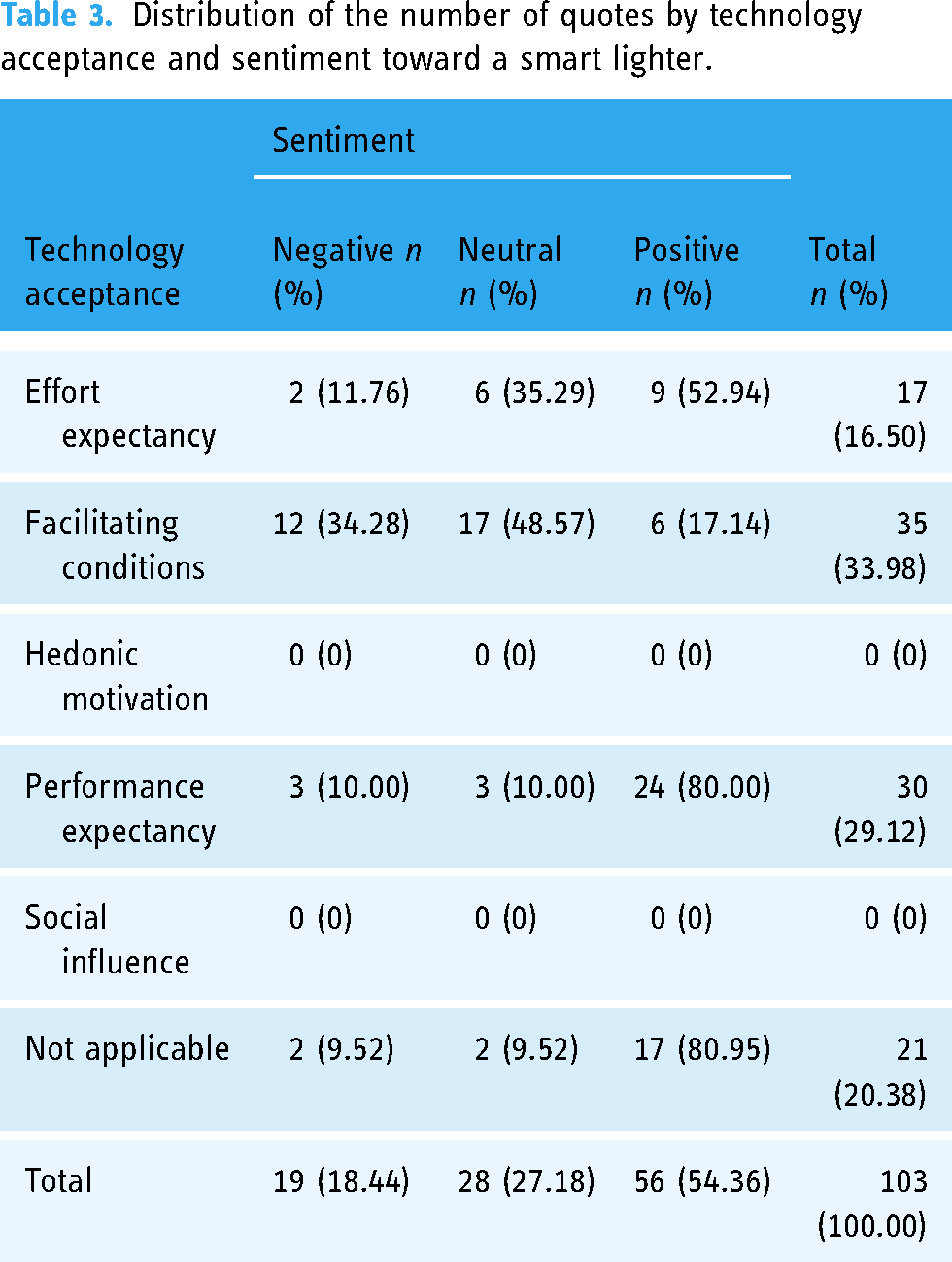
Overall sentiment regarding the use of smart lighters for smoking cessation was positive (54.36%). Salient themes were facilitating conditions (33.98%), followed by performance (29.12%) and effort (16.50%) expectancies (Table 3). Quotes that did not fit under a technology acceptance construct but still conveyed a particular sentiment were coded as “not applicable.” All extracted quotes appear in Supplementary Tables 3 and 4.
Distribution of the number of quotes by technology acceptance and sentiment toward a smart lighter.
Facilitating conditions
This theme overlapped with negative and neutral sentiment. Participants highlighted privacy concerns and distrust over tracking personal information (e.g., location) as reasons that would impede their use of smart lighters. Others were indifferent to privacy concerns because data sharing with mobile apps was commonplace. I wouldn’t be comfortable with [the smart lighter collecting data] … because it's like somebody's tracking you … they know where you at all time … I know you need to know you lit your cigarette, but why do you need to know where you lit your cigarette? (P19) I know a lot of people are worried about privacy, but I do think that apps in general, the smartphones that we all own … we’re already almost there, to the point where your location is being tracked anyway, so I don’t think that [the smart lighter collecting data] would bother me at all. (P14)
I don’t think I would pay a lot of money for [the smart lighter] because … you can go and just get … one lighter at a time and it’s like a dollar. (P11)
I liked the idea of the [smart] lighter, I think it’s … a great idea … I thought it was amazing, it’s just a matter of … how much would something like that be when you’re already spending so much on cigarettes and other things like that, like how much more do you want to spend to stop your addiction. (P08)
Finally, lack of knowledge of the existence of smart lighters emerged as a barrier to their use.
I’ve never even heard of [a smart lighter]. (P22)
Performance expectancy
Smart lighters were perceived as useful for smoking cessation because of their ability to track smoking events with minimal user input and to support cessation by gradually reducing the number of cigarettes smoked. I’m not great with … following through and recording things on my own, so [the smart lighter] would just take … all of the responsibility … on my part out of it … Because maybe I would smoke one and forget to record … if I was to do it myself. (P01) But I do think for people who are tapering and not trying to go cold turkey, it could be helpful just to bring awareness to how much they’re smoking. (P36)
[The smart lighter] is tracking where and when I smoke. So, it’s … working for my benefit, whereas, if I’m just using a regular lighter than I got at a store … it’s not doing anything to help me quit … So, even the act of smoking is … in a way working for me to break habits. I like that a lot, yeah. (P05)
Skepticism about the usefulness of smart lighters was attributed to the fact that, by their very nature, they could be a smoking cue that triggers cravings and subsequent smoking.
My confusion is … wouldn’t that kind of defeat the whole aspect of trying to quit smoking though? Because if you had to use the … lighter to track down your progress, you have to use the lighter to smoke cigarettes, right? So, doesn’t that’s kinda counteract what you’re trying to promote? (P26)
Effort expectancy
The smart lighter was perceived as easy to use. I mean [the smart lighter] looks simple enough if you’re just lighting it up and got the information there when it's used. So, it would be rather simple. (P04)
Suggestions
Few suggestions focused on the design and functionality of the smart lighter. Examples include making smart lighters harder to misplace given their purchasing price and making them capable of tracking the location of smoking episodes in addition to tracking their timing and frequency. I think maybe also if [the smart lighter] had some kind of like location tracking device … So, you … incorporate it into your urges and … the time information too. Maybe also … you have like a find my phone thing if you lose it, maybe you can have … something on there, depending on … how much it costs. Because like if it’s … pricy, it would suck to lose it. (P11)
Discussion
Smart lighters garnered positive sentiment for their use in smoking cessation interventions primarily for facilitating the monitoring of smoking episodes while minimizing user burden. Potential barriers to their use include cost, privacy and data sharing concerns, and unintended effects. Smart lighters are part of a broader array of mobile monitors created for tracking smoking and facilitating cessation (e.g., electronic cigarette pack holders or smart cases, filter-like cigarette trackers, carbon monoxide monitors).37–40 The promise of mobile monitors in revolutionizing smoking cessation efforts is dependent on increasing users’ awareness of their existence and alleviating barriers to their adoption and use, especially among groups with disproportionally high smoking prevalence and adverse health outcomes.
Tracking smoking behavior is a recommended behavioral change technique to promote cessation, 1 and smart lighters can effortlessly substitute regular lighters to facilitate self-monitoring with minimal user burden. Smart lighters can bypass the general tediousness, unenjoyability, and risk of reporting biases associated with traditional self-monitoring.41,42 This is consistent with prior research that shows that self-reporting can lead to underestimation of smoking behavior, 43 and that users desire mHealth technologies (e.g., mobile apps) that require minimal effort. 44 Noteworthy, misrepresentation of smoking behavior using smart lighters can still occur if individuals choose not to use the device for every smoking event or if the lighter is used for other purposes. 13 However, if used consistently, accurate recording of the timing and frequency of smoking events can increase individuals’ awareness of their smoking habits and facilitate timely support in personalized cessation interventions. 45 Furthermore, smart lighters can increase individuals’ motivation to reduce smoking 13 and can facilitate reduction in the number of cigarettes smoked. 12 Despite mixed evidence on the benefits of smoking reduction,6–11 gradual reduction of cigarettes smoked is the second most adopted quitting strategy (43.0% vs. 78.0% for abrupt cessation). 46
Notable concerns emerged about the use of smart lighters for cessation. Consistent with literature on cue reactivity,47,48 participants raised concerns over the smart lighter triggering cravings and encouraging smoking. Indeed, clinical guidelines for treating tobacco use disorder recommend that smokers should avoid smoking-related cues, including lighters, and remove them from their immediate environments. 49 Furthermore, several participants characterized the device as “awesome” or “cool.” While this may have been due to our sample consisting of young adults who are often more accustomed to digital technologies, 50 positive attitudes may subconsciously entice them to continue using the smart lighter to smoke, thus impeding cessation. Indeed, previous literature has found that perceptions relating to “coolness” (e.g., attractiveness, originality) can influence user attitude, intentions to use, and adoption of technological devices.51–53 Another concern involved distrust of location tracking. Notably, literature on privacy concerns associated with mHealth has been mixed.54,55 The privacy-personalization paradox highlights the ongoing complex debate on how to balance maintaining privacy while collecting data that allows for personalized services and programs. 56 With the increased reliance on mobile technologies, giving users complete control over the level of tracking and data sharing is important to maintain their trust.
Among socioeconomically disadvantaged populations, financial cost of mobile monitors is a significant barrier to their uptake. In our work, we found that financial cost was a barrier to acceptance of carbon monoxide monitors for cessation purposes. 31 To mitigate the initial purchase price, health insurers could cover the costs of smoking cessation devices if they are an integral part of multi-component, evidence-based cessation interventions. Given the interest in gradual smoking reduction as an approach to smoking cessation, 46 the purchase cost of a smart lighter may be justified given it could be used for a longer period. Noteworthy, with successful detection of smoking episodes using smartwatches and wristbands,57,58 purchase and use of smartwatches and fitness wearables may be more enticing for users than single-function smart lighters.
Lastly, ambulatory assessments via wearables and mobile monitors show great potential for improving smoking cessation interventions. 5 However, emerging technology companies can become defunct, as evidenced by the lighter we demoed for this study (Quitbit). This underscores the need for mHealth intervention developers to tech-proof their interventions to reduce vulnerability to market dynamics and rapid advancements in mobile technologies.
Strengths of the study include our focus on individuals with low SES who are disproportionally affected by smoking.20,21 Use of self-help interventions, particularly mobile-based ones, can be beneficial to underserved populations who can use such interventions independent of their access to routine health care and bypass barriers to traditional cessation support.59,60 This study contributes to limited available evidence on users’ perceptions of smart lighters and other remote monitors for smoking cessation.13,38,39,61 Limitations include the virtual settings of the focus groups, which meant we solely relied on screenshots of the smart lighter we demoed. While data saturation did not dictate participant recruitment, systematic-review evidence shows studies reach data saturation with 4–8 focus groups, especially when the study population is homogeneous and the research topic is narrowly focused. 62 Additionally, most of our participants had some college education, albeit no college degree, and thus our results do not fully capture opinions of non-college educated individuals who smoke. Finally, our results do not capture opinions of other populations that smoke such as those of older ages.
Conclusions
Perceptions of smart lighters use for cessation were positive but mitigating concerns related to cost, privacy, and limited awareness can enhance their acceptability and accessibility. Self-monitoring of smoking episodes using smart lighters can reduce user burden, provide insights into smoking behaviors, and facilitate timely cessation support. Careful consideration should be given to inadvertent consequences associated with the use of smart lighters.
Supplemental Material
sj-docx-1-dhj-10.1177_20552076251323998 - Supplemental material for Acceptability of a smart lighter for tracking cigarette smoking: A focus group study
Supplemental material, sj-docx-1-dhj-10.1177_20552076251323998 for Acceptability of a smart lighter for tracking cigarette smoking: A focus group study by Lydia Tesfaye, Michael Wakeman, Tim Gregory and Erin Leahy, Gunnar Baskin, Greg Gruse, Brandon Kendrick, Sherine El-Toukhy in DIGITAL HEALTH
Supplemental Material
sj-docx-2-dhj-10.1177_20552076251323998 - Supplemental material for Acceptability of a smart lighter for tracking cigarette smoking: A focus group study
Supplemental material, sj-docx-2-dhj-10.1177_20552076251323998 for Acceptability of a smart lighter for tracking cigarette smoking: A focus group study by Lydia Tesfaye, Michael Wakeman, Tim Gregory and Erin Leahy, Gunnar Baskin, Greg Gruse, Brandon Kendrick, Sherine El-Toukhy in DIGITAL HEALTH
Footnotes
Acknowledgements
ICF services for this manuscript were performed under the support of the National Institute on Minority Health and Health Disparities through contract #75N91019F00132 with the National Cancer Institute. The National Cancer Institute had no input on the study conceptualization, data analysis, or interpretation. The efforts of MW, LT, and SEL have been supported by the Division of Intramural Research of The National Institute on Minority Health and Health Disparities. Charmaine Chan, Kristyn Kamke, and Zahra Ansari reviewed the transcripts against audio files. Rahaf Zaza extracted quotes in an exploratory phase of the analysis.
Author note
Use of commercial products in the study does not imply endorsement of these products. Products used were paid for and commercial entities had no input on study conceptualization, data analysis, or interpretation. The views expressed in this manuscript are those of the authors and do not necessarily represent the views of the National Institute on Minority Health and Health Disparities, the National Institutes of Health, or the US Department of Health and Human Services.
Contributorship
Conceptualization, funding acquisition, and methodology: SEL; data curation: TG, EL, and SEL; formal analysis and writing—original draft: LT and MW; project administration: BK and SEL; writing—review and editing: LT, MW, TG, EL, GB, GG, BK, and SEL.
Data availability
All data appear in this manuscript and in the supplementary file.
Declaration of conflicting interests
TG, EL, GB, GG, and BK are employed by ICF. All other authors have no conflicts of interest, financial or otherwise, to declare.
Ethical approval
The study was deemed exempt by the National Institutes of Health Institutional Review Board on October 11, 2019 under Category 2: Research that only includes interactions involving educational tests, survey procedures, interview procedures, or observation of public behavior (§45 CFR 46.10(d)(2)); and Category 3: Research involving benign behavioral interventions (§45 CFR 46.10(d)(3)). The study was deemed exempt by ICF's Institutional Review Board on November 19, 2019 under Category 2. An amendment was approved by ICF's Institutional Review Boad on February 26, 2020.
Funding
The authors disclosed receipt of the following financial support for the research, authorship, and/or publication of this article: This work was supported by the Division of Intramural Research, National Institute on Minority Health and Health Disparities (ZIA MD000011).
Guarantor
Sherine El-Toukhy.
ORCID iDs

Supplemental material
Supplemental material for this article is available online.
References
Supplementary Material
Please find the following supplemental material available below.
For Open Access articles published under a Creative Commons License, all supplemental material carries the same license as the article it is associated with.
For non-Open Access articles published, all supplemental material carries a non-exclusive license, and permission requests for re-use of supplemental material or any part of supplemental material shall be sent directly to the copyright owner as specified in the copyright notice associated with the article.
