




Abstract
Background and Aims:
Crew resource management–based operating room team training will be an evident part of future surgical training. Hybrid simulation in the operating room enables the opportunity for trainees to perform higher fidelity training of technical and non-technical skills in a realistic context. We focus on situational motivation and self-efficacy, two important factors for optimal learning in light of a prototype course for teams of residents in surgery and anesthesiology and nurses.
Material and Methods:
Authentic operating room teams consisting of residents in anesthesia (n = 2), anesthesia nurses (n = 3), residents in surgery (n = 2), and scrub nurses (n = 6) were, during a one-day course, exposed to four different scenarios. Their situational motivation was self-assessed (ranging from 1 = does not correspond at all to 7 = corresponds exactly) immediately after training, and their self-efficacy (graded from 1 to 7) before and after training. Training was performed in a mock-up operating theater equipped with a hybrid patient simulator (SimMan 3G; Laerdal) and a laparoscopic simulator (Lap Mentor Express; Simbionix). The functionality of the systematic hybrid procedure simulation scenario was evaluated by an exit questionnaire (graded from 1 = disagree entirely to 5 = agree completely).
Results and Conclusions:
The trainees were mostly intrinsically motivated, engaged for their own sake, and had a rather great degree of self-determination toward the training situation. Self-efficacy among the team members improved significantly from 4 to 6 (median). Overall evaluation showed very good result with a median grading of 5. We conclude that hybrid simulation is feasible and has the possibility to train an authentic operating team in order to improve individual motivation and confidence.
Introduction
Hybrid simulation in the operating room (OR) enables us to provide higher fidelity training of management and teamwork skills in a realistic context (1–3) to trainees. A complete OR procedure combining technical and non-technical skills for the surgeon with systematic teamwork of an entire OR team will increase the complexity of training. In order to optimize training, it is important to calibrate the trainees’ motivation and self-efficacy.
Some theories of human motivation focus on quantity of motivation and others on quality. More studies in medical education should analyze the effect of quality of motivation on clinical performance. Quality of motivation depends on whether the source of motivation is internal or external. According to the Self-Determination Theory (SDT) of motivation, the quality of motivation is more important than quantity. Self-determination involves a true sense of feeling free in doing what one has chosen to do (4). Listed on a continuum from high to low levels of self-determination, the different motivations are intrinsic motivation (IM), identified regulation (IR), external regulation (ER), and amotivation (AM). Intrinsically motivated behaviors are those that trainees show when they are engaged for their own sake. IR occurs when a behavior is valued and perceived as being chosen by oneself. However, this motivation is extrinsic because the activity is a means to reach a specific (training) goal but not performed for itself. ER occurs when behavior is regulated by, for example, rewards. Amotivated individuals, as the least self-determined, are neither intrinsically nor extrinsically motivated. For these, there is no sense of purpose and no expectations of reward or possibility of changing the course of events during training.
Situational motivation refers to the motivation individuals experience when they are currently engaging in training (5). We were in particular interested in measuring each resident’s and nurse’s situational motivation toward their training as well as their position on the self-determination continuum after training in a prototype crew resource management (CRM)–based OR hybrid course triangulating technical and non-technical skills.
Self-efficacy plays a key role in the self-regulation of motivation. As Kneebone (6), we consider self-efficacy as an important feature of successful simulations in terms of learning and clinical outcomes. Self-efficacy is not a fixed ability but what you believe you can do in specific situations. Bandura’s (7, 8) social-cognitive theory conceives that people learn from one another, via observation, imitation, and modeling. It suggests that successful performance enhances perceived self-efficacy while repeated failures lower it. It proposes that higher self-efficacy increases several motivational elements (i.e. direction, effort, or persistence). In general, self-efficacy beliefs determine how people think, feel, motivate themselves, and behave. Hence, situational motivation and self-efficacy are both important variables to consider in hybrid simulation training.
In this study, we consider situational motivation and individual self-efficacy in light of a constructed prototype hybrid course for CRM-based OR training using a nonhaptic laparoscopic simulator coupled with a patient simulator. We hypothesize that CRM-based training in teams of five (surgical residents, anesthesiology residents, and nurses) in a full-scale hybrid simulation course would affect situational motivation and self-efficacy. We also explored their views on the quality of the training course.
Materials and Methods
Two residents in surgery, two in anesthesiology, three anesthesia nurses, and six scrub nurses participating in a prototype hybrid simulation course volunteered to participate in the study which was approved by the local ethical committee at the Karolinska Institutet (358/02).
An ordinarily equipped mock-up OR was used, where a high-fidelity patient simulator (SimMan 3G; Laerdal, Stavanger, Norway) had replaced a real patient. This patient simulator was coupled to a laparoscopic simulator (Lap Mentor Express; Simbionix, Airport City, Israel).
Training was performed in teams of five. Four different surgical case scenarios were constructed and they all took place during a laparoscopic cholecystectomy procedure. Before starting the scenario, the trainees were instructed about their training tasks and goals. They also had the possibility to become acquainted with the simulation environment. After each scenario, there was a debriefing session together with the instructors.
Situational Motivation
Each participant’s situational motivation was self-assessed by using the Situational Motivational Scale (5). It taps four qualities of situational motivation: IM, IR, ER, and AM. In response to the general question “Why did you do the simulator training?,” participants were asked to indicate to what extent 16 proposals corresponded to their reason for training, using a 7-point Likert-type scale ranging from 1 (does not correspond at all) to 7 (corresponds exactly). Sample items include “because it is fun” (IM), “by personal choice” (IR), “because I feel that I have to do it” (ER), and “I don’t know; I don’t see what this training brings me” (AM).
In this study, we also assessed each participant’s position on the self-determination continuum. The scores for each type of motivation were averaged across their respective 4 items of each subscale. In order to calculate a self-determination index (SDI) of situational motivation, each subscale score was then weighed according to their position on the self-determination continuum and summed by using the following formula

These scores theoretically range from −18 to +18, with higher scores indicative of greater self-determination toward the learning situation in question.
Self-Efficacy
Perceived individual self-efficacy was self-assessed by all participants before and after training using a 5-item questionnaire, where each item was rated on a 7-point Likert-type scale (9). Individual self-efficacy scores were calculated as the median value of these items.
Exit Questionnaire
All participants completed an exit questionnaire of five proposals regarding the quality of the training course by using a Likert-type scale, where 1 = strongly disagree and 5 = strongly agree (Table 2).
Statistics
Situational motivation scores, self-efficacy scores, SDI scores, and scores for the course evaluation are presented as medians and interquartile ranges. Wilcoxon matched-pairs test was used to test for differences in self-efficacy scores before and after training, and motivation scores. To statistically compare self-efficacy scores for doctors versus nurses, the Mann–Whitney test was used. P values below 0.05 were considered significant. All calculations were done using SigmaStat statistical software package (SigmaStat 3.0; Systat Software, San Jose, CA, USA).
Results
Situational Motivation
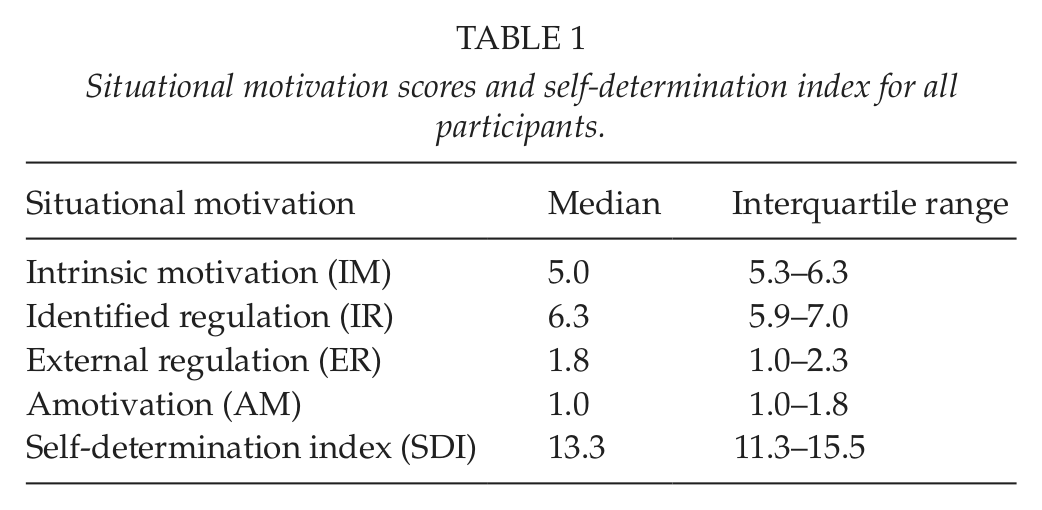
Median IM score for all participants was 5.8, and median IR score was 6.3. AM score was very low. Median SDI was 13.3 and thus rather high (Table 1). There were no statistical significant differences in IM, IR, ER, AM, and SDI between doctors and nurses.
Situational motivation scores and self-determination index for all participants.
Self-Efficacy
For all participants, the self-efficacy median score was 4.0 (interquartile range = 4.0–5.0) before training and 6.0 (5.0–6.0) after training (P ≤ 0.001) (Fig. 1). There were no significant differences between doctors and nurses (data not shown).
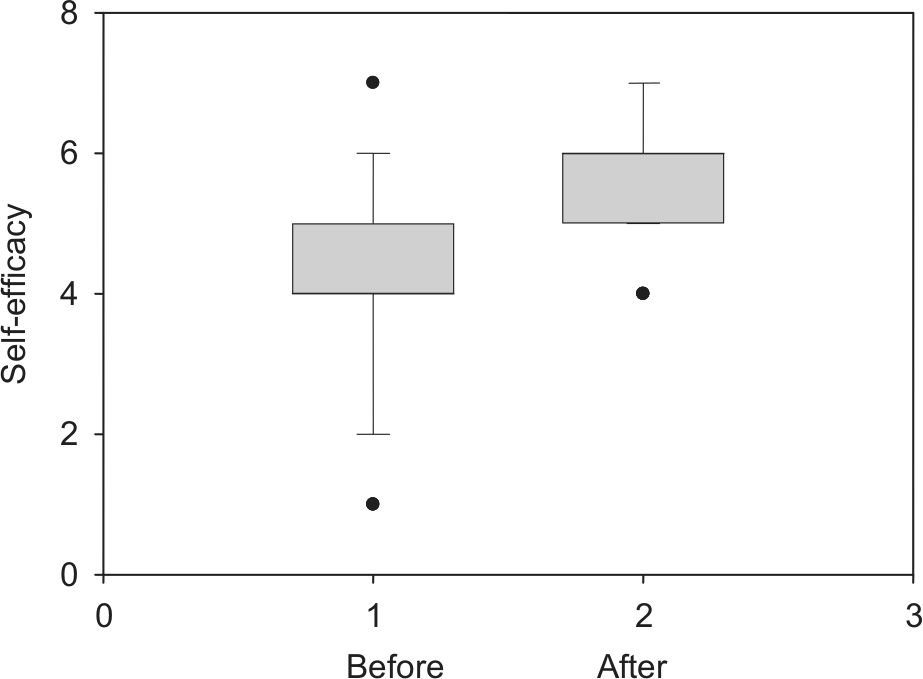
Self-efficacy scores before and after hybrid-training (n = 13). The box-plot illustrates 25th and 75th percentiles with median value as a line inside the plot and whiskers showing 10th and 90th percentiles. Outliers are marked as • .
Course Evaluation
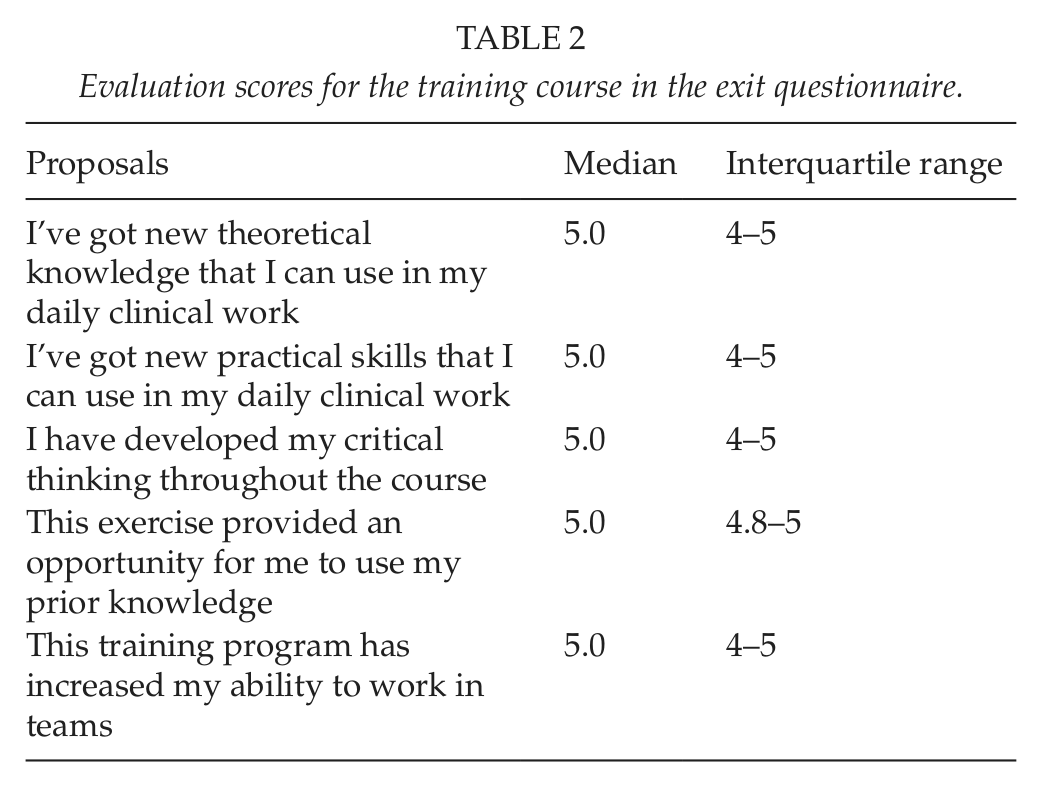
All participants evaluated all proposals with maximum scores (Table 2). Among the free comments in the evaluation, a common theme was the emphasis on the importance of communicating with the whole team, to use closed loop communication, to involve the whole team, to listen carefully, to speak up, and to use the World Health Organization checklist http://www.who.int/patientsafety/safesurgery/ss_checklist/en/.
Evaluation scores for the training course in the exit questionnaire.
Discussion
A wide range of different abilities and factors are relevant when learning both technical and non-technical skills. As shown in an earlier simulation-based study, visual–spatial ability is correlated to the technical performance in surgical simulators (10). Haptic feedback is also known to be a factor that can improve learning of technical skills (11). Behaviors and attitudes have also been shown to be affected by the use of full-scale patient simulation (12). Our focus was to look into the ability to use CRM while performing surgical procedures in an authentic OR team. With the center of attention toward improved patient safety, an earlier study has described teamwork in the OR as an important factor in Sexton et al. (13). Across these goal processes, the present trainees in general were mostly intrinsically motivated (engaged for their own sake) and self-motivated to reach the training goals (IR), and their SDI value indicates that they had a rather great degree of self-determination toward the training situation. The trainees’ level of AM was in general very low; their sense of purpose was great, and they experienced that they could change the course of events during training.
Overall, self-efficacy increased after the hybrid simulation teamwork training. It could be argued that the trainees got higher expectations in their ability to handle the situation. In the future, they will attempt to perform most or all of these training tasks since they will expect to be successful. Presumably, they will not become unmotivated and frustrated. With high self-efficacy, they will be able to set very high goals and remain motivated despite the possible threat of failures. On the contrary, a person with low self-efficacy will set lower goals, and at the first sign of hindrance will give up on the goal.
Bandura’s (7, 8) social-cognitive theory, a prominent self-regulation theory, focuses on the role of self-efficacy in various goal processes. He argues that self-efficacy increases the probability of choosing a difficult goal (a goal choice), the probability that effort will continue to be applied to a difficult goal (goal or task persistence), the probability that a goal will be increased/changed after successful performance (goal revision), and the effort applied to reach a goal (goal-striving behavior). Others have also argued that when goal-change issues are primary, self-efficacy may play a positive role on motivation for an individual (14, 15).
The exit questionnaire demonstrated a positive outcome. These findings are supported by previous reports where preoperative briefings were found to be important for quality and efficiency (16).
The study was a feasibility study with few participants. Despite this limitation, it indicates continued research on hybrid simulation with respect to self-efficacy and motivation in order to calibrate optimal individual learning.
Several reviewers of the training literature have already advocated incorporating direct self-efficacy interventions within different training programs (14, 15, 17, 18). In conclusion, one main goal for instructors would be to help the trainees to raise their degree of self-efficacy in order to handle stressful and challenging situations in simulated teamwork training. Situational motivation would then increase directly with self-efficacy levels, promoting the trainees’ beliefs in themselves and thus facilitate learning of complex skills relevant for surgical teamwork in the OR.
Another interesting issue to further explore is about the role of leaders and followers in the team. Meurling et al. (19) reported that self-efficacy improved overall during simulation-based team training but that the leader of the team experienced higher mental strain and concentration compared to the followers. During an operation leadership, changes are common depending on whether the situation involves an anesthetic or surgical problem. We have not focused on this leadership changes in our study due to few observations. Upcoming studies should examine how self-efficacy and situational motivation may differ according to the role in the team. In order to improve training outcomes there is a need to consider individual abilities for different categories of team members i.e. both leaders and followers.
Different professions in an authentic team benefit differently from team training, as an earlier study has also shown (20). Nurse assistants experienced improved quality of collaboration and communication among team members after simulation sessions. Since our study had few participants and lacked nurse assistants, we could not examine effects on professional levels, but in future studies, we plan to include nurse assistant in the team training and furtherance to collect larger groups of participants to be able to analyze eventually differences among various professions.
In a team where each team member knows his or her role and is confident in carrying out the tasks toward a shared goal, situation awareness (21) has to be maintained. Future studies should analyze how motivation, self-efficacy, and situation awareness are involved in the present hybrid simulation. This study has shown that the examined hybrid simulation is well appreciated and that it improved individual confidence. Hybrid simulation has the potential to bring the qualities of human motivation to the art of teamwork training in the OR. It can also enable different needs when it comes to leaders, followers, and different professionals.
Footnotes
Declaration of Conflicting Interests
The authors have no conflicts of interest or financial ties to disclose.
Funding
This study was supported by research grants from the Marianne and Marcus Wallenberg Foundation and research grants from the Stockholm County Council.