



Abstract
Aims
In recent years, a grey market has emerged in Sweden where teenagers use social media to obtain alcohol. This market has not yet been explored qualitatively. The present study addresses this gap by examining how social media is used to illicitly trade alcohol.
Methods
First, a netnographic approach involved systematically searching for and documenting social media accounts offering alcohol. Second, 33 in-depth, app-based textual interviews were conducted with 16 sellers and 17 buyers who had engaged in illicit alcohol transactions. Responses were thematically analysed within a critical realist framework, capturing experiential (explicit), inferential (inductive) and dispositional (retroductive) themes.
Results
Snapchat is the preferred platform due to its popularity among youths, ephemeral messaging features and recommendation algorithms. Sellers typically source smuggled alcohol in bulk to maintain competitive prices. Underage buyers cite ease of access, speed and convenience as main motivations. Risk perceptions differ as sellers worry primarily about arrest offline and platform bans online, whereas buyers fear personal victimisation during face-to-face exchanges.
Conclusions
Restriction-generated markets and platformisation sustain illicit alcohol markets. Strict regulations inadvertently shape the market's demand by denying legal access to underage individuals’ desire for alcohol. Simultaneously, the design of Snapchat facilitates rapid, anonymous connections and exchanges. The findings underscore a need for policymakers and practitioners to consider how social media amplifies underage alcohol consumption risks.
Keywords
Introduction
Social media platforms are increasingly hosting grey markets where technically legal commodities are sold illegally, such as prescription drugs, tobacco, counterfeit goods (Cheung et al., 2019; Foltea, 2020; Mackey et al., 2013) and, in Sweden, also alcohol (Guttormsson & Åström, 2022; Muntau, 2025). Sweden's restrictive alcohol policy prohibits the sale to those under 20 years and the serving of alcohol to those under 18 years (Norström & Ramstedt, 2006). Despite this, more than one-third of all 15-year-olds have sourced alcohol through older friends, siblings, parents and even strangers (Folkhälsomyndigheten, 2024; Skehan et al., 2016). While youth drinking in Sweden, similar to many other countries, has halved since 2000 (Raninen et al., 2024), unrecorded consumption has not decreased (Leifman, 2017). This indicates that the methods of procurement may have changed. For example, the share of 15-year-olds who have purchased alcohol via the internet rose from 1.13% in 2013 to 9.16% in 2021 (CAN, 2023).
We refer to this practice as a “market” defined as “arenas of regular voluntary exchange of goods or services for money under conditions of competition” (Beckert & Wehinger, 2013). In contrast to illicit drug markets, the illicit alcohol market in Sweden is characterised by lower legal severity and a higher buyer prevalence (Folkhälsomyndigheten, 2024; SFS 2010:1622, 2010). In this qualitative study, we examine the trade as shaped by perceptions and interactions of sellers and buyers, as well as how the social media platform characteristics influence the perceptions and choices of the participants. Research question 1: How do sellers and buyers experience their participation in the social media market for alcohol in Sweden? Research question 2: What underlying mechanisms help explain how illicit alcohol markets emerge and operate on social media?
Background
The restrictive Swedish alcohol policy dates back several hundred years. A referendum in 1922 came close to passing a prohibition law but a compromise was reached that stipulated a national monopoly on alcohol sales that has been in place since then (Room & Cisneros Örnberg, 2019). Policies restricting access to alcohol to promote public health, as have emerged in the Nordic countries, relate to the development of the welfare state. To prevent public health risks and public order problems that come with excessive drinking, policymakers pursued measures that balanced individual freedom to consume alcohol against the collective good of a healthier and more socially stable population (Moeller, 2012; Room, 2004).
Currently, the monopoly is upheld through legislation that states that all goods with more than 2.25% alcohol content may only be sold through the private company Systembolaget, which is fully owned by the Ministry of Health and Social Affairs. Beer with an alcohol percentage between 2.25% and 3.5% is exempted and may be sold elsewhere (Butler, 2023). Unlawful supply and smuggling carry penalties from fines to imprisonment; enforcement is distributed across the Police for supply, Customs for smuggling, Municipalities for licensing and the Consumer Agency for marketing (SFS 2000:1225, 2023; SFS 2010:1622, 2010).
Only 32% of Swedes support dismantling the monopoly (Karlsson et al., 2025), indicating that public support for its continuation can be considered quite strong. Pro-monopoly views are mainly motivated by perceptions of its positive societal effects (Karlsson et al., 2020). It is estimated that more than 86% of Swedish alcohol consumption stems from monopoly outlets, while the remainder was primarily served in bars and restaurants or was legally imported (Häkkinen, 2021; Örnberg & Ólafsdóttir, 2008).
Alcohol holds an important role in the social life of many adolescents as part of socialisation and exploring maturity (Beccaria & Sande, 2003; Demant & Østergaard, 2007). Young people are, however, particularly vulnerable to disruptions to brain development through alcohol use, and this is exacerbated by binge drinking. Moreover, the inebriation of young people is associated with risky behaviour, including delinquent behaviours and unsafe sexual practices (Skala & Walter, 2013). Therefore, one key public health measure is to reduce availability to young people. Generally, a higher legal drinking age is associated with lower binge drinking and less drunk-driving (Hingson & White, 2014) and lower consumption during youth is associated with lower future consumption (Raninen et al., 2016).
Literature review
Only limited research has specifically examined alcohol sales on social media, but Guttormsson and Åström (2022) found that 28% of 5,012 respondents, aged 16–21 years, had come across alcohol-seller accounts. Those with previous drinking experience were more likely to have seen alcohol-sellers (33%) than those who had no experience (11%). Most sellers were seen either on Snapchat (44%) or Instagram (41%), with all other platforms accounting for under 4% of observations. 12% of respondents had experience buying from such accounts. Girls were slightly over-represented among buyers (58% versus 42%). Their motivations were the availability, simplicity, speed of delivery and price (Guttormsson & Åström, 2022).
While academic research has been lacking on this grey market for alcohol, some studies have identified similar grey markets trading prescription drugs and tobacco on social media. Benefiting from the platforms ubiquitous use, as well as the low barriers to entry, sellers may cast a wide net to reach many prospective customers with little exertion. E-cigarettes and vapes are advertised overtly, utilising native functionalities to maximise visibility while mitigating risk (Aagesen et al., 2025; Dobbs et al., 2025). Prescription-drug sales appear frequently in Nordic social-media markets and overlap with illegal drug scenes (Demant et al., 2020; Katsuki et al., 2015; Moureaud et al., 2021).
There is also a broader scope of research on social media markets for illicit drugs (Miller & Miller, 2021). These markets mainly depend on physical meet-ups, taking the form of an online–offline hybrid practice (Demant & Nexø, 2024). As an increasingly common procurement method within drug markets (Oksanen et al., 2020), social media requires limited skills for offline dealers to expand into online dealing (Coomber et al., 2023; Korshøj & Søgaard, 2024). Through utilising these platforms, dealers may benefit from the platform's native functionalities to both simplify connections to buyers and increase a perception of safety (Demant & Nexø, 2024; McCulloch & Furlong, 2019).
A key finding in this research is that both parties of the trade perceive the risks as quite low (van der Sanden et al., 2022). This perception of low risks will likely also apply to alcohol, as the sanctions for illegally selling to minors in Sweden vary from fines to a maximum of 2 years of jailtime (SFS 2010:1622, 2010), which is lenient compared to selling drugs. No studies have examined the risk of being criminally sanctioned for buying or selling drugs on social media in Sweden. A report from the Swedish National Council for Crime Prevention noted that the online drug trade is usually investigated by regional Police, while the physical drug trade is handled locally. The two phenomena often overlap in practice which may cause confusion regarding where responsibility lies (Tollin et al., 2021).
Despite this extensive area of research, no qualitative study has previously examined the market for alcohol on social media. The insights will provide an interesting case to the growing research on grey and black markets on social media and beyond.
Theoretical framework
The grey market for alcohol on social media is a complex phenomenon, touching on multiple aspects of human behaviour. Buyers may feel motivated to seek out illegitimate sources to access a restricted product. Sellers identify this demand and take advantage of the opportunities for monetary gain, while mitigating the risks associated with law-breaking. Social media facilitate the connection between sellers and buyers, which influence participants’ perceptions of reality and afford specific action alternatives (Evans et al., 2017; Scott et al., 2022; Suler, 2004). This breadth of possible complementary mechanisms requires engagement with multiple theoretical perspectives, to avoid a single-lens understanding of a complex practice.
Beckert and Wehinger (2013) introduce a typology of illegal markets, characterised by the nature of the prohibition. Illegal markets may be defined by the sale of a prohibited product, or by violating regulations of how it may be sold. These markets exist when there is demand for the product that is sufficient to incentivise people to seek out the illegal markets, either due to lack of legal or convenient access. In turn, the expected profits from selling illegally would need to trump the costs from the associated risks. These are referred to as illicit markets or black markets. Grey markets are a type of illegal market where legal products are sold in ways that violate laws and regulations (Chaudhry, 2014). Our case of alcohol being distributed illicitly through unauthorised channels is this type of illegal market. In such markets, there may be a legal-illegal hybridity along the production and distribution chain because liquor may be produced officially and legally, yet distributed illicitly through smuggling and social media accounts at a later stage.
The grey market for alcohol has many similarities with other illicit markets in terms of the decision-making of those involved. Participants do not abstain from trading illegal products or services due to it being illegal. Rather they will often adapt their behaviours to reduce risk of sanction. “Restrictive deterrence” theory describes these behavioural modifications as different types of strategic displacements. This includes arrest avoidance strategies such as using pseudonymous accounts or removing accounts, similar to strategic displacements of drug sellers (Goldsmith & Wall, 2022; Moeller et al., 2016).
Another body of research that is relevant to our understanding of grey markets on social media is the study of “platformisation”. Childs and Bernot (2024) introduced the concept to explain how the practice and culture of illegal online markets are shaped by the different social media platform characteristics. Each platform has different properties that influence impressions, agency and strategy among users. Childs and Bernot (2024) highlight three strands of research on illegal online markets: datafication, digital labour and affordances. Datafication studies how the various metrics of the platform enable comparison, for example, of prices, products and buyer satisfaction, and by extension seller reputation. Digital labour describes how sellers of illegal products operate as businesses and communicate an image of corporate professionalism, with pseudo-corporate names, limited-time discounts and customer service (Bakken, 2021).
The concept of affordances originates from ecological psychology meant to explain behaviour as emerging from the interaction between the animal and its surrounding environment (Gibson, 2014). It has since been extensively used to explain human behaviour in field such as psychology, communication studies and other social-sciences perspectives on technology use (Davis & Chouinard, 2016). Affordance theory takes interest in how objects, in our case digital platforms, may afford different actions. These affordances differ between people and exist in the relationship between the static functionalities of the platform and the perception of the individual that makes a certain action possible (Evans et al., 2017). In practice, users adjust their behaviour with regard to functionalities, moderation and cultures of different platforms.
Methods
We collected two types of data to examine the sale of alcohol on social media. First, we conducted a netnographic search on social media to find seller accounts and get an understanding of the trade and its platformisation. Next, we invited seller accounts and recruited buyers to interviews to learn about participant perspectives. We used a critical realist thematic analysis to interpret and structure our findings. In the following, we explain more about each of these steps.
Netnography
The exploration of online social phenomena by searching and observing networked sociality is referred to as netnography (Kozinets, 2015). This study employed non-participatory observational netnography, also known as “lurking”. We systematically searched major social media platforms to explore the scope of the practice and inform subsequent methodological choices. Researchers familiarising themselves with a setting before interaction is generally regarded as one of the more ethically acceptable forms of lurking in research (Addeo et al., 2019).
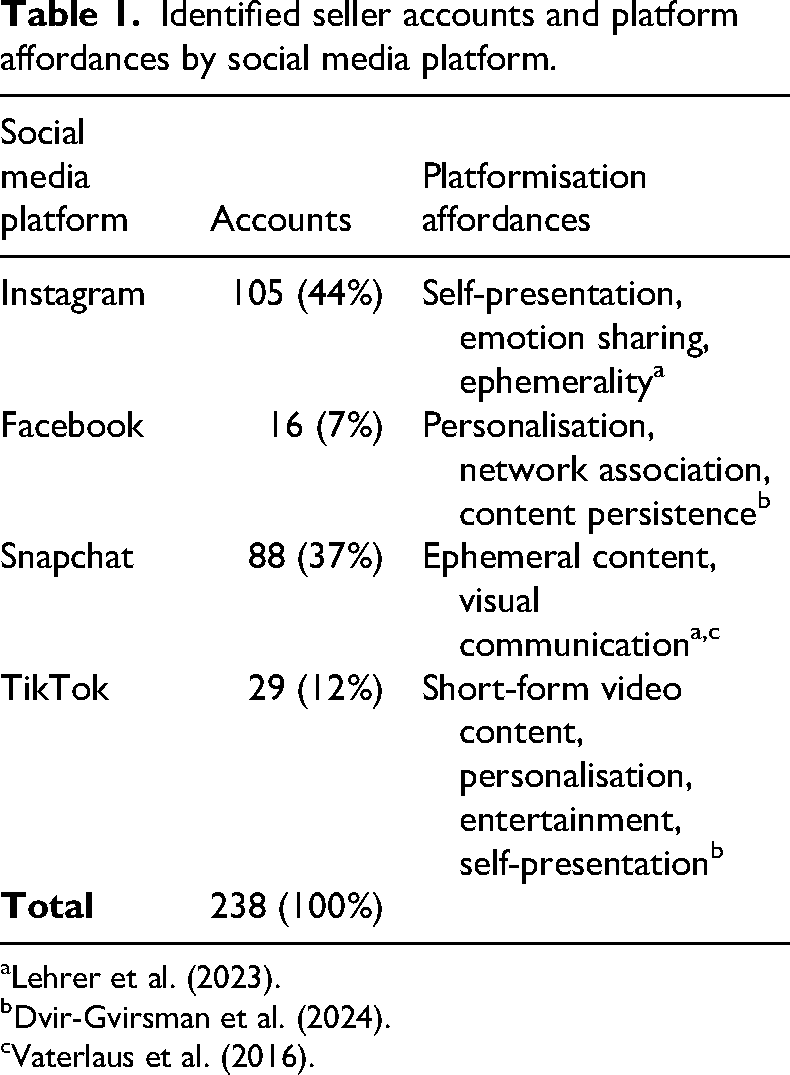
We started in the spring of 2023 by naively searching the five most popular social media platforms among Swedish high school students: Discord, Facebook, Instagram, Snapchat and TikTok (Internetstiftelsen, 2024). We excluded YouTube due to its focus on video sharing rather than person-to-person interaction. Furthermore, encrypted platforms such as Telegram and Signal were also excluded, as their functionality and design are more aligned to private messaging services rather than traditional open social media platforms. The search terms were chosen partly from news articles covering the illicit alcohol trade, and partly from terms that emerged during the search process. We identified 238 usernames as highly likely to be selling illicit alcohol through use of slang for alcohol or more conventional terms in combination with terms signalling sales such as “cheap”, “buy” or “quick”. Table 1 shows where they were found. The accounts were primarily found on Snapchat and Instagram, and only a limited number found on TikTok and Facebook. Most TikTok accounts referred customers to accounts on Snapchat, and only a handful of accounts offered sales within TikTok. The few accounts that we found on Facebook seemed to be several years old and appeared to have been abandoned. On the other platforms, we could not find any accounts. Table 1 also characterises the platforms in terms of their affordances based on prior studies.
Identified seller accounts and platform affordances by social media platform.
We kept track of our search by noting spontaneous impressions and more analytical interpretations in immersion journals, which were discussed in biweekly meetings. For each account, we took a screenshot, which we anonymised by removing pictures and geographic information and saved on a protected university server. This search procedure was revealing with respect to how each platform's search engines work. On several platforms, the search results are influenced by the platforms’ recommendation algorithms that input users’ previous behaviour (Eg et al., 2023; Rixen et al., 2023). This implies that our findings are not exhaustive. Since we repeatedly searched common terms used for illicit alcohol sales, the platform search engines picked up on our interests and guided us towards related accounts. This contributed towards thickening our understanding of the phenomenon (Geertz, 1973) because this is likely how prospective buyers who search for alcohol are exposed to new seller accounts.
App-based textual interviews
Next, we contacted seller accounts by sending a “friend request”. If they accepted, we asked for an interview in a private chat message in which we disclosed that we were collecting data for a research project. The inclusion criteria consisted of having sold alcohol through social media. We initiated the interviews shortly after the participant agreed (Bakken, 2023) and, after building rapport, the interviews shifted back and forth from synchronous to asynchronous. The time between replies varied from seconds to weeks. The advantage of using chat applications is that interviews can be conducted across physical distances. By eliminating the need to meet in the same place, there is greater flexibility in time and less personal investment from the participant (Bakken, 2023; Gibson, 2017). Text-based interviews are also suitable for vulnerable populations as it remove some social pressure of the face-to-face situation and lowers the bar for disclosing delinquent or criminal activities (Cook, 2012; Hammond, 2018). Limitations to this method include the lack of visual cues and the inability to fully verify participants’ claims. This is explored further in the conclusion section. Nevertheless, the strengths outlined above render these constraints manageable.
Buyers were recruited through different channels. We advertised in Facebook groups and used snowball sampling of existing contacts. Here, the inclusion criteria were broader, and we interviewed people who had bought alcohol from social media accounts or considered doing so. All interviews were semi-structured, based on an interview guide, adjusted for each sample group, covering general domains of interest, such as market dynamics, motivation, logistics and risk perception, while maintaining flexibility and adaptability in each interview.
Sample description
We interviewed 33 participants, 16 sellers and 17 buyers during spring and summer of 2024. All interviewees were informed about their anonymity and rights to end the interview at any time. Nine sellers provided information on age and gender. Six said they were between 17 and 21 years, while three others stated their ages as 26, 40 and 20–30 years, respectively. Six stated they were male, two were female and one was non-binary.
The buyers age ranged between 15 and 22 years with almost half (eight out of 17) aged between 17 and 18 years. Nine identified as female and eight as male. Seven lived in medium-sized cities, six in large cities and three in small cities. When asked about their first time buying alcohol through social media, the majority had started at around 15 and 16 years old. Two respondents started much earlier, at 11 and 13 years old. The latest debut was at 17 years old. Their subsequent buying varied as two stopped after their first time, five had bought five to ten times and five had bought 20 or more times. Two interviewees never went through with their plans to buy.
This sample was achieved through a purposive sampling strategy, as is common for studying hard-to-reach populations (Boeri & Lamonica, 2015), because our aim was to access relevant research subjects, useful for understanding the phenomena, and not to achieve a sample representative of the wider population (Neuman, 2014).
Critical realist thematic analysis
Wiltshire and Ronkainen (2021) proposed a critical realist framework for thematic analysis grounded in the stratified ontology of Bhaskar (2013) that divides reality into layers of the empirical (observed), the actual (unobserved) and the real (unobservable structures or causal mechanisms). In realist thematic analysis, these layers correspond to experiential, inferential and dispositional themes. Experiential themes are made up of what was explicitly expressed by interviewees. The inferential themes build on this and are generated through inductive and abductive reasoning of a broader understanding beyond the sample. Due to the limited sample size, the conclusions drawn in inferential themes should be treated as probabilistic, concerning what we assume to logically exist within this phenomenon. Dispositional themes are generated through retroductive reasoning at a higher level of abstraction, to theorise on the structures or mechanisms in place that enable the phenomena.
Ethical reflections
The ethics of researching illegal online phenomena are still debated (Proferes et al., 2021). One key ethical issue is translating the concept of a public/private data divide into the online space. Some online sites have formal restrictions, such as membership requirements, which make it easy to identify them as private and therefore out of bounds for researchers. On other sites, there are more informal expectations of online privacy. Here, users may share information that is intended for friends and family, that is technically visible to the public (Hewson, 2016). These informal expectations are not codified in any guidelines, but an important contribution to interpretation is the framework of Demant and Moretti (2024) based around the principles of “publicness” and “least intrusiveness”. They argue that it is acceptable not to seek consent if “a group” consists of a non-vulnerable population, has more than 200 members, does not require registration or administrative approval for access, and lacks specific access criteria stipulating privacy. In our study, we are accessing single-seller channels rather than “groups”, but their reasoning is still relevant to us. We interpret the rest of the guidelines put forward by Demant and Moretti (2024) in the following way: sellers who accept our friend requests are parallel to administrators of a group approving our request for access. Accepting a friend request from a neutral account such as ours corresponds to publicness.
Individuals sharing information about their criminal or deviant activity can be considered vulnerable (Dickson-Swift et al., 2008). However, taking into account that dealing alcohol leads to relatively low legal consequences and its relative broad prevalence across Sweden, it might be assumed to be less socially condemned than illicit drug sales (Folkhälsomyndigheten, 2024; SFS 2010:1622, 2010). Additionally, a protective factor is the platform-facilitated anonymity controlled by the participant's freedom to choose their pseudonym. We fully adhere to Swedish law that states that individuals 15 years or older are allowed to consent to research participation without parental approval, given that they are sufficiently informed (Riksdagen, 2003). Given these concerns, we consider our sample to have partial vulnerability, yet it is protected through diligent methodological procedure, including self-managed anonymity and reliance on informed consent.
In practice, once the friend request was approved, they received a participant information letter through the chat, outlining details about the study and their rights as participants to exit the study at any time. Once they explicitly agreed to be interviewed and confirmed that they were aged 15 years or older, the interview commenced. Taken together, we argue that our data collection has a high level of non-intrusiveness. The study was approved by the Swedish Ethical Review Authority (Dnr: 2021-04772).
Results
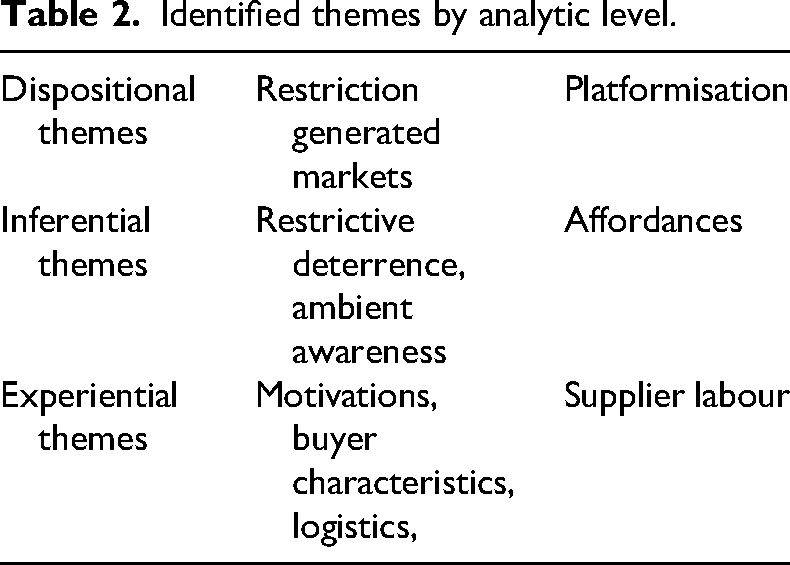
From our netnography and interviews, we identified two themes that we propose are acting as mechanisms necessary for the alcohol trade on social media. We present them as subheadings in the analysis below, referring to them as restriction-generated markets and platformisation. They are followed by further subheadings, where the experiential themes are presented, followed by the inferential themes. The structure of these themes and their respective levels of analysis are succinctly presented in Table 2.
Identified themes by analytic level.
Restriction-generated markets
The restrictive Swedish alcohol policy creates opportunities for selling and buying outside of the monopoly outlets and bars. These opportunities come with the consequences of a market without quality control. Since there is no formal quality control in the illegal trade, the traded products may be of illegal origin (smuggled, self-produced or bought with the intention of selling to minors) or even fake (not alcohol). Interviewed buyers mainly looked for liquor, such as vodka, which all sellers offered. A few also offered wine, beer or cider. When asked where the alcohol they bought came from, one buyer assumed: “I would guess Systemet [monopoly outlet]. He looked old enough” (Buyer 15). The sellers agreed that smuggled liquor dominates the market, which they could purchase from local suppliers. They recalled seeing unknown brands or signs pointing towards counterfeiting such as taped bottle caps and uneven labels: “Some bottles you get don’t even exist. And some bottles that he claims is Smirnoff don’t even have the shape of a Smirnoff. The stickers are loose sometimes, and the bottles are unevenly filled” (Seller 6).
Motivations
The buyers we interviewed all described their motivation for procuring alcohol as preparation for an upcoming party. Mostly the alcohol was intended for a specific party, commonly shared between multiple people. Sourcing it via social media was easy and they often received it the same day. The goal was “To drink at a party and get intoxicated” (Buyer 2).
Most sellers we interviewed were clear that they were motivated by making easy money with little effort. One of them had learned about selling from being a buyer. Most had only sold for a couple of months, but four interviewees said they had been active for more than a year. They had learned to manoeuvre and switch between multiple accounts over this period due to being banned for breaking Snapchat's community rules. This practice is also common among drug sellers, who move between accounts to evade bans (Haupt et al., 2022; McCulloch & Furlong, 2019). Still, even these sellers saw their involvement as a temporary gig to earn some extra money: “I’m doing this because I’m lazy and I don’t feel like scanning items at a grocery store. You become money damaged. I can make 4000 kr in 3–5 h. The grocery store is 120 kr per hour. Plus, it's high status to sell booze” (Seller 12).
Buyer characteristics and logistics
We asked sellers to describe their typical customer in terms of gender and age. While most claimed roughly equal gender distribution, several sellers preferred female buyers because they tend to have a pleasant attitude, meet up quickly and buy for multiple people at once.
Sellers characterised the typical buyer as roughly between 13 and 19 years old, but most agreed that late teens are the most common. We asked if they upheld any type of age restriction on their sales and whether they had denied a sale because of it. The most common age limit was 15 years, but it varied between sellers, ranging from 13 to 18 years old. The more common response, however, was the vague statement of not selling to “children”. Only one seller recalled rejecting a buyer for being too young. Two sellers didn’t uphold any age limits: “I don’t care about age; everyone has their own responsibility” (Seller 15). “No age limit, everyone with money gets to buy” (Seller 16). None of the buyers we interviewed had bought illicit alcohol online after passing the legal age; however, several sellers spoke about having encountered older buyers. We asked them to reflect on why these individuals buy from them and not monopoly outlets. The sellers noted convenience as they delivered to parties: “Many reach out because they’ve run out of drink or need more. And they can’t go to the store, so they just order to the party” (Seller 12).
The logistical practicalities were similar to drug dealing on social media: It was very simple and straightforward, they usually post what they have in stock and what it costs, and then you just write what you want […] how many will come, he replies with place and time. And if that works you confirm. Then you go to the spot and then the person comes on a bike with the stuff in a bag in the basket, and then smoothly hand over the liquor in one hand and the cash in the other and then he bikes away. (Buyer 4)
Their choice of location was often at a transportation hub, such as a train or metro station, to hide in the crowd. While most buyers recalled meeting in secluded places, a few were surprised by seller's lack of secrecy, openly brandishing bottles in public spaces. A minority of sellers offered home delivery, and they preferred locations inside the buyer's home or car, or in discreet public places like high-rise estates or quiet suburban streets. Buyers would often initially bring friends to the handover for safety reasons, but their reliance on friends subsided after repeated purchases from the same seller.
None of the sellers smuggled themselves and therefore depended on having access to wholesale distributors. Two of the sellers we interviewed, independently described hearing about a phone number one could obtain in exchange for 5000 SEK (442.75 EUR), granting access to a supplier. By calling that number, they could order a stock of alcoholic beverages and settle on a time for collection. “I bought a contact for the alcohol for 5000 kr and get Smirnoffs or tall blond … they’re [nationality] selling from [city area] in a stolen van” (Seller 12). Since two interviewees told us about this, and gave the exact same price, it is possible that they were using the same wholesaler. Through these suppliers, a box of 12 bottles of vodka sold for 1500 SEK (132.58 EUR), which they resold at 250 SEK (22.69 EUR) to 300 SEK to (27.23 EUR) per bottle. By selling 20–40 bottles per week, they could earn between 4000 SEK (354 EUR) and 12000 SEK (1062 EUR) weekly.
They were consistently specialised in alcohol sales and rarely offered other illicit wares; only three sellers also sold either cannabis, nitrous oxide, or counterfeit cash.
Restrictive deterrence
The sellers we interviewed identified two sources of risk: platform bans and police sanctions. With regard to platform bans, they expressed a fatalistic view, expecting them sooner or later, similar to low-level drug dealers and arrest risk perceptions (Moeller et al., 2016). Being banned meant a loss of income and a disruption but was not comparable to an arrest: “… it's slow for a couple of days to start up the new account but it's not that bad” (Seller 9). Sellers prepared for their eventual banning in different ways, and a common approach was to set up “back-up” accounts and encourage their customers to follow this account as well. Overall, sellers expressed minimal concern about being monitored by law enforcement through their platform accounts. This is also reflected in their account names, where they chose to be very forward about selling alcohol. They were more interested in attracting buyers than concerned about hiding their online presence from law enforcement. Granted, our recruitment method of contacting seller accounts might be unsuited for identifying sellers with this type of online risk aversion. When recruiting sellers for interviews, we encountered some initial suspicion: “Lemme guess, ur gonna add me from another account saying ‘my friends told me I could get 1 bottle for 200’. Then someone who wears blue is gonna pull up” (Seller 1).
One interviewee explained that they had been contacted by what they suspected were undercover police accounts multiple times. Similar to how drug dealers vet unknown buyers (Demant & Nexø, 2024), verbal cues such as outdated slang or tone uncharacteristic of a teenager raised their suspicion: “You get a feeling that something is not right […] it usually sounds very formal or like they are trying to keep up with trends that were abandoned months ago” (Seller 8).
Legal risks are most acute when meeting up with the buyer, forcing handovers to happen quickly and inconspicuously. Some sellers limited the number of bottles in their possession and avoided biometric locks on their phones. None of the interviewed sellers had gotten caught themselves, but a few had stories of close calls or knew someone who had been caught, which shaped their security routines. This mirrors the view of Paternoster and Piquero (1995) regarding how both direct and vicarious experiences shape risk mitigations.
From the buyer perspective, there was a clear gendered component to the risks of meetups. Several girls described concerns about harassment or violence: some discontinued purchases after uncomfortable interactions. They described how sellers would try to establish a more personal and flirtatious rapport with them or offered to sell alcohol at zero profit: “It was a bit unpleasant, he was being very flirty and used to write compliments on snapchat, so I stopped buying from him […]. The worst potential risk is to be the victim of some sort of violence or sexual [harassment]”. (Buyer 5).
Ambient awareness
Youth alcohol consumption is highly socially situated. While conventional social sourcing is arguably still the most common procurement method (Guttormsson & Åström, 2022), some buyers referenced their lack of access through those sources that drew them to seeking out unknown sellers on social media. The presence of alcohol sellers on social media was described by interviewees as common knowledge for their age, noting that they encountered such accounts even before making their first purchase. This can be connected to the concept “ambient awareness”, which suggest that illicit social media content may be normalised through repeated passive exposure (Leonardi & Meyer, 2015; Wood, 2018). “No, we don’t care, they sell to so many, so we don’t think anything is going to happen to us” (Buyer 16).
Platformisation
Social media platforms features enable and constrain user behaviours, influencing the choice of platform and the ways in which trade is conducted (Childs & Bernot, 2024). Our initial netnography identified most of the seller accounts to be located on Instagram (44%) and Snapchat (37%), echoing the findings of Guttormsson and Åström (2022).
Supplier labour
Sellers used commercial strategies similar to those characterised by Childs and Bernot (2024) as supplier labour. Since the trade is mainly initiated by the buyer contacting the seller, sellers need to be easily discoverable. Therefore, many seller accounts adhere to a naming convention that includes a term for alcohol, often in combination with a geographical area. The buyers echoed this sentiment: “Yes, it's so easy. It's just a matter of searching for liquor or beer or something like that, and then you will find multiple people who sell liquor” (Buyer 14).
While discoverability is important, word-of-mouth recommendations is crucial for both parties. Many buyers recalled being introduced to specific sellers via friends: It was with a friend who knew more than me … who’d gotten a Snapchat username sent to them, that were known among all our friends, as one who you buy from. So, they sent the username to us from and then you just wrote what you want [to order] and then you got the address you were supposed to go to. (Buyer 8)
Some buyers’ reliance on peer recommendations was incorporated into the sellers’ marketing. Word-of-mouth and shout-outs, where buyers post appreciation for sellers, in exchange for small discounts expanded reach: “I ask friends or other customers to put up a shoutout for a bottle or a little cheaper” (Seller 3). A less common approach was sellers making unsolicited contact with youths, which a few of the interviewed buyers recalled being subject to. This approach was described by one of the sellers as a strategy used when establishing a new seller account before there was a reliable customer base in place.
Affordances
In contrast to our initial netnography, Snapchat was described as the dominant platform of the market. When asked to reflect on what drew them to the platform, sellers referred to the popularity of the platform among young people and appreciated being able to add multiple accounts quickly and tag other accounts to increase attention to posts: “Snapchat is the best because basically everyone uses Snapchat and it's easy to market and spread the account on Snap” (Seller 9). The buyers in turn saw Snapchat as the platform most used by sellers. We tried to establish accounts on Instagram which simply didn’t work … the target group we were looking for and the number of new customers we tried to collect didn’t work … At first, we searched actively for customers but after a while people find their way to us. We can get between 100–200 young people per week …” (Seller 8)
We can infer from these quotes that Snapchat afford superior visibility and searchability, compared to Instagram. These affordances assist both sellers and buyers looking to connect. Snapchat was also described as the higher security platform, with functionalities such as screenshot notifications, self-deleting messages and photos. These features all fall into so-called ephemeral affordances, which may allow impulsive behaviour and a sense of lack-of-surveillance (Bayer et al., 2016; Handyside & Ringrose, 2017; Shklovski & Hervik, 2015). Instagram may produce less of such perceptions, due to it being comparatively less ephemeral, being built more around content persistence and public presentation (Kofoed & Larsen, 2016).
Meanwhile, Instagram was also mentioned as a relevant platform to reach an older clientele. In that context, we treat Instagram as affording networked associating, the possibility to use audience discovery to contact that age group, with search and recommendation as implementing features (Majchrzak et al., 2013). By implication, Snapchat appears to afford similar associating, operating as a platform through which to reach a younger customer base which are unable to buy alcohol legally.
Discussion
In the present study, we examined participant perceptions of the illicit trade of alcohol on social media in Sweden. We identified experiential and inferential themes from explicit statements, which informed the identification of two dispositional themes. We propose viewing these as mechanisms that jointly contribute to the grey market for alcohol on social media.
From our interviews, we found that the demand was concentrated on those unable to buy alcohol through legitimate means. Sellers sold mostly to youths under the age of 20 years, while older customers mainly bought outside the opening hours of monopoly outlets. Staff at the monopoly outlets are instructed to refuse sales if they suspect it will be passed on to underage individuals (Systembolaget, 2025), and none of our interviewed sellers reported this was their method of procurement. Sellers did in fact exclusively source their products through smuggling, offering them quantity discounts, which were attractive to profit-driven sellers (Canavire-Bacarreza et al., 2019; Neufeld et al., 2017). Taken together, we see how the legal restrictions on alcohol supply help structure the grey market on social media. We therefore understand the market for alcohol on social media as, in part, an unintended consequence of restrictions on supply.
Moreover, since the possession of alcohol is not illegal, the risks of the business are therefore, to a higher extent than in drug sales, focused on the transaction event. Meanwhile, accessing alcohol through sellers on social media carries risks for buyers. Several interviewed girls expressed a specific concern for sexual assault, possibly in light of recent media reports of rape in grey social media markets for vapes (Bozinovska & Pourshahidi, 2024). Our interviewees also confirmed that there was counterfeit alcohol sold, which may contain methanol, heavy metals, industrial chemicals or natural toxins, which can cause acute poisoning, long-term health problems and even death (Manning & Kowalska, 2021; Okaru et al., 2019).
The internet has long been argued to carry criminogenic properties, explored through theoretical concepts like the online disinhibition effect and digital transgressions (Goldsmith & Brewer, 2015; Suler, 2004). Psychological distancing, anonymity and fluid connectivity increase the perceived freedom of choice, lowering the threshold for deviant actions. Illicit sellers on Instagram and Snapchat primarily promote their business directly on these platforms through their choice of username. In limited space, they need to communicate what they are selling, in what city and potentially a characteristic about them; for example, quickness or inexpensiveness. Searching for substances on social media is therefore a highly effective way of finding sellers.
A recent report on social media drug dealing in the Nordic countries found Snapchat to remain as a prominent platform for drug dealing, while platforms such as Instagram and Facebook appear to decrease in importance (Demant & Aagesen, 2023). Although our netnography found more Instagram accounts, interviews highlighted Snapchat as dominant. This likely reflects the challenges of researching ephemeral versus persistent content (Chiu & Yuan, 2021).
Specifically, Snapchat carries some unique characteristics that allow for the market for alcohol. It is a popular platform among youths for spontaneous interactions, as the platform affords ephemerality, supported by functionalities such as self-deleting content and screenshot notifications. Platform ephemerality has been shown to promote a sense of privacy, enabling the acceptance of risky behaviour (Vaterlaus et al., 2016). This sense of privacy was supported by our sample, as reflections on online risks were strikingly low. While it does tie in to previous research (Bakken & Demant, 2019; van der Sanden et al., 2022) and the concept of platformisation, future studies could examine the restrictive deterrence strategies of a greater variety of offenders, using non-intrusive quantitative profile data, to solidify our understanding. Considering that restrictive deterrence identifies that different offenders employ different strategies to avoid detection and sanctions (Moeller et al., 2016), we can suspect there to be a variation of risk that is not captured through the current method.
Another key affordance of social media in general is the ease with which one can make new connections, with a greater reach than conventional social connections. There are search functions which are heavily supported by recommendation algorithms that suggest accounts relevant to your previous searches and network. On Snapchat, the recommendation algorithm has been shown to recommend illegal seller accounts after limited interaction with grey-market content (Aagesen & Demant, 2025)
A key limitation of the present study comes from our sampling. We sent many more interview requests than we received positive replies. This challenge is common to studies undertaking the same methodology of app-based textual interviews (Bakken, 2023; Demant & Nexø, 2024). This may have resulted in a bias towards less risk-aware sellers.
Our search strategy also likely missed covert accounts depending fully on word-of-mouth. We did, however, manage to interview two sellers operating under inconspicuous usernames, found through snowball sampling via another seller. These sellers exist but are difficult to reach for research. These limitations are common and expected in this kind of research, and we reiterate that our aim was to have a relevant sample and not a representative sample.
Conclusions
This study is the first to qualitatively explore the newly evolved practice of illicit alcohol sales through social media in Sweden, interviewing both sellers and buyers. We conclude that restriction-generated demand works jointly with platformisation to lower perceived barriers to participation. Sellers source through smuggling and report substantial earnings due to a consistent flow of new and returning customers, indicating significant demand among underage individuals who lack legal or social sourcing possibilities. Snapchat emerges as the dominant platform, through which ephemerality affords a sense of privacy and safety, while affordances such as searchability and visibility increase youth exposure, powered by recommendation algorithms. This fosters an ambient awareness that normalises the market. These affordances affecting perceptions of risk and availability show how the platformisation of drug markets (Childs & Bernot, 2024) is also found in the grey market for alcohol. Despite trading a normalised and otherwise legal product, buyers face risk of physical victimisation during handovers and of methanol poisoning from counterfeit alcohol.
This study has an explanatory ambition. Through exploring the experiences of sellers and buyers, we identified restriction-driven demand and platformisation as mechanisms that enable the emergence of the grey market. This argument, however, should not be interpreted as a recommendation to dismantle restrictions on alcohol. In line with critical realism, these mechanisms are best understood as contextual tendencies rather than isolated variables in a closed system. Such tendencies should not be seen as triggers which, when reversed, will create opposite outcomes (Bhaskar, 2013). Indeed, reducing restrictions may produce negative results, as restricting access to alcohol for youths has been shown to lead to clear public health advantages (Raninen et al., 2016). Finally, we caution against techno-legal solutionism: prevention efforts that target a single functionality, as they may risk becoming outdated, overly specific or even harmful (Reid et al., 2025).
Footnotes

Ethical considerations
The study was approved by the Swedish Ethical Review Authority (Dnr: 2021-04772) on 22 November 2021. All participants provided written informed consent prior to participating.
Funding
The authors disclosed receipt of the following financial support for the research, authorship, and/or publication of this article: The PhD position of the first author is funded at 50% by a grant from Systembolagets alkoholforskningsråd (Dnr 2022-0016), the Swedish government-owned enterprise holding monopoly on the retail sale of alcoholic beverages.
Declaration of conflicting interests
The authors declared no potential conflicts of interest with respect to the research, authorship and/or publication of this article.
Data availability
Data can be shared upon reasonable request, with restrictions on its use and spread to protect the identity of research participants.