




Abstract
Aim:
This methodological article aims to describe the use of comparative social media platforms within a photo-elicitation (PE) activity as part of a multi-method interview-based study on the gendered meanings of alcohol intoxication among young adults (aged 18–25 years, n = 200).
Method:
Early interviews revealed social media as a particularly engaging topic for participants, and discussions of social media exposed relevant issues that often were not discussed in other sections of the interview guide. By embedding photos of young people drinking within three social media platforms with photo-sharing capabilities – Instagram, SnapChat and Facebook – we elicited narrative data revealing important aspects of the meanings of intoxication and providing information on how participants manage and judge drinking behaviours shared through online social networking systems (SNS).
Conclusions:
Given that social media use and photo-sharing are so common, familiar, and endemic among young people, to ignore this feature of contemporary social interaction would have limited our exploration of meanings of intoxication. We suggest that embedding existing methods, such as photo-elicitation, into social media contexts that are salient for youth may be a valuable strategy for providing a more comprehensive approach for investigating contemporary social issues.
The use of photography in the social sciences dates back to the end of the 19th century, when researchers used images as illustrations, with photos accompanying many of their written observations (Heisley & Levy, 1991; Torre & Murphy, 2015). As exemplified in Jacob Riis’s (1890) How the other half lives and Franz Boas’s ethnographic work at Fort Rupert (1897), researchers at this time used photography to complement their texts, a practice which became a standard procedure for researchers involved in doing fieldwork (Heisley & Levy, 1991). The use of images in the social sciences fell out of favour during the progressive era, when the desire for a more “objective” understanding in the social sciences and the aim of mimicking “hard science” approaches and methodologies became fashionable (Torre & Murphy, 2015). The use of photographs would again gain traction decades later, as Bateson and Mead’s research in Bali (1942) marked a reconsideration of photography as a way of producing data for analysis rather than being used as a decorative tool for articles and publications (Heisley & Levy, 1991; Torre & Murphy, 2015).
As Harper (2002) explains, the term photo elicitation (PE) is credited to researcher and photographer John Collier. As part of Cornell University’s multi-disciplinary team researching mental health in Canada, he initially used photography as a survey tool in his work with maritime communities. By taking photos of each property, he was able to create a photo survey for the research teams to analyse and compare. Collier further argued that if one’s interpretation of physical records could be influenced by graphic information then maybe one’s social record was subject to the same influence. Testing this hypothesis in his study of French-Acadian migrants living in the English-speaking industrial town of Bristol, Collier used “photo interviews” as a way of drawing data from his in-person meetings with participants (1957). Using photographs of various Bristol landmarks as talking points, Collier noted that the data from the photo interview seemed to provide greater depth and breadth compared to responses elicited from traditional open-ended questioning. Devising a system of coding for each statement, he also found that using photos in the interviews was a better method of influencing the content of the interview compared with relying solely on verbal probing. Today, John Collier’s handbook, Visual anthropology: Photography as a research method (1967) is still regarded as an essential reference book for anyone investigating visual methodologies. He emphasised that the use of photographs in interviewing can “establish your entrée to the interview” (1967, p. 47), sharpen the participant’s memory, and divert the participant from discussing issues unrelated to the research. In this way, photographs operate as “projective material” allowing the participant a “sense of self-expression” (1967, p. 48).
Although Collier’s work is still considered the baseline for PE, many researchers today have reshaped the original model to better fit their specific research needs (Badry & Felske, 2013; Cappello, 2005; Clark & Zimmer, 2001; Gotschi Delve, & Freyer, 2009; Hinthorne, 2012; Ramalho, Lachal, Bucher-Maluschke, Moro, & Revah-Levy, 2016; Shaw, 2013; Strack, Magill, & McDonagh, 2004; Vassenden & Andersson, 2010). Moreover, many PE exercises openly encourage direct photographic participation by their subjects. This technique is often called auto-driven photo elicitation or Photovoice, in which the participant is asked to produce photographs and images of their own as a way to elicit discussion and reveal greater ideas of meaning within an interview (Badry & Falske, 2013; Cappello, 2005; Gotschi et al., 2009; Keller, Fleury, Perez, Ainsworth, & Vaughan, 2008; Oliffe & Bottorff, 2007; Ramalho et al., 2016; Shaw, 2013; Strack et al., 2004; Vassenden & Andersson, 2010). In other research, as is the case in our work, the photos are selected by researchers to reveal insights and experiences related to the situations and context of each photo. This technique is valuable for quickly establishing rapport with the participants, stimulating a deeper level of consciousness than words in that the brain processes visual information differently than verbal information, and enhancing the participant’s memory during the course of an interview (Clark-Ibañez, 2004; Creighton, Brussoni, Oliffe, & Han, 2015; Harper, 2002). Regardless of the specific approach to incorporating photos into interviews, PE arguably becomes a medium for projecting and exposing the participant’s perspective on a research topic in ways that classic interview methods may not (Antin, Constantine, & Hunt, 2015). In this case, PE can be a useful supplementary research tool.
While PE has become a popular method for data collection in qualitative research in general, it continues, with a number of exceptions (Demant & Törrönen, 2011; Egerer, 2012, 2014; Faccioli & Zuccheri, 1998; Rolando, Torronen, & Beccaria, 2014; Simonen, Törrönen, & Tigerstedt, 2013; Simonen et al., 2017; Törrönen, Rolando, & Beccaria, 2017) to be somewhat under-utilised in the alcohol and drug research fields. Though visual methods have been present in the field for some time, they are often grounded in the analysis of alcohol-centred visual media, such as alcohol-related advertisements (Adams, Coleman, & White, 2014; Atkinson, Sumnall, & Measham, 2011; Gee, 2013; Hellman et al., 2010; MacKenzie & Zaichkowsky, 1981; Russell & Russell, 2009; Smith, Cukier, & Jernigan, 2014), rather than being used for the purpose of enriching narrative discussions in interviews. In this article we will discuss the process by which we integrated a photo-elicitation activity in an in-depth interview-based study in the San Francisco bay area, the aim of which was to examine the gendered meanings of alcohol intoxication among young adults.
Using photo elicitation – an evolving process
The impetus for conducting the project described here was the result of recent survey data suggesting that gender differences in both heavy episodic drinking and intoxication were diminishing in the US and in other Western nations. Although the available epidemiological data had revealed the changes in prevalence, frequencies, and quantities of alcohol consumed by both young men and women, much less was known about the meaning and social context of intoxication for young adults and the extent to which these meanings and contexts were gendered. Although the drinking frequencies and quantities of young men and women might have been converging, this did not necessarily mean that their drinking practices, the social contexts of their drinking, and the meanings of intoxication in their lives were also converging. With this in mind, we aimed to examine the extent to which there were still significant gender differences in the meaning and context of drinking and intoxication for young women and men and the ways in which gender shaped the experience of intoxication for young people. In order to do this, we interviewed 200 youth participants (aged 18 to 25 years) living in the San Francisco Bay Area about their drinking and intoxication experiences. However, instead of relying solely on open-ended questions in our interview schedule, we decided to use a multi-method approach to interviewing in order to expand the breadth and depth of the potential narrative data (Antin et al., 2015). The interview schedule included four different methods to maximise data collection: (1) a closed-ended survey, (2) open-ended interview questions, (3) photo elicitation, and (4) vignettes. Mixing methods and modalities allows researchers to study an issue from different perspectives, to triangulate findings, and to work with the data in creative ways. We collect multiple types of qualitative data in our in-depth interviews: life history data about respondents’ experiences with drinking and intoxication, as well as narrative data about the meaning of gender and intoxication, derived from our vignette and photo-elicitation techniques. Different data types on the same topic (from the demographic and alcohol-use questionnaires, qualitative life-history questions, vignettes, and photo elicitation) can serve as both partial checks for one another allowing us to triangulate our results by comparing themes that emerge across our various methods and also as a way to shift the context of the interview to reveal potential divergences or contradictions in narratives which can help to highlight salient social and cultural meanings for participants (Antin et al., 2015; Flick, von Kardorff, & Steinke, 2004; Maxwell, 2012). In the process, we were able to collect rich descriptions about experiences with drinking, meanings of alcohol intoxication, and the performance of gender (West & Fenstermaker, 1995; West & Zimmerman, 1987).
Initially, the PE included a series of theoretically-informed photographs, which we found using online search engines and ensured that the pictures were exclusively open-source and could be used publicly without risk of copyright infringement. These photos depicted drinking and intoxication in different contexts and included pictures of young men or women engaged in different drinking behaviours, alcohol-centred advertisements, and a photograph of a drinking scene that we embedded into an image illustrating a fictitious Facebook® newsfeed that we modified using Photoshop. During the study’s initial months, we piloted these multiple images to identify those which seemed to resonate the most with the study population and produce rich narrative data related to the aims of the study. 1
From the beginning, we found that using PE was a valuable strategy with participants, especially those who appeared generally reluctant or unable to discuss any meaningful differences in intoxication between men and women during our use of open-ended questions. However, one photo in particular – the Facebook® photo – emerged as notably different from the others, producing unexpected data about identity management and the salience of online social networking platforms in sharing (or not) stories about alcohol use. Consequently, we decided additionally to embed two of our existing photo elicitation photographs into two other social media platforms to explore how these alternative online contexts influenced the meanings of intoxication for young adults. These photos were selected precisely because they had the potential to spark rich discussion about gendered meanings of intoxication, in a similar way to the one previously embedded into the fictitious Facebook® newsfeed context. Based on popularity among participants and common use for sharing digital media, we chose Instagram® (https://www.instagram.com/) and SnapChat® (https://www.snapchat.com/) as the two other platforms in which to embed the photos. Most of our participants were familiar with all three platforms, and discussed how alcohol use and intoxication is valued and perceived within different online communities. These discussions revealed not only important aspects of the gendered meanings of intoxication but also provided additional information on how participants manage their drinking identities on different social media platforms, an aspect of intoxication that we had not originally set out to explore. In the following section, we will present empirical data from interviews to illustrate the type of commentary that each of these three social media photos elicited.
The photos
We used visual design software to “stage” each photograph within a screenshot of each platform’s interface. Individual screenshots were taken by our research assistants, who had access to these social networking system (SNS) platforms through their own personal memberships. All the names and messages in the screenshots were modified and fictional, and based on narrative data emerging from our pilot interviews with participants. In creating fictional names and messages, we also avoided any possible ethical or human subject issues.
While probing for additional detail and clarifying meanings (Rubin & Rubin, 2011), participants were asked to describe the photos and tell us what came to mind upon viewing each photo. This was followed by a question, asking them how they might respond in a scenario where they saw a friend pictured on a social media platform in an identical situation. The participant was then asked how they would react if they saw the same photograph but where the gender of the subject had been changed. This discussion was followed by questions regarding their personal use of social media. In the following discussion, we introduce each platform and summarise the different types of responses elicited by each of the three embedded photos.
Instagram®
It is estimated that over half of the US online community of 18- to 29-year-olds use Instagram® (http://www.pewinternet.org/2015/08/19/the-demographics-of-social-media-users/). Instagram® is an online SNS that facilitates communication through the sharing of photos (https://www.instagram.com/about/faq/), providing users with a profile where they are able to upload and portray their photos. Members “follow” other users within their social network, allowing them to receive updates on that user’s activity on Instagram®. Although default settings make photos on this platform available to the entire Instagram® community, many users opt to set their profiles to private, making photos available only to those they accept through an online request. The platform also has messaging capabilities in which users can send and receive texts and photos directly to others in their network, creating user-to-user interaction.
In Figure 1, two young women are portrayed sitting side by side, with one of them holding a glass of clear liquid. Around the two women, other young people in the background are shown. The photograph is framed on Instagram®, accompanied by a series of hashtags (#drunk #BFF #latergram #nightout #lol #lovelife #happy); a text-based tool used by certain platforms (Twitter most notably) to allow users to search for specific subjects of interest. There are also emojis in the message, which are picture characters used in text-based messaging as embedded digital images or icons used to express emotions (http://www.iemoji.com/articles/where-did-emoji-come-from).
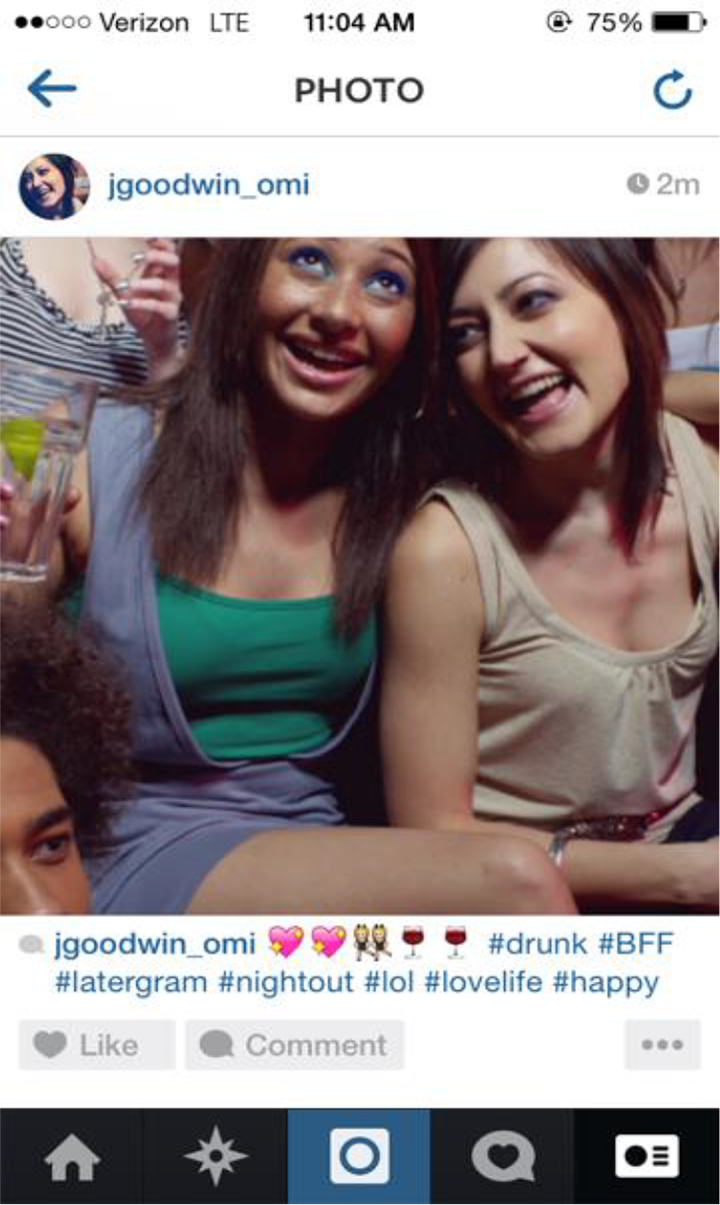
Fictitious Instagram post featuring an image of two women enjoying drinking.
In general, the photo was viewed as somewhat typical for this age group, and those participants who reported being Instagram® users discussed how they frequently saw photos like this in their networks. So personally I see some of these very often. People having fun and having fun nights out with alcohol either being involved in that. So it doesn’t surprise me if I knew these individuals personally. I would assume it’s just another group of friends that I’m not too close to, that are just having fun on a Friday night or a Saturday night. (076) Where you all at? I would like to know where you’re at, you know. I want to come, too. You all looking like you’re having a good time, just laughing, just you know. Picture says itself, you’re all happy and you’re having a good time. That’s where I’d like to be is, you know, where there’s a good time and having fun. (079)
Gender-based differences in online identity management also emerged from our interviews in response to this image, with many participants noting that men would present themselves quite differently. For example, one male participant remarked: You know, men wouldn’t portray this kind of scenario on their social media, or it doesn’t happen very often with men, traditionally. I think that two men drinking a beer or a glass of whiskey or something – not having all these hearts and hashtag BFFs and LOLs and Love Life, happy things – I don’t think that any of those would be present. So, it’s hard to make that jump just because I think that it would be very different. (081)
Finally, this photo also elicited discussion about young people’s use of Instagram®. Although most participants acknowledged its common use, discussions about personal use of Instagram® revealed a variety of responses in terms of different protocol for sharing alcohol-related imagery. Some participants commented that posting alcohol-related photos was acceptable on Instagram® while others felt that the broad and open nature of Instagram® prohibited them from feeling comfortable sharing such information. With Instagram®, everybody can see it, especially if it gets like, over a million likes. If you get over a million likes, it’s on Instagram®’s front page for the picks of the week and Instagram®’s most popular pictures. Like, as soon as you log on, it’s on the home page, so like, if this was like – if these were minors and they weren’t able to drink right now, this would be a big no-no – bad, bad. That would be bad. (140)
SnapChat®
SnapChat® is a popular SNS with young adults, having over 200 million users (http://www.omnicoreagency.com/snapchat-statistics/). Unlike other platforms that rely on user-procured “pages” as their visual interface, SnapChat® gives users temporary access to other’s visual material through time-dependant viewing. Instead of creating a profile page to upload material, members share and alter digital media using “Snaps”. These are photos and videos that users take in real time and send directly to others in their network. Users can make videos and photographs viewable for up to ten seconds. Recipients open the Snap and as soon as they do so, the time begins to elapse. Once it has been viewed for the allotted time period, the Snap closes and is no longer available. Stories are also popularly used, and are made up of a series of Snaps that the user hand-picks to make accessible to groups within the SnapChat® community. Whereas Snaps are available for relatively short periods of time, stories are openly accessible to their recipients for a 24-hour period.
Figure 2 shows two young men sitting on the grass, with three 40-ounce bottles. Both of them are looking at the camera, and while one of them one is actively drinking and “giving the finger”, the other has one eye partly shut is holding a bottle in his left hand and has another bottle placed between his legs. The young man with the two bottles also has his hands wrapped in clear tape. The picture is accompanied with large blue text reading, “40 Oz. to FREEDOM”. The photo is identifiable as part of SnapChat®, by the time wheel in the upper right-hand corner of the photo.
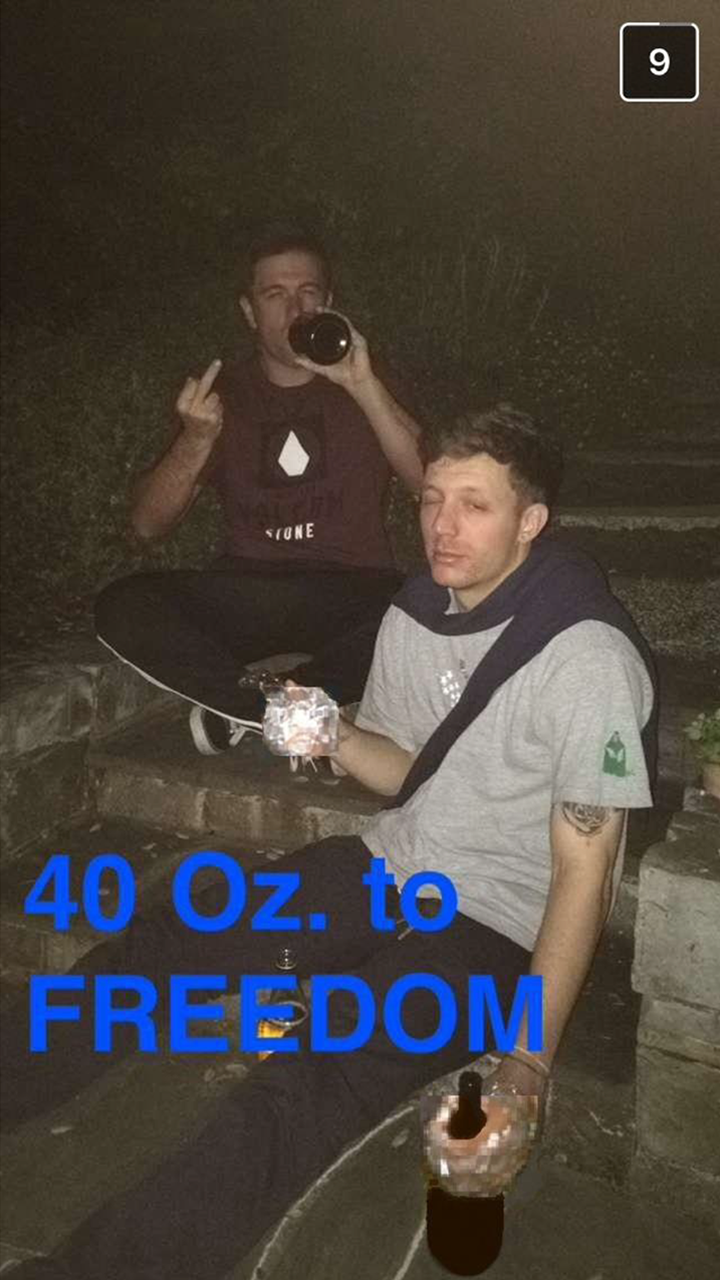
Fictitious SnapChat photo of two young men playing “Edward 40 hands”.
Most participants recognised that the drinking activity was “Edward 40 hands”, a game where the participants tape a 40 ounce malt liquor bottle to each hand and are not allowed to remove the tape until all of the alcohol has been consumed. Not all of our participants, who use SnapChat®, viewed this type of post as representing their own personal use of the platform, although most acknowledged the possibility of seeing a photo like this on SnapChat® and explained that people appear more willing to share photos and videos of riskier behaviours on SnapChat® compared to other social media platforms because of the “temporary” access others have to this information. Yeah, of friends, if it’s funny, if it would be funny and stuff. ‘Cause SnapChat® is just, it’s not really – it’s just shown, and you know that it’s gonna be gone after a day, 24 hours. So then, you don’t really care. And you do it for audience. Like, like you want to entertain the people that you have on, so. (067) For Instagram®, you just want to show like the cute picture that when you’re not drinking. Like, your outfit and stuff, not your drinking. But with SnapChat®, it’s just the whole scene, I feel like. And then, if it’s like when you wake up in the morning, and you watch it, if it’s too funny, like something you would talk about in the future, and like you save it. But you don’t post it. That’s too embarrassing. People see it. Especially like, you know like if your interviews, they check your social media account. So I wouldn’t want them to see that. (073) Oh, I forgot about SnapChat®. I’ve seen folks use SnapChat®, it’s a really quick and easy way to highlight an experience that they’re having, specifically with alcohol. Like, an example would be, say, it’s a Friday. Oh, it is Friday, actually. So, [quick laugh] tonight. I’m sure that some folks that I know, acquaintances, and possibly friends, will be indulging in like, really luxurious, alcohol experiences, and they will be giving a little video of what they – what their selection of alcohol will be for the evening, or if they’re at like a rave or a party or like, a bunch of alcohol at a club in the city, they’ll have a video SnapChat® of them drinking or showing everyone else drinking at a bar or something like that. (077)
Facebook®
Facebook® is one of the most frequently used social media sites in the United States, with research suggesting that 82% of young adults (18–29 years old) who have internet access in the US use Facebook® (http://www.pewinternet.org/2015/08/19/the-demographics-of-social-media-users/). Using profile pages as their main interface, members expand their network by adding and requesting other users as “friends”. By becoming accepted, those members receive updates on all material that is “posted” (meaning it is publicly added to the user’s profile) through their “timeline” – a user interface that acts as a newsfeed, listing posts in chronological order. Through additional methods such as direct messaging, event-sharing, and group-creating, members are also able to exchange information in a more private manner where it can only be accessed by members who have already been given permission.
The final image, Figure 3, portrays a screenshot of a Facebook® timeline. The photo shows a young woman, Steph, sprawled out on a public bench. Her body is lying in a supine posture, arms limp, and her head turned away from the camera. Her feet are the only parts of her which touch the ground. Next to her are two empty bottles, and the lighting suggests that the photo was shot early evening or at night. Two or maybe three other people are seen out of focus, walking by in the background. The photo is posted by “Corey”, a fictional character, whose image is accompanied by comment from him: “LOL steph had a little too much fun last night…”.
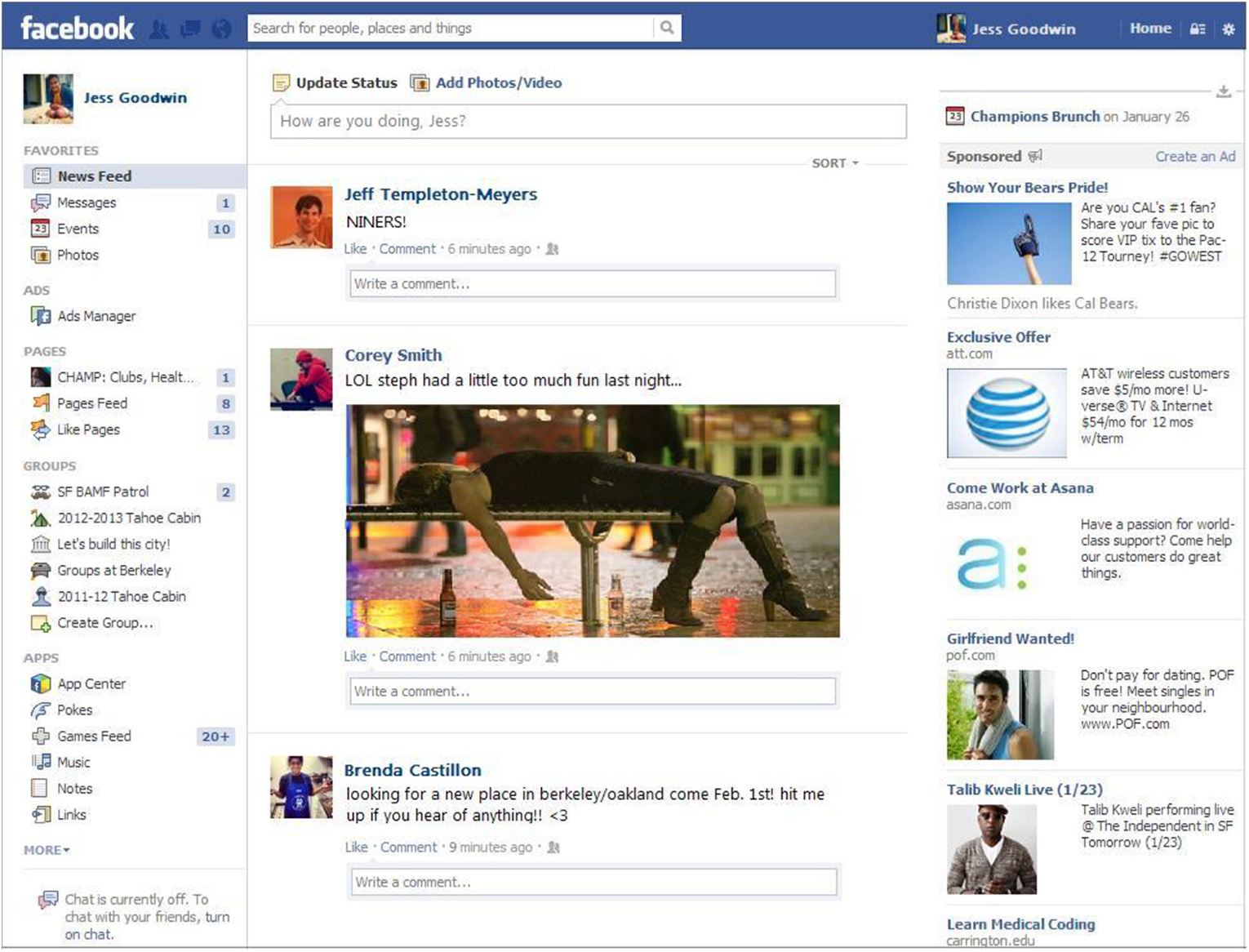
Fabricated Facebook newsfeed post featuring a photo of a young woman sprawled out on a public bench.
Compared with the other two social media photos, the Facebook® image provoked the most consistently strong reactions from our participants. First, most participants viewed Steph as being heavily intoxicated and they expressed concern for her safety. Like, why would you – I don’t know. I would be like – I wouldn’t want myself to be seen like that, and it’s dangerous. Like, I would be so worried. Like, did you leave the girl there? What happened to her? Is she okay? Is she like, you know – yeah, I’d be worried if that was my friend. (073) Um, this dude, uh, I guess he just – to me is, I don’t see shit funny about it. Like especially, like if that’s your friend, like I don’t know, seen in a friendly light. I mean that’s just his thing or whatever. He thinks it’s funny. I mean, he might just took the picture, and then took her home or whatever. But I mean, it appear to me, just that’s just not how it should end. (079) And the fact that you posted it on social media – Like, my momma ain’t – My momma ain’t never even seen me like, this drunk. You know, just speaking from a female point of view, like, my momma ain’t never seen me like, that drunk. And you gone’ post this on social media for everybody to see? But you supposed to be my partner. (019) I mean, nowadays, like, yeah, employers don’t do anything without checking your Facebook® and all your media, which is crazy, but it’s true. I don’t know. I’ve seen all these people that have all these crazy like, drunk night on there, and I’m just like, Are you crazy? Like, I barely post a picture of like, a normal one of me on Facebook®, let alone a drunk one. So, like, whoa. (067) Yeah [laugh]. Um, since I’m in an age where like lots of people are trying to get like real jobs, uh, for the first time or whatever, I’ve noticed that there’s less sort of – there are fewer pictures of that sort of thing on social media. And people might get upset if somebody posted a picture with them in it. (075)
The added value of social media embedded-photos
During the early phases of interviewing, using photographs proved to be successful in eliciting responses that were less accessible using other methods in the interview guide. Furthermore, the choice to have a Facebook®-embedded photograph proved to be of great value as its use prompted unique discussions from our participants on the meanings of drinking and intoxication. Using social-media-based photos allowed us to ask the participant questions about their membership of the online communities, thereby tapping into additional information regarding their real-life practices and experiences as members and users. To illustrate the value of using social-media-embedded photographs, the following summarises the emergence of two themes that resulted from our use of social media in PE: professional identities and the gendered double standard of online normative behaviour.
Professionalism
This issue of online normative behaviour and the potential for social consequences emerged naturally from our use of social-media-embedded photos, with participants discussing a wide range of demographic groups as possible members of the online community. Within these discussions, concerns quickly emerged related to employment issues and maintaining a “professional” image. On social media platforms, considered at risk for being viewed by employers (Facebook® and Instagram®), posting photos or videos of one’s alcohol use or intoxicated behaviour was seen as a taboo behaviour and participants expressed a strong level of concern for an individual’s job status or his or her ability to find employment. Yeah. With the job that I have, I can’t do it as much. I can’t have a beer in my hand and a blunt in my mouth and be like, oh, I’m just chilling. Because there are professionals looking at my Instagram® and my Facebook®. So if I am to do – I have before, like if you were to scroll way back into my past on my Instagram®, you would probably find a picture of me with a blunt in my hand or something like that. But for the most part, I understand that you can’t – that they will judge you fast, just off your social media. So I don’t. I don’t necessarily have that on my social media. But I’m pretty sure that you will be able to tell that I do. I do it. (107) I always knew that employers always look through your Facebook® profiles. And I was always suspicious of like, maybe if they really do, maybe it might not be the best thing for me to talk about me doing it, or having pictures of me doing it, which also made me refrain from taking a lot of pictures of me being intoxicated. (076)
A significant amount of research on the topic of e-professionalism has noted the online portrayal of drinking alcohol as a potential area of concern (Cunningham, 2014; Gupta, Singh, & Dhaliwal, 2015; Jain et al., 2014; Root & McKay, 2014). In their survey of college business students, Root and McKay (2014) found that their participants held a strong belief that their Facebook® profiles could greatly impact their chances for employment, noting that, “there seems to be a general awareness on the part of students that prospective employers would consider posts dealing with negative comments, drugs, alcohol, sex, and profanity to be important information about a potential job candidate” (p. 206).
The notion of workplace surveillance – that one’s drinking could be an employer-monitored activity – consistently came up as a concern during the social media phase of our PE. Furthermore, these concerns illuminated participant perceptions of drinking activities as unprofessional, and the oppositional relationship between their lives as drinkers and their professional lives. Consequently, the use of social-media-embedded photos gave us access to this rich, yet context-driven data, which were rarely talked about in other sections of the interview. By using social-media-embedded photos, we were able to explore the dichotomy between alcohol and professional identity, an issue that is of interest to our research, but one which would have gone underexplored if we had not employed social-media-embedded photos within our PE section of the interview schedule.
Women online: Classy vs. trashy
While participants often expressed reluctance to discuss differing outcomes and perceptions of men’s and women’s drinking practices, the social media photos evoked clear and descriptive narratives about gendered differences in intoxication. The notion of “classy vs. trashy” emerged as an especially salient theme from discussions elicited by social-media-embedded photos. Participants discussed how women are often discouraged from engaging in heavy drinking, in part due to the importance of maintaining their femininity. Furthermore, what was particularly striking was the extent to which female participants appeared harshest in their judgment of other women (Griffin, Szmigin, Bengry-Howell, Hackley, & Mistral, 2012). You’re giving that perception that women are not classy. And I just don’t think that taking photos of yourself, and posting it on social media inebriated is very classy. Drinking, maybe that’s a little bit of a different story. But actually being inebriated, and putting it on social media is not okay. And then, also when you get to that point where you’re that drunk, that you have people take photos of you, that’s not okay either. People shouldn’t be putting photos up of you, either, really inebriated. (091) See, if it’s a girl, it looks – I don’t know. It looks, it looks fun. But at the same time, it kind of looks disgusting [laughs], yeah, for some reason. ‘Cause it’s like, you know that picture you showed me about if you drink like a man, you might look like one?…It kind of applies to this one, too. Like we all know that you – it’s bad, ‘cause it’s not nice to look at if you’re a lady, and like – it’s okay to have fun. But like if you get loose and whatever, and like had like a wild night, and just you know, um, not behave as expected, it’s more kind of like unacceptable. So it’s like almost saying, she can’t control herself when she drinks, kind of. (095)
Such findings appear connected with general views about drinking and intoxication as primarily a performance of masculinity (Hunt & Antin, 2017; Hunt, Antin, Bjonness, & Ettorre, 2016). In this way, choosing to portray oneself online as intoxicated, while confirming normative masculine behaviour, was nevertheless viewed as a violation of normative feminine behaviour. This is not to say that all women in the study necessarily shared this belief – in fact many openly resisted such a skewed, gendered view of intoxicated behaviour. Nevertheless, using and comparing photos embedded in different social media platforms revealed information from our participants on issues not only about gender differences in the meanings of intoxication but also highlighted how they perceived social media platforms in managing their online identities.
Conclusion
For qualitative researchers seeking to answer questions of youth culture and young people’s social behaviours, employing social media in their methods may be valuable given the strong online presence of young people in the United States. It is estimated that 93% of Americans between the ages of 12 to 29 years go online (http://www.pewresearch.org/millennials/teen-internet-use-graphic/), and of the adults in this demographic (18–29 years) nearly 90% of them use some form of social media (http://www.pewinternet.org/fact-sheets/social-networking-fact-sheet/). Additionally, the widespread use of mobile devices with online capabilities, such as smart phones, has made communication online all the more frequent. This pertains especially to younger groups, with research suggesting that over 70% of teenagers use multiple social media platforms to communicate with others (http://www.pewinternet.org/2015/04/09/teens-social-media-technology-2015/).
For our project, social media became a valuable tool to view issues of drinking and intoxication. In fact, alcohol consumption is merely one aspect of a wide range of daily leisure activities that our participants exhibit using social media. The effectiveness of using social media platforms within our interview methods as a way of generating a more comprehensive approach to the study of intoxication proved especially important for the age demographic of our sample, given their use of social media. Even when participants had little experience with a specific photographed situation, the online context in which it was embedded gave them a familiar lens to view the material and reveal personal assumptions, opinions, and concerns about alcohol use and intoxication. This exercise also provided an invaluable repositioning of participants from the perspective of “drinker” to that of an “observer of drinkers”. Many participants answered questions very differently depending on whether they spoke from personal experience or they were simply interpreting or commenting on the experience of an “other”. Moreover, given the fact that online SNS are so common, so familiar and so endemic among young people, to ignore this feature of contemporary youthful social interaction would have unknowingly restricted our access to important narrative data. As researchers, we must use the resources we have at our disposal, and the opportunity to easily integrate such a pervasive medium such as social media may be valuable to researchers looking to explore contemporary issues.
In the “Visual methodology” chapter of The Sage handbook of qualitative methods (Denzin & Lincoln, 2011), Prosser states that, “Visual researchers are well aware that technologies change what and how they study. With the advent of new technology for storing, organizing, and presenting research, the qualitative–quantitative interface is being broadened, refined, and morphed” (p. 481). The shift from film to digital photography has allowed people to create and share visual information in rapidly changing ways as a result of ongoing technological advancements (Graham, Laurier, O’brien, & Rouncefield, 2011; Van House, 2011). Acknowledging this trend, research on social media and the use of SNS is rapidly expanding, resulting from an understanding of technology’s growing influence on people’s everyday lives – especially young people (boyd & Ellison, 2007).
Although full emersion into these online cultures would be ideal, research on social-media-related topics does not happen without ethical and methodological concerns. Many researchers are currently exploring SNS as a way to examine broader questions regarding human interactions and the use of new technologies (Hutton, Griffin, Lyons, Niland, & McCreanor, 2016; Lunnay, Borlagdan, McNaughton, & Ward, 2015; Moeweka Barnes et al., 2015; Moreno, Grant, Kacvinsky, Egan, & Fleming, 2012; Uimonen, 2013), but often confront challenges in terms of access and ethics (D’Arcy & Young, 2012; Edwards, Housley, Williams, Sloan, & Williams, 2013; Lunnay et al., 2015). Given that these SNS often contain a wide array of personal and confidential information, proper measures must be taken to ensure participant safety and security. This unfortunately creates extra barriers for research teams interested in this topic, and for them, alternative methodologies may be more appropriate. Using social-media-embedded photos as a part of a PE activity may serve as an effective alternative strategy for investigating yet another facet of people’s everyday lives. Instead of navigating legal risks of access and approval to gain entry to private pages and online information, researchers can gain insight into participants’ online social lives through discussion of photos embedded in different social media platforms. With that said, proper procedures must be taken to ensure that the photos used are gathered and altered with the consent and confidentiality of the photographed person(s) in mind. While it is relatively easy to retrieve photos from one’s social media account for research purposes, ensuring that all personal identities and messages are altered or omitted is essential. With such a wide array of personal data present on any single platform, researchers will still need to be vigilant in efforts to ensure confidentiality within their research designs. Consequently, although our method of PE comes with limitations, it can provide a simple strategy that reduces the use of private and confidential information from online sources as well as the logistical efforts involved in directly accessing participants’ personal SNS.
Footnotes
Acknowledgments
We would like to thank the 200 young adults who volunteered to participate in our study as well as valuable members of our research team, Maya Sisneros, Sandra Alayon and Olivia Bennett, who conducted some of the interviews.
Declaration of conflicting interests
The authors declared no potential conflicts of interest with respect to the research, authorship, and/or publication of this article.
Funding
The authors disclosed receipt of the following financial support for the research, authorship, and/or publication of this article: This work was supported by the National Institute on Alcohol Abuse and Alcoholism under Grant RO1 – AA022656.