



Abstract
Introduction
This study explores substance use patterns among Norwegian adolescent girls through an investigation of their subjective views, attitudes, and beliefs on substance use. Adolescence is a period marked by physical, psychological and social change. Some adolescents turn to substance use at this time. However, a recent study based on European School Survey Project on Alcohol and Other Drugs (ESPAD) surveys from 2007, 2011 and 2015 concludes that alcohol use among adolescents in Nordic countries has decreased (Ekholm et al., 2024). According to the 2015 ESPAD report, alcohol consumption among youth in Nordic and Baltic countries is less frequent but higher in volume compared to youth in other European countries. At the same time, the use of cannabis, inhalants and psychoactive substances is the lowest in Europe (Kraus & Nociar, 2016).
Nevertheless, according to a national survey of Norwegian youth (Ungdata) from 2022, narcotics use among Norwegian youth increases when they are in upper secondary school. This has been the case since 2015 for both boys and girls, but especially for boys. Among girls in upper secondary schools post-pandemic, there has been an increase in the use of cannabis and cocaine (Bakken, 2022). The most popular illegal substance among Norwegian youth is cannabis, followed by cocaine, amphetamine and methamphetamine (Skretting et al., 2017).
The years in upper secondary school bring many changes to the lives of Norwegian adolescents, and, on their 16th birthday, they acquire more rights under the law, including the right to decide what health information to share with or withhold from their parents. Some health information can be disclosed to parents without a child's consent if it is deemed necessary for them to fulfil their parental responsibilities. These exceptions typically pertain to serious mental illnesses, self-harm, substance abuse or suicidal risk. When such information has been shared with parents, the child will be informed (The Norwegian Directorate of Health, 2018). Norwegian youth in upper secondary school are offered free low threshold primary health services by municipalities through the school health service, and the youth health centre (Helsetjeneste for ungdom) (The Norwegian Directorate of Health, 2016). They offer counselling, health examinations and treatment. The youth are also able to discuss their health, social issues, and substance abuse problems with general practitioners (The Norwegian Directorate of Health, 2014). According to the Norwegian Institute of Public Health's report from 2018, emotional problems and psychological distress among girls increase in upper secondary school, especially among girls with immigrant backgrounds. There has been an increase of number of diagnoses given to girls in this age group from Child and adolescent Psychiatric Outpatient clinic (Barne- og ungdomspsykiatri, BUP) (Reneflot et al., 2018). BUP offers help only for youth aged between 16 and 18 years with substance use problems; adolescents over 18 years can obtain treatment from municipal mental healthcare units (The Norwegian Directorate of Health, 2016).
According to the 2021 Activity Report from the Norwegian Patient Register, only 0.6% of the patients in interdisciplinary specialised substance abuse treatment (Tverrfaglig spesialisert behandling av ruslidelser) were aged under 18 years, and, of those, only 34% were women (The Norwegian Directorate of Health, 2022). Approximately 0.2% were underage females. Several Norwegian municipalities have participated in the BrukerPlan (User Plan) survey, which concluded that young people with substance abuse problems should receive help earlier. A 2017 BrukerPlan report from central Norway suggests that adolescent girls need more attention, and also that professionals need better training in identifying substance abuse among girls who are able to hide it (Wright et al., 2017). To detect substance abuse among girls early, it is important to know more about their perceptions of substances and substance use, as well as how to detect different patterns of use. This study adds to the literature by answering the following research questions: What views do adolescent girls have on substance use? How are these views reflected in their patterns of use?
The concept of mattering
The concept of mattering can provide valuable insight when examining the adolescent girls views on substance use. Rosenberg and McCullough (1981) defined mattering as a human need to feel important and significant to others and addressed three components of mattering: (i) attention (feeling noticed); (ii) importance (feeling significant); and (iii) dependency (feeling that others depend and rely on them). Other components have since been added, such as feeling appreciated (Schlossberg, 1989).
After several decades of inattention, mattering is now being studied more intensively (Flett et al., 2023). In English, the term conveys a feeling, perception or sense of significance or importance. Prilleltensky (2020) and Prilleltensky & Prilleltensky (2021) have revealed that mattering entails adding value to others, not just feeling valued by others. According to Prilleltensky (2020) feeling valued encompasses appreciation, respect and acknowledgement. It is connected to three needs: survival (caregiver attachment and emotional availability), belonging (relational significance through connections with family and friends) and dignity (recognition, acknowledgement, inclusion, and respect). Dignity is attained by experiencing fairness through a sense of worthiness and equality. If these three needs are not met, mattering is absent. Adding value includes empowerment, autonomy, mastery and self-efficacy, and it happens through contribution or when people believe that they make a difference.
Mattering is not limited to people of any culture or region. It is complex and can be seen as double-edged (Flett, 2022). People who believe they matter tend to be more engaged and resilient, whereas those who do not are more vulnerable to psychological pain (Flett et al., 2023). Mattering can be considered on many levels, such as how individuals experience that they matter to the people closest to them; how they feel they matter at school or at work; or whether they matter in their community and society (Flett, 2018). Schmidt et al. (2020) identify two domains of mattering: interpersonal and societal. The former is influenced by relational factors, such as parental involvement, parent–child communication and support from friends. The latter is affected by contextual factors, such opportunities for community involvement, access to community resources and participation in decision-making.
Mattering is a recurring theme in the psychological and social work literature. Some studies explicitly address the concept, particularly in relation to its influence on relationships, intervention, and outcomes in social work practice. Elliott (2009) wrote one of the few studies of mattering in adolescent substance use. Understanding the influence of mattering to adolescent girls’ substance use patterns may contribute to the development of targeted interventions for this population. The mattering concept is apparent in the global social work statement of ethical principles of the International Federation Of Social Workers (IFSW): “Recognition of the Inherent Dignity of Humanity” and “Treating People as Whole Persons” (IFSW, 2018). These principles highlight the importance of respecting individuals, valuing their identities and addressing various dimensions of their lives. They oppose discriminatory practices and policies in social work practice, lift up the importance of respecting diversity and affirming individuals’ sense of value within their communities.
In social work research, mattering is applied in studies of attachment (Charles & Alexander, 2014) and relationship-based social work (Gupta & Blewett, 2007). Brown et al. (2019) studied the role of mattering among marginalised Black social work students. The concept is also used in relation to hope and economic mobility (Castro et al., 2021), wellness programmes for mothers (van Schalkwyk & Naidoo, 2022) and to the experience of hope and purpose (Castro Baker et al., 2021). The editorial notes by Powell (2010) in “Families in Society” emphasised the broader implications of mattering in social work practice. According to him, social workers possess the capacity to instill a sense of mattering in clients and improve their well-being by addressing issues such as marginalisation and loneliness, while fostering resilience through empathic communication and engagement. These studies show how diverse the nature of mattering is, and its profound implications for social work research.
Even though mattering is significant throughout life, it is especially important during childhood and adolescence. When children and youth experience that they matter to their families, it has a protective effect on their lives and on their substance use (Elliott, 2009). In adolescence, mattering generates hope, fosters school engagement and promotes positive behaviours (Somers et al., 2022). Adolescents who feel valued have better mental well-being, are less prone to depression and anxiety, feel less embarrassment in social situations, and are better able to cope with challenges (Flett et al., 2014). Family dynamics, parenting and communication styles also play a significant role. Elliott (2009) explains Baumrind's parenting styles in terms of mattering. Children of authoritarian parents may feel that they matter only when they meet their parents’ expectations. By contrast, children of more permissive parents may later realise that their parents didn’t offer enough guidance and structure. The authoritative parenting style, with its good communication, ensures children's experience of mattering and importance within the family. Schmidt et al. (2020) stress the importance of parental involvement and communication. They found that open and effective communication within the family gives adolescents a sense of significance and belonging.
Recent research also emphasises the importance of the father-child relationship in adolescents’ sense of mattering and their mental health (Vélez et al., 2020). Particularly for adolescent girls, peers exert a great influence on feeling valued and accepted, and girls who do not experience being important to their peers are more susceptible to loneliness (McComb et al., 2020). People who do not believe that they matter often feel disconnected, insignificant and lonely. They also report diminished motivation and a greater likelihood of engaging in risky behaviours (Somers et al., 2022). According to Elliott (2009), feelings of not mattering during adolescence are correlated with antisocial and self-destructive behaviours. Feelings of hopelessness (Flett, 2018) and insignificance (Shannon et al., 2020) are linked to suicidal ideation. Moreover, feelings of not mattering can lead to excessive drinking, substance use and overconsumption of social media (Flett et al., 2023).
Methods
This study utilised Q methodology (QM), a research technique that combines qualitative and quantitative methods to uncover patterns of subjective viewpoints among participants (Brown, 1980; Watts & Stenner, 2012). QM is becoming increasingly used in social work (Ellingsen et al., 2010), health care (Churruca et al., 2021), education (Lundberg et al., 2020) and comparative policy analysis (Molenveld, 2020). Because it also allows for the expression of viewpoints, beliefs, and attitudes in a participant-friendly way, it is valuable when studying social problems or perspectives from vulnerable social groups (Brown, 2006; Ellingsen et al., 2010). In QM, participants sort statements into a grid based on how they relate to each other. Each participant's Q sort undergoes by-person factor analysis, revealing shared perspectives among the participants (Watts & Stenner, 2012).
Developing study materials
The QM study process comprises several steps (McKeown & Thomas, 2013; Watts & Stenner, 2012). It begins with identifying the ways in which people familiar with the research topic may communicate about it. This process is based on the concourse theory of communication (Brown, 1980; Stephenson, 1953), where the researchers identify possible viewpoints on the research topic. In this study, the concourse was gathered from in-person interviews with adolescent girls with a history of substance use, and with professionals working in the health and social fields. This approach ensured the use of naturalistic language and comprehensive coverage of topics pertinent to the population. The professionals were from a low threshold service, which also had consented to assist in recruiting young females for the study.
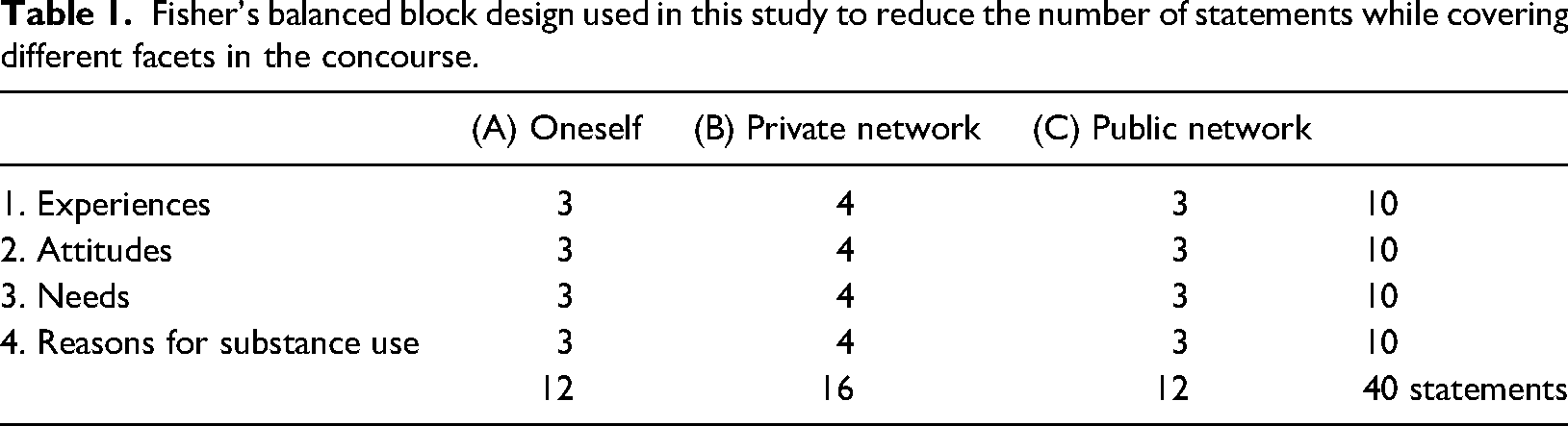
The interviews resulted in 417 possible statements. A subsequent systematic thematic coding of the statements using Nvivo 14 (Lumivero, 2013) detected 36 topics, which were classified under four categories: Experiences, Attitudes, Needs and Reasons for substance use. Within each theme, some statements were related to the adolescent girl, others concerned family or peers, and still others concerned teachers, school nurses or the help system generally. We combined family and peers into a single “private network” category, and grouped the school staff and helping professionals under "public network". Thereafter, we condensed the statements for Q-sorting using the Fisher's balanced block design (Stephenson, 1953) (Table 1), aiming to select a variety of statements from each crossed category to cover the heterogeneity of the concourse. The theme of private networks is represented in one statement more than the others, ensuring sufficient coverage of both family and peers. In Q methodology, it is important that the statements allow for self-reference on the research topic (McKeown & Thomas, 2013). Additionally, due to the variety of substances that exist, it was important to use a unifying concept that participants could easily relate to for different types of drugs and alcohol. Therefore, “substances” were chosen as a unifying concept. The final set of statements consist of 40 statements covering a range of perceptional views on substance use and related topics. Moreover, it was crucial to ensure that the statements were articulated clearly and could be related to by all participants, regardless of their substance use patterns and attitudes. The statements are used in the Q-sorting procedure where participants assign value to statements based on their views.
Fisher's balanced block design used in this study to reduce the number of statements while covering different facets in the concourse.
Study participants
To reveal the concourse and develop statements for the study, we wanted to interview adolescent girls with known substance use issues, and social workers experienced working with youth at risk. We contacted social workers at two low-threshold services for youth, and provided written information about the study, resulting in the recruitment of three girls and three professionals for initial interviews. These interviews were conducted in April and May 2021. To recruit participants for the Q-sorting procedure, we contacted upper secondary school principals, in addition to social workers. The pandemic made recruitment difficult and only one city school and one rural school responded positively. Thirty-one girls were recruited from the schools, five from low threshold services and six through snowball sampling, resulting in 42 participants in the study. Five were aged 16 years, 14 were aged 17 years, 17 were aged 18 years, five were aged 19 years and one was aged 20 years at the time of data collection. The average age of the participants was 17.6 years. Youth participants received 200 NOK in compensation for their time and additional travel expenses were reimbursed.
Q sort participation
The Q sorts were conducted between March and November 2022. As part of the Q-sorting process, the participants were instructed to arrange a set of statements in a grid. The grid had quasi-normal distribution ranging from “Most true to me” with a value of +5 to “Most untrue to me” with a value of −5. The grid also had spaces that graded into a more neutral area at the centre of the grid (Figure 1). To facilitate sorting, participants were asked to perform a preliminary sorting of the statements into three piles: one for statements true to them (green), another for statements untrue to them (red) and a third pile (yellow) for statements that they felt uncertain about or that they did not consider significant to them.
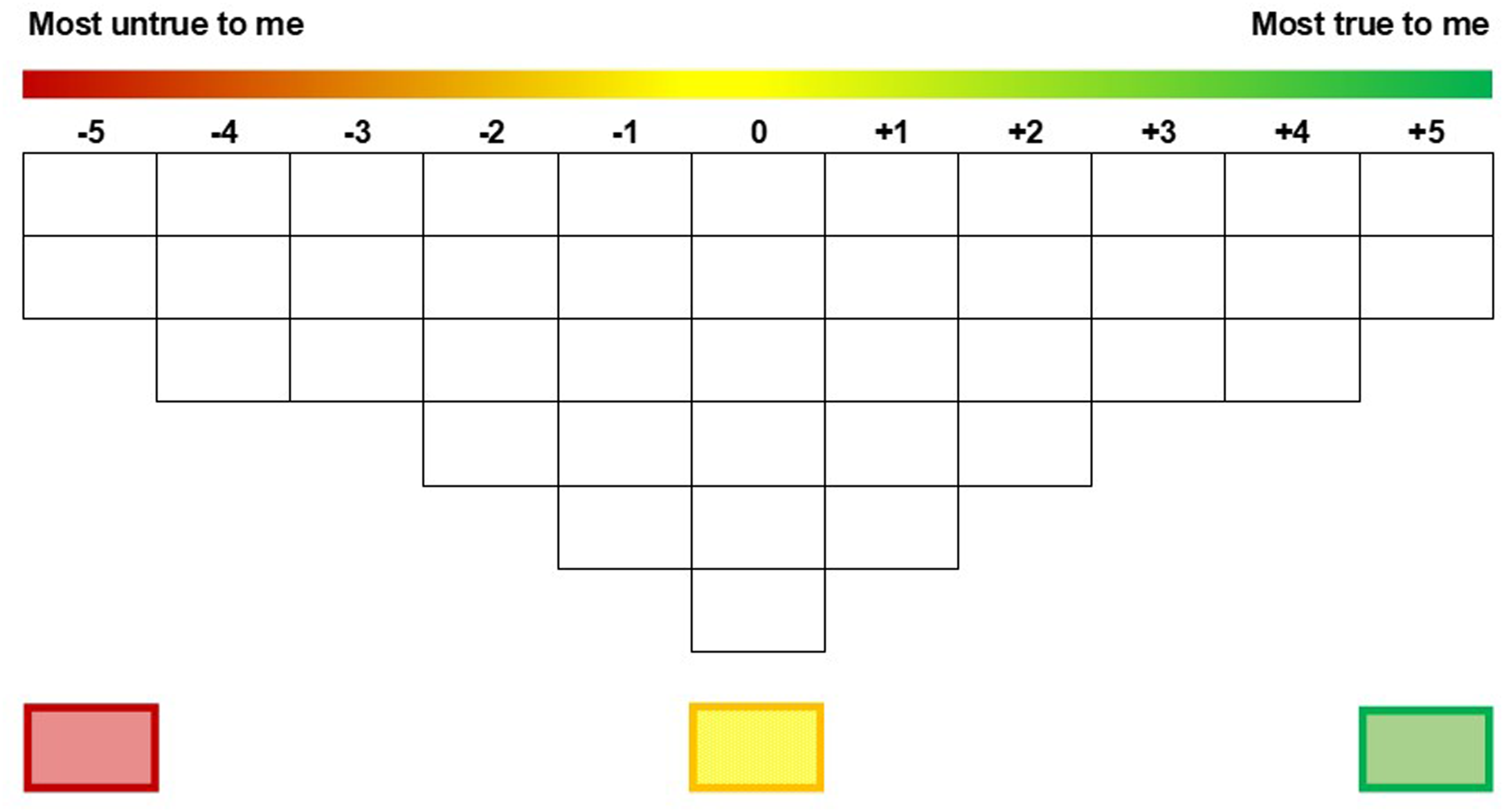
Grid used in this study where each statement is ranked and placed into the columns. The three squares were used in the presorting of the statements into three piles, true (higher positive psychological significance compared to other statements), uncertain/not important (lower psychological significance) and untrue (higher negative psychological significance).
While sorting the statements into the grid, participants were given the option to think aloud about the statements; for this reason, the sorting procedure was recorded. Such elaborations can provide important information for interpreting the participants’ perspectives (Jensen, 2021).
Q factor analysis
Each of the participants’ Q sort represents a holistic configuration of the included statements based on her perspective. The configuration also makes it possible to examine the relationship between each statement and to determine which statements are of high psychological significance to each participant, whether positively (most true) or negatively (most untrue) (Ellingsen et al., 2010). However, because QM aims to identify patterns of viewpoints, each participant’s Q sort is analysed through by-person factor analysis, which correlates their Q sort with those of other participants. In this study, Q factor analysis was carried out using KADE (Banasick, 2019), an open-source application for QM studies. When participants sort the statements in similar ways, they share resembling views and they will have a significant loading on the same factor, indicating a shared perspective.
In the analysis, several factor solutions were tested to find one that included as many participants as possible, with the highest factor loading possible. The output file of the analysis flags Q sorts that have a significant loading on a factor. When selecting the factor solution, we also considered factor correlations. Including too many factors increases the factor correlation between them, indicating significant overlap, and too few factors may lower the factor loadings of the Q sorts, leading to a less distinct perspective. We conducted principal component analysis using varimax rotation. A three-factor solution was determined to provide the clearest perspectives in terms of factor loadings, flagged Q sorts and factor correlations. Five participants did not load significantly on any of the three factors, indicating that their perspective differs from that of other participants; 37 participants share a perspective with at least six others revealing a “pattern of subjectivity” (Table 2).
Factor matrix showing each participant's loading on the factors (based on their Q sorts).
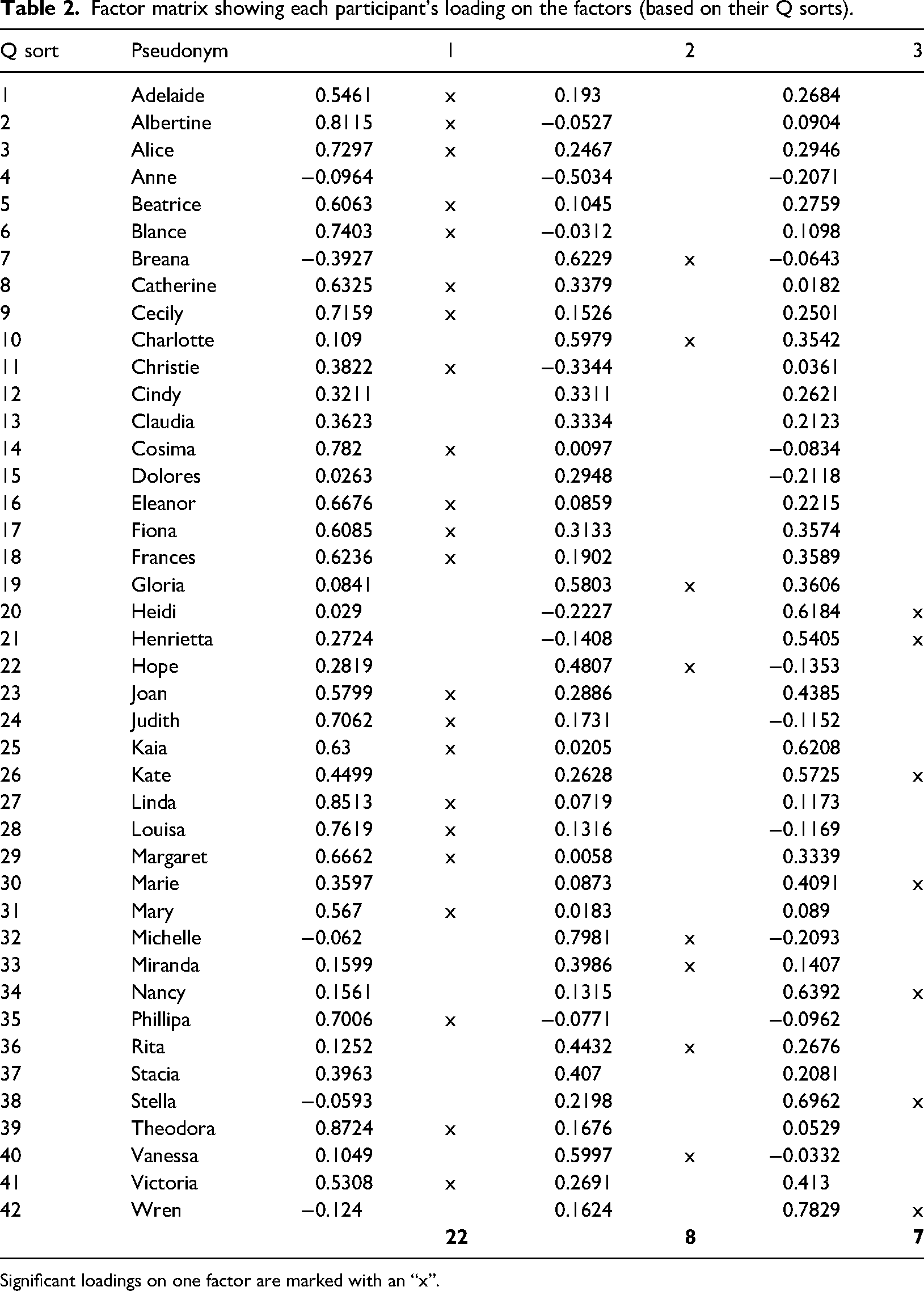
Significant loadings on one factor are marked with an “x”.
All data collection was conducted by the first author (HPSD), who also transcribed and anonymised the think-aloud elaborations. Participants were identified solely by codes, which were later replaced with pseudonyms.
Research ethics
This research project was approved by the Norwegian Agency for Shared Services in Education and Research (SIKT), and by Regional Committees for Medical and Health Research Ethics (REK). Prior to participation, all participants received their written and verbal information about the study and how ethics, confidentiality and anonymity would be secured before they provided their written informed consent. We informed all participants that, if they needed someone to talk to after participating in the study, they could reach out to the social workers at school or the low-threshold services. If they had any questions or needed assistance reaching help services, they could also contact the first author.
Results
Based on our analysis, we identified three distinct factors (perspectives) with a low correlation among them (between 1 and 2: r = 0.15, between 1 and 3: r = 0.31, between 2 and 3: r = 0.17). Based on our interpretation of the configuration of statements in each of the perspectives, we have labelled factor 1 “Confident – against illegal substances” (n = 22). Factor 2 is labelled “Ambivalent – substance use normalised, yet with negative consequences” (n = 8) and factor 3 is labelled “Outgoing – positive and curious about illegal substances” (n = 7).
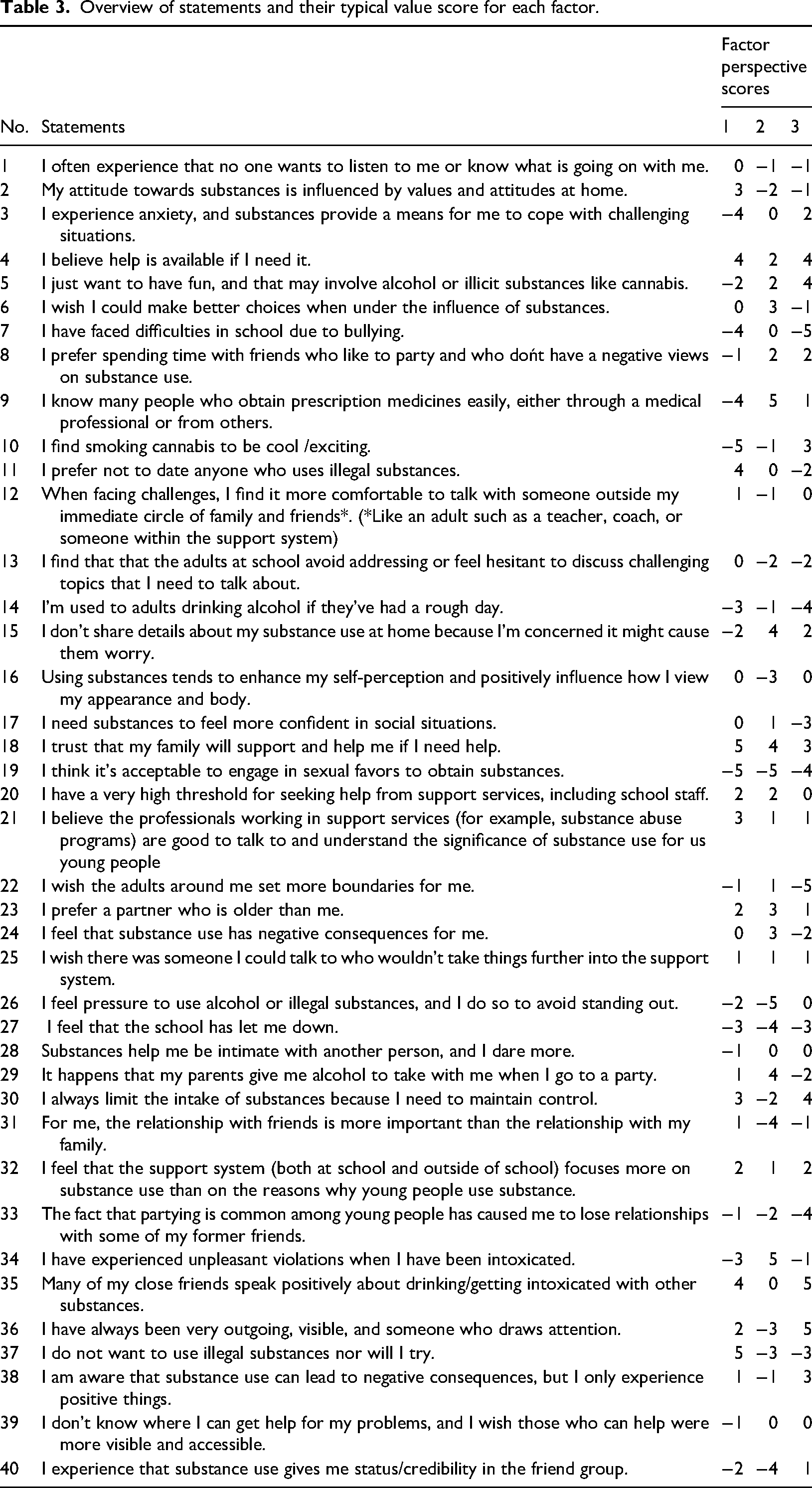
Before presenting the details of the three perspectives, we provide an overview of the 40 statements and their values ranging from +5 (most true to me) to −5 (most untrue to me) for each perspective (Table 3). For example, perspective 1 has typically given statement number 3 a score of −4, indicating the statement is strongly untrue to them (#3/–4).
Overview of statements and their typical value score for each factor.
Factor 1: confident – against illegal substances (n = 22)
This perspective (Figure 2, Appendix) is defined by a sense of security for both oneself and others, such as family, friends and public services. The participants with this perspective have a very conscious stance not to use illegal substances (#37/+5). Moreover, they find it neither cool, nor exciting to smoke cannabis (#10/–5), a perspective confirmed by Linda: “It's kind of the same thing. I have no interest, and I don't want to do it. I have no need for it.”
Furthermore, they claim that their attitudes towards substances are influenced by the values they were taught at home (#2/+3) and they are not used to seeing their parents using substances to cope with challenges (#14/–3). The statement about bringing alcohol from home to parties is scored +1, even though it is not considered important. However, most participants reported that they bring alcohol from home when going to a party. In addition, they do not express a need to hide their alcohol use from their parents (#34/–3).
In summary, this perspective communicates a sense of security in onés relationships to substances and attitudes within peer relationships. This perspective also reflects a sense of security in familial relationships. These participants are confident that their family will be there for them if they need help (#18/+5): Adelaide: “That's because I’ve always had someone to talk to when things have been difficult, yes. […] I’ve always had that kind of communication where I can always go to them (parents) if there's anything. And that's quite reassuring.” Eleanor: “Yes, I have actually very good relationship with my parents. I trust that they know what's best for me. And if there's something wrong, I just have to tell them, because they will never say it's my fault. Because everyone can make mistakes. I know that very well myself, and they (parents) have made some mistakes themselves too.”
Boundary setting by adults (#22/–1) is considered a minor issue, and the statement “For me, the relationship with friends is more important than the relationship with my family” is placed in a neutral position (+1). This may suggest that they do not need to explore it further since they already feel a sense of security. The relationship with the school and support systems also reflect trust. They know that help is available (#4/+4, #18/+5, #21/+3). The perspective gives the impression that these girls are experiencing mastery or at least a high level of proficiency in their lives (#3/–4 and #7/–4) and that they have secure relationships. At the same time, they have set a threshold for seeking help (#20/+2).
Factor 2: Ambivalent – substance use normalised, yet with negative consequences (n = 8)
The participants who are associated with this perspective (Figure 3, Appendix) all use both alcohol and illegal substances and they express a positive attitude to their use (#37/–3) (it should be noted that statement no. 37 is formulated negatively; when given a negative score, the meaning becomes positive). They also report that is easy for them to obtain prescription medicines (#9/+5). These adolescents associate having fun with use of alcohol or illegal substances (#5/+2) and it seems quite important to them to have friends who do not see partying and use of substances as something negative (#8/+2). They understand that substance use has negative consequences (#24/+3) and wish to make better decisions when under the influence (#6/+3).
It is also clear that the girls who have this perspective have experienced sexual abuse when intoxicated (#34/+5). The elaborations on the Q sort revealed that this abuse sometimes included rape, which shows that these girls are subjected to highly traumatic experiences. Nevertheless, they have a clear perception that exchanging substances for sex (#19/–5) is not acceptable. Moreover, girls associated with this perspective neither feel pressured to use substances (#26/–5), nor do they believe that substance use confers status among friends (#40/–4). This may be because they have normalised substance use and made it a natural part of everyday life. As Gloria explains: “I don't think so. Everyone is drinking … and most people have smoked weed. I mean, there are some in the friend group who do a lot of cocaine and a bit of molly here and there and … shrooms and stuff like that … And then I have a girlfriend who takes a lot of Xanax. And that's a bit worrying, but … in my friend group, it's pretty commonplace, actually. You don't become cool just because you smoke weed, you know. Everyone does it, kind of.” Michelle: “Um, yeah, I'm not very good at setting a limit, because yeah. Yeah, I take what I get no matter how much I've taken, you know. Yeah.” Breana: “I don't limit my intake because I'm not constantly thinking about control all the time. […] and if Dad picks me up, maybe I shouldn't take 3 lines of coke, you know. But if I'm at a party, like not too long ago, we had an extreme amount of coke, so then it was just ‘all out’ and I've overdosed twice.” Charlotte: “Yeah, I didn't really know that. Um, but here I can be completely honest and say that what often limits me is that I … what often limits me is that I run out [referring to illegal substances].” Hope: “Yeah, I never have control, I say yes to everything … if someone asks me to get high, I say yes. It's very hard for me to say no.”
Statements about having a boyfriend in the substance use environment (#11) and whether friends speak positively about substances (#35) result in a neutral score (0). When thinking aloud on the statements while sorting, it emerged that many of the girls already have boyfriends in the substance use environment, and that others in the friend circle have also experienced negative aspects of substance use, making it difficult to break away: Rita: “Um, yeah now … I don't want my boyfriend to use illegal drugs because I don't want to use them anymore myself. But if weed is considered an illegal drug, I think of this card as how I want my future to look. So, I don't want my future boyfriend to smoke weed either. He can do it occasionally, but not all the time.” Hope: “Yeah, this one is very important. I was sober for four months before I met my boyfriend last December. Like, I've been using drugs since then, yeah. It's really important to me, actually. I can't stay sober if he doesn't do the same.”
The perspective also shows that these girls, like factor 1, bring alcohol from home when going to parties (#29/+4), but they hide their illegal substance use from their parents (#15/+4). Statements addressing getting help for their problems (#39/0, #25/+1, #21/+1) or setting boundaries (#22/+1), are deemed relatively neutral. This may be seen in relation to that they reveal a high threshold for seeking help (#20/+2). Nevertheless, they feel confident that their family would support them (#18/+4) if they need help. They also state that the relationship with family is far more important than the relationship with friends (#31/–4). When placing this statement, several reveal that their friends are not especially trustworthy. As Hope elaborates: “Family is the most important, yes. It's the family I trust the most, and then there's the friend group that doesn't do drugs. But those who do drugs, I don't trust for a second. Can't make any plans with them.” Breana: “No, I've kind of tried a psychologist and stuff, but I'm way too afraid to speak up about my drug use, so I don't really know where I can talk […] I've been to PPT and DPS, but recently I got a message that we were going to end treatment at DPS because I didn't attend the sessions. But it wasn't about drugs at all, it was mostly about my social anxiety. But I don't feel like I can talk to a psychologist without there being further consequences … […] So when I talk to a psychologist and stuff, there are lots of things I must avoid saying, things I really could have used a lot of help with, because I feel like I can't talk to anyone in a way. And I struggle with quite a lot. And at school too, I feel like they could have been a bit more considerate, because I'm not doing very well at school.”
Factor 3: outgoing – positive and curious about illegal substances (n = 7)
This perspective (Figure 4, Appendix) is characterised by a favourable perception of parties and substance use. The girls who have this perspective have friends who speak positively about using substances (#35/+5), and they want to have fun using substances (#5/+4). They also find cannabis exciting (#10/+3, #37/–3). During the Q-sorting, it became evident that this group primarily uses alcohol, hash and MDMA, not prescription medicines or other pills; this might explain the placement of statement #9 about access to pills (+1).
The girls holding this perspective are aware of the negative consequences of substance use, but they primarily experience positive aspects themselves (#38/+3, #24/–2). That said, they have also experienced some negative consequences (#24/–2). The negative consequences have taken the forms of unwanted touching and suggestions of sexual acts. They believe they have control over their substance use (#30/+4), both in terms of their use and the consequences.
At the same time, they do not think that partying has harmed their friendships (#33/–4) and they have a positive view of being with others who are open to substance use (#8/+2). This is confirmed in the girls’ elaborations during the sorting of statements: Wren: “Um, yeah, it's just that it really sucks … like, being with people who are negative about … if you, for example, smoke (referring to weed) at a party and they're really negative about it or, or really judgemental, then it's not very fun. A real ‘party pooper’, you know, so that's basically what I was thinking.” Author 1: “Do you have friends who don't use drugs?” Wren: “Like, all my friends have smoked weed. And that's mostly what I do. So, I'm not really around a lot of people who don't smoke.”
Girls associated with this perspective see themselves as outgoing and with a social status among friends (#36/+5). As expressed by these participants: Marie: “We have a pretty silly class, and then maybe I feel like I have to have the loudest voice and be the one who raises their hand all the time …" Stella: “I'm very outgoing! I'm very social, I talk a lot. And I've kind of heard that maybe I need to calm down a bit on the talking, and that it's a bit like attention-seeking. I don't know, I've always liked being someone who talks a lot because then I have a bit of control over the conversations, you know.” Nancy: “I've had some anxiety, and then drugs have helped, like for example, weed, I couldn't eat, so I smoked and then I could eat. So yeah … so alcohol has actually been around for quite a while, […] it was hard to go out and meet people without drinking. So yeah.”
Furthermore, it is typical for girls holding this perspective to admit that their attitude toward substances is minimally influenced by their parents’ attitudes (#2/–1). Their parents have a stricter attitude to alcohol consumption (#14/–4) than the parents of girls associated with the other two perspectives. According to Nancy: “Yeah, my parents don't drink. Never really, so I've never experienced drinking at home. Or anything like that. Not at parties or Christmas Eve, it's never really happened. Yeah.”
Key differences across factors
When comparing these three perspectives, significant differences emerge. A crucial distinction between factor 1 and the other two factors lies in the girls’ attitudes to illegal substances and their openness with their parents. Substance use also serves different functions and yields distinct consequences for each perspective. In factor 1, substance use is limited to alcohol and is not concealed; for factors 2 and 3, the involvement includes hiding illegal substance use. Knowledge about access to prescription medication and pills varies significantly across factors, correlating with whether or not the participants use illegal substances (see statement #9) (Table 3).
Furthermore, girls associated with factor 1 reveal a more confident view of substance use, and in their relationships with friends and family. Those associated with factor 2 appear more insecure; they need substances to be social and at the same time feel tied to a social environment that uses substances. Those associated with factor 3 are more outgoing and have a more positive attitude to the social use of illegal substances. The girls’ relationships with their parents also diverge across factors. The first perspective indicates a reciprocal trust; girls associated with factor 2 desire more parental boundaries, whereas those associated with factor 3 claim that their parents are overly strict.
Analysing the seven consensus statements across the factors (statements #1, #13, #23, #25, #27, #32 and #33), these seem to be in general agreement within the youth population. However, their significance should be interpreted in conjunction with the configuration of statements for each factor.
Discussion
The results show that the participants in this study hold distinct perspectives of substance use that reflect a range of attitudes, behaviours and experiences related to use of alcohol and illegal substances. These align with use patterns described by the factor perspectives.
Three perspectives (factors) were revealed through the Q factor analysis. The perspectives are described as follows: “Confident – against illegal substances”, “Ambivalent -substance use normalised, yet with negative consequences”, and “Outgoing – positive and curious about illegal substances”. The differences among perspectives are related to attitudes to different substances and their use, the function of substance use, knowledge about various substances, relationships with peers and parents, and trust in help services and need to belong.
The concept of mattering is a relevant lens for investigating and interpreting the results of this study. The importance of mattering in adolescent girls’ lives seems to have a significant impact on their substance use patterns. As Factor 1 perspective shows, these girls feel valued within their social networks, and this has a positive effect on their substance use patterns. They trust their family, peers, and relationships, and feel secure in the knowledge that they can receive help if needed. Communication at home is open, honest, and trustful. This perspective illustrates many of the benefits of mattering such as promoting positive behaviours (Somers et al., 2022), good communication at home (Schmidt et al., 2020), connection to resilience and adaptivity (Flett, 2022), and mattering having a protective effect on adolescent substance use patterns (Elliott, 2009). Lack of mattering and feeling the need to belong may lead to attention-seeking through becoming visible either in a socially acceptable way or undesirable way just to secure attention (Elliott, 2009). This can be seen in Factors 2 and 3.
Factor 2 perspective shows that the participants feel a sense of belonging to social circles that accept and normalise the use of illegal substances. Although these relationships may also reflect a sense of mattering, the perspective reveals that these girls do not necessarily feel valued or significant within the group or trust their substance-using friends. Further, the Factor 2 perspective reveals that the participants desired parental boundaries earlier in their lives. This might suggest that they experienced a lack of guidance and support when growing up. As such, their need for validation may reflect feelings of not mattering. This perspective reveals experiences of sexual abuse. According to Flett et al. (2016) sexual abuse alongside with other types of maltreatment especially during childhood and adolescence contributes to development of a sense of not mattering. Moreover, their reluctance to seek help may be caused by shame, fear of legal consequences, fear of judgement, or not feeling deserving of help. Help-seeking behaviour is known to be linked to mattering and feeling valued. Individuals who perceive themselves as unimportant, or not valued by others might believe that others will treat them even worse if they ask for help, and this may lead to an even more diminished likelihood of seeking help (Shannon et al., 2020).
The results suggest that the perspective revealed by Factor 3 shows a desire to fit in and feel valued within social circles. These individuals describe their parents as too strict because they prohibit all use of any substances, including alcohol. Knowing their parents’ attitudes and boundaries, they still use alcohol and/or illegal substances, often excessively. Flett et al. (2016) argue that feelings of ‘not mattering’ may make one more vulnerable to peer pressure and more open to being influenced by others. These participants also distance themselves from peers who disapprove of their use of illegal substances. Such behaviour may be explained by underlying insecurities or a need for social validation as suggested by (Elliott, 2009). Breaking boundaries by using substances may give these girls a sense of autonomy and increase their popularity among like-minded peers. The results support thre claim by Elliott (2009) that mattering is crucial in shaping adolescent girls’ substance use patterns and that there is a connection between binge drinking and the sense of mattering to one's family and to oneself.
The results indicate that feelings of not mattering may lead to experimentation with and excessive use of illegal substances, as substance use in certain peer groups may be considered as an including and gathering factor and a significant part of social life. In substance-using peer groups, girls may experience a sense of belonging and acceptance that they do not feel elsewhere. Help-seeking behaviour can also be linked to feelings of mattering based on the revealed factor perspectives. Individuals who feel valued and significant are more likely to feel trust in help services and to seek support and assistance if facing challenges.
Conclusions
The results of the present study have several implications for professionals in social work practice, particularly with respect to providing guidance to adolescents who have developed or are at risk of developing substance abuse patterns.
Our analysis revealed three distinct perspectives among the adolescent girls who participated in this study. An overall finding across these perspectives is that substance use patterns appear to be closely linked to their desire for a sense of mattering within their social networks. Feeling valued and experiencing mattering seems to offer some protection against substance abuse. Moreover, the girls’ sense of agency and empowerment is impacted by the quality of their relationships with their parents. For some girls, substance use against their parents’ wishes can be an assertion of independence. While parents may believe they are loving and caring and raising their children in the “right way”, some girls perceive their parents as too controlling or as emotionally distant. Further, their sense of mattering is connected with peer relations through adolescent girls’ need to belong. Some of the girls admit to making risky choices and defying their parents’ wishes to fit in with groups of friends who have different boundaries. This is prominent among girls who describe their relationship with their parents as distant and therefore they look to their peers for confirmation. For adolescent girls who experience a low sense of mattering at home, the role of other significant adults in their lives may become even more important. For these reasons, schools and other social arenas where adolescents encounter other adults may have a substantial impact on their sense of mattering. Professionals working with adolescents must consider the emotional climate in families and other social contexts, such as peer groups, schools and help services. They should also acknowledge the complexity of adolescents’ experiences with substance use, which encompass both pleasure and despair, as expressed by participants associated with factor 2. The negative experiences can be kept hidden even if the use is revealed. It is crucial for social workers to have knowledge of trauma and trauma reactions, specifically when working with girls who have experienced highly traumatic events. Physical, psychological and sexual violence can occur far before the individual's use pattern has become dependent or addictive, and before the individual finally engages with any professionals. Therefore, it is crucial to address the needs of adolescents who presumably experiment with or casually use illegal substances, especially when working with those showing problematic substance use patterns. Regardless of the type of use pattern they have, the support and interventions that enhance feelings of mattering can be crucial for their acceptance of help and for their recovery. Connectedness to others across life situations is central in fostering a sense of mattering, both to and by others.
These findings highlight the importance of strong interpersonal relationships within families, peer groups, and broader social contexts such as schools and help services. Growing up feeling significant and valued can promote healthier choices for adolescent girls and enhance their well-being.
Footnotes
Declaration of conflicting interests
The author declared no potential conflicts of interest with respect to the research, authorship and/or publication of this article.
Funding
The authors received no financial support for the research, authorship and/or publication of this article.
