



Abstract
The ambition to translate the concept of recovery capital (RC) from research to practice has entailed operationalisations of RC to measure progress and outcomes of alcohol and other drug (AOD) treatments.At the same time, the role played by standardisation in social work organisations is known to be a complex matter, and research suggests that the implementation of standardisation should be carried out with caution. By examining the need for a RC assessment tool in a Swedish AOD treatment context, this paper contributes to the discussion on the use of assessment tools for measuring treatment progress and outcome in AOD treatments, as well as interrelations between standardisation aims and social work professionals. Four group interviews with employees at AOD treatment facilities were conducted in Stockholm, Sweden. The interviewees were presented with an example of an RC-based assessment tool and asked to review the applicability of the tool in their daily work. The findings provide insights on the applicability of specific assessment list items, as well as general observations on the complex relationship between standardisation and discretion in social work. The findings suggest that professionals will ultimately rely on their knowledge and experience, and act accordingly to support the service user, regardless of any manual or standardisation that regulates their work.
Keywords
Recovery Capital (RC) is a term used to describe and understand recovery that focuses on resources to initiate and maintain change. By focusing on resources, RC has been found to be analytically valuable to to determine treatment need and evaluate treatment progress. Considering this, RC has been operationalised into a number of assessment tools used to determine treatment need, measure treatment progress, and assess treatment outcome. Swedish National Board of Health and Welfare (NBHW) guidelines state that assessment tools are necessary to address clients' treatment needs, to analyse the outcomes of a specific treatment, and to help motivate the client to change (National Board of Health and Welfare, 2019). The practical and theoretical usefulness of RC has been recognised in Sweden ( Skogens et al., 2017; Skogens & von Greiff, 2016; Topor et al., 2018), suggesting that an assessment tool based on RC might be as applicable in a Swedish treatment context as it has been in other countries (Best et al., 2016; Burns & Marks, 2013; Groshkova et al., 2013; Lynch et al., 2021). A previously published paper (Härd et al., 2020) outlines the first step in analysing the applicability of an RC-based assessment tool in an AOD treatment context. The findings illustrated a multifaceted approach to the assessment tool where some expressed a need for systematisation and standardisation while others argued that this would reduce the status of the professional. One question that emerged was whether these two perspectives are mutually exclusive or can be combined in some way. To gain further knowledge concerning the combination of standards and social work professionalism, this paper examines the applicability of an established RC assessment tool from the perspective of social work professionals working in Swedish AOD treatment. The aim is to make a qualitative contribution to the discussion on the use of assessment tools in AOD treatment, as well as on the relationship between standardisation and expressions of social work professionalism.
Applicability and transferability
The evidence from existing studies of the applicability of assessment tools is that applicability and transferability are complex (Burchett et al., 2018; Cambon et al., 2012; Strydom & Schiller, 2019), and that there are different ways to understand applicability and replication (Burchett et al., 2018). Burchett et al. (2018) argue that a tool or intervention can be adapted, and to some extent altered, to fit the context in which it is being implemented without changing its key mechanisms or basic concepts. This approach entails a new perspective on applicability, in which a tool or intervention does not have to be either applicable or inapplicable (Burchett et al., 2018). An applicability evaluation of an intervention or assessment tool ultimately comes down to a search for potential contextually bound barriers to applicability. Moore et al. (2015) defines these contextually bound potential barriers as “factors that affect (and may be affected by) implementation, intervention mechanisms and outcomes”.
Professionals and standardisation in practice and theory
The introduction of practices along the lines of New Public Management (NPM) has had an impact on different aspects of work in the public sector (Hood, 1995), where standards and rules, such as requirements for documenting the work carried out (Lauri, 2016) and standardised assessments (Hjärpe, 2017; Lauri, 2016) interfere with professional discretion and constitute one dimension (Hood, 1995). Ultimately, the managerialism commonly attributed to NPM is associated with reduced reliance on the evaluations of social work professionals (Rogowski, 2012).
Assessment tools are an example of standardisation in social work (Bergmark & Lundström, 2006). Their implementation has been claimed to increase the professional status of the social work profession (Gambrill, 2011). The idea that standards and documentation increase the status of, and legitimise, the social work profession has also been expressed by social work practitioners themselves (Cumming et al., 2007). Advocates argue that standardisation in the form of assessment tools embodies objectivity and equality, which act to reduce the impact of subjectivity or “gut feeling” in decisions and evaluations (Barfoed & Jacobsson, 2012). Standards and their effect on discretion are, however, a contested subject, and they have been noted to be more complex than just tools for conforming quality and systemacy (see, for example, Evans & Harris, 2004). There is research suggesting that standardisations can increase the professional discretion by forcing social workers to manage contradictory logics (Evans & Harris, 2004; Ponnert & Svensson, 2016), and that social workers can occupy a variation of discretionary positions in relation to standardisations (Skillmark, 2018). Other findings suggest that reliance on documentation and standards is likely to affect the social work practitioner’s ability to perform emotional labour (Falkenström & Hjärpe, 2017), as well as the conversation between client and professional (Martinell Barfoed, 2014). This reveals a contradiction between client work and documentation, where standards can reduce social workers’ professional discretion and autonomy (Ponnert & Svensson, 2016; Timmermans & Berg, 2003). Furthermore, it has been suggested that a decrease in social workers’ professional discretion can cause a reduction in the amount of direct client time (Tham, 2018) and ultimately affect treatment quality, given that the relationship between client and professional can influence client treatment trajectories (Skogens et al., 2017).
Further, it is well known that evidence-based standards are sometimes adjusted and tinkered with by professionals, in order to adapt the standard to fit a particular context (Bakkeli & Breit, 2022; Björk, 2016a, 2016b; Ekendahl & Karlsson, 2021; Nordesjö et al., 2020; Ponnert & Svensson, 2016; Sletten & Bjorkquist, 2020), but there are different opinions on whether the EBP procedure should allow for these types of method adjustments. Some suggest that local adaptions can affect the effect of the evidence-based standards (Bond & Drake, 2020; Corbière et al., 2010; Sundell et al., 2016), while others argue that it is a way to assure that a method or tool is applicable and useful (Damschroder et al., 2009; Durlak & DuPre, 2008; Sletten & Bjorkquist, 2020).
Research also illustrates another side of standardisation and interventions as “fluid objects” (de Laet & Mol, 2000; Ekendahl & Karlsson, 2021; Law & Mol, 2001; Law & Singleton, 2005). This idea provides an alternative perspective on the relationship between standards and social work practice, in which standards and professional autonomy are not necessarily a threat to each other. Instead, interventions and standardisation are treated as adjustable, and, in practice, professionals are likely to use their skills, knowledge, and experience to decide how each is applied (Björk, 2013, 2016a, 2016b; Knaapen, 2014; Timmermans & Berg, 2003). Björk (2017) proposes the idea of “situated standardisations” (Zuiderent-Jerak, 2015) that enable evaluation and monitoring while considering in-practice adjustments, thereby implying that standards and social work practice are not necessarily a threat to one another. This perspective further entails that evaluations of standards and interventions should focus on how standards are used, rather than what is “good or possible” (Timmermans & Berg, 2003).
Regardless of the criteria used to distinguish between a profession and an occupation, the relationship between social work professionals and standardisation is a question of professionalism. Professionalism has been defined according to various attributes (Burrage & Torstendahl, 1990; Greenwood, 1957), from the perspective of power, control, and autonomy (Abbott, 1988; Cullen, 1978; Freidson, 1970; Millerson, 1964) or in a combination of all three (Weiss-Gal & Welbourne, 2008). The attribute-focused explanations of a profession have been criticised for only focusing on “structural similarities” (Abbott, 1988), as well as for exaggerating the importance of credentials and organisational features (Millerson, 1964). Furthermore, it has been argued that the exaggerated focus on “structural similarities” has reduced the focus on “the work that they actually do” (Abbott, 1988). Abbott also suggests that the attribute-focused explanations tend to neglect the notion that a profession is strongly shaped by its surroundings, and that it is therefore impossible to describe a profession by excluding environmental aspects. In line with this, Brante (2014) rejects attribute-focused definitions and argues that the only aspect that separates a profession from an occupation is knowledge. He suggests that one thing common to all “modern professions”, including social work, is that position and status are determined and legitimised by science. Common to the explanations presented by Brante and Abbott is the claim that the core of a profession is how knowledge and science are applied. In a similar vein, others suggest that skills, knowledge, and expertise are important, and in particular how these aspects are expressed and put into action in daily work (Dellgran & Höjer, 2001, 2003a, 2003b; Eraut, 1994; Schön, 2017).
There are different ways to distinguish a profession from an occupation. When applying standards in social work, the expression of professionalism can come down to the ability of social work professionals to apply and use standardisation in their everyday work without it interfering with their autonomy. Standardisation has been said to increase the professional status of the social work profession (Gambrill, 2011). However, looking at previous research on standardisation and interventions in social work practice (Björk, 2013, 2016a, 2016b; Ekendahl & Karlsson, 2021), it is possible that the idea of “fluid objects” and in-practice adjustments by professionals can also be interpreted as expressions of professionalism.
Materials and methods
Sample
The sample of participants recruited for the study’s group interviews consists of employees from four different AOD treatment facilities in Stockholm, Sweden. These facilities were selected since they had all participated in a previous study investigating the usefulness of RC in Swedish treatment of AOD problems (Härd et al., 2020). This meant that the facilities were familiar with the conceptual frames of the assessment tool. Between the first and second study, some of the interviewees had left while some new were recruited. The make-up of the groups in the group interviews (GI) for this study was therefore not the same as in the previous study. A fifth treatment facility, which had participated in the previous study, declined to participate in the second because a majority of its employees were off work due to the COVID-19 pandemic.
The interviewees’ and the facilities’ characteristics are presented in Table 1. Only one treatment facility stated that it worked with what can be defined as a mainly integrated client group (e.g., Skogens & von Greiff, 2014). This setup of facilities represented in the study means that the majority of the study participants were likely to be thinking of a more marginalised client group when reflecting on the applicability of the assessment tool. All the participating treatment facilities were currently using some kind of assessment tool to monitor treatment progress and outcomes. Furthermore, the 12-step programme was one of the treatment methods more commonly used by the participating treatment facilities. The 12-step programme is associated with the recovery movement (White, 2005), and RC assessment tools are often used in the 12-step treatment. This makes the sample of treatment facilities in this study similar to contexts in which these types of assessment tools have been previously applied.
Interviewees and treatment facilities characteristics (n = 18).
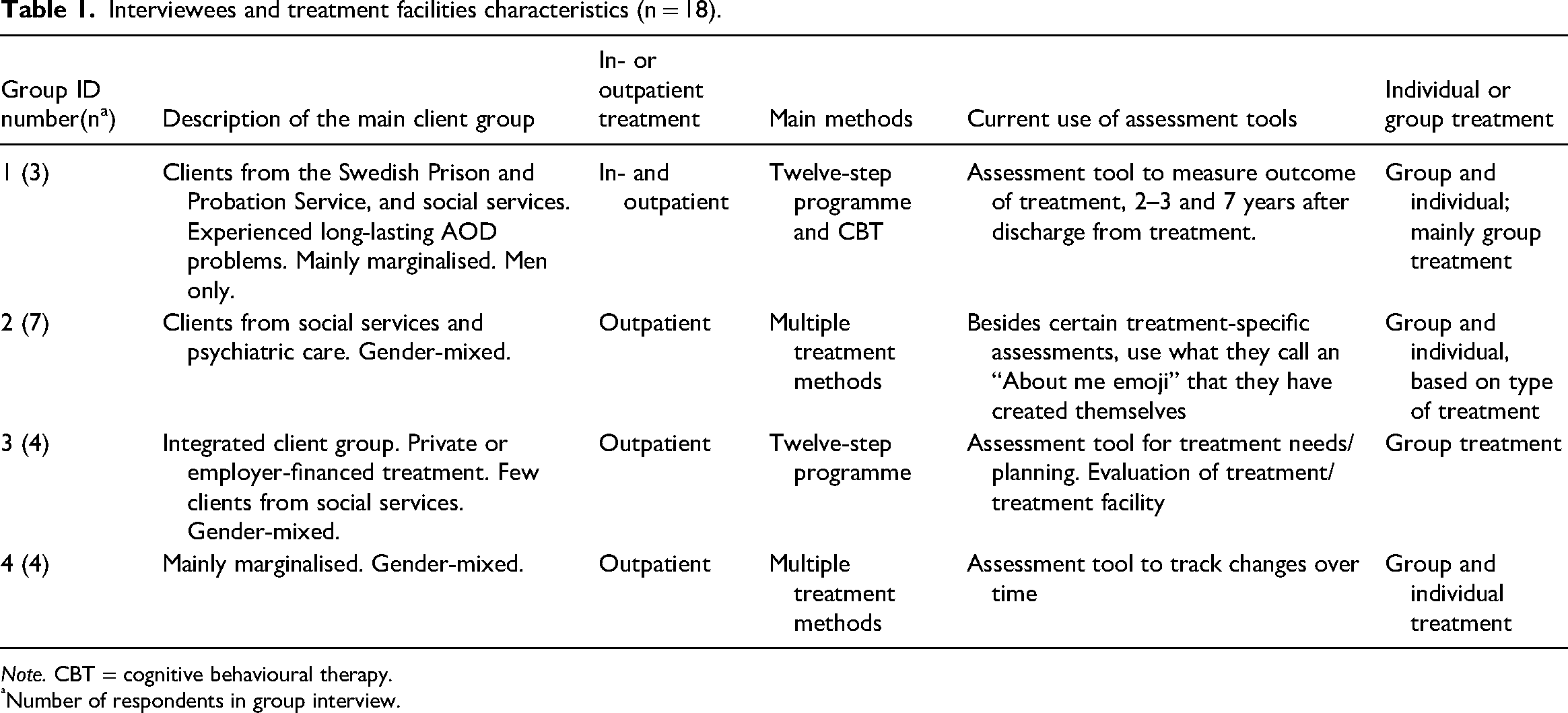
Note. CBT = cognitive behavioural therapy.
Number of respondents in group interview.
Four GIs were conducted, each of which consisted of 3–7 members of staff, yielding a sample of 18 interviewed professionals. The interviews lasted for 50–70 min. All the groups were given the choice of participating either online or face-to-face at a location of their choice. One GI took place by Zoom and the other three were conducted in a conference room at the respective treatment facilities.
Interviews
The assessment tool that was used as discussion material in the interviews was the Assessment of Recovery Capital (ARC) (Groshkova et al., 2013), which is one of the more commonly used RC assessment tools (Best & Hennessy, 2022). The ARC is designed to measure treatment progress and contains 50 items divided into social and personal capital. It is argued that by looking at an individual’s strengths and resources, it can evaluate treatment needs and progress more accurately than more problem-focused assessments. Each item represents a statement and the individual is asked to declare whether they agree with each statement. An ARC score can then be calculated by adding together the number of agreed-upon statements. A higher ARC score represents higher levels of RC (Groshkova et al., 2013).
One week before the GIs, the participants were sent an example of the 50 statements included in the ARC, along with a description of the purpose of the tool. At the interview, the interviewees were asked to briefly review each statement in the assessment tool and to reflect on whether it was applicable to and usable in their daily work. The applicability of the tool in the professionals’ daily work was addressed by asking the interviewees to discuss whether they believed that (1) the items measured important aspects of treatment progression, and (2) whether the items would be a good alternative for measuring treatment progress. In order to stimulate a rich and unrestricted discussion in the GIs, no specification about the point in the process at which the assessment tool might be useful was indicated to the participants. The assessment tool was presented in its original language (English) along with a Swedish translation. Besides the clear efficacy advantages, the decision to perform GIs relied on the notion that they are preferred in cases where the natural setting is important (Kitzinger, 1994; Frey & Fontana, 1991). It is also argued that pre-existing groups, such as a group of co-workers at a treatment facility, can help focus the conversation on contextual aspects (Frey & Fontana, 1991).
Analysis
All interviews were recorded using standard audio recording equipment. To facilitate transcription, the interview that was conducted using the Zoom video communication service was recorded using standard audio and video recording equipment. A thematic analysis (TA) (Braun & Clarke, 2021) was employed to process the data. After the interviews were transcribed, the data were coded and summarised under various topics. These topics were then reviewed and explored for potential themes. The analytical process, including some re-categorisation of themes, continued through the entire writing process and ultimately yielded three themes: the assessment tool; the clients; and the social work practice.
Ethics
The study was approved by the Swedish Ethical Review Authority (No. 2018/923-31-2).
Results
The assessment tool
When asked to evaluate the applicability of specific items in the tool, the interviewees could choose to discuss either how the statement was formulated (the structure) or the dimension it sought to capture. Overall, the latter was rarely questioned, and the majority recognised its importance, which was also demonstrated by interviewees referring to their current working methods or strategies. Many of the interviewees would justify the applicability of an item or the conceptual dimension by explaining that they were already asking questions about it in their work practices. ). This is a particularly interesting argument, as it would be more logical to define an item as not usable if implementation entailed little or no change in working methods (SOFIA: se förslag på 'conceptual dimension').
Some items were described as not applicable. Questions of appearance and diet were considered unimportant, especially by interviewees working with more marginalised client groups. At the same time, however, participants working with a more integrated client group stated that aspects such as appearance can be important for clients. In the following example, an interviewee working with a more integrated client group talked about the item previously dismissed by those working with a more marginalised client group: Yes, it is absolutely important. It is common for them to feel socially lost and different and scared of not blending in. They are afraid that it will show that they are addicts. I think that it is important to capture this in some way. Whether they are capable of blending in or not. (GI 3)
Furthermore, and as expected, some of the applicability was questioned due to language differences, and some phrases were defined as inapplicable because they simply lack an appropriate Swedish translation. In addition to some of the items being found inapplicable, some were also deemed inappropriate. The interviewees suggested that some of the items could in some situations be harmful to the client: they said that they would avoid certain questions in order to protect the client. For example, one participant talked about an item designed to assess the client’s family situation: One question made me react … sometimes I bring up the family question [in group therapy]. There is a man sitting there who has no family; he is completely alone and that makes me feel bad. It sometimes happens that I bring up the topic of family and I think to myself: I should not have done that. How does that make him feel when I ask him about his family? As a therapist, it is difficult for me since I know that he is all alone. I sometimes start my sessions by saying “we collect our thoughts and think about our families”, and later realise [that the man has no family to think about].…That was my reaction when I saw this. The family question is a sensitive question.
[…] I know that the client is lonely, we talked about it the week before, or the day before; and then I show up the next day or the week after and asked him about his family…it is tricky, why would I ask him about that? Are you saying that some areas can be inappropriate at some points and appropriate at others? Exactly, I want the [clients] to think about their families, it gives them strength. But for this guy: what family? He is thinking about his buried son. It is not nice to put him through that. You are saying that you have to… Yes, it can become painful for the guy…. The family question is a sensitive question. (GI 1)
This reasoning can be viewed from different perspectives. The interviewee suggests that the family situation is an important aspect, and that just thinking about family is important and can be considered a resource. The idea of family as an important resource is in line with the very foundations of RC, which further supports the implementation of an RC-based assessment tool, or at least its theoretical relevance. However, the interviewee suggests that applicability is conditioned by the social work professional’s ability to understand whether the item is appropriate. Such an understanding is seemingly based on both knowledge about the specific client, in that the interviewee knew about the client’s family situation, and the type of experience acquired from working with the client group, as the interviewee knew that certain types of questions can affect the well-being of particular clients.
Another recurring discussion concerned the applicability of a statement-oriented assessment tool; that is, whether statements that require the client to either agree or disagree with them were perceived as useful. Here, the study participants expressed different approaches. Some argued that a statement-oriented assessment tool could be useful for running a quick scan, while others argued that the assessment tool should be used as an interview guide. Regardless of whether the interviewees agreed with the statement format, they all said that they would want to ask follow-up questions. This is another illustration of how applicability is conditioned by the social work professional’s ability to modify and adjust the tool to the specific client or meeting. In the following example, the format was initially deemed inappropriate due to the lack of emotional contact: We have plenty of tools, but we would never go in with a checklist – we would lose the emotional contact. We have our checklists in our heads. If I were to ask questions according to a checklist, we would never reach into the [client’s] feelings, and we would never get any emotional answers. (GI 1)
The participant states that they have their checklists in their heads, implying that they already know what to ask and what not to ask clients. However, the same interviewee later suggested that the tool would be useful for someone new to the profession. The fact that the tool is considered useful for supporting less experienced staff members in meetings with clients indicates that the interviewee sees the overall themes and topics as important. It is also considered to be in line with the knowledge acquired from years of experience, which further implies that the tool covers important aspects of treatment progress and outcomes.
Some of the reasoning concerning the format of statement-oriented assessments shows the potential of the assessment tools to influence the relationship between social work professional and client. Similarly to the interviewee who stated that he would avoid certain subjects or topics to protect the client, some interviewees argued that the statement-oriented assessment might cause feelings of inadequacy.
To me it always feels best to start with a question instead of yes/no statements. Yes, or perhaps a scale of some sort… Yes… it should probably be a scale… this feels more like a pointer. Yes, I think that it would make them feel inadequate and guilty. (GI 2)
Here, the interviewees suggest that a scale would be less judgemental than a statement-oriented assessment that only allows for a binary response. This can be viewed as an illustration of the situations in which study participants saw that the standardisation of an assessment tool would not be suitable for conversations between social work professionals and clients. In this discussion, it was the format rather than certain topics or questions that was thought to affect the client in an undesirable way. The interviewees were worried that the statement-oriented assessment might convey expectations, indicating that the client was deficient in some way. This concern is another example of where the interviewees perceived a need to protect the client from the tool and argue accordingly, from the point of view of social work professionals, that the client’s feelings must be prioritised over a standardised approach.
The clients
Another recurring theme can be used to illustrate the ability to apply standards to this specific client group. In all the interviews, regardless of whether the tool was found to be applicable or not, the participants described the difficulties involved with applying standards to this client group. This circumstance was expressed for example in comments on some of the items on the list being more or less appropriate, depending on the client’s characteristics and treatment progress. It was also expressed by interviewees in wishes to ask follow-up questions in order to gain a deeper understanding, further emphasising the complex and variable nature of AOD treatment trajectories. An example of this type of reasoning is depicted below, where a study participant is talking about an item that assesses whether the client makes other people feel disappointed.
If I was to use this.… I am thinking that the client could answer but then he or she would have to explain what they meant by their answer. I think that you would have a subjective experience of it. Is it your parents you are making feel disappointed or is it friends? You have to examine that further. Do you understand what I mean? We cannot formulate questions that are constant. This is not chemistry – that if we add A, we will get B and then it becomes C. This is subjective. (GI 3)
This is another example of applicability being described as conditioned by the evaluations of the social work professional. In this case, the interviewee argues that the tool would need to be more nuanced and complemented with additional information in order to properly capture the client’s situation. The main barrier to applicability is described as related to the work context, where the social work profession is depicted as handling subjective experiences and perceptions as opposed to chemistry where certain actions always lead to the same progression and outcomes. Accordingly, subjective experiences along with unpredictable progress and outcomes are by the interviewee claimed to rule out the prospects for formulating questions or statements that are consistently and for all clients equally applicable. In the following example, the interviewee talks about the impact of dietary choices and daily routines on clients during the early stages of treatment: ...] they do not have the energy. They are often practising abstinence and can barely manage to exist. They do not care about sleep or diet or anything, and to undertake things like this is situated in a distance future[…] Much would have to have been put in place for the energy to come back to start working on these aspects. That is what I think from my experience – that diet and daily routine do simply not exist; some of them don’t eat at all. (GI 3)
A similar type of reasoning prevailed when interviewees implied that applicability would vary based on the needs of the client group. One participant suggested that the tool would be more suitable for a more integrated type of client group, in comparison with the more marginalised: It could work for some of our clients. Those who have a job, who just drink a little too much, and who have a little trouble in their marriage. For those who just want a little change, I think it could work. The type of client that still has a social network and all that. These questions feel more applicable to that group. (GI 3)
These are all examples of interviewees implying that applicability is conditioned by the evaluations of the social work professional. In these scenarios, the main barrier to applicability is a heterogenic client group with varying treatment trajectories and life situations.
The social work practice
Some interviewees stated that they would like to ask follow-up questions or that, depending on the client, they would avoid or change some of the questions of the tool. Others stated that they would just use the tool as a guide to support the conversation, so that they would not forget to ask about certain topics. However, and unexpectedly, their descriptions of how the tool might or might not serve their daily work were rarely reflected in their evaluation of the applicability of the tool.
We are back at the question of whether this [the questionnaire of the assessment tool] would benefit your daily work. Yes, I think it would. […] I am just thinking that they will think very differently, and that they won’t always understand the questions. But that isn’t a problem because you can always ask follow-up questions. That is one way to open up the questions. Exactly, you can ask: “what do you mean?” In that way, we can avoid telling them how to interpret the questions. (GI 4)
In the above quote, the participants agree that the tool would contribute to their daily work provided that it can be modified to make it more usable. A third interviewee (below) states that he lacks experience and would therefore benefit from using the tool, as suggested by other, more experienced interviewees. However, while clarifying the benefits of using the tool, both interviewees explained that they would modify it and rephrase the questions. This means that participants are not questioning the tool per se, instead it seemed self-evident that they would use it in an arbitrary way. In the following example, another participant explains that he would probably make modifications depending on the needs that emerged during the client conversation: When I first received this [the questionnaire of the assessment tool], my first thought was “great material”. I am very new here. I am still studying. I could easily be helped by this. Perhaps I would rephrase it on my own. I don’t have a lot of experience so I was just thinking that I might use it this afternoon, but that I would rephrase it. I definitely think that it could help people like me. I have only been working for a year. But you would use it more like a checklist and not as an assessment tool? Yes, sometimes I forget what to talk about. If so, I can just use this but modify it a bit. (GI 1)
Thus, follow-up questions and the ability to modify the assessment tool in conversations with the clients were suggested by professionals, regardless of their level of work experience. Surprisingly, the desire to modify the tool which was expressed in the conversations was rarely reflected in the conclusion on whether the tool could benefit interviewees’ daily work. In many cases, they considered the tool applicable even though they had stated that they would not use it in the way it was designed. In the interviews, it was quite difficult to understand the interviewees’ approach to the potential contribution of the tool. It seemed that it was self-evident to the interviewees that it would have to be adjusted in each specific client meeting, and that those adjustments would be made based on the experience and knowledge of the social work professional.
Discussion
This paper has examined how the applicability of an RC assessment tool is perceived by social work professionals, and in so doing provides perspectives on the possible consolidation of values of standardisation and those of professionalism. The vast majority of the interview subjects found the assessment tool useful but described how they would use it in a different way than originally intended. Surprisingly, the desire to modify and alter the tool was rarely reflected in the conclusion on whether the tool would positively contribute to the interviewees’ daily work. Ultimately, it seems that the social work professionals in the study do not perceive any conflict between the aims of standardisation, on the one hand, and those of professionalism, on the other. Some interviewees argued that the assessment tool could serve as an interview guide, especially beneficial for individuals new to the profession. However, only a small number acknowledged the advantages of the assessment tool’s systematic and standardised components. Further, it is reasonable to assume that experience and knowledge vary in relation to work experience, and that the newly trained would want greater support and more guidance (Tham & Lynch, 2021). //This adds to the literature by illustrating additional approaches to evaluate the concept of applicability. Specifically, it highlights how the assessment of applicability, considering both its psychometric properties and practical usage, can lead to different conclusions. These findings can be seen as an example of the fact that an assessment tool does not have to be classified as either applicable or inapplicable. This further strengthens the argument for adopting a new approach to understanding and evaluating applicability, as proposed by Burchett et al. (2018). It is evident that the conceptual dimension of an RC-based assessment tool holds practical value in a treatment context, as a majority of the study participants found the tool to be useful. However, the fact that the tool is likely to be applied in ways other than its intended purposes will serve as evidence supporting the exploration of alternative ways to assess and stregthen RC in practical treatment environments.
Adjustable standards
The findings have provided perspectives on how standards of client assessments and professionalism can be combined. There are arguments that standards can improve the outcomes of social work in various ways (National Board of Health and Welfare, 2019), and as a result enhance the status of the social work profession (Barfoed & Jacobsson, 2012). There is also a body of evidence that portrays a relationship between standards and professionalism, where standards are associated with a reduction in discretion and restrict the conversation between client and professional (Martinell Barfoed, 2014). There is also research suggesting that professionals can occupy a variation of discretionary positions in relation to standardisations (Skillmark, 2018) that does not necessarily entail reduced discretion (Evans & Harris, 2004; Ponnert & Svensson, 2016). The findings of this paper provide a third perspective on this relationship. For a tool to be applicable and useful, social work professionals argued that they would need to adjust it to each specific client meeting. These findings are in line with previous research, which shows that interventions and standardisation are considered adjustable and, in practice, professionals are likely to use their skills, knowledge, and experience to decide how they are used (Bakkeli & Breit, 2022; Björk, 2013, 2016a, 2016b; Knaapen, 2014; Sletten & Bjorkquist, 2020; Timmermans & Berg, 2003). This notion should however be considered in relation to research suggesting that interventions and assessment tools entail a risk of losing some of their effect when tinkered with (Sundell et al., 2016).
There is a body of evidence that shows that lighter versions of standardisations are not necessarily in conflict with professionalism (Björk, 2016a). This further supports the notion that standards and interventions can be viewedas “fluid objects” (de Laet & Mol, 2000; Ekendahl & Karlsson, 2021; Law & Mol, 2001; Law & Singleton, 2005). However, this perspective has notable practical implications. The use of these “lighter” and “fluid” standardisations can undermine assessment validations and reliability tests. Conversely, a more rigid approach might reduce the benefits of the tool. This presents a potential conflict in relation to evidence-based practice that cannot be resolved solely by adopting a lighter version of a standardisation.
Standards and professionalism
Some of the interviewees argued in favour of the subjects in the statements and the overarching themes by referring to working methods and strategies they already employ. This is particularly interesting as it implies that implementing the assessment tool would not result in significant changes to their daily work. Consequentely, the applicability of – and perhaps more significantly, the necessity for – the tool might have been questioned rather than endorsed. Furthermore, when justifying its applicability by referring to working methods and strategies already in use, the interviewees illustrated an approach to the tool where applicability and usability were associated with minor or no alterations in their working methods. This indicates that the interviewees have confidence in their current approaches and that attempts to regulate their work in different directions would, to some extent, have lesser impact.
A body of research promotes a focus on knowledge, skills, and expertise to describe professionalism, particularly how these are applied in everyday work (Dellgran & Höjer, 2001, 2003a, 2003b; Eraut, 1994; Schön, 2017). Regardless of their level of experience, all the interviewees expressed a desire to alter and modify the tool. Furthermore, it seemed as though this wish relied on the knowledge gained through work experience rather than formal education. The wish to alter or modify the tool can be interpreted as a professional skill, which ultimately suggests that the findings are an expression of social work professionalism. This is particularly interesting, given that it has been argued that standards increase the professional status of, and in doing so legitimise, the social work profession (Cumming et al., 2007; Gambrill, 2011). The implementation of standardisation has also been proposed to reduce the impact of subjective “gut feelings” and promote equal and objective treatment and care (Barfoed & Jacobsson, 2012). Gut feelings are viewed as being contrary to or distinct from, standardisation, suggesting that social services may fail to provide equal and objective care if decisions and actions are based solely on such feelings. The interviewees in this study expressed the need to alter and modify the tool according to different client settings. This illustrates a reverse relation where the social work professional plays a role in shaping the standard, using gut feelings to reduce the impact of standards and thereby challenge the standardisation. This can be interpreted in light of research suggesting that standardisations can increase the professional discretion by forcing social workers to manage contradictory logics (Evans & Harris, 2004; Ponnert & Svensson, 2016), and that social workers can occupy a variation of discretionary positions in relation to standardisations (Skillmark, 2018).
Social work professionals ultimately rely on their knowledge and expertise to support clients, regardless of the manuals and standards that govern their work. This study considers this relationship as the core of the social work profession. To further explore this dynamic, future research should aim to understand how standardisations can be designed to benefit social work professionals while maintaining the regulatory aspects of the standards. Moreover, existing research, combined with the findings presented in this paper, highlights the usefulness of a standardised tool or intervention even when it is not utilised as originally intended. In order to provide support for a policy aimed at regulating the social work profession, future research should focus on comprehending the content and significance of the implications arising from such inconsistent use.
Limitations
This study examines the applicability of an RC assessment tool in a number of Swedish AOD treatment facilities. However, it is important to note that the tool was not implemented in the interviewees’ actual work environment. Rather, the study interviewees were solely asked to discuss the tool and consider its potential contribution to their work. Consequently, the evaluation of applicability was based on their estimates of how well the tool would integrate. Therefore, it is crucial to acknowledge that the study participants might exhibit different behaviors if the tool were actually utlilisedin their daily work. As a result, any conclusions drawn from this study must be approached with limitations in mind.
This paper relies on data collected through GIs. However, it is important to acknowledge certain potential disadvantages when compared to individual interviews. Apart from the risk of interviewees conforming their opinions to align with the group’s view, one notable drawback is the presence of treatment facility manager in three out of the four GIs. This clear group hierarchy might have introduced perceived pressure to conform, potentially resulting in a “level of false information or awareness of the research problem” (Frey & Fontana, 1991, p. 185). Whether consciously or unconsciously, the interviewees may have been at risk of describing the applicability and potential use of the tool based on what they percieved as expected of them as social work professionals, thereby potentially exaggerating or modifying their accounts of how they would utilise the tool. The implications of these potential limitations were taken into account during the analysis and discussion of the results.
Another limitation of the study is the relatively small sample size, as well as the lack of identical samples in the first and second study. Firstly, one of the facilities that took part in the first round of GIs declined participation in the second round because a significant number of employees were unavailable during the COVID-19 pandemic. One solution to this dropout could have been to replace this group with a group of employees from a different treatment facility. However, considering that the groups from the first interview round were already familiar with the conceptual framework, the notion of including a new group in the second study was rejected. Moreover, there was also some employee turnover within the participating treatment facilities between the first and second round of GIs. Unfortunately, a suitable resolution to this issue could not be indentified. Nonetheless, it is noteworthy that the majority of those who participated in the interviews for the first study also participated in the second.
Footnotes
Declaration of conflicting interests
The author(s) declared no potential conflicts of interest with respect to the research, authorship, and/or publication of this article.
Funding
The author(s) received no financial support for the research, authorship, and/or publication of this article.
