




Abstract
Keywords
People who use drugs, specifically those medically classified as having substance use disorder (SUD), constitute a diverse group engaging in the use of both legal and illicit drugs. The consumption of substances is linked with difficulties in managing daily life, physical and mental health challenges, and increased mortality rates (Castaldelli-Maia & Bhugra, 2022; Walker et al., 2015). Concurrently, as the prevalence of people using drugs rises, there are obstacles in providing accessible healthcare and those who use substances experience inadequate treatment and stigmatisation from health and social services (Biancarelli et al., 2019; Van Boekel et al., 2013).
In several Western countries, a public health crisis related to substance use, particularly opioid injection and the risk of overdose, is described (Collins et al., 2019b; Vearrier, 2019). Common approaches to addressing this crisis include government control and law enforcement aimed at curbing substance use and trafficking in areas frequented by people using drugs (Olsen, 2017). Consequently, these efforts often result in individuals who use drugs avoiding medical assistance for fear of encountering law enforcement and may attempt to manage overdoses independently (Collins et al., 2019b; Hanoa et al., 2023).
Despite these measures, public spaces where people who use drugs congregate, referred to as urban or open “drug scenes”, continue to persist in major cities (Bless et al., 2009; Waal et al., 2014). These gathering spots are frequently unwelcome due to illegal activities and their visibility. However, studies have revealed a more nuanced perspective, highlighting these places as social arenas for marginalised individuals who feel disconnected from mainstream society (Bancroft & Houborg, 2020; Grønnestad et al., 2020; Grønnestad & Lalander, 2015). Attempts to close urban “drug scenes” have frequently resulted in displaced users relocating to more secluded areas, increasing their vulnerability to various harms and risks (Lundeberg & Mjåland, 2017; McNeil et al., 2015).
In 2020, debates surrounding the establishment of a public outdoor meeting place in Oslo for people with substance dependence underscored the challenges of providing a space where illegal drug transactions occur while also facilitating healthcare and social work interventions (Audestad et al., 2020; Olsen, 2017). Understanding the interaction between individuals and their environment is essential for implementing health and social services that can reduce risks for a specific group of individuals (Collins et al., 2019a). A study exploring this interaction from the perspective of individuals who use drugs found that acceptance by policymakers and the public diminished stigma and fostered a sense of belonging. Consequently, the public gathering place could function as health-promoting environment by satisfying psychological needs and enhancing the accessibility for healthcare and social workers (Bye et al., 2024).
However, there remains a scarcity of studies directly examining the role of healthcare and social care agencies and their experience in managing urban, public gathering places for people who use drugs. Street-level low-threshold services, operated by municipalities or non-profit organisations, play a crucial role in reaching individuals with problematic substance use and serve as an essential harm reduction effort (The Norwegian Directorate of Health, 2019). Community-based organisations are often preferred over larger, distant health services, as individuals who use drugs may avoid formal healthcare settings to evade stigma (Biancarelli et al., 2019; Van Boekel et al., 2013).
An emerging question pertains to the significance of public gathering places for people who use drugs in shaping the health and social service's relationship with them. The aim of the present study was to enhance understanding of the healthcare system and social services experiences with public gathering places for people who use drugs to inform policy, urban planning, and health and social service strategies. Two research questions have been formulated: (1) What are the perceived advantages and disadvantages of public gathering places for people who use drugs? and (2) What is the significance of the location and accessibility of such gathering places within a city?
Methods
A qualitative research design was employed, combining semi-structured focus group interviews and individual interviews. The methodological approach was inductive, characterised by search for patters (Graneheim et al., 2017). A user representative, who had personal experience in what he referred to as the Bench and the “drug milieu” in the city was included in the research team in the capacity of a co-researcher. The user representative actively engaged in the study's design process, crafting the interview guide, and providing insights for the analysis and presentation of findings.
Study setting
The study took place in a medium-sized Norwegian city where a public gathering place for people who use drugs had been established for several years. This gathering place, commonly known as “the Bench”, differs from larger “drug scenes” in major cities in that the environment is smaller and relatively manageable. Furthermore, the city's policy articulates that the downtown area should be arranged and developed to accommodate all citizens, including people using drugs. The police monitor the gathering place and have occasionally intervened to confiscate drugs as the use and distribution of all psychoactive substances are prohibited in public places. However, they simultaneously strive to maintain a high threshold where the assembly at the designated area is respected (Bye et al., 2024). Approximately 70–85 adults (approximately 75% men; mean age 45 years), all of whom use some form of intoxicant such as cannabis, alcohol, various pills and small amounts of amphetamine and heroin, utilise the gathering place (Bye et al., 2024). These individuals typically face significant health challenges and are outside the workforce receiving welfare money. During a city centre renovation, new benches with roofs and weather shelters were installed in a separate section of the new city park to accommodate all residents. This urban renewal made the gathering place for people using drugs increasingly visible in the city centre, referred to as “the Bench”. Therefore, in the results section, the public gathering place for people using drugs is referred to as the Bench.
The health and social agencies encompass the municipality's Department for Drug and Addiction, which includes the Flexible Assertive Community Treatment (FACT) team. In addition, independent low-threshold services provide health services, overdose prevention measures, hygiene support and nutrition assistance. The Norwegian Church also participates in outreach activities for individuals struggling with substance use issues. These services represent a combination of health and social care and are all represented in the study.
Recruitment and participants
The inclusion criteria involved providing health or social services to the individuals who frequented the public gathering place and used drugs. Relevant agencies for recruitment were identified in consultation with the study's user representative, and leaders from various agencies were approached and distributed information sheets to eligible employees.
A total of 13 participants (4 men, 9 women) were recruited, representing various support services aiding individuals with substance use who utilised the public meeting place in the park. Eight participants were engaged in outreach work and the remaining five participants had previous experience from outreach work at the Bench and operated premises with low-threshold services accessible to users. They had professional backgrounds as social workers, social educators, nurses and priests. In addition, some of the participants had education specialising in substance use. Further characteristics of the participants, such as specific employment details, are not provided to preserve anonymity, given the relatively small size of the support services.
Data collection
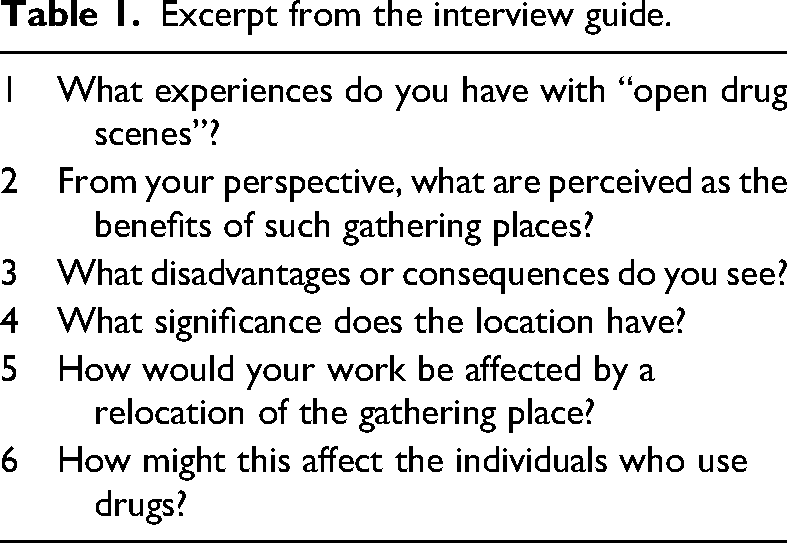
Three focus group interviews and two individual interviews were conducted. The focus group interviews were conducted with individuals who worked at the same agency and lasted for 90 min. All interviews occurred at the participants’ workplaces according to their preferences. Individual interviews were performed for those who wished or were unable to participate in the focus group interview. The interviews were semi-structured, based on an interview guide developed with the study's user representative. The same interview guide was utilised for the focus groups, albeit adapted to facilitate interaction among the participants. Table 1 displays the key questions from the interview guide. The interviews had an average duration of 66 min, with the longest lasting 85 min (focus group) and the shortest 39 min (individual interview). An audio recording was made and transcribed into text, with personally identifiable information removed.
Excerpt from the interview guide.
Saturation was discussed during data collection. After the completion of three focus group interviews, the data were deemed information-rich based on the depth and insights obtained (Saunders et al., 2018). Subsequently, data collection concluded after conducting two consecutive scheduled individual interviews.
Analysis
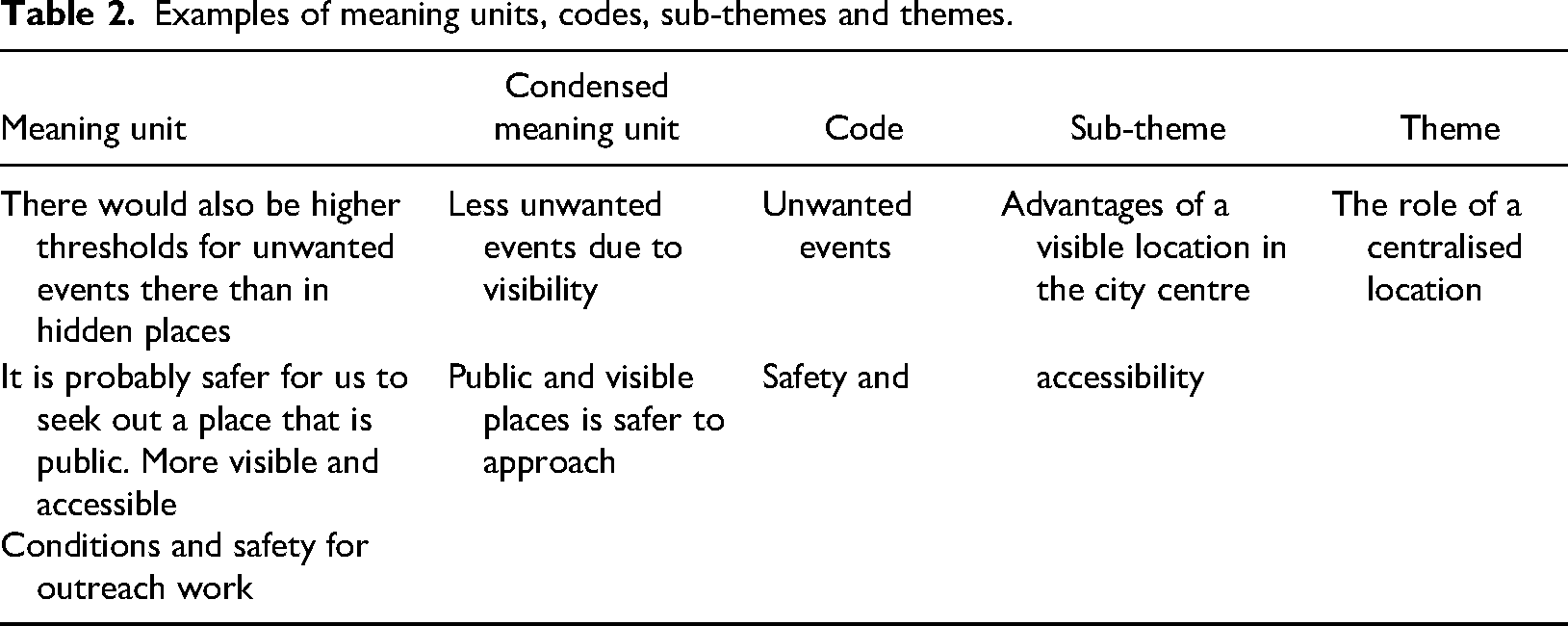
Qualitative content analysis according to Graneheim and Lundman (2004) was used to analyse the data. The interviews were carefully read multiple times and sentences containing aspects related to the research questions and each other through their content and context were marked as meaning units and extracted. The meaning units were shortened to condensates while preserving their contents and core. Condensed meaning units were coded and further organised in categories according to commonality. These initial steps of the analysis dealt with the manifest content of the text. Interpretation of the underlying meaning was discussed by all authors and resulted in agreement about how to sort the categorised codes into 12 sub-themes that were further abstracted and formulated as four main themes. The design of themes is an expression of the latent content of the text and can be described as a “red thread” cutting across categories to bring meaning to recurrent experiences (Graneheim et al., 2017; Graneheim & Lundman, 2004). Steps in the analysis process are illustrated in Table 2.
Examples of meaning units, codes, sub-themes and themes.
Research ethics considerations
The study was approved by the Norwegian Centre for Research Data (reference number 965605). Participation was based on voluntary and informed consent (World Medical Association, 2013), with all participants signing consent forms before ethe interviews. Information about the study was provided both in writing and orally. Participants were informed of their right to withdraw at any time without consequences.
Results
The analysis led to four themes: (1) belonging and a gateway to support and services; (2) balancing user autonomy at the Bench and systems support; (3) the role of a centralised location; and (4) the preventive role of support workers at the Bench.
Belonging and a gateway to support and services
In the interviews, it emerged that all participants were well acquainted with the Bench as the city's public gathering place for people using drugs. All 13 participants had been to the Bench, regardless of whether they conducted outreach work or primarily offered services on their premises. The participants had clear views on the role the gathering place fulfilled for individuals using drugs. Drawing from their interactions with the Bench's users, they underscored a user perspective in their depiction of this role: The Bench was described as a meeting point and a social arena where people using drugs, who often were stigmatised and rejected in other settings, could feel safe and welcome. It's a point of reference that they, they know the Bench is always there. So, whether they’re there every day or once a month, they know they can go there, and the environment is often the same. I mean, not necessarily that the people are always the same, but they’re welcomed there. It's a safe place for them. And it's theirs. (Morten) As a support worker, I also think about, if we want to get hold of someone. Concrete, wound care, something that needs to be followed up, that we’re concerned about, we can ask if they’ve seen so-and-so down there. Then we can maybe try to go down and see if they’re there. Then it's sort of a somewhat concrete place. (Nora)
Several participants also discussed the paradoxical nature of the Bench. They noted that while society tacitly accepts its existence as a gathering place, public drug use remains illegal; there was a clear perception that illicit drug transactions occur there. Moreover, it was underscored that people enrolled in opioid maintenance therapy (OMT) were unwelcome encounters for the helpers at the Bench as it conflicts with the therapy and OMT has interactions with other drugs, which raised concerns about overdose. Opinions were divided among the participants regarding whether the Bench could have been supplanted by low-threshold services. Some argued that the Bench held equal importance to their service offerings. Despite highlighting issues associated with it, several participants expressed a positive view of the Bench.
Balancing user autonomy at the Bench and systems support
Although several of the participants expressed a sense of belonging at the Bench themselves, it was consistently emphasised that the Bench belongs to its users. The Bench is their arena, where support systems are guests rather than hosts. Users dictate the dynamics of the space, emphasising the need for caution and humility when approaching it. In addition, several participants stressed the significance of people using drugs having a space of their own where they can shield themselves from the support system. Hence, the support system must be conscious of the arena they are in and the role they play. On their premises, the participants said it was natural to set demands, have rules and take charge, but they would not take the same role at a public meeting place for people using drugs. I mean, it's a bit harder to sort of control it when you meet them down at the Bench, than when they come here (to the service provider's premises) because here we’re the ones in control. We can say “OK, we want to have a chat with you”, but down there, it's about approaching them differently. (Maria)
And as I experience it right now, this new bench accommodates many people. And that means, I think, that more people sit down around the table than they would have done with less space to sit on. So, it's been crowded down there. Some of them watch us critically as we approach, wondering who we are. And then it's nice to feel confident in those we know. (Astrid)
The role of a centralised location
There was widespread agreement among the participants that the location of the Bench was suitable. The city centre was a natural meeting place and it was meant to be for everyone. Several participants perceived a showcasing of societal diversity at the Bench's location. Its central proximity is close to other venues the users frequent, and one participant expressed thoughts about a decentralised location for a public meeting place for people using drugs as follows: They gravitate towards the city centre. It was suggested another location further north, but then they all (people using the Bench) said that they wouldn’t use it but rather head into town. So, I don’t think we have a choice. I believe it must be central. (Jacob)
The Bench's visible and natural location was emphasised as positive for those engaged in outreach work. Approaching a meeting place for people using drugs entailed uncertainty, as one did not know in advance what to expect and what the conditions would be like that day. Participants stated that the public location of the Bench could make it safer to approach. They described the Bench as easily accessible, not time-consuming in terms of travel, and visible and natural when passing. The location where the city's inhabitants naturally pass by gives service providers the choice to approach the Bench and talk, or choose to move on, which would have been more challenging if the Bench's location were more concealed. One participant described this as follows: There would also be higher thresholds for unwanted events there than in hidden places. Accessibility to drugs, what's circulating… If we observe that there are a lot of pills circulating, then we could choose to wait to visit the Bench until the next day. (Astrid)
The preventive role of support workers at the Bench
The fact that the public gathering place for individuals using drugs was situated in a visible and open location facilitated the presence of healthcare and social workers, which was believed to mitigate and prevent unwanted incidents. Without such deterrents, the environment could become more challenging. The role of healthcare and social workers, especially those engaged in outreach work, was highlighted as preventive, which helped stabilise and resolve conflicts. An illustrative incident was recounted by a participant who mentioned observing two young individuals considering a transaction near the Beach on her way home from work one day: So, one of them says, no, we can’t go over there because he [colleague's name] is standing there now. So, the fact that the support system is visible down there, I think it can help a bit, in terms of buying and selling. (Emilie)
The participants held different views of whether the Bench served as a recruitment ground for youth. Although some highlighted the unfortunate proximity of the Bench to areas frequented by young people, adults present at the Bench were reported to discourage youth from lingering there. One participant refuted the notion that the Bench contributed to youth recruiting, posing a rhetorical question: If some young teenagers want to try cannabis or something and wonder where to get it or talk about where to get it. Would it be to go down to the open drug scene in the city square where they know police spotters and people are watching, or would it be easier for them to go to a closed and somewhat hidden drug scene and get it? (Kasper)
Discussion
Our study highlights the multifaceted role of public meeting places for people using drugs in the experiences of healthcare and social workers interacting with these individuals, serving as sites of belonging, support and potential criminality. Despite concerns about illicit activities and visibility, these spaces foster a sense of community and provide access to vital services, highlighting their importance for their users’ well-being. By serving as a place of encounter, the Bench has significant importance for the state of its users' health. Healthcare and social workers play a crucial role in mitigating conflicts and criminality and stabilising the environment. emphasising the preventive function of their presence.
While public support for safe consumption sites has been recognised as a significant harm reduction measure (McCann & Temenos, 2015; Vearrier, 2019), it is essential to distinguish urban “drug scenes” from supervised injection facilities. Supervised injection facilities are designed as controlled environments where individuals can use drugs under medical supervision. The Bench represents a more informal public space that primarily functions as a social arena. Unlike supervised injection facilities, drugs use at the Bench is not overt and public injections are avoided (Grønnestad & Lalander, 2015). This distinction influences the type of interventions and support that can be provided in each setting. Nonetheless, the comparison is relevant because it highlights the potential of health-promoting and harm-reduction functions even in non-medicalised settings. Social places are shaped by structural factors, and understanding their effect across populations is important for providing necessary care and services (Collins et al., 2019a). Our results suggests that the benefits of services provided in controlled environments, such as providing health services and reducing overdoses, can be partially emulated in less formal settings through outreach efforts. Understanding the role of informal public gathering places like the Bench offers a more comprehensive view of the multifaced approaches to harm reduction (Collins et al., 2019a; McNeil & Small, 2014).
Establishing contact with individuals who use drugs is vital for the support system to provide effective assistance (The Norwegian Directorate of Health, 2019), and public meeting places serve as tangible locations for outreach efforts where support services can approach and establish contact with users who are often difficult to reach, particularly during periods of relapse or escalation of drug use (Biancarelli et al., 2019). The location of a public meeting place for those who use drugs holds significance. The proximity between these spaces for people who use drugs and low-threshold services enhances access to life-saving treatment during overdoses, emphasising the importance of urban, centralised locations (Audestad et al., 2020; Lundeberg & Mjåland, 2017). Overdose deaths often occur alone in private residences (Hanoa et al., 2024; Ivsins et al., 2022), but our study showed how outreach workers were also approached at the Bench with concerns for individuals who were socially connected to the Bench but not present.
Failure to provide specific urban places for individuals who use drugs can lead to the dispersal of users to more marginalised areas, creating dispersed and hidden “drug scenes” that increase stigma and security risks (Bless et al., 2009; Lundeberg & Mjåland, 2017). However, public gathering places also pose challenges, including triggers for relapse (Grønnestad et al., 2020) and negative perceptions by the population. Nevertheless, city inhabitants apparently have greater acceptance than previously assumed, as new research has shown lower perceived community stigma in urban areas than in rural areas (Davis et al., 2023). According to our results, a public gathering place for individuals using drugs is not necessarily a recruitment arena for young people. Previous research confirms this by pointing to internal rules in open “drug scenes” that discourage the involvement of young people (Grønnestad & Lalander, 2015), while young people increasingly turn to social media to buy or sell illegal drugs (Demant et al., 2019).
Waal et al. (2014) proposed that coordinated efforts between law enforcement and healthcare and social services represent the most effective intervention strategy for addressing open “drug scenes”. However, it is well established that law enforcement strategies often exacerbate violence, stigma and barriers to access healthcare services (Beletsky et al., 2014; Collins et al., 2019b; Markwick et al., 2015; McNeil et al., 2015). Our findings differ from several previous studies reporting drug-related issues such as drug dealing, violence, injections and overdose fatalities (McNeil et al., 2014; Olsen, 2017; Waal et al., 2014). This disparity may be attributed to the collaboration between individuals at the Bench and the municipality, which emphasises user involvement. As a result, there is an agreement where the individuals on the Bench keep the space tidy and refrain from criminal activities, allowing them to take ownership of the space without being troubled by law enforcement.
However, it is important to acknowledge the limitations of our study. The location in a medium-sized Norwegian city may not fully reflect the dynamics of larger urban contexts. The study is grounded in the perspective of healthcare and social workers and does not explore the role of police and law enforcement. As the study is exploratory in nature, framework such as “risk environment” (Collins et al., 2019a) or “safer environment interventions” (McNeil & Small, 2014) are not applied. Such approaches could have contributed to a deeper understanding of harm prevention.
In conclusion, outdoor social venues for people who use drugs emerge as crucial hubs of community, support and safety, offering health-promoting functions for vulnerable individuals and countering the risks associated with isolated drug use. The Bench's informal nature offers a unique blend of social interactions and access to services, bridging the gap between formal medicalised settings and the daily realities of people using drugs. The presence of healthcare and social workers in these spaces is perceived as preventive against undesirable events, emphasising the importance of their visibility. The central location of the Bench is pivotal, as it not only facilitates ease of access for people using drugs to utilise the space but also ensures that healthcare and social workers are readily available, thereby maintaining essential harm reduction functions. Moving forward, it is imperative to consider the nuanced dynamics of public gathering spaces in promoting health and harm reduction efforts, ensuring they remain accessible, inclusive and responsive to the needs of those they serve.
Footnotes
Acknowledgements
We thank the participants for sharing their experiences, the user representative for their valuable contribution in designing the study, and Vilde Holan Bye and Amanda Skjong for discussions and input in design and analysis.
Declaration of conflicting interests
The authors declared no potential conflicts of interest with respect to the research, authorship, and/or publication of this article.
Funding
The authors received no financial support for the research, authorship, and/or publication of this article: However, a local savings bank/financial institution supported a seminar for presenting the results to stakeholders in the city where the study was conducted.
