




Abstract
Keywords
Introduction
Alcoholics Anonymous (AA) is one of the oldest mutual-help organisations that aims to help individuals who struggle with alcohol addiction to attain and maintain sobriety by spiritual means (Alcoholics Anonymous World Services, 2001; Rose, 2021). AA was founded in 1935 and it currently has a presence in approximately 180 countries. Although AA does not keep formal records of its members, it is believed to consist of more than 2 million members worldwide (Alcoholics Anonymous, 2022). AA has been proven to be at least as effective as, and in some cases even more effective than, other treatment options for alcohol addiction and is also significantly more cost-effective (Kelly et al., 2020a, 2020b). In addition, historical evidence found AA to be effective both as a substitute for hospitalisation and as a support therapy after detoxification in specialised addiction centres (Trice & Roman, 1970). While its popularity and availability have been documented (Morgenstern et al., 1997; Rose, 2021), affiliation to AA has been broadly studied (Bodin, 2006; Cloud et al., 2004; Day et al., 2019; Galanter et al., 2012; Humphreys et al., 1998; Kaskutas et al., 1999; Krentzman et al., 2011), and research has shown that affiliation to AA is associated with potential benefits (Day et al., 2019) and positive drinking outcomes (Groh et al., 2008; Kaskutas, 2009; McKellar et al., 2003; Morgenstern et al., 1997; Oakes, 2008). There have been numerous attempts to operationalise the concept. For example, McKellar et al. (2003) defined AA affiliation based on attendance to AA meetings, reading the AA literature, having a sponsor and number of AA friends. However, affiliation to AA involves a variety of AA activities (e.g., attending AA meetings, working the 12 Steps, having a sponsor and being one, involvement in AA service, reading the AA literature, self-identification as an AA member), thus its operationalisation became more complex. Cloud et al. (2004) measured AA affiliation using AA meeting attendance, number of completed AA Steps and self-identification as an AA member. Moreover, Tonigan et al. (2001) used two preliminary conditions in defining successful affiliation to AA: the sense of “hitting bottom” and working the 12 Steps programme. However, the aim of the present study was to identify the differences between individuals who successfully affiliate to AA and those who fail to affiliate or report a low level of AA affiliation in order to create a profile of successful affiliates to AA. In this regard, research has shown that participants in AA meetings have different recovery experiences. The results are heterogeneous, so it is difficult to create a general profile of the AA affiliated individual (Tonigan et al., 1996b). Nonetheless, previous studies suggest that individuals who have certain personality characteristics, such as proneness to guilt, low self-esteem, and affiliation and group dependence, are more likely to affiliate to AA (Trice & Roman, 1970). On the other hand, it seems that individuals who do manage to affiliate to AA become more extroverted, more realistic and less emotional than those who fail to affiliate to AA (Hurlburt et al., 1984). Yet, Smith (1993) showed that although successfully affiliated individuals may have certain characteristics, the interactive social processes of AA can foster a social development of these characteristics through an interactive re-socialisation process in individuals who do not fit the AA profile.
Measures of AA affiliation
In order to be able to assess the level of AA affiliation in individuals attending AA meetings, researchers have created specific measurement instruments. Among these, the most popular are Alcoholics Anonymous Involvement scale (AAI) and Alcoholics Anonymous Affiliation Scale (AAA). AAI was developed by Tonigan et al. (1996a) and is intended to measure lifetime and recent attendance and involvement in AA (alpha = 0.72). The scale was tested using a sample of 1625 individuals addicted to alcohol in treatment while its stability has been evaluated using a test-retest sample of 76 participants (Tonigan et al., 1996a). Results showed that AAI is a reliable and valid measurement for lifetime and recent attendance and involvement in AA. The 13-item self-report inventory consists of items such as “Have you attended an AA meeting in the last year?” (item 2), “Have you ever celebrated an AA sobriety birthday?” (item 5), “Have you ever been an AA sponsor?” (item 6) or “Regardless of whether you have or have not been to alcohol treatment, which of the 12 Steps of AA have you worked?” (item 10). Eight of the items are scored dichotomously (Yes/No) and five of them are considered continuous variables. Two years later, Humphreys et al. (1998) developed the AAA, an instrument designed to measure the AA affiliation level, alpha = 0.85 in treated sample and 0.84 in untreated sample. The scale was tested using two samples, one consisting of 927 individuals addicted to alcohol seeking treatment and the other consisting of 674 individuals with alcohol problems who did not seek help in the past year. AAA was tested. Results showed a good internal consistency for both treated and untreated populations and the validity of AAA has been demonstrated as both individuals who seek treatment and inpatients report higher affiliation compared to those who report alcohol problems and outpatients who do not seek treatment (Humphreys et al., 1998). The scale included nine items that cover a wide range of AA activities, such as having or being a sponsor, the spiritual awakening, involvement in AA, reading the AA literature, service, number of AA meetings, reaching out for help and self-identification as an AA member. Examples of items are “Have you ever considered yourself a member of AA?” (item 1), “Have you ever called an AA member for help?” (item 2), “Have you had a spiritual awakening or conversion experience through your involvement with AA?” (item 5) or “In the past 12 months, have you read AA literature?” (item 6). Seven of the items are scored dichotomously (0 = No, 1 = Yes) and two of them that assess AA attendance (over the past year and lifetime attendance) were coded as follows: 0 = no meetings; 0.25 = 1–30 meetings; 0.5 = 30–90 meetings; 0.75 = 90–500 meetings; and 1 = more than 500 meetings (Humphreys et al., 1998).
The present study
The purpose of the present research was to draw a more complex profile of the successful AA affiliate. In the present study, AA affiliation was assessed exploring factors such as identifying oneself as an AA member, sobriety, working the 12 Steps, satisfaction with life and well-being, gratitude, purpose in life and perceived need to search for and the strength of motivation to find purpose in life, religious coping, hitting the bottom, desire for abstinence, AA attendance, sense of belonging and commitment to AA, craving, abstinence self-efficacy and commitment to sobriety. These factors were included as a result of reviewing both the existing literature and the AA literature (Alcoholics Anonymous World Services, 2001; Humphreys et al., 1998; LaBelle & Edelstein, 2018; Tonigan et al., 1996a, 2001). Therefore, the purpose of this study was to identify the differences between individuals who successfully affiliate to AA and those who fail to affiliate (without taking for granted they are completely opposites) to create a more intricate profile of the successful AA affiliate. In this context, previous research did not manage to create a detailed profile of the successful AA affiliate, managing only to identify certain features of individuals who affiliate with AA. The present research tried to include as many factors associated with the AA affiliation as possible. Moreover, there are no studies on AA affiliation in Romania; therefore, this study shares novel information form a different setting.
Methods
The present study used qualitative methods. A total of 24 in-depth interviews were used in gathering the data (see Supplementary material). This method allowed us to assess different aspects related to affiliation to AA to gain insight on the differences between highly affiliated and low/non-affiliated individuals, and to draw a profile of those who successfully affiliate to AA.
Researcher characteristics and role
The researcher is familiar with the Romanian AA community since she conducted previous research in the same setting, starting from 2018 when she first contacted the Romanian AA representatives in order gain access to Romanian AA meetings. Her main areas of interest are alcohol addiction and recovery in the context of Alcoholics Anonymous. Contact was first established using a public phone number available on the official Romanian AA website and maintained due to AA's willingness to allow research within the AA community.
Study participants, sampling strategy and recruitment
A purposive sample of participants from the Romanian AA groups was recruited and included 24 participants in the online AA meetings: 12 low/non-affiliated and 12 highly affiliated individuals. Participants in the current study included individuals who attended both physical and online AA meetings in Romania. The selection criteria included length of sobriety, sobriety/relapse or active alcohol consumption, and involvement in the AA community. AA representatives were willing to facilitate this research and help with the selection process of participants in the study. They have different ages, sexes and sobriety (Table 1).
Sociodemographic characteristics of participants at baseline.
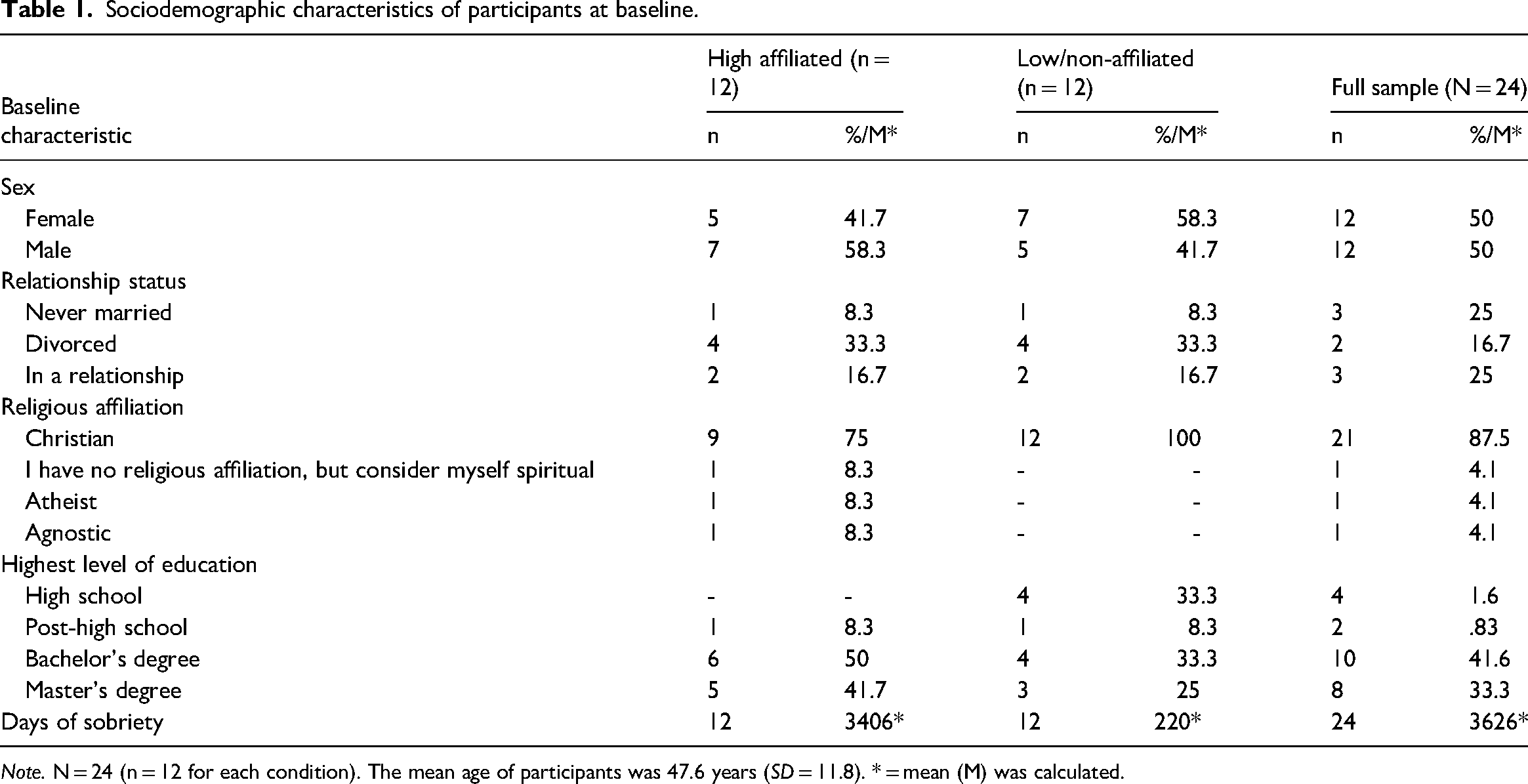
Note. N = 24 (n = 12 for each condition). The mean age of participants was 47.6 years (SD = 11.8). * = mean (M) was calculated.
Collection of the data
The present study was conducted in Bucharest, the capital city of Romania, between March and June 2021, and the interviews were recorded using a semi-structured interview guide consisting of 43 open and structured questions. Each interview lasted 30–70 min (average 45 min) and were carried out in Romanian. The process of translating the data from Romanian to English was performed by two researchers independently and the results were compared to verify the accuracy of translations. Finally, the researchers agreed on the most appropriate translation that best preserved the meaning of the original Romanian version of the interviews. The open questions were related to the individual's perspective and experience on AA attendance utility for recovery and the reasons behind their participation or dropping off, participants’ opinions regarding AA, the spiritual aspects of the 12 Steps AA programme, purpose in life, gratitude and gratitude lists, reliability in a Higher Power, spiritual awakening, satisfaction with life, sense of belonging to AA, purpose in life, well-being, identification as an AA member, commitment to AA, anxiety and depression, alcohol craving, commitment to sobriety, confidence on staying sober, sobriety, what was considered to be useful in attaining and maintaining sobriety, hitting the bottom and 10th Step inventory. The structured questions included demographic characteristics of participants as well as information related to AA meetings attendance frequencies, substance use over the past 30 days, if any – type of addictive substances used, drinking frequency, quantity, maximum alcohol quantity and heavy episodic drinking.
Analysis and categorisation
All interviews were recorded, transcribed and thematically analysed (Creswell & Creswell, 2018) following the research objectives, seeking to establish the perspective of participants on the utility of AA meetings and on the spiritual aspects of the 12 Steps AA programme. In this regard, the entire dataset was analysed repeatedly by two researchers in order to form an overall impression and to identify repeated patterns of meaning that were finally coded (Clarke et al., 2015) (see Figure 1 for a summary of the coding process). An initial list of themes, coding schemes and meaning units was developed, which, after further analysis and amendments, resulted in two main themes with four sub-themes each (Braun & Clarke, 2019) (see Figure 2 for a summary final themes and sub-themes).
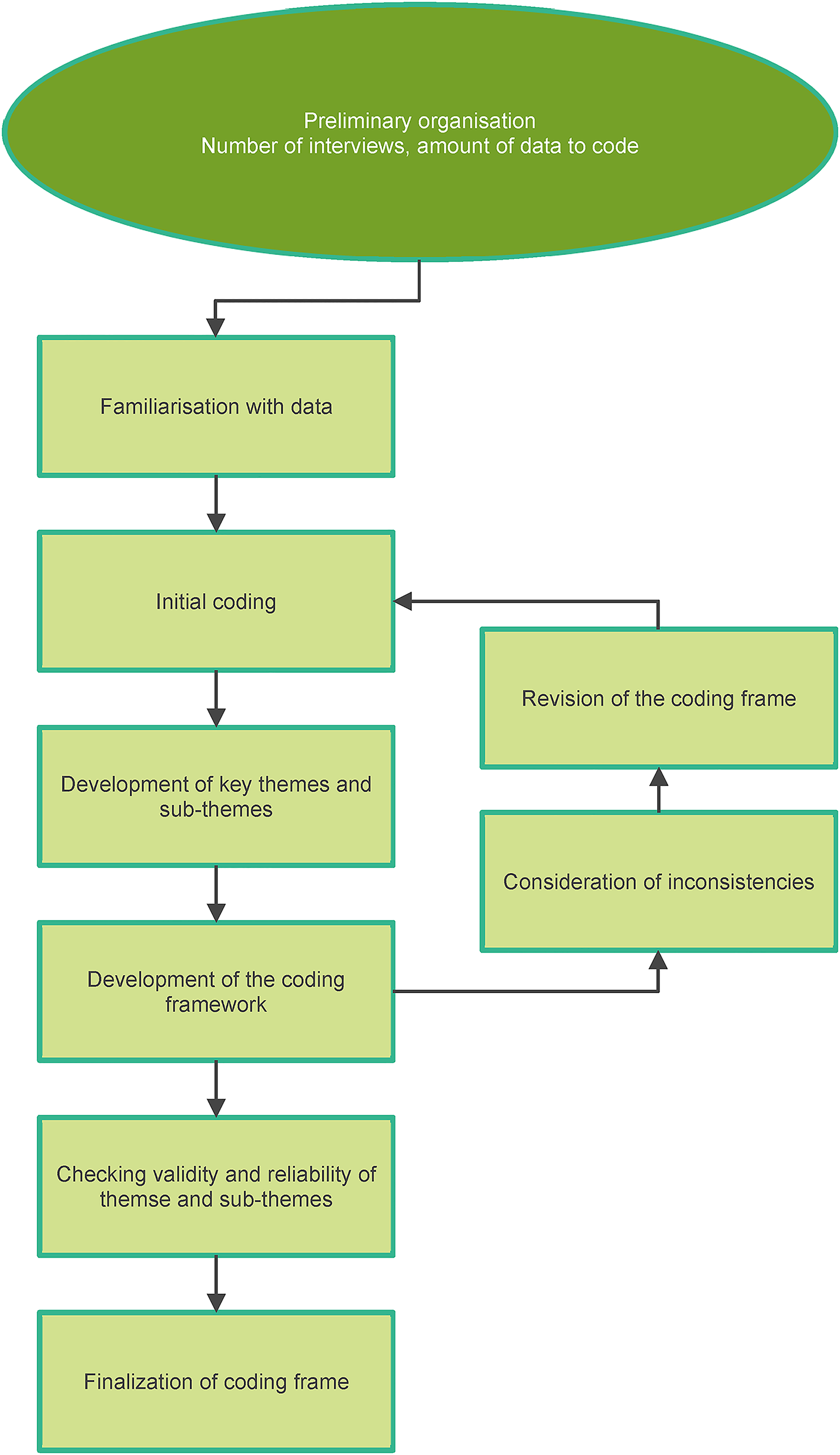
Overview of the coding process.
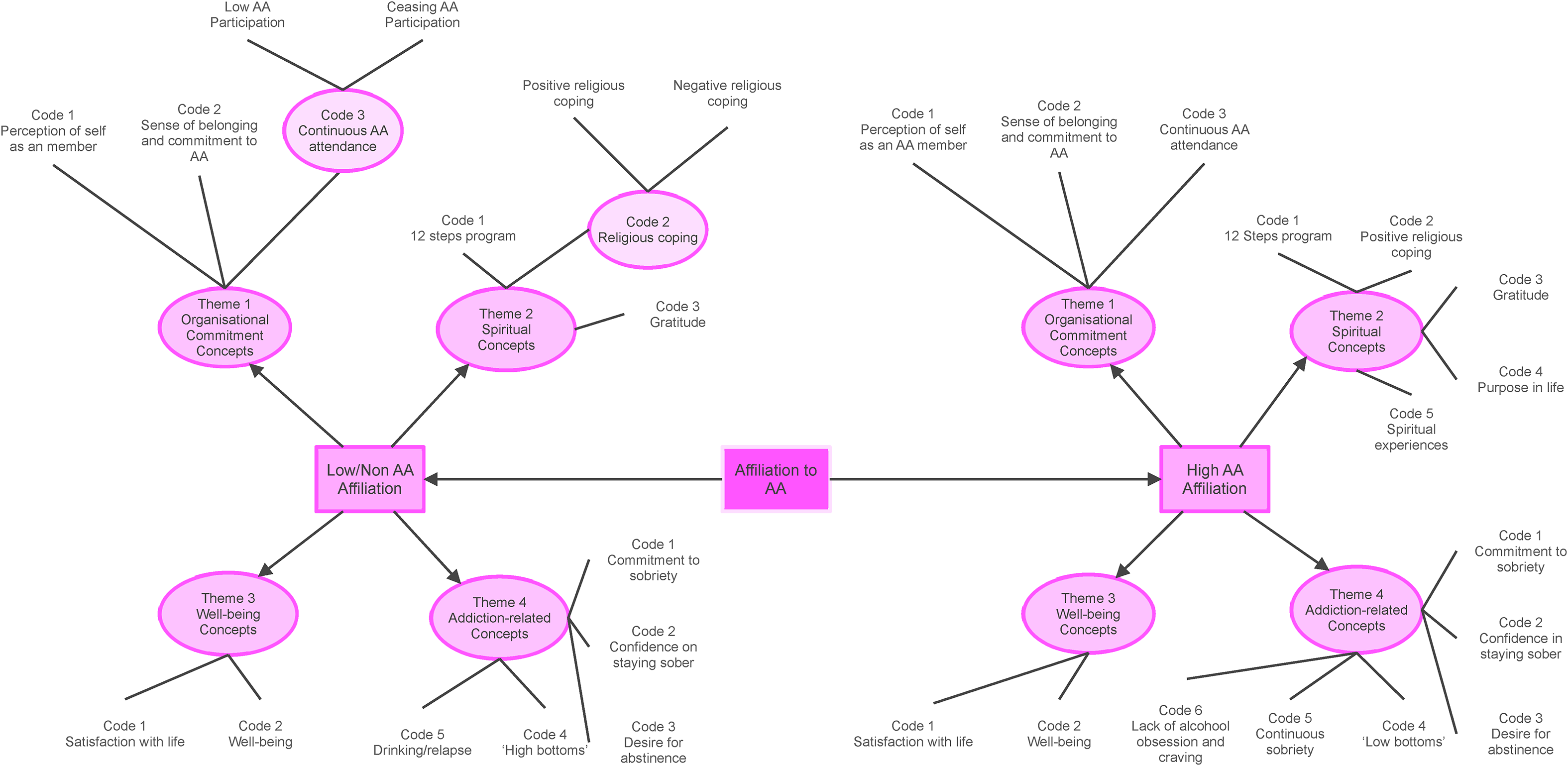
Themes and sub-themes that represent the data collected during the interviews.
Ethical issues
The data presented in this article derive from in-depth interviews recorded and transcribed. Informal conversations resulted from discussions that took place before and after the online interviews and were not recorded in the field diary. All participants gave their informed consent to participate in the study, and all reports were kept completely anonymous ensuring confidentiality. In order to ensure participants that their identities would not be revealed, the names of the participants were changed and the data related to their profile description was restricted to data on age, gender, sobriety and the length of AA participation. The study was conducted in accordance with the Declaration of Helsinki, and the protocol was approved by the Ethics Committee of Doctoral School of Sociology, University of Bucharest (anonymized for peer review).
Results
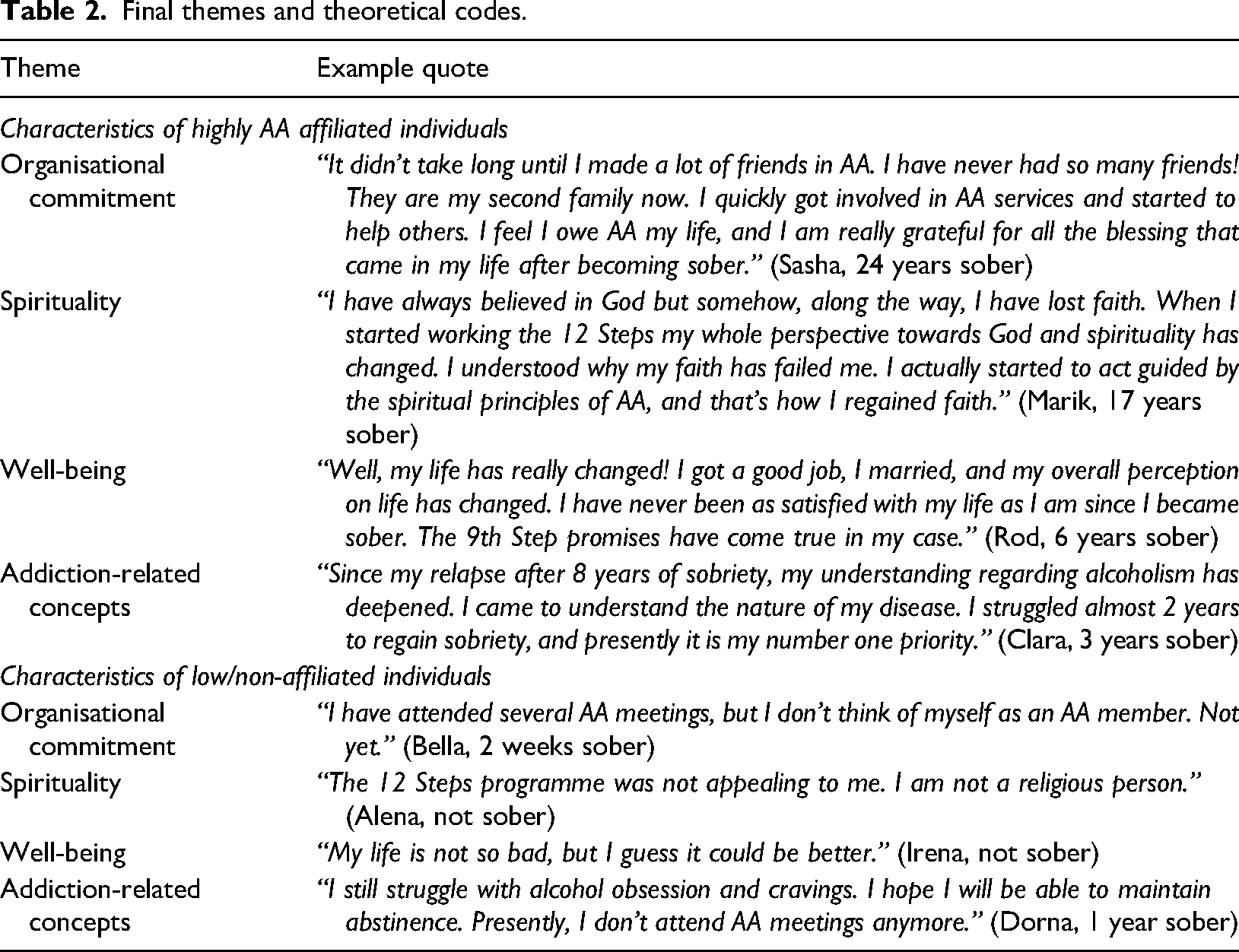
In-depth interviews analysis revealed two main themes: Characteristics of highly AA affiliated individuals and Characteristics of low/non-affiliated individuals divided into four sub-themes (Organisational commitment, Spirituality, Well-being and Addiction-related concepts). Table 2 provides a summary of final themes and theoretical codes.
Final themes and theoretical codes.
Characteristics of highly AA affiliated individuals
Organisational commitment
The Organisational commitment sub-theme included AA membership (perception of self as an AA member), sense of belonging and commitment to AA, as well as AA attendance. Highly AA affiliated individuals identify themselves as AA members. They experience a sense of belonging and commitment to AA and they report high AA attendance. In an interview, Stef has shared his experience with AA and his perspective on his sobriety. “From the moment I stepped in my first AA meeting I have not had a drink. This was more than 17 years ago. I have considered myself an AA member since the beginning of my recovery and over time I have developed a strong sense of belonging to AA since I would not have been alive today without them, I would not have succeeded without them. When I came to AA, I identified with the other AA members and they have inspired me; I told myself that if they were able to achieve sobriety, I will be as well and I succeeded.” (Stef, 17 years sober) “I have a very strong feeling of belonging to AA because over the years my family did not have time or was not willing to discuss about my problems and my struggles regarding my disease or to listen to me, while my AA colleagues and my true friends from AA took time to listen, to debate my problems and even though we did not solve them right away, I managed to go through critical periods of my life easier with them by my side. This is what belonging means to me. You cannot experience a feeling of belonging to a group or a community without being involved in helping others or in services. This way you develop a strong feeling of commitment to AA and its members whom you consider your family.” (Rob, 6 years sober) “Since I joined AA, over 12 years ago, I have attended thousands of AA meetings. There are weeks in which I attend three or four AA meetings a week. I first met AA in 2006 while I was living in another country and I got the chance to see what AA looks like outside. I managed to become sober and I did not drink for 8 years. Somehow, I did not understand the importance of the AA meetings and I stopped coming. As a result, I relapsed and I struggled for 2 years before getting sober again. Today I believe that an alcoholic cannot maintain sobriety without these meetings. In my case, I know that I cannot maintain sobriety without attending AA meetings and working the 12 Steps programme. I am aware that if I quit, I am going to die. I have no other options.” (Clara, 3 years sober)
Spirituality
This sub-theme included the 12 Steps programme, religious coping, gratitude, purpose in life and spiritual experiences. One of the main characteristics of highly AA affiliated individuals was found to be the 12 Steps programme. In this regard, highly affiliated individuals reinforced the importance of working the 12 Steps and practising the AA principles in all areas of their lives. They have completed the 12 Steps at least once. “The 12 Steps programme is one of the most effective and special methods of recovering from alcoholism. We are sick people who get better through this programme. The spiritual aspects of the programme are essential because each of us realise the divine within us and the ways by which we have denied it because of life circumstances and our attitude. I think that only through spiritual means we can regain it, by practising the 12 Steps and their principles.” (Roda, 8 years sober) “I do not consider myself a bigot, but the 12 Steps have opened a new reality for me, a new state of the spirit that began when I joined AA and still continues, after over 24 years of sobriety. It was a miracle that I have never had another drink from the moment I first stepped into AA and that the 12 Steps provided me with a new perception over life, over myself and over my connection with life, with God and with the other people in my life. All my life I have searched for peace and serenity since I have always experienced a feeling of uneasiness, like something was missing in my life. After joining AA and achieving sobriety, I have started to understand myself, to change the way I perceive the world around me and to change my behaviour in a manner that supported my sobriety and this new state of mind. The 12 Steps were the tool that facilitated the change.” (Sasha, 24 years sober) “I had no faith nor belief that God actually exists. Basically, I had to be willing to accept the existence of a Higher Power in order to work the 12 Steps. My own beliefs have changed over time. I started to acknowledge the existence of something bigger than myself.” (Axel, 6 years sober) “I started experiencing gratitude after I managed to achieve sobriety and worked the 12 Steps. I understood that gratitude comes from the heart and the best way to express it is to actually feel it. This feeling came later in sobriety as a result of accepting that I have to rely on a Higher Power, no matter which one. Only then did I start to really appreciate the people and things in my life. During my sobriety, I have had several spiritual experiences that made me aware that there are no coincidences and that I have a higher purpose in life, other than satisfying my own needs. I found this new meaning through AA, through helping others recover from alcoholism.” (Marik, 14 years sober)
Well-being
The third sub-theme included perceived satisfaction with life and well-being. Satisfaction with life explored aspects such as living a life close to one’s own ideals, achieving important things in life and the desire to change past, present or future, while well-being explored mood-related aspects such as feeling cheerful, relaxed, rested and enthusiastic about one’s own life. The interviews revealed that highly affiliated individuals experience both satisfaction with life and well-being since joining the AA community. It seems they believe that this improvement in their lives is due to gaining sobriety and mostly due to the 12 Steps programme, which allowed them to manage their lives differently. Gabi's confession emphasised the importance of the 12 Steps programme in increasing satisfaction with life and well-being. “I owe AA my life. AA taught me to live my life in a beautiful and wisely manner. Things did not change right away after becoming sober, it took years to experience a sense of satisfaction and well-being in my life. And it took a relapse after 4 years of sobriety. Only then was I able to embrace the 12 Steps programme and to live my life according to its principle. Gradually I began to experience all the promises in the 9th step.” (Gabi, 6 years sober)
Addiction related concepts
The final sub-theme included addiction-related concepts, such as alcohol craving, commitment to sobriety, confidence to stay sober, desire for abstinence, hitting the bottom and sobriety/drinking. The stories reveal a strong desire for abstinence along with the state of despair and hopelessness reported at the beginning of the recovery. Moreover, individuals highly affiliated to AA seem to have experienced low bottoms, and state that hitting the bottom was crucial in their decision to join AA, achieve and maintain sobriety, and recover from alcoholism. Clara allowed a glimpse into the significance of the emotions she felt while struggling to regain sobriety. “After the relapse I have finally hit the bottom. For almost 2 years I have struggled to regain sobriety and at some point I started to accept that this is how my life is going to be from now on until alcohol was going to kill me. I felt hopeless and powerless over alcohol and over my life as well. All my life was falling apart, and I was not able to do anything to stop it from happening. The pain and the suffering I have felt those 2 years is beyond imaginable. I finally understood my disease and the fact that I cannot maintain sobriety if do not take it seriously, that my disease is going to kill me if do not treat it.” (Clara, 3 years sober)
“At the beginning of my recovery I was willing to do anything they told me to in order to become sober. I did the 12 Steps work and I let myself be embraced by the programme. The results were amazing! Something happened and God released me of my alcohol obsession and craving. It was as if he took them with his hand … all the despair, the fear, the pain. My sanity was restored, and this is what I call the spiritual experience I have had as a result of the 12 Steps programme. Presently, I am living the 12 Steps programme, and I am confident that I will maintain my sobriety because I have a strong commitment. My sobriety comes first and this is how it has been since the beginning of my recovery.” (Stef, 17 years sober)
Characteristics of low/non-affiliated individuals
Organisational commitment
Most of the low/non-affiliated participants do not identify themselves as AA members. As a consequence, low/non-affiliated individuals do not experience a sense of belonging and commitment to AA. In this regard, Bella shared the following: “Personally, I do not consider myself an AA member. I attended a few online AA meetings and I do not really know the AA community. To some extent I feel as one of them, but not 100%. I know I need help to cease alcohol consumption, but I think my problem is not as severe as that of others.” (Bella, 2 weeks sober)
However, although some of the participants still attend AA meetings, those who stopped attending do not seem to fit with the AA practices and activities. Among the reasons some of the low/non-affiliated individuals have stopped attending AA meetings, Ilona mentions the following: “After attending a few AA meetings, I felt they did not help me. On the contrary, the fact that the main themes within the AA meetings were related to alcohol consumption and some of the shares had a powerful emotional impact over me, led me to drink. So, I decided not to participate anymore.” (Ilona, not sober)
Spirituality
Most low/non-affiliated individuals did not work the 12 Steps at all, and only some of them have tried to work the first Steps. In his share, Dragos explained: “In my case, AA did not work. I tried several times to become sober and to work the Steps. I had two sponsors, but I did not manage to complete the 4th Step. First, I found it really difficult to turn over my life and my will to a Higher Power and then, when I started to work the 4th Step inventory, I got stuck, I just could not continue. I had many relapses and presently I do not attend AA anymore, nor maintain sobriety.” (Dragos, not sober) “I do not think I had a spiritual awakening since I met AA, and I do not really know what this means. I heard people in AA talking about spiritual experiences, and honestly I found it hard to believe it is true.” (Irena, not sober) “I consider myself an atheist and I found it hard to resonate with the concept of a Higher Power, but there are some spiritual aspects that I consider useful.” (Mada, 5 months sober) “I have been sober for 3 years when I first came to AA, but after the relapse I was not able to attain sobriety again. More than 10 years have passed since then. To some extend I feel grateful for my life, but there are so many areas that need improvement. I feel like something is missing and sometimes I cannot find any purpose in my life. I have lost my family due to my inability to stop drinking and my friends have abandoned me. My finances are not well and my health is declining.” (Alex, not sober)
Well-being
Satisfaction with life and well-being within low/non-affiliated participants were reported only seldom, and when present they were reported to be only moderate or low. The shares emphasise some of the aspects related to these concepts: ‘It has been 1 year since I stopped drinking. I only attended a few AA meetings. It was very unclear to me what was I supposed to do in order to attain sobriety. The 12 Steps programme itself was unclear. I am not as satisfied with my life as I would wish to be.” (Dorna. 1 year sober)
Addiction-related concepts
Low/non-affiliated individuals did not manage to achieve sobriety or, in some cases, to maintain sobriety. The interviews revealed that although some of them have managed to cease alcohol consumption for a period of time, they have experienced relapse at some point. A common feature of low/non-affiliated participants was found to be discontinuous abstinence. “Actually, I stopped attending AA meetings. I have a busy schedule and I think I got caught up with everyday chores, I was not able to attend the meetings or did not want to.” (Alena, not sober) “When things get complicated in my life, I experience alcohol craving and often drink alcohol. I went to a few AA meetings but I did not want to work the Steps so I gave up. Usually, I can stop on my own and when I feel I cannot, I attend a meeting. My purpose is to be able to manage my life properly and to avoid the negative consequences of alcohol or drug abuse, not to become sober.” (Irena, not sober) “I did not resonate with the 12 Steps programme, nor with its principles.” (Emi, not sober) “I did not identify with the AA members and I really think my life did not become as bad as theirs as a result of alcohol consumption. I can keep my job, I have my family, and I have not lost the important people and things in my life.” “I attended a few AA meetings because I needed to be around people who shared the same problem as me. The purpose was not to stop drinking forever, it was to learn how to manage my drinking so it does not affect my life. And honestly, I do not think I am able to cease alcohol consumption. I am not as the others in the meetings. I have a husband, parents, a well-paid job, I am young and healthy.” (Ina, not sober)
Discussion
The aim of this study was to identify the differences between highly AA affiliated and low/non-affiliated individuals to create a more complex profile of AA affiliates. Affiliation to AA has already proven to be both effective and beneficial for individuals who struggle with alcohol addiction (Humphreys et al., 1999; Kaskutas, 2009; Krentzman, 2008; Project Match Research Group, 1997; Tonigan, 2008) and previous studies have focused on unveiling specific factors and personality traits that lead to successful affiliation to AA to facilitate affiliation in individuals who do not match the profile of the successful affiliate (Cloud et al., 2004; Day et al., 2019; Emrick et al., 1993; Humphreys et al., 1998; McKellar et al., 2003; Morgenstern et al., 1997; Trice & Roman, 1970). While AA seems to foster affiliation among both men and women with different racial, religious and ethnic backgrounds, research shows that AA does not fit everyone (e.g., women, individuals belonging to sexual minorities, young men and women) (Hoffman, 1994; Sanders, 2010). Currently, AA is still male dominated – 62% of AA affiliates are men – and 87% of AA members, regardless of gender, are aged older than 31 years (Sanders, 2010). In this context, 50% of newcomers give up attending AA after 3 months and only 41% of those in their first year of recovery will remain affiliated to AA for another 2 years (Chappel, 1993). Among the reasons why AA and other 12 Steps programmes may not fit everyone, research found that individuals who fail to affiliate to AA may not resonate with the spiritual aspects of the 12 Steps programme and the 12 Steps themselves, the disease model promoted by AA, certain AA practices that include labelling (Walters, 2002) or may disengage due to negative experiences and frustration developed while within AA (such as relapse followed by loss of fate in the AA method or feelings of needing more than what AA can offer) or out of desire to experience life as an ordinary individual and to involve more in other areas of life (Vederhus et al., 2020). However, while affiliation to AA involves a variety of AA activities (attendance to AA meetings, service in AA, working the 12 Steps, having a sponsor as well as being one, identification with the other AA members and self-identification as an AA member), attendance to AA meetings is often the main measure of AA affiliation (Cloud et al., 2004). Concepts, such as the sense of “hitting the bottom”, and working the 12 Steps programme were also included in assessing successful affiliation to AA (Tonigan et al., 2001). In this regard, hitting the bottom is a concept describing a turning point for individuals addicted to alcohol, the point at which the individual is ready and decides to seek help to attain sobriety (Young, 2011). Hitting the bottom is a subjective concept since its meaning is different depending on the individual`s perception (one can reach the bottom after losing a partner or a job, whereas another can lose his health or even lose his life and never hit the bottom). However, “hitting the bottom” is described as a necessary condition for recovery from alcoholism, a period of “incomprehensible demoralisation”, of desperation and characterised more by spiritual and existential vacuum rather than by other kinds of losses (Alcoholics Anonymous World Services, 2001; Tonigan et al., 2001). Young (2011) found significant differences between individuals who seek recovery from alcoholism and those who do not; individuals who identify as having experienced “high bottoms” report a higher motivation to change, to attain and maintain sobriety compared to those who identify as having experienced “low bottoms”. On the other hand, Bentley (2018) found that individuals who identify as having experienced “low bottoms” are less likely to attend AA since they are less likely to have social ties with AA members. In this context, the current study has defined successful affiliation to AA taking into consideration a variety of constructs such as organisational commitment constructs (AA membership, commitment and sense of belonging to AA, and AA attendance), spiritual constructs (working the 12 Steps programme, religious coping, gratitude, purpose in life and spiritual experiences), well-being (satisfaction with life and well-being) and addiction-related constructs (alcohol craving, commitment to sobriety, confidence to stay sober, desire for abstinence, hitting the bottom and sobriety/drinking). The results support previous findings and add additional features of successfully affiliated individuals, features that may determine successful affiliation to AA or may come as a result of successful affiliation to AA. The findings of the present study will be discussed for each construct.
Organisational commitment (AA membership, commitment and sense of belonging to AA, and AA attendance)
Our findings show that successfully affiliated individuals who identify themselves as AA members are committed to AA, experience a sense of belonging to AA and attend AA meetings on a regular basis. Surprisingly, perception on self as an AA member was not found to be a characteristic of highly AA affiliated individuals only. Some of the low/non-affiliated individuals identified themselves as AA members although they are not sober nor are they involved in the AA community. As a result, this measure only does not seem to be a reliable measure for AA affiliation. In this context, individuals who identify themselves as AA members and have the desire to stop drinking are considered to be AA affiliates according to AA (Alcoholics Anonymous World Services, 2001), yet AA membership implies commitment and a sense of belonging to AA, which develop through AA involvement. In this regard, involvement to AA was already found to have a supportive role in the process of recovery from alcoholism (Wnuk et al., 2009) and to be associated with sobriety (Zemore, 2007), continuous abstinence and lower risk of relapse (Sheeren, 1988). Although AA attendance, as well as perception on self as an AA member are associated with involvement to AA (Humphreys et al., 1998; Tonigan et al., 1996a), the present study found that these measures are not characteristics of only highly AA affiliated individuals. Some of the low/non-affiliated participants’ disclosures revealed they attend AA meetings albeit not on a regular basis. As a consequence, perception on self as an AA member and attendance to AA are only the first steps in attaining sobriety and do not necessarily reflect a high level of affiliation to AA, while involvement in AA seems to be a more appropriate concept associated with successful AA affiliation since it incorporates a wide range of AA-related activities (e.g., having/being a sponsor, AA service, AA attendance). Nonetheless, only a minority of individuals who enter AA become successful AA affiliates (Hoffmann, 2003).
Spiritual constructs (working the 12 Steps programme, religious coping, gratitude, purpose in life and spiritual experiences)
Among the barriers to becoming successfully affiliated to AA, the nature of the AA programme itself is considered to be one, since the 12 AA Steps refer to the concept of a Higher Power. In this regard, the findings in the present study revealed that highly AA affiliated individuals accepted the AA concept of a Higher Power regardless of their previous beliefs before joining AA while most of the low/non-affiliated individuals did not resonate with the concept at all. However, some of the low/non-affiliated individuals’ disclosures revealed they consider themselves religious and the concept of a Higher Power promoted by AA did not represent a barrier in attending AA meetings. Nonetheless, positive religious coping before attending AA may facilitate affiliation to AA, but it seems it is not enough to either attain or maintain sobriety, nor to predict successful affiliation to AA and long-term sobriety. Although considered to be “spiritual rather than religious” (Sandoz, 2014), the AA programme does not suit everyone. Results showed that atheists and agnostics find it difficult to work the 12 Steps due to their reluctance on the concept of a Higher Power. Moreover, it seems that the lack of any spiritual beliefs found in atheists and agnostics can lead to failure in affiliation to AA when it comes to initiating and maintaining participation in AA meetings compared with individuals who relate with some spiritual or religious principles (Tonigan et al., 2002). The bottom line is these individuals are less likely to embrace the AA solution for alcoholism, a spiritual experience as a result of the 12 Steps and to become successfully affiliated to AA. In this regard, previous studies found that increased spiritual experience in individuals suffering from alcoholism, compared to AA attendance alone (Krentzman et al., 2013), and spirituality have been positively associated to continuous sobriety in AA (Oakes et al., 2000; Poage et al., 2004). Our findings revealed that although some low/non-affiliated participants report positive religious coping, none of them have completed the 12 Steps programme and these participants did not experience a spiritual awakening and did not manage to successfully affiliate with AA. In this regard, further research should investigate the extent to which positive religious coping can predict AA affiliation. In addition, low/non-affiliated participants were not able to attain sobriety nor did they manage to cease alcohol consumption for a period of time but relapsed. These findings could be explained by the inability to work the 12 Steps as it seems that practising the principles of the 12 Steps results in a proactive spiritual way of action that is incompatible with alcohol consumption (Robinson et al., 2007). In addition, the results showed that successfully affiliated individuals experience gratitude and have found a meaningful purpose in life through AA compared with low/non-affiliated individuals. Although there is little research on gratitude and its influence on recovery from alcoholism, research has shown that gratitude in recovery increases wellness, is positively associated with 12 Step practices, shows greater social support and post-traumatic growth, with the accomplishment of more of the AA promises, and it is particularly beneficial for avoidant individuals (LaBelle & Edelstein, 2018). Moreover, previous research found that gratitude was positively associated with AA involvement and length of sobriety (Krentzman & Finn, 2019), while purpose in life is positively associated with continuous sobriety in AA (Oakes et al., 2000; Young-Hall, 2000) and higher motivation to change as well, since purpose in life is both a spiritual and motivational construct (Oakes, 2008). All highly AA affiliated participants experience gratitude as a result of the spiritual awakening experienced through the 12 Steps programme, which led to a profound change in thinking and behaving consistent with long-term sobriety. Although low levels of gratitude and purpose in life were found in some of the low/non-affiliated individuals, these concepts seem to have different meaning for the two categories. As most of the shares revealed, AA gave highly AA affiliated participants a higher purpose in life by helping others to recover from alcoholism.
Well-being (satisfaction with life and well-being)
The well-being construct has been included in this research as successful affiliation to AA seems to be associated not only with long-term sobriety but also with other recovery benefits, such as an increase in quality of life and satisfaction with the new way of living (the sober life) (Alcoholics Anonymous World Services, 2001). In this regard, AA promises a change in thinking, behaviour and attitude towards life that translates into feelings of freedom and serenity, happiness, lack of regrets related to the past, peace and a diminishing of fear of people and economic insecurity, which in return reflect both well-being and satisfaction with life. As the Big Book states, “Our whole attitude and outlook on life will change” (Alcoholics Anonymous World Services, 2001, p. 84). In this regard, highly affiliated individuals seem to share feelings that reflect contempt towards their new lives and their achievements in sobriety. Moreover, they experience feelings of happiness and enthusiasm about their new sober lives. As a consequence, the results suggest that successfully AA affiliated individuals benefit not only of sobriety, but of well-being and satisfaction with life as well as a result of AA involvement. On the other hand, these concepts were not common themes among low/non-affiliated individuals and took different meanings not related to the spiritual awakening experienced as a result of the 12 Steps. These results support previous findings that argue that spiritual experiences and spiritual growth determine subjective well-being (Wnuk & Marcinkowski, 2014; Wnuk, 2021), including satisfaction with life (Diener & Ryan, 2009).
Addiction-related constructs (alcohol craving, commitment to sobriety, confidence to stay sober, desire for abstinence, hitting the bottom and sobriety/drinking)
Differences between highly affiliated and low/non-affiliated individuals were also found in addiction-related constructs. Those who successfully affiliate to AA do not experience alcohol craving and relapse, report a higher commitment to sobriety and confidence to stay sober, and have a strong desire to attain and maintain sobriety due to experiencing “low bottoms”. Previous research has investigated the relationship between craving and relapse, as well as between craving and involvement in AA (Galanter et al., 2013; Martins et al., 2022). While craving predicts relapse, commitment to sobriety was proven to be much stronger than motivation (Kelly & Greene, 2014). Moreover, desire for abstinence seems to influence relapse, drinking outcomes, to predict length of sobriety and to be associated with recovery from alcoholism; therefore, we can assume it will also have an impact on successful affiliation to AA (Adamson et al., 2010; DiClemente, 2007; Whitford et al., 2009). In addition, confidence to stay sober is positively associated with attending the 12-Steps programme (Morgenstern et al., 1997). As expected, low/non-affiliated individuals experience both cravings and relapse, as well as low confidence to stay sober due to decreased commitment to sobriety. In addition, their disclosures revealed “high bottoms”, which reflect on low desire for abstinence and low motivation to change. In this regard, a common theme among highly affiliated individuals was the state of despair experienced before joining AA, which made them willing to go to any lengths to achieve sobriety and serenity. Previous research also found that hitting the bottom was associated with AA attendance, affiliation to AA and a desire for change in behaviour regarding alcohol use (Cunningham et al., 2005; Project MATCH, 1997; Tonigan et al., 1996a, 2001). Overall, the results showed that individuals who experienced “low bottoms” were the ones who became successfully affiliated to AA.
Strengths and limitations
The qualitative nature of the study allowed for a profound understanding of participants’ experiences through in-depth interviews. In this context, the study brings novel information from a developing country in which there are no studies on AA affiliation. Although the study has several strengths, several limitations should be also considered. First, the limited sample size does not allow for generalisation of the findings. Second, although the study included participants from different cities from Romania, there may be AA members who do not share the same characteristics of participants included in the study. In addition, the researcher did not have access to all AA groups from Romania due to lack of infrastructure (such as Internet access, computer or mobile phone) and/or knowledge as the interviews were performed in an online environment. In this regard, the impact of the COVID-19 pandemic should be considered as well since the restrictions associated with the pandemic context have probably affected certain vulnerable groups, such as older individuals and those who struggle with poverty and seek help from AA or those who recover from alcoholism in AA but do not have the knowledge or infrastructure to gain access to the online AA meetings. However, despite these limitations, the present study could constitute the basis for further research while the findings show that affiliation to AA is a rather complex concept to operationalise, and that level of AA affiliation is not the same within individuals who perceive themselves as AA members and attend AA meetings. In addition, the data collection was carried out in 2021, during the COVID-19 pandemic, which may have influenced some measures (e.g., attendance, metal health, etc.). However, this study brings new insights to the AA literature by highlighting the stability of the differences in levels of affiliation between those with high versus low/non-affiliation.
Conclusion
While successful affiliation to AA seems to be influenced by a multitude of organisational commitment, spiritual, well-being, and addiction-related constructs, this study unveiled only some of the differences between highly AA affiliated and low/non-affiliated individuals. The findings showed that individuals who do manage to successfully affiliate to AA identify themselves as AA members, become involved in and committed to AA, develop a sense of belonging to AA and regularly attend AA meetings. As a result of embracing the 12 Steps programme and attaining sobriety, these individuals report beneficial outcomes, such as positive religious coping, finding purpose in life, increased gratitude, experience a spiritual awakening, increased well-being and satisfaction with life. In addition, these individuals report less craving, higher desire for sobriety, commitment to sobriety and confidence to stay sober. Furthermore, a common characteristic of highly affiliated individuals seems to be the fact they have experienced “low bottoms”. In this regard, future research should investigate the influence of experiencing “low bottoms” on organisational commitment, spiritual, well-being and addiction related concepts among individuals who attend AA meetings as it seems to play an important role in successful affiliation to AA. Specifically, highly affiliated individuals are those who identify themselves as AA members, are sober, have worked the 12 Steps, are satisfied with their lives, experience a state of well-being, accept the Higher Power, have hit the bottom, have a strong desire for abstinence, attend AA meetings on a regular basis and are committed to both AA and their sobriety. However, the perception of self as an AA member and positive religious coping were found to be common characteristics of both highly affiliated individuals as well as of several low/non-affiliated participants. As a consequence, further research should investigate the extent to which these characteristics in newcomers can predict successful AA affiliation. These results may form the basis for future research on factors that influence successful affiliation to AA, as well as on the influence of level of AA affiliation on recovery outcomes, in order to facilitate AA affiliation for those that do not fit the AA profile and to motivate those who struggle with alcohol addiction and are reluctant in joining AA. Bottom line, the findings suggest that those working in the area of substance abuse should pay more attention to the influence of organisational commitment, spiritual and addiction-related concepts as they seem to play an important role in successful affiliation to AA.
Supplemental Material
sj-docx-1-nad-10.1177_14550725241278089 - Supplemental material for Affiliation to the Alcoholics Anonymous (AA) community: A qualitative study on differences between highly affiliated and low/non-affiliated individuals
Supplemental material, sj-docx-1-nad-10.1177_14550725241278089 for Affiliation to the Alcoholics Anonymous (AA) community: A qualitative study on differences between highly affiliated and low/non-affiliated individuals by Adriana Lavinia Bulumac in Nordic Studies on Alcohol and Drugs
Footnotes
Acknowledgements
The author wants to express her very great appreciation to Prof. Univ. Dr. Florin Lazăr for his valuable and constructive suggestions during the planning and development of this research. His willingness to give his time and so generously has been very much appreciated.
Declaration of conflicting interests
The author declared no potential conflicts of interest with respect to the research, authorship, and/or publication of this article.
Funding
The author received no financial support for the research, authorship, and/or publication of this article.

Supplementary material
Supplementary material for this article is available online.
References
Supplementary Material
Please find the following supplemental material available below.
For Open Access articles published under a Creative Commons License, all supplemental material carries the same license as the article it is associated with.
For non-Open Access articles published, all supplemental material carries a non-exclusive license, and permission requests for re-use of supplemental material or any part of supplemental material shall be sent directly to the copyright owner as specified in the copyright notice associated with the article.
