



Abstract
Keywords
In June 2019, Japan Tobacco International launched a new tobacco-free nicotine pouch onto the UK market. Branded “Nordic Spirit”, the product was swiftly advertised through a large-scale, slick marketing campaign, which involved a heavy social media presence, aligning with the country's biggest music festivals and giving out free samples at promotional events. By 2021, Nordic Spirit had become the UK's number one nicotine pouch and won “Nicotine Pouch Product of the Year” in Kantar's Consumer Survey of Product Innovation. Today, it holds a market share of 53.6% and fetches annual sales of £19.7 million (JTI, 2023). While Nordic Spirit's press launch claimed that its products are aimed at “existing adult smokers and vapers”, their marketing tactics have been strongly criticised for attracting non-smokers – mainly from the young population – by drawing on marketing practices “straight out of the big tobacco playbook of old” (Action on Smoking and Health, cited in Das, 2023).
Indeed, these concerns are legitimised by the fact that the nicotine pouch market is largely unregulated in the UK, thereby allowing tobacco companies to exploit a legal loophole. Unlike e-cigarettes, nicotine pouches are not currently classed as tobacco-related products, meaning that they can be legally sold to under-18s (Association of Directors of Public Health, 2023). Furthermore, while vape promotions are generally prohibited on social media, nicotine pouches can be legally advertised across platforms, with an emphasis on their variety of flavours and strengths. Although the Advertising Standards Authority (2022) states that nicotine pouches must be advertised “in a responsible manner”, it does not explicitly ban content, endorsements or promotions that go beyond “factual information”. An additional challenge is posed by the fact that, thus far, there has only been limited independent testing of the constituents, exposures and biomarkers of effects of nicotine pouches, meaning that their long-term health risks are unknown (Ohnesorg et al., 2024; Patwardhan and Fagerström, 2022). The “borderline” status of nicotine pouches, therefore, enables brands to take advantage of the “spaces of confusion” (Spackman, 2020:57) posed by their liminality to create marketing campaigns, inspired by the tried-and-tested formulas of both the tobacco and food industries.
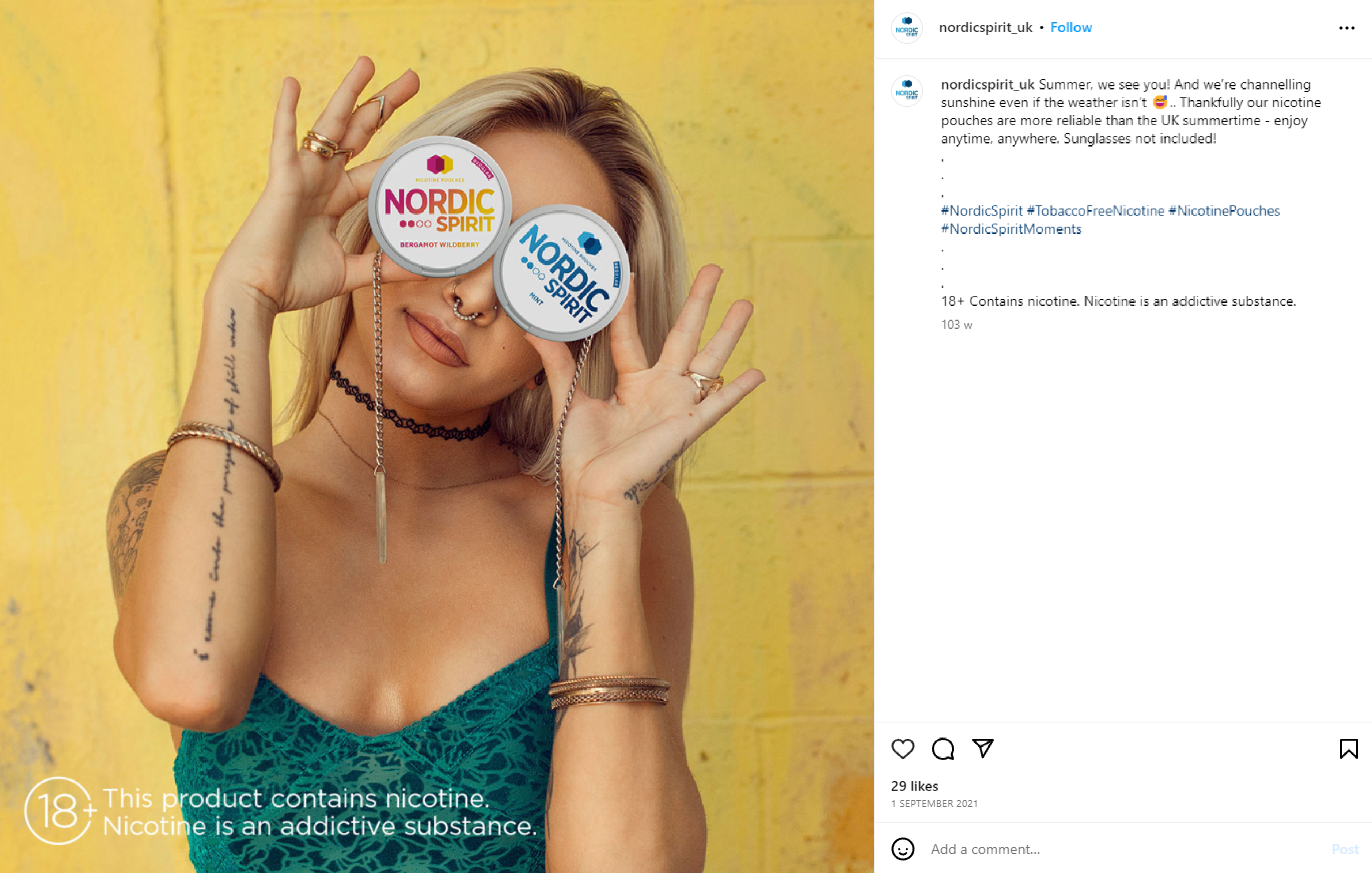
Playfulness with Nordic Spirit. Nordic Spirit Instagram page, 1 September 2021.
Research on the marketing of tobacco and nicotine products has a long trajectory, from both a historical and contemporary perspective. Some studies have explored the informational content (Ringold and Calfee, 1989), health claims (Paek et al., 2010; Witkowski, 1991) and use of physicians (Gardner and Brandt, 2006) in cigarette advertisements, as well as open-source marketing online (Freeman and Chapman, 2009), while others have been more concerned with cigarette marketing in specific periods of history, such as the Dutch East Indies (Riyanto et al., 2022), early 20th-century Egypt (Shechter 2005), post-war Germany (Elliot 2015) and Cold War Bulgaria (Neuburger, 2016). There has also been a large body of work focused on gender, whether in terms of masculinity in cigarette advertisements (Cortese and Ling, 2011; Starr, 1984; White et al., 2012) or attracting a “new” market of women, particularly as part of the US “Torches of Freedom” campaign (Amos and Haglund, 2000; Leal et al., 2016; Topić, 2021). Studies on smokeless tobacco have also focused predominantly on the link between female consumption and advertising (Hendlin et al., 2023; Timberlake et al., 2011), as well as health warning labels (Mays et al., 2016). Equally, there has been much research on children and young adults, with notable studies by Pollay (1995) on “youthful” marketing tactics, Schooler et al. (1996) on 7th-graders’ exposure to cigarette marketing and Crawford (2014) on cigarette advertising in student media.
Since the prohibition of most forms of tobacco advertising across the Western world, 1 the tobacco industry has introduced new products, such as e-cigarettes and nicotine pouches, to the market, continuing to promote them with similar strategies. Consequently, much research in the last decade has focused on the dangers of such advertisements, particularly for young people. On the topic of e-cigarettes, researchers have explored public engagement with informational content (Collins et al., 2019), receptivity (Pokhrel et al., 2015), youth-targeted marketing (De Andrade et al., 2013; Padon et al., 2018), youth exposure and trends (Mantey et al., 2016), the impact of marketing near schools (Giovenco et al., 2016) and marketing claims (Klein et al., 2016), to name but a few examples. Being a relatively new product, nicotine pouches have received less attention to date. Of the limited research carried out, most investigates consumer willingness to try products (Tosakoon et al., 2023; Vogel et al., 2022) or summarises regulatory approaches (Duren et al., 2023; Fjellner, 2020). Some notable exceptions include Duan et al. (2022), Ling et al. (2023), Laestadius et al. (2024) and Sun and Tattan-Birch (2024), who all focus instead on marketing strategies. However, these studies predominantly use quantitative approaches or provide limited details on social media marketing and the multimodal features at work in such posts.
This study
There is currently a lack of regulation on nicotine pouches within the UK. While e-cigarettes are regulated under both the Nicotine Inhaling Products Regulations 2015 and Tobacco and Related Products Regulations 2016, these laws do not apply to nicotine pouches. Furthermore, nicotine pouches are not covered by medicine licensing because they are marketed as consumer products, nor are they considered foods by the Food Standards Agency. This means that, as of June 2024, they are only governed by the General Product Safety Regulations, 2 which seeks to ensure that “no producer shall [supply or] place a [consumer] product on the market unless the product is a safe product”. Furthermore, while Meta Platforms Inc. prohibited branded content promoting tobacco products in 2019 (although Laestadius et al., 2024 have found that they are still present on social media), the policy does not explicitly prohibit promotion of nicotine products. Nicotine pouch brands are recommended to follow the Committee of Advertising Practice (CAP) Code on the advertising of age-restricted products online (cf. Advertising Standards Authority, 2021), but this is not statutory regulation. Consequently, the door is left open for brands to take advantage of consumers, particularly young people. As social media has been identified by tobacco pouch companies as a core platform through which to promote their products (cf. Duan et al., 2022), research into how these platforms are being strategically harnessed by brands to attract young people is of paramount importance.
The aim of the current study was to investigate how Nordic Spirit – one of the UK's bestselling tobacco pouches – uses social media to connect with young people through a comprehensive examination of posts on its UK Instagram page between 2019 and 2023. The decision to focus on posts as opposed to advertisements was due to their status as covert marketing tools, i.e., Instagram advertisements must be marked as sponsored content, whereas posts create engagement with followers and expose young people to “disguised” forms of advertisements (cf. Tatlow-Golden and Parker, 2020). Using qualitative content analysis, followed by multimodal critical discourse analysis (Ledin and Machin, 2018, 2020a), the study sought to answer three key questions:
The study identifies four core themes – (1) fun and freedom; (2) Nordic happiness; (3) fuss-free and discreet; and (4) healthy and scientifically rational – that are explicitly aimed at young people and seek to promote nicotine pouches as “a fun and glamorous lifestyle product” (Das, 2023). It argues that such strategies can encourage the risk of nicotine addiction and dependence and calls on the UK government and Advertising Standards Authority to do more to clamp down on these posts and introduce tighter regulations to protect young people and uphold their freedom from exploitation (cf. Tatlow-Golden and Garde, 2020).
Methodology and data
In order to explore how Nordic Spirit is marketed to young people in the UK, this study draws upon a sample of 496 posts published on Nordic Spirit's Instagram page between 6 June 2019 (the date that the product was launched) and 17 August 2023. While the first nicotine pouches (Choice) went on sale in 2003, it is only in the past 5 years that they have gained rapid popularity as a result of extensive marketing campaigns. Today, Nordic Spirit is the biggest and fastest-growing nicotine pouch company (JTI, 2023), making it an ideal case study to explore this phenomenon. The posts under study were collected through a manual process of visiting Nordic Spirit's Instagram page and taking screenshots of each alongside its caption. This yielded a total of 496 examples, of which 256 were photos and 240 were videos.
The collected posts were then organised into themes using qualitative content analysis to identify recurring patterns. Following guidance by Bell (2004), the content analysis focused largely on the depicted setting and represented participants in images/videos, the use of colour, angle, salience and framing, and any supporting language. This process identified four overarching themes: (1) fun and freedom; (2) Nordic happiness; (3) fuss-free and discreet; and (4) healthy and scientifically rational. The first links nicotine pouches to excitement and pleasure, the second ties nicotine pouches to the long history of snus 3 in Sweden; the third seeks to emphasise portability and nicotine pouches as part of a daily routine; and the fourth promotes nicotine pouches as “good” choices for both body and mind. A breakdown of all four themes can be seen in Table 1. Of the 496 examples collected, 78 were discounted as “Miscellaneous” because they focused solely on promotions and offers. This meant that 418 examples were carried through to the next stage of analysis.
Breakdown of themes in Nordic Spirit Instagram advertisements
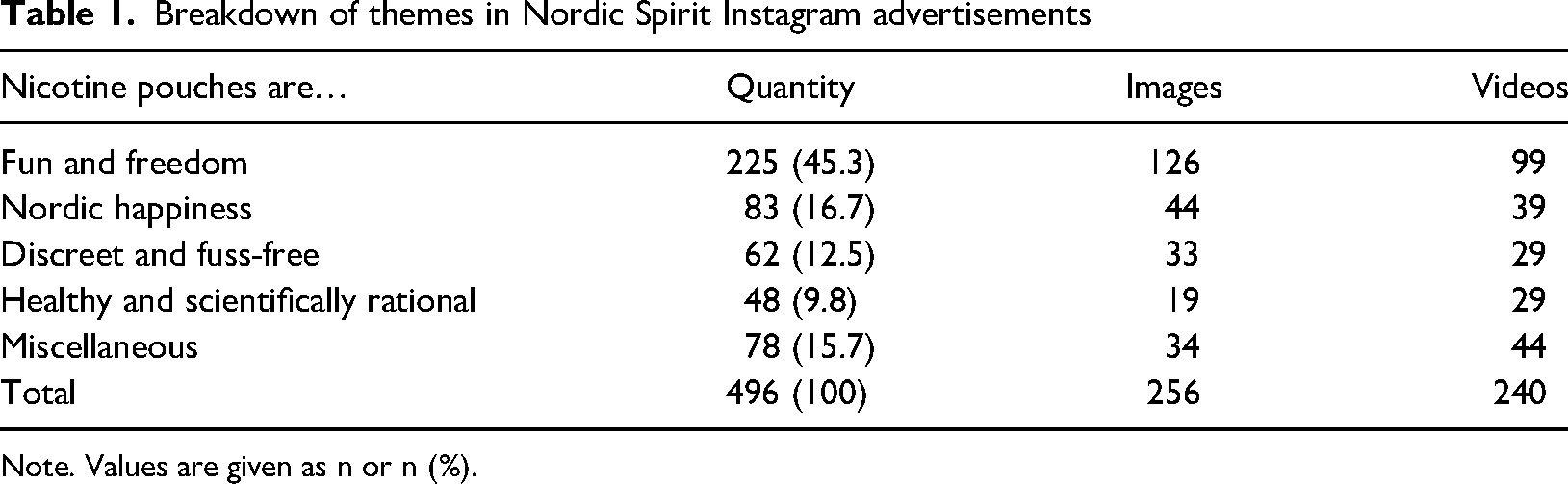
Note. Values are given as n or n (%).
After identification of the overarching themes, the specific posts were then explored by drawing upon the theoretical perspective of social semiotics (Kress and van Leeuwen, 1996) and the methodological toolkit of multimodal critical discourse analysis [MCDA] (Ledin and Machin, 2018, 2020a). Social semiotics is an approach to communication that sees meaning-making as a social practice and seeks to investigate how human signifying practices develop an understanding of the world and shape power relations with others, while MCDA is used to demonstrate how linguistic and other semiotic resources convey meaning in discourse. Applied here, it helps to unpack the different semiotic resources at work in Nordic Spirit's posts, establish their ideological patterns and uncover how they work together to frame nicotine pouches as an essential product for “trendy” young people.
Analysis
In what follows, I present the findings of this MCDA thematically, drawing on a selection of prototypical posts in the dataset representative of the four themes. Specific attention is paid to static images (which represented 53.1% of the 418 posts), although the content of videos (46.9%) will be drawn upon when pertinent. The themes are organised according to order of frequency.
Nicotine pouches are fun and freedom
Nordic Spirit places a heavy emphasis on the fun, freedom and escapism that its nicotine pouches can bring, often through collective experiences with loved ones. Accordingly, posts frequently highlight “Nordic Spirit moments” together, whether at barbeques, pubs, nightclubs, cafes or on the beach. Supporting these images is the strapline “anytime anywhere”, which underscores Nordic Spirit as a product that is unhindered by the rules and regulations of other tobacco products, such as cigarettes or cigars, granting more flexibility and power to users to live life as they choose. In many of these posts, young women are the key focus, tying in with findings by Hendlin et al. (2023) that tobacco companies are predominantly aiming nicotine pouches at women who represent a growing consumer market for such products. Summer and the sunshine also feature heavily in such posts, transferring their positive associations of warmth, health and happiness to the consumption of Nordic Spirit (cf. O'Hagan, 2023a). Straplines also draw upon this link, describing Nordic Spirit as “a taste of sunshine” – a marketing ploy that dates back to early 20th-century advertisements for radium and cod liver oil (cf. Eriksson and O'Hagan, 2021; O'Hagan and Eriksson, 2022).
Clear emphasis on the summer can be seen in a post from 29 June 2021, which shows two young women in bikinis and sunglasses lying in rubber rings and floating in the water. The various blue hues establish a feeling of calm, peace and nostalgia (Kress and van Leeuwen, 2002:354), while their smiling faces directed towards one another create a bidirectional transaction indicating that they are having fun (Kress and van Leeuwen, 1996:66). A tin of Nordic Spirit is carefully placed on the side of the ring, acting as a “circumstance of accompaniment” (ibid:72) that gives additional meaning to the image as viewers are encouraged to make a link between its different elements. Read together, the image promotes the idea that happiness is attributable to the nicotine pouches and that they enhance the experience of relaxing in the water. This is emphasised by the supporting text, which urges readers to “enjoy every moment with Nordic Spirit”, which is part of “the perfect summers [sic] day”. The addition of water and bird emojis adds a touch of playfulness, as does the informal alliterative instruction to “pop a pouch under your lip…”
This notion of playfulness is, in fact, a key component of many Nordic Spirit posts, used to convey the brand as fun and friendly and, therefore, more appealing to potential consumers. We see this in frequent images of couples embracing and laughing, groups of friends playing games together and Nordic Spirit tins repurposed in creative ways. In a post from 1 September 2021 (Figure 1), a young female figure is photographed from a frontal angle in a medium-close shot, which conveys intimacy and sincerity (Kress and van Leeuwen, 1996:124). Her piercings and tattoos frame her as “alternative” – the target audience of many Nordic Spirit posts – while her coy smile and tilted head suggest jocularity. This is furthered by the placement of two tins of Nordic Spirit over her eyes, playing upon their visual similarity in shape to sunglasses to imply that the brand is a shortcut to happiness (cf. Crawford, 2006). The bright yellow backdrop also adds to the implication that Nordic Spirit means happiness, drawing upon the positive connotations of sunshine, as does the text, which claims that Nordic Spirit is “channelling sunshine”. Like the image, the text is also playful in its bold statements (“Summer, we see you!”) and quips (“Our nicotine pouches are more reliable than the UK summertime”), which frame Nordic Spirit as a “consumer personal confidante” (Marchand, 1985:13).
Through its marketing, Nordic Spirit also seeks to create a “place of special intimacy” with consumers (Mandziuk, 2010:45) through the “therapeutic promise of a fuller and richer life” (Jackson Lears, 1983:18). It does this by accentuating the wanderlust and freedom that its nicotine pouches offer: “Smoke-free, tobacco-free freedom” “Fancy a taste of freedom?” “Experience the total freedom of Nordic Spirit” “We can already taste the freedom!”
Tapping further into the concept of fun and freedom, yet taking it beyond the bounds of a simple post, Nordic Spirit has also formed partnerships with the biggest music festivals in the UK, such as On the Beach, Isle of Wight, Reading and Leeds, Boomtown and Wilderness. This aspect of its marketing is perhaps the most problematic because these festivals (with the exception of Boomtown) are open to under-18s, the Isle of Wight Festival even offering younger child (3–8 years), older child (9–12 years) and teen (13–17 years) tickets. While many UK festivals have banned disposable vapes, nicotine pouches are actively encouraged, with Nordic Spirit running pop-up stalls where they give out free samples to festivalgoers – a practice that The Times has described as a “craze” that allows people to enjoy the “intensity of the rush” (Saunders, 2023). The stands also feature “top-notch DJs spinning the hottest beats”, games and prizes, while leading up to the festivals, Nordic Spirit uses its Instagram channel to promote attractive giveaways and competitions to win tickets, discounted bar tabs and festival bundles (consisting of tents, mattresses, sleeping bags and camping chairs). As part of a publicity campaign for the Isle of Wight Festival, they even ran a free ferry to take festivalgoers across the Solent and, in 2019, produced limited edition festival cans. Nordic Spirit is, thus, now firmly embedded in the UK music festival scene, with posts suggesting that the product enhances the festival experience and, consequently, no festivalgoer can do without it. 4 This blatant targeting of young people risks potentially introducing a new market to nicotine by promoting the addictive substance as something cool and trendy (Das, 2023).
When promoting festivals, Nordic Spirit tends to use the same image or video format, yet adapts the aesthetic accordingly. All posts show a large hexagon – a shape that has come to be associated with the Nordic Spirit brand due to its use on packaging as a marker of strength (i.e., one hexagon = weak; four hexagons = very strong). However, what is inside the hexagon and how the hexagon is framed varies. In the case of the heavy metal festival Bloodstock, for example, the hexagon's edges are trimmed with fire – a symbol strongly linked with the music genre due to its associations with the Devil. The accompanying festival logo of a skeleton with horns and the festival name in red flames also fits this aesthetic. The hexagon promoting the electronic dance festival Creamfields, on the other hand, has rigid white edges that mimic the beams of strobe lights, while its backdrop shows dramatic pink and purple lighting and a large group of people dancing. The Bloodstock backdrop, in contrast, depicts a crowded mosh pit with raised fists and a man crowd-surfing, while its caption states that Nordic Spirit is “ready to ROCK OUT” at the festival. Through its segmented marketing approach, Nordic Spirit is able to cast a wide net, evoking an emotional response from distinct target audiences and framing its product as both relevant and compelling (cf. Hatzithomas et al., 2016).
Nicotine pouches are Nordic happiness
Despite being owned by Japan Tobacco International, Nordic Spirit was developed with the subsidiary Nordic Snus AB. It is, therefore, keen to emphasise its Nordicness – or more specifically, its Swedishness – in posts. This embracing of Swedishness partially stems from a desire to tap into Sweden's tradition of using tobacco pouches in the form of snus and, thus, appear authentic and knowledgeable. However, it also seeks to align Nordic Spirit with positive and romanticised associations of Swedishness, particularly those tied up with nature and the “great outdoors”. Andersson (2019, 2020) notes the long historical link between Swedishness and nature, central in early 20th-century Swedish nation-building to represent the social democratic values of openness, freedom and equality. These values have since been latched onto by Swedish food marketers to convey public health and wellbeing – a practice that Nordic Spirit follows. Its posts regularly feature iconic snowy landscapes illuminated by the Northern Lights, while captions encourage consumers to “swap the beach break for a trip to Scandinavia”, “do life the Nordic way” and “be a little more Nordic”. The brand also has its own exclusive Club 64 (named after the 64° latitude of Scandinavia), where members have access to monthly rewards, offers, gifts and competitions to win their own “Nordic Adventure” (i.e., a trip to Scandinavia). The three membership tiers that it offers – Navigator, Explorer and Adventurer – are also embedded in nature, thereby articulating and reinforcing a core aspect of Swedishness (ibid), which sells an experience rather than a product to consumers.
Nordic Spirit's promotion of Swedishness culminated with a large-scale event in October 2020 called “Nordic Spirit Nights”. For 17 days, Nordic Spirit took over a building in Argyll Street, London and transformed it into a 360° “intrepid immersive pop-up” that sought to offer a “sensational multi-sensory experience” to visitors. The event was promoted through a series of photographs and videos on Instagram, which captured each aspect of Nordic Spirit Nights. Upon arrival, guests were guided through a “portal to the Nordics” where they emerged into a recreated forest illuminated by the Northern Lights. Accompanying the visuals was the “crisp scent of the Nordic forest” – a form of “olfactory marketing” (Spence, 2015) that serves to associate Nordic Spirit with the smells of nature and, therefore, extend its positive meanings of relaxation and comfort to the nicotine pouches. Once passed through the forest, guests arrived at a projected scene of a large lake with an inviting bonfire in the foreground, where they were invited to dine on typical Swedish foods and sample “the fresh botanical flavours of Nordic Spirit”. Erenkol and Merve (2015) have found that intensity of colours and sounds can enhance intensity of taste. This is the case here where the calming flicker of the bonfire and the steady ripples of the lake evoke strong cognitive and emotional responses in visitors, creating a memorable experience that reflects well on Nordic Spirit. The “journey” ended in a chillout room with beanbags and forest décor, where guests could watch Nordic noir on a large screen. Without nicotine pouches being a major focus of the event, Nordic Spirit successfully differentiates itself from the competition, creating an immersive experience that evokes feelings of excitement and, therefore, improves brand trust and engagement.
Away from nature, Nordic Spirit also seek to tap into Swedish traditions by making connections with national holidays and events, such as Midsummer and crayfish parties (kräftskivor). While there is a long history of Swedish brands integrating such cultural customs into their advertisements (see Andersson, 2019 on Arla and O'Hagan, 2022a on Stomatol and 2023a on Pommac, for example), Nordic Spirit take this to a new level by partnering with London Swedes – a community group for Swedish people living in London – to host shared events. These events are widely promoted on Instagram, using images and videos that draw upon stereotypes that will be familiar to the general public. In the case of Midsummer, for example, we see women in white dresses wearing flower crowns (blomsterkransar) and tables ladened with pickled herring, while at the crayfish parties, participants wear paper hats and bibs and drink snaps. Although Nordic Spirit is subtly present in these scenes, the emphasis on fun and camaraderie covertly suggests that the tobacco pouches are the gateway to such feelings and “liven up” any party.
This is apparent in Figure 2, which was posted on 11 November 2021 and shows a close-up shot of a young man and woman. The intimate distance portrays them as though they are our friends, thereby evoking an emotional response from viewers who are encouraged to identify with them (Kress and van Leeuwen, 1996:126). The woman is wearing a typical party hat and holds up two crayfish to the camera. Her direct gaze and raised hands act as “demands”, seeking viewers’ recognition and inviting them to enter into an imaginary relationship where they too are part of the crayfish party (ibid, 151). The man, on the other hand, looks at the woman as he playfully extends the claws of the crayfish and pretends to pinch her cheek. She responds with an open mouth of surprise, yet her broad dimples and smile makes clear that it is a joke. The only indications that this is a promotion for Nordic Spirit and not a shared photograph of a crayfish party are the subtle hashtags and caption about nicotine. Thus, the image works in two ways: as a “suggestive symbolic process” (ibid:106) that serves to create an atmosphere of fun around Nordic Spirit and as a “narrative process” (ibid, 60) that encapsulates the experience of the crayfish party. The fact that the two participants are not characteristically Swedish in terms of their physical appearance is also significant. Historical examples of nation branding have typically used blonde-haired, blue-eyed people to associate their products with Sweden (cf. O'Hagan, 2022a). Here, by using figures that break with this stereotype, Nordic Spirit seeks to extend its target audience and live up to its strapline: that anybody can “be a little more Nordic” simply by trying their tobacco pouches and/or taking part in traditional festivities.
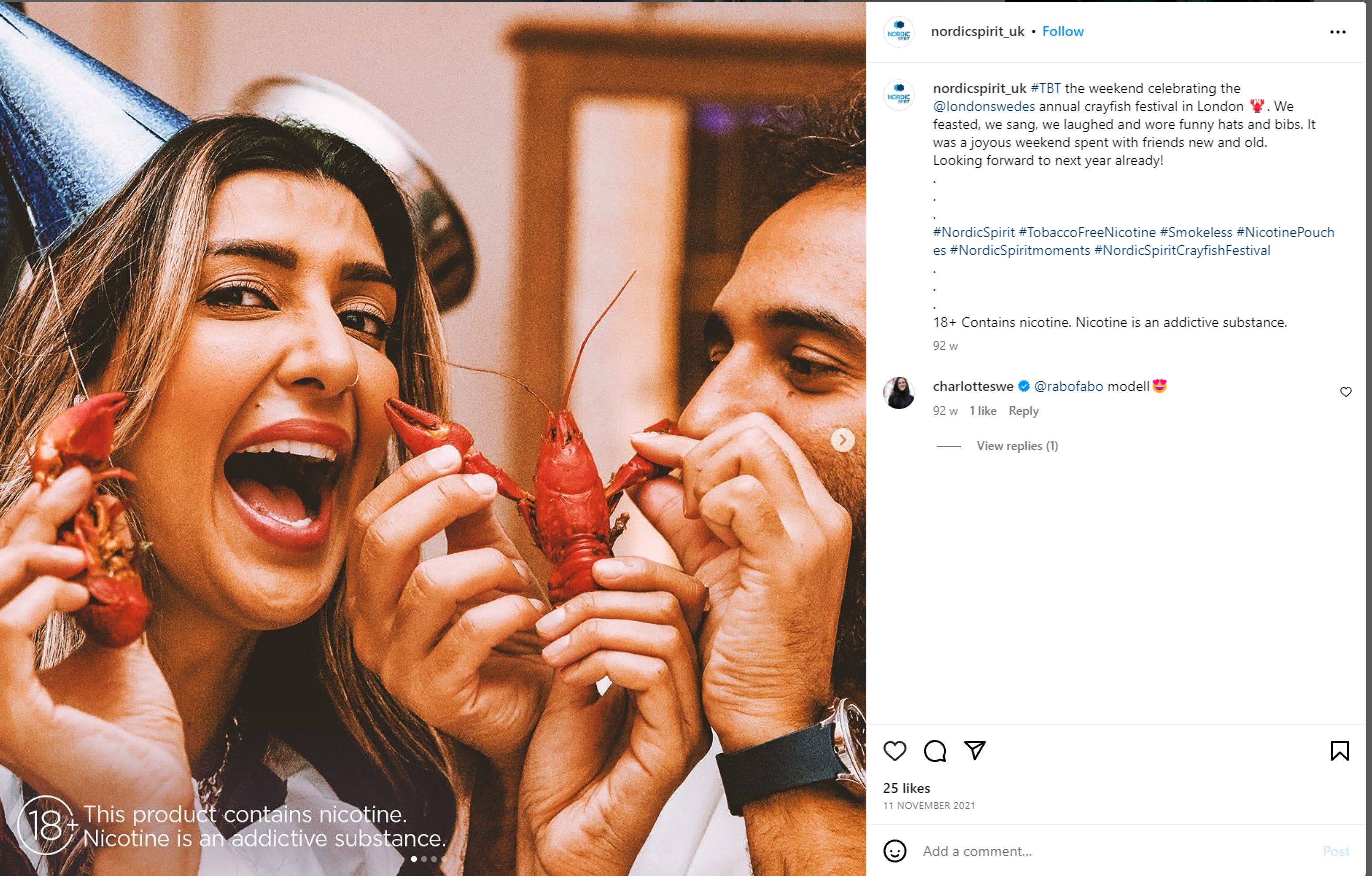
Nordic Spirit and crayfish parties, Nordic Spirit Instagram page, 11 November 2021.
Swedishness is also emphasised by Nordic Spirit through posts that encourage consumers to learn Swedish or “educate” them by introducing Swedish concepts that are central to the “Nordic way”. Words like lagom and fika, 5 for example, are shared with a definition, guidance on pronunciation and an image that encapsulates their meaning (e.g., an open hand, coffee and cake). In turn, these meanings are extended to Nordic Spirit and frame the brand as one that cares about its consumers. In the case of lagom, Nordic Spirit reminds consumers of the importance of “achieving balance between work and play”, while for fika, it states simply that “it's the Nordic way and it sure sounds good to us”. Although the word itself is not used, the concept of mys also plays a major role in Nordic Spirit posts – again, drawing on a long tradition of use in advertising for Swedish products (cf. O'Hagan, 2022b on margarine). Mys is about being relaxed, cosy and in the moment, able to enjoy “me-time” with all five senses, especially at home. This is something that Nordic Spirit depicts through people wearing comfy clothing and wrapped in blankets and duvets on their sofas or beds, as well as captions that emphasise “coziness”, “embrac[ing] the warmth” and “hibernation mode”. In some cases, competitions to win mys hampers are also promoted, with contents including Nordic Spirit, Daim bars, a Spotify membership, a H&M voucher and a book on lagom.
A good example of mys is a Nordic Spirit post from 15 May 2022, which shows an extreme close-up of a woman's hand reaching into an open tin of Nordic Spirit and taking out a tobacco pouch. Bordwell and Thompson (2006:31) note that extreme close-ups trigger strong emotional responses in viewers because their attention is turned fully towards a specific object of focus and is not distracted by any external items in the background. Here, viewers are directed specifically to the sensual dimensions of Nordic Spirit by its close placement to various fabrics. The wool of the woman's jumper and blanket, coupled with the corduroy cushion, draw upon prior bodily experience of texture – or what Djonov and van Leeuwen (2011) call “experiential meaning potential” – thereby symbolising warmth, comfort and coziness, i.e., mys. This is further emphasised by the caption “you, your sofa and a warm blanket”, followed by the heart with eyes emoji, as well as the rhetorical question “nothing beats a bit of cosy me-time, right?” and the invitation to “stay right where you are” and enjoy Nordic Spirit.
Nicotine pouches are fuss-free and discreet
While the previous Nordic Spirit posts were concerned with fun and freedom and the Nordic lifestyle, others are more focused on how the nicotine pouches can fit conveniently into everyday life and enable users to continue their activities without interruptions. To this end, posts show young men and women in a variety of social situations where hands are required, from shopping and cycling to driving and playing instruments, with the aim of promoting Nordic Spirit as a product for those “always on the go” who “never [want to] miss a moment”. A case in point is a post from 22 March 2022, which shows a full body side profile of a young man walking through an urban centre. He is dressed in casual clothing and carrying a rucksack, while his gaze is fixed forward as he talks on his mobile phone and wheels a bicycle – all of which imbues him with a sense of purpose and destination. The long shot creates social distance, placing him in an “offer” relationship with viewers and presenting the scene as a piece of information that provides an insight into his world (Kress and van Leeuwen, 1996:136).
On its own, the image is open to multiple interpretations; although it features a caption at the bottom with an age warning and details about nicotine, for example, the product itself is not represented in the image. It is only through the accompanying text, which acts as an “anchor” (Barthes, 1977), that viewers are directed to the correct meaning. The text starts with a rhetorical question “always on the go?” accompanied by a bicycle emoji, which adds an element of informality and fun to the post. It also invites viewers to draw similarities between themselves and the man in the image who is clearly “on the go”. A solution is then offered to this problematising question in the form of Nordic Spirit: “smoke-free and hands-free pouches” to “enjoy a nicotine delivery that keeps up with your busy schedule”. Here, Nordic Spirit is presented as a helpful product that solves the “difficulties” of obtaining a nicotine fix when you have a hectic lifestyle (cf. O'Hagan, 2023b; O'Hagan and Eriksson, forthcoming). This is further highlighted by the instructions to “simply pop a discreet pouch under your lip and you’re ready to roll”, the colloquial language, alliteration, contracted verb and value-laden adjective/adverb creating an aura of accessibility. The end phrase “right, where to next…” also adds to this perception of convenience, indicating that nicotine pouches are not intrusive or interruptive in the same way as other tobacco products, such as cigarettes.
As part of its aim to promote nicotine pouches as a product with “absolutely no faff”, Nordic Spirit also ran a campaign throughout 2020 showing how it fit into the everyday lives of working people who use their hands, such as builders, hairdressers and photographers. A series of 10 posts tagged a person on Instagram and displayed their answers to two questions using the hashtags #handsfreework and #nevermissamoment. Using testimonials from “living models of trust” (Schweitzer, 2004) seeks to give credibility and authenticity to Nordic Spirit, while providing their names makes it more likely for consumers to form an emotional attachment and grant them “role model authority” (van Leeuwen, 2008:187). We see this in a post from 26 April 2020, which shows a project manager called Lauren (@Yh.nah_). Lauren is depicted in a rather rundown urban environment next to a graffitied telephone box, wearing alternative clothing and holding a tin of Nordic Spirit in her hand. Both her physical appearance and the setting frame Nordic Spirit as a product for those who are unconventional, not tied to social norms and willing to take risks. Unlike the man in the previous post, Lauren looks directly at the viewer, engaging in an act of “demand” (Kress and van Leeuwen, 1996:136) as she holds forward the nicotine pouches and entices viewers to try them. Through the accompanying text, we are offered further insight into her life and how Nordic Spirit fits; in this case, by ensuring that she can still consume nicotine despite often having her “hands full […] on set” and that she does not “miss a moment” of concerts.
Another central aspect of all Nordic Spirit posts is discreetness. Nicotine pouches are frequently presented as a secret, coming in “mini” sizes that make them “less noticeable” and enable them to be hidden in a back pocket or handbag. In this way, they are framed as quasi-clandestine, which gives them an air of mystery and excitement. This is showcased visually through close-ups of pockets, sleeves and bags with a faint circular shape visible, as well as humorous captions, such as: “Yep, people can hear those power ballads through your headphones. Your nicotine delivery though – totally discreet.” “Discreet nicotine delivery and a seat on a train – turns out they’re not just myths.”
Although nicotine pouches have a long history of use in Sweden, their novelty in the UK means that Nordic Spirit engages in a range of creative ways to inform the public about them, such as through vox pop videos, explainer videos and tutorials. A typical tutorial video posted on 12 June 2019 (Figure 3) begins with a 360° view of the tin, before a green dotted line and two blue arrows appear, suggesting “causality” (Ledin and Machin, 2016) as users are directed to remove the lid. The lid then twists off and a colourful array of berries and leaves fly into the air, followed by a pouch that lands in a blue hexagon – a shape with a long history of use in marketing to associate products with science and technology (cf. O'Hagan, 2021a). Next, four simple steps are provided, their numbering connoting logic and technical order, which makes it easier for consumers to follow. This acts as a clear example of the “technologisation of discourse” (Fairclough, 1992) whereby signs are codified, broken down and placed into an easy cause-effect relationship with one another. The overall aim is to convey Nordic Spirit's simplicity and ease of use.
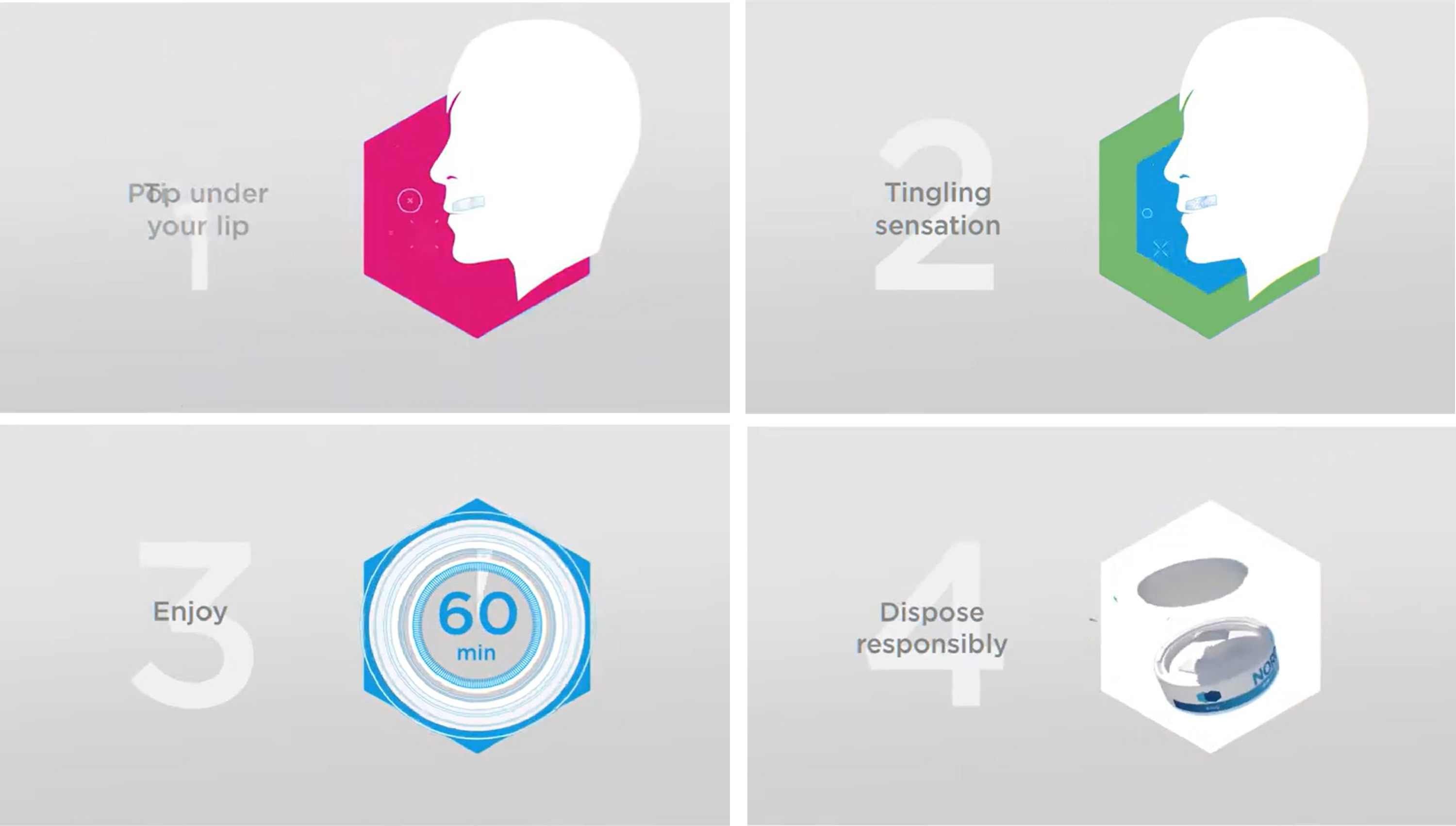
How to use nicotine pouches tutorial video. Nordic Spirit Instagram page, 12 June 2019.
Step 1 advises consumers to “pop under your lip” and is accompanied by a side profile of a head with an open mouth overlapping a hexagon. The hexagon begins to change colour as it fills with pulsating noughts and crosses, visually symbolising Step 2: “Tingling sensation”. While the changing colours do not have any apparent significance nor can Step 2 be considered an action for users to carry out, its relationship in a system of logic with Step 1 promotes it as part of a mutually dependent process, which is difficult to challenge (Ledin and Machin, 2016). A clock then runs forward 60 min, accompanied by Step 3: “Enjoy”. Again, this is not exactly guidance for use in the same way as Step 1, yet it embeds enjoyment as a central part of the Nordic Spirit experience. Finally, Step 4 shows the used pouch returned to the cap of the tin as users are advised to “dispose responsibly”. This display of social consciousness taps into the growing activism of brands who seek to show support for the environment to establish value-based relationships with consumers (Manfredi-Sánchez, 2019).
Nicotine pouches are healthy and scientifically rational
Although nicotine pouches are less harmful than smoking, Nordic Spirit is unable to explicitly state that it represents a healthy alternative. Nonetheless, it still finds creative ways to bend these rules by referring to itself as a “100% tobacco-free, smoke-free, vape-free” product or stating that it contains “no smoke, no vapour, no tobacco”. The emphasis on free and no – words that imply absence – creates a “halo effect” (Eriksson and Machin, 2020), suggesting that the nicotine pouches are healthy because they do not contain certain pernicious substances. This is furthered by the triadic structure, whose repetition adds rhythm and emphasis, leading readers to “connect the dots” and view Nordic Spirit as a safe substitute to tobacco. These messages are also often delivered in fun and playful ways, such as the use of two circular tins to stand in for the zeros in 100%. Whether delivered visually or verbally, such messages ignore the fact that nicotine is still linked with a number of health problems, such as increased risk of cardiovascular, respiratory and gastrointestinal disorders, decreased immune response and poor reproductive health (Mishra et al., 2015), thereby misleading consumers who may look to Nordic Spirit as a “healthy” choice.
Away from language, Nordic Spirit is also able to draw upon other semiotic resources, such as image, colour, layout and composition, in subtle ways to imply healthiness – a strategy that has been noted in food marketing studies to state discourses that cannot be overtly claimed with text (cf. Chen and Eriksson, 2019, 2021; Eriksson and Machin, 2020; Ledin and Machin, 2020b). One frequently occurring way in which it does this is by depicting the flavours of the nicotine pouches in their original form. Thus, posts are replete with colourful and succulent-looking strawberries, wildberries, watermelons and elderflowers that burst from inside tins, which removes the nicotine pouches from any industrial process and instead symbolises naturalness, freshness and purity. The vibrant hues create pseudo-depth and texture, thereby playing upon the sensual dimensions of the fruits and creating a “multisensorial taste experience” (Perullo, 2018:178), while the green hexagon that surrounds them draws upon both science and nature in its shape and colour. Through this depiction, Nordic Spirit offers a fetishised representation of its tobacco pouches, suggesting a natural process far removed from modern technology (O'Hagan, 2023a).
Nordic Spirit also relies heavily on humour to promote healthiness, as can be seen in a video post from 3 September 2019, which introduces consumers to a new bergamot flavour. Here, a short 10-s video opens with a green backdrop, drawing upon associations with nature and health (O'Hagan, 2022c), and poses the question “what exactly is bergamot?” Then, the aural similarity between its last syllable (M-O-T) and the homophones “not” and “knot” are exploited to offer an explanation. This type of aural priming has been found to make a product more memorable for consumers and influence buying decisions (cf. Davis and Herr, 2014). First, the screen flashes to an image of a burger with “BERGA
When Nordic Spirit first launched onto the market in 2019, many of its early posts centred around explaining to a UK audience, unfamiliar with the product, what exactly nicotine pouches are. For this purpose, it relied upon infographics – or what Ledin and Machin (2018) call “integrated designs” – to break down complex messages into simple technologised discourse. Figure 4, for example, posted on 8 June 2019, illustrates the distinct components of a nicotine pouch. To do so, it uses four hexagons of varying sizes attached to one another in a pattern that calls to mind a chemistry cell chain. Since the 1910s, hexagons have been used in food marketing to convey products as scientifically formulated (cf. Chen and Eriksson, 2021 on nootropic drinks; O'Hagan, 2021a on protein powder). 7 The four components of nicotine pouches are written inside the hexagons, the shapes’ connected edges clearly implying that they are all related parts of the same product (Ledin and Machin, 2020a:182). However, their varying sizes suggests a “hierarchy” (ibid, 188), with the largest hexagon representing the largest quantity (i.e., a blend of plant-based fibres) and the smallest hexagon representing the smallest (i.e., gum base). Although we are not privy to what these actual quantities are, the emphasis on plant-based fibres (through both size and bold font) foregrounds the “healthy” part of the nicotine pouches and downplays the less “healthy” aspects. A similar strategy is at work with the white colour of the “flavouring” hexagon, which softens links with artificiality and instead suggests purity and cleanliness (O'Hagan, 2020). Its close positioning to an image of the product, also in white, adds to these more positive connotations, as does the supporting text that explains the flavourings are “natural”, there is only “a small amount” of gum base and “absolutely no tobacco”.
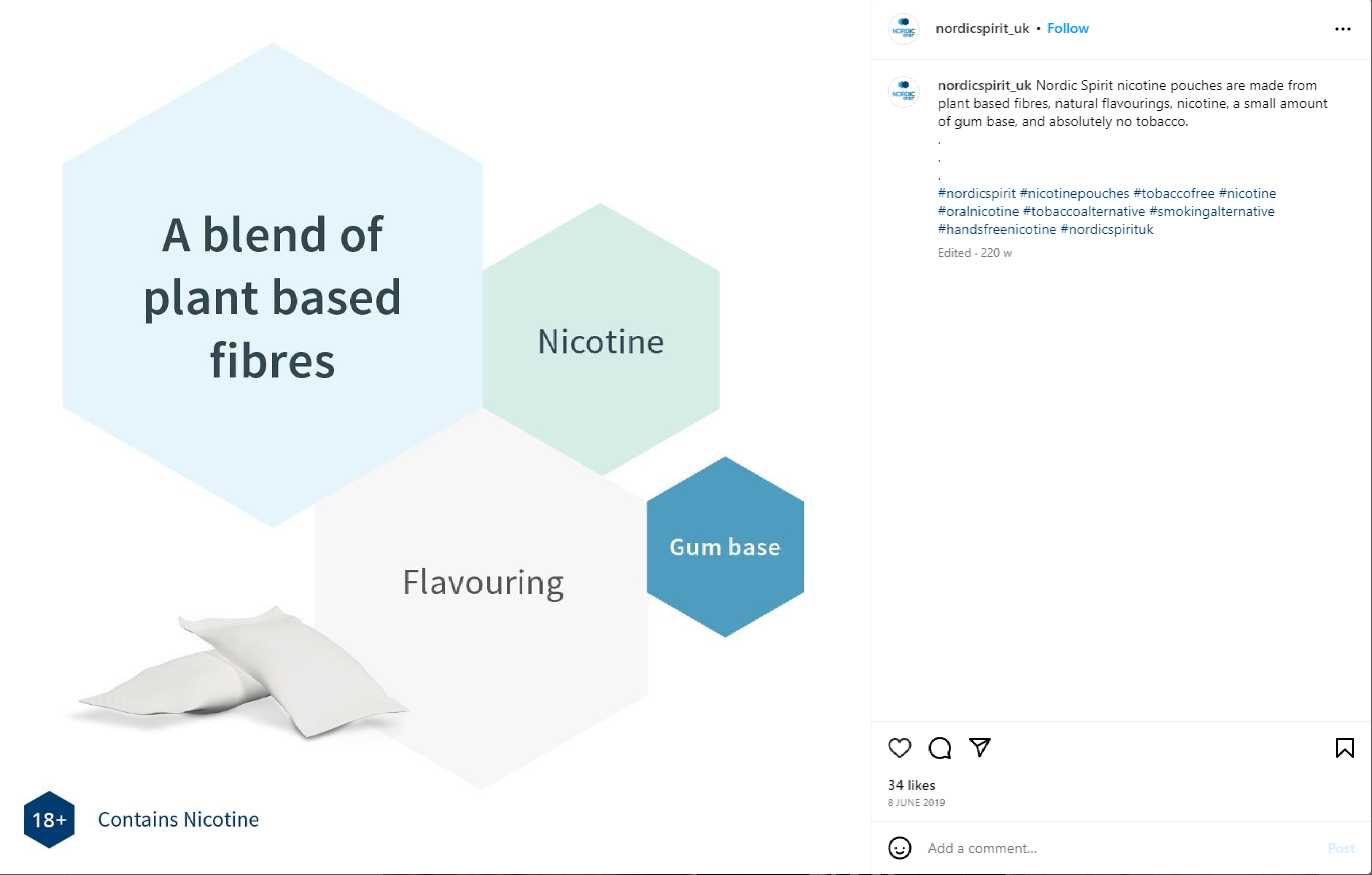
The four components of Nordic Spirit. Nordic Spirit Instagram page, 8 June 2019.
In other cases, Nordic Spirit uses infographics to represent that the product is something quantifiable and measurable. A case in point is Figure 5, posted 15 March 2022, which encourages consumers to do a “strength check” and find out which strength of nicotine is most suitable for them. To this end, the post shows the outline of three beakers – a container strongly associated with scientific laboratories – each filled with a varying amount of liquid which, according to the overlaid text, represents the amount of nicotine per pouch (6 mg, 9 mg and 11 mg, respectively). These amounts are said to correspond with three strengths and three types of users: “regular – newbies”, “strong – regular users” and “extra strong – experienced users”. The repetition of shapes with the same width and height indicates a quantitative comparison between units of a similar character, which is linked to objective scientific measurement (Chen and Eriksson, 2021). However, while the paradigms are assumed to be based on fixed measurements, we lack knowledge on who has determined these classifications and what defines them, their relative status, the recommended amount of nicotine in a pouch and how this compares to other tobacco products, and whether strength is to be interpreted as good or bad. Furthermore, the “comparison” neglects the fact that there is no standardised way to define strength and, thus, this can vary significantly per brand. 8 Another problematic feature of the infographic is the left-to-right orientation of the beakers, which indicates progression (Ledin and Machin, 2016) – a goal-oriented target where consumers seem advised to “level up” and gradually choose a greater strength as they gain experience. This is emphasised by the “target” being red – a salient colour that marks a stop point (Ledin and Machin, 2018:102). Also of concern is the term “newbie”; Nordic Spirit claims that its products are aimed at “existing adult smokers and vapers”, yet this word implies an introduction to nicotine and encourages “newbies” to keep up the habit to transform into the end goal of “experienced users”. The subtle presence of hexagons in the background of the image can also not be overlooked, again serving to frame Nordic Spirit as a scientifically formulated product.
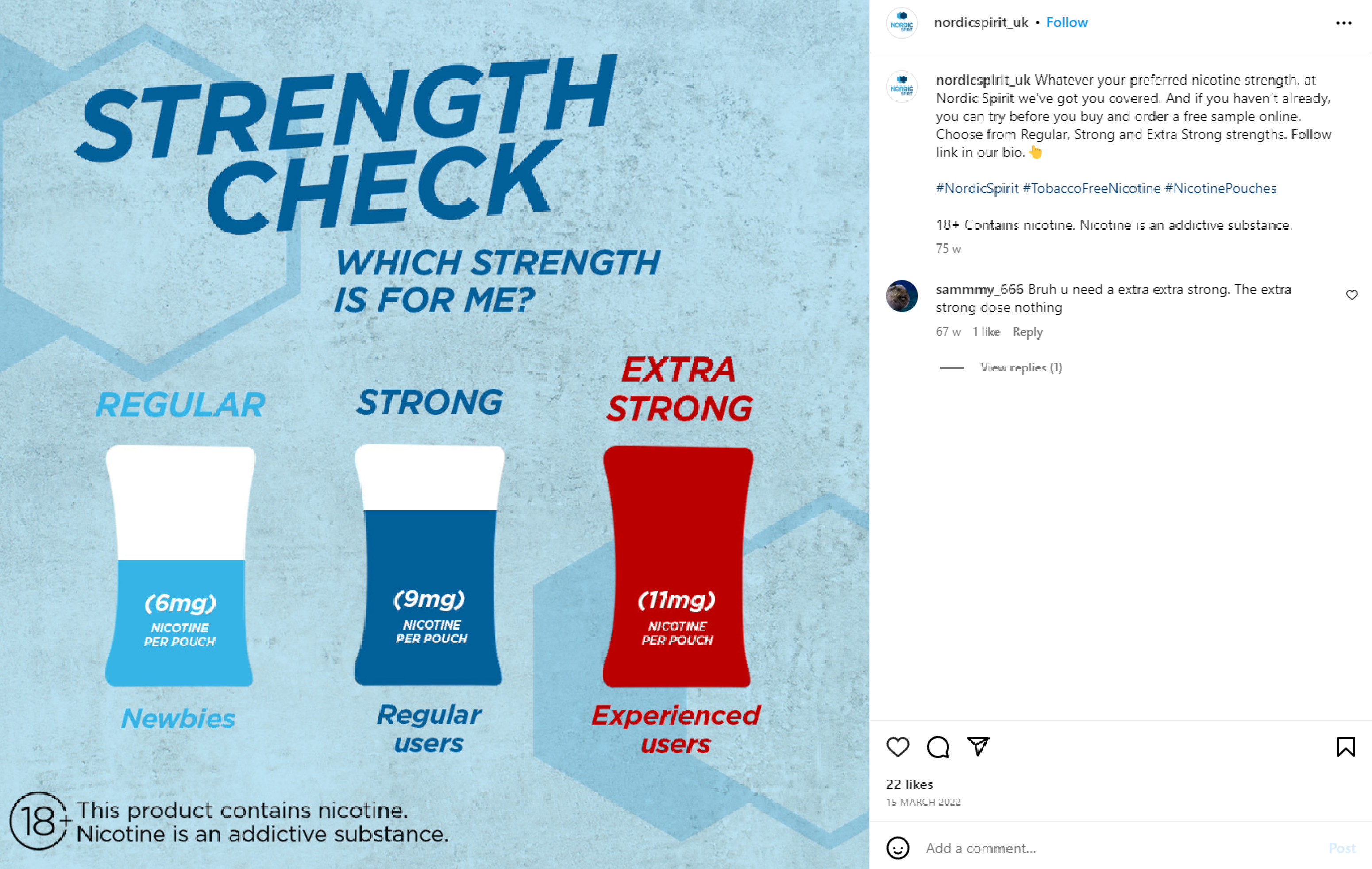
Strength check. Nordic Spirit Instagram page, 15 March 2022.
While hexagons also feature on tins of Nordic Spirit to indicate strength levels, in posts, strength is often indicated in a more user-friendly way that is relatable to the everyday lives of consumers. This is apparent in a marketing campaign that ran throughout April and May 2022 and visualised the four different strengths as paint samples. As a post from 13 April 2022 shows, a tin of Nordic Spirit's bergamot wildberry flavour is positioned on a desk next to a card with four different shades of pink. Their touching edges imply a “causality” (Ledin and Machin, 2016), while the repeated squares create a visual rhyme that emphasises common core qualities and helps foster a “seamless link” between the real-life product and the world of advertising (Ledin and Machin, 2020a:184). The card is playfully entitled with the rhyme “pink to make you wink”, while the four colours also have suitably playful names: “everything's peachy”; “deep blush”; “vibrant fuchsia”; and “magic magenta”. The accompanying text also follows this format, stating “think pink” followed by a flower emoji. This casual and creative presentation makes science more approachable, thereby generating the sense that consumers are being empowered (cf. Chen and Eriksson, 2019 and O'Hagan, 2021a for similar examples with protein snacks and powders). Here, there is also an overt genderisation of the product, pink being typically associated with women and even evoking the various make-up shades found in lipstick, blusher or eye shadow. This fits with the core strategy of nicotine pouch brands to target women by emphasising cleanliness, convenience and maintaining femininity as core selling points (Hendlin et al., 2023). In the post, the tin and paint sample are positioned next to a keyboard and two binder clips, which places the product firmly within an office or home environment. Situating tobacco pouches in the “sanctum sanctorum” of consumers turns them into something unthreatening that should become part of their everyday routine (O'Hagan, 2021b) – again, tying back nicely to Nordic Spirit's representation of nicotine strength in the familiar, everyday form of paint samples.
Discussion
In the UK, nicotine pouches are not currently viewed as a tobacco product, food or medicine. They are, thus, only covered by General Product Safety Regulations, which “provide the basis for ensuring the safety of consumer goods by setting requirements and providing a range of provisions to secure compliance and enforcement with the requirements”. This means that nicotine pouches can be openly advertised on social media platforms and there are only recommendations, rather than statutory regulations, in place, with companies advised simply to advertise “in a responsible manner” (Advertising Standards Authority, 2022). What that “responsible manner” entails, however, is open to interpretation and has left the floodgates open for unscrupulous marketing practices, with brands deliberately targeting young people through attractive competitions, free samples and even the use of influencers to front their campaigns.
Previous studies on nicotine pouches have emphasised the risks that such marketing strategies pose for young people, attracting non-users of nicotine/tobacco products and increasing positive perceptions towards these products as less harmful, less addictive and more socially acceptable than cigarettes and smokeless tobacco (Tosakoon et al., 2023; Vogel et al., 2022). Duan et al. (2022) have found that nicotine pouch marketing is often centred around themes of freedom and innovation, while Ling et al. (2023) have encountered frequent claims around novelty, modernity and use in a variety of contexts. Equally, Sun and Tattan-Birch (2024) have emphasised the visually impactful nature of nicotine pouch posts on social media, with brands using particular lifestyle appeals and engaging competitions. In all cases, young people were identified as a major target, featured in brand imagery but also implied through the types of settings and lifestyles promoted in such advertisements.
The current study further develops this important and timely line of research through a case study of the marketing practices of Nordic Spirit (a previously uninvestigated brand) on its UK Instagram account over a 4-year period (2019–2023) and how its posts are designed to appeal to young people. Unlike previous studies, adopting a qualitative approach, grounded in MCDA, has facilitated a comprehensive understanding of the various linguistic and other semiotic resources (e.g., image, typography, colour, layout, composition) at work in the posts and how they are co-deployed to promote certain discourses, ideologies and agendas.
Nordic Spirit claims to abide by the CAP Code on the advertising of age-restricted products online (cf. Advertising Standards Authority, 2021; Committee of Advertising Practices, 2022). While it is true that all its posts do include age verification and nicotine addiction warnings, this does not stop under-18s from accessing such content on Instagram. Furthermore, while there are no specific CAP guidelines on nicotine pouches, the guidelines on e-cigarettes clearly state that marketing must not promote use in a positive light (22.3), must not contain medical claims (22.5), must not encourage uptake by non-smokers or non-nicotine-users (22.8), must not appeal to under-18s, especially by reflecting or being associated with young culture (22.9), and must not feature people who look under 25 (22.10). The MCDA of Nordic Spirit's posts clearly indicate room for improvement in all five of these areas.
As Ling et al. (2023) note, there is a real risk that nicotine pouches will expand the nicotine market because tobacco-free claims “alleviate concerns about health harms and advertising features a greater diversity of people and contexts than typical smokeless tobacco advertising”. This is apparent from Nordic Spirit's posts, which overwhelmingly depict young people, particularly women, and frame those who use nicotine pouches as subversive, alternative and rebellious misfits. In other words, to use nicotine pouches is to disrupt the norm and do something cool and fashionable. We see similar arguments at work with nootropic drinks (Chen and Eriksson, 2021), CBD oil (Runefelt and O'Hagan, Forthcoming) and dietary supplements (Starr, 2015), all of which cleverly take advantage of the “spaces of confusion” (Spackman, 2020:57) between food and medicine, thereby enabling companies to exploit the youth market.
The MCDA has identified four key discourses of Nordic Spirit's social media campaign. First, nicotine pouches are fun and freedom. Posts are largely based around creating an illusion of fun and frivolity, with nicotine pouches framed as offering consumers total freedom and escapism. Posts are often playful and humorous, with images focused heavily on shared moments of leisure, whether on the beach, in a pub or at a concert. Positive connotations of summer and sunshine are also regularly employed to convey the brand as offering a memorable experience rather than simply a functional product. Similar patterns were identified by Duan et al. (2022), Ling et al. (2023) and Sun and Tattan-Birch (2024) in their studies on nicotine pouch marketing, but they also have a broader historical trajectory in early-mid 20th-century marketing of cigarettes (cf. Crawford, 2014; Leal et al., 2016; Pollay, 1995). What is different – and perhaps more troubling – about Nordic Spirit is the strong connections it has made with the UK's biggest music festivals, many of which are attended by under-18s. Embedding the product firmly in festival culture risks associating the product with lifestyle aspirations and opening up its use to non-users of nicotine/tobacco products. Action on Smoking and Health have called for an end to this type of partnership (Cross, 2023).
Nordic Spirit also promote the discourse that nicotine pouches are Nordic happiness. Drawing on its brand name, Nordic Spirit emphasises its Nordicness – or rather, Swedishness – , tapping into the long tradition of snus in Sweden and aligning itself with romanticised aspects of the Swedish way of life, whether nature, mys or lagom, as best emphasised through its Nordic Spirit Nights event in 2020. Upholding cultural customs is also essential to this portrayal, with Nordic Spirit routinely hosting Midsummer and crayfish parties in conjunction with London Swedes. While Swedishness is a major part of the identity of brands like IKEA or Volvo (cf. Benischke, 2019) and has a long historical use in Swedish marketing (cf. Andersson, 2019, 2020), this is a new angle, which sets apart Nordic Spirit from other nicotine pouch brands and gives it an air of authenticity. Furthermore, its alignment with Swedish cultural events firmly embeds the product in group celebrations – as valid as flower crowns and crayfish – thereby encouraging its use as a “fun” stand-in for social smoking.
The notion that nicotine pouches are discreet and fuss free is also at the core of Nordic Spirit's social media campaign. In these posts, young women are the particular target, with an emphasis placed on cleanliness, discreetness and uncomplicated consumption. The concept of discreetness has a long history of use in menstrual product marketing (cf. Quint, 2019; Raftos et al., 2003) aimed at “protecting” women's femininity. Employed here by Nordic Spirit, it seeks to remove any taboos around smoking and reassure women that the product can be used without the “risk” of others finding out. Similarly, Nordic Spirit emphasises women's busy lifestyles today and the ease of the product in enabling them to carry out their everyday activities uninterrupted. (cf. Duan et al., 2022; Hendlin et al., 2023 for similar findings). Such strategies hark back to early tobacco company marketing, where advertisements sought to appeal to women's psychosocial needs and tap into discourses of empowerment (Amos and Haglund, 2000; Anderson et al., 2005). While cigarettes were framed as offering women a relaxing break, nicotine pouches instead are represented as offering a discreet “boost” to keep going.
Finally, Nordic Spirit promotes the idea that nicotine pouches are healthy and scientifically rational. Posts place great emphasis on the “healthiness” of nicotine pouches, relying heavily on multimodal aspects like images of fruit, colour schemes, visual hierarchies and integrated framing to connote what cannot be explicitly stated in the text (cf. Chen and Eriksson, 2019, 2021). Science is a major component of this discourse, communicated through the use of hexagons, infographics and appealing images, such as paint samples, that are easy to understand. This is an aspect of nicotine pouch marketing that has not been previously investigated (although similar discourses have been identified in historical cigarette and food advertisements – cf. Gardner and Brandt, 2006; White et al., 2012; O'Hagan, 2021a, 2023b) and can offer a revealing insight into how brands cannily rely on semiotic resources to make unsubstantiated claims in an appealing manner.
All of the above strategies are problematic in the way that they position nicotine pouches as trendy lifestyle products rather than as smoking alternatives. Furthermore, posted on a popular social media platform, young people are likely to come across them on a regular basis and encounter their messages, either overtly or covertly. Such posts could, thus, attract new, young users rather than just established smokers hoping to quit their habit, thereby threatening to become a real public health issue (Tosakoon et al., 2023; Vogel et al., 2022). Despite warnings that nicotine is addictive and should be used by over-18s only, there is currently no actual age limit on sales of nicotine pouches, nor on quantity of free samples or nicotine strength, meaning that some products can even offer nicotine levels at a far higher level than nicotine gum or lozenges – both medically endorsed products. 9 Thus, urgent action is needed to protect young people and stop them from being exposed to these harmful and covert forms of nicotine pouch marketing.
Conclusion
This study has used qualitative content analysis and multimodal critical discourse analysis to uncover how Nordic Spirit is marketing its nicotine pouches to young people on its UK Instagram account. It has highlighted the particular risk that these strategies pose to young people, many of whom are non-smokers, with posts often being misleading, underplaying the dangers of nicotine and framing nicotine pouches as a trendy and must-have experience. In a 2022 report, the Committee on Toxicity raised concerns about nicotine pouches, while the Association of Directors of Public Health (2023) described children and young people as “vulnerable”, yet the UK government continues not to regulate the products. While they have recently turned their attention towards tackling youth vaping, with discussions around banning flavours and colourful packaging, more needs to be done to address nicotine pouches, which are equally challenging and see many of the historical patterns of Big Tobacco marketing being repeated, particularly in its targeting of women (cf. Topić, 2021 on the “Torches of Freedom” campaign). Thus, it is clear that regulating nicotine pouches must become a priority area for the UK government and that both the Nicotine Inhaling Products Regulations 2015 and Tobacco and Related Products Regulations 2016 should be revised to impose more restrictions on advertising, thereby safeguarding young people and protecting them from harmful content, particularly on social media.
Footnotes
Author’s note
Lauren Alex O’Hagan is also affiliated at The Open University, School of Languages and Applied Linguistics, Walton Hall, Milton Keynes, MK7 6AA.
Declaration of conflicting interests
The author declared no potential conflicts of interest with respect to the research, authorship, and/or publication of this article.
Funding
The author received no financial support for the research, authorship, and/or publication of this article.
